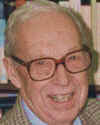
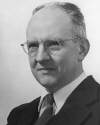
Born 1 Sep 1902; died 31 Jan 1966 at age 63.
Dutch-American astronomer and geophysicist known for his achievements in celestial mechanics, especially for his pioneering application of high-speed digital computers for astronomical computations. While still a student he determined the mass of Titan from its influence on other Saturnian moons. Brouwer developed general methods for finding orbits and computing errors and applied these methods to comets, asteroids, and planets. He computed the orbits of the first artificial satellites and from them obtained increased knowledge of the figure of the earth. His book, Methods of Celestial Mechanics, taught a generation of celestial mechanicians. He also redetermined astronomical constants.
Dutch-American astronomer and geophysicist known for his achievements in celestial mechanics, especially for his pioneering application of high-speed digital computers for astronomical computations. While still a student he determined the mass of Titan from its influence on other Saturnian moons. Brouwer developed general methods for finding orbits and computing errors and applied these methods to comets, asteroids, and planets. He computed the orbits of the first artificial satellites and from them obtained increased knowledge of the figure of the earth. His book, Methods of Celestial Mechanics, taught a generation of celestial mechanicians. He also redetermined astronomical constants.
(EB)
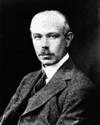
Born 1 Sep 1877; died 20 Nov 1945 at age 68. quotes
English chemist, physicist and chemist who was awarded the 1922 Nobel Prize for Chemistry for his development of the mass spectrograph, a device that separates atoms or molecular fragments of different mass and measures those masses with remarkable accuracy. In 1910 he became an assistant to Sir J.J. Thomson at Cambridge, who was investigating positively charged rays emanating from gaseous discharges. Aston invented his mass spectrograph (a new type of positive-ray apparatus) after WWI, with which he showed that many elements are mixtures of isotopes. In fact, he discovered 212 of the 287 naturally occurring nuclides. The mass spectrograph is now widely used in geology, chemistry, biology, and nuclear physics.
English chemist, physicist and chemist who was awarded the 1922 Nobel Prize for Chemistry for his development of the mass spectrograph, a device that separates atoms or molecular fragments of different mass and measures those masses with remarkable accuracy. In 1910 he became an assistant to Sir J.J. Thomson at Cambridge, who was investigating positively charged rays emanating from gaseous discharges. Aston invented his mass spectrograph (a new type of positive-ray apparatus) after WWI, with which he showed that many elements are mixtures of isotopes. In fact, he discovered 212 of the 287 naturally occurring nuclides. The mass spectrograph is now widely used in geology, chemistry, biology, and nuclear physics.
Born 1 Sep 1872; died 10 Sep 1956 at age 84.
American botanist who discovered the antibotic Aureomycin. While a professor of plant physiology and economic botany, his research included the physiology of fungi; the biological effects of radiation on bacteria; and yielded procedures for commercial mushroom growing, a treatment for root rot in cotton plants, and a way to combat the tobacco mosaic virus. He retirement from an academic career in 1943 and the following year began working as a research consultant for Lederle Laboratories where he discovered chlortetracycline, a tetracycline antibiotic, from a soil sample containing what he named the streptomyces aureofaciens fungus. It was subsequently given the brand name of Aureomycin for a topical ointment and veterinary use. The name derives from its golden colour.«
American botanist who discovered the antibotic Aureomycin. While a professor of plant physiology and economic botany, his research included the physiology of fungi; the biological effects of radiation on bacteria; and yielded procedures for commercial mushroom growing, a treatment for root rot in cotton plants, and a way to combat the tobacco mosaic virus. He retirement from an academic career in 1943 and the following year began working as a research consultant for Lederle Laboratories where he discovered chlortetracycline, a tetracycline antibiotic, from a soil sample containing what he named the streptomyces aureofaciens fungus. It was subsequently given the brand name of Aureomycin for a topical ointment and veterinary use. The name derives from its golden colour.«
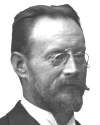
Born 1 Sep 1858; died 4 Aug 1929 at age 70.
Carl Auer Freiherr (baron) von Welsbach was an Austrian chemist, physicist and engineer whose invention of the gas mantle greatly improved the brightness of light that could be obtained from gas lamps. While doing flame tests to examine the spectrum of certain rare earth compounds, he observed the small beads of test material on a platinum wire became white-hot and incandescent. He then had the idea to soak cotton webbing with a solution of the salts, then burn out the cotton leaving a matrix of the compound. His experiments began with slightly promising results with lanthanum oxide, then a mixture with magnesia. He also tried zirconium oxides and others before adding thorium oxide which made commercially viable mantles. His invention was adopted around the world wherever manufactured gas was available, meaning he had a profitable business improving and manufacturing them.« more
Carl Auer Freiherr (baron) von Welsbach was an Austrian chemist, physicist and engineer whose invention of the gas mantle greatly improved the brightness of light that could be obtained from gas lamps. While doing flame tests to examine the spectrum of certain rare earth compounds, he observed the small beads of test material on a platinum wire became white-hot and incandescent. He then had the idea to soak cotton webbing with a solution of the salts, then burn out the cotton leaving a matrix of the compound. His experiments began with slightly promising results with lanthanum oxide, then a mixture with magnesia. He also tried zirconium oxides and others before adding thorium oxide which made commercially viable mantles. His invention was adopted around the world wherever manufactured gas was available, meaning he had a profitable business improving and manufacturing them.« more
Born 1 Sep 1856; died 25 Feb 1953 at age 96.
Russian microbiologist who helped to establish bacteriology as a major biological science. He was first to isolate the bacteria responsible for nitrification and nitrogen fixation by soil bacteria (1890).Winogradsky also studied bacteria that recycle other vital elements for use by other organisms - including ‘iron bacteria', and those which metabolize sulfur (1887-9) - deriving metabolic energy from inorganic nutrients. Previously, only organic substrates were considered suitable for microbes. The "Winogradsky column" is still used as an enrichment culture that simulates the muddy habitat of anoxygenic photosynthetic bacteria.[Name also spelled Sergei or Sergius.]
Russian microbiologist who helped to establish bacteriology as a major biological science. He was first to isolate the bacteria responsible for nitrification and nitrogen fixation by soil bacteria (1890).Winogradsky also studied bacteria that recycle other vital elements for use by other organisms - including ‘iron bacteria', and those which metabolize sulfur (1887-9) - deriving metabolic energy from inorganic nutrients. Previously, only organic substrates were considered suitable for microbes. The "Winogradsky column" is still used as an enrichment culture that simulates the muddy habitat of anoxygenic photosynthetic bacteria.[Name also spelled Sergei or Sergius.]
Born 1 Sep 1854; died 24 Aug 1930 at age 75.
American illustrator, writer and educator remembered for her work in nature study.Née Anna Botsford.
American illustrator, writer and educator remembered for her work in nature study.Née Anna Botsford.
Born 1 Sep 1848; died 27 Jul 1931 at age 82.
Swiss neuroanatomist, psychiatrist, and entomologist known for his investigations of brain structure. Professor of Psychiatry at the University of Zürich and director of the world-famous Burghölzli Hospital, Forel was Adolf Meyer's teacher. Interested in ants from childhood, he became engrossed in the psychology of ants and contributed greatly to the study of their social instincts, leading to his magnum opus in 5 volumes of The Social World of the Ants (1921-23). He was the first to describe the phenomena of parabiosis and lestobiosis in ants.
Swiss neuroanatomist, psychiatrist, and entomologist known for his investigations of brain structure. Professor of Psychiatry at the University of Zürich and director of the world-famous Burghölzli Hospital, Forel was Adolf Meyer's teacher. Interested in ants from childhood, he became engrossed in the psychology of ants and contributed greatly to the study of their social instincts, leading to his magnum opus in 5 volumes of The Social World of the Ants (1921-23). He was the first to describe the phenomena of parabiosis and lestobiosis in ants.
Born 1 Sep 1826; died 1 Jan 1896 at age 69. quotes
Alfred Ely Beach was an American inventor and publisher of Scientific American magazine which reported on technology developments and patents in the 19th-century. It is still published today, one of the world's leading science magazines. Beach himself invented a tunneling shield and built the pneumatic tube subway which propelled a carriage by means of air pressure generated by huge fans. The tunnel was short - one block - so it operated as a demonstration (1870-73), with one station and train car. In 1856 he won First Prize and a gold medal at New York's Crystal Palace Exhibition. Beach had invented a typewriter for the blind, resembling the modern typewriter in the arrangement of its keys and typebars, but embossed its letters on a narrow paper strip instead of a sheet.
Alfred Ely Beach was an American inventor and publisher of Scientific American magazine which reported on technology developments and patents in the 19th-century. It is still published today, one of the world's leading science magazines. Beach himself invented a tunneling shield and built the pneumatic tube subway which propelled a carriage by means of air pressure generated by huge fans. The tunnel was short - one block - so it operated as a demonstration (1870-73), with one station and train car. In 1856 he won First Prize and a gold medal at New York's Crystal Palace Exhibition. Beach had invented a typewriter for the blind, resembling the modern typewriter in the arrangement of its keys and typebars, but embossed its letters on a narrow paper strip instead of a sheet.
Secret Subway: The Fascinating Tale of an Amazing Feat of Engineering, by Martin W. Sandler. - book suggestion.

Died 1 Sep 1988 at age 77 (born 13 Jun 1911). quotes
Luis Walter Alvarez was an American physicist who was awarded the Nobel Prize for Physics in 1968 for work that included the discovery of many resonance particles (subatomic particles having extremely short lifetimes and occurring only in high-energy nuclear collisions). Alvarez invented a radio distance and direction indicator. During World War II, he designed a landing system for aircraft and a radar system for locating planes. He participated in the development of the atomic bomb at the Los Alamos Scientific Laboratory, Los Alamos, N.M. (1944-45). He suggested the technique for detonating the implosion type of atomic bomb. Later, he helped develop the hydrogen bubble chamber, used to detect subatomic particles. This research led to the discovery of over 70 elementary particles and resulted in a major revision of nuclear theories.
Luis Walter Alvarez was an American physicist who was awarded the Nobel Prize for Physics in 1968 for work that included the discovery of many resonance particles (subatomic particles having extremely short lifetimes and occurring only in high-energy nuclear collisions). Alvarez invented a radio distance and direction indicator. During World War II, he designed a landing system for aircraft and a radar system for locating planes. He participated in the development of the atomic bomb at the Los Alamos Scientific Laboratory, Los Alamos, N.M. (1944-45). He suggested the technique for detonating the implosion type of atomic bomb. Later, he helped develop the hydrogen bubble chamber, used to detect subatomic particles. This research led to the discovery of over 70 elementary particles and resulted in a major revision of nuclear theories.
Adventures of a Physicist, by Luis W. Alvarez. - book suggestion.
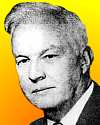
Died 1 Sep 1982 at age 81 (born 12 Sep 1900).
American mathematician who was a pioneer of modern mathematical logic. His research in the foundations of mathematics led him to the development of combinatory logic. Later, this seminal work found significant application in computer science, especially in the design of programming languages. Curry worked on the first electronic computer, called ENIAC, during WW II. He also formulated a logical calculus using inferential rules. In 1942, he published Curry's paradox, which occurs in naive set theory or naive logics, and allows the derivation of an arbitrary sentence from a self-referring sentence and some apparently innocuous logical deduction rules.«
American mathematician who was a pioneer of modern mathematical logic. His research in the foundations of mathematics led him to the development of combinatory logic. Later, this seminal work found significant application in computer science, especially in the design of programming languages. Curry worked on the first electronic computer, called ENIAC, during WW II. He also formulated a logical calculus using inferential rules. In 1942, he published Curry's paradox, which occurs in naive set theory or naive logics, and allows the derivation of an arbitrary sentence from a self-referring sentence and some apparently innocuous logical deduction rules.«
Foundations of Mathematical Logic, by Haskell Brooks Curry. - book suggestion.
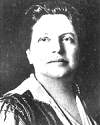
Died 1 Sep 1940 at age 73 (born 10 Mar 1867).
American public health nurse who was influential in establishing a nationwide system of nurses in public schools. Known as "Angel of Henry Street" (New York City) because, for more than 40 years, Wald directed the Henry Street Visiting Nurse Service, while at the same time tirelessly opposing political and social corruption. She helped initiate revision of child labor laws, improved housing conditions in tenement districts, enactment of pure food laws, education for the mentally handicapped, and passage of enlightened immigration regulations.
American public health nurse who was influential in establishing a nationwide system of nurses in public schools. Known as "Angel of Henry Street" (New York City) because, for more than 40 years, Wald directed the Henry Street Visiting Nurse Service, while at the same time tirelessly opposing political and social corruption. She helped initiate revision of child labor laws, improved housing conditions in tenement districts, enactment of pure food laws, education for the mentally handicapped, and passage of enlightened immigration regulations.
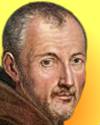
Died 1 Sep 1648 at age 59 (born 8 Sep 1588). quotes
French mathematician, natural philosopher and theologian whose discovery of the Mersenne numbers is considered to have been a pioneering effort to derive a formula that would represent all prime numbers. Although he failed in this, his work on numbers of the form (2 p - 1), where p is prime, has been of continuing interest in the investigation of large primes. Although Mersenne numbers represent only some primes, their formula inspired great advances in the theory of numbers. He continued some of Galileo's work in acoustics and stimulated some of Galileo's own later discoveries. It is through him that Galileo's work became known outside Italy. Mersenne proposed the use of the pendulum as a timing device to Huygens, who first used it in a clock.
French mathematician, natural philosopher and theologian whose discovery of the Mersenne numbers is considered to have been a pioneering effort to derive a formula that would represent all prime numbers. Although he failed in this, his work on numbers of the form (2 p - 1), where p is prime, has been of continuing interest in the investigation of large primes. Although Mersenne numbers represent only some primes, their formula inspired great advances in the theory of numbers. He continued some of Galileo's work in acoustics and stimulated some of Galileo's own later discoveries. It is through him that Galileo's work became known outside Italy. Mersenne proposed the use of the pendulum as a timing device to Huygens, who first used it in a clock.
In 1997, the discovery of a new sub-atomic particle was announced, called the "exotic meson." Scientists speculated that the exotic meson might comprise four quarks, unlike all other known particles, which have three. The research team included physicists at Brookhaven National Laboratory, Upton, N.Y., and other facilities in the U.S. and Russia.eb

In 1961, the Soviet Union ended a moratorium on atomic bomb testing with an above-ground nuclear explosion in central Asia. The USSR had ended speculation the day before in a TASS broadcast that announced it had resumed atomic testing, and by 5 Sep, had conducted three nuclear weapons tests. President Kennedy ordered the resumption of U.S. underground weapons testing. The U.S. response began on 15 Sep 1961 with a series of nine low yield underground experiments at Yucca Flat with a further 62 tests there in 1962. The Soviet Union activity extended to a series of 50 detonations. On 5 Aug 1963 the Limited Test Ban Treaty was signed in Moscow prohibiting testing in outer space, underwater or in the atmosphere.
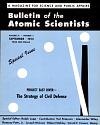
In 1953, the Doomsday Clock on the Sep 1953 cover of the Bulletin of the Atomic Scientist (Vol. 9, No. 7) the hands were set at two minutes to midnight—the closest to nuclear Doomsday (midnight) they have ever been. It represented the great tension after the first Soviet hydrogen bomb test the previous month (12 Aug 1953), just 9 months after the first U.S. nuclear test (1 Nov 1952). On later covers, the minute hand was moved up and back over the years, reflecting increasing or lessening urgency of concern for humanity's catastrophic destruction.. A newsletter (Vol. 1, No. 1), was first published 10 Dec 1945, which later became the Bulletin of the Atomic Scientists. The Doomsday Clock cover background was added in Jun 1947, during the Cold War, as the newsletter became a magazine, (Vol 3, No. 6).«
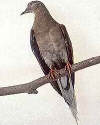
In 1914, the Passenger Pigeon (Ectopistes migratorius) became extinct as the last surviving bird of the colorful native American species of dove died at the Cincinnati Zoo. The passenger pigeon was hunted to extinction; the fact that it traveled and nested in large flocks made it easy to slaughter. The adult male passenger pigeon had grey upper parts, the tips of the wings and the tail were black; its throat was a dark rust, while its breast was a lighter rust; its eyes were red. The adult female was of a duller color, with brownish upper parts and a lighter, brownish throat and breast; its eyes were black
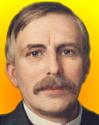
In 1898, in a paper dated 1 Sep, Ernest Rutherford coined the terms alpha and beta “for two distinct types of radiation, one that is very readily absorbed, which will be termed for convenience the α radiation, and the other of a more penetrative character, which will be termed the β radiation.” His paper, Uranium Radiation and the Electrical Conduction Produced by It, gave tables of the amount of radiation that passed through successive layers of metal leaf (or aluminium foil). He measured it using the rate at which charge leaked off a zinc plate due to the ionizing influence of the uranium radiation that reached it, as detected by the needle of an electrometer connected to it. He also compared the radiation emitted by different uranium compounds; and transparency to the radiation of different filter substances.«[Ref: Philosphical Magazine (1898), 47, 109-67.
A Force of Nature: The Frontier Genius of Ernest Rutherford, by Richard Reeves. - book suggestion.
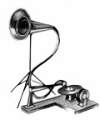
In 1887, Emile Berliner (1851 - 1929) filed for a patent for his invention of the lateral-cut, flat-disk gramophone on this day. We know it better as the record player. Emile got the patent, but Thomas Edison got the fame (for making it work and making music with his American invention). Berliner's legacy also lives on in his trademark (later adopted by RCA): a picture of a dog listening to "his master's voice" issuing from a gramophone.
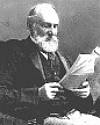
In 1881, in a Presidential Address to the British Association, at York, Sir William Thomson (Lord Kelvin) spoke On the Sources of Energy in Nature Available to Man for the Production of Mechanical Effect. He summarized the natural sources of energy as Tides, Food, Fuel, Wind, and Rain. All except the tides derive energy from the sun. “Heat radiated from the sun ... is the principal source of mechanical effect available to man.” He referred to tide mills, and the possibility of storing energy in batteries between tides, but nevertheless considered the economics impractical for wide application. Windpower he considered “decadent,” but acknowledged coal would become an exhausted resource, thus windmills should generate electrical power. Kelvin also outlined the economics of hydroelectricity.«
Degrees Kelvin: A Tale of Genius, Invention, and Tragedy, by David Lindley. - book suggestion.
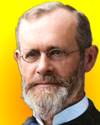
Abbe
In 1869, Cleveland Abbe began his own private weather reporting and forecasting service at Cincinnati, Ohio, issuing bulletins of his weather reports. On 9 Feb 1870, the U.S. Congress authorized a new federal weather service, under the direction of the Signal Corps. At that time, Abbe was the only person in the nation with experience in gathering telegraphic reports and using them to draw weather maps and make forecasts. Being the obvious choice, Abbe was asked to be the chief scientist in this new service. He accepted, and on 3 Jan 1871 became the official weather forecaster. As America's first professional meteorologist, Cleveland Abbe is known as the “father of the U.S. Weather Bureau” (later renamed the National Weather Service).«
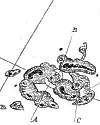
In 1859, a solar flare was observed for the first time by astronomer Richard C. Carrington. He reported his Description of a Singular Appearance seen in the Sun in the Monthly Notices of the Royal Astronomical Society (1860), "While engaged in the ... observation of ... solar spots ... two patches of intensely bright and white light broke out. ... I therefore noted down the time, ... and seeing the outburst to be very rapidly on the increase ... I hastily ran to call some one to witness ... and on returning within 60 seconds, was mortified to find that it was already much changed and enfeebled. Very shortly afterwards the last trace was gone. In this lapse of 5 minutes, the two patches of light traversed a space of about 35,000 miles."
In 1858, the first transatlantic cable failed after less than 1 month of service.
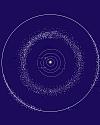
In 1854, the first observation made in North America of a previously unknown asteroid was recorded by Scottish-born American James Ferguson of the U.S. Naval Observatory. This was the thirty-first of the series and is now known as 31 Euphrosyne, named after one of the Charites in Greek mythology. It is one of the largest of the main belt asteroids, between Mars and Jupiter. Ferguson subsequently discovered two more asteroids: 50 Virginia (4 Oct 1857) and 60 Echo (14 Sep 1860). Within the next two decades, more asteroids were discovered by American astronomers: one by Searle, two by Tuttle (1861-62), 16 by Watson (1863-74), and 22 by Peters (1861-1875), making a total of 44 discovered in a period of about 20 years.«
In 1801, David Hosack (1769-1835) purchased twenty acres on Manhattan on which he subsequently developed his Elgin Botanic Garden. From 1809 to 1811, Frederick Pursh (1774-1820) served as gardener. In 1811, the Garden became the property of the Regents of the State of New York; in 1814, it was attached to Columbia University but was not maintained.