 (source)
|
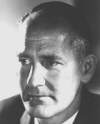
George Beadle
(22 Oct 1903 - 9 Jun 1989)
American geneticist.
|
Science Quotes by George Beadle (7 quotes)
In a sense, genetics grew up as an orphan. In the beginning botanists and zoologists were often indifferent and sometimes hostile toward it. “Genetics deals only with superficial characters”, it was often said. Biochemists likewise paid it little heed in its early days. They, especially medical biochemists, knew of Garrod’s inborn errors of metabolism and no doubt appreciated them in the biochemical sense and as diseases; but the biological world was inadequately prepared to appreciate fully the significance of his investigations and his thinking. Geneticists, it should be said, tended to be preoccupied mainly with the mechanisms by which genetic material is transmitted from one generation to, the next.
— George Beadle
'Genes and Chemical Reactions In Neurospora', Nobel Lecture, 11 Dec 1958. In Nobel Lectures: Physiology or Medicine 1942-1962 (1964), 598.
It is, I believe, justifiable to make the generalization that anything an organic chemist can synthesize can be made without him. All he does is increase the probability that given reactions will “go”. So it is quite reasonable to assume that given sufficient time and proper conditions, nucleotides, amino acids, proteins, and nucleic acids will arise by reactions that, though less probable, are as inevitable as those by which the organic chemist fulfills his predictions. So why not self-duplicating virus-like systems capable of further evolution?
— George Beadle
The Place of Genetics in Modern Biology (1959),18.
Knowing what we now know about living systems—how they replicate and how they mutate—we are beginning to know how to control their evolutionary futures. To a considerable extent we now do that with the plants we cultivate and the animals we domesticate. This is, in fact, a standard application of genetics today. We could even go further, for there is no reason why we cannot in the same way direct our own evolutionary futures. I wish to emphasize, however—and emphatically—that whether we should do this and, if so, how, are not questions science alone can answer. They are for society as a whole to think about. Scientists can say what the consequences might be, but they are not justified in going further except as responsible members of society.
— George Beadle
The Place of Genetics in Modern Biology (1959), 20.
Our methods of communication with our fellow men take many forms. We share with other animals the ability to transmit information by such diverse means as the posture of our bodies, by the movements of our eyes, head, arms, and hands, and by our utterances of non-specific sounds. But we go far beyond any other species on earth in that we have evolved sophisticated forms of pictorial representation, elaborate spoken and written languages, ingenious methods of recording music and language on discs, on magnetic tape and in a variety of other kinds of code.
— George Beadle
As quoted in epigraph before title page in John Wolfenden, Hermann Bondi, et al., The Languages of Science: A Survey of Techniques of Communication (1963), i.
Since many cases are known in which the specificities of antigens and enzymes appear to bear a direct relation to gene specificities, it seems reasonable to suppose that the gene’s primary and possibly sole function is in directing the final configurations of protein molecules.
Assuming that each specific protein of the organism has its unique configuration copied from that of a gene, it follows that every enzyme whose specificity depends on a protein should be subject to modification or inactivation through gene mutation. This would, of course, mean that the reaction normally catalyzed by the enzyme in question would either have its rate or products modified or be blocked entirely.
Such a view does not mean that genes directly “make” proteins. Regardless of precisely how proteins are synthesized, and from what component parts, these parts must themselves be synthesized by reactions which are enzymatically catalyzed and which in turn depend on the functioning of many genes. Thus in the synthesis of a single protein molecule, probably at least several hundred different genes contribute. But the final molecule corresponds to only one of them and this is the gene we visualize as being in primary control.
Assuming that each specific protein of the organism has its unique configuration copied from that of a gene, it follows that every enzyme whose specificity depends on a protein should be subject to modification or inactivation through gene mutation. This would, of course, mean that the reaction normally catalyzed by the enzyme in question would either have its rate or products modified or be blocked entirely.
Such a view does not mean that genes directly “make” proteins. Regardless of precisely how proteins are synthesized, and from what component parts, these parts must themselves be synthesized by reactions which are enzymatically catalyzed and which in turn depend on the functioning of many genes. Thus in the synthesis of a single protein molecule, probably at least several hundred different genes contribute. But the final molecule corresponds to only one of them and this is the gene we visualize as being in primary control.
— George Beadle
In 'Genetics and Metabolism in Neurospora', Physiological Reviews, 1945, 25, 660.
We spend long hours discussing the curious situation that the two great bodies of biological knowledge, genetics and embryology, which were obviously intimately interrelated in development, had never been brought together in any revealing way. An obvious difficulty was that the most favorable organisms for genetics, Drosophila as a prime example, were not well suited for embryological study, and the classical objects of embryological study, sea urchins and frogs as examples, were not easily investigated genetically. What might we do about it? There were two obvious approaches: one to learn more about the genetics of an embryologically favourable organism, the other to better understand the development of Drosophila. We resolved to gamble up to a year of our lives on the latter approach, this in Ephrussi’s laboratory in Paris which was admirably equipped for tissue culture, tissue or organ transplantation, and related techniques.
— George Beadle
In 'Recollections', Annual Review of Biochemistry, 1974, 43, 6.
You too can win Nobel Prizes. Study diligently. Respect DNA. Don't smoke. Don't drink. Avoid women and politics. That's my formula.
— George Beadle
As given in David Pratt, 'What makes a Nobel laureate?', Los Angeles Times (9 Oct 2013). Cited as the response to telegram of congratulations from Caltech students (Oct 1958) in David Pratt, The Impossible Takes Longer: The 1,000 Wisest Things Ever Said by Nobel Prize Laureates (2007), 10 and 178.
Quotes by others about George Beadle (2)
Beadle believed that genetics were inseparable from chemistry—more precisely, biochemistry. They were, he said, “two doors leading to the same room.”
In Warren Weaver, Science and Imagination (1967), xii. Quoted in Thomas Hager, Force of Nature: The Life of Linus Pauling (1995), 276.
Every species of plant and animal is determined by a pool of germ plasm that has been most carefully selected over a period of hundreds of millions of years. We can understand now why it is that mutations in these carefully selected organisms almost invariably are detrimental.The situation can be suggested by a statement by Dr. J.B.S. Haldane: “My clock is not keeping perfect time. It is conceivable that it will run better if I shoot a bullet through it; but it is much more probable that it will stop altogether.” Professor George Beadle, in this connection, has asked: “What is the chance that a typographical error would improve Hamlet?”
In No More War! (1958), Chap. 4, 53.
See also:
- 22 Oct - short biography, births, deaths and events on date of Beadle's birth.
- George Beadle... The Emergence of Genetics in the 20th Century, by Paul Berg, Maxine Singer. - book suggestion.
 In science it often happens that scientists say, 'You know that's a really good argument; my position is mistaken,' and then they would actually change their minds and you never hear that old view from them again. They really do it. It doesn't happen as often as it should, because scientists are human and change is sometimes painful. But it happens every day. I cannot recall the last time something like that happened in politics or religion.
(1987) --
In science it often happens that scientists say, 'You know that's a really good argument; my position is mistaken,' and then they would actually change their minds and you never hear that old view from them again. They really do it. It doesn't happen as often as it should, because scientists are human and change is sometimes painful. But it happens every day. I cannot recall the last time something like that happened in politics or religion.
(1987) --