Home

Mechanical Appliances and Novelties of Construction
by
Gardner D. Hiscox, M.E.
Norman W. Henley Publ. Co.
1927

The Inventor's Paradox - Desaguliers' Demonstration
The Prevailing Wheel Type
Marquis Of Worcester Wheel
Rolling Balls
Folding Arms
Chain Wheel
Most Common Idea
Magnetism And Gravity
Pick-up Ball
Ball-Carrying Belt
Ferguson's Type
French, 1858
Revolving Tubes And Balls
Geared Motive Power
Differential Hydrostatic Wheel
Lever Type
Double Cone
Rocking Beam
Titling Tray And Ball
Rolling Ring
Differential Water Wheel
Multiple Water Wheel
Gear Problem
Mercurial Wheel
Water Wheel
Air-Bag Wheel
Water Wheel
Air Transfer In Submerged Wheel
Extending Weights And Water Transfer
Chain Buckets
Congreve's Sponges
Transfer Of Air
Differential Weight of Balls
Inclined Disk And Balls
Self-Moving Water Power
Chain Pump, 1618
Archimedean Screw
Differential Weight By Flotation
Floatation Problem
Liquid Transfer Wheel
Chain-Pump
Mercurial Displacement
Air-Buoyed Wheel
Magnetic Resistance
Overbalanced Cylinder
Hydrostatic Weight
Capillary Attraction
Magnetic Pendulum
Magnetic Wheel
Magnetic Mill
Regenerating Pendulum
Magnetic Wheel
Alternate Magnet Type
Electro-magnetic Type
Electrical Generation
Perpetual-Motion Puzzle


23. Perpetual Motion
French, 1858

     The invention consists in communicating a rotary motion to a fly wheel or drum by means of a set of falling weights tied together by chains, ropes, or straps. This set of weights, forming an endless chain, runs over two pulleys, suitably disposed A up and down near the fly wheel, which is provided with a set of cups fixed around its periphery, so as to receive the weights as they are delivered by the upper pulley, and to carry them down to the lower pulley, whence the same weights reascend in a straight direction to the upper pulley. 
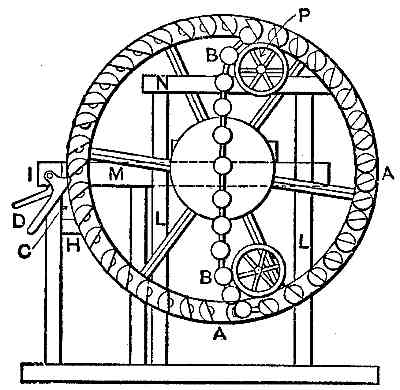
Perpetual Motion Machine: FergusonsType

     The weights of the endless chain running or falling down in the curvilinear direction of the periphery of the drum are more numerous than those that are raised up in a straight line, because the curvilinear line is longer than the straight one, and the difference of heaviness due to the number of weights is the force which, by its action at the end of the levers or radii of the drum, causes that drum to rotate.

(Subsection 926, from p.370)


back next