 (source)
|
Alexander Wetmore
(18 Jun 1886 - 7 Dec 1978)
American ornithologist who was the sixth Secretary of the Smithsonian Institution (1945-1952).
|

My Experience with a Red-headed Woodpecker
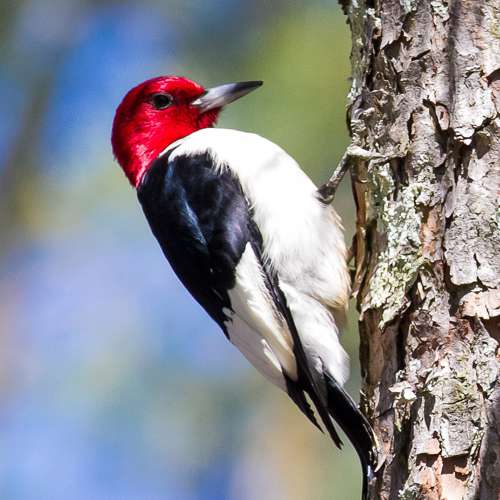
by ALICK WETMORE (age, 13 years), North Freedom, Wis.
from Bird-Lore (Oct 1900)
[p.155] THE first time that I saw the subject of this sketch was on Sunday, October 8, 1899. As I was going along a ravine on that day, I heard a loud, tree-toad-like ker-r- r-ruck coming from the top of a tall dead stub. I looked up and soon saw that the owner of the voice was a young Red-headed Woodpecker. His (?) head was a dusky color. He would stick his head around the tree and, after giving the note, dodge back. I thought I would keep a sharp eye on him, and a little while afterward I was rewarded by seeing him get an acorn from a small oak. He seemed to be storing acorns up for winter in holes and crannies.
Once he lit on an oak limb that would not bear him, and it swung until he hung back down, but he got his acorn. While he was flying off, a little Junco seemed to think that he was trespassing and flew at him in a rage and made him get out of the way. I went to a stump nearby and got an acorn and found that it was whole. A few marks on the shell showed where he had hammered it into the crevice. He always seemed to go to the same tree for his acorns.
I laid down on the bank of the ravine close to the tree in the sun to watch him, but he was suspicious and would not come near at first. I was rather surprised to see that he could easily go down a tree backwards, lifting his tail and, after hopping down, falling back onto it. Everywhere he went, he expressed, in vigorous notes, his disgust at having me around.
The stub he liked best was very tall and had a crack in it near the top, and into this crack he hammered, with his shiny white bill, all the acorns that he possibly could. Some of them he cracked in two and then put them in the crack. One fragment he dropped as he lighted. He was after it quick as a flash, and chased it so near the ground that I thought he would dash himself onto it and be killed, but he turned up just before he reached it and flew off without the acorn.
In a cornfield a short distance away I found some nubbins for him. While I was looking for a place to put them up, I found a hole with sixteen acorns in it. He had put them there, for I could see the marks of his bill on them and around the edges of the hole [p.156] were a few small dark gray feathers. He had hidden the acorns by putting pieces of bark over them. I then went back to where he was and saw him drinking water, like a chicken, out of the brooklet. After returning from a short walk, I saw him carrying a large piece of bark to put over the acorns that I had uncovered. He started from the base of his stub, but as the bark was nearly as large as he was he could not carry it and was forced to drop it. As it was then nearly dark, I had to go home without learning where he stayed nights, and which, indeed, I never found out.
The next Sunday, the 16th of October, I did not have much time. When I reached the ravine he was catching insects. He was in the top of a tree and would fly out after the insects at they flew by but, growing tried of this, he went to the ground after an acorn. When I went to the hole in which I had found the sixteen acorns before, I now took out forty-five.
Sunday, November 19, I thought I would pay my Red-head visit. As I did not see him for about fifteen minutes, I thought that some wandering hunter had killed him; but while looking around I heard a welcome ker-r-r-ruck, and there he was on his favorite stub. After taking a look at me, he flew down for a drink, with a loud note before he left the stub and shorter ones in between drinks to call attention, and well he might! His somber head had turned red since I had seen him last. The color was a little dark in places, but was fine all the same.
I next saw him on Sunday, November 26. I had gone to my usual place of study and was watching some Pine Siskins when he appeared. He was rather cross, for he chased a Tree Sparrow until it took refuge in a thick, bushy thorn-apple tree. Then he watched until it came out and took after it again. I watched him sunning himself—for it was quite warm—and then went over to the hole in which I had found so many acorns. It was empty, and a number of shells were scattered around the foot of the tree.
From my note-book I see that the date of my next visit was Sunday, December 3. It was cold and snowing quite hard. I put on my overcoat and went down to see him. I may have wanted to see him, but he was evidently afraid of that big black thing in the fence-corner. He scolded and bobbed as though crazy till a pair of Blue Jays lighted in the tree. He was afraid of them and went around to the other side of the trunk and kept still until they left.
On Monday February 12, I saw him last. He was across the river from the ravine in a tree after acorns.
I know that he is still here and alive, and I intend to watch him in the spring when he sets up housekeeping.
- 18 Jun - short biography, births, deaths and events on date of Wetmore's birth.
- Alexander Wetmore, Ornithologist
- Song and Garden Birds of North America, by Alexander Wetmore. - book suggestion.