The Seeds of Curiosity
Young Readers’ Edition1
For Older Readers’ Edition (Grades 9+), click here.
A story2 of how two grandparents inspired a young scientist.
Thoughts for Grandparents’ Day
(First Sunday of September after Labor Day)
A House Full of Questions
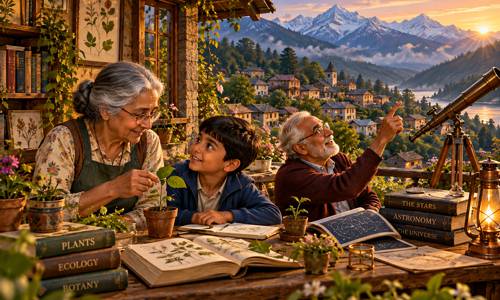
In a small village surrounded by mountains and forests lived a boy named Ravi, who seemed to have a question about everything. Why did some flowers close at night? How did birds find their way across enormous distances? Why did the Moon change shape? His parents sometimes grew tired of answering, but his grandparents never did. Indeed, Meera and Vijay seemed to enjoy questions almost as much as Ravi enjoyed asking them.
Meera had been a botanist, a scientist who studied plants. Although retired, she still tended a wonderful garden filled with flowers, herbs and unusual specimens collected during her travels. Vijay, a retired schoolteacher, loved astronomy. He owned an old brass telescope and spent clear evenings studying the stars. Their house was crowded with books, maps of the heavens, drawings of plants and notebooks filled with observations. Ravi thought it was the most interesting house in the world.
His grandparents had very different ways of teaching. Meera was practical and precise. She liked measurements, careful observations and experiments. Vijay preferred stories, surprising facts and questions that made Ravi imagine things far beyond the village. When Ravi asked Meera something difficult, she usually replied, “That’s interesting. How could we find out?” Vijay was more likely to exclaim, “Splendid question! I’ve been waiting years for someone to ask me that!”
Neither grandparent was satisfied with simply telling Ravi what to think. They wanted him to discover things for himself.
The Plant That Was Frightened
One morning, when Ravi was seven, he burst into the kitchen. “Grandma! There’s a plant in your garden that’s frightened of me!”
Meera looked up from the seeds she was sorting. “Did it tell you so?”
“Of course not! But whenever I touch it, its leaves fold up.”
“Ah,” said Meera. “Now that’s something we can investigate. Come and show me.”
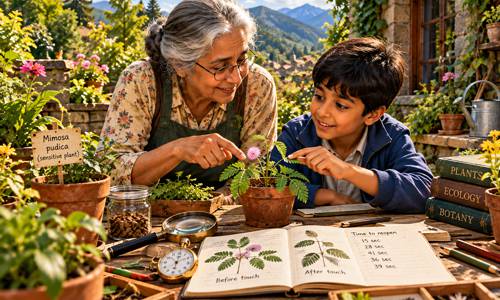
In the garden, Ravi touched a small Mimosa pudica, sometimes called the sensitive plant. Its delicate leaves folded inward. Meera watched, then asked him to touch another leaf and another. Soon she fetched a notebook and a stopwatch.
“Let’s see how long they take to open again,” she suggested.
“But Grandma, I only wanted to know why they close!”
“And I want to know whether they always close, how quickly they do it and how long they stay closed. One good question often leads to several more.”
Meera explained that the leaves moved because of changes in water pressure inside special cells. The plant was responding to touch, not becoming frightened. Ravi was fascinated, but after half an hour of recording observations, he complained that all this measuring was taking the fun out of the discovery.
“On the contrary,” Meera replied. “I’m showing you where the fun begins.”
Another day, she gave Ravi two bean seedlings. He placed one beside a sunny window and the other in a dark cupboard, watering both equally. Several days later, he proudly announced that the plant in the cupboard had grown taller.
“Then it must be healthier!” he declared.
“Look again,” said Meera.
Ravi noticed that the taller plant was pale and weak, while the shorter one was green and sturdy. Meera explained how plants needed light to make food through photosynthesis.
“So growing faster doesn’t always mean growing better,” Ravi concluded.
“Exactly. And that’s why scientists must look carefully before deciding what their results mean.”
Meera taught Ravi many things about plants, but her most important lesson was simple: never confuse what you observe with what you merely imagine.
The Grandfather Who Gave Him the Stars
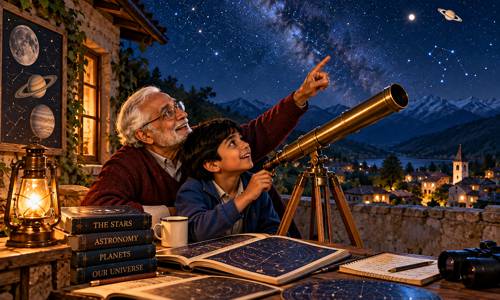
On clear evenings, Vijay carried his telescope onto the roof. “Come along, Professor Ravi!” he would call. “The universe has been waiting billions of years for you to take an interest in it. We mustn’t keep it waiting any longer!”
Vijay showed Ravi the Moon’s craters, Jupiter’s largest moons and the bright stars of Orion. But nothing amazed Ravi more than his first sight of Saturn.
“Grandpa! It really has rings!”
“Indeed it does,” Vijay replied. “A perfectly respectable planet, wearing an enormous hat.”
“Why doesn’t the hat fall off?”
“Because it isn’t a hat, my boy. Those rings are made of countless pieces of ice and rock, all traveling around Saturn under the influence of gravity.”
“Is that the same gravity that makes things fall on Earth?”
“The very same! The universe is remarkably consistent about its rules. Rather more consistent than our village cricket club.”
Ravi laughed, but the idea astonished him. The force that pulled an apple toward the ground also governed the motion of distant planets.
Vijay loved telling stories about the constellations. He described ancient heroes, hunters and animals that people had imagined among the stars. Yet he always explained the difference between a story and a scientific explanation.
“The legends tell us what people imagined,” he said. “Astronomy tells us what we can discover through observation. Both are interesting, but we mustn’t confuse them.”
Sometimes Ravi asked questions that even Vijay could not answer. Were there planets around other stars? Could living things exist on them? Might human beings someday travel to those distant worlds?
“Perhaps,” Vijay would say. “And perhaps you’ll help discover the answers. The wonderful thing about science is that nobody knows what the next great discovery will be.”
Before long, Ravi was keeping his own astronomy notebook, recording the Moon’s changing appearance and the positions of the planets. Sometimes his predictions were wrong, but Vijay never minded.
“A wrong prediction can teach you something,” he said, “provided you’re willing to find out why it was wrong.”
When Meera overheard this, she nodded approvingly. “At last, Vijay, something sensible enough to write down.”
“My dear,” he replied, “I’ve been saying sensible things for forty years. You simply haven’t been recording them.”
The Summer Without Rain
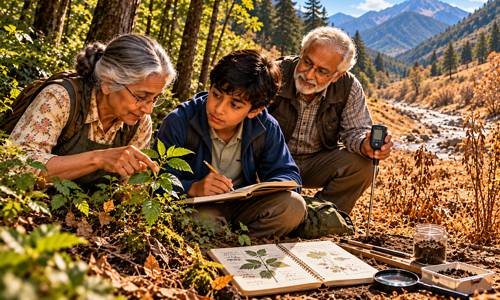
When Ravi was twelve, a terrible drought struck the village. The rains failed, streams shrank to muddy pools and farmers watched their crops wither. Even Meera’s garden suffered. Some plants she had tended for years began to die.
Ravi was upset. “Can’t we do something, Grandma?”
“We can try,” she answered. “But first we must understand what’s happening.”
One afternoon, Ravi noticed something curious while walking through the forest. Plants growing in sunny clearings were dry and brown, yet many beneath the trees remained green. He hurried home to tell Meera.
“Perhaps the shade keeps the ground cooler,” she suggested. “Perhaps fallen leaves help hold moisture in the soil. How could we test those ideas?”
Together they measured soil temperatures and moisture in shaded and sunny places. Vijay helped Ravi draw graphs of the results. After several weeks, they found that shaded soil generally stayed cooler and retained more water.
“I’ve made a discovery!” Ravi exclaimed.
“You’ve discovered something for yourself,” Meera replied. “Other scientists may already know it. Now you can compare your findings with theirs.”
Ravi entered his investigation in a school science exhibition and won a prize. Vijay insisted on hanging the certificate beside his telescope.
“Every great scientist needs a collection of honors,” he declared. “Best to begin before the wall gets crowded.”
But the drought left Ravi thinking about something more important than prizes. Some living things could survive conditions that killed others. How did they manage it? And if life could endure harsh conditions on Earth, might it survive in strange environments on other planets?
For the first time, the questions raised by Meera’s garden and Vijay’s telescope seemed connected.
Choosing a Future
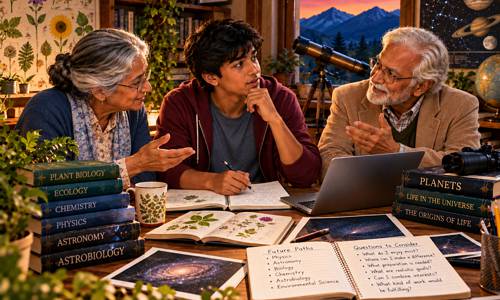
As Ravi grew older, relatives began asking what career he intended to pursue. Some suggested medicine, others engineering. Ravi enjoyed biology, physics and mathematics, but he could not decide which interested him most.
“I don’t want to give up plants,” he told his grandparents one evening. “But I don’t want to give up astronomy either.”
Meera put down her book. “Who says you must give up one to study the other?”
“Don’t scientists have to specialize?”
“They do,” she replied. “But nature doesn’t divide itself neatly into school subjects. Plants need sunlight, which comes from a star. Living cells obey the laws of chemistry and physics.”
Vijay leaned forward. “And astronomers are discovering planets around other stars. Some might have conditions suitable for life.”
Ravi looked from one grandparent to the other. “Could I study life on other planets?”
“There’s a field called astrobiology,” Meera explained. “It investigates how life begins, what conditions it needs and whether it might exist elsewhere. But you’ll need a strong understanding of several sciences.”
“And plenty of imagination,” Vijay added.
“Imagination supported by evidence,” Meera corrected.
“Precisely. Your grandmother improves all my sentences.”
Ravi eventually chose to study physics at university, with additional courses in biology and chemistry. He hoped to become an astrobiologist, combining the interests his grandparents had encouraged since childhood.
The Discovery That Wasn’t
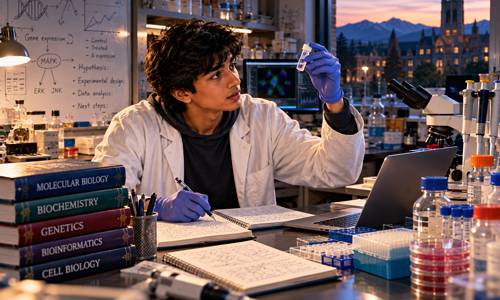
University was harder than Ravi expected. His mathematics courses were demanding, and many classmates had attended schools with better laboratories and equipment. Sometimes he wondered whether he was clever enough to become a scientist.
Meera encouraged him to identify exactly what he found difficult and work patiently to improve. Vijay reminded him of the first evening he had tried to find Saturn through the telescope and spent nearly an hour looking in the wrong direction.
“The universe hadn’t failed you,” his grandfather wrote. “You simply needed to learn where to look. Mathematics is another telescope. You’re learning how to use it.”
Ravi persevered. After several years, he joined a university research team studying microorganisms that could survive extreme dryness. Scientists hoped such research might help them understand whether life could exist in harsh environments elsewhere in the Solar System.
Ravi was thrilled. The work reminded him of the drought in his grandmother’s garden. He wanted to discover how tiny living cells survived when almost all their available water disappeared.
After months of experiments, Ravi thought he had found something important. His results suggested that certain microorganisms used a previously unknown protective mechanism to survive drying out. His supervisor was impressed, and Ravi began preparing a scientific paper.
Then disaster struck.
When Ravi repeated the experiment with new samples, the results were different. He tried again, but the earlier pattern did not appear. After carefully checking his equipment, he discovered that a temperature-control instrument had been operating incorrectly during some of the original experiments.
His exciting discovery might not be real at all.
Ravi was devastated. Nearly two years of work seemed wasted, and his research funding would soon expire. Without convincing results, the university might not extend his appointment. He could lose the opportunity to finish his project.
For several days he struggled to decide what to do. Could he still defend his original explanation? Perhaps the new experiments were wrong. Perhaps another adjustment would produce the results he wanted.
Finally, he telephoned Meera.
“Grandma, I think I’ve wasted two years. Everything I believed about my experiment may be wrong.”
Meera listened carefully. “Have you checked which results were affected by the faulty instrument?”
“Not all of them.”
“Then you haven’t finished investigating.”
“But my discovery—”
“Ravi, listen to me. You may have lost an explanation you liked. That isn’t the same as losing everything you’ve learned. Your task is to find out what the evidence really says.”
Vijay took the telephone next.
“My boy, do you remember the astronomers who believed they could see canals on Mars? Some became so convinced that they interpreted faint markings as evidence of a civilization. They were intelligent people, but their imaginations ran ahead of their observations.”
“I was so sure I was right,” Ravi admitted.
“Of course you were. That’s what makes this difficult. It takes courage to defend an idea, but sometimes it takes greater courage to abandon one.”
Ravi returned to the laboratory determined to discover what had really happened. He checked the instruments, improved his experimental controls and repeated the tests with help from a colleague.
The work was slow, and some days he felt like giving up. But gradually a new pattern emerged. The microorganisms did possess remarkable ways of surviving dryness, though not the particular mechanism Ravi had first imagined. Their survival depended strongly on how quickly they dried out and how carefully water was restored afterward.
The new results were less dramatic than his original claim, but they were supported by better evidence. Ravi wrote a revised paper, explaining the experiments and their limitations. His university extended his appointment, and the paper was eventually published.
When he sent a copy to his grandparents, Meera read the abstract twice.
“I understand some of it,” she announced. “You’ll have to explain the rest.”
Vijay studied the diagrams. “Very impressive. But I have a question.”
Ravi laughed. Of course he did.
Looking back, Ravi realized that this had been the greatest test of his scientific career. He had been forced to choose between protecting an exciting idea and accepting evidence that contradicted it. Meera had taught him how to make that choice, while Vijay had helped him find the courage to carry it through.
The Gift Passed On
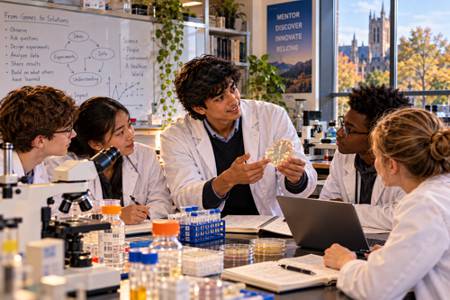
In time, Ravi became a respected scientist, working with researchers in different countries and helping younger students begin their own investigations. He enjoyed making discoveries, but he found equal pleasure in encouraging others.
When a student brought him an unexpected result, Ravi often replied, “That’s interesting. How could we find out what it means?” He smiled whenever he heard himself repeating Meera’s familiar words.
And when students became discouraged by difficult problems, he sometimes told them about his grandfather’s telescope. “You may not be looking in the right direction yet,” he would say. “That doesn’t mean there’s nothing worth finding.”
Returning Home
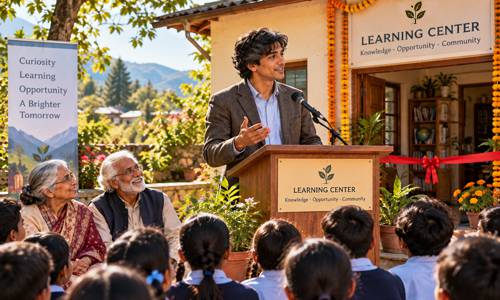
Years later, Ravi returned to his village and helped establish a small science learning center beside the school. It had microscopes, books, simple laboratory equipment, a garden for experiments and telescopes for observing the night sky. He wanted children to experience the same excitement of discovery that his grandparents had given him.
Meera helped plan the garden, insisting that it needed experimental beds rather than merely pretty flowers. Vijay examined the roof and demanded somewhere comfortable for children to sit while waiting for the stars.
“Astronomy,” he explained, “consists of brief moments of excitement separated by long periods of sitting comfortably.”
“And warm clothing,” Meera added. “Children won’t learn much if they’re shivering.”
“Quite right,” Vijay replied. “Your grandmother has just invented practical astronomy.”
At the opening ceremony, Ravi told the children how he had become a scientist. He spoke about the garden, the telescope, the drought and the experiment that had nearly ended his career.
“My grandparents taught me something more important than scientific facts,” he said. “They taught me to ask questions, to test my ideas and to admit when I was wrong. They showed me that not knowing an answer is nothing to be ashamed of. It’s where discovery begins.”
That afternoon, Ravi found Meera surrounded by children in the garden. A little girl held up a leaf.
“Why does this one have tiny hairs?”
Meera examined it. “That’s a good question. What do you think the hairs might do?”
Nearby, Vijay was helping a boy adjust the telescope.
“Careful now,” he said. “A telescope isn’t a magic wand, although I think it’s rather better.”
As evening fell, Ravi stood with his grandparents beneath the stars. He thanked them for everything they had taught him.
“What was the most important lesson?” Meera asked.
“How to ask questions,” Ravi replied.
“A fine beginning,” said Vijay.
“And how to find answers,” Ravi added.
“Better,” said Meera, smiling.
Just then, a boy looking through the telescope cried out, “It really has rings!”
Vijay laughed with delight. “Saturn! A perfectly respectable planet, wearing an enormous hat.”
Meera shook her head affectionately. “Vijay, you’ve told that joke a hundred times.”
“Indeed I have,” he replied. “But never to this particular boy.”
Ravi remembered saying almost the same words when he first saw Saturn as a child. He looked at the excited faces gathered around the telescope and realized that his grandparents’ greatest achievement was not simply helping him become a scientist. It was teaching him a love of discovery that he could now share with others.
Above them, the stars shone as brightly as ever. The universe still held countless mysteries, and another generation was beginning to ask questions.
That, Ravi knew, was where science began.
The Central Message
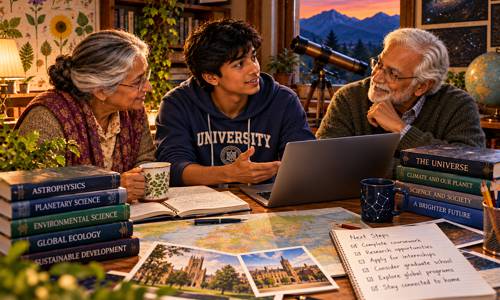
A grandparent’s influence on a future scientist need not depend on advanced scientific knowledge or expensive equipment. It may begin with a garden, a night sky, a magnifying glass or a simple question. By giving children time, encouragement, practical experiences and the freedom to investigate, grandparents can nurture habits of observation, critical thinking and intellectual persistence. Their most lasting contribution may be not the answers they provide, but the confidence they give a child to seek answers independently.
1 The Young Readers’ Edition is written with accessible explanations of the scientific ideas woven into the story.