The Seeds of Curiosity
For a Young Reader’s Edition1, click here.
A story2 of how two grandparents inspired a young scientist
Thoughts for Grandparents’ Day
(First Sunday of September after Labor Day
A Village of Questions
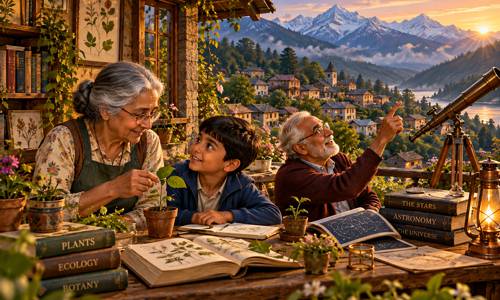
In a quiet village nestled between forested mountains, where morning mist drifted across the rooftops and the night sky glittered with thousands of stars, lived a boy named Ravi. He was curious about almost everything. Why did the leaves of some plants fold when touched? How did birds know when to migrate? Why did the Moon sometimes appear in the afternoon? His parents loved him dearly, but they were busy with the demands of everyday life, and when Ravi asked questions they could not answer, they often suggested that he ask his grandparents. This suited Ravi perfectly. He considered his grandparents’ house the most interesting place in the village, and he could scarcely imagine a question that would not be welcomed there.
His grandmother, Meera, had been a botanist, studying plants and their relationships with the environment. Though retired from formal research, she had never retired from observing the natural world. Her garden was a living laboratory, filled with flowering plants, medicinal herbs, vegetables, mosses and seedlings growing in carefully labeled pots. His grandfather, Vijay, a retired schoolteacher and enthusiastic amateur astronomer, had spent much of his life studying the heavens. His greatest treasure was a brass telescope, somewhat battered from decades of use, which stood beside an upstairs window. Their modest home contained bookshelves crowded with scientific works, drawers of preserved leaves, maps of the constellations and notebooks filled with observations. To Ravi, it was a house of wonders.
The two grandparents had quite different personalities. Meera was precise, practical and gently demanding, with an eye for details other people overlooked. Vijay was imaginative, humorous and fond of telling stories that began with something familiar and ended somewhere among the stars. Where Meera preferred to begin with an observation and work patiently toward an explanation, Vijay delighted in presenting a great mystery and inviting Ravi to imagine its possibilities. Yet they shared an important conviction: children should be encouraged to ask questions, and the best way to teach science was not always to supply an answer. When Ravi asked something particularly difficult, Meera would often reply, “That’s an interesting question. How might we find the answer?” Vijay was more likely to exclaim, “A splendid question! The universe has been waiting for someone to ask it!” Between them, they gave Ravi something more valuable than a collection of scientific facts. They taught him to enjoy the process of discovering things for himself.
Lessons in the Garden
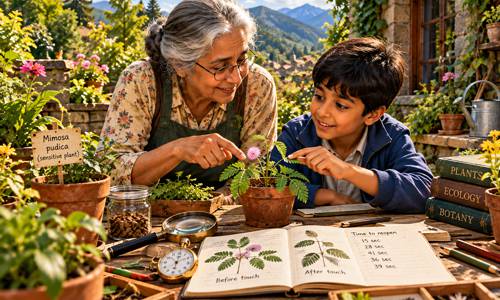
One morning, when Ravi was seven, he came running into the kitchen announcing that he had discovered a plant that was frightened of him. Meera looked up from the seeds she was sorting and asked, with characteristic seriousness, whether the plant had actually told him it was frightened. “Of course not, Grandma,” Ravi replied, laughing, “but it closes its leaves whenever I touch it.” Meera put down her seeds. “Ah, now you’ve told me something useful. The leaves close when you touch them. That’s what you observed. Being frightened is what you’ve imagined. Those are two quite different things.” She followed him into the garden, where he demonstrated the curious behavior of a Mimosa pudica. After watching the leaves fold inward, she asked him to touch another leaf, and then another. When Ravi wondered why she kept repeating the experiment, she explained that a single observation might be interesting, but repeated observations could reveal a pattern. She fetched a notebook and Vijay’s old stopwatch, and together they recorded how long the leaves took to reopen.
Meera explained that the plant responded to touch through changes in water pressure inside specialized cells, but she was more interested in Ravi’s questions than in delivering a botanical lecture. When he asked how the plant knew it had been touched, she smiled. “Now that’s a better question. Shall we see what we can discover?” She encouraged him to examine different parts of the plant and compare their responses. Ravi soon found himself absorbed in measurements, predictions and small surprises. When he complained that all this recording was taking the fun out of the discovery, Meera replied, “On the contrary, my boy. I’m showing you where the fun begins.” It was the first of many occasions on which she taught him to distinguish what he could actually observe from what he merely supposed to be true.
On another occasion, Meera gave Ravi two identical pots containing bean seedlings and instructed him to place one beside a sunny window and the other in a dark cupboard, watering both equally. Several days later, Ravi triumphantly announced that the seedling in the cupboard had grown much faster. Meera examined the plants and asked whether he thought the taller one was healthier. Ravi looked again. The seedling from the cupboard was pale and weak, with small yellowish leaves, while the shorter plant beside the window was green and sturdy. Meera explained how plants depended upon light for photosynthesis, and how a seedling deprived of light might grow unusually tall as it searched for illumination. “So growing faster doesn’t always mean growing better,” Ravi concluded. “Precisely,” Meera replied. “And remember that when people tell you something is better simply because there is more of it.”
As Ravi grew older, his grandmother introduced him to increasingly demanding investigations. He learned to examine flowers with a magnifying glass, recognize the structures of leaves, identify pollinating insects and understand why different plants flourished in different environments. She was patient with mistakes but impatient with careless conclusions. If Ravi announced that a plant preferred shade, she wanted to know what he meant by preferred. If he claimed that an experiment had failed, she demanded to see his results. “An experiment doesn’t fail merely because it refuses to agree with you,” she told him. “It fails when you learn nothing from it.” Sometimes Ravi found her insistence on precision frustrating, but he gradually discovered that careful observation could reveal things far more interesting than his first guesses.
The Grandfather Who Gave Him the Stars
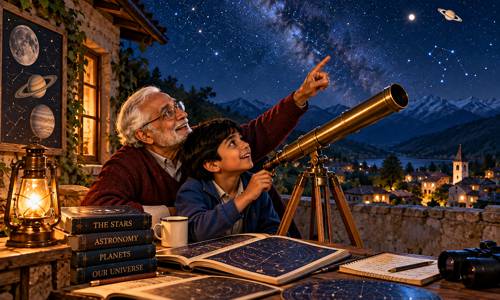
If Meera’s garden revealed the astonishing complexity of life close at hand, Vijay’s telescope opened a window onto distances beyond Ravi’s imagination. On clear evenings, grandfather and grandson climbed to the flat roof of the house, where Vijay set up his old brass telescope and consulted the astronomical charts he had kept for many years. He approached these occasions with an enthusiasm that never seemed to diminish. “Come along, Professor Ravi!” he would call. “The universe has been waiting several billion years for you to take an interest in it. We mustn’t keep it waiting any longer.” Sometimes clouds interfered with their plans, and Vijay would announce that astronomy was an excellent occupation for learning to make alternative arrangements. If Saturn was hidden, they would look for Jupiter; if Jupiter was obscured, they would examine the Moon; and if the whole sky disappeared beneath clouds, Vijay would settle into his chair and tell stories about the astronomers who had made the great discoveries of the past.
The first time Ravi saw Saturn through the telescope, he was astonished. He had seen pictures of the planet in books, but the delicate rings surrounding the tiny globe seemed almost too perfect to be real. “Grandpa! It looks like a drawing!” he exclaimed. Vijay chuckled and suggested that nature had been rather extravagant in giving a perfectly respectable planet such a magnificent hat. When Ravi asked why the hat did not fall off, his grandfather explained that the rings consisted of countless particles of ice and rock, each moving around Saturn under the influence of gravity. “Think of it, Ravi. The same force that makes you fall out of a tree when you climb higher than your grandmother thinks sensible also governs the motion of those distant particles.” Ravi looked down at the roof beneath his feet and then back through the telescope. “So the same rules work here and there?” he asked. “As far as we can tell,” Vijay replied. “The universe is remarkably consistent about its rules, which is more than I can say for the village cricket club.”
Vijay loved the ancient legends associated with the constellations, and he narrated them with considerable dramatic enthusiasm. He told Ravi about Orion the hunter, the Great Bear and the stories people had invented to explain the patterns they saw among the stars. Yet he was careful to distinguish mythology from astronomy. When Ravi asked whether Orion really was a hunter placed in the heavens, Vijay explained that the stars forming the familiar pattern were actually separated by enormous distances and appeared to make a recognizable figure only because of Earth’s particular viewpoint. “The old stories tell us what people imagined,” he said. “The telescope tells us what we can observe. Both are interesting, but we mustn’t confuse them. A wise fellow knows which instrument he’s using.”
One evening, Ravi asked whether people might someday travel to planets orbiting other stars. Vijay admitted that the distances were enormous and that no known technology could carry human beings across them in a reasonable time. But he refused to dismiss the question. “Perhaps one day someone will discover a way,” he said. “Or perhaps we’ll learn so much about those distant worlds without visiting them that we’ll scarcely believe what we’ve found.” When Ravi asked whether he might make such a discovery himself, Vijay considered the question seriously. “You might, Ravi. Or you might discover something none of us has even thought to ask about. That’s the difficulty with predicting the future of science. The most interesting discoveries are often the ones nobody expected.”
Before long, Ravi was keeping a notebook of his astronomical observations, recording the Moon’s changing appearance, the positions of the planets and the times at which particular stars appeared above the mountains. Vijay encouraged him to make predictions and compare them with what he subsequently observed. Sometimes Ravi was wrong, but his grandfather never treated a mistaken prediction as a disgrace. “A wrong prediction is useful,” he explained, “provided you try to understand why it was wrong.” Meera, overhearing this remark one evening, nodded approvingly and observed that Vijay had finally said something sufficiently precise to deserve writing down. “My dear,” he replied, “I’ve been saying sensible things for forty years. You simply haven’t been recording them.”
The Summer the Forest Began to Die
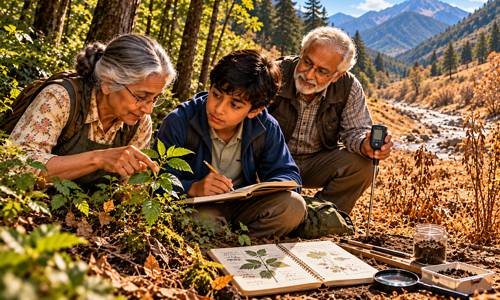
When Ravi was twelve, the village suffered the worst drought anyone could remember. The monsoon rains arrived late and then failed almost entirely. Streams that had flowed through the forest for generations dwindled to muddy pools, the soil cracked beneath the afternoon sun, and farmers watched anxiously as their crops withered. For the first time in Ravi’s life, the natural world that had always seemed so generous became frighteningly vulnerable. Meera’s garden suffered too. She rationed water carefully, moved delicate plants into shade and watched helplessly as some of her oldest specimens died. Ravi was distressed by her losses, but Meera refused to let him believe that distress alone could accomplish anything. “Feeling sorry for a plant won’t save it,” she told him. “Understanding what it needs might.”
One afternoon, while walking along a forest path, Ravi noticed something curious. Many plants growing in exposed clearings had dried out, yet others beneath the forest canopy remained surprisingly green. He hurried home and told Meera, who suggested several possible explanations. Perhaps the shade kept the soil cooler, perhaps fallen leaves helped retain moisture, or perhaps the plants themselves differed in their ability to withstand drought. Ravi wanted to know which explanation was correct, and Meera helped him devise an investigation. They placed thermometers in shaded and exposed locations, measured soil moisture and recorded the condition of plants over several weeks. Vijay joined the project, teaching Ravi how to arrange his measurements in tables and draw graphs that would make patterns easier to recognize.
Their results suggested that shaded soil generally remained cooler and retained more moisture, while the layer of decaying leaves on the forest floor also helped conserve water. Ravi was delighted. “I’ve discovered something!” he announced. Meera smiled and replied, “You’ve discovered something for yourself. Other people may already know it, but that doesn’t make your discovery any less valuable. Now the next question is whether your explanation agrees with what other scientists have found.” She encouraged him to consult books and compare his observations with published research. For the first time, Ravi understood that science was not simply a collection of facts written by clever people long ago. It was a continuing process of investigation in which he, too, could participate.
Ravi presented his findings at a school exhibition, complete with graphs, photographs and samples of forest soil. The judges awarded him a prize, but what he remembered most clearly was a younger pupil asking how he had thought of the experiment. “My grandmother asked me a question,” Ravi answered. When he told Meera about the exchange, she seemed more pleased by his answer than by the prize itself. Vijay, however, insisted that the certificate should be framed and hung beside the telescope. “Every great scientist needs an impressive collection of honors,” he declared. “Best to begin early, before the wall gets too crowded.” Meera remarked that Ravi would be better advised to concentrate on his next experiment, and Vijay replied that she was perfectly capable of keeping the boy’s feet on the ground while he encouraged him to reach for the stars.
Yet the drought had left a deeper impression on Ravi than his school prize suggested. He had watched living things struggle to survive under conditions that seemed almost impossible, and he could not forget the contrast between the green patches beneath the forest canopy and the dead plants in the open. When Vijay spoke of distant planets with harsh climates, Ravi began wondering whether life might survive in places very different from Earth. The question remained with him, linking the two worlds his grandparents had opened to him: the living complexity of Meera’s garden and the vast possibilities of Vijay’s universe.
A Difficult Choice
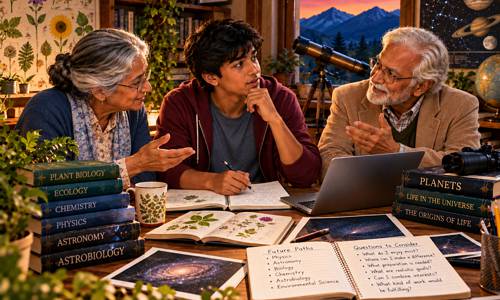
As Ravi approached the end of his schooling, relatives began asking what career he intended to pursue. Some suggested medicine, others engineering or a secure government position. Ravi enjoyed mathematics, biology and physics, and he could imagine studying plants for a lifetime, yet he remained equally fascinated by the stars. The choice troubled him, particularly because he feared that selecting one subject would mean abandoning the others. One evening he found Meera examining a leaf through her magnifying glass and confessed that he did not know what to do. She listened carefully before asking what kind of work he most enjoyed. When Ravi replied that he liked finding out how things worked, she observed that this described half the sciences and demanded a more specific answer.
Vijay, who had been listening from his chair, chuckled and remarked that Meera would demand greater precision even if Ravi announced that he wanted to become king of the universe. “And you,” Meera replied, “would encourage him to apply before checking whether the position existed.” Vijay accepted the criticism cheerfully and turned to Ravi. He asked what interested him most when he examined a plant. Ravi answered that he wanted to understand how it survived, grew and responded to its surroundings. When Vijay asked what interested him about the stars, Ravi spoke of distant planets and the possibility that life might exist elsewhere in the universe. His grandfather smiled. “Well, well. Perhaps your two interests aren’t as far apart as you think.”
Meera explained that fields such as astrobiology brought together biology, chemistry, physics and planetary science in the investigation of life’s origins and possible existence beyond Earth. But she cautioned Ravi against choosing a career simply because its name sounded exciting. He should examine university courses, learn what researchers actually did and consider whether he would enjoy the difficult work required to master the subject. Vijay agreed, though he added that Ravi should never neglect the pleasure of asking apparently impossible questions. “Questions that appear impossible,” Meera corrected. “Precisely,” Vijay replied. “Your grandmother improves all my sentences.”
Neither grandparent attempted to make the decision for him. Instead, they helped Ravi speak with teachers, investigate universities and think carefully about his interests and abilities. Eventually he chose to study physics, while taking additional courses in biology and chemistry, with the possibility of specializing later in astrobiology. It seemed a natural meeting place between his grandmother’s garden and his grandfather’s telescope, though Ravi understood that reaching it would require years of demanding study.
The Experiment That Threatened Everything
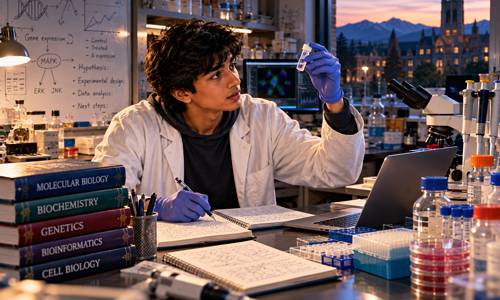
University life was exhilarating but difficult. Ravi encountered mathematical problems far more demanding than anything he had studied at school, and many of his classmates came from cities with better-equipped schools and greater opportunities for laboratory experience. After a disappointing examination, he wrote home wondering whether he was clever enough to become a scientist. Meera replied that he should identify precisely where his difficulties began rather than declare himself generally bad at mathematics. Vijay reminded him of the evening when he had spent nearly an hour searching for Saturn through a telescope pointed in the wrong direction. “The universe had not failed you,” his grandfather wrote. “You simply needed to learn where to look. Mathematics is a telescope of extraordinary power, and at present you’re learning how to point it.” Ravi kept their letter and worked steadily until his confidence returned.
Several years later, during postgraduate research, he encountered a far more serious challenge. He had joined a team investigating how microorganisms survived extreme dryness, work that might help scientists understand whether life could persist in harsh environments elsewhere in the Solar System. Ravi was particularly interested in microorganisms that appeared capable of recovering after losing almost all their available water. The subject reminded him of the drought in his grandmother’s garden, and he threw himself into the research with extraordinary enthusiasm. After months of experiments, he began to suspect that one group of microorganisms survived by activating a previously unrecognized protective mechanism. If his interpretation was correct, it could be an important contribution to the study of biological survival under extreme conditions.
The laboratory results initially seemed encouraging. Ravi prepared a paper describing the findings, and his supervisor suggested that the work might attract considerable attention. For several weeks Ravi worked almost without rest, checking calculations, preparing diagrams and refining his explanation. Then, during a final series of tests, something went wrong. A new batch of samples failed to reproduce the earlier results. Ravi repeated the experiment, convinced that a minor technical error was responsible, but the discrepancy persisted. When he examined his laboratory records more closely, he discovered that a temperature-control instrument had been operating outside its specified range during part of the original experiment. The supposed protective mechanism might have been nothing more than an artifact of the experimental conditions.
The discovery was devastating. Ravi had invested nearly two years in the project, and his research funding was approaching its end. His supervisor told him that the paper could not be submitted until the results had been independently reproduced. Worse still, the university’s committee would soon decide whether to extend his research appointment. Without convincing results, Ravi might have to abandon the project and find another career. For the first time, the possibility of leaving science seemed painfully real.
Ravi spent several miserable days reviewing his notebooks. He felt embarrassed that he had not noticed the instrument problem sooner and angry that so much work might have been wasted. One evening he telephoned Meera and told her what had happened. She listened quietly before asking whether he had identified exactly which results were affected. Ravi admitted that he had not yet completed the analysis. “Then you haven’t finished investigating,” she replied. “You’re mourning a conclusion before you’ve established what the evidence actually says.” When he protested that two years of work might have been lost, she answered firmly, “Ravi, you have not lost two years. You’ve learned a great deal about those organisms, your instruments and the weaknesses of your experimental design. What you may have lost is an explanation you were particularly fond of. Those are not the same thing.”
Vijay took the telephone next. He was sympathetic, but his advice was characteristically different. “My boy, do you remember the astronomers who thought they had discovered canals on Mars? Some were so persuaded by what they expected to see that they interpreted faint markings as evidence of an entire civilization. They were intelligent men, but their imaginations ran ahead of their instruments. Imagination is a splendid servant and a dangerous master.” Ravi replied that he had been certain his explanation was correct. “Of course you were,” Vijay said. “That’s what makes this difficult. It takes courage to defend an idea, but sometimes it takes greater courage to let one go. And remember, a scientist who discovers that he has been mistaken has still discovered something important.”
Their words did not solve Ravi’s immediate problem. He still faced a deadline, uncertain funding and the possibility that his most promising research had collapsed. But the conversation changed the way he approached the crisis. Instead of trying to rescue his original conclusion, he began systematically identifying the conditions under which the microorganisms survived. He recalibrated the instruments, redesigned the controls and repeated the experiments with assistance from a colleague who had not been involved in the earlier work. The process was slow and discouraging. Some results contradicted others, and several weeks passed before a consistent pattern began to emerge.
What Ravi eventually found was less dramatic than his original hypothesis but scientifically more reliable. The microorganisms did possess remarkable mechanisms for tolerating dryness, though not the particular mechanism he had proposed. Their recovery depended strongly on the rate of dehydration and subsequent rehydration, factors his earlier experiments had not adequately controlled. By studying these effects, he and his colleagues were able to identify conditions that substantially improved survival. The findings suggested new questions about how biological cells respond to environmental stress and how experiments intended to simulate extraterrestrial environments should be designed.
Ravi submitted a revised paper, openly explaining the limitations of the earlier experiments and presenting the new results. The research committee extended his appointment, though only after considerable discussion, and the paper was eventually accepted for publication. Its conclusions were more modest than Ravi had once hoped, but he knew they were supported by stronger evidence. Looking back, he realized that the crisis had tested something more fundamental than his technical competence. He had been forced to choose between protecting an attractive explanation and following the evidence wherever it led. Meera had taught him how to make that choice, and Vijay had helped him find the courage to accept its consequences.
The Gift Passed On
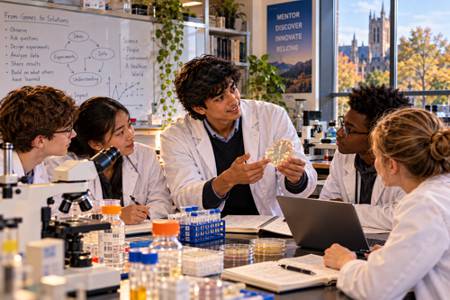
As the years passed, Ravi became an established researcher, working with scientists in different countries and helping train younger students. His investigations continued to explore questions at the intersection of biology, chemistry and planetary science. Yet his greatest satisfaction did not come from professional recognition. It came when a student approached him with an unexpected observation and asked whether it was worth investigating. Ravi found himself replying, almost without thinking, “That’s an interesting question. How might we find the answer?” Hearing his grandmother’s words coming from his own mouth, he realized how deeply her habits of thought had become part of his own.
He also discovered that he had inherited something of Vijay’s manner. When students grew discouraged by difficult calculations or unsuccessful experiments, Ravi sometimes compared their problems with learning to point a telescope toward a distant planet. He enjoyed showing them how an apparently ordinary observation could lead to a question of enormous significance. When one young researcher confessed that a failed experiment had destroyed months of work, Ravi told him about the instrument malfunction that had nearly ended his own career. He explained that the most important question was not whether the experiment had produced the expected result, but what could now be learned from it. He had learned from Meera how to investigate a problem rigorously, and from Vijay how to recognize the wonder that made investigation worthwhile.
Returning Home
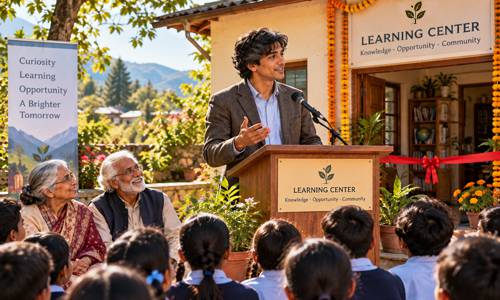
Many years later, Ravi returned to the village where his curiosity had first awakened. The mountains were unchanged, though new roads and buildings had appeared. Meera’s garden was smaller now, and Vijay no longer climbed to the roof as easily as before. Ravi had long dreamed of giving the village children some of the opportunities his grandparents had given him, and with help from colleagues, local teachers and a charitable foundation, he established a modest science learning center beside the village school. It was not a grand research institute, but its rooms contained microscopes, computers, simple laboratory equipment, books and telescopes that could be carried outdoors on clear evenings. There was also space for a botanical garden and a weather station where pupils could record rainfall, temperature and wind.
Ravi invited his grandparents to help plan the center, and their differing personalities immediately became apparent. Meera examined the proposed garden and announced that it contained far too much ornamental planting and insufficient space for experiments. Where, she wanted to know, would the children grow seedlings under different conditions? Where would they study soil, collect seeds and observe insects? Vijay, meanwhile, was examining the roof and calculating where the telescopes should stand. He insisted upon an unobstructed view of the southern sky and somewhere comfortable for children to sit while waiting for darkness. “Astronomy,” he explained, “consists of brief moments of excitement separated by long periods of sitting comfortably.” Meera added that warm clothing would be essential, since children would learn little if they were shivering. “Quite right,” Vijay replied. “Your grandmother has just invented practical astronomy.”
At the opening ceremony, Ravi spoke to the assembled pupils, parents and teachers. People sometimes asked him when he had decided to become a scientist, he explained, and he could truthfully say that he had made the formal decision when applying to university. But that was not really when his scientific education had begun. It had begun when his grandmother showed him that an ordinary leaf could raise a hundred questions, and when his grandfather showed him that the same laws of nature governed the village and the distant planets. They had given him books, experiments and a telescope, but their greatest gift was something simpler. They had taken his questions seriously and encouraged him to seek answers for himself.
Ravi also spoke of the difficult period when his research had nearly collapsed. He explained that science was not a steady procession of brilliant discoveries, and that even experienced researchers made mistakes, followed unproductive ideas and sometimes had to begin again. What mattered was the willingness to examine evidence honestly and to learn from unexpected results. His grandparents, he said, had prepared him for that challenge long before he entered a university laboratory. Meera had taught him to be skeptical of easy explanations, while Vijay had taught him not to lose his sense of wonder when an explanation proved wrong. “I became a scientist,” Ravi told the children, “not because my grandparents always knew the answers, but because they showed me that not knowing an answer was the beginning of an adventure.”
Later that afternoon, Ravi found Meera in the garden surrounded by a group of children. A little girl was holding up a leaf and asking why it had tiny hairs on its surface. Meera examined it carefully and asked what the girl thought the hairs might do. Nearby, Vijay was showing a boy how to adjust a telescope, explaining that it was not a magic wand, although he privately considered it something rather better. Ravi watched them with affection. Their hair had grown white and their movements had slowed, but their curiosity remained undiminished.
That evening, after the visitors had departed, Ravi stood with his grandparents beneath the stars. He told them that although he had spent years investigating how life might survive on distant worlds, he believed the most important things he had ever learned were those they had taught him as a child. Meera asked what those things were. “How to ask questions,” Ravi replied. Vijay smiled and called that a fine beginning. “And how to find answers,” Ravi added. Meera nodded approvingly. “Better,” she said.
For a moment the three stood together in comfortable silence, looking toward the stars above the mountains. Then Vijay noticed a group of children gathering beside the telescope and announced that he was going to show them Saturn. Meera observed that he had told the story of Saturn’s rings at least a hundred times. “Indeed I have,” Vijay replied cheerfully, “but never to these particular children.”
A few minutes later, a boy peered through the eyepiece and exclaimed in astonishment that Saturn really did have rings. Ravi smiled, remembering the night when he had said almost exactly the same words. He realized that the most enduring achievement of his grandparents was not simply the scientist he had become, but the curiosity they had taught him to pass on. The stars were as distant as ever, and the mysteries of life were as deep, but another generation had begun asking questions. And that, Ravi knew, was where science began.
The Central Message
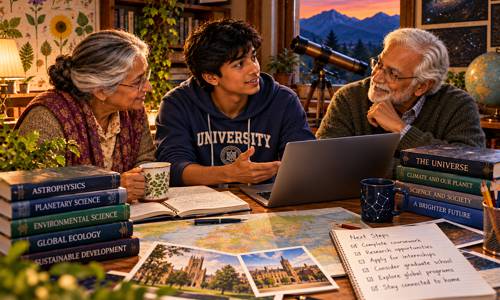
A grandparent’s influence on a future scientist need not depend on advanced scientific knowledge or expensive equipment. It may begin with a garden, a night sky, a magnifying glass or a simple question. By giving children time, encouragement, practical experiences and the freedom to investigate, grandparents can nurture habits of observation, critical thinking and intellectual persistence. Their most lasting contribution may be not the answers they provide, but the confidence they give a child to seek answers independently.