 (source)
|
President Jimmy Carter
(1 Oct 1924 - )
American president and farmer who was the 39th President of the United States.
|
Solar Energy
Remarks by President Jimmy Carter, Announcing Administration Proposals
Dedication Ceremony for Solar Panels on the White House Roof
West Terrace at the White House (20 June 1979)
In 1891, during the Presidency of William Henry Harrison [Benjamin Harrison], electric lights were first installed in the White House, the residence of the leaders of our country. At that time, commercial electricity was not economically feasible, but President Harrison wanted to affirm his confidence in the technological capability of our country.
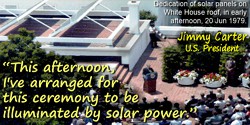
This afternoon, I've arranged for this ceremony to be illuminated by solar power. [Laughter] And I think we've done an excellent job in utilizing that tremendous, sometimes untapped resource.
Unfortunately, in the last few years, that confidence that President Harrison expressed in our Nation's ability to meet new challenges has not always been evident. Lately, as we have begun to see the first signs of inevitable shortages of fossil fuels, our country has been disconcerted, sometimes discouraged. Some few Americans have almost reached a state of panic.
We import now about half of all the oil we use from overseas. And this dependence on foreign sources of oil is of great concern to all of us.
America was not built on timidity or panic or uncertainty about the future or a lack of confidence in our own technology or our own will or ability. America was built with vision, with faith, and also with hard work. It's time for us to recognize once again, with the surest degree of confidence, the great natural resources which God has given us and to seize the opportunities that we have to build a more prosperous, self-reliant, enjoyable, confident future in which all Americans can share.
Today, in directly harnessing the power of the Sun, we're taking the energy that God gave us, the most renewable energy that we will ever see, and using it to replace our dwindling supplies of fossil fuels.
There is no longer any question that solar energy is both feasible and also cost-effective. In those homes now using electricity, a typical solar hot water heating system, such as the one behind me, can pay for itself in 7 to 10 years. As energy costs increase, which is an almost inevitable prospect, that period for paying for this investment will be substantially reduced. Solar energy will not pollute our air or water. We will not run short of it. No one can ever embargo the Sun or interrupt its delivery to us. But we must work together to turn our vision and our dream into a solar reality.
Today, I am sending to the Congress legislative recommendations for a new solar strategy that will move our Nation toward true energy security and abundant, readily available energy supplies.
This effort to analyze where we are and where our tremendous opportunities might be was originated by a meeting between myself and congressional leaders known as the Solar Energy Caucus and by many private groups. In May of 1978, on Sun Day, I went out to Colorado to make a speech there. And beginning on that date, we began to put forward, from many sources, the recommendation submitted to Congress this day.
This solar strategy will not be easy to accomplish. It will be a tremendous, exciting challenge to the American people, a challenge as important as exploring our first frontiers or building the greatest industrial society on Earth. By the end of this century, I want our Nation to derive 20 percent of all the energy we use from the Sun—direct solar energy in radiation and also renewable forms of energy derived more indirectly from the Sun. This is a bold proposal, and it's an ambitious goal. But it is attainable if we have the will to achieve it.
Government action alone cannot make this goal come true. It will require a concerted effort of all of us—government at all levels, industry, labor, business, inventors, entrepreneurs, architects, builders, homeowners, concerned citizens, all working together.
If we do not learn to eliminate waste and to be more productive and more efficient in the ways we use energy, then we will fall short of this goal. But if we use our technological imagination, if we can work together to harness the light of the Sun, the power of the wind, and the strength of rushing streams, then we will succeed.
In this as in all major national programs, of course, the Federal Government can be a catalyst for change. I'm proposing a coordinated governmentwide effort, using all the tools at our disposal, to spend more than $1 billion in fiscal year 1980 to stimulate solar and other renewable forms of energy. I'm directing the Tennessee Valley Authority, our Nation's largest utility, to become a solar showcase. I'm proposing major tax credits to speed the development and the commercialization of solar energy.
This strong Federal commitment to solar energy will be sustained year after year after year after year. It will not be a temporary program.
An important new program in the solar strategy is the creation of a solar bank, which will be funded out of the energy security fund, the money to be derived from the windfall profits tax now making its way through Congress. This will allow us to encourage the use of solar energy in residential and commercial buildings and in many other uses.
In the year 2000, the solar water heater behind me, which is being dedicated today, will still be here supplying cheap, efficient energy. A generation from now, this solar heater can either be a curiosity, a museum piece, an example of a road not taken, or it can be just a small part of one of the greatest and most exciting adventures ever undertaken by the American people: harnessing the power of the Sun to enrich our lives as we move away from our crippling dependence on foreign oil.
As President, I am determined that America will move toward the solar age with effectiveness and determination, with excitement, high spirits, and with confidence. Therefore, I dedicate, this afternoon, this solar heater, harnessing the rays of the Sun to the benefit of those who serve our country at the White House, with the faith that American technology will meet challenges that lie ahead and that we will build a more self-reliant and a more secure nation for the generations to come.
On behalf of the people of our country, I want to thank the Members of Congress who are assembled here this afternoon, the members of my own administration, dozens of private citizens groups who have long worked with dedication and sometimes disappointment in increasing the interest in and the dedication to solar power. I think all of us working together can assure the success of what is being initiated this afternoon—a national program supported and enjoyed by all Americans to make solar energy a clean, sure, economical, exciting part of Americans' lives. Thank you very much.

- Science Quotes by President Jimmy Carter.
- 1 Oct - short biography, births, deaths and events on date of Carter's birth.
- Jimmy Carter - context of his Superfund Legislation quote.
- Jimmy Carter - context of his Superfund Legislation quote - Large Image (800 x 600 px)
- An Important Address on Energy in 1977 - by President Jimmy Carter.
- 98 Reasons to Thank Jimmy Carter, by Arthur Milnes. - book suggestion.