 (source) |
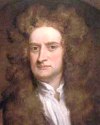
Sir Isaac Newton
(25 Dec 1642 - 20 Mar 1727)
English physicist and mathematician who made seminal discoveries in several areas of science, and was the leading scientist of his era.
|
A NICE OLD GENTLEMAN.
An article for young readers about Isaac Newton1
from St. Nicholas2 (Jun 1874)
By D. G. M.3
Boys, in a general way, don’t make a great hero of a man who does such things as to discover the law of gravitation, or laws about the refraction of light, or the laws of the higher mathematics. How could there be anything great (to a boy) in a man who wrote algebraically concerning the Differential Calculus?
And as for that law of gravitation—of course, a man was likely to discover that who wore a wig, and lived in a library with a globe and instruments about him, and with a window opening on an apple-orchard, where he couldn’t help seeing the apples fall. Or, if one man of this sort didn’t discover the law of gravitation, some other man in a wig probably would.
I think it was in this way, at any rate, that the matter struck us boys when our old master undertook to make a point about the greatness of Sir Isaac Newton. If he had spoken in the same solemn way about Alexander and Bucephalus, or about Richard Cœur de Lion, with his big battleaxe, or about William Wallace, —ah, indeed, that were quite another matter!—I think we should have pricked up our ears along the benches and sniffed the odor of battle. We should never have confounded those characters; but some of us did confound Sir Isaac Newton and that most excellent old gentleman, Dr. Isaac Watts. I don’t know why—except the Isaac. But I have a vivid recollection of how one of us, in a splendid composition, introduced a little poetic quotation, beginning—
“Let dogs delight to bark and bite,”
with “from the well-known British poet, Sir Isaac Newton.”
The truth is, at the age of fifteen we measure differently the work that makes men great, from the way in which we measure it when we are fifty. The din of the great battle-axes goes down, and Bucephalus is not so grand a figure.
But at the age when good “alleys” are in demand (“alley” was the name we used to give to a good solid marble, that would make havoc in a ring full of lighter metal), there isn’t much account made of the laws of gravitation, or of their discoverer. We kept Franklin in mind, because he made kites and flew them; and if our old teacher, instead of harping on gravitation, had told us how Isaac Newton, when he was a lad, made a mill with his jackknife, copied wheel by wheel from a wind-mill that ground corn upon a hill near to Grantham, in Lincolnshire, where he went to school, we should have kept Isaac Newton better in mind; and better still, if we had known how he made his little mill, at last, so perfect, that by turning a mouse into its door, by some curious system of tread-wheels the machinery would begin to move, and the mill to grind. He made also a little water-clock, which kept time perfectly; and he placed a dial on the wall of the house where he was born, which only a few years back was in place still.
I don’t suppose he won any triumphs at marbles or in wrestling bouts. He was never strong-limbed, but a quiet, shy lad, plodding and thinking by himself. And so sure was he of his own drift, that before he was twenty-seven, he had thought out and ripened all his great discoveries. I shan’t try to explain to you what those discoveries were, for it would make too long a story, and besides, I do not think I should do it so well as you will find it done for you in your school-books.
There were quarrelsome, envious people in that time (nearly two hundred years ago), who said that Mr. Newton didn’t deserve all the honor he received, and who said that other philosophers had more than half-discovered the same things before Newton did.
But half-doing things doesn’t count in the long run; so the world thought then, and so the world thinks now. You may have a great many happy and wise thoughts; but if you don’t follow them up with industry and patience, they will never come to any great show of blossom.
Newton himself said that industry and patience had done more for him than all beside. He didn’t think much of that swift cleverness which boys are too apt to admire and strive after, which makes a little spurt in a speech or a poem, and then is lost.
There were other jealous and unwise people in Newton’s day, who said that he was undermining religion. There are just such unwise people nowa-days, who are shocked by the discovery of any new laws in nature. They are very weak and blind. All the little truths men can find out will never shut out or alter the big Truth, which is past finding out.
Sir Isaac Newton was called a very absent-minded man,—that is to say, he forgot common things because he was thinking so keenly and so constantly of uncommon things. They tell a story of his table being served one day with a nice broiled chicken; but he forgot his dinner-hour, and forgot it for so long a time, that a friend came in and ate up his chicken. Presently after, Sir Isaac came bustling in, and seeing the remnants of the dinner, exclaimed, “How stupid of me! I quite forgot that I had dined!”
On another day, when he went out for an airing, he got off his horse at the bottom of a high hill, to lead him up. When he reached the top, and would have mounted again, he found he had only the bridle in his hand! The horse had slipped his head-gear quietly, and trotted home. This was stupid; but if you can think as steadily as Sir Isaac Newton thought, you can afford to be stupid at times.
Sir Isaac was never married, and always possessed a calm and unruffled temper. [I declare solemnly to the elderly people who may read this, that I joined the above two statements in one sentence by sheerest accident.]

The picture accompanying this article illustrates one incident in the life of Sir Isaac Newton, that is often spoken of, in token of his mild temper. His dog Diamond, which was a great favorite with him, and had the privilege of his library, one day overset a candle among his most valued papers, and before rescue could be made, they were utterly burned. “Oh, Diamond! Diamond!” said Sir Isaac, “thou little knowest the mischief thou hast done!”
I must confess that it seems to me rather a tough story. I know a great many goodish sort of people who, in such a strait, would have used a different word from “Diamond,” and repented of it next day.
There were enemies of Sir Isaac Newton who said he had lost his mind by reason of this mishap; if he did lose it, he found another, for he died with a good solid one at over eighty.
It is true that he made no great discoveries in the later years of his life; indeed, he almost ceased to be known as a philosopher, and was for a long period a quiet office-holder under government in London. In our time, you know, office-holders are said not to favor discoveries; but Sir Isaac had nothing to conceal. He was attached to no rings but the rings of Saturn.
As I said, he was a bachelor; and living modestly, he grew rich. He was kindly and charitable throughout his life, and left his personal fortune to a niece (the daughter of a half-sister), who had been for a long time the mistress of his London home. His landed property, which was inherited, and which included the old stone farm-house where the philosopher was born, fell into the hands of a Robert Newton, eldest son of a cousin, who was a worthless, dissolute fellow, who squandered his inheritance, and who, in a drunken fit, fell while smoking his pipe, and was choked by a portion of the pipe-stem.
If you ever go to London, and into Westminster Abbey, you will see an elaborate tomb, in honor of Sir Isaac Newton, against the choir-screen, to the north of the entrance; but, in the rooms of the Royal Society, you will find what is better worth seeing, that is, the first telescope that Newton made, and also the old dial which he constructed when a boy, and which, in 1844, was brought away from the walls of his early home in Lincolnshire; and, last of all, a lock of his silver hair.
1 Isaac Newton is particularly well suited to introducing science to young readers because his achievements grew from qualities children can recognize in themselves: curiosity, imagination, observation, and a fascination with how things work. As a boy, Newton constructed mechanical models, experimented with clocks and devised ingenious inventions. These activities make his scientific genius more approachable than his abstract discoveries in mathematics and physics. His absent-mindedness, modest habits and the amusing stories associated with his life also humanize a figure who might otherwise seem remote and intimidating. In “A Nice Old Gentleman,” the author cleverly acknowledges that young readers may find heroic battles more exciting than the discovery of gravitation. By presenting Newton as an inventive boy before describing him as a great scientist, the article suggests that scientific achievement begins with the same curiosity and delight in discovery that children experience in their own play and experiments.
2 “A Nice Old Gentleman,” published in St. Nicholas, illustrates how popular science was presented to young readers in Victorian America. Founded in 1873, St. Nicholas: An Illustrated Magazine for Young Folks combined literature, history, science and entertainment to educate and engage children. Rather than explaining Isaac Newton’s mathematical discoveries, this lively article introduces the great scientist through stories of his childhood inventions, personal habits and scientific curiosity. It exemplifies the magazine's approach to making science accessible and appealing to young minds through biography, humor and anecdote. St. Nicholas was published in New York City, beginning in November 1873. Its original publisher was Scribner & Co., and its first title was St. Nicholas: Scribner's Illustrated Magazine for Girls and Boys. In 1881, publication passed to the Century Company, and the subtitle became An Illustrated Magazine for Young Folks. Why the name St. Nicholas? The name was chosen by its founding editor, Mary Mapes Dodge, in honor of Saint Nicholas, the traditional patron saint of children and the historical figure associated with Santa Claus. Dodge explained her choice in the magazine’s first issue (Nov 1873): “Is he not the boys’ and girls’ own Saint, the especial friend of young Americans?” She went on to describe him as: “the kindest, best, and jolliest old dear that ever was known?” The name therefore expressed the magazine’s intended personality: friendly, generous, cheerful and devoted to children's happiness. Although named after a Christian saint, St. Nicholas was not primarily a religious magazine. It was a general-interest literary and educational publication, designed to stimulate children's curiosity and imagination. Dodge believed children deserved intelligent, entertaining writing rather than simplified adult literature or relentless moral instruction. She wanted a magazine that children would enjoy reading voluntarily.
3 Who was D.G.M.? Webmaster has not found a specific attribution, but a strong possibility is the author and essayist Donald Grant Mitchell (1822–1908), who wrote under the pen name Ik Marvel. His initials, literary career and interest in writing for young readers make him a plausible candidate. Furthermore, Mitchell (as an editor) had worked earlier with Mary Mapes Dodge (as associate editor) on Hearth and Home, a New York weekly magazine, before she founded St. Nicholas, in 1873. Thus, there previously existed a professional connection between Mitchell and Dodge.
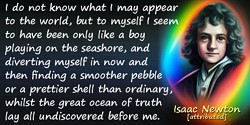
- Science Quotes by Sir Isaac Newton.
- 25 Dec - short biography, births, deaths and events on date of Newton's birth.
- Isaac Newton - Comments on his “Playing on the Seashore” Quote
- Isaac Newton - “Playing on the Seashore” illustrated quote - Medium 500px.
- Isaac Newton - “Playing on the Seashore” illustrated quote - Large 800px.
- Isaac Newton - context of quote “A change in motion” - Medium image (500 x 250 px)
- Isaac Newton - context of quote “A change in motion” - Large image (800 x 400 px)
- Isaac Newton - context of quote “In experimental philosophy” - Medium image (500 x 250 px)
- Isaac Newton - context of quote “In experimental philosophy” - Large image (800 x 400 px)
- Isaac Newton - context of quote “Standing on the shoulders of giants” - Medium image (500 x 250 px)
- Isaac Newton - context of quote “Standing on the shoulders of giants” - Large image (800 x 400 px)
- Isaac Newton - context of quote “Impressed force is the action” - Medium image (500 x 250 px)
- Isaac Newton - context of quote “Impressed force is the action” - Large image (800 x 400 px)
- Isaac Newton - context of quote “Inherent force of matter is the power of resisting…” - Medium image (500 x 250 px)
- Isaac Newton - context of quote “Inherent force of matter is the power of resisting…” - Large image (800 x 400 px)
- Isaac Newton - context of quote “Plato is my friend” - Medium image (500 x 250 px)
- Isaac Newton - biography from Famous Men of Science (1889)
- Isaac Newton - context of quote “Plato is my friend” - Large image (800 x 400 px)
- Isaac Newton - context of quote “Colours which appear through the Prism ” - Medium image (500 x 250 px)
- Isaac Newton - context of quote “Colours which appear through the Prism ” - Large image (800 x 400 px)
- Isaac Newton - context of quote “Nature does nothing in vain” - Medium image (500 x 250 px)
- Isaac Newton - context of quote “Nature does nothing in vain” - Large image (800 x 400 px)
- Isaac Newton - context of quote “No more causes of natural things should be admitted” - Medium image (500 x 250 px)
- Isaac Newton - context of quote “No more causes of natural things should be admitted” - Large image (800 x 400 px)
- Isaac Newton - context of quote “Truth is ever to be found in simplicity” - Medium image (500 x 250 px)
- Isaac Newton - context of quote “Truth is ever to be found in simplicity” - Large image (800 x 400 px)
- Isaac Newton - context of quote “Every body perseveres in its state of being at rest” - Medium image (500 x 250 px)
- Isaac Newton - context of quote “Every body perseveres in its state of being at rest” - Large image (800 x 400 px)
- Isaac Newton - context of quote “God, in the beginning, formed matter” - Medium image (500 x 250 px)
- Isaac Newton - context of quote “God, in the beginning, formed matter” - Large image (800 x 400 px)
- Isaac Newton - context of quote “The cause of gravity is what I do not pretend to know” - Medium image (500 x 250 px)
- Isaac Newton - context of quote “The cause of gravity is what I do not pretend to know” - Large image (800 x 400 px)
- Sir Isaac Newton’s Apple-Tree - debunking the myth, from Historic Ninepins: A Book of Curiosities by John Timbs (1869)
- Newton and the Dog - debunking the myth about Newton’s dog Diamond.
- Booklist for Isaac Newton.