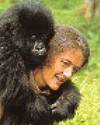
Born 16 Jan 1932; died 26 Dec 1985 at age 53. quotes
American zoologist who for years made a daily study of the mountain forest gorillas of Rwanda, central Africa. In 1963, she met Louis and Mary Leakey, who encouraged her initial interest. With Jane Goodall's encouragement, she set up and directed (1967-80) the Karisoke Research Center, Rwanda. Living a solitary life for many years, she observed the gorillas’ habits and gradually gained their acceptance. She wrote Gorillas in the Mist (1983) to acquaint the public with the threats to the gorillas from poachers and loss of habitat. In 1985, Fossey’s mutilated body, hacked by machete, was found near the centre. Poachers, whose devastating attacks on the gorillas she had tried to stop, were suspected for her murder, although unproved.«
American zoologist who for years made a daily study of the mountain forest gorillas of Rwanda, central Africa. In 1963, she met Louis and Mary Leakey, who encouraged her initial interest. With Jane Goodall's encouragement, she set up and directed (1967-80) the Karisoke Research Center, Rwanda. Living a solitary life for many years, she observed the gorillas’ habits and gradually gained their acceptance. She wrote Gorillas in the Mist (1983) to acquaint the public with the threats to the gorillas from poachers and loss of habitat. In 1985, Fossey’s mutilated body, hacked by machete, was found near the centre. Poachers, whose devastating attacks on the gorillas she had tried to stop, were suspected for her murder, although unproved.«
Gorillas in the Mist, by Dian Fossey. - book suggestion.
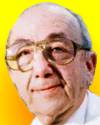
Born 16 Jan 1919; died 6 Sep 2012 at age 93. quotes
Jerome Phillip Horwitz was an American cancer researcher who first synthesized azidothymidine, AZT (1964), while seeking an effective cancer drug. For this application, it failed. He discontinued development and did not patent it. Yet, 22 years later, AZT was given federal approval, as the first drug proved to extend AIDS patent’s lives when tested and patented by Burroughs Wellcome. Although that drug company reaped great financial rewards from it, Horwitz never received any royalties. With colleagues, Horwitz had investigated AZT as one of a family of compounds he called dideoxythymidines which were “fraudulent” nucleosides (a component of DNA). It had been hoped that such a molecule injected in cancer cells might retard their growth.«
Jerome Phillip Horwitz was an American cancer researcher who first synthesized azidothymidine, AZT (1964), while seeking an effective cancer drug. For this application, it failed. He discontinued development and did not patent it. Yet, 22 years later, AZT was given federal approval, as the first drug proved to extend AIDS patent’s lives when tested and patented by Burroughs Wellcome. Although that drug company reaped great financial rewards from it, Horwitz never received any royalties. With colleagues, Horwitz had investigated AZT as one of a family of compounds he called dideoxythymidines which were “fraudulent” nucleosides (a component of DNA). It had been hoped that such a molecule injected in cancer cells might retard their growth.«
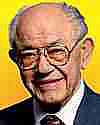
Born 16 Jan 1901; died 27 Jul 1988 at age 87.
American inventor known for his invention of the Zamboni ice resurfacer used in ice skating rinks. In 1939, Zamboni was a partner in building Iceland Skating Rink in California, when maintaining the ice surface was very labor instensive and slow. At the time, a tractor dragging a scraper was used, with several workers removing shaving and manually finishing the surface. From Mar 1942, Zamboni began experimenting to find a better way. After several prototypes, by 1949, he had made improvements and had his Model A machine worthy of patenting (23 Jun 1953, U.S. No. 2,642,679). It combined the processes of scraping, removing shaving, and applying a wash water system. His idea drew requests from other rink operators. He began manufacturing, with continuing improvements in his design, and it became a familiar sight for ice hockey games.«
American inventor known for his invention of the Zamboni ice resurfacer used in ice skating rinks. In 1939, Zamboni was a partner in building Iceland Skating Rink in California, when maintaining the ice surface was very labor instensive and slow. At the time, a tractor dragging a scraper was used, with several workers removing shaving and manually finishing the surface. From Mar 1942, Zamboni began experimenting to find a better way. After several prototypes, by 1949, he had made improvements and had his Model A machine worthy of patenting (23 Jun 1953, U.S. No. 2,642,679). It combined the processes of scraping, removing shaving, and applying a wash water system. His idea drew requests from other rink operators. He began manufacturing, with continuing improvements in his design, and it became a familiar sight for ice hockey games.«
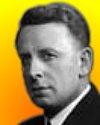
Born 16 Jan 1881; died 14 Sep 1960 at age 79.
English engineer who was a major figure in developing techniques for manufacturing radar components. During WW I, Fleming made important advances in submarine-detection gear. In 1920, as a pioneer in the development of radio, he established in Manchester the second British transmitting station to broadcast programs on a daily basis. His work on demountable, high-power thermionic tubes made it possible to establish radar stations in Great Britain by the time WW II began in 1939.
English engineer who was a major figure in developing techniques for manufacturing radar components. During WW I, Fleming made important advances in submarine-detection gear. In 1920, as a pioneer in the development of radio, he established in Manchester the second British transmitting station to broadcast programs on a daily basis. His work on demountable, high-power thermionic tubes made it possible to establish radar stations in Great Britain by the time WW II began in 1939.
Born 16 Jan 1875; died 9 Oct 1949 at age 74.
German-American chemist.
German-American chemist.
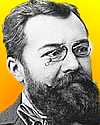
Born 16 Jan 1853; died 4 Apr 1931 at age 78.
French industrialist who, with his younger brother Édouard, founded Michelin Tyre Co. in 1888, expanding the rubber company established (1832) by their grandfather, Aristide Barbier, and Nicolas Edouard Daubree. The Michelins made the first pneumatic tyres that could be easily removed for repair, for bicycles (1891) and for automobiles (1895). They introduced tire tread patterns, low-pressure balloon tires, and steel-cord tires. The company created a tourist guide organization which placed milestones on French roads and established a standard road map service for most of Europe. André created Michelin guides to promote tourism by car. The first Red Guide, with restaurant ratings, was published in 1900.« more
French industrialist who, with his younger brother Édouard, founded Michelin Tyre Co. in 1888, expanding the rubber company established (1832) by their grandfather, Aristide Barbier, and Nicolas Edouard Daubree. The Michelins made the first pneumatic tyres that could be easily removed for repair, for bicycles (1891) and for automobiles (1895). They introduced tire tread patterns, low-pressure balloon tires, and steel-cord tires. The company created a tourist guide organization which placed milestones on French roads and established a standard road map service for most of Europe. André created Michelin guides to promote tourism by car. The first Red Guide, with restaurant ratings, was published in 1900.« more
The Michelin Men: Driving an Empire, by Herbert Lottman. - book suggestion.
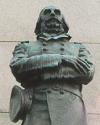
Born 16 Jan 1807; died 18 Feb 1877 at age 70.
U.S. naval officer and scientist who published several hydrographic studies, was a superintendent of the Naval Observatory (1865–67, 1874–77) and worked to further scientific progress. Between his naval duties at sea, he studied mathematics at Harvard. He made the first comprehensive survey of the coasts of Massachusetts, Rhode Island, and Maine, including the intricate Nantucket shoals area. He helped establish and then supervised the preparation of the American Nautical Almanac (1849) for several years. Davis was a co-founder of the National Academy of Sciences (1863), and wrote several scientific books.«
U.S. naval officer and scientist who published several hydrographic studies, was a superintendent of the Naval Observatory (1865–67, 1874–77) and worked to further scientific progress. Between his naval duties at sea, he studied mathematics at Harvard. He made the first comprehensive survey of the coasts of Massachusetts, Rhode Island, and Maine, including the intricate Nantucket shoals area. He helped establish and then supervised the preparation of the American Nautical Almanac (1849) for several years. Davis was a co-founder of the National Academy of Sciences (1863), and wrote several scientific books.«
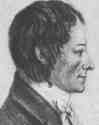
Born 16 Jan 1767; died 11 Feb 1813 at age 46.
Swedish chemist who in 1802 discovered the element tantalum. A graduate of the University of Uppsala (1788) he began teaching at Uppsala (1794), introducing the chemistry of Antoine-Laurent Lavoisier. He continued his experiments despite partial deafness from a childhood infection and one eye blinded by an exploding flask (1801). His most notable student was Jöns Jacob Berzelius.
Swedish chemist who in 1802 discovered the element tantalum. A graduate of the University of Uppsala (1788) he began teaching at Uppsala (1794), introducing the chemistry of Antoine-Laurent Lavoisier. He continued his experiments despite partial deafness from a childhood infection and one eye blinded by an exploding flask (1801). His most notable student was Jöns Jacob Berzelius.
Born 16 Jan 1730; died 20 Apr 1794 at age 64.
French lawyer and natural scientist who pursued his interest in astronomy both as a productive amatuer and a patron. He assembled a significant collection of astronomical instruments made by renowned craftsmen. He both utilized then himself and gave access to his academic colleagues. In collaboration with Charles Messier, who provided the data, he calculated orbits of comets, helping his friend find them again after they had disappeared behind the sun. He funded the publication of Laplace's Theory of the Movement and Elliptic Figure of the Planets (1784). Bochart made calculations for what was at first called Herschel's comet, supposing a circular orbit at twelve time the Sun-Saturn distance. This was refined by Laplace, and contributed to the discovery of Uranus. Bochart died as a politician guillotined during the French Revolution..«
French lawyer and natural scientist who pursued his interest in astronomy both as a productive amatuer and a patron. He assembled a significant collection of astronomical instruments made by renowned craftsmen. He both utilized then himself and gave access to his academic colleagues. In collaboration with Charles Messier, who provided the data, he calculated orbits of comets, helping his friend find them again after they had disappeared behind the sun. He funded the publication of Laplace's Theory of the Movement and Elliptic Figure of the Planets (1784). Bochart made calculations for what was at first called Herschel's comet, supposing a circular orbit at twelve time the Sun-Saturn distance. This was refined by Laplace, and contributed to the discovery of Uranus. Bochart died as a politician guillotined during the French Revolution..«
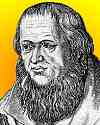
Born 16 Jan 1477; died 16 Jan 1547 at age 70.
German geographer who is noted for making and printing geographical globes. A notable work from 1515 is one of the earliest surviving globes produced following the discovery of new lands by Christopher Columbus. It was the first to show the name America that had been suggested by Waldseemüller. Tantalizingly, it also depicts a passage around South America before it was recorded as having been discovered by Magellan. Schöner was a professor mathematics at the University of Nuremberg and was the author of numerous mathematical, astronomical and geographical works. In his first career, he was an ordained Roman Catholic priest, which he gave up on becoming a university professor and converted to a Lutheran.«[Image as depicted in Jean-Jacques Boissard, Bibliotheca chalcographica (1669).]
German geographer who is noted for making and printing geographical globes. A notable work from 1515 is one of the earliest surviving globes produced following the discovery of new lands by Christopher Columbus. It was the first to show the name America that had been suggested by Waldseemüller. Tantalizingly, it also depicts a passage around South America before it was recorded as having been discovered by Magellan. Schöner was a professor mathematics at the University of Nuremberg and was the author of numerous mathematical, astronomical and geographical works. In his first career, he was an ordained Roman Catholic priest, which he gave up on becoming a university professor and converted to a Lutheran.«[Image as depicted in Jean-Jacques Boissard, Bibliotheca chalcographica (1669).]
Johann Schöner’s Globe of 1515: Transcription and Study, by Chet Van Duzer. - book suggestion.

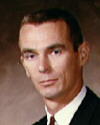
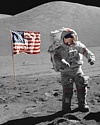
American astronaut who travelled into space three times. When he left his spacecraft for more than two hours during the Gemini 9 mission (1966), he was the second American to make a tethered extravehicular activity. As a member of the Apollo 10 flight (launched 18 May 1969), he piloted the lunar module to within 10 miles of the lunar surface. As Commander of the Apollo 17 lunar-landing mission (launched 7 Dec 1972) he was the last of 12 humans to walk on the moon. In this final part of the Apollo program, he landed with a geologist-astronaut, Harrison H. Schmitt, near the Sea of Serenity. The bluish-gray and tan rocks they collected were 4 billion years old. They also brought back orange-red soil samples.«
The Last Man on the Moon: Astronaut Eugene Cernan and America's Race in Space, by Eugene Cernan and Donald A. Davis. - book suggestion.
Died 16 Jan 2002 at age 85 (born 31 Aug 1916). quotes
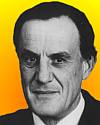
English astronomer who was a pioneer in radar and observational astronomy. During and after WW II he worked with R.A. Watson-Watt and then E.G. Bowen to develop radar for uses in aerial combat. In the 1950s he applied this experience to radio astronomy, developing radio-telescope technology at Jodrell Bank Observatory and mapping stellar radio sources. He designed a radio interferometer capable of resolving radio stars while eliminating atmospheric distortion from the image (1952). With R.Q. Twiss, Brown applied this method to measuring the angular size of bright visible stars, thus developing the technique of intensity interferometry. They set up an intensity interferometer at Narrabri in New South Wales, Australia, for measurements of hot stars.«
English astronomer who was a pioneer in radar and observational astronomy. During and after WW II he worked with R.A. Watson-Watt and then E.G. Bowen to develop radar for uses in aerial combat. In the 1950s he applied this experience to radio astronomy, developing radio-telescope technology at Jodrell Bank Observatory and mapping stellar radio sources. He designed a radio interferometer capable of resolving radio stars while eliminating atmospheric distortion from the image (1952). With R.Q. Twiss, Brown applied this method to measuring the angular size of bright visible stars, thus developing the technique of intensity interferometry. They set up an intensity interferometer at Narrabri in New South Wales, Australia, for measurements of hot stars.«
Boffin: A Personal Story of the Early Days of Radar, Radio Astronomy... , by R. Hanbury Brown. - book suggestion.
Died 16 Jan 2000 at age 85 (born 4 Mar 1914). quotes
Robert Rathbun Wilson was an American physicist who was the first director of Fermilab. From 1967, he led the design and construction of Fermilab (the Fermi National Accelerator Laboratory) near Chicago, Illinois. He also improved the environment by restoring prairie at the site. It began operating in 1972 with the world's most powerful particle accelerator. With later improvements, it retained that status for well over three decades until it was superceded by the LHC (Large Hadron Collider) at the CERN laboratory in Geneva, Switzerland. Wilson is remembered for his justification of the needed financing at a Senate hearing in 1969, where he said “It has nothing to do with defending our country, except to make it worth defending.” He resigned in 1978 because he did not believe the government was giving it sufficient funding for its research mission.«
Robert Rathbun Wilson was an American physicist who was the first director of Fermilab. From 1967, he led the design and construction of Fermilab (the Fermi National Accelerator Laboratory) near Chicago, Illinois. He also improved the environment by restoring prairie at the site. It began operating in 1972 with the world's most powerful particle accelerator. With later improvements, it retained that status for well over three decades until it was superceded by the LHC (Large Hadron Collider) at the CERN laboratory in Geneva, Switzerland. Wilson is remembered for his justification of the needed financing at a Senate hearing in 1969, where he said “It has nothing to do with defending our country, except to make it worth defending.” He resigned in 1978 because he did not believe the government was giving it sufficient funding for its research mission.«
Died 16 Jan 1967 at age 65 (born 20 Dec 1901).
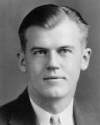
American physicist and inventor of the Van de Graaff generator, a type of high-voltage electrostatic generator that can be used as a particle accelerator in atomic research. The potential differences achieved in modern Van de Graaff generators can be up to 5 MV. It is a principle of electric fields that charges on a surface can leap off at points where the curvature is great, that is, where the radius is small. Thus, a dome of great radius will inhibit the electric discharge and added charge can reach a high voltage. This generator has been used in medical (such as high-energy X-ray production) and industrial applications (sterilization of food). In the 1950s, Van de Graaff invented the insulating core transformer able to produce high voltage direct current.«
American physicist and inventor of the Van de Graaff generator, a type of high-voltage electrostatic generator that can be used as a particle accelerator in atomic research. The potential differences achieved in modern Van de Graaff generators can be up to 5 MV. It is a principle of electric fields that charges on a surface can leap off at points where the curvature is great, that is, where the radius is small. Thus, a dome of great radius will inhibit the electric discharge and added charge can reach a high voltage. This generator has been used in medical (such as high-energy X-ray production) and industrial applications (sterilization of food). In the 1950s, Van de Graaff invented the insulating core transformer able to produce high voltage direct current.«
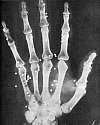
Died 16 Jan 1941 (born Mar 1863).
English radiologist who pioneered the clinical use of X-rays in the UK, beginning shortly after Wilhelm Röntgen announced their discovery. He was present at the first clinical use of X-rays in England, (7 Feb 1896) in the laboratory of Oliver Lodge, head of the physics department at Liverpool University. The wrist of a 12-year-old boy who had shot himself the previous month was examined. The boy had been brought there by surgeon Sir Robert Jones who with Lodge reported the case in the 22 Feb 1896 of The Lancet. Jones subsequently financed an X-ray apparatus for Holland to pioneer radiology at Royal Southern Hospital, Liverpool. During WWI, he perfected methods of detecting bullets and shell fragments in patients' bodies.«[Image: X-ray from 1896 of hand with buckshot made at Columbia University, USA]
English radiologist who pioneered the clinical use of X-rays in the UK, beginning shortly after Wilhelm Röntgen announced their discovery. He was present at the first clinical use of X-rays in England, (7 Feb 1896) in the laboratory of Oliver Lodge, head of the physics department at Liverpool University. The wrist of a 12-year-old boy who had shot himself the previous month was examined. The boy had been brought there by surgeon Sir Robert Jones who with Lodge reported the case in the 22 Feb 1896 of The Lancet. Jones subsequently financed an X-ray apparatus for Holland to pioneer radiology at Royal Southern Hospital, Liverpool. During WWI, he perfected methods of detecting bullets and shell fragments in patients' bodies.«[Image: X-ray from 1896 of hand with buckshot made at Columbia University, USA]
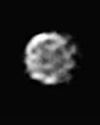
Died 16 Jan 1938 at age 79 (born 15 Feb 1858).
American astronomer who discovered Phoebe, the ninth moon of Saturn (1899). This was the first planetary satellite with retrograde motion to be detected, i.e., with orbital motion directed in an opposite sense to that of the planets. He set up a number of observing stations for Harvard. He made extensive observations of Mars and claimed, like Lowell, that he saw signs of life on the planet by observing what he took to be oases in 1892. He went further than Lowell however when in 1903 he claimed to observe signs of life on the Moon. By comparing descriptions of the Moon from Giovanni Riccioli’s 1651 chart onward, he thought he had detected changes that could have been due to the growth and decay of vegetation.[Image: Voyager Image of Phoebe.][DSB gives date of death 16 Jan 1938. EB gives 17 Jan 1938.]
American astronomer who discovered Phoebe, the ninth moon of Saturn (1899). This was the first planetary satellite with retrograde motion to be detected, i.e., with orbital motion directed in an opposite sense to that of the planets. He set up a number of observing stations for Harvard. He made extensive observations of Mars and claimed, like Lowell, that he saw signs of life on the planet by observing what he took to be oases in 1892. He went further than Lowell however when in 1903 he claimed to observe signs of life on the Moon. By comparing descriptions of the Moon from Giovanni Riccioli’s 1651 chart onward, he thought he had detected changes that could have been due to the growth and decay of vegetation.[Image: Voyager Image of Phoebe.][DSB gives date of death 16 Jan 1938. EB gives 17 Jan 1938.]
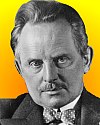
Died 16 Jan 1936 at age 56 (born 1 Nov 1879).
German engineer who designed the first miniature camera (1913), the Leica I. Its commercial introduction, delayed by WW I, was made in 1924 by the Ernst Leitz optical firm at Wetzlar, Germany where he was employed. Barnack was an enthusiastic photographer from when only heavy plate cameras were available. As early 1905, he conceived using a reduced format negative, to be enlarged after exposure. He adapted his idea from equipment he made to take still exposures on samples of cine film to test their sensitivity and consistency before movie use. For this camera, Barnack established the standard 35-mm film picture size by doubling the standard 18x24mm cine frame. His invention had only 1/250 of the weight of a plate camera.
German engineer who designed the first miniature camera (1913), the Leica I. Its commercial introduction, delayed by WW I, was made in 1924 by the Ernst Leitz optical firm at Wetzlar, Germany where he was employed. Barnack was an enthusiastic photographer from when only heavy plate cameras were available. As early 1905, he conceived using a reduced format negative, to be enlarged after exposure. He adapted his idea from equipment he made to take still exposures on samples of cine film to test their sensitivity and consistency before movie use. For this camera, Barnack established the standard 35-mm film picture size by doubling the standard 18x24mm cine frame. His invention had only 1/250 of the weight of a plate camera.
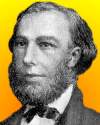
Died 16 Jan 1874 at age 48 (born 25 Mar 1825). quotes
German zoologist and cytologist, known especially for his researches in microscopic anatomy. He altered the conception of the cell, emphasizing not the membrane, but the living mass of protoplasm with a nucleus (1861). He pointed out that some cells, for example those of the embryo, do not have bounding membranes. He recognized the protoplasm, with its nucleus, as the fundamental substance found in both plants and animals. Schultze also studied protozoa, and demonstrated minute nerve endings in the ear (1858), nose (1863), and retina (1866). He was an outstanding histologist, introducing several new techniques in histology, including the use of osmic acid for staining fine details of cells. His sudden death in 1874 was caused by a perforated ulcer.
German zoologist and cytologist, known especially for his researches in microscopic anatomy. He altered the conception of the cell, emphasizing not the membrane, but the living mass of protoplasm with a nucleus (1861). He pointed out that some cells, for example those of the embryo, do not have bounding membranes. He recognized the protoplasm, with its nucleus, as the fundamental substance found in both plants and animals. Schultze also studied protozoa, and demonstrated minute nerve endings in the ear (1858), nose (1863), and retina (1866). He was an outstanding histologist, introducing several new techniques in histology, including the use of osmic acid for staining fine details of cells. His sudden death in 1874 was caused by a perforated ulcer.
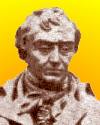
Died 16 Jan 1806 at age 63 (born 6 Dec 1742).
French surgeon and chemist who in 1790 developed the process for making soda ash (sodium carbonate) from common salt (sodium chloride). This process, which bears his name, became one of the most important industrial chemical processes of the 19th century. In the Leblanc process, salt was treated with sulphuric acid to obtain salt cake (sodium sulphate). This was then roasted with limestone or chalk and coal to produce black ash, which consisted primarily of sodium carbonate and calcium sulphide. The sodium carbonate was dissolved in water and then crystallized. The Leblanc process was simple, cheap, and direct, but because of the disruption of the French Revolution, he profitted little from it. He died by suicide in 1806.
French surgeon and chemist who in 1790 developed the process for making soda ash (sodium carbonate) from common salt (sodium chloride). This process, which bears his name, became one of the most important industrial chemical processes of the 19th century. In the Leblanc process, salt was treated with sulphuric acid to obtain salt cake (sodium sulphate). This was then roasted with limestone or chalk and coal to produce black ash, which consisted primarily of sodium carbonate and calcium sulphide. The sodium carbonate was dissolved in water and then crystallized. The Leblanc process was simple, cheap, and direct, but because of the disruption of the French Revolution, he profitted little from it. He died by suicide in 1806.
Died 16 Jan 1547 at age 70 (born 16 Jan 1477).
German geographer who is noted for making and printing geographical globes. A notable work from 1515 is one of the earliest surviving globes produced following the discovery of new lands by Christopher Columbus. It was the first to show the name America that had been suggested by Waldseemüller. Tantalizingly, it also depicts a passage around South America before it was recorded as having been discovered by Magellan. Schöner was a professor mathematics at the University of Nuremberg and was the author of numerous mathematical, astronomical and geographical works. In his first career, he was an ordained Roman Catholic priest, which he gave up on becoming a university professor and converted to a Lutheran.«[Image as depicted in Jean-Jacques Boissard, Bibliotheca chalcographica (1669).]
German geographer who is noted for making and printing geographical globes. A notable work from 1515 is one of the earliest surviving globes produced following the discovery of new lands by Christopher Columbus. It was the first to show the name America that had been suggested by Waldseemüller. Tantalizingly, it also depicts a passage around South America before it was recorded as having been discovered by Magellan. Schöner was a professor mathematics at the University of Nuremberg and was the author of numerous mathematical, astronomical and geographical works. In his first career, he was an ordained Roman Catholic priest, which he gave up on becoming a university professor and converted to a Lutheran.«[Image as depicted in Jean-Jacques Boissard, Bibliotheca chalcographica (1669).]
Johann Schöner’s Globe of 1515: Transcription and Study, by Chet Van Duzer. - book suggestion.
In 2006, the Stardust capsule successfully returned to Earth, carrying dust from a comet, which could shed light on the origins of our planetary system. It ended its six-year mission by entering the atmosphere at 28,860 mph - faster than any other man-made object before. Its speed was reduced to 14.8 feet per second as it parachuted back to the United States, and was retrieved by NASA scientists. It was the first successful collection of cometary and interstellar material, and the first rock samples taken from space since the Apollo missions. A prior attempt by the same team to retrieve solar wind particles, the Genesis return probe, ended 16 months earlier without properly opening its parachute and had been badly damaged by hitting the ground at 193 mph.«
In 1991, astronomers report the discovery of two extremely large and hot stars by the Hubble Space Telescope.
In 1980, scientists in Boston produce interferon, a natural virus-fighting substance through genetic engineering.
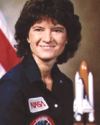
Ride
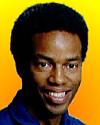
Bluford
In 1973, USSR's Lunakhod 2 begins radio-controlled exploration of the Moon.
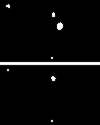
Optical pulsar “on” and “off.”
In 1969, an optical pulsar was identified for the first time by University of Arizona astronomers led by John Cocke and Michael Disney at the Steward Observatory. It was discovered in the Crab Nebula. Fourteen months before, the first type of pulsar to be discovered was in the radio spectrum and was detected on 28 Nov 1967 by Jocelyn Bell, a graduate student of Anthony Hewish. Most pulsars emit regular pulses of radio waves, some up to 1,000 pulses per second,. They are believed to be neutron stars with exceedingly rapid spin. Optical pulsars flash at a similar rate, which is too fast for the eye to perceive. The Arizona astronomers used a stroboscopic technique to look at a known radio spectrum pulsar, at a time when an optical pulsar was only a theoretical question. Only a handful have been found since.«
In 1969, two manned Soviet Soyuz spaceships (Soviet Soyuz 4 and Soyuz 5) became the first vehicles to dock in space and transfer personnel.
In 1964, the first angioplasty was performed by physician Charles Dotter, a vascular radiologist. This ground-breaking procedure to open a blocked blood vessel saved the patient from a potential leg amputation, and she left the hospital with only a Band-Aid. The pioneering method used no costly, traumatic surgery, no stitches and left no scars. Instead, Dotter used only a tiny pinhole for access, and used medical imaging to see inside the body without the need for open surgery. He created a new medical approach of minimally invasive, image-guided procedures (MIIP) which now is usaed to treat a broad range of diseases throughout the body. In 1978, Dotter was nominated (but not selected) for a Nobel Prize in Medicine.«
In 1957, three B-52's took off from Castle Air Force Base in California on the first nonstop, round-the-world flight by jet planes. The trip lasted 45 hours and 19 minutes.
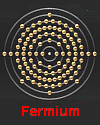
In 1953, a sample amounting to about 200 atoms of fermium (Fm, atomic number 100) was first discovered by ion-exchange chromatography and identified at the University of California, Berkeley. Like einsteinium, fermium was first isolated from the debris of the Nov 1952 test of the hydrogen-bomb (called the “Mike” event, conducted at Eniwetok Atoll in the Pacific Ocean). Samples of debris were collected by drone aircraft flying through the cloud. For security reasons, it was kept secret until 1955 [See Phys. Rev., 99,1048 (1955)]. Because it is so short-lived, scientists doubt that enough fermium will ever be obtained to be weighed. Fermium was the eighth transuranium element of the actinide series to be discovered, and was named in honour of Enrico Fermi.
In 1936, the first photofinish camera was installed at a U.S. racetrack. The electric eye was used for races at Hialeah, Florida.
In 1909, British explorer Ernest Shackleton claimed to have found the magnetic south pole.
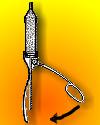
(USPTO)
In 1894, Canadian inventor Theodore Witte of Chilliwhack, British Columbia, was issued a U.S. patent for a "Puttying-Tool" to improve the application "of putty to window sashes and similar things." It incorporated the ratcheted feed now familiar in the caulking gun (No. 512930). The putty is placed in a tube fitted with a nozzle at one end, and a ratcheted lever-operated piston at the other which moves longitudinally through the body in order to squeeze the compound out through the nozzle. The lever is "manipulated so as to force the putty outward as fast as is necessary, and the nozzle is dragged over the surface to be puttied," until the whole mass within the body is ejected from the nozzle. The method has since been adopted to apply a variety of construction materials, including caulking and glue.«
In 1877, the first U.S. patent for a color organ was issued to Bainbridge Bishop.
In 1877, a U.S. patent was issued for a carpet power loom to weave Axminster carpets to Halcyon Skinner and his employer, Alexander Smith, both of Yonkers, New York (No. 186374). The loom was intended to securely weave tufting material into the carpet during the operations in the interweaving of the threads to form the fabric, suitable for the "Moquette" type of fabrics. Skinner was worked as a master mechanic for the carpet manufacturer Alexander Smith and Co., which became a leading carpet producer as a result of Skinner's machines. Skinner's other patents included not only more inventions for power-looms, but also a Carpenter's Gage (22 Aug 1854, No. 11572), an Apparatus for Teaching Spelling (2 Feb 1866, No. 52758), and a Motor-Truck for Street-Cars (11 Oct 1887, No. 371383).«
In 1868, a patent for a refrigerator car, “ice box on wheels,” was granted to William Davis, a fish dealer in Detroit, Mich. (who also designed the first railroad refrigerated car).
In 1866, Everett Hosmer Barney patented the all-metal screw clamp skates, which attached to normal shoes and were tightened with a key. Clamp skates dropped out of popularity with the advent of modern athletic shoes, which lacked a hard edge where the roller skates could be clamped.
In 1795, Jacob Perkins, of Newburyport, Massachusetts, was awarded a U.S. patent for a machine for cutting and heading nails. It was the second year of President George Washington's second term. In 1795, he was issued a patent for an improved nail machine. He established a nail maufacturing business on the Powwow River in Amesbury, Mass. He eventually held 21 American patents, and 19 more in England.