|
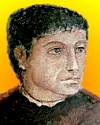
Cardinal Nicholas de Cusa
(1401 - 11 Aug 1464)
German scholar, philosopher and theologian who envisioned that the universe was infinite, that the Earth and Sun were not at its center, and that the orbits of the planets were not perfect circles.
|
Science Quotes by Cardinal Nicholas de Cusa (5 quotes)
Also the earth is not spherical, as some have said, although it tends toward sphericity, for the shape of the universe is limited in its parts as well as its movement… . The movement which is more perfect than others is, therefore, circular, and the corporeal form which is the most perfect is the sphere.
— Cardinal Nicholas de Cusa
In every science certain things must be accepted as first principles if the subject matter is to be understood; and these first postulates rest upon faith.
— Cardinal Nicholas de Cusa
As quoted, without citation, in Ronald Keast, Dancing in the Dark: The Waltz in Wonder of Quantum Metaphysics (2009), 104-105. If you know a primary source, please contact Webmaster.
Note the saying of Protagoras that man is the measure of things. With the senses man measures perceptible things, with the intellect he measures intelligible things, and he attains unto supra-intelligible things transcendently
— Cardinal Nicholas de Cusa
Dialog, 'De Beryllo' (1458). As translated in Jasper Hopkins, Complete Philosophical and Theological Treatises of Nicholas of Cusa: De visione Dei (2001), Vol. 2, 793.
The universe, then, has no circumference, for, if it had a center and a circumference, it would thus have in itself its beginning and its end, and the universe itself would be terminated by relation to something else; there would be outside the universe another thing and a place—but all this contains no truth.
— Cardinal Nicholas de Cusa
Whether a man is on the earth, or the sun, or some other star, it will always seem to him that the position that he occupies is the motionless center, and that all other things are in motion.
— Cardinal Nicholas de Cusa
…...
See also:
- 11 Aug - short biography, births, deaths and events on date of Cusa's death.
- Nicholas of Cusa: Selected Spiritual Writings, by Nicholas of Cusa and H. Lawrence Bond (trans.). - book suggestion.
 In science it often happens that scientists say, 'You know that's a really good argument; my position is mistaken,' and then they would actually change their minds and you never hear that old view from them again. They really do it. It doesn't happen as often as it should, because scientists are human and change is sometimes painful. But it happens every day. I cannot recall the last time something like that happened in politics or religion.
(1987) --
In science it often happens that scientists say, 'You know that's a really good argument; my position is mistaken,' and then they would actually change their minds and you never hear that old view from them again. They really do it. It doesn't happen as often as it should, because scientists are human and change is sometimes painful. But it happens every day. I cannot recall the last time something like that happened in politics or religion.
(1987) --