 (source)
|
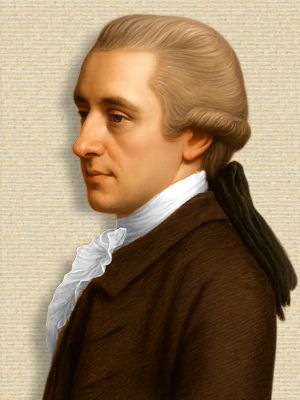
William Hewson
(14 Nov 1739 - 1 May 1774)
British anatomist and physiologist , often called the “father of hematology” for his pioneering studies about the components of blood.
|
Science Quotes by William Hewson (7 quotes)
An Inquiry into the Properties of the Blood, it is presumed, will be thought, in a particular manner, interesting, since there is no part of the human body upon which more physiological reasoning is founded, nor any from which more inferences are drawn for the cure of diseases.
— William Hewson
From Preface, An Inquiry into the Properties of the Blood with Remarks on Some of Its Morbid Appearances (1772), collected in William Hewson and George Gulliver (ed.), The Works of William Hewson, F.R.S (1846), lv.
In these experiments I found that these [red] particles of the blood were as flat as a guinea. I likewise observed that they had a dark spot in the middle,… but,upon a careful examination, I found it was not a perforation, and therefore that they were not annular.
— William Hewson
In Paper, read 17 Jun 1773 to the Royal Society, 'On the Figure and Composition of the Red Particles of the Blood, Commonly Called the Red Globules', published in Philosophical Transactions (1773), 63, 307.
It is a curious and important fact, that these particles are found so generally through the animal kingdom; that is, they are found in the human species, in all quadrupeds, in all birds, in all amphibious animals, and in all fish, in which animals they are red, and colour the blood. The blood
even of insects contains particles similar in shape to those of the blood of more perfect animals, but differing in colour. In water insects, as lobsters and shrimps, these particles are white; in some land insects, as the caterpillar and the grass-hopper they appear of a faint green, when in the vessels as I am persuaded from experiments. I have seen them in an insect no bigger than a pin’s head, and suspect they exist almost universally through the animal kingdom.
— William Hewson
In Paper, read 17 Jun 1773 to the Royal Society, 'On the Figure and Composition of the Red Particles of the Blood, Commonly Called the Red Globules', published in Philosophical Transactions (1773), 63, 303-304.
It will appear wonderful, that the figure of these particles should have been mistaken; but our wonder will be lessened, when we consider how many obvious things are overlooked, till our attention is very particularly directed to them.
— William Hewson
In Paper, read 17 Jun 1773 to the Royal Society, 'On the Figure and Composition of the Red Particles of the Blood, Commonly Called the Red Globules', published in Philosophical Transactions (1773), 63, 306.
Of all the animals which I have examined, the [blood] particles are largest in the fish called a skate; next to the skate they are largest in a frog and a viper, and other animals of this class; they are somewhat smaller in the common fish, as the salmon, cod, and eel. In birds they are smaller than in fish; in the human subject smaller than in birds and in some quadrupeds still smaller than in the human subject. … They are flat in all animals.
— William Hewson
In Paper, read 17 Jun 1773 to the Royal Society, 'On the Figure and Composition of the Red Particles of the Blood, Commonly Called the Red Globules', published in Philosophical Transactions (1773), 63, 308. A figure included with the article shows the relative blood particle sizes in a number of different animals.
The red particles of the blood in the human subject have, since the time of Leeuwenhoeck, been so generally allowed to be spherical, that in almost all books of physiology they are denominated red globules. A few authors, however, have at different times doubted whether they were spheres…. I have made some new observations of these particles.
— William Hewson
In Article, read 17 Jun 1773 to the Royal Society, 'On the Figure and Composition of the Red Particles of the Blood, Commonly Called the Red Globules', published in Philosophical Transactions (1773), 63, 303.
These [red] particles of the blood, improperly called globules, are in reality flat bodies.
— William Hewson
In Paper, read 17 Jun 1773 to the Royal Society, 'On the Figure and Composition of the Red Particles of the Blood, Commonly Called the Red Globules', published in Philosophical Transactions (1773), 63, 306.
See also:
- 14 Nov - short biography, births, deaths and events on date of Hewson's birth.
- The Works Of William Hewson (1846), by William Hewson & George Gulliver (ed.). - book suggestion.
 In science it often happens that scientists say, 'You know that's a really good argument; my position is mistaken,' and then they would actually change their minds and you never hear that old view from them again. They really do it. It doesn't happen as often as it should, because scientists are human and change is sometimes painful. But it happens every day. I cannot recall the last time something like that happened in politics or religion.
(1987) --
In science it often happens that scientists say, 'You know that's a really good argument; my position is mistaken,' and then they would actually change their minds and you never hear that old view from them again. They really do it. It doesn't happen as often as it should, because scientists are human and change is sometimes painful. But it happens every day. I cannot recall the last time something like that happened in politics or religion.
(1987) --