 (source)
|
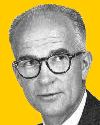
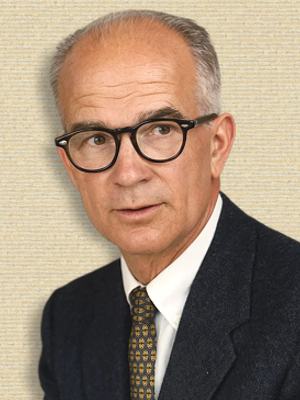
William B. Shockley
(13 Feb 1910 - 12 Aug 1989)
English-American physicist and engineer who shared (with John Bardeen and Walter H. Brattain) the 1956 Nobel Prize for Physics for their development of the transistor
|
Science Quotes by William B. Shockley (3 quotes)
Frequently, I have been asked if an experiment I have planned is pure or applied science; to me it is more important to know if the experiment will yield new and probably enduring knowledge about nature. If it is likely to yield such knowledge, it is, in my opinion, good fundamental research; and this is more important than whether the motivation is purely aesthetic satisfaction on the part of the experimenter on the one hand or the improvement of the stability of a high-power transistor on the other.
— William B. Shockley
Quoted in Richard R. Nelson, 'The Link Between Science and Invention: The Case of the Transistor,' The Rate and Direction of the Inventive Activity (1962). In Daniel S. Greenberg, The Politics of Pure Science (1999), 32, footnote.
I am overwhelmed by an irresistible temptation to do my climb by moonlight and unroped. This is contrary to all my rock climbing teaching & does not mean poor training, but only a strong-headedness.
— William B. Shockley
An undated note in an envelope containing Walter Brattain’s plea (1947) to keep the transistor team together. As quoted in Joel N. Shurkin, Broken Genius: The Rise and Fall of William Shockley, Creator of the Electronic Age (2006), 125.
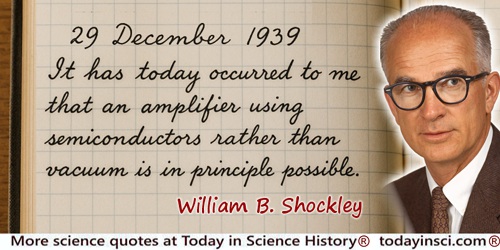
It has today occurred to me that an amplifier using semiconductors rather than vacuum is in principle possible.
Laboratory notebook (29 Dec 1939).
Laboratory notebook (29 Dec 1939).
— William B. Shockley
In Michael Dudley Sturge , Statistical and Thermal Physics (2003), 251.
Quotes by others about William B. Shockley (2)
I can’t work well under the conditions at Bell Labs. Walter [Brattain] and I are looking at a few questions relating to point-contact transistors, but [William] Shockley keeps all the interesting problems for himself.
From conversation with Frederick Seitz as quoted in Lillian Hoddeson, 'John Bardeen: A Place to Win Two Nobel Prizes and Make a Hole in One', collected in Lillian Hoddeson (ed.), No Boundaries: University of Illinois Vignettes (2004), Chap. 16, 242.
On the morning of 1 November 1956 the US physicist John Bardeen dropped the frying-pan of eggs that he was cooking for breakfast, scattering its contents on the kitchen floor. He had just heard that he had won the Nobel Prize for Physics along with William Shockley and Walter Brattain for their invention of the transistor. That evening Bardeen was startled again, this time by a parade of his colleagues from the University of Illinois marching to the door of his home bearing champagne and singing “For He’s a Jolly Good Fellow”.
In Abstract for 'John Bardeen: An Extraordinary Physicist', Physics World (2008), 21, No. 4, 22.
See also:
- 13 Feb - short biography, births, deaths and events on date of Shockley's birth.
- Broken Genius: Rise and Fall of William Shockley, Creator of the Electronic Age, by Joel N. Shurkin. - book suggestion.
 In science it often happens that scientists say, 'You know that's a really good argument; my position is mistaken,' and then they would actually change their minds and you never hear that old view from them again. They really do it. It doesn't happen as often as it should, because scientists are human and change is sometimes painful. But it happens every day. I cannot recall the last time something like that happened in politics or religion.
(1987) --
In science it often happens that scientists say, 'You know that's a really good argument; my position is mistaken,' and then they would actually change their minds and you never hear that old view from them again. They really do it. It doesn't happen as often as it should, because scientists are human and change is sometimes painful. But it happens every day. I cannot recall the last time something like that happened in politics or religion.
(1987) --