 (source)
|
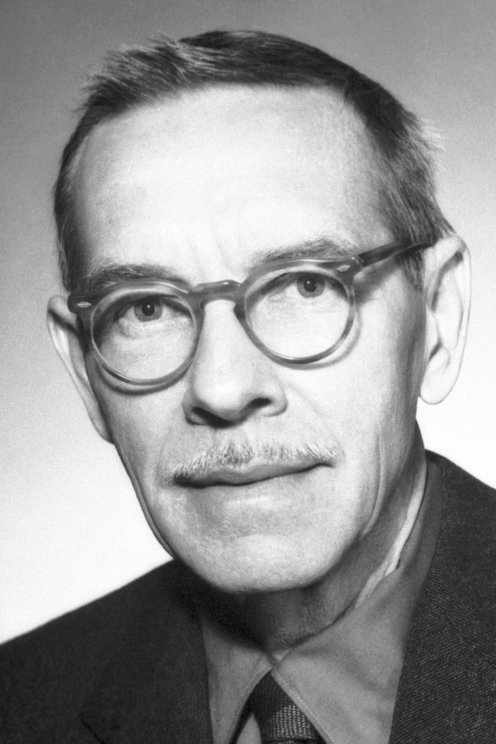
Alfred D. Hershey
(4 Dec 1908 - 22 May 1997)
American microbiologist who shared the 1969 Nobel Prize in Physiology or Medicine for research on bacteriophages (viruses that infect bacteria).
|
Science Quotes by Alfred D. Hershey (11 quotes)
Different viral species contain nucleic acids that differ not only in length and nucleotide sequence but in many unexpected ways as well.
— Alfred D. Hershey
From Summary, 'Idiosyncrasies of DNA Structure in Bacteriophage', Nobel Lecture (12 Dec 1969), published in Nobel Lectures, Physiology or Medicine 1963–1970 (1972). [Hershey’s “unexpected ways” referred to the then-new realization that viral nucleic acids are chemically modified, structurally diverse, sometimes single-stranded, sometimes circularly permuted or terminally redundant, and often packaged by unconventional mechanisms—far more varied than the textbook double helix. —Webmaster]
Humans love truth and justice, and rejoice in ceremonies that honor those qualities.
— Alfred D. Hershey
Nobel Banquet Speech, Stockholm (10 Dec 1969). On nobelprize.org website.
Joseph Mandell and I began by attempting to make chromatography of DNA work.
— Alfred D. Hershey
His dry way of introducing the technical work behind his DNA studies, in Nobel Lecture (12 Dec 1969), 'Idiosyncrasies of DNA Structure in Bacteriophage', published in Nobel Lectures, Physiology or Medicine 1963–1970 (1972).
Later when I started playing around at being a physical chemist, I enjoyed very much doing work on the structure of DNA molecules, something which I would never have dreamed of doing before I started. But that’s the nice thing about doing research.
— Alfred D. Hershey
From a BBC interview with Hershey in 1953. Quoted in Neville Symonds, 'Obituary: Alfred Hershey', The Independent (6 Jun 1997). Reminiscences of Symonds also collected in Franklin W. Stahl (ed.), We Can Sleep Later: Alfred D. Hershey and the Origins of Molecular Biology (2000), 94.
Of course I was very excited by the blendor experiment because I realised that other people were going to be excited by it. But as far as my own private interests were concerned I always liked what I was doing. Of course there are depressing periods when nothing appears to be happening. But whenever anything was happening, and even when nothing was happening, it was fun just to do phage experiments.
— Alfred D. Hershey
From a BBC interview with Hershey in 1953. Quoted in Neville Symonds, 'Obituary: Alfred Hershey', The Independent (6 Jun 1997). Reminiscences of Symonds also collected in Franklin W. Stahl (ed.), We Can Sleep Later: Alfred D. Hershey and the Origins of Molecular Biology (2000), 94.
Physical studies of DNA had of course been under way for some years before analysis of virus particles began.
— Alfred D. Hershey
Reflecting on how phage work fit into the broader story of DNA research. From Epilogue, 'Idiosyncrasies of DNA Structure in Bacteriophage', Nobel Lecture (12 Dec 1969), published in Nobel Lectures, Physiology or Medicine 1963–1970 (1972).
That’s the nice thing about doing research. Whatever you do is novel, so you always have this sense of novelty even if you are only using a new gadget. That’s nothing to be proud of, but it’s fun. And if you get some results with a new gadget, then it’s doubly fun.
— Alfred D. Hershey
From a BBC interview with Hershey in 1953. Quoted in Neville Symonds, 'Obituary: Alfred Hershey', The Independent (6 Jun 1997). Reminiscences of Symonds also collected in Franklin W. Stahl (ed.), We Can Sleep Later: Alfred D. Hershey and the Origins of Molecular Biology (2000), 94.
The beautiful structure of DNA … made DNA so irresistible intellectually, whatever the facts might be.
— Alfred D. Hershey
Reflecting on why his blendor experiment result was accepted so quickly. From a BBC interview with Hershey in 1953. Quoted in Neville Symonds, 'Obituary: Alfred Hershey', The Independent (6 Jun 1997). Reminiscences of Symonds also collected in Franklin W. Stahl (ed.), We Can Sleep Later: Alfred D. Hershey and the Origins of Molecular Biology (2000), 93.
To have one experiment that works, and keep doing it all the time.
— Alfred D. Hershey
An Anecdote based on a statement made by Hershey to Alan Garen about Hershey’s idea of scientific happiness. Garen was a member of his phage group. Seymour Benzer and colleagues nicknamed this state “Hershey Heaven.” This quote is an anecdote, not in Hershey’s own writings. An early published example is in Lecture (22 Sep 1966), Norton D. Zinder, 'Phage RNA as Genetic Material', The Harvey Lectures, Series 62 (1966–1967) (1968), 4. The above exact wording is as later quoted and popularized by Horace Freeland Judson in The Eighth Day of Creation: The Makers of the Revolution in Biology (1979), 275.
Virus particles contain single molecules of nucleic acid.
— Alfred D. Hershey
From Summary, 'Idiosyncrasies of DNA Structure in Bacteriophage', Nobel Lecture (12 Dec 1969), published in Nobel Lectures, Physiology or Medicine 1963–1970 (1972).
Year after year the Nobel Awards bring a moment of happiness not only to the recipients, not only to colleagues and friends of the recipients, but even to strangers. One reason for this must be that humans love truth and justice, and rejoice in ceremonies that honor those qualities.
— Alfred D. Hershey
Nobel Banquet Speech, Stockholm (10 Dec 1969). On nobelprize.org website.
Quotes by others about Alfred D. Hershey (1)
The fundamental biological variant is DNA. That is why Mendel’s definition of the gene as the unvarying bearer of hereditary traits, its chemical identification by Avery (confirmed by Hershey), and the elucidation by Watson and Crick of the structural basis of its replicative invariance, are without any doubt the most important discoveries ever made in biology. To this must be added the theory of natural selection, whose certainty and full significance were established only by those later theories.
In Jacques Monod and Austryn Wainhouse (trans.), Chance and Necessity: An Essay on the Natural Philosophy of Modern Biology (1971), 104.
See also:
- 4 Dec - short biography, births, deaths and events on date of Hershey's birth.
- We Can Sleep Later: Alfred D. Hershey and the Origins of Molecular Biology, by Frederick W. Stahl. - book suggestion.
 In science it often happens that scientists say, 'You know that's a really good argument; my position is mistaken,' and then they would actually change their minds and you never hear that old view from them again. They really do it. It doesn't happen as often as it should, because scientists are human and change is sometimes painful. But it happens every day. I cannot recall the last time something like that happened in politics or religion.
(1987) --
In science it often happens that scientists say, 'You know that's a really good argument; my position is mistaken,' and then they would actually change their minds and you never hear that old view from them again. They really do it. It doesn't happen as often as it should, because scientists are human and change is sometimes painful. But it happens every day. I cannot recall the last time something like that happened in politics or religion.
(1987) --