Sobriety Quotes (3 quotes)
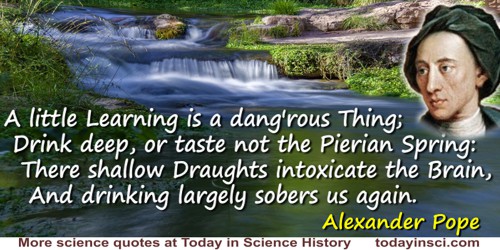
A little Learning is a dang’rous Thing;
Drink deep, or taste not the Pierian Spring:
There shallow Draughts intoxicate the Brain,
And drinking largely sobers us again.
Drink deep, or taste not the Pierian Spring:
There shallow Draughts intoxicate the Brain,
And drinking largely sobers us again.
In An Essay on Criticism (Written 1709, published 1711), 14. (Written in 1709). Misquoted in The Monthly Miscellany; or Gentleman and Lady’s Complete Magazine (1774), as “Mr. Pope says, very truly, ‘A little knowledge is a dangerous thing.’” This latter version of the quote has, in modern times, been misattributed to Albert Einstein.
To conclude, therefore, let no man out of a weak conceit of sobriety, or an ill-apply'd moderation, think or maintain, that a man can search too far or be too well studied in the book of God’s word, or in the book of God’s works; divinity or philosophy; but rather let men endeavour an endless progress or proficience in both.
In Of Proficience and Advancement of Learning Divine and Human (1605), collected in The Works of Francis Bacon (1711), Vol. 2, 417. Charles Darwin placed this quote on the title page of his On the Origin of Species.
Vary the mental and bodily exercises with dancing, horsemanship, swimming, fencing with sword and with sabre, shooting with gun and pistol, skating, the sling, stilts, tennis, bowls; hop on one foot, cross the arms, jump high and far, turn on one foot propped against the wall, exercise in shirt in the evening to get up a perspiration before going to bed; turning, joinery, gardening, reading while walking, declamation, singing, violin, versification, musical composition; eight hours of sleep; a walk on awakening, before and after eating; great sobriety; eat slowly, little, and often; avoid idleness and useless meditation.
From Appendix A, 'Extracts From the Unpublished Writings of Carnot', Reflections on the Motive Power of Heat (1890, 2nd ed. 1897), 205-206.
 In science it often happens that scientists say, 'You know that's a really good argument; my position is mistaken,' and then they would actually change their minds and you never hear that old view from them again. They really do it. It doesn't happen as often as it should, because scientists are human and change is sometimes painful. But it happens every day. I cannot recall the last time something like that happened in politics or religion.
(1987) --
In science it often happens that scientists say, 'You know that's a really good argument; my position is mistaken,' and then they would actually change their minds and you never hear that old view from them again. They really do it. It doesn't happen as often as it should, because scientists are human and change is sometimes painful. But it happens every day. I cannot recall the last time something like that happened in politics or religion.
(1987) --