 (source)
|
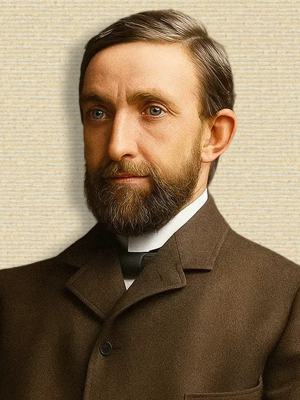
Philipp Lenard
(7 Jun 1862 - 20 May 1947)
Hungarian-German physicist who was awarded the 1905 Nobel Prize in Physics for his study of cathode rays. He also demonstrated the photoelectric effect produces electrons like those in cathode rays.
|
Science Quotes by Philipp Lenard (1 quote)
My work has depended on that of others, and … work by other investigators is related to mine. Thus …
I have by no means always been numbered among those who pluck the fruit; I have been repeatedly only one of those who planted or cared for the trees.
— Philipp Lenard
In Nobel Lecture, 'On Cathode Rays' (28 May 1906), online at nobelprize.org website.
Quotes by others about Philipp Lenard (2)
I will insist particularly upon the following fact, which seems to me quite important and beyond the phenomena which one could expect to observe: The same [double sulfate of uranium and potassium] crystalline crusts, arranged the same way [as reported to the French academy on 24 Feb 1896] with respect to the photographic plates, in the same conditions and through the same screens, but sheltered from the excitation of incident rays and kept in darkness, still produce the same photographic images … [when kept from 26 Feb 1896] in the darkness of a bureau drawer. … I developed the photographic plates on the 1st of March, expecting to find the images very weak. Instead the silhouettes appeared with great intensity.
It is important to observe that it appears this phenomenon must not be attributed to the luminous radiation emitted by phosphorescence … One hypothesis which presents itself to the mind naturally enough would be to suppose that these rays, whose effects have a great similarity to the effects produced by the rays studied by M. Lenard and M. Röntgen, are invisible rays …
[Having eliminated phosphorescence as a cause, he has further revealed the effect of the as yet unknown radioactivity.]
It is important to observe that it appears this phenomenon must not be attributed to the luminous radiation emitted by phosphorescence … One hypothesis which presents itself to the mind naturally enough would be to suppose that these rays, whose effects have a great similarity to the effects produced by the rays studied by M. Lenard and M. Röntgen, are invisible rays …
[Having eliminated phosphorescence as a cause, he has further revealed the effect of the as yet unknown radioactivity.]
Read at French Academy of Science (2 Mar 1896). In Comptes Rendus (1896), 122, 501. As translated by Carmen Giunta on the Classic Chemistry web site.
Philipp Lenard … had not been willing to switch over to the modern international development of physics…. The ranks of physicists still teaching modern, true physics had thinned considerably. Many of the leading personalities had left Germany: besides Einstein, Max Born, James Franck, Heisenberg’s outstanding assistant Felix Bloch, Hans Bethe, as well as many others. Lenard wrote triumphantly: “Of its own free will, the alien spirit is already leaving the universities, indeed, the country!”
To Lenard, the abstractions of modern physics were “alien,” and Einstein was practicing subversive physics. In Inner Exile: Recollections of a Life with Werner Heisenberg (1984), 41-42.
See also:
- 7 Jun - short biography, births, deaths and events on date of Lenard's birth.
 In science it often happens that scientists say, 'You know that's a really good argument; my position is mistaken,' and then they would actually change their minds and you never hear that old view from them again. They really do it. It doesn't happen as often as it should, because scientists are human and change is sometimes painful. But it happens every day. I cannot recall the last time something like that happened in politics or religion.
(1987) --
In science it often happens that scientists say, 'You know that's a really good argument; my position is mistaken,' and then they would actually change their minds and you never hear that old view from them again. They really do it. It doesn't happen as often as it should, because scientists are human and change is sometimes painful. But it happens every day. I cannot recall the last time something like that happened in politics or religion.
(1987) --