TODAY IN SCIENCE HISTORY ®  •  TODAYINSCI ®
Celebrating 26 Years on the Web
Find science on or your birthday

Today in Science History - Quickie Quiz
Who said: “Environmental extremists ... wouldn�t let you build a house unless it looked like a bird�s nest.”
more quiz questions >>
Home > Dictionary of Science Quotations > Scientist Names Index B > Daniel Bovet Quotes

Thumbnail of Daniel Bovet (source)
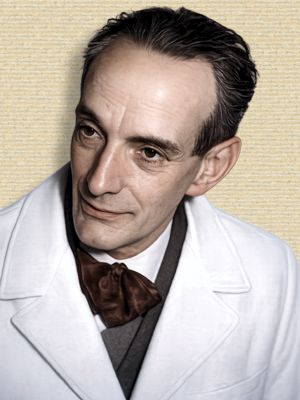
Daniel Bovet
(23 Mar 1907 - 8 Apr 1992)

who was awarded the 1957 Nobel Prize for Physiology or Medicine. He discovered the first clinically useful antihistamine, effective against allergic reactions.


Science Quotes by Daniel Bovet (10 quotes)
A society, even an animal society, is viable only to the degree that it comprises individuals with very different behavior. Take the now‐fashionable subject of aggression, whatever that is. Assuming that an animal colony must have aggressive individuals to defend itself, then there must also be passive individuals, because if all the members were equally aggressive, life would be impossible.
— Daniel Bovet
In John L. Hess, 'Scientist Doubts That Race of Robots Is Price of Improving Intelligence', The New York Times (11 Apr 1972), 6
Science quotes on:  |  Aggression (11)  |  Animal (680)  |  Assume (48)  |  Behavior (135)  |  Colony (10)  |  Comprise (5)  |  Defend (33)  |  Degree (285)  |  Different (613)  |  Equal (97)  |  Fashion (37)  |  Impossible (269)  |  Individual (428)  |  Life (1941)  |  Member (45)  |  Passive (9)  |  Society (365)  |  Subject (553)  |  Viable (3)

I would say that the pharmacologist is a bit like a poet whose most subtle joy lies in the search for rhyme: and indeed, for us, no theoretical result is satisfactory unless it is accompanied by clinical verification.
— Daniel Bovet
From Nobel Banquet speech (10 Dec 1957) as translated (Google) from the original French in Göran Liljestrand (ed.), The Nobel Prizes in 1957 (1958).
Science quotes on:  |  Accompany (26)  |  Clinical (21)  |  Joy (120)  |  Pharmacologist (3)  |  Poet (100)  |  Result (719)  |  Rhyme (7)  |  Satisfactory (22)  |  Science And Art (199)  |  Search (185)  |  Subtle (39)  |  Theoretical (30)  |  Verification (33)

I’d like one day to transform a mouse that doesn’t learn into a mouse that learns, with a medicine or with a nutriment, or with the color of the cage or with the presence of another animal.
— Daniel Bovet
In John L. Hess, 'Scientist Doubts That Race of Robots Is Price of Improving Intelligence', The New York Times (11 Apr 1972), 6.
Science quotes on:  |  Animal (680)  |  Cage (14)  |  Color (163)  |  Learn (697)  |  Medicine (401)  |  Mouse (35)  |  Nutrition (26)  |  Presence (67)  |  Transform (79)

In a paradoxical way, intelligence is born on the debris of instinct—that is, instinct as codified in the genes came first, but as life developed thought broke out of instinctive patterns.
— Daniel Bovet
In John L. Hess, 'Scientist Doubts That Race of Robots Is Price of Improving Intelligence', The New York Times (11 Apr 1972), 6.
Science quotes on:  |  Break (115)  |  Codify (3)  |  Debris (8)  |  Develop (287)  |  First (1325)  |  Gene (106)  |  Instinct (98)  |  Intelligence (225)  |  Life (1941)  |  Paradox (57)  |  Pattern (119)  |  Thought (1019)

It is generally admitted that the most intelligent person uses at most 5 or 10 per cent of his brain cells. [This will prevail,] until the day when the pharmacologists—maybe me, maybe somebody else—will find the way to develop everybody’s brain by giving a pill or a serum to the child or a hallucinogen to the adult, so as to make his whole brain function
— Daniel Bovet
In John L. Hess, 'Scientist Doubts That Race of Robots Is Price of Improving Intelligence', The New York Times (11 Apr 1972), 6.
Science quotes on:  |  Admit (51)  |  Adult (28)  |  Brain (292)  |  Cell (148)  |  Child (347)  |  Develop (287)  |  Everybody (73)  |  Find (1041)  |  Function (240)  |  Give (229)  |  Intelligent (113)  |  Maybe (4)  |  Pharmacologist (3)  |  Pill (8)  |  Prevail (48)  |  Serum (12)  |  Somebody (9)  |  Whole (767)

The diversity is not between intelligent and unintelligent animals; it covers a much broader variety of behavior. If my neighbor has an I.Q. of 110 and I have an I.Q. of 105, that does not make him superior to me, because I may have qualities of tenacity or laziness or indifference to money, which may have determined that I’d do better in a scientific career.
— Daniel Bovet
In John L. Hess, 'Scientist Doubts That Race of Robots Is Price of Improving Intelligence', The New York Times (11 Apr 1972), 6.
Science quotes on:  |  Animal (680)  |  Behavior (135)  |  Better (511)  |  Career (94)  |  Determine (156)  |  Diversity (78)  |  Indifference (17)  |  Intelligent (113)  |  Laziness (10)  |  Money (186)  |  Neighbor (15)  |  Quality (143)  |  Superior (92)  |  Tenacity (12)  |  Unintelligent (3)  |  Variety (143)

The great catastrophe of our society, is that it does not welcome a great number of temperaments. Whence the student unrest. My father used to say that people think more of their children’s feet than of their brains since they pick their shoes according to the size of their feet but send them all to the same school.
— Daniel Bovet
In John L. Hess, 'Scientist Doubts That Race of Robots Is Price of Improving Intelligence', The New York Times (11 Apr 1972), 6.
Science quotes on:  |  Brain (292)  |  Catastrophe (37)  |  Child (347)  |  Father (116)  |  Foot (71)  |  Great (1655)  |  Number (723)  |  Pick (17)  |  Same (181)  |  School (237)  |  Send (24)  |  Shoe (14)  |  Size (69)  |  Society (365)  |  Student (322)  |  Temperament (20)  |  Think (1155)  |  Unrest (3)  |  Welcome (22)

There is no barrier between the psychic and the chemical domains. The organic bases of thought indeed exist—there is no need to seek them in correspondence with a higher being, a paradise in which we will find the guardian of our soul. I base human dignity on thought and logic, not on pseudoscience.
— Daniel Bovet
Referring to experiments on the split brain, whose halves may be taught conflicting notions, and on zones controlling memory and emotions. In John L. Hess, 'Scientist Doubts That Race of Robots Is Price of Improving Intelligence', The New York Times (11 Apr 1972), 6.
Science quotes on:  |  Barrier (35)  |  Base (128)  |  Chemical (310)  |  Correspondence (25)  |  Dignity (46)  |  Domain (76)  |  Exist (474)  |  Find (1041)  |  God (788)  |  Guardian (4)  |  Human (1549)  |  Logic (323)  |  Organic (162)  |  Paradise (16)  |  Pseudoscience (18)  |  Psychic (17)  |  Seek (234)  |  Soul (241)  |  Thought (1019)

This young science [pharmacology], which is not yet universally accepted, falls under the umbrella of both physiology and medicine; some criticize it for being neither. In reality, in our eyes, it has the immense merit of being a true and highly sophisticated science, and moreover, of forging the most peaceful weapons in the world—those used to treat wounds and cure most diseases, without which doctors would be like soldiers without rifles.
— Daniel Bovet
From Nobel Banquet speech (10 Dec 1957) as translated (Google) from the original French in Göran Liljestrand (ed.), The Nobel Prizes in 1957 (1958).
Science quotes on:  |  Accept (208)  |  Criticize (9)  |  Cure (130)  |  Disease (353)  |  Doctor (193)  |  Forge (12)  |  Medicine (401)  |  Merit (53)  |  Peace (119)  |  Pharmacology (2)  |  Physiology (107)  |  Reality (287)  |  Rifle (4)  |  Science (66)  |  Soldier (29)  |  Sophisticated (17)  |  Treat (41)  |  True (253)  |  Umbrella (5)  |  Universal (209)  |  Weapon (101)  |  Without (15)  |  World (1901)  |  Wound (29)  |  Young (262)

What guides our work and gives it its distinctive character is that the nature of the [pharmacology] research goes hand in hand with clinical application, the theoretical result with its immediate action in the body.
— Daniel Bovet
From Nobel Banquet speech (10 Dec 1957) as translated (Google) from the original French in Göran Liljestrand (ed.), The Nobel Prizes in 1957 (1958).
Science quotes on:  |  Action (349)  |  Application (266)  |  Body (576)  |  Character (264)  |  Clinical (21)  |  Distinct (102)  |  Give (229)  |  Guide (110)  |  Hand In Hand (7)  |  Immediate (103)  |  Nature (2076)  |  Pharmacology (2)  |  Research (768)  |  Result (719)  |  Theoretical (30)  |  Work (1447)


See also:
  • 23 Mar - short biography, births, deaths and events on date of Bovet's birth.
  • The Road to Stockholm: Nobel Prizes, Science, and Scientists, by Istvan Hargittai, James D. Watson. - book suggestion.

Carl Sagan Thumbnail In science it often happens that scientists say, 'You know that's a really good argument; my position is mistaken,' and then they would actually change their minds and you never hear that old view from them again. They really do it. It doesn't happen as often as it should, because scientists are human and change is sometimes painful. But it happens every day. I cannot recall the last time something like that happened in politics or religion. (1987) -- Carl Sagan
Quotations by:Albert EinsteinIsaac NewtonLord KelvinCharles DarwinSrinivasa RamanujanCarl SaganFlorence NightingaleThomas EdisonAristotleMarie CurieBenjamin FranklinWinston ChurchillGalileo GalileiSigmund FreudRobert BunsenLouis PasteurTheodore RooseveltAbraham LincolnRonald ReaganLeonardo DaVinciMichio KakuKarl PopperJohann GoetheRobert OppenheimerCharles Kettering  ... (more people)

Quotations about:Atomic  BombBiologyChemistryDeforestationEngineeringAnatomyAstronomyBacteriaBiochemistryBotanyConservationDinosaurEnvironmentFractalGeneticsGeologyHistory of ScienceInventionJupiterKnowledgeLoveMathematicsMeasurementMedicineNatural ResourceOrganic ChemistryPhysicsPhysicianQuantum TheoryResearchScience and ArtTeacherTechnologyUniverseVolcanoVirusWind PowerWomen ScientistsX-RaysYouthZoology  ... (more topics)
Sitewide search within all Today In Science History pages:
Visit our Science and Scientist Quotations index for more Science Quotes from archaeologists, biologists, chemists, geologists, inventors and inventions, mathematicians, physicists, pioneers in medicine, science events and technology.

Names index: | A | B | C | D | E | F | G | H | I | J | K | L | M | N | O | P | Q | R | S | T | U | V | W | X | Y | Z |

Categories index: | 1 | 2 | A | B | C | D | E | F | G | H | I | J | K | L | M | N | O | P | Q | R | S | T | U | V | W | X | Y | Z |
Thank you for sharing.
- 100 -
Sophie Germain
Gertrude Elion
Ernest Rutherford
James Chadwick
Marcel Proust
William Harvey
Johann Goethe
John Keynes
Carl Gauss
Paul Feyerabend
- 90 -
Antoine Lavoisier
Lise Meitner
Charles Babbage
Ibn Khaldun
Euclid
Ralph Emerson
Robert Bunsen
Frederick Banting
Andre Ampere
Winston Churchill
- 80 -
John Locke
Bronislaw Malinowski
Bible
Thomas Huxley
Alessandro Volta
Erwin Schrodinger
Wilhelm Roentgen
Louis Pasteur
Bertrand Russell
Jean Lamarck
- 70 -
Samuel Morse
John Wheeler
Nicolaus Copernicus
Robert Fulton
Pierre Laplace
Humphry Davy
Thomas Edison
Lord Kelvin
Theodore Roosevelt
Carolus Linnaeus
- 60 -
Francis Galton
Linus Pauling
Immanuel Kant
Martin Fischer
Robert Boyle
Karl Popper
Paul Dirac
Avicenna
James Watson
William Shakespeare
- 50 -
Stephen Hawking
Niels Bohr
Nikola Tesla
Rachel Carson
Max Planck
Henry Adams
Richard Dawkins
Werner Heisenberg
Alfred Wegener
John Dalton
- 40 -
Pierre Fermat
Edward Wilson
Johannes Kepler
Gustave Eiffel
Giordano Bruno
JJ Thomson
Thomas Kuhn
Leonardo DaVinci
Archimedes
David Hume
- 30 -
Andreas Vesalius
Rudolf Virchow
Richard Feynman
James Hutton
Alexander Fleming
Emile Durkheim
Benjamin Franklin
Robert Oppenheimer
Robert Hooke
Charles Kettering
- 20 -
Carl Sagan
James Maxwell
Marie Curie
Rene Descartes
Francis Crick
Hippocrates
Michael Faraday
Srinivasa Ramanujan
Francis Bacon
Galileo Galilei
- 10 -
Aristotle
John Watson
Rosalind Franklin
Michio Kaku
Isaac Asimov
Charles Darwin
Sigmund Freud
Albert Einstein
Florence Nightingale
Isaac Newton


by Ian Ellis
who invites your feedback
Thank you for sharing
on Blue Sky.
Today in Science History
Sign up for Newsletter
with quiz, quotes and more.