 (source)
|
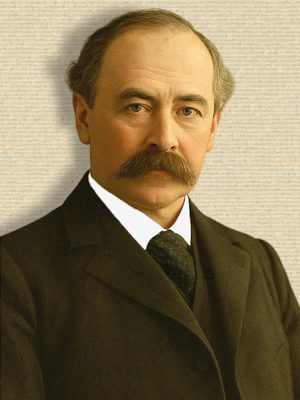
Silvanus Phillips Thompson
(19 Jun 1851 - 12 Jun 1916)
British physicist and historian whose influence spanned both scientific research and technical education. In 1879 he became professor of physics and principal of Finsbury Technical College, where he emphasized hands-on training to prepare workers for modern industry.
|
Science Quotes by Silvanus Phillips Thompson (14 quotes)
Again and again in reading even his [William Thomson] most abstract writings one is struck by the tenacity with which physical ideas control in him the mathematical form in which he expressed them. An instance of this is afforded by … an example of a mathematical result that is, in his own words, “not instantly obvious from the analytical form of my solution, but which we immediately see must be the case by thinking of the physical meaning of the result.”
— Silvanus Phillips Thompson
As given in Life of Lord Kelvin (1910), Vol. 2, 1136. The ellipsis gives the reference to the quoted footnote, to a passage in his Mathematical and Physical Papers, Vol. 1, 457. [Note: William Thomson, later became Lord Kelvin. —Webmaster]
Considering how many fools can calculate, it is surprising that it should be thought either a difficult or a tedious task for any other fool to learn how to master the same tricks … Being myself a remarkably stupid fellow, I have had to unteach myself the difficulties, and now beg to present to my fellow fools the parts that are not hard. Master these thoroughly, and the rest will follow. What one fool can do, another can.
— Silvanus Phillips Thompson
In 'Prologue', Calculus Made Easy: Being a Very-Simplest Introduction to Those Beautiful Methods of Reckoning Which Are Generally Called by the Terrifying Names of the Differential Calculus and the Integral Calculus (1910, 3rd ed. 1987), vi.
Not seldom did he [Sir William Thomson], in his writings, set down some mathematical statement with the prefacing remark “it is obvious that” to the perplexity of mathematical readers, to whom the statement was anything but obvious from such mathematics as preceded it on the page. To him it was obvious for physical reasons that might not suggest themselves at all to the mathematician, however competent.
— Silvanus Phillips Thompson
As given in Life of Lord Kelvin (1910), Vol. 2, 1136. [Note: William Thomson, later became Lord Kelvin —Webmaster]
Once when lecturing to a class he [Lord Kelvin] used the word “mathematician,” and then interrupting himself asked his class: “Do you know what a mathematician is?” Stepping to the blackboard he wrote upon it:— [an integral expression equal to the square root of pi]
Then putting his finger on what he had written, he turned to his class and said: “A mathematician is one to whom that is as obvious as that twice two makes four is to you. Liouville was a mathematician.”
Then putting his finger on what he had written, he turned to his class and said: “A mathematician is one to whom that is as obvious as that twice two makes four is to you. Liouville was a mathematician.”
— Silvanus Phillips Thompson
In Life of Lord Kelvin (1910), 1139.
One other thing will the professed mathematicians say about this thoroughly bad and vicious book: that the reason why it is so easy is because the author has left out all the things that are really difficult. And the ghastly fact about this accusation is that—it is true!
— Silvanus Phillips Thompson
In 'Epilogue and Apologue', Calculus Made Easy: Being a Very-Simplest Introduction to Those Beautiful Methods of Reckoning Which Are Generally Called by the Terrifying Names of the Differential Calculus and the Integral Calculus (1910, 3rd ed. 1987), 237.
Tait once urged the advantage of Quaternions on Cayley (who never used them), saying: “You know Quaternions are just like a pocket-map.” “That may be,” replied Cayley, “but you’ve got to take it out of your pocket, and unfold it, before it’s of any use.” And he dismissed the subject with a smile.
— Silvanus Phillips Thompson
In Life of Lord Kelvin (1910), 1137.
The following is one of the many stories told of “old Donald McFarlane” the faithful assistant of Sir William Thomson.
The father of a new student when bringing him to the University, after calling to see the Professor [Thomson] drew his assistant to one side and besought him to tell him what his son must do that he might stand well with the Professor. “You want your son to stand weel with the Profeessorr?” asked McFarlane. “Yes.” “Weel, then, he must just have a guid bellyful o’ mathematics!”
The father of a new student when bringing him to the University, after calling to see the Professor [Thomson] drew his assistant to one side and besought him to tell him what his son must do that he might stand well with the Professor. “You want your son to stand weel with the Profeessorr?” asked McFarlane. “Yes.” “Weel, then, he must just have a guid bellyful o’ mathematics!”
— Silvanus Phillips Thompson
As given in Life of Lord Kelvin (1910), Vol. 1, 420, footnote. [Note: William Thomson, later became Lord Kelvin. —Webmaster]
The following story (here a little softened from the vernacular) was narrated by Lord Kelvin himself when dining at Trinity Hall:
A certain rough Highland lad at the university had done exceedingly well, and at the close of the session gained prizes both in mathematics and in metaphysics. His old father came up from the farm to see his son receive the prizes, and visited the College. Thomson was deputed to show him round the place. “Weel, Mr. Thomson,” asked the old man, “and what may these mathematics be, for which my son has getten a prize?” “I told him,” replied Thomson, “that mathematics meant reckoning with figures, and calculating.” “Oo ay,” said the old man, “he’ll ha’ getten that fra’ me: I were ever a braw hand at the countin’.” After a pause he resumed: “And what, Mr. Thomson, might these metapheesics be?” “I endeavoured,” replied Thomson, “to explain how metaphysics was the attempt to express in language the indefinite.” The old Highlander stood still and scratched his head. “Oo ay: may be he’ll ha’ getten that fra’ his mither. She were aye a bletherin’ body."
A certain rough Highland lad at the university had done exceedingly well, and at the close of the session gained prizes both in mathematics and in metaphysics. His old father came up from the farm to see his son receive the prizes, and visited the College. Thomson was deputed to show him round the place. “Weel, Mr. Thomson,” asked the old man, “and what may these mathematics be, for which my son has getten a prize?” “I told him,” replied Thomson, “that mathematics meant reckoning with figures, and calculating.” “Oo ay,” said the old man, “he’ll ha’ getten that fra’ me: I were ever a braw hand at the countin’.” After a pause he resumed: “And what, Mr. Thomson, might these metapheesics be?” “I endeavoured,” replied Thomson, “to explain how metaphysics was the attempt to express in language the indefinite.” The old Highlander stood still and scratched his head. “Oo ay: may be he’ll ha’ getten that fra’ his mither. She were aye a bletherin’ body."
— Silvanus Phillips Thompson
As given in Life of Lord Kelvin (1910), Vol. 2, 1124, footnote. [Note: William Thomson, later became Lord Kelvin. —Webmaster]
The seemingly useless or trivial observation made by one worker leads on to a useful observation by another: and so science advances, “creeping on from point to point.”
— Silvanus Phillips Thompson
Lecture 6, collected in Light Visible and Invisible: A Series of Lectures Delivered at the Royal Institution of Great Britain, at Christmas, 1896 (1897), 276.
The work that is done for love is no less noble than the work that is done for necessity.
— Silvanus Phillips Thompson
From the Presidential Address, in 'Proceedings of the Twelfth Annual Congress; Woolwich, 12-15 June 1907', Transactions of the South-Eastern Union of Scientific Societies (1907), 6. As quoted and cited in Hannah Gay and Anne Barrett, 'Should the Cobbler Stick to His Last? Silvanus Phillips Thompson and the Making of a Scientific Career' The British Journal for the History of Science (Jun 2002), 35, No. 2, 152.
This tractate Calculus Made Easy … shows how ridiculously easy most of the operations of the calculus really are.…It gives away so many trade secrets. By showing you that what one fool can do, other fools can do also, it lets you see that these mathematical swells, who pride themselves on having mastered such an awfully difficult subject as the calculus, have no such great reason to be puffed up. They like you to think how terribly difficult it is, and don’t want that superstition to be rudely dissipated.
— Silvanus Phillips Thompson
In 'Epilogue and Apologue', Calculus Made Easy: Being a Very-Simplest Introduction to Those Beautiful Methods of Reckoning Which Are Generally Called by the Terrifying Names of the Differential Calculus and the Integral Calculus (1910, 3rd ed. 1987), 236. The epigraph following the title page identifies the saying, What one fool can do, other fools can do also, as an Ancient Simian proverb.
We are all cobblers of one sort or another, who, instead of sticking to the lasts by which we earn our daily bread, instead of confining ourselves to our daily avocations which we pursue to our own material advantage, and doubtless also to the benefit of society at large, instead of shutting ourselves up in the practice of our own craft, are cultivating science as a by-product to the ordinary activities of our lives.
— Silvanus Phillips Thompson
From the Presidential Address, in 'Proceedings of the Twelfth Annual Congress; Woolwich, 12-15 June 1907', Transactions of the South-Eastern Union of Scientific Societies (1907), 3-6. As quoted and cited in Hannah Gay and Anne Barrett, 'Should the Cobbler Stick to His Last? Silvanus Phillips Thompson and the Making of a Scientific Career' The British Journal for the History of Science (Jun 2002), 35, No. 2, 152.
We are meteorologists for our own amusement and edification, mineralogists for our personal instruction, naturalists by taste and inclination, astronomers for our own delight.
— Silvanus Phillips Thompson
From the Presidential Address, in 'Proceedings of the Twelfth Annual Congress; Woolwich, 12-15 June 1907', Transactions of the South-Eastern Union of Scientific Societies (1907), 1. As quoted and cited in Hannah Gay and Anne Barrett, 'Should the Cobbler Stick to His Last? Silvanus Phillips Thompson and the Making of a Scientific Career' The British Journal for the History of Science (Jun 2002), 35, No. 2, 151.
What you get here, remember, is … scientific education largely conducted in the laboratory … If a man is going to be any good in science he must learn through his own work. He cannot learn much merely by reading.
— Silvanus Phillips Thompson
From Inaugural Lecture, delivered to the first-year students at Finsbury Technical College. As quoted in Hannah Gay and Anne Barrett, 'Should the Cobbler Stick to His Last? Silvanus Phillips Thompson and the Making of a Scientific Career' The British Journal for the History of Science (Jun 2002), 35, No. 2, 166; citing IC archives, Thompson papers, 'An Inaugural Address Delivered by Silvanus P. Thompson, D.Sc., F.R.S., to First Year students of the City and Guilds of London Technical College, Finsbury' (privately printed).
See also:
- 19 Jun - short biography, births, deaths and events on date of Thompson's birth.
- Education as a Hindrance to Manual Occupations by Silvanus Phillips Thompson.
- Calculus Made Easy, by Silvanus P. Thompson and Martin Gardner. - book suggestion.
 In science it often happens that scientists say, 'You know that's a really good argument; my position is mistaken,' and then they would actually change their minds and you never hear that old view from them again. They really do it. It doesn't happen as often as it should, because scientists are human and change is sometimes painful. But it happens every day. I cannot recall the last time something like that happened in politics or religion.
(1987) --
In science it often happens that scientists say, 'You know that's a really good argument; my position is mistaken,' and then they would actually change their minds and you never hear that old view from them again. They really do it. It doesn't happen as often as it should, because scientists are human and change is sometimes painful. But it happens every day. I cannot recall the last time something like that happened in politics or religion.
(1987) --