 (source)
|
Abraham Lincoln
(12 Feb 1809 - 15 Apr 1865)
American president and lawyer who served as the 16th President of the U.S. from 1861, during the American Civil War, until his assasination in 1865. He is the only American president issued a patent for an invention (a device to lift boats over shoals, 1849).
|
Science Quotes by Abraham Lincoln (9 quotes)
All creation is a mine, and every man a miner.
The whole earth, and all within it, upon it, and round about it, including himself … are the infinitely various “leads” from which, man, from the first, was to dig out his destiny.
The whole earth, and all within it, upon it, and round about it, including himself … are the infinitely various “leads” from which, man, from the first, was to dig out his destiny.
— Abraham Lincoln
Opening sentences of lecture 'Discoveries and Inventions', (1860) in Discoveries and Inventions (1915).
I have always found that mercy bears richer fruits than strict justice.
— Abraham Lincoln
Quoted in Osborn Hamiline Oldroyd (ed.), Recollection by Joseph Gillespie, The Lincoln Memorial: Album-Immortelles (1882), 459.
I know of nothing so pleasant to minds as the discovery of anything which is at once new and valuable; for nothing which so lightens and sweetens toil, as the hopeful pursuit of such discovery.
— Abraham Lincoln
In The Wit & Wisdom of Abraham Lincoln by James C. Humes (1996).
In the world’s history certain inventions and discoveries occurred of peculiar value, on account of their great efficiency in facilitating all other inventions and discoveries. Of these were the art of writing and of printing, the discovery of America, and the introduction of patent laws. The date of the first … is unknown; but it certainly was as much as fifteen hundred years before the Christian era; the second—printing—came in 1436, or nearly three thousand years after the first. The others followed more rapidly—the discovery of America in 1492, and the first patent laws in 1624.
— Abraham Lincoln
Lecture 'Discoveries, Inventions and Improvements' (22 Feb 1860) in John George Nicolay and John Hay (eds.), Complete Works of Abraham Lincoln (1894), Vol. 5, 109-10.
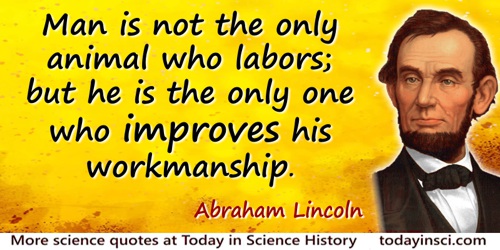
Man is not the only animal who labors; but he is the only one who improves his workmanship.
— Abraham Lincoln
Lecture 'Discoveries and Inventions', (1860) in Discoveries and Inventions (1915).
My concern is not whether God is on our side; my greatest concern is to be on God’s side, for God is always right.
— Abraham Lincoln
Quoted in Kim Lim (ed.), 1,001 Pearls of Spiritual Wisdom: Words to Enrich, Inspire, and Guide Your Life (2014), 155
Next came the patent laws. These began in England in 1624, and in this country with the adoption of our Constitution. Before then any man [might] instantly use what another man had invented, so that the inventor had no special advantage from his own invention. The patent system changed this, secured to the inventor for a limited time exclusive use of his inventions, and thereby added the fuel of interest to the fire of genius in the discovery and production of new and useful things.
— Abraham Lincoln
Lecture 'Discoveries, Inventions and Improvements' (22 Feb 1860) in John George Nicolay and John Hay (eds.), Complete Works of Abraham Lincoln (1894), Vol. 5, 113. In Eugene C. Gerhart, Quote it Completely! (1998), 802.
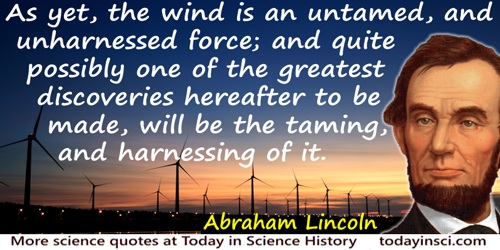
Of all the forces of nature, I should think the wind contains the largest amount of motive power—that is, power to move things. Take any given space of the earth’s surface— for instance, Illinois; and all the power exerted by all the men, and beasts, and running-water, and steam, over and upon it, shall not equal the one hundredth part of what is exerted by the blowing of the wind over and upon the same space. And yet it has not, so far in the world’s history, become proportionably valuable as a motive power. It is applied extensively, and advantageously, to sail-vessels in navigation. Add to this a few windmills, and pumps, and you have about all. … As yet, the wind is an untamed, and unharnessed force; and quite possibly one of the greatest discoveries hereafter to be made, will be the taming, and harnessing of it.
— Abraham Lincoln
Lecture 'Discoveries and Inventions', (1860) in Discoveries and Inventions (1915).
The problem with quotes on the Internet is that it is hard to verify their authenticity.
— Abraham Lincoln
…...
Quotes by others about Abraham Lincoln (4)
Darwin was as much of an emancipator as was Lincoln.
Attributed.
As a nation, we are too young to have true mythic heroes, and we must press real human beings into service. Honest Abe Lincoln the legend is quite a different character from Abraham Lincoln the man. And so should they be. And so should both be treasured, as long as they are distinguished. In a complex and confusing world, the perfect clarity of sports provides a focus for legitimate, utterly unambiguous support or disdain. The Dodgers are evil, the Yankees good. They really are, and have been for as long as anyone in my family can remember.
…...
A few months after a devastating defeat at Fredericksburg,… President Abraham Lincoln signed into law an act creating the National Academy of Sciences—in the midst of civil war. Lincoln refused to accept that our nation’s sole purpose was mere survival. He created this academy, founded the land grant colleges, and began the work of the transcontinental railroad, believing that we must add—and I quote—“the fuel of interest to the fire of genius in the discovery … of new and useful things.”
Speech to the National Academy of Sciences Annual Meeting (27 Apr 2009).
Perseverance is my motto. It laid the Atlantic cable; it gave us the telegraph, telephone, and wireless. It gave to the world an Abraham Lincoln, and to a race freedom. It gave to the negro Booker T. Washington and Tuskegee Institute. It made Frederick Douglass the great orator that he was, and it gave to the race Paul Laurence Dunbar, and to poetry a new song.
In 'Wealthiest Negro Woman's Suburban Mansion: Estate at Irvington, Overlooking Hudson and Containing All the Attractions That A Big Fortune Commands', New York Times Sunday Magazine (4 Nov 1917), 4.
 In science it often happens that scientists say, 'You know that's a really good argument; my position is mistaken,' and then they would actually change their minds and you never hear that old view from them again. They really do it. It doesn't happen as often as it should, because scientists are human and change is sometimes painful. But it happens every day. I cannot recall the last time something like that happened in politics or religion.
(1987) --
In science it often happens that scientists say, 'You know that's a really good argument; my position is mistaken,' and then they would actually change their minds and you never hear that old view from them again. They really do it. It doesn't happen as often as it should, because scientists are human and change is sometimes painful. But it happens every day. I cannot recall the last time something like that happened in politics or religion.
(1987) --