 (source)
|
Robert Andrews Millikan
(22 Mar 1868 - 19 Dec 1953)
American physicist whose famous oil-drop experiment determined the charge on the electron, which also showed the electron was a fundamental, discrete particle.
|
Science Quotes by Robert Andrews Millikan (12 quotes)

[Charles Kettering] is unique in that he combines in one individual the interest in pure science with the practical ability to apply knowledge in useful devices.
— Robert Andrews Millikan
As quoted in book review, T.A. Boyd, 'Charles F. Kettering: Prophet of Progress', Science (30 Jan 1959), 256.

[Ignorance] of the principle of conservation of energy … does not prevent inventors without background from continually putting forward perpetual motion machines… Also, such persons undoubtedly have their exact counterparts in the fields of art, finance, education, and all other departments of human activity… persons who are unwilling to take the time and to make the effort required to find what the known facts are before they become the champions of unsupported opinions—people who take sides first and look up facts afterward when the tendency to distort the facts to conform to the opinions has become well-nigh irresistible.
— Robert Andrews Millikan
From Evolution in Science and Religion (1927), 58-59. An excerpt from the book including this quote appears in 'New Truth and Old', Christian Education (Apr 1927), 10, No. 7, 394-395.
From that night on, the electron—up to that time largely the plaything of the scientist—had clearly entered the field as a potent agent in the supplying of man's commercial and industrial needs… The electronic amplifier tube now underlies the whole art of communications, and this in turn is at least in part what has made possible its application to a dozen other arts. It was a great day for both science and industry when they became wedded through the development of the electronic amplifier tube.
— Robert Andrews Millikan
The Autobiography of Robert A. Millikan (1951), 136.
Fullness of knowledge always means some understanding of the depths of our ignorance; and that is always conducive to humility and reverence.
— Robert Andrews Millikan
In 'What I Believe: Living Philosophies II', The Forum (Oct 1929), 82, No. 4, 199.
I suspect that the changes that have taken place during the last century in the average man's fundamental beliefs, in his philosophy, in his concept of religion. in his whole world outlook, are greater than the changes that occurred during the preceding four thousand years all put together. ... because of science and its applications to human life, for these have bloomed in my time as no one in history had had ever dreamed could be possible.
— Robert Andrews Millikan
In The Autobiography of Robert A. Millikan (1951, 1980), xii.
Indeed, nothing more beautifully simplifying has ever happened in the history of science than the whole series of discoveries culminating about 1914 which finally brought practically universal acceptance to the theory that the material world contains but two fundamental entities, namely, positive and negative electrons, exactly alike in charge, but differing widely in mass, the positive electron—now usually called a proton—being 1850 times heavier than the negative, now usually called simply the electron.
— Robert Andrews Millikan
Time, Matter and Values (1932), 46. Cited in Karl Raimund Popper and William Warren Bartley (ed.), Quantum Theory and theSchism in Physics (1992), 37.
The chemist in America has in general been content with what I have called a loafer electron theory. He has imagined the electrons sitting around on dry goods boxes at every corner [viz. the cubic atom], ready to shake hands with, or hold on to similar loafer electrons in other atoms.
— Robert Andrews Millikan
'Atomism in Modern Physics', Journal of the Chemical Society (1924), 1411.

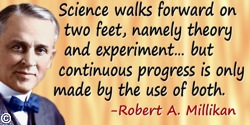
The fact that Science walks forward on two feet, namely theory and experiment, is nowhere better illustrated than in the two fields for slight contributions to which you have done me the great honour of awarding the the Nobel Prize in Physics for the year 1923. Sometimes it is one foot that is put forward first, sometimes the other, but continuous progress is only made by the use of both—by theorizing and then testing, or by finding new relations in the process of experimenting and then bringing the theoretical foot up and pushing it on beyond, and so on in unending alterations.
— Robert Andrews Millikan
'The Electron and the Light-quant from the Experimental Point of View', Nobel Lecture (23 May 1924). In Nobel Lectures: Physics 1922-1941 (1998), 54.
The progress of civilization consists merely in the multiplication and refinement of human wants.
— Robert Andrews Millikan
Statement prepared for a dinner-symposium on 'Previews of Industrial Progress in the Next century', held in Chicago (25 May 1935), the evening preceding the reopening of the Century of Progress Exposition. In Alfred P. Sloan, Jr., 'Science and Industry in the Coming Century', The Scientific Monthly (Jul 1934), 39, No. 1, 75. Also in Address (20 Apr 1939) at a dinner of the Merchants and Manufacturers celebrating the opening of the New York World’s Fair, as “Civilization consists in the multiplication and refinement of human wants.” Collected in Representative American Speeches (1939), 13, No. 3, 193.
The purpose of science is to develop, without prejudice or preconception of any kind, a knowledge of the facts, the laws, and the processes of nature. The even more important task of religion, on the other hand, is to develop the consciences, the ideals, and the aspirations of mankind.
— Robert Andrews Millikan
'A Joint Statement Upon the Relations of Science and Religion' formulated by Millikan (1923), signed by forty-five leaders of religion, science and human affairs. Reproduced in Bulletin of the American Association of University Professors (May 1923), 9, No. 5, 47. Included in Science and Life (1924), 86. (Note the context in time: the contemporary social climate by 1925 led to the Butler Act banning the teaching of evolution in Tennessee schools and the resulting trial of John Scopes.)
Two erroneous impressions … seem to be current among certain groups of uninformed persons. The first is that religion today stands for mediaeval theology; the second that science is materialistic and irreligious.
— Robert Andrews Millikan
Explaining the object of the statement formulated by Millikan (1923) signed by forty-five leaders of religion, science and human affairs. Reproduced in Bulletin of the American Association of University Professors (May 1923), 9, No. 5, 46.
We have been forced to admit for the first time in history not only the possibility of the fact of the growth and decay of the elements of matter. With radium and with uranium we do not see anything but the decay. And yet, somewhere, somehow, it is almost certain that these elements must be continuously forming. They are probably being put together now in the laboratory of the stars. ... Can we ever learn to control the process. Why not? Only research can tell.
— Robert Andrews Millikan
'The Significance of Radium,' an address delivered (in connection with the presentation of a gram of radium to Madame Curie) at the National Museum, Washington, D.C. (25 May 1921). In Science (1921), 54, No. 1383, 1921. In Rodney P. Carlisle, Scientific American Inventions and Discoveries (2004), 375.
Quotes by others about Robert Andrews Millikan (1)
All that Eddington and Millikan achieve, when they attempt their preposterous reconciliation of science and theology, is to prove that they themselves, for all their technical skill, are scientists only by trade, not by conviction. They practice science diligently and to some effect, but only in the insensate way in which Blind Tom played the piano. … they can’t get rid of a congenital incredulity. Science, to them, remains a bit strange and shocking. They are somewhat in the position of a Christian clergyman who finds himself unable to purge himself of a suspicion that Jonah, after all, probably did not swallow the whale.
Minority Report (1956, 2006 reprint), 140.


See also:
- 22 Mar - short biography, births, deaths and events on date of Millikan's birth.
- Robert Andrews Millikan - context of quote “The purpose of science is to develop…a knowledge…of nature.” - Medium image (500 x 250 px)
- Robert Andrews Millikan - context of quote “The purpose of science is to develop…a knowledge…of nature.” - Large image (800 x 400 px)
- Robert Andrews Millikan - context of quote “The tendency to distort the facts” - Medium image (500 x 250 px)
- Robert Andrews Millikan - context of quote “The tendency to distort the facts” - Large image (800 x 400 px)
- Robert Andrews Millikan - context of quote “Science walks forward on two feet” - Medium image (500 x 250 px)
- Robert Andrews Millikan - context of quote “Science walks forward on two feet” - Large image (800 x 400 px)
- The electron: Its isolation and measurement and the determination of some of its properties, by Robert Andrews Millikan. - book suggestion.
- Booklist for Robert Millikan.
 In science it often happens that scientists say, 'You know that's a really good argument; my position is mistaken,' and then they would actually change their minds and you never hear that old view from them again. They really do it. It doesn't happen as often as it should, because scientists are human and change is sometimes painful. But it happens every day. I cannot recall the last time something like that happened in politics or religion.
(1987) --
In science it often happens that scientists say, 'You know that's a really good argument; my position is mistaken,' and then they would actually change their minds and you never hear that old view from them again. They really do it. It doesn't happen as often as it should, because scientists are human and change is sometimes painful. But it happens every day. I cannot recall the last time something like that happened in politics or religion.
(1987) --