 (source)
|
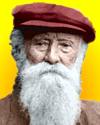
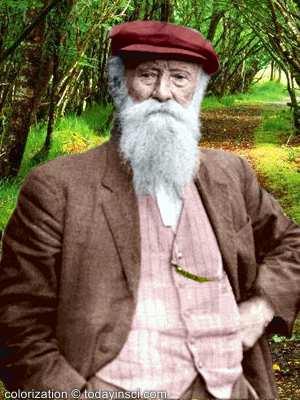
John Burroughs
(3 Apr 1837 - 29 Mar 1921)
American naturalist and author whose many writings and books, by celebrating nature in highly readable essays, significantly nurtured the conservation movement in the United States.
|
Science Quotes by John Burroughs (16 quotes)
[Theodore Roosevelt] was a naturalist on the broadest grounds, uniting much technical knowledge with knowledge of the daily lives and habits of all forms of wild life. He probably knew tenfold more natural history than all the presidents who had preceded him, and, I think one is safe in saying, more human history also.
— John Burroughs
In 'Theodore Roosevelt', Natural History (Jan 1919), 19, No.1, 5.
Descriptive science is powerless to portray for me the bird or the flower or the friend I love; only art and literature can do that. Science deals with fixed concepts, art with fluid concepts.
— John Burroughs
From essay, 'A Prophet of the Soul', Under the Apple-Trees (1916), 210.
If we take science as our sole guide, if we accept and hold fast that alone which is verifiable, the old theology must go.
— John Burroughs
From essay, 'Science and Theology', collected in The Writings of John Burrows, Volume XVII, The Light of Day (1904), 24.
In the printed page the only real things are the paper and the ink; the white spaces play the same part in aiding the eye to take in the meaning of the print as do the black letters.
— John Burroughs
From Under the Apple-Trees (1916), 302.
It is one thing to treat your facts with imagination and quite another to imagine your facts.
— John Burroughs
Collected in 'Straight Seeing and Straight Thinking',Leaf and Tendril (1908), 111. Also seen shortened as, “To treat your facts with imagination is one thing, to imagine your facts is quite another,” with source given as Journal, October 24, 1907 in Science Says
It is reported of Margaret Fuller that she said she accepted the universe. “Gad, she'd better!” retorted Carlyle. Carlyle himself did not accept the universe in a very whole-hearted manner. Looking up at the midnight stars, he exclaimed: “A sad spectacle! If they be inhabited, what a scope for misery and folly; if they be na inhabited, what a waste of space!”
— John Burroughs
Opening paragraph of book of collected essays, Accepting the Universe (1920), 3. “‘I accept the universe’ is reported to have been a favorite utterance of our New England transcendentalist, Margaret Fuller…” was stated by William James in The Varieties of Religious Experience (1902), 41. James continues, “and when some one repeated this phrase to Thomas Carlyle, his sardonic comment is said to have been: ‘Gad! she'd better!’” Note that James does not here merge Carlyle's remark about the universe. Burroughs’ attribution of the “sad spectacle” quote is, so far, the earliest found by the Webmaster, who has not located it in a printed work by Carlisle himself. If you know a primary source, or earlier attribution, please contact Webmaster.
Joy in the universe, and keen curiosity about it all—that has been my religion.
— John Burroughs
The Heart of Burroughs's Journals (1928), 257.
Natural history is a matter of observation; it is a harvest which you gather when and where you find it growing. Birds and squirrels and flowers are not always in season, but philosophy we have always with us. It is a crop which we can grow and reap at all times and in all places and it has its own value and brings its own satisfaction.
— John Burroughs
From Under the Apple-Trees (1916), Preface.
One summer day, while I was walking along the country road on the farm where I was born, a section of the stone wall opposite me, and not more than three or four yards distant, suddenly fell down. Amid the general stillness and immobility about me the effect was quite startling. ... It was the sudden summing up of half a century or more of atomic changes in the material of the wall. A grain or two of sand yielded to the pressure of long years, and gravity did the rest.
— John Burroughs
Under the Apple-Trees (1916), 105.
Science has done more for the development of western civilization in one hundred years than Christianity did in eighteen hundred years.
— John Burroughs
From essay, 'Religious Truth', collected in The Writings of John Burrows, Volume XVII, The Light of Day (1904), 166.
Science is a capital or fund perpetually reinvested; it accumulates, rolls up, is carried forward by every new man. Every man of science has all the science before him to go upon, to set himself up in business with. What an enormous sum Darwin availed himself of and reinvested! Not so in literature; to every poet, to every artist, it is still the first day of creation, so far as the essentials of his task are concerned. Literature is not so much a fund to be reinvested as it is a crop to be ever new-grown.
— John Burroughs
Indoor Studies, vol. 12, Collected Works, Houghton (1913).
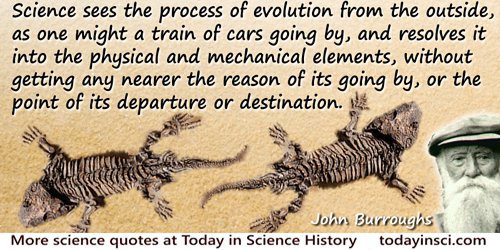
Science sees the process of evolution from the outside, as one might a train of cars going by, and resolves it into the physical and mechanical elements, without getting any nearer the reason of its going by, or the point of its departure or destination.
— John Burroughs
From essay, 'A Prophet of the Soul', Under the Apple-Trees (1916), 212.
The floating vapour is just as true an illustration of the law of gravity as the falling avalanche.
— John Burroughs
The Century Illustrated Monthly Magazine, May 1883 to October 1883 (1883), 26, 539.
The fuel in the earth will be exhausted in a thousand or more years, and its mineral wealth, but man will find substitutes for these in the winds, the waves, the sun's heat, and so forth. (1916)
— John Burroughs
From Under the Apple-Trees (1916), 308.
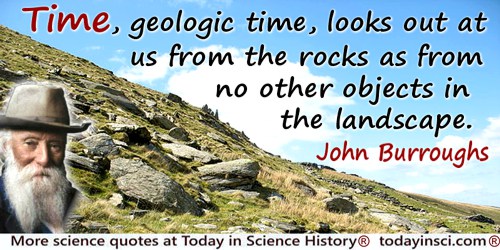
The rocks are not so close akin to us as the soil; they are one more remove from us; but they lie back of all, and are the final source of all. ... Time, geologic time, looks out at us from the rocks as from no other objects in the landscape.
— John Burroughs
From Under the Apple-Trees (1916), Chap. 2, 'The Friendly Rocks', 40.
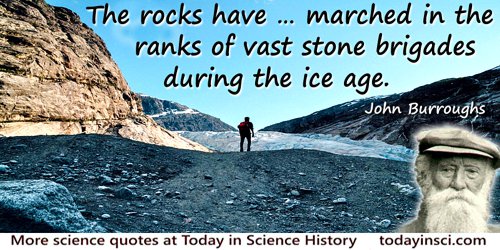
The rocks have a history; gray and weatherworn, they are veterans of many battles; they have most of them marched in the ranks of vast stone brigades during the ice age; they have been torn from the hills, recruited from the mountaintops, and marshaled on the plains and in the valleys; and now the elemental war is over, there they lie waging a gentle but incessant warfare with time and slowly, oh, so slowly, yielding to its attacks!
— John Burroughs
In Under the Apple-Trees (1916), 42.
Quotes by others about John Burroughs (1)
Thinking, after a while, becomes the most pleasurable thing in the world. Give me a satchel and a fishing rod, and I could hie myself off and keep busy at thinking forever. I don't need anybody to amuse me. It is the same way with my friends John Burroughs, the naturalist, and Henry Ford, who is a natural-born mechanic. We can derive the most satisfying kind of joy from thinking and thinking and thinking.
As quoted from an interview by B.C. Forbes in The American Magazine (Jan 1921), 86.
See also:
- 3 Apr - short biography, births, deaths and events on date of Burroughs's birth.
- John Burroughs - Chap XV - 01 The Ether - from Under the Apple-Trees (1916).
- John Burroughs - 'Scientific Faith', from The Outlook (1911)
- John Burroughs - The Friendly Rocks - an excerpt from Under the Apple-Trees (1916), giving a naturalist's view of rocks: “The rocks are not so close akin to us as the soil ... [but they] are the final source of all.”
- John Burroughs - Great Questions In Little: Astronomic Grandeur - an excerpt from Under the Apple-Trees (1916) - reflections on the Universe, the Why and How of science, the Limitations of Science, the Beginnings of Life, and Evolution.
- John Burroughs - context of quote “Stone brigades” - Medium image (500 x 250 px)
- John Burroughs - context of quote “Stone brigades” - Large image (800 x 400 px)
- John Burroughs - context of quote “Evolution” - Medium image (500 x 250 px)
- John Burroughs - context of quote “Evolution” - Large image (800 x 400 px)
- “A Prophet of the Soul” - John Burroughs on Henri Bergson’s philosophy.
- Theodore Roosevelt - naturalist - In Memoriam by John Burroughs in Natural History magazine (1913).
 In science it often happens that scientists say, 'You know that's a really good argument; my position is mistaken,' and then they would actually change their minds and you never hear that old view from them again. They really do it. It doesn't happen as often as it should, because scientists are human and change is sometimes painful. But it happens every day. I cannot recall the last time something like that happened in politics or religion.
(1987) --
In science it often happens that scientists say, 'You know that's a really good argument; my position is mistaken,' and then they would actually change their minds and you never hear that old view from them again. They really do it. It doesn't happen as often as it should, because scientists are human and change is sometimes painful. But it happens every day. I cannot recall the last time something like that happened in politics or religion.
(1987) --