 (source)
|
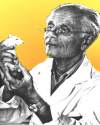
Hans Selye
(26 Jan 1907 - 16 Oct 1982)
Austrian-Canadian endocrinologist was renowned for pioneering research on biological stress. His studies revealed how chronic stress disrupts hormonal balance, contributing to heart disease, hypertension, and other “diseases of adaptation.”
|
Science Quotes by Hans Selye (30 quotes)

“Peripheral vision”: the ability not only to look straight at what you want to see, but also
to watch continually, through the corner of your eye, for the unexpected. I believe this to be one of the greatest gifts a scientist can have.
— Hans Selye
In Dream to Discovery: On Being a Scientist (1964)‚ 78.
“The fairest thing we can experience is the mysterious. It is the fundamental emotion which stands at the cradle of true science. He who knows it not, and can no longer wonder, no longer feel amazement, is as good as dead.” We all had this priceless talent when we were young. But as time goes by, many of us lose it. The true scientist never loses the faculty of amazement. It is the essence of his being.
— Hans Selye
In From Dream to Discovery: On Being a Scientist (1964). As quoted in Marguerite Clark, 'Toward Sounder Hearts' Newsweek (31 Mar 1958). Selye begins with a remark from Einstein’s essay, The World As I See It.
A fairly normal blood supply may become completely inadequate with increased stress demands, due to unusual physical exertion.
— Hans Selye
As quoted in Marguerite Clark, 'Toward Sounder Hearts' Newsweek (31 Mar 1958), 57.
Casanova was no specialist in sex hormones.
— Hans Selye
In Dream to Discovery: On Being a Scientist (1964)‚ 68.
Dr. [Frederick] Banting used to drop into my little laboratory, sit on the desk, and listen to my daydreaming. He helped me get my first $500 grant for stress research.
— Hans Selye
As quoted in Marguerite Clark, 'Toward Sounder Hearts' Newsweek (31 Mar 1958), 58. [Sir Frederick Banting is remembered for his contribution to the isolation of insulin. —Webmaster]
Errors in observation are not limited to missing the seemingly obvious but are often due to pure invention of detail. … Errors in observation are frequently made owing to bias by immediately preceding impressions.
— Hans Selye
In Dream to Discovery: On Being a Scientist (1964)‚ 79.
Genius translates the unknown into terms simple enough to become accessible by the step-by-step analysis of logic that even mere intellect can employ.
— Hans Selye
In Dream to Discovery: On Being a Scientist (1964)‚ 68.
If a scientist makes no important observation he deserves no credit, yet, at least he can blame it on lack of chance. But if a significant fact comes his way and he still does not see its importance, he
can blame only himself.
— Hans Selye
In Dream to Discovery: On Being a Scientist (1964)‚ 92.
Instinct and intellect forever despise each other, for one only does, the other only knows why. Genius builds bridges between instinct and intellect, between feeling and logic.
— Hans Selye
In Dream to Discovery: On Being a Scientist (1964)‚ 68.
Instinct and logic are constantly at odds within us; for what we want is often not logical and what is logical, we often do not want.
— Hans Selye
In Dream to Discovery: On Being a Scientist (1964)‚ 68.
Intelligence is usually defined as the power of understanding. It is the ability to use conscious knowledge in meeting new situations and to foresee problems by thinking abstractly of relationships in symbols. It depends upon a general mental acuteness or sagacity for the meticulous, objective, conscious evaluation of observations.
— Hans Selye
In Dream to Discovery: On Being a Scientist (1964)‚ 68.
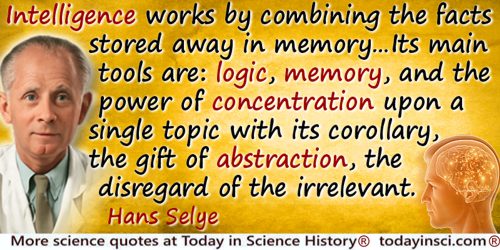
Intelligence works by combining the facts stored away in memory …. Its main tools are: logic, memory, and the power of concentration upon a single topic with its corollary, the gift of abstraction, the disregard of the irrelevant.
— Hans Selye
In Dream to Discovery: On Being a Scientist (1964)‚ 68.
It is not an understanding of embryology, but far less intellectual talents that enable a woman to create a baby.
— Hans Selye
In Dream to Discovery: On Being a Scientist (1964)‚ 68.
It is not to see something first, but to establish solid connections between the previously known and the hitherto unknown that constitutes the essence of scientific discovery.
— Hans Selye
In The Stress of Life: A New Theory of Disease (1956), 6. Also in In Dream to Discovery: On Being a Scientist (1964), 89.
It is perhaps the scientist’s greatest asset to recognize the importance of the things he sees. That is why he needs erudition; his memory must be enriched by having seen—or read—much, and he must be greatly talented in connecting the newly observed with the particular memories relevant to it. Only in this way can he actually discover something.
— Hans Selye
In Dream to Discovery: On Being a Scientist (1964)‚ 78.
It must be kept in mind that broad outlines are best seen from a distance; close inspection reveals only details which may be trivial aspects of the whole picture. The microscope can see things the naked eye cannot, but the reverse is equally true. You certainly would not find out what a dog looks like by assiduously examining its every separate part under the electron microscope.
— Hans Selye
In From Dream to Discovery; On Being a Scientist (1964), 203.
It would be presumptuous for intellect to belittle the creative genius of instinct.
— Hans Selye
In Dream to Discovery: On Being a Scientist (1964)‚ 68.
Let us consider a really great achievement of basic research: the observation by Alexander Fleming that penicillin can kill varieties of disease-producing microbes … was surprising to find that molds, which we regarded as contaminators, can have a curative value. Only a highly creative, original mind, one that can completely free itself from established ways of observation, can make such a discovery. Many bacteriologists had seen that cultures of microbes are spoiled when exposed to molds, but all they concluded was that molds must be kept out of such cultures. It took a stroke of genius to see the medicinal promise of the basic observation.
— Hans Selye
In The Stress of My Life: A Scientist’s Memoirs (1979), 43-44.
Many people believe that, after they have exposed themselves to very stressful activities, a rest can restore them to where they were before. This is false. Experiments on animals have clearly shown that each exposure leaves an indelible scar, in that it uses up reserves of adaptability which cannot be replaced. It is true that immediately after some harassing experience, rest can restore us almost to the original level of fitness by eliminating acute fatigue. But the emphasis is on the word almost. Since we constantly go through periods of stress and rest during life, just a little deficit of adaptation energy every day adds up—it adds up to what we call aging.
— Hans Selye
In The Stress of Life (1956), 274. A paraphrase seen in quote collections is: "Every stress leaves an indelible scar, and the organism pays for its survival after a stressful situation by becoming a little older." Webmaster, as yet, has not found a primary source for that wording. Please make contact if you know it.
Most of the discoveries which are usually attributed to chance are actually made by virtue of a prodigious power of imagination which immediately visualizes manifold general applications of the chance observation.
— Hans Selye
In Dream to Discovery: On Being a Scientist (1964)‚ 45. [Compare with the older maxim attributed to Louis Pasteur: “Chance favors the prepared mind.” —Webmaster]
Pasteur had the most extraordinary gift for seeing the unexpected. His researches on fowl cholera were interrupted by the summer vacations, and when he resumed work, nearly all the germ cultures proved to be sterile. He attempted to revive the microbes by injection into fowls, but the birds were not affected. He was about to give up when he had the inspiration of reinoculating the test fowls with a potent fresh culture. His colleague Duclaux relates:
“To the surprise of all, and perhaps even of Pasteur, who was not expecting such success, nearly all these (pretreated) fowls withstood the inoculation, although fresh fowls succumbed after the usual incubation period This resulted in the discovery of the principle of immunisation with attenuated pathogens.”
“To the surprise of all, and perhaps even of Pasteur, who was not expecting such success, nearly all these (pretreated) fowls withstood the inoculation, although fresh fowls succumbed after the usual incubation period This resulted in the discovery of the principle of immunisation with attenuated pathogens.”
— Hans Selye
In Dream to Discovery: On Being a Scientist (1964)‚ 79.
Scientific curiosity can be satisfied much more easily by reading the publications of others than by working in the lab. It may take years to prove by experimentation what we can learn in the few minutes needed to read the published end result. So let us not fool ourselves; the driving force is hardly sheer curiosity.
— Hans Selye
In From Dream to Discovery: On Being a Scientist (1964), 15.
Scientists are probably the most individualistic bunch of people in the world. All of us are and should be essentially different; there would be no purpose in trying to fit us into a common mold.
— Hans Selye
In From Dream to Discovery; On Being a Scientist (1964), 4.
Stress is not nervous tension alone. Stress reactions occur in lower animals that have no nervous system. Stress can be produced in cell cultures grown outside the body.… Stress is the rate of all wear and tear used by life. The secret of health lies in successful adjustment to external stress.
— Hans Selye
As quoted in Marguerite Clark, 'Toward Sounder Hearts' Newsweek (31 Mar 1958), 57.
The dictionaries define logic as the science that deals with the criteria of validity in thought and demonstration. It comprises the principles of definition, classification, correct use of terms, correct predication, demonstration, and reasoning in general. In essence, it is a system of the formal principles used in subjecting a problem to consciously planned intellectual analysis.
— Hans Selye
In Dream to Discovery: On Being a Scientist (1964)‚ 69.
The element of chance in basic research is overrated. Chance is a lady who smiles only upon those few who know how to make her smile.
— Hans Selye
In The Stress of My Life: A Scientist’s Memoirs (1979), 43. Previously seen in a longer form in his Textbook of Endocrinology (1947), 480. Also, quoting himself, in Dream to Discovery: On Being a Scientist (1964)‚ 92.
The element of chance, in medical discoveries, is overrated in any case. Chance is a lady who smiles only upon those who know how to appreciate her artful charms; these connoisseurs she rarely neglects—the secret of the game is art appreciation.
— Hans Selye
In Textbook of Endocrinology (1947), 480. Also, quoting himself, in Dream to Discovery: On Being a Scientist (1964)‚ 92. Later paraphrased as, “The element of chance in basic research is overrated. Chance is a lady who smiles only upon those few who know how to make her smile” in The Stress of My Life: A Scientist’s Memoirs (1979), 43.
The improbable is really worthy of attention! If the unexpected is nevertheless found to be true, the observation usually represents a great step forward.
— Hans Selye
In Dream to Discovery: On Being a Scientist (1964)‚ 78.
To me, nature created man, and nature is superior.
— Hans Selye
From interview, with author Denis Brian, Genius Talk: Conversations with Nobel Scientists and Other Luminaries (1995), 267.
To remain healthy, man must have some goal, some purpose in life that he can respect and be proud to work for.
— Hans Selye
In Stress without Distress (1974), 103.
Quotes by others about Hans Selye (1)
The further knowledge advances, the nearer we come to the unfathomable: the more we know how to use our knowledge, the better we see that the unfathomable is of no practical use.
'Science: Maxim 576', in Goethe and Bailey Saunders (trans.), Maxims and Reflections (1892), 200. Also seen misattributed to Hans Selye. From the original German in Sprüche in Prosa, which wasn't originally a single book published at once, but a collection of aphorisms written throughout his life.
See also:
- 26 Jan - short biography, births, deaths and events on date of Selye's birth.
- The Stress of my Life: A Scientist’s Memoirs, by Hans Selye. - book suggestion.
 In science it often happens that scientists say, 'You know that's a really good argument; my position is mistaken,' and then they would actually change their minds and you never hear that old view from them again. They really do it. It doesn't happen as often as it should, because scientists are human and change is sometimes painful. But it happens every day. I cannot recall the last time something like that happened in politics or religion.
(1987) --
In science it often happens that scientists say, 'You know that's a really good argument; my position is mistaken,' and then they would actually change their minds and you never hear that old view from them again. They really do it. It doesn't happen as often as it should, because scientists are human and change is sometimes painful. But it happens every day. I cannot recall the last time something like that happened in politics or religion.
(1987) --