Slave Quotes (40 quotes)
A free soul ought not to pursue any study slavishly; for while bodily labors performed under constraint do not harm the body, nothing that is learned under compulsion stays with the mind.
— Plato
From The Republic 7 536e, as translated by Paul Shorey (1930).
A slave world is not worth preserving. Better be lifeless like the cold moon, or primitively vegetal like desolate Mars, than be a planet populated by social robots.
From speech (Oct 1947), 'Peace or Pieces: or Who Amends the Golden Rule'. As reprinted in Henry Goddard Leach (ed.), The American-Scandinavian Review (1950), 37-38, 34. As quoted in 'Dr. Harlow Shapley Dies at 86; Dean of American Astronomers', New York Times (21 Oct 1972), 69.
A sword in the hands of a drunken slave is less dangerous than science in the hands of the immoral.
…...
And who can doubt that it will lead to the worst disorders when minds created free by God are compelled to submit slavishly to an outside will? When we are told to deny our senses and subject them to the whim of others? When people devoid of whatsoever competence are made judges over experts and are granted authority to treat them as they please? These are the novelties which are apt to bring about the ruin of commonwealths and the subversion of the state.
In Galileo’s handwriting is his personal copy of Dialogue on the Great World Systems, x. As quoted in Edward Aloysius Pace and James Hugh Ryan, The New Scholasticism (1954),
Animals, whom we have made our slaves, we do not like to consider our equal.
Notebook B, (1837-38)
Ants are so much like human beings as to be an embarrassment. They farm fungi, raise aphids as livestock, launch armies into wars, use chemical sprays to alarm and confuse enemies, capture slaves…. They exchange information ceaselessly. They do everything but watch television.
(1974) In 'On Societies as Organisms', A Long Line of Cells: Collected Essays (1990), 10.
Art, science, discovery and invention, startle and bewilder us at every turn, by their rapid, vast and wonderful achievements. These forces have made men lords where they were vassals, masters where they were slaves, and kings where they were subjects. They have abolished the limitations of time and space and have brought the ends of the earth together.
From speech (20 Nov 1883) delivered to the Bethel Literary and Historical Association, Washington D.C.,'It Moves, or Philosophy of Reform' , collected in The Speeches of Frederick Douglass (2018), 387.
Be daring, be different, be impractical; be anything that will assert integrity of purpose and imagination vision against the play-it-safers, the creatures of the commonplace, the slave of the ordinary.
…...
Even now, the imprisoned winds which the earliest poet made the Grecian warrior bear for the protection of his fragile bark; or those which, in more modern times, the Lapland wizards sold to the deluded sailors;—these, the unreal creations of fancy or of fraud, called, at the command of science, from their shadowy existence, obey a holier spell: and the unruly masters of the poet and the seer become the obedient slaves of civilized man.
In 'Future Prospects', On the Economy of Machinery and Manufactures (1st ed., 1832), chap. 32, 280.
For my own part I would as soon be descended from that heroic little monkey, who braved his dreaded enemy in order to save the life of his keeper; or from that old baboon, who, descending from the mountains, carried away in triumph his young comrade from a crowd of astonished dogs—as from a savage who delights to torture his enemies, offers up bloody sacrifices, practices infanticide without remorse, treats his wives like slaves, knows no decency, and is haunted by the grossest superstitions.
The Descent of Man (1871), Vol. 2, 404-5.
I have patiently born with abundance of Clamour and Ralary [raillery], for beginning a new Practice here (for the Good of the Publick) which comes well Recommended, from Gentlemen of Figure & Learning, and which well agrees to Reason, when try’d & duly considered, viz. Artificially giving the Small Pocks, by Inoculation, to One of my Children, and Two of my Slaves, in order to prevent the hazard of Life… . and they never took one grain or drop of Medicine since, & are perfectly well.
By “clamour” he is referring to the public commotion in Boston reacting to his introduction of smallpox inoculation. Public statement in the Gazette (Jul 10-17), No. 85, 1721. As quoted and cited in Reginald H. Fitz, 'Zabdiel Boylston, Inoculator, and the Epidemic of Smallpox in Boston in 1721', Bulletin of the Johns Hopkins Hospital (1911), 22, 319.
I see I have made my self a slave to Philosophy.
Letter to Henry Oldenburg (18 Nov 1676). In H. W. Turnbull (ed.), The Correspondence of Isaac Newton, 1676-1687 (1960), Vol. 2, 182.
It has been said that computing machines can only carry out the processes that they are instructed to do. This is certainly true in the sense that if they do something other than what they were instructed then they have just made some mistake. It is also true that the intention in constructing these machines in the first instance is to treat them as slaves, giving them only jobs which have been thought out in detail, jobs such that the user of the machine fully understands what in principle is going on all the time. Up till the present machines have only been used in this way. But is it necessary that they should always be used in such a manner? Let us suppose we have set up a machine with certain initial instruction tables, so constructed that these tables might on occasion, if good reason arose, modify those tables. One can imagine that after the machine had been operating for some time, the instructions would have altered out of all recognition, but nevertheless still be such that one would have to admit that the machine was still doing very worthwhile calculations. Possibly it might still be getting results of the type desired when the machine was first set up, but in a much more efficient manner. In such a case one would have to admit that the progress of the machine had not been foreseen when its original instructions were put in. It would be like a pupil who had learnt much from his master, but had added much more by his own work. When this happens I feel that one is obliged to regard the machine as showing intelligence.
Lecture to the London Mathematical Society, 20 February 1947. Quoted in B. E. Carpenter and R. W. Doran (eds.), A. M. Turing's Ace Report of 1946 and Other Papers (1986), 122-3.
It is unworthy of excellent men to lose hours like slaves in the labour of calculation which could safely be relegated to anyone else if machines were used.
Describing, in 1685, the value to astronomers of the hand-cranked calculating machine he had invented in 1673.
Describing, in 1685, the value to astronomers of the hand-cranked calculating machine he had invented in 1673.
From 'Machina Arithmetica in qua non Aditio tantum Subtractio', as translated by Mark Kormes in David Eugene Smith, A Source Book in Mathematics (1929), 181.
Its immediate significance was as a currency, for it closed the triangle linking spirits, slaves, and sugar. Rum could be used to buy slaves, with which to produce sugar, the leftovers of which could be made into rum to buy more slaves, and so on and on.
In A History of the World in 6 Glasses (2005, 2009), 110.
Many quite nefarious ideologies pass for common sense. For decades of American history, it was common sense in some quarters for white people to own slaves and for women not to vote. … If common sense sometimes preserves the social status quo, and that status quo sometimes treats unjust social hierarchies as natural, it makes good sense on such occasions to find ways of challenging common sense.
In 'A “Bad Writer” Bites Back', The New York Times (20 Mar 1999), A15.
Mr. Auld … forbade Mrs. Auld to instruct me further, telling her … “A [slave] should know nothing but to obey his master… If you teach that [slave] (speaking of myself) how to read, there would be no keeping him. It would forever unfit him to be a slave.”
In autobiography, Narrative Of The Life Of Frederick Douglass (1851), 35. Often seen restated as “Knowledge makes a man unfit to be a slave.” [Webmaster has substituted “[slave]” in the subject quotation above, where the original text had a word much spoken in that period, but is now regarded too offensive to use.]
Reason is, and ought only to be the slave of the passions, and can never pretend to any other office than to serve and obey them.
A Treatise on Human Nature (1739-40), ed. L. A. Selby-Bigge (1888), book 2, part 3, section 3, 415.
Science only means knowledge; and for [Greek] ancients it did only mean knowledge. Thus the favorite science of the Greeks was Astronomy, because it was as abstract as Algebra. ... We may say that the great Greek ideal was to have no use for useful things. The Slave was he who learned useful things; the Freeman was he who learned useless things. This still remains the ideal of many noble men of science, in the sense they do desire truth as the great Greeks desired it; and their attitude is an external protest against vulgarity of utilitarianism.
'About Beliefs', in As I was Saying: A Book of Essays (1936), 65-66. Collected in G. K. Chesterton and Dale Ahlquist (ed.), In Defense of Sanity: The Best Essays of G.K. Chesterton (2011), 318.
She [Chien-Shiung Wu] is a slave driver. She is the image of the militant woman so well known in Chinese literature as either empress or mother.
As quoted in 'Queen of Physics', Newsweek (20 May 1963), No. 61, 20. Note: Chien-Shiung Wu was Segrè’s student.
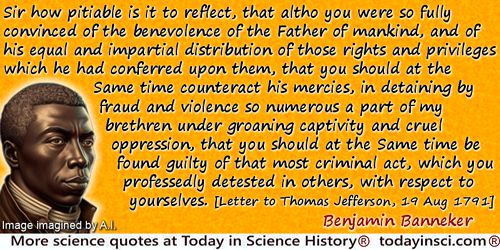
Sir how pitiable is it to reflect, that altho you were so fully convinced of the benevolence of the Father of mankind, and of his equal and impartial distribution of those rights and privileges which he had conferred upon them, that you should at the Same time counteract his mercies, in detaining by fraud and violence so numerous a part of my brethren under groaning captivity and cruel oppression, that you should at the Same time be found guilty of that most criminal act, which you professedly detested in others, with respect to yourselves.
In Letter to Thomas Jefferson (19 Aug 1791). In John Hazlehurst Boneval Latrobe, Memoir of Benjamin Banneker: Read Before the Maryland Historical Society, at the Monthly Meeting, May 1, 1845 (1845), 15-16.
Someone who had begun to read geometry with Euclid, when he had learned the first proposition, asked Euclid, “But what shall I get by learning these things?” whereupon Euclid called his slave and said, “Give him three-pence, since he must make gain out of what he learns.”
As quoted in Robert Édouard Moritz, Memorabilia Mathematica; Or, The Philomath's Quotation-Book (1914), 152-153, citing Stobaeus, Edition Wachsmuth (1884), Ecl. II.
Somewhere in the arrangement of this world there seems to be a great concern about giving us delight, which shows that, in the universe, over and above the meaning of matter and forces, there is a message conveyed through the magic touch of personality. ...
Is it merely because the rose is round and pink that it gives me more satisfaction than the gold which could buy me the necessities of life, or any number of slaves. ... Somehow we feel that through a rose the language of love reached our hearts.
Is it merely because the rose is round and pink that it gives me more satisfaction than the gold which could buy me the necessities of life, or any number of slaves. ... Somehow we feel that through a rose the language of love reached our hearts.
The Religion of Man (1931), 102. Quoted in H. E. Hunter, The Divine Proportion (1970), 6.
The future offers very little hope for those who expect that our new mechanical slaves will offer us a world in which we may rest from thinking. Help us they may, but at the cost of supreme demands upon our honesty and our intelligence. The world of the future will be an ever more demanding struggle against the limitations of our intelligence, not a comfortable hammock in which we can lie down to be waited upon by our robot slaves.
In God & Golem, Inc (1964), 73-74.
The greatest slave is not he who is ruled by a despot, great though that evil be, but he who is in the thrall of his own moral ignorance, selfishness, and vice.
In Self-help: With Illustrations of Character and Conduct (1859, 1861), 17.
The man who listens to Reason is lost: Reason enslaves all whose minds are not strong enough to master her.
In 'Maxims for Revolutionists: Reason', in Man and Superman (1903), 238.
The mathematician requires tact and good taste at every step of his work, and he has to learn to trust to his own instinct to distinguish between what is really worthy of his efforts and what is not; he must take care not to be the slave of his symbols, but always to have before his mind the realities which they merely serve to express. For these and other reasons it seems to me of the highest importance that a mathematician should be trained in no narrow school; a wide course of reading in the first few years of his mathematical study cannot fail to influence for good the character of the whole of his subsequent work.
In Presidential Address British Association for the Advancement of Science, Section A, (1890), Nature, 42, 467.
THE OATH. I swear by Apollo [the healing God], the physician and Aesclepius [son of Apollo], and Health [Hygeia], and All-heal [Panacea], and all the gods and goddesses, that, according to my ability and judgment, I will keep this Oath and this stipulation—to reckon him who taught me this Art equally dear to me as my parents, to share my substance with him, and relieve his necessities if required; to look upon his offspring in the same footing as my own brothers, and to teach them this art, if they shall wish to learn it, without fee or stipulation; and that by precept, lecture, and every other mode of instruction, I will impart a knowledge of the Art to my own sons, and those of my teachers, and to disciples bound by a stipulation and oath according to the law of medicine, but to none others. I will follow that system of regimen which, according to my ability and judgment, I consider for the benefit of my patients, and abstain from whatever is deleterious and mischievous. I will give no deadly medicine to any one if asked, nor suggest any such counsel; and in like manner I will not give to a woman a pessary to produce abortion. With purity and with holiness I will pass my life and practice my Art. I will not cut persons laboring under the stone, but will leave this to be done by men who are practitioners of this work. Into whatever houses I enter, I will go into them for the benefit of the sick, and will abstain from every voluntary act of mischief and corruption; and, further, from the seduction of females or males, of freemen and slaves. Whatever, in connection with my professional practice or not, in connection with it, I see or hear, in the life of men, which ought not to be spoken of abroad, I will not divulge, as reckoning that all such should be kept secret. While I continue to keep this Oath unviolated, may it be granted to me to enjoy life and the practice of the art, respected by all men, in all times! But should I trespass and violate this Oath, may the reverse be my lot!
The Genuine Works of Hippocrates, trans. Francis Adams (1886), Vol. 2, 344-5.
The power of man to do work—one man-power—is, in its purely physical sense, now an insignificant accomplishment, and could only again justify his existence if other sources of power failed. … Curious persons in cloisteral seclusion are experimenting with new sources of energy, which, if ever harnessed, would make coal and oil as useless as oars and sails. If they fail in their quest, or are too late, so that coal and oil, everywhere sought for, are no longer found, and the only hope of men lay in their time-honoured traps to catch the sunlight, who doubts that galley-slaves and helots would reappear in the world once more?
Science and Life (1920), 6.
The routine produces. But each day, nevertheless, when you try to get started you have to transmogrify, transpose yourself; you have to go through some kind of change from being a normal human being, into becoming some kind of slave.
I simply don’t want to break through that membrane. I’d do anything to avoid it. You have to get there and you don’t want to go there because there’s so much pressure and so much strain and you just want to stay on the outside and be yourself. And so the day is a constant struggle to get going.
And if somebody says to me, You’re a prolific writer—it seems so odd. It’s like the difference between geological time and human time. On a certain scale, it does look like I do a lot. But that’s my day, all day long, sitting there wondering when I’m going to be able to get started. And the routine of doing this six days a week puts a little drop in a bucket each day, and that’s the key. Because if you put a drop in a bucket every day, after three hundred and sixty-five days, the bucket’s going to have some water in it.
I simply don’t want to break through that membrane. I’d do anything to avoid it. You have to get there and you don’t want to go there because there’s so much pressure and so much strain and you just want to stay on the outside and be yourself. And so the day is a constant struggle to get going.
And if somebody says to me, You’re a prolific writer—it seems so odd. It’s like the difference between geological time and human time. On a certain scale, it does look like I do a lot. But that’s my day, all day long, sitting there wondering when I’m going to be able to get started. And the routine of doing this six days a week puts a little drop in a bucket each day, and that’s the key. Because if you put a drop in a bucket every day, after three hundred and sixty-five days, the bucket’s going to have some water in it.
https://www.theparisreview.org/interviews/5997/john-mcphee-the-art-of-nonfiction-no-3-john-mcphee
The stars bend like slaves to laws not decreed for them by human intelligence, but gleaned from them.
As quoted by George Greenstein in 'The Bulldog: A Profile of Ludwig Boltzmann', The American Scholar (1 Jan 1999), 60, 102.
The value the world sets upon motives is often grossly unjust and inaccurate. Consider, for example, two of them: mere insatiable curiosity and the desire to do good. The latter is put high above the former, and yet it is the former that moves some of the greatest men the human race has yet produced: the scientific investigators. What animates a great pathologist? Is it the desire to cure disease, to save life? Surely not, save perhaps as an afterthought. He is too intelligent, deep down in his soul, to see anything praiseworthy in such a desire. He knows by life-long observation that his discoveries will do quite as much harm as good, that a thousand scoundrels will profit to every honest man, that the folks who most deserve to be saved will probably be the last to be saved. No man of self-respect could devote himself to pathology on such terms. What actually moves him is his unquenchable curiosity–his boundless, almost pathological thirst to penetrate the unknown, to uncover the secret, to find out what has not been found out before. His prototype is not the liberator releasing slaves, the good Samaritan lifting up the fallen, but the dog sniffing tremendously at an infinite series of rat-holes.
In 'Types of Men: The Scientist', Prejudices (1923), 269-70.
The year that Rutherford died (1938 [sic]) there disappeared forever the happy days of free scientific work which gave us such delight in our youth. Science has lost her freedom. Science has become a productive force. She has become rich but she has become enslaved and part of her is veiled in secrecy. I do not know whether Rutherford would continue to joke and laugh as he used to.
'Notes from Here and There', Science Policy News (1969), 1, No 2, 33.
There is an influence which is getting strong and stronger day by day, which shows itself more and more in all departments of human activity, and influence most fruitful and beneficial—the influence of the artist. It was a happy day for the mass of humanity when the artist felt the desire of becoming a physician, an electrician, an engineer or mechanician or—whatnot—a mathematician or a financier; for it was he who wrought all these wonders and grandeur we are witnessing. It was he who abolished that small, pedantic, narrow-grooved school teaching which made of an aspiring student a galley-slave, and he who allowed freedom in the choice of subject of study according to one's pleasure and inclination, and so facilitated development.
'Roentgen Rays or Streams', Electrical Review (12 Aug 1896). Reprinted in The Nikola Tesla Treasury (2007), 307.
By Nikola Tesla
Thus died Negro Tom [Thomas Fuller], this untaught arithmetician, this untutored scholar. Had his opportunities of improvement been equal to those of thousands of his fellow-men, neither the Royal Society of London, the Academy of Science at Paris, nor even a Newton himself need have been ashamed to acknowledge him a brother in science.
[Thomas Fuller (1710-1790), although enslaved from Africa at age 14, was an arithmetical prodigy. He was known as the Virginia Calculator because of his exceptional ability with arithmetic calculations. His intellectual accomplishments were related by Dr. Benjamin Rush in a letter read to the Pennsylvania Society for the Abolition of Slavery.]
[Thomas Fuller (1710-1790), although enslaved from Africa at age 14, was an arithmetical prodigy. He was known as the Virginia Calculator because of his exceptional ability with arithmetic calculations. His intellectual accomplishments were related by Dr. Benjamin Rush in a letter read to the Pennsylvania Society for the Abolition of Slavery.]
— Obituary
From obituary in the Boston Columbian Centinal (29 Dec 1790), 14, No. 31. In George Washington Williams, History of the Negro Race in America from 1619 to 1880 (1882), Vol. 1, 400
To limit the press is to insult a nation; to prohibit reading of certain books is to declare the inhabitants to be either fools or slaves: such a prohibition ought to fill them with disdain.
From the original French, “Les semences des découvertes présentées à tous par le hazard, sont stériles, si l’attention ne les séconde,” in 'Notes', De l'Homme, de ses Facultés Intellectuelles, et de son Éducation (1773), Tome 1, 383. English version from Claude Adrien Helvétius and W. Hooper (trans.), 'Notes', A Treatise on Man, His Intellectual Faculties and His Education: A Posthumous Work of M. Helvetius (1777), Note 53, 375.
We are the generation that searched on Mars for evidence of life, but couldn’t rouse enough moral sense to stop the destruction of even the grandest manifestations of life on earth. In that sense, we are like the Romans whose works of an, architecture, and engineering inspire our awe but whose traffic in slaves and gladiatorial combat is mystifying and loathsome.
[Co-author with Anna Sequoia.]
[Co-author with Anna Sequoia.]
67 Ways to Save the Animals
Whenever a man can get hold of numbers, they are invaluable: if correct, they assist in informing his own mind, but they are still more useful in deluding the minds of others. Numbers are the masters of the weak, but the slaves of the strong.
Passages From the Life of a Philosopher (1864), 410.
Wherever possible, scientists experiment. Which experiments suggest themselves often depends on which theories currently prevail. Scientists are intent of testing those theories to the breaking point. They do not trust what is intuitively obvious. That the Earth is flat was once obvious. That heavy bodies fall faster than light ones was once obvious. That bloodsucking leeches cure most diseases was once obvious. That some people are naturally and by divine decree slaves was once obvious. That there is such a place as the center of the Universe, and that the Earth sits in that exalted spot was once obvious. That there is an absolute standard of rest was once obvious. The truth may be puzzling or counterintuitive. It may contradict deeply held beliefs. Experiment is how we get a handle on it.
In The Demon-Haunted World: Science As A Candle in the Dark (1995), 36.
You cannot put a rope around the neck of an idea; you cannot put an idea up against a barrack-square wall and riddle it with bullets; you cannot confine it in the strongest prison cell that your slaves could ever build.
Death of Thomas Ashe
 In science it often happens that scientists say, 'You know that's a really good argument; my position is mistaken,' and then they would actually change their minds and you never hear that old view from them again. They really do it. It doesn't happen as often as it should, because scientists are human and change is sometimes painful. But it happens every day. I cannot recall the last time something like that happened in politics or religion.
(1987) --
In science it often happens that scientists say, 'You know that's a really good argument; my position is mistaken,' and then they would actually change their minds and you never hear that old view from them again. They really do it. It doesn't happen as often as it should, because scientists are human and change is sometimes painful. But it happens every day. I cannot recall the last time something like that happened in politics or religion.
(1987) --