Danger Quotes (127 quotes)
... If I let myself believe anything on insufficient evidence, there may be no great harm done by the mere belief; it may be true after all, or I may never have occasion to exhibit it in outward acts. But I cannot help doing this great wrong towards Man, that I make myself credulous. The danger to society is not merely that it should believe wrong things, though that is great enough; but that it should become credulous, and lose the habit of testing things and inquiring into them; for then it must sink back into savagery.
The Scientific Basis of Morals (1884), 28.
... in time of war, soldiers, however sensible, care a great deal more on some occasions about slaking their thirst than about the danger of enteric fever.
[Better known as typhoid, the disease is often spread by drinking contaminated water.]
[Better known as typhoid, the disease is often spread by drinking contaminated water.]
Parliamentaray Debate (21 Mar 1902). Quoted in Winston Churchill and Richard Langworth (ed.), Churchill by Himself: The Definitive Collection of Quotations (2008), 469.
... the besetting danger is not so much of embracing falsehood for truth, as of mistaking a part of the truth for the whole.
'Coleridge', essay in Dissertations and Discussions: Political, Philosophical, and Historical (1864), Vol. 2, 11.
“Normal” science, in Kuhn’s sense, exists. It is the activity of the non-revolutionary, or more precisely, the not-too-critical professional: of the science student who accepts the ruling dogma of the day… in my view the 'normal' scientist, as Kuhn describes him, is a person one ought to be sorry for… He has been taught in a dogmatic spirit: he is a victim of indoctrination… I can only say that I see a very great danger in it and in the possibility of its becoming normal… a danger to science and, indeed, to our civilization. And this shows why I regard Kuhn’s emphasis on the existence of this kind of science as so important.
In Imre Lakatos and A. Musgrave (eds.), 'Normal Science and its Dangers', Criticism and the Growth of Knowledge (1970), 52-53.
[It was] a lot of fun and we were so absorbed trying to do a good job that we didn’t think of the dangers. Until later on when people were saying, “You were sitting on top of all that hydrogen and oxygen.” Those tanks were right outside, the control room’s right there. I mean now, like up at Plum Brook, the control room for B-2 is like half a mile away. We were fifty feet away.
Recalling his experience with rocket engine tests using liquid hydrogen and liquid oxygen, while working as an engineer at the Propulsion Systems Laboratory. From Interview (1 Sep 2009), for the NASA Glenn History Collection, Oral History Collection, Cleveland, Ohio. As quoted an cited in Robert S. Arrighi, Pursuit of Power: NASA’s Propulsion and Systems Laboratory No. 1 and 2 (2012), 91.
[My grandmother] lived the latter years of her life in the horrible suspicion that electricity was dripping invisibly all over the house. It leaked, she contended, out of empty sockets if the wall switch had been left on. She would go around screwing in bulbs, and if they lighted up, she would fearfully turn off the wall switch and go back to her Pearson's or Everybody's, happy in the satisfaction that she had stopped not only a costly but dangerous leakage. nothing could ever clear this up for her.
In My Life and Hard Times (1937, 1999), 16.
[Shawn Lawrence Otto describes the damaging] strategy used to undermine science in the interest of those industries where science has pointed out the dangers of their products to individuals and human life in general … [It was] used a generation ago by the tobacco industry… First they manufacture uncertainty by raising doubts about even the most indisputable scientific evidence. Then they launder information by using seemingly independent front organizations to promote their desired message and thereby confuse the public. And finally they recruit unscrupulous scientific spokespeople to misrepresent peer-reviewed scientific findings and cherry-pick facts in an attempt to persuade the media and the public that there is still serious debate among scientists on the issue at hand.
In 'Science Is Politics', Huffington Post (28 May 2014).
[The infinitely small] neither have nor can have theory; it is a dangerous instrument in the hands of beginners [ ... ] anticipating, for my part, the judgement of posterity, I would dare predict that this method will be accused one day, and rightly, of having retarded the progress of the mathematical sciences.
Annales des Mathematiques Pures et Appliquées (1814-5), 5, 148.
[The steamboat] will answer for sea voyages as well as for inland navigation, in particular for packets, where there may be a great number of passengers. He is also of opinion, that fuel for a short voyage would not exceed the weight of water for a long one, and it would produce a constant supply of fresh water. ... [T]he boat would make head against the most violent tempests, and thereby escape the danger of a lee shore; and that the same force may be applied to a pump to free a leaky ship of her water. ... [T]he good effects of the machine, is the almost omnipotent force by which it is actuated, and the very simple, easy, and natural way by which the screws or paddles are turned to answer the purpose of oars.
[This letter was written in 1785, before the first steamboat carried a man (Fitch) on 27 Aug 1787.]
[This letter was written in 1785, before the first steamboat carried a man (Fitch) on 27 Aug 1787.]
Letter to Benjamin Franklin (12 Oct 1785), in The Works of Benjamin Franklin (1882), Vol. 10, 232.
[We are] a fragile species, still new to the earth, … here only a few moments as evolutionary time is measured, … in real danger at the moment of leaving behind only a thin layer of of our fossils, radioactive at that.
The Fragile Species (1992, 1996), 25.
[While in school, before university,] I, like almost all chemists I know, was also attracted by the smells and bangs that endowed chemistry with that slight but charismatic element of danger which is now banned from the classroom. I agree with those of us who feel that the wimpish chemistry training that schools are now forced to adopt is one possible reason that chemistry is no longer attracting as many talented and adventurous youngsters as it once did. If the decline in hands-on science education is not redressed, I doubt that we shall survive the 21st century.
Nobel laureate autobiography in Les Prix Nobel/Nobel Lectures 1996 (1997), 191.
Quaedam remedia graviora ipsis periculis sunt.
Some cures are worse than the dangers they combat.
Some cures are worse than the dangers they combat.
Controversiae, 6.7. In M. Winterbottom (ed.), The Elder Seneca (1974), Vol. 1, 520.
A little Learning is a dang’rous Thing;
Drink deep, or taste not the Pierian Spring:
There shallow Draughts intoxicate the Brain,
And drinking largely sobers us again.
Drink deep, or taste not the Pierian Spring:
There shallow Draughts intoxicate the Brain,
And drinking largely sobers us again.
In An Essay on Criticism (Written 1709, published 1711), 14. (Written in 1709). Misquoted in The Monthly Miscellany; or Gentleman and Lady’s Complete Magazine (1774), as “Mr. Pope says, very truly, ‘A little knowledge is a dangerous thing.’” This latter version of the quote has, in modern times, been misattributed to Albert Einstein.
A doctor who cannot take a good history and a patient who cannot give one are in danger of giving and receiving bad treatment.
In Paul Dudley White , Clues in the Diagnosis and Treatment of Heart Disease (1956), Introduction.
A frequent misunderstanding of my vision of Gaia is that I champion complacence, that I claim feedback will always protect the environment from any serious harm that humans might do. It is sometimes more crudely put as “Lovelock’s Gaia gives industry the green light to pollute at will.” The truth is almost diametrically opposite. Gaia, as I see her, is no doting mother tolerant of misdemeanors, nor is she some fragile and delicate damsel in danger from brutal mankind. She is stern and tough, always keeping the world warm and comfortable for those who obey the rules, but ruthless in her destruction of those who transgress. Her unconscious goal is a planet fit for life. If humans stand in the way of this, we shall be eliminated with as little pity as would be shown by the micro-brain of an intercontinental ballistic nuclear missile in full flight to its target.
In The Ages of Gaia: A Biography of Our Living Earth (1999), 199.
A man does what he must—in spite of personal consequences, in spite of obstacles and dangers and pressures—and that is the basis of all human morality.
In Profiles in Courage (1956), 246.
A mathematician who can only generalise is like a monkey who can only climb UP a tree. ... And a mathematician who can only specialise is like a monkey who can only climb DOWN a tree. In fact neither the up monkey nor the down monkey is a viable creature. A real monkey must find food and escape his enemies and so must be able to incessantly climb up and down. A real mathematician must be able to generalise and specialise. ... There is, I think, a moral for the teacher. A teacher of traditional mathematics is in danger of becoming a down monkey, and a teacher of modern mathematics an up monkey. The down teacher dishing out one routine problem after another may never get off the ground, never attain any general idea. and the up teacher dishing out one definition after the other may never climb down from his verbiage, may never get down to solid ground, to something of tangible interest for his pupils.
From 'A Story With A Moral', Mathematical Gazette (Jun 1973), 57, No. 400, 86-87
A theoretical physicist can spend his entire lifetime missing the intellectual challenge of experimental work, experiencing none of the thrills and dangers — the overhead crane with its ten-ton load, the flashing skull and crossbones and danger, radioactivity signs. A theorist’s only real hazard is stabbing himself with a pencil while attacking a bug that crawls out of his calculations.
In Leon Lederman and Dick Teresi, The God Particle: If the Universe is the Answer, What is the
Question (1993), 15.
Altering a gene in the gene line to produce improved offspring is likely to be very difficult because of the danger of unwanted side effects. It would also raise obvious ethical problems.
Although the way ahead [for immunology] is full of pitfalls and difficulties, this is indeed an exhilarating prospect. There is no danger of a shortage of forthcoming excitement in the subject. Yet, as always, the highlights of tomorrow are the unpredictabilities of today.
From Nobel Lecture (8 Dec 1984), collected in Tore Frängsmyr and Jan Lindsten (eds.), Nobel Lectures in Physiology Or Medicine: 1981-1990 (1993), 267.
An experiment is an observation that can be repeated, isolated and varied. The more frequently you can repeat an observation, the more likely are you to see clearly what is there and to describe accurately what you have seen. The more strictly you can isolate an observation, the easier does your task of observation become, and the less danger is there of your being led astray by irrelevant circumstances, or of placing emphasis on the wrong point. The more widely you can vary an observation, the more clearly will the uniformity of experience stand out, and the better is your chance of discovering laws.
In A Text-Book of Psychology (1909), 20.
By increasing the size of the keyhole, today's playwrights are in danger of doing away with the door.
In Christian Science Monitor (14 Nov 62).
Certainly, speaking for the United States of America, I pledge that, as we sign this treaty in an era of negotiation, we consider it only one step toward a greater goal: the control of nuclear weapons on earth and the reduction of the danger that hangs over all nations as long as those weapons are not controlled.
'Remarks at the Signing Ceremony of the Seabed Arms Control Treaty' (11 Feb 1971), Public Papers of the Presidents of the United States: Richard M. Nixon (1972), 150.
Civilization is in no immediate danger of running out of energy or even just out of oil. But we are running out of environment—that is, out of the capacity of the environment to absorb energy's impacts without risk of intolerable disruption—and our heavy dependence on oil in particular entails not only environmental but also economic and political liabilities.
Power to the People: How the Coming Energy Revolution will Transform an Industry, Change our Lives, and Maybe Even Save the Planet (2003).
Climbing for me was more than a sport. Danger and difficulty were part of the game, together with adventure and exposure.
In Reinhold Messner: My Life At The Limit (2014), 12.
Education was in danger from the source that always hampered it—religious fanaticism.
In The Story of My Life (1932), 249. How he described his reason to act for the defendant in the Scopes Monkey Trial.
Every utterance from government - from justifying 90-day detention to invading other countries [and] to curtailing civil liberties - is about the dangers of religious division and fundamentalism. Yet New Labour is approving new faith schools hand over fist. We have had the grotesque spectacle of a British prime minister, on the floor of the House of Commons, defending - like some medieval crusader - the teaching of creationism in the science curriculum at a sponsor-run school whose running costs are wholly met from the public purse.
In The Guardian (10 Apr 2006).
Finally, I aim at giving denominations to things, as agreeable to truth as possible. I am not ignorant that words, like money, possess an ideal value, and that great danger of confusion may be apprehended from a change of names; in the mean time it cannot be denied that chemistry, like the other sciences, was formerly filled with improper names. In different branches of knowledge, we see those matters long since reformed: why then should chemistry, which examines the real nature of things, still adopt vague names, which suggest false ideas, and favour strongly of ignorance and imposition? Besides, there is little doubt but that many corrections may be made without any inconvenience.
Physical and Chemical Essays (1784), Vol. I, xxxvii.
First, as concerns the success of teaching mathematics. No instruction in the high schools is as difficult as that of mathematics, since the large majority of students are at first decidedly disinclined to be harnessed into the rigid framework of logical conclusions. The interest of young people is won much more easily, if sense-objects are made the starting point and the transition to abstract formulation is brought about gradually. For this reason it is psychologically quite correct to follow this course.
Not less to be recommended is this course if we inquire into the essential purpose of mathematical instruction. Formerly it was too exclusively held that this purpose is to sharpen the understanding. Surely another important end is to implant in the student the conviction that correct thinking based on true premises secures mastery over the outer world. To accomplish this the outer world must receive its share of attention from the very beginning.
Doubtless this is true but there is a danger which needs pointing out. It is as in the case of language teaching where the modern tendency is to secure in addition to grammar also an understanding of the authors. The danger lies in grammar being completely set aside leaving the subject without its indispensable solid basis. Just so in Teaching of Mathematics it is possible to accumulate interesting applications to such an extent as to stunt the essential logical development. This should in no wise be permitted, for thus the kernel of the whole matter is lost. Therefore: We do want throughout a quickening of mathematical instruction by the introduction of applications, but we do not want that the pendulum, which in former decades may have inclined too much toward the abstract side, should now swing to the other extreme; we would rather pursue the proper middle course.
Not less to be recommended is this course if we inquire into the essential purpose of mathematical instruction. Formerly it was too exclusively held that this purpose is to sharpen the understanding. Surely another important end is to implant in the student the conviction that correct thinking based on true premises secures mastery over the outer world. To accomplish this the outer world must receive its share of attention from the very beginning.
Doubtless this is true but there is a danger which needs pointing out. It is as in the case of language teaching where the modern tendency is to secure in addition to grammar also an understanding of the authors. The danger lies in grammar being completely set aside leaving the subject without its indispensable solid basis. Just so in Teaching of Mathematics it is possible to accumulate interesting applications to such an extent as to stunt the essential logical development. This should in no wise be permitted, for thus the kernel of the whole matter is lost. Therefore: We do want throughout a quickening of mathematical instruction by the introduction of applications, but we do not want that the pendulum, which in former decades may have inclined too much toward the abstract side, should now swing to the other extreme; we would rather pursue the proper middle course.
In Ueber den Mathematischen Unterricht an den hoheren Schulen; Jahresbericht der Deutschen Mathematiker Vereinigung, Bd. 11, 131.
For of men it may in general be affirmed that they are thankless, fickle, false, studious to avoid danger, greedy of gain, devoted to you while you are able to confer benefits upon them …; but in the hour of need they forsake you.
In The Prince (1882), 111, as translated from the Italian by N.H.Thomson. Another translation gives: “Speaking generally, men are ungrateful, fickle, hypocritical, fearful of danger, and covetous of gain,” in Forbes Book of Quotations: 10,000 Thoughts on the Business of Life (2016).
Fractal geometry will make you see everything differently. There is a danger in reading further. You risk the loss of your childhood vision of clouds, forests, flowers, galaxies, leaves, feathers, rocks, mountains, torrents of water, carpet, bricks, and much else besides. Never again will your interpretation of these things be quite the same.
Fractals Everywhere (2000), 1.
God and the Doctor we alike adore
But only when in danger, not before;
The danger o’er, both are alike requited,
God is forgotten, and the Doctor slighted.
But only when in danger, not before;
The danger o’er, both are alike requited,
God is forgotten, and the Doctor slighted.
…...
Have you ever watched an eagle held captive in a zoo, fat and plump and full of food and safe from danger too?
Then have you seen another wheeling high up in the sky, thin and hard and battle-scarred, but free to soar and fly?
Well, which have you pitied the caged one or his brother? Though safe and warm from foe or storm, the captive, not the other!
There’s something of the eagle in climbers, don’t you see; a secret thing, perhaps the soul, that clamors to be free.
It’s a different sort of freedom from the kind we often mean, not free to work and eat and sleep and live in peace serene.
But freedom like a wild thing to leap and soar and strive, to struggle with the icy blast, to really be alive.
That’s why we climb the mountain’s peak from which the cloud-veils flow, to stand and watch the eagle fly, and soar, and wheel... below...
Then have you seen another wheeling high up in the sky, thin and hard and battle-scarred, but free to soar and fly?
Well, which have you pitied the caged one or his brother? Though safe and warm from foe or storm, the captive, not the other!
There’s something of the eagle in climbers, don’t you see; a secret thing, perhaps the soul, that clamors to be free.
It’s a different sort of freedom from the kind we often mean, not free to work and eat and sleep and live in peace serene.
But freedom like a wild thing to leap and soar and strive, to struggle with the icy blast, to really be alive.
That’s why we climb the mountain’s peak from which the cloud-veils flow, to stand and watch the eagle fly, and soar, and wheel... below...
…...
He that could teach mathematics well, would not be a bad teacher in any of [physics, chemistry, biology or psychology] unless by the accident of total inaptitude for experimental illustration; while the mere experimentalist is likely to fall into the error of missing the essential condition of science as reasoned truth; not to speak of the danger of making the instruction an affair of sensation, glitter, or pyrotechnic show.
In Education as a Science (1879), 298.
History warns us … that it is the customary fate of new truths to begin as heresies and to end as superstitions; and, as matters now stand, it is hardly rash to anticipate that, in another twenty years, the new generation, educated under the influences of the present day, will be in danger of accepting the main doctrines of the “Origin of Species,” with as little reflection, and it may be with as little justification, as so many of our contemporaries, twenty years ago, rejected them.
'The Coming of Age of the Origin of Species' (1880). In Collected Essays, Vol. 2: Darwiniana (1893), 229.
Hubris is the greatest danger that accompanies formal data analysis, including formalized statistical analysis. The feeling of “Give me (or more likely even, give my assistant) the data, and I will tell you what the real answer is!” is one we must all fight against again and again, and yet again.
In 'Sunset Salvo', The American Statistician (Feb 1986), 40, No. 1, 75.
I do not approve of anything that tampers with natural ignorance. Ignorance is like a delicate exotic fruit; touch it and the bloom is gone. The whole theory of modern education is radically unsound. Fortunately in England, at any rate, education produces no effect whatsoever. If it did, it would prove a serious danger to the upper classes.
Lines for fictional Lady Bracknell in play, The Importance of Being Earnest. Collected in Plays (1898), 293-294. [Wilde is speaking his mind through her voice, in characteristic trenchant style, about the mind-boggling stupidity of the British aristocratic leisure class. Wilde is making a serious social and political point. Effective education could threaten the established order. If the English downtrodden poor knew anything about anything they probably would overthrow the ruling class. —condensed from sparknotes.com]
I have always consistently opposed high-tension and alternating systems of electric lighting, not only on account of danger, but because of their general unreliability and unsuitability for any general system of distribution.
In 'The Dangers of Electric Lighting', North American Review (Nov 1889), 149, No. 396, 633.
I know that to personalize the Earth System as Gaia, as I have often done and continue to do in this book, irritates the scientifically correct, but I am unrepentant because metaphors are more than ever needed for a widespread comprehension of the true nature of the Earth and an understanding of the lethal dangers that lie ahead.
In The Revenge of Gaia: Earth’s Climate Crisis & The Fate of Humanity (2006, 2007), 188.
I suspect one of the reasons that fantasy and science fiction appeal so much to younger readers is that, when the space and time have been altered to allow characters to travel easily anywhere through the continuum and thus escape physical dangers and timepiece inevitabilities, mortality is so seldom an issue.
…...
If a man walked in the woods for love of them half of each day, he is in danger of being regarded as a loafer, but if he spends his whole day as a speculator shearing of those woods and making earth bald before her time, he is estimated as an industrious and enterprising citizen—as if a town had no interest in forests but to cut them down.
Walden. Quoted in Dr. N Sreedharan, Quotations of Wit and Wisdom (2007), 19.
If I had a screwdriver and a pair of pliers, anything that could be opened was in danger. I had this need to know what was inside.
Concerning his curiosity for electrical devices which began as a child. Quoted in Timothy L. O’Brien, 'Not Invented here: Are U.S. Innovators Losing Their Competitive Edge?', New York Times (13 Nov 2005), B6.
In the first papers concerning the aetiology of tuberculosis I have already indicated the dangers arising from the spread of the bacilli-containing excretions of consumptives, and have urged moreover that prophylactic measures should be taken against the contagious disease. But my words have been unheeded. It was still too early, and because of this they still could not meet with full understanding. It shared the fate of so many similar cases in medicine, where a long time has also been necessary before old prejudices were overcome and the new facts were acknowledged to be correct by the physicians.
'The current state of the struggle against tuberculosis', Nobel Lecture (12 Dec 1905). In Nobel Lectures: Physiology or Medicine 1901-1921 (1967), 169.
In the performance of our duty one feeling should direct us; the case we should consider as our own, and we should ask ourselves, whether, placed under similar circumstances, we should choose to submit to the pain and danger we are about to inflict.
Quoted in Bransby Blake Cooper, The Life of Sir Astley Cooper (1843), Vol. 2, 207.
In the wilderness, people think of danger from Indians, alligators, and jaguars. They are not the things you mind. It is the mosquitoes, the poisonous ants, the maribondo wasps that are perfectly awful. It is the borrachudos and plum flies—like the black flies of the north woods,
only worse … The day after I threw away my spare clothing ants ate up all my underwear. These were white ants. The driver ants try to eat the man instead of his clothes.
In National Geographic, Great Adventures with National Geographic: Exploring Land, Sea, and Sk (1963), 109. The last sentences about the white and driver ants, with slightly different wording, also appear in Theodore Roosevelt, 'A Journey in Central Brazil', The Geographical Journey (Feb 1915), 45, No. 2, 104, previously read to the Royal Geographic Society (16 Jun 1914).
Increasingly, our leaders must deal with dangers that threaten the entire world, where an understanding of those dangers and the possible solutions depend on a good grasp of science. The ozone layer, the greenhouse effect, acid rain, questions of diet and of heredity--all require scientific literacy. Can Americans choose the proper leaders and support the proper programs if they are scientifically illiterate?
articles.latimes.com/1989-03-31/news/vw-543_1_scientific-literacy
Increasingly, our leaders must deal with dangers that threaten the entire world, where an understanding of those dangers and the possible solutions depends on a good grasp of science. The ozone layer, the greenhouse effect, acid rain, questions of diet and heredity. All require scientific literacy. Can Americans choose the proper leaders and support the proper programs if they themselves are scientifically illiterate? The whole premise of democracy is that it is safe to leave important questions to the court of public opinion—but is it safe to leave them to the court of public ignorance?
In Los Angeles Times (31 Mar 1989).
It is by the aid of iron that we construct houses, cleave rocks, and perform so many other useful offices of life. But it is with iron also that wars, murders, and robberies are effected, and this, not only hand to hand, but from a distance even, by the aid of missiles and winged weapons, now launched from engines, now hurled by the human arm, and now furnished with feathery wings. This last I regard as the most criminal artifice that has been devised by the human mind; for, as if to bring death upon man with still greater rapidity, we have given wings to iron and taught it to fly. ... Nature, in conformity with her usual benevolence, has limited the power of iron, by inflicting upon it the punishment of rust; and has thus displayed her usual foresight in rendering nothing in existence more perishable, than the substance which brings the greatest dangers upon perishable mortality.
Natural History of Pliny, translation (1857, 1898) by John Bostock and H. T. Riley, 205-6.
It is now necessary to indicate more definitely the reason why mathematics not only carries conviction in itself, but also transmits conviction to the objects to which it is applied. The reason is found, first of all, in the perfect precision with which the elementary mathematical concepts are determined; in this respect each science must look to its own salvation .... But this is not all. As soon as human thought attempts long chains of conclusions, or difficult matters generally, there arises not only the danger of error but also the suspicion of error, because since all details cannot be surveyed with clearness at the same instant one must in the end be satisfied with a belief that nothing has been overlooked from the beginning. Every one knows how much this is the case even in arithmetic, the most elementary use of mathematics. No one would imagine that the higher parts of mathematics fare better in this respect; on the contrary, in more complicated conclusions the uncertainty and suspicion of hidden errors increases in rapid progression. How does mathematics manage to rid itself of this inconvenience which attaches to it in the highest degree? By making proofs more rigorous? By giving new rules according to which the old rules shall be applied? Not in the least. A very great uncertainty continues to attach to the result of each single computation. But there are checks. In the realm of mathematics each point may be reached by a hundred different ways; and if each of a hundred ways leads to the same point, one may be sure that the right point has been reached. A calculation without a check is as good as none. Just so it is with every isolated proof in any speculative science whatever; the proof may be ever so ingenious, and ever so perfectly true and correct, it will still fail to convince permanently. He will therefore be much deceived, who, in metaphysics, or in psychology which depends on metaphysics, hopes to see his greatest care in the precise determination of the concepts and in the logical conclusions rewarded by conviction, much less by success in transmitting conviction to others. Not only must the conclusions support each other, without coercion or suspicion of subreption, but in all matters originating in experience, or judging concerning experience, the results of speculation must be verified by experience, not only superficially, but in countless special cases.
In Werke [Kehrbach] (1890), Bd. 5, 105. As quoted, cited and translated in Robert Édouard Moritz, Memorabilia Mathematica; Or, The Philomath’s Quotation-Book (1914), 19.
It is the business of science to offer rational explanations for all the events in the real world, and any scientist who calls on God to explain something is falling down on his job. This applies as much to the start of the expansion as to any other event. If the explanation is not forthcoming at once, the scientist must suspend judgment: but if he is worth his salt he will always maintain that a rational explanation will eventually be found. This is the one piece of dogmatism that a scientist can allow himself—and without it science would be in danger of giving way to superstition every time that a problem defied solution for a few years.
The Mystery of the Expanding Universe (1964), 122.
It is the task of science, as a collective human undertaking, to describe from the external side, (on which alone agreement is possible), such statistical regularity as there is in a world “in which every event has a unique aspect, and to indicate where possible the limits of such description. It is not part of its task to make imaginative interpretation of the internal aspect of reality—what it is like, for example, to be a lion, an ant or an ant hill, a liver cell, or a hydrogen ion. The only qualification is in the field of introspective psychology in which each human being is both observer and observed, and regularities may be established by comparing notes. Science is thus a limited venture. It must act as if all phenomena were deterministic at least in the sense of determinable probabilities. It cannot properly explain the behaviour of an amoeba as due partly to surface and other physical forces and partly to what the amoeba wants to do, with out danger of something like 100 per cent duplication. It must stick to the former. It cannot introduce such principles as creative activity into its interpretation of evolution for similar reasons. The point of view indicated by a consideration of the hierarchy of physical and biological organisms, now being bridged by the concept of the gene, is one in which science deliberately accepts a rigorous limitation of its activities to the description of the external aspects of events. In carrying out this program, the scientist should not, however, deceive himself or others into thinking that he is giving an account of all of reality. The unique inner creative aspect of every event necessarily escapes him.
In 'Gene and Organism', American Naturalist, (1953), 87, 17.
It must be conceded that a theory has an important advantage if its basic concepts and fundamental hypotheses are 'close to experience,' and greater confidence in such a theory is certainly justified. There is less danger of going completely astray, particularly since it takes so much less time and effort to disprove such theories by experience. Yet more and more, as the depth of our knowledge increases, we must give up this advantage in our quest for logical simplicity in the foundations of physical theory...
'On the Generalized Theory of Gravitation', Scientific American (Apr 1950), 13. In David H. Levy (Ed.), The Scientific American Book of the Cosmos (2000), 19.
It would seem at first sight as if the rapid expansion of the region of mathematics must be a source of danger to its future progress. Not only does the area widen but the subjects of study increase rapidly in number, and the work of the mathematician tends to become more and more specialized. It is, of course, merely a brilliant exaggeration to say that no mathematician is able to understand the work of any other mathematician, but it is certainly true that it is daily becoming more and more difficult for a mathematician to keep himself acquainted, even in a general way, with the progress of any of the branches of mathematics except those which form the field of his own labours. I believe, however, that the increasing extent of the territory of mathematics will always be counteracted by increased facilities in the means of communication. Additional knowledge opens to us new principles and methods which may conduct us with the greatest ease to results which previously were most difficult of access; and improvements in notation may exercise the most powerful effects both in the simplification and accessibility of a subject. It rests with the worker in mathematics not only to explore new truths, but to devise the language by which they may be discovered and expressed; and the genius of a great mathematician displays itself no less in the notation he invents for deciphering his subject than in the results attained. … I have great faith in the power of well-chosen notation to simplify complicated theories and to bring remote ones near and I think it is safe to predict that the increased knowledge of principles and the resulting improvements in the symbolic language of mathematics will always enable us to grapple satisfactorily with the difficulties arising from the mere extent of the subject.
In Presidential Address British Association for the Advancement of Science, Section A., (1890), Nature, 42, 466.
Jefferson refused to pin his hopes on the occasional success of honest and unambitious men; on the contrary, the great danger was that philosophers would be lulled into complacence by the accidental rise of a Franklin or a Washington. Any government which made the welfare of men depend on the character of their governors was an illusion.
In The Lost World of Thomas Jefferson (1948, 1993), 178.
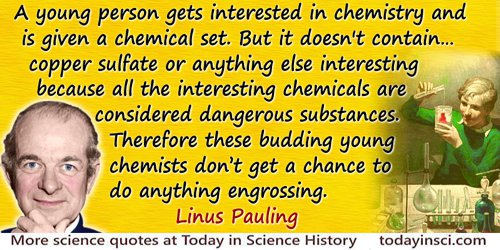
Just think of the differences today. A young person gets interested in chemistry and is given a chemical set. But it doesn't contain potassium cyanide. It doesn't even contain copper sulfate or anything else interesting because all the interesting chemicals are considered dangerous substances. Therefore, these budding young chemists don't get a chance to do anything engrossing with their chemistry sets. As I look back, I think it is pretty remarkable that Mr. Ziegler, this friend of the family, would have so easily turned over one-third of an ounce of potassium cyanide to me, an eleven-year-old boy.
In Barbara Marinacci, Linus Pauling In His Own Words (1995), 29.
Knowing he [Bob Serber] was going to the [first atom bomb] test, I asked him how he planned to deal with the danger of rattlesnakes. He said, “I’ll take along a bottle of whiskey.” … I ended by asking, “What would you do about those possibilities [of what unknown phenomena might cause a nuclear explosion to propagate in the atmosphere]?” Bob replied, “Take a second bottle of whiskey.”
Edward Teller with Judith L. Shoolery, Memoirs: A Twentieth-Century Journey in Science and Politics (2001), 211.
Knowledge has been accumulating at an ever increasing rate, and knowledge, once it is available, can be used for evil as well as for good. It was inevitable that a day would come when the expanding body of knowledge would sweep across the danger level. That day, as you know, has come—and passed. Knowledge is already available by means of which men could wreck the civilization of the world—and the growth of knowledge continues faster than ever before.
The Nature of Science and Other Lectures (1954), 4.
Like taxes, radioactivity has long been with us and in increasing amounts; it is not to be hated and feared, but accepted and controlled. Radiation is dangerous, let there be no mistake about that—but the modern world abounds in dangerous substances and situations too numerous to mention. ... Consider radiation as something to be treated with respect, avoided when practicable, and accepted when inevitable.
Recommending the same view towards radiation as the risks of automobile travel.
Recommending the same view towards radiation as the risks of automobile travel.
While in the Office of Naval Research. In Must we Hide? (1949), 44.
Love is of all stimulants the most powerful. It sharpens the wits like danger, and the memory like hatred; it spurs the will like ambition; it exalts the imagination like hashish; it intoxicates like wine.
In novel, Debenham’s Vow (1870, publ. Hurst and Blackett), Vol. 1, 137. In later collections of quotations, the phrase about “imagination” is omitted, for example, in Maturin M. Ballou (ed.), Edge-Tools of Speech (1886), 284.
Man must at all costs overcome the Earth’s gravity and have, in reserve, the space at least of the Solar System. All kinds of danger wait for him on the Earth… We are talking of disaster that can destroy the whole of mankind or a large part of it… For instance, a cloud of bolides [meteors] or a small planet a few dozen kilometers in diameter could fall on the Earth, with such an impact that the solid, liquid or gaseous blast produced by it could wipe off the face of the Earth all traces of man and his buildings. The rise of temperature accompanying it could alone scorch or kill all living beings… We are further compelled to take up the struggle against gravity, and for the utilization of celestial space and all its wealth, because of the overpopulation of our planet. Numerous other terrible dangers await mankind on the Earth, all of which suggest that man should look for a way into the Cosmos. We have said a great deal about the advantages of migration into space, but not all can be said or even imagined.
Man's chief enemy and danger is his own unruly nature and the dark forces pent up within him.
In The Life and Work of Sigmund Freud (1957), Vol. 3, 441.
Many years have passed since the exploration, and those who were boys with me in the enterprise are—ah, most of them are dead, and the living are gray with age. Their bronzed, hardy, brave faces come before me as they appeared in the vigor of life; their lithe but powerful forms seem to move around me; and the memory of the men and their heroic deeds, the men and their generous acts, overwhelms me with a joy that seems almost a grief, for it starts a fountain of tears. I was a maimed man; my right arm was gone; and these brave men, these good men, never forgot it. In every danger my safety was their first care, and in every waking hour some kind service was rendered me, and they transfigured my misfortune into a boon.
In 'Preface' to Canyons of the Colorado (1895), v.
Mathematicians go mad, and cashiers; but creative artists very seldom. I am not, as will be seen, in any sense attacking logic: I only say that the danger does lie in logic, not in imagination.
In Orthodoxy (1908), 27.
Mathematics is distinguished from all other sciences except only ethics, in standing in no need of ethics. Every other science, even logic—logic, especially—is in its early stages in danger of evaporating into airy nothingness, degenerating, as the Germans say, into an anachrioid [?] film, spun from the stuff that dreams are made of. There is no such danger for pure mathematics; for that is precisely what mathematics ought to be.
In Charles S. Peirce, Charles Hartshorne (ed.), Paul Weiss (ed.), Collected Papers of Charles Sanders Peirce (1931), Vol. 4, 200.
May we not suspect that the vague but very real fears of children, which are quite independent of experience, are the inherited effects of real dangers and abject superstitions during ancient savage times?
Mind, 1877
Nazis started the Science of Eugenics. It’s the theory that to them, justified the holocaust. The problem is the Science has been broadly accepted around the world, including the United States. We even went as far as to hire the Scientists that were working on it and brought them over here rather then charging them with war crimes. [Project Paperclip] I think it is a very dangerous Science that contains ideologies that are a grave danger to the entire world.
…...
No society has ever yet been able to handle the temptations of technology, to mastery, to waste, to exuberance, to exploration and exploitation. We have to create something new, something that has never existed in the world before. We have to learn to cherish this Earth and cherish it as something that is fragile, that’s only one, that’s all we have, and we have to set up a system that is sufficiently complex to continue to monitor the whole. We have to use our scientific knowledge to correct the dangers that have come from science and technology.
Speaking at the first Earth Day (22 Apr 1970). As quoted in Hans Baer, Merrill Singer, The Anthropology of Climate Change: An Integrated Critical (2014), 23.
Now any dogma, based primarily on faith and emotionalism, is a dangerous weapon to use on others, since it is almost impossible to guarantee that the weapon will never be turned on the user.
In The Foundation Trilogy (1951), 155.
Of all the intellectual faculties, judgment is the last to arrive at maturity. The child should give its attention either to subjects where no error is possible at all, such as mathematics, or to those in which there is no particular danger in making a mistake, such as languages, natural science, history, and so on.
In Arthur Schopenhauer and T. Bailey (ed., trans.) Essays of Arthur Schopenhauer (1902), 67.
One may say that predictions are dangerous particularly for the future. If the danger involved in a prediction is not incurred, no consequence follows and the uncertainty principle is not violated.
Edward Teller , Wendy Teller and Wilson Talley, Conversations from the Dark Side of Physics (1991, 2002), 235.
One of the striking things about places heavily contaminated by radioactive nuclides is the richness of their wildlife. This is true of the land around Chernobyl, the bomb test sites of the Pacific, and areas near the United States’ Savannah River nuclear weapons plant of the Second World War. Wild plants and animals do not perceive radiation as dangerous, and any slight reduction it may cause in their lifespans is far less a hazard than is the presence of people and their pets.
In The Revenge of Gaia: Earth’s Climate Crisis & The Fate of Humanity (2006, 2007), 115-116.
One reason why mathematics enjoys special esteem, above all other sciences, is that its laws are absolutely certain and indisputable, while those of other sciences are to some extent debatable and in constant danger of being overthrown by newly discovered facts.
In Albert Einstein, translated by G.B. Jeffery and W. Perrett, 'Geometry and Experience',Sidelights on Relativity (1922), 27.

Our children will enjoy in their homes electrical energy too cheap to meter. … Transmutation of the elements, unlimited power, ability to investigate the working of living cells by tracer atoms, the secret of photosynthesis about to be uncovered, these and a host of other results, all in about fifteen short years. It is not too much to expect that our children will know of great periodic regional famines in the world only as matters of history, will travel effortlessly over the seas and under the and through the air with a minimum of danger and at great speeds, and will experience a life span far longer than ours, as disease yields and man comes to understand what causes him to age.
Speech at the 20th anniversary of the National Association of Science Writers, New York City (16 Sep 1954), as quoted in 'Abundant Power From Atom Seen', New York Times (17 Sep 1954) 5.
Perfect concordance among reformers is not to be expected; and men who are honestly struggling towards the light cannot hope to attain at one bound to the complete truth. There is always a danger lest the fascination of a new discovery should lead us too far. Men of science, being human, are apt, like lovers, to exaggerate the perfections and be a little blind to the faults of the object of their choice.
'The Anniversary Address of the President', Quarterly Journal of the Geological Society of London, 1885, 41, 55.
Preconceived ideas are like searchlights which illumine the path of experimenter and serve him as a guide to interrogate nature. They become a danger only if he transforms them into fixed ideas – this is why I should like to see these profound words inscribed on the threshold of all the temples of science: “The greatest derangement of the mind is to believe in something because one wishes it to be so.”
Speech (8 Jul 1876), to the French Academy of Medicine. As translated in René J. Dubos, Louis Pasteur, Free Lance of Science (1950, 1986), 376. Date of speech identified in Maurice B. Strauss, Familiar Medical Quotations (1968), 502.
Pressure, no doubt, has always been a most important factor in the metamorphism of rocks; but there is, I think, at present some danger in over-estimating this, and representing a partial statement of truth as the whole truth. Geology, like many human beings, suffered from convulsions in its infancy; now, in its later years, I apprehend an attack of pressure on the brain.
In 'The Foundation-Stones of the Earth’s Crust', Nature, 1888, 39, 93.
Reliable scientific knowledge is value free and has no moral or ethical value. Science tells us how the world is. … Dangers and ethical issue arise only when science is applied as technology.
Nobel Symposium, at Stockholm, Sweden on 'Virtual Museums and Public Understanding of Science and Culture' (26-29 May 2002), Lecture 'Is Science Dangerous'. Published in 'Is Cell Science Dangerous?', Journal of Medical Ethics (Jun 2007), 33, No. 6, 345.
Research cannot be forced very much. There is always danger of too much foliage and too little fruit.
Letter to Professor Simon H. Gage. Quoted in Paul Franklin Clark, 'Theobald Smith, Student of Disease (1859-1934)', Journal of the History of Medicine and Allied Sciences (1959), 14, 492.
Research may start from definite problems whose importance it recognizes and whose solution is sought more or less directly by all forces. But equally legitimate is the other method of research which only selects the field of its activity and, contrary to the first method, freely reconnoitres in the search for problems which are capable of solution. Different individuals will hold different views as to the relative value of these two methods. If the first method leads to greater penetration it is also easily exposed to the danger of unproductivity. To the second method we owe the acquisition of large and new fields, in which the details of many things remain to be determined and explored by the first method.
In Zum Gedächtniss an Julius Plucker', Göttinger Abhandlungen (1871), 16, Mathematische Classe, 6.
Science becomes dangerous only when it imagines that it has reached its goal.
In Preface to the play, The Doctor’s Dilemma (1911), xc.
Science can point out dangers, but science cannot turn the direction of minds and hearts. That is the province of spiritual powers within and without our very beings—powers that are the mysteries of life itself.
…...
Science is a magnificent force, but it is not a teacher of morals. It can perfect machinery, but it adds no moral restraints to protect society from the misuse of the machine. It can also build gigantic intellectual ships, but it constructs no moral rudders for the control of storm tossed human vessel. It not only fails to supply the spiritual element needed but some of its unproven hypotheses rob the ship of its compass and thus endangers its cargo.
Proposed summation written for the Scopes Monkey Trial (1925), in Genevieve Forbes Herrick and John Origen Herrick ,The Life of William Jennings Bryan (1925), 405. This speech was prepared for delivery at the trial, but was never heard there, as both sides mutually agreed to forego arguments to the jury.
Sir Hiram Maxim is a genuine and typical example of the man of science, romantic, excitable, full of real but somewhat obvious poetry, a little hazy in logic and philosophy, but full of hearty enthusiasm and an honorable simplicity. He is, as he expresses it, “an old and trained engineer,” and is like all of the old and trained engineers I have happened to come across, a man who indemnifies himself for the superhuman or inhuman concentration required for physical science by a vague and dangerous romanticism about everything else.
In G.K. Chesterton, 'The Maxims of Maxim', Daily News (25 Feb 1905). Collected in G. K. Chesterton and Dale Ahlquist (ed.), In Defense of Sanity: The Best Essays of G.K. Chesterton (2011), 87.
So long as the fur of the beaver was extensively employed as a material for fine hats, it bore a very high price, and the chase of this quadruped was so keen that naturalists feared its speedy consideration. When a Parisian manufacturer invented the silk hat, which soon came into almost universal use, the demand for beavers' fur fell off, and this animal–whose habits, as we have seen, are an important agency in the formation of bogs and other modifications of forest nature–immediately began to increase, reappeared in haunts which we had long abandoned, and can no longer be regarded as rare enough to be in immediate danger of extirpation. Thus the convenience or the caprice of Parisian fashion has unconsciously exercised an influence which may sensibly affect the physical geography of a distant continent.
In Man and Nature, (1864), 84.
Suppose you had a small electrical fire and... a structural engineer [looked] at your home’s wiring [and] reports that the wiring is “shot” and there is a 50% chance that your house would burn down in the next few years unless you replace all the wiring. The job will cost $20,000... so you get an independent assessment. The next engineer agrees with the first warning. You can either continue to shop for additional evaluations until you find the one engineer in 1,000 that is willing to give you the answer you want, “Your family is not in danger” or you can change the wiring.
[Comparing the urgency of action on climate change to a problem with electrical wiring in a house.]
[Comparing the urgency of action on climate change to a problem with electrical wiring in a house.]
From press conference at National Press Club (17 Sep 2008), 'Basic Research: Fueling America's Future'. Quoted on the Science Coalition website.
Surely it must be admitted that if the conceptions of Physics are presented to the beginner in erroneous language, there is a danger that in many instances these conceptions will never be properly acquired. And is not accurate language as cheap as inaccurate?
A paper read at the Association for the Improvement of Geometrical Teaching (19 Jan 1889), 'The Vices of our Scientific Education', in Nature (6 Jun 1889), 40, 128.
That radioactive elements created by us are found in nature is an astounding event in the history of the earth. And of the Human race. To fail to consider its importance and its consequences would be a folly for which humanity would have to pay a terrible price. When public opinion has been created in the countries concerned and among all the nations, an opinion informed of the dangers involved in going on with the tests and led by the reason which this information imposes, then the statesmen may reach an agreement to stop the experiments.
In 'Excerpts from Message by Schweitzer', New York Times (24 Apr 1957), 4, translated from a letter issued by Schweitzer through the Nobel Committee, asking that public opinion demand an end to nuclear tests.
That so few now dare to eccentric, marks the chief danger of our time.
From On Liberty (1859), 121.
The Atomic Age was born in secrecy, and for two decades after Hiroshima, the high priests of the cult of the atom concealed vital information about the risks to human health posed by radiation. Dr. Alice Stewart, an audacious and insightful medical researcher, was one of the first experts to alert the world to the dangers of low-level radiation.
(Udeall is a former U.S. Secretary of the Interior.)
(Udeall is a former U.S. Secretary of the Interior.)
Quoted in Gayle Jacoba Greene, The Woman Who Knew Too Much (1999), back cover.
The biggest danger we face is overfishing. We have too many boats out there. We literally could fish out our oceans, some scientists believe, in the next 40, 50, 60 years. We are trending in that direction. … Every year, for the first time in history, we catch fewer and fewer fish with more and more sophisticated boats going out trying to find them.
From transcript of PBS TV interview by Tavis Smiley (28 Mar 2011).
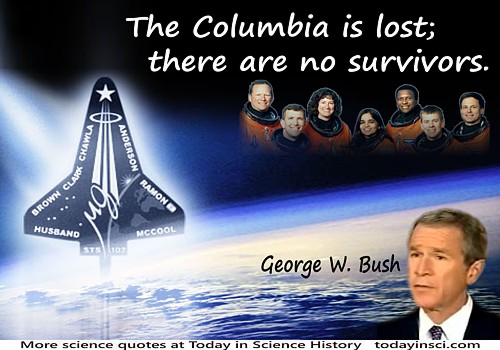
The Columbia is lost; there are no survivors. … In an age when space flight has come to seem almost routine, it is easy to overlook the dangers of travel by rocket, and the difficulties of navigating the fierce outer atmosphere of the Earth. These astronauts knew the dangers, and they faced them willingly, knowing they had a high and noble purpose in life. Because of their courage and daring idealism, we will miss them all the more. … The cause in which they died will continue. Mankind is led into the darkness beyond our world by the inspiration of discovery and the longing to understand. Our journey into space will go on.
Address to the Nation on the Space Shuttle Columbia tragedy, from the Cabinet Room (1 Feb 2003). In William J. Federer, A Treasury of Presidential Quotations (2004), 437.
The dangers of atomic war are underrated. It would be hard on little, concentrated countries like England. In the United States, we have lots of space.
Chicago Tribune (23 Feb 1950).
The dangers that face the world can, every one of them, be traced back to science. The salvations that may save the world will, every one of them, be traced back to science.
In Today and Tomorrow (1974), 304.
The dangers threatening modern science cannot be averted by more experimenting, for our complicated experiments have no longer anything to do with nature in her own right, but with nature charged and transformed by our own cognitive activity.
As quoted by Erich Heller in The Disinherited Mind: Essays in Modern German Literature and Thought (1952), 26.
The Earth has recovered after fevers like this, and there are no grounds for thinking that what we are doing will destroy Gaia, but if we continue business as usual, our species may never again enjoy the lush and verdant world we had only a hundred years ago. What is most in danger is civilization; humans are tough enough for breeding pairs to survive, and Gaia is toughest of all. What we are doing weakens her but is unlikely to destroy her. She has survived numerous catastrophes in her three billion years or more of life.
In The Revenge of Gaia: Earth’s Climate Crisis & The Fate of Humanity (2006, 2007), 76-77.
The fact that no limits exist to the destructiveness of this weapon [the “Super”, i.e. the hydrogen bomb] makes its very existence and the knowledge of its construction a danger to humanity as a whole. It is necessarily an evil thing considered in any light. For these reasons, we believe it important for the President of the United States to tell the American public and the world what we think is wrong on fundamental ethical principles to initiate the development of such a weapon.
Enrico Fermi and I.I. Rabi, 'Minority Report of the General Advisory Committee', United States Atomic Energy Commission: In the Matter of J. Robert Oppenheimer: Transcript of Hearing before Personnel Security Board, Washington, D.C. April 12th 1954—May 6th 1954 (1954), 79-80.
The frequency of disastrous consequences in compound fracture, contrasted with the complete immunity from danger to life or limb in simple fracture, is one of the most striking as well as melancholy facts in surgical practice.
'On a New Method of Treating Compound Fracture, Abscesses, etc: With Observations on the Conditions of Supperation', Part I, The Lancet (1867), 326.
The good Christian should beware of mathematicians, and all those who make empty prophecies. The danger already exists that the mathematicians have made a covenant with the devil to darken the spirit and to confine man in the bonds of Hell.
Mathematician refers to astrologer. From De Genesi ad Litteram (400s), Book 2, xviii, 37. As quoted in Morris Kline, Mathematics in Western Culture (1953, 1964), 3.
The introduction of men into the lying in chamber in place of female attendants, has increased the suffering and dangers of childbearing women, and brought multiplied injuries and fatalities upon mothers and children; it violates the sensitive feelings of husbands and wives and causes an untold amount of domestic misery. The unlimited intimacy between a male profession and the female population silently and effectually wears away female delicacy and professional morality, and tends probably more than any other cause in existence, to undermine the foundation of public virtue.
Man-midwifery Exposed and Corrected (1848) quoted in The Male Midwife and the Female Doctor: The Gynecology Controversy in Nineteenth Century America Charles Rosenburg and Carroll Rovenberg Smith (Editors) publ. Arno, 1974.
The mathematical take-over of physics has its dangers, as it could tempt us into realms of thought which embody mathematical perfection but might be far removed, or even alien to, physical reality. Even at these dizzying heights we must ponder the same deep questions that troubled both Plato and Immanuel Kant. What is reality? Does it lie in our mind, expressed by mathematical formulae, or is it “out there”.
In Book Review 'Pulling the Strings,' of Lawrence Krauss's Hiding in the Mirror: The Mysterious Lure of Extra Dimensions, from Plato to String Theory and Beyond in Nature (22 Dec 2005), 438, 1081.
The moment one has offered an original explanation for a phenomenon which seems satisfactory, that moment affection for his intellectual child springs into existence, and as the explanation grows into a definite theory his parental affections cluster about his offspring and it grows more and more dear to him. ... There springs up also unwittingly a pressing of the theory to make it fit the facts and a pressing of the facts to make them fit the theory... To avoid this grave danger, the method of multiple working hypotheses is urged. It differs from the simple working hypothesis in that it distributes the effort and divides the affections... In developing the multiple hypotheses, the effort is to bring up into view every rational exploration of the phenomenon in hand and to develop every tenable hypothesis relative to its nature, cause or origin, and to give to all of these as impartially as possible a working form and a due place in the investigation. The investigator thus becomes the parent of a family of hypotheses; and by his parental relations to all is morally forbidden to fasten his affections unduly upon anyone. ... Each hypothesis suggests its own criteria, its own method of proof, its own method of developing the truth, and if a group of hypotheses encompass the subject on all sides, the total outcome of means and of methods is full and rich.
'Studies for Students. The Method of Multiple Working Hypotheses', Journal of Geology (1897), 5, 840-6.
The most dangerous untruths are truths slightly distorted.
Aphorism 7 in Notebook H, as translated by R.J. Hollingdale in Aphorisms (1990).
The name of medicine is thought to have been given from 'moderation', modus, that is, from a due proportion, which advises that things be done not to excess, but 'little by little', paulatim. For nature is pained by surfeit but rejoices in moderation. Whence also those who take drugs and antidotes constantly, or to the point of saturation, are sorely vexed, for every immoderation brings not health but danger.
Etymologies [c.600], Book IV, chapter 2, quoted in E. Grant (ed.), A Source Book in Medieval Science (1974), trans. W. D. Sharpe (1964), 701.
The real danger is not that computers will begin to think like men, but that men will begin to think like computers.
As quoted, without citation, in Howard W. Eves, Return to Mathematical Circles, (1988), 63.
The saying that a little knowledge is a dangerous thing is, to my mind, a very dangerous adage. If knowledge is real and genuine, I do not believe that it is other than a very valuable posession, however infinitesimal its quantity may be. Indeed, if a little knowledge is dangerous, where is a man who has so much as to be out of danger?
'Instruction in Physiology', in Science and Culture and Other Essays (1882), 91.
The sciences have sworn among themselves an inviolable partnership; it is almost impossible to separate them, for they would rather suffer than be torn apart; and if anyone persists in doing so, he gets for his trouble only imperfect and confused fragments. Yet they do not arrive all together, but they hold each other by the hand so that they follow one another in a natural order which it is dangerous to change, because they refuse to enter in any other way where they are called. ...
Les Préludes de l'Harmonie Universelle (1634), 135-139. In Charles Coulston Gillespie (ed.), Dictionary of Scientific Biography (1974), Vol. 9, 316.
The scientists speak with an authority which the ordinary citizen, the non-scientist, cannot challenge, and to which he is compelled to listen. Since they cannot hope for much help from the generals or the ministers, they must act for themselves, in a supreme endeavor to avert the mortal dangers which confront mankind.
In 'Science and Disarmament,' Impact, 1965.
The state exists for man, not man for the state. The same may be said of science. These are old phrases, coined by people who saw in human individuality the highest human value. I would hesitate to repeat them, were it not for the ever recurring danger that they may be forgotten, especially in these days of organization and stereotypes.
…...
The theory of numbers is particularly liable to the accusation that some of its problems are the wrong sort of questions to ask. I do not myself think the danger is serious; either a reasonable amount of concentration leads to new ideas or methods of obvious interest, or else one just leaves the problem alone. “Perfect numbers” certainly never did any good, but then they never did any particular harm.
In A Mathematician’s Miscellany (1953). Reissued as Béla Bollobás (ed.), Littlewood’s Miscellany (1986), 74.
There are three elements of mountaineering—difficulty, danger, and exposure. Difficulty is the technical aspect of it. Danger, it is best to avoid, but some people like to increase danger to a point where their success is dependent only on luck. And exposure, which is what truly defines Alpinism, is what you face in wild nature. It’s the weather, the cold, the oxygen, the storms, the avalanches and rock falls, rain and snow. It’s the exposure that determines how you will move, it tells you that one wrong step means death. Exposure means no help is coming from outside, it’s you and the mountain.
From interview with Rudraneil Sengupta, 'Reinhold Messner: When You’re Alone, Fear is All on You', Mint (1 Mar 2014). A business newspaper in India, also online at livemint.com website.
There are, as we have seen, a number of different modes of technological innovation. Before the seventeenth century inventions (empirical or scientific) were diffused by imitation and adaption while improvement was established by the survival of the fittest. Now, technology has become a complex but consciously directed group of social activities involving a wide range of skills, exemplified by scientific research, managerial expertise, and practical and inventive abilities. The powers of technology appear to be unlimited. If some of the dangers may be great, the potential rewards are greater still. This is not simply a matter of material benefits for, as we have seen, major changes in thought have, in the past, occurred as consequences of technological advances.
Concluding paragraph of "Technology," in Dictionary of the History of Ideas (1973), Vol. 4, 364.
There is always the danger in scientific work that some word or phrase will be used by different authors to express so many ideas and surmises that, unless redefined, it loses all real significance.
'Valence and Tautomerism', Journal of the American Chemical Society (1913), 35, 1448.
There is another form of temptation even more fraught with danger. This is the disease of curiosity. ... It is this which drives us on to try to discover the secrets of nature, those secrets which are beyond our understanding, which can avail us nothing and which men should not wish to learn.
In Dragons of Eden by Carl Sagan (1977).
There is more danger of numerical sequences continued indefinitely than of trees growing up to heaven. Each will some time reach its greatest height.
Grundgesetz der Arithmetik(1893), Vol. 2, Section 60, In P. Greach and M. Black (eds., Translations from the Philosophical Writings of Gottlob Frege (1952), 204.
They hold that the function of universities is to make learning repellent and thus to prevent its becoming dangerously common. And they discharge this beneficent function all the more efficiently because they do it unconsciously and automatically. The professors think they are advancing healthy intellectual assimilation and digestion when they are in reality little better than cancer on the stomach.
Samuel Butler, Henry Festing Jones (ed.), The Note-Books of Samuel Butler (1917), 32.
To this I may add another form of temptation, manifold in its dangers … There exists in the soul … a cupidity which does not take delight in the carnal pleasure but in perceptions acquired through the flesh. It is a vain inquisitiveness dignified with the title of knowledge and science. As this is rooted in the appetite for knowing, and as among the senses the eyes play a leading role in acquiring knowledge, the divine word calls it “the lust of the eyes” (I John, 2: 16) … To satisfy this diseased craving … people study the operations of nature, which lie beyond our grasp when there is no advantage in knowing and the investigators simply desire knowledge for its own sake. This motive is again at work if, using a perverted science for the same end, people try to achieve things by magical arts.
From Confessions (c.397), Book X, Chap. 35 (54-55), as given in Henry Chadwick, Confessions: A New Translation by Henry Chadwick (1991), 210-212.
Visualize yourself confronted with the task of killing, one after the other, a cabbage, a fly, a fish, a lizard, a guinea pig, a cat, a dog, a monkey and a baby chimpanzee. In the unlikely case that you should experience no greater inhibitions in killing the chimpanzee than in destroying the cabbage or the fly, my advice to you is to commit suicide at your earliest possible convenience, because you are a weird monstrosity and a public danger.
'The Enmity Between Generations and Its Probable Ethological Causes'. In Richard I. Evans, Konrad Lorenz: The Man and his Ideas (1975), 227.
We regard as 'scientific' a method based on deep analysis of facts, theories, and views, presupposing unprejudiced, unfearing open discussion and conclusions. The complexity and diversity of all the phenomena of modern life, the great possibilities and dangers linked with the scientific-technical revolution and with a number of social tendencies demand precisely such an approach, as has been acknowledged in a number of official statements.
Progress, Coexistence and Intellectual Freedom (1968), 25.
We should remember that there was once a discipline called natural philosophy. Unfortunately, this discipline seems not to exist today. It has been renamed science, but science of today is in danger of losing much of the natural philosophy aspect.
[Pointing out the increasing specialization of science during the century to explain the resistance to his ideas,]
[Pointing out the increasing specialization of science during the century to explain the resistance to his ideas,]
(1986) Quoted in Anthony L. Peratt, 'Dean of the Plasma Dissidents', Washington Times, supplement: The World and I (May 1988),192.
Were we in danger of stopping [the experiment] when we liked the answer? I realized then, as I have often said since, that nature does not “know” what experiment a scientist is trying to do. “God loves the noise as much as the signal.”
In Confessions of a Technophile (1994), 45, with embedded quote by Branscomb cited in footnote as from 'Physics and the APS in 1979', Physics Today (Apr 1980), 33, No. 4, 49.
What we’re dealing with is so vast and so global that it really does need to be energized and kicked into high gear. Basically what’s going on is we are overfishing–the biggest danger–there are lots of things going on with the oceans that are threatening them.
From transcript of PBS TV interview by Tavis Smiley (28 Mar 2011).
Whatever advantage can be attributed to logic in directing and strengthening the action of the understanding is found in a higher degree in mathematical study, with the immense added advantage of a determinate subject, distinctly circumscribed, admitting of the utmost precision, and free from the danger which is inherent in all abstract logic—of leading to useless and puerile rules, or to vain ontological speculations. The positive method, being everywhere identical, is as much at home in the art of reasoning as anywhere else: and this is why no science, whether biology or any other, can offer any kind of reasoning, of which mathematics does not supply a simpler and purer counterpart. Thus, we are enabled to eliminate the only remaining portion of the old philosophy which could even appear to offer any real utility; the logical part, the value of which is irrevocably absorbed by mathematical science.
In Auguste Comte and Harriet Martineau (trans.), Positive Philosophy (1858), Vol. 1, 326-327.
Whatsoever therefore is consequent to a time of Warre, where every man is Enemy to every man; the same is consequent to the time, wherein men live without other security, than what their own strength, and their own invention shall furnish them withall. In such condition, there is no place for Industry; because the fruit thereof is uncertain: and consequently no Culture of the Earth; no Navigation, nor use of the commodities that may be imported by Sea; no commodious Building; no Instruments of moving, and removing, such things as require much force; no Knowledge of the face of the Earth; no account of Time; no Arts; no Letters; no Society; and which is worst of all, continual fear, and danger of violent death; And the life of man, solitary, poore, nasty, brutish, and short.
Leviathan (1651), ed. C. B. Macpherson (1968), Part 1, Chapter 13, 186.
When Death lurks at the door, the physician is considered as a God. When danger has been overcome, the physician is looked upon as an angel. When the patient begins to convalesce, the physician becomes a mere human. When the physician asks for his fees, he is considered as the devil himself.
In Harper's Magazine (1931-32), 164, 512.
Whenever Nature's bounty is in danger of exhaustion, the chemist has sought for a substitute. The conquest of disease has made great progress as a result of your efforts. Wherever we look, the work of the chemist has raised the level of our civilization and has increased the productive capacity of the nation. Waste materials, formerly cast aside, are now being utilized.
Speech to American Chemical Society, White House lawn (Apr 1924). Quoted in American Druggist (1925), 73, 19.
Why had we come to the moon?
The thing presented itself to me as a perplexing problem. What is this spirit in man that urges him for ever to depart from happiness and security, to toil, to place himself in danger, to risk an even a reasonable certainty of death? It dawned upon me that there in the moon as a thing I ought always to have known, that man is not made to go about safe and comfortable and well fed and amused. ... against his interest, against his happiness, he is constantly being driven to do unreasonable things. Some force not himself impels him, and he must go.
The thing presented itself to me as a perplexing problem. What is this spirit in man that urges him for ever to depart from happiness and security, to toil, to place himself in danger, to risk an even a reasonable certainty of death? It dawned upon me that there in the moon as a thing I ought always to have known, that man is not made to go about safe and comfortable and well fed and amused. ... against his interest, against his happiness, he is constantly being driven to do unreasonable things. Some force not himself impels him, and he must go.
The First Men in the Moon (1901)
Yet, in holding scientific research and discovery in respect, as we should, we must also be alert to the equal and opposite danger that public policy could itself become the captive of a scientific-technological elite.
Farewell Address as U.S. President (1961). In Diane Ravitch, The American Reader (2000), 538.
 In science it often happens that scientists say, 'You know that's a really good argument; my position is mistaken,' and then they would actually change their minds and you never hear that old view from them again. They really do it. It doesn't happen as often as it should, because scientists are human and change is sometimes painful. But it happens every day. I cannot recall the last time something like that happened in politics or religion.
(1987) --
In science it often happens that scientists say, 'You know that's a really good argument; my position is mistaken,' and then they would actually change their minds and you never hear that old view from them again. They really do it. It doesn't happen as often as it should, because scientists are human and change is sometimes painful. But it happens every day. I cannot recall the last time something like that happened in politics or religion.
(1987) --