Teacher Quotes (154 quotes)
[Certain students] suppose that because science has penetrated the structure of the atom it can solve all the problems of the universe. ... They are known in every ... college as the most insufferable, cocksure know-it-alls. If you want to talk to them about poetry, they are likely to reply that the "emotive response" to poetry is only a conditioned reflex .... If they go on to be professional scientists, their sharp corners are rubbed down, but they undergo no fundamental change. They most decidedly are not set apart from the others by their intellectual integrity and faith, and their patient humility in front of the facts of nature.... They are uneducated, in the fullest sense of the word, and they certainly are no advertisement for the claims of science teachers.
In Science is a Sacred Cow (1950), 18-19.
[The error in the teaching of mathematics is that] mathematics is expected either to be immediately attractive to students on its own merits or to be accepted by students solely on the basis of the teacher’s assurance that it will be helpful in later life. [And yet,] mathematlcs is the key to understanding and mastering our physical, social and biological worlds.
In editorial in Focus, a Journal of the Mathematical Association of America (1986), quoted in obituary by Eric Pace, New York Times (11 Jun 1992).
[Elementary student, laying a cocoon on the teacher's desk:] That is serendipity. The caterpillar thinks it is dying but it is really being born.
As quoted, without citation, by Marcus Bach, 'Serendiptiy in the Business World', in The Rotarian (Oct 1981), 139, No. 4, 40.
[Students or readers about teachers or authors.] They will listen with both ears to what is said by the men just a step or two ahead of them, who stand nearest to them, and within arm’s reach. A guide ceases to be of any use when he strides so far ahead as to be hidden by the curvature of the earth.
From Lecture (5 Apr 1917) at Hackley School, Tarrytown, N.Y., 'Choosing Books', collected in Canadian Stories (1918), 150.
Every teacher certainly should know something of non-euclidean geometry. Thus, it forms one of the few parts of mathematics which, at least in scattered catch-words, is talked about in wide circles, so that any teacher may be asked about it at any moment. … Imagine a teacher of physics who is unable to say anything about Röntgen rays, or about radium. A teacher of mathematics who could give no answer to questions about non-euclidean geometry would not make a better impression.
On the other hand, I should like to advise emphatically against bringing non-euclidean into regular school instruction (i.e., beyond occasional suggestions, upon inquiry by interested pupils), as enthusiasts are always recommending. Let us be satisfied if the preceding advice is followed and if the pupils learn to really understand euclidean geometry. After all, it is in order for the teacher to know a little more than the average pupil.
On the other hand, I should like to advise emphatically against bringing non-euclidean into regular school instruction (i.e., beyond occasional suggestions, upon inquiry by interested pupils), as enthusiasts are always recommending. Let us be satisfied if the preceding advice is followed and if the pupils learn to really understand euclidean geometry. After all, it is in order for the teacher to know a little more than the average pupil.
In George Edward Martin, The Foundations of Geometry and the Non-Euclidean Plane (1982), 72.
A few of the results of my activities as a scientist have become embedded in the very texture of the science I tried to serve—this is the immortality that every scientist hopes for. I have enjoyed the privilege, as a university teacher, of being in a position to influence the thought of many hundreds of young people and in them and in their lives I shall continue to live vicariously for a while. All the things I care for will continue for they will be served by those who come after me. I find great pleasure in the thought that those who stand on my shoulders will see much farther than I did in my time. What more could any man want?
In 'The Meaning of Death,' in The Humanist Outlook edited by A. J. Ayer (1968) [See Gerald Holton and Sir Isaac Newton].
A good notation has a subtlety and suggestiveness which at times make it almost seem like a live teacher. … a perfect notation would be a substitute for thought.
In 'Introduction' by Bertrand Russell written for Ludwig Wittgenstein, Tractatus Logico-Philosophicus (1922), 17-18.
A good teacher is a master of simplification and an enemy of simplism.
Erin Gruwell and Frank McCourt, The Gigantic Book of Teachers' Wisdom (2007), 73.Erin Gruwell, Frank McCourt
A good teacher must know the rules; a good pupil, the exceptions.
Martin H. Fischer, Howard Fabing (ed.) and Ray Marr (ed.), Fischerisms (1944).
A mathematician who can only generalise is like a monkey who can only climb UP a tree. ... And a mathematician who can only specialise is like a monkey who can only climb DOWN a tree. In fact neither the up monkey nor the down monkey is a viable creature. A real monkey must find food and escape his enemies and so must be able to incessantly climb up and down. A real mathematician must be able to generalise and specialise. ... There is, I think, a moral for the teacher. A teacher of traditional mathematics is in danger of becoming a down monkey, and a teacher of modern mathematics an up monkey. The down teacher dishing out one routine problem after another may never get off the ground, never attain any general idea. and the up teacher dishing out one definition after the other may never climb down from his verbiage, may never get down to solid ground, to something of tangible interest for his pupils.
From 'A Story With A Moral', Mathematical Gazette (Jun 1973), 57, No. 400, 86-87
A parable: A man was examining the construction of a cathedral. He asked a stone mason what he was doing chipping the stones, and the mason replied, “I am making stones.” He asked a stone carver what he was doing. “I am carving a gargoyle.” And so it went, each person said in detail what they were doing. Finally he came to an old woman who was sweeping the ground. She said. “I am helping build a cathedral.”
...Most of the time each person is immersed in the details of one special part of the whole and does not think of how what they are doing relates to the larger picture.
[For example, in education, a teacher might say in the next class he was going to “explain Young's modulus and how to measure it,” rather than, “I am going to educate the students and prepare them for their future careers.”]
...Most of the time each person is immersed in the details of one special part of the whole and does not think of how what they are doing relates to the larger picture.
[For example, in education, a teacher might say in the next class he was going to “explain Young's modulus and how to measure it,” rather than, “I am going to educate the students and prepare them for their future careers.”]
In The Art of Doing Science and Engineering: Learning to Learn (1975, 2005), 195.
A school teacher probably never enjoys anything she reads, she is so intently looking for errors.
In Sinner Sermons: A Selection of the Best Paragraphs of E. W. Howe (1926), 38.
A schoolteacher or professor cannot educate individuals, he educates only species. A thought that deserves taking to heart.
Aphorism 5 in Notebook J (1789-1793), as translated by R. J. Hollingdale in Aphorisms (1990). Reprinted as The Waste Books (2000), 129.
A teacher … is never a giver of "truth”; he is a guide, a pointer to the truth that the student must discover for himself. … For example, a skillful teacher might spur his student’s growth by confronting him with certain frustrations. A good teacher is a catalyst.
In 'Liberate Yourself From Classical Karate', Black Belt (Sep 1971), 27.
A teacher effects eternity; [s]he can never tell where [her] his influence stops.
The Education of Henry Adams: An Autobiography? (1918), 300.
A teacher of mathematics has a great opportunity. If he fills his allotted time with drilling his students in routine operations he kills their interest, hampers their intellectual development, and misuses his opportunity. But if he challenges the curiosity of his students by setting them problems proportionate to their knowledge, and helps them to solve their problems with stimulating questions, he may give them a taste for, and some means of, independent thinking.
In How to Solve It (1948), Preface.
Abstract as it is, science is but an outgrowth of life. That is what the teacher must continually keep in mind. … Let him explain … science is not a dead system—the excretion of a monstrous pedantism—but really one of the most vigorous and exuberant phases of human life.
In 'The Teaching of the History of Science', The Scientific Monthly (Sep 1918), 195-196.
Acceleration of knowledge generation also emphasizes the need for lifelong education. The trained teacher, scientist or engineer can no longer regard what they have learned at the university as supplying their needs for the rest of their lives.
In article Total Quality: Its Origins and its Future (1995), published at the Center for Quality and Productivity Improvement.
All the modern higher mathematics is based on a calculus of operations, on laws of thought. All mathematics, from the first, was so in reality; but the evolvers of the modern higher calculus have known that it is so. Therefore elementary teachers who, at the present day, persist in thinking about algebra and arithmetic as dealing with laws of number, and about geometry as dealing with laws of surface and solid content, are doing the best that in them lies to put their pupils on the wrong track for reaching in the future any true understanding of the higher algebras. Algebras deal not with laws of number, but with such laws of the human thinking machinery as have been discovered in the course of investigations on numbers. Plane geometry deals with such laws of thought as were discovered by men intent on finding out how to measure surface; and solid geometry with such additional laws of thought as were discovered when men began to extend geometry into three dimensions.
In Lectures on the Logic of Arithmetic (1903), Preface, 18-19.
Among your pupils, sooner or later, there must be one. who has a genius for geometry. He will be Sylvester’s special pupil—the one pupil who will derive from his master, knowledge and enthusiasm—and that one pupil will give more reputation to your institution than the ten thousand, who will complain of the obscurity of Sylvester, and for whom you will provide another class of teachers.
Letter (18 Sep 1875) recommending the appointment of J.J. Sylvester to Daniel C. Gilman. In Daniel C. Gilman Papers, Ms. 1, Special Collections Division, Milton S. Eisenhower Library, Johns Hopkins University. As quoted in Karen Hunger Parshall, 'America’s First School of Mathematical Research: James Joseph Sylvester at The Johns Hopkins University 1876—1883', Archive for History of Exact Sciences (1988), 38, No. 2, 167.
An ignorant or half-informed teacher may present science as an accumulation of unconnected facts. … To teach in that fashion is like going to the tree of science with its glorious fruit in order to pick up a handful of the dry fallen leaves from the ground.
In Inaugural Presidential Address (9 Sep 1885) to the British Association for the Advancement of Science, Aberdeen, Scotland, 'Relations of Science to the Public Weal', Report to the Fifty-Fifth Meeting of the British Association (1886), 11.
Arithmetic, as we shall see by and by, is overdone, in a certain sense, in our schools; just so far as the teaching is based upon the concrete, so far is it profitable; but when the book-makers begin to make it too abstract, as they very often do, it becomes a torture to both teacher and learners, or, at best, a branch of imaginary knowledge unconnected with real life.
From 'Introduction', Mathematical Teaching and its Modern Methods (1886), 10.
As an investigator [Robert Bunsen] was great, as a teacher he was greater, as a man and friend he was greatest.
Concluding remark in obituary, "Professor Bunsen', Nature, (31 Aug 1899), 60, No. 1557, 425.
But for us, it’s different. Look again at that dot. That’s here. That’s home. That’s us. On it everyone you love, everyone you know, everyone you ever heard of, every human being who ever was, lived out their lives. The aggregate of our joy and suffering, thousands of confident religions, ideologies, and economic doctrines, every hunter and forager, every hero and coward, every creator and destroyer of civilization, every king and peasant, every young couple in love, every mother and father, hopeful child, inventor and explorer, every teacher of morals, every corrupt politician, every “superstar,” every “supreme leader,” every saint and sinner in the history of our species lived there - on a mote of dust suspended in a sunbeam.
…...
Chemistry is an art that has furnished the world with a great number of useful facts, and has thereby contributed to the improvement of many arts; but these facts lie scattered in many different books, involved in obscure terms, mixed with many falsehoods, and joined to a great deal of false philosophy; so that it is not great wonder that chemistry has not been so much studied as might have been expected with regard to so useful a branch of knowledge, and that many professors are themselves but very superficially acquainted with it. But it was particularly to be expected, that, since it has been taught in universities, the difficulties in this study should have been in some measure removed, that the art should have been put into form, and a system of it attempted—the scattered facts collected and arranged in a proper order. But this has not yet been done; chemistry has not yet been taught but upon a very narrow plan. The teachers of it have still confined themselves to the purposes of pharmacy and medicine, and that comprehends a small branch of chemistry; and even that, by being a single branch, could not by itself be tolerably explained.
John Thomson, An Account of the Life, Lectures and Writings of William Cullen, M.D. (1832), Vol. 1, 40.
Come forth into the light of things,
Let Nature be your Teacher.
Let Nature be your Teacher.
In 'The Tables Turned' (1798). ln The Works of William Wordsworth (1994), Book 4, 381.
Come forth into the light of things,
Let Nature be your teacher. …
One impulse from a vernal wood
May teach you more of man,
Of moral evil and of good,
Than all the sages can.
Let Nature be your teacher. …
One impulse from a vernal wood
May teach you more of man,
Of moral evil and of good,
Than all the sages can.
From poem, 'The Tables Turned', collected in Lyrical Ballads, With a Few Other Poems (1798), 187.
Consciously and systematically Klein sought to enthrall me with the problems of mathematical physics, and to win me over to his conception of these problems as developed it in lecture courses in previous years. I have always regarded Klein as my real teacher only in things mathematical, but also in mathematical physics and in my conception of mechanics.
As quoted in Paul Forman and Armin Hermann, 'Sommerfeld, Arnold (Johannes Wilhelm)', Biography in Dictionary of Scientific Biography (1975), Vol. 12, 526. Cited from 'Autobiographische Skizze', Gesammelte Schriften, Vol 4, 673–682.
Constant muscular activity was natural for the child, and, therefore, the immense effort of the drillmaster teachers to make children sit still was harmful and useless.
Quoted in Bill McKibben, Maybe One: A Personal and Enviromental Argument for Single-Child Families (1998), 19.
Coolidge is a better example of evolution than either Bryan or Darrow, for he knows when not to talk, which is the biggest asset the monkey possesses over the human.
[Referring to the Scopes trial, with Darrow defending a teacher being prosecuted for teaching evolution in the state of Tennessee.]
[Referring to the Scopes trial, with Darrow defending a teacher being prosecuted for teaching evolution in the state of Tennessee.]
'Rogers Thesaurus'. Saturday Review (25 Aug 1962). In Will Rogers' Weekly Articles (1981), Vol. 2, 66.
Creation science has not entered the curriculum for a reason so simple and so basic that we often forget to mention it: because it is false, and because good teachers understand why it is false. What could be more destructive of that most fragile yet most precious commodity in our entire intellectual heritage—good teaching—than a bill forcing our honorable teachers to sully their sacred trust by granting equal treatment to a doctrine not only known to be false, but calculated to undermine any general understanding of science as an enterprise?.
In 'The Verdict on Creationism' The Sketical Inquirer (Winter 1987/88), 12, 186.
Creative activity could be described as a type of learning process where teacher and pupil are located in the same individual.
In Drinkers of Infinity: Essays, 1955-1967 (1969), 235.
Descartes, the father of modern philosophy … would never—so he assures us—have been led to construct his philosophy if he had had only one teacher, for then he would have believed what he had been told; but, finding that his professors disagreed with each other, he was forced to conclude that no existing doctrine was certain.
From 'Philosophy For Laymen', collected in Unpopular Essays (1950, 1996), 57.
Doubly galling was the fact that at the same time my roommate was taking a history course … filled with excitement over a class discussion. … I was busy with Ampere’s law. We never had any fascinating class discussions about this law. No one, teacher or student, ever asked me what I thought about it.
In Understanding the Universe: An Inquiry Approach to Astronomy and the Nature of Scientific Research (2013), ix.
During my stay in London I resided for a considerable time in Clapham Road in the neighbourhood of Clapham Common... One fine summer evening I was returning by the last bus 'outside' as usual, through the deserted streets of the city, which are at other times so full of life. I fell into a reverie (Träumerei), and 10, the atoms were gambolling before my eyes! Whenever, hitherto, these diminutive beings had appeared to me, they had always been in motion: but up to that time I had never been able to discern the nature of their motion. Now, however, I saw how, frequently, two smaller atoms united to form a pair: how the larger one embraced the two smaller ones: how still larger ones kept hold of three or even four of the smaller: whilst the whole kept whirling in a giddy dance. I saw how the larger ones formed a chain, dragging the smaller ones after them but only at the ends of the chain. I saw what our past master, Kopp, my highly honoured teacher and friend has depicted with such charm in his Molekular-Welt: but I saw it long before him. The cry of the conductor 'Clapham Road', awakened me from my dreaming: but I spent part of the night in putting on paper at least sketches of these dream forms. This was the origin of the 'Structural Theory'.
Kekule at Benzolfest in Berichte (1890), 23, 1302.
Each generation has its few great mathematicians, and mathematics would not even notice the absence of the others. They are useful as teachers, and their research harms no one, but it is of no importance at all. A mathematician is great or he is nothing.
Reflections: Mathematics and Creativity', New Yorker (1972), 47, No. 53, 39-45. In Douglas M. Campbell, John C. Higgins (eds.), Mathematics: People, Problems, Results (1984), Vol. 2, 3.
Early in my school career, I turned out to be an incorrigible disciplinary problem. I could understand what the teacher was saying as fast as she could say it, I found time hanging heavy, so I would occasionally talk to my neighbor. That was my great crime, I talked in school.
In In Memory Yet Green: the Autobiography of Isaac Asimov, 1920-1954 (1979), 73.
Even fairly good students, when they have obtained the solution of the problem and written down neatly the argument, shut their books and look for something else. Doing so, they miss an important and instructive phase of the work. ... A good teacher should understand and impress on his students the view that no problem whatever is completely exhausted.
In How to Solve It: A New Aspect of Mathematical Method (2004), 14.
Every fool believes what his teachers tell him, and calls his credulity science or morality as confidently as his father called it divine revelation.
In 'Maxims for Revolutionists: Education', in Man and Superman (1905), 230.
Every man who rises above the common level has received two educations: the first from his teachers; the second, more personal and important, from himself. … in which his mind has expanded to its proper form and dimensions … in the voluntary labours. … the merit of spontaneous and solid industry.
In The Autobiographies of Edward Gibbon (1896), 231.
Experience is the great teacher; unfortunately, experience leaves mental scars, and scar tissue contracts.
From speech 'In the Time of Henry Jacob Bigelow', given to the Boston Surgical Society, Medalist Meeting (6 Jun 1921). Printed in Journal of the Medical Association (1921), 77, 599.
Few will deny that even in the first scientific instruction in mathematics the most rigorous method is to be given preference over all others. Especially will every teacher prefer a consistent proof to one which is based on fallacies or proceeds in a vicious circle, indeed it will be morally impossible for the teacher to present a proof of the latter kind consciously and thus in a sense deceive his pupils. Notwithstanding these objectionable so-called proofs, so far as the foundation and the development of the system is concerned, predominate in our textbooks to the present time. Perhaps it will be answered, that rigorous proof is found too difficult for the pupil’s power of comprehension. Should this be anywhere the case,—which would only indicate some defect in the plan or treatment of the whole,—the only remedy would be to merely state the theorem in a historic way, and forego a proof with the frank confession that no proof has been found which could be comprehended by the pupil; a remedy which is ever doubtful and should only be applied in the case of extreme necessity. But this remedy is to be preferred to a proof which is no proof, and is therefore either wholly unintelligible to the pupil, or deceives him with an appearance of knowledge which opens the door to all superficiality and lack of scientific method.
In 'Stücke aus dem Lehrbuche der Arithmetik', Werke, Bd. 2 (1904), 296.
For the better part of my last semester at Garden City High, I constructed a physical pendulum and used it to make a “precision” measurement of gravity. The years of experience building things taught me skills that were directly applicable to the construction of the pendulum. Twenty-five years later, I was to develop a refined version of this measurement using laser-cooled atoms in an atomic fountain interferometer.
[Outcome of high school physics teacher, Thomas Miner, encouraging Chu's ambitious laboratory project.]
[Outcome of high school physics teacher, Thomas Miner, encouraging Chu's ambitious laboratory project.]
Autobiography in Gösta Ekspong (ed.), Nobel Lectures: Physics 1996-2000 (2002), 116.
God help the teacher, if a man of sensibility and genius, when a booby father presents him with his booby son, and insists on lighting up the rays of science in a fellow's head whose skull is impervious and inaccessible by any other way than a positive fracture with a cudgel.
In a letter to Mr. Cunningham, 11 Jun 1791. Quoted in James Wood Dictionary of Quotations from Ancient and Modern, English and Foreign Sources (1893), 126:18.
Good teachers deserve apples; great teachers deserve chocolate.
A favorite quotation, written in calligraphy on his office door.
A favorite quotation, written in calligraphy on his office door.
As quoted in obituary for Richard Hamming, by Herschel H. Loomis and David S. Potter, in National Academy of Engineering, Memorial Tributes (2002), 123.
He that could teach mathematics well, would not be a bad teacher in any of [physics, chemistry, biology or psychology] unless by the accident of total inaptitude for experimental illustration; while the mere experimentalist is likely to fall into the error of missing the essential condition of science as reasoned truth; not to speak of the danger of making the instruction an affair of sensation, glitter, or pyrotechnic show.
In Education as a Science (1879), 298.
He who can, does. He who cannot, teaches.
In 'Maxims for Revolutionists: Education', in Man and Superman (1903), 230.
He who knows what best to omit is the best teacher.
In Otto Neurath, Empiricism and Sociology (1973), 220.
His work was so great that it cannot be compassed in a few words. His death is one of the greatest losses ever to occur to British science.
Describing Ernest Rutherford upon his death at age 66. Thomson, then 80 years old, was once his teacher.
Describing Ernest Rutherford upon his death at age 66. Thomson, then 80 years old, was once his teacher.
Quoted in Time Magazine (1 Nov 1937).
Hypotheses are cradle-songs by which the teacher lulls his scholars to sleep. The thoughtful and honest observer is always learning more and more of his limitations; he sees that the further knowledge spreads, the more numerous are the problems that make their appearance.
In The Maxims and Reflections of Goethe (1906), 195.
I am sure that one secret of a successful teacher is that he has formulated quite clearly in his mind what the pupil has got to know in precise fashion. He will then cease from half-hearted attempts to worry his pupils with memorising a lot of irrelevant stuff of inferior importance.
In 'The Rhythmic Claims of Freedom and Discipline', The Aims of Education and Other Essays (1929), 46.
I cannot, however, but think that the world would be better and brighter if our teachers would dwell on the Duty of Happiness as well as the Happiness of Duty; for we ought to be as cheerful as we can, if only because to be happy ourselves is a most effectual contribution to the happiness of others.
The Pleasures of Life (1887, 2007), 7.
I continued to pursue my studies and half believed I might try for a doctorate in philosophy and become a teacher, as teaching is, after all, a form of show business.
In Born Standing Up: A Comic’s Life (2007), 101.
I didn’t really decide that I wanted to be an astronaut for sure until the end of college. But even in elementary school and junior high, I was very interested in space and in the space program. I had both male and female heroes. One was a high school science teacher who was very important in encouraging me to pursue science. Because I was a tennis player, Billie Jean King was a hero of mine. And the early astronauts, John Glenn and Neil Armstrong, were heroes of mine as well.
Interview conducted on Scholastic website (20 Nov 1998).
I do not intend to go deeply into the question how far mathematical studies, as the representatives of conscious logical reasoning, should take a more important place in school education. But it is, in reality, one of the questions of the day. In proportion as the range of science extends, its system and organization must be improved, and it must inevitably come about that individual students will find themselves compelled to go through a stricter course of training than grammar is in a position to supply. What strikes me in my own experience with students who pass from our classical schools to scientific and medical studies, is first, a certain laxity in the application of strictly universal laws. The grammatical rules, in which they have been exercised, are for the most part followed by long lists of exceptions; accordingly they are not in the habit of relying implicitly on the certainty of a legitimate deduction from a strictly universal law. Secondly, I find them for the most part too much inclined to trust to authority, even in cases where they might form an independent judgment. In fact, in philological studies, inasmuch as it is seldom possible to take in the whole of the premises at a glance, and inasmuch as the decision of disputed questions often depends on an aesthetic feeling for beauty of expression, or for the genius of the language, attainable only by long training, it must often happen that the student is referred to authorities even by the best teachers. Both faults are traceable to certain indolence and vagueness of thought, the sad effects of which are not confined to subsequent scientific studies. But certainly the best remedy for both is to be found in mathematics, where there is absolute certainty in the reasoning, and no authority is recognized but that of one’s own intelligence.
In 'On the Relation of Natural Science to Science in general', Popular Lectures on Scientific Subjects, translated by E. Atkinson (1900), 25-26.
I do not maintain that the chief value of the study of arithmetic consists in the lessons of morality that arise from this study. I claim only that, to be impressed from day to day, that there is something that is right as an answer to the questions with which one is able to grapple, and that there is a wrong answer—that there are ways in which the right answer can be established as right, that these ways automatically reject error and slovenliness, and that the learner is able himself to manipulate these ways and to arrive at the establishment of the true as opposed to the untrue, this relentless hewing to the line and stopping at the line, must color distinctly the thought life of the pupil with more than a tinge of morality. … To be neighborly with truth, to feel one’s self somewhat facile in ways of recognizing and establishing what is right, what is correct, to find the wrong persistently and unfailingly rejected as of no value, to feel that one can apply these ways for himself, that one can think and work independently, have a real, a positive, and a purifying effect upon moral character. They are the quiet, steady undertones of the work that always appeal to the learner for the sanction of his best judgment, and these are the really significant matters in school work. It is not the noise and bluster, not even the dramatics or the polemics from the teacher’s desk, that abide longest and leave the deepest and stablest imprint upon character. It is these still, small voices that speak unmistakably for the right and against the wrong and the erroneous that really form human character. When the school subjects are arranged on the basis of the degree to which they contribute to the moral upbuilding of human character good arithmetic will be well up the list.
In Arithmetic in Public Education (1909), 18. As quoted and cited in Robert Édouard Moritz, Memorabilia Mathematica; Or, The Philomath’s Quotation-book (1914), 69.
I had a dislike for [mathematics], and ... was hopelessly short in algebra. ... [One extraordinary teacher of mathematics] got the whole year's course into me in exactly six [after-school] lessons of half an hour each. And how? More accurately, why? Simply because he was an algebra fanatic—because he believed that algebra was not only a science of the utmost importance, but also one of the greatest fascination. ... [H]e convinced me in twenty minutes that ignorance of algebra was as calamitous, socially and intellectually, as ignorance of table manners—That acquiring its elements was as necessary as washing behind the ears. So I fell upon the book and gulped it voraciously. ... To this day I comprehend the binomial theorem.
In Prejudices: third series (1922), 261-262.
For a longer excerpt, see H. L. Mencken's Recollections of School Algebra.
For a longer excerpt, see H. L. Mencken's Recollections of School Algebra.
I had this experience at the age of eight. My parents gave me a microscope. I don’t recall why, but no matter. I then found my own little world, completely wild and unconstrained, no plastic, no teacher, no books, no anything predictable. At first I did not know the names of the water-drop denizens or what they were doing. But neither did the pioneer microscopists. Like them, I graduated to looking at butterfly scales and other miscellaneous objects. I never thought of what I was doing in such a way, but it was pure science. As true as could be of any child so engaged, I was kin to Leeuwenhoek, who said that his work “was not pursued in order to gain the praise I now enjoy, but chiefly from a craving after knowledge, which I notice resides in me more that most other men.”
In The Creation: An Appeal to Save Life on Earth (2010), 143-144.
I have a vision of the world as a global village, a world without boundaries. Imagine a history teacher making history!
From an interview during her training. As quoted in Danielle Kovacs, 'Christa McAuliffe: Biography', record for Christa Corrigan McAuliffe Papers, Archives and Special Collections, Henry Whittemore Library on Framingham State College website.
I have, also, a good deal of respect for the job they [physicists] did in the first months after Hiroshima. The world desperately needed information on this new problem in the daily life of the planet, and the physicists, after a slow start, did a good job of giving it to them. It hasn’t come out with a fraction of the efficiency that the teachers might have wished, but it was infinitely more effective than anyone would have dared expect.
In 'A Newsman Looks at Physicists', Physics Today (May 1948), 1, No. 1, 15.
I know a good many men of great learning—that is, men born with an extraordinary eagerness and capacity to acquire knowledge. One and all, they tell me that they can't recall learning anything of any value in school. All that schoolmasters managed to accomplish with them was to test and determine the amount of knowledge that they had already acquired independently—and not infrequently the determination was made clumsily and inaccurately.
In Prejudices: third series (1922), 261.
For a longer excerpt, see H. L. Mencken's Recollections of School Algebra.
For a longer excerpt, see H. L. Mencken's Recollections of School Algebra.
I like a teacher who gives you something to take home to think about besides homework.
Performed as Edith Ann.
I once knew an otherwise excellent teacher who compelled his students to perform all their demonstrations with incorrect figures, on the theory that it was the logical connection of the concepts, not the figure, that was essential.
In Ernst Mach and Thomas Joseph McCormack, Space and Geometry (1906), 93.
I really see no harm which can come of giving our children a little knowledge of physiology. ... The instruction must be real, based upon observation, eked out by good explanatory diagrams and models, and conveyed by a teacher whose own knowledge has been acquired by a study of the facts; and not the mere catechismal parrot-work which too often usurps the place of elementary teaching.
Science and Culture (1882), 92.
I should object to any experimentation which can justly be called painful, for the purpose of elementary instruction ... [but I regret] a condition of the law which permits a boy to troll for pike, or set lines with live frog bait, for idle amusement; and, at the same time, lays the teacher of that boy open to the penalty of fine and imprisonment, if he uses the same animal for the purpose of exhibiting one of the most beautiful and instructive of physiological spectacles, the circulation in the web of the foot. ... [Maybe the frog is] inconvenienced by being wrapped up in a wet rag, and having his toes tied out ... But you must not inflict the least pain on a vertebrated animal for scientific purposes (though you may do a good deal in that way for gain or for sport) without due licence of the Secretary of State for the Home Department, granted under the authority of the Vivisection Act.
... [Yet, in] 1877, two persons may be charged with cruelty to animals. One has impaled a frog, and suffered the creature to writhe about in that condition for hours; the other has pained the animal no more than one of us would be pained by tying strings round his fingers, and keeping him in the position of a hydropathic patient. The first offender says, 'I did it because I find fishing very amusing,' and the magistrate bids him depart in peace; nay, probably wishes him good sport. The second pleads, 'I wanted to impress a scientific truth, with a distinctness attainable in no other way, on the minds of my scholars,' and the magistrate fines him five pounds.
I cannot but think that this is an anomalous and not wholly creditable state of things.
... [Yet, in] 1877, two persons may be charged with cruelty to animals. One has impaled a frog, and suffered the creature to writhe about in that condition for hours; the other has pained the animal no more than one of us would be pained by tying strings round his fingers, and keeping him in the position of a hydropathic patient. The first offender says, 'I did it because I find fishing very amusing,' and the magistrate bids him depart in peace; nay, probably wishes him good sport. The second pleads, 'I wanted to impress a scientific truth, with a distinctness attainable in no other way, on the minds of my scholars,' and the magistrate fines him five pounds.
I cannot but think that this is an anomalous and not wholly creditable state of things.
'On Elementary Instruction in Physiology'. Science and Culture (1882), 92.
I wanted certainty in the kind of way in which people want religious faith. I thought that certainty is more likely to be found in mathematics than elsewhere. But I discovered that many mathematical demonstrations, which my teachers expected me to accept, were full of fallacies, and that, if certainty were indeed discoverable in mathematics, it would be in a new field of mathematics, with more solid foundations than those that had hitherto been thought secure. But as the work proceeded, I was continually reminded of the fable about the elephant and the tortoise. Having constructed an elephant upon which the mathematical world could rest, I found the elephant tottering, and proceeded to construct a tortoise to keep the elephant from falling. But the tortoise was no more secure than the elephant, and after some twenty years of very arduous toil, I came to the conclusion that there was nothing more that I could do in the way of making mathematical knowledge indubitable.
In 'Reflections on my Eightieth Birthday', Portraits from Memory (1956), 54.
I'm not saying … I'm gonna change the world, but I guarantee you that I will spark the brain that will change the world.
From interview on MTV (1994).
If a teacher is full of his subject, and can induce enthusiasm in his pupils; if his facts are concrete and naturally connected, the amount of material that an average child can assimilate without injury is as astonishing as is the little that will fag him if it is a trifle above or below or remote from him, or taught dully or incoherently.
In The North American Review (Mar 1883), No. 316, 289.
If I were summing up the qualities of a good teacher of medicine, I would enumerate human sympathy, moral and intellectual integrity, enthusiasm, and ability to talk, in addition, of course, to knowledge of his subject.
If I would be a young man again and had to decide how to make my living, I would not try to become a scientist or scholar or teacher. I would rather choose to be a plumber or a peddler in the hope to find that modest degree of independence still available under present circumstances.
According to Ralph Keyes, The Quote Verifier: Who Said What, Where, and When (2006), 53, on other occasions Einstein said “he might rather have been a musician, or light-house keeper”; however it is a “popular misquotation” that refers to being a watchmaker.
If I would follow your advice and Jesus could perceive it, he, as a Jewish teacher, surely would not approve of such behavior.
…...
If today you can take a thing like evolution and make it a crime to teach it in the public schools, tomorrow you can make it a crime to teach it in the private schools, and next year you can make it a crime to teach it to the hustings or in the church. At the next session you may ban books and the newspapers. Soon you may set Catholic against Protestant and Protestant against Protestant, and try to foist your own religion upon the minds of men. If you can do one you can do the other. Ignorance and fanaticism are ever busy and need feeding. Always it is feeding and gloating for more. Today it is the public school teachers; tomorrow the private. The next day the preachers and the lecturers, the magazines, the books, the newspapers. After a while, Your Honor, it is the setting of man against man and creed against creed until with flying banners and beating drums we are marching backward to the glorious ages of the sixteenth century when bigots lighted fagots to burn the men who dared to bring any intelligence and enlightenment and culture to the human mind.
Darrow’s concluding remarks before adjournment of the second day of the Scopes Monkey Trial, Dayton, Tennessee (Monday, 13 Jul 1925). In The World's Most Famous Court Trial: Tennessee Evolution Case: a Complete Stenographic Report of the Famous Court Test of the Tennessee Anti-Evolution Act, at Dayton, July 10 to 21, 1925 (1925), Second Day's Proceedings, 87.
In 1847 I gave an address at Newton, Mass., before a Teachers’ Institute conducted by Horace Mann. My subject was grasshoppers. I passed around a large jar of these insects, and made every teacher take one and hold it while I was speaking. If any one dropped the insect, I stopped till he picked it up. This was at that time a great innovation, and excited much laughter and derision. There can be no true progress in the teaching of natural science until such methods become general.
In Melvin Calvin’s office there were four photographs: Michael Polanyi, Joel Hildebrand, Gilbert N. Lewis, and Ernest O. Lawrence. These scientists were his mentors: Polanyi for introducing him to the chemistry of phthalocyanine; Hildebrand for bringing him to Berkeley; Lewis, perhaps his most influential teacher; and Lawrence, who provided him the opportunity to work with the new scientific tool of radioactive carbon, which enabled the search for the path of carbon in photosynthesis to be successful.
Co-author with Marilyn Taylor and Robert E. Connick, obituary, 'Melvin Calvin', Proceedings of the American Philosophical Society (Dec 2000), 144, No. 4, 454.
In those days in the South, the only professional jobs that seemed to be open to a black man were a teacher, a preacher, a doctor or a lawyer.
About his youth. Quoted in Johns Hopkins University News Release (9 Jan 2003) on jh.edu web site.
Instead of dismissing professors for finding something out, let us rather discharge those who do not. Let each teacher understand that investigation is not dangerous for him; that his bread is safe, no matter how much truth he may discover, and that his salary will not be reduced, simply because he finds that the ancient Jews did not know the entire history of the world.
In Some Mistakes of Moses (1879), 27.
It is an obvious and imperative duty of every teacher of mathematics to study the masterpieces of mathematical literature.
In A Preface to Mathematics (1938), 76.
It is not easy to imagine how little interested a scientist usually is in the work of any other, with the possible exception of the teacher who backs him or the student who honors him.
Pensées d'un Biologiste (1939). Translated in The Substance of Man (1962), 195.
It is very interesting to observe how high the rank may be in the world of science, without the aid of wealth. I have before me a letter of the late Dr. Dalton, who, notwithstanding his great reputation as a chemist, until a late period of his life was a teacher of mathematics. He remarks in this note, that if the price of mercury continues so dear he shall not be able to afford the expense of filling the barometers which he requires for some experiments.
In Education and Manufactures (1863), 44-45.
It may sound like a lot of work to keep up with organic chemistry, and it is; however, those who haven't the time to do it become subject to decay in the ability to teach and to contribute to the Science—a sort of first-order process the half-life of which can't be much more than a year or two.
Highlights of Organic Chemistry: An Advanced Textbook (1974), 112.
It seems to me it [hands-on experience] was more prevalent in a more primitive society, where you’re closer to machinery. [As a university teacher,] I see this with farm kids all the time. They have a more or less rugged self-reliance.
About the his concern that as society is changing, education is losing the benefits of childhood hand-on experience. In interview, Rushworth M. Kidder, 'Grounded in Space Science', Christian Science Monitor (22 Dec 1989).
Let each social order … give the scientist a free hand and provide him with the environment and tools he needs; make him accessible to students, for he is essentially a teacher, make the university his home, and otherwise, for humanity’s sake, leave him alone.
Address upon receiving the Passano award in Baltimore, MD. In 'Medicine: The Egg & He', Time (27 May 1946). The author of the article described (not as direct quote) that Goodpasture deplored the fact that researchers are too often hamstrung by special “projects,” and not permitted to follow their own keen noses. Goodpasture acknowledged that exploratory research does entail relatively great financial risk, but these risks must be met if medicine is to serve humanity and not a social order. The author wrote that the ceremony was “last week”.
Let Nature be your teacher
In poem, 'The Tables Turned: An evening Scene, on the Same Subject', Lyrical Ballads: With a Few Other Poems (1798), 187.
Liebig was not a teacher in the ordinary sense of the word. Scientifically productive himself in an unusual degree, and rich in chemical ideas, he imparted the latter to his advanced pupils, to be put by them to experimental proof; he thus brought his pupils gradually to think for themselves, besides showing and explaining to them the methods by which chemical problems might be solved experimentally.
As quoted in G. H. Getman, The Life of Ira Remsen (1980), 18-19.
Love is a better teacher than duty.
…...
M. Waldman … concluded with a panegyric upon modern chemistry…:— “The ancient teachers of this science” said he, “Promised impossibilities and performed nothing. The modern masters promise very little; they know that metals cannot be transmuted and that the elixir of life is a chimera. But these philosophers seem only made to dabble in dirt, and their eyes to pore over the microscope or crucible, have indeed performed miracles. They penetrate into the recesses of nature and show how she works in her hiding-places. They ascend into the heavens; they have discovered how the blood circulates, and the nature of the air we breathe. They can command the thunders of heaven, mimic the earthquake, and even mock the invisible world with its own shadows.”
In Frankenstein: Or, The Modern Prometheus (1823), Vol. 1, 73-74. Webmaster note: In the novel, when the fictional characters meet, M. Waldman, professor of chemistry, sparks Victor Frankenstein’s interest in science. Shelley was age 20 when the first edition of the novel was published anonymously (1818).
Much have I learned from my teachers, more from my colleagues, but most from my students.
— Talmud
…...
My decision to begin research in radio astronomy was influenced both by my wartime experience with electronics and antennas and by one of my teachers, Jack Ratcliffe, who had given an excellent course on electromagnetic theory during my final undergraduate year.
From Autobiography in Wilhelm Odelberg (ed.), Les Prix Nobel en 1974/Nobel Lectures (1975)
My teacher, Hopkins, often commented on the craving for certainty that led so many physicists into mysticism or into the Church and similar organisations ... Faith seems to be an occupational hazard for physicists.
Penguin New Biology (1954), 16, 44
My third teacher was by far the wisest and most trustworthy, though he used neither books nor pictures, and was a poor lecturer. He was painfully silent, would talk only after repeated urging, and then often spoke almost unintelligibly in a language which had to be translated to be understood. But what he had to say was final and exhaustive, and could be passed on in good conscience to those who either would not or could not go directly to him for information. This teacher was Nature itself.
In Hans Cloos, Ernst Cloos (ed.) and Curt Dietz (ed.), Conversation With the Earth (1953, 1959), 249-250, as translated by E.B. Garside from the original German edition, Gespräch mit der Erde (1947). [In the original text, “nature itself” was in all lower case. Webmaster has capitalized “Nature” for emphasis, to compensate for the cropped context about the great importance of geology field trips as an instructor.]
Nature has been for me, for as long as I remember a source of solace, inspiration, adventure, and delight; a home, a teacher, a companion.
In Sisters of the Earth: Women’s Prose and Poetry (1991), Preface, xv.
Nature is man’s teacher. She unfolds her treasures to his search, unseals his eye, illumes his mind, and purifies his heart; an influence breathes from all the sights and sounds of her existence.
…...
Nature is our teacher, and science does not move a step without her.
In Introduction to Isaac Asimov and Jason A. Shulman (eds.), Isaac Asimov’s Book of Science and Nature Quotations (1988), xx.
Nature without learning is a blind thing, and learning without nature is an imperfect thing, and practice without both is an ineffective thing. Just as in farming, first of all the soil must be good, secondly, the husbandman skilful, and thirdly, the seed sound, so, after the same manner, nature is like to the soil, the teacher to the farmer and the verbal counsels precepts like to the seed.
— Plutarch
In 'On the Education of Children', Moralia (1927), Vol 3, 9, as translated by Frank Cole Babbitt.
Nearly every subject has a shadow, or imitation. It would, I suppose, be quite possible to teach a deaf and dumb child to play the piano. When it played a wrong note, it would see the frown of its teacher, and try again. But it would obviously have no idea of what it was doing, or why anyone should devote hours to such an extraordinary exercise. It would have learnt an imitation of music. and it would fear the piano exactly as most students fear what is supposed to be mathematics.
In Mathematician's Delight (1943), 8.
No video, no photographs, no verbal descriptions, no lectures can provide the enchantment that a few minutes out-of-doors can: watch a spider construct a web; observe a caterpillar systematically ravaging the edge of a leaf; close your eyes, cup your hands behind your ears, and listen to aspen leaves rustle or a stream muse about its pools and eddies. Nothing can replace plucking a cluster of pine needles and rolling them in your fingers to feel how they’re put together, or discovering that “sedges have edges and grasses are round,” The firsthand, right-and-left-brain experience of being in the out-of-doors involves all the senses including some we’ve forgotten about, like smelling water a mile away. No teacher, no student, can help but sense and absorb the larger ecological rhythms at work here, and the intertwining of intricate, varied and complex strands that characterize a rich, healthy natural world.
Into the Field: A Guide to Locally Focused Teaching
One looks back with appreciation to the brilliant teachers, but with gratitude to those who touched our human feelings. The curriculum is so much necessary raw material, but warmth is the vital element for the growing plant and for the soul of the child.
From The Gifted Child collected in Collected Works (1954, 1971), Vol. 17, 144. Translated from 'Der Begabt', Psychologie und Erziehung (1946).
One of the big misapprehensions about mathematics that we perpetrate in our classrooms is that the teacher always seems to know the answer to any problem that is discussed. This gives students the idea that there is a book somewhere with all the right answers to all of the interesting questions, and that teachers know those answers. And if one could get hold of the book, one would have everything settled. That’s so unlike the true nature of mathematics.
As quoted in L.A. Steen and D.J. Albers (eds.), Teaching Teachers, Teaching Students (1981), 89.
One of the first and foremost duties of the teacher is not to give his students the impression that mathematical problems have little connection with each other, and no connection at all with anything else. We have a natural opportunity to investigate the connections of a problem when looking back at its solution.
In How to Solve It: A New Aspect of Mathematical Method (2004), 15.
Ostwald was a great protagonist and an inspiring teacher. He had the gift of saying the right thing in the right way. When we consider the development of chemistry as a whole, Ostwald's name like Abou ben Adhem's leads all the rest ... Ostwald was absolutely the right man in the right place. He was loved and followed by more people than any chemist of our time.
'Ostwald', Journal of Chemical Education, 1933, 10, 612, as cited by Erwin N. Hiebert and Hans-Gunther Korber in article on Ostwald in Charles Coulston Gillespie (ed.), Dictionary of Scientific Biography Supplement 1, Vol 15-16, 466, which also says Wilder Bancroft "received his doctorate under Ostwald in 1892."
Paris ... On this side of the ocean it is difficult to understand the susceptibility of American citizens on the subject and precisely why they should so stubbornly cling to the biblical version. It is said in Genesis the first man came from mud and mud is not anything very clean. In any case if the Darwinian hypothesis should irritate any one it should only be the monkey. The monkey is an innocent animal—a vegetarian by birth. He never placed God on a cross, knows nothing of the art of war, does not practice lynch law and never dreams of assassinating his fellow beings. The day when science definitely recognizes him as the father of the human race the monkey will have no occasion to be proud of his descendants. That is why it must be concluded that the American Association which is prosecuting the teacher of evolution can be no other than the Society for Prevention of Cruelty to Animals.
[A cynical article in the French press on the Scopes Monkey Trial, whether it will decide “a monkey or Adam was the grandfather of Uncle Sam.”]
[A cynical article in the French press on the Scopes Monkey Trial, whether it will decide “a monkey or Adam was the grandfather of Uncle Sam.”]
Article from a French daily newspaper on the day hearings at the Scopes Monkey Trial began, Paris Soir (13 Jul 1925), quoted in 'French Satirize the Case', New York Times (14 Jul 1925), 3.
Poor is the pupil who does not surpass his master.
'Aphorisms', in The Notebooks of Leonardo da Vinci, trans. E. MacCurdy (1938 ), Vol. 1, 98.
Science is a magnificent force, but it is not a teacher of morals. It can perfect machinery, but it adds no moral restraints to protect society from the misuse of the machine. It can also build gigantic intellectual ships, but it constructs no moral rudders for the control of storm tossed human vessel. It not only fails to supply the spiritual element needed but some of its unproven hypotheses rob the ship of its compass and thus endangers its cargo.
Proposed summation written for the Scopes Monkey Trial (1925), in Genevieve Forbes Herrick and John Origen Herrick ,The Life of William Jennings Bryan (1925), 405. This speech was prepared for delivery at the trial, but was never heard there, as both sides mutually agreed to forego arguments to the jury.
Scientific observation has established that education is not what the teacher gives; education is a natural process spontaneously carried out by the human individual, and is acquired not by listening to words but by experiences upon the environment. The task of the teacher becomes that of preparing a series of motives of cultural activity, spread over a specially prepared environment, and then refraining from obtrusive interference. Human teachers can only help the great work that is being done, as servants help the master. Doing so, they will be witnesses to the unfolding of the human soul and to the rising of a New Man who will not be a victim of events, but will have the clarity of vision to direct and shape the future of human society.
In Education For a New World (1946), 4.
Success is a lousy teacher. It seduces smart people into thinking they can’t lose.
…...
Success is achievable without public recognition, and the world has many unsung heroes. The teacher who inspires you to pursue your education to your ultimate ability is a success. The parents who taught you the noblest human principles are a success. The coach who shows you the importance of teamwork is a success. The spiritual leader who instills in you spiritual values and faith is a success. The relatives, friends, and neighbors with whom you develop a reciprocal relationship of respect and support - they, too, are successes. The most menial workers can properly consider themselves successful if they perform their best and if the product of their work is of service to humanity.
From 'Getting to the Heart of Success', in Jim Stovall, Success Secrets of Super Achievers: Winning Insights from Those Who Are at the Top (1999), 42-43.
Such men as Newton and Linnaeus are incidental, but august, teachers of religion.
In Essays: Education of the People.
Teachers can only help the great work that is being done, as servants help the master.
In Education For a New World (1946), 4. Part of a longer quote on the Maria Montessori page that begins “Scientific observation has established…”.
Teachers need to be more inspirational. But it’s also up to engineering to make itself more interesting.
As quoted on imdb.com biography page for Bruce Dickinson. Webmaster has not yet found a primary source for this quote. Can you help?
Teachers should be able to teach subjects, not manuals merely.
Annual Reports of the Secretary of the Board of Education of Massachusetts for the years 1839-1844, Life and Works of Horace Mann (1891), Vol. 3, 58.
The ancients devoted a lifetime to the study of arithmetic; it required days to extract a square root or to multiply two numbers together. Is there any harm in skipping all that, in letting the school boy learn multiplication sums, and in starting his more abstract reasoning at a more advanced point? Where would be the harm in letting the boy assume the truth of many propositions of the first four books of Euclid, letting him assume their truth partly by faith, partly by trial? Giving him the whole fifth book of Euclid by simple algebra? Letting him assume the sixth as axiomatic? Letting him, in fact, begin his severer studies where he is now in the habit of leaving off? We do much less orthodox things. Every here and there in one’s mathematical studies one makes exceedingly large assumptions, because the methodical study would be ridiculous even in the eyes of the most pedantic of teachers. I can imagine a whole year devoted to the philosophical study of many things that a student now takes in his stride without trouble. The present method of training the mind of a mathematical teacher causes it to strain at gnats and to swallow camels. Such gnats are most of the propositions of the sixth book of Euclid; propositions generally about incommensurables; the use of arithmetic in geometry; the parallelogram of forces, etc., decimals.
In Teaching of Mathematics (1904), 12.
The beauty of his better self lives on
In minds he touched with fire, in many an eye
He trained to Truth’s exact severity;
He was a teacher: why be grieved for him
Whose living word still stimulates the air?
In minds he touched with fire, in many an eye
He trained to Truth’s exact severity;
He was a teacher: why be grieved for him
Whose living word still stimulates the air?
[On Jean Louis Rodolphe Agassiz.] 'Ode on the Death of Agassiz' (1888). In The Poetical Works of James Russell Lowell (1978),381.
The best person able to appraise promise as a mathematician is a gifted teacher, and not a professional tester.
In speech, 'Education for Creativity in the Sciences', Conference at New York University, Washington Square. As quoted by Gene Currivan in 'I.Q. Tests Called Harmful to Pupil', New York Times (16 Jun 1963), 66.
The child asks, “What is the moon, and why does it shine?” “What is this water and where does it run?” “What is this wind?” “What makes the waves of the sea?” “Where does this animal live, and what is the use of this plant?” And if not snubbed and stunted by being told not to ask foolish questions, there is no limit to the intellectual craving of a young child; nor any bounds to the slow, but solid, accretion of knowledge and development of the thinking faculty in this way. To all such questions, answers which are necessarily incomplete, though true as far as they go, may be given by any teacher whose ideas represent real knowledge and not mere book learning; and a panoramic view of Nature, accompanied by a strong infusion of the scientific habit of mind, may thus be placed within the reach of every child of nine or ten.
In 'Scientific Education', Lay Sermons, Addresses, and Reviews (1870), 71.
https://books.google.com/books?id=13cJAAAAIAAJ
Thomas Henry Huxley - 1870
The dispute between evolutionists and creation scientists offers textbook writers and teachers a wonderful opportunity to provide students with insights into the philosophy and methods of science. … What students really need to know is … how scientists judge the merit of a theory. Suppose students were taught the criteria of scientific theory evaluation and then were asked to apply these criteria … to the two theories in question. Wouldn’t such a task qualify as authentic science education? … I suspect that when these two theories are put side by side, and students are given the freedom to judge their merit as science, creation theory will fail ignominiously (although natural selection is far from faultless). … It is not only bad science to allow disputes over theory to go unexamined, but also bad education.
In Building a Bridge to the 18th Century: How the Past Can Improve Our Future (1999), 168.
The experienced observer does more than merely report and recite. He guides the eager student to an understanding of the earth. He may chart the scientist’s steep, barren road of sober observation and strict deduction, or the artist’s gentle road of contemplation and empathy. And, finally, he may point out his own unique way, the path of the initiated, which leads him from the laboratories and libraries to the meadows and flower gardens of the living earth.
In 'Prologue', Conversation with the Earth (1954), 7. As translated by E.B. Garside from Gespräch mit der Erde (1947).
The fear of mathematics is a tradition handed down from days when the majority of teachers knew little about human nature and nothing at all about the nature of mathematics itself. What they did teach was an imitation.
in Mathematician’s Delight (1946), 12.
The first business of a teacher … should be to excite … curiosity. … This process saves a student from being (as many are) intellectually damaged by having a very good memory.
From Annotation to Essay 50, 'Of Studies', in Bacon’s Essays: With Annotations (1856), 446.
The future generation of scientists will be a sorry lot if the best teachers leave the academic circles for more lucrative positions in military or industrial laboratories.
In 'The Physicist Returns from the War', The Atlantic Monthly (Oct 1945), 176, No. 4, 108. Collected in 'Physics: A Physicist Surveys the Scene', American Thought 1947 (1947), 326.
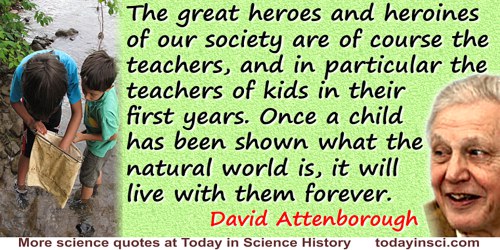
The great heroes and heroines of our society are of course the teachers, and in particular the teachers of kids in their first years. Once a child has been shown what the natural world is, it will live with them forever.
As quoted in Alexandra Pope, 'Attenborough Awarded RCGS Gold', Canadian Geographic, (May 2017), 137, No. 3, 73.
The great moral teachers of humanity were, in a way, artistic geniuses in the art of living.
In 'Science and Religion: Irreconcilable?', Ideas and Opinions (1954), 51.
The mediocre teacher tells. The good teacher explains. The superior teacher demonstrates. The great teacher inspires.
In Thoughts of a Christian Optimist: The Words of William Arthur Ward (1968), 16
The National Science Foundation asked the great “breakthrough” scientists what they felt to be the most dominantly favorable factor in their educational experience. The answer was almost uniformly, “Intimate association with a great, inspiring teacher.”
In "How Little I Know", in Saturday Review (12 Nov 1966), 152. Excerpted in Buckminster Fuller and Answar Dil, Humans in Universe (1983), 70.
THE OATH. I swear by Apollo [the healing God], the physician and Aesclepius [son of Apollo], and Health [Hygeia], and All-heal [Panacea], and all the gods and goddesses, that, according to my ability and judgment, I will keep this Oath and this stipulation—to reckon him who taught me this Art equally dear to me as my parents, to share my substance with him, and relieve his necessities if required; to look upon his offspring in the same footing as my own brothers, and to teach them this art, if they shall wish to learn it, without fee or stipulation; and that by precept, lecture, and every other mode of instruction, I will impart a knowledge of the Art to my own sons, and those of my teachers, and to disciples bound by a stipulation and oath according to the law of medicine, but to none others. I will follow that system of regimen which, according to my ability and judgment, I consider for the benefit of my patients, and abstain from whatever is deleterious and mischievous. I will give no deadly medicine to any one if asked, nor suggest any such counsel; and in like manner I will not give to a woman a pessary to produce abortion. With purity and with holiness I will pass my life and practice my Art. I will not cut persons laboring under the stone, but will leave this to be done by men who are practitioners of this work. Into whatever houses I enter, I will go into them for the benefit of the sick, and will abstain from every voluntary act of mischief and corruption; and, further, from the seduction of females or males, of freemen and slaves. Whatever, in connection with my professional practice or not, in connection with it, I see or hear, in the life of men, which ought not to be spoken of abroad, I will not divulge, as reckoning that all such should be kept secret. While I continue to keep this Oath unviolated, may it be granted to me to enjoy life and the practice of the art, respected by all men, in all times! But should I trespass and violate this Oath, may the reverse be my lot!
The Genuine Works of Hippocrates, trans. Francis Adams (1886), Vol. 2, 344-5.
The object of teaching a child is to enable him to get along without his teacher.
Used as epigraph on cover of Harry Persons Taber and Elbert Hubbard, The Philistine: A Periodical of Protest (Apr 1902), Vol. 14, 128.
The role of the teacher is to create the conditions for invention rather than provide ready-made knowledge.
Quoted in Richard Saul Wurman, Information Anxiety 2 (2001), 240.
The safest thing for a patient is to be in the hands of a man engaged in teaching medicine. In order to be a teacher of medicine the doctor must always be a student.
Proceedings of the Staff Meetings of the Mayo Clinic (1927).
The science fair has long been a favorite educational tool in the American school system, and for a good reason: Your teachers hate you.
'Science: It’s just not fair', Miami Herald (22 Mar 1998)
The so-called science of psychology is now in chaos, with no sign that order is soon to be restored. It is hard to find two of its professors who agree, and when the phenomenon is encountered it usually turns out that one of them is not a psychologist at all, but simply a teacher of psychology. … Not even anthropology offers a larger assortment of conflicting theories, or a more gaudy band of steaming and blood-sweating professors.
From book review (of Psychology: A Simplification) in American Mercury (Jul 1927), 582-583. Collected in A Mencken Chrestomathy (1949, 1956), 317.
The teacher can seldom afford to miss the questions: What is the unknown? What are the data? What is the condition? The student should consider the principal parts of the problem attentively, repeatedly, and from various sides.
In How to Solve It: A New Aspect of Mathematical Method (2004), 77
The teacher manages to get along still with the cumbersome algebraic analysis, in spite of its difficulties and imperfections, and avoids the smooth infinitesimal calculus, although the eighteenth century shyness toward it had long lost all point.
Elementary Mathematics From an Advanced Standpoint (1908). 3rd edition (1924), trans. E. R. Hedrick and C. A. Noble (1932), Vol. 1, 155.
The teacher who is attempting to teach without inspiring the pupil to learn is hammering on cold iron.
Thoughts Selected from the Writings of Horace Mann (1872), 225.
The teaching of elementary mathematics should be conducted so that the way should be prepared for the building upon them of the higher mathematics. The teacher should always bear in mind and look forward to what is to come after. The pupil should not be taught what may be sufficient for the time, but will lead to difficulties in the future. … I think the fault in teaching arithmetic is that of not attending to general principles and teaching instead of particular rules. … I am inclined to attack Teaching of Mathematics on the grounds that it does not dwell sufficiently on a few general axiomatic principles.
In John Perry (ed.), Discussion on the Teaching of Mathematics (1901), 33. The discussion took place on 14 Sep 1901 at the British Association at Glasgow, during a joint meeting of the mathematics and physics sections with the education section. The proceedings began with an address by John Perry. Professor Hudson was the first speak in the Discussion which followed.
The truth is, when all is said and done, one does not teach a subject, one teaches a student how to learn it.
Begin Here: The Forgotten Conditions of Teaching and Learning (1991), 35. In Richard J. Cox, Managing Records as Evidence and Information (2001), 217.
The university is the archive of the Western mind, it's the keeper of the Western culture, ... the guardian of our heritage, the teacher of our teachers, ... the dwelling place of the free mind.
In speech at the fourth bicentennial Conference of Columbia University, quoted in 'Text of Adlai Stevenson's Address at Columbia...', in New York Times (6 Jun 1954), 52.
The worst primary school scolding I ever received was for ridiculing a classmate who asked, ‘What’s an atom?’ To my third grader’s mind, the question betrayed a level of ignorance more befitting a preschooler, but the teacher disagreed and banned me from recess for a week. I had forgotten the incident until a few years ago, while sitting in on a quantum mechanics class taught by a Nobel Prizewinning physicist. Midway through a brutally abstract lecture on the hydrogen atom, a plucky sophomore raised his hand and asked the very same question. To the astonishment of all, our speaker fell silent. He stared out the window for what seemed like an eternity before answering, ‘I don’t know.’
'The Secret Life of Atoms'. Discover (Jun 2007), 28:6, 52.
Then I have more than an impression—it amounts to a certainty—that algebra is made repellent by the unwillingness or inability of teachers to explain why we suddenly start using a and b, what exponents mean apart from their handling, and how the paradoxical behavior of + and — came into being. There is no sense of history behind the teaching, so the feeling is given that the whole system dropped down readymade from the skies, to be used only by born jugglers. This is what paralyzes—with few exceptions—the infant, the adolescent, or the adult who is not a juggler himself.
In Teacher in America (1945), 82.
There are science teachers who actually claim that they teach “a healthy skepticism.” They do not. They teach a profound gullibility, and their dupes, trained not to think for themselves, will swallow any egregious rot, provided it is dressed up with long words and an affectation of objectivity to make it sound scientific.
In Science is a Sacred Cow (1950), 189.
There is a popular cliché ... which says that you cannot get out of computers any more than you have put in..., that computers can only do exactly what you tell them to, and that therefore computers are never creative. This cliché is true only in a crashingly trivial sense, the same sense in which Shakespeare never wrote anything except what his first schoolteacher taught him to write—words.
In The Blind Watchmaker: Why the Evidence of Evolution Reveals a Universe Without Design (1966, 1986), 64. Excerpted in Richard Dawkins, ‘Creation and Natural Selection’. New Scientist (25 Sep 1986), 111, 38.
There is no thing as a man who does not create mathematics and yet is a fine mathematics teacher. Textbooks, course material—these do not approach in importance the communication of what mathematics is really about, of where it is going, and of where it currently stands with respect to the specific branch of it being taught. What really matters is the communication of the spirit of mathematics. It is a spirit that is active rather than contemplative—a spirit of disciplined search for adventures of the intellect. Only as adventurer can really tell of adventures.
Reflections: Mathematics and Creativity', New Yorker (1972), 47, No. 53, 39-45. In Douglas M. Campbell, John C. Higgins (eds.), Mathematics: People, Problems, Results (1984), Vol. 2, 7.
Those who study the stars have God for a teacher.
To teach effectively a teacher must develop a feeling for his subject; he cannot make his students sense its vitality if he does not sense it himself. He cannot share his enthusiasm when he has no enthusiasm to share. How he makes his point may be as important as the point he makes; he must personally feel it to be important.
Mathematical Methods in Science (1963, 1977), 1.
Trees and fields tell me nothing: men are my teachers.
— Plato
Phædrus. In Clifton Wilbraham Collins, William Lucas Collins, Plato (1879), Vol. 4, 62.
We cannot hope to fill the schools with persons of high intelligence, for persons of high intelligence simply refuse to spend their lives teaching such banal things as spelling and arithmetic. Among the teachers male we may safely assume that 95% are of low mentality, else they would depart for more appetizing pastures. And even among the teachers female the best are inevitably weeded out by marriage, and only the worst (with a few romantic exceptions) survive. The task before us, as I say, is … to search out and put to use the value lying concealed in it.
In 'Education' Prejudices: Third Series (1922), 3, 247.
We have theories of races and of functions, but scarcely yet a remote approach to an idea of creation. We are now so far from the road to truth, that religious teachers dispute and hate each other, and speculative men are esteemed unsound and frivolous.
In 'Introduction', Nature: Addresses, and Lectures (1849), 2.
We live in a capitalist economy, and I have no particular objection to honorable self-interest. We cannot hope to make the needed, drastic improvement in primary and secondary education without a dramatic restructuring of salaries. In my opinion, you cannot pay a good teacher enough money to recompense the value of talent applied to the education of young children. I teach an hour or two a day to tolerably well-behaved near-adults–and I come home exhausted. By what possible argument are my services worth more in salary than those of a secondary-school teacher with six classes a day, little prestige, less support, massive problems of discipline, and a fundamental role in shaping minds. (In comparison, I only tinker with intellects already largely formed.)
…...
We must not only prepare [students] in sciences, we must prepare them in other areas. For example, I teach Chemistry but on every test I give I have an English question. And I give a simple question. I say, “Discuss your understanding of this topic.”
In address, to the Economic Club of Detroit (14 Jan 1990), 'Where Do We Go From Here?' on the massiechairs.com website.
We should not be speaking to, but with. That is second nature to any good teacher.
…...
What, then, is it in particular that can be learned from teachers of special distinction? Above all, what they teach is high standards. We measure everything, including ourselves, by comparisons; and in the absence of someone with outstanding ability there is a risk that we easily come to believe that we are excellent and much better than the next man. Mediocre people may appear big to themselves (and to others) if they are surrounded by small circumstances. By the same token, big people feel dwarfed in the company of giants, and this is a most useful feeling. So what the giants of science teach us is to see ourselves modestly and not to overrate ourselves.
Reminiscences and Reflections (1981), 175.
When I began my physical studies [in Munich in 1874] and sought advice from my venerable teacher Philipp von Jolly...he portrayed to me physics as a highly developed, almost fully matured science...Possibly in one or another nook there would perhaps be a dust particle or a small bubble to be examined and classified, but the system as a whole stood there fairly secured, and theoretical physics approached visibly that degree of perfection which, for example, geometry has had already for centuries.
From a lecture (1924). In Damien Broderick (ed.), Year Million: Science at the Far Edge of Knowledge (2008), 104.
When it was first proposed to establish laboratories at Cambridge, Todhunter, the mathematician, objected that it was unnecessary for students to see experiments performed, since the results could be vouched for by their teachers, all of them of the highest character, and many of them clergymen of the Church of England.
In The Scientific Outlook (1931, 2009), 49.
Why administrators are respected and school-teachers are not: An administrator is paid a lot for doing very little, while a teacher is paid very little for doing a lot.
In 'Money Et Cetera', A Voice Crying in the Wilderness (Vox Clamantis in Deserto) (1989), 101.
You have to dream. We all have to dream. Dreaming is okay. Imagine me teaching from space, all over the world, touching so many people’s lives. That’s a teacher’s dream!
From an interview during her training. As quoted in Danielle Kovacs, 'Christa McAuliffe: Biography', record for Christa Corrigan McAuliffe Papers, Archives and Special Collections, Henry Whittemore Library on Framingham State College website.
You have to grow from the inside out. None can teach you, none can make you spiritual. There is no other teacher but your own soul.
Quoted in Kim Lim (ed.), 1,001 Pearls of Spiritual Wisdom: Words to Enrich, Inspire, and Guide Your Life (2014), 247
 In science it often happens that scientists say, 'You know that's a really good argument; my position is mistaken,' and then they would actually change their minds and you never hear that old view from them again. They really do it. It doesn't happen as often as it should, because scientists are human and change is sometimes painful. But it happens every day. I cannot recall the last time something like that happened in politics or religion.
(1987) --
In science it often happens that scientists say, 'You know that's a really good argument; my position is mistaken,' and then they would actually change their minds and you never hear that old view from them again. They really do it. It doesn't happen as often as it should, because scientists are human and change is sometimes painful. But it happens every day. I cannot recall the last time something like that happened in politics or religion.
(1987) -- 





.jpg)