Poetry Quotes (150 quotes)
[Certain students] suppose that because science has penetrated the structure of the atom it can solve all the problems of the universe. ... They are known in every ... college as the most insufferable, cocksure know-it-alls. If you want to talk to them about poetry, they are likely to reply that the "emotive response" to poetry is only a conditioned reflex .... If they go on to be professional scientists, their sharp corners are rubbed down, but they undergo no fundamental change. They most decidedly are not set apart from the others by their intellectual integrity and faith, and their patient humility in front of the facts of nature.... They are uneducated, in the fullest sense of the word, and they certainly are no advertisement for the claims of science teachers.
In Science is a Sacred Cow (1950), 18-19.
[First use of the term science fiction:] We hope it will not be long before we may have other works of Science-Fiction [like Richard Henry Horne's The Poor Artist], as we believe such books likely to fulfil a good purpose, and create an interest, where, unhappily, science alone might fail.
[Thomas] Campbell says, that “Fiction in Poetry is not the reverse of truth, but her soft and enchanting resemblance.” Now this applies especially to Science-Fiction, in which the revealed truths of Science may be given interwoven with a pleasing story which may itself be poetical and true—thus circulating a knowledge of Poetry of Science, clothed in a garb of the Poetry of life.
[Thomas] Campbell says, that “Fiction in Poetry is not the reverse of truth, but her soft and enchanting resemblance.” Now this applies especially to Science-Fiction, in which the revealed truths of Science may be given interwoven with a pleasing story which may itself be poetical and true—thus circulating a knowledge of Poetry of Science, clothed in a garb of the Poetry of life.
In A Little Earnest Book Upon a Great Old Subject (1851), 137.
[L]et us not overlook the further great fact, that not only does science underlie sculpture, painting, music, poetry, but that science is itself poetic. The current opinion that science and poetry are opposed is a delusion. … On the contrary science opens up realms of poetry where to the unscientific all is a blank. Those engaged in scientific researches constantly show us that they realize not less vividly, but more vividly, than others, the poetry of their subjects. Whoever will dip into Hugh Miller’s works on geology, or read Mr. Lewes's “Seaside Studies,” will perceive that science excites poetry rather than extinguishes it. And whoever will contemplate the life of Goethe will see that the poet and the man of science can co-exist in equal activity. Is it not, indeed, an absurd and almost a sacrilegious belief that the more a man studies Nature the less he reveres it? Think you that a drop of water, which to the vulgar eye is but a drop of water, loses anything in the eye of the physicist who knows that its elements are held together by a force which, if suddenly liberated, would produce a flash of lightning? Think you that what is carelessly looked upon by the uninitiated as a mere snow-flake, does not suggest higher associations to one who has seen through a microscope the wondrously varied and elegant forms of snow-crystals? Think you that the rounded rock marked with parallel scratches calls up as much poetry in an ignorant mind as in the mind of a geologist, who knows that over this rock a glacier slid a million years ago? The truth is, that those who have never entered upon scientific pursuits know not a tithe of the poetry by which they are surrounded. Whoever has not in youth collected plants and insects, knows not half the halo of interest which lanes and hedge-rows can assume. Whoever has not sought for fossils, has little idea of the poetical associations that surround the places where imbedded treasures were found. Whoever at the seaside has not had a microscope and aquarium, has yet to learn what the highest pleasures of the seaside are. Sad, indeed, is it to see how men occupy themselves with trivialities, and are indifferent to the grandest phenomena—care not to understand the architecture of the Heavens, but are deeply interested in some contemptible controversy about the intrigues of Mary Queen of Scots!—are learnedly critical over a Greek ode, and pass by without a glance that grand epic written by the finger of God upon the strata of the Earth!
In Education: Intellectual, Moral, and Physical (1889), 82-83.
[The popular impression about some chemists is that] the aquafortis and the chlorine of the laboratories have as effectually bleached the poetry out of them, as they destroy the colours of tissues exposed to their action.
'The Alleged Antagonism between Poetry and Chemistry.' In Jesse Aitken Wilson, Memoirs of George Wilson. Quoted in Natural History Society of Montreal, 'Reviews and Notices of Books,' The Canadian Naturalist and Geologist (1861) Vol. 6, 391.
[About describing atomic models in the language of classical physics:] We must be clear that when it comes to atoms, language can be used only as in poetry. The poet, too, is not nearly so concerned with describing facts as with creating images and establishing mental connections.
As quoted by Werner Heisenberg, as translated by Arnold J. Pomerans, in Physics and Beyond: Encounters and Conversations (1971), 41. The words are not verbatim, but as later recollected by Werner Heisenberg describing his early encounter with Bohr in 1920.
Copernicus, who rightly did condemn
This eldest systeme, form’d a wiser scheme;
In which he leaves the Sun at Rest, and rolls
The Orb Terrestial on its proper Poles;
Which makes the Night and Day by this Career,
And by its slow and crooked Course the Year.
The famous Dane, who oft the Modern guides,
To Earth and Sun their Provinces divides:
The Earth’s Rotation makes the Night and Day,
The Sun revolving through th’ Eccliptic Way
Effects the various seasons of the Year,
Which in their Turn for happy Ends appear.
This Scheme or that, which pleases best, embrace,
Still we the Fountain of their Motion trace.
Kepler asserts these Wonders may be done
By the Magnetic Vertue of the Sun,
Which he, to gain his End, thinks fit to place
Full in the Center of that mighty Space,
Which does the Spheres, where Planets roll, include,
And leaves him with Attractive Force endu’d.
The Sun, thus seated, by Mechanic Laws,
The Earth, and every distant Planet draws;
By which Attraction all the Planets found
Within his reach, are turn'd in Ether round.
This eldest systeme, form’d a wiser scheme;
In which he leaves the Sun at Rest, and rolls
The Orb Terrestial on its proper Poles;
Which makes the Night and Day by this Career,
And by its slow and crooked Course the Year.
The famous Dane, who oft the Modern guides,
To Earth and Sun their Provinces divides:
The Earth’s Rotation makes the Night and Day,
The Sun revolving through th’ Eccliptic Way
Effects the various seasons of the Year,
Which in their Turn for happy Ends appear.
This Scheme or that, which pleases best, embrace,
Still we the Fountain of their Motion trace.
Kepler asserts these Wonders may be done
By the Magnetic Vertue of the Sun,
Which he, to gain his End, thinks fit to place
Full in the Center of that mighty Space,
Which does the Spheres, where Planets roll, include,
And leaves him with Attractive Force endu’d.
The Sun, thus seated, by Mechanic Laws,
The Earth, and every distant Planet draws;
By which Attraction all the Planets found
Within his reach, are turn'd in Ether round.
In Creation: A Philosophical Poem in Seven Books (1712), book 2, l. 430-53, p.78-9.
Nature is curious, and such worke may make,
That our dull sense can never finde, but scape.
For Creatures, small as Atomes, may be there,
If every Atome a Creatures Figure beare.
If foure Atomes a World can make, then see
What severall Worlds might in an Eare--ring bee:
For Millions of these Atomes may bee in
The Head of one Small, little, Single Pin.
And if thus Small, then Ladies may well weare
A World of Worlds, as Pendents in each Eare.
That our dull sense can never finde, but scape.
For Creatures, small as Atomes, may be there,
If every Atome a Creatures Figure beare.
If foure Atomes a World can make, then see
What severall Worlds might in an Eare--ring bee:
For Millions of these Atomes may bee in
The Head of one Small, little, Single Pin.
And if thus Small, then Ladies may well weare
A World of Worlds, as Pendents in each Eare.
From 'Of Many Worlds in this World', in Poems and Fancies (1653), 44-5.
Steckt keine Poesie in der Lokomotive, die brausend durch die Nacht zieht und über die zitternde Erde hintobt, als wollte sie Raum und Zeit zermalmen, in dem hastigen, aber wohl geregelten Zucken und Zerren ihrer gewaltigen Glieder, in dem stieren, nur auf ein Ziel losstürmenden Blick ihrer roten Augen, in dem emsigen, willenlosen Gefolge der Wagen, die kreischend und klappernd, aber mit unfehlbarer Sicherheit dem verkörperten Willen aus Eisen
und Stahl folge leisten?
Is there no poetry in the locomotive roaring through the night and charging over the quivering earth as if it wanted to crush time and space? Is there no poetry in the hasty but regular jerking and tugging of its powerful limbs, in the stare of its red eyes that never lose sight of their goal? Is there no poetry in the bustling, will-less retinue of cars that follow, screeching and clattering with unmistakable surety, the steel and iron embodiment of will?
Is there no poetry in the locomotive roaring through the night and charging over the quivering earth as if it wanted to crush time and space? Is there no poetry in the hasty but regular jerking and tugging of its powerful limbs, in the stare of its red eyes that never lose sight of their goal? Is there no poetry in the bustling, will-less retinue of cars that follow, screeching and clattering with unmistakable surety, the steel and iron embodiment of will?
— Max Eyth
From 'Poesie und Technik' (1904) (Poetry and Technology), in Schweizerische Techniker-Zeitung (1907), Vol 4, 306, as translated in Paul A. Youngman, Black Devil and Iron Angel: The Railway in Nineteenth-Century German Realism (2005), 128.
Where faith commences, science ends. Both these arts of the human mind must be strictly kept apart from each other. Faith has its origin in the poetic imagination; knowledge, on the other hand, originates in the reasoning intelligence of man. Science has to pluck the blessed fruits from the tree of knowledge, unconcerned whether these conquests trench upon the poetical imaginings of faith or not.
In Ernst Haeckel and E. Ray Lankester (trans.), The History of Creation (1880), Vol. 1, 9.
A man said to the universe,
“Sir, I exist.”
“However,” replied the universe,
“the fact has not created in me
a sense of obligation.”
“Sir, I exist.”
“However,” replied the universe,
“the fact has not created in me
a sense of obligation.”
In 'A Man Said to the Universe', Poem 21 in War Is Kind (1899). In Stephen Crane and Joseph Katz (ed.), The Complete Poems by Stephen Crane (1972), 139.
A painter makes patterns with shapes and colours, a poet with words. A painting may embody an “idea,” but the idea is usually commonplace and unimportant. In poetry, ideas count for a good deal more; but, as Housman insisted, the importance of ideas in poetry is habitually exaggerated. … The poverty of ideas seems hardly to affect the beauty of the verbal pattern. A mathematician, on the other hand, has no material to work with but ideas, and so his patterns are likely to last longer, since ideas wear less with time than words.
In A Mathematician’s Apology (1940, 2012), 84-85.
Alas! That partial Science should approve
The sly rectangle’s too licentious love!
From three bright Nymphs the wily wizard burns;-
Three bright-ey’d Nymphs requite his flame by turns.
Strange force of magic skill! Combined of yore.
The sly rectangle’s too licentious love!
From three bright Nymphs the wily wizard burns;-
Three bright-ey’d Nymphs requite his flame by turns.
Strange force of magic skill! Combined of yore.
'The Loves of the Triangles. A Mathematical and Philosophical Poem', in The Anti-Jacobean or Weekly Examiner, Monday 16 April 1798, 182. [Written by George Canning, Hookham Frere, and George Ellis].
And make us as Newton was, who in his garden watching
The apple falling towards England, became aware
Between himself and her of an eternal tie.
The apple falling towards England, became aware
Between himself and her of an eternal tie.
'Prologue' in Look Stranger! (1936), 11.
As for types like my own, obscurely motivated by the conviction that our existence was worthless if we didn’t make a turning point of it, we were assigned to the humanities, to poetry, philosophy, painting—the nursery games of humankind, which had to be left behind when the age of science began. The humanities would be called upon to choose a wallpaper for the crypt, as the end drew near.
From More Die of Heartbreak (1987, 1997), 246-247.
Astronomy, that micrography of heaven, is the most magnificent of the sciences. … Astronomy has its clear side and its luminous side; on its clear side it is tinctured with algebra, on its luminous side with poetry.
In Victor Hugo and Lorenzo O’Rourke (trans.) Victor Hugo’s Intellectual Autobiography: (Postscriptum de ma vie) (1907), 237-8. From the original French (1901): “L'astronomie, cette micrographie d'en haut, est la plus magnifique des sciences … L'astronomie a son côté clair et son côté lumineux ; par le côté clair elle trempe dans l'algèbre, par le côté lumineux dans la poésie.” [Note: The published translation had the typo “micography”, which is corrected herein. —Webmaster]
Be very vigilent over thy Childe … If he chuse the profession of a Scholler, advise him to study the most profitable Arts: Poetry, and the Mathematichs, take up too great a latitude of the Soule, and moderately used, are good Recreations, but bad Callings, bring nothing but their owne Reward.
From Alexander B. Grosart (ed), 'Enchyridion: The Fourth Book' (1641), The Complete Works in Prose and Verse of Francis Quarles (1880), Vol. 1, 48, Cap. XCIX.
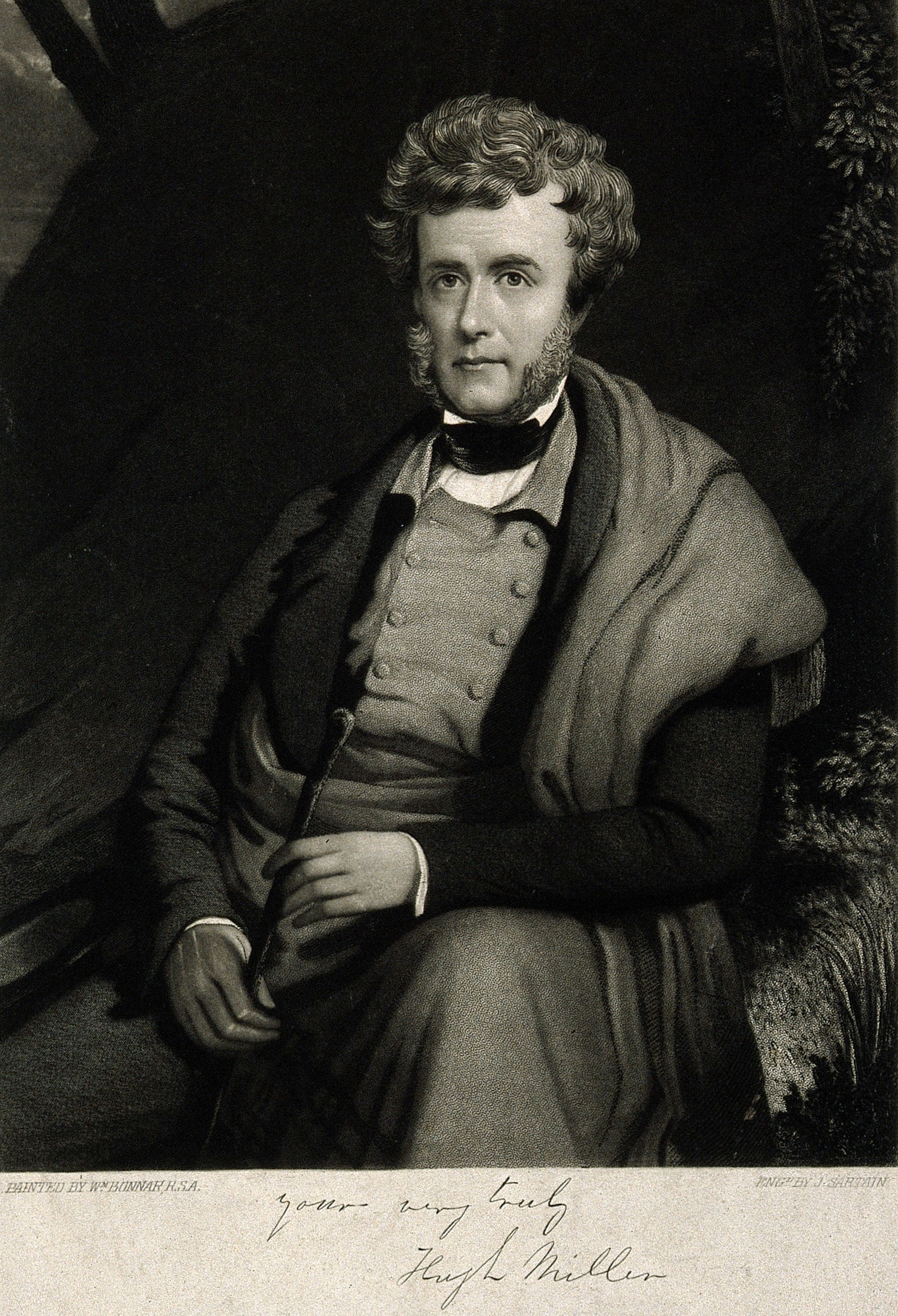
Because science flourishes, must poesy decline? The complaint serves but to betray the weakness of the class who urge it. True, in an age like the present,—considerably more scientific than poetical,—science substitutes for the smaller poetry of fiction, the great poetry of truth.
Lecture Second, collected in Popular Geology: A Series of Lectures Read Before the Philosophical Institution of Edinburgh, with Descriptive Sketches from a Geologist's Portfolio (1859), 123.
Chemistry has the same quickening and suggestive influence upon the algebraist as a visit to the Royal Academy, or the old masters may be supposed to have on a Browning or a Tennyson. Indeed it seems to me that an exact homology exists between painting and poetry on the one hand and modern chemistry and modern algebra on the other. In poetry and algebra we have the pure idea elaborated and expressed through the vehicle of language, in painting and chemistry the idea enveloped in matter, depending in part on manual processes and the resources of art for its due manifestation.
Attributed.
Consciousness is not wholly, nor even primarily a device for receiving sense-impressions. …there is another outlook than the scientific one, because in practice a more transcendental outlook is almost universally admitted. …who does not prize these moments that reveal to us the poetry of existence?
Swarthmore Lecture (1929) at Friends’ House, London, printed in Science and the Unseen World (1929), 44.
Could Hamlet have been written by a committee, or the “Mona Lisa” painted by a club? Could the New Testament have been composed as a conference report? Creative ideas do not spring from groups. They spring from individuals. The divine spark leaps from the finger of God to the finger of Adam, whether it takes ultimate shape in a law of physics or a law of the land, a poem or a policy, a sonata or a mechanical computer.
Baccalaureate address (9 Jun 1957), Yale University. In In the University Tradition (1957), 156.
Coy Nature, (which remain'd, though aged grown,
A beauteous virgin still, enjoy'd by none,
Nor seen unveil'd by anyone),
When Harvey's violent passion she did see,
Began to tremble and to flee;
Took sanctuary, like Daphne, in a tree:
There Daphne’s Lover stopped, and thought it much
The very leaves of her to touch:
But Harvey, our Apollo, stopp’d not so;
Into the Bark and Root he after her did go!
A beauteous virgin still, enjoy'd by none,
Nor seen unveil'd by anyone),
When Harvey's violent passion she did see,
Began to tremble and to flee;
Took sanctuary, like Daphne, in a tree:
There Daphne’s Lover stopped, and thought it much
The very leaves of her to touch:
But Harvey, our Apollo, stopp’d not so;
Into the Bark and Root he after her did go!
'Ode Upon Dr Harvey' (1663). In The British Poets: Including Translations in One Hundred Volumes (1822), Vol. 13, 245.
Energy is Eternal Delight.
'The Marriage of Heaven and Hell' (1790). In W. H. Stevenson (ed.), The Poems of William Blake (1971), 106.
For a scientist must indeed be freely imaginative and yet skeptical, creative and yet a critic. There is a sense in which he must be free, but another in which his thought must be very preceisely regimented; there is poetry in science, but also a lot of bookkeeping.
The Strange Case of the Spotted Mice and Other Classic Essays on Science (1996), 63.
For the harmony of the world is made manifest in Form and Number, and the heart and soul and all the poetry of Natural Philosophy are embodied in the concept of mathematical beauty.
In 'Epilogue', On Growth and Form (1917), 778-9.
Fossil bones and footsteps and ruined homes are the solid facts of history, but the surest hints, the most enduring signs, lie in those miniscule genes. For a moment we protect them with our lives, then like relay runners with a baton, we pass them on to be carried by our descendents. There is a poetry in genetics which is more difficult to discern in broken bomes, and genes are the only unbroken living thread that weaves back and forth through all those boneyards.
The Self-Made Man: Human Evolution From Eden to Extinction (1996), 13.
Gel’fand amazed me by talking of mathematics as though it were poetry. He once said about a long paper bristling with formulas that it contained the vague beginnings of an idea which could only hint at and which he had never managed to bring out more clearly. I had always thought of mathematics as being much more straightforward: a formula is a formula, and an algebra is an algebra, but Gel’fand found hedgehogs lurking in the rows of his spectral sequences!
In '1991 Ruth Lyttle Satter Prize', Notices of the American Mathematical Society (Mar 1991), 38, No. 3, 186. This is from her acceptance of the 1991 Ruth Lyttle Satter Prize.
Geometry seems to stand for all that is practical, poetry for all that is visionary, but in the kingdom of the imagination you will find them close akin, and they should go together as a precious heritage to every youth.
From The Proceedings of the Michigan Schoolmasters’ Club, reprinted in School Review (1898), 6 114.
Great fleas have little fleas upon their backs to bite 'em,
And little fleas have lesser fleas, and so ad infinitum.
And the great fleas themselves, in turn have, greater fleas to go on;
While these again have greater still, and greater still, and so on.
[He was imitating: 'So, naturalists observe, a flea Has smaller fleas that on him prey; And these have smaller still to bite 'em; And so proceed ad infinitum.' Poetry, a Rhapsody, by Jonathan Swift.]
And little fleas have lesser fleas, and so ad infinitum.
And the great fleas themselves, in turn have, greater fleas to go on;
While these again have greater still, and greater still, and so on.
[He was imitating: 'So, naturalists observe, a flea Has smaller fleas that on him prey; And these have smaller still to bite 'em; And so proceed ad infinitum.' Poetry, a Rhapsody, by Jonathan Swift.]
A Budget of Paradoxes (1915), first published 1872, Vol. 2, 191.
Hubble touches people. When you're looking that far out, you're giving people their place in the universe, it touches people. Science is often visual, so it doesn't need translation. It's like poetry, it touches you.
Interview (22 May 1997). On Academy of Achievement website.
I am ill at these numbers.
In Hamlet (1603), Act 2, Scene 2. [Note: Not for arithmetic. The numbers relate to the number of syllables in each line to write poetry; he is a bad poet. —Webmaster]
I do not see how a man can work on the frontiers of physics and write poetry at the same time. They are in opposition. In science you want to say something that nobody knew before, in words which everyone can understand. In poetry you are bound to say ... something that everyone knows already in words that nobody can understand.
Commenting to him about the poetry J. Robert Oppenheimer wrote.
Commenting to him about the poetry J. Robert Oppenheimer wrote.
Quoted in Steven George Krantz, Mathematical Apocrypha Redux: More Stories and Anecdotes of Mathematicians (2005), 169
I should not think of devoting less than 20 years to an Epic Poem. Ten to collect materials and warm my mind with universal science. I would be a tolerable Mathematician, I would thoroughly know Mechanics, Hydrostatics, Optics, and Astronomy, Botany, Metallurgy, Fossilism, Chemistry, Geology, Anatomy, Medicine—then the mind of man—then the minds of men—in all Travels, Voyages and Histories. So I would spend ten years—the next five to the composition of the poem—and the five last to the correction of it. So I would write haply not unhearing of the divine and rightly-whispering Voice, which speaks to mighty minds of predestinated Garlands, starry and unwithering.
Letter to Joseph Cottle, early April 1797. In Earl Leslie Griggs (ed.), The Collected Letters of Samuel Taylor Coleridge (1956), Vol. 1, 320-1.
I think that I shall never see
A poem as lovely as a tree.
A tree whose hungry mouth is prest
Against the earth’s sweet flowing breast;
A tree that looks at God all day,
And lifts her leafy arms to pray;
A tree that may in Summer wear
A nest of robins in her hair;
Upon whose bosom snow has lain;
Who intimately lives with rain.
Poems are made by fools like me,
But only God can make a tree.
A poem as lovely as a tree.
A tree whose hungry mouth is prest
Against the earth’s sweet flowing breast;
A tree that looks at God all day,
And lifts her leafy arms to pray;
A tree that may in Summer wear
A nest of robins in her hair;
Upon whose bosom snow has lain;
Who intimately lives with rain.
Poems are made by fools like me,
But only God can make a tree.
Trees and Other Poems (1914), 19.
I turn my eyes to the schools & universities of Europe
And there behold the loom of Locke whose woof rages dire,
Washed by the water-wheels of Newton. Black the cloth
In heavy wreaths folds over every nation; cruel works
Of many wheels I view, wheel without wheel, with cogs tyrannic
Moving by compulsion each other: not as those in Eden, which
Wheel within wheel in freedom revolve, in harmony & peace.
And there behold the loom of Locke whose woof rages dire,
Washed by the water-wheels of Newton. Black the cloth
In heavy wreaths folds over every nation; cruel works
Of many wheels I view, wheel without wheel, with cogs tyrannic
Moving by compulsion each other: not as those in Eden, which
Wheel within wheel in freedom revolve, in harmony & peace.
'Jerusalem, The Emanation of the Giant Albion' (1804-20), First Chapter, Pl.15, lines 14-20. In W. H. Stevenson (ed.), The Poems of William Blake (1971), 654-55.
I would liken science and poetry in their natural independence to those binary stars, often different in colour, which Herschel’s telescope discovered to revolve round each other. “There is one light of the sun,” says St. Paul, “and another of the moon, and another of the stars: star differeth from star in glory.” It is so here. That star or sun, for it is both, with its cold, clear, white light, is SCIENCE: that other, with its gorgeous and ever-shifting hues and magnificent blaze, is POETRY. They revolve lovingly round each other in orbits of their own, pouring forth and drinking in the rays which they exchange; and they both also move round and shine towards that centre from which they came, even the throne of Him who is the Source of all truth and the Cause of all beauty.
'The Alleged Antagonism between Poetry and Chemistry.' In Jesse Aitken Wilson, Memoirs of George Wilson. Quoted in Natural History Society of Montreal, 'Reviews and Notices of Books,' The Canadian Naturalist and Geologist (1861) Vol. 6, 393.
I wrote a fair amount of poetry in college. It was really, really bad. I mean, bad. And that’s how I found out—by doing it.
…...
If matter is not eternal, its first emergence into being is a miracle beside which all others dwindle into absolute insignificance. But, as has often been pointed out, the process is unthinkable; the sudden apocalypse of a material world out of blank nonentity cannot be imagined; its emergence into order out of chaos when “without form and void” of life, is merely a poetic rendering of the doctrine of its slow evolution.
In Nineteenth Century (Sep c.1879?). Quoted in John Tyndall, 'Professor Virchow and Evolution', Fragments of Science (1879), Vol. 2, 377.
If you want to penetrate into the heart of physics, then let yourself be initiated into the mysteries of poetry.
Friedrich Schlegel's Lucinde and the Fragments, trans. Peter Firchow (1971), 250.
In a notable family called Stein
There were Gertrude, and Ep, and then Ein.
Gert's writing was hazy,
Ep's statues were crazy,
And nobody understood Ein.
There were Gertrude, and Ep, and then Ein.
Gert's writing was hazy,
Ep's statues were crazy,
And nobody understood Ein.
Out on a Limerick (1961), 76.
In addition to instructing them in the holy Scriptures, they also taught their pupils poetry, astronomy, and the calculation of the church calendar.
— Bede
Referring to the teaching methods of Theodore, Archbishop of Canterbury, and Hadrian, abbot of Canterbury (A.D. 669).
In early times, medicine was an art, which took its place at the side of poetry and painting; to-day, they try to make a science of it, placing it beside mathematics, astronomy, and physics.
In Armand Trousseau and John Rose Cormack (trans.), Lectures on Clinical Medicine: Delivered at the Hôtel-Dieu, Paris (1869), Vol. 2, 40.
In every case the awakening touch has been the mathematical spirit, the attempt to count, to measure, or to calculate. What to the poet or the seer may appear to be the very death of all his poetry and all his visions—the cold touch of the calculating mind,—this has proved to be the spell by which knowledge has been born, by which new sciences have been created, and hundreds of definite problems put before the minds and into the hands of diligent students. It is the geometrical figure, the dry algebraical formula, which transforms the vague reasoning of the philosopher into a tangible and manageable conception; which represents, though it does not fully describe, which corresponds to, though it does not explain, the things and processes of nature: this clothes the fruitful, but otherwise indefinite, ideas in such a form that the strict logical methods of thought can be applied, that the human mind can in its inner chamber evolve a train of reasoning the result of which corresponds to the phenomena of the outer world.
In A History of European Thought in the Nineteenth Century (1896), Vol. 1, 314.
IN MEMORIAM: FLORENCE NIGHTINGALE
She whom we love, our Lady of Compassion,
Can never die, for Love forbids her death.
Love has bent down in his old kindly fashion,
And breathed upon her his immortal breath.
On wounded soldiers, in their anguish lying,
Her gentle spirit shall descend like rain.
Where the white flag with the red cross is flying,
There shall she dwell, the vanquisher of pain.
[In remembrance of 'The Lady of the Lamp' who died 13 Aug 1910.]
She whom we love, our Lady of Compassion,
Can never die, for Love forbids her death.
Love has bent down in his old kindly fashion,
And breathed upon her his immortal breath.
On wounded soldiers, in their anguish lying,
Her gentle spirit shall descend like rain.
Where the white flag with the red cross is flying,
There shall she dwell, the vanquisher of pain.
[In remembrance of 'The Lady of the Lamp' who died 13 Aug 1910.]
In New York Times (29 Aug 1910), 6. Collected in Summer of Love (1911), 72.
In science one tries to tell people, in such a way as to be understood by everyone, something that no one ever knew before. But in poetry, it’s the exact opposite.
As quoted, without citation, in Robert Jungk and James Cleugh (trans.), Brighter Than a Thousand Suns: A Personal History of the Atomic Scientists (1958), 22. The writing of poetry by Robert Oppenheimer was being remarked upon by Dirac, as he was talking with him.
In science, reason is the guide; in poetry, taste. The object of the one is truth, which is uniform and indivisible; the object of the other is beauty, which is multiform and varied.
Lacon: Many Things in Few Words (1820-22, 1866), 33.
In scientific thought we adopt the simplest theory which will explain all the facts under consideration and enable us to predict new facts of the same kind. The catch in this criterion lies in the world “simplest.” It is really an aesthetic canon such as we find implicit in our criticisms of poetry or painting. The layman finds such a law as dx/dt = κ(d²x/dy²) much less simple than “it oozes,” of which it is the mathematical statement. The physicist reverses this judgment, and his statement is certainly the more fruitful of the two, so far as prediction is concerned. It is, however, a statement about something very unfamiliar to the plain man, namely the rate of change of a rate of change.
In 'Science and Theology as Art-Forms', Possible Worlds (1927), 227.
In the beginning was the myth. God, in his search for self-expression, invested the souls of Hindus, Greeks, and Germans with poetic shapes and continues to invest each child’s soul with poetry every day.
Quoted in Kim Lim (ed.), 1,001 Pearls of Spiritual Wisdom: Words to Enrich, Inspire, and Guide Your Life (2014), 8
In the earliest ages science was poetry, as in the latter poetry has become science.
In literary essay, 'Witchcraft' (1868), collected in The Writings of James Russell Lowell in Prose and Poetry (1870, 1898), Vol. 2, 359.
Inspiration is needed in geometry, just as much as in poetry.
(1827). In Aleksandr Sergeevich Pushkin, John Bayley (ed.), Pushkin on Literature (1986), 211.
It is a lovely and terrible wilderness, such as wilderness as Christ and the prophets went out into; harshly and beautifully colored, broken and worn until its bones are exposed, its great sky without a smudge of taint from Technocracy, and in hidden corners and pockets under its cliffs the sudden poetry of springs.
Letter (3 Dec 1960) written to David E. Pesonen of the Outdoor Recreation Resources Review Commission. Collected in 'Coda: Wilderness Letter', The Sound of Mountain Water: The Changing American West (1969), 153.
It is an open secret to the few who know it, but a mystery and stumbling block to the many, that Science and Poetry are own sisters; insomuch that in those branches of scientific inquiry which are most abstract, most formal, and most remote from the grasp of the ordinary sensible imagination, a higher power of imagination akin to the creative insight of the poet is most needed and most fruitful of lasting work.
From Introduction written for William Kingdon Clifford, Clifford’s Lectures and Essays (1879), Vol. 1, 1.
It is as great a mistake to maintain that a high development of the imagination is not essential to progress in mathematical studies as to hold with Ruskin and others that science and poetry are antagonistic pursuits.
In Sphere of Science (1898), 107.
It is only in mathematics, and to some extent in poetry, that originality may be attained at an early age, but even then it is very rare (Newton and Keats are examples), and it is not notable until adolescence is completed.
In A Study of British Genius (1904), 142
It is the very strangeness of nature that makes science engrossing. That ought to be at the center of science teaching. There are more than seven-times-seven types of ambiguity in science, awaiting analysis. The poetry of Wallace Stevens is crystal-clear alongside the genetic code.
In Late Night Thoughts on Listening to Mahler's Ninth Symphony(1984), 209.
It is with mathematics not otherwise than it is with music, painting or poetry. Anyone can become a lawyer, doctor or chemist, and as such may succeed well, provided he is clever and industrious, but not every one can become a painter, or a musician, or a mathematician: general cleverness and industry alone count here for nothing.
In Ueber die Anlage zur Mathematik (1900), 5. As translated in Robert Édouard Moritz, Memorabilia Mathematica; Or, The Philomath’s Quotation-Book (1914), 184.
Language is the archives of history… . Language is fossil poetry.
From 'The Poet', Essays: Second Series, Essays & Lectures (1983), 457.
Learn to reverence night and to put away the vulgar fear of it, for, with the banishment of night from the experience of man, there vanishes as well a religious emotion, a poetic mood, which gives depth to the adventure of humanity. By day, space is one with the earth and with man - it is his sun that is shining, his clouds that are floating past; at night, space is his no more. When the great earth, abandoning day, rolls up the deeps of the heavens and the universe, a new door opens for the human spirit, and there are few so clownish that some awareness of the mystery of being does not touch them as they gaze. For a moment of night we have a glimpse of ourselves and of our world islanded in its stream of stars - pilgrims of mortality, voyaging between horizons across eternal seas of space and time. Fugitive though the instant be, the spirit of man is, during it, ennobled by a genuine moment of emotional dignity, and poetry makes its own both the human spirit and experience.
…...
Life is the most important thing about the world, the most important thing about life is evolution. Thus, by consciously seeking what is most meaningful, I moved from poetry to mineralogy to paleontology to evolution.
This View of Life: the World of an Evolutionist (1964), 27-28.
Mathematics and Poetry are … the utterance of the same power of imagination, only that in the one case it is addressed to the head, and in the other, to the heart.
From a review of William Rowan Hamilton’s, Lectures on Quaternions (1853), in 'The Imagination in Mathematics', The North American Review (Jul 1857), 85, No. 176, 230. Also in Robert Édouard Moritz, Memorabilia Mathematica; Or, The Philomath’s Quotation-book (1914), 189. The original text has “Mathematics…” but the latter text gives “Mathesis…”. The ellipsis is for the word “therefore”.
Mathematics is a form of poetry which transcends poetry in that it proclaims a truth; a form of reasoning which transcends reasoning in that it wants to bring about the truth it proclaims; a form of action, of ritual behavior, which does not find fulfilment in the act but must proclaim and elaborate a poetic form of truth.
'Why Mathematics Grows', Journal of the History of Ideas (Jan-Mar 1965), 26, No. 1, 3. In Salomon Bochner and Robert Clifford Gunning (ed.) Collected Papers of Salomon Bochner (1992), Vol. 4, 191. Footnoted as restating about Mathematics what was written about Myth by Henri Frankfort, et al., in The Intellectual Adventures of Ancient Man (1946), 8.
Mathematics is, as it were, a sensuous logic, and relates to philosophy as do the arts, music, and plastic art to poetry.
Aphorism 365 from Selected Aphorisms from the Lyceum (1797-1800). In Friedrich Schlegel, translated by Ernst Behler and Roman Struc, Dialogue on Poetry and Literary Aphorisms (trans. 1968), 147.
Mathematics may, like poetry or music, “promote and sustain a lofty habit of mind.”
In A Mathematician's Apology (1940, 2012), 116.
Mathematics, among all school subjects, is especially adapted to further clearness, definite brevity and precision in expression, although it offers no exercise in flights of rhetoric. This is due in the first place to the logical rigour with which it develops thought, avoiding every departure from the shortest, most direct way, never allowing empty phrases to enter. Other subjects excel in the development of expression in other respects: translation from foreign languages into the mother tongue gives exercise in finding the proper word for the given foreign word and gives knowledge of laws of syntax, the study of poetry and prose furnish fit patterns for connected presentation and elegant form of expression, composition is to exercise the pupil in a like presentation of his own or borrowed thoughtsand their development, the natural sciences teach description of natural objects, apparatus and processes, as well as the statement of laws on the grounds of immediate sense-perception. But all these aids for exercise in the use of the mother tongue, each in its way valuable and indispensable, do not guarantee, in the same manner as mathematical training, the exclusion of words whose concepts, if not entirely wanting, are not sufficiently clear. They do not furnish in the same measure that which the mathematician demands particularly as regards precision of expression.
In Anleitung zum mathematischen Unterricht in höheren Schulen (1906), 17.
May God us keep
From Single vision & Newton’s sleep!
From Single vision & Newton’s sleep!
Letter to Thomas Butt (22 Nov 1802). Collected in William Blake and Archibald George Blomefield Russell (ed.), The Letters of William Blake (1906), Vol. 1, 112.
Mock on, mock on, Voltaire, Rousseau!
Mock on, mock on: 'Tis all in vain!
You throw the sand against the wind,
And the wind blows it back again.
And every sand becomes a gem
Reflected in the beams divine;
Blown back they blind the mocking eye,
But still in Israel's paths they shine.
The atoms of Democritus
And Newton's particles of light
Are sands upon the Red Sea shore,
Where Israel's tents do shine so bright.
Mock on, mock on: 'Tis all in vain!
You throw the sand against the wind,
And the wind blows it back again.
And every sand becomes a gem
Reflected in the beams divine;
Blown back they blind the mocking eye,
But still in Israel's paths they shine.
The atoms of Democritus
And Newton's particles of light
Are sands upon the Red Sea shore,
Where Israel's tents do shine so bright.
Notebook Drafts (c. 1804). In W. H. Stevenson (ed.), The Poems of William Blake (1971), 481.
My mind seems to have become a kind of machine for grinding general laws out of large collections of facts, but why this should have caused the atrophy of that part of the brain that alone on which the higher tastes depend, I cannot conceive. A man with a mind more highly organised or better constituted than mine would not, I suppose, have thus suffered, and if I had to live my life over again, I would have made a rule to read some poetry and listen to some music at least once every week; for perhaps the parts of my brain now atrophied would thus have been kept alive through use.
In Charles Darwin and Francis Darwin (ed.), Charles Darwin: His Life Told in an Autobiographical Chapter, and in a Selected Series of His Published Letters (1892), 51.
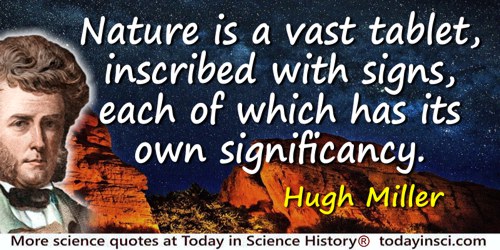
Nature is a vast tablet, inscribed with signs, each of which has its own significancy, and becomes poetry in the mind when read; and geology is simply the key by which myriads of these signs, hitherto indecipherable, can be unlocked and perused, and thus a new province added to the poetical domain.
Lecture Third, collected in Popular Geology: A Series of Lectures Read Before the Philosophical Institution of Edinburgh, with Descriptive Sketches from a Geologist's Portfolio (1859), 131.
Never mind what two tons refers to. What is it? How has it entered in so definite a way into our exprerience? Two tons is the reading of the pointer when the elephant was placed on a weighing machine. Let us pass on. … And so we see that the poetry fades out of the problem, and by the time the serious application of exact science begins we are left only with pointer readings.
From Gifford Lecture, Edinburgh, (1927), 'Pointer Readings', collected in The Nature of the Physical World (1928), 252.
Nobody, I suppose, could devote many years to the study of chemical kinetics without being deeply conscious of the fascination of time and change: this is something that goes outside science into poetry; but science, subject to the rigid necessity of always seeking closer approximations to the truth, itself contains many poetical elements.
From Nobel Lecture (11 Dec 1956), collected in Nobel Lectures in Chemistry (1999), 474.
Nothing could have been worse for the development of my mind than Dr. Butler's school, as it was strictly classical, nothing else being taught, except a little ancient geography and history. The school as a means of education to me was simply a blank. During my whole life I have been singularly incapable of mastering any language. Especial attention was paid to versemaking, and this I could never do well. I had many friends, and got together a good collection of old verses, which by patching together, sometimes aided by other boys, I could work into any subject.
In Charles Darwin and Francis Darwin (ed.), Charles Darwin: His Life Told in an Autobiographical Chapter, and in a Selected Series of His Published Letters (1892), 8.
Nothing will sustain you more potently than the power to recognize in your humdrum routine, as perhaps it may be thought, the true poetry of life—the poetry of the commonplace, of the ordinary man, of the plain, toil-worn woman, with their loves and their joys, their sorrows and their griefs.
From address 'The Student Life', No. 20 in Aequanimitas and other Addresses (1904, 1906), 423. This was a farewell address to American and Canadian medical students.
Nowhere would anyone grant that science and poetry can be united. They forgot that science arose from poetry, and did not see that when times change the two can meet again on a higher level as
friends.
On Morphology (Zur Morphologie) (1817). Quoted in Goethe’s Botanical Writings (1952), 171-172.
Of the many definitions of poetry, the simplest is still the best: “memorable speech.”
From 'The Poet's Tongue' (1935), Introduction, collected in Edward Mendelson (ed.), The Complete Works of W.H. Auden: Prose and Travel Books in Prose and Verse: 1926-1938 (1996), Vol. 1.
On poetry and geometric truth,
And their high privilege of lasting life,
From all internal injury exempt,
I mused; upon these chiefly: and at length,
My senses yielding to the sultry air,
Sleep seized me, and I passed into a dream.
And their high privilege of lasting life,
From all internal injury exempt,
I mused; upon these chiefly: and at length,
My senses yielding to the sultry air,
Sleep seized me, and I passed into a dream.
From 'The Prelude' in Book 5, collected in Henry Reed (ed.), The Complete Poetical Works of William Wordsworth (1851), 497.
Once early in the morning, at two or three in the morning, when the master was asleep, the books in the library began to quarrel with each other as to which was the king of the library. The dictionary contended quite angrily that he was the master of the library because without words there would be no communication at all. The book of science argued stridently that he was the master of the library for without science there would have been no printing press or any of the other wonders of the world. The book of poetry claimed that he was the king, the master of the library, because he gave surcease and calm to his master when he was troubled. The books of philosophy, the economic books, all put in their claims, and the clamor was great and the noise at its height when a small low voice was heard from an old brown book lying in the center of the table and the voice said, “The Lord is my shepherd, I shall not want.” And all of the noise and the clamor in the library ceased, and there was a hush in the library, for all of the books knew who the real master of the library was.
'Ministers of Justice', address delivered to the Eighty-Second Annual Convention of the Tennessee Bar Association at Gatlinburg (5 Jun 1963). In Tennessee Law Review (Fall 1963), 31, No. 1, 19.
Our aim [with poetry therapy] is to help the individual learn the art of helping himself or herself. We believe strongly with Walt Whitman, who wrote, “I am larger, better than I thought/I did not know I held so much goodness.”
As given in obituary, Myrna Oliver, 'Arthur Lerner; Promoted Use of Poetry in Therapy', Los Angeles Times (8 Apr 1998), quoting from a The Times article (1987).
Particular and contingent inventions in the solution of problems, which, though many times more concise than a general method would allow, yet, in my judgment, are less proper to instruct a learner, as acrostics, and such kind of artificial poetry, though never so excellent, would be but improper examples to instruct one that aims at Ovidean poetry.
In Letter to Collins (Macclesfield, 1670), Correspondence of Scientific Men (1841), Vol. 2, 307.
Perhaps the strongest bond of sympathy between mathematics and poetry, however, is the endless invention of each. Dr. Johnson remarked, “The essence of poetry is invention; such invention as, by producing something unexpected, surprises and delights”; but he might have said the same of mathematics.
In 'The Poetry of Mathematics', The Mathematics Teacher (May 1926), 19, No. 5, 295.
Perseverance is my motto. It laid the Atlantic cable; it gave us the telegraph, telephone, and wireless. It gave to the world an Abraham Lincoln, and to a race freedom. It gave to the negro Booker T. Washington and Tuskegee Institute. It made Frederick Douglass the great orator that he was, and it gave to the race Paul Laurence Dunbar, and to poetry a new song.
In 'Wealthiest Negro Woman's Suburban Mansion: Estate at Irvington, Overlooking Hudson and Containing All the Attractions That A Big Fortune Commands', New York Times Sunday Magazine (4 Nov 1917), 4.
Philosophy becomes poetry, and science imagination, in the enthusiasm of genius.
Literary Character of Men of Genius, Chap. 12. In In Jehiel Keeler Hoyt, The Cyclopedia of Practical Quotations (1996), 270.
Poetry creates life; Science dissects death.
Lectures and Addresses on Literary and Social Topics (1859), 123. In James Wood, Dictionary of Quotations from Ancient and Modern, English and Foreign Sources (1893), 382:26 .
Poetry is as exact a science as geometry.
In Letters of Gustave Flaubert (1951), 81.
Poetry is not the proper antithesis to prose, but to science…. The proper and immediate object of science is the acquirement, or communication, of truth; the proper and immediate object of poetry is the communication of immediate pleasure.
From 'Definition of Poetry' (1811), in Henry Nelson Coleridge (ed.), The Literary Remains of Samuel Taylor Coleridge (1836), Vol. 2, 7.
Poetry, mythology, and religion represent the world as man would like to have it, while science represents the world as he gradually comes to discover it.
In The Modern Temper: a Study and a Confession (1929), 6.
Poets are always ahead of science; all the great discoveries of science have been stated before in poetry.
In Epigrams of Oscar Wilde (2007), 71.
Pure mathematics is, in its way, the poetry of logical ideas. One seeks the most general ideas of operation which will bring together in simple, logical and unified form the largest possible circle of formal relationships. In this effort toward logical beauty spiritual formulas are discovered necessary for the deeper penetration into the laws of nature.
In letter (1 May 1935), Letters to the Editor, 'The Late Emmy Noether: Professor Einstein Writes in Appreciation of a Fellow-Mathematician', New York Times (4 May 1935), 12.
Quantum provides us with a striking illustration of the fact that though we can fully understand a connection … we can only speak of it in images and parables. We must be clear that when it comes to atoms, language can be used only as in poetry. The poet, too, is not nearly so concerned with describing facts as with creating images and establishing mental connections.
In conversation during first meeting with Werner Heisenberg (summer 1920), as quoted in Werner Heisenberg and Arnold J. Pomerans (trans.), Physics and Beyond: Encounters and Conversations (1971), 41. As cited in Philip Kuberski, The Forgèd Feature: Toward a Poetics of Uncertainty: New and Selected Essays (1995), 177-178.
Science and art, or by the same token, poetry and prose differ from one another like a journey and an excursion. The purpose of the journey is its goal, the purpose of an excursion is the process.
Notebooks and Diaries (1838). In The Columbia World of Quotations (1996).
Science and poetry are, in fact, inseparable. By providing a vision of life, of Earth, of the universe in all its splendor, science does not challenge human values; it can inspire human values. It does not negate faith; it celebrates faith.
In Jacques Cousteau and Susan Schiefelbein, The Human, the Orchid, and the Octopus: Exploring and Conserving Our Natural World (2007), 201.
Science boasts of the distance of its stars; of the terrific remoteness of the things of which it has to speak. But poetry and religion always insist upon the proximity, the almost menacing closeness of the things with which they are concerned. Always the Kingdom of Heaven is “At Hand.”
'A Glimpse of My Country', The Daily News. Collected in Tremendous Trifles (1920), 277.
Science can be the religion of the nonreligious, the poetry of the non-poet, the art of the man who cannot paint, the humor of the serious man, and the lovemaking of the inhibited and shy man. Not only does science begin in wonder; it also ends in wonder.
In The Psychology of Science: A Reconnaissance (1966), 151.
Science has succeeded to poetry, no less in the little walks of children than with men. Is there no possibility of averting this sore evil?
Letter to Coleridge (23 Oct 1802). In Edwin W. Marrs, Jr. (ed.), The Letters of Charles and Mary Anne Lamb (1976), Vol. 2, 81-2.
Science is continually correcting what it has said. Fertile corrections... science is a ladder... poetry is a winged flight... An artistic masterpiece exists for all time... Dante does not efface Homer.
Quoted in Pierre Biquard, Frederic Joliot-Curie: The Man and his Theories (1961), trans. Geoffrey Strachan (1965), 168.
Science is for those who learn; poetry for those who know.
In Meditations of a Parish Priest: Thoughts, Pt. 1, No. 71, translated from the third French edition by Isabel Florence Hapgood (1886), 43.
Science is the labor and handicraft of the mind; poetry can only be considered its recreation.
As quoted in Nathaniel Holmes, The Authorship of Shakespeare (1867), 198. Footnoted as Int. Globe, Works (Mont.), XV. 150.
Science sees signs: poetry, the thing signified.
Co-author with his brother Augustus William Hare Guesses At Truth, By Two Brothers: Second Edition: With Large Additions (1848), Second Series, 86. (The volume is introduced as “more than three fourths new.” The quote is identified as by Julius; Augustus had died in 1833.)
Science was false by being unpoetical. It assumed to explain a reptile or a mollusk, and isolated it—which is hunting for life in graveyards. Reptile or mollusk or man or angel only exists in system, in relation.
In 'Letters and Social Aims: Poetry and Imagination', Prose works of Ralph Waldo Emerson (1880), Vol. 3, 199.
Shakespeare was pursuing two Methods at once; and besides the Psychological Method, he had also to attend to the Poetical. (Note) we beg pardon for the use of this insolent verbum: but it is one of which our Language stands in great need. We have no single term to express the Philosophy of the Human Mind.
Sir Hiram Maxim is a genuine and typical example of the man of science, romantic, excitable, full of real but somewhat obvious poetry, a little hazy in logic and philosophy, but full of hearty enthusiasm and an honorable simplicity. He is, as he expresses it, “an old and trained engineer,” and is like all of the old and trained engineers I have happened to come across, a man who indemnifies himself for the superhuman or inhuman concentration required for physical science by a vague and dangerous romanticism about everything else.
In G.K. Chesterton, 'The Maxims of Maxim', Daily News (25 Feb 1905). Collected in G. K. Chesterton and Dale Ahlquist (ed.), In Defense of Sanity: The Best Essays of G.K. Chesterton (2011), 87.
Some drill and bore
The solid earth, and from the strata there
Extract a register, by which we learn,
That he who made it, and reveal'd its date
To Moses, was mistaken in its age.
The solid earth, and from the strata there
Extract a register, by which we learn,
That he who made it, and reveal'd its date
To Moses, was mistaken in its age.
The Task and Other Poems, Book III, The Garden (1785). In John D. Baird and Charles Ryskamp (eds.), The Poems of William Cowper (1995), Vol. 2, 1782-1785, 166-7.
Sound travels farthest as music; the most telling form of truth is poetry.
From chapter 'Jottings from a Note-book', in Canadian Stories (1918), 167.
The aim of poetry is to give a high and voluptuous plausibility to what is palpably not true. I offer the Twenty-third Psalm as an example: ‘The Lord is my shepherd: I shall not want.’ It is immensely esteemed by the inmates of almshouses, and by gentlemen waiting to be hanged. I have to limit my own reading of it, avoiding soft and yielding moods, for I too, in my way, am a gentleman waiting to be hanged, as you are.
…...
The beautiful has its place in mathematics as elsewhere. The prose of ordinary intercourse and of business correspondence might be held to be the most practical use to which language is put, but we should be poor indeed without the literature of imagination. Mathematics too has its triumphs of the Creative imagination, its beautiful theorems, its proofs and processes whose perfection of form has made them classic. He must be a “practical” man who can see no poetry in mathematics.
In A Scrap-book of Elementary Mathematics: Notes, Recreations, Essays (1908), 208.
The belief that mathematics, because it is abstract, because it is static and cold and gray, is detached from life, is a mistaken belief. Mathematics, even in its purest and most abstract estate, is not detached from life. It is just the ideal handling of the problems of life, as sculpture may idealize a human figure or as poetry or painting may idealize a figure or a scene. Mathematics is precisely the ideal handling of the problems of life, and the central ideas of the science, the great concepts about which its stately doctrines have been built up, are precisely the chief ideas with which life must always deal and which, as it tumbles and rolls about them through time and space, give it its interests and problems, and its order and rationality. That such is the case a few indications will suffice to show. The mathematical concepts of constant and variable are represented familiarly in life by the notions of fixedness and change. The concept of equation or that of an equational system, imposing restriction upon variability, is matched in life by the concept of natural and spiritual law, giving order to what were else chaotic change and providing partial freedom in lieu of none at all. What is known in mathematics under the name of limit is everywhere present in life in the guise of some ideal, some excellence high-dwelling among the rocks, an “ever flying perfect” as Emerson calls it, unto which we may approximate nearer and nearer, but which we can never quite attain, save in aspiration. The supreme concept of functionality finds its correlate in life in the all-pervasive sense of interdependence and mutual determination among the elements of the world. What is known in mathematics as transformation—that is, lawful transfer of attention, serving to match in orderly fashion the things of one system with those of another—is conceived in life as a process of transmutation by which, in the flux of the world, the content of the present has come out of the past and in its turn, in ceasing to be, gives birth to its successor, as the boy is father to the man and as things, in general, become what they are not. The mathematical concept of invariance and that of infinitude, especially the imposing doctrines that explain their meanings and bear their names—What are they but mathematicizations of that which has ever been the chief of life’s hopes and dreams, of that which has ever been the object of its deepest passion and of its dominant enterprise, I mean the finding of the worth that abides, the finding of permanence in the midst of change, and the discovery of a presence, in what has seemed to be a finite world, of being that is infinite? It is needless further to multiply examples of a correlation that is so abounding and complete as indeed to suggest a doubt whether it be juster to view mathematics as the abstract idealization of life than to regard life as the concrete realization of mathematics.
In 'The Humanization of Teaching of Mathematics', Science, New Series, 35, 645-46.
The cloning of humans is on most of the lists of things to worry about from Science, along with behaviour control, genetic engineering, transplanted heads, computer poetry and the unrestrained growth of plastic flowers.
In The Medusa and the Snail: More Notes of a Biology Watcher (1979), 51.
The design of a book is the pattern of reality controlled and shaped by the mind of the writer. This is completely understood about poetry or fiction, but it is too seldom realized about books of fact. And yet the impulse which drives a man to poetry will send a man into the tide pools and force him to report what he finds there. Why is an expedition to Tibet undertaken, or a sea bottom dredged? Why do men, sitting at the microscope, examine the calcareous plates of a sea cucumber and give the new species a name, and write about it possessively? It would be good to know the impulse truly, not to be confused by the “services to science” platitudes or the other little mazes into which we entice our minds so that they will not know what we are doing.
In John Steinbeck and Edward Flanders Ricketts, Introduction to Sea of Cortez: a Leisurely Journal of Travel and Research (1941), opening paragraph. John Steinbeck had an interest in marine science before he met Ricketts. This book is an account of their trip in the Gulf of California, once called the Sea of Cortez, and recording the marine life to be found there.
The highest reach of science is, one may say, an inventive power, a faculty of divination, akin to the highest power exercised in poetry; therefore, a nation whose spirit is characterised by energy may well be eminent in science; and we have Newton. Shakspeare [sic] and Newton: in the intellectual sphere there can be no higher names. And what that energy, which is the life of genius, above everything demands and insists upon, is freedom; entire independence of all authority, prescription and routine, the fullest room to expand as it will.
'The Literary Influence of Acadennes' Essays in Criticism (1865), in R.H. Super (ed.) The Complete Prose Works of Matthew Arnold: Lectures and Essays in Criticism (1962), Vol. 3, 238.
The interpretations of science do not give us this intimate sense of objects as the interpretations of poetry give it; they appeal to a limited faculty, and not to the whole man. It is not Linnaeus or Cavendish or Cuvier who gives us the true sense of animals, or water, or plants, who seizes their secret for us, who makes us participate in their life; it is Shakspeare [sic] … Wordsworth … Keats … Chateaubriand … Senancour.
'Maurice de Guerin' Essays in Criticism (1865), in R.H. Super (ed.) The Complete Prose Works of Matthew Arnold: Lectures and Essays in Criticism (1962), Vol. 3, 13.
The Mathematics are usually considered as being the very antipodes of Poesy. Yet Mathesis and Poesy are of the closest kindred, for they are both works of imagination. Poetry is a creation, a making, a fiction; and the Mathematics have been called, by an admirer of them, the sublimest and the most stupendous of fictions. It is true, they are not only μάθησις learning, but ποίησις, a creation.
From a review of William Rowan Hamilton’s, Lectures on Quaternions (1853), in 'The Imagination in Mathematics', The North American Review (Jul 1857), 85, No. 176, 229. Also in Robert Édouard Moritz, Memorabilia Mathematica; Or, The Philomath’s Quotation-book (1914), 189. The original text has “Poetry is a creation…” but the latter text gives “Poesy is a creation…”.
The more we know about this universe, the more mysterious it is. The old world that Job knew was marvelous enough, and his description of its wonders is among the noblest poetry of the race, but today the new science has opened to our eyes vistas of mystery that transcend in their inexplicable marvel anything the ancients ever dreamed.
In 'What Keeps Religion Going?', collected in Living Under Tension: Sermons On Christianity Today (1941), 53.
The process of preparing programs for a digital computer is especially attractive, not only because it can be economically and scientifically rewarding, but also because it can be an aesthetic experience much like composing poetry or music.
The Art of Computer Programming (1968), Vol. 1, v.
The school of Plato has advanced the interests of the race as much through geometry as through philosophy. The modern engineer, the navigator, the astronomer, built on the truths which those early Greeks discovered in their purely speculative investigations. And if the poetry, statesmanship, oratory, and philosophy of our day owe much to Plato’s divine Dialogues, our commerce, our manufactures, and our science are equally indebted to his Conic Sections. Later instances may be abundantly quoted, to show that the labors of the mathematician have outlasted those of the statesman, and wrought mightier changes in the condition of the world. Not that we would rank the geometer above the patriot, but we claim that he is worthy of equal honor.
In 'Imagination in Mathematics', North American Review, 85, 228.
/AdamsJohn(1735-1826)-Study500x250px.jpg)
The science of government is my duty. … I must study politics and war that my sons may have liberty to study mathematics and philosophy. My sons ought to study mathematics and philosophy, geography, natural history, naval architecture, navigation, commerce, and agriculture, in order to give their children a right to study painting, poetry, music, architecture, statuary, tapestry, and porcelain.
Letter to Abigail Adams, (1780). In John Adams and Charles Francis Adams, Letters of John Adams, Addressed to His Wife (1841), 68.
The science of Humboldt is one thing, poetry is another thing. The poet to-day, notwithstanding all the discoveries of science, and the accumulated... ?
The Columbia World of Quotations. 1996
The story of scientific discovery has its own epic unity—a unity of purpose and endeavour—the single torch passing from hand to hand through the centuries; and the great moments of science when, after long labour, the pioneers saw their accumulated facts falling into a significant order—sometimes in the form of a law that revolutionised the whole world of thought—have an intense human interest, and belong essentially to the creative imagination of poetry.
In Prefactory Note, Watchers of the Sky (1922), v.
The sublime can only be found in the great subjects. Poetry, history and philosophy all have the same object, and a very great object—Man and Nature. Philosophy describes and depicts Nature. Poetry paints and embellishes it. It also paints men, it aggrandizes them, it exaggerates them, it creates heroes and gods. History only depicts man, and paints him such as he is.
'Discours Prononcé a L' Académie française par M. De Buffon. Le Jour de sa Reception 25 Aout 1753'. Supplement a T.iv (1753), Histoire Naturelle, Générale et Particulière, Avec la Description du Cabinet du Roi (1777), 11. Trans. Phillip R. Sloan.
The time is ripe for poetry therapy now because the psychiatric profession is more flexible in its willingness to use new techniques.Ten years ago we were laughed at. Now they’re starting to teach it in colleges.”
As quoted in Paul L. Montgomery, 'Psychopoetry: A New Way of Reaching the Disturbed', New York Times (17 Apr 1971), 31.
The tragic element in poetry is like Saturn in alchemy,—the Malevolent, the Destroyer of Nature; but without it no true Aurum Potabile, or Elixir of Life, can be made.
In 'Table-Talk', The Poetical Works of Henry Wadsworth Longfellow: Volume 3 (1883), 1355.
The true men of action in our time, those who transform the world, are not the politicians and statesmen, but the scientists. Unfortunately poetry cannot celebrate them because their deeds are concerned with things, not persons, and are, therefore, speechless.
In 'The Poet and the City' (1962), collected in The Dyer’s Hand and Other Essays (1965), 81.
The true spirit of delight, the exaltation, the sense of being more than man, which is the touchstone of highest excellence, is to be found in mathematics as surely as in poetry.
Essay, 'The Study of Mathematics' (1902), collected in Philosophical Essays (1910), 73-74. Also collected in Mysticism and Logic: And Other Essays (1919), 60.
The universe flows, carrying with it milky ways and worlds, Gondwanas and Eurasias, inconsistent visions and clumsy systems. But the good conceptual models, these serena templa of intelligence on which several masters have worked, never disappear entirely. They are the great legacy of the past. They linger under more and more harmonious forms and actually never cease to grow. They bring solace by the great art that is inseparable from them. Their permanence relies on the immortal poetry of truth, of the truth that is given to us in minute amounts, foretelling an order whose majesty dominates time.
In Tectonics of Asia (1924, 1977), 164, trans. Albert V. and Marguerite Carozzi.
The winds, the sea, and the moving tides are what they are. If there is wonder and beauty and majesty in them, science will discover these qualities. If they are not there, science cannot create them. If there is poetry in my book about the sea, it is not because I deliberately put it there, but because no one could write truthfully about the sea and leave out the poetry.
Address upon receiving National Book Award at reception, Hotel Commodore, New York (27 Jan 1952). As cited in Linda Lear, Rachel Carson: Witness for Nature (1997), 219. She was referring to her book being recognized, The Sea Around Us.
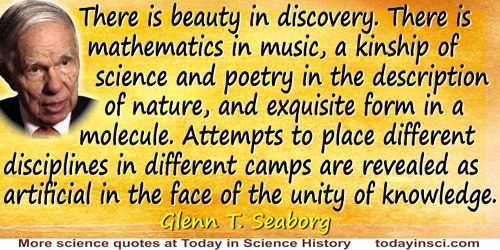
There is beauty in discovery. There is mathematics in music, a kinship of science and poetry in the description of nature, and exquisite form in a molecule. Attempts to place different disciplines in different camps are revealed as artificial in the face of the unity of knowledge. All illiterate men are sustained by the philosopher, the historian, the political analyst, the economist, the scientist, the poet, the artisan, and the musician.
From address (1958), upon being appointed Chancellor of the University of California.
There is no Professor of Wit at either University. Surely they might as reasonably have a professor of wit as of poetry.
Samuel Butler, Henry Festing Jones (ed.), The Note-Books of Samuel Butler (1917), 221.
There is poetry in science and the cultivation of the imagination is an essential prerequisite to the successful investigation of nature.
Presidential address to the American Association for the Advancement of Science (22 Aug 1850),The Papers of Joseph Henry, Vol. 8, 89. (Original text had typos: “immagination” and “prerequsite”.)
This is, in truth, the first charm of chemistry, and the secret of the almost universal interest excited by its discoveries. The serious complacency which is afforded by the sense of truth, utility, permanence, and progression, blends with and ennobles the exhilarating surprise and the pleasurable sting of curiosity, which accompany the propounding and the solving of an Enigma... If in SHAKPEARE [sic] we find Nature idealized into Poetry, through the creative power of a profound yet observant meditation, so through the meditative observation of a DAVY, a WOOLLASTON [sic], or a HATCHETT; we find poetry, as if were, substantiated and realized in nature.
Essays on the Principle of Method, Essay VI (1818). In The Collected Works of Samuel Taylor Coleridge: The Friend (1969), Vol. 4, 1, Barbara E. Rooke (ed.), 471.
Through and through the world is infected with quantity: To talk sense is to talk quantities. It is not use saying the nation is large—How large? It is no use saying the radium is scarce—How scarce? You cannot evade quantity. You may fly to poetry and music, and quantity and number will face you in your rhythms and your octaves.
In 'The Aims of Education', The Aims of Education: & Other Essays (1917), 11.
To be always poring over the same Object, dulls the Intellects and tires the Mind, which is delighted and improved by a Variety: and therefore it ought, at times, to be relaxed from the more severe mathematical Contemplations, and to be employed upon something more light and agreeable, as Poetry, Physic, History, &c
In Dr. Boerhaave's Academical Lectures on the Theory of Physic (1746), Vol. 6, 264.
To our senses, the elements are four
and have ever been, and will ever be
for they are the elements of life, of poetry, and of perception,
the four Great Ones, the Four Roots, the First Four
of Fire and the Wet, Earth and the wide Air of the World.
To find the other many elements, you must go to the laboratory
and hunt them down.
But the four we have always with us, they are our world.
Or rather, they have us with them.
and have ever been, and will ever be
for they are the elements of life, of poetry, and of perception,
the four Great Ones, the Four Roots, the First Four
of Fire and the Wet, Earth and the wide Air of the World.
To find the other many elements, you must go to the laboratory
and hunt them down.
But the four we have always with us, they are our world.
Or rather, they have us with them.
'The Four', David Herbert Lawrence, The Works of D.H. Lawrence (1994), 593.
To see a world in a grain of sand
And a heaven in a wild flower,
Hold infinity in the palm of your hand
And eternity in an hour.
And a heaven in a wild flower,
Hold infinity in the palm of your hand
And eternity in an hour.
'The Pickering Manuscript' - Auguries of Innocence (c.1805). In W. H. Stevenson (ed.), The Poems of William Blake (1971), 585.
True poetry is truer than science, because it is synthetic, and seizes at once what the combination of all the sciences is able, at most, to attain as a final result.
Entry for 31 Oct 1852 in Amiel’s Journal: The Journal Intime of Henri-Frédéric Amiel, trans. Humphry Ward (1893), 30.
Two kinds of symbol must surely be distinguished. The algebraic symbol comes naked into the world of mathematics and is clothed with value by its masters. A poetic symbol—like the Rose, for Love, in Guillaume de Lorris—comes trailing clouds of glory from the real world, clouds whose shape and colour largely determine and explain its poetic use. In an equation, x and y will do as well as a and b; but the Romance of the Rose could not, without loss, be re-written as the Romance of the Onion, and if a man did not see why, we could only send him back to the real world to study roses, onions, and love, all of them still untouched by poetry, still raw.
C.S. Lewis and E.M. Tillyard, The Personal Heresy: A Controversy (1936), 97.
War rages on the teeming earth;
The hot and sanguinary fight
Begins with each new creature’s birth:
A dreadful war where might is right;
Where still the strongest slay and win,
Where weakness is the only sin.
The hot and sanguinary fight
Begins with each new creature’s birth:
A dreadful war where might is right;
Where still the strongest slay and win,
Where weakness is the only sin.
In The Ascent of Man (1889), 13.
We are looking to brands for poetry and for spirituality, because we’re not getting those things from our communities or from each other.
Quoted in Kim Lim (ed.), 1,001 Pearls of Spiritual Wisdom: Words to Enrich, Inspire, and Guide Your Life (2014), 30
We do not listen with the best regard to the verses of a man who is only a poet, nor to his problems if he is only an algebraist; but if a man is at once acquainted with the geometric foundation of things and with their festal splendor, his poetry is exact and his arithmetic musical.
In 'Works and Days', Society and Solitude (1883), Chap. 7, 171.
We especially need imagination in science. It is not all mathematics, nor all logic, but it is somewhat beauty and poetry.
In Phebe Mitchell Kendall (ed.), Maria Mitchell: Life, Letters, and Journals (1896), 186.
We have heard much about the poetry of mathematics, but very little of it has yet been sung. The ancients had a juster notion of their poetic value than we. The most distinct and beautiful statements of any truth must take at last the mathematical form.
In A Week on the Concord and Merrimack Rivers (1862), 381.
We have refused to recognize the creativity of youth. We don’t want our children to write poetry or go to the stars. We want them to go steady, get married and have four children.
As quoted in interview with Frances Glennon, 'Student and Teacher of Human Ways', Life (14 Sep 1959), 147.
We pass the word around; we ponder how the case is put by different people, we read the poetry; we meditate over the literature; we play the music; we change our minds; we reach an understanding. Society evolves this way. Not by shouting each other down, but by the unique capacity of unique, individual human beings to comprehend each other.
Essay, 'On Committees' collected in The Medusa and the Snail: More Notes of a Biology Watcher (1974, 1979), 120.
What binds us to space-time is our rest mass, which prevents us from flying at the speed of light, when time stops and space loses meaning. In a world of light there are neither points nor moments of time; beings woven from light would live “nowhere” and “nowhen”; only poetry and mathematics are capable of speaking meaningfully about such things.
In 'Mathematics and Physics', collected in Mathematics as Metaphor: Selected Essays of Yuri I. Manin (2007), 130.
Whatever the subject of any investigation may be, whether poetry, biology, ethics or torpedo warfare, the same scientific method of procedure must be followed. We must first unravel the complex and heterogeneous back to first principles, and then reason forward from the simple to the complex, from the homogeneous to the heterogeneous, from what we know to what we would learn. Such are the methods pursued by all successful inventors, scientific investigators and discoverers.
In The Science of Poetry and the Philosophy of Language (1910), ix.
When we reflect that all the aspects of Nature, all the emotions of the soul, and all the events of life, have been the subjects of poetry for hundreds and thousands of years, we can hardly wonder that there should be so many resemblances and coincidences of expression among poets, but rather that they are not more numerous and more striking.
In 'Table-Talk', The Poetical Works of Henry Wadsworth Longfellow: Volume 3 (1883), 1355.
Where we reach the sphere of mathematics we are among processes which seem to some the most inhuman of all human activities and the most remote from poetry. Yet it is just here that the artist has the fullest scope for his imagination. … We are in the imaginative sphere of art, and the mathematician is engaged in a work of creation which resembles music in its orderliness, … It is not surprising that the greatest mathematicians have again and again appealed to the arts in order to find some analogy to their own work. They have indeed found it in the most varied arts, in poetry, in painting, and in sculpture, although it would certainly seem that it is in music, the most abstract of all the arts, the art of number and time, that we find the closest analogy.
In The Dance of Life (1923), 138-139.
Why do they [Americans] quarrel, why do they hate Negroes, Indians, even Germans, why do they not have science and poetry commensurate with themselves, why are there so many frauds and so much nonsense? I cannot soon give a solution to these questions ... It was clear that in the United States there was a development not of the best, but of the middle and worst sides of European civilization; the notorious general voting, the tendency to politics... all the same as in Europe. A new dawn is not to be seen on this side of the ocean.
The Oil Industry in the North American State of Pennsylvania and in the Caucasus (1877). Translated by H. M. Leicester, from the original in Russian, in 'Mendeleev's Visit to America', Journal of Chemical Education (1957), 34, 333.
Without poetry our science will appear incomplete, and most of what now passes with us for religion and philosophy will be replaced by poetry.
Thomas Humphry Ward (ed.) with Introduction by Matthew Arnold, The English Poets: Chaucer to Donne (3rd. Ed., 1880), Vol. 1, xviii.
Women have absolutely no sense of art, though they may have of poetry. They have no natural disposition for the sciences, though they may have for philosophy. They are by no means wanting in power of speculation and intuitive perception of the infinite; they lack only power of abstraction, which is far more easy to be learned.
From Selected Aphorisms from the Lyceum (1797-1800). As translated by Luis H. Gray in Kuno Francke and Isidore Singer (eds.), The German Classics: Masterpieces of German Literature Translated Into English (1913), Vol. 4, 177.
You can be a thorough-going Neo-Darwinian without imagination, metaphysics, poetry, conscience, or decency. For “Natural Selection” has no moral significance: it deals with that part of evolution which has no purpose, no intelligence, and might more appropriately be called accidental selection, or better still, Unnatural Selection, since nothing is more unnatural than an accident. If it could be proved that the whole universe had been produced by such Selection, only fools and rascals could bear to live.
Back to Methuselah: A Metabiological Pentateuch (1921), lxi-lxii.
You may take the noblest poetry in the world, and, if you stumble through it at snail's pace, it collapses from a work of art into a rubbish heap.
In 'The Place of Classics in Education', The Aims of Education and Other Essays (1929), 76.
You may translate books of science exactly. ... The beauties of poetry cannot be preserved in any language except that in which it was originally written.
Quoted in James Boswell, The Life of Samuel Johnson, LL.D. (1826), Vol. 3, 29.
You tell me of an invisible planetary system in which electrons gravitate around a nucleus. You explain this world to me with an image. I realize that you have been reduced to poetry. … So that science that was to teach me everything ends up in a hypothesis, that lucidity founders in metaphor, that uncertainty is resolved in a work of art.
In Albert Camus and Justin O’Brien (trans.), 'An Absurd Reasoning', The Myth of Sisyphus and Other Essays (1955), 15.
 In science it often happens that scientists say, 'You know that's a really good argument; my position is mistaken,' and then they would actually change their minds and you never hear that old view from them again. They really do it. It doesn't happen as often as it should, because scientists are human and change is sometimes painful. But it happens every day. I cannot recall the last time something like that happened in politics or religion.
(1987) --
In science it often happens that scientists say, 'You know that's a really good argument; my position is mistaken,' and then they would actually change their minds and you never hear that old view from them again. They really do it. It doesn't happen as often as it should, because scientists are human and change is sometimes painful. But it happens every day. I cannot recall the last time something like that happened in politics or religion.
(1987) --