Physician Quotes (284 quotes)
…as our friend Zach has often noted, in our days those who do the best for astronomy are not the salaried university professors, but so-called dillettanti, physicians, jurists, and so forth.Lamenting the fragmentary time left to a professor has remaining after fulfilling his teaching duties.
Letter to Heinrich Olbers (26 Oct 1802). Quoted in G. Waldo Dunnington, Carl Friedrich Gauss: Titan of Science (2004), 415.
…the ideal doctor would be a man endowed with profound knowledge of life and of the soul, intuitively divining any suffering or disorder of whatever kind, and restoring peace by his mere presence.
Amiel's Journal The Journal Intime of Henri-Frederic Amiel (22 Aug 1873), trans. By Mrs Humphry Ward (1889), Vol 2., 153.
[Alchemists] get a small livelihood by some Physical Experiments, as also by some Paints and effeminate Fucusses [cosmetics], which the Scriptures call the Oyntments of harlott; whence the Proverb, Every Alchymist is a Physician or a Sope-boyler.
In The Vanity of the Arts and Sciences (1530), translation (1676), 312-313.
[Reply to a lady enquiring: “Have we lost faith?”] Certainly not, but we have only transferred it from God to the General Medical Council.
Invited to contribute to a series of article in a Manchester paper in reply to an enquiry [Have we lost faith?] the question, Shaws’s reply was the single sentence. In The Collected Works of Bernard Shaw (1930), Vol.22, 1.
[Someone] remarked to me once: Physicians should not say, I have cured this man, but, This man didn’t die in my care. In physics too one might say, For such and such a phenomenon I have determined causes whose absurdity cannot finally be proved, instead of saying, I have explained it.
As quoted in Joseph Peter Stern, Lichtenberg: A Doctrine of Scattered Occasions: Reconstructed From His Aphorisms and Reflections (1959), 297.
[Technical courage means the] physician-scientist must be brave enough to adopt new methods. It is far too easy to learn one technique and then to repeat the same experiment over and over. In this fashion one can write many papers, receive large research grants, and remain solidly rooted in the middle of a scientific field. But the true innovator has the confidence to drop one set of experimental crutches and leap to another when he or she must move forward.
In Banquet Speech, 'The Nobel Prize in Physiology or Medicine 1985', on website nobelprize.org. Published in Les Prix Nobel, 1985: Nobel Prizes, Presentations, Biographies and Lectures (1986).
[When his physician father died of a heart attack:] It was then and there that I gave myself to medicine the way a monk gives himself to God. Not to have done so would have seemed an act of filial impiety. Since I could not find him in the flesh, I would find him in the work he did.
In Down From Troy: A Doctor Comes of Age (1992), 136.
He who doth with the greatest exactness imaginable, weigh every individual thing that shall or hath hapned to his Patient, and may be known from the Observations of his own, or of others, and who afterwards compareth all these with one another, and puts them in an opposite view to such Things as happen in a healthy State; and lastly, from all this with the nicest and severest bridle upon his reasoning faculty riseth to the knowledge of the very first Cause of the Disease, and of the Remedies fit to remove them; He, and only He deserveth the Name of a true Physician.
Aphorism No. 13 in Boerhaave’s Aphorisms: Concerning The Knowledge and Cure of Diseases (1715), 3.
Hominem ad deos nulla re propius accedunt quam salutem hominibus dando,
In nothing do men more nearly approach the gods, than in giving health to men.
In nothing do men more nearly approach the gods, than in giving health to men.
Henry Thomas Riley, Dictionary of Latin Quotations, Proverbs, Maxims, and Mottos (1866), 152.
Je suis médecin. Je tiens boutique de mensonges. Je soulage, je console. Peut-on consoler et soulager sans mentir? … Les femmes et les médecins savent seuls combien le mensonge est nécessaire et bienfaisant aux hommes.
I am a physician. I keep a drug-shop of lies. I give relief, consolation. Can one console and relieve without lying? … Only women and doctors know how necessary and how helpful lies are to men.
I am a physician. I keep a drug-shop of lies. I give relief, consolation. Can one console and relieve without lying? … Only women and doctors know how necessary and how helpful lies are to men.
From the fictional Dr. Trublet in Histoire Comique (1900), 171-172. As translated in Lewis P. Shanks, Anatole France (1919), 165.
Male secum agit æger, medicum qui hæredem ficit.Br>That sick man does ill for himself, who makes his physician his heir.
In 'Ornamenta Rationalia, or, Elegant Sentences' (1625). As given in Essays, Moral, Economical, and Political: A New Edition, With the Latin Quotations Translated (1813), No. 31, 364. A century later, Benjamin Franklin included this in his Poor Richard’s Almanac as “He’s a Fool that makes his Doctor his Heir.”
Medicus curat, Natura sanat morbus.
The physician heals, Nature makes well.
The physician heals, Nature makes well.
In Jehiel Keeler Hoyt and Kate Louise Roberts Hoyt's New Cyclopedia of Practical Quotations (1922), 502:1. (It is attributed therein to Aristotle as 'Idea in Nicomachean Ethics, Bk. VII. 15. 7. Oxford text.' However, a search by this webmaster found the specified reference did not match the quote.)
Medicus enim nihil aliud est quam animi consolatio
A doctor is nothing more than consolation for the spirit.
A doctor is nothing more than consolation for the spirit.
Satyricon, Cap. 42. In Iain Bamforth, The Body in the Library (2003), 298.
Medicus naturae minister, non magister
The doctor is the servant, not master for teaching Nature.
The doctor is the servant, not master for teaching Nature.
In Alfred J. Schauer, Ethics in Medicine (2001), 119.
A certain author defines a doctor to be a man who writes prescriptions till the patient either dies or is cured by nature.
The Reflector: Representing Human Affairs As They Are (1750). In The Pocket Lacon (1839), Vol. 1, 59.
A doctor is the only man who can suffer from good health.
In Edward Jewitt Wheeler, et al., The Literary Digest (1931),13.
A doctor must work eighteen hours a day and seven days a week. If you cannot console yourself to this, get out of the profession
Martin H. Fischer, Howard Fabing (ed.) and Ray Marr (ed.), Fischerisms (1944).
A doctor who cannot take a good history and a patient who cannot give one are in danger of giving and receiving bad treatment.
In Paul Dudley White , Clues in the Diagnosis and Treatment of Heart Disease (1956), Introduction.
A doctor whose breath smells has no right to medical opinion.
A hundred devils leap into my body, if there be not more old drunkards than old physicians.
As translated to English by Thomas Urquart in Chap. 41, 'How the Monk made Gargantua sleep, and of his hours and breviaries', The Romance of Gargantua and Pantagruel (1838), 112. The original French quote is: “Cent diables me sautent au corps s’il n’y a plus de vieux yurognes, qu’il n’y a de vieux medecins.” From Chap. 41, Gargantua et Pantagruel collected in Les Oeuvres de M. François Rabelais, Docteur en médecine (1596), 132.
A lucky physician is better than a learned one.
In Dwight Edwards Marvin, The Antiquity of Proverbs (1922), 238.
A magician of old waved a wand that he might banish disease, a physician to-day peers through a microscope to detect the bacillus of that disease and plan its defeat. The belief in miracles was premature, that is all; it was based on dreams now coming true.
From chapter 'Jottings from a Note-book', in Canadian Stories (1918), 176.
A man is a poor physician who has not two or three remedies ready for use in every case of illness.
Attributed.
A man of very moderate ability may be a good physician, if he devotes himself faithfully to the work.
…...
A man who cannot work without his hypodermic needle is a poor doctor. The amount of narcotic you use is inversely proportional to your skill.
Martin H. Fischer, Howard Fabing (ed.) and Ray Marr (ed.), Fischerisms (1944).
A physician advised his patient that had sore eyes, that he should abstain from wine; but the patient said, “I think rather, sir, from wine and water; for I have often marked it in blue eyes, and I have seen water come forth, but never wine.”
In 'A Collection of Apophthegms, New and Old' (1625). As given in Essays, Moral, Economical, and Political: A New Edition, With the Latin Quotations Translated (1813), No. 52, 279.
A physician is an unfortunate gentleman who is every day required to perform a miracle; namely to reconcile health with intemperance.
In Great Thoughts from Master Minds (1887), 8, 49.
A physician is judged by the three A’s, Ability, Availability and Affability.
Quoted in: Familiar Medical Quotations, by M. B. Strauss.
A physician is obligated to consider more than a diseased organ, more than even the whole man—he must view the man in his world.
Attributed by Rene Dubos, Man Adapting (1965, 1980), Chap. 12, 342. Dubos introduces the quote with “is reported to have taught” and no other citation.
A physician is someone who knows everything and does nothing.
A surgeon is someone who does everything and knows nothing.
A psychiatrist is someone who knows nothing and does nothing.
A pathologist is someone who knows everything and does everything too late.
A surgeon is someone who does everything and knows nothing.
A psychiatrist is someone who knows nothing and does nothing.
A pathologist is someone who knows everything and does everything too late.
A physician ought to have his shop provided with plenty of all necessary things, as lint, rollers, splinters: let there be likewise in readiness at all times another small cabinet of such things as may serve for occasions of going far from home; let him have also all sorts of plasters, potions, and purging medicines, so contrived that they may keep some considerable time, and likewise such as may be had and used whilst they are fresh.
In Prose Quotations from Socrates to Macaulay (1876), 536.
A physician’s subject of study is necessarily the patient, and his first field for observation is the hospital. But if clinical observation teaches him to know the form and course of diseases, it cannot suffice to make him understand their nature; to this end he must penetrate into the body to find which of the internal parts are injured in their functions. That is why dissection of cadavers and microscopic study of diseases were soon added to clinical observation. But to-day these various methods no longer suffice; we must push investigation further and, in analyzing the elementary phenomena of organic bodies, must compare normal with abnormal states. We showed elsewhere how incapable is anatomy alone to take account of vital phenenoma, and we saw that we must add study of all physico-chemical conditions which contribute necessary elements to normal or pathological manifestations of life. This simple suggestion already makes us feel that the laboratory of a physiologist-physician must be the most complicated of all laboratories, because he has to experiment with phenomena of life which are the most complex of all natural phenomena.
From An Introduction to the Study of Experimental Medicine (1865), as translated by Henry Copley Greene (1957), 140-141.
A reference to the two sorts of doctors is also found in the Republic: “Now you know that when patients do not require medicine, but have only to be put under a regimen, the inferior sort of practitioner is deemed to be good enough; but when medicine has to be given, then the doctor should be more of a man.”
Osler is referring to Plato’s Dialogues, iii, 153. In Address (1893) to the Johns Hopkins Hospital Historical Club, 'Physic and Physicians as Depicted in Plato', collected in Aequanimitas: With Other Addresses to Medical Students, Nurses and Practitioners of Medicine (1904), 70.
A wise physician, skill’d our wounds to heal, is more than armies to the public weal.
Homer and Alexander Pope (trans.), The Iliad of Homer (1809), Vol. 2, 144.
After all we are merely the servants of the public, in spite of our M.D.’s and our hospital appointments.
The Corner of Harley Street: Being Some Familiar Correspondence of Peter Harding, M. D., Ch.8.
All knowledge attains its ethical value and its human significance only by the human sense with which it is employed. Only a good man can be a great physician.
Inaugural address (1882), quoted in Johann Hermann Baas, Henry Ebenezer Handerson (trans.), Outlines of the History of Medicine and the Medical Profession (1889), 966.
All that Anatomie can doe is only to shew us the gross and sensible parts of the body, or the vapid and dead juices all which, after the most diligent search, will be noe more able to direct a physician how to cure a disease than how to make a man; for to remedy the defects of a part whose organicall constitution and that texture whereby it operates, he cannot possibly know, is alike hard, as to make a part which he knows not how is made. Now it is certaine and beyond controversy that nature performs all her operations on the body by parts so minute and insensible that I thinke noe body will ever hope or pretend, even by the assistance of glasses or any other intervention, to come to a sight of them, and to tell us what organicall texture or what kinde offerment (for whether it be done by one or both of these ways is yet a question and like to be soe always notwithstanding all the endeavours of the most accurate dissections) separate any part of the juices in any of the viscera, or tell us of what liquors the particles of these juices are, or if this could be donne (which it is never like to be) would it at all contribute to the cure of the diseases of those very parts which we so perfectly knew.
'Anatomie' (1668). Quoted in Kenneth Dewhurst (ed.), Dr. Thomas Sydenham (1624-1689): His Life and Original Writings (1966), 85-6.
Although it be a known thing subscribed by all, that the foetus assumes its origin and birth from the male and female, and consequently that the egge is produced by the cock and henne, and the chicken out of the egge, yet neither the schools of physicians nor Aristotle’s discerning brain have disclosed the manner how the cock and its seed doth mint and coin the chicken out of the egge.
As quoted in John Arthur Thomson, The Science of Life: An Outline of the History of Biology and Its Recent Advances (1899), 126.
An alcoholic has been lightly defined as a man who drinks more than his own doctor.
Journal of the American Medical Association (1962), 181, 393.
An old Scotch physician, for whom I had a great respect, and whom I frequently met professionally in the city, used to say, as we were entering the patient's room together, 'Weel, Mister Cooper, we ha' only twa things to keep in meend, and they'll searve us for here and herea'ter; one is always to have the fear of the Laird before our ees; that 'ill do for herea'ter; and t'other is to keep your booels open, and that will do for here.'
'Lecture 3, Treatment of Inflammation', The Lectures of Sir Astley Cooper (1825), Vol. 1, 58.Lectures on surgery, Lect. 3.
Anatomy is the great ocean of intelligence upon which the true physician must sail. Bacteriology is but one little harbor.
In 'Advancement of Surgery', Journal of the American Medical Association (25 Feb 1893), 20, No. 8, 199.
And it has been sarcastically said, that there is a wide difference between a good physician and a bad one, but a small difference between a good physician and no physician at all; by which it is meant to insinuate, that the mischievous officiousness of art does commonly more than counterbalance any benefit derivable from it.
Elements of Medical Logic (1819), 8-9.
Any man who is intelligent must, on considering that health is of the utmost value to human beings, have the personal understanding necessary to help himself in diseases, and be able to understand and to judge what physicians say and what they administer to his body, being versed in each of these matters to a degree reasonable for a layman.
Affections, in Hippocrates, trans. P. Potter (1988), Vol. 5, 7.
Any physician who advertises a positive cure for any disease, who issues nostrum testimonials, who sells his services to a secret remedy, or who diagnoses and treats by mail patients he has never seen, is a quack.
'The Sure-Cure School,' Collier’s Weekly (14 Jul 1906). Reprinted in The Great American Fraud (1907), 84.
APOTHECARY, n. The physician's accomplice, undertaker's benefactor and grave worm's provider
The Collected Works of Ambrose Bierce (1911), Vol. 7, The Devil's Dictionary, 24.
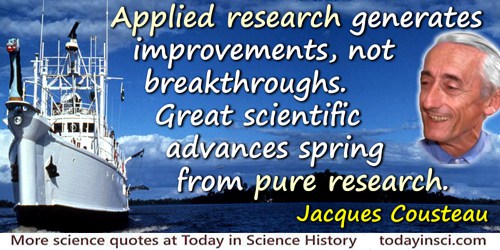
Applied research generates improvements, not breakthroughs. Great scientific advances spring from pure research. Even scientists renowned for their “useful” applied discoveries often achieved success only when they abandoned their ostensible applied-science goal and allowed their minds to soar—as when Alexander Fleming, “just playing about,” refrained from throwing away green molds that had ruined his experiment, studied them, and discovered penicillin. Or when C. A. Clarke, a physician affiliated with the University of Liverpool, became intrigued in the 1950s by genetically created color patterns that emerged when he cross-bred butterflies as a hobby. His fascination led him—“by the pleasant route of pursuing idle curiosity”—to the successful idea for preventing the sometimes fatal anemia that threatened babies born of a positive-Rhesus-factor father and a negative-Rhesus-factor mother.
In Jacques Cousteau and Susan Schiefelbein, The Human, the Orchid, and the Octopus: Exploring and Conserving Our Natural World (2007), 214-215.
As he approached the place where a meeting of doctors was being held, he saw some elegant limousines and remarked, “The surgeons have arrived.” Then he saw some cheaper cars and said, “The physicians are here, too.” ... And when he saw a row of overshoes inside, under the hat rack, he is reported to have remarked, “Ah, I see there are laboratory men here.”
The Way of an Investigator (1945, 1965), 207.
As we cannot use physician for a cultivator of physics, I have called him a physicist. We need very much a name to describe a cultivator of science in general. I should incline to call him a Scientist. Thus we might say, that as an Artist is a Musician, Painter or Poet, a Scientist is a Mathematician, Physicist, or Naturalist.
The Philosophy of the Inductive Sciences (1840), Vol. I, cxiii.
As with eggs, there is no such thing as a poor doctor, doctors are either good or bad.
In Russell L. Cecil and Robert F. Leob, 'Diseases of the Ductless Glands,' Textbook of Medicine (9th ed.), Introduction.
At a given instant everything the surgeon knows suddenly becomes important to the solution of the problem. You can't do it an hour later, or tomorrow. Nor can you go to the library and look it up.
Quoted in 'The Best Hope of All', Time (3 May 1963)
Better to hunt in fields, for health unbought, Than fee the doctor for a nauseous draught, The wise, for cure, on exercise depend; God never made his work for man to mend.
'To my Honoured Kinsman, John Dryden', The English Poets (1901), Vol. 2, 491.
Beware of the young Doctor, & the old Barber.
In Poor Richard's Almanack (1733).
BODY-SNATCHER, n. A robber of grave-worms. One who supplies the young physicians with that with which the old physicians have supplied the undertaker.
The Collected Works of Ambrose Bierce (1911), Vol. 7, The Devil's Dictionary, 38-39.
But nothing is more estimable than a physician who, having studied nature from his youth, knows the properties of the human body, the diseases which assail it, the remedies which will benefit it, exercises his art with caution, and pays equal attention to the rich and the poor.
A Philosophical Dictionary: from the French? (2nd Ed.,1824), Vol. 5, 239-240.
By destroying the biological character of phenomena, the use of averages in physiology and medicine usually gives only apparent accuracy to the results. From our point of view, we may distinguish between several kinds of averages: physical averages, chemical averages and physiological and pathological averages. If, for instance, we observe the number of pulsations and the degree of blood pressure by means of the oscillations of a manometer throughout one day, and if we take the average of all our figures to get the true or average blood pressure and to learn the true or average number of pulsations, we shall simply have wrong numbers. In fact, the pulse decreases in number and intensity when we are fasting and increases during digestion or under different influences of movement and rest; all the biological characteristics of the phenomenon disappear in the average. Chemical averages are also often used. If we collect a man's urine during twenty-four hours and mix all this urine to analyze the average, we get an analysis of a urine which simply does not exist; for urine, when fasting, is different from urine during digestion. A startling instance of this kind was invented by a physiologist who took urine from a railroad station urinal where people of all nations passed, and who believed he could thus present an analysis of average European urine! Aside from physical and chemical, there are physiological averages, or what we might call average descriptions of phenomena, which are even more false. Let me assume that a physician collects a great many individual observations of a disease and that he makes an average description of symptoms observed in the individual cases; he will thus have a description that will never be matched in nature. So in physiology, we must never make average descriptions of experiments, because the true relations of phenomena disappear in the average; when dealing with complex and variable experiments, we must study their various circumstances, and then present our most perfect experiment as a type, which, however, still stands for true facts. In the cases just considered, averages must therefore be rejected, because they confuse, while aiming to unify, and distort while aiming to simplify. Averages are applicable only to reducing very slightly varying numerical data about clearly defined and absolutely simple cases.
From An Introduction to the Study of Experimental Medicine (1865), as translated by Henry Copley Greene (1957), 134-135.
By medicine life may be prolong’d, yet death
Will seize the Doctor too.
Will seize the Doctor too.
Cymbeline (1609, publ. 1623), Act 5, Scene 5. In Charles Knight (ed.), The Works of William Shakspere (1868), 605.
Certainly it is by their signs and symptoms, that internal diseases are revealed to the physician.
Philosophy of Medical Science, Pt II, Ch. 10.
Conscientious and careful physicians allocate causes of disease to natural laws, while the ablest scientists go back to medicine for their first principles.
Attributed.
DIAGNOSIS, n. A physician's forecast of disease by the patient's pulse and purse.
The Collected Works of Ambrose Bierce (1911), Vol. 7, The Devil's Dictionary, 70.
Doctor Johnson said, that in sickness there were three things that were material; the physician, the disease, and the patient: and if any two of these joined, then they get the victory; for, Ne Hercules quidem contra duos [Not even Hercules himself is a match for two]. If the physician and the patient join, then down goes the disease; for then the patient recovers: if the physician and the disease join, that is a strong disease; and the physician mistaking the cure, then down goes the patient: if the patient and the disease join, then down goes the physician; for he is discredited.
In 'A Collection of Apophthegms, New and Old' (1625). As given in Essays, Moral, Economical, and Political: A New Edition, With the Latin Quotations Translated (1813), No. 147, 308. The doctor is identified Ben Johnson by Forbes Winslow in his notes appended to Physic and Physicians (1842). Notes section, 39. Perhaps he means poet and playwright of stage comedy, Ben Jonson (1572-1637), also referred to in the book as “Benjamin Johnson” and once as “Dr. Johnson.” Note that Francis Bacon (1561-1626) died well before the life of writer Dr. Samuel Johnson (1709-1784).
Doctors and Clergymen. A physician’s physiology has much the same relation to his power of healing as a cleric’s divinity has to his power of influencing conduct.
Samuel Butler, Henry Festing Jones (ed.), The Note-Books of Samuel Butler (1917), 216.
Doctors are just the same as lawyers; the only difference is that lawyers merely rob you, whereas doctors rob you and kill you, too.
ĵIvanovĵ (1887), Act I.
Doctors are men who prescribe medicines of which they know little, to cure diseases of which they know less, in human beings of whom they know nothing. (1760)
In Robert Allan Weinberg, The Biology of Cancer (2006), 726. (Note: Webmaster has not yet found this quote, in this wording, in a major quotation reference book. If you know a primary print source, or correction, please contact Webmaster.)
Doctors can do almost anything nowadays, can't they, unless they kill you while they're trying to cure you.
Endless Night (2002), 117.
Doctors coin money when they do procedures—family practice doesn’t have any procedures. A urologist has cystoscopies, a gastroenterologist has gastroscopies, a dermatologist has biopsies. They can do three or four of those and make five or six hundred dollars in a single day. We get nothing for the use of our time to understand the lives of our patients. Technology is rewarded in medicine, it seems to me, and not thinking.
Quoted in John McPhee, 'Heirs of General Practice,' New Yorker (23 Jul 1984), 40-85. In David Barton Smith and Arnold D. Kaluzny, The White Labyrinth (2000), 227.
Doctors have been exposed—you always will be exposed—to the attacks of those persons who consider their own undisciplined emotions more important than the world's most bitter agonies—the people who would limit and cripple and hamper research because they fear research may be accompanied by a little pain and suffering.
Doctors (1908), 28-9.
Dr Bell fell down the well
And broke his collar bone
Doctors should attend the sick
And leave the well alone.
And broke his collar bone
Doctors should attend the sick
And leave the well alone.
Each patient ought to feel somewhat the better after the physician’s visit, irrespective of the nature of the illness.
…...
Employment is Nature’s physician, and is essential to human happiness.
— Galen
In James Wood, Dictionary of Quotations from Ancient and Modern, English and Foreign Sources (1893), 81:44.
Employment, which Galen calls 'Nature's Physician,' is so essential to human happiness that indolence is justly considered as the mother of misery.
In Tryon Edwards, A Dictionary of Thoughts (1908), 243.
English physicians kill you, the French let you die.
…...
Even in populous districts, the practice of medicine is a lonely road which winds up-hill all the way and a man may easily go astray and never reach the Delectable Mountains unless he early finds those shepherd guides of whom Bunyan tells, Knowledge, Experience, Watchful, and Sincere.
In Aequanimitas (1904), 299.
Every disease is a physician.
…...
Everyone admits that the male is the primary efficient cause in generation, as being that in whom the species or form resides, and they further assert that his genitures emitted in coitus causes the egg both to exist and to be fertile. But how the semen of the cock produces the chick from the egg, neither the philosophers nor the physicians of yesterday or today have satisfactorily explained, or solved the problem formulated by Aristotle.
Disputations Touching the Generation of Animals (1651), trans. Gweneth Whitteridge (1981), Chapter 47, 214.
Few men live lives of more devoted self-sacrifice than the family physician, but he may become so completely absorbed in work that leisure is unknown…. More than most men he feels the tragedy of isolation—that inner isolation so well expressed in Matthew Arnold’s line “We mortal millions live alone.”
Address to the Canadian Medical Association, Montreal (17 Sep 1902), 'Chauvinism in Medicine', published in The Montreal Medical Journal (1902), 31, 267. Collected in Aequanimitas, with Other Addresses to Medical Students, Nurses and Practitioners of Medicine (1904), 299.
Fifty years ago the successful doctor was said to need three things; a top hat to give him Authority, a paunch to give him Dignity, and piles to give him an Anxious Expression.
Lancet (1951), 1, 169.
For many doctors the achievement of a published article is a tedious duty to be surmounted as a necessary hurdle in a medical career.
British Medical Journal (1958), 2, 502
For the most part, Western medicine doctors are not healers, preventers, listeners, or educators. But they're damned good at saving a life and the other aspects kick the beam. It's about time we brought some balance back to the scale.
From the physician, as emphatically the student of Nature, is expected not only an inquiry into cause, but an investigation of the whole empire of Nature and a determination of the applicability of every species of knowledge to the improvement of his art.
In 'An Inquiry, Analogical and Experimental, into the Different Electrical conditions of Arterial and Venous Blood', New Orleans Medical and Surgical Journal (1853-4), 10, 584-602 & 738-757. As cited in George B. Roth, 'Dr. John Gorrie—Inventor of Artificial Ice and Mechanical Refrigeration', The Scientific Monthly (May 1936) 42 No. 5, 464-469.
From the womb of darkness and cocoon of indifference is emerging a form of treatment that will eventually be added to the armamentarium of the alert and concerned physician.
Let's Live (Apr 1976). In Morton Walker and Hitendra H. Shah, Everything You Should Know About Chelation Therapy (1998), 15.
General practice is at least as difficult, if it is to be carried on well and successfully, as any special practice can be, and probably more so; for the G.P. has to live continually, as it were, with the results of his handiwork.
The Corner of Harley Street: Being Some Familiar Correspondence of Peter Harding, M. D., Ch. 26.
Given one has before oneself a strong, healthy, youth rich in spirited blood and a powerless, weak, cachectic old man scarcely capable of breathing. If now the physician wishes to practise the rejuvenating art on the latter, he should make silver tubes which fit into each other: open then the artery of the healthy person and introduce one of the tubes into it and fasten it into the artery; thereupon he opens also the artery of the ill person...
[First detailed description of blood transfusion (1615)]
[First detailed description of blood transfusion (1615)]
In N.S.R. Maluf, 'History of Blood Transfusion', Journal of the History of Medicine and Allied Sciences (1954), 9, No. 1, 59.
Given one well-trained physician of the highest type and he will do better work for a thousand people than ten specialists.
From speech 'In the Time of Henry Jacob Bigelow', given to the Boston Surgical Society, Medalist Meeting (6 Jun 1921). Printed in Journal of the Medical Association (1921), 77, 601.
God healeth and the physician hath the thanks.
In John Ray, A Compleat Collection of English Proverbs (1678, 1818), 7.
God heals, and the Doctor takes the Fees.
In Poor Richard's Almanack (1744). Note: q.v. John Ray, “God healeth and the physician hath the thanks.”
He is the best Physician in whom the Patient has the greatest Confidence.
The Reflector: Representing Human Affairs As They Are (1750). In Allan Ingram, Patterns of Madness in the Eighteenth Century (1998), 69.
He that takes medicine and neglects to diet himself wastes the skill of the physician.
Chinese proverb.
He who cures a disease may be the skillfullest, but he who prevents it is the safest physician.
In Practical Spelling: A Text Book For Use in Commercial Schools (1902), 34.
He’s a Fool that makes his Doctor his Heir.
In Poor Richard's Almanack (1733). See the Francis Bacon page for: Male secum agit æger, medicum qui hæredem ficit. That sick man does ill for himself, who makes his physician his heir. (1625)
He's the best physician that knows the worthlessness of the most medicines.
In Poor Richard's Almanack (1733).
Heaven defend me from a busy doctor.
Welsh Proverb. In Henry Louis Mencken, A New Dictionary of Quotations (1942), 299.
I am dying with the help of too many physicians.
Comment on his deathbed.
Comment on his deathbed.
Attributed. Peter McDonald, In The Oxford Dictionary of Medical Quotations (2004), 2.
I devoted myself to studying the texts—the original and commentaries—in the natural sciences and metaphysics, and the gates of knowledge began opening for me. Next I sought to know medicine, and so read the books written on it. Medicine is not one of the difficult sciences, and therefore, I excelled in it in a very short time, to the point that distinguished physicians began to read the science of medicine under me. I cared for the sick and there opened to me some of the doors of medical treatment that are indescribable and can be learned only from practice. In addition I devoted myself to jurisprudence and used to engage in legal disputations, at that time being sixteen years old.
— Avicenna
W. E. Gohhnan, The Life of Ibn Sina: A Critical Edition and Annotated Translation (1974), 25-7.
I felt more determined than ever to become a physician, and thus place a strong barrier between me and all ordinary marriage. I must have something to engross my thoughts, some object in life which will fill this vacuum, and prevent this sad wearing away of the heart.
Entry from her early journal, stated in Pioneer Work in Opening the Medical Profession to Women (1895), 28.
I got the bill for my surgery. Now I know what those doctors were wearing masks for.
I look upon a good physician, not so properly as a servant to nature, as one, that is a counsellor and friendly assistant, who, in his patient’s body, furthers those motions and other things, that he judges conducive to the welfare and recovery of it; but as to those, that he perceives likely to be hurtful, either by increasing the disease, or otherwise endangering the patient, he thinks it is his part to oppose or hinder, though nature do manifestly enough seem to endeavour the exercising or carrying on those hurtful motions.
Quoted In Barbara Kaplan (ed.) Divulging of Useful Truths in Physick: The Medical Agenda of Robert Boyle (1993), 125.
I love doctors and hate their medicine.
In Horace Traubel, With Walt Whitman in Camden (1906), Vol. 1, 433.
I prefer the spagyric chemical physicians, for they do not consort with loafers or go about gorgeous in satins, silks and velvets, gold rings on their fingers, silver daggers hanging at their sides and white gloves on their hands, but they tend their work at the fire patiently day and night. They do not go promenading, but seek their recreation in the laboratory, wear plain learthern dress and aprons of hide upon which to wipe their hands, thrust their fingers amongst the coals, into dirt and rubbish and not into golden rings. They are sooty and dirty like the smiths and charcoal burners, and hence make little show, make not many words and gossip with their patients, do not highly praise their own remedies, for they well know that the work must praise the master, not the master praise his work. They well know that words and chatter do not help the sick nor cure them... Therefore they let such things alone and busy themselves with working with their fires and learning the steps of alchemy. These are distillation, solution, putrefaction, extraction, calcination, reverberation, sublimination, fixation, separation, reduction, coagulation, tinction, etc.
Quoted in R. Oesper, The Human Side of Scientists (1975), 150. [Spagyric is a form of herbalism based on alchemic procedures of preparation.]
I speak as a planetary physician whose patient, the living Earth, complains of fever; I see the Earth’s declining health as our most important concern, our very lives depending upon a healthy Earth. Our concern for it must come first, because the welfare of the burgeoning mass of humanity demands a healthy planet.
In The Revenge of Gaia: Earth’s Climate Crisis & The Fate of Humanity (2006, 2007), 2.
I think if a physician wrote on a death certificate that old age was the cause of death, he’d be thrown out of the union. There is always some final event, some failure of an organ, some last attack of pneumonia, that finishes off a life. No one dies of old age.
In talk, 'Origin of Death' (1970). Evolution began with one-celled organisms reproducing indefinitely by cell division.
I think it perfectly just, that he who, from the love of experiment, quits an approved for an uncertain practice, should suffer the full penalty of Egyptian law against medical innovation; as I would consign to the pillory, the wretch, who out of regard to his character, that is, to his fees, should follow the routine, when, from constant experience he is sure that his patient will die under it, provided any, not inhuman, deviation would give his patient a chance.
From his researches in Fever, 196. In John Edmonds Stock, Memoirs of the life of Thomas Beddoes (1810), 400.
I think, and I am not the only one who does, that it is important never to introduce any conception which may not be completely defined by a finite number of words. Whatever may be the remedy adopted, we can promise ourselves the joy of the physician called in to follow a beautiful pathological case [beau cas pathologique].
From address read at the general session of the Fourth International Congress of Mathematicians in Rome (10 Apr 1908). As translated in 'The Future of Mathematics: by Henri Poincaré', General Appendix, Annual Report of the Boars of Regents of The Smithsonian Institution: For the Year Ending June 1909 (1910), 140.
I wished to show that Pythagoras, the first founder of the vegetable regimen, was at once a very great physicist and a very great physician; that there has been no one of a more cultured and discriminating humanity; that he was a man of wisdom and of experience; that his motive in commending and introducing the new mode of living was derived not from any extravagant superstition, but from the desire to improve the health and the manners of men.
From Dell Vitto Pitagorico (1743), (The Pythagorean Diet: for the Use of the Medical Faculty), as translated quotes in Howard Williams, The Ethics of Diet: A Catena of Authorities Deprecatory of the Practice of Flesh-Eating (1883), 158.
I wondher why ye can always read a doctor's bill an’ ye niver can read his purscription.
'Drugs', Mr. Dooley Says (1910). In The Speaker: A Quarterly Magazine (1913), Vol. 8, 147.
If a patient is poor he is committed to a public hospital as a 'psychotic.' If he can afford a sanitarium, the diagnosis is 'neurasthenia.' If he is wealthy enough to be in his own home under the constant watch of nurses and physicians, he is simply 'an indisposed eccentric.'
…...
If a physician make a large incision with an operating knife and cure it, or if he open a tumor (over the eye) with an operating knife, and saves the eye, he shall receive ten shekels in money. …
If a physician make a large incision with an operating knife, and kill him, or open a tumor with an operating knife, and cut out the eye, his hands shall be cut off. ...
If a physician heal the broken bone or diseased soft part of a man, the patient shall pay the physician five shekels in money.
[The Code of Hammurabi (a king of ancient Babylon), the earliest well-preserved ancient law code, circa 1760 B.C.]
If a physician make a large incision with an operating knife, and kill him, or open a tumor with an operating knife, and cut out the eye, his hands shall be cut off. ...
If a physician heal the broken bone or diseased soft part of a man, the patient shall pay the physician five shekels in money.
[The Code of Hammurabi (a king of ancient Babylon), the earliest well-preserved ancient law code, circa 1760 B.C.]
In L. W. King (trans.), The Code of Hammurabi (1910), 22, No. 215, 218 and 221.
If every drug in the world were abolished a physician would still be a useful member of society.
As quoted in Sir William Withey Gull and Theodore Dyke Acland (ed.), A Collection of the Published Writings of William Withey Gull (1896), xxv.
If I were a physician I would try my patients thus. I would wheel them to a window and let Nature feel their pulse. It will soon appear if their sensuous existence is sound. The sounds are but the throbbing of some pulse in me.
(26 Feb 1841). In Henry David Thoreau and Bradford Torrey (ed.), The Writings of Henry Thoreau: Journal: I: 1837-1846 (1906), 224.
If migraine patients have a common and legitimate second complaint besides their migraines, it is that they have not been listened to by physicians. Looked at, investigated, drugged, charged, but not listened to.
Quoted by Walter Clemons, 'Listening to the Lost', Newsweek (20 Aug 1984).
If my doctor told me I had only six minutes to live, I wouldn’t brood. I’d type a little faster.
Life (1984).
If popular medicine gave the people wisdom as well as knowledge, it would be the best protection for scientific and well-trained physicians.
In Fielding Hudson Garrison, An Introduction to the History of Medicine (1966), 577.
If the just cure of a disease be full of peril, let the physician resort to palliation.
Nat. Hist. As quoted in entry for 'Palliation', Samuel Johnson, A Dictionary of the English Language; in which the Words are Deduced from their Originals (1818), Vol. 3 (unpaginated).
If you are physically sick, you can elicit the interest of a battery of physicians; but if you are mentally sick, you are lucky if the janitor comes around.
Martin H. Fischer, Howard Fabing (ed.) and Ray Marr (ed.), Fischerisms (1944).
If you are too smart to pay the doctor, you had better be too smart to get ill.
African proverb, Transvaal
If you have a lawsuit, and you get one bad lawyer, you lose your suit, but you can appeal; but if you have one bad doctor, and he kills you, then there can be no appeal.
In Stephen Wickes and Jonathan Dickinson, History of Medicine in New Jersey: And of Its Medical Men, from the Settlement of the Province to A.D. 1800 (1879), 143.
If you wish to die young, make your physician your heir.
In H. Pullar-Strecker, Proverbs for Pleasure (1954), 193.
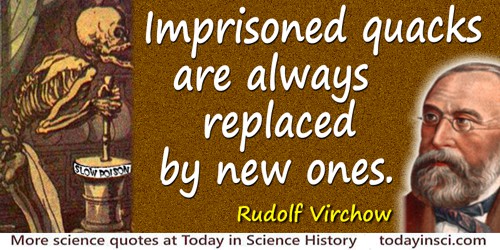
Imprisoned quacks are always replaced by new ones.
In Fielding Hudson Garrison, An Introduction to the History of Medicine (1966), 577.
In a large proportion of cases treated by physicians the disease is cured by nature, not by them. In a lesser, but not a small proportion, the disease is cured by nature in spite of them.
…...
In a word, I consider hospitals only as the entrance to scientific medicine; they are the first field of observation which a physician enters; but the true sanctuary of medical science is a laboratory; only there can he seek explanations of life in the normal and pathological states by means of experimental analysis.
From An Introduction to the Study of Experimental Medicine (1865), as translated by Henry Copley Greene (1957), 146.
In acute diseases the physician must conduct his inquiries in the following way. First he must examine the face of the patient, and see whether it is like the faces of healthy people, and especially whether it is like its usual self. Such likeness will be the best sign, and the greatest unlikeness will be the most dangerous sign. The latter will be as follows. Nose sharp, eyes hollow, temples sunken, ears cold and contracted with their lobes turned outwards, the skin about the face hard and tense and parched, the colour of the face as a whole being yellow or black.
Prognostic, in Hippocrates, trans. W. H. S. Jones (1923), Vol. 2, 9.
In clinical investigation the sick individual is at the centre of the picture. The physician must have a deep interest in his patient’s economic and social structure as well as in his physical and psychic state. If attention is not paid to the diagnosis of the person the clinical investigator is apt to fail in studies of the patient’s disease. Without a consideration of the patient as a human being it would have been difficult to have fed patients daily large amounts of liver.
In Nobel Banquet speech (10 Dec 1934). Collected in Gustaf Santesson (ed.) Les Prix Nobel en 1934 (1935).
In diagnosis, the young are positive and the middle-aged tentative; only the old have flair.
Lancet (1951), 1, 795.
In order to discover Truth in this manner by observation and reason, it is requisite we should fix on some principles whose certainty and effects are demonstrable to our senses, which may serve to explain the phenomena of natural bodies and account for the accidents that arise in them; such only are those which are purely material in the human body with mechanical and physical experiments … a physician may and ought to furnish himself with, and reason from, such things as are demonstrated to be true in anatomy, chemistry, and mechanics, with natural and experimental philosophy, provided he confines his reasoning within the bounds of truth and simple experiment.
As quoted in selection from the writings of Herman Boerhaave, collected in Oliver Joseph Thatcher (ed.), The Ideas that Have Influenced Civilization, in the Original Documents (1800), Vol. 6, 242.
In psychoanalytic treatment nothing happens but an exchange of words between the patient and the physician.
From a series of 28 lectures for laymen, Part One, 'The Psychology of Errors'. Lecture 1, 'Introduction' collected in Sigmund Freud and G. Stanley Hall (trans.), A General Introduction to Psychoanalysis (1920), 3.
In the first papers concerning the aetiology of tuberculosis I have already indicated the dangers arising from the spread of the bacilli-containing excretions of consumptives, and have urged moreover that prophylactic measures should be taken against the contagious disease. But my words have been unheeded. It was still too early, and because of this they still could not meet with full understanding. It shared the fate of so many similar cases in medicine, where a long time has also been necessary before old prejudices were overcome and the new facts were acknowledged to be correct by the physicians.
'The current state of the struggle against tuberculosis', Nobel Lecture (12 Dec 1905). In Nobel Lectures: Physiology or Medicine 1901-1921 (1967), 169.
Inexact method of observation, as I believe, is one flaw in clinical pathology to-day. Prematurity of conclusion is another, and in part follows from the first; but in chief part an unusual craving and veneration for hypothesis, which besets the minds of most medical men, is responsible. Except in those sciences which deal with the intangible or with events of long past ages, no treatises are to be found in which hypothesis figures as it does in medical writings. The purity of a science is to be judged by the paucity of its recorded hypotheses. Hypothesis has its right place, it forms a working basis; but it is an acknowledged makeshift, and, at the best, of purpose unaccomplished. Hypothesis is the heart which no man with right purpose wears willingly upon his sleeve. He who vaunts his lady love, ere yet she is won, is apt to display himself as frivolous or his lady a wanton.
The Mechanism and Graphic Registration of the Heart Beat (1920), vii.
Into whatsoever houses I enter, I will enter to help the sick, and I will abstain from all intentional wrong-doing and harm, especially from abusing the bodies of man or woman, bond or free. And whatsoever I shall see or hear in the course of my profession, as well as outside my profession in my intercourse with men, if it be what should not be published abroad, I will never divulge, holding such things to be holy secrets.
Oath, in Hippocrates, trans. W. H. S. Jones (1923), Vol. 1, 301.
It is a good thing for a physician to have prematurely grey hair and itching piles. The first makes him appear to know more than he does, and the second gives him an expression of concern which the patient interprets as being on his behalf.
…...
It is a mathematical fact that fifty percent of all doctors graduate in the bottom half of their class.
It is better to have recourse to a Quack, if he can cure our disorder, although he cannot explain it than to a Physician, if he can explain our disease but cannot cure it.
Reflection 323, in Lacon: Or Many Things in Few Words, Addressed to Those who Think (1820), 166.
It is easy for men to give advice, but difficult for one’s self to follow; we have an example in physicians: for their patients they order a strict regime, for themselves, on going to bed, they do all that they have forbidden to others.
— Philemon
'The Sicilian.' In Gustave Jules Witkowski, The Evil that Has Been Said of Doctors (1889), 4-5
It is impossible for the strength of an elderly person to be great. Some physicians think that
children also do not have great strength, but they are mistaken in their opinion.
As quoted in Robert Taylor, White Coat Tales: Medicine's Heroes, Heritage, and Misadventures (2010), 125.
It is no part of a physician's business to use either persuasion or compulsion upon the patients.
Politics, VII, ii.
It is said to be the manner of hypochondriacs to change often their physician …For a physician who does not admit the reality of the disease cannot be supposed to take much pains to cure it.
First Lines of the Practice of Physic, (annoted by John Rotheram, 1796), Vol. 3, 297-8.
It is the doctors who desert the dying and there is so much to be learned about pain.
Quoted in Journal of the Royal Society of Medicine (2001), 94, 430.
It is when physicians are bogged down … when they lack a clear understanding of disease mechanisms, that the deficiencies of the health-care system are most conspicuous. If I were a policy-maker, interested in saving money for health care over the long haul, I would regard it as an act of high prudence to give high priority to a lot more basic research in biologic science.
In 'The Technology of Medicine', The Lives of a Cell: Notes of a Biology Watcher (1974), 41-42.
It often happens that men, even of the best understandings and greatest circumspection, are guilty of that fault in reasoning which the writers on logick call the insufficient, or imperfect enumeration of parts, or cases: insomuch that I will venture to assert, that this is the chief, and almost the only, source of the vast number of erroneous opinions, and those too very often in matters of great importance, which we are apt to form on all the subjects we reflect upon, whether they relate to the knowledge of nature, or the merits and motives of human actions. It must therefore be acknowledged, that the art which affords a cure to this weakness, or defect, of our understandings, and teaches us to enumerate all the possible ways in which a given number of things may be mixed and combined together, that we may be certain that we have not omitted anyone arrangement of them that can lead to the object of our inquiry, deserves to be considered as most eminently useful and worthy of our highest esteem and attention. And this is the business of the art, or doctrine of combinations ... It proceeds indeed upon mathematical principles in calculating the number of the combinations of the things proposed: but by the conclusions that are obtained by it, the sagacity of the natural philosopher, the exactness of the historian, the skill and judgement of the physician, and the prudence and foresight of the politician, may be assisted; because the business of all these important professions is but to form reasonable conjectures concerning the several objects which engage their attention, and all wise conjectures are the results of a just and careful examination of the several different effects that may possibly arise from the causes that are capable of producing them.
Ars conjectandi (1713). In F. Maseres, The Doctrine of Permutations and Combinations (1795), 36.
It ought ... to be understood that no one can be a good physician who has no idea of surgical operations, and that a surgeon is nothing if ignorant of medicine. In a word, one must be familiar with both departments of medicine.
Chirurgia Magna (1296, printed 1479). In Henry Ebenezer Handerson, Gilbertus Anglicus (1918), 77,
It was above all in the period after the devastating incursions of the Goths that all branches of knowledge which previously had flourished gloriously and been practiced in the proper manner, began to deteriorate. This happened first of all in Italy where the most fashionable physicians, spurning surgery as did the Romans of old, assigned to their servants such surgical work as their patients seemed to require and merely exercised a supervision over them in the manner of architects.
From De Humani Corporis Fabrica Libri Septem: (1543), Book I, i, as translated by William Frank Richardson, in On The Fabric of the Human Body: Book I: The Bones and Cartilages (1998), Preface, xlviii.
Laplace considers astronomy a science of observation, because we can only observe the movements of the planets; we cannot reach them, indeed, to alter their course and to experiment with them. “On earth,” said Laplace, “we make phenomena vary by experiments; in the sky, we carefully define all the phenomena presented to us by celestial motion.” Certain physicians call medicine a science of observations, because they wrongly think that experimentation is inapplicable to it.
From An Introduction to the Study of Experimental Medicine (1865), as translated by Henry Copley Greene (1957), 18. A footnote cites Laplace, Système du monde, Chap. 2.
Laws should be made, not against quacks but against superstition.
In Fielding Hudson Garrison, An Introduction to the History of Medicine (1966), 577.
Let me tell you how at one time the famous mathematician Euclid became a physician. It was during a vacation, which I spent in Prague as I most always did, when I was attacked by an illness never before experienced, which manifested itself in chilliness and painful weariness of the whole body. In order to ease my condition I took up Euclid’s Elements and read for the first time his doctrine of ratio, which I found treated there in a manner entirely new to me. The ingenuity displayed in Euclid’s presentation filled me with such vivid pleasure, that forthwith I felt as well as ever.
Selbstbiographie (1875), 20. In Robert Édouard Moritz, Memorabilia Mathematica; Or, The Philomath's Quotation-book (1914), 146.
Let the surgeon take care to regulate the whole regimen of the patient's life for joy and happiness by promising that he will soon be well, by allowing his relatives and special friends to cheer him and by having someone tell him jokes, and let him be solaced also by music on the viol or psaltery. The surgeon must forbid anger, hatred, and sadness in the patient, and remind him that the body grows fat from joy and thin from sadness.
In James Joseph Walsh, Old-Time Makers of Medicine (1911), 270.
Let the young know they will never find a more interesting, more instructive book than the patient himself.
Attributed.
Life is short, and the Art long; the occasion fleeting; experience fallacious, and judgment difficult. The physician must not only be prepared to do what is right himself, but also to make the patient, the attendants, and externals cooperate.
The Genuine Works of Hippocrates, trans. Francis Adams (1886), Vol. 2, 192.
Life is short, the Art long, opportunity fleeting, experience treacherous, judgment difficult. The physician must be ready, not only to do his duty himself, but also to secure the co-operation of the patient, of the attendants and of externals.
Aphorisms, in Hippocrates, trans. W. H. S. Jones (1931), Vol. 4, 99.
Look around you: there is not a doctor who desires the health of his friends, not a soldier who desires peace for his country.
— Philemon
In Gustave Jules Witkowski, 'The Sicilian', The Evil that Has Been Said of Doctors (1889), 4-5.
Many a diabetic has stayed alive by stealing the bread denied him by his doctor.
Martin H. Fischer, Howard Fabing (ed.) and Ray Marr (ed.), Fischerisms (1944).
Many physicians would prefer passing a small kidney stone to presenting a paper.
Journal of the American Medical Association (1960) 174, 292.
Medical men do not know the drugs they use, nor their prices.
De Erroribus Medicorum.
Medicine disregards international boundaries. The physician studies for the benefit of mankind.
In Nobel Banquet speech (10 Dec 1934). Collected in Gustaf Santesson (ed.) Les Prix Nobel en 1934 (1935).
Medicine is a science, acquiring a practice an art.
In Wystan Hugh Auden, The Viking Book of Aphorisms: A Personal Selection (), 217.
Medicine rests upon four pillars—philosophy, astronomy, alchemy, and ethics. The first pillar is the philosophical knowledge of earth and water; the second, astronomy, supplies its full understanding of that which is of fiery and airy nature; the third is an adequate explanation of the properties of all the four elements—that is to say, of the whole cosmos—and an introduction into the art of their transformations; and finally, the fourth shows the physician those virtues which must stay with him up until his death, and it should support and complete the three other pillars.
Vas Buch Paragranum (c.1529-30), in J. Jacobi (ed.), Paracelsus: Selected Writings (1951), 133-4.
Medicine would be the ideal profession if it did not involve giving pain.
The Health Master (1913), 61.
Medicine, like every useful science, should be thrown open to the observation and study of all. It should, in fact, like law and every important science, be made part of the primary education of the people. … We should at once explode the whole machinery of mystification and concealment—wigs, gold canes, and the gibberish of prescriptions—which serves but as a cloak to ignorance and legalized murder.
Populist philosophy, of Samuel Thomson (1769-1843), founder of the Thomsonian System of medicine, as stated in New York Evening Star (27 Dec 1833)., as cited in the Thomsonian Recorder (17 Jan 1835), 3, 127. Quoted in Paul Starr The Social Transformation of American Medicine (1984), 56.
Medicine, the only profession that labours incessantly to destroy the reason for its own existence.
Speech at a dinner for General W.C. Gorgas (23 Mar 1914). In Carl C. Gaither and Andrew SlocombeMedically Speaking (), 204.
Men who are occupied in the restoration of health to other men, by the joint exertion of skill and humanity, are above all the great of the earth. They even partake of divinity, since to preserve and renew is almost as noble as to create.
A Philosophical Dictionary? (1764, 1843), Vol. 2, 317.
Mr. Hobbes told me that the cause of his Lordship’s [Francis Bacon s] death was trying an experiment: viz., as he was taking the air in a coach with Dr. Witherborne, a Scotchman, physician to the King, towards Highgate, snow lay on the ground, and it came into my Lord’s thoughts, why flesh might not be preserved in snow as in salt. They were resolved they would try the experiment presently. They alighted out of the coach and went into a poor woman s house at the bottom of Highgate Hill and bought a hen and made the woman exenterate it, and then stuffed the body with snow, and my Lord did help to do it himself The snow so chilled him that he immediately fell so extremely ill that he could not return to his lodgings.
In Brief Lives (late 17th century), as excerpted in The Retrospective Review (1821), 292.
My father, the practicing physician, … was a passionate collector of natural objects (amber, shells, minerals, beetles, etc.) and a great friend of the natural sciences. … To my energetic and intellectually vigorous mother I owe an infinite debt.
As quoted in Paul Forman and Armin Hermann, 'Sommerfeld, Arnold (Johannes Wilhelm)', Biography in Dictionary of Scientific Biography (1975), Vol. 12, 525. Cited from 'Autobiographische Skizze', Gesammelte Schriften, Vol 4, 673–682.
My opinion is, that more harm than good is done by physicians; and I am convinced, that, had I left my patients to nature, instead of prescribing drugs, more would have been saved.
Quoted by E.T.M. Hurlbut, 'Homeopathy, Hygiene, and Opium,' Address at Annual Meeting of the Nebraska State Homeopathic Medical Association, 19 May 1874. In William Riddle Childs, et al., Pamphlets - Homeopathic (1851), Vol. 6, 3.

Nature, … in order to carry out the marvelous operations [that occur] in animals and plants has been pleased to construct their organized bodies with a very large number of machines, which are of necessity made up of extremely minute parts so shaped and situated as to form a marvelous organ, the structure and composition of which are usually invisible to the naked eye without the aid of a microscope. … Just as Nature deserves praise and admiration for making machines so small, so too the physician who observes them to the best of his ability is worthy of praise, not blame, for he must also correct and repair these machines as well as he can every time they get out of order.
'Reply to Doctor Sbaraglia' in Opera Posthuma (1697), in H. B. Adelmann (ed.), Marcello Malpighi and the Evolution of Embryology (1966), Vol. 1, 568.
No man is a good doctor who has never been sick himself.
Chinese proverb.
No man is a good physician who has never been sick.
Arabic proverb.
No physician is really good before he has killed one or two patients.
Hindu Proverb. In Colin Jarman, The Book of Poisonous Quotes (1993), 234.
No physician, in so far as he is a physician, considers his own good in what he prescribes, but the good of his patient; for the true physician is also a ruler having the human body as a subject, and is not a mere money-maker.
— Plato
In Plato and B. Jowett (trans.), The Dialogues of Plato (1875), Vol. 3, 211.
Not one amongst the doctors, as you'll see
For his own friends desires to prescribe.
For his own friends desires to prescribe.
— Philemon
Fabulae Incertae, Fragment 46, A. In William Shepard Walsh, The International Encyclopedia of Prose and Poetical Quotations from the Literature of the World (1921), 197.
Nothing is so firmly believed as what we least know; nor any people so confident as those who entertain us with fabulous stories, such as your alchemists, judicial astrologers, fortune-tellers, and physicians.
In Charles Cotton (trans.), Essays of Michael Seigneur de Montaigne: In Three Books (1693), Vol. 1, 339.
Observation, Reason, Human Understanding, Courage; these make the physician.
In Fischerisms (1930), 7.
Observe the practice of many physicians; do not implicitly believe the mere assertion of your master; be something better than servile learner; go forth yourselves to see and compare!
In Armand Trousseau, as translated by P. Victor and John Rose Cormack, Lectures on Clinical Medicine: Delivered at the Hôtel-Dieu, Paris (1873), Vol. 1, 40.
Often the confidence of the patient in his physician does more for the cure of his disease than the physician with all his remedies.
Reasserting the statement by Avicenna.
Reasserting the statement by Avicenna.
In James Joseph Walsh, Old-Time Makers of Medicine (1911), 270.
On J-Day our profession will have a lot to answer for! We might at least have withheld our hands instead of making them work against God.
One of the most successful physicians I have ever known, has assured me, that he used more bread pills, drops of colored water, and powders of hickory ashes, than of all other medicines put together. It was certainly a pious fraud.
In letter to Caspar Wistar (21 Jun 1807), collected in Thomas Jefferson Randolph (ed.), Memoir, Correspondence, And Miscellanies, From The Papers Of Thomas Jefferson (1829), Vol. 4, 93.
Only the doctor and the judge have the right to inflict the death penalty without receiving the same.
— Philemon
In 'The Sicilian.' Fragment preserved by Stobaeus, Florigelium. In Gustave Jules Witkowski, The Evil that Has Been Said of Doctors (1889), 4-5.
Only the healing art enables one to make a name for himself and at the same time give benefit to others.
Chinese proverb.
Only those who regard healing as the ultimate goal of their efforts can, therefore, be designated as physicians.
'Standpoints in Scientific Medicine', Disease, Life, and Man: Selected Essays (1958), 39.
Our physicians have observed that, in process of time, some diseases have abated of their virulence, and have, in a manner, worn out their malignity, so as to be no longer mortal.
Over the years, many Americans have made sacrifices in order to promote freedom and human rights around the globe: the heroic actions of our veterans, the lifesaving work of our scientists and physicians, and generosity of countless individuals who voluntarily give of their time, talents, and energy to help others—all have enriched humankind and affirmed the importance of our Judeo-Christian heritage in shaping our government and values.
Message on the observance of Christmas (8 Dec 1992). In William J. Federer, A Treasury of Presidential Quotations (2004), 300.
PHYSICIAN, n. One upon whom we set our hopes when ill and our dogs when well.
The Collected Works of Ambrose Bierce (1911), Vol. 7, The Devil's Dictionary, 252.
Physician's faults are covered with earth, and rich men's with money.
In Adam Wooléver (ed.), Treasury of Wisdom, Wit and Humor, Odd Comparisons and Proverbs (1878), 507.
Physicians and politicians resemble one another in this respect, that some defend the constitution and others destroy it.
Acton or the Circle of Life : A Collection of Thoughts and Observations (1849), 190.
Physicians are many in title but very few in reality.
The Genuine Works of Hippocrates, trans. Francis Adams (1886), Vol. 2, 284.
Physicians are rather like undescended testicles, they are difficult to locate and when they are found, they are pretty ineffective.
Susi Greenwood, Book of Humorous Medical Anecdotes (1989), 47.
Physicians are some of them so pleasing and conformable to the humour of the patient, as they press not the true cure of the disease : and some other are so regular in proceeding according to art for the disease, as they respect not sufficiently the condition of the patient.
XXX. Of Regimen of Health,' Essays (1597). In Francis Bacon and Basil Montagu, The Works of Francis Bacon, Lord Chancellor of England (1852), 39.
Physicians get neither name nor fame by the pricking of wheals or the picking out thistles,
or by laying of plaisters to the scratch of a pin; every old woman can do this. But if they would have a name and a fame, if they will have it quickly, they must do some great and desperate cures. Let them fetch one to life that was dead; let them recover one to his wits that was mad; let them make one that was born blind to see; or let them give ripe wits to a fool: these are notable cures, and he that can do thus, if he doth thus first, he shall have the name and fame he deserves; he may lie abed till noon.
In John Bunyan and Robert Philip (ed.), The Works of John Bunyan (1850), Vol. 1, 75.
Physicians of the Utmost Fame
Were called at once; but when they came
They answered, as they took their Fees,
“There is no Cure for this Disease.”
Were called at once; but when they came
They answered, as they took their Fees,
“There is no Cure for this Disease.”
In 'Henry King', Cautionary Tales for Children (1907, 1908 edition), 18-19.
Physicians still retain something of their priestly origin; they would gladly do what they forbid.
Quoted in Frank Heynick, Jews and Medicine: An Epic Saga (2002), 293.
Physicians who cut, burn, stab, and rack the sick, demand a fee for it which they do not deserve to get.
Fragment R.P. 47c, quoted in John Burnet, Early Greek Philosophy (1908), 151.
Physicians, of all men, are most happy; whatever good success soever they have, the world proclaimeth; and what faults they commit, the earth covereth.
In 'Nicocles', Emblems, Divine and Moral; The School of the Heart; and Hieroglyphics of the Life of Man (1866), 404.
Poverty is a virtue greatly exaggerated by physicians no longer forced to practise it.
Printer’s ink, when it spells out a doctor’s promise to cure, is one of the subtlest and most dangerous of poisons.
In 'The Sure-Cure School,' Collier’s Weekly (14 Jul 1906). Reprinted in The Great American Fraud (1907), 84.
Science even more than the Gospel teaches us humility. She cannot look down on anything, she does not know what superiority means, she despises nothing, never lies for the sake of a pose, and conceals nothing out of coquetry. She stops before the facts as an investigator, sometimes as a physician, never as an executioner, and still less with hostility and irony.
My Past and Thoughts: the Memoirs of Alexander Herzen (revised translation 1968, 1982), 639.
Signs and symptoms indicate the present, past and future states of the three states of the body (health, illness, neutrality). According to Galen, knowledge of the present state is of advantage only to the patient as it helps him to follow the proper course of management. Knowledge of the past state is useful only to the physician inasmuch as its disclosure by him to the patient brings him a greater respect for his professional advice. Knowledge of the future state is useful to both. It gives an opportunity to the patient to be forewarned to adopt necessary preventative measures and it enhances the reputation of the physician by correctly forecasting the future developments.
— Avicenna
'The Signs and Symptoms (Diagnosis): General Remarks,' in The Canon of Medicine, adapted by L. Bakhtiar (1999), 259.
Sir Adolph Abrams, the physician, in a lecture entitled Amanuensis, described a case history as an amalgam of false memories, rumour, innuendo and downright lies, and on these we are expected to make a diagnosis.
— Myre Sim
Quoted in book review by Myre Sim about 'Ending the Cycle of Abuse', The Canadian Journal of Psychiatry (May 1997), 42:4, 424-425. Webmaster believes the correct name should be Sir Adolphe Abrahams of Westminster Hospital.
Somewhere between 1900 and 1912 in this country, according to one sober medical scientist [Henderson] a random patient, with a random disease, consulting a doctor chosen at random had, for the first time in the history of mankind, a better than fifty-fifty chance of profiting from the encounter.
Quoted in New England Journal of Medicine (1964), 270, 449.
Such is the respect for physicians that most people are astonished when one of them falls sick—and yet they do.
Epigraph in Isaac Asimov’s Book of Science and Nature Quotations (1988), 140.
Sufficient knowledge and a solid background in the basic sciences are essential for all medical students. But that is not enough. A physician is not only a scientist or a good technician. He must be more than that—he must have good human qualities. He has to have a personal understanding and sympathy for the suffering of human beings.
From interview with Benjamin Fine, 'Einstein Stresses Critical Thinking', New York Times (5 Oct 1952), 37.
That physician will hardly be thought very careful of the health of others who neglects his own.
— Galen
From Lib. 5, De Sanitate tuenda (Of Protecting the Health). As quoted and cited in François Rabelais translated by Sir Thomas Urquhart and Motteux, The Works of Francis Rabelais (1849), Vol. 2, 191. Stated under 'Galen' in Peter McDonald, Oxford Dictionary of Medical Quotations (2004), 38. (Note by Webmaster: The quote appears in some 19th century quotation collections attributed to Rabelais himself—and this continues to the present (e.g. by Asimov)—but in the first book above, Rabelais clearly cites it to Galen.
The aim of medicine is to prevent disease and prolong life, the ideal of medicine is to eliminate the need of a physician.
Concluding remark from address, 'The Aims and Ideals of the American Medical Association', collected in Proceedings of the 66th Annual Meeting of the National Education Association of the United States (1928), 163.
The air of caricature never fails to show itself in the products of reason applied relentlessly and without correction. The observation of clinical facts would seem to be a pursuit of the physician as harmless as it is indispensable. [But] it seemed irresistibly rational to certain minds that diseases should be as fully classifiable as are beetles and butterflies. This doctrine … bore perhaps its richest fruit in the hands of Boissier de Sauvauges. In his Nosologia Methodica published in 1768 … this Linnaeus of the bedside grouped diseases into ten classes, 295 genera, and 2400 species.
In 'General Ideas in Medicine', The Lloyd Roberts lecture at House of the Royal Society of Medicine (30 Sep 1935), British Medical Journal (5 Oct 1935), 2, 609. In The Collected Papers of Wilfred Trotter, FRS (1941), 151.
The art of healing is an occupation worthy of the best and ablest men, but it is less entirely satisfying to the purely scientific mind than other pursuits of equal dignity. … A physician will have to count the pulses of thirty patients while a physiologist is watching the circulation of a single tadpole.
In 'Professor Jeffries Wyman: A Memorial Outline', The Atlantic Monthly (Nov 1874), 620.
The artist and the scientist—and the physician, in a sense, is both—is a man who is presumed to be interested primarily in his work, not in its emoluments. He can do genuinely good work, indeed, only to the extent that he is so interested. The moment he begins habitually to engage in enterprises that offer him only profit he ceases to be either an artist or a scientist, and becomes a mere journeyman artisan.
From Baltimore Evening Sun (12 May 1924). Collected in A Mencken Chrestomathy (1949, 1956), 297.
The best physician is also a philosopher.
— Galen
Title of one of Galen’s works.
The best physicians are Dr. Diet, Dr. Quiet and Dr. Merryman.
The blunders of a doctor are felt not by himself but by others.
— Ar-Rumi
Attributed.
The British Medical Association is a club of London physicians and surgeons who once a year visit and patronize their professional friends in the country.
Medical Times and Gazette (18 Jan 1870), 37.
The Chinese, who aspire to be thought an enlightened nation, to this day are ignorant of the circulation of the blood; and even in England the man who made that noble discovery lost all his practice in the consequence of his ingenuity; and Hume informs us that no physician in the United Kingdom who had attained the age of forty ever submitted to become a convert to Harvey’s theory, but went on preferring numpsimus to sumpsimus to the day of his death.
Reflection 352, in Lacon: or Many things in Few Words; Addressed to Those Who Think (1820), 164-165.
The classic dictum that genes encode enzymes was enunciated by a physician, Archibald Garrod, who studied a patient with black urine.
In Banquet Speech, 'The Nobel Prize in Physiology or Medicine 1985', on website nobelprize.org. Published in Les Prix Nobel, 1985: Nobel Prizes, Presentations, Biographies and Lectures (1986).
The common people say, that physicians are the class of people who kill other men in the most polite and courteous manner.
…...
The dedicated doctor knows that he must be both scientist and humanitarian; his most agonizing decisions lie in the field of human relations.
Inaugural address to the AMA (Jun 1957). Quoted in obituary, New York Times (31 Mar 1971), 49.
The dedicated physician is constantly striving for a balance between personal, human values [and] scientific realities and the inevitabilities of God's will.
'The Brotherhood of Healing', address to the National Conference of Christians and Jews (12 Feb 1958). In James Beasley Simpson, Contemporary Quotations (1964), 177.
The doctor is the servant and the interpreter of nature. Whatever he thinks or does, if he follows not in nature’s footsteps he will never be able to control her.
De Praxi Medica (1696), Introduction.
The examining physician often hesitates to make the necessary examination because it involves soiling the finger.
Lancet (1915).
The first [quality] to be named must always be the power of attention, of giving one's whole mind to the patient without the interposition of anything of oneself. It sounds simple but only the very greatest doctors ever fully attain it. … The second thing to be striven for is intuition. This sounds an impossibility, for who can control that small quiet monitor? But intuition is only interference from experience stored and not actively recalled. … The last aptitude I shall mention that must be attained by the good physician is that of handling the sick man's mind.
In 'Art and Science in Medicine', The Collected Papers of Wilfred Trotter, FRS (1941), 98.
The goal of scientific physicians in their own science … is to reduce the indeterminate. Statistics therefore apply only to cases in which the cause of the facts observed is still indeterminate.
From An Introduction to the Study of Experimental Medicine (1865), as translated by Henry Copley Greene (1957), 139.
The great doctors all got their education off dirt pavements and poverty—not marble floors and foundations.
Martin H. Fischer, Howard Fabing (ed.) and Ray Marr (ed.), Fischerisms (1944).
The great horde of physicians are always servile imitators, who can neither perceive nor correct the faults of their system, and are always ready to growl at and even to worry the ingenious person that could attempt it. Thus was the system of Galen secured in the possession of the schools of physic.
In Lectures Introductory to the Practice of Physic, Collected in The Works of William Cullen: Containing his Physiology, Nosology, and first lines of the practice of physic (1827), Vol. 1, 386.
The inhabitants of Harley Street and Wimpole Street had so taken up with their private practices that they had neglected to add to knowledge. The pursuit of learning had been handicapped by the pursuit of gain.
Royal Commission on University Education (1915). Quoted in Reginald Pound, Harley Street (1967), 186.
The late James McNeil Whistler had a French poodle of which he was extravagantly fond. This poodle was seized with an affection of the throat, and Whistler had the audacity to send for the great throat specialist, Mackenzie. Sir Morell, when he saw that he had been called to treat a dog, didn't like it much, it was plain. But he said nothing. He prescribed, pocketed a big fee, and drove away.
The next day he sent posthaste for Whistler. And Whistler, thinking he was summoned on some matter connected with his beloved dog, dropped his work and rushed like the wind to Mackenzie's. On his arrival Sir Morell said, gravely: “How do you do, Mr. Whistler? I wanted to see you about having my front door painted.”
The next day he sent posthaste for Whistler. And Whistler, thinking he was summoned on some matter connected with his beloved dog, dropped his work and rushed like the wind to Mackenzie's. On his arrival Sir Morell said, gravely: “How do you do, Mr. Whistler? I wanted to see you about having my front door painted.”
Attributed or merely a legend. This anecdote wording is from 'Turn About Is Fair Play', Collier's (26 Mar 1904), 32, No. 26, 24, the earliest version the Webmaster has found so far. It has been variously reworded and printed in a number of books and magazines over the decades since, and is still circulated in the present day. The wording of Mackenzie's remark changes from one version to another, but remains true to the sense of it. In Medical Record (4 Jan 1913), 83, No. 1, 46, a reprinted column from The Universal Medical Record says: “‘X’ relates that he ‘has recently been watching through the weekly papers, of a story anent the artist Whistler and Sir mrell Mackenzie, which, curiously enough, starting in Paris, has now reached the American medical Journals and seems embarked on a long and active career. ... Mr. Ben Trovato, the eminent raconteur, seems for the moment at fault. Still, the natural history of such legends as this leads us to suppose that the story of the laryngologist and the poodle will continue to circulate, till after having served its day it ‘falls on sleep,’ later to be revived by the journalists of the next generation about some heroes of to-day.” Examples of other versions are in La Vulgarisation scientifique: revue mensuelle illustrée (1906); Don C. Seitz Whistler Stories (1913); Lewis C. Henry, Humorous Anecdotes About Famous People (1948); Graeme Garden The Best Medicine (1984); The Reader's Digest (1986), 128, Nos. 765-769, 40. So, in fact, this anecdote has, indeed, been revived for over a century, but is still narrated about Whistler and Mackenzie. Meanwhile, the column in the Medical Record mentioned above comments: “Why Whistler—whose brother, by-the-bye, was almost equally celebrated in the same department of medicine—should have desired the services of a laryngologist for his poodle, heaven only knows.” So, whether to regard this as entirely legend, or perhaps having some foundation of truth, the Webmaster cannot say, but would like to hear from anyone with more historical background to add.
The longer I practise medicine, the more convinced I am there are only two types of cases: those that involve taking the trousers off and those that don't.
Spoken by character Dr. Wicksteed in play Habeas Corpus (1973).
The mark of a true doctor is usually illegible.
In Eugene E. Brussell, Webster's New World Dictionary of Quotable Definitions (2006), 151
The means by which I preserve my own health are, temperance, early rising, and spunging the body every morning with cold water, a practice I have pursued for thirty years ; and though I go from this heated theatre into the squares of the Hospital, in the severest winter nights, with merely silk stockings on my legs, yet I scarcely ever have a cold...
'Lecture 3, Treatment of Inflammation', The Lectures of Sir Astley Cooper (1825), Vol. 1, 58.Lectures on surgery, Lect. 3.
The number of travellers by gigs, the outside of coaches, and on horseback, have, since the introduction of railways, been prodigiously diminished; and as, in addition, the members of the medical faculty having lent their aid to run down the use of water-proof (apparently having found it decided enemy against their best friends colds and catarrhs), the use of the article [the Macintosh] in the form of cloaks, etc., has of late become comparatively extinct.
A Biographical Memoir of the late Charles Macintosh Esq FRS (1847), 89.
THE OATH. I swear by Apollo [the healing God], the physician and Aesclepius [son of Apollo], and Health [Hygeia], and All-heal [Panacea], and all the gods and goddesses, that, according to my ability and judgment, I will keep this Oath and this stipulation—to reckon him who taught me this Art equally dear to me as my parents, to share my substance with him, and relieve his necessities if required; to look upon his offspring in the same footing as my own brothers, and to teach them this art, if they shall wish to learn it, without fee or stipulation; and that by precept, lecture, and every other mode of instruction, I will impart a knowledge of the Art to my own sons, and those of my teachers, and to disciples bound by a stipulation and oath according to the law of medicine, but to none others. I will follow that system of regimen which, according to my ability and judgment, I consider for the benefit of my patients, and abstain from whatever is deleterious and mischievous. I will give no deadly medicine to any one if asked, nor suggest any such counsel; and in like manner I will not give to a woman a pessary to produce abortion. With purity and with holiness I will pass my life and practice my Art. I will not cut persons laboring under the stone, but will leave this to be done by men who are practitioners of this work. Into whatever houses I enter, I will go into them for the benefit of the sick, and will abstain from every voluntary act of mischief and corruption; and, further, from the seduction of females or males, of freemen and slaves. Whatever, in connection with my professional practice or not, in connection with it, I see or hear, in the life of men, which ought not to be spoken of abroad, I will not divulge, as reckoning that all such should be kept secret. While I continue to keep this Oath unviolated, may it be granted to me to enjoy life and the practice of the art, respected by all men, in all times! But should I trespass and violate this Oath, may the reverse be my lot!
The Genuine Works of Hippocrates, trans. Francis Adams (1886), Vol. 2, 344-5.
The old fashioned family physician and general practitioner ... was a splendid figure and useful person in his day; but he was badly trained, he was often ignorant, he made many mistakes, for one cannot by force of character and geniality of person make a diagnosis of appendicitis, or recognize streptococcus infection.
New York Medical Journal (1913), 97, 1.
The only sure foundations of medicine are, an intimate knowledge of the human body, and observation on the effects of medicinal substances on that. The anatomical and clinical schools, therefore, are those in which the young physician should be formed. If he enters with innocence that of the theory of medicine, it is scarcely possible he should come out untainted with error. His mind must be strong indeed, if, rising above juvenile credulity, it can maintain a wise infidelity against the authority of his instructors, and the bewitching delusions of their theories.
In letter to Caspar Wistar (21 Jun 1807), collected in Thomas Jefferson Randolph (ed.), Memoir, Correspondence, And Miscellanies, From The Papers Of Thomas Jefferson (1829), Vol. 4, 93.
The person most often late for a doctor's appointment is the doctor himself.
In Bob Phillips, Phillips' Book of Great Thoughts and Funny Sayings (1993), 99
The physician being, then, truly a blind man, armed with a club, who, as chance directs the weight of his blow, will be certain of annihilating nature or the disease.
…...
The physician himself, if sick, actually calls in another physician, knowing that he cannot reason correctly if required to judge his own condition while suffering.
De Republica, iii.16.
The physician is Nature’s assistant.
— Galen
…...
The physician of the future will be an Immunisator.
In Studies on Immunisation: And Their Application to the Diagnosis and Treatment of Bacterial Infections (1909), title page. As cited in Andrew Cunningham and Perry Williams, The Laboratory Revolution in Medicine (2002), 248, footnote 7.
The physician should look upon the patient as a besieged city and try to rescue him with every means that art and science place at his command.
Attributed. Peter McDonald, In The Oxford Dictionary of Medical Quotations (2004), 2.
The physician would be even worse off than he is, if not for the occasional emergence of common sense which breaks through dogmas with intuitive freshness.
In Robots Or Gods: An Essay on Craft and Mind (1931), 62.
The Physician, by the study and inspection of urine and ordure, approves himself in the science; and in like sort should our author accustom and exercise his imagination upon the dregs of nature.
The Works of Alexander Pope (1806), Vol. 6, 209.
The physicians surely are the natural advocates of the poor and the social problem largely falls within their scope.
Introductory article, 'The Aims of the Journal “Medical Reform”', in the first edition of Die medizinische Reform (10 Jul 1848). From the original in German, “Die Ärzte sind die natürlichen Anwälte der Armen und die sociale Frage fallt zu einem erheblichen Theil in ihre Jurisdiction.” As translated in Rudolf Virchow and L.J. Rather (ed.), Collected Essays on Public Health and Epidemiology (1985), Vol. 1, 4. Elsewhere seen translated as “Physicians are the natural attorneys of the poor, and the social problems should largely be solved by them,” or “The physicians are the natural attorneys of the poor, and social problems fall to a large extent within their jurisdiction.”
The rich man, gasping for breath … feels at last the impotence of gold; that death which he dreaded at a distance as an enemy, he now hails when he is near, as a friend; a friend that alone can bring the peace his treasures cannot purchase, and remove the pain his physicians cannot cure.
In Lacon: Or Many Things in Few Words, Addressed to Those who Think (1832), 125. [Part of this quote (after the semicolon) is often seen attributed to Mortimer Collins, who was born in 1827. That date makes it clearly impossible for Collins to be the author of this quote, published in 1832 by Colton.]
The Royal Navy’s unique ability to combat scurvy was said by one naval physician to have doubled its performance and contributed directly to Britain’s eventual defeat of the French and Spanish fleets at Trafalgar in 1805. (It also meant that British sailors became known as “limeys.”)
In A History of the World in 6 Glasses (2005, 2009), 110.
The study of nature with a view to works is engaged in by the mechanic, the mathematician, the physician, the alchemist, and the magician; but by all (as things now are) with slight endeavour and scanty success.
From Novum Organum (1620), Book 1, Aphorism 5. Translated as The New Organon: Aphorisms Concerning the Interpretation of Nature and the Kingdom of Man), collected in James Spedding, Robert Ellis and Douglas Heath (eds.), The Works of Francis Bacon (1857), Vol. 4, 47-48.
The superior doctor prevents sickness; The mediocre doctor attends to impending sickness; The inferior doctor treats actual sickness.
Chinese Proverb. In North Manchurian Plague Prevention Service Reports (1925-1926) (1926), 292, 305.
The suppression of crime is not entirely a legal question. It is a problem for the physician, the economist and the lawyer. We, as physicians, should encourage the criminologist by lending to him the surgeon, the internist and all of the rest of the resources of medicine, just as we have done in the case of the flea man, the fly man, the mosquito man, the bed-bug man and all the other ologists.
From paper read at the Section on State Medicine and Public Hygiene of the State Medical Association of Texas at El Paso (11 May 1922), 'The Use Of Scopolamine In Criminology', published in Texas State Journal of Medicine (Sep 1922). Reprinted in The American Journal of Police Science (Jul-Aug 1931), 2, No. 4, 328.
The theory of medicine, therefore, presents what is useful in thought, but does not indicate how it is to be applied in practice—the mode of operation of these principles. The theory, when mastered, gives us a certain kind of knowledge. Thus we say, for example, there are three forms of fevers and nine constitutions. The practice of medicine is not the work which the physician carries out, but is that branch of medical knowledge which, when acquired, enables one to form an opinion upon which to base the proper plan of treatment.
— Avicenna
'The Definition of Medicine', in The Canon of Medicine, adapted by L. Bakhtiar (1999), 10.
The two fulcra of medicine are reason and observation. Observation is the clue to guide the physician in his thinking.
Praxi Medica (1696), Introduction.
The unlucky doctor treats the head of a disease; the lucky doctor its tail.
Chinese proverb.
The vulgar opinion, then, which, on health reasons, condemns vegetable food and so much praises animal food, being so ill-founded, I have always thought it well to oppose myself to it, moved both by experience and by that refined knowledge of natural things which some study and conversation with great men have given me. And perceiving now that such my constancy has been honoured by some learned and wise physicians with their authoritative adhesion (della autorevole sequela), I have thought it my duty publicly to diffuse the reasons of the Pythagorean diet, regarded as useful in medicine, and, at the same time, as full of innocence, of temperance, and of health. And it is none the less accompanied with a certain delicate pleasure, and also with a refined and splendid luxury (non è privo nemmeno d’una certa delicate voluttà e d’un lusso gentile e splendido ancora), if care and skill be applied in selection and proper supply of the best vegetable food, to which the fertility and the natural character of our beautiful country seem to invite us. For my part I have been so much the more induced to take up this subject, because I have persuaded myself that I might be of service to intending diet-reformers, there not being, to my knowledge, any book of which this is the sole subject, and which undertakes exactly to explain the origin and the reasons of it.
From Dell Vitto Pitagorico (1743), (The Pythagorean Diet: for the Use of the Medical Faculty), as translated quotes in Howard Williams, The Ethics of Diet: A Catena of Authorities Deprecatory of the Practice of Flesh-Eating (1883), 158.
The watchmaker to whom one gives a watch that does not run will take it all apart and will examine each of the pieces until he finds out which one is damaged. The physician to whom one presents a patient cannot dissect him to establish the diagnosis. The physicist resembles a doctor, not a watchmaker.
In Revue des Questions Scientifiques, 1897.
The weeping philosopher too often impairs his eyesight by his woe, and becomes unable from his tears to see the remedies for the evils which he deplores. Thus it will often be found that the man of no tears is the truest philanthropist, as he is the best physician who wears a cheerful face, even in the worst of cases.
From Memoirs of Extraordinary Popular Delusions (1841), Vol. 1, 323.
There are more old Drunkards than old Physicians.
No. 4858 in Gnomologia: Adagies and Proverbs, Wise Sentences and Witty Sayings (1732), 210. Later printed by Benjamin Franklin as, “There’s more old Drunkards than old Doctors,” in Poor Richard’s Almanack (1736). The quote appears centuries earlier by François Rabelais (1596), as translated to English: “A hundred devils leap into my body, if there be not more old drunkards than old physicians.” See the François Rabelais quotes page on this website.
Candidate for medical degree being examined in the subject of “Bedside Manner” — Punch (22 Apr 1914) (source)
There are only two sorts of doctors: those who practice with their brains, and those who practice with their tongues.
Address to McGill Medical School (1 Oct 1894), 'Teaching and Thinking', collected in Aequanimitas: With Other Addresses to Medical Students, Nurses and Practitioners of Medicine (1904), 131.
There are some arts which to those that possess them are painful, but to those that use them are helpful, a common good to laymen, but to those that practise them grievous. Of such arts there is one which the Greeks call medicine. For the medical man sees terrible sights, touches unpleasant things, and the misfortunes of others bring a harvest of sorrows that are peculiarly his; but the sick by means of the art rid themselves of the worst of evils, disease, suffering, pain and death.
Breaths, in Hippocrates, trans. W. H. S. Jones (1923), Vol. 2, 227.
There are some modern practitioners, who declaim against medical theory in general, not considering that to think is to theorize; and that no one can direct a method of cure to a person labouring under disease, without thinking, that is, without theorizing; and happy therefore is the patient, whose physician possesses the best theory.
Zoonomia, or, The Laws Of Organic Life (1801), Vol. 2, ix.
There are two kinds of physician - those who work for love, and those who work for their own profit. They are both known by their works; the true and just physician is known by his love and by his unfailing love for his neighbor. The unjust physicians are known for their transgressions against the commandment; for they reap, although they have not sown, and they are like ravening wolves; they reap because they want to reap, in order to increase their profit, and they are heedless of the commandment of love.
…...
There is an influence which is getting strong and stronger day by day, which shows itself more and more in all departments of human activity, and influence most fruitful and beneficial—the influence of the artist. It was a happy day for the mass of humanity when the artist felt the desire of becoming a physician, an electrician, an engineer or mechanician or—whatnot—a mathematician or a financier; for it was he who wrought all these wonders and grandeur we are witnessing. It was he who abolished that small, pedantic, narrow-grooved school teaching which made of an aspiring student a galley-slave, and he who allowed freedom in the choice of subject of study according to one's pleasure and inclination, and so facilitated development.
'Roentgen Rays or Streams', Electrical Review (12 Aug 1896). Reprinted in The Nikola Tesla Treasury (2007), 307.
By Nikola Tesla
There is not, we believe, a single example of a medicine having been received permanently into the Materia Medica upon the sole ground of its physical, chemical, or physiological properties. Nearly every one has become a popular remedy before being adopted or even tried by physicians; by far the greater number were first employed in countries which were and are now in a state of scientific ignorance....
Therapeutics and Materia Medica (2006), 31
There is only one cardinal rule: One must always listen to the patient.
Quoted by Walter Clemons, 'Listening to the Lost', Newsweek (20 Aug 1984).
There was a painter became a physician: whereupon one said to him; “You have done well; for before the faults of your work were seen; but now they are unseen.”
In 'A Collection of Apophthegms, New and Old' (1625). As given in Essays, Moral, Economical, and Political: A New Edition, With the Latin Quotations Translated (1813), No. 149, 308.
These hormones still belong to the physiologist and to the clinical investigator as much as, if not more than, to the practicing physician. But as Professor Starling said many years ago, 'The physiology of today is the medicine of tomorrow'.
'The Reversibility of Certain Rheumatic and Non-rheumatic Conditions by the use of Cortisone or of the Pituitary Adrenocorticotropic Hormone', Nobel Lecture, 11 Dec 1950. In Nobel Lectures: Physiology or Medicine 1942- 1962 (1964), 334.
They are the best physicians, who being great in learning most incline to the traditions of experience, or being distinguished in practice do not reflect the methods and generalities of art.
The Advancement of Learning, Bk IV, Ch. II.
This is the way physicians mend or end us
Secundum artem; but although we sneer
In health-when ill, we call them to attend us,
Without the least propensity to jeer;
While that hiatus maxime deplendus
To be fill’d by spade or mattock, ‘s nea
Secundum artem; but although we sneer
In health-when ill, we call them to attend us,
Without the least propensity to jeer;
While that hiatus maxime deplendus
To be fill’d by spade or mattock, ‘s nea
…...
Three train travelers, passing through Scottish countryside, saw a black sheep through the window.
Engineer: Aha! I see that Scottish sheep are black.
Physician: Hmm. You mean that some Scottish sheep are black.
Mathematician: No, all we know is that there is at least one sheep in Scotland, and that at least one side of that one sheep is black.
Engineer: Aha! I see that Scottish sheep are black.
Physician: Hmm. You mean that some Scottish sheep are black.
Mathematician: No, all we know is that there is at least one sheep in Scotland, and that at least one side of that one sheep is black.
Thus we work not in the light of public opinion but in the secrecy of the chamber; and perhaps the best of us are apt at times to forget the delicacies and sincerities which under these conditions are essential to harmony and honour.
On Professional Education with Special Reference to Medicine (), 78.
Tis not always in a physician’s power to cure the sick; at times the disease is stronger than trained art.
Ovid and Arthur Leslie Wheeler (trans.), Ovid Tristia Ex Ponto (2007), 281.
To apply tools of science, physicians must learn to think like scientists. They must acquire technical ability, taste in evaluating experiments, and a sense of creative adventure.
In Banquet Speech, 'The Nobel Prize in Physiology or Medicine 1985', on website nobelprize.org. Published in Les Prix Nobel, 1985: Nobel Prizes, Presentations, Biographies and Lectures (1986).
To be great, a surgeon must have a fierce determination to be the leader in his field. He must have a driving ego, a hunger beyond money. He must have a passion for perfectionism. He is like the actor who wants his name in lights.
Quoted in 'The Best Hope of All', Time (3 May 1963)
To mix science up with philosophy is only to produce a philosophy that has lost all its ideal value and a science that has lost all its practical value. It is for my private physician to tell me whether this or that food will kill me. It is for my private philosopher to tell me whether I ought to be killed.
In All Things Considered (1908), 187.
To the Philosopher, the Physician, the Meteorologist, and the Chemist, there is perhaps no subject more attractive than that of Ozone.
Ozone and Antozone (1873), 1.
Very different would be the position of the profession toward homeopathy if it had aimed, like other doctrines advanced by physicians, to gain a foothold among medical men alone or chiefly, instead of making its appeal to the popular favour and against the profession. … And as its adherents do not aim simply at the establishment of a system of doctrines, but wage a war of radicalism against the profession, and seek to throw down the barricades and guard it from the intrusion of ignorance and quackery … our duty is to expel them.
Proceedings of the Connecticut Medical Society (1847), 24. Quoted by Harris L. Coulter in Divided Legacy: the Conflict Between Homeopathy and the American Medical Association (1982), 204.
We do not know the mode of action of almost all remedies. Why therefore fear to confess our ignorance? In truth, it seems that the words “I do not know” stick in every physicians throat.
In Bulletin de l’Académie impériale de médecine (1860), 25, 733.
We ought to observe that practice which is the hardest of all—especially for young physicians—we ought to throw in no medicine at all—to abstain—to observe a wise and masterly inactivity.
Speech (25 Jan 1828), in Register of Debates in Congress, Vol. 4, Col. 1170.
What do all of these pioneers [Archibald Garrod, Oswald Avery, Peyton Rous] have in common? First, they were physicians who were trained in basic science. To them, it was not a question of physiology or medicine. To them, medicine was physiology. Second, they showed technical courage in using the most advanced scientific methods to solve medical problems.
In Banquet Speech, 'The Nobel Prize in Physiology or Medicine 1985', on website nobelprize.org. Published in Les Prix Nobel, 1985: Nobel Prizes, Presentations, Biographies and Lectures (1986).
What makes philosophy so tedious is not the profundity of philosophers, but their lack of art; they are like physicians who sought to cure a slight hyperacidity by prescribing a carload of burned oyster-shells.
In A Mencken Chrestomathy (1949, 1956), 617.
When a doctor does go wrong he is the first of criminals. He has nerve and he has knowledge.
The Adventure of the Speckled Band. In The Strand Magazine (1892), 3, 154.
When a man lacks mental balance in pneumonia he is said to be delirious. When he lacks mental balance without the pneumonia, he is pronounced insane by all smart doctors.
Martin H. Fischer, Howard Fabing (ed.) and Ray Marr (ed.), Fischerisms (1944).
When a physician is called to a patient, he should decide on the diagnosis, then the prognosis, and then the treatment. … Physicians must know the evolution of the disease, its duration and gravity in order to predict its course and outcome. Here statistics intervene to guide physicians, by teaching them the proportion of mortal cases, and if observation has also shown that the successful and unsuccessful cases can be recognized by certain signs, then the prognosis is more certain.
From An Introduction to the Study of Experimental Medicine (1865), as translated by Henry Copley Greene (1957), 213.
When Death lurks at the door, the physician is considered as a God. When danger has been overcome, the physician is looked upon as an angel. When the patient begins to convalesce, the physician becomes a mere human. When the physician asks for his fees, he is considered as the devil himself.
In Harper's Magazine (1931-32), 164, 512.
When fate arrives the physician becomes a fool.
Arabic Proverb. In James Long, Eastern Proverbs and Emblems (2001), 84.
When he can render no further aid, the physician alone can mourn as a man with his incurable patient. This is the physician's sad lot.
Attributed
When the disease is stronger than the patient, the physician will not be able to help him at all, and if the strength of the patient is greater than the strength of the disease, he does not need a physician at all. But when both are equal, he needs a physician who will support the patient’s strength and help him against the disease.
— Rhazes
…...
Who ever saw a doctor use the prescription of his colleague without cutting out or adding something?
The Complete Essays of Montaigne, trans. Donald M. Frame (1958), 584.
Whoever is to acquire a competent knowledge of medicine, ought to be possessed of the following advantages: a natural disposition; instructionl a favorable place for the study; early tuition, love of labor; leisure.
The Genuine Works of Hippocrates, trans. Francis Adams (1886), Vol. 2, 284.
Why have … so many … eminently furnished for professional success, seen fit to give up all their professional prospects and take the almost monastic vows of the devotee to science? Doctor Louis Agassiz, Doctor Asa Gray, Doctor Jeffries Wyman, were all duly qualified to exercise the healing art. They each left its beaten road for the several paths to which they found themselves called.
Noting how these scientists (respectively biologist, botanist, anatomist) first trained to be physicians. In 'Professor Jeffries Wyman: A Memorial Outline', The Atlantic Monthly (Nov 1874), 620.
Why, in God's name, in our days, is there such a great difference between a physician and a surgeon? The physicians have abandoned operative procedures and the laity, either, as some say, because they disdain to operate with their hands, or rather, as I think, because they do not know how to perform operation. Indeed, this abuse is so inveterate that the common people look upon it as impossible for the same person to understand both surgery and medicine.
Chirurgia Magna (1296, printed 1479). In Henry Ebenezer Handerson, Gilbertus Anglicus (1918), 77.
With the exception of lawyers, there is no profession which, considers itself above the law so widely as the medical profession.
The Health Master (1913), 10.
Work is nature’s physician; it is essential to human health and happiness.
— Galen
…...
You have chosen the most fascinating and dynamic profession there is, a profession with the highest potential for greatness, since the physician’s daily work is wrapped up in the subtle web of history. Your labors are linked with those of your colleagues who preceded you in history, and those who are now working all over the world. It is this spiritual unity with our colleagues of all periods and all countries that has made medicine so universal and eternal. For this reason we must study and try to imitate the lives of the “Great Doctors” of history.
epilogue to A Prelude to Medical History
You Surgeons of London, who puzzle your Pates,
To ride in your Coaches, and purchase Estates,
Give over, for Shame, for your Pride has a Fall,
And ye Doctress of Epsom has outdone you all.
Dame Nature has given her a doctor's degree,
She gets all the patients and pockets the fee;
So if you don't instantly prove it a cheat,
She'll loll in a chariot whilst you walk the street.
Cautioning doctors about the quack bone-setter, Mrs. Mapp (d. 22 Dec 1737), who practiced in Epsom town once a week, arriving in a coach-and-four.
To ride in your Coaches, and purchase Estates,
Give over, for Shame, for your Pride has a Fall,
And ye Doctress of Epsom has outdone you all.
Dame Nature has given her a doctor's degree,
She gets all the patients and pockets the fee;
So if you don't instantly prove it a cheat,
She'll loll in a chariot whilst you walk the street.
Cautioning doctors about the quack bone-setter, Mrs. Mapp (d. 22 Dec 1737), who practiced in Epsom town once a week, arriving in a coach-and-four.
Verses from a song in a comedy at the Lincoln's Inn Fields Theatre, called The Husband's Relief, or The Female Bone-setter and the Worm-doctor. In Robert Chambers, The Book of Days (1832), 729.
 In science it often happens that scientists say, 'You know that's a really good argument; my position is mistaken,' and then they would actually change their minds and you never hear that old view from them again. They really do it. It doesn't happen as often as it should, because scientists are human and change is sometimes painful. But it happens every day. I cannot recall the last time something like that happened in politics or religion.
(1987) --
In science it often happens that scientists say, 'You know that's a really good argument; my position is mistaken,' and then they would actually change their minds and you never hear that old view from them again. They really do it. It doesn't happen as often as it should, because scientists are human and change is sometimes painful. But it happens every day. I cannot recall the last time something like that happened in politics or religion.
(1987) -- 





.jpg)
