Dream Quotes (222 quotes)
… certain conditions under which the observable thing is perceived are tacitly assumed ... for the possibility that we deal with hallucinations or a dream can never be excluded.
In The Language of Modern Physics (1956).
[Creationists] make it sound as though a “theory” is something you dreamt up after being drunk all night.
Remark to the National Center Against Censorship (NCAC)(1980). In Norman A. Johnson, Darwinian Detectives (2007), 27.
[In 1909,] Paris was the center of the aviation world. Aeronautics was neither an industry nor even a science; both were yet to come. It was an “art” and I might say a “passion”. Indeed, at that time it was a miracle. It meant the realization of legends and dreams that had existed for thousands of years and had been pronounced again and again as impossible by scientific authorities. Therefore, even the brief and unsteady flights of that period were deeply impressive. Many times I observed expressions of joy and tears in the eyes of witnesses who for the first time watched a flying machine carrying a man in the air.
In address (16 Nov 1964) presented to the Wings Club, New York City, Recollections and Thoughts of a Pioneer (1964), 5.
[My dream dinner guest is] Charles Darwin. It’s an obvious answer, but it’s the truth. Think of any problem and before you start theorising, just check up whether Charles Darwin mentioned it in one of those green books sitting on your shelf. Whether it’s earthworms, human gestures or the origin of species, the observations that man made are unbelievable. He touched on so many subjects. Then, Alexander von Humboldt, the last polymath. There was no aspect of the natural world that he wasn’t curious about or didn’t write about in Kosmos, an extraordinary book.
From interview with Alice Roberts, 'Attenborough: My Life on Earth', The Biologist (Aug 2015), 62, No. 4, 16.
[Science] is not a job nine to five. When you do science you have to do science 24 hours a day. When you are at home you should be thinking about science; when you are going to bed, you should be dreaming about science. It’s full immersion vou see.
As quoted in Lewis Wolpert and Alison Richards (eds.), Passionate Minds: The Inner World of Scientists (1997), 6.
[Describing the effects of over-indulgence in wine:]
But most too passive, when the blood runs low
Too weakly indolent to strive with pain,
And bravely by resisting conquer fate,
Try Circe's arts; and in the tempting bowl
Of poisoned nectar sweet oblivion swill.
Struck by the powerful charm, the gloom dissolves
In empty air; Elysium opens round,
A pleasing frenzy buoys the lightened soul,
And sanguine hopes dispel your fleeting care;
And what was difficult, and what was dire,
Yields to your prowess and superior stars:
The happiest you of all that e'er were mad,
Or are, or shall be, could this folly last.
But soon your heaven is gone: a heavier gloom
Shuts o'er your head; and, as the thundering stream,
Swollen o'er its banks with sudden mountain rain,
Sinks from its tumult to a silent brook,
So, when the frantic raptures in your breast
Subside, you languish into mortal man;
You sleep, and waking find yourself undone,
For, prodigal of life, in one rash night
You lavished more than might support three days.
A heavy morning comes; your cares return
With tenfold rage. An anxious stomach well
May be endured; so may the throbbing head;
But such a dim delirium, such a dream,
Involves you; such a dastardly despair
Unmans your soul, as maddening Pentheus felt,
When, baited round Citheron's cruel sides,
He saw two suns, and double Thebes ascend.
But most too passive, when the blood runs low
Too weakly indolent to strive with pain,
And bravely by resisting conquer fate,
Try Circe's arts; and in the tempting bowl
Of poisoned nectar sweet oblivion swill.
Struck by the powerful charm, the gloom dissolves
In empty air; Elysium opens round,
A pleasing frenzy buoys the lightened soul,
And sanguine hopes dispel your fleeting care;
And what was difficult, and what was dire,
Yields to your prowess and superior stars:
The happiest you of all that e'er were mad,
Or are, or shall be, could this folly last.
But soon your heaven is gone: a heavier gloom
Shuts o'er your head; and, as the thundering stream,
Swollen o'er its banks with sudden mountain rain,
Sinks from its tumult to a silent brook,
So, when the frantic raptures in your breast
Subside, you languish into mortal man;
You sleep, and waking find yourself undone,
For, prodigal of life, in one rash night
You lavished more than might support three days.
A heavy morning comes; your cares return
With tenfold rage. An anxious stomach well
May be endured; so may the throbbing head;
But such a dim delirium, such a dream,
Involves you; such a dastardly despair
Unmans your soul, as maddening Pentheus felt,
When, baited round Citheron's cruel sides,
He saw two suns, and double Thebes ascend.
The Art of Preserving Health: a Poem in Four Books (2nd. ed., 1745), Book IV, 108-110.
Pour accomplir de grandes choses il ne suffit pas d'agir il faut rêver; il ne suffit pas de calculer, il faut croire.
To accomplish great things, we must not only act but also dream, not only plan but also believe.
[Referring to the Suez Canal, initiated by Ferdinand de Lesseps.]
To accomplish great things, we must not only act but also dream, not only plan but also believe.
[Referring to the Suez Canal, initiated by Ferdinand de Lesseps.]
Speech (24 Dec 1896) upon election to the French Academy, in the vacant place of the late Ferdinand de Lesseps, Discours de Réception de M. Anatole France: Séance de l'Académie Française du 24 Décembre 1896 (1897), 21.
~~[No known source from Adams]~~ If your actions inspire others to dream more, learn more, do more and become more, you are a leader.
No primary source seems to exist to attribute this quote to Adams. A documented source found on the quoteinvestigator website is from Dolly Parton, in 1997. See the quote that begins, “If your actions create a legacy…”, on the Dolly Parton Quotes page of this website.
A magician of old waved a wand that he might banish disease, a physician to-day peers through a microscope to detect the bacillus of that disease and plan its defeat. The belief in miracles was premature, that is all; it was based on dreams now coming true.
From chapter 'Jottings from a Note-book', in Canadian Stories (1918), 176.
A man’s dreams are an index to his greatness.
…...
A star is drawing on some vast reservoir of energy by means unknown to us. This reservoir can scarcely be other than the subatomic energy which, it is known exists abundantly in all matter; we sometimes dream that man will one day learn how to release it and use it for his service. The store is well nigh inexhaustible, if only it could be tapped. There is sufficient in the Sun to maintain its output of heat for 15 billion years.
Address to the British Association in Cardiff, (24 Aug 1920), in Observatory (1920), 43 353. Reprinted in Foreward to Arthur S. Eddington, The Internal Constitution of the Stars (1926, 1988), x.
Across the communication landscape move the specters of sinister technologies and the dreams that money can buy.
In the Introduction to the French edition (1984) of Crash (1974),
All men and women are born, live suffer and die; what distinguishes us one from another is our dreams, whether they be dreams about worldly or unworldly things, and what we do to make them come about... We do not choose to be born. We do not choose our parents. We do not choose our historical epoch, the country of our birth, or the immediate circumstances of our upbringing. We do not, most of us, choose to die; nor do we choose the time and conditions of our death. But within this realm of choicelessness, we do choose how we live.
…...
All our dreams can come true, if we have the courage to pursue them.
…...
All people dream, but not equally. Those who dream by night in the dusty recesses of their mind, wake in the morning to find that it was vanity. But the dreamers of the day are dangerous people, for they dream their dreams with open eyes, and make them come true.
…...
All these delusions of Divination have their root and foundation from Astrology. For whether the lineaments of the body, countenance, or hand be inspected, whether dream or vision be seen, whether marking of entrails or mad inspiration be consulted, there must be a Celestial Figure first erected, by the means of whole indications, together with the conjectures of Signs and Similitudes, they endeavour to find out the truth of what is desired.
In The Vanity of the Arts and Sciences (1530), translation (1676), 108.
Although as a boy I had dreamed about going into space, I had completely forgotten about that until one day I received a call from an astronaut, who suggested that I should join the program.
…...
Although the whole of this life were said to be nothing but a dream and the physical world nothing but a phantasm, I should call this dream or phantasm real enough, if, using reason well, we were never deceived by it.
Epigraph, without citation, in J.R. Newman (ed.) The World of Mathematics (1956), 1832.
America has always been greatest when we dared to be great. We can reach for greatness again. We can follow our dreams to distant stars, living and working in space for peaceful, economic, and scientific gain. Tonight, I am directing NASA to develop a permanently manned space station and to do it within a decade.
From State of the Union Address (25 Jan 1984).
And so the great truth, now a paradox, may become a commonplace, that man is greater than his surroundings, and that the production of a breed of men and women, even in our great cities, less prone to disease, and pain, more noble in aspect, more rational in habits, more exultant in the pure joy of living, is not only scientifically possible, but that even the partial fulfillment of this dream, if dream it be, is the most worthy object towards which the lover of his kind can devote the best energies of his life.
In 'The Breed of Man', The Nineteenth Century, (Oct 1900), 669, as collected in Martin Polley (ed.), The History of Sport in Britain, 1880-1914: Sport, Education, and Improvement (2004), Vol. 2, 181.
Are God and Nature then at strife,
That Nature lends such evil dreams?
So careful of the type she seems,
So careless of the single life; ...
'So careful of the type', but no.
From scarped cliff and quarried stone
She cries, 'A thousand types are gone:
I care for nothing, all shall go' ...
Man, her last work, who seemed so fair,
Such splendid purpose in his eyes,
Who rolled the psalm to wintry skies,
Who built him fanes of fruitless prayer,
Who trusted God was love indeed
And love Creation's final law—
Tho’ Nature red in tooth and claw
With ravine, shrieked against his creed...
That Nature lends such evil dreams?
So careful of the type she seems,
So careless of the single life; ...
'So careful of the type', but no.
From scarped cliff and quarried stone
She cries, 'A thousand types are gone:
I care for nothing, all shall go' ...
Man, her last work, who seemed so fair,
Such splendid purpose in his eyes,
Who rolled the psalm to wintry skies,
Who built him fanes of fruitless prayer,
Who trusted God was love indeed
And love Creation's final law—
Tho’ Nature red in tooth and claw
With ravine, shrieked against his creed...
In Memoriam A. H. H. (1850), Cantos 56-57. Collected in Alfred Tennyson and William James Rolfe (ed.) The Poetic and Dramatic works of Alfred, Lord Tennyson (1898), 176.
Are God and Nature then at strife,
That Nature lends such evil dreams?
So careful of the type she seems,
So careless of the single life…
So careful of the type, but no.
From scarped cliff and quarried stone
She cries, “A thousand types are gone;
I care for nothing, all shall go.”
That Nature lends such evil dreams?
So careful of the type she seems,
So careless of the single life…
So careful of the type, but no.
From scarped cliff and quarried stone
She cries, “A thousand types are gone;
I care for nothing, all shall go.”
From poem, 'In Memoriam A.H.H.' written between 1833-50, and first published anonymously in 1850. Collected in Poetical Works of Alfred Tennyson (1860), Vol.2, 64.
As regards the co-ordination of all ordinary properties of matter, Rutherford’s model of the atom puts before us a task reminiscent of the old dream of philosophers: to reduce the interpretation of the laws of nature to the consideration of pure numbers.
In Faraday Lecture (1930), Journal of the Chemical Society (Feb 1932), 349. As quoted and cited in Chen Ning Yang, Elementary Particles (1961), 7.
At first men try with magic charms
To fertilize the earth,
To keep their flocks and herds from harm
And bring new young to birth.
Then to capricious gods they turn
To save from fire or flood;
Their smoking sacrifices burn
On altars red with blood.
Next bold philosopher and sage
A settled plan decree
And prove by thought or sacred page
What Nature ought to be.
But Nature smiles—a Sphinx-like smile
Watching their little day
She waits in patience for a while—
Their plans dissolve away.
Then come those humbler men of heart
With no completed scheme,
Content to play a modest part,
To test, observe, and dream.
Till out of chaos come in sight
Clear fragments of a Whole;
Man, learning Nature’s ways aright
Obeying, can control.
To fertilize the earth,
To keep their flocks and herds from harm
And bring new young to birth.
Then to capricious gods they turn
To save from fire or flood;
Their smoking sacrifices burn
On altars red with blood.
Next bold philosopher and sage
A settled plan decree
And prove by thought or sacred page
What Nature ought to be.
But Nature smiles—a Sphinx-like smile
Watching their little day
She waits in patience for a while—
Their plans dissolve away.
Then come those humbler men of heart
With no completed scheme,
Content to play a modest part,
To test, observe, and dream.
Till out of chaos come in sight
Clear fragments of a Whole;
Man, learning Nature’s ways aright
Obeying, can control.
Epigraph in A History of Science and Its Relation with Philosophy & Religion (1968), vi.
At night I would return home, set out a lamp before me, and devote myself to reading and writing. Whenever sleep overcame me or I became conscious of weakening, I would turn aside to drink a cup of wine, so that my strength would return to me. Then I would return to reading. And whenever sleep seized me I would see those very problems in my dream; and many questions became clear to me in my sleep. I continued in this until all of the sciences were deeply rooted within me and I understood them as is humanly possible. Everything which I knew at the time is just as I know it now; I have not added anything to it to this day. Thus I mastered the logical, natural, and mathematical sciences, and I had now reached the science.
— Avicenna
W. E. Gohhnan, The Life of Ibn Sina: A Critical Edition and Annotated Translation (1974), 29-31.
Be not afeard.
The isle is full of noises,
Sounds, and sweet airs, that give delight and hurt not.
Sometimes a thousand twangling instruments
Will hum about mine ears; and sometime voices
That if I then had waked after long sleep
Will make me sleep again; and then, in dreaming
The clouds methought would open and show riches
Ready to drop upon me, that, when I waked,
I cried to dream again.
The isle is full of noises,
Sounds, and sweet airs, that give delight and hurt not.
Sometimes a thousand twangling instruments
Will hum about mine ears; and sometime voices
That if I then had waked after long sleep
Will make me sleep again; and then, in dreaming
The clouds methought would open and show riches
Ready to drop upon me, that, when I waked,
I cried to dream again.
The Tempest (1611), III, ii.

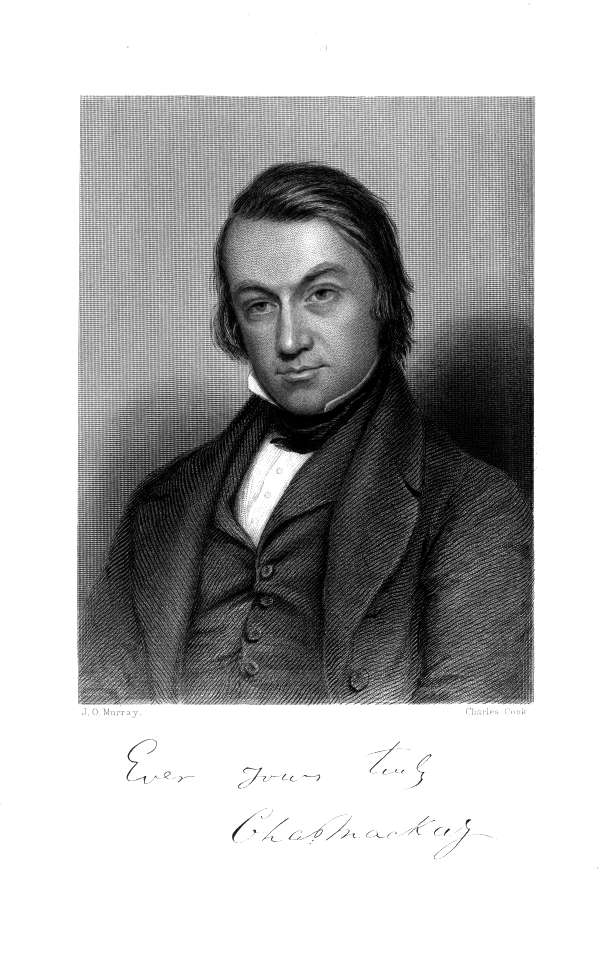
Blessings on Science, and her handmaid Steam!
They make Utopia only half a dream.
They make Utopia only half a dream.
From poem, 'Railways' (1846), collected in The Poetical Works of Charles Mackay: Now for the First Time Collected Complete in One Volume (1876), 214.
But the creative principle resides in mathematics. In a certain sense, therefore, I hold it true that pure thought can grasp reality, as the ancients dreamed.
From Herbert Spencer Lecture, at University of Oxford (10 Jun 1933), 'On the Methods of Theoretical Physics'. Printed in Philosophy of Science, (Apr 1934), 1, No. 2. Quoted and cited in epigraph, A. H. Louie, More Than Life Itself: A Synthetic Continuation in Relational Biology (2013), 81.
But the dreams about the modes of creation, enquiries whether our globe has been formed by the agency of fire or water, how many millions of years it has cost Vulcan or Neptune to produce what the fiat of the Creator would effect by a single act of will, is too idle to be worth a single hour of any man’s life.
Letter (2 May 1826) to Doctor John P. Emmet. Collected in The Writings of Thomas Jefferson (1854), Vol. 7, 443.
Champions aren’t made in gyms. Champions are made from something they have deep inside them—a desire, a dream, a vision. They have to have last-minute stamina, they have to be a little faster, they have to have the skill and the will. But the will must be stronger than the skill.
As co-author with Richard Durham, in The Greatest: My Own Story (1975), 365.
Change requires experimentation. But no problem can be solved by the same consciousness that created it. Our job is to dream—and to make those dreams happen.
In interview article, 'Designing For The Future', Newsweek (15 May 2005).
Chaos was the law of nature; order was the dream of man.
From his autobiography, The Education of Henry Adams (1907, 1918), 451.
Cherish you visions and your dreams as they are the children of your soul; the blue prints of your ultimate achievements.
…...
Cleveland, even now I can remember
Cause the Cuyahoga River
Goes smokin’ through my dreams
Burn on, big river, burn on
Burn on, big river, burn on
Now the Lord can make you tumble
And the Lord can make you turn
And the Lord can make you overflow
But the Lord can’t make you burn.
Cause the Cuyahoga River
Goes smokin’ through my dreams
Burn on, big river, burn on
Burn on, big river, burn on
Now the Lord can make you tumble
And the Lord can make you turn
And the Lord can make you overflow
But the Lord can’t make you burn.
From lyrics of 'Burn On', released on LP album Sail Away (May 1972), track 8. The song 'Burn On' was used as the opening song in Major League (7 Apr 1989).
Creative imagination is likely to find corroborating novel evidence even for the most 'absurd' programme, if the search has sufficient drive. This look-out for new confirming evidence is perfectly permissible. Scientists dream up phantasies and then pursue a highly selective hunt for new facts which fit these phantasies. This process may be described as “science creating its own universe” (as long as one remembers that “creating” here is used in a provocative-idiosyncratic sense). A brilliant school of scholars (backed by a rich society to finance a few well-planned tests) might succeed in pushing any fantastic programme ahead, or alternatively, if so inclined, in overthrowing any arbitrarily chosen pillar of “established knowledge”.
In 'Falsification and the Methodology of Scientific Research Programmes', in I. Lakatos and A. Musgrave (eds.), Criticism and the Growth of Knowledge: Proceedings of the International Colloquium in the Philosophy of Science, London 1965 (1970), Vol. 4, 187-8.
Dare to live the life you have dreamed for yourself. Go forward and make your dreams come true.
…...
Don’t be afraid of the space between your dreams and reality. If you can dream it, you can make it so.
…...
Dr. Bhabha was a visionary. He had excellent command over electronics, physics and he saw the dream of India being a nuclear power. … He was a perfectionist and would leave no point of suspicion while working on any project. He was an inspiration.
Interview in newsletter of the Raja Ramanna Centre for Advanced Technology (Oct 2001), online.
Dream analysis stands or falls with [the hypothesis of the unconscious]. Without it the dream appears to be merely a freak of nature, a meaningless conglomerate of memory-fragments left over from the happenings of the day.
Dream Analysis in its Practical Application (1930), 1-2.
Dream as if you’ll live forever... live as if you’ll die today.
…...
Dreaming over a subject is simply … allowing the will to focus the mind passively on the subject so that it follows the trains of thought as they arise, stopping them only when unprofitable but in general allowing them to form and branch naturally until some useful and interesting results occur.
In An Anatomy of Inspiration (1940), 5.
Dreams are excursions into the limbo of things, a semi-deliverance from the human prison.
Amiel's Journal The Journal Intime of Henri-Frederic Amiel, (3 Dec 1872), trans. By Mrs Humphry Ward (1889),131.
Dreams are renewable. No matter what our age or condition, there are still untapped possibilities within us and new beauty waiting to be born.
…...
Dreams are the reality you are afraid to live, reality is the fact that your dreams will probably never come true. You can find the word me in dream, that is because it is up to you to make them come true.
…...
Dreams are the touchstone of our character.
…...
Dreams are true interpreters of our inclinations; but there is art required to categorize and understand them.
In The Works of Michael de Montaigne (1849), 536.
Dreams are wishes cast upon stars, so catch a shining one ~ take your friend’s hand~ and hold on forever.
…...
Dreams do not vanish, so long as people do not abandon them.
…...
During my stay in London I resided for a considerable time in Clapham Road in the neighbourhood of Clapham Common... One fine summer evening I was returning by the last bus 'outside' as usual, through the deserted streets of the city, which are at other times so full of life. I fell into a reverie (Träumerei), and 10, the atoms were gambolling before my eyes! Whenever, hitherto, these diminutive beings had appeared to me, they had always been in motion: but up to that time I had never been able to discern the nature of their motion. Now, however, I saw how, frequently, two smaller atoms united to form a pair: how the larger one embraced the two smaller ones: how still larger ones kept hold of three or even four of the smaller: whilst the whole kept whirling in a giddy dance. I saw how the larger ones formed a chain, dragging the smaller ones after them but only at the ends of the chain. I saw what our past master, Kopp, my highly honoured teacher and friend has depicted with such charm in his Molekular-Welt: but I saw it long before him. The cry of the conductor 'Clapham Road', awakened me from my dreaming: but I spent part of the night in putting on paper at least sketches of these dream forms. This was the origin of the 'Structural Theory'.
Kekule at Benzolfest in Berichte (1890), 23, 1302.
Everest for me, and I believe for the world, is the physical and symbolic manifestation of overcoming odds to achieve a dream.
…...
Every dream will reveal itself as a psychological structure, full of significance.
First sentence of Chapter 1, 'The Scientific Literature on the Problems of the Dream, The Interpretation of Dreams (1900) as translated by A.A. Brill (1913), 1.
Every little girl needed a doll through which to project herself into her dream of her future. If she was going to do role playing of what she would be like when she was 16 or 17, it was a little stupid to play with a doll that had a flat chest. So I gave it beautiful breasts.
Interview (1977), as quoted in Kenneth C. Davis, Don't Know Much About History (2009), 435.
Experience hobbles progress and leads to abandonment of difficult problems; it encourages the initiated to walk on the shady side of the street in the direction of experiences that have been pleasant. Youth without experience attacks the unsolved problems which maturer age with experience avoids, and from the labors of youth comes progress. Youth has dreams and visions, and will not be denied.
From speech 'In the Time of Henry Jacob Bigelow', given to the Boston Surgical Society, Medalist Meeting (6 Jun 1921). Printed in Journal of the Medical Association (1921), 77, 599.
Few scientists acquainted with the chemistry of biological systems at the molecular level can avoid being inspired. Evolution has produced chemical compounds exquisitely organized to accomplish the most complicated and delicate of tasks. Many organic chemists viewing crystal structures of enzyme systems or nucleic acids and knowing the marvels of specificity of the immune systems must dream of designing and synthesizing simpler organic compounds that imitate working features of these naturally occurring compounds.
In 'The Design of Molecular Hosts, Guests, and Their Complexes', Nobel Lecture, 8 December 1987. In Nobel Lectures: Chemistry 1981-1990 (1992), 419.
Finally, since I thought that we could have all the same thoughts, while asleep, as we have while we are awake, although none of them is true at that time, I decided to pretend that nothing that ever entered my mind was any more true than the illusions of my dreams. But I noticed, immediately afterwards, that while I thus wished to think that everything was false, it was necessarily the case that I, who was thinking this, was something. When I noticed that this truth “I think, therefore I am” was so firm and certain that all the most extravagant assumptions of the sceptics were unable to shake it, I judged that I could accept it without scruple as the first principle of the philosophy for which I was searching. Then, when I was examining what I was, I realized that I could pretend that I had no body, and that there was no world nor any place in which I was present, but I could not pretend in the same way that I did not exist. On the contrary, from the very fact that I was thinking of doubting the truth of other things, it followed very evidently and very certainly that I existed; whereas if I merely ceased to think, even if all the rest of what I had ever imagined were true, I would have no reason to believe that I existed. I knew from this that I was a substance, the whole essence or nature of which was to think and which, in order to exist, has no need of any place and does not depend on anything material. Thus this self—that is, the soul by which I am what I am—is completely distinct from the body and is even easier to know than it, and even if the body did not exist the soul would still be everything that it is.
Discourse on Method in Discourse on Method and Related Writings (1637), trans. Desmond M. Clarke, Penguin edition (1999), Part 4, 24-5.
First, inevitably, the idea, the fantasy, the fairy tale. Then, scientific calculation. Ultimately, fulfillment crowns the dream.
For centuries we have dreamt of flying; recently we made that come true: we have always hankered for speed; now we have speeds greater than we can stand: we wanted to speak to far parts of the Earth; we can: we wanted to explore the sea bottom; we have: and so on, and so on. And, too, we wanted the power to smash our enemies utterly; we have it. If we had truly wanted peace, we should have had that as well. But true peace has never been one of the genuine dreams—we have got little further than preaching against war in order to appease out consciences.
The Outward Urge (1959)
For forty-nine months between 1968 and 1972, two dozen Americans had the great good fortune to briefly visit the Moon. Half of us became the first emissaries from Earth to tread its dusty surface. We who did so were privileged to represent the hopes and dreams of all humanity. For mankind it was a giant leap for a species that evolved from the Stone Age to create sophisticated rockets and spacecraft that made a Moon landing possible. For one crowning moment, we were creatures of the cosmic ocean, an epoch that a thousand years hence may be seen as the signature of our century.
…...
Fractals are patterns which occur on many levels. This concept can be applied to any musical parameter. I make melodic fractals, where the pitches of a theme I dream up are used to determine a melodic shape on several levels, in space and time. I make rhythmic fractals, where a set of durations associated with a motive get stretched and compressed and maybe layered on top of each other. I make loudness fractals, where the characteristic loudness of a sound, its envelope shape, is found on several time scales. I even make fractals with the form of a piece, its instrumentation, density, range, and so on. Here I’ve separated the parameters of music, but in a real piece, all of these things are combined, so you might call it a fractal of fractals.
Interview (1999) on The Discovery Channel. As quoted by Benoit B. Manelbrot and Richard Hudson in The (Mis)Behaviour of Markets: A Fractal View of Risk, Ruin and Reward (2010), 133.
Great men stand like solitary towers in the city of God, and secret passages running deep beneath external nature give their thoughts intercourse with higher intelligences, which strengthens and consoles them, and of which the labourers on the surface do not even dream!
Opening paragraph of his prose work, Kavanagh: A Tale (1849), 3.
Hold fast to dreams for if dreams die, life is a broken winged bird that cannot fly.
…...
Hold fast to dreams,
Let them stay with you forever.
Don’t let them die.
You might fly up in the sky
On a silver unicorn’s back,
Dreaming of the ocean,
Listening to the dolphins sing.
Dreams, hold on to them forever.
Let them stay with you forever.
Don’t let them die.
You might fly up in the sky
On a silver unicorn’s back,
Dreaming of the ocean,
Listening to the dolphins sing.
Dreams, hold on to them forever.
…...
Hope is a waking dream.
In Benjamin F. Powell (ed.), 'Selections Fron the Moral Remarks of Aristotle', Bible of Reason; or, Scriptures of Ancient Moralists (1837), Vol. 1, 9.
I always dreamed that man was a stranger on this planet.
As quoted in Jon, Michael and Deborah Fripp, Speaking of Science (2000), 167, citing “in conversation with Bill Smollers.”
I believe in everything until it’s disproved. So I believe in fairies, the myths, dragons… . Who’s to say that dreams and nightmares aren’t as real as the here and now?
Quoted in Kim Lim (ed.), 1,001 Pearls of Spiritual Wisdom: Words to Enrich, Inspire, and Guide Your Life (2014), 10
I can conceive few human states more enviable than that of the man to whom, panting in the foul laboratory, or watching for his life under the tropic forest, Isis shall for a moment lift her sacred veil, and show him, once and for ever, the thing he dreamed not of; some law, or even mere hint of a law, explaining one fact; but explaining with it a thousand more, connecting them all with each other and with the mighty whole, till order and meaning shoots through some old Chaos of scattered observations.
Health and Education (1874), 289.
I cannot serve as an example for younger scientists to follow. What I teach cannot be learned. I have never been a “100 percent scientist.” My reading has always been shamefully nonprofessional. I do not own an attaché case, and therefore cannot carry it home at night, full of journals and papers to read. I like long vacations, and a catalogue of my activities in general would be a scandal in the ears of the apostles of cost-effectiveness. I do not play the recorder, nor do I like to attend NATO workshops on a Greek island or a Sicilian mountain top; this shows that I am not even a molecular biologist. In fact, the list of what I have not got makes up the American Dream. Readers, if any, will conclude rightly that the Gradus ad Parnassum will have to be learned at somebody else’s feet.
In Heraclitean Fire: Sketches from a Life before Nature (1978), 7.
I don’t use drugs, my dreams are frightening enough.
As given, without citation, in G. Kleiser, Dictionary of Proverbs (2005), 77.
I find it [science] analytical, pretentious and superficial—largely because it does not address itself to dreams, chance, laughter, feelings, or paradox—in other words,—all the things I love the most.
My Last Sigh, trans. Abigail Israel (1983), 174.
I had a dream, and it landed right here in my hand.
…...
I had a dream, which was not all a dream.
The bright sun was extinguish'd, and the stars
Did wander darkling in the eternal space,
Rayless, and pathless, and the icy earth
Swung blind and blackening in the moonless air;
Morn came, and went—and came, and brought no day.
The bright sun was extinguish'd, and the stars
Did wander darkling in the eternal space,
Rayless, and pathless, and the icy earth
Swung blind and blackening in the moonless air;
Morn came, and went—and came, and brought no day.
Darkness (1816), lines 1-6. In Jerome J. McGann (ed.), Lord Byron: The Complete Poetical Works (1986), Vol. 4, 40-1.
I had at one time a very bad fever of which I almost died. In my fever I had a long consistent delirium. I dreamt that I was in Hell, and that Hell is a place full of all those happenings that are improbable but not impossible. The effects of this are curious. Some of the damned, when they first arrive below, imagine that they will beguile the tedium of eternity by games of cards. But they find this impossible, because, whenever a pack is shuffled, it comes out in perfect order, beginning with the Ace of Spades and ending with the King of Hearts. There is a special department of Hell for students of probability. In this department there are many typewriters and many monkeys. Every time that a monkey walks on a typewriter, it types by chance one of Shakespeare's sonnets. There is another place of torment for physicists. In this there are kettles and fires, but when the kettles are put on the fires, the water in them freezes. There are also stuffy rooms. But experience has taught the physicists never to open a window because, when they do, all the air rushes out and leaves the room a vacuum.
'The Metaphysician's Nightmare', Nightmares of Eminent Persons and Other Stories (1954), 38-9.
I have never really had dreams to fulfil…. You just want to go on looking at these ecosystems and trying to understand them and they are all fascinating. To achieve a dream suggests snatching a prize from the top of a tree and running off with it, and that’s the end of it. It isn’t like that. … What you are trying to achieve is understanding and you don’t do that just by chasing dreams.
From interview with Michael Bond, 'It’s a Wonderful Life', New Scientist (14 Dec 2002), 176, No. 2373, 52.
I hear you say “Why?” Always “Why?” But I dream things that never were; and I say “Why not?”
Back to Methuselah: a Metabiological Pentateuch (1921), 6. Often seen attributed to John F. Kennedy or Bobby Kennedy who restated this quote as “Some look at things that are, and ask why. I dream of things that never were and ask why not?”
I hear you say “Why?” Always “Why?” You see things; and you say “Why?” But I dream things that never were; and I say “Why not?”
The Serpent. Quoted in Kim Lim (ed.), 1,001 Pearls of Spiritual Wisdom: Words to Enrich, Inspire, and Guide Your Life (2014), 121
I immediately loved working with flies. They fascinated me, and followed me around in my dreams.
1995 Nobel Prize - Nobel Autobiography
I learned this, at least, by my experiment: that if one advances confidently in the direction of his dreams, and endeavors to live the life which he has imagined, he will meet with a success unexpected in common hours.
In Walden: or, Life in the Woods (1854, 1893), 496.
I suppose that the first chemists seemed to be very hard-hearted and unpoetical persons when they scouted the glorious dream of the alchemists that there must be some process for turning base metals into gold. I suppose that the men who first said, in plain, cold assertion, there is no fountain of eternal youth, seemed to be the most cruel and cold-hearted adversaries of human happiness. I know that the economists who say that if we could transmute lead into gold, it would certainly do us no good and might do great harm, are still regarded as unworthy of belief. Do not the money articles of the newspapers yet ring with the doctrine that we are getting rich when we give cotton and wheat for gold rather than when we give cotton and wheat for iron?
'The Forgotten Man' (1883). In The Forgotten Man and Other Essays (1918), 468.
I suspect that the changes that have taken place during the last century in the average man's fundamental beliefs, in his philosophy, in his concept of religion. in his whole world outlook, are greater than the changes that occurred during the preceding four thousand years all put together. ... because of science and its applications to human life, for these have bloomed in my time as no one in history had had ever dreamed could be possible.
In The Autobiography of Robert A. Millikan (1951, 1980), xii.
I was sitting writing at my textbook but the work did not progress; my thoughts were elsewhere. I turned my chair to the fire and dozed. Again the atoms were gambolling before my eyes. This time the smaller groups kept modestly in the background. My mental eye, rendered more acute by the repeated visions of the kind, could now distinguish larger structures of manifold confirmation: long rows, sometimes more closely fitted together all twining and twisting in snake like motion. But look! What was that? One of the snakes had seized hold of its own tail, and the form whirled mockingly before my eyes. As if by a flash of lightning I awoke; and this time also I spent the rest of the night in working out the rest of the hypothesis. Let us learn to dream, gentlemen, then perhaps we shall find the truth... But let us beware of publishing our dreams till they have been tested by waking understanding.
Kekule at Benzolfest in Berichte (1890), 23, 1302.
I’ve always been inspired by Dr. Martin Luther King, who articulated his Dream of an America where people are judged not by skin color but “by the content of their character.” In the scientific world, people are judged by the content of their ideas. Advances are made with new insights, but the final arbitrator of any point of view are experiments that seek the unbiased truth, not information cherry picked to support a particular point of view.
In letter (1 Feb 2013) to Energy Department employees announcing his decision not to serve a second term.
If I were not a physicist, I would probably be a musician. I often think in music. I live my dreams in music. I see my life in terms of music... I get most joy in life out of music.
…...
If sleeping and dreaming do not perform vital biological functions, then they must represent nature's most stupid blunder and most colossal waste of time.
Private Myths: Dreams and Dreaming (1995, 1997), 91.
If you dream of something worth doing and then simply go to work on it and don't think anything of personalities, or emotional conflicts, or of money, or of family distractions; if you think of, detail by detail, what you have to do next, it is a wonderful dream even though the end is a long way off, for there are about five thousand steps to be taken before we realize it; and [when you] start taking the first ten, and ... twenty after that, it is amazing how quickly you get through through the four thousand [nine hundred] and ninety. The last ten steps you never seem to work out. But you keep on coming nearer to giving the world something.
Victor K. McElheny, Insisting on the Impossible (1999), 1.
If you had come to me a hundred years ago, do you think I should have dreamed of the telephone? Why, even now I cannot understand it! I use it every day, I transact half my correspondence by means of it, but I don’t understand it. Thnk of that little stretched disk of iron at the end of a wire repeating in your ear not only sounds, but words—not only words, but all the most delicate and elusive inflections and nuances of tone which separate one human voice from another! Is not that something of a miracle?
Quoted in Harold Begbie in Pall Mall magazine (Jan 1903). In Albert Shaw, The American Monthly Review of Reviews (1903), 27, 232.
If you talk to your children, you can help them to keep their lives together. If you talk to them skillfully, you can help them to build future dreams.
— Jim Rohn
…...
If you were going to risk all that, not just risk the hardship and the pain but risk your life. Put everything on line for a dream, for something that’s worth nothing, that can’t be proved to anybody. You just have the transient moment on a summit and when you come back down to the valley it goes. It is actually a completely illogical thing to do. It is not justifiable by any rational terms. That’s probably why you do it.
The Beckoning Silence
If your actions create a legacy that inspires others to dream more, learn more, do more and become more, then, you are an excellent leader.
In Lorne A. Adrain (ed.), The Most Important Thing I Know<: Life Lessons From Colin Powell, Stephen Covey, Maya Angelou and Over 75 Other Eminent Individuals (1997), 60-61. A similar quote is found attributed to John Quincy Adams, but this is likely not authentic, as documented on the quoteinvestigator.com website.
In 1963, when I assigned the name “quark” to the fundamental constituents of the nucleon, I had the sound first, without the spelling, which could have been “kwork.” Then, in one of my occasional perusals of Finnegans Wake, by James Joyce, I came across the word “quark” in the phrase “Three quarks for Muster Mark.” Since “quark” (meaning, for one thing, the cry of a gull) was clearly intended to rhyme with “Mark,” as well as “bark” and other such words, I had to find an excuse to pronounce it as “kwork.” But the book represents the dreams of a publican named Humphrey Chimpden Earwicker. Words in the text are typically drawn from several sources at once, like the “portmanteau words” in Through the Looking Glass. From time to time, phrases occur in the book that are partially determined by calls for drinks at the bar. I argued, therefore, that perhaps one of the multiple sources of the cry “Three quarks for Muster Mark” might be pronunciation for “Three quarts for Mister Mark,” in which case the pronunciation “kwork” would not be totally unjustified. In any case, the number three fitted perfectly the way quarks occur in nature.
The Quark and the Jaguar (1994), 180.
In 1975, ... [speaking with Shiing Shen Chern], I told him I had finally learned ... the beauty of fiber-bundle theory and the profound Chern-Weil theorem. I said I found it amazing that gauge fields are exactly connections on fiber bundles, which the mathematicians developed without reference to the physical world. I added, “this is both thrilling and puzzling, since you mathematicians dreamed up these concepts out of nowhere.” He immediately protested: “No, no. These concepts were not dreamed up. They were natural and real.”
In 'Einstein's Impact on Theoretical Physics', collected in Jong-Ping Hsu, Leonard Hsu (eds.), JingShin Theoretical Physics Symposium in Honor of Professor Ta-You Wu (1998), 70. Reprinted from Physics Today (Jun 1980), 49. The article was adapted from a talk given at the Second Marcel Grossman meeting, held in Trieste, Italy (Jul 1979), in honor of the 100th anniversary of the birth of Albert Einstein.
In an era in which the domain of intellect and politics were almost exclusively male, Theon [her father] was an unusually liberated person who taught an unusually gifted daughter [Hypatia] and encouraged her to achieve things that, as far as we know, no woman before her did or perhaps even dreamed of doing.
From 'Hypatia', in Louise S. Grinstein (ed.), Women of Mathematics, (1987), 74.
In dreams begins responsibility.
In The Collected Poems of W. B. Yeats (2000), 81.
In geology we cannot dispense with conjectures: [but] because we are condemned to dream let us ensure that our dreams are like those of sane men—e.g. that they have their foundations in truth—and are not like the dreams of the sick, formed by strange combinations of phantasms, contrary to nature and therefore incredible.
Introducione alla Geologia, Part I (1811), trans. Ezio Vaccari, 81.
In some respects, science has far surpassed religion in delivering awe. How is it that hardly any major religion has looked at science and concluded, “This is better than we thought! The Universe is much bigger than our prophets said, grander, more subtle, more elegant. God must be even greater than we dreamed”? Instead they say, 'No, no, no! My god is a little god, and I want him to stay that way.'
Pale Blue Dot: A Vision of the Human Future in Space (1994), 52.
In this House on July 24, 1895 the Secret of Dreams was revealed to Dr. Sigmund Freud.
Plaque was placed on 6 May 1977 at Bellevue (a house on the slopes of the Wienerwald) where the Freud family spent their summers.
Plaque was placed on 6 May 1977 at Bellevue (a house on the slopes of the Wienerwald) where the Freud family spent their summers.
From a letter to Wilhelm Fliess, 20 Jun 1900. Quoted in Ernst L. Freud (ed.), Letters of Sigmund Freud 1873-1939 (1961), 250.
In your heart, keep one still secret spot where dreams may go and be sheltered so they may thrive and grow.
…...
Is it a fact—or have I dreamt it—that, by means of electricity, the world of matter has become a great nerve, vibrating thousands of miles in a breathless point of time?
In The House of the Seven Gables (1851), 203.
It is an old dream: To travel on the back of a benevolent sea beast down to some secret underwater garden.
…...

It is difficult to say what is impossible, for “The dream of yesterday is the hope of today and the reality of tomorrow.”
The opening clause is his own paraphrase of his own introductory remark, followed by quoting directly from his Oration (21 Jun 1904), 'On Taking Things for Granted', at his own graduation from South High School, Worcester, Massachusetts, in 'Material for an Autobiography of R.H. Goddard: written in July 1923 with interpolations made in 1933', The Papers of Robert H. Goddard: Vol. 1: 1898-1924 (1970), 11. The source of the paraphrase is seen in a longer direct quote from his Oration: “In the sciences we have learned that we are too ignorant to pronounce anything impossible,… The dream of yesterday is the hope of today and the reality of tomorrow”, in the epigraph on page v. The full Oration is on pp 63-66.
It is not improbable that some of the presentations which come before the mind in sleep may even be causes of the actions cognate to each of them. For as when we are about to act [in waking hours], or are engaged in any course of action, or have already performed certain actions, we often find ourselves concerned with these actions, or performing them, in a vivid dream.
In Mortimer Jerome Adler, Charles Lincoln Van Doren (eds.) Great Treasury of Western Thought: A Compendium of Important Statements on Man and His Institutions by the Great Thinkers in Western History (1977), 352
It is obvious that man dwells in a splendid universe, a magnificent expanse of earth and sky and heaven, which manifestly is built on a majestic plan, maintains some mighty design, though man himself cannot grasp it. Yet for him it is not a pleasant or satisfying world. In his few moments of respite from labor or from his enemies, he dreams that this very universe might indeed be perfect, its laws operating just as now they seem to do, and yet he and it somehow be in full accord. The very ease with which he can frame this image to himself makes the reality all the more mocking. ... It is only too clear that man is not at home in this universe, and yet he is not good enough to deserve a better.
In The New England Mind: The Seventeenth Century (1939, 1954), 7.
It is only by introducing the young to great literature, drama and music, and to the excitement of great science that we open to them the possibilities that lie within the human spirit—enable them to see visions and dream dreams.
Quoted, without citation in Reader's Digest Quotable Quotes (1997), 144. This quote, usually seen attributed as 'Eric Anderson' is here tentatively linked to Sir Eric Anderson. If you can confirm this with a primary source, please contact Webmaster.
It is said that fact is sometimes stranger than fiction, and nowhere is this more true than in the case of black holes. Black holes are stranger than anything dreamt up by science fiction writers.
In Lecture, 'Into a Black Hole' (2008). On hawking.org website.
It is the individual only who is timeless. Societies, cultures, and civilizations - past and present - are often incomprehensible to outsiders, but the individual’s hunger, anxieties, dreams, and preoccupations have remained unchanged through the millennia. Thus, we are up against the paradox that the individual who is more complex, unpredictable, and mysterious than any communal entity is the one nearest to our understanding; so near that even the interval of millennia cannot weaken our feeling of kinshiIf in some manner the voice of an individual reaches us from the remotest distance of time, it is a timeless voice speaking about ourselves.
In Reflections on the Human Condition (1973), 97.
It is we, we alone, who have dreamed up the causes, the one-thing-after-another, the one-thing-reciprocating-another, the relativity, the constraint, the numbers, the laws, the freedom, the ‘reason why,’ the purpose. ... We are creating myths.
…...
It must be borne in mind that the tragedy of life doesn’t lie in not reaching your goal. The tragedy lies in having no goal to reach. It isn’t a calamity to die with dreams unfulfilled, but it is a calamity not to dream. It is not a disaster to be unable to capture your idea, but it is disaster to have no idea to capture. It is not a disgrace not to reach for the stars, but it is a disgrace to have no stars to reach for. Not failure, but low aim is a sin.
…...
It takes someone with a vision of the possibilities to attain new levels of experience. Someone with the courage to live his dreams.
…...
Keep some souvenirs of your past, or how will you ever prove it wasn’t all a dream?
…...
Let your dream devour your life not your life devour your dream.
Widely seen on French websites as, “Faites que le rêve dévore votre vie afin que la vie ne dévore pas votre rêve,” citing Le Petit Prince (The Little Prince). However, as yet, Webmaster has not been able to verify that the quote is found in that book. Can you help?
Life, this anti-entropy, ceaselessly reloaded with energy, is a climbing force, toward order amidst chaos, toward light, among the darkness of the indefinite, toward the mystic dream of Love, between the fire which devours itself and the silence of the Cold.
Nobel Lecture, The Coming Age of the Cell, 12 Dec 1974
Like most fathers, by clear star-studded skies I used to take each of my two little boys in my arms for a glimpse at infinity. The splendor of the unreachable silenced their chatterboxes for a few seconds. They raised their arms and closed their little fingers in a futile attempt to grasp one of the twinkling sparks that dot our dreams. The little fellows obeyed the command reported by Ovid: “God elevated man's forehead and ordered him to contemplate the stars.”
Written as opening paragraph for 'Foreword' to Kevin W. Kelley (ed.), The Home Planet (1988) (unpaginated).
Mankind have been slow to believe that order reigns in the universe—that the world is a cosmos and a chaos.
… The divinities of heathen superstition still linger in one form or another in the faith of the ignorant, and even intelligent men shrink from the contemplation of one supreme will acting regularly, not fortuitously, through laws beautiful and simple rather than through a fitful and capricious system of intervention.
... The scientific spirit has cast out the demons, and presented us with nature clothed in her right mind and living under the reign of law. It has given us, for the sorceries of the alchemist, the beautiful laws of chemistry; for the dreams of the astrologer, the sublime truths of astronomy; for the wild visions of cosmogony, the monumental records of geology; for the anarchy of diabolism, the laws of God.
… The divinities of heathen superstition still linger in one form or another in the faith of the ignorant, and even intelligent men shrink from the contemplation of one supreme will acting regularly, not fortuitously, through laws beautiful and simple rather than through a fitful and capricious system of intervention.
... The scientific spirit has cast out the demons, and presented us with nature clothed in her right mind and living under the reign of law. It has given us, for the sorceries of the alchemist, the beautiful laws of chemistry; for the dreams of the astrologer, the sublime truths of astronomy; for the wild visions of cosmogony, the monumental records of geology; for the anarchy of diabolism, the laws of God.
Speech (16 Dec 1867) given while a member of the U.S. House of Representatives, introducing resolution for the appointment of a committee to examine the necessities for legislation upon the subject of the ninth census to be taken the following year. Quoted in John Clark Ridpath, The Life and Work of James A. Garfield (1881), 216.
Mars is the next frontier, what the Old West was, what America was 500 years ago. It’s been 500 years since Columbus. It’s time to strike out anew. There’s a big argument at the moment. The moon is closer, and we’ve got to go back there sometime. But whether it will ever be settled on a large scale is a question. But Mars—there’s no doubt about it. … Everything you need is on Mars.
The characteristic of human nature, and perhaps our simian family group, is curiosity and exploration. When we stop doing that, we won't be human anymore. You say there's been a decline, well, I’ve seen far more happen in my lifetime than I ever dreamed. And the momentary plateau now, well, many of our problems on Earth can only be solved by space technology. … When we get out of the present sort of slump and confusion, well, I mean the next step is space. It's inevitable.
The characteristic of human nature, and perhaps our simian family group, is curiosity and exploration. When we stop doing that, we won't be human anymore. You say there's been a decline, well, I’ve seen far more happen in my lifetime than I ever dreamed. And the momentary plateau now, well, many of our problems on Earth can only be solved by space technology. … When we get out of the present sort of slump and confusion, well, I mean the next step is space. It's inevitable.
Interview in Sri Lanka by Steve Coll for The Washington Post (9 Mar 1992), B1.
Mathematics is distinguished from all other sciences except only ethics, in standing in no need of ethics. Every other science, even logic—logic, especially—is in its early stages in danger of evaporating into airy nothingness, degenerating, as the Germans say, into an anachrioid [?] film, spun from the stuff that dreams are made of. There is no such danger for pure mathematics; for that is precisely what mathematics ought to be.
In Charles S. Peirce, Charles Hartshorne (ed.), Paul Weiss (ed.), Collected Papers of Charles Sanders Peirce (1931), Vol. 4, 200.
May not Music be described as the Mathematic of sense, Mathematic as Music of the reason? the soul of each the same! Thus the musician feels Mathematic, the mathematician thinks Music, Music the dream, Mathematic the working life each to receive its consummation from the other when the human intelligence, elevated to its perfect type, shall shine forth glorified in some future Mozart-Dirichlet or Beethoven-Gauss a union already not indistinctly foreshadowed in the genius and labours of a Helmholtz!
In paper read 7 Apr 1864, printed in 'Algebraical Researches Containing a Disquisition On Newton’s Rule for the Discovery of Imaginary Roots', Philosophical Transactions of the Royal Society of London (1865), 154, 613, footnote. Also in Collected Mathematical Papers, Vol. 2, 419.
Modern Science has along with the theory that the Earth dated its beginning with the advent of man, swept utterly away this beautiful imagining. We can, indeed, find no beginning of the world. We trace back events and come to barriers which close our vistabarriers which, for all we know, may for ever close it. They stand like the gates of ivory and of horn; portals from which only dreams proceed; and Science cannot as yet say of this or that dream if it proceeds from the gate of horn or from that of ivory.
In short, of the Earth's origin we have no certain knowledge; nor can we assign any date to it. Possibly its formation was an event so gradual that the beginning was spread over immense periods. We can only trace the history back to certain events which may with considerable certainty be regarded as ushering in our geological era.
In short, of the Earth's origin we have no certain knowledge; nor can we assign any date to it. Possibly its formation was an event so gradual that the beginning was spread over immense periods. We can only trace the history back to certain events which may with considerable certainty be regarded as ushering in our geological era.
Lecture at the Royal Dublin Society, 6 Feb 1914. Published in Science Progress, Vol. 9, 37. Republished in The Birth-Time of the World and Other Scientific Essays, (1915), 2.
Most of us who become experimental physicists do so for two reasons; we love the tools of physics because to us they have intrinsic beauty, and we dream of finding new secrets of nature as important and as exciting as those uncovered by our scientific heroes.
In Nobel Lecture (11 Dec 1968), 'Recent Developments in Particle Physics', collected in Nobel Lectures: Physics 1963-1970 (1972), 241.
Mother of all the sciences, it [mathematics] is a builder of the imagination, a weaver of patterns of sheer thought, an intuitive dreamer, a poet.
In The American Mathematical Monthly (1949), 56, 19. Excerpted in John Ewing (ed,), A Century of Mathematics: Through the Eyes of the Monthly (1996), 186.
My life has been a continuous fulfillment of dreams. It appears that everything I saw and did has a new, and perhaps, more significant meaning, every time I see it. The earth is good. It is a privilege to live thereon.
In The National Gardener (1952?), 7.

My whole life is devoted unreservedly to the service of my sex. The study and practice of medicine is in my thought but one means to a great end, for which my very soul yearns with intensest passionate emotion, of which I have dreamed day and night, from my earliest childhood, for which I would offer up my life with triumphant thanksgiving, if martyrdom could secure that glorious end:— the true ennoblement of woman, the full harmonious development of her unknown nature, and the consequent redemption of the whole human race.
From letter (12 Aug 1848) replying to Emily Collins, reproduced in Elizabeth Cady Stanton, Susan Brownell Anthony and Matilda Joslyn Gage, History of Woman Suffrage (1881), Vol. 1, 91. Blackwell was at the time a student at the medical college of Geneva, N.Y.
Never laugh at anyone’s dreams. People who don’t have dreams don’t have much.
No science contains so many sophisms, errors, dreams, and lies as medicine.
…...
No storyteller has been able to dream up anything as fantastically unlikely as what really does happen in this mad Universe.
Time Enough For Love: the Lives of Lazarus Long (1973), 51.
Nor do I know any study which can compete with mathematics in general in furnishing matter for severe and continued thought. Metaphysical problems may be even more difficult; but then they are far less definite, and, as they rarely lead to any precise conclusion, we miss the power of checking our own operations, and of discovering whether we are thinking and reasoning or merely fancying and dreaming.
In Conflict of Studies (1873), 13.
Not every one of our desires can be immediately gratified. We’ve got to learn to wait patiently for our dreams to come true, especially on the path we’ve chosen. But while we wait, we need to prepare symbolically a place for our hopes and dreams.
…...
Nothing ever built ... arose to touch the skies unless some man dreamed that it should, some man believed that it could, and some man willed that it must.
O God, I could be bounded in a nutshell and count myself a king of infinite space, were it not that I have bad dreams.
Hamlet (1601), II, ii.
Objective evidence and certitude are doubtless very fine ideals to play with, but where on this moonlit and dream-visited planet are they found?
'The Will to Believe' (1896). In The Will to Believe and Other Essays in Popular Philosophy (1897), 14.
Oh, I have slipped the surly bonds of earth
and danced the skies on laughter-silvered wings;
Sunward I’ve climbed, and joined the tumbling mirth
of sun-split clouds and done a hundred things
you have not dreamed of wheeled and soared and swung
high in the sunlit silence. Hovering there,
I’ve chased the shouting wind along, and flung
my eager craft through footless halls of air.
Up, up the long, delirious, burning blue
I’ve topped the windswept heights with easy grace
where never lark, or even eagle flew
and, while with silent, lifting mind I’ve trod
the high untrespassed sanctity of space,
put out my hand, and touched the face of God.
and danced the skies on laughter-silvered wings;
Sunward I’ve climbed, and joined the tumbling mirth
of sun-split clouds and done a hundred things
you have not dreamed of wheeled and soared and swung
high in the sunlit silence. Hovering there,
I’ve chased the shouting wind along, and flung
my eager craft through footless halls of air.
Up, up the long, delirious, burning blue
I’ve topped the windswept heights with easy grace
where never lark, or even eagle flew
and, while with silent, lifting mind I’ve trod
the high untrespassed sanctity of space,
put out my hand, and touched the face of God.
…...
On 17th July there came to us at Potsdam the eagerly-awaited news of the trial of the atomic bomb in the [New] Mexican desert. Success beyond all dreams crowded this sombre, magnificent venture of our American allies. The detailed reports ... could leave no doubt in the minds of the very few who were informed, that we were in the presence of a new factor in human affairs, and possessed of powers which were irresistible.
From Churchill's final review of the war and his first major speech as Leader of the Opposition in the House of Commons (16 Aug 1945). In Robert Rhodes James, ed., Winston S. Churchill: His Complete Speeches, 1897-1963 (1974), Vol. 1, 7210.
On poetry and geometric truth,
And their high privilege of lasting life,
From all internal injury exempt,
I mused; upon these chiefly: and at length,
My senses yielding to the sultry air,
Sleep seized me, and I passed into a dream.
And their high privilege of lasting life,
From all internal injury exempt,
I mused; upon these chiefly: and at length,
My senses yielding to the sultry air,
Sleep seized me, and I passed into a dream.
From 'The Prelude' in Book 5, collected in Henry Reed (ed.), The Complete Poetical Works of William Wordsworth (1851), 497.
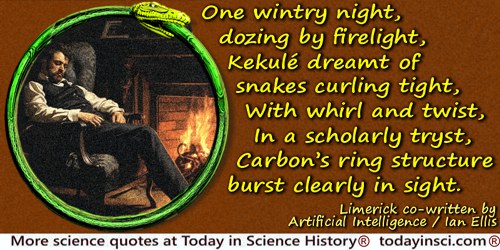
One wintry night, dozing by firelight,
Kekulé dreamt of snakes curling tight,
With whirl and twist,
In a scholarly tryst,
Carbon’s ring structure burst clearly in sight.
Kekulé dreamt of snakes curling tight,
With whirl and twist,
In a scholarly tryst,
Carbon’s ring structure burst clearly in sight.
Limerick co-written by Artificial Intelligence and Ian Ellis.
Only dream I ever have... is it the surface of the Sun? Every time I shut my eyes... it’s always the same.
— Movie
Cassie, Sunshine (2007)
Our experience up to date justifies us in feeling sure that in Nature is actualized the ideal of mathematical simplicity. It is my conviction that pure mathematical construction enables us to discover the concepts and the laws connecting them, which gives us the key to understanding nature… In a certain sense, therefore, I hold it true that pure thought can grasp reality, as the ancients dreamed.
In Herbert Spencer Lecture at Oxford (10 Jun 1933), 'On the Methods of Theoretical Physics'. Printed in Discovery (Jul 1933), 14, 227. Also quoted in Stefano Zambelli and Donald A. R. George, Nonlinearity, Complexity and Randomness in Economics (2012).
Our revels are now ended. These our actors,
As I foretold you, were all spirits, and Are melted into air, into thin air;
And like the baseless fabric of this vision,
The cloud-capp'd towers, the gorgeous palaces,
The solemn temples, the great globe itself,
Yea, all which it inherit, shall dissolve.
And like this insubstantial pageant faded,
Leave not a rack behind. We are such stuff
As dreams are made on; and our little life
Is rounded with a sleep.
As I foretold you, were all spirits, and Are melted into air, into thin air;
And like the baseless fabric of this vision,
The cloud-capp'd towers, the gorgeous palaces,
The solemn temples, the great globe itself,
Yea, all which it inherit, shall dissolve.
And like this insubstantial pageant faded,
Leave not a rack behind. We are such stuff
As dreams are made on; and our little life
Is rounded with a sleep.
The Tempest (1611), IV, i.
Paris ... On this side of the ocean it is difficult to understand the susceptibility of American citizens on the subject and precisely why they should so stubbornly cling to the biblical version. It is said in Genesis the first man came from mud and mud is not anything very clean. In any case if the Darwinian hypothesis should irritate any one it should only be the monkey. The monkey is an innocent animal—a vegetarian by birth. He never placed God on a cross, knows nothing of the art of war, does not practice lynch law and never dreams of assassinating his fellow beings. The day when science definitely recognizes him as the father of the human race the monkey will have no occasion to be proud of his descendants. That is why it must be concluded that the American Association which is prosecuting the teacher of evolution can be no other than the Society for Prevention of Cruelty to Animals.
[A cynical article in the French press on the Scopes Monkey Trial, whether it will decide “a monkey or Adam was the grandfather of Uncle Sam.”]
[A cynical article in the French press on the Scopes Monkey Trial, whether it will decide “a monkey or Adam was the grandfather of Uncle Sam.”]
Article from a French daily newspaper on the day hearings at the Scopes Monkey Trial began, Paris Soir (13 Jul 1925), quoted in 'French Satirize the Case', New York Times (14 Jul 1925), 3.
People have been looking up at the skies for 10,000 years, wondering and dreaming. I hope we always do.
As quoted by Howard Wilkinson in 'John Glenn Had the Stuff U.S. Heroes are Made of', The Cincinnati Enquirer (20 Feb 2002)
People move out to the suburbs to make their lives and seek their dream, only too often to find that they are playing leapfrog with bulldozers, longing for the meadow that used to be the children’s paradise at the end of the street.
— Al Gore
As quoted in Time (1999), 153, 159. Also in Lecture (2 Dec 1998) to 1998 Democratic Leadership Council Annual Conference, Washington, D.C., collected in Joseph Kaufmann (ed.), The World According To Al Gore: An A-To-Z Compilation Of His Opinions, Positions and Public Statements (1999), 282.
Perhaps some day in the dim future it will be possible to advance the computations faster than the weather advances and at a cost less than the saving to mankind due to the information gained. But that is a dream.
Weather Prediction by Numerical Process (1922), 66. Quoted in Peter Lynch, The Emergence of Numerical Weather Prediction (2006), vii.
Philosophers, if they have much imagination, are apt to let it loose as well as other people, and in such cases are sometimes led to mistake a fancy for a fact. Geologists, in particular, have very frequently amused themselves in this way, and it is not a little amusing to follow them in their fancies and their waking dreams. Geology, indeed, in this view, may be called a romantic science.
Conversations on Geology (1840), 5.
Present experience is a dream; the future a distraction; only memory can unlock the meaning of life.
In 'Thomas Hardy', Saturday Review of Literature (1 Dec 1928), 5, 422. Rearranged by Anne Ellis for epigraph to Chap. 1 as “The present is a distraction; the future a dream; only memory can unlock the meaning of life” in Plain Anne Ellis: More About the Life of an Ordinary Woman (1931), 1, cited as “Desmond MacCarthy. (Rearranged by A.E.)”. The Anne Ellis variant is used as an epigraph attributed to Desmond MacCarthy, in Hans Cloos, 'Ship’s Wake', Conversation With the Earth. The variant also appears quoted in a conversation between characters in Chap. 31, Frank Herbert, God Emperor of Dune: Dune Chronicles #4 (1981).
Reach high, for stars lie hidden in your soul. Dream deep, for every dream precedes the goal.
…...
Religion is, in reality, living. Our religion is not what we profess, or what we say, or what we proclaim; our religion is what we do, what we desire, what we seek, what we dream about, what we fantasize, what we think—all these things.
Quoted in Kim Lim (ed.), 1,001 Pearls of Spiritual Wisdom: Words to Enrich, Inspire, and Guide Your Life (2014), 21
Science and technology revolutionize our lives, but memory, tradition and myth frame our response. Expelled from individual consciousness by the rush of change, history finds its revenge by stamping the collective unconsciousness with habits, values, expectations, dreams. The dialectic between past and future will continue to form our lives.
…...
Science, then, is the attentive consideration of common experience; it is common knowledge extended and refined. Its validity is of the same order as that of ordinary perception; memory, and understanding. Its test is found, like theirs, in actual intuition, which sometimes consists in perception and sometimes in intent. The flight of science is merely longer from perception to perception, and its deduction more accurate of meaning from meaning and purpose from purpose. It generates in the mind, for each vulgar observation, a whole brood of suggestions, hypotheses, and inferences. The sciences bestow, as is right and fitting, infinite pains upon that experience which in their absence would drift by unchallenged or misunderstood. They take note, infer, and prophesy. They compare prophesy with event, and altogether they supply—so intent are they on reality—every imaginable background and extension for the present dream.
The Life of Reason, or the Phases of Human Progress (1954), 393.
Scientists dream about doing great things. Engineers do them.
In Space: A Novel (1982), 173.
Self-esteem must be earned! When you dare to dream, dare to follow that dream, dare to suffer through the pain, sacrifice, self-doubts, and friction from the world, you will genuinely impress yourself.
…...
Should the research worker of the future discover some means of releasing this [atomic] energy in a form which could be employed, the human race will have at its command powers beyond the dream of scientific fiction, but the remotest possibility must always be considered that the energy once liberated will be completely uncontrollable and by its intense violence detonate all neighbouring substances. In this event, the whole of the hydrogen on earth might be transformed at once and the success of the experiment published at large to the universe as a new star.
'Mass Spectra and Isotopes', Nobel Lecture, 12 December 1922. In Nobel Lectures, Chemistry, 1922-1941 (1966), 20.
Since 1849 I have studied incessantly, under all its aspects, a question which was already in my mind [since 1832. I confess that my scheme is still a mere dream, and I do not shut my eyes to the fact that so long as I alone believe it to be possible, it is virtually impossible. ... The scheme in question is the cutting of a canal through the Isthmus of Suez. This has been thought of from the earliest historical times, and for that very reason is looked upon as impracticable. Geographical dictionaries inform us indeed that the project would have been executed long ago but for insurmountable obstacles. [On his inspiration for the Suez Canal.]
Letter to M.S.A. Ruyssenaers, Consul-General for Holland in Egypt, from Paris (8 Jul 1852), seeking support. Collected in Ferdinand de Lesseps, The Suez Canal: Letters and Documents Descriptive of Its Rise and Progress in 1854-1856 (1876), 2.
Some of my youthful readers are developing wonderful imaginations. This pleases me. Imagination has brought mankind through the Dark Ages to its present state of civilization. Imagination led Columbus to discover America. Imagination led Franklin to discover electricity. Imagination has given us the steam engine, the telephone, the talking-machine and the automobile, for these things had to be dreamed of before they became realities. So I believe that dreams—day dreams, you know, with your eyes wide open and your brain-machinery whizzing—are likely to lead to the betterment of the world. The imaginative child will become the imaginative man or woman most apt to create, to invent, and therefore to foster civilization. A prominent educator tells me that fairy tales are of untold value in developing imagination in the young. I believe it.
Opening paragraph of preface, 'To My Readers', The Lost Princess of Oz (1917), 13.
Some people see things as they are and say why. I dream things that never were and say why not?
…...
Sometimes dreams alter the course of an entire life.
…...
Surely something is wanting in our conception of the universe. We know positive and negative electricity, north and south magnetism, and why not some extra terrestrial matter related to terrestrial matter, as the source is to the sink. … Worlds may have formed of this stuff, with element and compounds possessing identical properties with our own, indistinguishable from them until they are brought into each other’s vicinity. … Astronomy, the oldest and most juvenile of the sciences, may still have some surprises in store. May anti-matter be commended to its care! … Do dreams ever come true?
[Purely whimsical prediction long before the 1932 discovery of the positron, the antiparticle of the electron.]
[Purely whimsical prediction long before the 1932 discovery of the positron, the antiparticle of the electron.]
'Potential Matter—A Holiday Dream', Letter to the Editor, Nature (18 Aug 1898), 58, No. 1503, 367. Quoted in Edward Robert Harrison, Cosmology: the Science of the Universe (2000), 433.
That ability to impart knowledge … what does it consist of? … a deep belief in the interest and importance of the thing taught, a concern about it amounting to a sort of passion. A man who knows a subject thoroughly, a man so soaked in it that he eats it, sleeps it and dreams it—this man can always teach it with success, no matter how little he knows of technical pedagogy. That is because there is enthusiasm in him, and because enthusiasm is almost as contagious as fear or the barber’s itch. An enthusiast is willing to go to any trouble to impart the glad news bubbling within him. He thinks that it is important and valuable for to know; given the slightest glow of interest in a pupil to start with, he will fan that glow to a flame. No hollow formalism cripples him and slows him down. He drags his best pupils along as fast as they can go, and he is so full of the thing that he never tires of expounding its elements to the dullest.
This passion, so unordered and yet so potent, explains the capacity for teaching that one frequently observes in scientific men of high attainments in their specialties—for example, Huxley, Ostwald, Karl Ludwig, Virchow, Billroth, Jowett, William G. Sumner, Halsted and Osler—men who knew nothing whatever about the so-called science of pedagogy, and would have derided its alleged principles if they had heard them stated.
This passion, so unordered and yet so potent, explains the capacity for teaching that one frequently observes in scientific men of high attainments in their specialties—for example, Huxley, Ostwald, Karl Ludwig, Virchow, Billroth, Jowett, William G. Sumner, Halsted and Osler—men who knew nothing whatever about the so-called science of pedagogy, and would have derided its alleged principles if they had heard them stated.
In Prejudices: third series (1922), 241-2.
For a longer excerpt, see H.L. Mencken on Teaching, Enthusiasm and Pedagogy.
For a longer excerpt, see H.L. Mencken on Teaching, Enthusiasm and Pedagogy.
The atmosphere is much too near for dreams. It forces us to action. It is close to us. We are in it and of it. It rouses us both to study and to do. We must know its moods and also its motive forces.
From Address (16 Mar 1909) at Columbia University, printed in 'Meteorology of the Future', Popular Science Monthly (Dec 1910), 78, 22.
The belief that mathematics, because it is abstract, because it is static and cold and gray, is detached from life, is a mistaken belief. Mathematics, even in its purest and most abstract estate, is not detached from life. It is just the ideal handling of the problems of life, as sculpture may idealize a human figure or as poetry or painting may idealize a figure or a scene. Mathematics is precisely the ideal handling of the problems of life, and the central ideas of the science, the great concepts about which its stately doctrines have been built up, are precisely the chief ideas with which life must always deal and which, as it tumbles and rolls about them through time and space, give it its interests and problems, and its order and rationality. That such is the case a few indications will suffice to show. The mathematical concepts of constant and variable are represented familiarly in life by the notions of fixedness and change. The concept of equation or that of an equational system, imposing restriction upon variability, is matched in life by the concept of natural and spiritual law, giving order to what were else chaotic change and providing partial freedom in lieu of none at all. What is known in mathematics under the name of limit is everywhere present in life in the guise of some ideal, some excellence high-dwelling among the rocks, an “ever flying perfect” as Emerson calls it, unto which we may approximate nearer and nearer, but which we can never quite attain, save in aspiration. The supreme concept of functionality finds its correlate in life in the all-pervasive sense of interdependence and mutual determination among the elements of the world. What is known in mathematics as transformation—that is, lawful transfer of attention, serving to match in orderly fashion the things of one system with those of another—is conceived in life as a process of transmutation by which, in the flux of the world, the content of the present has come out of the past and in its turn, in ceasing to be, gives birth to its successor, as the boy is father to the man and as things, in general, become what they are not. The mathematical concept of invariance and that of infinitude, especially the imposing doctrines that explain their meanings and bear their names—What are they but mathematicizations of that which has ever been the chief of life’s hopes and dreams, of that which has ever been the object of its deepest passion and of its dominant enterprise, I mean the finding of the worth that abides, the finding of permanence in the midst of change, and the discovery of a presence, in what has seemed to be a finite world, of being that is infinite? It is needless further to multiply examples of a correlation that is so abounding and complete as indeed to suggest a doubt whether it be juster to view mathematics as the abstract idealization of life than to regard life as the concrete realization of mathematics.
In 'The Humanization of Teaching of Mathematics', Science, New Series, 35, 645-46.
The cities and mansions that people dream of are those in which they finally live.
In The Story of Utopias (1922), 11.
The difficulties connected with my criterion of demarcation (D) are important, but must not be exaggerated. It is vague, since it is a methodological rule, and since the demarcation between science and nonscience is vague. But it is more than sharp enough to make a distinction between many physical theories on the one hand, and metaphysical theories, such as psychoanalysis, or Marxism (in its present form), on the other. This is, of course, one of my main theses; and nobody who has not understood it can be said to have understood my theory.
The situation with Marxism is, incidentally, very different from that with psychoanalysis. Marxism was once a scientific theory: it predicted that capitalism would lead to increasing misery and, through a more or less mild revolution, to socialism; it predicted that this would happen first in the technically highest developed countries; and it predicted that the technical evolution of the 'means of production' would lead to social, political, and ideological developments, rather than the other way round.
But the (so-called) socialist revolution came first in one of the technically backward countries. And instead of the means of production producing a new ideology, it was Lenin's and Stalin's ideology that Russia must push forward with its industrialization ('Socialism is dictatorship of the proletariat plus electrification') which promoted the new development of the means of production.
Thus one might say that Marxism was once a science, but one which was refuted by some of the facts which happened to clash with its predictions (I have here mentioned just a few of these facts).
However, Marxism is no longer a science; for it broke the methodological rule that we must accept falsification, and it immunized itself against the most blatant refutations of its predictions. Ever since then, it can be described only as nonscience—as a metaphysical dream, if you like, married to a cruel reality.
Psychoanalysis is a very different case. It is an interesting psychological metaphysics (and no doubt there is some truth in it, as there is so often in metaphysical ideas), but it never was a science. There may be lots of people who are Freudian or Adlerian cases: Freud himself was clearly a Freudian case, and Adler an Adlerian case. But what prevents their theories from being scientific in the sense here described is, very simply, that they do not exclude any physically possible human behaviour. Whatever anybody may do is, in principle, explicable in Freudian or Adlerian terms. (Adler's break with Freud was more Adlerian than Freudian, but Freud never looked on it as a refutation of his theory.)
The point is very clear. Neither Freud nor Adler excludes any particular person's acting in any particular way, whatever the outward circumstances. Whether a man sacrificed his life to rescue a drowning, child (a case of sublimation) or whether he murdered the child by drowning him (a case of repression) could not possibly be predicted or excluded by Freud's theory; the theory was compatible with everything that could happen—even without any special immunization treatment.
Thus while Marxism became non-scientific by its adoption of an immunizing strategy, psychoanalysis was immune to start with, and remained so. In contrast, most physical theories are pretty free of immunizing tactics and highly falsifiable to start with. As a rule, they exclude an infinity of conceivable possibilities.
The situation with Marxism is, incidentally, very different from that with psychoanalysis. Marxism was once a scientific theory: it predicted that capitalism would lead to increasing misery and, through a more or less mild revolution, to socialism; it predicted that this would happen first in the technically highest developed countries; and it predicted that the technical evolution of the 'means of production' would lead to social, political, and ideological developments, rather than the other way round.
But the (so-called) socialist revolution came first in one of the technically backward countries. And instead of the means of production producing a new ideology, it was Lenin's and Stalin's ideology that Russia must push forward with its industrialization ('Socialism is dictatorship of the proletariat plus electrification') which promoted the new development of the means of production.
Thus one might say that Marxism was once a science, but one which was refuted by some of the facts which happened to clash with its predictions (I have here mentioned just a few of these facts).
However, Marxism is no longer a science; for it broke the methodological rule that we must accept falsification, and it immunized itself against the most blatant refutations of its predictions. Ever since then, it can be described only as nonscience—as a metaphysical dream, if you like, married to a cruel reality.
Psychoanalysis is a very different case. It is an interesting psychological metaphysics (and no doubt there is some truth in it, as there is so often in metaphysical ideas), but it never was a science. There may be lots of people who are Freudian or Adlerian cases: Freud himself was clearly a Freudian case, and Adler an Adlerian case. But what prevents their theories from being scientific in the sense here described is, very simply, that they do not exclude any physically possible human behaviour. Whatever anybody may do is, in principle, explicable in Freudian or Adlerian terms. (Adler's break with Freud was more Adlerian than Freudian, but Freud never looked on it as a refutation of his theory.)
The point is very clear. Neither Freud nor Adler excludes any particular person's acting in any particular way, whatever the outward circumstances. Whether a man sacrificed his life to rescue a drowning, child (a case of sublimation) or whether he murdered the child by drowning him (a case of repression) could not possibly be predicted or excluded by Freud's theory; the theory was compatible with everything that could happen—even without any special immunization treatment.
Thus while Marxism became non-scientific by its adoption of an immunizing strategy, psychoanalysis was immune to start with, and remained so. In contrast, most physical theories are pretty free of immunizing tactics and highly falsifiable to start with. As a rule, they exclude an infinity of conceivable possibilities.
'The Problem of Demarcation' (1974). Collected in David Miller (ed.) Popper Selections (1985), 127-128.
The distributed architecture and its technique of packet switching were built around the problem of getting messages delivered despite blockages, holes and malfunctions. Imagine the poor censor faced with such a system. There is no central exchange to seize and hold; messages actively “seek out” alternative routes so that even if one path is blocked another may open up. Here is the civil libertarian’s dream.
As quoted in Richard Rogers, 'The Internet Treats Censorship as a Malfunction and Routes Around It? : A New Media Approach to the Study of State Internet Censorship', collected in Jussi Parikka and Tony D. Sampson (eds.), The Spam Book: On Viruses, Porn, and Other Anomalies from the Dark Side of Digital Culture (2009), 243.
The dream is a little hidden door in the innermost and most secret recesses of the psyche, opening into the cosmic night which was psyche long before there was any ego-consciousness, and which will remain psyche no matter how far our ego-consciousness may extend.
In Civilization in Transition (1964), 144.
The famous principle of indeterminacy is not as negative as it appears. It limits the applicability of classical concepts to atomic events in order to make room for new phenomena such as the wave-particle duality. The uncertainty principle has made our understanding richer, not poorer; it permits us to include atomic reality in the framework of classical concepts. To quote from Hamlet: “There are more things in heaven and earth, Horatio, than are dreamt of in your philosophy.”
In Scientific American as quoted in epigraph, in Barbara Lovett Cline, The Questioners: Physicists and the Quantum Theory (1965), 235. Weisskopf was replying to James R Newman’s statement beginning “In this century the professional philosophers…” on this site’s webpage of James R. Newman Quotations.
The first watch of night is given
To the red planet Mars.
Is it the tender star of love?
The star of love and dreams?
Oh. no! from that blue tent above,
A hero’s armour gleams.
And earnest thoughts within me rise,
When I behold afar,
Suspended in the evening skies,
The shield of that red star.
O star of strength! I see thee stand
And smile upon my pain;
Thou beckonest with thy mailèd hand,
And I am strong again.
To the red planet Mars.
Is it the tender star of love?
The star of love and dreams?
Oh. no! from that blue tent above,
A hero’s armour gleams.
And earnest thoughts within me rise,
When I behold afar,
Suspended in the evening skies,
The shield of that red star.
O star of strength! I see thee stand
And smile upon my pain;
Thou beckonest with thy mailèd hand,
And I am strong again.
From 'The Light of Stars', The Poetical Works of Henry Wadsworth Longfellow (1855), 43.
The future belongs to those who believe in the beauty of their dreams.
…...

The helicopter approaches closer than any other [transport] to fulfillment of mankind’s ancient dream of the flying horse and the magic carpet.
In The Story of the Winged-S: The Autobiography of Igor I. Sikorsky (2011).
The history of science gives us the materials of an evolution of human intellect, so one could look in the history of the arts and of literature for the story of the evolution of human sensibility. The history of science is a history of ideas; just so the history of art could be considered as a history of man’s dreams.
In 'The History of Science', The Monist (July 1916), 26, No. 3, 342.
The history of science, like the history of all human ideas, is a history of irresponsible dreams, of obstinacy, and of error. But science is one of the very few human activities—perhaps the only one—in which errors are systematically criticized and fairly often, in time, corrected. This is why we can say that, in science, we often learn from our mistakes, and why we can speak clearly and sensibly about making progress there. In most other fields of human endeavour there is change, but rarely progress ... And in most fields we do not even know how to evaluate change.
From Conjectures and Refutations: The Growth of Scientific Knowledge (1963), 216. Reproduced in Karl Popper, Truth, Rationality and the Growth of Scientific Knowledge (1979), 9.

The interpretation of dreams is the royal road to a knowledge of the unconscious activities of the mind.
The Interpretation of Dreams (1900), In James Strachey (ed.), The Standard Edition of the Complete Psychological Works of Sigmund Freud (1953), Vol. 5, 608.
The marriage of reason and nightmare which has dominated the 20th century has given birth to an ever more ambiguous world. Across the communications landscape move the specters of sinister technologies and the dreams that money can buy. Thermonuclear weapons systems and soft drink commercials coexist in an overlit realm ruled by advertising and pseudoevents, science and pornography. Over our lives preside the great twin leitmotifs of the 20th century—sex and paranoia.
Crash (1973, 1995), catalogue notes. In J. G. Ballard, The Kindness of Women (2007), 221.
The mathematician’s best work is art, a high and perfect art, as daring as the most secret dreams of imagination, clear, and limpid. Mathematical genius and artistic genius touch each other.
As quoted in Havelock Ellis, The Dance of Life (1923), 139.
The mathematician’s best work is art, a high perfect art, as daring as the most secret dreams of imagination, clear and limpid. Mathematical genius and artistic genius touch one another.
As quoted, without citation, in Havelock Ellis, The Dance of Life (1923), 139.
The more we know about this universe, the more mysterious it is. The old world that Job knew was marvelous enough, and his description of its wonders is among the noblest poetry of the race, but today the new science has opened to our eyes vistas of mystery that transcend in their inexplicable marvel anything the ancients ever dreamed.
In 'What Keeps Religion Going?', collected in Living Under Tension: Sermons On Christianity Today (1941), 53.
The personal adventures of a geologist would form an amusing narrative. He is trudging along, dusty and weatherbeaten, with his wallet at his back, and his hammer on his shoulder, and he is taken for a stone-mason travelling in search of work. In mining-countries, he is supposed to be in quest of mines, and receives many tempting offers of shares in the ‘Wheel Dream’, or the ‘Golden Venture’;—he has been watched as a smuggler; it is well if he has not been committed as a vagrant, or apprehended as a spy, for he has been refused admittance to an inn, or has been ushered into the room appropriated to ostlers and postilions. When his fame has spread among the more enlightened part of the community of a district which he has been exploring, and inquiries are made of the peasantry as to the habits and pursuits of the great philosopher who has been among them, and with whom they have become familiar, it is found that the importance attached by him to shells and stones, and such like trumpery, is looked upon as a species of derangement, but they speak with delight of his affability, sprightliness, and good-humour. They respect the strength of his arm, and the weight of his hammer, as they point to marks which he inflicted on the rocks, and they recount with wonder his pedestrian performances, and the voracious appetite with which, at the close of a long day’s work he would devour the coarsest food that was set before him.
In Practical Geology and Mineralogy: With Instructions for the Qualitative Analysis of Minerals (1841), 31-2.
The philosopher may very justly be delighted with the extent of his views, the artificer with the readiness of his hands, but let the one remember that without mechanical performance, refined speculation is an empty dream, and the other that without theoretical reasoning, dexterity is little more than brute instinct.
In 'The Rambler' (17 Apr 1750), No. 9. Collected in The Rambler (1763), Vol. 1, 48.
The position of the anthropologist of to-day resembles in some sort the position of classical scholars at the revival of learning. To these men the rediscovery of ancient literature came like a revelation, disclosing to their wondering eyes a splendid vision of the antique world, such as the cloistered of the Middle Ages never dreamed of under the gloomy shadow of the minster and within the sound of its solemn bells. To us moderns a still wider vista is vouchsafed, a greater panorama is unrolled by the study which aims at bringing home to us the faith and the practice, the hopes and the ideals, not of two highly gifted races only, but of all mankind, and thus at enabling us to follow the long march, the slow and toilsome ascent, of humanity from savagery to civilization. And as the scholar of the Renaissance found not merely fresh food for thought but a new field of labour in the dusty and faded manuscripts of Greece and Rome, so in the mass of materials that is steadily pouring in from many sides—from buried cities of remotest antiquity as well as from the rudest savages of the desert and the jungle—we of to-day must recognise a new province of knowledge which will task the energies of generations of students to master.
'Author’s Introduction' (1900). In Dr Theodor H. Gaster (ed.), The New Golden Bough (1959), xxv-xxvi.
The problems of the world cannot possibly be solved by skeptics or cynics whose horizons are limited by the obvious realities. We need men who can dream of things that never were.
From Address (Jun 1963) to the Irish Parliament, Dublin, as collected in Public Papers of the Presidents of the United States: John F. Kennedy (1964), 537.
The sixth pre-Christian century—the miraculous century of Buddha, Confucius and Lâo-Tse, of the Ionian philosophers and Pythagoras—was a turning point for the human species. A March breeze seemed to blow across the planet from China to Samos, stirring man into awareness, like the breath of Adam's nostrils. In the Ionian school of philosophy, rational thought was emerging from the mythological dream-world. …which, within the next two thousand years, would transform the species more radically than the previous two hundred thousand had done.
In The Sleepwalkers: A History of Man’s Changing Vision of the Universe (1959), 21-22.
The United States this week will commit its national pride, eight years of work and $24 billion of its fortune to showing the world it can still fulfill a dream. It will send three young men on a human adventure of mythological proportions with the whole of the civilized world invited to watch—for better or worse.
In 'Prestige of U.S. Rides on Apollo', Los Angeles Times (13 Jul 1969). As quoted and cited in Michael Collins, Carrying the Fire: An Astronaut’s Journey (2001), 315.
The university imparts information, but it imparts it imaginatively. At least, this is the function which it should perform for society. A university which fails in this respect has no reason for existence. This atmosphere of excitement, arising from imaginative consideration, transforms knowledge. A fact is no longer a bare fact: it is invested with all its possibilities. It is no longer a bur. den on the memory: it is energising as the poet of our dreams, and as the architect of our purposes.
In 'Universities and Their Function', The Aims of Education: & Other Essays (1917), 139.
The vortex theory [of the atom] is only a dream. Itself unproven, it can prove nothing, and any speculations founded upon it are mere dreams about dreams.
Quoted in Henry Smith Williams, 'Some Unsolved Scientific Problems', Harper's New Monthly Magazine (1899-1900), Vol. 100, 779.
Then I had shown, in the same place, what the structure of the nerves and muscles of the human body would have to be in order for the animal spirits in the body to have the power to move its members, as one sees when heads, soon after they have been cut off, still move and bite the ground even though they are no longer alive; what changes must be made in the brain to cause waking, sleep and dreams; how light, sounds, odours, tastes, warmth and all the other qualities of external objects can impress different ideas on it through the senses; how hunger, thirst, and the other internal passions can also send their ideas there; what part of the brain should be taken as “the common sense”, where these ideas are received; what should be taken as the memory, which stores the ideas, and as the imagination, which can vary them in different ways and compose new ones and, by the same means, distribute the animal spirits to the muscles, cause the limbs of the body to move in as many different ways as our own bodies can move without the will directing them, depending on the objects that are present to the senses and the internal passions in the body. This will not seem strange to those who know how many different automata or moving machines can be devised by human ingenuity, by using only very few pieces in comparison with the larger number of bones, muscles, nerves, arteries, veins and all the other parts in the body of every animal. They will think of this body like a machine which, having been made by the hand of God, is incomparably better structured than any machine that could be invented by human beings, and contains many more admirable movements.
Discourse on Method in Discourse on Method and Related Writings (1637), trans. Desmond M. Clarke, Penguin edition (1999), Part 5, 39-40.
Theories rarely arise as patient inferences forced by accumulated facts. Theories are mental constructs potentiated by complex external prods (including, in idealized cases, a commanding push from empirical reality) . But the prods often in clude dreams, quirks, and errors–just as we may obtain crucial bursts of energy from foodstuffs or pharmaceuticals of no objective or enduring value. Great truth can emerge from small error. Evolution is thrilling, liberating, and correct. And Macrauchenia is a litoptern.
…...
There are more things in Heaven and Earth, Horatio, than are dreamt of in your philosophy.
Hamlet, Act 1, Scene 5.
There is inherent in nature a hidden harmony that reflects itself in our minds under the image of simple mathematical laws. That then is the reason why events in nature are predictable by a combination of observation and mathematical analysis. Again and again in the history of physics this conviction, or should I say this dream, of harmony in nature has found fulfillments beyond our expectations.
…...
There is nothing more mysterious than a TV set left on in an empty room. It is even stranger than a man talking to himself or a woman standing dreaming at her stove. It is as if another planet is communicating with you.
In Jean Baudrillard and Chris Turner (trans.), America (1989), 50.
There is thus a possibility that the ancient dream of philosophers to connect all Nature with the properties of whole numbers will some day be realized. To do so physics will have to develop a long way to establish the details of how the correspondence is to be made. One hint for this development seems pretty obvious, namely, the study of whole numbers in modern mathematics is inextricably bound up with the theory of functions of a complex variable, which theory we have already seen has a good chance of forming the basis of the physics of the future. The working out of this idea would lead to a connection between atomic theory and cosmology.
From Lecture delivered on presentation of the James Scott prize, (6 Feb 1939), 'The Relation Between Mathematics And Physics', printed in Proceedings of the Royal Society of Edinburgh (1938-1939), 59, Part 2, 129.
There will always be dreams grander or humbler than your own, but there will never be a dream exactly like your own...for you are unique and more wondrous than you know!
…...
Think impossible and dreams get discarded, projects get abandoned, and hope for wellness is torpedoed. But let someone yell the words it’s possible, and resources we hadn’t been aware of come rushing in to assist us in our quest.
…...
This interpretation of the atomic number [as the number of orbital electrons] may be said to signify an important step toward the solution of the boldest dreams of natural science, namely to build up an understanding of the regularities of nature upon the consideration of pure number.
Atomic Theory and the Description of Nature (1934), 103-104Cited in Gerald James Holton, Thematic Origins of Scientific Thought: Kepler to Einstein (1985), 74.
This science [experimental science] alone, therefore, knows how to test perfectly what can be done by nature, what by the effort of art, what by trickery, what the incantations, conjurations, invocations, deprecations, sacrifices that belong to magic mean and dream of, and what is in them, so that all falsity may be removed and the truth alone of art and nature may be retained. This science alone teaches us how to view the mad acts of magicians, that they may be not ratified but shunned, just as logic considers sophistical reasoning.
In Opus Majus (1267).
Those who know physicists and mountaineers know the traits they have in common: a “dream-and-drive” spirit, a bulldog tenacity of purpose, and an openness to try any route to the summit.
In obituary 'Albert Einstein', National Academy of Sciences, Biographical Memoirs, Vol. 51, (1980), 98-99.
Those who lose dreaming are lost.
Aboriginal Proverb
Thou hast nor youth nor age,
But as it were an after-dinner's sleep
Dreaming on both; for all thy blessed youth
Becomes as aged, and doth beg the alms
Of palsied eld.
But as it were an after-dinner's sleep
Dreaming on both; for all thy blessed youth
Becomes as aged, and doth beg the alms
Of palsied eld.
Measure for Measure (1604), III, i.
Thus will the fondest dream of Phallic science be realized: a pristine new planet populated entirely by little boy clones of great scientific entrepreneurs free to smash atoms, accelerate particles, or, if they are so moved, build pyramids—without any social relevance or human responsibility at all.
…...
To be the first to enter the cosmos, to engage, single-handed, in an unprecedented duel with nature—could one dream of anything more?
From remarks made minutes before launch (12 Apr 1961), as quoted in Ulrike Landfester, Nina-Louisa Remuss, Kai-Uwe Schrogl, Jean-Claude Worms (eds.), Humans in Outer Space - Interdisciplinary Perspectives (2010), 225.
To fulfill a dream, to be allowed to sweat over lonely labor, to be given a chance to create, are the meat and potatoes of life. The money is the gravy.
…...
To have a railroad, there must have been first the discoverers, who found out the properties of wood and iron, fire and water, and their latent power to carry men over the earth; next the organizers, who put these elements together, surveyed the route, planned the structure, set men to grade the hill, to fill the valley, and pave the road with iron bars; and then the administrators, who after all that is done, procure the engines, engineers, conductors, ticket-distributors, and the rest of the “hands;” they buy the coal and see it is not wasted, fix the rates of fare, calculate the savings, and distribute the dividends. The discoverers and organizers often fare hard in the world, lean men, ill-clad and suspected, often laughed at, while the administrator is thought the greater man, because he rides over their graves and pays the dividends, where the organizer only called for the assessments, and the discoverer told what men called a dream. What happens in a railroad happens also in a Church, or a State.
Address at the Melodeon, Boston (5 Mar 1848), 'A Discourse occasioned by the Death of John Quincy Adams'. Collected in Discourses of Politics: The Collected Works of Theodore Parker: Part 4 (1863), 139. Note: Ralph Waldo Emerson earlier used the phrase “pave the road with iron bars,” in Nature (1836), 17.
To keep pace with the growth of mathematics, one would have to read about fifteen papers a day, most of them packed with technical details and of considerable length. No one dreams of attempting this task.
In 'The Extent of Mathematics', Prelude to Mathematics (1955), 11.
To me, spirituality means “no matter what.” One stays on the path, one commits to love, one does one’s work; one follows one’s dream...no matter what.
Quoted in Kim Lim (ed.), 1,001 Pearls of Spiritual Wisdom: Words to Enrich, Inspire, and Guide Your Life (2014), 20
Traveling is a brutality. It forces you to trust strangers and to lose sight of all that familiar comfort of home and friends. You are constantly off balance. Nothing is yours except the essential things - air, sleep, dreams, the sea, the sky - all things tending towards the eternal or what we imagine of it.
…...
Tree…
he watching you.
You look at tree,
he listen to you.
He got no finger,
he can’t speak.
But that leaf...
he pumping, growing,
growing in the night.
While you sleeping
you dream something.
Tree and grass same thing.
They grow with your body,
with your feeling.
he watching you.
You look at tree,
he listen to you.
He got no finger,
he can’t speak.
But that leaf...
he pumping, growing,
growing in the night.
While you sleeping
you dream something.
Tree and grass same thing.
They grow with your body,
with your feeling.
Poem from Gagadju Man Bill Neidjie: The Environmental and Spiritual Philosophy of a Senior
Traditional Owner, Kakadu National Park, Northern Territory Australia (2002), 40.
True Agnosticism will not forget that existence, motion, and law-abiding operation in nature are more stupendous miracles than any recounted by the mythologies, and that there may be things, not only in the heavens and earth, but beyond the intelligible universe, which “are not dreamt of in our philosophy.” The theological “gnosis” would have us believe that the world is a conjurer’s house; the anti-theological “gnosis” talks as if it were a “dirt-pie,” made by the two blind children, Law and Force. Agnosticism simply says that we know nothing of what may be behind phenomena.
In Life and Letters of Thomas Henry Huxley (1913), Vol. 3, 98, footnote 3.
Trust in dreams, for in them is the hidden gate to eternity.
In Kahlil Gibran, Kahlil Gibran - The Collected Works (2007), 150.
Twenty years from now you will be more disappointed by the things you didn’t do than by the ones you did. So throw off the bowlines, Sail away from the safe harbor. Catch the trade winds in your sails. Explore. Dream. Discover.
…...
We are at that very point in time when a four-hundred-year-old age is rattling in its deathbed and another is struggling to be born. A shifting of culture, science, society and institutions enormously greater and swifter than the world has ever experienced. Ahead, lies the possibility of regeneration of individuality, liberty, community and ethics such as the world has never known, and a harmony with nature, with one another and with the divine intelligence such as the world has always dreamed.
Birth of the Chaordic Age (1999), 310-311.
We are not to think that Jupiter has four satellites given him by nature, in order, by revolving round him, to immortalize the name of the Medici, who first had notice of the observation. These are the dreams of idle men, who love ludicrous ideas better than our laborious and industrious correction of the heavens.—Nature abhors so horrible a chaos, and to the truly wise, such vanity is detestable.
From Nodus Gordius, Appendix, as cited in John Elliot Drinkwater Bethune, Life of Galileo Galilei: With Illustrations of the Advancement of Experimental Philosophy (1832), 93.
We ever long for visions of beauty,
We ever dream of unknown worlds.
We ever dream of unknown worlds.
Quoted in Carl Sagan, Broca’s Brain: Reflections on the Romance of Science (1979, 1986), 269.
We find ourselves, in consequence of the progress of physical science, at the pinnacle of one ascent of civilisation, taking the first step upwards out on to the lowest plane of the next. Above us still rises indefinitely the ascent of physical power—far beyond the dreams of mortals in any previous system of philosophy.
Lecture (1908) at Glasgow University. Collected in The Interpretation of Radium: Being the Substance of Six Free Popular Experimental Lectures Delivered at the University of Glasgow (1912), 252.
We grow great by dreams. All big men are dreamers. They see things in the soft haze of a spring day or in the red fire of a long winter’s evening. Some of us let these great dreams die, but others nourish and protect them; nurse them through bad days till they bring them to the sunshine and light which comes always to those who sincerely hope that their dreams will come true.
Quoted, for example, in The American Exporter (1930), Vol. 106, 158. Webmaster has found this quote in numerous texts, but as yet has not identified the original. (Can you help?)
We may discover resources on the moon or Mars that will boggle the imagination, that will test our limits to dream. And the fascination generated by further exploration will inspire our young people to study math, and science, and engineering and create a new generation of innovators and pioneers.
Speech, NASA Headquarters (14 Jan 2004). In Office of the Federal Register (U.S.) Staff (eds.), Public Papers of the Presidents of the United States, George W. Bush (2007), 58-59.
We must never stop dreaming. Dreams provide nourishment for the soul, just as a meal does for the body.
The Pilgrimage. Quoted in Kim Lim (ed.), 1,001 Pearls of Spiritual Wisdom: Words to Enrich, Inspire, and Guide Your Life (2014), 239
We must somehow keep the dreams of space exploration alive, for in the long run they will prove to be of far more importance to the human race than the attainment of material benefits. Like Darwin, we have set sail upon an ocean: the cosmic sea of the Universe. There can be no turning back. To do so could well prove to be a guarantee of extinction. When a nation, or a race or a planet turns its back on the future, to concentrate on the present, it cannot see what lies ahead. It can neither plan nor prepare for the future, and thus discards the vital opportunity for determining its evolutionary heritage and perhaps its survival.
…...
We remember our dreams; we do not remember our sleep.
…...
Whatever you can do or dream you can, begin it. Boldness has genius, power, and magic in it.
…...
When Franklin drew the lightning from the clouds, he little dreamed that in the evolution of science his discovery would illuminate the torch of Liberty for France and America. The rays from this beacon, lighting this gateway to the continent, will welcome the poor and the persecuted with the hope and promise of homes and citizenship.
Speech at unveiling of the Statue of Liberty, New York. In E.S. Werner (ed.), Werner's Readings and Recitations (1908), 108.
When our memories outweigh our dreams, we have grown old.
…...
When we are motivated by goals that have deep meaning, by dreams that need completion, by pure love that needs expressing, then we truly live life.
…...
Why does the eye see a thing more clearly in dreams than the imagination when awake?
Br. M. 278 b. From the original Italian: “Perchè vede piv certa la cosa l’ochio ne’ sogni che colla imaginatione, stando desto?” English and Italian in Jean Paul Richter (trans.), 'Philosophical Maxims: Of Mechanics', The Literary Works of Leonardo da Vinci (1883), Vol. 1, Part 2, 287, Note 1144.
Why has not anyone seen that fossils alone gave birth to a theory about the formation of the earth, that without them, no one would have ever dreamed that there were successive epochs in the formation of the globe.
Discours sur les révolutions du globe, (Discourse on the Revolutions of the Surface of the Globe), originally the introduction to Recherches sur les ossemens fossiles des quadrupèdes (1812). Translated by Ian Johnston from the 1825 edition. Online at Vancouver island University website.
With the neutron bomb, which destroys life but not property, capitalism has found the weapon of its dreams.
In 'Money Et Cetera', A Voice Crying in the Wilderness (Vox Clamantis in Deserto) (1989), 100.
Yesterday's dreams are today's science
In Leonard and Thelma Spinrad, Speaker's Lifetime Library (1979), 220.
You can’t put a limit on anything. The more you dream, the farther you get.
…...
You have to dream. We all have to dream. Dreaming is okay. Imagine me teaching from space, all over the world, touching so many people’s lives. That’s a teacher’s dream!
From an interview during her training. As quoted in Danielle Kovacs, 'Christa McAuliffe: Biography', record for Christa Corrigan McAuliffe Papers, Archives and Special Collections, Henry Whittemore Library on Framingham State College website.
 In science it often happens that scientists say, 'You know that's a really good argument; my position is mistaken,' and then they would actually change their minds and you never hear that old view from them again. They really do it. It doesn't happen as often as it should, because scientists are human and change is sometimes painful. But it happens every day. I cannot recall the last time something like that happened in politics or religion.
(1987) --
In science it often happens that scientists say, 'You know that's a really good argument; my position is mistaken,' and then they would actually change their minds and you never hear that old view from them again. They really do it. It doesn't happen as often as it should, because scientists are human and change is sometimes painful. But it happens every day. I cannot recall the last time something like that happened in politics or religion.
(1987) --