Color Quotes (155 quotes)
Colour Quotes, Colouration Quotes, Colouring Quotes, Coloured Quotes, Coloration Quotes, Coloring Quotes, Colored Quotes
Colour Quotes, Colouration Quotes, Colouring Quotes, Coloured Quotes, Coloration Quotes, Coloring Quotes, Colored Quotes
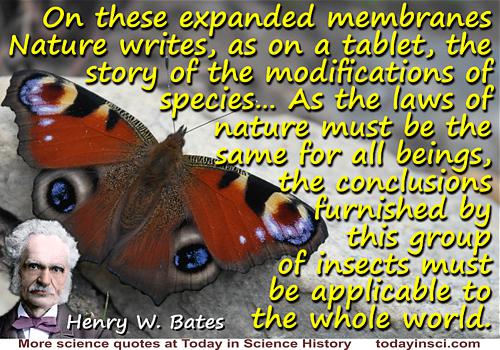
… on these expanded membranes [butterfly wings] Nature writes, as on a tablet, the story of the modifications of species, so truly do all changes of the organisation register themselves thereon. Moreover, the same colour-patterns of the wings generally show, with great regularity, the degrees of blood-relationship of the species. As the laws of nature must be the same for all beings, the conclusions furnished by this group of insects must be applicable to the whole world.
From The Naturalist on the River Amazons: A record of Adventures, Habits of Animals, Sketches of Brazilian and Indian life, and Aspects of Nature under the Equator, During Eleven Years of Travel (1864), 413.
...for the animals, which we resemble and which would be our equals if we did not have reason, do not reflect upon the actions or the passions of their external or internal senses, and do not know what is color, odor or sound, or if there is any differences between these objects, to which they are moved rather than moving themselves there. This comes about by the force of the impression that the different objects make on their organs and on their senses, for they cannot discern if it is more appropriate to go and drink or eat or do something else, and they do not eat or drink or do anything else except when the presence of objects or the animal imagination [l'imagination brutalle], necessitates them and transports them to their objects, without their knowing what they do, whether good or bad; which would happen to us just as to them if we were destitute of reason, for they have no enlightenment except what they must have to take their nourishment and to serve us for the uses to which God has destined them.
[Arguing the uniqueness of man by regarding animals to be merely automatons.].
[Arguing the uniqueness of man by regarding animals to be merely automatons.].
Les Préludes de l'Harmonie Universelle (1634), 135-139. In Charles Coulston Gillespie (ed.), Dictionary of Scientific Biography (1974), Vol. 9, 318.
“By convention there is color, by convention sweetness, by convention bitterness, but in reality there are atoms and the void,” announced Democritus. The universe consists only of atoms and the void; all else is opinion and illusion. If the soul exists, it also consists of atoms.
In Masks of the Universe: Changing Ideas on the Nature of the Cosmos (1985), 55.
[On the practical applications of particle physics research with the Large Hadron Collider.] Sometimes the public says, “What's in it for Numero Uno? Am I going to get better television reception? Am I going to get better Internet reception?” Well, in some sense, yeah. … All the wonders of quantum physics were learned basically from looking at atom-smasher technology. … But let me let you in on a secret: We physicists are not driven to do this because of better color television. … That's a spin-off. We do this because we want to understand our role and our place in the universe.
As quoted in Alan Boyle, 'Discovery of Doom? Collider Stirs Debate', article (8 Sep 2008) on a msnbc.com web page. The article writer included the information that Kaku noted that past discoveries from the world of particle physics ushered in many of the innovations we enjoy today, ranging from satellite communications and handheld media players to medical PET scanners (which put antimatter to practical use)."
Il maestro di color che sanno.
The master of those who know.
Of Aristotle.
The master of those who know.
Of Aristotle.
InDivina Commedia 'Inferno' canto 4, line 80.
Quelquefois, par exemple, je me figure que je suis suspendu en l’air, et que j’y demeure sans mouvement, pendant que la Terre tourne sous moi en vingt-quatre heures. Je vois passer sous mes yeux tous ces visages différents, les uns blancs, les autres noirs, les autres basanés, les autres olivâtres. D’abord ce sont des chapeaux et puis des turbans, et puis des têtes chevelues, et puis des têtes rasées; tantôt des villes à clochers, tantôt des villes à longues aiguilles qui ont des croissants, tantôt des villes à tours de porcelaine, tantôt de grands pays qui n’ont que des cabanes; ici de vastes mers, là des déserts épouvantables; enfin, toute cette variété infinie qui est sur la surface de la Terre.
Sometimes, for instance, I imagine that I am suspended in the air, and remain there motionless, while the earth turns under me in four-and-twenty hours. I see pass beneath me all these different countenances, some white, others black, others tawny, others olive-colored. At first they wear hats, and then turbans, then heads with long hair, then heads shaven; sometimes towns with steeples, sometimes towns with long spires, which have crescents, sometimes towns with porcelain towers, sometimes extensive countries that have only huts; here wide seas; there frightful deserts; in short, all this infinite variety on the surface of the earth.
Sometimes, for instance, I imagine that I am suspended in the air, and remain there motionless, while the earth turns under me in four-and-twenty hours. I see pass beneath me all these different countenances, some white, others black, others tawny, others olive-colored. At first they wear hats, and then turbans, then heads with long hair, then heads shaven; sometimes towns with steeples, sometimes towns with long spires, which have crescents, sometimes towns with porcelain towers, sometimes extensive countries that have only huts; here wide seas; there frightful deserts; in short, all this infinite variety on the surface of the earth.
In 'Premier Soir', Entretiens Sur La Pluralité Des Mondes (1686, 1863), 43. French and translation in Craufurd Tait Ramage, Beautiful Thoughts from French and Italian Authors (1866), 117-118.
Question: Account for the delicate shades of colour sometimes seen on the inside of an oyster shell. State and explain the appearance presented when a beam of light falls upon a sheet of glass on which very fine equi-distant parallel lines have been scratched very close to one another.
Answer: The delicate shades are due to putrefaction; the colours always show best when the oyster has been a bad one. Hence they are considered a defect and are called chromatic aberration.
The scratches on the glass will arrange themselves in rings round the light, as any one may see at night in a tram car.
Answer: The delicate shades are due to putrefaction; the colours always show best when the oyster has been a bad one. Hence they are considered a defect and are called chromatic aberration.
The scratches on the glass will arrange themselves in rings round the light, as any one may see at night in a tram car.
Genuine student answer* to an Acoustics, Light and Heat paper (1880), Science and Art Department, South Kensington, London, collected by Prof. Oliver Lodge. Quoted in Henry B. Wheatley, Literary Blunders (1893), 182, Question 27. (*From a collection in which Answers are not given verbatim et literatim, and some instances may combine several students' blunders.)
Question: How would you disprove, experimentally, the assertion that white light passing through a piece of coloured glass acquires colour from the glass? What is it that really happens?
Answer: To disprove the assertion (so repeatedly made) that “white light passing through a piece of coloured glass acquires colour from the glass,” I would ask the gentleman to observe that the glass has just as much colour after the light has gone through it as it had before. That is what would really happen.
Answer: To disprove the assertion (so repeatedly made) that “white light passing through a piece of coloured glass acquires colour from the glass,” I would ask the gentleman to observe that the glass has just as much colour after the light has gone through it as it had before. That is what would really happen.
Genuine student answer* to an Acoustics, Light and Heat paper (1880), Science and Art Department, South Kensington, London, collected by Prof. Oliver Lodge. Quoted in Henry B. Wheatley, Literary Blunders (1893), 178, Question 8. (*From a collection in which Answers are not given verbatim et literatim, and some instances may combine several students' blunders.)
1104 … In this year the first day of Whitsuntide was on 5 June, and on the following Tuesday at noon there appeared four intersecting halos around the sun, white in color, and looking as if they had been painted. All who saw it were astonished, for they did not remember seeing anything like it before.
From the 'Peterborough Chronicle (Laud Manuscript)', The Anglo-Saxon Chronicle, as translated in The Anglo-Saxon Chronicle, Issue 1624 (1975), 239. The Chronicle is the work of many successive hands at several monasteries across England.
A “pacifist male” is a contradiction in terms. Most self-described “pacifists” are not pacific; they simply assume false colors. When the wind changes, they hoist the Jolly Roger.
In 'From the Notebooks of Lazarus Long', Time Enough for Love: The Lives of Lazarus Long (1973), 258.
A black hole has no hair.
[Summarizing the simplicity of a black hole, which shows only three characteristics to the outside world (mass, charge, spin) and comparing the situation to a room full of bald-pated people who had one characteristic in common, but no differences in hair length, style or color for individual variations.]
[Summarizing the simplicity of a black hole, which shows only three characteristics to the outside world (mass, charge, spin) and comparing the situation to a room full of bald-pated people who had one characteristic in common, but no differences in hair length, style or color for individual variations.]
In Geons, Black Holes, and Quantum Foam (2000), 297. Quote introduced previously as the No-Hair Theorem in Charles W. Misner, Kip S. Thorne and John Wheeler, Gravitation (1973).
A fossil hunter needs sharp eyes and a keen search image, a mental template that subconsciously evaluates everything he sees in his search for telltale clues. A kind of mental radar works even if he isn’t concentrating hard. A fossil mollusk expert has a mollusk search image. A fossil antelope expert has an antelope search image. … Yet even when one has a good internal radar, the search is incredibly more difficult than it sounds. Not only are fossils often the same color as the rocks among which they are found, so they blend in with the background; they are also usually broken into odd-shaped fragments. … In our business, we don’t expect to find a whole skull lying on the surface staring up at us. The typical find is a small piece of petrified bone. The fossil hunter’s search therefore has to have an infinite number of dimensions, matching every conceivable angle of every shape of fragment of every bone on the human body.
Describing the skill of his co-worker, Kamoya Kimeu, who discovered the Turkana Boy, the most complete specimen of Homo erectus, on a slope covered with black lava pebbles.
Describing the skill of his co-worker, Kamoya Kimeu, who discovered the Turkana Boy, the most complete specimen of Homo erectus, on a slope covered with black lava pebbles.
Richard Leakey and Roger Lewin, Origins Reconsidered: In Search of What Makes Us Human (1992), 26.
A good ornithologist should be able to distinguish birds by their air as well as by their colors and shape; on the ground as well as on the wing, and in the bush as well as in the hand. For, though it must not be said that every species of birds has a manner peculiar to itself, yet there is somewhat, in most genera at least, that at first sight discriminates them and enables a judicious observer to pronounce upon them with some certainty.
Letter (7 Aug 1778) to Daines Barrington, collected in The Natural History of Selborne (1829), 274.
A great ball of fire about a mile in diameter, changing colors as it kept shooting upward, from deep purple to orange, expanding, growing bigger, rising as it was expanding, an elemental force freed from its bonds after being chained for billions of years.
On the first atomic explosion in New Mexico, 16 Jul 1945.
On the first atomic explosion in New Mexico, 16 Jul 1945.
From 'Drama of the Atomic Bomb Found Climax in July 16 Test', in New York Times (26 Sep 1945). This was the first of a series of articles by Laurence, who was the only civilian witness of the first bomb test. He was on a flight to see the dropping of a bomb on Nagasaki. Laurence, science writer for the NYT, had been requested for service to the War Department to explain the atomic bomb to the lay public.
A major scientific advancement would be the development of cigarette ashes that would match the color of the rug.
In E.C. McKenzie, 14,000 Quips and Quotes for Speakers, Writers, Editors, Preachers, and Teachers (1990), 85.
A moment’s consideration of this case shows what a really great advance in the theory and practise of breeding has been obtained through the discovery of Mendel’s law. What a puzzle this case would have presented to the biologist ten years ago! Agouti crossed with chocolate gives in the second filial generation (not in the first) four varieties, viz., agouti, chocolate, black and cinnamon. We could only have shaken our heads and looked wise (or skeptical).
Then we had no explanation to offer for such occurrences other than the “instability of color characters under domestication,” the “effects of inbreeding,” “maternal impressions.” Serious consideration would have been given to the proximity of cages containing both black and cinnamon-agouti mice.
Now we have a simple, rational explanation, which anyone can put to the test. We are able to predict the production of new varieties, and to produce them.
We must not, of course, in our exuberance, conclude that the powers of the hybridizer know no limits. The result under consideration consists, after all, only in the making of new combinations of unit characters, but it is much to know that these units exist and that all conceivable combinations of them are ordinarily capable of production. This valuable knowledge we owe to the discoverer and to the rediscoverers of Mendel’s law.
Then we had no explanation to offer for such occurrences other than the “instability of color characters under domestication,” the “effects of inbreeding,” “maternal impressions.” Serious consideration would have been given to the proximity of cages containing both black and cinnamon-agouti mice.
Now we have a simple, rational explanation, which anyone can put to the test. We are able to predict the production of new varieties, and to produce them.
We must not, of course, in our exuberance, conclude that the powers of the hybridizer know no limits. The result under consideration consists, after all, only in the making of new combinations of unit characters, but it is much to know that these units exist and that all conceivable combinations of them are ordinarily capable of production. This valuable knowledge we owe to the discoverer and to the rediscoverers of Mendel’s law.
'New Colour Variety of the Guinea Pig', Science, 1908, 28, 250-252.
A painter makes patterns with shapes and colours, a poet with words. A painting may embody an “idea,” but the idea is usually commonplace and unimportant. In poetry, ideas count for a good deal more; but, as Housman insisted, the importance of ideas in poetry is habitually exaggerated. … The poverty of ideas seems hardly to affect the beauty of the verbal pattern. A mathematician, on the other hand, has no material to work with but ideas, and so his patterns are likely to last longer, since ideas wear less with time than words.
In A Mathematician’s Apology (1940, 2012), 84-85.
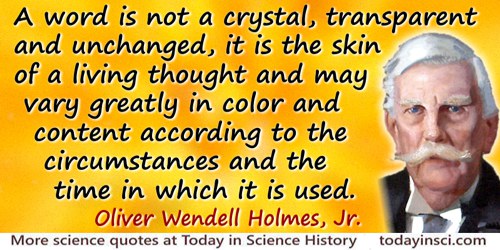
A word is not a crystal, transparent and unchanged, it is the skin of a living thought and may vary greatly in color and content according to the circumstances and the time in which it is used.
In Towne v. Eisner (1918), 245 U.S. 425. As quoted in Richard A. Posner (ed.), The Essential Holmes: Selections from the Letters, Speeches, Judicial Opinions, and Other Writings of Oliver Wendell Holmes, Jr. (1992), 287.
About thirty years ago there was much talk that geologists ought only to observe and not theorise; and I well remember some one saying that at this rate a man might as well go into a gravel-pit and count the pebbles and describe the colours. How odd it is that anyone should not see that all observation must be for or against some view if it is to be of any service!
Letter to Henry Fawcett (18 Sep 1861). In Charles Darwin, Francis Darwin, Albert Charles Seward, More Letters of Charles Darwin (1903), Vol. 1, 195.
All frescoes are as high finished as miniatures or enamels, and they are known to be unchangeable; but oil, being a body itself, will drink or absorb very little colour, and changing yellow, and at length brown, destroys every colour it is mixed with, especially every delicate colour. It turns every permanent white to a yellow and brown putty, and has compelled the use of that destroyer of colour, white lead, which, when its protecting oil is evaporated, will become lead again. This is an awful thing to say to oil painters ; they may call it madness, but it is true. All the genuine old little pictures, called cabinet pictures, are in fresco and not in oil. Oil was not used except by blundering ignorance till after Vandyke’s time ; but the art of fresco painting being lost, oil became a fetter to genius and a dungeon to art.
In 'Opinions', The Poems: With Specimens of the Prose Writings of William Blake (1885), 276-277.
Although the ocean’s surface seems at first to be completely homogeneous, after half a month we began to differentiate various seas and even different parts of oceans by their characteristic shades. We were astonished to discover that, during an flight, you have to learn anew not only to look, but also to see. At first the finest nuances of color elude you, but gradually your vision sharpens and your color perception becomes richer, and the planet spreads out before you with all its indescribable beauty.
…...
Among our sensations it is difficult not to confuse what comes from the part of objects with what comes from the part of our senses. … Supposing this, one clearly sees that it is not easy to say much about colors,… and that all one can expect in such a difficult subject is to give some general rules and to derive from them consequences that can be of some use in the arts and satisfy somewhat the natural desire we have to render account of everything that appears to us.
'De la Nature des Couleurs', collected in Oeuvres (1717), 196–197.
Among those whom I could never pursuade to rank themselves with idlers, and who speak with indignation of my morning sleeps and nocturnal rambles, one passes the day in catching spiders, that he may count their eyes with a microscope; another exhibits the dust of a marigold separated from the flower with a dexterity worthy of Leuwenhoweck himself. Some turn the wheel of electricity; some suspend rings to a lodestone, and find that what they did yesterday, they can do again to-day.—Some register the changes of the wind, and die fully convinced that the wind is changeable.—There are men yet more profound, who have heard that two colorless liquors may produce a color by union, and that two cold bodies will grow hot of they are mingled: they mingle them, and produce the effect expected, say it is strange, and mingle them again.
In Tryon Edwards, A Dictionary of Thoughts (1908), 243.
An eye critically nice can only be formed by observing well-colored pictures with attention; and by close attention … discover … expedients by which good colorists have raised the value of their tints, and by which nature has been so happily imitated.
In The Life and Discourses of Sir Joshua Reynolds (1853), 24.
An eye critically nice will discern in every colour a tendency to some other colour, according as it is influenced by light, shade, depth or diluteness; nor is this the case only in the inherent colours of pigments, &c. but it is so also in the transient colours of the prism, &c. Hence blue in its depth inclines to purple; deep-yellow to orange, &c.; nor is it practicable to realize these colours to the satisfaction of the critical eye,-since perfect colours, like perfect geometrical figures, are pure ideals. My examples of colours are therefore quite as adequate to their office of illustrating and distinguishing, as the figure of an angle inclining to the acute or obtuse, instead of a perfect right angle, or middle form, would be in illustrating the conception of an angle in general.
In 'On Colors—In Answer to Mr. T. Hargreaves’s Strictures on the Work Entitled “Chromatics; or, An Essay on the Analogy and Harmony of Colours”', The Philosophical Magazine and Journal: Comprehending The Various Branches of Science, The Liberal and Fine Arts, Geology, Agriculture, Manufactures and Commerce (Oct 1817), 50, No. 234, 241.
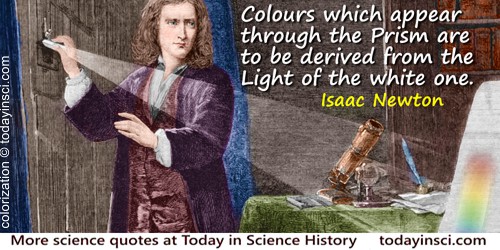
And if one look through a Prism upon a white Object encompassed with blackness or darkness, the reason of the Colours arising on the edges is much the same, as will appear to one that shall a little consider it. If a black Object be encompassed with a white one, the Colours which appear through the Prism are to be derived from the Light of the white one, spreading into the Regions of the black, and therefore they appear in a contrary order to that, when a white Object is surrounded with black. And the same is to be understood when an Object is viewed, whose parts are some of them less luminous than others. For in the borders of the more and less luminous Parts, Colours ought always by the same Principles to arise from the Excess of the Light of the more luminous, and to be of the same kind as if the darker parts were black, but yet to be more faint and dilute.
Opticks (1704), Book I, Part 2, Prop. VIII, Prob. III, 123.
Another argument of hope may be drawn from this–that some of the inventions already known are such as before they were discovered it could hardly have entered any man's head to think of; they would have been simply set aside as impossible. For in conjecturing what may be men set before them the example of what has been, and divine of the new with an imagination preoccupied and colored by the old; which way of forming opinions is very fallacious, for streams that are drawn from the springheads of nature do not always run in the old channels.
Translation of Novum Organum, XCII. In Francis Bacon, James Spedding, The Works of Francis Bacon (1864), Vol. 8, 128.
Antiessentialist thinking forces us to view the world differently. We must accept shadings and continua as fundamental. We lose criteria for judgment by comparison to some ideal: short people, retarded people, people of other beliefs, colors, and religions are people of full status.
…...

Any customer can have a car painted any color that he wants so long as it is black.
Remark made while announcing (1909) that production was being switched to only one model, the Model T. As quoted in Henry Ford and Samuel Crowther, My Life and Work (1922), 71. Often seen as a shorter paraphrase, such as “You can have any color as long as it's black.”

Applied research generates improvements, not breakthroughs. Great scientific advances spring from pure research. Even scientists renowned for their “useful” applied discoveries often achieved success only when they abandoned their ostensible applied-science goal and allowed their minds to soar—as when Alexander Fleming, “just playing about,” refrained from throwing away green molds that had ruined his experiment, studied them, and discovered penicillin. Or when C. A. Clarke, a physician affiliated with the University of Liverpool, became intrigued in the 1950s by genetically created color patterns that emerged when he cross-bred butterflies as a hobby. His fascination led him—“by the pleasant route of pursuing idle curiosity”—to the successful idea for preventing the sometimes fatal anemia that threatened babies born of a positive-Rhesus-factor father and a negative-Rhesus-factor mother.
In Jacques Cousteau and Susan Schiefelbein, The Human, the Orchid, and the Octopus: Exploring and Conserving Our Natural World (2007), 214-215.
Art is unquestionably one of the purest and highest elements in human happiness. It trains the mind through the eye, and the eye through the mind. As the sun colors flowers, so does art color life.
The Pleasures of Life (1887, 2007), 99.
As white reflects more heat, as well as more light than any other colour, it ought always to be preferred for the inside of a Chimney Fire-place, and black, which reflects neither light nor heat, should be most avoided.
In Essays, Political, Economical, and Philosophical (1798), Vol. 1, 328.
As for what I have done as a poet, I take no pride in whatever. Excellent poets have lived at the same time with me, poets more excellent lived before me, and others will come after me. But that in my country I am the only person who knows the truth in the difficult science of colors—of that, I say, I am not a little proud, and here have a consciousness of superiority to many.
Wed 18 Feb 1829. Johann Peter Eckermann, Conversations with Goethe, ed. J. K. Moorhead and trans. J. Oxenford, (1971), 302.
Attaching significance to invariants is an effort to recognize what, because of its form or colour or meaning or otherwise, is important or significant in what is only trivial or ephemeral. A simple instance of failing in this is provided by the poll-man at Cambridge, who learned perfectly how to factorize a²-b² but was floored because the examiner unkindly asked for the factors of p²–q².
In 'Recent Developments in Invariant Theory', The Mathematical Gazette (Dec 1926), 13, No. 185, 217. [Note: A poll-man is a student who takes the ordinary university degree, without honours. -Webmaster]
Between men of different studies and professions, may be observed a constant reciprocation of reproaches. The collector of shells and stones derides the folly of him who pastes leaves and flowers upon paper, pleases himself with colours that are perceptibly fading, and amasses with care what cannot be preserved. The hunter of insects stands amazed that any man can waste his short time upon lifeless matter, while many tribes of animals yet want their history. Every one is inclined not only to promote his own study, but to exclude all others from regard, and having heated his imagination with some favourite pursuit, wonders that the rest of mankind are not seized with the same passion.
From 'Numb. 83, Tuesday, January 1, 1750', The Rambler (1756), Vol. 2, 150.
BOTANY, n. The science of vegetables—those that are not good to eat, as well as those that are. It deals largely with their flowers, which are commonly badly designed, inartistic in color, and ill-smelling.
The Collected Works of Ambrose Bierce (1911), Vol. 7, The Devil's Dictionary, 40.
But it will be found... that one universal law prevails in all these phenomena. Where two portions of the same light arrive in the eye by different routes, either exactly or very nearly in the same direction, the appearance or disappearance of various colours is determined by the greater or less difference in the lengths of the paths.
Lecture XIV. 'Of Physical Optics'. In A Syllabus of a Course of Lectures on Natural and Experimental Philosophy (1802), 112-4.
By convention sweet is sweet, by convention bitter is bitter, by convention hot is hot, by convention cold is cold, by convention colour is colour. But in reality there are atoms and the void. That is, the objects of sense are supposed to be real and it is customary to regard them as such, but in truth they are not. Only the atoms and the void are real.
Cited as from Sext. Emp. Math. VII. 135, in Charles Montague Bakewell, Source Book in Ancient Philosophy (1907), 60.
By the advance of civilization, a sharper and more healthy form of competition is brought about. The markets have become more fastidious; and he who puts such a product upon the market as it demands controls that market, regardless of color. It is simply a survival of the fittest.
In Farmer’s Leaflet 7: The Need of Scientific Agriculture in the South (1902). Reprinted in The Review of Reviews (1902), 25, 322.
Colour, Figure, Motion, Extension and the like, considered only so many Sensations in the Mind, are perfectly known, there being nothing in them which is not perceived. But if they are looked on as notes or Images, referred to Things or Archetypes existing without the Mind, then are we involved all in Scepticism.
A Treatise Concerning the Principles of Human Knowledge [first published 1710], (1734), 109.
Do not the Rays which differ in Refrangibility differ also in Flexibity; and are they not by their different Inflexions separated from one another, so as after separation to make the Colours in the three Fringes above described? And after what manner are they inflected to make those Fringes?
Opticks (1704), Book 3, Query 2, 132-3.
Every philosophy is tinged with the colouring of some secret imaginative background, which never emerges explicitly into its train of reasoning.
In Science and the Modern World (1925), 7.
Everything which comes to be, comes to be out of, and everything which passes away passes away into, its opposite or something in between. And the things in between come out of the opposites—thus colors come out of pale and dark. So the things which come to be naturally all are or are out of opposites.
In 'Physics', Book 1, Chapter 2, 188b22, as translated by William Charlton, Physics: Books I and II (1983), 12.
For a stone, when it is examined, will be found a mountain in miniature. The fineness of Nature’s work is so great, that, into a single block, a foot or two in diameter, she can compress as many changes of form and structure, on a small scale, as she needs for her mountains on a large one; and, taking moss for forests, and grains of crystal for crags, the surface of a stone, in by far the plurality of instances, is more interesting than the surface of an ordinary hill; more fantastic in form and incomparably richer in colour—the last quality being, in fact, so noble in most stones of good birth (that is to say, fallen from the crystalline mountain ranges).
Modern Painters, 4, Containing part 5 of Mountain Beauty (1860), 311.
For the sake of persons of ... different types, scientific truth should be presented in different forms, and should be regarded as equally scientific, whether it appears in the robust form and the vivid coloring of a physical illustration, or in the tenuity and paleness of a symbolic expression.
…...
From what has been said it is also evident, that the Whiteness of the Sun's Light is compounded all the Colours wherewith the several sorts of Rays whereof that Light consists, when by their several Refrangibilities they are separated from one another, do tinge Paper or any other white Body whereon they fall. For those Colours ... are unchangeable, and whenever all those Rays with those their Colours are mix'd again, they reproduce the same white Light as before.
Opticks (1704), Book 1, Part 2, Exper. XV, 114.
Have you ever observed a humming-bird moving about in an aerial dance among the flowers—a living prismatic gem that changes its colour with every change of position— … its exquisite form, its changeful splendour, its swift motions and intervals of aërial suspension, it is a creature of such fairy-like loveliness as to mock all description.
In Green Mansions: A Romance of the Tropical Forest (1916),
He who contemplates nature finds an inexhaustible source of wonder and pleasure in considering, among the class of insects, their forms, their colours, the different offensive and defensive weapons with which they are provided, their curious habitudes, the bond of union which is shewn in some kinds, and the prudence and industry which they employ, less indeed for their individual preservation than with a view to secure the perpetuity of the species, while yielding to the soft and powerful impulse of nature. But if this innumerable family of little animals furnishes ample matter for the curious researches of the naturalist, it affords also a subject of meditation for public economy, since some kinds of these beings cause even national calamities, while on the contrary other species greatly contribute to the prosperity of states and individuals.
As translated (by uncredited trans.) in Chap. 1, 'Of Caterpillars Generally, Amongst Which is Comprised the Silk-Worm', The Art of Rearing Silk-Worms (1825), 1. Originally published in Italian as, Dell'arte di governare i bachi da seta (1815). Above quote from the original Italian, “Una sorgente inesausta di meraviglia e di piacere trova il contemplatore della natura nella classe degli insetti allorquando si fa a considerare l’abito esterno di çodesto iminenso popolo di esseri viventi, le tante differenti armi di offesa e di difesa loro prestate dalla provvida natura, le curiosissime loro abitudini, lo spirito di famiglia eminentissimo, che sì bene si mamifesta in alcune spezie, e la somma loro previdenza ed insdustria rispetto non tanto a’ mezzi che impiegano per la loro individuale conservazione, quanto a quelli cui, seguendo il dolce e possente invito della natura, mettono in opera, onde meglio assicurare la perpetuazione della spezie. Ma se questa innumerevole famiglia di animali fornisce ampia materia alle curiose indagini del naturalista, offre pur auco un soggetto di grande studio al pubblico economista, per la ragione che come alcune spezie di cotali esseri esercitano talvolta una influenza la più diretta sulle disgrazie dei popoli, così altre spezie per lo contrario l’hanno grandissima sulla prosperità degli Statie di quanti individui li compongono.” [Note: Whereas the printed translation gives “cause even national calamities”, the original Italian reads, “disgrazie dei popoli”—which might be translated less dramatically as, “misfortunes of the peoples.” —Webmaster
His [Isaac Newton’s] observations of the colours of thin films [were] the origin of the next great theoretical advance, which had to await, over a hundred years, the coming of Thomas Young.
In 'Foreword' to Isaac Newton, Opticks: Or, A Treatise of the Reflections, Refractions, Inflections & Colours of Light. Based on the 4th Ed., London, 1730 (1952), lix-lx.
How far will chemistry and physics … help us understand the appeal of a painting?
Colour: Why the World Isn’t Grey (1983). Quoted in Sidney Perkowitz, Empire of Light (1999), 1.
I am above the forest region, amongst grand rocks & such a torrent as you see in Salvator Rosa's paintings vegetation all a scrub of rhodods. with Pines below me as thick & bad to get through as our Fuegian Fagi on the hill tops, & except the towering peaks of P. S. [perpetual snow] that, here shoot up on all hands there is little difference in the mt scenery—here however the blaze of Rhod. flowers and various colored jungle proclaims a differently constituted region in a naturalists eye & twenty species here, to one there, always are asking me the vexed question, where do we come from?
Letter to Charles Darwin (24 Jun 1849). Quoted in The Correspondence of Charles Darwin (1988), Vol. 4, 1847-1850, 242.
I am of the African race, and in the colour which is natural to them of the deepest dye; and it is under a sense of the most profound gratitude to the Supreme Ruler of the Universe.
Letter to Thomas Jefferson included with a copy of Banneker’s first almanacs. In George Washington Williams, History of the Negro Race in America from 1619 to 1880 (1882), Vol. 1, 395.
I am told that the wall paintings which we had the happiness of admiring in all their beauty and freshness [in the chapel she discovered at Abu Simbel] are already much injured. Such is the fate of every Egyptian monument, great or small. The tourist carves it over with names and dates, and in some instances with caricatures. The student of Egyptology, by taking wet paper “squeezes” sponges away every vestige of the original colour. The “Collector” buys and carries off everything of value that he can, and the Arab steals it for him. The work of destruction, meanwhile goes on apace. The Museums of Berlin, of Turin, of Florence are rich in spoils which tell their lamentable tale. When science leads the way, is it wonderful that ignorance should follow?
Quoted in Margaret S. Drower, The Early Years, in T.G.H. James, (ed.), Excavating in Egypt: The Egypt Exploration Society, 1882-1982 (1982), 10. As cited in Wendy M.K. Shaw, Possessors and Possessed: Museums, Archaeology, and the Visualization of History in the Late Ottoman Empire (2003), 37. Also quoted in Margaret S. Drower, Flinders Petrie: A Life in Archaeology (1995), 57.
I am very fond of the oyster shell. It is humble and awkward and ugly. It is slate-colored and unsymmetrical. Its form is not primarily beautiful but functional. I make fun of its knobbiness. Sometimes I resent its burdens and excrescences. But its tireless adaptability and tenacity draw my astonished admiration and sometimes even my tears. And it is comfortable in its familiarity, its homeliness, like old garden gloves when have molded themselves perfectly to the shape of the hand.
In 'Oyster Bed', Gift From the Sea (1955), 77.
I do not maintain that the chief value of the study of arithmetic consists in the lessons of morality that arise from this study. I claim only that, to be impressed from day to day, that there is something that is right as an answer to the questions with which one is able to grapple, and that there is a wrong answer—that there are ways in which the right answer can be established as right, that these ways automatically reject error and slovenliness, and that the learner is able himself to manipulate these ways and to arrive at the establishment of the true as opposed to the untrue, this relentless hewing to the line and stopping at the line, must color distinctly the thought life of the pupil with more than a tinge of morality. … To be neighborly with truth, to feel one’s self somewhat facile in ways of recognizing and establishing what is right, what is correct, to find the wrong persistently and unfailingly rejected as of no value, to feel that one can apply these ways for himself, that one can think and work independently, have a real, a positive, and a purifying effect upon moral character. They are the quiet, steady undertones of the work that always appeal to the learner for the sanction of his best judgment, and these are the really significant matters in school work. It is not the noise and bluster, not even the dramatics or the polemics from the teacher’s desk, that abide longest and leave the deepest and stablest imprint upon character. It is these still, small voices that speak unmistakably for the right and against the wrong and the erroneous that really form human character. When the school subjects are arranged on the basis of the degree to which they contribute to the moral upbuilding of human character good arithmetic will be well up the list.
In Arithmetic in Public Education (1909), 18. As quoted and cited in Robert Édouard Moritz, Memorabilia Mathematica; Or, The Philomath’s Quotation-book (1914), 69.
I feel that the recent ruling of the United States Army and Navy regarding the refusal of colored blood donors is an indefensible one from any point of view. As you know, there is no scientific basis for the separation of the bloods of different races except on the basis of the individual blood types or groups. (1942)
Spencie Love, One Blood: The Death and Resurrection of Charles R. Drew (1996), 155-56, quoting as it appeared in Current Biography (1944), 180.
I had a Meccano set with which I “played” endlessly. Meccano which was invented by Frank Hornby around 1900, is called Erector Set in the US. New toys (mainly Lego) have led to the extinction of Meccano and this has been a major disaster as far as the education of our young engineers and scientists is concerned. Lego is a technically trivial plaything and kids love it partly because it is so simple and partly because it is seductively coloured. However it is only a toy, whereas Meccano is a real engineering kit and it teaches one skill which I consider to be the most important that anyone can acquire: This is the sensitive touch needed to thread a nut on a bolt and tighten them with a screwdriver and spanner just enough that they stay locked, but not so tightly that the thread is stripped or they cannot be unscrewed. On those occasions (usually during a party at your house) when the handbasin tap is closed so tightly that you cannot turn it back on, you know the last person to use the washroom never had a Meccano set.
Nobel laureate autobiography in Les Prix Nobel/Nobel Lectures 1996 (1997), 189.
I had been struck by the beautiful colour of the sea when seen through the chinks of a straw hat.— To day 26th. Lat 18°6' S: Long 36°6' W. it was according to Werner nomenclature ‘Indigo with a little Azure blue’. The sky at the time was ‘Berlin with little Ultra marine’ & there were some cirro cumili scattered about.
In Zoological Notebook, Mar 26. As quoted in epigraph for the Second Edition of Patrick Syme, Werner’s Nomenclature of Colours: Adapted to Zoology, Botany, Chemistry, Mineralogy, Anatomy, and the Arts (1821)
I have always been very fond of mathematics—for one short period, I even toyed with the possibility of abandoning chemistry in its favour. I enjoyed immensely both its conceptual and formal beauties, and the precision and elegance of its relationships and transformations. Why then did I not succumb to its charms? … because by and large, mathematics lacks the sensuous elements which play so large a role in my attraction to chemistry.I love crystals, the beauty of their forms and formation; liquids, dormant, distilling, sloshing! The fumes, the odors—good or bad, the rainbow of colors; the gleaming vessels of every size, shape and purpose.
In Arthur Clay Cope Address, Chicago (28 Aug 1973). In O. T. Benfey and P. J. T. Morris (eds.), Robert Burns Woodward. Architect and Artist in the World of Molecules (2001), 427.
I have seen a thousand sunsets and sunrises, on land where it floods forest and mountains with honey coloured light, at sea where it rises and sets like a blood orange in a multicoloured nest of cloud, slipping in and out of the vast ocean. I have seen a thousand moons: harvest moons like gold coins, winter moons as white as ice chips, new moons like baby swans’ feathers.
Letter to Lee McGeorge (31 Jul 1978). Collected in Letters of Note: Volume 2: An Eclectic Collection of Correspondence (2016), 76.
I must own I am much in the dark about light. I am not satisfied with the doctrine that supposes particles of matter, called light … May not all the phenomena of light be more conveniently solved, by supposing universal space filled with a subtle elastic fluid, which, when at rest, is not visible, but whose vibrations affect that fine sense in the eye, as … the ear … in the case of sound … May not different degrees of the vibration of the above-mentioned universal medium occasion the appearances of different colors? I think the electric fluid is always the same; yet I find that weaker and stronger sparks differ in apparent color; some white, blue, purple, red; the strongest, white; weak ones, red.
In Letter (23 Apr 1752) to Calwallader Colden, collected in William Duane (ed.), Memoirs of Benjamin Franklin (1834), Vol. 2, 270.
I remember my father had a sermon he used to preach when we were in Florida, in which he gave a reference to the Southern Cross—about the stars, the colors, in the Southern Cross, which thrilled me very much. I must have been around 5 years old. ... Now, it turns out that the Southern Cross itself does have one red star, together with three blue ones.
'Oral History Transcript: Dr. William Wilson Morgan' (8 Aug 1978) in the Niels Bohr Library & Archives.
I return to the newborn world, and the soft-soil fields,
What their first birthing lifted to the shores
Of light, and trusted to the wayward winds.
First the Earth gave the shimmer of greenery
And grasses to deck the hills; then over the meadows
The flowering fields are bright with the color of springtime,
And for all the trees that shoot into the air.
What their first birthing lifted to the shores
Of light, and trusted to the wayward winds.
First the Earth gave the shimmer of greenery
And grasses to deck the hills; then over the meadows
The flowering fields are bright with the color of springtime,
And for all the trees that shoot into the air.
On the Nature of Things, trans. Anthony M. Esolen (1995) Book 5, lines 777-84, 181.
I shall never forget the sight. The vessel of crystallization was three quarters full of slightly muddy water—that is, dilute water-glass—and from the sandy bottom there strove upwards a grotesque little landscape of variously colored growths: a confused vegetation of blue, green, and brown shoots which reminded one of algae, mushrooms, attached polyps, also moss, then mussels, fruit pods, little trees or twigs from trees, here, and there of limbs. It was the most remarkable sight I ever saw, and remarkable not so much for its profoundly melancholy nature. For when Father Leverkühn asked us what we thought of it and we timidly answered him that they might be plants: “No,” he replied, “they are not, they only act that way. But do not think the less of them. Precisely because they do, because they try as hard as they can, they are worthy of all respect.”
It turned out that these growths were entirely unorganic in their origin; they existed by virtue of chemicals from the apothecary's shop.
It turned out that these growths were entirely unorganic in their origin; they existed by virtue of chemicals from the apothecary's shop.
Description of a “chemical garden” in Doktor Faustus: The Life of the German Composer Adrian Leverkühn, as Told by a Friend, (1947), 19.
I shuddered when I saw a crimson flame through the porthole instead of the usual starry sky at the night horizon of the planet. Vast pillars of light were bursting into the sky, melting into it, and flooding over with all the colors of the rainbow. An area of red luminescence merged smoothly into the black of the cosmos. The intense and dynamic changes in the colors and forms of the pillars and garlands made me think of visual music. Finally, we saw that we had entered directly into the aurora borealis.
…...
I wept when I saw the color of the sea—how can a mere color make one cry? Or moonlight, or the luminescence of the sea in a pitch black night? … But if there is one thing which is more worthy of our admiration than natural beauty, it is the art of men who have conquered this never-ending sea so Fully in a struggle that has been going since the time of the Phoenicians.
In an article 'Voyage of a German Professor to Eldorado' describing his summer 1905 travels for a series of lectures at Berkeley in America. As quoted in, George Greenstein, 'The Bulldog: A Profile of Ludwig Boltzmann', The American Scholar (1 Jan 1999), 102.
I wish they would use English instead of Greek words. When I want to know why a leaf is green, they tell me it is coloured by “chlorophyll,” which at first sounds very instructive; but if they would only say plainly that a leaf is coloured green by a thing which is called “green leaf,” we should see more precisely how far we had got.
The word “chlorophyll” is formed from the Greek words for “green” “leaf.” In The Queen of the Air: a Study of the Greek Myths of Cloud and Storm (1869, 1889), 51.
I’ve always been inspired by Dr. Martin Luther King, who articulated his Dream of an America where people are judged not by skin color but “by the content of their character.” In the scientific world, people are judged by the content of their ideas. Advances are made with new insights, but the final arbitrator of any point of view are experiments that seek the unbiased truth, not information cherry picked to support a particular point of view.
In letter (1 Feb 2013) to Energy Department employees announcing his decision not to serve a second term.
If [in a rain forest] the traveler notices a particular species and wishes to find more like it, he must often turn his eyes in vain in every direction. Trees of varied forms, dimensions, and colors are around him, but he rarely sees any of them repeated. Time after time he goes towards a tree which looks like the one he seeks, but a closer examination proves it to be distinct.
In 'Equitorial Vegetation', Natural Selection and Tropical Nature Essays on Descriptive and Theoretical Biology (1891), 267.
If Louis Pasteur were to come out of his grave because he heard that the cure for cancer still had not been found, NIH would tell him, “Of course we'll give you assistance. Now write up exactly what you will be doing during the three years of your grant.” Pasteur would say, “Thank you very much,” and would go back to his grave. Why? Because research means going into the unknown. If you know what you are going to do in science, then you are stupid! This is like telling Michelangelo or Renoir that he must tell you in advance how many reds and how many blues he will buy, and exactly how he will put those colors together.
Interview for Saturday Evening Post (Jan/Feb 1981), 30.
If we assume that there is only one enzyme present to act as an oxidizing agent, we must assume for it as many different degrees of activity as are required to explain the occurrence of the various colors known to mendelize (three in mice, yellow, brown, and black). If we assume that a different enzyme or group of enzymes is responsible for the production of each pigment we must suppose that in mice at least three such enzymes or groups of enzymes exist. To determine which of these conditions occurs in mice is not a problem for the biologist, but for the chemist. The biologist must confine his attention to determining the number of distinct agencies at work in pigment formation irrespective of their chemical nature. These agencies, because of their physiological behavior, the biologist chooses to call 'factors,' and attempts to learn what he can about their functions in the evolution of color varieties.
Experimental Studies of the Inheritance of Color in Mice (1913), 17-18.
If we seek for the simplest arrangement, which would enable it [the eye] to receive and discriminate the impressions of the different parts of the spectrum, we may suppose three distinct sensations only to be excited by the rays of the three principal pure colours, falling on any given point of the retina, the red, the green, and the violet; while the rays occupying the intermediate spaces are capable of producing mixed sensations, the yellow those which belong to the red and green, and the blue those which belong to the green and violet.
'Chromatics', in Supplement to the Fourth, Fifth, and Sixth Editions of the Encyclopedia Britannica (1824), Vol. 3, 142.
If we would indicate an idea … striving to remove the barriers which prejudice and limited views of every kind have erected among men, and to treat all mankind, without reference to religion, nation, or color, as one fraternity, one great community, fitted for the attainment of one object, the unrestrained development of the physical powers. This is the ultimate and highest aim of society.
In Ueber die Kawi-Sprache, Vol. 3, 426. As quoted in Alexander von Humboldt, Cosmos: A Sketch of a Physical Description of the Universe (1850), Vol. 1, 358, as translated by Elise C. Otté.
If you look at a tree and think of it as a design assignment, it would be like asking you to make something that makes oxygen, sequesters carbon, fixes nitrogen, distills water, provides habitat for hundreds of species, accrues solar energy’s fuel, makes complex sugars and food, changes colors with the seasons, creates microclimates, and self-replicates.
In audio segment, 'William McDonough: Godfather of Green', WNYC, Studio 360 broadcast on NPR radio (18 Mar 2008) and archived on the station website.
In shape, it is perfectly elliptical. In texture, it is smooth and lustrous. In color, it ranges from pale alabaster to warm terra cotta. And in taste, it outstrips all the lush pomegranates that Swinburne was so fond of sinking his lyrical teeth into.
From 'Tribute to an Egg', Majority of One (1957), 77.
In the beginning of the year 1665 I found the Method of approximating series & the Rule for reducing any dignity of any Bionomial into such a series. The same year in May I found the method of Tangents of Gregory & Slusius, & in November had the direct method of fluxions & the next year in January had the Theory of Colours & in May following I had entrance into ye inverse method of fluxions. And the same year I began to think of gravity extending to ye orb of the Moon & (having found out how to estimate the force with wch [a] globe revolving within a sphere presses the surface of the sphere) from Keplers rule of the periodic times of the Planets being in sesquialterate proportion of their distances from the center of their Orbs, I deduced that the forces wch keep the Planets in their Orbs must [be] reciprocally as the squares of their distances from the centers about wch they revolve: & thereby compared the force requisite to keep the Moon in her Orb with the force of gravity at the surface of the earth, & found them answer pretty nearly. All this was in the two plague years of 1665-1666. For in those days I was in the prime of my age for invention & minded Mathematicks & Philosophy more then than at any time since.
Quoted in Richard Westfall, Never at Rest: A Biography of Isaac Newton (1980), 143.
In the benzene nucleus we have been given a soil out of which we can see with surprise the already-known realm of organic chemistry multiply, not once or twice but three, four, five or six times just like an equivalent number of trees. What an amount of work had suddenly become necessary, and how quickly were busy hands found to carry it out! First the eye moves up the six stems opening out from the tremendous benzene trunk. But already the branches of the neighbouring stems have become intertwined, and a canopy of leaves has developed which becomes more spacious as the giant soars upwards into the air. The top of the tree rises into the clouds where the eye cannot yet follow it. And to what an extent is this wonderful benzene tree thronged with blossoms! Everywhere in the sea of leaves one can spy the slender hydroxyl bud: hardly rarer is the forked blossom [Gabelblüte] which we call the amine group, the most frequent is the beautiful cross-shaped blossom we call the methyl group. And inside this embellishment of blossoms, what a richness of fruit, some of them shining in a wonderful blaze of color, others giving off an overwhelming fragrance.
A. W. Hofmann, after-dinner speech at Kekulé Benzolfest (Mar 1890). Trans. in W. H. Brock, O. Theodor Benfrey and Susanne Stark, 'Hofmann's Benzene Tree at the Kekulé Festivities', Journal of Chemical Education (1991), 68, 887-8.
In these strenuous times, we are likely to become morbid and look constantly on the dark side of life, and spend entirely too much time considering and brooding over what we can't do, rather than what we can do, and instead of growing morose and despondent over opportunities either real or imaginary that are shut from us, let us rejoice at the many unexplored fields in which there is unlimited fame and fortune to the successful explorer and upon which there is no color line; simply the survival of the fittest.
In article urging African-Americans to engage in plant breeding to develop improved species.'A New Industry for Colored Men and Women', Colored American (Jan 1908, 14, 33. Cited in Linda O. McMurry, George Washington Carver, Scientist and Symbol (1982), 109.
Instead of being presented with stereotypes by age, sex, color, class, or religion, children must have the opportunity to learn that within each range, some people are loathsome and some are delightful.
In Twentieth Century Faith: Hope and Survival (1972), 61.
Instead of disbursing her annual millions for these dye stuffs, England will, beyond question, at no distant day become herself the greatest coloring producing country in the world; nay, by the very strangest of revolutions she may ere long send her coal-derived blues to indigo-growing India, her tar-distilled crimson to cochineal-producing Mexico, and her fossil substitutes for quercitron and safflower to China, Japan and the other countries whence these articles are now derived.
From 'Report on the Chemical Section of the Exhibition of 1862.' As quoted in Sir Frederick Abel, 'The Work of the Imperial Institute' Nature (28 Apr 1887), 35, No. 913, 620. Abel called the display of the first dye-products derived from coal tar at the Exhibition of 1862, “one of the features of greatest novelty.”
Iron and coal dominated everywhere, from grey to black: the black boots, the black stove-pipe hat, the black coach or carriage, the black iron frame of the hearth, the black cooking pots and pans and stoves. Was it a mourning? Was it protective coloration? Was it mere depression of the senses? No matter what the original color of the paleotechnic milieu might be it was soon reduced by reason of the soot and cinders that accompanied its activities, to its characteristic tones, grey, dirty-brown, black.
Technics and Civilisation (1934), 163.
It [mathematics] is in the inner world of pure thought, where all entia dwell, where is every type of order and manner of correlation and variety of relationship, it is in this infinite ensemble of eternal verities whence, if there be one cosmos or many of them, each derives its character and mode of being,—it is there that the spirit of mathesis has its home and its life.
Is it a restricted home, a narrow life, static and cold and grey with logic, without artistic interest, devoid of emotion and mood and sentiment? That world, it is true, is not a world of solar light, not clad in the colours that liven and glorify the things of sense, but it is an illuminated world, and over it all and everywhere throughout are hues and tints transcending sense, painted there by radiant pencils of psychic light, the light in which it lies. It is a silent world, and, nevertheless, in respect to the highest principle of art—the interpenetration of content and form, the perfect fusion of mode and meaning—it even surpasses music. In a sense, it is a static world, but so, too, are the worlds of the sculptor and the architect. The figures, however, which reason constructs and the mathematic vision beholds, transcend the temple and the statue, alike in simplicity and in intricacy, in delicacy and in grace, in symmetry and in poise. Not only are this home and this life thus rich in aesthetic interests, really controlled and sustained by motives of a sublimed and supersensuous art, but the religious aspiration, too, finds there, especially in the beautiful doctrine of invariants, the most perfect symbols of what it seeks—the changeless in the midst of change, abiding things hi a world of flux, configurations that remain the same despite the swirl and stress of countless hosts of curious transformations.
Is it a restricted home, a narrow life, static and cold and grey with logic, without artistic interest, devoid of emotion and mood and sentiment? That world, it is true, is not a world of solar light, not clad in the colours that liven and glorify the things of sense, but it is an illuminated world, and over it all and everywhere throughout are hues and tints transcending sense, painted there by radiant pencils of psychic light, the light in which it lies. It is a silent world, and, nevertheless, in respect to the highest principle of art—the interpenetration of content and form, the perfect fusion of mode and meaning—it even surpasses music. In a sense, it is a static world, but so, too, are the worlds of the sculptor and the architect. The figures, however, which reason constructs and the mathematic vision beholds, transcend the temple and the statue, alike in simplicity and in intricacy, in delicacy and in grace, in symmetry and in poise. Not only are this home and this life thus rich in aesthetic interests, really controlled and sustained by motives of a sublimed and supersensuous art, but the religious aspiration, too, finds there, especially in the beautiful doctrine of invariants, the most perfect symbols of what it seeks—the changeless in the midst of change, abiding things hi a world of flux, configurations that remain the same despite the swirl and stress of countless hosts of curious transformations.
In 'The Universe and Beyond', Hibbert Journal (1904-1906), 3, 314.
It appears that the extremely important papers that trigger a revolution may not receive a proportionately large number of citations. The normal procedures of referencing are not used for folklore. A real scientific revolution, like any other revolution, is news. The Origin of Species sold out as fast as it could be printed and was denounced from the pulpit almost immediately. Sea-floor spreading has been explained, perhaps not well, in leading newspapers, magazines, books, and most recently in a color motion picture. When your elementary school children talk about something at dinner, you rarely continue to cite it.
'Citations in a Scientific Revolution', in R. Shagam et al., Studies in Earth and Space Sciences: A Memoir in Honor of Harry Hammond Hess (1972), 4.
It is a lovely and terrible wilderness, such as wilderness as Christ and the prophets went out into; harshly and beautifully colored, broken and worn until its bones are exposed, its great sky without a smudge of taint from Technocracy, and in hidden corners and pockets under its cliffs the sudden poetry of springs.
Letter (3 Dec 1960) written to David E. Pesonen of the Outdoor Recreation Resources Review Commission. Collected in 'Coda: Wilderness Letter', The Sound of Mountain Water: The Changing American West (1969), 153.
It is in everything else as it is in colors; bad eyes can distinguish between black and white; better eyes, and eyes much exercised, can distinguish every nicer gradation.
As translated in definition for 'Extreme', A Philosophical Dictionary: From the French (1824), Vol. 3, 139.
It is not by his mixing and choosing, but by the shapes of his colors, and the combination of those shapes, that we recognize the colorist. Color becomes significant only when it becomes form.
In Art (1958), 156.
It is sometimes said that scientists are unromantic, that their passion to figure out robs the world of beauty and mystery. But is it not stirring to understand how the world actually works—that white light is made of colors, that color is the way we perceive the wavelengths of light, that transparent air reflects light, that in so doing it discriminates among the waves, and that the sky is blue for the same reason that the sunset is red? It does no harm to the romance of the sunset to know a little bit about it.
Pale Blue Dot: A Vision of the Human Future in Space (1994), 159.
It is to Titian we must turn our eyes to find excellence with regard to color, and light and shade, in the highest degree. He was both the first and the greatest master of this art. By a few strokes he knew how to mark the general image and character of whatever object he attempted.
In Discourse XI, Discourses on Painting and the Fine Arts: Delivered at the Royal Academy (1826), 209
Journalism must find the facts, it must not prejudge things in terms of conservatism or liberalism or radicalism; it must not decide in advance that it is to be conformist or non-conformist; it cannot fly in the face of facts without courting ultimate disaster.
Journalism must focus the facts; facts are not important for their own sake; they are important only as a basis for action; journalism must focus the facts it finds upon the issues its readers face.
Journalism must filter the facts; it must with conscientious care separate the facts from admixtures of prejudice, passion, partisanship, and selfish interest; facts that are diluted, colored, or perverted are valueless as a basis for action.
Journalism must face the facts; it must learn that the energy spent in trying to find ways to get around, under, or over the facts is wasted energy; facts have a ruthless way of winning the day sooner or later.
Journalism must follow the facts; journalism must say of facts as Job said, of God: though they slay us, yet shall we trust them; if the facts threaten to upset a paper's cherished policy, it always pays the journalist to re-examine his policy; that way lies realism, and realism is the ultimate good.
Journalism must focus the facts; facts are not important for their own sake; they are important only as a basis for action; journalism must focus the facts it finds upon the issues its readers face.
Journalism must filter the facts; it must with conscientious care separate the facts from admixtures of prejudice, passion, partisanship, and selfish interest; facts that are diluted, colored, or perverted are valueless as a basis for action.
Journalism must face the facts; it must learn that the energy spent in trying to find ways to get around, under, or over the facts is wasted energy; facts have a ruthless way of winning the day sooner or later.
Journalism must follow the facts; journalism must say of facts as Job said, of God: though they slay us, yet shall we trust them; if the facts threaten to upset a paper's cherished policy, it always pays the journalist to re-examine his policy; that way lies realism, and realism is the ultimate good.
From address as president of the Wisconsin local chapter of Theta Sigma Phi, at its first annual Matrix Table (9 Jan 1926). quoted in 'Journalism News and Notes', in Robert S. Crawford (ed.), The Wisconsin Alumni Magazine (Feb 1926), 27, No. 4, 101. If you know any other example of Glenn Frank speaking about his five themes on facts, please contact Webmaster.
Looking at the thunder machine which had been set up, I saw not the slightest indication of the presence of electricity. However, while they were putting the food on the table, I obtained extraordinary electric sparks from the wire. My wife and others approached from it, for the reason that I wished to have witnesses see the various colors of fire about which the departed Professor Richmann used to argue with me. Suddenly it thundered most violently at the exact time that I was holding my hand to the metal, and sparks crackled. All fled away from me, and my wife implored that I go away. Curiosity kept me there two or three minutes more, until they told me that the soup was getting cold. By that time the force of electricity greatly subsided. I had sat at table only a few minutes when the man servant of the departed Richmann suddenly opened the door, all in tears and out of breath from fear. I thought that some one had beaten him as he was on his way to me, but he said, with difficulty, that the professor had been injured by thunder… . Nonetheless, Mr. Richmann died a splendid death, fulfilling a duty of his profession.
As quoted in Boris Menshutkin, 'Lomonosov: Excerpts', collected in Thomas Riha (ed.), Readings for Introduction to Russian Civilization (1963), Vol. 2, 30.
Mathematics is no more the art of reckoning and computation than architecture is the art of making bricks or hewing wood, no more than painting is the art of mixing colors on a palette, no more than the science of geology is the art of breaking rocks, or the science of anatomy the art of butchering.
In Lectures on Science, Philosophy and Art (1908), 29.
May we attribute to the color of the herbage and plants, which no doubt clothe the plains of Mars, the characteristic hue of that planet, which is noticeable by the naked eye, and which led the ancients to personify it as a warrior?
In 'Mars, by the Latest Observations', Popular Science (Dec 1873), 4, 190.
Men are not going to embrace eugenics. They are going to embrace the first likely, trim-figured girl with limpid eyes and flashing teeth who comes along, in spite of the fact that her germ plasm is probably reeking with hypertension, cancer, haemophilia, colour blindness, hay fever, epilepsy, and amyotrophic lateral sclerosis.
…...
Mineral substances vary greatly in color, transparency, luster, brilliance, odor, taste, and other properties which are shown by their strength and weakness, shape, and form. They do not have the variety of origins that we find not only in living matter but also in original matter. Moreover they have not been classified like the latter on the basis of the place where they pass their life since mineral substances lack life and with rare exceptions are found only within the earth. They do not have the differences in characters and actions which nature has given to living things alone. Great differences are not the essential features of minerals as they are of living and original matter.
De Natura Fossilium (1546), trans. M. C. and J. A. Bandy (1955), 1.
Mr. [Granville T.] Woods says that he has been frequently refused work because of the previous condition of his race, but he has had great determination and will and never despaired because of disappointments. He always carried his point by persistent efforts. He says the day is past when colored boys will be refused work only because of race prejudice. There are other causes. First, the boy has not the nerve to apply for work after being refused at two or three places. Second, the boy should have some knowledge of mechanics. The latter could be gained at technical schools, which should be founded for the purpose. And these schools must sooner or later be established, and thereby, we should be enabled to put into the hands of our boys and girls the actual means of livelihood.
From William J. Simmons, Men of Mark: Eminent, Progressive and Rising (1887), 108.
My earliest impressions of wildlife and its pursuit retain a vivid sharpness of form, color, and atmosphere that half a century of professional wildlife experience has failed to obliterate or improve on.
In 'Red Legs Kicking', A Sand County Almanac, and Sketches Here and There (1949, 1987), 120.
Nature offers us a thousand simple pleasures—plays of light and color, fragrance in the air, the sun’s warmth on skin and muscle, the audible rhythm of life’s stir and push—for the price of merely paying attention. What joy! But how unwilling or unable many of us are to pay this price in an age when manufactured sources of stimulation and pleasure are everywhere at hand. For me, enjoying nature’s pleasures takes conscious choice, a choice to slow down to seed time or rock time, to still the clamoring ego, to set aside plans and busyness, and to simply to be present in my body, to offer myself up.
In Sisters of the Earth: Women’s Prose and Poetry (1991), 43.
Never to have seen anything but the temperate zone is to have lived on the fringe of the world. Between the Tropic of Capricorn and the Tropic of Cancer live the majority of all the plant species, the vast majority of the insects, most of the strange ... quadrupeds, all of the great and most of the poisonous snakes and large lizards, most of the brilliantly colored sea fishes, and the strangest and most gorgeously plumaged of the birds.
Exploring For Plants (1930), 329.
Newton was probably responsible for the concept that there are seven primary colours in the spectrum—he had a strong interest in musical harmonies and, since there are seven distinct notes in the musical scale, he divided up the spectrum into spectral bands with widths corresponding to the ratios of the small whole numbers found in the just scale.
In 'Light and Colour', Trevor Lamb and Janine Bourriau, Colour: Art & Science (1995), 72.
No matter how far you have wandered hitherto, or how many famous gorges and valleys you have seen, this one, the Grand Cañon of the Colorado, will seem as novel to you, as unearthly in the color and grandeur and quantity of its architecture, as if you have found it after death, on some other star.
In 'The Wild Parks and Forest Reservations of the West', The Atlantic Monthly (1896), 81, 28.
Nothing in the whole system of nature is isolated or unimportant. The fall of a leaf and the motion of a planet are governed by the same laws. … It is in the study of objects considered trivial and unworthy of notice by the casual observer that genius finds the most important and interesting phenomena. It was in the investigation of the varying colors of the soap-bubble that Newton detected the remarkable fact of the fits of easy reflection and easy refraction presented by a ray of light in its passage through space, and upon which he established the fundamental principle of the present generalization of the undulatory theory of light. … The microscopic organization of animals and plants is replete with the highest instruction; and, surely, in the language of one of the fathers of modern physical science, “nothing can be unworthy of being investigated by man which was thought worthy of being created by GOD.”
In 'Report of the Secretary', Seventh Annual Report of the Board of Regents of the Smithsonian Institution for 1852 (1853), 15.
Now, that this whiteness is a Mixture of the severally colour’d rays, falling confusedly on the paper, I see no reason to doubt of.
In 'Answer to some Considerations upon his Doctrine of Light and Colors', Philosophical Transactions (18 Nov 1672), 7, No. 88, 5100. The considerations were from Robert Hooke.
Old and new put their stamp to everything in Nature. The snowflake that is now falling is marked by both. The present moment gives the motion and the color of the flake, Antiquity its form and properties. All things wear a lustre which is the gift of the present, and a tarnish of time.
Epigraph for chapter 'Quotation and Originality', in Letters and Social Aims (1875, 1917), 175.
One of the most curious and interesting reptiles which I met with in Borneo was a large tree-frog, which was brought me by one of the Chinese workmen. He assured me that he had seen it come down in a slanting direction from a high tree, as if it flew. On examining it, I found the toes very long and fully webbed to their very extremity, so that when expanded they offered a surface much larger than the body. The forelegs were also bordered by a membrane, and the body was capable of considerable inflation. The back and limbs were of a very deep shining green colour, the undersurface and the inner toes yellow, while the webs were black, rayed with yellow. The body was about four inches long, while the webs of each hind foot, when fully expanded, covered a surface of four square inches, and the webs of all the feet together about twelve square inches. As the extremities of the toes have dilated discs for adhesion, showing the creature to be a true tree frog, it is difficult to imagine that this immense membrane of the toes can be for the purpose of swimming only, and the account of the Chinaman, that it flew down from the tree, becomes more credible. This is, I believe, the first instance known of a “flying frog,” and it is very interesting to Darwinians as showing that the variability of the toes which have been already modified for purposes of swimming and adhesive climbing, have been taken advantage of to enable an allied species to pass through the air like the flying lizard. It would appear to be a new species of the genus Rhacophorus, which consists of several frogs of a much smaller size than this, and having the webs of the toes less developed.
Malay Archipelago
One of the most successful physicians I have ever known, has assured me, that he used more bread pills, drops of colored water, and powders of hickory ashes, than of all other medicines put together. It was certainly a pious fraud.
In letter to Caspar Wistar (21 Jun 1807), collected in Thomas Jefferson Randolph (ed.), Memoir, Correspondence, And Miscellanies, From The Papers Of Thomas Jefferson (1829), Vol. 4, 93.
One or two atoms can convert a fuel to a poison, change a color, render an inedible substance edible, or replace a pungent odor with a fragrant one. That changing a single atom can have such consequences is the wonder of the chemical world.
In Scientific American Library, Molecules (1987), 2.
One thought [spectra are] marvellous, but it is not possible to make progress there. Just as if you have the wing of a butterfly then certainly it is very regular with the colors and so on, but nobody thought one could get the basis of biology from the coloring of the wing of a butterfly.
Quoted from Interviews (I, 7) in 'The Genesis of the Bohr Atom', J.L. Heilbron and T.S. Kuhn, Historical Studies in the Physical Sciences (1969), 257, reprinted in J. L. Heilbron, Historical Studies in the Theory of Atomic Structure (1981), 195.
Our challenge is to give what account we can of what becomes of life in the solar system, this corner of the universe that is our home; and, most of all, what becomes of men—all men, of all nations, colors, and creeds. This has become one world, a world for all men. It is only such a world that can now offer us life, and the chance to go on.
From speech given at an anti-war teach-in at the Massachusetts Institute of Technology, (4 Mar 1969) 'A Generation in Search of a Future', as edited by Ron Dorfman for Chicago Journalism Review, (May 1969).
People say the effect is only on the mind. It is no such thing. The effect is on the body, too. Little as we know about the way in which we are affected by form, by color, and light, we do know this, that they have an actual physical effect. Variety of form and brilliancy of color in the objects presented to patients, are actual means of recovery.
Notes on Nursing: What it is and what it is not (1860), 84.
Red is the color in which the interior of the body is painted. If an operation be thought of as a painting in progress, and blood red the color on the brush, it must be suitably restrained and attract no undue attention; yet any insufficiency of it will increase the perishability of the canvas.
In 'Letter to a Young Surgeon II', Letters to a Young Doctor (1996), 47.
Science is an enterprise that can only flourish if it puts the truth ahead of nationality, ethnicity, class and color.
from a speech at the University of California at Berkeley (1994) quoted in Encyclopedia of World Biography, 2nd ed., Gale Research, (1998)
Secondly, the study of mathematics would show them the necessity there is in reasoning, to separate all the distinct ideas, and to see the habitudes that all those concerned in the present inquiry have to one another, and to lay by those which relate not to the proposition in hand, and wholly to leave them out of the reckoning. This is that which, in other respects besides quantity is absolutely requisite to just reasoning, though in them it is not so easily observed and so carefully practised. In those parts of knowledge where it is thought demonstration has nothing to do, men reason as it were in a lump; and if upon a summary and confused view, or upon a partial consideration, they can raise the appearance of a probability, they usually rest content; especially if it be in a dispute where every little straw is laid hold on, and everything that can but be drawn in any way to give color to the argument is advanced with ostentation. But that mind is not in a posture to find truth that does not distinctly take all the parts asunder, and, omitting what is not at all to the point, draws a conclusion from the result of all the particulars which in any way influence it.
In Conduct of the Understanding, Sect. 7.
The Qualities then that are in Bodies rightly considered, are of Three sorts.
First, the Bulk, Figure, Number, Situation, and Motion, or Rest of their solid Parts; those are in them, whether we perceive them or no; and when they are of that size, that we can discover them, we have by these an Idea of the thing, as it is in it self, as is plain in artificial things. These I call primary Qualities.
Secondly, The Power that is in any Body, by Reason of its insensible primary Qualities, to operate after a peculiar manner on any of our Senses, and thereby produce in us the different Ideas of several Colours, Sounds, Smells, Tastes, etc. These are usually called sensible Qualities.
Thirdly, The Power that is in any Body, by Reason of the particular Constitution of its primary Qualities, to make such a change in the Bulk, Figure, Texture, and Motion of another Body, as to make it operate on our Senses, differently from what it did before. Thus the Sun has a Power to make Wax white, and Fire to make Lead fluid. These are usually called Powers.
First, the Bulk, Figure, Number, Situation, and Motion, or Rest of their solid Parts; those are in them, whether we perceive them or no; and when they are of that size, that we can discover them, we have by these an Idea of the thing, as it is in it self, as is plain in artificial things. These I call primary Qualities.
Secondly, The Power that is in any Body, by Reason of its insensible primary Qualities, to operate after a peculiar manner on any of our Senses, and thereby produce in us the different Ideas of several Colours, Sounds, Smells, Tastes, etc. These are usually called sensible Qualities.
Thirdly, The Power that is in any Body, by Reason of the particular Constitution of its primary Qualities, to make such a change in the Bulk, Figure, Texture, and Motion of another Body, as to make it operate on our Senses, differently from what it did before. Thus the Sun has a Power to make Wax white, and Fire to make Lead fluid. These are usually called Powers.
An Essay Concerning Human Understanding (1690). Edited by Peter Nidditch (1975), Book 2, Chapter 8, Section 23, 140-1.
The attitude which the man in the street unconsciously adopts towards science is capricious and varied. At one moment he scorns the scientist for a highbrow, at another anathematizes him for blasphemously undermining his religion; but at the mention of a name like Edison he falls into a coma of veneration. When he stops to think, he does recognize, however, that the whole atmosphere of the world in which he lives is tinged by science, as is shown most immediately and strikingly by our modern conveniences and material resources. A little deeper thinking shows him that the influence of science goes much farther and colors the entire mental outlook of modern civilised man on the world about him.
Reflections of a Physicist (1950), 81.
The clouds roll on.
Silent as sleepwalkers the clouds
keep coming from infinity
bank behind bank
and line after line,
and change colors on the earth.
Silent as sleepwalkers the clouds
keep coming from infinity
bank behind bank
and line after line,
and change colors on the earth.
As translated in Rolf Jacobsen and Roger Greenwald (ed., trans.), 'The Clouds', North in the World: Selected Poems of Rolf Jacobsen, A Bilingual Edition (1985, 2002), 9, from 'Earth and Iron' (1933). Collected in the original Norwegian edition (1999).
The colors are stunning. In a single view, I see - looking out at the edge of the earth: red at the horizon line, blending to orange and yellow, followed by a thin white line, then light blue, gradually turning to dark blue and various gradually darker shades of gray, then black and a million stars above. It’s breathtaking.
…...
The earth’s atmosphere is an imperfect window on the universe. Electromagnetic waves in the optical part of the spectrum (that is, waves longer than X rays and shorter than radio waves) penetrate to the surface of the earth only in a few narrow spectral bands. The widest of the transmitted bands corresponds roughly to the colors of visible light; waves in the flanking ultraviolet and infrared regions of the optical spectrum are almost totally absorbed by the atmosphere. In addition, atmospheric turbulence blurs the images of celestial objects, even when they are viewed through the most powerful ground-based telescopes.
in an article promoting the construction of the Hubble Space Telescope
in an article promoting the construction of the Hubble Space Telescope
Scientific American (July 1977)
The genius of Man in our time has gone into jet-propulsion, atom-splitting, penicillin-curing, etc. There is left none over for works of imagination; of spiritual insight or mystical enlightenment. I asked for bread and was given a tranquilizer. It is important to recognize that in our time man has not written one word, thought one thought, put two notes or two bricks together, splashed color on to canvas or concrete into space, in a manner which will be of any conceivable imaginative interest to posterity.
The Most of Malcolm Muggeridge (1966), 70.
The glories and the beauties of form, color, and sound unite in the Grand Canyon—forms unrivaled even by the mountains, colors that vie with sunsets, and sounds that span the diapason from tempest to tinkling raindrop, from cataract to bubbling fountain.
In Canyons of the Colorado (1895), 397.
The King saw them with no common satisfaction, expressing his desire in no particular to have yt Stellar fish engraven and printed. We wish very much, Sir, yt you could procure for us a particular description of yesd Fish, viz. whether it be common there; what is observable in it when alive; what colour it then hath; what kind of motion in the water; what use it maketh of all that curious workmanship, wch Nature hath adorn'd it with?
Letter to John Winthrop, Jr. (26 Mar 1670), concerning specimens provided by Winthrop to the Society. In A. Rupert Hall & Marie Boas Hall (eds.), The Correspondence of Henry Oldenburg (1969), Vol. 6, 594.
The laws of light and of heat translate each other;—so do the laws of sound and colour; and so galvanism, electricity and magnetism are varied forms of this selfsame energy.
In 'Letters and Social Aims: Poetry and Imagination', Prose works of Ralph Waldo Emerson (1880), Vol. 3, 198.
The mathematically formulated laws of quantum theory show clearly that our ordinary intuitive concepts cannot be unambiguously applied to the smallest particles. All the words or concepts we use to describe ordinary physical objects, such as position, velocity, color, size, and so on, become indefinite and problematic if we try to use them of elementary particles.
In Across the Frontiers (1974), 114.
The mathematician's patterns, like the painter's or the poet's must be beautiful; the ideas, like the colours or the words must fit together in a harmonious way.
In A Mathematician's Apology (1940, reprint with Foreward by C.P. Snow 1992), 85.
The One remains, the many change and pass;
Heaven's light forever shines, Earth's shadows fly;
Life, like a dome of many-coloured glass,
Stains the white radiance of Eternity,
Until Death tramples it to fragments.
Heaven's light forever shines, Earth's shadows fly;
Life, like a dome of many-coloured glass,
Stains the white radiance of Eternity,
Until Death tramples it to fragments.
Adonais (1821), St. 52. In K. Raine (ed.), Shelley (1974), 209.
The point of mathematics is that in it we have always got rid of the particular instance, and even of any particular sorts of entities. So that for example, no mathematical truths apply merely to fish, or merely to stones, or merely to colours. … Mathematics is thought moving in the sphere of complete abstraction from any particular instance of what it is talking about.
In 'Mathematics', Science and the Modern World (1926, 2011), 27.
The point of mathematics is that in it we have always got rid of the particular instance, and even of any particular sorts of entities. So that for example, no mathematical truths apply merely to fish, or merely to stones, or merely to colours. So long as you are dealing with pure mathematics, you are in the realm of complete and absolute abstraction. … Mathematics is thought moving in the sphere of complete abstraction from any particular instance of what it is talking about.
In Science and the Modern World: Lowell Lectures, 1925 (1925), 31.
The progress of synthesis, or the building up of natural materials from their constituent elements, proceeds apace. Even some of the simpler albuminoids, a class of substances of great importance in the life process, have recently been artificially prepared. ... Innumerable entirely new compounds have been produced in the last century. The artificial dye-stuffs, prepared from materials occurring in coal-tar, make the natural colours blush. Saccharin, which is hundreds of times sweeter than sugar, is a purely artificial substance. New explosives, drugs, alloys, photographic substances, essences, scents, solvents, and detergents are being poured out in a continuous stream.
In Matter and Energy (1912), 45-46.
The sensation of colour cannot be accounted for by the physicist's objective picture of light-waves.
In Tarner Lecture, at Trinity College, Cambridge (Oct 1956), 'Science and Religion', printed in Mind and Matter (1958), 90. Also collected in What is Life?: With Mind and Matter and Autobiographical Sketches (1992, 2012), 154.
The signs of liver inflammation [hepatitis] are eight in number, as follows: high fever, thirst, complete anorexia, a tongue which is initially red and then turns black, biliary vomitus initially yellow egg yolk in color, which later turns dark green, pain on the right side which ascends up to the clavicle. … Occasionally a mild cough may occur and a sensation of heaviness which is first felt on the right side and then spreads widely.
As quoted in Fred Rosner, The Medical Legacy of Moses Maimonides (1998), 53-54.
The sky looks very blue. Is that its real color, or is it because it is so far away and has no end? [For whether the blue of the sky is its real colour, or only the result of distance without end.] [Is this immense blue of the sky its true color or is it the effect of infinite distance?]
As translated from the Chinese original by Burton Watson in The Complete Works Of Chuang Tzu (1968, 2013), 1. In first brackets, as translated by Herbert A. Giles in Chuang Tzŭ: Mystic, Moralist, and Social Reformer (1889), 1-2. In second brackets, as translated to English from a version in Spanish on website page at frasesypensamientos.com.ar.
The Sun truly “comes up like thunder,” and it sets just as fast. Each sunrise and sunset lasts only a few seconds. But in that time you see at least eight different bands of color come and go, from a brilliant red to the brightest and deepest blue. And you see sixteen sunrises and sixteen sunsets every day you’re in space. No sunrise or sunset is ever the same.
…...
There is, I think, no more wonderful and illuminating spectacle than that of an osmotic growth,—a crude lump of brute inanimate matter germinating before our very eyes, putting forth bud and stem and root and branch and leaf and fruit, with no stimulus from germ or seed, without even the presence of organic matter. For these mineral growths are not mere crystallizations as many suppose … They imitate the forms, the colour, the texture, and even the microscopical structure of organic growth so closely as to deceive the very elect.
In the 'Translator’s Preface' of his translation of Stéphane Leduc, The Mechanism of Life (1911), vii-viii. Butcher is drawing attention to the remarkable discussion of “Organic Growth” in Leduc’s book. Must-see illustrations of various inorganic growths are shown on the M.I.T. web page Osmotic Morphogenesis. Also note that “to deceive the very elect” is a Biblical reference, where the “elect” are the chosen ones faithful to their divine call.See, for example, Matthew 24:24.
This pure species of air [oxygen] has the property of combining with the blood and … this combination constitutes its red colour.
From 'Expériences sur la respiration des animaux, et sur les changemens qui arrivent à l’air en passant par leur poumon', Histoire de l’Académie Royale des Sciences for 1777 (1780) as translated by Thomas Henry in 'Experiments on the Respiration of Animals on the Changes effected on the Air passing through their Lungs', Essays, on the Effects Produced by Various Processes on Atmospheric Air, etc. (1783), 13-14. Also in John F. Fulton, Selected Readings in the History of Physiology (1930), 125.
This very important property of rods, and indeed also of each kind of cone, this limitation of output to a single dimension of change, may be called the Principle of Univariance and stated thus: “The output of a receptor depends upon its quantum catch, but not upon what quanta are caught.” … Young's theory of colour vision may now be stated in terms of cone pigments. “There are three classes of cone each containing a different visual pigment. The output of each cone is univariant, depending simply upon the quantum catch of its pigment. Our sensation of colour depends upon the ratios of these three cone outputs.”
Principle of Univariance, concerning color vision, as stated in Lecture to a meeting of the Physiological Society at Chelsea College, London (17 Apr 1970), and reported in 'Pigments and Signals in Colour Vision', The Journal of Physiology (1972), 220 No. 3, 4P.
Three ways have been taken to account for it [racial differences]: either that they are the posterity of Ham, who was cursed; or that God at first created two kinds of men, one black and another white; or that by the heat of the sun the skin is scorched, and so gets the sooty hue. This matter has been much canvassed among naturalists, but has never been brought to any certain issue.
In James Boswell, London Journal, 1762-1763, as First Published in 1950 from the Original Manuscript (1956), 251.
Through the magic of motion pictures, someone who’s never left Peoria knows the softness of a Paris spring, the color of a Nile sunset, the sorts of vegetation one will find along the upper Amazon and that Big Ben has not yet gone digital.
…...
To appreciate a work of art we need bring with us nothing but a sense of form and colour and a knowledge of three-dimensional space.
In Art (1913), 27.
Two kinds of symbol must surely be distinguished. The algebraic symbol comes naked into the world of mathematics and is clothed with value by its masters. A poetic symbol—like the Rose, for Love, in Guillaume de Lorris—comes trailing clouds of glory from the real world, clouds whose shape and colour largely determine and explain its poetic use. In an equation, x and y will do as well as a and b; but the Romance of the Rose could not, without loss, be re-written as the Romance of the Onion, and if a man did not see why, we could only send him back to the real world to study roses, onions, and love, all of them still untouched by poetry, still raw.
C.S. Lewis and E.M. Tillyard, The Personal Heresy: A Controversy (1936), 97.
Typhoons are a sort of violent whirlwinds. Before these whirlwinds come on... there appears a heavy cloud to the northeast which is very black near the horizon, but toward the upper part is a dull reddish color. The tempest came with great violence, but after a while, the winds ceased all at once and a calm succeeded. This lasted... an hour, more or less, then the gales were turned around, blowing with great fury from the southwest.
from A New Voyage Round the World (1697)
We do live in a conceptual trough that encourages such yearning for unknown and romanticized greener pastures of other times. The future doesn’t seem promising, if only because we can extrapolate some disquieting present trends in to further deterioration: pollution, nationalism, environmental destruction, and aluminum bats. Therefore, we tend to take refuge in a rose-colored past ... I do not doubt the salutary, even the essential, properties of this curiously adaptive human trait, but we must also record the down side. Legends of past golden ages become impediments when we try to negotiate our current dilemma.
…...
We have to keep in practice like musicians. Besides, there are still potentialities to be realized in color film. To us, it’s just like bringing up a child. You don’t stop after you’ve had it.
On product improvement research. As Quoted in Alix Kerr, 'What It Took: Intuition, Goo,' Life (25 Jan 1963), 54, No. 4, 86.
We took on things which people might think would take a year or two. They weren't particularly hard. What was hard was believing they weren't hard.
[Recalling high-pressure, short-deadline problem solving leading up to planned release date of Polaroid instant color film.]
[Recalling high-pressure, short-deadline problem solving leading up to planned release date of Polaroid instant color film.]
Quoted in Alix Kerr, 'What It Took: Intuition, Goo,' Life (25 Jan 1963), 54, No. 4, 86.
We were able to see the plankton blooms resulting from the upwelling off the coast of Chile. The plankton itself extended along the coastline and had some long tenuous arms reaching out to sea. The arms or lines of plankton were pushed around in a random direction, fairly well-defined yet somewhat weak in color, in contrast with the dark blue ocean. The fishing ought to be good down there.
…...
We’ll get to the details of what’s around here, but it looks like a collection of just about every variety of shape - angularity, granularity, about every variety of rock. The colors - well, there doesn’t appear to be too much of a general color at all; however, it looks as though some of the rocks and boulders [are] going to have some interesting colors to them. Over.
…...
Well, the thing about a black hole—it’s main distinguishing feature—is it’s black. And the thing about space, the color of space, your basic space color—is it’s black. So how are you supposed to see them?
Voiced by 'Holly', the computer on the spaceship of TV series, Red Dwarf (1989), series 3, episode 2. The episode was co-written with Rob Grant.
What about the magical number seven? What about the seven wonders of the world, the seven seas, the seven deadly sins, the seven daughters of Atlas in the Pleiades, the seven ages of man, the seven levels of hell, the seven primary colors, the seven notes of the musical scale, and the seven days of the week? What about the seven-point rating scale, the seven categories for absolute judgment, the seven objects in the span of attention, and the seven digits in the span of immediate memory? For the present I propose to withhold judgment. Perhaps there is something deep and profound behind all these sevens, something just calling out for us to discover it. But I suspect that it is only a pernicious, Pythagorean coincidence.
The Magical Number Seven, Plus or Minus Two (1956), 42-3.
What beauty. I saw clouds and their light shadows on the distant dear earth…. The water looked like darkish, slightly gleaming spots…. When I watched the horizon, I saw the abrupt, contrasting transition from the earth’s light-colored surface to the absolutely black sky. I enjoyed the rich color spectrum of the earth. It is surrounded by a light blue aureole that gradually darkens, becomes turquoise, dark blue, violet, and finally coal black.
Describing his view while making the first manned orbit of the earth (12 Apr 1961). As quoted in Don Knefel, Writing and Life: A Rhetoric for Nonfiction with Readings (1986), 93.
Front Cover
What quality is shared by all objects that provoke our aesthetic emotions? Only one answer seems possible—significant form. In each, lines and colors combined in a particular way; certain forms and relations of forms, stir our aesthetic emotions. These relations and combinations of lines and colours, these æsthetically moving forms, I call “Significant Form”; and “Significant Form” is the one quality common to all works of visual art.
In Art (1913), 8.
What was once called the objective world is a sort of Rorschach ink blot, into which each culture, each system of science and religion, each type of personality, reads a meaning only remotely derived from the shape and color of the blot itself.
In 'Orientation to Life,' The Conduct of Life (1951).
Whatsoever accidents Or qualities our sense make us think there be in the world, they are not there, but are seemings and apparitions only. The things that really are in the world without us, are those motions by which these seemings are caused. And this is the great deception of sense, which also is by sense to be corrected. For as sense telleth me, when I see directly, that the colour seemeth to be in the object; so also sense telleth me, when I see by reflection, that colour is not in the object.
The Elements of Law: Natural and Politic (1640), Ferdinand Tonnies edn. (1928), Part 1, Chapter 2, 6.
When God made the color purple, God was just showing off.
Paraphrasing from Alice Walker's book, The Color Purple. From online transcript of TED talk, 'Mae Jemison on teaching arts and sciences together' (2002).
When it is considered that this light, when obtained with mercury gas, has an efficiency at least eight times as great as that obtained by an ordinary incandescent lamp, it will be appreciated that it has its use in places where lack of red is not important, for the economy of operation will much more than compensate for the somewhat unnatural color given to illuminated objects.
'Electric Gas Lamps and Gas Electrical Resistance Phenomena', a paper read at the 150th AIEE meeting 3 Jan 1902. In Transactions of the American Institute of Electrical Engineers (1902), 61.
While reading in a textbook of chemistry, … I came across the statement, “nitric acid acts upon copper.” I was getting tired of reading such absurd stuff and I determined to see what this meant. Copper was more or less familiar to me, for copper cents were then in use. I had seen a bottle marked “nitric acid” on a table in the doctor’s office where I was then “doing time.” I did not know its peculiarities, but I was getting on and likely to learn. The spirit of adventure was upon me. Having nitric acid and copper, I had only to learn what the words “act upon” meant … I put one of them [cent] on the table, opened the bottle marked “nitric acid”; poured some of the liquid on the copper; and prepared to make an observation. But what was this wonderful thing which I beheld? The cent was already changed, and it was no small change either. A greenish blue liquid foamed and fumed over the cent and over the table. The air in the neighborhood of the performance became colored dark red. A great colored cloud arose. This was disagreeable and suffocating—how should I stop this? I tried to get rid of the objectionable mess by picking it up and throwing it out of the window, which I had meanwhile opened. I learned another fact—nitric acid not only acts upon copper but it acts upon fingers. The pain led to another unpremeditated experiment. I drew my fingers across my trousers and another fact was discovered. Nitric acid acts upon trousers. Taking everything into consideration, that was the most impressive experiment, and, relatively, probably the most costly experiment I have ever performed.
In F.H. Getman, The Life of Ira Remsen (1940), 9.
You have all heard of that celebrated painter who would never allow any one to mix his colors for him. He always insisted on doing that himself, and at last one of his students, whose curiosity had been aroused, said: “Professor, what do you mix your colors with?” “With brains, sir,” said the professor. Now, that is what we have to do with our observations.
From Address (22 May 1914) to the graduating class of the Friends’ School, Washington, D.C. Printed in 'Discovery and Invention', The National Geographic Magazine (1914), 25, 650.
You’ve watched the Star Trek and the Star Wars and all those movies, and everything is evil looking and all sharp and angular. But on the moon it’s not that way at all. It’s all smooth and…just sort of rounded, general rolling terrain except for the individual rocks and things. And they were angular, but the general impression was just the rounded mountains that came down and then rolled into the valley, and then the valley rolled away to the horizon… it was mostly gray in color, but some of the rocks were white and some were gray…. It was just tremendously exciting to stand on the moon. I can’t even put into words the excitement that I experienced as I stood there looking across this dramatic landscape, which was absolutely lifeless.
Describing his first impression of the moon landscape and sky, as quoted in Colin Burgess, Footprints in the Dust: The Epic Voyages of Apollo, 1969-1975 (2010), 422-423.
 In science it often happens that scientists say, 'You know that's a really good argument; my position is mistaken,' and then they would actually change their minds and you never hear that old view from them again. They really do it. It doesn't happen as often as it should, because scientists are human and change is sometimes painful. But it happens every day. I cannot recall the last time something like that happened in politics or religion.
(1987) --
In science it often happens that scientists say, 'You know that's a really good argument; my position is mistaken,' and then they would actually change their minds and you never hear that old view from them again. They really do it. It doesn't happen as often as it should, because scientists are human and change is sometimes painful. But it happens every day. I cannot recall the last time something like that happened in politics or religion.
(1987) --