Philosopher Quotes (269 quotes)
Philosophers Quotes
Philosophers Quotes
“Unless,” said I [Socrates], “either philosophers become kings in our states or those whom we now call our kings and rulers take to the pursuit of' philosophy seriously and adequately, and there is a conjunction of these two things, political power and philosophic intelligence, while the motley horde of the natures who at present pursue either apart from the other are compulsorily excluded, there can be no cessation of troubles, dear Glaucon, for our states, nor, I fancy for the human race either. Nor, until this happens, will this constitution which we have been expounding in theory ever be put into practice within the limits of possibility and see the light of the sun.”
— Plato
From The Republic 5 473 c-e, in Paul Shorey (trans.), Plato in Twelve Volumes (1930, 1969), Vol. 5, 509.
[Helmholtz] is not a philosopher in the exclusive sense, as Kant, Hegel, Mansel are philosophers, but one who prosecutes physics and physiology, and acquires therein not only skill in developing any desideratum, but wisdom to know what are the desiderata, e.g., he was one of the first, and is one of the most active, preachers of the doctrine that since all kinds of energy are convertible, the first aim of science at this time. should be to ascertain in what way particular forms of energy can be converted into each other, and what are the equivalent quantities of the two forms of energy.
Letter to Lewis Campbell (21 Apr 1862). In P.M. Harman (ed.), The Scientific Letters and Papers of James Clerk Maxwell (1990), Vol. 1, 711.
[Philosopher Lao-tse] is not dogmatic, and he does not go in for big, universal ideas. For instance, I like what he says about failure and success, “Failure is the foundation of success and the means by which it is achieved. Success is the lurking place of failure; but who can tell when the turning point will come?”
As quoted in Robert Coughlan, 'Dr. Edward Teller’s Magnificent Obsession', Life (6 Sep 1954), 74.
[Simplicio] is much puzzled and perplexed. I think I hear him say, 'To whom then should we repair for the decision of our controversies if Aristotle were removed from the choir? What other author should we follow in the schools, academies, and studies? What philosopher has written all the divisions of Natural Philosophy, and so methodically, without omitting as much as a single conclusion? Shall we then overthrow the building under which so many voyagers find shelter? Shall we destroy that sanctuary, that Prytaneum, where so many students find commodious harbour; where without exposing himself to the injuries of the air, with only the turning over of a few leaves, one may learn all the secrets of Nature.'
Dialogue on the Great World Systems (1632). Revised and Annotated by Giorgio De Santillana (1953), 66.
[Some] philosophers have been of opinion that our immortal part acquires during this life certain habits of action or of sentiment, which become forever indissoluble, continuing after death in a future state of existence ... I would apply this ingenious idea to the generation, or production of the embryon, or new animal, which partakes so much of the form and propensities of the parent.
Zoonomia (1794), Vol. 1, 483-4.
[T]he rapt philosopher, and he who contemplates a work of art, inhabit a world with an intense and peculiar significance of its own; that significance is unrelated to the significance of life.
In Art (1913), 26.
Aux mathématiciens, il appartient de chercher le vrai; les philosophes doivent se contenter du probable
The concern of mathematicians is to seek the truth; philosophers must be content with the probable.
The concern of mathematicians is to seek the truth; philosophers must be content with the probable.
In 'Divers Opuscules' collected in Oeuvres de Vico (1835), Vol. 1, 159. Translation by Webmaster.
Bernard: Oh, you’re going to zap me with penicillin and pesticides. Spare me that and I’ll spare you the bomb and aerosols. But don’t confuse progress with perfectibility. A great poet is always timely. A great philosopher is an urgent need. There’s no rush for Isaac Newton. We were quite happy with Aristotle’s cosmos. Personally, I preferred it. Fifty-five crystal spheres geared to God’s crankshaft is my idea of a satisfying universe. I can’t think of anything more trivial than the speed of light. Quarks, quasars—big bangs, black holes—who [cares]? How did you people con us out of all that status? All that money? And why are you so pleased with yourselves?
Chloe: Are you against penicillin, Bernard?
Bernard: Don’t feed the animals.
Chloe: Are you against penicillin, Bernard?
Bernard: Don’t feed the animals.
In the play, Acadia (1993), Act 2, Scene 5, 61.
Quand on demande à nos philosophes à quoi sert ce nombre prodigieux d’étoiles fixes, dont une partie suffirait pour faire ce qu’elles font toutes, ils vous répondent froidement qu’elles servent à leur réjouir la vue.
When our philosophers are asked what is the use of these countless myriads of fixed stars, of which a small part would be sufficient to do what they all do, they coolly tell us that they are made to give delight to their eyes.
When our philosophers are asked what is the use of these countless myriads of fixed stars, of which a small part would be sufficient to do what they all do, they coolly tell us that they are made to give delight to their eyes.
In 'Premier Soir', Entretiens Sur La Pluralité Des Mondes (1686, 1863), 29. French and translation in Craufurd Tait Ramage, Beautiful Thoughts from French and Italian Authors (1866), 117.
There is no such thing as a Scientific Mind. Scientists are people of very dissimilar temperaments doing different things in very different ways. Among scientists are collectors, classifiers, and compulsive tidiers-up; many are detectives by temperament and many are explorers; some are artists and others artisans. There are poet-scientists and philosopher-scientists and even a few mystics.
The Art of the Soluble: Creativity and Originality in Science (1967). Reprinted in Pluto’s Republic (1982), 116.
A bilious philosopher’s opinion of the world can only be accepted with a pinch of salt, of Epsom salt by preference.
From essay in Proper Studies: The Proper Study of Mankind Is Man (1927). Extract published in Vanity Fair (1927), 28, No. 4, 100.
A foolish consistency is the hobgoblin of little minds, adored by little statesmen and philosophers and divines.
From 'Self-Reliance', collected in The Complete Works of Ralph Waldo Emerson (1903), 57.

A good philosopher is one who does not take ideas seriously.
In 'Philosophy, Religion, and So Forth', A Voice Crying in the Wilderness (1989), 1.
A hundred years ago, Auguste Compte, … a great philosopher, said that humans will never be able to visit the stars, that we will never know what stars are made out of, that that's the one thing that science will never ever understand, because they're so far away. And then, just a few years later, scientists took starlight, ran it through a prism, looked at the rainbow coming from the starlight, and said: “Hydrogen!” Just a few years after this very rational, very reasonable, very scientific prediction was made, that we'll never know what stars are made of.
Quoted in Nina L. Diamond, Voices of Truth (2000), 332.
A magician is a rule-of-thumb engineer. … And…a philosopher is a scientist with no thumbs.
In Glory Road (1963, 1981), 156.
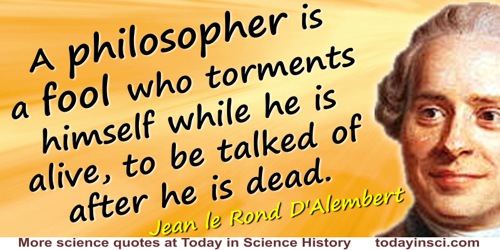
A philosopher is a fool who torments himself while he is alive, to be talked of after he is dead.
As translated, without citation, in Familiar Short Sayings of Great Men: With Historical and Explanatory Notes (1887), 6.
A philosopher once said, “It is necessary for the very existence of science that the same conditions always produce the same results”. Well, they do not.
In Character of Physical Law (1965), 147.
A physicist learns more and more about less and less, until he knows everything about nothing; whereas a philosopher learns less and less about more and more, until he knows nothing about everything.
Saying.
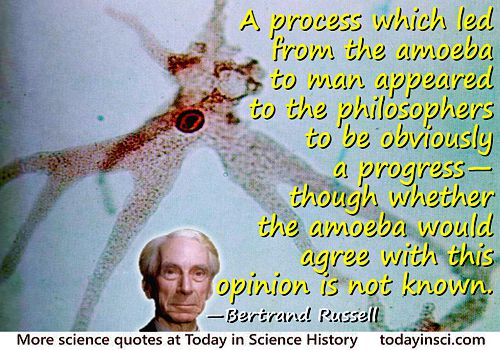
A process which led from the amoeba to man appeared to the philosophers to be obviously a progress—though whether the amoeba would agree with this opinion is not known.
From 'Current Tendencies', delivered as the first of a series of Lowell Lectures in Boston (Mar 1914). Collected in Our Knowledge of the External World (1914), 12.
A regiment of soldiers on parade is, according to some philosophers, a system.
From Selected Aphorisms from the Lyceum (1797-1800). As translated by Luis H. Gray in Kuno Francke and Isidore Singer (eds.), The German Classics: Masterpieces of German Literature Translated Into English (1913), Vol. 4, 176.
A rock or stone is not a subject that, of itself, may interest a philosopher to study; but, when he comes to see the necessity of those hard bodies, in the constitution of this earth, or for the permanency of the land on which we dwell, and when he finds that there are means wisely provided for the renovation of this necessary decaying part, as well as that of every other, he then, with pleasure, contemplates this manifestation of design, and thus connects the mineral system of this earth with that by which the heavenly bodies are made to move perpetually in their orbits.
Theory of the Earth, with Proofs and l1lustrations, Vol. 1 (1795), 276.
After what has been premised, I think we may lay down the following Conclusions. First, It is plain Philosophers amuse themselves in vain, when they inquire for any natural efficient Cause, distinct from a Mind or Spirit. Secondly, Considering the whole Creation is the Workmanship of a wise and good Agent, it should seem to become Philosophers, to employ their Thoughts (contrary to what some hold) about the final Causes of Things: And I must confess, I see no reason, why pointing out the various Ends, to which natural Things are adapted and for which they were originally with unspeakable Wisdom contrived, should not be thought one good way of accounting for them, and altogether worthy a Philosopher.
A Treatise Concerning the Principles of Human Knowledge [first published 1710], (1734), 126-7.
All our contemporary philosophers perhaps without knowing it are looking through eyeglasses that Baruch Spinoza polished.
Quoted in Frank Heynick, Jews and Medicine: An Epic Saga (2002), 204. Heynick adds some background that, “Heine’s quote alludes to the fact that Spinoza earned his livelihood by grinding lenses.”
An enthusiastic philosopher, of whose name we are not informed, had constructed a very satisfactory theory on some subject or other, and was not a little proud of it. “But the facts, my dear fellow,” said his friend, “the facts do not agree with your theory.”—“Don't they?” replied the philosopher, shrugging his shoulders, “then, tant pis pour les faits;”—so much the worse for the facts!
From Memoirs of Extraordinary Popular Delusions (1841), Vol. 3, 313, footnote.
An extra-terrestrial philosopher, who had watched a single youth up to the age of twenty-one and had never come across any other human being, might conclude that it is the nature of human beings to grow continually taller and wiser in an indefinite progress towards perfection; and this generalization would be just as well founded as the generalization which evolutionists base upon the previous history of this planet.
Scientific Method in Philosophy (1914), 12.
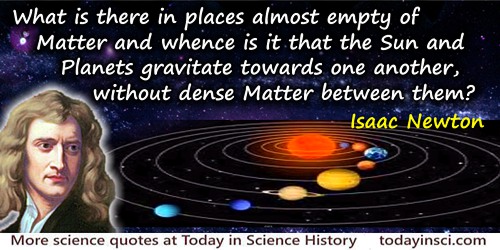
And for rejecting such a Medium, we have the Authority of those the oldest and most celebrated Philosophers of Greece and Phoenicia, who made a Vacuum, and Atoms, and the Gravity of Atoms, the first Principles of their Philosophy; tacitly attributing Gravity to some other Cause than dense Matter. Later Philosophers banish the Consideration of such a Cause out of natural Philosophy, feigning Hypotheses for explaining all things mechanically, and referring other Causes to Metaphysicks: Whereas the main Business of natural Philosophy is to argue from Phaenomena without feigning Hypotheses, and to deduce Causes from Effects, till we come to the very first Cause, which certainly is not mechanical; and not only to unfold the Mechanism of the World, but chiefly to resolve these and such like Questions. What is there in places almost empty of Matter, and whence is it that the Sun and Planets gravitate towards one another, without dense Matter between them? Whence is it that Nature doth nothing in vain; and whence arises all that Order and Beauty which we see in the World? ... does it not appear from phaenomena that there is a Being incorporeal, living, intelligent, omnipresent, who in infinite space, as it were in his Sensory, sees the things themselves intimately, and thoroughly perceives them, and comprehends them wholly by their immediate presence to himself.
In Opticks, (1704, 2nd. Ed. 1718), Book 3, Query 28, 343-5. Newton’s reference to “Nature does nothing in vain” recalls the axiom from Aristotle, which may be seen as “Natura nihil agit frustra” in the Aristotle Quotes on this web site.
And so many think incorrectly that everything was created by the Creator in the beginning as it is seen, that not only the mountains, valleys, and waters, but also various types of minerals occurred together with the rest of the world, and therefore it is said that it is unnecessary to investigate the reasons why they differ in their internal properties and their locations. Such considerations are very dangerous for the growth of all the sciences, and hence for natural knowledge of the Earth, particularly the art of mining, though it is very easy for those clever people to be philosophers, having learnt by heart the three words 'God so created' and to give them in reply in place of all reasons.
About the Layers of the Earth and other Works on Geology (1757), trans. A. P. Lapov (1949), 55.
And we daily in our experiments electrise bodies plus or minus, as we think proper. [These terms we may use till your Philosophers give us better.] To electrise plus or minus, no more needs to be known than this, that the parts of the Tube or Sphere, that are rubb’d, do, in the Instant of Friction, attract the Electrical Fire, and therefore take it from the Thin rubbing; the same parts immediately, as the Friction upon them ceases, are disposed to give the fire they have received, to any Body that has less.
Letter 25 May 1747. Quoted in I. Bernard Cohen, Franklin and Newton: An Enquiry into Speculative Newtonian Experimental Science and Franklin’s Work in Electricity as an Example Thereof (1956), 439.
Aristotle, in spite of his reputation, is full of absurdities. He says that children should be conceived in the Winter, when the wind is in the North, and that if people marry too young the children will be female. He tells us that the blood of females is blacker then that of males; that the pig is the only animal liable to measles; that an elephant suffering from insomnia should have its shoulders rubbed with salt, olive-oil, and warm water; that women have fewer teeth than men, and so on. Nevertheless, he is considered by the great majority of philosophers a paragon of wisdom.
From An Outline of Intellectual Rubbish (1937, 1943), 19. Collected in The Basic Writings of Bertrand Russell (2009), 63.
As for hailing [the new term] scientist as 'good', that was mere politeness: Faraday never used the word, describing himself as a natural philosopher to the end of his career.
Nineteenth-Century Attitudes: Men of Science (1991), 10.
As for the causes of magnetic movements, referred to in the schools of philosophers to the four elements and to prime qualities, these we leave for roaches and moths to prey upon.
De Magnete (1600), Book II. Concluding sentence of Chap. 3, as translated in William Gilbert and P. Fleury Mottelay (trans.), William Gilbert of Colchester, physician of London: On the load stone and magnetic bodies (1893), 104.
As regards the co-ordination of all ordinary properties of matter, Rutherford’s model of the atom puts before us a task reminiscent of the old dream of philosophers: to reduce the interpretation of the laws of nature to the consideration of pure numbers.
In Faraday Lecture (1930), Journal of the Chemical Society (Feb 1932), 349. As quoted and cited in Chen Ning Yang, Elementary Particles (1961), 7.
As soon … as it was observed that the stars retained their relative places, that the times of their rising and setting varied with the seasons, that sun, moon, and planets moved among them in a plane, … then a new order of things began.… Science had begun, and the first triumph of it was the power of foretelling the future; eclipses were perceived to recur in cycles of nineteen years, and philosophers were able to say when an eclipse was to be looked for. The periods of the planets were determined. Theories were invented to account for their eccentricities; and, false as those theories might be, the position of the planets could be calculated with moderate certainty by them.
Lecture delivered to the Royal Institution (5 Feb 1864), 'On the Science of History'. Collected in Notices of the Proceedings at the Meetings of the Members of the Royal Institution of Great Britain with Abstracts of the Discourses (1866), Vol. 4, 187.
At first men try with magic charms
To fertilize the earth,
To keep their flocks and herds from harm
And bring new young to birth.
Then to capricious gods they turn
To save from fire or flood;
Their smoking sacrifices burn
On altars red with blood.
Next bold philosopher and sage
A settled plan decree
And prove by thought or sacred page
What Nature ought to be.
But Nature smiles—a Sphinx-like smile
Watching their little day
She waits in patience for a while—
Their plans dissolve away.
Then come those humbler men of heart
With no completed scheme,
Content to play a modest part,
To test, observe, and dream.
Till out of chaos come in sight
Clear fragments of a Whole;
Man, learning Nature’s ways aright
Obeying, can control.
To fertilize the earth,
To keep their flocks and herds from harm
And bring new young to birth.
Then to capricious gods they turn
To save from fire or flood;
Their smoking sacrifices burn
On altars red with blood.
Next bold philosopher and sage
A settled plan decree
And prove by thought or sacred page
What Nature ought to be.
But Nature smiles—a Sphinx-like smile
Watching their little day
She waits in patience for a while—
Their plans dissolve away.
Then come those humbler men of heart
With no completed scheme,
Content to play a modest part,
To test, observe, and dream.
Till out of chaos come in sight
Clear fragments of a Whole;
Man, learning Nature’s ways aright
Obeying, can control.
Epigraph in A History of Science and Its Relation with Philosophy & Religion (1968), vi.
At first sight nothing seems more obvious than that everything has a beginning and an end, and that everything can be subdivided into smaller parts. Nevertheless, for entirely speculative reasons the philosophers of Antiquity, especially the Stoics, concluded this concept to be quite unnecessary. The prodigious development of physics has now reached the same conclusion as those philosophers, Empedocles and Democritus in particular, who lived around 500 B.C. and for whom even ancient man had a lively admiration.
'Development of the Theory of Electrolytic Dissociation', Nobel Lecture, 11 December 1903. In Nobel Lectures: Chemistry 1901-1921 (1966), 45.
Bad philosophers may have a certain influence; good philosophers, never.
Uncertain attribution. Often seen, but Webmaster has not yet found this wording in a primary source, and remains uncertain that this is an actual Russell quote. It is included here to provide this caution. Contact Webmaster if you have more information.
Be a Philosopher; but, amidst all your Philosophy, be still a Man.
An Enquiry Concerning Human Understanding (1748), 7.
But as a philosopher said, one day after mastering the winds, the waves, the tides and gravity, after all the scientific and technological achievements, we shall harness for God the energies of love. And then, for the second time in the history of the world, man will have discovered fire.
Speech accepting nomination as candidate for vice president, Democratic National Committee, Washington, D.C. (8 Aug 1972) as reported in New York Times (9 Aug 1972), 18. Shriver slightly paraphrased the similar sentiment written in 1934 by Pierre Teilhard de Chardin, translated by René Hague in 'The Evolution of Chastity', Toward the Future (1975), 86-87.
But concerning vision alone is a separate science formed among philosophers, namely, optics, and not concerning any other sense ... It is possible that some other science may be more useful, but no other science has so much sweetness and beauty of utility. Therefore it is the flower of the whole of philosophy and through it, and not without it, can the other sciences be known.
Opus Majus [1266-1268], Part V, distinction I, chapter I, trans. R. B. Burke, The Opus Maius of Roger Bacon (1928), Vol. 2, 420.
But from the time I was in college I learned that there is nothing one could imagine which is so strange and incredible that it was not said by some philosopher; and since that time, I have recognized through my travels that all those whose views are different from our own are not necessarily, for that reason, barbarians or savages, but that many of them use their reason either as much as or even more than we do. I also considered how the same person, with the same mind, who was brought up from infancy either among the French or the Germans, becomes different from what they would have been if they had always lived among the Chinese or among the cannibals, and how, even in our clothes fashions, the very thing that we liked ten years ago, and that we may like again within the next ten years, appears extravagant and ridiculous to us today. Thus our convictions result from custom and example very much more than from any knowledge that is certain... truths will be discovered by an individual rather than a whole people.
Discourse on Method in Discourse on Method and Related Writings (1637), trans. Desmond M. Clarke, Penguin edition (1999), Part 2, 14-5.
But that which will excite the greatest astonishment by far, and which indeed especially moved me to call the attention of all astronomers and philosophers, is this: namely, that I have observed four planets, neither known nor observed by any one of the astronomers before my time, which have their orbits round a certain bright star [Jupiter], one of those previously known, like Venus or Mercury round the sun, and are sometimes in front of it, sometimes behind it, though they never depart from it beyond certain limits. All of which facts were discovered and observed a few days ago by the help of a telescope devised by me, through God’s grace first enlightening my mind.
In pamphlet, The Sidereal Messenger (1610), reprinted in The Sidereal Messenger of Galileo Galilei: And a Part of the Preface to the Preface to Kepler's Dioptrics Containing the Original Account of Galileo's Astronomical Discoveries (1880), 9.
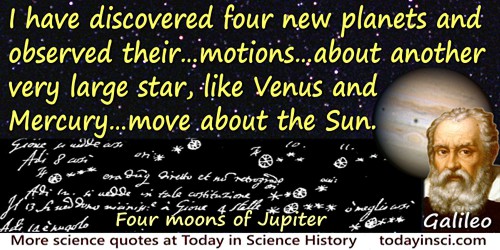
But what exceeds all wonders, I have discovered four new planets and observed their proper and particular motions, different among themselves and from the motions of all the other stars; and these new planets move about another very large star [Jupiter] like Venus and Mercury, and perchance the other known planets, move about the Sun. As soon as this tract, which I shall send to all the philosophers and mathematicians as an announcement, is finished, I shall send a copy to the Most Serene Grand Duke, together with an excellent spyglass, so that he can verify all these truths.
Letter to the Tuscan Court, 30 Jan 1610. Quoted in Albert van Heiden (ed.), Siderius Nuncius or The Sidereal Messenger (1989), 18.
CARTESIAN, adj. Relating to Descartes, a famous philosopher, author of the celebrated dictum, Cogito, ergo sum—whereby he was pleased to suppose he demonstrated the reality of human existence. The dictum might be improved, however, thus: Cogito ergo cogito sum—'I think that I think, therefore I think that I am;' as close an approach to certainty as any philosopher has yet made.
The Collected Works of Ambrose Bierce (1911), Vol. 7, The Devil's Dictionary, 46-47.
Cavendish gave me once some bits of platinum for my experiments, and came to see my results on the decomposition of the alkalis, and seemed to take an interest in them; but he encouraged no intimacy with any one, and received nobody at his own house. … He was acute, sagacious, and profound, and, I think, the most accomplished British philosopher of his time.
As quoted in Victor Robinson, Pathfinders in Medicine (1912), 143.
Cavendish was a great Man with extraordinary singularities—His voice was squeaking his manner nervous He was afraid of strangers & seemed when embarrassed to articulate with difficulty—He wore the costume of our grandfathers. Was enormously rich but made no use of his wealth... He Cavendish lived latterly the life of a solitary, came to the Club dinner & to the Royal Society: but received nobody at his home. He was acute sagacious & profound & I think the most accomplished British Philosopher of his time.
Quoted in J. Z. Fullmer, 'Davy's Sketches of his Contemporaries', Chymia, 1967, 12, 133.
Descartes said, “I think; therefore I am.” The philosophic evolutionist reverses and negatives the epigram. He says, “I am not; therefore I cannot think.”
In Orthodoxy (1918, 2008), 25.
Development of Western science is based on two great achievements: the invention of the formal logical system (in Euclidean geometry) by the Greek philosophers, and the discovery of the possibility to find out causal relationships by systematic experiment (during the Renaissance). In my opinion, one has not to be astonished that the Chinese sages have not made these steps. The astonishing thing is that these discoveries were made at all.
Letter to J. S. Switzer, 23 Apr 1953, Einstein Archive 61-381. Quoted in Alice Calaprice, The Quotable Einstein (1996), 180.
Einstein, my upset stomach hates your theory [of General Relativity]—it almost hates you yourself! How am I to provide for my students? What am I to answer to the philosophers?!!
Letter to Albert Einstein, 20 Nov 1919. In Martin J. Klein, Paul Ehrenfest: The Making of a Theoretical Physicist (1970), Vol. 1, 315.
Every good mathematician is at least half a philosopher, and every good philosopher at least half a mathematician.
Quoted, without citation, in 'Gottlob Frege', The New Encyclopedia Britannica (1992), Vol. 4, 968. If you know a primary source, please contact Webmaster.
Every man is ready to join in the approval or condemnation of a philosopher or a statesman, a poet or an orator, an artist or an architect. But who can judge of a mathematician? Who will write a review of Hamilton’s Quaternions, and show us wherein it is superior to Newton’s Fluxions?
In 'Imagination in Mathematics', North American Review, 85, 224.
Every man will be a poet if he can; otherwise a philosopher or man of science. This proves the superiority of the poet.
Odell Shepard (Ed.), The Heart of Thoreau's Journals (1961), 84.
Every philosophical thinker hails it [The Origin of Species] as a veritable Whitworth gun in the armoury of liberalism.
'The Origin of Species' (1860). In Collected Essays (1893), Vol. 2, 23.
Everybody is to some small extent a philosopher of mathematics. Let him only exclaim on occasion: “But figures can’t lie!” and he joins the ranks of Plato and of Lakatos.
Co-author with Reuben Hersh, in The Mathematical Experience (1981), xi.
Everyone admits that the male is the primary efficient cause in generation, as being that in whom the species or form resides, and they further assert that his genitures emitted in coitus causes the egg both to exist and to be fertile. But how the semen of the cock produces the chick from the egg, neither the philosophers nor the physicians of yesterday or today have satisfactorily explained, or solved the problem formulated by Aristotle.
Disputations Touching the Generation of Animals (1651), trans. Gweneth Whitteridge (1981), Chapter 47, 214.
Everyone now agrees that a Physics where you banish all relationship with mathematics, to confine itself to a mere collection of observations and experiences, would be but an historical amusement, more fitting to entertain idle people, than to engage the mind of a true philosopher.
In 'Préface Contenant l’Exposition du Système', Dictionnaire de Physique (1761), Vol. 1, iii. English version via Google Translate, tweaked by Webmaster. From the original French, “Tout le monde convient maintenant qu’une Physique d’où l'on banniroit tout ce qui peut avoir quelque rapport avec les mathématiques, pour se borner à un simple recueil d’observations & d’experiences, ne seroit qu’un amusement historique, plus propre à récréer un cercle de personnes oisives, qu’à occuper un esprit véritablement philosophique.” Also seen translated as—“Everyone now agrees that a physics lacking all connection with mathematics…would only be an historical amusement, fitter for entertaining the idle than for occupying the mind of a philosopher,” in John L. Heilbron, Electricity in the 17th and 18th centuries: A Study of Early Modern Physics (1979), 74. In the latter source, the subject quote immediately follows a different one by Franz Karl Achard. An editor misreading that paragraph is the likely reason the subject quote will be found in Oxford Dictionary of Science Quotations attributed to Achard. Webmaster checked the original footnoted source, and corrected the author of this entry to Paulian (16 May 2014).
Far from becoming discouraged, the philosopher should applaud nature, even when she appears miserly of herself or overly mysterious, and should feel pleased that as he lifts one part of her veil, she allows him to glimpse an immense number of other objects, all worthy of investigation. For what we already know should allow us to judge of what we will be able to know; the human mind has no frontiers, it extends proportionately as the universe displays itself; man, then, can and must attempt all, and he needs only time in order to know all. By multiplying his observations, he could even see and foresee all phenomena, all of nature's occurrences, with as much truth and certainty as if he were deducing them directly from causes. And what more excusable or even more noble enthusiasm could there be than that of believing man capable of recognizing all the powers, and discovering through his investigations all the secrets, of nature!
'Des Mulets', Oeuvres Philosophiques, ed. Jean Piveteau (1954), 414. Quoted in Jacques Roger, The Life Sciences in Eighteenth-Century French Thought, ed. Keith R. Benson and trans. Robert Ellrich (1997), 458.
For centuries knowledge meant proven knowledge…. Einstein’s results again turned the tables and now very few philosophers or scientists still think that scientific knowledge is, or can be, proven knowledge. But few realize that with this the whole classical structure of intellectual values falls in ruins and has to be replaced.
In 'Falsification and the Methodology of Scientific Research Programmes', in I. Lakatos and A. Musgrave (eds.), Criticism and the Growth of Knowledge: Proceedings of the International Colloquium in the Philosophy of Science, London 1965 (1970), Vol. 4, 91-92.
For other great mathematicians or philosophers, he [Gauss] used the epithets magnus, or clarus, or clarissimus; for Newton alone he kept the prefix summus.
In History of Mathematics (3rd Ed., 1901), 362.
For the philosopher, order is the entirety of repetitions manifested, in the form of types or of laws, by perceived objects. Order is an intelligible relation. For the biologist, order is a sequence in space and time. However, according to Plato, all things arise out of their opposites. Order was born of the original disorder, and the long evolution responsible for the present biological order necessarily had to engender disorder.
An organism is a molecular society, and biological order is a kind of social order. Social order is opposed to revolution, which is an abrupt change of order, and to anarchy, which is the absence of order.
I am presenting here today both revolution and anarchy, for which I am fortunately not the only one responsible. However, anarchy cannot survive and prosper except in an ordered society, and revolution becomes sooner or later the new order. Viruses have not failed to follow the general law. They are strict parasites which, born of disorder, have created a very remarkable new order to ensure their own perpetuation.
An organism is a molecular society, and biological order is a kind of social order. Social order is opposed to revolution, which is an abrupt change of order, and to anarchy, which is the absence of order.
I am presenting here today both revolution and anarchy, for which I am fortunately not the only one responsible. However, anarchy cannot survive and prosper except in an ordered society, and revolution becomes sooner or later the new order. Viruses have not failed to follow the general law. They are strict parasites which, born of disorder, have created a very remarkable new order to ensure their own perpetuation.
'Interaction Among Virus, Cell, and Organism', Nobel Lecture (11 Dec 1965). In Nobel Lectures: Physiology or Medicine 1963-1970 (1972), 174.
For there was never yet philosopher
That could endure the toothache patiently,
However they have writ the style of gods,
And made a push at chance and sufferance.
That could endure the toothache patiently,
However they have writ the style of gods,
And made a push at chance and sufferance.
Much Ado about Nothing (1598-9), V, i.
Forty years ago the philosopher Alfred North Whitehead thought it self-evident that you would get a good government if you took power out of the hands of the acquisitive and gave it to the learned and the cultivated. At present, a child in kindergarten knows better than that.
In Before the Sabbath (1979), 40-41.
From very ancient times, the question of the constitution of matter with respect to divisibility has been debated, some adopting the opinion that this divisibility is infinite …. We have absolutely no means at our disposal for deciding such a question, which remains at the present day in the same state as when it first engaged the attention of the Greek philosophers, or perhaps that of the sages of Egypt and Hindostan long before them.
In Elementary Chemistry, Theoretical and Practical (1854), 206. Note: this was the limit of knowledge, or even speculation, decades before the discovery of the nucleus, electron, proton and other particles.
God created man in his own image, says the Bible; the philosophers do the exact opposite, they create God in theirs.
Aphorism 48 in Notebook D (1773-1775), as translated by R.J. Hollingdale in Aphorisms (1990). Reprinted as The Waste Books (2000), 51.
Haldane could have made a success of any one of half a dozen careers—as mathematician, classical scholar, philosopher, scientist, journalist or imaginative writer. On his life’s showing he could not have been a politician, administrator (heavens, no!), jurist or, I think, a critic of any kind. In the outcome he became one of the three or four most influential biologists of his generation.
Essay, 'J.B.S.', in Pluto’s Republic: Incorporating The Art of the Soluble and Induction and Intuition in Scientific Thought (1982), collected in The Strange Case of the Spotted Mice and Other Classic Essays on Science (1996), 87.
He (Anaxagoras) is said to have been twenty years old at the time of Xerxes' crossing, and to have lived to seventy-two. Apollodorus says in his Chronicles that he was born in the seventieth Olympiad (500-497 B.C.) and died in the first year of the eighty-eighth (428/7). He began to be a philosopher at Athens in the archonship of Callias (456/5), at the age of twenty, as Demetrius Phalereus tells us in his Register of Archons, and they say he spent thirty years there. … There are different accounts given of his trial. Sotion, in his Succession of Philosophers, says that he was prosecuted by Cleon for impiety, because he maintained that the sun was a red hot mass of metal, and after that Pericles, his pupil, had made a speech in his defence, he was fined five talents and exiled. Satyrus in his Uves, on the other hand, says that the charge was brought by Thucydides in his political campaign against Pericles; and he adds that the charge was not only for the impiety but for Medism as well; and he was condemned to death in his absence. ... Finally he withdrew to Lampsacus, and there died. It is said that when the rulers of the city asked him what privilege he wished to be granted, he replied that the children should be given a holiday every year in the month in which he died. The custom is preserved to the present day. When he died the Lampsacenes buried him with full honours.
Diogenes Laërtius 2.7. In G. S. Kirk, J. E. Raven and M. Schofield (eds.), The Presocratic Philosophers: A Critical History with a Selection of Texts (1983), p. 353.
Historically the most striking result of Kant's labors was the rapid separation of the thinkers of his own nation and, though less completely, of the world, into two parties;—the philosophers and the scientists.
The Order of Nature: An Essay (1917), 69.
I am one of those philosophers who have held that that “the Common Sense view of the world” is in certain fundamental features, wholly true.
In 'A Defence of Common Sense', J.H. Muirhead (ed.), Contemporary British Philosophy (1925). Reprinted in Philosophical Papers of George Edward Moore (1959), 44.
I am particularly concerned to determine the probability of causes and results, as exhibited in events that occur in large numbers, and to investigate the laws according to which that probability approaches a limit in proportion to the repetition of events. That investigation deserves the attention of mathematicians because of the analysis required. It is primarily there that the approximation of formulas that are functions of large numbers has its most important applications. The investigation will benefit observers in identifying the mean to be chosen among the results of their observations and the probability of the errors still to be apprehended. Lastly, the investigation is one that deserves the attention of philosophers in showing how in the final analysis there is a regularity underlying the very things that seem to us to pertain entirely to chance, and in unveiling the hidden but constant causes on which that regularity depends. It is on the regularity of the main outcomes of events taken in large numbers that various institutions depend, such as annuities, tontines, and insurance policies. Questions about those subjects, as well as about inoculation with vaccine and decisions of electoral assemblies, present no further difficulty in the light of my theory. I limit myself here to resolving the most general of them, but the importance of these concerns in civil life, the moral considerations that complicate them, and the voluminous data that they presuppose require a separate work.
Philosophical Essay on Probabilities (1825), trans. Andrew I. Dale (1995), Introduction.
I am sorry the infernal Divinities, who visit mankind with diseases, and are therefore at perpetual war with Doctors, should have prevented my seeing all you great Men at Soho to-day-Lord! what inventions, what wit, what rhetoric, metaphysical, mechanical and pyrotecnical, will be on the wing, bandy'd like a shuttlecock from one to another of your troop of philosophers! while poor I, I by myself I, imprizon'd in a post chaise, am joggled, and jostled, and bump'd, and bruised along the King's high road, to make war upon a pox or a fever!
Letter to Matthew Boulton, 5 April 1778. Quoted in Desmond King-Hele (ed.), The Letters of Erasmus Darwin (1981), 84.
I believe that the useful methods of mathematics are easily to be learned by quite young persons, just as languages are easily learned in youth. What a wondrous philosophy and history underlie the use of almost every word in every language—yet the child learns to use the word unconsciously. No doubt when such a word was first invented it was studied over and lectured upon, just as one might lecture now upon the idea of a rate, or the use of Cartesian co-ordinates, and we may depend upon it that children of the future will use the idea of the calculus, and use squared paper as readily as they now cipher. … When Egyptian and Chaldean philosophers spent years in difficult calculations, which would now be thought easy by young children, doubtless they had the same notions of the depth of their knowledge that Sir William Thomson might now have of his. How is it, then, that Thomson gained his immense knowledge in the time taken by a Chaldean philosopher to acquire a simple knowledge of arithmetic? The reason is plain. Thomson, when a child, was taught in a few years more than all that was known three thousand years ago of the properties of numbers. When it is found essential to a boy’s future that machinery should be given to his brain, it is given to him; he is taught to use it, and his bright memory makes the use of it a second nature to him; but it is not till after-life that he makes a close investigation of what there actually is in his brain which has enabled him to do so much. It is taken because the child has much faith. In after years he will accept nothing without careful consideration. The machinery given to the brain of children is getting more and more complicated as time goes on; but there is really no reason why it should not be taken in as early, and used as readily, as were the axioms of childish education in ancient Chaldea.
In Teaching of Mathematics (1902), 14.
I can assure you, reader, that in a very few hours, even during the first day, you will learn more natural philosophy about things contained in this book, than you could learn in fifty years by reading the theories and opinions of the ancient philosophers. Enemies of science will scoff at the astrologers: saying, where is the ladder on which they have climbed to heaven, to know the foundation of the stars? But in this respect I am exempt from such scoffing; for in proving my written reason, I satisfy sight, hearing, and touch: for this reason, defamers will have no power over me: as you will see when you come to see me in my little Academy.
The Admirable Discourses (1580), trans. Aurele La Rocque (1957), 27.
I entered Gettysburg College intent on preparing for medical school. But my ambition was far from resolute. Every new subject that I encountered in college proved a siren song. I imagined myself an historian, a philosopher, a novelist, rarely a scientist.
In 'J. Michael Bishop: Biographical', website of nobelprize.org.
I have never seen the Philosopher's Stone that turns lead into Gold, but I have known the pursuit of it turn a Man's Gold into Lead.
In Poor Richard's Almanack (1738).
I have no doubt that certain learned men, now that the novelty of the hypotheses in this work has been widely reported—for it establishes that the Earth moves, and indeed that the Sun is motionless in the middle of the universe—are extremely shocked, and think that the scholarly disciplines, rightly established once and for all, should not be upset. But if they are willing to judge the matter thoroughly, they will find that the author of this work has committed nothing which deserves censure. For it is proper for an astronomer to establish a record of the motions of the heavens with diligent and skilful observations, and then to think out and construct laws for them, or rather hypotheses, whatever their nature may be, since the true laws cannot be reached by the use of reason; and from those assumptions the motions can be correctly calculated, both for the future and for the past. Our author has shown himself outstandingly skilful in both these respects. Nor is it necessary that these hypotheses should be true, nor indeed even probable, but it is sufficient if they merely produce calculations which agree with the observations. … For it is clear enough that this subject is completely and simply ignorant of the laws which produce apparently irregular motions. And if it does work out any laws—as certainly it does work out very many—it does not do so in any way with the aim of persuading anyone that they are valid, but only to provide a correct basis for calculation. Since different hypotheses are sometimes available to explain one and the same motion (for instance eccentricity or an epicycle for the motion of the Sun) an astronomer will prefer to seize on the one which is easiest to grasp; a philosopher will perhaps look more for probability; but neither will grasp or convey anything certain, unless it has been divinely revealed to him. Let us therefore allow these new hypotheses also to become known beside the older, which are no more probable, especially since they are remarkable and easy; and let them bring with them the vast treasury of highly learned observations. And let no one expect from astronomy, as far as hypotheses are concerned, anything certain, since it cannot produce any such thing, in case if he seizes on things constructed for another other purpose as true, he departs from this discipline more foolish than he came to it.
Although this preface would have been assumed by contemporary readers to be written by Copernicus, it was unsigned. It is now believed to have been written and added at press time by Andreas Osiander (who was then overseeing the printing of the book). It suggests the earth’s motion as described was merely a mathematical device, and not to be taken as absolute reality. Text as given in 'To the Reader on the Hypotheses in this Work', Copernicus: On the Revolutions of the Heavenly Spheres (1543), translated by Alistair Matheson Duncan (1976), 22-3. By adding this preface, Osiander wished to stave off criticism by theologians. See also the Andreas Osiander Quotes page of this website.
I have tried to read philosophers of all ages and have found many illuminating ideas but no steady progress toward deeper knowledge and understanding. Science, however, gives me the feeling of steady progress: I am convinced that theoretical physics is actual philosophy. It has revolutionized fundamental concepts, e.g., about space and time (relativity), about causality (quantum theory), and about substance and matter (atomistics), and it has taught us new methods of thinking (complementarity) which are applicable far beyond physics.
— Max Born
My Life & My Views (1968), 48.
I must not pass by Dr. Young called Phaenomenon Young at Cambridge. A man of universal erudition, & almost universal accomplishments. Had he limited himself to anyone department of knowledge, he must have been first in that department. But as a mathematician, a scholar, a hieroglyphist, he was eminent; & he knew so much that it is difficult to say what he did not know. He was a most amiable & good-tempered man; too fond, perhaps, of the society of persons of rank for a true philosopher.
J. Z. Fullmer, 'Davy's Sketches of his Contemporaries', Chymia (1967), 12, 135.
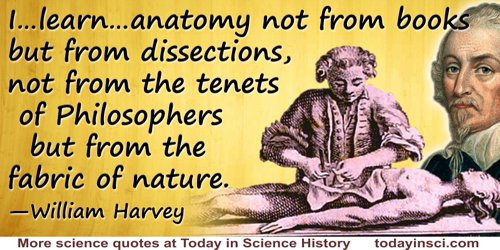
I profess to learn and to teach anatomy not from books but from dissections, not from the tenets of Philosophers but from the fabric of Nature.
De Motu Cordis (1628), The Circulation of the Blood and Other Writings, trans. Kenneth J. Franklin (1957), Dedication to Doctor Argent, 7.
I shall conclude, for the time being, by saying that until Philosophers make observations (especially of mountains) that are longer, more attentive, orderly, and interconnected, and while they fail to recognize the two great agents, fire and water, in their distinct affects, they will not be able to understand the causes of the great natural variety in the disposition, structure, and other matter that can be observed in the terrestrial globe in a manner that truly corresponds to the facts and to the phenomena of Nature.
'Aleune Osservazioni Orittologiche fatte nei Monti del Vicentino', Giomale d’Italia, 1769, 5, 411, trans. Ezio Vaccari.
I shall no doubt be blamed by certain scientists, and, I am afraid, by some philosophers, for having taken serious account of the alleged facts which are investigated by Psychical Researchers. I am wholly impenitent about this. The scientists in question seem to me to confuse the Author of Nature with the Editor of Nature; or at any rate to suppose that there can be no productions of the former which would not be accepted for publication by the latter. And I see no reason to believe this.
The Mind and its Place in Nature (1925), viii.
I think a future flight should include a poet, a priest and a philosopher… we might get a much better idea of what we saw.
…...
I was ever of the opinion that the philosopher’s stone, and an holy war, were but the rendezvous of cracked brains, that wore their feather in their heads.
From essay, An Advertisement Touching a Holy War (1622). As collected and translated in Francis Bacon and Basil Montagu, The Works of Francis Bacon (1844), Vol. 2, 439. As quoted in Samuel Austin Allibone, Prose Quotations From Socrates to Macaulay (1876), 28. [Note: In Bacon’s time, the 17th century, the meaning of “advertise” was to give knowledge, advice or counsel. An “advertisement” meant the same in the form of a written statement. —Webmaster]
I was introduced to Mr. Davy, who has rooms adjoining mine (in the Royal Institution); he is a very agreeable and intelligent young man, and we have interesting conversation in an evening; the principal failing in his character as a philosopher is that he does not smoke.
Letter to John Rothwell, January 1804. Quoted in J. P. Millington, John Dalton (1906), 141.
I was unable to devote myself to the learning of this al-jabr [algebra] and the continued concentration upon it, because of obstacles in the vagaries of Time which hindered me; for we have been deprived of all the people of knowledge save for a group, small in number, with many troubles, whose concern in life is to snatch the opportunity, when Time is asleep, to devote themselves meanwhile to the investigation and perfection of a science; for the majority of people who imitate philosophers confuse the true with the false, and they do nothing but deceive and pretend knowledge, and they do not use what they know of the sciences except for base and material purposes; and if they see a certain person seeking for the right and preferring the truth, doing his best to refute the false and untrue and leaving aside hypocrisy and deceit, they make a fool of him and mock him.
A. P. Youschkevitch and B. A. Rosenfeld, 'Al-Khayyami', in C. C. Gillispie (ed.), Dictionary of Scientific Biography (1973), Vol. 7, 324.
I wish, my dear Kepler, that we could have a good laugh together at the extraordinary stupidity of the mob. What do you think of the foremost philosophers of this University? In spite of my oft-repeated efforts and invitations, they have refused, with the obstinacy of a glutted adder, to look at the planets or the Moon or my glass [telescope].
Opere ed Nas. X, 423. As cited in Alan Mackay, A Dictionary of Scientific Quotations (1991), 99. Galileo wished others to use his telescope to see for themselves the moons of Jupiter which he had himself first seen in Jan 1610. If you have a primary source for this letter giving the date it was written, please contact Webmaster.
If any philosopher had been asked for a definition of infinity, he might have produced some unintelligible rigmarole, but he would certainly not have been able to give a definition that had any meaning at all.
…...
If experiments are performed thousands of times at all seasons and in every place without once producing the effects mentioned by your philosophers, poets, and historians, this will mean nothing and we must believe their words rather our own eyes? But what if I find for you a state of the air that has all the conditions you say are required, and still the egg is not cooked nor the lead ball destroyed? Alas! I should be wasting my efforts... for all too prudently you have secured your position by saying that 'there is needed for this effect violent motion, a great quantity of exhalations, a highly attenuated material and whatever else conduces to it.' This 'whatever else' is what beats me, and gives you a blessed harbor, a sanctuary completely secure.
'The Assayer' (1623), trans. Stillman Drake, Discoveries and Opinions of Galileo (1957), 273.
If the God of revelation is most appropriately worshipped in the temple of religion, the God of nature may be equally honored in the temple of science. Even from its lofty minarets the philosopher may summon the faithful to prayer, and the priest and sage exchange altars without the compromise of faith or knowledge.
In Tryon Edwards (ed.), A Dictionary of Thoughts: Being a Cyclopedia of Laconic Quotations from the Best Authors of the World, Both Ancient and Modern (1891), 507.
If the Tincture of the Philosophers is to be used for transmutation, a pound of it must be projected on a thousand pounds of melted Sol [gold]. Then, at length, will a medicine have been prepared for transmuting the leprous moisture of the metals. This work is a wonderful one in the light of nature, namely, that by the Magistery, or the operation of the Spagyrist, a metal, which formerly existed, should perish, and another be produced. This fact has rendered that same Aristotle, with his ill-founded philosophy, fatuous.
In Paracelsus and Arthur Edward Waite (ed.), The Hermetic and Alchemical Writings of Paracelsus (1894), Vol. 1, 28.
If we do discover a complete unified theory, it should be in time understandable in broad principle by everyone, not just a few scientists. Then we shall all, philosophers, scientists and just ordinary people, be able to take part in the discussion of why it is that we and the universe exist. If we find the answer to that, it would be the ultimate triumph of human reason—for then we would know the mind of God.
A Brief History of Time (1988), 191.
In England, philosophers are honoured, respected; they rise to public offices, they are buried with the kings... In France warrants are issued against them, they are persecuted, pelted with pastoral letters: Do we see that England is any the worse for it?
'Introduction aux Grands Principes ou Reception d'un Philosophe', in J. Assézat (ed.), Oeuvres Complètes (1875-7), Vol. 2, 80.
In every case the awakening touch has been the mathematical spirit, the attempt to count, to measure, or to calculate. What to the poet or the seer may appear to be the very death of all his poetry and all his visions—the cold touch of the calculating mind,—this has proved to be the spell by which knowledge has been born, by which new sciences have been created, and hundreds of definite problems put before the minds and into the hands of diligent students. It is the geometrical figure, the dry algebraical formula, which transforms the vague reasoning of the philosopher into a tangible and manageable conception; which represents, though it does not fully describe, which corresponds to, though it does not explain, the things and processes of nature: this clothes the fruitful, but otherwise indefinite, ideas in such a form that the strict logical methods of thought can be applied, that the human mind can in its inner chamber evolve a train of reasoning the result of which corresponds to the phenomena of the outer world.
In A History of European Thought in the Nineteenth Century (1896), Vol. 1, 314.
In its earliest development knowledge is self-sown. Impressions force themselves upon men’s senses whether they will or not, and often against their will. The amount of interest in which these impressions awaken is determined by the coarser pains and pleasures which they carry in their train or by mere curiosity; and reason deals with the materials supplied to it as far as that interest carries it, and no further. Such common knowledge is rather brought than sought; and such ratiocination is little more than the working of a blind intellectual instinct. It is only when the mind passes beyond this condition that it begins to evolve science. When simple curiosity passes into the love of knowledge as such, and the gratification of the æsthetic sense of the beauty of completeness and accuracy seems more desirable that the easy indolence of ignorance; when the finding out of the causes of things becomes a source of joy, and he is accounted happy who is successful in the search, common knowledge passes into what our forefathers called natural history, whence there is but a step to that which used to be termed natural philosophy, and now passes by the name of physical science.
In this final state of knowledge the phenomena of nature are regarded as one continuous series of causes and effects; and the ultimate object of science is to trace out that series, from the term which is nearest to us, to that which is at the farthest limit accessible to our means of investigation.
The course of nature as it is, as it has been, and as it will be, is the object of scientific inquiry; whatever lies beyond, above, or below this is outside science. But the philosopher need not despair at the limitation on his field of labor; in relation to the human mind Nature is boundless; and, though nowhere inaccessible, she is everywhere unfathomable.
In this final state of knowledge the phenomena of nature are regarded as one continuous series of causes and effects; and the ultimate object of science is to trace out that series, from the term which is nearest to us, to that which is at the farthest limit accessible to our means of investigation.
The course of nature as it is, as it has been, and as it will be, is the object of scientific inquiry; whatever lies beyond, above, or below this is outside science. But the philosopher need not despair at the limitation on his field of labor; in relation to the human mind Nature is boundless; and, though nowhere inaccessible, she is everywhere unfathomable.
The Crayfish: an Introduction to the Study of Zoölogy (1880), 2-3. Excerpted in Popular Science (Apr 1880), 16, 789-790.
In many aspects, the theoretical physicist is merely a philosopher in a working suit.
In Black Holes by Jean-Pierre Luminet (1987).
In mathematics, which is but a mirror of the society in which it thrives or suffers, the pre-Athenian period is one of colorful men and important discoveries. Sparta, like most militaristic states before and after it, produced nothing. Athens, and the allied Ionians, produced a number of works by philosophers and mathematicians; some good, some controversial, some grossly overrated.
In A History of Pi (1970), 34.
In my opinion a mathematician, in so far as he is a mathematician, need not preoccupy himself with philosophy—an opinion, moreover, which has been expressed by many philosophers.
As quoted in E.T. Bell, Men of Mathematics (1937, 1986), xvii.
In reality, all Arguments from Experience are founded on the Similarity which we discover among natural Objects, and by which we are induc'd to expect effects similar to those which we have found to follow from such Objects. And tho' none but a Fool or Madman will ever pretend to dispute the Authority of Experience, or to reject that great Guide of human Life, it may surely be allow'd a Philosopher to have so much Curiosity at least as to examine the Principle of human Nature, which gives this mighty Authority to Experience, and makes us draw Advantage from that Similarity which Nature has plac'd among different Objects. From Causes which appear similar we expect similar Effects. This is the Sum of our experimental Conclusions.
An Enquiry Concerning Human Understanding (1748), 63.
In the discovery of hidden things and the investigation of hidden causes, stronger reasons are obtained from sure experiments and demonstrated arguments than from probable conjectures and the opinions of philosophical speculators of the common sort...
De Magnete (1600). In William Gilbert and P. Fleury Mottelay (trans.), William Gilbert of Colchester, physician of London: On the load stone and magnetic bodies (1893), xlvii.
In the school of political projectors, I was but ill entertained, the professors appearing, in my judgment, wholly out of their senses; which is a scene that never fails to make me melancholy. These unhappy people were proposing schemes for persuading monarchs to choose favourites upon the score of their wisdom, capacity, and virtue; of teaching ministers to consult the public good; of rewarding merit, great abilities, and eminent services; of instructing princes to know their true interest, by placing it on the same foundation with that of their people; of choosing for employment persons qualified to exercise them; with many other wild impossible chimeras, that never entered before into the heart of man to conceive, and confirmed in me the old observation, that there is nothing so extravagant and irrational which some philosophers have not maintained for truth.
Gulliver's Travels (1726, Penguin ed. 1967), Part III, Chap. 6, 232.
In the Vienna of the late 1920s and 1930s there throve an internationally famous philosophical bunch called the logical positivists. … They said that a key ingredient of knowledge was “sense data,” and proclaimed emphatically, in the words of … J.S.L. Gilmour, that sense data are “objective and unalterable.” …Good guess, but no cigar!
In 'A Trip Through the Perception Factory', Global Brain: The Evolution of Mass Mind from the Big Bang to the 21st Century (2000), 64.
In this century the professional philosophers have let the physicists get away with murder. It is a safe bet that no other group of scientists could have passed off and gained acceptance for such an extraordinary principle as complementarity, nor succeeded in elevating indeterminacy to a universal law.
In Scientific American as quoted in epigraph, in Barbara Lovett Cline, The Questioners: Physicists and the Quantum Theory (1965), 235.
Individual science fiction stories may seem as trivial as ever to the blinder critics and philosophers of today–but the core of science fiction, its essence, the concept around which it revolves, has become crucial to our salvation if we are to be saved a
…...
It appears that the solution of the problem of time and space is reserved to philosophers who, like Leibniz, are mathematicians, or to mathematicians who, like Einstein, are philosophers.
Collected in Paul Arthur Schilpp (ed.), Albert Einstein: Philosopher-Scientist (1959), Vol. 1, 307. Also, in James Louis Jarrett and Sterling M. McMurrin (eds.), Contemporary Philosophy: A Book of Readings (1954), 71.
It can happen to but few philosophers, and but at distant intervals, to snatch a science, like Dalton, from the chaos of indefinite combination, and binding it in the chains of number, to exalt it to rank amongst the exact. Triumphs like these are necessarily 'few and far between.'
Reflections on the Decline of Science in England (1830), 22.
It has been said by a distinguished philosopher that England is “usually the last to enter into the general movement of the European mind.” The author of the remark probably meant to assert that a man or a system may have become famous on the continent, while we are almost ignorant of the name of the man and the claims of his system. Perhaps, however, a wider range might be given to the assertion. An exploded theory or a disadvantageous practice, like a rebel or a patriot in distress, seeks refuge on our shores to spend its last days in comfort if not in splendour.
Opening from essay, 'Elementary Geometry', included in The Conflict of Studies and Other Essays (1873), 136.
It has often been said, and certainly not without justification, that the man of science is a poor philosopher. Why then should it not be the right thing for the physicist to let the philosopher do the philosophising? Such might indeed be the right thing to do a time when the physicist believes he has at his disposal a rigid system of fundamental laws which are so well that waves of doubt can't reach them; but it cannot be right at a time when the very foundations of physics itself have become problematic as they are now … when experience forces us to seek a newer and more solid foundation.
‘Physics and Reality’, Franklin Institute Journal (Mar 1936). Collected in Out of My Later Years (1950), 58.
It is a temptation for philosophers that they should weave a fairy tale of the adjustment of factors; and then as an appendix introduce the notion of frustration, as a secondary aspect. I suggest to you that this is the criticism to be made on the monistic idealisms of the nineteenth century, and even of the great Spinoza. It is quite incredible that the Absolute, as conceived in monistic philosophy, should evolve confusion about its own details.
In Modes of Thought (1938), 69-70.
It is evident that scientists and philosophers can help each other. For the scientist sometimes wants a new idea, and the philosopher is enlightened as to meanings by the study of the scientific consequences.
From Epilogue to a collection of lectures, 'The Aim of Philosophy', Modes of Thought (1938), 235.
It is like the difference between a specialist and a philosopher. A specialist is someone who knows more and more about less and less until at last he knows everything about nothing. A philosopher is someone who knows less and less about more and more until at last he knows nothing about everything. Physics is now too philosophical. In my work I would like to reverse the process, and to try to limit the things to be found out and to make some modest discoveries which may later be useful.
As quoted in Robert Coughlan, 'Dr. Edward Teller’s Magnificent Obsession', Life (6 Sep 1954), 74.
It is my intent to beget a good understanding between the chymists and the mechanical philosophers who have hitherto been too little acquainted with one another's learning.
The Sceptical Chymist (1661).
It is not Cayley’s way to analyze concepts into their ultimate elements. … But he is master of the empirical utilization of the material: in the way he combines it to form a single abstract concept which he generalizes and then subjects to computative tests, in the way the newly acquired data are made to yield at a single stroke the general comprehensive idea to the subsequent numerical verification of which years of labor are devoted. Cayley is thus the natural philosopher among mathematicians.
In Mathematische Annalen, Bd. 46 (1895), 479. As quoted and cited in Robert Édouard Moritz, Memorabilia Mathematica; Or, The Philomath’s Quotation-book (1914), 146.
It is not necessary to probe into the nature of things, as was done by those whom the Greeks call physici; nor need we be in alarm lest the Christian should be ignorant of the force and number of the elements—the motion, and order, and eclipses of the heavenly bodies; the form of the heavens; the species and the natures of animals, plants, stones, fountains, rivers, mountains; about chronology and distances; the signs of coming storms; and a thousand other things which those philosophers either have found out, or think they have found out. … It is enough for the Christian to believe that the only cause of all created things, whether heavenly or earthly … is the goodness of the Creator, the one true God.
In Marcus Dods (ed.), J.F. Shaw (trans.), The Enchiridion of Augustine, Chap. 9, collected in The Works of Aurelius Augustine, Bishop of Hippo: A new translation (1873), Vol. 9, 180-181. The physici are natural philosophers.
It is profitable nevertheless to permit ourselves to talk about 'meaningless' terms in the narrow sense if the preconditions to which all profitable operations are subject are so intuitive and so universally accepted as to form an almost unconscious part of the background of the public using the term. Physicists of the present day do constitute a homogenous public of this character; it is in the air that certain sorts of operation are valueless for achieving certain sorts of result. If one wants to know how many planets there are one counts them but does not ask a philosopher what is the perfect number.
Reflections of a Physicist (1950), 6.
It is related of the Socratic philosopher Aristippus that, being shipwrecked and cast ashore on the coast of the Rhodians, he observed geometrical figures drawn thereon, and cried out to his companions:"Let us be of good cheer, for I see the traces of man."
In Vitruvius Pollio and Morris Hicky Morgan (trans.), 'Book VI: Introduction', Vitruvius, the Ten Books on Architecture (1914), 167. From the original Latin, “Aristippus philosophus Socraticus, naufragio cum ejectus ad Rhodiensium litus animaduertisset Geometrica schemata descripta, exclama uisse ad comites ita dicitur, Bene speremus, hominum enim vestigia video.” In De Architectura libri decem (1552), 218.
It is sages and grey-haired philosophers who ought to sit up all night reading Alice in Wonderland in order to study that darkest problem of metaphysics, the borderland between reason and unreason, and the nature of the most erratic of spiritual forces, humour, which eternally dances between the two. That we do find a pleasure in certain long and elaborate stories, in certain complicated and curious forms of diction, which have no intelligible meaning whatever, is not a subject for children to play with; it is a subject for psychologists to go mad over.
In 'The Library of the Nursery', in Lunacy and Letters (1958), 26.
It is the man of science, eager to have his every opinion regenerated, his every idea rationalised, by drinking at the fountain of fact, and devoting all the energies of his life to the cult of truth, not as he understands it, but as he does not understand it, that ought properly to be called a philosopher. To an earlier age knowledge was power—merely that and nothing more—to us it is life and the summum bonum.
As quoted in Sir Richard Gregory, Discovery: Or, The Spirit and Service of Science (1916), 24.
It is time, therefore, to abandon the superstition that natural science cannot be regarded as logically respectable until philosophers have solved the problem of induction. The problem of induction is, roughly speaking, the problem of finding a way to prove that certain empirical generalizations which are derived from past experience will hold good also in the future.
Language, Truth and Logic (1960), 49.
It is told of Faraday that he refused to be called a physicist; he very much disliked the new name as being too special and particular and insisted on the old one, philosopher, in all its spacious generality: we may suppose that this was his way of saying that he had not over-ridden the limiting conditions of class only to submit to the limitation of a profession.
Commentary (Jun 1962), 33, 461-77. Cited by Sydney Ross in Nineteenth-Century Attitudes: Men of Science (1991), 11.
It is true that Fourier had the opinion that the principal end of mathematics was public utility and the explanation of natural phenomena; but a philosopher as he is should have known that the unique end of science is the honor of the human mind and that from this point of view a question of [the theory of] number is as important as a question of the system of the world.
From letter to Legendre, translation as given in F.R. Moulton, 'The Influence of Astronomy on Mathematics', Science (10 Mar 1911), N.S. Vol. 33, No. 845, 359. A different translation begins, “It is true that M. Fourier believed…” on the Karl Jacobi Quotes web page on this site.
It is true that M. Fourier believed that the main aim of mathematics was public utility and the explanation of natural phenomena; but a philosopher of his ability ought to have known that the sole aim of science is the honour of the human intellect, and that on this ground a problem in numbers is as important as a problem on the system of the world.
In Letter to Legendre, as quoted in an Address by Emile Picard to the Congress of Science and Art, St. Louis (22 Sep 1904), translated in 'Development of Mathematical Analysis', The Mathematical Gazette (Jul 1905), 3, No. 52, 200. A different translation begins, “It is true that Fourier had the opinion…” on the Karl Jacobi Quotes web page on this site.
It often happens that men, even of the best understandings and greatest circumspection, are guilty of that fault in reasoning which the writers on logick call the insufficient, or imperfect enumeration of parts, or cases: insomuch that I will venture to assert, that this is the chief, and almost the only, source of the vast number of erroneous opinions, and those too very often in matters of great importance, which we are apt to form on all the subjects we reflect upon, whether they relate to the knowledge of nature, or the merits and motives of human actions. It must therefore be acknowledged, that the art which affords a cure to this weakness, or defect, of our understandings, and teaches us to enumerate all the possible ways in which a given number of things may be mixed and combined together, that we may be certain that we have not omitted anyone arrangement of them that can lead to the object of our inquiry, deserves to be considered as most eminently useful and worthy of our highest esteem and attention. And this is the business of the art, or doctrine of combinations ... It proceeds indeed upon mathematical principles in calculating the number of the combinations of the things proposed: but by the conclusions that are obtained by it, the sagacity of the natural philosopher, the exactness of the historian, the skill and judgement of the physician, and the prudence and foresight of the politician, may be assisted; because the business of all these important professions is but to form reasonable conjectures concerning the several objects which engage their attention, and all wise conjectures are the results of a just and careful examination of the several different effects that may possibly arise from the causes that are capable of producing them.
Ars conjectandi (1713). In F. Maseres, The Doctrine of Permutations and Combinations (1795), 36.
It seems to me that your Reverence and Signor Galileo act prudently when you content yourselves with speaking hypothetically and not absolutely, as I have always understood that Copernicus spoke. To say that on the supposition of the Earth’s movement and the Sun's quiescence all the celestial appearances are explained better than by the theory of eccentrics and epicycles is to speak with excellent good sense and to run no risk whatsoever. Such a manner of speaking is enough for a mathematician. But to want to affirm that the Sun, in very truth, is at the center of the universe and only rotates on its axis without going from east to west, is a very dangerous attitude and one calculated not only to arouse all Scholastic philosophers and theologians but also to injure our holy faith by contradicting the Scriptures.
Letter to Paolo Antonio Foscarini, 12 April 1615. Quoted in Giorgio De Santillana, The Crime of Galileo (1955), 99.
Jefferson refused to pin his hopes on the occasional success of honest and unambitious men; on the contrary, the great danger was that philosophers would be lulled into complacence by the accidental rise of a Franklin or a Washington. Any government which made the welfare of men depend on the character of their governors was an illusion.
In The Lost World of Thomas Jefferson (1948, 1993), 178.
Joad, the philosopher, said … “science changes our environment faster than we have the ability to adjust ourselves to it.”
In 'The Talk of the Town', in The New Yorker (18 Aug 1945), 13.
John Dalton was a very singular Man, a quaker by profession & practice: He has none of the manners or ways of the world. A tolerable mathematician He gained his livelihood I believe by teaching the mathematics to young people. He pursued science always with mathematical views. He seemed little attentive to the labours of men except when they countenanced or confirmed his own ideas... He was a very disinterested man, seemed to have no ambition beyond that of being thought a good Philosopher. He was a very coarse Experimenter & almost always found the results he required.—Memory & observation were subordinate qualities in his mind. He followed with ardour analogies & inductions & however his claims to originality may admit of question I have no doubt that he was one of the most original philosophers of his time & one of the most ingenious.
J. Z. Fullmer, 'Davy's Sketches of his Contemporaries', Chymia, 1967, 12, 133-134.
Just as in the animal and vegetable kingdoms, an individual comes into being, so to speak, grows, remains in being, declines and passes on, will it not be the same for entire species? If our faith did not teach us that animals left the Creator's hands just as they now appear and, if it were permitted to entertain the slightest doubt as to their beginning and their end, may not a philosopher, left to his own conjectures, suspect that, from time immemorial, animal life had its own constituent elements, scattered and intermingled with the general body of matter, and that it happened when these constituent elements came together because it was possible for them to do so; that the embryo formed from these elements went through innumerable arrangements and developments, successively acquiring movement, feeling, ideas, thought, reflection, consciousness, feelings, emotions, signs, gestures, sounds, articulate sounds, language, laws, arts and sciences; that millions of years passed between each of these developments, and there may be other developments or kinds of growth still to come of which we know nothing; that a stationary point either has been or will be reached; that the embryo either is, or will be, moving away from this point through a process of everlasting decay, during which its faculties will leave it in the same way as they arrived; that it will disappear for ever from nature-or rather, that it will continue to exist there, but in a form and with faculties very different from those it displays at this present point in time? Religion saves us from many deviations, and a good deal of work. Had religion not enlightened us on the origin of the world and the universal system of being, what a multitude of different hypotheses we would have been tempted to take as nature's secret! Since these hypotheses are all equally wrong, they would all have seemed almost equally plausible. The question of why anything exists is the most awkward that philosophy can raise- and Revelation alone provides the answer.
Thoughts on the Interpretation of Nature and Other Philosophical Works (1753/4), ed. D. Adams (1999), Section LVIII, 75-6.
Let poets dream, let artists dream, let philosophers dream: let all thinkers be dreamers.
In 'Promonotorium Somnii', Victor Hugo's Intellectual Autobiography: (Postscriptum de Ma Vie) (1907), 125.
Like almost every subject of human interest, this one [mathematics] is just as easy or as difficult as we choose to make it. A lifetime may be spent by a philosopher in discussing the truth of the simplest axiom. The simplest fact as to our existence may fill us with such wonder that our minds will remain overwhelmed with wonder all the time. A Scotch ploughman makes a working religion out of a system which appalls a mental philosopher. Some boys of ten years of age study the methods of the differential calculus; other much cleverer boys working at mathematics to the age of nineteen have a difficulty in comprehending the fundamental ideas of the calculus.
In Teaching of Mathematics (1902), 19-20.
M. Waldman … concluded with a panegyric upon modern chemistry…:— “The ancient teachers of this science” said he, “Promised impossibilities and performed nothing. The modern masters promise very little; they know that metals cannot be transmuted and that the elixir of life is a chimera. But these philosophers seem only made to dabble in dirt, and their eyes to pore over the microscope or crucible, have indeed performed miracles. They penetrate into the recesses of nature and show how she works in her hiding-places. They ascend into the heavens; they have discovered how the blood circulates, and the nature of the air we breathe. They can command the thunders of heaven, mimic the earthquake, and even mock the invisible world with its own shadows.”
In Frankenstein: Or, The Modern Prometheus (1823), Vol. 1, 73-74. Webmaster note: In the novel, when the fictional characters meet, M. Waldman, professor of chemistry, sparks Victor Frankenstein’s interest in science. Shelley was age 20 when the first edition of the novel was published anonymously (1818).
Man tries to make for himself in the fashion that suits him best a simplified and intelligible picture of the world; he then tries to some extent to substitute this cosmos of his for the world of experience, and thus to overcome it. This is what the painter, the poet, the speculative philosopher, and the natural scientist do, each in his own fashion. Each makes this cosmos and its construction the pivot of his emotional life, in order to find in this way the peace and security which he cannot find in the narrow whirlpool of personal experience.
Address at The Physical Society, Berlin (1918) for Max Planck’s 60th birthday, 'Principles of Research', collected in Essays in Science (1934, 2004) 3.
Man, some modern philosophers tell us, is alienated from his world: he is a stranger and afraid in a world he never made. Perhaps he is; yet so are animals, and even plants. They too were born, long ago, into a physico-chemical world, a world they never made.
'A Realist View of Logic Physics', in Wolfgang Yourgrau, et al., Physics, Logic, and History: based on the First International Colloquium held at the University of Denver, May 16-20, 1966 (1970), 1.
Many Species of Animals have been lost out of the World, which Philosophers and Divines are unwilling to admit, esteeming the Destruction of anyone Species a Dismembring of the Universe, and rendring the World imperfect; whereas they think the Divine Providence is especially concerned, and solicitous to secure and preserve the Works of the Creation. And truly so it is, as appears, in that it was so careful to lodge all Land Animals in the Ark at the Time of the general Deluge; and in that, of all Animals recorded in Natural Histories, we cannot say that there hath been anyone Species lost, no not of the most infirm, and most exposed to Injury and Ravine. Moreover, it is likely, that as there neither is nor can be any new Species of Animals produced, all proceeding from Seeds at first created; so Providence, without which one individual Sparrow falls not to the ground, doth in that manner watch over all that are created, that an entire Species shall not be lost or destroyed by any Accident. Now, I say, if these Bodies were sometimes the Shells and Bones of Fish, it will thence follow, that many Species have been lost out of the World... To which I have nothing to reply, but that there may be some of them remaining some where or other in the Seas, though as yet they have not come to my Knowledge. Far though they may have perished, or by some Accident been destroyed out of our Seas, yet the Race of them may be preserved and continued still in others.
— John Ray
Three Physico-Theological Discourses (1713), Discourse II, 'Of the General Deluge, in the Days of Noah; its Causes and Effects', 172-3.
Medicine, poor science! Doctors, poor philosophers! Patients, poor victims!
…...
Modern philosophers, to avoid circumlocutions, call that instrument, wherein a cylinder of quicksilver, of between 28 to 32 inches in altitude, is kept suspended after the manner of the Torricellian experiment, a barometer or baroscope.
Opening sentence of 'A Relation of Some Mercurial Observations, and Their Results', Philosophical Transactions of the Royal Society (12 Feb 1665/6), 1, No. 9, 153. Since no author is identified, it is here assumed that the article was written by the journal (founding) editor, Oldenburg.
Modern war, even from the consideration of physical welfare, is not creative. Soldiers and civilians alike are supposed to put on mental khaki. … War means the death of that fertile war which consists of the free, restless conflict of ideas. The war which matters is that of the scientist with nature; of the farmer with the tawny desert; of … philosopher against … mob stupidity. Such war is creative. … Inventions that further life and joy; freedom; new knowledge, whether Luther Burbank’s about the breeding of fruits or Einstein's about relativity; great cathedrals and Beethoven's music: these modern mechanical war can destroy but never produce. At its most inventive height, war creates the Maxim gun, the submarine, disseminable germs of disease, life-blasting gases. Spiritually and intellectually, modern war is not creative.
From ‘The Stagnation of War’, in Allen D. Hole (ed.) The Messenger of Peace (Nov 1924), 49, No. 11, 162-163.
Nothing could be more admirable than the manner in which for forty years he [Joseph Black] performed this useful and dignified office. His style of lecturing was as nearly perfect as can well be conceived; for it had all the simplicity which is so entirely suited to scientific discourse, while it partook largely of the elegance which characterized all he said or did … I have heard the greatest understandings of the age giving forth their efforts in its most eloquent tongues—have heard the commanding periods of Pitt’s majestic oratory—the vehemence of Fox’s burning declamation—have followed the close-compacted chain of Grant’s pure reasoning—been carried away by the mingled fancy, epigram, and argumentation of Plunket; but I should without hesitation prefer, for mere intellectual gratification (though aware how much of it is derived from association), to be once more allowed the privilege which I in those days enjoyed of being present while the first philosopher of his age was the historian of his own discoveries, and be an eyewitness of those experiments by which he had formerly made them, once more performed with his own hands.
In 'Philosophers of the Time of George III', The Works of Henry, Lord Brougham, F.R.S. (1855), Vol. I, 19-21.
Oh, most magnificent and noble Nature!
Have I not worshipped thee with such a love
As never mortal man before displayed?
Adored thee in thy majesty of visible creation,
And searched into thy hidden and mysterious ways
As Poet, as Philosopher, as Sage?
Have I not worshipped thee with such a love
As never mortal man before displayed?
Adored thee in thy majesty of visible creation,
And searched into thy hidden and mysterious ways
As Poet, as Philosopher, as Sage?
A late fragment, probably written when he knew he was dying, in Fragmentary Remains (1858), 14.
On foundations we believe in the reality of mathematics, but of course, when philosophers attack us with their paradoxes, we rush to hide behind formalism and say 'mathematics is just a combination of meaningless symbols,'... Finally we are left in peace to go back to our mathematics and do it as we have always done, with the feeling each mathematician has that he is working with something real. The sensation is probably an illusion, but it is very convenient.
'The Work of Nicholas Bourbaki'American Mathematical Monthly (1970), 77, 134. In Carl C. Gaither, Alma E. Cavazos-Gaither, Mathematically Speaking: a Dictionary of Quotations (), 194.
One of the petty ideas of philosophers is to elaborate a classification, a hierarchy of sciences. They all try it, and they are generally so fond of their favorite scheme that they are prone to attach an absurd importance to it. We must not let ourselves be misled by this. Classifications are always artificial; none more than this, however. There is nothing of value to get out of a classification of science; it dissembles more beauty and order than it can possibly reveal.
In 'The Teaching of the History of Science', The Scientific Monthly (Sep 1918), 194.
Organic life, we are told, has developed gradually from the protozoan to the philosopher, and this development, we are assured, is indubitably an advance. Unfortunately it is the philosopher, not the protozoon, who gives us this assurance.
From Herbert Spencer lecture delivered at Oxford (1914) 'On Scientific Method in Philosophy', collected in Mysticism and Logic and Other Essays (1919), 106.
Our failure to discern a universal good does not record any lack of insight or ingenuity, but merely demonstrates that nature contains no moral messages framed in human terms. Morality is a subject for philosophers, theologians, students of the humanities, indeed for all thinking people. The answers will not be read passively from nature; they do not, and cannot, arise from the data of science. The factual state of the world does not teach us how we, with our powers for good and evil, should alter or preserve it in the most ethical manner.
…...
Our knowledge is composed not of facts, but of the relations which facts and ideas bear to themselves and to each other; and real knowledge consists not in an acquaintance with facts, which only makes a pedant, but in the use of facts, which makes a philosopher.
Lecture (19 Mar 1858) at the Royal Institution, 'The Influence Of Women On The Progress Of Knowledge', collected in The Miscellaneous and Posthumous Works of Henry Thomas Buckle (1872), Vol. 1, 4. Published in Frazier’s Magazine (Apr 1858).
Our science, in contrast with others, is not founded on a single period of human history, but has accompanied the development of culture through all its stages. Mathematics is as much interwoven with Greek culture as with the most modern problems in Engineering. She not only lends a hand to the progressive natural sciences but participates at the same time in the abstract investigations of logicians and philosophers.
In Klein und Riecke: Ueber angewandte Mathematik und Physik (1900), 228.
Pathology, probably more than any other branch of science, suffers from heroes and hero-worship. Rudolf Virchow has been its archangel and William Welch its John the Baptist, while Paracelsus and Cohnheim have been relegated to the roles of Lucifer and Beelzebub. … Actually, there are no heroes in Pathology—all of the great thoughts permitting advance have been borrowed from other fields, and the renaissance of pathology stems not from pathology itself but from the philosophers Kant and Goethe.
Quoted from an address to a second year class, in Levin L. Waters, obituary for Harry S. N. Greene, M.D., in Yale Journal of Biology and Medicine (Feb-Apr 1971), 43:4-5, 207.
People complain that our generation has no philosophers. They are wrong. They now sit in another faculty. Their names are Max Planck and Albert Einstein.
Upon appointment as the first president of the Kaiser Wilhelm Society, Berlin, formed for the advancement of science (1911).
Upon appointment as the first president of the Kaiser Wilhelm Society, Berlin, formed for the advancement of science (1911).
Upon Harnack’s appointment to be the first president of the Kaiser Wilhelm Society, Berlin, formed for the advancement of science (1911). As Quoted in Carl Seelig, Albert Einstein: A Documentary Biography (1956), 45.
Philosophers and psychiatrists should explain why it is that we mathematicians are in the habit of systematically erasing our footsteps. Scientists have always looked askance at this strange habit of mathematicians, which has changed little from Pythagoras to our day.
From the second Fubini Lecture, delivered at the Villa Gualino, Torino (2 Jun 1998), 'What is Invariant Theory, Really?' Collected in Henry H. Crapo and D. Senato (eds.), Algebraic Combinatorics and Computer Science: A Tribute to Gian-Carlo Rota (2001), 55.
Philosophers and theologians have yet to learn that a physical fact is as sacred as a moral principle. Our own nature demands from us this double allegiance.
Contributions to the Natural History of the United States of America (1857).
Philosophers go the way in which scientists shove them.
Quoted in Ralph Oesper, The Human Side of Scientists (1975), 107.
Philosophers have said that if the same circumstances don't always produce the same results, predictions are impossible and science will collapse. Here is a circumstance—identical photons are always coming down in the same direction to the piece of glass—that produces different results. We cannot predict whether a given photon will arrive at A or B. All we can predict is that out of 100 photons that come down, an average of 4 will be reflected by the front surface. Does this mean that physics, a science of great exactitude, has been reduced to calculating only the probability of an event, and not predicting exactly what will happen? Yes. That's a retreat, but that's the way it is: Nature permits us to calculate only probabilities. Yet science has not collapsed.
QED: The Strange Theory of Light and Matter (1985), 19.
Philosophers no longer write for the intelligent, only for their fellow professionals. The few thousand academic philosophers in the world do not stint themselves: they maintain more than seventy learned journals. But in the handful that cover more than one subdivision of philosophy, any given philosopher can hardly follow more than one or two articles in each issue. This hermetic condition is attributed to “technical problems” in the subject. Since William James, Russell, and Whitehead, philosophy, like history, has been confiscated by scholarship and locked away from the contamination of general use.
In The Culture We Deserve (1989), 9.
Philosophers of science constantly discuss theories and representation of reality, but say almost nothing about experiment, technology, or the use of knowledge to alter the world. This is odd, because ‘experimental method’ used to be just another name for scientific method.... I hope [to] initiate a Back-to-Bacon movement, in which we attend more seriously to experimental science. Experimentation has a life of its own.
Representing and Intervening, p. 149f (1983). Announcing the author's intention to stress 'intervening' as an essential component of science.
Philosophers say a great deal about what is absolutely necessary for science, and it is always, so far as one can see, rather naive, and probably wrong.
…...
Philosophers say, that Man is a Microcosm, or little World, resembling in Miniature every Part of the Great: And, in my Opinion, the Body Natural may be compared to the Body Politic: and if this be so, how can the Epicureans Opinion be true, that the Universe was formed by a fortuitous Concourse of Atoms; which I will no more believe, than that the accidental Jumbling of the Letters of the Alphabet, could fall by Chance into a most ingenious and learned Treatise of Philosophy. Risum teneatis Amici, Hor.
In 'A Tritical Essay Upon the Faculties of the Mind' (6 Aug 1707), collected in various volumes and editions, for example, The Works of J.S, D.D, D.S.P.D.: Volume 1: Miscellanies in Prose (1739), 173. An earlier, undated, fourth volume of Miscellanies gives the 6 Aug 1707 date the essay was written. The final Latin phrase can be translated as, “Can you help laughing, friends?” attributed to Horace. In Jonathan Swift and Temple Scott (ed.), The Prose Works of Jonathan Swift: A Tale of a Tub: the Battle of the Books, and Other Early Works (1897, reprint 1907), Vol. 1, 291, the editor footnotes that “this essay is a parody on the pseudo-philosophical essays of the time, in which all sense was lost in the maze of inconsequential quotations.” Indeed, the rest of the essay is, by design, a jumble of disjointed thoughts and makes next to no sense.
Philosophers, if they have much imagination, are apt to let it loose as well as other people, and in such cases are sometimes led to mistake a fancy for a fact. Geologists, in particular, have very frequently amused themselves in this way, and it is not a little amusing to follow them in their fancies and their waking dreams. Geology, indeed, in this view, may be called a romantic science.
Conversations on Geology (1840), 5.
Physiology is the experimental science par excellence of all sciences; that in which there is least to be learnt by mere observation, and that which affords the greatest field for the exercise of those faculties which characterize the experimental philosopher.
In 'Educational Value of Natural History Sciences', Lay Sermons, Addresses, and Reviews (1870), 90.
Saturated with that speculative spirit then pervading the Greek mind, he [Pythagoras] endeavoured to discover some principle of homogeneity in the universe. Before him, the philosophers of the Ionic school had sought it in the matter of things; Pythagoras looked for it in the structure of things. He observed the various numerical relations or analogies between numbers and the phenomena of the universe. Being convinced that it was in numbers and their relations that he was to find the foundation to true philosophy, he proceeded to trace the origin of all things to numbers. Thus he observed that musical strings of equal lengths stretched by weights having the proportion of 1/2, 2/3, 3/4, produced intervals which were an octave, a fifth and a fourth. Harmony, therefore, depends on musical proportion; it is nothing but a mysterious numerical relation. Where harmony is, there are numbers. Hence the order and beauty of the universe have their origin in numbers. There are seven intervals in the musical scale, and also seven planets crossing the heavens. The same numerical relations which underlie the former must underlie the latter. But where number is, there is harmony. Hence his spiritual ear discerned in the planetary motions a wonderful “Harmony of spheres.”
In History of Mathematics (1893), 67.
Science and mathematics [are] much more compelling and exciting than the doctrines of pseudoscience, whose practitioners were condemned as early as the fifth century B.C. by the Ionian philosopher Heraclitus as “night walkers, magicians, priests of Bacchus, priestesses of the wine-vat, mystery-mongers.” But science is more intricate and subtle, reveals a much richer universe, and powerfully evokes our sense of wonder. And it has the additional and important virtue—to whatever extent the word has any meaning—of being true.
Broca's Brain: Reflections on the Romance of Science (1979, 1986), 76.
Science develops best when its concepts and conclusions are integrated into the broader human culture and its concerns for ultimate meaning and value. Scientists cannot, therefore, hold themselves entirely aloof from the sorts of issues dealt with by philosophers and theologians. By devoting to these issues something of the energy and care they give to their research in science, they can help others realize more fully the human potentialities of their discoveries. They can also come to appreciate for themselves that these discoveries cannot be a genuine substitute for knowledge of the truly ultimate.
In Letter (1 Jun 1988) to Father George V. Coyne, Director of the Vatican Observatory. On vatican.va website.
Science, the partisan of no country, but the beneficent patroness of all, has liberally opened a temple where all may meet. Her influence on the mind, like the sun on the chilled earth, has long been preparing it for higher cultivation and further improvement. The philosopher of one country sees not an enemy in the philosopher of another; he takes his seat in the temple of science, and asks not who sits beside him.
In Letter to the Abbé Reynal, on the 'Affairs of North America in which the Mistakes in the Abbé’s Account of the Revolution of America are Corrected and Cleared Up', collected in The Works of Thomas Paine (1797), Vol. 1, 295. Originally published in the Pennsylvania magazine (1775).
Scientists are people of very dissimilar temperaments doing different things in very different ways. Among scientists are collectors, classifiers and compulsive tidiers-up; many are detectives by temperament and many are explorers; some are artists and others artisans. There are poets–scientists and philosopher–scientists and even a few mystics. ... and most people who are in fact scientists could easily have been something else instead.
'Hypothesis and Imagination', The Art of the Soluble (1967), 132.
Scientists have been only too willing to show their haughty disregard for philosophy. It is also true that in going against the practices of one’s own time and in ignoring the fashion prevailing in the schools and in books, one runs the risk of being very poorly received. But, after all, each philosopher works in his own way, and each brings to his philosophical speculations the imprint of his other studies and the turn of mind which they have given him. The theologian, the jurist, the mathematician, the physicist, and the philologist can each be recognised at a glance by the way in which he wears the mantle of philosophy.
From Essai sur les Fondements de nos Connaissances et sur les Caractères de la Critique Philosophique (1851), Preface, ii, as translated by Merritt H Moore in An Essay on the Foundations of Our Knowledge (1956), 3. From the original French: “Les savants à montrer volontiers leur peu d’estime pour la philosophie. Il est vrai qu’en allant ainsi contre les habitudes de son temps, et en s’écartant de la manière qui prévaut dans les écoles et dans les livres, on court grand risque d’être fort peu goûté: mais enfin, chacun philosophe à sa mode, et
porte dans la spéculation philosophique l’empreinte de ses autres études, le pli d’esprit que lui ont donné d’autres travaux. Le théologien, le légiste, le géomètre, le médecin, le philologue se laissent encore reconnaître à leur manière de draper le manteau du philosophe.” [Notice from the original French, “médecin”, was given by Moore as “physicist”, but a true translation would be “doctor” or “physician.” —Webmaster]
Since Pawlow [Pavlov] and his pupils have succeeded in causing the secretion of saliva in the dog by means of optic and acoustic signals, it no longer seems strange to us that what the philosopher terms an 'idea' is a process which can cause chemical changes in the body.
The Mechanistic Conception of Life (1912), 63.
Since the princes take the Earth for their own, it’s fair that the philosophers reserve the sky for themselves and rule there, but they should never permit the entry of others.
Conversations on the Plurality of Words (1686), trans. H. A. Hargreaves (1990), 51.
Sir Isaac Newton and Dr. Bentley met accidentally in London, and on Sir Isaac’s inquiring what philosophical pursuits were carrying on at Cambridge, the doctor replied—None—for when you go a hunting Sir Isaac, you kill all the game; you have left us nothing to pursue.—Not so, said the philosopher, you may start a variety of game in every bush if you will but take the trouble to beat for it.
From Richard Watson, Chemical Essays (1786, 1806), Vol. 4, 257-258. No citation given, so—assuming it is more or less authentic—Webmaster offers this outright guess. Watson was the source of another anecdote about Newton (see “I find more sure marks…”). Thus, one might by pure speculation wonder if this quote was passed along in the same way. Was this another anecdote relayed to Watson by his former teacher, Dr. Robert Smith (Master of Trinity House), who might have been told this by Newton himself? Perhaps we’ll never know, but if you know a primary source, please contact Webmaster.
So, then, the Tincture of the Philosophers is a universal medicine, and consumes all diseases, by whatsoever name they are called, just like an invisible fire. The dose is very small, but its effect is most powerful. By means thereof I have cured the leprosy, venereal disease, dropsy, the falling sickness, colic, scab, and similar afflictions; also lupus, cancer, noli-metangere, fistulas, and the whole race of internal diseases, more surely than one could believe.
Quoted in Paracelsus and Arthur Edward Waite (ed.), The Hermetic and Alchemical Writings of Paracelsus (1894), Vol. 1, 29.
Society is becoming increasingly aware of the power of science to bring weal or woe to mankind. But now when it is seen that the same science that brings prosperity and comfort may lead to depression and discomfort, men are beginning to look with mixed feelings at this monster which society may exalt or persecute, but cannot view with indifference. Perhaps my topic today should have read “Ought Scientists to be Burnt at the Stake?” I shall not attempt to decide this question, but only to present in a cursory way some of the pros and cons … But if scientists are to be destroyed, let them not alone by the victims; every creative thought must be extirpated. A philosopher’s epigram may kindle a world war. So scientist, inventor, artist, poet and every sort of troublous enthusiast must together be brought before the bar of the new inquisition
As quoted in Lecture (1981), American Chemical Society, Symposium of the Division of Chemical Education on Gilbert Newton Lewis Melvin Calvin, 'Gilbert Newton Lewis: His Influence on Physical-Organic Chemists at Berkeley', published in Chemical Biodynamics Division, Lawrence Berkeley Laboratory, Proceedings (Mar 1982).
Some filosifers think that a fakkilty’s granted
The minnit it’s felt to be thoroughly wanted.…
That the fears of a monkey whose holt chanced to fail
Drawed the vertibry out to a prehensile tail.
The minnit it’s felt to be thoroughly wanted.…
That the fears of a monkey whose holt chanced to fail
Drawed the vertibry out to a prehensile tail.
Satire, from 'Biglow Papers', as quoted in Horatio Hackett Newman (ed.), Readings in Evolution, Genetics, and Eugenics (1921), 330.
Some recent philosophers seem to have given their moral approval to these deplorable verdicts that affirm that the intelligence of an individual is a fixed quantity, a quantity that cannot be augmented. We must protest and react against this brutal pessimism; we will try to demonstrate that it is founded on nothing.
Les idées modernes sur les enfants (1909), 141.
Somebody once observed to the eminent philosopher Wittgenstein how stupid medieval Europeans living before the time of Copernicus must have been that they could have looked at the sky and thought that the sun was circling the earth. Surely a modicum of astronomical good sense would have told them that the reverse was true. Wittgenstein is said to have replied: “I agree. But I wonder what it would have looked like if the sun had been circling the earth.”
In Day the Universe Changed (1985), 11.
Students of the heavens are separable into astronomers and astrologers as readily as the minor domestic ruminants into sheep and goats, but the separation of philosophers into sages and cranks seems to be more sensitive to frames of reference.
Theories and Things (1981), 192.
Taking him for all and all, I think it will be conceded that Michael Faraday was the greatest experimental philosopher the world has ever seen; and I will add the opinion, that the progress of future research will tend, not to dim or to diminish, but to enhance and glorify the labours of this mighty investigator.
In Faraday as a Discoverer (1868), 147.
That a free, or at least an unsaturated acid usually exists in the stomachs of animals, and is in some manner connected with the important process of digestion, seems to have been the general opinion of physiologists till the time of SPALLANZANI. This illustrious philosopher concluded, from his numerous experiments, that the gastric fluids, when in a perfectly natural state, are neither acid nor alkaline. Even SPALLANZANI, however, admitted that the contents of the stomach are very generally acid; and this accords not only with my own observation, but with that, I believe, of almost every individual who has made any experiments on the subject. ... The object of the present communication is to show, that the acid in question is the muriatic [hydrochloric] acid, and that the salts usually met with in the stomach, are the alkaline muriates.
'On the Nature of the Acid and Saline Matters Usually Existing in the Stomachs of Animals', Philosophical Transactions of the Royal Society of London (1824), 114, 45-6.
The aim of science is to seek the simplest explanations of complex facts. We are apt to fall into the error of thinking that the facts are simple because simplicity is the goal of our quest. The guiding motto in the life of every natural philosopher should be, Seek simplicity and distrust it.
In The Concept of Nature: Tarner Lectures Delivered in Trinity College, November 1919 (1920), 163.
The arguments for the two substances [mind and body] have, we believe, entirely lost their validity; they are no longer compatible with ascertained science and clear thinking. The one substance with two sets of properties, two sides, the physical and the mental—a double-faced unity—would appear to comply with all the exigencies of the case. … The mind is destined to be a double study—to conjoin the mental philosopher with the physical philosopher.
From concluding paragraph in Mind and Body: The Theories of their Relation (1872), 195.
The art of causing intemperance and health to exist in the same body is as chimerical as the philosopher’s stone, judicial astrology, and the theology of the magi.
From the original French, “L'art de faire subsister ensemble l'intempérance et la santé, est un art aussi chimérique que la pierre philosophale, l'astrologie judiciaire, et la théologie des magies”, in Zadig. Accompanied with the translation in Craufurd Tait Ramage, Beautiful Thoughts from French and Italian Authors (1866), 371.
The best instrument of synthesis, and the most natural hyphen between scientist and philosopher is the history of science.
In 'The History of Science', The Monist (July 1916), 26, No. 3, 330.
The best physician is also a philosopher.
— Galen
Title of one of Galen’s works.
The conundrum that baffled Medieval philosophers, How many angels can dance on the head of a pin?, can have only one correct answer: All of them.
Please contact webmaster if you have information on a primary source for this quote.
The efforts of the great philosopher [Newton] were always superhuman; the questions which he did not solve were incapable of solution in his time
In 'Eulogy on Laplace', Smithsonian Report (1874), 133.
The ether is not a fantastic creation of the speculative philosopher; it is as essential to us as the air we breathe.
In 'Address of the President of the British Association for the Advancement of Science', Science (27 Aug 1909), 30, 267.
The external world of physics has … become a world of shadows. In removing our illusions we have removed the substance, for indeed we have seen that substance is one of the greatest of our illusions. Later perhaps we may inquire whether in our zeal to cut out all that is unreal we may not have used the knife too ruthlessly. Perhaps, indeed, reality is a child which cannot survive without its nurse illusion. But if so, that is of little concern to the scientist, who has good and sufficient reasons for pursuing his investigations in the world of shadows and is content to leave to the philosopher the determination of its exact status in regard to reality.
In Introduction to The Nature of the Physical World (1928), xiv.
The fading of ideals is sad evidence of the defeat of human endeavour. In the schools of antiquity philosophers aspired to impart wisdom, in modern colleges our humbler aim is to teach subjects
Opening lines of 'The Rhythmic Claims of Freedom and Discipline', The Aims of Education: & Other Essays (1917), 45.
The Grand Duke [of Tuscany] …after observing the Medicaean plants several times with me … has now invited me to attach myself to him with the annual salary of one thousand florins, and with the title of Philosopher and Principal Mathematicial to His Highness; without the duties of office to perform, but with the most complete leisure; so that I can complete my Treatises...
From a letter to Kepler. Quoted in John Elliot Drinkwater Bethune, Life of Galileo Galilei (1832), 63.
The human understanding is unquiet; it cannot stop or rest, and still presses onward, but in vain. Therefore it is that we cannot conceive of any end or limit to the world, but always as of necessity it occurs to us that there is something beyond... But he is no less an unskilled and shallow philosopher who seeks causes of that which is most general, than he who in things subordinate and subaltern omits to do so
From Aphorism 48, Novum Organum, Book I (1620). Collected in James Spedding (ed.), The Works of Francis Bacon (1858), Vol. 4, 57.
The influence of the mathematics of Leibnitz upon his philosophy appears chiefly in connection with his law of continuity and his prolonged efforts to establish a Logical Calculus. … To find a Logical Calculus (implying a universal philosophical language or system of signs) is an attempt to apply in theological and philosophical investigations an analytic method analogous to that which had proved so successful in Geometry and Physics. It seemed to Leibnitz that if all the complex and apparently disconnected ideas which make up our knowledge could be analysed into their simple elements, and if these elements could each be represented by a definite sign, we should have a kind of “alphabet of human thoughts.” By the combination of these signs (letters of the alphabet of thought) a system of true knowledge would be built up, in which reality would be more and more adequately represented or symbolized. … In many cases the analysis may result in an infinite series of elements; but the principles of the Infinitesimal Calculus in mathematics have shown that this does not necessarily render calculation impossible or inaccurate. Thus it seemed to Leibnitz that a synthetic calculus, based upon a thorough analysis, would be the most effective instrument of knowledge that could be devised. “I feel,” he says, “that controversies can never be finished, nor silence imposed upon the Sects, unless we give up complicated reasonings in favor of simple calculations, words of vague and uncertain meaning in favor of fixed symbols [characteres].” Thus it will appear that “every paralogism is nothing but an error of calculation.” “When controversies arise, there will be no more necessity of disputation between two philosophers than between two accountants. Nothing will be needed but that they should take pen in hand, sit down with their counting-tables, and (having summoned a friend, if they like) say to one another: Let us calculate.” This sounds like the ungrudging optimism of youth; but Leibniz was optimist enough to cherish the hope of it to his life’s end.
By Robert Latta in 'Introduction' to his translation of Gottfried Leibnitz, The Monadology and Other Philosophical Writings (1898), 85. Also quoted (omitting the last sentence) in Robert Édouard Moritz, Memorabilia Mathematica; Or, The Philomath’s Quotation-Book (1914), 205-206.
The mathematic, then, is an art. As such it has its styles and style periods. It is not, as the layman and the philosopher (who is in this matter a layman too) imagine, substantially unalterable, but subject like every art to unnoticed changes form epoch to epoch. The development of the great arts ought never to be treated without an (assuredly not unprofitable) side-glance at contemporary mathematics.
In Oswald Spengler and Charles Francis Atkinson (trans.), The Decline of the West (1926), 62.
The mathematician can afford to leave to his clients, the engineers, or perhaps the popular philosophers, the emotion of belief: for himself he keeps the lyrical pleasure of metre and of evolving equations: and it is a pleasant surprise to him and an added problem if he finds that the arts can use his calculations, or that the senses can verify them, much as if a composer found that sailors could heave better when singing his songs.
In 'Revolution in Science', Some Turns of Thought in Modern Philosophy (1933), 81.
The metaphysical philosopher from his point of view recognizes mathematics as an instrument of education, which strengthens the power of attention, develops the sense of order and the faculty of construction, and enables the mind to grasp under the simple formulae the quantitative differences of physical phenomena.
In Dialogues of Plato (1897), Vol. 2, 78.
The most ominous conflict of our time is the difference of opinion, of outlook, between men of letters, historians, philosophers, the so-called humanists, on the one side and scientists on the other. The gap cannot but increase because of the intolerance of both and the fact that science is growing by leaps and bounds.
The History of Science and the New Humanism (1931), 69.Omnious;Conflict;Difference;Opinion;Outlook;Men OfLetters;Historian;Philosopher;Humanist;So-Called;Scientist;Gap;Intolerance;Fact;Growth;Leap;Bound
The name of Sir Isaac Newton has by general consent been placed at the head of those great men who have been the ornaments of their species. … The philosopher [Laplace], indeed, to whom posterity will probably assign a place next to Newton, has characterized the Principia as pre-eminent above all the productions of human intellect.
In Life of Sir Isaac Newton (1831), 1, 2.
The natural philosophers are mostly gone. We modern scientists are adding too many decimals.
The natural scientists of the previous age knew less than we do and believed they were very close to the goal: we have taken very great steps in its direction and now discover we are still very far away from it. With the most rational philosophers an increase in their knowledge is always attended by an increased conviction of their ignorance.
Aphorisms, trans. R. J. Hollingdale (1990), 89.
The negative cautions of science are never popular. If the experimentalist would not commit himself, the social philosopher, the preacher, and the pedagogue tried the harder to give a short-cut answer.
In Coming of Age in Samoa (1928, 2001), 4.
The next object which I have observed is the essence or substance of the Milky Way. By the aid of a telescope anyone may behold this in a manner which so distinctly appeals to the senses that all the disputes which have tormented philosophers through so many ages are exploded at once by the irrefragable evidence of our eyes, and we are freed from wordy disputes upon this subject, for the Galaxy is nothing else but a mass of innumerable stars planted together in clusters.
In pamphlet, The Sidereal Messenger (1610), reprinted in The Sidereal Messenger of Galileo Galilei: And a Part of the Preface to the Preface to Kepler's Dioptrics Containing the Original Account of Galileo's Astronomical Discoveries (1880), 42.
The one who stays in my mind as the ideal man of science is, not Huxley or Tyndall, Hooker or Lubbock, still less my friend, philosopher and guide Herbert Spencer, but Francis Galton, whom I used to observe and listen to—I regret to add, without the least reciprocity—with rapt attention. Even to-day. I can conjure up, from memory’s misty deep, that tall figure with its attitude of perfect physical and mental poise; the clean-shaven face, the thin, compressed mouth with its enigmatical smile; the long upper lip and firm chin, and, as if presiding over the whole personality of the man, the prominent dark eyebrows from beneath which gleamed, with penetrating humour, contemplative grey eyes. Fascinating to me was Francis Galton’s all-embracing but apparently impersonal beneficence. But, to a recent and enthusiastic convert to the scientific method, the most relevant of Galton’s many gifts was the unique contribution of three separate and distinct processes of the intellect; a continuous curiosity about, and rapid apprehension of individual facts, whether common or uncommon; the faculty for ingenious trains of reasoning; and, more admirable than either of these, because the talent was wholly beyond my reach, the capacity for correcting and verifying his own hypotheses, by the statistical handling of masses of data, whether collected by himself or supplied by other students of the problem.
In My Apprenticeship (1926), 134-135.
The opinion of Bacon on this subject [geometry] was diametrically opposed to that of the ancient philosophers. He valued geometry chiefly, if not solely, on account of those uses, which to Plato appeared so base. And it is remarkable that the longer Bacon lived the stronger this feeling became. When in 1605 he wrote the two books on the Advancement of Learning, he dwelt on the advantages which mankind derived from mixed mathematics; but he at the same time admitted that the beneficial effect produced by mathematical study on the intellect, though a collateral advantage, was “no less worthy than that which was principal and intended.” But it is evident that his views underwent a change. When near twenty years later, he published the De Augmentis, which is the Treatise on the Advancement of Learning, greatly expanded and carefully corrected, he made important alterations in the part which related to mathematics. He condemned with severity the pretensions of the mathematicians, “delidas et faslum mathematicorum.” Assuming the well-being of the human race to be the end of knowledge, he pronounced that mathematical science could claim no higher rank than that of an appendage or an auxiliary to other sciences. Mathematical science, he says, is the handmaid of natural philosophy; she ought to demean herself as such; and he declares that he cannot conceive by what ill chance it has happened that she presumes to claim precedence over her mistress.
In 'Lord Bacon', Edinburgh Review (Jul 1837). Collected in Critical and Miscellaneous Essays: Contributed to the Edinburgh Review (1857), Vol. 1, 395.
The ordinary man (or woman) thinks he knows what time is but cannot say. The learned man, physicist or philosopher, is not sure he knows but is ready to write volumes on the subject of his speculation and ignorance.
In Revolution in Time: Clocks and the Making of the Modern World (1983), 1.
The other book you may have heard of and perhaps read, but it is not one perusal which will enable any man to appreciate it. I have read it through five or six times, each time with increasing admiration. It will live as long as the ‘Principia’ of Newton. It shows that nature is, as I before remarked to you, a study that yields to none in grandeur and immensity. The cycles of astronomy or even the periods of geology will alone enable us to appreciate the vast depths of time we have to contemplate in the endeavour to understand the slow growth of life upon the earth. The most intricate effects of the law of gravitation, the mutual disturbances of all the bodies of the solar system, are simplicity itself compared with the intricate relations and complicated struggle which have determined what forms of life shall exist and in what proportions. Mr. Darwin has given the world a new science, and his name should, in my opinion, stand above that of every philosopher of ancient or modem times. The force of admiration can no further go!!!
Letter to George Silk (1 Sep 1860), in My Life (1905), Vol. I, 372-373.
The personal adventures of a geologist would form an amusing narrative. He is trudging along, dusty and weatherbeaten, with his wallet at his back, and his hammer on his shoulder, and he is taken for a stone-mason travelling in search of work. In mining-countries, he is supposed to be in quest of mines, and receives many tempting offers of shares in the ‘Wheel Dream’, or the ‘Golden Venture’;—he has been watched as a smuggler; it is well if he has not been committed as a vagrant, or apprehended as a spy, for he has been refused admittance to an inn, or has been ushered into the room appropriated to ostlers and postilions. When his fame has spread among the more enlightened part of the community of a district which he has been exploring, and inquiries are made of the peasantry as to the habits and pursuits of the great philosopher who has been among them, and with whom they have become familiar, it is found that the importance attached by him to shells and stones, and such like trumpery, is looked upon as a species of derangement, but they speak with delight of his affability, sprightliness, and good-humour. They respect the strength of his arm, and the weight of his hammer, as they point to marks which he inflicted on the rocks, and they recount with wonder his pedestrian performances, and the voracious appetite with which, at the close of a long day’s work he would devour the coarsest food that was set before him.
In Practical Geology and Mineralogy: With Instructions for the Qualitative Analysis of Minerals (1841), 31-2.
The philosopher has no objections to a physicist’s beliefs, so long as they are not advanced in the form of a philosophy.
From 'Philosophie der Raum-Zeit-Lehre' (1927). English version in 'The Philosophical Significance of Relativity' in P.A. Schilpp (ed.), Albert Einstein, Philosopher-Scientist (1949), 293.
Readings in Philosophy of Science: Introduction to the Foundations ...
https://books.google.com/books?id=BnwGAQAAIAAJ
Philip Paul Wiener - 1953
The philosopher may very justly be delighted with the extent of his views, the artificer with the readiness of his hands, but let the one remember that without mechanical performance, refined speculation is an empty dream, and the other that without theoretical reasoning, dexterity is little more than brute instinct.
In 'The Rambler' (17 Apr 1750), No. 9. Collected in The Rambler (1763), Vol. 1, 48.
The philosopher of science is not much interested in the thought processes which lead to scientific discoveries; he looks for a logical analysis of the completed theory, including the establishing its validity. That is, he is not interested in the context of discovery, but in the context of justification.
'The Philosophical Significance of the Theory of Relativity' (1938). Collected in P.A. Schillp (ed.). Albert Einstein: Philosopher-Scientist (1949, 1970), 292. Cited in G. Holton, Thematic Origins of Scientific Thought (1973), 7.
The philosopher of science is not much interested in the thought processes which lead to scientific discoveries; he looks for a logical analysis of the completed theory, including the relationships establishing its validity. That is, he is not interested in the context of discovery, but in the context of justification.
In'The Philosophical Significance of the Theory of Relativity' (1949), collected in P.A. Schilpp (ed), Albert Einstein: Philosopher-Scientist (1969), 292. As quoted and cited in Stanley Goldberg, Understanding Relativity: Origin and Impact of a Scientific Revolution (1984, 2013), 306.
The philosophers have only interpreted the world in various ways, the point is to change it.
Epitaph on Marx’s tombstone in Highgate Cemetery. In Theses on Feuerbach (1845), 5.
The physicist cannot simply surrender to the philosopher the critical contemplation of the theoretical foundations for he himself knows best and feels most surely where the shoe pinches. … he must try to make clear in his own mind just how far the concepts which he uses are justified … The whole of science is nothing more than a refinement of everyday thinking. It is for this reason that the critical thinking of the physicist cannot possibly be restricted by the examination of the concepts of his own specific field. He cannot proceed without considering critically a much more difficult problem, the problem of analyzing the nature of everyday thinking.
‘Physics and Reality’, Franklin Institute Journal (Mar 1936). Collected in Out of My Later Years (1950), 59.
The progress of the individual mind is not only an illustration, but an indirect evidence of that of the general mind. The point of departure of the individual and of the race being the same, the phases of the mind of a man correspond to the epochs of the mind of the race. Now, each of us is aware, if he looks back upon his own history, that he was a theologian in his childhood, a metaphysician in his youth, and a natural philosopher in his manhood. All men who are up to their age can verify this for themselves.
The Positive Philosophy, trans. Harriet Martineau (1853), Vol. 1, 3.
The pursuits of the greatest trifles may sometimes have a very good effect. The search after the philosopher’s stone has preserved chemistry; and the following astrology so much in former ages has been the cause of astronomy’s being so much advanced in ours. Sir Isaac Newton himself has owned that he began with studying judicial astrology, and that it was his pursuits of that idle and vain study which led him into the beauties and love of astronomy.
As recalled and recorded in Joseph Spence and Edmund Malone (ed.) Anecdotes, Observations, and Characters of Books and Men (1858), 159-160.
The ridge of the Lammer-muir hills... consists of primary micaceous schistus, and extends from St Abb's head westward... The sea-coast affords a transverse section of this alpine tract at its eastern extremity, and exhibits the change from the primary to the secondary strata... Dr HUTTON wished particularly to examine the latter of these, and on this occasion Sir JAMES HALL and I had the pleasure to accompany him. We sailed in a boat from Dunglass ... We made for a high rocky point or head-land, the SICCAR ... On landing at this point, we found that we actually trode [sic] on the primeval rock... It is here a micaceous schistus, in beds nearly vertical, highly indurated, and stretching from S.E. to N. W. The surface of this rock... has thin covering of red horizontal sandstone laid over it, ... Here, therefore, the immediate contact of the two rocks is not only visible, but is curiously dissected and laid open by the action of the waves... On us who saw these phenomena for the first time, the impression will not easily be forgotten. The palpable evidence presented to us, of one of the most extraordinary and important facts in the natural history of the earth, gave a reality and substance to those theoretical speculations, which, however probable had never till now been directly authenticated by the testimony of the senses... What clearer evidence could we have had of the different formation of these rocks, and of the long interval which separated their formation, had we actually seen them emerging from the bosom of the deep? ... The mind seemed to grow giddy by looking so far into the abyss of time; and while we listened with earnestness and admiration to the philosopher who was now unfolding to us the order and series of these wonderful events, we became sensible how much farther reason may sometimes go than imagination can venture to follow.
'Biographical Account of the Late Dr James Hutton, F.R.S. Edin.' (read 1803), Transactions of the Royal Society of Edinburgh (1805), 5, 71-3.
The scientist, by the very nature of his commitment, creates more and more questions, never fewer. Indeed the measure of our intellectual maturity, one philosopher suggests, is our capacity to feel less and less satisfied with our answers to better problems.
Becoming: Basic Considerations for a Psychology of Personality (1955), 67.
The second law of thermodynamics is, without a doubt, one of the most perfect laws in physics. Any reproducible violation of it, however small, would bring the discoverer great riches as well as a trip to Stockholm. The world’s energy problems would be solved at one stroke… . Not even Maxwell’s laws of electricity or Newton’s law of gravitation are so sacrosanct, for each has measurable corrections coming from quantum effects or general relativity. The law has caught the attention of poets and philosophers and has been called the greatest scientific achievement of the nineteenth century.
In Thermodynamics (1964). As cited in The Mathematics Devotional: Celebrating the Wisdom and Beauty of Physics (2015), 82.
The sixth pre-Christian century—the miraculous century of Buddha, Confucius and Lâo-Tse, of the Ionian philosophers and Pythagoras—was a turning point for the human species. A March breeze seemed to blow across the planet from China to Samos, stirring man into awareness, like the breath of Adam's nostrils. In the Ionian school of philosophy, rational thought was emerging from the mythological dream-world. …which, within the next two thousand years, would transform the species more radically than the previous two hundred thousand had done.
In The Sleepwalkers: A History of Man’s Changing Vision of the Universe (1959), 21-22.
The stakes are immense, the task colossal, the time is short. But we may hope–we must hope–that man’s own creation, man’s own genius, will not destroy him. Scholars, indeed all men, must move forward in the faith of that philosopher who held that there is no problem the human reason can propound which the human reason cannot reason out.
From 'Is Einstein Right?', in William Allison Shimer (ed.), The American Scholar (1946), 15, 476. Reprinted in American Thought 1947 (1947), 196. Gauss is commenting on an article by Einstein about the challenges following the creation of the atomic bomb, 'The Real Problem Is in the Hearts of Men', New York Times Magazine (23 Jun 1946), SM4.
The study of economics does not seem to require any specialised gifts of an unusually high order. Is it not, intellectually regarded, a very easy subject compared with the higher branches of philosophy and pure science? Yet good, or even competent, economists are the rarest of birds. An easy subject, at which very few excel! The paradox finds its explanation, perhaps, in that the master-economist must possess a rare combination of gifts. He must reach a high standard in several different directions and must combine talents not often found together. He must be mathematician, historian, statesman, philosopher—in some degree. He must understand symbols and speak in words. He must contemplate the particular in terms of the general, and touch abstract and concrete in the same flight of thought. He must study the present in the light of the past for the purposes of the future. No part of man's nature or his institutions must lie entirely outside his regard. He must be purposeful and disinterested in a simultaneous mood; as aloof and incorruptible as an artist, yet sometimes as near the earth as a politician.
'Alfred Marshall: 1842-1924' (1924). In Geoffrey Keynes (ed.), Essays in Biography (1933), 170.
The technology [semiconductors] which has transformed practical existence is largely an application of what was discovered by these allegedly irresponsible [natural] philosophers.
Address on the Tercentenary of the Royal Society (1960). In Michael Dudley Sturge, Statistical and Thermal Physics (2003), 251.
The traditional disputes of philosophers are, for the most part, as unwarranted as they are unfruitful. The surest way to end them is to establish beyond question what should be the purpose and method of a philosophical enquiry. And this is by no means so difficult a task as the history of philosophy would lead one to suppose. For if there are any questions which science leaves it to philosophy to answer, a straightforward process of elimination must lead to their discovery.
Language, Truth and Logic (1960), 33.
The true business of the philosopher, though not flattering to his vanity, is merely to ascertain, arrange and condense the facts.
'Dissertation Fifth: Exhibiting a General View of the Progress of Mathematical and Physical Science, chiefly during the Eighteenth Century', Encyclopedia Britannica, 7th edn. (1842), 743. In John Heilbron, Weighing Imponderables and Other Quantitative Science around 1800 (1993), 17.
The useless search of philosophers for a cause of the universe is a regressus in infinitum (a stepping backwards into the infinite) and resembles climbing up an endless ladder, the recurring question as to the cause of the cause rendering the attainment of a final goal impossible.
From Force and Matter: Or, Principles of the Natural Order of the Universe (15th ed. 1884), 10.
The value of mathematical instruction as a preparation for those more difficult investigations, consists in the applicability not of its doctrines but of its methods. Mathematics will ever remain the past perfect type of the deductive method in general; and the applications of mathematics to the simpler branches of physics furnish the only school in which philosophers can effectually learn the most difficult and important of their art, the employment of the laws of simpler phenomena for explaining and predicting those of the more complex. These grounds are quite sufficient for deeming mathematical training an indispensable basis of real scientific education, and regarding with Plato, one who is … as wanting in one of the most essential qualifications for the successful cultivation of the higher branches of philosophy
In System of Logic, Bk. 3, chap. 24, sect. 9.
The weeping philosopher too often impairs his eyesight by his woe, and becomes unable from his tears to see the remedies for the evils which he deplores. Thus it will often be found that the man of no tears is the truest philanthropist, as he is the best physician who wears a cheerful face, even in the worst of cases.
From Memoirs of Extraordinary Popular Delusions (1841), Vol. 1, 323.
The whole inherent pride of human nature revolts at the idea that the lord of the creation is to be treated like any other natural object. No sooner does the naturalist discover the resemblance of some higher mammals, such as the ape, to man, than there is a general outcry against the presumptuous audacity that ventures to touch man in his inmost sanctuary. The whole fraternity of philosophers, who have never seen monkeys except in zoological gardens, at once mount the high horse, and appeal to the mind, the soul, to reason, to consciousness, and to all the rest of the innate faculties of man, as they are refracted in their own philosophical prisms.
From Carl Vogt and James Hunt (ed.), Lectures on Man: His Place in Creation, and in the History of the Earth (1861), 10.
There are certain general Laws that run through the whole Chain of natural Effects: these are learned by the Observation and Study of Nature, and are by Men applied as well to the framing artificial things for the Use and Ornament of Life, as to the explaining the various Phænomena: Which Explication consists only in shewing the Conformity any particular Phænomenon hath to the general Laws of Nature, or, which is the same thing, in discovering the Uniformity there is in the production of natural Effects; as will be evident to whoever shall attend to the several Instances, wherin Philosophers pretend to account for Appearances.
A Treatise Concerning the Principles of Human Knowledge [first published 1710], (1734), 87-8.
There are two ways of extending life: firstly by moving the two points “born” and “died” farther away from one another… The other method is to go more slowly and leave the two points wherever God wills they should be, and this method is for the philosophers.
Aphorism 22 in Notebook B (1768-1771), as translated by R.J. Hollingdale in Aphorisms (1990). Reprinted as The Waste Books (2000), 21.
There is beauty in discovery. There is mathematics in music, a kinship of science and poetry in the description of nature, and exquisite form in a molecule. Attempts to place different disciplines in different camps are revealed as artificial in the face of the unity of knowledge. All illiterate men are sustained by the philosopher, the historian, the political analyst, the economist, the scientist, the poet, the artisan, and the musician.
From address (1958), upon being appointed Chancellor of the University of California.
There is no art or science that is too difficult for industry to attain to; it is the gift of tongues, and makes a man understood and valued in all countries, and by all nations; it is the philosopher's stone, that turns all metals, and even stones, into gold, and suffers not want to break into its dwelling; it is the northwest passage, that brings the merchant's ships as soon to him as he can desire: in a word, it conquers all enemies, and makes fortune itself pay contribution.
'Essay on Industry' (1670). In Thomas Henry Lister, Life and Administration of Edward, first Earl of Clarendon (1838), Vol. 2, 566.
There is no end of hypotheses about consciousness, particularly by philosophers. But most of these are not what we might call principled scientific theories, based on observables and related to the functions of the brain and body. Several theories of consciousness based on functionalism and on the machine model of the mind... have recently been proposed. These generally come in two flavors: one in which consciousness is assumed to be efficacious, and another in which it is considered an epiphenomenon. In the first, consciousness is likened to the executive in a computer systems program, and in the second, to a fascinating but more or less useless by-product of computation.
Bright and Brilliant Fire, On the Matters of the Mind (1992), 112.
There is no record in human history of a happy philosopher; they exist only in romantic legend. Many of them have committed suicide; many others have turned their children out of doors and beaten their wives. And no wonder. If you want to find out how a philosopher feels when he is engaged in the practise of his profession, go to the nearest zoo and watch a chimpanzee at the wearying and hopeless job of chasing fleas. Both suffer damnably, and neither can win.
From The Human Mind, Prejudices: Sixth Series (1927), 85. Collected in A Mencken Chrestomathy (1949, 1956), 16.
There is thus a possibility that the ancient dream of philosophers to connect all Nature with the properties of whole numbers will some day be realized. To do so physics will have to develop a long way to establish the details of how the correspondence is to be made. One hint for this development seems pretty obvious, namely, the study of whole numbers in modern mathematics is inextricably bound up with the theory of functions of a complex variable, which theory we have already seen has a good chance of forming the basis of the physics of the future. The working out of this idea would lead to a connection between atomic theory and cosmology.
From Lecture delivered on presentation of the James Scott prize, (6 Feb 1939), 'The Relation Between Mathematics And Physics', printed in Proceedings of the Royal Society of Edinburgh (1938-1939), 59, Part 2, 129.
There was a time, I can assure you, when he was possessed with the old fooleries of astrology; and another when he was so far gone in chemistry as to be
upon the hunt after the philosopher’s stone.
As recalled and recorded in Joseph Spence and Edmund Malone (ed.) Anecdotes, Observations, and Characters of Books and Men (1858), 159.
Therefore on long pondering this uncertainty of mathematical traditions on the deduction of the motions of the system of the spheres, I began to feel disgusted that no more certain theory of the motions of the mechanisms of the universe, which has been established for us by the best and most systematic craftsman of all, was agreed by the philosophers, who otherwise theorised so minutely with most careful attention to the details of this system. I therefore set myself the task of reading again the books of all philosophers which were available to me, to search out whether anyone had ever believed that the motions of the spheres of the, universe were other than was supposed by those who professed mathematics in the schools.
'To His Holiness Pope Paul III', in Copernicus: On the Revolutions of the Heavenly Spheres (1543), trans. A. M. Duncan (1976), 25.
These Disciplines [mathematics] serve to inure and corroborate the Mind to a constant Diligence in Study; to undergo the Trouble of an attentive Meditation, and cheerfully contend with such Difficulties as lie in the Way. They wholly deliver us from a credulous Simplicity, most strongly fortify us against the Vanity of Scepticism, effectually restrain from a rash Presumption, most easily incline us to a due Assent, perfectly subject us to the Government of right Reason, and inspire us with Resolution to wrestle against the unjust Tyranny of false Prejudices. If the Fancy be unstable and fluctuating, it is to be poized by this Ballast, and steadied by this Anchor, if the Wit be blunt it is sharpened upon this Whetstone; if luxuriant it is pared by this Knife; if headstrong it is restrained by this Bridle; and if dull it is rouzed by this Spur. The Steps are guided by no Lamp more clearly through the dark Mazes of Nature, by no Thread more surely through the intricate Labyrinths of Philosophy, nor lastly is the Bottom of Truth sounded more happily by any other Line. I will not mention how plentiful a Stock of Knowledge the Mind is furnished from these, with what wholesome Food it is nourished, and what sincere Pleasure it enjoys. But if I speak farther, I shall neither be the only Person, nor the first, who affirms it; that while the Mind is abstracted and elevated from sensible Matter, distinctly views pure Forms, conceives the Beauty of Ideas, and investigates the Harmony of Proportions; the Manners themselves are sensibly corrected and improved, the Affections composed and rectified, the Fancy calmed and settled, and the Understanding raised and excited to more divine Contemplations. All which I might defend by Authority, and confirm by the Suffrages of the greatest Philosophers.
Prefatory Oration in Mathematical Lectures (1734), xxxi.
These machines [used in the defense of the Syracusans against the Romans under Marcellus] he [Archimedes] had designed and contrived, not as matters of any importance, but as mere amusements in geometry; in compliance with king Hiero’s desire and request, some time before, that he should reduce to practice some part of his admirable speculation in science, and by accommodating the theoretic truth to sensation and ordinary use, bring it more within the appreciation of people in general. Eudoxus and Archytas had been the first originators of this far-famed and highly-prized art of mechanics, which they employed as an elegant illustration of geometrical truths, and as means of sustaining experimentally, to the satisfaction of the senses, conclusions too intricate for proof by words and diagrams. As, for example, to solve the problem, so often required in constructing geometrical figures, given the two extremes, to find the two mean lines of a proportion, both these mathematicians had recourse to the aid of instruments, adapting to their purpose certain curves and sections of lines. But what with Plato’s indignation at it, and his invectives against it as the mere corruption and annihilation of the one good of geometry,—which was thus shamefully turning its back upon the unembodied objects of pure intelligence to recur to sensation, and to ask help (not to be obtained without base supervisions and depravation) from matter; so it was that mechanics came to be separated from geometry, and, repudiated and neglected by philosophers, took its place as a military art.
— Plutarch
In John Dryden (trans.), Life of Marcellus.
This leads us to ask for the reasons which call for this new theory of transmutation. The beginning of things must needs lie in obscurity, beyond the bounds of proof, though within those of conjecture or of analogical inference. Why not hold fast to the customary view, that all species were directly, instead of indirectly, created after their respective kinds, as we now behold them,--and that in a manner which, passing our comprehension, we intuitively refer to the supernatural? Why this continual striving after “the unattained and dim,”—these anxious endeavors, especially of late years, by naturalists and philosophers of various schools and different tendencies, to penetrate what one of them calls “the mystery of mysteries,” the origin of species? To this, in general, sufficient answer may be found in the activity of the human intellect, “the delirious yet divine desire to know,” stimulated as it has been by its own success in unveiling the laws and processes of inorganic Nature,—in the fact that the principal triumphs of our age in physical science have consisted in tracing connections where none were known before, in reducing heterogeneous phenomena to a common cause or origin, in a manner quite analogous to that of the reduction of supposed independently originated species to a common ultimate origin,—thus, and in various other ways, largely and legitimately extending the domain of secondary causes. Surely the scientific mind of an age which contemplates the solar system as evolved from a common, revolving, fluid mass,— which, through experimental research, has come to regard light, heat, electricity, magnetism, chemical affinity, and mechanical power as varieties or derivative and convertible forms of one force, instead of independent species,—which has brought the so-called elementary kinds of matter, such as the metals, into kindred groups, and raised the question, whether the members of each group may not be mere varieties of one species,—and which speculates steadily in the direction of the ultimate unity of matter, of a sort of prototype or simple element which may be to the ordinary species of matter what the protozoa or component cells of an organism are to the higher sorts of animals and plants,—the mind of such an age cannot be expected to let the old belief about species pass unquestioned.
— Asa Gray
'Darwin on the Origin of Species', The Atlantic Monthly (Jul 1860), 112-3. Also in 'Natural Selection Not Inconsistent With Natural Theology', Darwiniana: Essays and Reviews Pertaining to Darwinism (1876), 94-95.
Those who consider James Watt only as a great practical mechanic form a very erroneous idea of his character: he was equally distinguished as a natural philosopher and a chemist, and his inventions demonstrate his profound knowledge of those sciences, and that peculiar characteristic of genius, the union of them for practical application.
As reported in Proceedings of the Public Meeting held at Preemasons' Hall, on the 18th June, 1824, for Erecting a Monument to the Late James Watt (1824), 8.
Those who knew that the judgements of many centuries had reinforced the opinion that the Earth is placed motionless in the middle of heaven, as though at its centre, if I on the contrary asserted that the Earth moves, I hesitated for a long time whether to bring my treatise, written to demonstrate its motion, into the light of day, or whether it would not be better to follow the example of the Pythagoreans and certain others, who used to pass on the mysteries of their philosophy merely to their relatives and friends, not in writing but by personal contact, as the letter of Lysis to Hipparchus bears witness. And indeed they seem to me to have done so, not as some think from a certain jealousy of communicating their doctrines, but so that their greatest splendours, discovered by the devoted research of great men, should not be exposed to the contempt of those who either find it irksome to waste effort on anything learned, unless it is profitable, or if they are stirred by the exhortations and examples of others to a high-minded enthusiasm for philosophy, are nevertheless so dull-witted that among philosophers they are like drones among bees.
'To His Holiness Pope Paul III', in Copernicus: On the Revolutions of the Heavenly Spheres (1543), trans. A. M. Duncan (1976), 24.
Through the Middle Ages and down to the late eighteenth century, many philosophers, most men of science, and, indeed, most educated men, were to accept without question—the conception of the universe as a Great Chain of Being, composed of an immense, or—by the strict but seldom rigorously applied logic of the principle of continuity—of an infinite number of links ranging in hierarchical order from the meagerest kind of existents, which barely escape non-existence, through 'every possible' grade up to the ens perfectissimum—or, in a somewhat more orthodox version, to the highest possible kind of creature, between which and the Absolute Being the disparity was assumed to be infinite—every one of them differing from that immediately above and that immediately below it by the 'least possible' degree of difference.
The Great Chain of Being (1936), 59.
Thus identified with astronomy, in proclaiming truths supposed to be hostile to Scripture, Geology has been denounced as the enemy of religion. The twin sisters of terrestrial and celestial physics have thus been joint-heirs of intolerance and persecution—unresisting victims in the crusade which ignorance and fanaticism are ever waging against science. When great truths are driven to make an appeal to reason, knowledge becomes criminal, and philosophers martyrs. Truth, however, like all moral powers, can neither be checked nor extinguished. When compressed, it but reacts the more. It crushes where it cannot expand—it burns where it is not allowed to shine. Human when originally divulged, it becomes divine when finally established. At first, the breath of a rage—at last it is the edict of a god. Endowed with such vital energy, astronomical truth has cut its way through the thick darkness of superstitious times, and, cheered by its conquests, Geology will find the same open path when it has triumphed over the less formidable obstacles of a civilized age.
More Worlds than One: The Creed of the Philosopher and the Hope of the Christian (1854), 42.
To cosmologists that [the universe is expanding] is the most amazing scientific discovery ever made. … It’s an audacious quest that is unparalleled in human inquiry. … We have entered what once was the ethereal realm only of speculative philosophers.
As quoted in John Noble Wilford, 'Sizing up the Cosmos: An Astronomers Quest', New York Times (12 Mar 1991), C10.
To Descartes, the great philosopher of the 17th century, is due the undying credit of having removed the bann which until then rested upon geometry. The analytical geometry, as Descartes’ method was called, soon led to an abundance of new theorems and principles, which far transcended everything that ever could have been reached upon the path pursued by the ancients.
In Die Entwickelung der Mathematik in den letzten Jahrhunderten (1884), 10.
To him [Faraday], as to all true philosophers, the main value of a fact was its position and suggestiveness in the general sequence of scientific truth.
In Faraday as a Discoverer (1868), 84.
To mix science up with philosophy is only to produce a philosophy that has lost all its ideal value and a science that has lost all its practical value. It is for my private physician to tell me whether this or that food will kill me. It is for my private philosopher to tell me whether I ought to be killed.
In All Things Considered (1908), 187.
To suppose that the eye, with all its inimitable contrivances for adjusting the focus to different distances, for admitting different amounts of light, and for the correction of spherical and chromatic aberration, could have been formed by natural selection, seems, I freely confess, absurd in the highest possible degree. When it was first said that the sun stood still and the world turned round, the common sense of mankind declared the doctrine false; but the old saying of Vox populi, vox Dei, as every philosopher knows, cannot be trusted in science. Reason tells me, that if numerous gradations from a perfect and complex eye to one very imperfect and simple, each grade being useful to its possessor, can be shown to exist; if further, the eye does vary ever so slightly, and the variations be inherited, which is certainly the case; and if any variation or modification in the organ be ever useful to an animal under changing conditions of life, then the difficulty of believing that a perfect and complex eye could be formed by natural selection, though insuperable by our imagination, can hardly be considered real.
On The Origin of Species by Means of Natural Selection (1859, 1882), 143-144.
To test a perfect theory with imperfect instruments did not impress the Greek philosophers as a valid way to gain knowledge.
The New Intelligent Man's Guide to Science (1965), Vol. 1, 12.
To the natural philosopher, to whom the whole extent of nature belongs, all the individual branches of science constitute the links of an endless chain, from which not a single link can be detached without destroying the harmony of the whole.
'Astronomy', Friedrich Schoedler and Henry Medlock (trans.) The Book of Nature (1858), 140.
To the Philosopher, the Physician, the Meteorologist, and the Chemist, there is perhaps no subject more attractive than that of Ozone.
Ozone and Antozone (1873), 1.
To turn Karl [Popper]'s view on its head, it is precisely the abandonment of critical discourse that marks the transition of science. Once a field has made the transition, critical discourse recurs only at moments of crisis when the bases of the field are again in jeopardy. Only when they must choose between competing theories do scientists behave like philosophers.
'Logic of Discovery or Psychology of Research', in I. Lakatos and A. Musgrave (eds.), Criticism and the Growth of Knowledge (1970), 6-7.
Today, it is not only that our kings do not know mathematics, but our philosophers do not know mathematics and—to go a step further—our mathematicians do not know mathematics.
'The Tree of Knowledge', Harper's Magazine (1958), 217, 55.
Various accounts of Empedocles’ death are given in ancient sources. His enemies said that his desire to be thought a god led him to throw himself into the crater of Mount Etna so that he might vanish from the world completely and thus lead men to believe he had achieved apotheosis. Unfortunately the volcano defeated his design by throwing out one of the philosopher’s sandals.
As described in Clifton Fadiman (ed.), André Bernard (ed.), Bartlett's Book of Anecdotes (2000), 193, citing Oxford Classical Dictionary.
Very few of us can now place ourselves in the mental condition in which even such philosophers as the great Descartes were involved in the days before Newton had announced the true laws of the motion of bodies.
'Introductory Lecture on Experimental Physics', 1871. In W. D. Niven (ed.), The Scientific Papers of James Clerk Maxwell (1890), Vol. 2, 241.
Very few, even among those who have taken the keenest interest in the progress of the revolution in natural knowledge set afoot by the publication of the “Origin of Species”; and who have watched, not without astonishment, the rapid and complete change which has been effected both inside and outside the boundaries of the scientific world in the attitude of men’s minds towards the doctrines which are expounded in that great work, can have been prepared for the extraordinary manifestation of affectionate regard for the man, and of profound reverence for the philosopher, which followed the announcement, on Thursday last, of the death of Mr Darwin.
'Obituary [of Charles Darwin]' (1882). In Collected Essays (1893), Vol. 2, 244.
Was it not the great philosopher and mathematician Leibnitz who said that the more knowledge advances the more it becomes possible to condense it into little books?
Opening remark in 'Introductory Note', Outline of Science: A Plain Story Simply Told (1922), Vol. 1, iii. Webmaster has not yet identified the quote in Leibnitz's original words (translated). If you know the primary source, please contact Webmaster.
We can’t define anything precisely. If we attempt to, we get into that paralysis of thought that comes to philosophers… one saying to the other: “You don’t know what you are talking about!” The second one says: “What do you mean by know? What do you mean by talking? What do you mean by you?”
In 'Motion', The Feynman Lectures on Physics (1961), Vol. 1, 8-2.
We see a universe marvelously arranged and obeying certain laws, but only dimly understand these laws. Our limited minds cannot grasp the mysterious force that moves the constellations. I am fascinated by Spinoza’s pantheism, but admire even more his contributions to modern thought because he is the first philosopher to deal with the soul and the body as one, not two separate things.
…...
What is a good definition? For the philosopher or the scientist, it is a definition which applies to all the objects to be defined, and applies only to them; it is that which satisfies the rules of logic. But in education it is not that; it is one that can be understood by the pupils.
Science and Method (1914, 2003), 117.
What makes philosophy so tedious is not the profundity of philosophers, but their lack of art; they are like physicians who sought to cure a slight hyperacidity by prescribing a carload of burned oyster-shells.
In A Mencken Chrestomathy (1949, 1956), 617.
When a philosopher says something that is true then it is trivial. When he says something that is not trivial then it is false.
When science makes minor mysteries disappear, greater mysteries stand confessed. For one object of delight whose emotional value science has inevitably lessened—as Newton damaged the rainbow for Keats—science gives back double. To the grand primary impressions of the worldpower, the immensities, the pervading order, and the universal flux, with which the man of feeling has been nurtured from of old, modern science has added thrilling impressions of manifoldness, intricacy, uniformity, inter-relatedness, and evolution. Science widens and clears the emotional window. There are great vistas to which science alone can lead, and they make for elevation of mind. The opposition between science and feeling is largely a misunderstanding. As one of our philosophers has remarked, science is in a true sense 'one of the humanities.'
J. Arthur Thomson (ed.), The Outline of Science: A Plain Story Simply Told (1921/2), Vol. 2, Science and Modern Thought, 787.
When the boy begins to understand that the visible point is preceded by an invisible point, that the shortest distance between two points is conceived as a straight line before it is ever drawn with the pencil on paper, he experiences a feeling of pride, of satisfaction. And justly so, for the fountain of all thought has been opened to him, the difference between the ideal and the real, potentia et actu, has become clear to him; henceforth the philosopher can reveal him nothing new, as a geometrician he has discovered the basis of all thought.
In Sprüche in Reimen. Sprüche in Prosa. Ethisches (1850), Vol. 3, 214. As translated in Robert Édouard Moritz, Memorabilia Mathematica; Or, The Philomath’s Quotation-Book (1914), 67. From the original German, “Wenn der knabe zu begreifen anfängt, daß einem sichtbaren Punkte ein unsichtbarer vorhergehen müsse, daß der nächste Weg zwischen zwei Punkten schon als Linie gedacht werde, ehe sie mit dem Bleistift aufs Papier gezogen wird, so fühlt er einen gewissen Stolz, ein Behagen. Und nicht mit Unrecht; denn ihm ist die Quelle alles Denkens aufgeschlossen, Idee und Verwirklichtes, potentia et actu, ist ihm klargeworden; der Philosoph entdeckt ihm nichts Neues; dem Geometer war von seiner Seite der Grund alles Denkens aufgegangen.” The Latin phrase, “potentia et actu” means “potentiality and actuality”.
When the old and bewhiskered alchemist mentally planned his transmutations from lead to gold, he no doubt considered his reagent “spiritus vitroli” second only to his trusty Philosopher’s Stone in power and usefulness; for we read of sulphuric acid back through Alchemical times.
Co-author with E.L. Larison, American Sulphuric Acid Practice (1921), 1.
When we seek a textbook case for the proper operation of science, the correction of certain error offers far more promise than the establishment of probable truth. Confirmed hunches, of course, are more upbeat than discredited hypotheses. Since the worst traditions of ‘popular’ writing falsely equate instruction with sweetness and light, our promotional literature abounds with insipid tales in the heroic mode, although tough stories of disappointment and loss give deeper insight into a methodology that the celebrated philosopher Karl Popper once labeled as ‘conjecture and refutation.’
…...
Whether or not it draws on new scientific research, technology is a branch of moral philosophy, not of Science. It aims at prudent goods for the comnonweal and to provide efficient means for these goods … philosopher, a technician should be able to criticize the programs given him (or her) to implement.
In 'Can Technology Be Humane?', New York Review of Books (20 Nov 1969),
While we keep an open mind on this question of vitalism, or while we lean, as so many of us now do, or even cling with a great yearning, to the belief that something other than the physical forces animates the dust of which we are made, it is rather the business of the philosopher than of the biologist, or of the biologist only when he has served his humble and severe apprenticeship to philosophy, to deal with the ultimate problem. It is the plain bounden duty of the biologist to pursue his course unprejudiced by vitalistic hypotheses, along the road of observation and experiment, according to the accepted discipline of the natural and physical sciences. … It is an elementary scientific duty, it is a rule that Kant himself laid down, that we should explain, just as far as we possibly can, all that is capable of such explanation, in the light of the properties of matter and of the forms of energy with which we are already acquainted.
From Presidential Address to Zoological Section of the British Association for the Advancement of Science. As quoted in H.V. Neal, 'The Basis of Individuality in Organisms: A Defense of Vitalism', Science (21 Jul 1916), 44 N.S., No. 1125, 82.
Whilst I am writing to a Philosopher and a Friend, I can scarcely forget that I am also writing to the greatest Statesman of the present, or perhaps of any century, who spread the happy contagion of Liberty among his countrymen.
Letter to Benjamin Franklin, 29 May 1787. Quoted In Desmond King-Hele (ed.), The Letters of Erasmus Darwin (1981), 166.
Whoever limits his exertions to the gratification of others, whether by personal exhibition, as in the case of the actor and of the mimic, or by those kinds of literary composition which are calculated for no end but to please or to entertain, renders himself, in some measure, dependent on their caprices and humours. The diversity among men, in their judgments concerning the objects of taste, is incomparably greater than in their speculative conclusions; and accordingly, a mathematician will publish to the world a geometrical demonstration, or a philosopher, a process of abstract reasoning, with a confidence very different from what a poet would feel, in communicating one of his productions even to a friend.
In Elements of the Philosophy of the Human Mind (1827), Vol. 3, Chap. 1, Sec. 3, 202.
Why do I call [Isaac Newton] a magician? Because he looked on the whole universe and all that is in it as a riddle, as a secret which could be read by applying pure thought to certain evidence, certain mystic clues which God had laid about the world to allow a sort of philosopher's treasure hunt.
In 'Newton, the Man' (1946). In Geoffrey Keynes (ed.), Essays in Biography, 2nd edition (1951), 313.
Wonder is the feeling of a philosopher, and philosophy begins in wonder.
— Plato
…...
You may perceive something of the distinction which I think necessary to keep in view between art and science, between the artist and the man of knowledge, or the philosopher. The man of knowledge, the philosopher, is he who studies and acquires knowledge in order to improve his own mind; and with a desire of extending the department of knowledge to which he turns his attention, or to render it useful to the world, by discoveries, or by inventions, which may be the foundation of new arts, or of improvements in those already established. Excited by one or more of these motives, the philosopher employs himself in acquiring knowledge and in communicating it. The artist only executes and practises what the philosopher or man of invention has discovered or contrived, while the business of the trader is to retail the productions of the artist, exchange some of them for others, and transport them to distant places for that purpose.
From the first of a series of lectures on chemistry, collected in John Robison (ed.), Lectures on the Elements of Chemistry: Delivered in the University of Edinburgh (1807), Vol. 1, 3.
You want to find out what the facts are, and what you do is in that respect similar to what a laboratory technician does. Possibly philosophers would look on us mathematicians the same way as we look on the technicians, if they dared.
In I Want to be a Mathematician: an Automathography (1985), 321.
Your remarks upon chemical notation with the variety of systems which have arisen, &c., &c., had almost stirred me up to regret publicly that such hindrances to the progress of science should exist. I cannot help thinking it a most unfortunate thing that men who as experimentalists & philosophers are the most fitted to advance the general cause of science & knowledge should by promulgation of their own theoretical views under the form of nomenclature, notation, or scale, actually retard its progress.
Letter to William Whewell (21 Feb 1831). In Isaac Todhunter, William Whewell, An Account of his Writings (1876), Vol. 1., 307. Faraday may have been referring to a paper by Whewell published in the Journal of the Royal Institution of England (1831), 437-453.
Zenophobia: the irrational fear of converging sequences.
Pun on the name of the Greek philosopher, Zeno, famous for his challenging paradoxes concerning converging sequences.
Pun on the name of the Greek philosopher, Zeno, famous for his challenging paradoxes concerning converging sequences.
In Wieslaw Krawcewicz, Bindhyachal Rai, Calculus with Maple Labs (2003), 407.
Zoological taxonomists in general are inclined to be practical workers rather than philosophers, if only because they face such an unending task that they are not encouraged to sit back and philosophize.
In 'Illogicality in Criticism', Systematic Zoology (Dec 1969), 18, No. 4, 470.
 In science it often happens that scientists say, 'You know that's a really good argument; my position is mistaken,' and then they would actually change their minds and you never hear that old view from them again. They really do it. It doesn't happen as often as it should, because scientists are human and change is sometimes painful. But it happens every day. I cannot recall the last time something like that happened in politics or religion.
(1987) --
In science it often happens that scientists say, 'You know that's a really good argument; my position is mistaken,' and then they would actually change their minds and you never hear that old view from them again. They really do it. It doesn't happen as often as it should, because scientists are human and change is sometimes painful. But it happens every day. I cannot recall the last time something like that happened in politics or religion.
(1987) --