 (source)
|
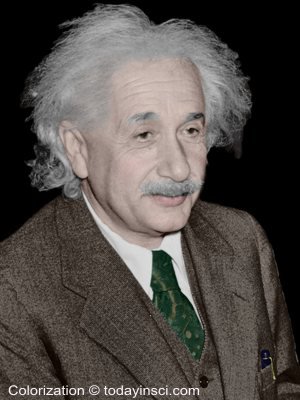
Albert Einstein
(14 Mar 1879 - 18 Apr 1955)
German-American physicist who developed the special and general theories of relativity. He was awarded the 1921 Nobel Prize for Physics for his explanation of the photoelectric effect.
|
Science Quotes by Albert Einstein (532 quotes)
>> Click for Albert Einstein Quotes on | Atomic Bomb | Belief | Biography | Concept | Construction | Creation | Discovery | Electron | Enquiry | Equation | Escape | Eternity | Everyday | Experience | Experiment | Fact | Feeling | Genius | God | Idea | Imagination | Intellect | Knowledge | Law | Life | Logic | Longing | Love | Mathematics | Motive | Nature | Newton_Isaac | Physics | Problem | Progress | Reality | Relativity | Religion | Research | Science | Science And Art | Science And Religion | Scientific | Technology | Theory | Thinking | Thought | Truth | Understanding | Vegetarian | War | Word | Work | World |
>> Click for Albert Einstein Quotes on | Atomic Bomb | Belief | Biography | Concept | Construction | Creation | Discovery | Electron | Enquiry | Equation | Escape | Eternity | Everyday | Experience | Experiment | Fact | Feeling | Genius | God | Idea | Imagination | Intellect | Knowledge | Law | Life | Logic | Longing | Love | Mathematics | Motive | Nature | Newton_Isaac | Physics | Problem | Progress | Reality | Relativity | Religion | Research | Science | Science And Art | Science And Religion | Scientific | Technology | Theory | Thinking | Thought | Truth | Understanding | Vegetarian | War | Word | Work | World |
… how the real proof should run. The main thing is the content, not the mathematics. With mathematics one can prove anything.
— Albert Einstein
Commenting on a mistake in some work from Planck, for which “the result is correct but the proof is faulty.” As quoted in Denis Brian, Einstein—A Life (1996), 76.
[A man] must learn to understand the motives of human beings, their illusions, and their sufferings human beings, their illusions, and their sufferings in order to acquire a proper relationship to individual fellow-men and to the community. These precious things … primarily constitutes and preserves culture. This is what I have in mind when I recommend the “humanities” as important, not just dry specialized knowledge in the fields of history and philosophy.
— Albert Einstein
From interview with Benjamin Fine, 'Einstein Stresses Critical Thinking', New York Times (5 Oct 1952), 37.
[An outsider views a scientist] as a type of unscrupulous opportunist: he appears as a realist, insofar as he seeks to describe the world independent of the act of perception; as idealist insofar as he looks upon the concepts and theories as the free inventions of the human spirit (not logically derivable from that which is empirically given); as positivist insofar as he considers his concepts and theories justified only to the extent to which they furnish a logical representation of relations among sense experiences. He may even appear as Platonist or Pythagorean insofar as he considers the viewpoint of logical simplicity as an indispensable and effective tool of his research.
— Albert Einstein
In 'Reply to Critcisms', Paul Arthur Schilpp (ed.), Albert Einstein: Philosopher-Scientist (1949, 1959), Vol. 2, 684.
[Ernest Rutherford is]...a second Newton.
— Albert Einstein
Weizmann
[Kepler] had to realize clearly that logical-mathematical theoretizing, no matter how lucid, could not guarantee truth by itself; that the most beautiful logical theory means nothing in natural science without comparison with the exactest experience. Without this philosophic attitude, his work would not have been possible.
— Albert Einstein
From Introduction that Einstein wrote for Carola Baumgardt and Jamie Callan, Johannes Kepler Life and Letters (1953), 13.
[Lecturing:] This has been done elegantly by Minkowski; but chalk is cheaper than grey matter, and we will do it as it comes.
— Albert Einstein
Via George Pólya, present at an early lecture on Special Relativity by Einstein, who at the time preferred to show his own old formulation, not yet embracing Minkowski’s geometrical reformulation. Quote given as Pólya’s recollection in J.E. Littlewood, A Mathematician’s Miscellany, (1953). Also in the expanded edition, Béla Bollobás (ed.), 'Odds and Ends',
Littlewood’s Miscellany (1986), 152.
[Misattributed] A little knowledge is a dangerous thing. So is a lot.
— Albert Einstein
See the original quoted on the page for Alexander Pope, beginning “A little learning …”.
[Misquotation; not by Einstein.] If only I had known, I should have become a watchmaker. [Apparently remorseful for his role in the development of the atom bomb.]
— Albert Einstein
Although often seen cited as “Attributed” New Statesman (16 Apr 1965), Ralph Keyes in The Quote Verifier: Who Said What, Where, and When (2006), 53, states “Einstein said no such thing.” See the similar quote about a plumber.
[Misquotation; not by Einstein.] You do not really understand something unless you can explain it to your grandmother.
— Albert Einstein
No evidence exists that this was ever said or written by Einstein, yet is often seen attribued to him, for example, in Rosemarie Jarski, Words from the Wise: Over 6,000 of the Smartest Things Ever Said (2007), 515. However, see a similar quote by Ernest Rutherford about explaining to a “barmaid.”
[Misquotation? Probably not by Einstein.] We owe a lot to the Indians, who taught us how to count, without which no worthwhile scientific discovery could have been made.
— Albert Einstein
Webmaster doubts that this is a true Albert Einstein quote, having been unable to find it in any major collection of quotations (although it is seen widely quoted) and has been unable to find any source or citation elsewhere. The quote seems of the notable kind that, were it valid, it would have surely have been included in a major collection of Einstein quotes. Nor has it been found attributed to someone else. So, since it is impossible to prove a negative, Webmaster can only caution anyone using this quote that it seems to be an orphan. To provide this warning is the reason it is included here. Neither can it be found attributed to someone else. Otherwise, remember the words of Studs Terkel: “I like quoting Einstein. Know why? Because nobody dares contradict you.” in ‘Voice of America’, The Guardian (1 Mar 2002). If you have knowledge of a primary source, please contact the Webmaster.
[Newton wrote to Halley … that he would not give Hooke any credit] That, alas, is vanity. You find it in so many scientists. You know, it has always hurt me to think that Galileo did not acknowledge the work of Kepler.
— Albert Einstein
In I. Bernard Cohen, 'An Interview with Einstein', in Anthony Philip French (ed.), Einstein: A Centenary Volume (1979), 41. Cited in Timothy Ferris, Coming of Age in the Milky Way (2003), 94-95.
[Almost certainly not by Einstein.] The more I study science, the more I believe in God.
— Albert Einstein
No cited primary source has been found, so it is almost certainly falsely linked with Einstein. Also, it is not compatible with Einstein’s documented statements on his religious views. See, for example, the quote beginning “It was, of course, a lie what you read about my religious convictions….” The subject quote is included here so readers may find this disclaimer.
[When asked “Dr. Einstein, why is it that when the mind of man has stretched so far as to discover the structure of the atom we have been unable to devise the political means to keep the atom from destroying us?”] That is simple, my friend. It is because politics is more difficult than physics.
— Albert Einstein
Einstein’s answer to a conferee at a meeting at Princeton, N.J. (Jan 1946), as recalled by Greenville Clark in 'Letters to the Times', in New York Times (22 Apr 1955), 24.
Die Natur hates sich nicht angelegen sein lassen, uns die Auffindung ihrer Gesetze bequem zu machen.
Nature did not deem it her business to make the discovery of her laws easy for us.
Nature did not deem it her business to make the discovery of her laws easy for us.
— Albert Einstein
English translation as in The Collected Papers of Albert Einstein, (1987), Vol. 5, 202. Also seen translated elsewhere as “Nature has not made it a priority for us to discover its laws,” or “Nature did not care to comfort us with the discovery of its laws.” Original German in letter from Prague to Erwin Freundlich (1 Sep 1911). Freundlich was an assistant at the Royal Observatory of Prussia in Berlin wishing to investigate the bending of starlight by the gravitational field of Jupiter, but Einstein pointed out it was not massive enough for a detectable effect. Einstein in the letter also lamented “If only we had an orderly planet larger than Jupiter!”
Gott würfelt nicht.
God does not play dice.
God does not play dice.
— Albert Einstein
Commonly seen paraphrase. Einstein expressed this idea at different times. See variations on this website on the Albert Einstein Quotes page.
Raffiniert ist der Herr Gott, aber boshaft ist er nicht.
The Lord God is subtle, but malicious he is not.
The Lord God is subtle, but malicious he is not.
— Albert Einstein
Remark during Einstein’s first visit to Princeton University (Apr/May 1921), responding to the news that a “non aether drift” had been found by Mount Vernon Observatory. As quoted by Banesh Hoffmann, in Albert Einstein: Creator and Rebel (1972), 146. Later posted in the Einstein lounge at the Princeton Department of Mathematics Department. Einstein’s own translation given to Derek Price was “God is slick, but he ain't mean” (1946).
Wenige sind imstande, von den Vorurteilen der Umgebung abweichende Meinungen gelassen auszusprechen; die Meisten sind sogar unfähig, überhaupt zu solchen Meinungen zu gelangen.
Few people are able to express opinions that dissent from the prejudices of their social group. The majority are even incapable of forming such opinions at all.
Few people are able to express opinions that dissent from the prejudices of their social group. The majority are even incapable of forming such opinions at all.
— Albert Einstein
Original German in Essays Presented to Leo Baeck on the Occasion of His Eightieth Birthday (1954), 26. English text by Webmaster assisted by online translation tools.
~~[Misattributed]~~ Time and space are modes by which we think and not conditions in which we live.
— Albert Einstein
Although seen in later years in various sources as a direct quote by Einstein, it apparently is not. This statement first appears as these authors’ own commentary about Einstein’s relativity theory, as given by Dimitri Marianoff and Palma Wayne, Einstein: An Intimate Study of a Great Man (1944), 62.
~~[Not in his own words]~~ Common sense is the collection of prejudices acquired by age eighteen.
— Albert Einstein
Attributed, no citation found, and probably not by Einstein. For example, it is found without citation in Albert Einstein, Jerry Mayer and John P. Holms, Bite-size Einstein (1996), 25. Listed under heading 'Probably Not by Einstein' by Alice Calaprice, The New Quotable Einstein (2005), 294. It probably morphed from a writer’s restatement of how he understood Einstein’s views, expressed in the writer’s own words, without quotation marks as: But as Einstein has pointed out, common sense is actually nothing more than a deposit of prejudices laid down in the mind prior to the age of eighteen. This statement appeared in Lincoln Barnett, 'The Universe and Dr. Einstein', Harper’s Magazine (May 1948), 473. The quoteinvestigator.com site gives more background, with the speculation on how eventually quotation marks crept in, and then propagated that way.
~~[Orphan]~~ If the facts don’t fit the theory, change the facts.
— Albert Einstein
Although in recent years seen attributed to Einstein, there seems to be no authentic source. So treat it as by “Anonymous”. Included here under Einstein to link it to this warning. Compare with, “If the facts do not agree with your theory … then so much the worse for the facts.” See quote beginning, “An enthusiastic philosopher…” on the Charles Mackay Quotes page on this website.
~~[Orphan]~~ The truth of a theory is in your mind, not in your eyes.
— Albert Einstein
Attributed, without citation, in Howard W. Eves Mathematical Circles Squared (1972), 57. Webmaster has so far not been able to verify from a primary source. Can you help?
~~[Reinterpretation]~~ The significant problems we face cannot be solved at the same level of thinking we were at when we created them.
— Albert Einstein
Yet another of the Einstein-like quotes in common circulation for which there appears to be no known source in the given wording. There are also a number of variations on the the theme. It resembles an authentic quote, “A new type of thinking is essential if mankind is to survive and move toward higher levels,” from a longer discussion, in 'Atomic Education Urged by Einstein', New York Times (25 May 1946), 13. Other reinterpretations, not in exactly Einstein’s wording, include: “No problem can be solved from the same level of consciousness that created it.” “The world will not evolve past its current state of crisis by using the same thinking that created the situation.” “The significant problems we have cannot be solved at the same level of thinking with which we created them.” “The world we have made, as a result of the level of thinking we have done thus far, creates problems we cannot solve at the same level of thinking at which we created them.” For more context, see the authentic quote that begins, “Our world faces a crisis as yet unperceived…,” on the Albert Einstein Quotes page on this website.
~~[Unverified attribution]~~ Most people stop looking when they find the proverbial needle in the haystack. I would continue looking to see if there were other needles.
— Albert Einstein
Alice Calaprice, the most definitive editor of Einstein’s quotes, relegates this to the end of her book under 'Attributed to Einstein', meaning no primary source could be verified for it when published. See Alice Calaprice (ed.), The Ultimate Quotable Einstein (2013), 481.
~~[Variant]~~ Technological progress is like an axe in the hands of a pathological criminal.
— Albert Einstein
This is a shortened variant seen for Einstein’s longer quote, “All of our exalted technological progress, civilization for that matter, is comparable to an axe in the hand of a pathological criminal.” Citation with original quote elsewhere on this web page.
A conflict arises when a religious community insists on the absolute truthfulness of all statements recorded in the Bible. This means an intervention on the part of religion into the sphere of science; this is where the struggle of the Church against the doctrines of Galileo and Darwin belongs. On the other hand, representatives of science have often made an attempt to arrive at fundamental judgments with respect to values and ends on the basis of scientific method, and in this way have set themselves in opposition to religion. These conflicts have all sprung from fatal errors.
— Albert Einstein
From an Address (19 May 1939) at Princeton Theological Seminary, 'Science and Religion', collected in Ideas And Opinions (1954, 2010), 45.
A happy man is too satisfied with the present to dwell too much on the future.
— Albert Einstein
First sentence written in a French essay, 'Mes Projets d'Avenir' (18 Sep 1896), at age 17. From original French, “Un homme heureux est trop content du présent pour trop se soucier de l'avenir.” In 'Document 22, Matura Examination (B) French: “My Future Plans”', The Collected Papers of Albert Einstein: The Early Years, 1879-1902 (1987), Vol. 1, Document 22, 28.
A human being is part of the whole, called by us “Universe”; a part limited in time and space. He experiences himself, his thoughts and feelings as something separated from the rest—a kind of optical delusion of his consciousness. This delusion is a kind of prison for us, restricting us to our personal desires and to affection for a few persons nearest us. Our task must be to free ourselves from this prison by widening our circle of compassion to embrace all living creatures and the whole of nature in its beauty. Nobody is able to achieve this completely but the striving for such achievement is, in itself, a part of the liberation and a foundation for inner security.
— Albert Einstein
In Letter (4 Mar 1950), replying to a grieving father over the loss of a young son. In Dear Professor Einstein: Albert Einstein’s Letters to and from Children (2002), 184.
A hundred times every day I remind myself that my inner and outer life depends on the labors of other men, living and dead, and that I must exert myself in order to give in the measure as I have received and am still receiving.
— Albert Einstein
…...
A little knowledge is dangerous. So is a lot.
— Albert Einstein
…...
A man should look for what is, and not for what he thinks should be.
— Albert Einstein
…...
A man who is convinced of the truth of his religion is indeed never tolerant. At the least, he is to feel pity for the adherent of another religion but usually it does not stop there. The faithful adherent of a religion will try first of all to convince those that believe in another religion and usually he goes on to hatred if he is not successful. However, hatred then leads to persecution when the might of the majority is behind it.
— Albert Einstein
…...
A man’s value to the community depends primarily on how far his feelings, thoughts, and actions are directed towards promoting the good of his fellows. We call him good or bad according to how he stands in this matter. It looks at first sight as if our estimate of a man depended entirely on his social qualities.
— Albert Einstein
…...
A people that were to honor falsehood, defamation, fraud, and murder would be unable, indeed, to subsist for very long.
— Albert Einstein
…...
A person starts to live when he can live outside himself.
— Albert Einstein
…...
A person who is religiously enlightened appears to me to be one who has, to the best of his ability, liberated himself from the fetters of his selfish desires and is preoccupied with thoughts, feelings, and aspirations to which he clings because of their superpersonal value. It seems to me that what is important is the force of this superpersonal content and the depth of the conviction concerning its overpowering meaningfulness, regardless of whether any attempt is made to unite this content with a divine Being, for otherwise it would not be possible to count Buddha and Spinoza as religious personalities. Accordingly, a religious person is devout in the sense that he has no doubt of the significance and loftiness of those superpersonal objects and goals which neither require nor are capable of rational foundation. They exist with the same necessity and matter-of-factness as he himself. In this sense religion is the age-old endeavor of mankind to become clearly and completely conscious of these values and goals and constantly to strengthen and extend their effect. If one conceives of religion and science according to these definitions then a conflict between them appears impossible. For science can only ascertain what is, but not what should be, and outside of its domain value judgments of all kinds remain necessary.
— Albert Einstein
…...
A theory can be proved by experiment; but no path leads from experiment to the birth of a theory.
— Albert Einstein
As quoted in Antonina Vallentin, Einstein: A Biography (1954), 105. The author,
a close friend of Einstein’s family, cites the quote only as “which he has recently made public.”
A theory is the more impressive the greater the simplicity of its premises is, the more different kinds of things it relates, and the more extended is its area of applicability. Therefore the deep impression which classical thermodynamics made upon me. It is the only physical theory of universal content concerning which I am convinced that within the framework of the applicability of its basic concepts, it will never be overthrown.
— Albert Einstein
Autobiographical Notes (1946), 33. Quoted in Gerald Holton and Yehuda Elkana, Albert Einstein: Historical and Cultural Perspectives (1997), 227.
After a certain high level of technical skill is achieved, science and art tend to coalesce in esthetics, plasticity, and form. The greatest scientists are always artists as well.
— Albert Einstein
Remark (1923) as recalled in Archibald Henderson, Durham Morning Herald (21 Aug 1955) in Einstein Archive 33-257. Quoted in Alice Calaprice, The Quotable Einstein (1996), 171.
All great achievements in science start from intuitive knowledge, namely, in axioms, from which deductions are then made. … Intuition is the necessary condition for the discovery of such axioms.
— Albert Einstein
In Conversations with Einstein by Alexander Moszkowski (1970).
All of our exalted technological progress, civilization for that matter, is comparable to an axe in the hand of a pathological criminal.
— Albert Einstein
Letter to Heinrich Zangger (Dec 1917), Collected Papers Vol. 8, 412, as cited in Jürgen Neffe, Einstein: A Biography (2007), 256.
All of us who are concerned for peace and triumph of reason and justice must be keenly aware how small an influence reason and honest good will exert upon events in the political field.
— Albert Einstein
…...
All religions, arts and sciences are branches of the same tree. All these aspirations are directed toward ennobling man’s life, lifting it from the sphere of mere physical existence and leading the individual towards freedom.
— Albert Einstein
'Moral Decay', Out of My Later Years (1937, 1995), 9.
All that is valuable in human society depends upon the opportunity for development accorded the individual.
— Albert Einstein
…...
All the fifty years of conscious brooding have brought me no closer to answer the question, “What are light quanta?” Of course today every rascal thinks he knows the answer, but he is deluding himself.
— Albert Einstein
(1951). Quoted in Raymond W. Lam, Seasonal Affective Disorder and Beyond (1998), 1.
Although I am a typical loner in daily life, my consciousness of belonging to the invisible community of those who strive for truth, beaut y, and justice has preserved me from feeling isolated.
— Albert Einstein
…...
An autocratic system of coercion, in my opinion, soon degenerates. For force always attracts men of low morality, and I believe it to be an invariable rule that tyrants of genius are succeeded by scoundrels. For this reason I have always been passionately opposed to systems such as we see in Italy and Russia to-day.
— Albert Einstein
In The World As I See It (1934), 240.
Any fool can know. The point is to understand.
— Albert Einstein
…...
Any man who can drive safely while kissing a pretty girl is simply not giving the kiss the attention it deserves.
— Albert Einstein
…...
Anybody who really wants to abolish war must resolutely declare himself in favor of his own country’s committing a portion of its sovereignty in favor of international institutions.
— Albert Einstein
…...
Anyone who doesn’t take truth seriously in small matters cannot be trusted in large ones either.
— Albert Einstein
…...
Anyone who has never made a mistake has never tried anything new.
— Albert Einstein
…...
Anyone who thinks science is trying to make human life easier or more pleasant is utterly mistaken.
— Albert Einstein
In 'Quotation Marks', New York Times (11 Oct 1931), XX2.
Armament is no protection against the war but leads to war. Striving for peace and preparing for war are incompatible with each other
— Albert Einstein
…...
As a child, I received instruction both in the Bible and in the Talmud. I am a Jew, but I am enthralled by the luminous figure of the Nazarene.
— Albert Einstein
…...
As an eminent pioneer in the realm of high frequency currents … I congratulate you [Nikola Tesla] on the great successes of your life’s work.
— Albert Einstein
…...
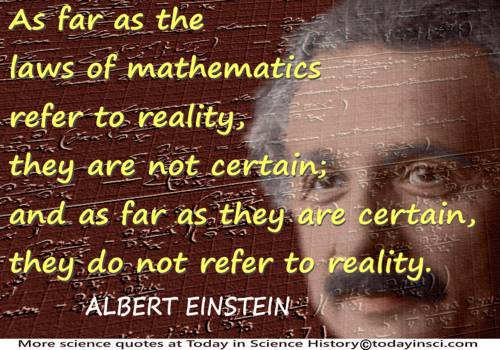
As far as the laws of mathematics refer to reality, they are not certain; and as far as they are certain, they do not refer to reality.
— Albert Einstein
Sidelights on Relativity (1920), 28.
As for the search for truth, I know from my own painful searching, with its many blind alleys, how hard it is to take a reliable step, be it ever so small, towards the understanding of that which is truly significant.
— Albert Einstein
Letter to an interested layman (13 Feb 1934). In Helen Dukas and Banesh Hoffman, Albert Einstein: The Human Side: New Glipses From His Archives (1981), 18.
As our circle of knowledge expands, so does the circumference of darkness surrounding it.
— Albert Einstein
…...
As regards religion, on the other hand, one is generally agreed that it deals with goals and evaluations and, in general, with the emotional foundation of human thinking and acting, as far as these are not predetermined by the inalterable hereditary disposition of the human species. Religion is concerned with man’s attitude toward nature at large, with the establishing of ideals for the individual and communal life, and with mutual human relationship. These ideals religion attempts to attain by exerting an educational influence on tradition and through the development and promulgation of certain easily accessible thoughts and narratives (epics and myths) which are apt to influence evaluation and action along the lines of the accepted ideals.
— Albert Einstein
…...
As the issues are greater than men ever sought to realize before, the recriminations will be fiercer and pride more desperately hurt. It may help to recall that many recognized before the bomb ever feel that the time had already come when we must learn to live in One World.
— Albert Einstein
…...
Before God we are all equally wise–and equally foolish.
— Albert Einstein
As quoted, without citation, in Albert Einstein, Cosmic Religion: With Other Opinions and Aphorisms (1931), 105.
Besides agreeing with the aims of vegetarianism for aesthetic and moral reasons, it is my view that a vegetarian manner of living by its purely physical effect on the human temperament would most beneficially influence the lot of mankind.
— Albert Einstein
In letter to Harmann Huth (27 Dec 1930). Presumably published in Vegetarische Warte (Vegetarian Watch, some time before 1935), a German magazine published by the society Vegetarier-Bund of which Harmann Huth was vice-president. As cited by Alice Calaprice (ed.) in The Ultimate Quotable Einstein (2010), 453. This might be the inspiration for a much-circulated and much-elaborated version attributed, but apparently wrongly, to Einstein. The questionable quote appears as: “Nothing will benefit human health and increase the chances for survival of life on Earth as much as the evolution to a vegetarian diet,” but no reliable source has been found for this as Einstein’s own words. Calaprice included this quote in her earlier edition of The Quotable Einstein (1996) in a final section of “Attributed to Einstein,” but it was removed from the final edition (2010), presumably because after much effort, it remained unsubstantiated.
Body and soul are not two different things, but only two different ways of perceiving the same thing. Similarly, physics and psychology are only different attempts to link our experiences together by way of systematic thought.
— Albert Einstein
(1937). In Albert Einstein, the Human Side by Helen Dukas and Banesh Hoffman (1979), 38.
But the creative principle resides in mathematics. In a certain sense, therefore, I hold it true that pure thought can grasp reality, as the ancients dreamed.
— Albert Einstein
From Herbert Spencer Lecture, at University of Oxford (10 Jun 1933), 'On the Methods of Theoretical Physics'. Printed in Philosophy of Science, (Apr 1934), 1, No. 2. Quoted and cited in epigraph, A. H. Louie, More Than Life Itself: A Synthetic Continuation in Relational Biology (2013), 81.
But, on the other hand, every one who is seriously involved in the pursuit of science becomes convinced that a spirit is manifest in the laws of the Universe—a spirit vastly superior to that of man, and one in the face of which we with our modest powers must feel humble.
— Albert Einstein
Letter (24 Jan 1936). Quoted in Helen Dukas and Banesh Hoffman, Albert Einstein: The Human Side (1981), 33.
By an application of the theory of relativity to the taste of readers, today in Germany I am called a German man of science, and in England I am represented as a Swiss Jew. If I come to be regarded as a bête noire the descriptions will be reversed, and I shall become a Swiss Jew for the Germans and a German man of science for the English!
— Albert Einstein
Times (28 Nov 1919). In Robert Andrews Famous Lines: a Columbia Dictionary of Familiar Quotations (1997), 414. Variations of this quote were made by Einstein on other occasions.
Chess grips its exponent, shackling the mind and brain so that the inner freedom and independence of even the strongest character cannot remain unaffected.
— Albert Einstein
Einstein commenting on mathematician Emanuel Lasker's fate as world chess champion (1894-1921). As quoted in Daniel Johnson, White King and Red Queen: How the Cold War Was Fought on the Chessboard (2008), 50.
Clarity about the aims and problems of socialism is of greatest significance in our age of transition. Since, under present circumstances, free and unhindered discussion of these problems has come under a powerful taboo, I consider the foundation of this magazine to be an important public service.
— Albert Einstein
…...
Classical thermodynamics ... is the only physical theory of universal content which I am convinced ... will never be overthrown.
— Albert Einstein
Quoted in Albert Einstein and Stephen Hawking (ed.), A Stubbornly Persistent Illusion (2007), 353.
Common to all these types is the anthropomorphic character of their conception of God. In general, only individuals of exceptional endowments, and exceptionally high-minded communities, rise to any considerable extent above this level. But there is a third stage of religious experience which belongs to all of them, even though it is rarely found in a pure form: I shall call it cosmic religious feeling. It is very difficult to elucidate this feeling to anyone who is entirely without it, especially as there is no anthropomorphic conception of God corresponding to it.
— Albert Einstein
…...
Compound interest is the most powerful force in the universe.
— Albert Einstein
…...
Concepts that have proven useful in ordering thi ngs easily achieve such authority over us that we forget their earthly origins and accept them as unalterable givens.
— Albert Einstein
…...
Cosmic religiousness is the strongest and most noble driving force of scientific research.
— Albert Einstein
…...
Creating a new theory is not like destroying an old barn and erecting a skyscraper in its place. It is rather like climbing a mountain, gaining new and wider views, discovering unexpected connections between our starting point and its rich environment. But the point from which we started out still exists and can be seen, although it appears smaller and forms a tiny part of our broad view gained by the mastery of the obstacles on our adventurous way up.
— Albert Einstein
Culture in its higher forms is a delicate plant which depends on a complicated set of conditions and is wont to flourish only in a few places at any given time.
— Albert Einstein
From Mein Weltbild, as translated by Alan Harris (trans.), 'Politics and Pacifism: Culture and Prosperity', The World as I See It (1956, 1993), 74.
Development of Western science is based on two great achievements: the invention of the formal logical system (in Euclidean geometry) by the Greek philosophers, and the discovery of the possibility to find out causal relationships by systematic experiment (during the Renaissance). In my opinion, one has not to be astonished that the Chinese sages have not made these steps. The astonishing thing is that these discoveries were made at all.
— Albert Einstein
Letter to J. S. Switzer, 23 Apr 1953, Einstein Archive 61-381. Quoted in Alice Calaprice, The Quotable Einstein (1996), 180.
Do not worry about your difficulties in Mathematics. I can assure you mine are still greater.
— Albert Einstein
In letter (7 Jan 1943) to Barbara Wilson, a junior high school student, who had difficulties in school with mathematics. In Einstein Archives, 42-606. Quoted in Alice Calaprice, Dear Professor Einstein: Albert Einstein's Letters to and from Children (2002), 140.
Do not worry about your problems in mathematics. I assure you, my problems with mathematics are much greater than yours.
— Albert Einstein
…...
Does there truly exist an insuperable contradiction between religion and science? Can religion be superseded by science? The answers to these questions have, for centuries, given rise to considerable dispute and, indeed, bitter fighting. Yet, in my own mind there can be no doubt that in both cases a dispassionate consideration can only lead to a negative answer. What complicates the solution, however, is the fact that while most people readily agree on what is meant by ‘science,’ they are likely to differ on the meaning of ‘religion.’
— Albert Einstein
…...
During his Zurich stay the woman doctor, Paulette Brubacher, asked the whereabouts of his [Einstein's] laboratory. With a smile he took a fountain pen out of his breast pocket and said: 'here'.
— Albert Einstein
C. Seelig, Albert Einstein: A Documentary Biography (1956), 154.
Each ray of light moves in the coordinate system 'at rest' with the definite, constant velocity V independent of whether this ray of light is emitted by a body at rest or a body in motion.
— Albert Einstein
Annalen der Physik, 1905, 17, 891-921. Trans. John Stachel et al (eds.), The Collected Papers of Albert Einstein, Vol. 2, (1989), Doc. 23, 143.
Education is what remains after one has forgotten everything he learned in school.
— Albert Einstein
…...
Enough for me the mystery of the eternity of life, and the inkling of the marvellous structure of reality, together with the single-hearted endeavour to comprehend a portion, be it never so tiny, of the reason that manifests itself in nature.
— Albert Einstein
In Alan Harris (ed.), The World As I See It (1934), 242.
Equations are more important to me, because politics is for the present, but an equation is something for eternity.
— Albert Einstein
Quoted in Carl Seelig (ed.), Helle Zeit, Dunkle Zeit: In Memoriam Albert Einstein (1956), 71.
Ethical axioms are found and tested not very differently from the axioms of science. Truth is what stands the test of experience.
— Albert Einstein
…...
Even on the most solemn occasions I got away without wearing socks and hid that lack of civilisation in high boots.
— Albert Einstein
…...
Even though the realms of religion and science in themselves are clearly marked off from each other, nevertheless there exist between the two strong reciprocal relationships and dependencies. Though religion may be that which determines the goal, it has, nevertheless, learned from science, in the broadest sense, what means will contribute to the attainment of the goals it has set up. But science can only be created by those who are thoroughly imbued with the aspiration toward truth and understanding. This source of feeling, however, springs from the sphere of religion. To this there also belongs the faith in the possibility that the regulations valid for the world of existence are rational, that is, comprehensible to reason. I cannot conceive of a genuine scientist without that profound faith. The situation may be expressed by an image: science without religion is lame, religion without science is blind.
— Albert Einstein
From paper 'Science, Philosophy and Religion', prepared for initial meeting of the Conference on Science, Philosophy and Religion in Their Relation to the Democratic Way of Life, at the Jewish Theological Seminary of America, New York City (9-11 Sep 1940). Collected in Albert Einstein: In His Own Words (2000), 212.
Every serious scientific worker is painfully conscious of this involuntary relegation to an ever-narrowing sphere of knowledge, which threatens to deprive the investigator of his broad horizon and degrades him to the level of a mechanic.
— Albert Einstein
In Ideas and Opinions (1954), 69.
Everyone is aware of the difficult and menacing situation in which human society–shrunk into one community with a common fate–now finds itself, but only a few act accordingly. Most people go on living their every-day life: half frightened, half indifferent, they behold the ghostly tragicomedy which is being performed on the international stage before the eyes and ears of the world. But on that stage, on which the actors under the floodlights play their ordained parts, our fate of tomorrow, life or death of the nations, is being decided.
— Albert Einstein
…...
Everything is determined … by forces over which we have no control. It is determined for the insect as well as the star. Human beings, vegetables, or cosmic dust—we all dance to a mysterious tune, intoned in the distance by an invisible piper.
— Albert Einstein
In interview, George Sylvester Viereck, 'What Life Means to Einstein', The Saturday Evening Post (26 Oct 1929), 117.
Everything should be made as simple as possible, but not simpler.
— Albert Einstein
Attributed.
Everything that is really great and inspiring is created by the individual who can labor in freedom.
— Albert Einstein
…...
Everything that the human race has done and thought is concerned with the satisfaction of deeply felt needs and the assuagement of pain. One has to keep this constantly in mind if one wishes to understand spiritual movements and their development. Feeling and longing are the motive force behind all human endeavor and human creation, in however exalted a guise the latter may present themselves to us.
— Albert Einstein
…...
Falling in love is not at all the most stupid thing that people do, but gravitation cannot be held responsible for it.
Scribbled by Einstein on a letter received during a visit to England (1933) from a man who suggested that gravity meant that as the world rotated people were sometimes upside down, horizontal, or at 'left angles' and that perhaps, this disorientation explained why people do foolish things like falling in love.
Scribbled by Einstein on a letter received during a visit to England (1933) from a man who suggested that gravity meant that as the world rotated people were sometimes upside down, horizontal, or at 'left angles' and that perhaps, this disorientation explained why people do foolish things like falling in love.
— Albert Einstein
In Helen Dukas and Banesh Hoffmann (editors.), Einstein: The Human Side (1981), 56.
Few are those who see with their own eyes and feel with their own hearts.
— Albert Einstein
…...
For any one who is pervaded with the sense of causal law in all that happens, who accepts in real earnest the assumption of causality, the idea of a Being who interferes with the sequence of events in the world is absolutely impossible! Neither the religion of fear nor the social-moral religion can have, any hold on him. A God who rewards and punishes is for him unthinkable, because man acts in accordance with an inner and outer necessity, and would, in the eyes of God, be as little responsible as an inanimate object is for the movements which it makes. Science, in consequence, has been accused of undermining morals—but wrongly. The ethical behavior of man is better based on sympathy, education and social relationships, and requires no support from religion. Man’s plight would, indeed, be sad if he had to be kept in order through fear of punishment and hope of rewards after death.
— Albert Einstein
From 'Religion and Science', The New York Times Magazine, (9 Nov 1930), 1. Article in full, reprinted in Edward H. Cotton (ed.), Has Science Discovered God? A Symposium of Modern Scientific Opinion (1931), 101. The wording differs significantly from the version collected in 'Religion And Science', Ideas And Opinions (1954), 39, giving its source as: “Written expressly for the New York Times Magazine. Appeared there November 9, 1930 (pp. 1-4). The German text was published in the Berliner Tageblatt, November 11, 1930.” This variant form of the quote from the book begins, “The man who is thoroughly convinced of the universal operation of the law of causation….” and is also on the Albert Einstein Quotes page on this website. As for why the difference, Webmaster speculates the book form editor perhaps used a revised translation from Einstein’s German article.
For scientific endeavor is a natural whole the parts of which mutually support one another in a way which, to be sure, no one can anticipate.
— Albert Einstein
…...
For the most part we humans live with the false impression of security and a feeling of being at home in a seemingly trustworthy physical and human environment. But when the expected course of everyday life is interrupted, we are like shipwrecked people on a miserable plank in the open sea, having forgotten where they came from and not knowing whither they are drifting. But once we fully accept this, life becomes easier and there is no longer any disappointment.
— Albert Einstein
…...
For the rest of my life I will reflect on what light is.
— Albert Einstein
(1917). Quoted in Sidney Perkowitz, Empire of Light (1999), 69.
For what is thought to be a ‘system’ is after all, just conventional, and I do not see how one is supposed to divide up the world objectively so that one can make statements about parts.
— Albert Einstein
…...
Formal symbolic representation of qualitative entities is doomed to its rightful place of minor significance in a world where flowers and beautiful women abound.
— Albert Einstein
…...
Fortunate Newton, happy childhood of science! … In one person he combined the experimenter, the theorist, the mechanic—and, not least, the artist in exposition. He stands before us strong, certain, and alone: his joy in creation and his minute precision are evident in every word and
in every figure.
— Albert Einstein
Describing the reader’s experience while perusing the Opticks. From Isaac Newton, Opticks, Or, A Treatise of the Reflections, Refractions, Inflections (1730; Dover edition, 1979), Forward by Albert Einstein, lix.
Fortunate Newton…! Nature to him was an open book, whose letters he could read without effort.
— Albert Einstein
In 'Foreword' to Isaac Newton, Opticks (1952), lix.
From a certain temperature on, the molecules 'condense' without attractive forces; that is, they accumulate at zero velocity. The theory is pretty, but is there some truth in it.
— Albert Einstein
Letter to Ehrenfest (Dec 1924). Quoted in Abraham Pais, Roger Penrose, Subtle Is the Lord: The Science and the Life of Albert Einstein (2005), 432.
Generations to come, it may be, will scarcely believe that such a one as this ever in flesh and blood walked upon this earth.
— Albert Einstein
…...
God does not care about our mathematical difficulties. He integrates empirically.
— Albert Einstein
Quoted, without citation, by Léopold Infeld in Quest (1942, 1980), 279. If you know the primary source, please contact Webmaster.
Great spirits have always encountered violent opposition from mediocre minds.
— Albert Einstein
…...
Great spirits have always found violent opposition from mediocrities. The latter cannot understand it when a man does not thoughtlessly submit to hereditary prejudices but honestly and courageously uses his intelligence and fulfills the duty to express the results of his thoughts in clear form.
— Albert Einstein
…...
Grossmann, you must help me, or else I’ll go crazy!
— Albert Einstein
From the original German: “Grossmann, Du mußt mir helfen, sonst werd’ ich verrückt!” Einstein implored his mathematician friend, Marcel Grossmann, for collaboration. Einstein lacked knowledge on using higher-dimensional differential geometry, but realized he needed it to describe gravitation when developing his general theory of relativity. As quoted in K. Kollros, Helv. Phys. Acta. Suppl. (1956), 4, 271. As cited in Abraham Pais, Subtle is the Lord (1982, 2005), 212.
Have holy curiosity.
— Albert Einstein
…...
He who finds a thought that lets us even a little deeper into the eternal mystery of nature has been granted great peace.
— Albert Einstein
…...
He who has never been deceived by a lie does not know the meaning of bliss.
— Albert Einstein
In a letter to Elsa Lowenthal, April 30, 1912.
He who joyfully marches to music in rank and file has already earned my contempt. He has been given a large brain by mistake, since for him the spinal cord would fully suffice. This disgrace to civilisation should be done away with at once. Heroism at command, senseless brutality, deplorable love-of-country stance, how violently I hate all this, how despicable and ignoble war is; I would rather be torn to shreds than be part of so base an action! It is my conviction that killing under the cloak of war is nothing but an act of murder.
— Albert Einstein
…...
Here arises a puzzle that has disturbed scientists of all periods. How can it be that mathematics, being after all a product of human thought which is independent of experience, is so admirably appropriate to the objects of reality? Is human reason, then, without experience, merely by taking thought, able to fathom the properties of real things?
— Albert Einstein
From 'Geometry and Experience', an expanded form of an Address by Albert Einstein to the Prussian Academy of Sciences in Berlin (27 Jan 1921). In Albert Einstein, translated by G. B. Jeffery and W. Perrett, Sidelights on Relativity (1923).
His [Isaac Newton’s] observations of the colours of thin films [were] the origin of the next great theoretical advance, which had to await, over a hundred years, the coming of Thomas Young.
— Albert Einstein
In 'Foreword' to Isaac Newton, Opticks: Or, A Treatise of the Reflections, Refractions, Inflections & Colours of Light. Based on the 4th Ed., London, 1730 (1952), lix-lx.
Hitler is living—or shall I say sitting?—on the empty stomach of Germany. As soon as economic conditions improve, Hitler will sink into oblivion. He dramatizes impossible extremes in an amateurish manner.
— Albert Einstein
In Cosmic Religion: With Other Opinions and Aphorisms (1931), 105. Also quoted in book review, 'Einstein Obiter Dicta', Time (6 Oct 1930), 16, No. 14, 18.
How can cosmic religious feeling be communicated from one person to another, if it can give rise to no definite notion of a God and no theology? In my view, it is the most important function of art and science to awaken this feeling and keep it alive in those who are receptive to it.
— Albert Einstein
…...
How does it happen that a properly endowed natural scientist comes to concern himself with epistemology?
— Albert Einstein
…...
How insidious Nature is when one is trying to get at it experimentally.
— Albert Einstein
Letter to Michele Besso (15 Feb 1915). As quoted in Albrecht Fösling, Albert Einstein (1998), 362.
How much do I love that noble man / More than I could tell with words / I fear though he’ll remain alone / With a holy halo of his own.
— Albert Einstein
…...
How strange is the lot of us mortals! Each of us is here for a brief sojourn; for what purpose he knows not, though he sometimes thinks he senses it. But without deeper reflection one knows from daily life that one exists for other people–first of all for those upon whose smiles and well-being our own happiness is wholly dependent, and then for the many, unknown to us, to whose destinies we are bound by the ties of sympathy. A hundred times every day I remind myself that my inner and outer life are based on the labors of other men, living and dead, and that I must exert myself in order to give in the same measure as I have received and am still receiving.
— Albert Einstein
…...
However, all scientific statements and laws have one characteristic in common: they are “true or false” (adequate or inadequate). Roughly speaking, our reaction to them is “yes” or “no.” The scientific way of thinking has a further characteristic. The concepts which it uses to build up its coherent systems are not expressing emotions. For the scientist, there is only “being,” but no wishing, no valuing, no good, no evil; no goal. As long as we remain within the realm of science proper, we can never meet with a sentence of the type: “Thou shalt not lie.” There is something like a Puritan's restraint in the scientist who seeks truth: he keeps away from everything voluntaristic or emotional.
— Albert Einstein
Essays in Physics (1950), 68.
I agree with Schopenhauer that one of the most powerful motives that attracts people to science and art is the longing to escape from everyday life.
— Albert Einstein
Quoted, without citation in Bulletin of the Atomic Scientists (Feb 1959), 85. If you know a primary source, please contact Webmaster.
I agree with your remark about loving your enemy as far as actions are concerned. But for me the cognitive basis is the trust in an unrestricted causality. ‘I cannot hate him, because he must do what he does.’ That means for me more Spinoza than the prophets.
— Albert Einstein
…...
I am a horse for single harness, not cut out for tandem or teamwork.
— Albert Einstein
In Leopold Infeld, Quest, the Evolution of a Scientist (1941), 287.
I am absolutely convinced that no wealth in the world can help humanity forward, even in the hands of the most devoted worker. The example of great and pure individuals is the only thing that can lead us to noble thoughts and deeds. Money only appeals to selfishness and irresistibly invites abuse. Can anyone imagine Moses, Jesus or Gandhi armed with the moneybags of Carnegie?
— Albert Einstein
…...
I am an adherent of the ideal of democracy, although I well know the weaknesses of the democratic form of government. Social equality and economic protection of the individual appeared to me always as the important communal aims of the state.
— Albert Einstein
…...
I am by heritage a Jew, by citizenship a Swiss, and by makeup a human being, and only a human being, without any special attachment to any state or national entity whatsoever.
— Albert Einstein
…...
I am convinced there is only one way to eliminate these grave evils, namely through the establishment of a socialist economy, accompanied by an educational system which would be oriented toward social goals.
— Albert Einstein
…...
I am not only a pacifist but a militant pacifist. I am willing to fight for peace. Nothing will end war unless the people themselves refuse to go to war.
— Albert Einstein
…...
I am quite aware that we have just now lightheartedly expelled in imagination many excellent men who are largely, perhaps chiefly, responsible for the buildings of the temple of science; and in many cases our angel would find it a pretty ticklish job to decide. But of one thing I feel sure: if the types we have just expelled were the only types there were, the temple would never have come to be, any more than a forest can grow which consists of nothing but creepers. For these people any sphere of human activity will do, if it comes to a point; whether they become engineers, officers, tradesmen, or scientists depends on circumstances.
— Albert Einstein
…...
I am satisfied with the mystery of life’s eternity and with a knowledge, a sense, of the marvelous structure of existence–as well as the humble attempt to understand even a tiny portion of the Reason that manifests itself in nature.
— Albert Einstein
…...
I am truly a ‘lone traveler’ and have never belonged to my country, my home, my friends, or even my immediate family, with my whole heart; in the face of all these ties, I have never lost a sense of distance and a need for solitude.
— Albert Einstein
…...
I assert that the cosmic religious experience is the strongest and the noblest driving force behind scientific research.
— Albert Einstein
…...
I believe in intuition and inspiration. Imagination is more important than knowledge. For knowledge is limited, whereas imagination embraces the entire world, stimulating progress, giving birth to evolution. It is, strictly speaking, a real factor in scientific research.
— Albert Einstein
Cosmic Religion: With Other Opinions and Aphorisms (1931), 97.
I believe in Spinoza’s God, Who reveals Himself in the lawful harmony of the world, not in a God Who concerns Himself with the fate and the doings of mankind.
— Albert Einstein
…...
I believe no woman could have invented calculus.
— Albert Einstein
…...
I believe that pipe smoking contributes to a somewhat calm and objective judgment in all human affairs.
— Albert Einstein
…...
I believe with Schopenhauer that one of the strongest motives that lead men to art and science is escape from everyday life with its painful crudity and hopeless dreariness, from the fetters of one’s own ever shifting desires. A finely tempered nature longs to escape from personal life into the world of objective perception and thought; this desire may be compared with the townsman’s irresistible longing to escape from his noisy, cramped surroundings into the silence of high mountains, where the eye ranges freely through the still, pure air and fondly traces out the restful contours apparently built for eternity.
— Albert Einstein
Address at The Physical Society, Berlin (1918) for Max Planck’s 60th birthday, 'Principles of Research', collected in Essays in Science (1934) 2.
I can understand your aversion to the use of the term ‘religion’ to describe an emotional and psychological attitude which shows itself most clearly in Spinoza ... I have not found a better expression than ‘religious’ for the trust in the rational nature of reality that is, at least to a certain extent, accessible to human reason.
— Albert Einstein
…...
I cannot accept any concept of God based on the fear of life or the fear of death, or blind faith.
— Albert Einstein
As recollected from a visit some months earlier, and quoted in William Miller, 'Old Man’s Advice to Youth: “Never Lose a Holy Curiosity”', Life (2 May 1955), 62.
I cannot conceive of a God who rewards and punishes his creatures, or has a will of the type of which we are conscious in ourselves. An individual who should survive his physical death is also beyond my comprehension, nor do I wish it otherwise; such notions are for the fears or absurd egoism of feeble souls.
— Albert Einstein
…...
I cannot imagine a God who rewards and punishes the objects of his creation, whose purposes are modeled after our own–a God, in short, who is but a reflection of human frailty. Neither can I believe that the individual survives the death of his body, although feeble souls harbor such thoughts through fear or ridiculous egotism. It is enough for me to contemplate the mystery of conscious life perpetuating itself through all eternity, to reflect upon the marvelous structure of the universe which we can dimly perceive, and to try humbly to comprehend even an infinitesimal part of the intelligence manifested in nature.
— Albert Einstein
From 'What I Believe: Living Philosophies XIII', Forum and Century (Oct 1930), 84, No. 4, 194. Article in full, reprinted in Edward H. Cotton (ed.), Has Science Discovered God? A Symposium of Modern Scientific Opinion (1931), 97.
I cannot seriously believe in it [quantum theory] because the theory cannot be reconciled with the idea that physics should represent a reality in time and space, free from spooky actions at a distance [spukhafte Fernwirkungen].
— Albert Einstein
Letter to Max Born (3 Mar 1947). In Born-Einstein Letters (1971), 158.
I consider it important, indeed urgently necessary, for intellectual workers to get together, both to protect their own economic status and, also, generally speaking, to secure their influence in the political field.
— Albert Einstein
…...
I could burn my fingers that I wrote that first letter to Roosevelt.
— Albert Einstein
…...
I didn’t arrive at my understanding of the fundamental laws of the universe through my rational mind.
— Albert Einstein
…...
I do not believe in freedom of the will. Schopenhauer’s words: ‘Man can do what he wants, but he cannot will what he wills’ accompany me in all situations throughout my life and reconcile me with the actions of others even if they are rather painful to me. This awareness of the lack of freedom of will preserves me from taking too seriously myself and my fellow men as acting and deciding individuals and from losing my temper.
— Albert Einstein
…...
I do not believe that a moral philosophy can ever be founded on a scientific basis. … The valuation of life and all its nobler expressions can only come out of the soul’s yearning toward its own destiny. Every attempt to reduce ethics to scientific formulas must fail. Of that I am perfectly convinced.
— Albert Einstein
In 'Science and God: A Dialogue', Forum and Century (June 1930), 83, 374. Einstein’s dialogue was with James Murphy and J.W.N. Sullivan. Excerpted in David E. Rowe and Robert J. Schulmann, Einstein on Politics: His Private Thoughts and Public Stands on Nationalism, Zionism, War, Peace, and the Bomb (2007), 230. The book introduces this quote as Einstein’s reply when Murphy asked, in the authors’ words, “how far he thought modern science might be able to go toward establishing practical ideals of life on the ruins of religious ideals.”
I do not see any reason to assume that the heuristic significance of the principle of general relativity is restricted to gravitation and that the rest of physics can be dealt with separately on the basis of special relativity, with the hope that later on the whole may be fitted consistently into a general relativistic scheme. I do not think that such an attitude, although historically understandable, can be objectively justified. The comparative smallness of what we know today as gravitational effects is not a conclusive reason for ignoring the principle of general relativity in theoretical investigations of a fundamental character. In other words, I do not believe that it is justifiable to ask: What would physics look like without gravitation?
— Albert Einstein
…...
I do not think words alone will solve humanity’s present problems. The sound of bombs drowns out
men’s voices. In times of peace I have great faith in the communication of ideas among thinking men, but today, with brute force dominating so many millions of lives, I fear that the appeal to
man’s intellect is fast becoming virtually meaningless.
— Albert Einstein
In 'I Am an American' (22 Jun 1940), Einstein Archives 29-092. Excerpted in David E. Rowe and Robert J. Schulmann, Einstein on Politics: His Private Thoughts and Public Stands on Nationalism, Zionism, War, Peace, and the Bomb (2007), 470. It was during a radio broadcast for the Immigration and Naturalization Service, interviewed by a State Department Official. Einstein spoke following an examination on his application for American citizenship in Trenton, New Jersey. The attack on Pearl Harbor and America’s declaration of war on Japan was still over a year in the future.
I don’t believe in mathematics.
— Albert Einstein
A offhand remark when discussing the rigid rules of mathematics in a café conversation with engineer Gustave Ferrière. As quoted in Denis Brian, Einstein—A Life (1996), 76.
I don’t pretend to understand the universe–it’s much bigger than I am.
— Albert Einstein
…...
I even believe that those who consider themselves to be opponents of Mach barely know how many of his views they absorbed, in a manner of speaking, with their mother’s milk.
— Albert Einstein
Translation from obituary, 'Ernst Mach', Physikalische Zeitschrift (1 Apr 1916), 102. Einstein was pointing out how Mach as a science philosopher had influenced and continued to exert upon generations of physicists. Originally written in German, the subject quote is a translation into English. There are slight variations in wording in other translations. For example: “I believe that even those who consider themselves opponents of Mach are hardly aware of how much of Mach’s way of thinking they imbibed, so to speak, with their mother’s milk.” From the original German text: “Ich glaube sogar, daß diejenigen, welche sich für Gegner Machs halten, kaum wissen, wieviel von Machscher Betrachtungsweise sie sozusagen mit der Muttermilch eingesogen haben.”
I gang my own gait and have never belonged to my country, my home, my friends, or even my immediate family, with my whole heart; in the face of all these ties I have never lost an obstinate sense of detachment, of the need for solitude–a feeling which increases with the years.
— Albert Einstein
…...
I have always eaten animal flesh with a somewhat guilty conscience.
— Albert Einstein
From Einstein Archive 60-058 (Aug 1953). Cited in Alice Calaprice (ed.), The Quotable Einstein (1996), 216.
I have deep faith that the principle of the universe will be beautiful and simple.
— Albert Einstein
…...
I have found no better expression than ‘religious’ for confidence in the rational nature of reality, insofar as it is accessible to human reason. Whenever this feeling is absent, science degenerates into uninspired empiricism.
— Albert Einstein
…...
I have just got a new theory of eternity.
— Albert Einstein
Alleged comment to the secretary of the Netherlands embassy, seated beside him at a National Academy of Sciences annual awards ceremony (1921), after listening to lengthy formal speeches. As quoted in Ronald W. Clark, Einstein: The Life and Times (1971), 389.
I have little patience with scientists who take a board of wood, look for its thinnest part and drill a great number of holes where drilling is easy.
— Albert Einstein
P. Frank in 'Einstein's Philosophy of Science', Reviews of Modern Physics (1949).
I have never looked upon ease and happiness as ends in themselves–this critical basis I call the ideal of a pigsty. The ideals that have lighted my way, and time after time have given me new courage to face life cheerfully, have been Kindness, Beauty, and Truth. Without the sense of kinship with men of like mind, without the occupation with the objective world, the eternally unattainable in the field of art and scientific endeavors, life would have seemed empty to me. The trite objects of human efforts–possessions, outward success, luxury–have always seemed to me contemptible.
— Albert Einstein
In 'What I Believe,' Forum and Century (1930).
I have no special talents. I am only passionately curious.
— Albert Einstein
Letter to Carl Seelig (11 Mar 1952), AEA 39-013. As cited in Walter Isaacson, Einstein: His Life and Universe (2008), 548.
I have now reached the point where I may indicate briefly what to me constitutes the essence of the crisis of our time. It concerns the relationship of the individual to society. The individual has become more conscious than ever of his dependence upon society. But he does not experience this dependence as a positive asset, as an organic tie, as a protective force, but rather as a threat to his natural rights, or even to his economic existence. Moreover, his position in society is such that the egotistical drives of his make-up are constantly being accentuated, while his social drives, which are by nature weaker, progressively deteriorate. All human beings, whatever their position in society, are suffering from this process of deterioration. Unknowingly prisoners of their own egotism, they feel insecure, lonely, and deprived of the naive, simple, and unsophisticated enjoyment of life. Man can find meaning in life, short and perilous as it is, only through devoting himself to society.
— Albert Einstein
…...
I have second thoughts. Maybe God is malicious.
Told to Valentine Bargmann.
Told to Valentine Bargmann.
— Albert Einstein
Quoted in J. Sayen, Einstein in America (1958), 51.
I know not with what weapons World War III will be fought, but World War IV will be fought with sticks and stones.
— Albert Einstein
In interview, Alfred Werner, Liberal Judaism (Apr-May 1949), 16. Einstein Archive 30-1104. As cited in Alice Calaprice, The New Quotable Einstein (2005), 173.
I live in that solitude which is painful in youth, but delicious in the years of maturity.
— Albert Einstein
…...
I love to travel, but hate to arrive.
— Albert Einstein
…...
I never think of the future. It comes soon enough. When visiting the U.S. from Germany for a winter academic stay.
— Albert Einstein
From interview aboard the liner Belgenland (Dec 1930).
I sometimes ask myself how it came about that I was the one to develop the theory of relativity. The reason, I think, is that a normal adult never stops to think about the problem of space and time. These are things which he has thought of as a child. But my intellectual development was retarded, as a result of which I began to wonder about space and time only when I had already grown up.
— Albert Einstein
In Ronald W. Clark, Einstein: The Life and Times (1971), 10.
I think and think for months and years. Ninety-nine times, the conclusion is false. The hundredth time I am right.
— Albert Einstein
…...
I think that a particle must have a separate reality independent of the measurements. That is an electron has spin, location and so forth even when it is not being measured. I like to think that the moon is there even if I am not looking at it.
— Albert Einstein
…...
I think that only daring speculation can lead us further and not accumulation of facts.
— Albert Einstein
…...
I used to wonder how it comes about that the electron is negative. Negative-positive—these are perfectly symmetric in physics. There is no reason whatever to prefer one to the other. Then why is the electron negative? I thought about this for a long time and at last all I could think was 'It won the fight!'
— Albert Einstein
Quoted in George Wald, 'The Origin of Optical Activity', Annals of the New York Academy of Sciences (1957), 60, 352-68.
I want to know God’s thoughts; the rest are details.
— Albert Einstein
…...
I want to know how God created this world. I am not interested in this or that phenomenon, in the spectrum of this or that element. I want to know His thoughts; the rest are details.
— Albert Einstein
…...
I was sitting in a chair in the patent office at Bern when all of a sudden a thought occurred to me: “If a person falls freely he will not feel his own weight.” I was startled. This simple thought made a deep impression on me. It impelled me toward a theory of gravitation.
— Albert Einstein
Lecture in Japan (1922). The quote is footnoted in Michael White, John Gribbin, Einstein: a Life in Science (1995), 128, saying the talk is known as the 'Kyoto address', reported in J. Ishiwara, Einstein Koen-Roku (1977).
I wish they don’t forget to keep those treasures pure which they have in excellence over the west: their artistic building of life, the simplicity a nd modesty in personal need, and the pureness and calmness of Japanese soul.
— Albert Einstein
…...
I’m not an atheist and I don’t think I can call myself a pantheist. We are in the position of a little child entering a huge library filled with books in many different languages. The child knows someone must have written those books. It doe s not know how. The child dimly suspects a mysterious order in the arrangement of the books but doesn’t know what it is. That, it seems to me, is the attitude of even the most intelligent human being toward God.
— Albert Einstein
…...
If a body releases the energy L in the form of radiation, its mass is decreased by L/V2.
[Now expressed as E= mc2 where E=energy, m=mass, c=velocity of light. This relationship of mass and energy initiated the atomic era.]
[Now expressed as E= mc2 where E=energy, m=mass, c=velocity of light. This relationship of mass and energy initiated the atomic era.]
— Albert Einstein
Annalen der Physik, 1905, 18, 639-641. Quoted in Alice Calaprice, The Quotable Einstein (1996), 165.
If A is a success in life, I should say the formula is A = X + Y + Z, X being work and Y being play. … … [Z] is keeping your mouth shut.
— Albert Einstein
Reply to question about what Einstein considered “the best formula for success in life,” asked by S.J. Woolf in an interview at Einstein's home, published as 'Einstein’s Own Corner of Space’, New York Times (18 Aug 1929), Sunday Magazine, 1. Also stated in Carl Seelig, Albert Einstein: A Documentary Biography (1956), 54, as “A (Success) = X (Work) + Y (Play) + Z (Keep your mouth shut).
If at first, the idea is not absurd, there is no hope for it.
— Albert Einstein
In Marc J. Madou, Fundamentals of Microfabrication: the Science of Miniaturization (2nd ed., 2002), 535.
If I could remember the names of all these particles I’d be a botanist.
— Albert Einstein
…...
If I give you a pfennig, you will be one pfennig richer and I’ll be one pfennig poorer. But if I give you an idea, you will have a new idea, but I shall still have it, too.
— Albert Einstein
…...
If I were not a physicist, I would probably be a musician. I often think in music. I live my dreams in music. I see my life in terms of music... I get most joy in life out of music.
— Albert Einstein
…...
If I would be a young man again and had to decide how to make my living, I would not try to become a scientist or scholar or teacher. I would rather choose to be a plumber or a peddler in the hope to find that modest degree of independence still available under present circumstances.
— Albert Einstein
According to Ralph Keyes, The Quote Verifier: Who Said What, Where, and When (2006), 53, on other occasions Einstein said “he might rather have been a musician, or light-house keeper”; however it is a “popular misquotation” that refers to being a watchmaker.
If I would follow your advice and Jesus could perceive it, he, as a Jewish teacher, surely would not approve of such behavior.
— Albert Einstein
…...
If my theory of relativity is proven successful, Germany will claim me as a German and France will declare I am a citizen of the world. Should my theory prove untrue, France will say I am a German and Germany will declare I am a Jew.
— Albert Einstein
In Speech (6 Apr 1922) to the French Philosophical Society, Sorbonne. Quoted in Alice Calaprice, The Quotable Einstein (1996), 8.
If one purges the Judaism of the Prophets and Christianity as Jesus Christ taught it of all subsequent additions, especially those of the priests, one is left with a teaching which is capable of curing all the social ills of humanity.
— Albert Einstein
…...
If people are good only because they fear punishment, and hope for reward, then we are a sorry lot indeed.
— Albert Einstein
…...
If the bee disappeared off the face of the earth, man would only have four years left to live.
This is regarded as probably NOT a quote by Einstein.
This is regarded as probably NOT a quote by Einstein.
— Albert Einstein
This is something Einstein most probably did NOT say! Since scholarly search for this quote has thus far found no reliable source for it, it must at least be classed as undetermined. Furthermore, since its first appearance is 40 years after his death, in dubious context for authenticity, it deserves to be regarded as spurious. See snopes.com article. It is added here to serve as a caution to the reader.
If we consider that part of the theory of relativity which may nowadays in a sense be regarded as bone fide scientific knowledge, we note two aspects which have a major bearing on this theory. The whole development of the theory turns on the question of whether there are physically preferred states of motion in Nature (physical relativity problem). Also, concepts and distinctions are only admissible to the extent that observable facts can be assigned to them without ambiguity (stipulation that concepts and distinctions should have meaning). This postulate, pertaining to epistemology, proves to be of fundamental importance.
— Albert Einstein
'Fundamental ideas and problems of the theory of relativity', Lecture delivered to the Nordic Assembly of Naturalists at Gothenburg, 11 Jul 1923. In Nobel Physics 1901-1921 (1998), 482.
If we knew what it was we were doing, it would not be called research, would it?
— Albert Einstein
…...
If we knew what we were doing, it wouldn’t be called research, would it?
— Albert Einstein
…...
If you are out to describe the truth, leave elegance to the tailor.
On being reproached that his formula of gravitation was longer and more cumbersome than Newton’s.
On being reproached that his formula of gravitation was longer and more cumbersome than Newton’s.
— Albert Einstein
Quoted in J. H. Mitchell, Writing for Professional and Technical Journals (1968), Introduction.
If you want to find out anything from the theoretical physicists about the methods they use, I advise you to stick closely to one principle: don't listen to their words, fix your attention on their deeds. To him who is a discoverer in this field the products of his imagination appear so necessary and natural that he regards them, and would like to have them regarded by others, not as creations of thought but as given realities.
— Albert Einstein
From 'On the Method of Theoretical Physics', in Essays in Science (1934, 2004), 12.
If you want your children to be intelligent, read them fairy tales. If you want them to be more intelligent, read them more fairy tales.
— Albert Einstein
…...
If you wish to learn from the theoretical physicist anything about the methods which he uses, I would give you the following piece of advice: Don’t listen to his words, examine his achievements. For to the discoverer in that field, the constructions of his imagination appear so necessary and so natural that he is apt to treat them not as the creations of his thoughts but as given realities.
— Albert Einstein
In Herbert Spencer Lecture at Oxford (10 Jun 1933), 'On the Methods of Theoretical Physics'. Printed inPhilosophy of Science (Apr 1934), 1, No. 2, 163.
In every true searcher of Nature there is a kind of religious reverence, for he finds it impossible to imagine that he is the first to have thought out the exceedingly delicate threads that connect his perceptions.
— Albert Einstein
1920, in Conversations with Einstein by Alexander Moszkowski (1970).
In human freedom in the philosophical sense I am definitely a disbeliever. Everybody acts not only under external compulsion but also in accordance with inner necessity. Schopenhauer’s saying, that ‘a man can do what he wants, but not want what he wants,’ has been an inspiration to me since my youth up, and a continual consolation and unfailing well-spring of patience in the face of the hardships of life, my own and others. This feeling mercifully not only mitigates the sense of responsibility which so easily becomes paralysing, and it prevents us from taking ourselves and other people too seriously; it conduces to a view of life in which humour, above all, has its due place.
— Albert Einstein
In The World As I See It (1934), 238.
In light of new knowledge ... an eventual world state is not just desirable in the name of brotherhood, it is necessary for survival ... Today we must abandon competition and secure cooperation. This must be the central fact in all our considerations of international affairs; otherwise we face certain disaster. Past thinking and methods did not prevent world wars. Future thinking must prevent wars.
— Albert Einstein
…...
In long intervals I have expressed an opinion on public issues whenever they appeared to be so bad and unfortunate that silence would have made me feel guilty of complicity.
— Albert Einstein
…...
In my opinion it is not right to bring politics into scientific matters, nor should individuals be held responsible for the government of the country to which they happen to belong.
— Albert Einstein
In Einstein: A Centenary Volume edited by A. P. French (1979).
In my opinion there is no other salvation for civilization and even for the human race than the creation of a world government with security on the basis of law. As long as there are sovereign states with their separate armaments and armament secrets, new world wars cannot be avoided.
— Albert Einstein
Interview comment reported in 'For a World Government: Einstein Says This is Only Way to Save Mankind', New York Times (15 Sep 1945), 11.
In one person he [Isaac Newton] combined the experimenter, the theorist, the mechanic and, not least, the artist in exposition.
— Albert Einstein
In 'Foreword' to Isaac Newton, Opticks (1952), lix.
In order to form an immaculate member of a flock of sheep one must, above all, be a sheep.
— Albert Einstein
…...
In the beginning (if there was such a thing), God created Newton’s laws of motion together with the necessary masses and forces. This is all; everything beyond this follows from the development of appropriate mathematical methods by means of deduction.
— Albert Einstein
Autobiographical Notes (1946), 19. In Albert Einstein, Alice Calaprice, Freeman Dyson , The Ultimate Quotable Einstein (2011), 397.
In the case of a Christian clergyman, the tragic-comical is found in this: that the Christian religion demands love from the faithful, even love for the enemy. This demand, because it is indeed superhuman, he is unable to fulfill. Thus intolerance and hatred ring through the oily words of the clergyman. The love, which on the Christian side is the basis for the conciliatory attempt towards Judaism is the same as the love of a child for a cake. That means that it contains the hope that the object of the love will be eaten up.
— Albert Einstein
…...
In the judgment of the most competent living mathematicians, Fraulein Noether was the most significant mathematical genius thus far produced since the higher education of women began.
— Albert Einstein
In letter (1 May 1935), Letters to the Editor, 'The Late Emmy Noether: Professor Einstein Writes in Appreciation of a Fellow-Mathematician', New York Times (4 May 1935), 12.
In the light of knowledge attained, the happy achievement seems almost a matter of course, and any intelligent student can grasp it without too much trouble. But the years of anxious searching in the dark, with their intense longing, their alternations of confidence and exhaustion, and the final emergence into the light—only those who have experienced it can understand that.
— Albert Einstein
Quoted in Banesh Hoffmann and Helen Dukas, Albert Einstein: Creator and Rebel (1972), 124.
In the matter of physics, the first lessons should contain nothing but what is experimental and interesting to see. A pretty experiment is in itself often more valuable than twenty formulae extracted from our minds.
— Albert Einstein
…...
In the temple of science are many mansions, and various indeed are they that dwell therein and the motives that have led them thither. Many take to science out of a joyful sense of superior intellectual power; science is their own special sport to which they look for vivid experience and the satisfaction of ambition; many others are to be found in the temple who have offered the products of their brains on this altar for purely utilitarian purposes. Were an angel of the Lord to come and drive all the people belonging to these two categories out of the temple, the assemblage would be seriously depleted, but there would still be some men, of both present and past times, left inside. Our Planck is one of them, and that is why we love him.
— Albert Einstein
Address at Physical Society, Berlin (1918), for Max Planck’s 60th birthday, 'Principles of Research' in Essays in Science (1934, 2004), 1.
In view of such harmony in the cosmos which I, with my limited human mind, am able to recognise, there are yet people who say there is no God. But what makes me really angry is that they quote me for support of such views.
— Albert Einstein
…...
Innovation is not the product of logical thought, even though the final product is tied to a logical structure.
— Albert Einstein
…...
Insanity: doing the same thing over and over again and expecting different results.
— Albert Einstein
…...
Insofar as mathematics is about reality, it is not certain, and insofar as it is certain, it is not about reality.
— Albert Einstein
…...
It follows from the theory of relativity that mass and energy are both different manifestations of the same thing—a somewhat unfamiliar conception for the average man. Furthermore E=MC2, in which energy is put equal to mass multiplied with the square of the velocity of light, showed that a very small amount of mass may be converted into a very large amount of energy... the mass and energy were in fact equivalent.
— Albert Einstein
As expressed in the Einstein film, produced by Nova Television (1979). Quoted in Alice Calaprice, The Quotable Einstein (1996), 183.
It gave me great pleasure to tell you about the mysteries with which physics confronts us. As a human being, one has been endowed with just enough intelligence to be able to see clearly how utterly inadequate that intelligence is when confronted with what exists. If such humility could be conveyed to everybody, the world of human activities would be more appealing.
— Albert Einstein
Letter (19 Sep 1932) replying to Queen Elizabeth of Belgium, in which she had complimented his lucid explanation of the casual and probabilistic theories in physics during a wander with her, in a park. As quoted in Albert Einstein, edited by Helen Dukas and Banesh Hoffman, Albert Einstein, The Human Side: Glimpses from His Archives (1979, 2013), 48.
It has become appallingly obvious that our technology has exceeded our humanity.
— Albert Einstein
…...
It has often been said, and certainly not without justification, that the man of science is a poor philosopher. Why then should it not be the right thing for the physicist to let the philosopher do the philosophising? Such might indeed be the right thing to do a time when the physicist believes he has at his disposal a rigid system of fundamental laws which are so well that waves of doubt can't reach them; but it cannot be right at a time when the very foundations of physics itself have become problematic as they are now … when experience forces us to seek a newer and more solid foundation.
— Albert Einstein
‘Physics and Reality’, Franklin Institute Journal (Mar 1936). Collected in Out of My Later Years (1950), 58.
It is a scale of proportions which makes the bad difficult and the good easy.
— Albert Einstein
…...
It is almost a miracle that modern teaching methods have not yet entirely strangled the holy curiousity of inquiry; for what this delicate little plant needs more than anything, besides stimulation, is freedom.
— Albert Einstein
Quoted in H. Eves, Return to Mathematical Circles.
It is also vital to a valuable education that independent critical thinking be developed in the young human being, a development that is greatly jeopardized by overburdening with too much and too varied subjects. Overburdening necessarily leads to superficiality.
— Albert Einstein
From interview with Benjamin Fine, 'Einstein Stresses Critical Thinking', New York Times (5 Oct 1952), 37. [Here, “superficiality” has been inserted as a correction for a typo, “superciality”, in the original text. —Webmaster]
It is an irony of fate that I myself have been the recipient of excessive admiration and reverence from my fellow-beings, through no fault, and no merit, of my own. The cause of this may well be the desire, unattainable for many, to understand the few ideas to which I have with my feeble powers attained through ceaseless struggle. I am quite aware that for any organisation to reach its goals, one man must do the thinking and directing and generally bear the responsibility. But the led must not be coerced, they must be able to choose their leader.
— Albert Einstein
In 'What I Believe', Forum and Century (1930), 84, 193-194.
It is appallingly obvious that our technology exceeds our humanity.
— Albert Einstein
…...
It is certainly true that principles cannot be more securely founded than on experience and consciously clear thinking.
— Albert Einstein
'The Goal' lecture at Princeton University (1939), quoted in Philipp Frank and George Rosen, Einstein (2002), 287.
It is clear that all the valuable things, material, spiritual, and moral, which we receive from society can be traced back through countless generations to certain creative individuals. The use of fire, the cultivation of edible plants, the steam engine–each was discovered by one man.
— Albert Einstein
…...
It is difficult even to attach a precise meaning to the term “scientific truth.” So different is the meaning of the word “truth” according to whether we are dealing with a fact of experience, a mathematical proposition or a scientific theory. “Religious truth” conveys nothing clear to me at all.
— Albert Einstein
From 'Scientific Truth' in Essays in Science (1934, 2004), 11.
It is easier to denature plutonium than to denature the evil spirit of man.
— Albert Einstein
…...
It is easy to follow in the sacred writings of the Jewish people the development of the religion of fear into the moral religion, which is carried further in the New Testament. The religions of all civilized peoples, especially those of the Orient, are principally moral religions. An important advance in the life of a people is the transformation of the religion of fear into the moral religion.
— Albert Einstein
…...
It is hard to sneak a look at God’s cards. But that he would choose to play dice with the world … is something I cannot believe for a single moment.
— Albert Einstein
On quantum theory. In Letter (21 Mar 1942) to his student-colleague, Cornel Lanczos. In Yale Book of Quotations (2006), 229. Also seen paraphrased as, “I cannot believe that God would choose to play dice with the universe.”
It is harder to crack a prejudice than an atom.
— Albert Einstein
…...
It is harder to crack prejudice than an atom.
— Albert Einstein
…...
It is mathematics that offers the exact natural sciences a certain measure of security which, without mathematics, they could not attain.
— Albert Einstein
…...
It is not enough that you should understand about applied science in order that your work may increase man's blessings. Concern for man himself and his fate must always form the chief interest of all technical endeavours... in order that the creations of our minds shall be a blessing and not a curse to mankind. Never forget this in the midst of your diagrams and equations.
— Albert Einstein
Address to students of the California Institute of Technology, Pasadena, California (16 Feb 1931). In New York Times (17 Feb 1931), p. 6.
It is not enough to teach man a specialty. Through it he may become a kind of useful machine, but not a harmoniously developed personality. It is essential that the student acquire an understanding of and a lively feeling for values. He must acquire a vivid sense of the beautiful and of the morally good. Otherwise he—with his specialized knowledge—more closely resembles a well-trained dog than a harmoniously developed person.
— Albert Einstein
From interview with Benjamin Fine, 'Einstein Stresses Critical Thinking', New York Times (5 Oct 1952), 37.
It is not so very important for a person to learn facts. For that he does not really need a college. He can learn them from books. The value of an education in a liberal arts college is not the learning of many facts but the training of the mind to think something that cannot be learned from textbooks.
— Albert Einstein
1921, commenting on Thomas Edison’s opinion that a college education is useless, in Einstein: His Life and Times by Philipp Frank (1953).
It is not the fruits of scientific research that elevate man and enrich his nature but the urge to understand, the intellectual work, creative or receptive.
— Albert Einstein
…...
It is open to every man to choose the direction of his striving; and also every man may draw comfort from Lessing's fine saying, that the search for truth is more precious than its possession.
— Albert Einstein
From 'E=mc2', in Science Illustrated (Apr 1946). In Albert Einstein, The Einstein Reader (2006), 99.
It is the duty of every citizen according to his best capacities to give validity to his convictions in political affairs.
— Albert Einstein
…...
It is the duty of every man of good will to strive steadfastly in his own little world to make this teaching of pure humanity a living force, so far as he can. If he makes an honest attempt in this direction without being crushed and trampled under foot by his contemporaries, he may consider himself and the community to which he belongs lucky.
— Albert Einstein
…...
It is the theory that decides what can be observed.
— Albert Einstein
…...
It is therefore easy to see why the churches have always fought science and persecuted its devotees. On the other hand, I maintain that the cosmic religious feeling is the strongest and noblest motive for scientific research. Only those who realize the immense efforts and, above all, the devotion without which pioneer work in theoretical science cannot be achieved are able to grasp the strength of the emotion out of which alone such work, remote as it is from the immediate realities of life, can issue. What a deep conviction of the rationality of the universe and what a yearning to understand, were it but a feeble reflection of the mind revealed in this world, Kepler and Newton must have had to enable them to spend years of solitary labor in disentangling the principles of celestial mechanics! Those whose acquaintance with scientific research is derived chiefly from its practical results easily develop a completely false notion of the mentality of the men who, surrounded by a skeptical world, have shown the way to kindred spirits scattered wide through the world and through the centuries. Only one who has devoted his life to similar ends can have a vivid realization of what has inspired these men and given them the strength to remain true to their purpose in spite of countless failures. It is cosmic religious feeling that gives a man such strength. A contemporary has said, not unjustly, that in this materialistic age of ours the serious scientific workers are the only profoundly religious people.
— Albert Einstein
…...
It is this mythical, or rather this symbolic, content of the religious traditions which is likely to come into conflict with science. This occurs whenever this religious stock of ideas contains dogmatically fixed statements on subjects which be long in the domain of science. Thus, it is of vital importance for the preservation of true religion that such conflicts be avoided when they arise from subjects which, in fact, are not really essential for the pursuance of the religious aims.
— Albert Einstein
…...
It must be conceded that a theory has an important advantage if its basic concepts and fundamental hypotheses are 'close to experience,' and greater confidence in such a theory is certainly justified. There is less danger of going completely astray, particularly since it takes so much less time and effort to disprove such theories by experience. Yet more and more, as the depth of our knowledge increases, we must give up this advantage in our quest for logical simplicity in the foundations of physical theory...
— Albert Einstein
'On the Generalized Theory of Gravitation', Scientific American (Apr 1950), 13. In David H. Levy (Ed.), The Scientific American Book of the Cosmos (2000), 19.
It seems to me that the idea of a personal God is an anthropological concept which I cannot take seriously. I also cannot imagine some will or goal outside the human sphere has been cited as a statement that precedes the last three sentences here, but this might have originated in a paraphrase, a transcription error, or a misquotation; it does not appear in any editions of the essay which have thus far been checked.
— Albert Einstein
…...
It stands to the everlasting credit of science that by acting on the human mind it has overcome man's insecurity before himself and before nature.
— Albert Einstein
Out of My Later Years (1995), 137.
It was my good fortune to be linked with Mme. Curie through twenty years of sublime and unclouded friendship. I came to admire her human grandeur to an ever growing degree. Her strength, her purity of will, her austerity toward herself, her objectivity, her incorruptible judgement—all these were of a kind seldom found joined in a single individual… The greatest scientific deed of her life—proving the existence of radioactive elements and isolating them—owes its accomplishment not merely to bold intuition but to a devotion and tenacity in execution under the most extreme hardships imaginable, such as the history of experimental science has not often witnessed.
— Albert Einstein
Out of My Later Years (1950), 227-8.
It was, of course, a lie what you read about my religious convictions, a lie which is being systematically repeated. I do not believe in a personal God and I have never denied this but have expressed it clearly. If something is in me which can be called religious then it is the unbounded admiration for the structure of the world so far as our science can reveal it.
— Albert Einstein
From Letter (24 Mar 1954) in Einstein archives. Quoted by Helen Dukas and Banesh Hoffman, Albert Einstein: The Human Side (1979, 2013), 43. Dukas was Einstein’s personal secretary for 28 years, so she knew his philosophy well.
It would be possible to describe absolutely everything scientifically, but it would make no sense. It would be without meaning, as if you described a Beethoven symphony as a variation of wave pressure.
— Albert Einstein
Attributed to Einstein by Frau Born. Paraphrased words as given in Ronald William Clark, Einstein (1984), 243.
It would not be difficult to come to an agreement as to what we understand by science. Science is the century-old endeavor to bring together by means of systematic thought the perceptible phenomena of this world into as thoroughgoing an association as possible. To put it boldly, it is the attempt at the posterior reconstruction of existence by the process of conceptualization. But when asking myself what religion is I cannot think of the answer so easily. And even after finding an answer which may satisfy me at this particular moment, I still remain convinced that I can never under any circumstances bring together, even to a slight extent, the thoughts of all those who have given this question serious consideration.
— Albert Einstein
…...
It’s not that I’m so smart, it’s just that I stay with problems longer.
— Albert Einstein
…...
Jesus is too colossal for the pen of phrasemongers, however artful. No man can dispose of Christianity with a bon mot.
— Albert Einstein
…...
Joy in looking and comprehending is nature’s most beautiful gift.
— Albert Einstein
…...
Knowledge is limited. Imagination encircles the world.
— Albert Einstein
…...
Knowledge is necessary too. A child with great intuition could not grow up to become something worthwhile in life without some knowledge. However there comes a point in everyone’s life where only intuition can make the leap ahead, without knowing precisely how.
— Albert Einstein
As recollected from a visit some months earlier, and quoted in William Miller, 'Old Man’s Advice to Youth: “Never Lose a Holy Curiosity”', Life (2 May 1955), 64.
Laws alone can not secure freedom of expression; in order that every man present his views without penalty there must be spirit of tolerance in the entire population.
— Albert Einstein
…...
Life is like riding a bicycle. To keep your balance you must keep moving.
— Albert Einstein
…...
Light is always propagated in empty space with a definite velocity, “c,” which is independent of the state of motion of the emitting body.
— Albert Einstein
Look deep into nature, and then you will understand everything better.
— Albert Einstein
…...
Love is a better teacher than duty.
— Albert Einstein
…...
Man has an intense desire for assured knowledge.
— Albert Einstein
Quoted in P. A. Schilpp (ed.), The Philosophy of Bertrand Russell (1971), Vol. 1, 285.
Man tries to make for himself in the fashion that suits him best a simplified and intelligible picture of the world; he then tries to some extent to substitute this cosmos of his for the world of experience, and thus to overcome it. This is what the painter, the poet, the speculative philosopher, and the natural scientist do, each in his own fashion. Each makes this cosmos and its construction the pivot of his emotional life, in order to find in this way the peace and security which he cannot find in the narrow whirlpool of personal experience.
— Albert Einstein
Address at The Physical Society, Berlin (1918) for Max Planck’s 60th birthday, 'Principles of Research', collected in Essays in Science (1934, 2004) 3.
Many persons have inquired concerning a recent message of mine that “a new type of thinking is essential if mankind is to survive and move to higher levels.”
— Albert Einstein
From interview with Michael Amrine, 'The Real Problem is in the Hearts of Men', New York Times Magazine, (23 Jun 1946), 7. See more of the message from which Einstein quoted himself, see the longer quote that begins, “Our world faces a crisis as yet unperceived…,” on the Albert Einstein Quotes page of this website.
Marie Curie is, of all celebrated beings, the only one whom fame has not corrupted.
— Albert Einstein
As quoted in Eve Curie, Madame Curie: a Biography by Eve Curie (1937), xi.
May the conscience and the common sense of the peoples be awakened, so that we may reach a new stage in the life of nations, where people will look back on war as an incomprehensible aberration of their forefathers!
— Albert Einstein
…...
Measured objectively, what a man can wrest from Truth by passionate striving is utterly infinitesimal. But the striving frees us from the bonds of the self and makes us comrades of those who are the best and the greatest.
— Albert Einstein
…...
Modern anthropology has taught us, through comparative investigation of so-called primitive cultures, that the social behavior of human beings may differ greatly, depending upon prevailing cultural patterns and the types of organisation which predominate in society. It is on this that those who are striving to improve the lot of man may ground their hopes: human beings are not condemned, because of their biological constitution, to annihilate each other or to be at the mercy of a cruel, self-inflicted fate.
— Albert Einstein
…...
Morality is of the highest importance—but for us, not for God.
— Albert Einstein
In a letter to a banker in Colorado, August 1927, in Albert Einstein, the Human Side by Helen Dukas and Banesh Hoffman (1979), 66.
Most of the fundamental ideas of science are essentially simple, and may, as a rule, be expressed in a language comprehensible to everyone.
Co-authored with Leopold Infeld.
Co-authored with Leopold Infeld.
— Albert Einstein
The Evolution of Physics: The Growth of Ideas from the Early Concepts to Relativity and Quanta (1938), 29. Infeld was a Polish physicist (1898-1968).
My internal and external life depend so much on the work of others that I must make an extreme effort to give as much as I receive.
— Albert Einstein
Quoted, without citation, in Floyd Merrell, Unthinking Thinking: Jorge Luis Borges, Mathematics, and the New Physics, 241. Webmaster has not found any other source for this quote, and cautions doubt about its authenticity. If you know a primary source, please contact Webmaster.
My passion for social justice has often brought me into conflict with people, as did my aversion to any obligation and dependence I do not regard as absolutely necessary. I always have a high regard for the individual and have an insuperable distaste for violence and clubmanship.
— Albert Einstein
…...
My passionate sense of social justice and social responsibility has always contrasted oddly with my pronounced lack of need for direct contact with other human beings and human communities.
— Albert Einstein
…...
My political ideal is democracy. Let every man be respected as an individual and no man idolized.
— Albert Einstein
…...
My religion consists of a humble admiration of the illimitable superior spirit who reveals himself in the slight details we are able to perceive with our frail and feeble minds. That deeply emotional conviction of the presence of a superior reasoning power, which is revealed in the incomprehensible universe, forms my idea of God.
— Albert Einstein
As quoted in obituary, 'Einstein Noted as an Iconoclast In Research, Politics and Religion', The New York Times (19 Apr 1955), 25.
My scientific work is motivated by an irresistible longing to understand the secrets of nature and by no other feeling. My love for justice and striving to contribute towards the improvement of human conditions are quite independent from my scientific interests.
— Albert Einstein
In Helen Dukas and Banesh Hoffman, Albert Einstein, the Human Side: New Glipses from his Archives (1971) 18. In Vladimir Burdyuzha, The Future of Life and the Future of Our Civilization (2006), 374.
Nationalism is an infantile sickness. It is the measles of the human race.
— Albert Einstein
In Helen Dukas and Banesh Hoffmann, Albert Einstein, The Human Side (1979), 38. The full provenance of this quote is not fully known. The editors cite that it was used by a South American writer as a motto on his letterhead, with attribution to Einstein. The editors judged it to be authentic, as it is fully consistent “since it faithfully echoes frequent conversational remarks made
by Einstein.”
Nature hides her secret because of her essential loftiness, but not by means of ruse.
— Albert Einstein
…...
Nature only shows us the tail of the lion. I am convinced, however, that the lion is attached to it, even though he cannot reveal himself directly because of his enormous size.
— Albert Einstein
Quoted in Kim Lim (ed.), 1,001 Pearls of Spiritual Wisdom: Words to Enrich, Inspire, and Guide Your Life (2014), 41
Nature shows us only the tail of the lion. But I do not doubt that the lion belongs to it even though he cannot at once reveal himself because of his enormous size.
— Albert Einstein
…...
Neither on my death bed nor before will I ask myself such a question. Nature is not an engineer or a contractor, and I myself am a part of Nature.
— Albert Einstein
Responding to a question concerning what would determine the success or failure of his life (12 Nov 1930), in Albert Einstein, the Human Side by Helen Dukas and Banesh Hoffman (1979), 91.
Never do anything against conscience even if the state demands it.
— Albert Einstein
…...
Never lose a holy curiosity.
— Albert Einstein
…...
Never memorize what you can look up in books.
— Albert Einstein
…...
Never regard study as a duty, but as the enviable opportunity to learn to know the liberating influence of beauty in the realm of the spirit for your own personal joy and to the profit of the community to which your later work belongs.
— Albert Einstein
…...
Nevertheless, it is necessary to remember that a planned economy is not yet socialism. A planned economy as such may be accompanied by the complete enslavement of the individual. The achievement of socialism requires the solution of some extremely difficult socio-political problems: how is it possible, in view of the far-reaching centralisation of political and economic power, to prevent bureaucracy from becoming all-powerful and overweening? How can the rights of the individual be protected and therewith a democratic counterweight to the power of bureaucracy be assured?
— Albert Einstein
…...
No amount of experimentation can ever prove me right; a single experiment can prove me wrong.
— Albert Einstein
Attributed to Einstein. Quoted in Alice Calaprice, The Quotable Einstein (1996), 224.
No one can read the Gospels without feeling the actual presence of Jesus. His personality pulsates in every word. No myth is filled with such life.
— Albert Einstein
…...
No one must think that Newton’s great creation can be overthrown in any real sense by this [Theory of Relativity] or by any other theory. His clear and wide ideas will for ever retain their significance as the foundation on which our modern conceptions of physics have been built.
— Albert Einstein
In 'Time, Space, and Gravitation', The Times (28 Nov 1919). Excerpted in David E. Rowe and Robert J. Schulmann, Einstein on Politics: His Private Thoughts and Public Stands on Nationalism, Zionism, War, Peace, and the Bomb (2007), 104.
No path leads from a knowledge of that which is to that which should be.
— Albert Einstein
'The Goal' lecture at Princeton University (1939), quoted in Philipp Frank and George Rosen, Einstein (2002), 287.
No, this trick wont work ... How on earth are you ever going to explain in terms of chemistry and physics so important a biological phenomenon as first love?
— Albert Einstein
…...
Nobody knows how the stand of our knowledge about the atom would be without him. Personally, [Niels] Bohr is one of the amiable colleagues I have met. He utters his opinions like one perpetually groping and never like one who believes himself to be in possession of the truth.
— Albert Einstein
Quoted in Bill Becker, 'Pioneer of the Atom', New York Times Sunday Magazine (20 Oct 1957), 52.
Nobody, certainly, will deny that the idea of the existence of an omnipotent, just, and omnibeneficent personal God is able to accord man solace, help, and guidance; also, by virtue of its simplicity it is accessible to the most undeveloped mind. But, on the other hand, there are decisive weaknesses attached to this idea in its elf, which have been painfully felt since the beginning of history. That is, if this being is omnipotent, then every occurrence, including every human action, every human thought, and every human feeling and aspiration is also His work; how is it possible to think of holding men responsible for their deeds and thoughts before such an almighty Being? In giving out punishment and rewards He would to a certain extent be passing judgment on Himself. How can this be combined with the goodness and righteousness ascribed to Him?
— Albert Einstein
…...
Not everything that counts can be counted, and not everything that can be counted counts.
— Albert Einstein
…...
Nothing will benefit human health and increase chances for survival of life on Earth as much as the evolution to a vegetarian diet.
— Albert Einstein
…...
Now [Michele Besso] has departed from this strange world a little ahead of me. That signifies nothing. For us believing in physicists, the distinction between past, present and future is only a stubbornly persistent illusion.
— Albert Einstein
Letter of condolence to the family of Michele Besso, his lifelong friend (21 Mar 1955). In Tabatha Yeatts, Albert Einstein (2007), 116. (Besso died on 15 Mar 1955. Einstein died 18 Apr 1955.)
Now it came to me: … the independence of the gravitational acceleration from the nature of the falling substance, may be expressed as follows: In a gravitational field (of small spatial extension) things behave as they do in a space free of gravitation. … This happened in 1908. Why were another seven years required for the construction of the general theory of relativity? The main reason lies in the fact that it is not so easy to free oneself from the idea that coordinates must have an immediate metrical meaning.
— Albert Einstein
In Paul Arthur Schilpp, 'Autobiographical Notes', Albert Einstein: Philosopher-Scientist (1949), 65-67.
Of what significance is one’s one existence, one is basically unaware. What does a fish know about the water in which he swims all his life? The bitter and the sweet come from outside. The hard from within, from one’s own efforts. For the most part I do what my own nature drives me to do. It is embarrassing to earn such respect and love for it.
— Albert Einstein
…...
Often in evolutionary processes a species must adapt to new conditions in order to survive. Today the atomic bomb has altered profoundly the nature of the world as we know it, and the human race consequently finds itself in a new habitat to which it must adapt its thinking.
— Albert Einstein
…...
On quantum theory I use up more brain grease than on relativity.
— Albert Einstein
…...
Once you can accept the universe as matter expanding into nothing that is something, wearing stripes with plaid comes easy.
— Albert Einstein
…...
One has a feeling that one has a kind of home in this timeless community of human beings that strive for truth ... I have always believed that Jesus meant by the Kingdom of God the small group scattered all through time of intellectually and ethically valuable people.
— Albert Einstein
…...
One has to divide one’s time between politics and our equations. But our equations are much more important to me, because politics is for the present, while such an equation is for eternity.
— Albert Einstein
Remark to his assistant, Ernst Straus,(late 1940s) while at Princeton University Institute of Advanced Study. As quoted in Albrecht Fösling and Ewald Osers (trans.), Albert Einstein: A Biography (1997), 725. At the time Einstein was one of the Emergency Committee of Atomic Scientists, concerned with informing the public on the atomic bomb and its effects. (He was its Chairman from May 1946.)
One may say “the eternal mystery of the world is its comprehensibility” … The fact that it is comprehensible is a miracle.
— Albert Einstein
‘Physics and Reality’, Franklin Institute Journal (Mar 1936). Collected in Out of My Later Years (1950), 60.
One of the strongest motives that lead men to art and science is escape from everyday life with its painful crudity and hopeless dreariness, from the fetters of one's own ever-shifting desires. A finely tempered nature longs to escape from the personal life into the world of objective perception and thought.
— Albert Einstein
Albert Einstein and Walter Shropshire (ed.), The Joys of Research (1981), 40.
One ought to be ashamed to make use of the wonders of science embodied in a radio set, while appreciating them as little as a cow appreciates the botanical marvels in the plant she munches.
— Albert Einstein
…...
One reason why mathematics enjoys special esteem, above all other sciences, is that its laws are absolutely certain and indisputable, while those of other sciences are to some extent debatable and in constant danger of being overthrown by newly discovered facts.
— Albert Einstein
In Albert Einstein, translated by G.B. Jeffery and W. Perrett, 'Geometry and Experience',Sidelights on Relativity (1922), 27.
One scientific epoch ended and another began with James Clerk Maxwell.
— Albert Einstein
Quoted in Robyn Arianrhod, Einstein's Heroes: Imagining the World Through the Language of Mathematics (2005), 272.
One should guard against inculcating a young man with the idea that success is the aim of life, for a successful man normally receives from his peers an incomparably greater portion than the services he has been able to render them deserve. The value of a man resides in what he gives and not in what he is capable of receiving. The most important motive for study at school, at the university, and in life is the pleasure of working and thereby obtaining results which will serve the community. The most important task for our educators is to awaken and encourage these psychological forces in a young man {or woman}. Such a basis alone can lead to the joy of possessing one of the most precious assets in the world - knowledge or artistic skill.
— Albert Einstein
…...
One should guard against preaching to the young man success in the customary sense as the aim in life. ... The most important motive for work in school and in life is pleasure in work, pleasure in its result, and the knowledge of the value of the result to the community.
— Albert Einstein
'On Education', address at the State University of New York, Albany (15 Oct 1936) in celebration of the Tercentenary of Higher Education in America, translation prepared by Lina Arronet. In Albert Einstein, The Einstein Reader (2006), 30.
One strength of the communist system of the East is that it has some of the character of a religion and inspires the emotions of a religion.
— Albert Einstein
…...
One thing I have learned in a long life: that all our science, measured against reality, is primitive and childlike—and yet is the most precious thing we have.
— Albert Einstein
Epigraph in Banesh Hoffmann and Helen Dukas, Albert Einstein: Creator and Rebel (1972, 1973), vii.
Only a life lived for others is a life worthwhile.
— Albert Einstein
…...
Only one who devotes himself to a cause with his whole strength and soul can be a true master. For this reason mastery demands all of a person.
— Albert Einstein
…...
Only the individual can think, and thereby create new values for society–nay, even set up new moral standards to which the life of the community conforms. Without creative, independently thinking and judging personalities the upward development of society is as unthinkable as the development of the individual personality without the nourishing soil of the community.
— Albert Einstein
…...
Only two things are certain: the universe and human stupidity; and I’m not certain about the universe.
— Albert Einstein
…...
Our death is not an end if we can live on in our children and the younger generation. For they are us, our bodies are only wilted leaves on the tree of life.
— Albert Einstein
In a letter to Dutch physicist Heike Kamerlingh-Omnes’ widow, February 25,1926.
Our defense is not in our armaments, nor in science, nor in going underground. Our defense is in law and order.
— Albert Einstein
…...
Our experience up to date justifies us in feeling sure that in Nature is actualized the ideal of mathematical simplicity. It is my conviction that pure mathematical construction enables us to discover the concepts and the laws connecting them, which gives us the key to understanding nature… In a certain sense, therefore, I hold it true that pure thought can grasp reality, as the ancients dreamed.
— Albert Einstein
In Herbert Spencer Lecture at Oxford (10 Jun 1933), 'On the Methods of Theoretical Physics'. Printed in Discovery (Jul 1933), 14, 227. Also quoted in Stefano Zambelli and Donald A. R. George, Nonlinearity, Complexity and Randomness in Economics (2012).
Our Marie Curie. [Referring to Lise Meitner]
— Albert Einstein
Ruth Sime, Lise Meitner: A Life in Physics (1996), 74-5.
Our new idea is simple: to build a physics valid for all coordinate systems.
— Albert Einstein
Our situation on this earth seems strange. Every one of us appears here involuntarily and uninvited for a short stay, without knowing the whys and the wherefore. In our daily lives we only feel that man is here for the sake of others, for those whom we love and for many other beings whose fate is connected with our own. I am often worried at the thought that my life is based to such a large extent on the work of my fellow human beings and I am aware of my great indebtedness to them.
— Albert Einstein
…...
Our time is distinguished by wonderful achievements in the fields of scientific understanding and the technical application of those insights. Who would not be cheered by this? But let us not forget that human knowledge and skills alone cannot lead humanity to a happy and dignified life. Humanity has every reason to place the proclaimers of high moral standards and values above the discoverers of objective truth. What humanity owes to personalities like Buddha, Moses, and Jesus ranks for me higher than all the achievements of the inquiring constructive mind.
— Albert Einstein
(Sep 1937). In Helen Dukas and Banesh Hoffman (eds.), Albert Einstein, the Human Side (1979), 70. The editors state that except being unrelated to “a ‘Preaching Mission’, nothing of any consequence is known of the circumstances that prompted its composition.”
Our world faces a crisis as yet unperceived by those possessing power to make great decisions for good or evil. The unleashed power of the atom has changed everything save our modes of thinking and we thus drift toward unparalleled catastrophe. We scientists who released this immense power have an overwhelming responsibility in this world life-and-death struggle to harness the atom for the benefit of mankind and not for humanity’s destruction. … We need two hundred thousand dollars at once for a nation-wide campaign to let people know that a new type of thinking is essential if mankind is to survive and move toward higher levels. This appeal is sent to you only after long consideration of the immense crisis we face. … We ask your help at this fateful moment as a sign that we scientists do not stand alone.
— Albert Einstein
In 'Atomic Education Urged by Einstein', New York Times (25 May 1946), 13. Extract from a telegram (24 May 1946) to “several hundred prominent Americans”, signed by Albert Einstein as Chairman, with other members, of the Emergency Committee of Atomic Scientists. It was also signed by the Federation of American Scientists.
Overemphasis on the competitive system and premature specialization on the ground of immediate usefulness kill the spirit on which all cultural life depends.
— Albert Einstein
From interview with Benjamin Fine, 'Einstein Stresses Critical Thinking', New York Times (5 Oct 1952), 37.
Peace cannot be achieved through violence, it can only be attained through understanding.
— Albert Einstein
…...
Peace cannot be kept by force. It can only be achieved by understanding.
— Albert Einstein
…...
People like you and I, though mortal of course like everyone else, do not grow old no matter how long we live...[We] never cease to stand like curious children before the great mystery into which we were born.
— Albert Einstein
…...
Perfection of means and confusion of ends seems to characterize our age.
— Albert Einstein
…...
Perfections of means and confusion of goals seem—in my opinion to characterize our age.
— Albert Einstein
In Out of My Later Years (1950, 1956), 113. Footnoted on page 277 as from 'The Common Language of Science', a broadcast recording for the Science Conference, London (28 Sep 1941) and published in Advancement of Science, 2, No. 5, 16.
Physical concepts are free creations of the human mind, and are not, however it may seem, uniquely determined by the external world. In our endeavour to understand reality we are somewhat like a man trying to understand the mechanism of a closed watch. He sees the face and the moving hands, even hears its ticking, but he has no way of opening the case. If he is ingenious he may form some picture of a mechanism which could be responsible for all the things he observes, but he may never be quite sure his picture is the only one which could explain his observations. He will never be able to compare his picture with the real mechanism and he cannot even imagine the possibility or the meaning of such a comparison. But he certainly believes that, as his knowledge increases, his picture of reality will become simpler and simpler and will explain a wider and wider range of his sensuous impressions. He may also believe in the existence of the ideal limit of knowledge and that it is approached by the human mind. He may call this ideal limit the objective truth.
— Albert Einstein
Albert Einstein and Leopold Infeld, The Evolution of Physics (1938), 33.
Politics is a pendulum whose swings between anarchy and tyranny are fueled by perennially rejuvenated illusions.
— Albert Einstein
(1937), in Albert Einstein, the Human Side by Helen Dukas and Banesh Hoffman (1979), 38.
Pure mathematics is, in its way, the poetry of logical ideas. One seeks the most general ideas of operation which will bring together in simple, logical and unified form the largest possible circle of formal relationships. In this effort toward logical beauty spiritual formulas are discovered necessary for the deeper penetration into the laws of nature.
— Albert Einstein
In letter (1 May 1935), Letters to the Editor, 'The Late Emmy Noether: Professor Einstein Writes in Appreciation of a Fellow-Mathematician', New York Times (4 May 1935), 12.
Quantum mechanics is certainly imposing. But an inner voice tells me that this is not yet the real thing. The theory says a lot, but does not bring us any closer to the secrets of the “Old One.” I, at any rate, am convinced that He is not playing at dice.
— Albert Einstein
Letter to Max Born (4 Dec 1926). Collected in The Born-Einstein Letters: Correspondence between Albert Einstein and Max and Hedwig Born from 1916-1955 (1971), 91. Also seen as “God does not play dice [with the universe].”
Quantum mechanics is very imposing. … I, at any rate, am convinced that He [God] is not playing at dice.
— Albert Einstein
In letter (4 Dec 1926) to Max Born. From the original German, “Die Quantenmechanik ist sehr achtung-gebietend. … Jedenfalls bin ich überzeugt, daß der nicht würfelt.” English version as in Albert Einstein, Max Born, Hedwig Born and Irene Born (trans.), The Born-Einstein Letters (1971).
Read no newspapers, try to find a few friends who think as you do, read the wonderful writers of earlier times, Kant, Goethe, Lessing, and the classics of other lands, and enjoy the natural beauties of Munich’s surroundings. Make believe all the time that you are living, so to speak, on Mars among alien creatures and blot out any deeper interest in the actions of those creatures. Make friends with a few animals. Then you will become a cheerful man once more and nothing will be able to trouble you.
— Albert Einstein
Letter (5 Apr 1933). As quoted in Jamie Sayen, Einstein in America: The Scientist’s Conscience in the Age of Hitler and Hiroshima (1985), 12. This is part of Einstein’s reply to a letter from a troubled, unemployed musician, presumably living in Munich.
Read, and found correct.
Written, with Einstein’s signature, below this statement written by an admirer: “A Short Definition of Relativity: There is no hitching post in the Universe—as far as we know.”
Written, with Einstein’s signature, below this statement written by an admirer: “A Short Definition of Relativity: There is no hitching post in the Universe—as far as we know.”
— Albert Einstein
As described in Ronald William Clark, Einstein: The Life and Times (1995), 248-249.
Reading, after a certain age, diverts the mind too much from its creative pursuits. Any man who reads too much and uses his own brain too little falls into lazy habits of thinking.
— Albert Einstein
…...
Reality is merely an illusion, albeit a very persistent one.
— Albert Einstein
…...
Reality is the real business of physics.
— Albert Einstein
…...
Relativity applies to physics, not ethics.
— Albert Einstein
…...
Relativity teaches us the connection between the different descriptions of one and the same reality.
— Albert Einstein
…...
Responsibility lies with those who make use of these new tools and not with those who contribute to the progress of knowledge: therefore, with the politicians, not with the scientists.
— Albert Einstein
discussing atomic weapons, in an interview, February 1949.
Scarcely anyone who comprehends this theory can escape its magic.
— Albert Einstein
Quoted, without citation, in Norman K. Glendenning, Our Place in the Universe (2007), 107. Webmaster has not found any other source for this quote, and cautions doubt about its authenticity. If you know a primary source, please contact Webmaster.
Science can progress on the basis of error as long as it is not trivial.
— Albert Einstein
…...
Science has gone a long way toward helping man to free himself from the burden of hard labor; yet, science itself is not a liberator. It creates means, not goals. It is up to men to utilize those means to achieve reasonable goals.
— Albert Einstein
In 'I Am an American' (22 Jun 1940), Einstein Archives 29-092. Excerpted in David E. Rowe and Robert J. Schulmann, Einstein on Politics: His Private Thoughts and Public Stands on Nationalism, Zionism, War, Peace, and the Bomb (2007), 470. The British Library Sound Archive holds a recording of this statement by Einstein. It was during a radio broadcast for the Immigration and Naturalization Service, interviewed by a State Department Official. Einstein spoke following an examination on his application for American citizenship in Trenton, New Jersey. The attack on Pearl Harbor and America’s declaration of war on Japan was still over a year in the future.
Science is a wonderful thing if one does not have to earn one’s living at it. One should earn one’s living by work of which one is sure one is capable. Only when we do not have to be accountable to anybody can we find joy in scientific endeavor.
— Albert Einstein
Reply to a 24 Mar 1951 letter from a student uncertain whether to pursue astronomy, while not outstanding in mathematics. In Albert Einstein, Helen Dukas (ed.) and Banesh Hoffmann (ed.), Albert Einstein, The Human Side (1981), 57.
Science is the attempt to make the chaotic diversity of our sense-experience correspond to a logically uniform system of thought.
— Albert Einstein
Out of my Later Years (1950, 1995), 98.
Science is, according to Mach, nothing but the comparison and orderly arrangement of factually given contents of our consciousness, in accord with certain gradually acquired points of view and methods. Therefore, physics and psychology differ from each other not so much in the subject matter, but rather only in the points of view of the arrangement and connection of the various topics.
— Albert Einstein
Translation from obituary, 'Ernst Mach', Physikalische Zeitschrift (1 Apr 1916), 102. From the original German text: “Nach Mach ist Wissenschaft nichts anderes, als Vergleichung und Ordnung der uns tatsächlich gegebenen Bewußtseinsinhalte nach gewissen, von uns allmählich ertasteten Gesichtspunkten und Methoden. Physik und Psychologie unterscheiden sich also voneinander nicht in dem Gegenstände, sondern nur in den Gesichtspunkten der Anordnung und Verknüpfung des Stoffes.”
Science not only purifies the religious impulse of the dross of its anthropomorphism but also contributes to a religious spiritualization of our understanding of life.
— Albert Einstein
…...
Science without religion is lame; religion without science is blind.
— Albert Einstein
In paper 'Science, Philosophy and Religion', prepared for initial meeting of the Conference on Science, Philosophy and Religion in Their Relation to the Democratic Way of Life, at the Jewish Theological Seminary of America, New York City (9-11 Sep 1940). In Ralph Keyes, The Quote Verifier (2006), 51, Keyes compares Einstein's own subsequent quote: “Epistomology without contact with science becomes an empty scheme. Science without epistomology is—insofar as it is thinkable at all—primitive and muddled.” Alice Calaprice, in The Quotable Einstein (1996), 153, compares the earlier quote by Immanuel Kant: “Notion without intuition is empty; intuition without notion is blind.” Calaprice states Einstein made this quote in a written contribution to the Symposium, and gives its date as 1941, the date of publication (?) of the Symposium proceedings. Calaprice cites Einstein Archive 28-523; and Einstein's Ideas and Opinions, 41-49.
Science, in the immediate, produces knowledge and, indirectly, means of action. It leads to methodical action if definite goals are set up in advance. For the function of setting up goals and passing statements of value transcends its domain. While it is true that science, to the extent of its grasp of causative connections, may reach important conclusions as to the compatibility and incompatibility of goals and evaluations, the independent and fundamental definitions regarding goals and values remain beyond science’s reach.
— Albert Einstein
…...
Scientific research can reduce superstition by encouraging people to think and survey things in terms of cause and effect. Certain it is that a conviction, akin to religious feeling, of the rationality or intelligibility of the world lies behind all scientific work of a higher order.
— Albert Einstein
From 'Scientific Truth' in Essays in Science (1934, 2004), 11.
Scientific research is based on the idea that everything that takes place is determined by laws of nature, and therefore this holds for the actions of people. For this reason, a research scientist will hardly be inclined to believe that events could be influenced by a prayer, i.e. by a wish addressed to a supernatural Being.
However, it must be admitted that our actual knowledge of these laws is only imperfect and fragmentary, so that, actually, the belief in the existence of basic all-embracing laws in Nature also rests on a sort of faith. All the same this faith has been largely justified so far by the success of scientific research.
However, it must be admitted that our actual knowledge of these laws is only imperfect and fragmentary, so that, actually, the belief in the existence of basic all-embracing laws in Nature also rests on a sort of faith. All the same this faith has been largely justified so far by the success of scientific research.
— Albert Einstein
Letter (24 Jan 1936) replying to a a letter (19 Jan 1936) asking if scientists pray, from a child in the sixth grade in a Sunday School in New York City. In Albert Einstein, Helen Dukas (ed.) and Banesh Hoffmann (ed.), Albert Einstein, The Human Side (1981), 32-33.
Setting an example is not the main means of influencing another, it is the only means.
— Albert Einstein
…...
Since the mathematicians have invaded the theory of relativity, I do not understand it myself anymore.
— Albert Einstein
Quoted as “Einstein once joked”, in Carl Seelig, Albert Einstein: A Documentary Biography (1956), 28.
So many people today–and even professional scientists–seem to me like someone who has seen thousands of trees but has never seen a forest . A knowledge of the historic and philosophical background gives that kind of independence from prejudices of his generation from which most scientists are suffering. This independence created by philosophical insight is–in my opinion–the mark of distinction between a mere artisan or specialist and a real seeker after truth.
— Albert Einstein
In unpublished Letter (7 Dec 1944) to R.A. Thornton, Einstein Archive, EA 6-574, Hebrew University, Jerusalem, Israel. As quoted and cited in Don A. Howard, 'Albert Einstein as a Philosopher of Science', Physics Today (Dec 2006), 34.
Some recent work by E. Fermi and L. Szilard, which has been communicated to me in manuscript, leads me to expect that the element uranium may be turned into a new and important source of energy in the immediate future. Certain aspects of the situation seem to call for watchfulness and, if necessary, quick action on the part of the Administration. …
In the course of the last four months it has been made probable … that it may become possible to set up nuclear chain reactions in a large mass of uranium, by which vast amounts of power and large quantities of new radium-like elements would be generated. Now it appears almost certain that this could be achieved in the immediate future.
This new phenomenon would also lead to the construction of bombs, and it is conceivable—though much less certain—that extremely powerful bombs of a new type may thus be constructed. A single bomb of this type, carried by boat or exploded in a port, might well destroy the whole port altogether with some of the surrounding territory. However, such bombs might well prove to be too heavy for transportation by air.
In the course of the last four months it has been made probable … that it may become possible to set up nuclear chain reactions in a large mass of uranium, by which vast amounts of power and large quantities of new radium-like elements would be generated. Now it appears almost certain that this could be achieved in the immediate future.
This new phenomenon would also lead to the construction of bombs, and it is conceivable—though much less certain—that extremely powerful bombs of a new type may thus be constructed. A single bomb of this type, carried by boat or exploded in a port, might well destroy the whole port altogether with some of the surrounding territory. However, such bombs might well prove to be too heavy for transportation by air.
— Albert Einstein
Letter to President Franklin P. Roosevelt, (2 Aug 1939, delivered 11 Oct 1939). In Otto Nathan and Heinz Norden (Eds.) Einstein on Peace (1960, reprinted 1981), 294-95.
Sometimes one pays most for the things one gets for nothing.
— Albert Einstein
…...
Still there are moments when one feels free from one’s own identification with human limitations and inadequacies. At such moments, one imagines that one stands on some spot of a small planet, gazing in amazement at the cold yet profoundly moving beauty of the eternal, the unfathomable: life and death flow into one, and there is neither evolution nor destiny; only being.
— Albert Einstein
From Letter (9 Jan 1939) to Queen Mother Elisabeth of Belgium asking for help to get his cousin out of wartime Germany. Einstein was already at the Institute for Advanced Study at Princeton in Ameerica. As quoted in The New Yorker (10 Mar 1973), 49, 46.
Study and, in general, the pursuit of truth and beauty is a sphere of activity in which we are permitted to remain children all of our lives.
— Albert Einstein
…...
Subtle is the Lord, but malicious He is not.
— Albert Einstein
…...
Sufficient knowledge and a solid background in the basic sciences are essential for all medical students. But that is not enough. A physician is not only a scientist or a good technician. He must be more than that—he must have good human qualities. He has to have a personal understanding and sympathy for the suffering of human beings.
— Albert Einstein
From interview with Benjamin Fine, 'Einstein Stresses Critical Thinking', New York Times (5 Oct 1952), 37.
Taken on the whole, I would believe that Gandhi’s views were the most enlightened of all the political men in our time. We should strive to do things in his spirit ... not to use violence in fighting for our cause, but by non-participation in what we believe is evil.
— Albert Einstein
…...
Teaching should be such that what is offered is perceived as a valuable gift, and not as a hard duty.
— Albert Einstein
From interview with Benjamin Fine, 'Einstein Stresses Critical Thinking', New York Times (5 Oct 1952), 37.
That deeply emotional conviction of the presence of a superior reasoning power, which is revealed in the incomprehensible universe, forms my idea of God.
— Albert Einstein
…...
The aim of science is, on the one hand, as complete a comprehension as possible of the connection between perceptible experiences in their totality, and, on the other hand, the achievement of this aim by employing a minimum of primary concepts and relations.
— Albert Einstein
H. Cuny, Albert Einstein: The Man and his Theories (1963), 128.
The best that Gauss has given us was likewise an exclusive production. If he had not created his geometry of surfaces, which served Riemann as a basis, it is scarcely conceivable that anyone else would have discovered it. I do not hesitate to confess that to a certain extent a similar pleasure may be found by absorbing ourselves in questions of pure geometry.
— Albert Einstein
Quoted in G. Waldo Dunnington, Carl Friedrich Gauss: Titan of Science (2004), 350.
The big political doings of our time are so disheartening that in our generation one feels quite alone. It is as if people had lost the passion for justice and dignity and no longer treasure what better generations have won by extraordinary sacrifices.
— Albert Einstein
…...
The bigotry of the nonbeliever is for me nearly as funny as the bigotry of the believer.
— Albert Einstein
…...
The conflict that exists today is no more than an old-style struggle for power, once again presented to mankind in semireligious trappings. The difference is that, this time, the development of atomic power has imbued the struggle with a ghostly character; for both parties know and admit that, should the quarrel deteriorate into actual war, mankind is doomed.
— Albert Einstein
Address he was writing, left unfinished when he died (Apr 1955).
The creative scientist studies nature with the rapt gaze of the lover, and is guided as often by aesthetics as by rational considerations in guessing how nature works.
— Albert Einstein
…...
The crippling of individuals I consider the worst evil of capitalism. Our whole educational system suffers from this evil. An exaggerated competitive attitude is inculcated into the student, who is trained to worship acquisitive success as a preparation for his future career.
— Albert Einstein
…...
The cult of individual personalities is always, in my view, unjustified. To be sure, nature distributes her gifts variously among her children. But there are plenty of the well-endowed ones too, thank God, and I am firmly convinced that most of them live quiet, unregarded lives. It strikes me as unfair, and even in bad taste, to select a few of them for boundless admiration, attributing superhuman powers of mind and character to them. This has been my fate, and the contrast between the popular estimate of my powers and achievements and the reality is simply grotesque. The consciousness of this extraordinary state of affairs would be unbearable but for one great consoling thought: it is a welcome symptom in an age which is commonly denounced as materialistic, that it makes heroes of men whose ambitions lie wholly in the intellectual and moral sphere. This proves that knowledge and justice are ranked above wealth and power by a large section of the human race. My experience teaches me that this idealistic outlook is particularly prevalent in America, which is usually decried as a particularly materialistic country.
— Albert Einstein
From Mein Weltbild, as translated by Alan Harris (trans.), 'Some Notes on my American Impressions', The World as I See It (1956, 1993), 37-38.
The desire for guidance, love, and support prompts men to form the social or moral conception of God. This is the God of Providence, who protects, disposes, rewards, and punishes; the God who, according to the limits of the believer’s outlook, loves and cherishes the life of the tribe or of the human race, or even or life itself; the comforter in sorrow and unsatisfied longing; he who preserves the souls of the dead. This is the social or moral conception of God.
— Albert Einstein
…...
The difference between what the most and the least learned people know is inexpressibly trivial in relation to that which is unknown.
— Albert Einstein
…...
The economic anarchy of capitalist society as it exists today is, in my opinion, the real source of the evil. We see before us a huge community of producers the members of which are unceasingly striving to deprive each other of the fruits of their collective labor–not by force, but on the whole in faithful compliance with legally established rules.
— Albert Einstein
…...
The efforts of most human-beings are consumed in the struggle for their daily bread, but most of those who are, either through fortune or some special gift, relieved of this struggle are largely absorbed in further improving their worldly lot. Beneath the effort directed toward the accumulation of worldly goods lies all too frequently the illusion that this is the most substantial and desirable end to be achieved; but there is, fortunately, a minority composed of those who recognize early in their lives that the most beautiful and satisfying experiences open to humankind are not derived from the outside, but are bound up with the development of the individual's own feeling, thinking and acting. The genuine artists, investigators and thinkers have always been persons of this kind. However inconspicuously the life of these individuals runs its course, none the less the fruits of their endeavors are the most valuable contributions which one generation can make to its successors.
— Albert Einstein
In letter (1 May 1935), Letters to the Editor, 'The Late Emmy Noether: Professor Einstein Writes in Appreciation of a Fellow-Mathematician', New York Times (4 May 1935), 12.
The essential unity of ecclesiastical and secular institutions was lost during the 19th century, to the point of senseless hostility. Yet there was never any doubt as to the striving for culture. No one doubted the sacredness of the goal. It was the approach that was disputed.
— Albert Einstein
…...
The fact that man produces a concept ‘I’ besides the totality of his mental and emotional experiences or perceptions does not prove that there must be any specific existence behind such a concept. We are succumbing to illusions produced by our self-created language, without reaching a better understanding of anything. Most of so-called philosophy is due to this kind of fallacy.
— Albert Einstein
…...
The fairest thing we can experience is the mysterious. It is the fundamental emotion which stands at the cradle of true art and true science. He who knows it not and can no longer wonder, no longer feel amazement, is as good as dead, a snuffed-out candle. It was the experience of mystery–even if mixed with fear–that engendered religion. A knowledge of the existence of something we cannot penetrate, of the manifestations of the profoundest reason and the most radiant beauty, which are only accessible to our reason in their most elementary forms–it is this knowledge and this emotion that constitute the truly religious attitude; in this sense, and in this alone, I am a deeply religious man.
— Albert Einstein
From 'What I Believe: Living Philosophies XIII', Forum and Century (Oct 1930), 84, No. 4, 193-194. Alan Harris (trans.), The World as I See It (1956, 1993), 5.
The final results [of work on the theory of relativity] appear almost simple; any intelligent undergraduate can understand them without much trouble. But the years of searching in the dark for a truth that one feels, but cannot express; the intense effort and the alternations of confidence and misgiving, until one breaks through to clarity and understanding, are only known to him who has himself experienced them.
— Albert Einstein
Concluding remark of George Gibson lecture at the University of Glasgow, 'The Origins of the General Theory of Relativity', (20 Jun 1933). Published by Glasgow University as The Origins of the General Theory of Relativity: Being the First Lecture on the George A. Gibson Foundation in the University of Glasgow, Delivered on June 20th, 1933 (1933), 11. Also quoted in 'No Hitching Posts' The Atlantic (1936), 157, 251.
The finest emotion of which we are capable is the mystic emotion. Herein lies the germ of all art and all true science.
— Albert Einstein
Quoted in Kim Lim (ed.), 1,001 Pearls of Spiritual Wisdom: Words to Enrich, Inspire, and Guide Your Life (2014), 16
The formulation of a problem is often more essential than its solution, which may be merely a matter of mathematical or experimental skill. To raise new questions, new possibilities, to regard old problems from a new angle requires creative imagination and marks real advances in science.
— Albert Einstein
In Albert Einstein and Léopold Infeld, The Evolution of Physics: The Growth of Ideas from Early Concepts to Relativity and Quanta (1938, 1966), 92.
The foundation of morality should not be made dependent on myth nor tied to any authority lest doubt about the myth or about the legitimacy of the authority imperil the foundation of sound judgment and action.
— Albert Einstein
In a letter to a minister in Brooklyn, N.Y. (20 Nov 1950), third paragraph, as quoted in Helen Dukas and Banesh Hoffmann (eds.), Albert Einstein: The Human Side (1979, 1981), 95.
The further the spiritual evolution of mankind advances, the more certain it seems to me that the path to genuine religiosity does not lie through the fear of life, and the fear of death, and blind faith, but through striving after rational knowledge.
— Albert Einstein
…...
The grand aim of all science is to cover the greatest number of empirical facts by logical deduction from the smallest possible number of hypotheses or axioms.
— Albert Einstein
(1923). As quoted in Lincoln Barnett, The Universe and Dr. Einstein (1950), 110.
The great moral teachers of humanity were, in a way, artistic geniuses in the art of living.
— Albert Einstein
In 'Science and Religion: Irreconcilable?', Ideas and Opinions (1954), 51.
The hardest thing to understand in the world is the income tax.
— Albert Einstein
…...
The hardest thing to understand is why we can understand anything at all.
— Albert Einstein
…...
The health of society thus depends quite as much on the independence of the individuals composing it as on their close political cohesion.
— Albert Einstein
…...
The highest principles for our aspirations and judgments are given to us in the Jewish-Christian religious tradition. It is a very high goal which, with our weak powers, we can reach only very inadequately, but which gives a sure foundation to our aspirations and valuations.
— Albert Einstein
…...
The human mind has first to construct forms, independently, before we can find them in things.
— Albert Einstein
Essays in Science (1934), 27.
The human mind is not capable of grasping the Universe. We are like a little child entering a huge library. The walls are covered to the ceilings with books in many different tongues. The child knows that someone must have written these books. It does not know who or how. It does not understand the languages in which they are written. But the child notes a definite plan in the arrangement of the books—a mysterious order which it does not comprehend, but only dimly suspects.
— Albert Einstein
…...
The idea of achieving security through national armament is, at the present state of military technique, a disastrous illusion.
— Albert Einstein
…...
The ideals which have always shone before me and filled me with the joy of living are goodness, beauty, and truth. To make a goal of comfort or happiness has never appealed to me.
— Albert Einstein
…...
The importance of C.F. Gauss for the development of modern physical theory and especially for the mathematical fundament of the theory of relativity is overwhelming indeed; also his achievement of the system of absolute measurement in the field of electromagnetism. In my opinion it is impossible to achieve a coherent objective picture of the world on the basis of concepts which are taken more or less from inner psychological experience.
— Albert Einstein
Quoted in G. Waldo Dunnington, Carl Friedrich Gauss: Titan of Science (2004), 350.
The important thing is not to stop questioning. Curiosity has its own reason for existing. One cannot help but be in awe when he contemplates the mysteries of eternity, of life, of the marvelous structure of reality.
— Albert Einstein
Recollection of a statement to William Miller, an editor, as quoted in, 'Old Man’s Advice to Youth: “Never Lose a Holy Curiosity”', Life (2 May 1955), 64.
The individual feels the futility of human desires and aims and the sublimity and marvelous order which reveal themselves both in nature and in the world of thought. Individual existence impresses him as a sort of prison and he wants to experience the universe as a single significant whole. The beginnings of cosmic religious feeling already appear at an early stage of development, e.g., in many of the Psalms of David and in some of the Prophets. Buddhism, as we have learned especially from the wonderful writings of Schopenhauer, contains a much stronger element of this. The religious geniuses of all ages have been distinguished by this kind of religious feeling, which knows no dogma and no God conceived in man’s image; so that there can be no church whose central teachings are based on it. Hence it is precisely among the heretics of every age that we find men who were filled with this highest kind of religious feeling and were in many cases regarded by their contemporaries as atheists, sometimes also as saints. Looked at in this light, men like Democritus, Francis of Assisi, and Spinoza are closely akin to one another.
— Albert Einstein
…...
The individual, if left alone from birth would remain primitive and beast-like in his thoughts and feelings to a degree that we can hardly conceive. The individual is what he is and has the significance that he has not so much in virtue of his individuality, but rather as a member of a great human society, which directs his material and spiritual existence from the cradle to the grave.
— Albert Einstein
…...
The intellect has little to do on the road to discovery. There comes a leap in consciousness, call it intuition or what you will, and the solution comes to you and you don’t know why or how.
— Albert Einstein
Quoted in Forbes (15 Sep 1974). In Larry Chang, Wisdom for the Soul (2006), 179.
The Jewish scriptures admirably illustrate the development from the religion of fear to moral religion, a development continued in the New Testament. The religions of all civilized peoples, especially the peoples of the Orient, are primarily moral religions. The development from a religion of fear to moral religion is a great step in peoples’ lives. And yet, that primitive religions are based entirely on fear and the religions of civilized peoples purely on morality is a prejudice against which we must be on our guard. The truth is that all religions are a varying blend of both types, with this differentiation: that on the higher levels of social life the religion of morality predominates.
— Albert Einstein
…...
The longing to behold this pre-established harmony [of phenomena and theoretical principles] is the source of the inexhaustible patience and perseverance with which Planck has devoted himself ... The state of mind which enables a man to do work of this kind is akin to that of the religious worshiper or the lover; the daily effort comes from no deliberate intention or program, but straight from the heart.
— Albert Einstein
Address (1918) for Max Planck's 60th birthday, at Physical Society, Berlin, 'Principles of Research' in Essays in Science (1934), 4-5.
The main source of the present-day conflicts between the spheres of religion and of science lies in this concept of a personal God.
— Albert Einstein
…...
The man who is thoroughly convinced of the universal operation of the law of causation cannot for a moment entertain the idea of a being who interferes in the course of events–provided, of course, that he takes the hypothesis of causality really seriously. He has no use for the religion of fear and equally little for social or moral religion. A God who rewards and punishes is inconceivable to him for the simple reason that a man’s actions are determined by necessity, external and internal, so that in God’s eyes he cannot be responsible, any more than an inanimate object is responsible for the motions it undergoes. Science has therefore been charged with undermining morality, but the charge is unjust. A man’s ethical behavior should be based effectually on sympathy, education, and social ties and needs; no religious basis is necessary. Man would indeed be in a poor way if he had to be restrained by fear of punishment and hopes of reward after death.
— Albert Einstein
From 'Religion And Science', as collected in Ideas And Opinions (1954), 39, given its source as: “Written expressly for the New York Times Magazine. Appeared there November 9, 1930 (pp. 1-4). The German text was published in the Berliner Tageblatt, November 11, 1930.” The NYT Magazine article in full, is reprinted in Edward H. Cotton (ed.), Has Science Discovered God? A Symposium of Modern Scientific Opinion (1931), 101. This original version directly from the magazine has significantly different wording, beginning, “For anyone who is pervaded with the sense of causal law….” See this alternate form on the Albert Einstein Quotes page on this website. As for why the difference, Webmaster speculates the book form editor perhaps used a revised translation from Einstein’s German article.
The mass of a body is a measure of its energy content.
— Albert Einstein
…...
The mediocre mind is incapable of understanding the man who refuses to bow blindly to conventional prejudices and chooses instead to express his opinions courageously and honestly.
— Albert Einstein
…...
The mind can proceed only so far upon what it knows and can prove. There comes a point where the mind takes a higher plane of knowledge, but can never prove how it got there. All great discoveries have involved such a leap
— Albert Einstein
As recollected from a visit some months earlier, and quoted in William Miller, 'Old Man’s Advice to Youth: “Never Lose a Holy Curiosity”', Life (2 May 1955), 64.
The moral attitudes of a people that is supported by religion need always aim at preserving and promoting the sanity and vitality of the community and its individuals, since otherwise this community is bound to perish. A people that were to honor falsehood, defamation, fraud, and murder would be unable, indeed, to subsist for very long.
— Albert Einstein
…...
The more a man is imbued with the ordered regularity of all events the firmer becomes his conviction that there is no room left by the side of this ordered regularity for causes of a different nature. For him neither the rule of human nor the rule of divine will exists as an independent cause of natural events. To be sure, the doctrine of a personal God interfering with natural events could never be refuted, in the real sense, by science, for this doctrine can always take refuge in those domains in which scientific knowledge has not yet been able to set foot.
— Albert Einstein
…...
The more success the quantum theory has, the sillier it looks.
— Albert Einstein
The more success the quantum theory has, the sillier it looks.
— Albert Einstein
The most beautiful and deepest experience a man can have is the sense of the mysterious. It is the underlying principle of religion as well as all serious endeavour in art and science. He who never had this experience seems to me, if not dead, then at least blind. To sense that behind anything that can be experienced there is a something that our mind cannot grasp and whose beauty and sublimity reaches us only indirectly and as a feeble reflection, this is religiousness.
— Albert Einstein
…...
The most beautiful and profound experience for a person is the feeling of the mysterious. It underlies religion and all deeper endeavors in art and science. Anyone who has not experienced this appears to me, if not like a dead man, at least like a blind man. To feel that behind the perceptible is hidden something that is incomprehensible, whose beauty and grandeur only reach us indirectly and in a dim reflection—that is religiousness. In that sense I am religious. It is enough for me to sense these secrets with wonder and to try to humbly grasp a faint image of the majestic structure of all things.
— Albert Einstein
From His 'Credo' on a manuscript in German (Aug 1932) which he read for a sound recording (c. end Sep/early Oct 1932) for limited distribution on a 20 cm, 75 rpm shellac disk, by order and to benefit of the German League of Human Rights. Manuscript held by the Albert Einstein Archives, Hebrew University of Jerusalem, Israel. Original text, in German, “Das Schönste und Tiefste, was der Mensch erleben kann, ist das Gefühl des Geheimnisvollen. Es liegt der Religion sowie allem tieferen Streben in Kunst und Wissenschaft zugrunde. Wer dies nicht erlebt hat, erscheint mir, wenn nicht wie ein Toter, so doch wie ein Blinder. Zu empfinden, dass hinter dem Erlebbaren ein für unseren Geist Unerreichbares verborgen sei, dessen Schönheit und Erhabenheit uns nur mittelbar und in schwachem Widerschein erreicht, das ist Religiosität. In diesem Sinne bin ich religiös. Es ist mir genug, diese Geheimnisse staunend zu ahnen und zu versuchen, von der erhabenen Struktur des Seienden in Demut ein mattes Abbild geistig zu erfassen.” Translated to English using Google Translate and other online tools—and tweaked by Webmaster.
The most beautiful emotion we can experience is the mystical. It is the power of all true art and science. He to whom this emotion is a stranger, who can no longer wonder and stand rapt in awe, is as good as dead. To know that what is impenetrable to us really exists, manifesting itself as the highest wisdom and the most radiant beauty, which our dull faculties can comprehend only in their most primitive forms — this knowledge, this feeling, is at the center of true religiousness. In this sense, and in this sense only, I belong to the rank of devoutly religious men.
— Albert Einstein
As quoted in Philip Frank, Einstein: His Life and Times (1947), chap. 12, sec. 5 - “Einstein’s Attitude Toward Religion.”
The most beautiful thing we can experience is the mysterious. It is the source of all true art and science. He to whom this emotion is a stranger, who can no longer pause to wonder and stand rapt in awe, is as good as dead: his eyes are closed.
— Albert Einstein
'The World As I See It', Forum and Century Oct 1930), 84, 193-194. Albert Einstein and Carl Seelig. Ideas and Opinions, based on Mein Weltbild (1954), 11.
The most important human endeavor is the striving for morality in our actions. Our inner balance and even our very existence depend on it. Only morality in our actions can give beauty and dignity to life.
— Albert Einstein
In a letter to a minister in Brooklyn, N.Y. (20 Nov 1950), first paragraph, as quoted in Helen Dukas and Banesh Hoffmann (eds.), Albert Einstein: The Human Side (1979, 1981), 95.
The most incomprehensible thing about the world is that it is comprehensible.
— Albert Einstein
In Banesh Hoffmann and Helen Dukas, Albert Einstein: Creator and Rebel (1972, 1973), 18.
The most powerful force in the universe is compound interest.
— Albert Einstein
…...
The most practical solution is a good theory.
— Albert Einstein
Epigraph, without citation, in Eberhard Zeidler, Applied Functional Analysis: main principles and their applications (1995), 1.
The only way to escape the personal corruption of praise is to go on working. One is tempted to stop and listen to it. The only thing is to turn away and go on working. Work. There is nothing else.
— Albert Einstein
…...
The owner of the means of production is in a position to purchase the labor power of the worker. By using the means of production, the worker produces new goods which become the property of the capitalist. The essential point about this process is the relation between what the worker produces and what he is paid, both measured in terms of real value. In so far as the labor contract is free what the worker receives is determined not by the real value of the goods he produces, but by his minimum needs and by the capitalists’ requirements for labor power in relation to the number of workers competing for jobs. It is important to understand that even in theory the payment of the worker is not determined by the value of his product.
— Albert Einstein
…...
The physicist cannot simply surrender to the philosopher the critical contemplation of the theoretical foundations for he himself knows best and feels most surely where the shoe pinches. … he must try to make clear in his own mind just how far the concepts which he uses are justified … The whole of science is nothing more than a refinement of everyday thinking. It is for this reason that the critical thinking of the physicist cannot possibly be restricted by the examination of the concepts of his own specific field. He cannot proceed without considering critically a much more difficult problem, the problem of analyzing the nature of everyday thinking.
— Albert Einstein
‘Physics and Reality’, Franklin Institute Journal (Mar 1936). Collected in Out of My Later Years (1950), 59.
The physicists say that I am a mathematician, and the mathematicians say that I am a physicist. I am a completely isolated man and though everybody knows me, there are very few people who really know me.
— Albert Einstein
…...
The position in which we are now is a very strange one which in general political life never happened. Namely, the thing that I refer to is this: To have security against atomic bombs and against the other biological weapons, we have to prevent war, for if we cannot prevent war every nation will use every means that is at their disposal; and in spite of all promises they make, they will do it.
— Albert Einstein
…...
The present theory of relativity is based on a division of physical reality into a metric field (gravitation) on the one hand and into an electromagnetic field and matter on the other hand. In reality space will probably be of a uniform character and the present theory will be valid only as a limiting case. For large densities of field and of matter, the field equations and even the field variables which enter into them will have no real significance. One may not therefore assume the validity of the equations for very high density of field and matter, and one may not conclude that the 'beginning of the expansion' must mean a singularity in the mathematical sense. All we have to realise is that the equations may not be continued over such regions.
— Albert Einstein
In O. Nathan and H. Norden (eds.), Einstein on Peace (1960), 640.
The prestige of government has undoubtedly been lowered considerably by the prohibition law. For nothing is more destructive of respect for the government and the law of the land than passing laws which cannot be enforced. It is an open secret that the dangerous increase of crime in the United States is closely connected with this.
— Albert Einstein
…...
The process of scientific discovery is, in effect, a continual flight from wonder.
— Albert Einstein
…...
The really valuable factor is intuition!
— Albert Einstein
In Alexander Moszkowski, Gesprächen mit Einstein (1921), translated in Conversations with Einstein 96.
The really valuable thing in the pageant of human life seems to me not the State but the creative, sentient individual, the personality; it alone creates the noble and the sublime, while the herd as such remains dull in thought and dull in feeling.
— Albert Einstein
…...
The reciprocal relationship of epistemology and science is of noteworthy kind. They are dependent on each other. Epistemology without contact with science becomes an empty scheme. Science without epistemology is–insofar as it is thinkable at all–primitive and muddled.
— Albert Einstein
In Ralph Keyesr, The Quote Verifier, 51-52.
The release of atomic energy has not created a new problem. It has merely made more urgent the necessity of solving an existing one … I do not believe that civilization will be wiped out in a war fought with the atomic bomb. Perhaps two thirds of the people of the Earth would be killed.
— Albert Einstein
In interview with Raymond Swing, 'Einstein on the Atomic Bomb' Atlantic Monthly, (Nov 1945), 176, No. 5, 43.
The scientific method can teach us nothing else beyond how facts are related to, and conditioned by, each other. The aspiration toward such objective knowledge belongs to the highest of which man is capable…. Yet it is equally clear that knowledge of what is does not open the door directly to what should be. One, can have the clearest and most complete knowledge of is, and yet not be able to deduct from that what should be the goal of our human aspirations.
— Albert Einstein
From an Address (19 May 1939) at Princeton Theological Seminary, 'Science and Religion', collected in Ideas And Opinions (1954, 2010), 41.
The scientific theorist is not to be envied. For Nature, or more precisely experiment, is an inexorable and not very friendly judge of his work. It never says “Yes” to a theory. In the most favorable cases it says “Maybe,” and in the great majority of cases simply “No.” If an experiment agrees with a theory it means for the latter “Maybe,” and if it does not agree it means “No.” Probably every theory will someday experience its “No”—most theories, soon after conception.
— Albert Einstein
In Albert Einstein: The Human Side by Helen Dukas and Banesh Hoffmann (1979).
The secret to creativity is knowing how to hide your sources.
— Albert Einstein
…...
The state exists for man, not man for the state. The same may be said of science. These are old phrases, coined by people who saw in human individuality the highest human value. I would hesitate to repeat them, were it not for the ever recurring danger that they may be forgotten, especially in these days of organization and stereotypes.
— Albert Einstein
…...
The state is made for man, not man for the state. And in this respect science resembles the state.
— Albert Einstein
…...
The supreme goal of all theory is to make the irreducible basic elements as simple and as few as possible without having to surrender the adequate representation of a single datum of experience.
— Albert Einstein
…...
The supreme task of the physicist is to arrive at those universal elementary laws from which the cosmos can be built up by pure deduction. There is no logical path to these laws; only intuition, resting on sympathetic understanding of experience, can reach them. In this methodological uncertainty, one might suppose that there were any number of possible systems of theoretical physics all equally well justified; and this opinion is no doubt correct, theoretically. But the development of physics has shown that at any given moment, out of all conceivable constructions, a single one has always proved itself decidedly superior to all the rest.
— Albert Einstein
Address (1918) for Max Planck's 60th birthday, at Physical Society, Berlin, 'Principles of Research' in Essays in Science (1934), 4.
The telegraph is a kind of very long cat. You pull his tail in New York and he is mewing in Los Angeles. Radio operates in exactly the same way, except there is no cat.
— Albert Einstein
…...
The theoretical idea … does not arise apart from and independent of experience; nor can it be derived from experience by a purely logical procedure. It is produced by a creative act. Once a theoretical idea has been acquired, one does well to hold fast to it until it leads to an untenable conclusion.
— Albert Einstein
'On the Generalized Theory of Gravitation', Scientific American (Apr 1950). Collected in David H. Levy (ed.), The Scientific American Book of the Cosmos (2000), 14.
The true value of a human being is determined primarily by the measure and the sense in which he has attained to liberation from the self.
— Albert Einstein
…...
The United States is the most powerful technically advanced country in the world to-day. Its influence on the shaping of international relations is absolutely incalculable. But America is a large country and its people have so far not shown much interest in great international problems, among which the problem of disarmament occupies first place today. This must be changed, if only in the essential interests of the Americans. The last war has shown that there are no longer any barriers between the continents and that the destinies of all countries are closely interwoven. The people of this country must realize that they have a great responsibility in the sphere of international politics. The part of passive spectator is unworthy of this country and is bound in the end to lead to disaster all round.
— Albert Einstein
…...
The unleashed power of the atom has changed everything save our modes of thinking and we thus drift toward unparalleled catastrophe.
— Albert Einstein
Telegram (24 May 1946) sent to prominent Americans. Quoted in New York Times (25 May 1946). In Robert Andrews Famous Lines: a Columbia Dictionary of Familiar Quotations (1997), 340. Variations exist due to different translations from the original German.
The whole of science is nothing more than a refinement of everyday thinking.
— Albert Einstein
‘Physics and Reality’, Franklin Institute Journal (Mar 1936). Collected in Out of My Later Years (1950), 59.
The world is a dangerous place, not because of those who do evil, but because of those who look on and do nothing.
— Albert Einstein
Widely quoted, but without citation, for example in Eve Herold, George Daley, Stem Cell Wars (2007), 79. If you know a primary source, please contact Webmaster.
The world needs heroes and it’s better they be harmless men like me than villains like Hitler.
— Albert Einstein
As quoted in an anecdote, without further citation, in Howard W. Eves Return to Mathematical Circles, (1988), 21. Described as a comment made by Einstein, at home, while his bust was being sculpted by Robert Berks (1953).
There are few enough people with sufficient independence to see the weaknesses and follies of their contemporaries and remain themselves untouched by them. And these isolated few usually soon lose their zeal for putting things to rights when they have come face to face with human obduracy. Only to a tiny minority is it given to fascinate their generation by subtle humour and grace and to hold the mirror up to it by the impersonal agency of art. To-day I salute with sincere emotion the supreme master of this method, who has delighted–and educated–us all.
— Albert Einstein
…...
There are only two ways to live your life. One is as though nothing is a miracle. The other is as though everything is a miracle.
— Albert Einstein
…...
There are pessimists who hold that such a state of affairs is necessarily inherent in human nature; it is those who propound such views that are the enemies of true religion, for they imply thereby that religious teachings are utopian ideals and unsuited to afford guidance in human affairs. The study of the social patterns in certain so-called primitive cultures, however, seems to have made it sufficiently evident that such a defeatist view is wholly unwarranted.
— Albert Einstein
From a response to a greeting sent by the Liberal Ministers' Club of New York City, published in The Christian Register (Jun 1948). Collected as 'Religion and Science: Irreconcilable?', in Carl Seelig (ed.)Ideas and Opinions (1954, 2010), 52.
There exists a passion for comprehension, just as there exists a passion for music. That passion is rather common in children but gets lost in most people later on. Without this passion, there would be neither mathematics nor natural science.
— Albert Einstein
'On the Generalized Theory of Gravitation', Scientific American (Apr 1950). Collected in David H. Levy (ed.), The Scientific American Book of the Cosmos (2000), 13.
There is no inductive method which could lead to the fundamental concepts of physics. Failure to understand this fact constituted the basic philosophical error of so many investigators of the nineteenth century.
— Albert Einstein
Opening of section 4, 'The Theory of Relativity', in Physics and Reality (1936), collected in Essays in Physics (1950), 34.
There is no logical way to the discovery of these elemental laws. There is only the way of intuition, which is helped by a feeling for the order lying behind the appearance.
— Albert Einstein
In the 'Introduction' he wrote for Max Planck’s book, Where is Science Going (c.1932), 12, translated by James Murphy.
There is not the slightest indication that nuclear energy will ever be obtainable. It would mean that the atom would have to be shattered at will.
— Albert Einstein
From interview, 'Atom Energy Hope is Spiked By Einstein: Efforts at Loosing Vast Force is Called Fruitless,' Pittsburgh Post-Gazette (29 Dec 1934), 13. As quoted in John Finney (ed.), Hiroshima Plus 20 (1965), 16.
There remains something subtle, intangible and inexplicable. Veneration for this force beyond anything that we can comprehend is my religion.
— Albert Einstein
…...
There was this huge world out there, independent of us human beings and standing before us like a great, eternal riddle, at least partly accessible to our inspection and thought. The contemplation of that world beckoned like a liberation.
— Albert Einstein
…...
There would be no place, in our new physics, for both field and matter, field being the only reality.
— Albert Einstein
Epigraph in Albert Einstein and Leopold Infeld, 'Introduction' The Evolution of Physics: The Growth of Ideas from Early Concepts to Relativity and Quanta (1938, 1978), xi.
Therefore it is by no means an idle game if we become practiced in analysing long-held commonplace concepts and showing the circumstances on which their justification and usefulness depend, and how they have grown up, individually, out of the givens of experience. Thus their excessive authority will be broken.
— Albert Einstein
…...
These thoughts did not come in any verbal formulation. I rarely think in words at all. A thought comes, and I may try to express it in words afterward.
— Albert Einstein
As quoted as a comment to an unnamed friend, “when discussing the genesis of his ideas,” in Howard W. Eves Mathematical Circles Adieu, (1977), 59. Eves also states that “Dr. Gerald Holton, professor of physics at Harvard University, believed Einstein’s habit, from infancy on, of thinking in concepts rather than words played a key role in Einstein’s scientific work.”
These were errors in thinking which caused me two years of hard work before at last, in 1915, I recognised them as such. … The final results appear almost simple; any intelligent undergraduate can understand them without much trouble. But the years of searching in the dark for a truth that one feels, but cannot express; the intense desire and the alternations of confidence and misgiving, until one breaks through to clarity and understanding, are only known to him who has himself experienced them.
— Albert Einstein
From address, 'Notes on the Origin of the General Theory of Relativity', part of the collection of essays in Mein Weltbild (1934), translated from the original German. This translation as quoted in W.I.B. Beveridge, The Art of Scientific Investigation (1957), 60. Another translation is given on this web page, beginning: “These were errors of thought…”.
These were errors of thought which cost me two years of excessively hard work, until I finally recognized them as such at the end of 1915, and after having ruefully returned to the Riemannian curvature, succeeded in linking the theory with the facts of astronomical experience.
In the light of knowledge attained, the happy achievement seems almost a matter of course, and any intelligent student can grasp it without too much trouble. But the years of anxious searching in the dark, with their intense longing, their alternations of confidence and exhaustion and the final emergence into the light—only those who have experienced it can understand it.
In the light of knowledge attained, the happy achievement seems almost a matter of course, and any intelligent student can grasp it without too much trouble. But the years of anxious searching in the dark, with their intense longing, their alternations of confidence and exhaustion and the final emergence into the light—only those who have experienced it can understand it.
— Albert Einstein
From address, 'Notes on the Origin of the General Theory of Relativity', part of the collection of essays in Mein Weltbild (1934). Translation from the original German by Sonja Bargmann, in Ideas And Opinions (1954), 289-290.
This change in the conception of reality is the most profound and the most fruitful that physics has experienced since the time of Newton.
Refering to James Clerk Maxwell's contributions to physics.
Refering to James Clerk Maxwell's contributions to physics.
— Albert Einstein
'Maxwell's Influence on the Development of the Conception of Physical Reality', James Clerk Maxwell: A Commemorative Volume 1831-1931 (1931), 71.
This is really the cornerstone of our situation. Now, I believe what we should try to bring about is the general conviction that the first thing you have to abolish is war at all costs, and every other point of view must be of secondary importance.
— Albert Einstein
…...
This is the most beautiful and satisfactory explanation of creation to which I have ever listened,?
[Having attended Lemaitre’s seminar at Caltech on the ‘cosmic egg’, the mass of all the Universe at its origination. (Dec 1932).]
[Having attended Lemaitre’s seminar at Caltech on the ‘cosmic egg’, the mass of all the Universe at its origination. (Dec 1932).]
— Albert Einstein
In David Michael Harland, The Big Bang (), 136.
This is the reason why all attempts to obtain a deeper knowledge of the foundations of physics seem doomed to me unless the basic concepts are in accordance with general relativity from the beginning. This situation makes it difficult to use our empirical knowledge, however comprehensive, in looking for the fundamental concepts and relations of physics, and it forces us to apply free speculation to a much greater extent than is presently assumed by most physicists.
— Albert Einstein
…...
This topic brings me to that worst outcrop of the herd nature, the military system, which I abhor. That a man can take pleasure in marching in formation to the strains of a band is enough to make me despise him. He has only been given his big brain by mistake; a backbone was all he needed. This plague-spot of civilisation ought to be abolished with all possible speed. Heroism by order, senseless violence, and all the pestilent nonsense that goes by the name of patriotism–how I hate them! War seems to me a mean, contemptible thing: I would rather be hacked in pieces than take part in such an abominable business.
— Albert Einstein
…...
Those who are finer and nobler are always alone — and necessarily so — and that because of this they can enjoy the purity of their own atmosphere.
— Albert Einstein
Letter (5 Apr 1933). As quoted in Jamie Sayen, Einstein in America: The Scientist’s Conscience in the Age of Hitler and Hiroshima (1985), 12. This is part of Einstein’s reply to a letter from a troubled, unemployed musician, presumably living in Munich.
Through purely logical thinking we can attain no knowledge whatsoever of the empirical world.
— Albert Einstein
In Francis Crick, The Astonishing Hypothesis: the Scientific Search for the Soul (1995), 215.
Through the reading of popular scientific books I soon reached the conviction that much in the stories of the Bible could not be true. The consequence was a positively fanatic [orgy of] freethinking coupled with the impression that youth is intentionally being deceived by the state through lies; it was a crushing impression. Mistrust of every kind of authority grew out of this experience, a skeptical attitude toward the convictions that were alive in any specific social environment–an attitude that has never again left me, even though, later on, it has been tempered by a better insight into the causal connections.
— Albert Einstein
In P. A. Schilpp, (ed.), Part I, 'Autobiographical Notes', Albert Einstein: Philosopher-Scientist (1949, 1959), Vol. 1, 5. Translated by the P.A. Schilpp, from Einstein’s original German manuscript, written at age 67, (p.2, 4): “Durch Lesen populärwissenschaftlicher Bücher kam ich bald zu der Ueberzeugung, dass vieles in den Erzählungen der Bibel nicht wahr sein konnte. Die Folge war eine geradezu fanatische Freigeisterei, verbunden mit dem Eindruck, dass die Jugend vom Staate mit Vorbedacht belogen wird; es war ein niederschmetternder Eindruck. Das Misstrauen gegen jede Art Autorität erwuchs aus diesem Erlebnis, eine skeptische Einstellung gegen die Ueberzeugungen, welche in der jeweiligen sozialen Umwelt lebendig waren—eine Einstellung, die mich nicht wieder verlassen hat, wenn sie auch später durch bessere Einsicht in die kausalen Zusammenhänge ihre ursprünglische Schärfe verloren haben.”.
To act intelligently in human affairs is only possible if an attempt is made to understand the thoughts, motives, and apprehensions of one’s opponent so fully that one can see the world through his eyes.
— Albert Einstein
In The New York Times, 1948.
To make [morality] a living force and bring it to clear consciousness is perhaps the foremost task of education.
— Albert Einstein
In a letter to a minister in Brooklyn, N.Y. (20 Nov 1950), second paragraph, as quoted in Helen Dukas and Banesh Hoffmann (eds.), Albert Einstein: The Human Side (1979, 1981), 95.
To me it is enough to wonder at the secrets.
— Albert Einstein
on 'Biography,' 1991.
To punish me for my contempt for authority, fate made me an authority myself.
— Albert Einstein
Letter to Mileva Marie (12 Dec 1901), as cited in Walter Isaacson, Einstein: His Life and Universe (2008), 33.
To take those fools in clerical garb seriously is to show them too much honor.
— Albert Einstein
Letter to Joseph Levy (20 Jun 1945), declining invitation to join a Jewish Citizens Committee to protest the excommunication of Dr. Mordecai Kaplan by the Union of Orthodox Rabbis because of his disbelief in God as a personal entity. As reproduced in Fred Jerome, Einstein on Israel and Zionism: His Provocative Ideas About the Middle East (2009).
To the village square, we must bring the facts about nuclear energy. And from here must come America’s voice.
— Albert Einstein
Too many of us look upon Americans as dollar chasers. This is a cruel libel, even if it is reiterated thoughtlessly by the Americans themselves.
— Albert Einstein
…...
Try and penetrate with our limited means the secrets of nature and you will find that, behind all the discernible concatenations, there remains something subtle, intangible and inexplicable. Veneration for this force beyond anything that we can comprehend is my religion. To that extent I am, in point of fact, religious.
— Albert Einstein
…...
Try not to become a man of success, but rather try to become a man of value. He is considered
successful in our day who gets more out of life than he puts in. But a man of value will give more than he receives."
— Albert Einstein
In William Miller, 'Old Man's Advice to Youth: Never Lose a Holy Curiosity', Life (2 May 1955), 64.
Two things are infinite: the universe and human stupidity; and I’m not sure about the universe.
— Albert Einstein
…...
Two years ago 1 tried to appeal to Rockefeller’s conscience about the absurd method of allocating grants, unfortunately without success. Bohr has now gone to see him, in an attempt to persuade him to take some action on behalf of the exiled German scientists.
— Albert Einstein
Unthinking respect for authority is the greatest enemy of truth.
— Albert Einstein
…...
Watch the stars, and from them learn. To the Master’s honor all must turn, each in its track, without a sound, forever tracing Newton’s ground.
— Albert Einstein
…...
We all know, from what we experience with and within ourselves, that our conscious acts spring from our desires and our fears. Intuition tells us that that is true also of our fellows and of the higher animals. We all try to escape pain and death, while we seek what is pleasant. We are all ruled in what we do by impulses; and these impulses are so organized that our actions in general serve for our self preservation and that of the race. Hunger, love, pain, fear are some of those inner forces which rule the individual’s instinct for self preservation. At the same time, as social beings, we are moved in the relations with our fellow beings by such feelings as sympathy, pride, hate, need for power, pity, and so on. All these primary impulses, not easily described in words, are the springs of man’s actions. All such action would cease if those powerful elemental forces were to cease stirring within us. Though our conduct seems so very different from that of the higher animals, the primary instincts are much alike in them and in us. The most evident difference springs from the important part which is played in man by a relatively strong power of imagination and by the capacity to think, aided as it is by language and other symbolical devices. Thought is the organizing factor in man, intersected between the causal primary instincts and the resulting actions. In that way imagination and intelligence enter into our existence in the part of servants of the primary instincts. But their intervention makes our acts to serve ever less merely the immediate claims of our instincts.
— Albert Einstein
…...
We believe in the possibility of a theory which is able to give a complete description of reality, the laws of which establish relations between the things themselves and not merely between their probabilities ... God does not play dice.
— Albert Einstein
…...
We can invent as many theories we like, and any one of them can be made to fit the facts. But that theory is always preferred which makes the fewest number of assumptions.
— Albert Einstein
From interview by S.J. Woolf, 'Einstein’s Own Corner of Space’, New York Times (18 Aug 1929), Sunday Magazine, 2.
We can’t solve problems by using the same kind of thinking we used when we created them.
— Albert Einstein
…...
We cannot despair of humanity, since we are ourselves human beings.
— Albert Einstein
…...
We come now to the question: what is a priori certain or necessary, respectively in geometry (doctrine of space) or its foundations? Formerly we thought everything; nowadays we think nothing. Already the distance-concept is logically arbitrary; there need be no things that correspond to it, even approximately.
— Albert Einstein
In article he wrote, 'Space-Time', for Encyclopaedia Britannica (14th ed., 1929), Vol. 21, 106.
We may assume the existence of an aether; only we must give up ascribing a definite state of motion to it, I.e. we must by abstraction take from it the last mechanical characteristic which Lorentz had still left it.
— Albert Einstein
…...
We now realize with special clarity, how much in error are those theorists who believe that theory comes inductively from experience.
— Albert Einstein
In section 3, 'The Field Concept', Physics and Reality (1936), collected in Essays in Physics (1950), 28.
We reverence ancient Greece as the cradle of western science. Here for the first time the world witnessed the miracle of a logical system which proceeded from step to step with such precision that every single one of its propositions was absolutely indubitable—I refer to Euclid’s geometry. This admirable triumph of reasoning gave the human intellect the necessary confidence in itself for its subsequent achievements. If Euclid failed to kindle your youthful enthusiasm, then you were not born to be a scientific thinker.
— Albert Einstein
From 'On the Method of Theoretical Physics', in Essays in Science (1934, 2004), 13.
We scientists, whose tragic destiny it has been to help make the methods of annihilation ever more gruesome and more effective, must consider it our solemn and transcendent duty to do all in our power to prevent these weapons from being used for the brutal purpose for which they were invented.
— Albert Einstein
In The New York Times, (29 Aug 1948).
We see a universe marvelously arranged and obeying certain laws, but only dimly understand these laws. Our limited minds cannot grasp the mysterious force that moves the constellations. I am fascinated by Spinoza’s pantheism, but admire even more his contributions to modern thought because he is the first philosopher to deal with the soul and the body as one, not two separate things.
— Albert Einstein
…...
We should make things as simple as possible, but not simpler.
— Albert Einstein
…...
We should take care not to make the intellect our god; it has, of course, powerful muscles, but no personality.
— Albert Einstein
From NBC radio broadcast for the United Jewish Appeal (11 Apr 1943), 'The Goal of Human Existence.' Einstein Archives 28-587. Transcript reprinted in full in David E. Rowe and Robert Schulmann (eds.), Einstein on Politics (2007), 322. Also in Albert Einstein, Out of My Later Years: The Scientist, Philosopher, and Man Portrayed Through His Own Words (1956), 260-261.
Weakness of attitude becomes weakness of character.
— Albert Einstein
…...
Were I wrong, one professor would have been quite enough.
— Albert Einstein
In response to a book in which 100 Nazi professors charged him with scientific error, in The Washington Post, December 12, 1978.
What a deep faith in the rationality of the structure of the world and what a longing to understand even a small glimpse of the reason revealed in the world there must have been in Kepler and Newton to enable them to unravel the mechanism of the heavens in long years of lonely work!
— Albert Einstein
'Religion and Science', The New York Times (9 Nov 1930), Sunday Magazine, 1.
What distinguishes the language of science from language as we ordinarily understand the word? … What science strives for is an utmost acuteness and clarity of concepts as regards their mutual relation and their correspondence to sensory data.
— Albert Einstein
In Out of My Later Years (1950, 1956), 112. Footnoted on page 277 as from 'The Common Language of Science', a broadcast recording for the Science Conference, London (28 Sep 1941) and published in Advancement of Science, 2, No. 5, 16.
What humanity owes to personalities like Buddha, Moses, and Jesus ranks for me higher than all the achievements of the enquiring and constructive mind. What these blessed men have given us we must guard and try to keep alive with all our strength if humanity is not to lose its dignity, the security of its existence, and its joy in living.
— Albert Einstein
…...
What I especially admire about you [Arnold Sommerfeld] is the way, at a stamp of your foot, a great number of talented young theorists spring up out of the ground.
— Albert Einstein
As quoted in Paul Forman and Armin Hermann, 'Sommerfeld, Arnold (Johannes Wilhelm)', Biography in Dictionary of Scientific Biography (1975), Vol. 12, 529. Cited from Armin Herman (ed.), Albert Einstein/Arnold Sommerfeld. Briefwechsel: Sechzig Briefe aus dem goldenen Zeitalter der modernen Physik (1968, German), 98.
What I’m really interested in is whether God could have made the world in a different way; that is, whether the necessity of logical simplicity leaves any freedom at all.
— Albert Einstein
Told to Ernst Straus. As quoted in Gerald Holton, The Scientific Imagination: Case Studies (1978), xii.
What is the meaning of human life, or for that matter, of the life of any creature? To know an answer to this question means to be religious. Does it make any sense, then, to pose this question? I answer: The man who regards his own life and that of his fellow creatures as meaningless is not merely unhappy but hardly fit for life.
— Albert Einstein
In Ideas and Opinions (1954), 11. A different translation is given in The World As I See It (1935), 1. From the original German in Mein Weltbild (1934).
What is the meaning of human life, or of organic life altogether? To answer this question at all implies a religion. Is there any sense then, you ask, in putting it? I answer, the man who regards his own life and that of his fellow creatures as meaningless is not merely unfortunate but almost disqualified for life.
— Albert Einstein
In The World As I See It (1935), 1. A different translation is given in Ideas and Opinions (1954), 11. From the original German in Mein Weltbild (1934).
What is this frog and mouse battle among the mathematicians?
— Albert Einstein
As quoted in an anecdote, without citation, in Howard W. Eves Mathematical Circles Squared (1972), 133. The comment applied to editorial disagreements between L.E.J. Brouwer and David Hilbert while on the staff of Mathematische Annalen. Einstein was “so disturbed by the controversy that he resigned” his position as one of the principal editors.
What must be an essential feature of any future fundamental physics?
— Albert Einstein
…...
What nature demands of us is not a quantum theory or a wave theory, instead nature demands of us a synthesis both conceptions, which, to be sure, until now still exceeds the powers of thought of the physicists.
— Albert Einstein
Concluding remark in Lecture (23 Feb 1927) to Mathematisch-physikalische Arbeitsgemeinschaft, University of Berlin, reported in 'Theoretisches und Experimentelles zur Frage der Lichtentstehung', Zeitschr. f. ang. Chem., 40, 546. As translated and cited in Arthur I. Miller, Sixty-Two Years of Uncertainty: Historical, Philosophical, and Physical Inquiries into the Foundations of Quantum Mechanics (2012), 89 & 108.
What really interests me is whether God had any choice in the creation of the world.
— Albert Einstein
…...
When a man sits with a pretty girl for an hour, it seems like a minute. But let him sit on a hot stove for a minute—and it’s longer than any hour. That’s relativity.
Explanation given to his secretary, Helen Dukas, to relay to reporters and laypersons.
Explanation given to his secretary, Helen Dukas, to relay to reporters and laypersons.
— Albert Einstein
James B. Simpson, Best Quotes of '54, '55, '56 (1957), as cited in Fred R. Shapiro and Joseph Epstein, The Yale Book of Quotations (2006), 230. Also reprinted in Simpson's Contemporary Quotations (1988), 208, annotated merely as “recalled on his death 18 Apr 1955.” Compare with the News Chronicle (14 Mar 1949) as “When you are courting a nice girl an hour seems like a second. When you sit on a red-hot cinder a second seems like an hour. That’s relativity.”
When I examine myself and my methods of thought, I come to the conclusion that the gift of fantasy has meant more to me that my talent for absorbing positive knowledge.
— Albert Einstein
…...
When I read the Bhagavad Gita and reflect about how God created this universe everything else seems so superfluous.
— Albert Einstein
…...
When I study philosophical works I feel I am swallowing something which I don’t have in my mouth.
— Albert Einstein
In A Dictionary of Scientific Quotations by Alan L. Mackay (1991).
When men are engaged in war and conquest, the tools of science become as dangerous as a razor in the hands of a child of three. We must not condemn man because his inventiveness and patient conquest of the forces of nature are being exploited for false and destructive purposes. Rather, we should remember that the fate of mankind hinges entirely upon man’s moral development.
— Albert Einstein
In 'I Am an American' (22 Jun 1940), Einstein Archives 29-092. Excerpted in David E. Rowe and Robert J. Schulmann, Einstein on Politics: His Private Thoughts and Public Stands on Nationalism, Zionism, War, Peace, and the Bomb (2007), 470. The British Library Sound Archive holds a recording of this statement by Einstein. It was during a radio broadcast for the Immigration and Naturalization Service, interviewed by a State Department Official. Einstein spoke following an examination on his application for American citizenship in Trenton, New Jersey. The attack on Pearl Harbor and America’s declaration of war on Japan was still over a year in the future.
When the number of factors coming into play in a phenomenological complex is too large, scientific method in most cases fails us. One need only think of the weather, in which case prediction even for a few days ahead is impossible. Nevertheless no one doubts that we are confronted with a causal connection whose causal components are in the main known to us.
— Albert Einstein
Out of My Later Years (1995), 28.
When the solution is simple, God is answering. Where the world ceases to be the scene of our personal hopes and wishes, where we face it as free beings admiring, asking and observing, there we enter the realm of Art and Science.
— Albert Einstein
…...
When we survey our lives and endeavours we soon observe that almost the whole of our actions and desires are bound up with the existence of other human beings. We see that our whole nature resembles that of the social animals. We eat food that others have grown, wear clothes that others have made, live in houses that others have built. The greater part of our knowledge and beliefs has been communicated to us by other people through the medium of a language which others have created. Without language our mental capacities would be poor indeed, comparable to those of the higher animals; we have, therefore, to admit that we owe our principal advantage over the beasts to the fact of living in human society. The individual, if left alone from birth would remain primitive and beast-like in his thoughts and feelings to a degree that we can hardly conceive. The individual is what he is and has the significance that he has not so much in virtue of his individuality, but rather as a member of a great human society, which directs his material and spiritual existence from the cradle to the grave.
— Albert Einstein
…...
Where the world ceases to be the scene of our personal hopes and wishes, where we face it as free beings admiring, asking and observing, there we enter the realm of Art and Science. If what is seen is seen and experienced is portrayed in the language of logic, we are engaged in science. If it is communicated through forms whose connections are not accessible to the conscious mind but are recognized intuitively as meaningful, then we are engaged in art.
— Albert Einstein
'What Artistic and Scientific Experience Have in Common', Menschen (27 Jan 1921). In Albert Einstein, Helen Dukas, Banesh Hoffmann, Albert Einstein, The Human Side (1981), 37-38. The article was published in a German magazine on modern art, upon a request from the editor, Walter Hasenclever, for a few paragraphs on the idea that there was a close connection between the artistic developments and the scientific results belonging to a given epoch. (The magazine name, and editor's name are given by Ze'ev Rosenkranz, The Einstein Scrapbook (2002), 27.
Whether you can observe a thing or not depends on the theory which you use. It is the theory which decides what can be observed.
— Albert Einstein
Quoted in Werner Heisenberg, Physics and Beyond: Encounters and Conversations (1971), 77.
While it is true that scientific results are entirely independent from religious and moral considerations, those individuals to whom we owe the great creative achievements of science were all of them imbued with the truly religious conviction that this universe of ours is something perfect and susceptible to the rational striving for knowledge. If this conviction had not been a strongly emotional one and if those searching for knowledge had not been inspired by Spinoza's Amor Dei Intellectualis, they would hardly have been capable of that untiring devotion which alone enables man to attain his greatest achievements.
— Albert Einstein
In response to a greeting sent by the Liberal Ministers’ Club of New York City, published in 'Religion and Science: Irreconcilable?' The Christian Register (Jun 1948). Collected in Ideas and Options (1954), 52.
While religion prescribes brotherly love in the relations among the individuals and groups, the actual spectacle more resembles a battlefield than an orchestra. Everywhere, in economic as well as in political life, the guiding principle is one of ruthless striving for success at the expense of one’s fellow men. This competitive spirit prevails even in school and, destroying all feelings of human fraternity and cooperation, conceives of achievement not as derived from the love for productive and thoughtful work, but as springing from personal ambition and fear of rejection.
— Albert Einstein
…...
Whoever has undergone the intense experience of successful advances made in [science], is moved by profound reverence for the rationality made manifest in existence.
— Albert Einstein
…...
Whoever undertakes to set himself up as a judge of Truth and knowledge is shipwrecked by the laughter of the gods.
— Albert Einstein
In 'Aphorisms for Leo Baeck', Ideas and Opinions (1954), 28. German version, “Wer es untemimmt, auf dem Gebiete der Wahrheit und der Erkenntnis als Autorität, scheitert an dem Gelächter der Götter,” in Lewis Samuel Feuer, Einstein and the Generations of Science (1982), 105.
Why does this magnificent applied science which saves work and makes life easier bring us so little happiness? … The simple answer runs: “Because we have not yet learned to make sensible use of it.”
— Albert Einstein
Address to students of the California Institute of Technology, Pasadena, California (16 Feb 1931). In New York Times (17 Feb 1931), p. 6.
Why is that nobody understands me, and everybody likes me?
— Albert Einstein
In an interview in The New York Times, March 12, 1944.
Wisdom is not a product of schooling but of the lifelong attempt to acquire it.
— Albert Einstein
…...
With fame I become more and more stupid, which, of course, is a very common phenomenon. There is far too great a disproportion between what one is and what others think one is, or at least what they say they think one is. But one has to take it all with good humor.
— Albert Einstein
From Letter (Christmas 1919) to his friend Heinrich Zangger, in Einstein archives. Quoted by Helen Dukas and Banesh Hoffman, Albert Einstein: The Human Side (1979, 2013), 8.
Working is thinking, hence it is not always easy to give an exact accounting of one’s time. Usually I work about four to six hours a day. I am not a very diligent man.
— Albert Einstein
In Cosmic Religion: With Other Opinions and Aphorisms (1931), 105.
Working on the final formulation of technological patents was a veritable blessing for me. It enforced many-sided thinking and also provided important stimuli to physical thought. Academia places a young person under a kind of compulsion to produce impressive quantities of scientific publications–a temptation to superficiality.
— Albert Einstein
…...
Yes, we have to divide up our time like that, between our politics and our equations. But to me our equations are far more important, for politics are only a matter of present concern. A mathematical equation stands forever.
— Albert Einstein
…...
You believe in the God who plays dice, and I in complete law and order in a world that objectively exists, and which I, in a wildly speculative way, am trying to capture. … Even the great initial success of the quantum theory does not make me believe in the fundamental dice-game, although I am well aware that our younger colleagues interpret this as a consequence of senility. No doubt the day will come when we will see whose instinctive attitude was the correct one.
— Albert Einstein
Letter to Max Born (7 Sep 1944). In Born-Einstein Letters, 146. Einstein Archives 8-207. In Albert Einstein, Alice Calaprice, Freeman Dyson, The Ultimate Quotable Einstein (2011), 393-394. Often seen paraphrased as “I cannot believe that God plays dice with the cosmos.” Also see a related quote about God playing dice on the Stephen W. Hawking Quotes page of this website.
You cannot simultaneously prevent and prepare for war.
— Albert Einstein
…...
You make experiments and I make theories. Do you know the difference? A theory is something nobody believes, except the person who made it. An experiment is something everybody believes, except the person who made it.
Remark to Hermann F. Mark.
Remark to Hermann F. Mark.
— Albert Einstein
As related by Herman F. Mark to the author. Quoted in Gerald Holton, The Advancement of Science, and Its Burdens, (1986), 13.
You see, wire telegraph is a kind of a very, very long cat. You pull his tail in New York and his head is meowing in Los Angeles. Do you understand this? And radio operates exactly the same way: you send signals here, they receive them there. The only difference is that there is no cat.
When asked to describe radio
When asked to describe radio
— Albert Einstein
…...
Quotes by others about Albert Einstein (92)
In a notable family called Stein
There were Gertrude, and Ep, and then Ein.
Gert's writing was hazy,
Ep's statues were crazy,
And nobody understood Ein.
There were Gertrude, and Ep, and then Ein.
Gert's writing was hazy,
Ep's statues were crazy,
And nobody understood Ein.
Out on a Limerick (1961), 76.
In science, attempts at formulating hierarchies are always doomed to eventual failure. A Newton will always be followed by an Einstein, a Stahl by a Lavoisier; and who can say who will come after us? What the human mind has fabricated must be subject to all the changes—which are not progress—that the human mind must undergo. The 'last words' of the sciences are often replaced, more often forgotten. Science is a relentlessly dialectical process, though it suffers continuously under the necessary relativation of equally indispensable absolutes. It is, however, possible that the ever-growing intellectual and moral pollution of our scientific atmosphere will bring this process to a standstill. The immense library of ancient Alexandria was both symptom and cause of the ossification of the Greek intellect. Even now I know of some who feel that we know too much about the wrong things.
Voices in the Labyrinth: Nature, Man, and Science (1979), 46.
[Regarding mathematics,] there are now few studies more generally recognized, for good reasons or bad, as profitable and praiseworthy. This may be true; indeed it is probable, since the sensational triumphs of Einstein, that stellar astronomy and atomic physics are the only sciences which stand higher in popular estimation.
In A Mathematician's Apology (1940, reprint with Foreward by C.P. Snow 1992), 63-64.
I think a strong claim can be made that the process of scientific discovery may be regarded as a form of art. This is best seen in the theoretical aspects of Physical Science. The mathematical theorist builds up on certain assumptions and according to well understood logical rules, step by step, a stately edifice, while his imaginative power brings out clearly the hidden relations between its parts. A well constructed theory is in some respects undoubtedly an artistic production. A fine example is the famous Kinetic Theory of Maxwell. ... The theory of relativity by Einstein, quite apart from any question of its validity, cannot but be regarded as a magnificent work of art.
Responding to the toast, 'Science!' at the Royal Academy of the Arts in 1932.)
Responding to the toast, 'Science!' at the Royal Academy of the Arts in 1932.)
Quoted in Lawrence Badash, 'Ernest Rutherford and Theoretical Physics,' in Robert Kargon and Peter Achinstein (eds.) Kelvin's Baltimore Lectures and Modern Theoretical Physics: Historical and Philosophical Perspectives (1987), 352.
What I remember most clearly was that when I put down a suggestion that seemed to me cogent and reasonable, Einstein did not in the least contest this, but he only said, 'Oh, how ugly.' As soon as an equation seemed to him to be ugly, he really rather lost interest in it and could not understand why somebody else was willing to spend much time on it. He was quite convinced that beauty was a guiding principle in the search for important results in theoretical physics.
quoted in Fearful Symmetry: The Search for Beauty in Modern Physics (1987)
In the history of scientific development the personal aspects of the process are usually omitted or played down to emphasize that the thing discovered is independent of the discoverer and that the result can be checked. But, as Einstein has pointed out, scientific concepts are 'created in the minds of men,' and in some way the nonprofessional aspects of life and mind are inevitably related to the professional.
American Institute of Physics, Center for History of Physics Newsletter (Fall 2004).
At the beginning of this debate Stephen [Hawking] said that he thinks that he is a positivist, whereas I am a Platonist. I am happy with him being a positivist, but I think that the crucial point here is, rather, that I am a realist. Also, if one compares this debate with the famous debate of Bohr and Einstein, some seventy years ago, I should think that Stephen plays the role of Bohr, whereas I play Einstein's role! For Einstein argued that there should exist something like a real world, not necessarily represented by a wave function, whereas Bohr stressed that the wave function doesn't describe a 'real' microworld but only 'knowledge' that is useful for making predictions.
Debate at the Isaac Newton Institute of the Mathematical Sciences, Cambridge University (1994), transcribed in Stephen Hawking and Roger Penrose, The Nature of Space and Time (1996), 134-135.
Einstein ... always spoke to me of Rutherford in the highest terms, calling him a second Newton.
Trial and Error: The Autobiography of Chaim Weizman (1949), 118. Quoted in A Force of Nature: The Frontier Genius of Ernest Rutherford (2007), 65-66.
As scientists the two men were contrasting types—Einstein all calculation, Rutherford all experiment ... There was no doubt that as an experimenter Rutherford was a genius, one of the greatest. He worked by intuition and everything he touched turned to gold. He had a sixth sense.
(Reminiscence comparing his friend, Ernest Rutherford, with Albert Einstein, whom he also knew.)
(Reminiscence comparing his friend, Ernest Rutherford, with Albert Einstein, whom he also knew.)
Trial and Error: The Autobiography of Chaim Weizman (1949), 118. Quoted in A Force of Nature: The Frontier Genius of Ernest Rutherford (2007), 65-66.
They were very different men. Or boys. Someone said they were both like curious children—Einstein the merry boy, Rutherford the boisterous one. They were looking and working in different directions—Einstein looking outward, rather dreamily trying to discover where we came from, and Rutherford drilling deep to discover what we were.
A Force of Nature: The Frontier Genius of Ernest Rutherford (2007), 66.
People complain that our generation has no philosophers. They are wrong. They now sit in another faculty. Their names are Max Planck and Albert Einstein.
Upon appointment as the first president of the Kaiser Wilhelm Society, Berlin, formed for the advancement of science (1911).
Upon appointment as the first president of the Kaiser Wilhelm Society, Berlin, formed for the advancement of science (1911).
Upon Harnack’s appointment to be the first president of the Kaiser Wilhelm Society, Berlin, formed for the advancement of science (1911). As Quoted in Carl Seelig, Albert Einstein: A Documentary Biography (1956), 45.
A stitch in time would have confused Einstein.
In Lily Splane, Quantum Consciousness (2004), 307
My view of the matter, for what it is worth, is that there is no such thing as a logical method of having new ideas, or a logical reconstruction of this process. My view may be expressed by saying that every discovery contains an “irrational element,” or “a creative intuition,” in Bergson's sense. In a similar way Einstein speaks of the “search for those highly universal laws … from which a picture of the world can be obtained by pure deduction. There is no logical path.” he says, “leading to these … laws. They can only be reached by intuition, based upon something like an intellectual love (Einfühlung) of the objects of experience.”
In The Logic of Scientific Discovery: Logik Der Forschung (1959, 2002), 8.
I believe in logic, the sequence of cause and effect, and in science its only begotten son our law, which was conceived by the ancient Greeks, thrived under Isaac Newton, suffered under Albert Einstein…
That fragment of a 'creed for materialism' which a friend in college had once shown him rose through Donald's confused mind.
That fragment of a 'creed for materialism' which a friend in college had once shown him rose through Donald's confused mind.
Stand on Zanzibar (1969)
After long reflection in solitude and meditation, I suddenly had the idea, during the year 1923, that the discovery made by Einstein in 1905 should be generalised by extending it to all material particles and notably to electrons.
Preface to his re-edited 1924 Ph.D. Thesis, Recherches sur la théorie des quanta (1963), 4. In Steve Adams, Frontiers (2000), 13.
Einstein uses his concept of God more often than a Catholic priest. Once I asked him:
'Tomorrow is Sunday. Do you want me to come to you, so we can work?'
'Why not?'
'Because I thought perhaps you would like to rest on Sunday.'
Einstein settled the question by saying with a loud laugh: 'God does not rest on Sunday either.'
'Tomorrow is Sunday. Do you want me to come to you, so we can work?'
'Why not?'
'Because I thought perhaps you would like to rest on Sunday.'
Einstein settled the question by saying with a loud laugh: 'God does not rest on Sunday either.'
Quest: The Evolution of a Scientist (1941), 247.
Bistromathics itself is simply a revolutionary new way of understanding the behavior of numbers. Just as Einstein observed that space was not an absolute but depended on the observer's movement in space, and that time was not an absolute, but depended on the observer's movement in time, so it is now realized that numbers are not absolute, but depend on the observer's movement in restaurants.
Life, the Universe and Everything (1982, 1995), 47.
The world has changed far more in the past 100 years than in any other century in history. The reason is not political or economic but technological—technologies that flowed directly from advances in basic science. Clearly, no scientist better represents those advances than Albert Einstein: TIME’s Person of the Century.
'A Brief History of Relativity'. Time (31 Dec 1999).
Walking the streets of Tokyo with Hawking in his wheelchair ... I felt as if I were taking a walk through Galilee with Jesus Christ [as] crowds of Japanese silently streamed after us, stretching out their hands to touch Hawking's wheelchair. ... The crowds had streamed after Einstein [on Einstein's visit to Japan in 1922] as they streamed after Hawking seventy years later. ... They showed exquisite choice in their heroes. ... Somehow they understood that Einstein and Hawking were not just great scientists, but great human beings.
Foreward to Alice Calaprice, The Quotable Einstein (1996), xiii-xiv.
Einstein’s 1905 paper came out and suddenly changed people’s thinking about space-time. We’re again [2007] in the middle of something like that. When the dust settles, time—whatever it may be—could turn out to be even stranger and more illusory than even Einstein could imagine.
Quoted by Tim Folger in 'Newsflash: Time May Not Exist', Discover Magazine (Jun 2007).
Governments are trying to achieve unanimity by stifling any scientist who disagrees. Einstein could not have got funding under the present system.
Quoted in Tom Harper, 'Scientists threatened for "climate denial",' The Telegraph (11 Mar 2007).
But, contrary to the lady’s prejudices about the engineering profession, the fact is that quite some time ago the tables were turned between theory and applications in the physical sciences. Since World War II the discoveries that have changed the world are not made so much in lofty halls of theoretical physics as in the less-noticed labs of engineering and experimental physics. The roles of pure and applied science have been reversed; they are no longer what they were in the golden age of physics, in the age of Einstein, Schrödinger, Fermi and Dirac.
'The Age of Computing: a Personal Memoir', Daedalus (1992), 121, 120.
Einstein was a giant. His head was in the clouds, but his feet were on the ground. Those of us who are not so tall have to choose!
Spoken at a seminar, as quoted by Carver A. Mead, Collective Electrodynamics: Quantum Foundations of Electromagnetism (2002), xix.
Why do the laws that govern [the universe] seem constant in time? One can imagine a Universe in which laws are not truly law-full. Talk of miracle does just this, invoking God to make things work. Physics aims to find the laws instead, and hopes that they will be uniquely constrained, as when Einstein wondered whether God had any choice when He made the Universe.
Gregory Benford, in John Brockman, What We Believe But Cannot Prove. In Clifford A. Pickover, Archimedes to Hawking: Laws of Science and the Great Minds Behind Them (2008), 182-183.
The very closest stars would require many years to visit, even traveling at the speed of light, which is impossible according to Einstein's theory of relativity. Today's fastest spaceships would require 200,000 years to travel to Alpha Centauri, our closest bright star. The energy required to send a hundred colonists to another star, as Frank Drake has pointed out, would be enough to meet the energy needs of the entire United States over a human lifetime. And these estimates are regarding nearby stars. When we consider the distances across the entire galaxy, and between galaxies, interstellar travel seems absolutely untenable.
As co-author with his son, Marshall Fisher, in Strangers in the Night: a Brief History of Life on Other Worlds (1998).
[As a science hobbyist, hoping to become famous someday, Artie Pinsetter (Lou Costello):] They also laughed at Einstein and his theory of relativity. Now everyone has relatives.
From movie The 30-foot Bride of Candy Rock (1959). Writers, Rowland Barber and Arthur A. Ross. In Larry Langman and Paul Gold, Comedy Quotes from the Movies (2001), 289. This movie, (with its rare appearance of Costello without Bud Abott, his usual comedy partner), was released later in the year of Costello's death.
When I hear to-day protests against the Bolshevism of modern science and regrets for the old-established order, I am inclined to think that Rutherford, not Einstein, is the real villain of the piece. When we compare the universe as it is now supposed to be with the universe as we had ordinarily preconceived it, the most arresting change is not the rearrangement of space and time by Einstein but the dissolution of all that we regard as most solid into tiny specks floating in void. That gives an abrupt jar to those who think that things are more or less what they seem. The revelation by modern physics of the void within the atom is more disturbing than the revelation by astronomy of the immense void of interstellar space.
In The Nature of the Physical World (1928, 2005), 1.
The layman, taught to revere scientists for their absolute respect for the observed facts, and for the judiciously detached and purely provisional manner in which they hold scientific theories (always ready to abandon a theory at the sight of any contradictory evidence) might well have thought that, at [Dayton C.] Miller's announcement of this overwhelming evidence of a “positive effect” [indicating that the speed of light is not independent from the motion of the observer, as Einstein's theory of relativity demands] in his presidential address to the American Physical Society on December 29th, 1925, his audience would have instantly abandoned the theory of relativity. Or, at the very least, that scientists—wont to look down from the pinnacle of their intellectual humility upon the rest of dogmatic mankind—might suspend judgment in this matter until Miller's results could be accounted for without impairing the theory of relativity. But no: by that time they had so well closed their minds to any suggestion which threatened the new rationality achieved by Einstein's world-picture, that it was almost impossible for them to think again in different terms. Little attention was paid to the experiments, the evidence being set aside in the hope that it would one day turn out to be wrong.
Personal Knowledge: Towards a Post-Critical Philosophy (1958, 1998), 13. Miller had earlier presented his evidence against the validity of the relativity theory at the annual meeting, 28 Apr 1925, of the National Academy of Sciences. Miller believed he had, by a much-refined and improved repetition of the so-called Michelson-Morley experiment, shown that there is a definite and measurable motion of the earth through the ether. In 1955, a paper by R.S. Shankland, et al., in Rev. Modern Phys. (1955), 27, 167, concluded that statistical fluctuations and temperature effects in the data had simulated what Miller had taken to be he apparent ether drift.
It appears that the solution of the problem of time and space is reserved to philosophers who, like Leibniz, are mathematicians, or to mathematicians who, like Einstein, are philosophers.
Collected in Paul Arthur Schilpp (ed.), Albert Einstein: Philosopher-Scientist (1959), Vol. 1, 307. Also, in James Louis Jarrett and Sterling M. McMurrin (eds.), Contemporary Philosophy: A Book of Readings (1954), 71.
Much later, when I discussed the problem with Einstein, he remarked that the introduction of the cosmological term was the biggest blunder he ever made in his life. But this “blunder,” rejected by Einstein, is still sometimes used by cosmologists even today, and the cosmological constant denoted by the Greek letter Λ rears its ugly head again and again and again.
My World Line (1970). Cited in Edward Robert Harrison, Cosmology: the Science of the Universe (2000), 379, which adds: “The Λ force is referred to by various names, such as the cosmological constant, cosmological term, cosmical constant or cosmical term.”
Facts and theories are different things, not rungs in a hierarchy of increasing certainty. Facts are the world's data. Theories are structures of ideas that explain and interpret facts. Facts do not go away while scientists debate rival theories for explaining them. Einstein's theory of gravitation replaced Newton's, but apples did not suspend themselves in mid-air pending the outcome.
'Evolution as Fact and Theory', in Hen's Teeth and Horse's Toes (1983, 1994), Chap. 19.
One day at Fenner's (the university cricket ground at Cambridge), just before the last war, G. H. Hardy and I were talking about Einstein. Hardy had met him several times, and I had recently returned from visiting him. Hardy was saying that in his lifetime there had only been two men in the world, in all the fields of human achievement, science, literature, politics, anything you like, who qualified for the Bradman class. For those not familiar with cricket, or with Hardy's personal idiom, I ought to mention that “the Bradman class” denoted the highest kind of excellence: it would include Shakespeare, Tolstoi, Newton, Archimedes, and maybe a dozen others. Well, said Hardy, there had only been two additions in his lifetime. One was Lenin and the other Einstein.
Variety of Men (1966), 87. First published in Commentary magazine.
Einstein, twenty-six years old, only three years away from crude privation, still a patent examiner, published in the Annalen der Physik in 1905 five papers on entirely different subjects. Three of them were among the greatest in the history of physics. One, very simple, gave the quantum explanation of the photoelectric effect—it was this work for which, sixteen years later, he was awarded the Nobel prize. Another dealt with the phenomenon of Brownian motion, the apparently erratic movement of tiny particles suspended in a liquid: Einstein showed that these movements satisfied a clear statistical law. This was like a conjuring trick, easy when explained: before it, decent scientists could still doubt the concrete existence of atoms and molecules: this paper was as near to a direct proof of their concreteness as a theoretician could give. The third paper was the special theory of relativity, which quietly amalgamated space, time, and matter into one fundamental unity.
This last paper contains no references and quotes no authority. All of them are written in a style unlike any other theoretical physicist’s. They contain very little mathematics. There is a good deal of verbal commentary. The conclusions, the bizarre conclusions, emerge as though with the greatest of ease: the reasoning is unbreakable. It looks as though he had reached the conclusions by pure thought, unaided, without listening to the opinions of others. To a surprisingly large extent, that is precisely what he had done.
This last paper contains no references and quotes no authority. All of them are written in a style unlike any other theoretical physicist’s. They contain very little mathematics. There is a good deal of verbal commentary. The conclusions, the bizarre conclusions, emerge as though with the greatest of ease: the reasoning is unbreakable. It looks as though he had reached the conclusions by pure thought, unaided, without listening to the opinions of others. To a surprisingly large extent, that is precisely what he had done.
In Variety of Men (1966), 100-101. First published in Commentary magazine.
It did not last: the Devil howling “Ho, Let Einstein be,” restored the status quo.
Adding to earlier Epitaph by Alexander Pope for Isaac Newton, 'In Continuation of Pope on Newton', in J.C. Squire, Poems in One Volume (1926), 218.
I have read various articles on the fourth dimension, the relativity theory of Einstein, and other psychological speculation on the constitution of the universe; and after reading them I feel as Senator Brandegee felt after a celebrated dinner in Washington. “I feel,” he said, “as if I had been wandering with Alice in Wonderland and had tea with the Mad Hatter.”
Quoted in Michio Kaku, Einstein's Cosmos: How Albert Einstein's vision Transformed Our Understanding of Space and Time (2005), 118-119. [Note:Brandegee's original remark was in the context of politics after a White House conference with President Wilson (Feb 1917), and unrelated to Einstein's theory.]
The supposed astronomical proofs of the theory [of relativity], as cited and claimed by Einstein, do not exist. He is a confusionist. The Einstein theory is a fallacy. The theory that ether does not exist, and that gravity is not a force but a property of space can only be described as a
crazy vagary, a disgrace to our age.
Quoted in Elizabeth Dilling, A "Who's Who" and Handbook of Radicalism for Patriots (1934), 49.
Yet as I cast my eye over the whole course of science I behold instances of false science, even more pretentious and popular than that of Einstein gradually fading into ineptitude under the searchlight; and I have no doubt that there will arise a new generation who will look with a wonder and amazement, deeper than now accompany Einstein, at our galaxy of thinkers, men of science, popular critics, authoritative professors and witty dramatists, who have been satisfied to waive their common sense in view of Einstein's absurdities.
In Elizabeth Dilling, A "Who's Who" and Handbook of Radicalism for Patriots (1934), 49.
There is a reward structure in science that is very interesting: Our highest honors go to those who disprove the findings of the most revered among us. So Einstein is revered not just because he made so many fundamental contributions to science, but because he found an imperfection in the fundamental contribution of Isaac Newton.
In 'Wonder and Skepticism', Skeptical Enquirer (Jan-Feb 1995), 19, No. 1.
Science has taught us to think the unthinkable. Because when nature is the guide—rather than a priori prejudices, hopes, fears or desires—we are forced out of our comfort zone. One by one, pillars of classical logic have fallen by the wayside as science progressed in the 20th century, from Einstein's realization that measurements of space and time were not absolute but observer-dependent, to quantum mechanics, which not only put fundamental limits on what we can empirically know but also demonstrated that elementary particles and the atoms they form are doing a million seemingly impossible things at once.
In op-ed, 'A Universe Without Purpose', Los Angeles Times (1 Apr 2012).
Einstein was wrong when he said, 'God does not play dice'. Consideration of black holes suggests, not only that God does play dice, but that he sometimes confuses us by throwing them where they can't be seen.
In The Nature Of Space And Time (1996, 2010), 26.
What has been learned in physics stays learned. People talk about scientific revolutions. The social and political connotations of revolution evoke a picture of a body of doctrine being rejected, to be replaced by another equally vulnerable to refutation. It is not like that at all. The history of physics has seen profound changes indeed in the way that physicists have thought about fundamental questions. But each change was a widening of vision, an accession of insight and understanding. The introduction, one might say the recognition, by man (led by Einstein) of relativity in the first decade of this century and the formulation of quantum mechanics in the third decade are such landmarks. The only intellectual casualty attending the discovery of quantum mechanics was the unmourned demise of the patchwork quantum theory with which certain experimental facts had been stubbornly refusing to agree. As a scientist, or as any thinking person with curiosity about the basic workings of nature, the reaction to quantum mechanics would have to be: “Ah! So that’s the way it really is!” There is no good analogy to the advent of quantum mechanics, but if a political-social analogy is to be made, it is not a revolution but the discovery of the New World.
From Physics Survey Committee, U.S. National Academy of Sciences, National
Research Council, 'The Nature of Physics', in report Physics in Perspective (1973), 61-62. As cited in I. Bernard Cohen, Revolution in Science (1985), 554-555.
The highest
court is in the end one’s own conscience and conviction—that goes for you and for Einstein and every other physicist—and before any science there is first of all belief. For me, it is belief in a complete lawfulness in everything that happens.
Letter from Planck to Niels Bohr (19 Oct 1930). As cited in J. L. Heilbron, The Dilemmas of an Upright Man: Max Planck As Spokesman for German Science (1987), 143.
Scientists come in two varieties, hedgehogs and foxes. I borrow this terminology from Isaiah Berlin (1953), who borrowed it from the ancient Greek poet Archilochus. Archilochus told us that foxes know many tricks, hedgehogs only one. Foxes are broad, hedgehogs are deep. Foxes are interested in everything and move easily from one problem to another. Hedgehogs are only interested in a few problems that they consider fundamental, and stick with the same problems for years or decades. Most of the great discoveries are made by hedgehogs, most of the little discoveries by foxes. Science needs both hedgehogs and foxes for its healthy growth, hedgehogs to dig deep into the nature of things, foxes to explore the complicated details of our marvelous universe. Albert Einstein and Edwin Hubble were hedgehogs. Charley Townes, who invented the laser, and Enrico Fermi, who built the first nuclear reactor in Chicago, were foxes.
In 'The Future of Biotechnology', A Many-Colored Glass: Reflections on the Place of Life in the Universe (2007), 1.
It was basic research in the photoelectric field—in the photoelectric effect that would one day lead to solar panels. It was basic research in physics that would eventually produce the CAT scan. The calculations of today's GPS satellites are based on the equations that Einstein put to paper more than a century ago.
Speech to the National Academy of Sciences Annual Meeting (27 Apr 2009).
It is a remarkable fact that the second law of thermodynamics has played in the history of science a fundamental role far beyond its original scope. Suffice it to mention Boltzmann’s work on kinetic theory, Planck’s discovery of quantum theory or Einstein’s theory of spontaneous emission, which were all based on the second law of thermodynamics.
From Nobel lecture, 'Time, Structure and Fluctuations', in Tore Frängsmyr and Sture Forsén (eds.), Nobel Lectures, Chemistry 1971-1980, (1993), 263.
The difference between the amoeba and Einstein is that, although both make use of the method of trial and error elimination, the amoeba dislikes erring while Einstein is intrigued by it.
In Objective Knowledge: An Evolutionary Approach (1972), 70. As cited in Alexander Naraniecki, Returning to Karl Popper: A Reassessment of his Politics and Philosophy (2014), 89, footnote.
[Albert Einstein] is not challenging the fact of science; he is challenging the action of science. Not only is he challenging the action of science, but the action of science has surrendered to his challenge.
Giving a toast to “the greatest of our contemporaries” to a thousand guests at a public dinner, given in Einstein's honor by the Ortoze Society at the Savoy Hotel, London (28 Oct 1930). 'Shaw and Einstein Speeches', New York Times (29 Oct 1930), 12. The Ortoze Society worked for the welfare of Jews in Eastern Europe.
I like quoting Einstein. … Because nobody dares contradict you.
From interview reported by Oliver Burkeman, 'Voice of America', The Guardian (1 Mar 2002) newspaper.
The aether: Invented by Isaac Newton, reinvented by James Clerk Maxwell. This is the stuff that fills up the empty space of the universe. Discredited and discarded by Einstein, the aether is now making a Nixonian comeback. It’s really the vacuum, but burdened by theoretical, ghostly particles.
In Leon Lederman and Dick Teresi, The God Particle: If the Universe is the Answer, What is the
Question (1993, 2006), xiii.
Now Einstein was a very clever man,
with us all his philosophies he shared,
He gave us the theory of relativity,
which is E equals M C squared.
with us all his philosophies he shared,
He gave us the theory of relativity,
which is E equals M C squared.
From lyrics of song Sod’s Law.
In these days of conflict between ancient and modern studies, there must surely be something to be said for a study which did not begin with Pythagoras, and will not end with Einstein, but is the oldest and the youngest of all.
In A Mathematician's Apology (1940, 2012), 76.
I count Maxwell and Einstein, Eddington and Dirac, among “real” mathematicians. The great modern achievements of applied mathematics have been in relativity and quantum mechanics, and these subjects are at present at any rate, almost as “useless” as the theory of numbers.
In A Mathematician's Apology (1940, 2012), 131.
The universe came into being in a big bang, before which, Einstein’s theory instructs us, there was no before. Not only particles and fields of force had to come into being at the big bang, but the laws of physics themselves, and this by a process as higgledy-piggledy as genetic mutation or the second law of thermodynamics.
In 'The Computer and the Universe', International Journal of Theoretical Physics (1982), 21, 565.
Preferring a search for objective reality over revelation is another way of satisfying religious hunger. It is an endeavor almost as old as civilization and intertwined with traditional religion, but it follows a very different course—a stoic’s creed, an acquired taste, a guidebook to adventure plotted across rough terrain. It aims to save the spirit, not by surrender but by liberation of the human mind. Its central tenet, as Einstein knew, is the unification of knowledge. When we have unified enough certain knowledge, we will understand who we are and why we are here. If those committed to the quest fail, they will be forgiven. When lost, they will find another way.
In Consilience: The Unity of Knowledge (1998), 5.
I bet it would have been a lot of fun to work with Einstein. What I really respect about Einstein is his desire to throw aside all conventional modes and just concentrate on what seems to be the closest we can get to an accurate theory of nature.
As quoted by Christina Couch, '10 Questions for Alan Guth, Pioneer of the Inflationary Model of the Universe' (7 Jan 2016) on the website for NPR radio program Science Friday.
Modern war, even from the consideration of physical welfare, is not creative. Soldiers and civilians alike are supposed to put on mental khaki. … War means the death of that fertile war which consists of the free, restless conflict of ideas. The war which matters is that of the scientist with nature; of the farmer with the tawny desert; of … philosopher against … mob stupidity. Such war is creative. … Inventions that further life and joy; freedom; new knowledge, whether Luther Burbank’s about the breeding of fruits or Einstein's about relativity; great cathedrals and Beethoven's music: these modern mechanical war can destroy but never produce. At its most inventive height, war creates the Maxim gun, the submarine, disseminable germs of disease, life-blasting gases. Spiritually and intellectually, modern war is not creative.
From ‘The Stagnation of War’, in Allen D. Hole (ed.) The Messenger of Peace (Nov 1924), 49, No. 11, 162-163.
The work of Planck and Einstein proved that light behaved as particles in some ways and that the ether therefore was not needed for light to travel through a vacuum. When this was done, the ether was no longer useful and it was dropped with a glad cry. The ether has never been required since. It does not exist now; in fact, it never existed.
In Asimov on Physics (1976), 85. Also in Isaac Asimov’s Book of Science and Nature Quotations (1988), 212.
If ever an equation has come into its own it is Einstein’s e = me2. Everyone can rattle it off now, from the highest to the lowest.
In Asimov on Physics (1976), 96. Also in Isaac Asimov’s Book of Science and Nature Quotations (1988), 212.
Well, evolution is a theory. It is also a fact. And facts and theories are different things, not rungs in a hierarchy of increasing certainty. Facts are the world’s data. Theories are structures of ideas that explain and interpret facts. Facts do not go away while scientists debate rival theories for explaining them. Einstein’s theory of gravitation replaced Newton’s, but apples did not suspend themselves in mid-air pending the outcome. And human beings evolved from apelike ancestors whether they did so by Darwin’s proposed mechanism or by some other, yet to be discovered … Evolutionists make no claim for perpetual truth, though creationists often do (and then attack us for a style of argument that they themselves favor).
'Evolution as Fact and Theory', in Hen’s Teeth and Horse’s Toes: Further Reflections in Natural History (1983), 254-255.
Spacetime tells matter how to move; matter tells spacetime how to curve.
With co-author Kenneth William Ford Geons, Black Holes, and Quantum Foam: A Life in Physics (1998, 2010), 235. Adapted from his earlier book, co-authored with Charles W. Misner and Kip S. Thorne, Gravitation (1970, 1973), 5, in which one of the ideas in Einstein’s geometric theory of gravity was summarized as, “Space acts on matter, telling it how to move. In turn, matter reacts back on space, telling it how to curve”.
Of all heroes, Spinoza was Einstein’s greatest. No one expressed more strongly than he a belief in the harmony, the beauty, and most of all the ultimate comprehensibility of nature.
In obituary 'Albert Einstein', National Academy of Sciences, Biographical Memoirs, Vol. 51, (1980), 101
Newton was the greatest creative genius physics has ever seen. None of the other candidates for the superlative (Einstein, Maxwell, Boltzmann, Gibbs, and Feynman) has matched Newton’s combined achievements as theoretician, experimentalist, and mathematician. … If you were to become a time traveler and meet Newton on a trip back to the seventeenth century, you might find him something like the performer who first exasperates everyone in sight and then goes on stage and sings like an angel.
In Great Physicists (2001), 39.
First, [Newton’s Law of Universal Gravitation] is mathematical in its expression…. Second, it is not exact; Einstein had to modify it…. There is always an edge of mystery, always a place where we have some fiddling around to do yet…. But the most impressive fact is that gravity is simple…. It is simple, and therefore it is beautiful…. Finally, comes the universality of the gravitational law and the fact that it extends over such enormous distances…
In The Character of Physical Law (1965, 2001), 33.
When anybody contradicted Einstein he thought it over, and if he was found wrong he was delighted, because he felt that he had escaped from an error, and that now he knew better than before.
As quoted in Max F. Perutz, I Wish I’d Made You Angry Earlier: Essays on Science, Scientists, and Humanity (2002), 312.
Newton made a universe which lasted 300 years. Einstein has made a universe, which I suppose you want me to say will never stop, but I don't know how long it will last.
Speech (28 Oct 1930) at the Savoy Hotel, London in Einstein’s honor sponsored by a committee to help needy Jews in Eastern Europe. In Albert Einstein, Cosmic Religion: With Other Opinions and Aphorisms (1931), 32.
Napoleon and other great men were makers of empires, but these eight men whom I am about to mention were makers of universes and their hands were not stained with the blood of their fellow men. I go back 2,500 years and how many can I count in that period? I can count them on the fingers of my two hands. Pythagoras, Ptolemy, Kepler, Copernicus, Aristotle, Galileo, Newton and Einstein—and I still have two fingers left vacant.
Speech (28 Oct 1930) at the Savoy Hotel, London in Einstein’s honor sponsored by a committee to help needy Jews in Eastern Europe. In Albert Einstein, Cosmic Religion: With Other Opinions and Aphorisms (1931), 31.
No other theory known to science [other than superstring theory] uses such powerful mathematics at such a fundamental level. …because any unified field theory first must absorb the Riemannian geometry of Einstein’s theory and the Lie groups coming from quantum field theory… The new mathematics, which is responsible for the merger of these two theories, is topology, and it is responsible for accomplishing the seemingly impossible task of abolishing the infinities of a quantum theory of gravity.
In 'Conclusion', Hyperspace: A Scientific Odyssey Through Parallel Universes, Time Warps, and the Tenth Dimension (1995), 326.
The Question is what is The Question?
Is it all a Magic Show?
Is Reality an Illusion?
What is the framework of The Machine?
Darwin’s Puzzle: Natural Selection?
Where does Space-Time come from?
Is there any answer except that it comes from consciousness?
What is Out There?
T’is Ourselves?
Or, is IT all just a Magic Show?
Einstein told me:
“If you would learn, teach!”
Is it all a Magic Show?
Is Reality an Illusion?
What is the framework of The Machine?
Darwin’s Puzzle: Natural Selection?
Where does Space-Time come from?
Is there any answer except that it comes from consciousness?
What is Out There?
T’is Ourselves?
Or, is IT all just a Magic Show?
Einstein told me:
“If you would learn, teach!”
Speaking at the American Physical Society, Philadelphia (Apr 2003). As quoted and cited in Jack Sarfatti, 'Wheeler's World: It From Bit?', collected in Frank H. Columbus and Volodymyr Krasnoholovets (eds.), Developments in Quantum Physics (2004), 42.
In the field of thinking, the whole history of science from geocentrism to the Copernican revolution, from the false absolutes of Aristotle’s physics to the relativity of Galileo’s principle of inertia and to Einstein’s theory of relativity, shows that it has taken centuries to liberate us from the systematic errors, from the illusions caused by the immediate point of view as opposed to “decentered” systematic thinking.
As quoted in D. E. Berlyne, Structure and Direction in Thinking (1965), 232.
That he [Einstein] may sometimes have missed the target in his speculations, as, for example, in his hypothesis of light quanta, cannot really be held much against him.
From letter proposing the young Einstein as a member of the Royal Prussian Academy of Science. As quoted in Albert Einstein: A Documentary Biography (1956), 145. The letter was co-signed by Nernst, Rubens and Warburg.
If Einstein’s theory [of relativity] should prove to be correct, as I expect it will, he will be considered the Copernicus of the twentieth century.
As quoted in Philipp Frank and Shuichi Kusaka, Einstein, His Life and Times (1947), 101.
A little Learning is a dang’rous Thing;
Drink deep, or taste not the Pierian Spring:
There shallow Draughts intoxicate the Brain,
And drinking largely sobers us again.
Drink deep, or taste not the Pierian Spring:
There shallow Draughts intoxicate the Brain,
And drinking largely sobers us again.
In An Essay on Criticism (Written 1709, published 1711), 14. (Written in 1709). Misquoted in The Monthly Miscellany; or Gentleman and Lady’s Complete Magazine (1774), as “Mr. Pope says, very truly, ‘A little knowledge is a dangerous thing.’” This latter version of the quote has, in modern times, been misattributed to Albert Einstein.
It is a good principle in science not to believe any “fact”—however well attested—until it fits into some accepted frame of reference. Occasionally, of course, an observation can shatter the frame and force the construction of a new one, but that is extremely rare. Galileos and Einsteins seldom appear more than once per century, which is just as well for the equanimity of mankind.
In Opening of Chap 14, 'Search', 2061: Odyssey Three (1987, 1989), 62.
Einstein’s space is no closer to reality than Van Gogh’s sky. The glory of science is not in a truth more absolute than the truth of Bach or Tolstoy, but in the act of creation itself. The scientist’s discoveries impose his own order on chaos, as the composer or painter imposes his; an order that always refers to limited aspects of reality, and is based on the observer's frame of reference, which differs from period to period as a Rembrandt nude differs from a nude by Manet.
In The Act of Creation (1964), 252.
Albert Einstein called the intuitive or metaphoric mind a sacred gift. He added that the rational mind is a faithful servant. It it paradoxical that in the context of modern life we have begun to worship the servant and defile the divine.
In The Metaphoric Mind: A Celebration of Creative Consciousness (1976), 26. Note that these words are the author’s own free interpretation Einstein’s views. He is not directly quoting Einstein’s words. No verbatim version appears in Einstein writings. A variant of Samples’ words has become misattributed as an Einstein quote: “The intuitive mind is a sacred gift and the rational mind is a faithful servant; we have created a society that honors the servant and has forgotten the gift.”
For centuries knowledge meant proven knowledge…. Einstein’s results again turned the tables and now very few philosophers or scientists still think that scientific knowledge is, or can be, proven knowledge. But few realize that with this the whole classical structure of intellectual values falls in ruins and has to be replaced.
In 'Falsification and the Methodology of Scientific Research Programmes', in I. Lakatos and A. Musgrave (eds.), Criticism and the Growth of Knowledge: Proceedings of the International Colloquium in the Philosophy of Science, London 1965 (1970), Vol. 4, 91-92.
When Faraday filled space with quivering lines of force, he was bringing mathematics into electricity. When Maxwell stated his famous laws about the electromagnetic field it was mathematics. The relativity theory of Einstein which makes gravity a fiction, and reduces the mechanics of the universe to geometry, is mathematical research.
In 'The Spirit of Research', III, 'Mathematical Research', in The Monist (Oct 1922), 32, No. 4, 542-543.
Fiction is, indeed, an indispensable supplement to logic, or even a part of it; whether we are working inductively or deductively, both ways hang closely together with fiction: and axioms, though they seek to be primary verities, are more akin to fiction. If we had realized the nature of axioms, the doctrine of Einstein, which sweeps away axioms so familiar to us that they seem obvious truths, and substitutes others which seem absurd because they are unfamiliar, might not have been so bewildering.
In The Dance of Life (1923), 86.
The Einsteinian and the Newtonian vision of the world are two faithful reflectors of it: just as the two images, polarized in opposite directions, which Iceland spar shows us in its strange crystal both share the light of the same object.
In Einstein and the Universe; A Popular Exposition of the Famous Theory (1922), 239.
We can’t all be Einstein (because we don’t all play the violin). At the very least we need a sort of street-smart science: the ability to recognize evidence gather it assess it and act on it.
In Light Elements: Essays in Science from Gravity to Levity (1991), 14.
Whatever may happen to the latest theory of Dr. Einstein, his treatise represents a mathematical effort of overwhelming proportions. It is the more remarkable since Einstein is primarily a physicist and only incidentally a mathematician. He came to mathematics rather of necessity than by predilection, and yet he has here developed mathematical formulae and calculations springing from a colossal knowledge.
In 'Marvels at Einstein For His Mathematics', New York Times (4 Feb 1929), 3.
Personally, learning about science has helped me to understand Buddhism more deeply. I agree with Einstein that if there is a religion that can go along with science, it is Buddhism. That is because Buddhism has the spirit of nonattachment to rules. You may have a view that you consider to be the truth, but if you cling to it, then that is the end of your free inquiring. You have to be aware that with the practice of looking deeply, you may see things more clearly. That is why you should not be so dogmatic about what you have found; you have to be ready to release your view in order to get a higher insight. That is very exciting.
In Melvin McLeod (ed.), 'Love without Limit: An Interview with Thich Nhat Hanh', The Best Buddhist Writing 2007 (2007), 74.
I am very much a scientist, and so I naturally have thought about religion also through the eyes of a scientist. When I do that, I see religion not denominationally, but in a more, let us say, deistic sense. I have been influenced in my thinking by the writing of Einstein who has made remarks to the effect that when he contemplated the world he sensed an underlying Force much greater than any human force. I feel very much the same. There is a sense of awe, a sense of reverence, and a sense of great mystery.
From interview with John F. Luca, 'Dr. Walter Kohn: Science, Religion, and the Human Experience', The Santa Barbara Independent (26 Jul 2001).
Mathematical theories have sometimes been used to predict phenomena that were not confirmed until years later. For example, Maxwell’s equations, named after physicist James Clerk Maxwell, predicted radio waves. Einstein’s field equations suggested that gravity would bend light and that the universe is expanding. Physicist Paul Dirac once noted that the abstract mathematics we study now gives us a glimpse of physics in the future. In fact, his equations predicted the existence of antimatter, which was subsequently discovered. Similarly, mathematician Nikolai Lobachevsky said that “there is no branch of mathematics, however abstract, which may not someday be applied to the phenomena of the real world.”
In 'Introduction', The Math Book: From Pythagoras to the 57th Dimension, 250 Milestones in the History of Mathematics (2009), 12.
Scientists today are hampered by their low social and economic status. Long gone is the respect and independence given to Lavoisier, Darwin, Faraday, Maxwell, Perkin, Curie and Einstein. Hardly any laboratory scientist anywhere is as free as a good writer can be. Indeed I suspect that the only scientists we know well are those who can write entertaining books; the real contributors to knowledge are mostly unknown.
In The Revenge of Gaia: Earth’s Climate Crisis & The Fate of Humanity (2006, 2007), 93.
Should a scientist consider possible ramifications of his research and their effects on society,…? Answer: I think it is impossible for anybody, scientist or not, to foresee the ramifications. We might say that that is a definition of basic science. Vide Einstein’s discovery of 1905 of the equivalence of mass and energy and the development of atomic weaponry. … CONSIDER RAMIFICATIONS? IMPOSSIBLE.
In 'Homo Scientificus According to Beckett," collected in William Beranek, Jr. (ed.)Science, Scientists, and Society, (1972), 135. Excerpted in Ann E. Kammer, Science, Sex, and Society (1979), 277.
When Hitler arrived in 1933, the tradition of scholarship in Germany was destroyed, almost overnight. … Europe was no longer hospitable to the imagination—and not just the scientific imagination. A whole conception of culture was in retreat…. Silence fell, as after the trial of Galileo. The great men went out into a threatened world. Max Born. Erwin Schrödinger. Albert Einstein. Sigmund Freud. Thomas Mann. Bertolt Brecht. Arturo Toscanini. Bruno Walter. Marc Chagall. Enrico Fermi. Leo Szilard….
In Ch. 11, 'Knowledge or Certainty', The Ascent of Man, (1973), 367.
Chandra [Subrahmanyan Chandrasekhar] probably thought longer and deeper about our universe than anyone since Einstein.
Quoted without citation in NASA MFSC News Release 98-253 from Marshall Space Flight Center, 'NASA Selects New Name And Sets New Launch Date For Advanced Space X-Ray Telescope' (21 Dec 1998). Several copies can be found with web search.
There once was a cat named Albert’s pet,Whose physics ideas you wouldn’t forget, It solved E=mc^2, With a twitch of its tail and a mew,Proving cats can be smart, that’s a sure bet!
Text by Artificial Intelligence: ChatGPT. Einstein caricature by AI: midjourney. Prompts by Webmaster. (10 Feb 2023)
There once was a man with wild hair
Whose equation was truly rare
E equals M C squared
And when people stared
He’d say, “It's all relative, I swear!”
Whose equation was truly rare
E equals M C squared
And when people stared
He’d say, “It's all relative, I swear!”
Text by Artificial Intelligence: ChatGPT. Einstein caricature by AI: midjourney. Prompts by Webmaster (15 Feb 2023).
Science is no longer what one man says. The likes of Newton, Pascal and Einstein may live again. But the need for intense specialization has combined with the need for huge facilities to make group work imperative. Los Alamos, Brookhaven, and the Institute for Advanced Studies are symbols of the change. The world of science is no longer a world of lonely geniuses. It is a collection of communities.
From Draft of Science Speech for Presidential Campaign (1960), held by the John F. Kennedy Presidential Library and Museum. Digital Identifier: JFKCAMP1960-0993-005.
In a grove lay Einstein one day,
’Neath an apple tree’s inviting display.
Hoped for insight anew,
Like old Newton’s big clue,
But the fruit gave no eureka away.
’Neath an apple tree’s inviting display.
Hoped for insight anew,
Like old Newton’s big clue,
But the fruit gave no eureka away.
Caricature by AI: midjourney, clipdrop. Text by Artificial Intelligence: ChatGPT. Slight text edit and prompts by Webmaster. (19 Aug 2023)
See also:
- 14 Mar - short biography, births, deaths and events on date of Einstein's birth.
- Albert Einstein - Context of “God … integrates empirically” quote - Medium image (500 x 350 px)
- Albert Einstein - Context of “Laws of mathematics refer to reality” quote
- Albert Einstein - Context of “Laws of mathematics refer to reality” quote - with Large image (800 x 600 px).
- Albert Einstein - Context of “God … integrates empirically” quote - Large image (800 x 600 px)
- Albert Einstein - context of quote Mathematics…a product of human thought - Medium image (500 x 350 px)
- Albert Einstein - context of quote Mathematics…a product of human thought - Large image (800 x 600 px)
- Large color picture of Albert Einstein (850 x 1000 px).
- Albert Einstein - context of quote “Politics is more difficult than physics” - Medium image (500 x 350 px)
- Albert Einstein - context of quote “Politics is more difficult than physics” - Large image (800 x 600 px)
- Albert Einstein - context of quote “Science without religion is lame; religion without science is blind.” - Medium image (500 x 350 px)
- Albert Einstein - context of quote “Science without religion is lame; religion without science is blind.” - Large image (800 x 600 px)
- Albert Einstein - My Theory - The Times (1919).
- Geometry and Experience - Address by Albert Einstein to the Prussian Academy of Sciences (27 Jan 1921).
- Even Einstein's Little Universe Is Big Enough - New York Times article (2 Feb 1921).
- Albert Einstein - context of quote The Lord God is subtle - Medium image (500 x 350 px)
- Albert Einstein - context of quote The Lord God is subtle - Large image (800 x 600 px)
- Albert Einstein - context of quote Imagination is more important than knowledge - Medium image (500 x 350 px)
- Albert Einstein - context of quote Imagination is more important than knowledge - Large image (800 x 600 px)
- Albert Einstein - context of quote A theory can be proved by experiment - Medium image (500 x 350 px)
- Albert Einstein - context of quote A theory can be proved by experiment - Large image (800 x 600 px)
- Albert Einstein - context of quote Falling in love is not at all the most stupid thing - Medium image (500 x 350 px)
- Albert Einstein - context of quote Falling in love is not at all the most stupid thing - Large image (800 x 600 px)
- Albert Einstein - context of quote That is relativity - Medium image (500 x 350 px)
- Albert Einstein - context of quote That is relativity - Large image (800 x 600 px)
- Albert Einstein - context of quote “One thing I have learned in a long life” - Medium image (500 x 350 px)
- Albert Einstein - context of quote One thing I have learned in a long life - Large image (800 x 600 px)
- Albert Einstein - context of quote “Why is the electron negative?” - Medium image (500 x 350 px)
- Albert Einstein - context of quote “Why is the electron negative?” - Large image (800 x 600 px)
- Albert Einstein - context of quote “The formulation of a problem is often far more essential than its solution” - Medium image (500 x 350 px)
- Albert Einstein - context of quote “The formulation of a problem is often far more essential than its solution” - Large image (800 x 600 px)
- Albert Einstein - context of quote “Our exalted technological progress” - Medium image (500 x 350 px)
- Albert Einstein - context of quote “Our exalted technological progress” - Large image (800 x 600 px)
- Albert Einstein - context of quote “There exists a passion for comprehension” - Medium image (500 x 350 px)
- Albert Einstein - context of quote “There exists a passion for comprehension” - Large image (800 x 600 px)
- Albert Einstein - context of quote “An equation is for eternity” - Medium image (500 x 350 px)
- Albert Einstein - context of quote “An equation is for eternity” - Large image (800 x 600 px)
- Subtle Is the Lord: The Science and the Life of Albert Einstein, by Abraham Pais. - book suggestion.
- Booklist for Albert Einstein.
 In science it often happens that scientists say, 'You know that's a really good argument; my position is mistaken,' and then they would actually change their minds and you never hear that old view from them again. They really do it. It doesn't happen as often as it should, because scientists are human and change is sometimes painful. But it happens every day. I cannot recall the last time something like that happened in politics or religion.
(1987) --
In science it often happens that scientists say, 'You know that's a really good argument; my position is mistaken,' and then they would actually change their minds and you never hear that old view from them again. They really do it. It doesn't happen as often as it should, because scientists are human and change is sometimes painful. But it happens every day. I cannot recall the last time something like that happened in politics or religion.
(1987) --