State Quotes (510 quotes)
… (T)he same cause, such as electricity, can simultaneously affect all sensory organs, since they are all sensitive to it; and yet, every sensory nerve reacts to it differently; one nerve perceives it as light, another hears its sound, another one smells it; another tastes the electricity, and another one feels it as pain and shock. One nerve perceives a luminous picture through mechanical irritation, another one hears it as buzzing, another one senses it as pain… He who feels compelled to consider the consequences of these facts cannot but realize that the specific sensibility of nerves for certain impressions is not enough, since all nerves are sensitive to the same cause but react to the same cause in different ways… (S)ensation is not the conduction of a quality or state of external bodies to consciousness, but the conduction of a quality or state of our nerves to consciousness, excited by an external cause.
Law of Specific Nerve Energies.
Law of Specific Nerve Energies.
Handbuch der Physiologie des Menschen für Vorlesungen, 2nd Ed. translation by Edwin Clarke and Charles Donald O'Malley
… the United States was not built by those who waited and rested and wished to look behind them. This country was conquered by those who moved forward, and so will space.
From Address at Rice Stadium (12 Sep 1962). On website of John F. Kennedy Presidential Library and Museum. [This go-to-the-moon speech was largely written by presidential advisor and speechwriter Ted Sorensen.]
...it would be a simple way of solving the goiter problem. And in addition to that it would be the biggest thing in a medical proposition to be carried out in the state of Michigan, and Michigan is a large place. And as I thought of the thing the more convinced I became that this oughtn't to be a personal thing, This ought to be something done by the Michigan State Medical Society as a body.
Recommending the addition of a trace of iodine to table salt.
Recommending the addition of a trace of iodine to table salt.
Opening address to the Medical Department of the University of Michigan, Sep 1914. Quoted by Howard Markel in 'When it Rains it Pours' : Endemic Goiter, Iodized Salt, and David Murray Cowie, M.D. American Journal of Public Health, Feb 1987, vol.77, No.2, page 222.
“Every moment dies a man,/ Every moment one is born”:
I need hardly point out to you that this calculation would tend to keep the sum total of the world's population in a state of perpetual equipoise whereas it is a well-known fact that the said sum total is constantly on the increase. I would therefore take the liberty of suggesting that in the next edition of your excellent poem the erroneous calculation to which I refer should be corrected as follows:
'Every moment dies a man / And one and a sixteenth is born.” I may add that the exact figures are 1.167, but something must, of course, be conceded to the laws of metre.
I need hardly point out to you that this calculation would tend to keep the sum total of the world's population in a state of perpetual equipoise whereas it is a well-known fact that the said sum total is constantly on the increase. I would therefore take the liberty of suggesting that in the next edition of your excellent poem the erroneous calculation to which I refer should be corrected as follows:
'Every moment dies a man / And one and a sixteenth is born.” I may add that the exact figures are 1.167, but something must, of course, be conceded to the laws of metre.
Unpublished letter to Tennyson in response to his Vision of Sin (1842). Quoted in Philip and Emily Morrison, Charles Babbage and his Calculating Engines: Selected Writings by Charles Babbage and Others (1961), xxiii.
“Facts, facts, facts,” cries the scientist if he wants to emphasize the necessity of a firm foundation for science. What is a fact? A fact is a thought that is true. But the scientist will surely not recognize something which depends on men's varying states of mind to be the firm foundation of science.
From the first chapter of an unfinished book, The Thought: A Logical Inquiry (1918), collected in Arthur Sullivan (ed.), Logicism and the Philosophy of Language: Selections from Frege and Russell (2003), 215.
“Unless,” said I [Socrates], “either philosophers become kings in our states or those whom we now call our kings and rulers take to the pursuit of' philosophy seriously and adequately, and there is a conjunction of these two things, political power and philosophic intelligence, while the motley horde of the natures who at present pursue either apart from the other are compulsorily excluded, there can be no cessation of troubles, dear Glaucon, for our states, nor, I fancy for the human race either. Nor, until this happens, will this constitution which we have been expounding in theory ever be put into practice within the limits of possibility and see the light of the sun.”
— Plato
From The Republic 5 473 c-e, in Paul Shorey (trans.), Plato in Twelve Volumes (1930, 1969), Vol. 5, 509.
[Euclid's Elements] has been for nearly twenty-two centuries the encouragement and guide of that scientific thought which is one thing with the progress of man from a worse to a better state. The encouragement; for it contained a body of knowledge that was really known and could be relied on, and that moreover was growing in extent and application. For even at the time this book was written—shortly after the foundation of the Alexandrian Museum—Mathematics was no longer the merely ideal science of the Platonic school, but had started on her career of conquest over the whole world of Phenomena. The guide; for the aim of every scientific student of every subject was to bring his knowledge of that subject into a form as perfect as that which geometry had attained. Far up on the great mountain of Truth, which all the sciences hope to scale, the foremost of that sacred sisterhood was seen, beckoning for the rest to follow her. And hence she was called, in the dialect of the Pythagoreans, ‘the purifier of the reasonable soul.’
From a lecture delivered at the Royal Institution (Mar 1873), collected postumously in W.K. Clifford, edited by Leslie Stephen and Frederick Pollock, Lectures and Essays, (1879), Vol. 1, 296.
[John Scott Haldane] preferred to work on himself or other human beings who were sufficiently interested in the work to ignore pain or fear … [His] object was not to achieve this state of [pain or fear] but to achieve knowledge which could save other men's lives. His attitute was much more like a good soldier who will risk his life and endure wounds in order to gain victory than that of an ascetic who deliberately undergoes pain. The soldier does not get himself wounded deliberately, and my father did not seek pain in his work though he greeted pain which would have made some people writhe or groan, with laughter.
In R.W. Clark, JBS: The Life and Work of J.B.S. Haldane (1968), quoted in Lawrence K. Altman, Who Goes First? (1986), 215.
[Locating, from scratch, the gene related to a disease is like] trying to find a burned-out light bulb in a house located somewhere between the East and West coasts without knowing the state, much less the town or street the house is on.
Quoted in Philip Elmer-Dewitt, et al.,'The Genetic Revolution', Time magazine (17 Jan 1994), 46-53.
[Louis Rendu, Bishop of Annecy] collects observations, makes experiments, and tries to obtain numerical results; always taking care, however, so to state his premises and qualify his conclusions that nobody shall be led to ascribe to his numbers a greater accuracy than they merit. It is impossible to read his work, and not feel that he was a man of essentially truthful mind and that science missed an ornament when he was appropriated by the Church.
In The Glaciers of the Alps (1860), 299.
[On Oxygen, Chlorine, Iodine, Fluorine:] The most important division of ponderable substances seems to be that which represents their electrical energies or their respective inherent states. When the poles of a voltaic apparatus are introduced into a mixture of the simple substances, it is found that four of them go to the positive, while the rest evince their state by passing to the negative pole. As this division coincides with one resulting from a consideration of their most important properties, it is that which I shall adopt as the first.
From 5th Lecture in 1816, in Bence Jones, The Life and Letters of Faraday (1870), Vol. 1, 217-218.
[Receiving a university scholarship] was fundamentally important to me, to be able to afford going to school, and I still believe so strongly in the value of public education and state-funded universities.
As quoted in Anna Azvolinsky, 'Fearless About Folding', The Scientist (Jan 2016).
[Relativist] Rel. There is a well-known proposition of Euclid which states that “Any two sides of a triangle are together greater than the third side.” Can either of you tell me whether nowadays there is good reason to believe that this proposition is true?
[Pure Mathematician] Math. For my part, I am quite unable to say whether the proposition is true or not. I can deduce it by trustworthy reasoning from certain other propositions or axioms, which are supposed to be still more elementary. If these axioms are true, the proposition is true; if the axioms are not true, the proposition is not true universally. Whether the axioms are true or not I cannot say, and it is outside my province to consider.
[Pure Mathematician] Math. For my part, I am quite unable to say whether the proposition is true or not. I can deduce it by trustworthy reasoning from certain other propositions or axioms, which are supposed to be still more elementary. If these axioms are true, the proposition is true; if the axioms are not true, the proposition is not true universally. Whether the axioms are true or not I cannot say, and it is outside my province to consider.
In Space, Time and Gravitation: An Outline of the General Relativity Theory (1920, 1921), 1.
[Some] philosophers have been of opinion that our immortal part acquires during this life certain habits of action or of sentiment, which become forever indissoluble, continuing after death in a future state of existence ... I would apply this ingenious idea to the generation, or production of the embryon, or new animal, which partakes so much of the form and propensities of the parent.
Zoonomia (1794), Vol. 1, 483-4.
[When combustion occurs,] one body, at least, is oxygenated, and another restored, at the same time, to its combustible state... This view of combustion may serve to show how nature is always the same, and maintains her equilibrium by preserving the same quantities of air and water on the surface of our globe: for as fast as these are consumed in the various processes of combustion, equal quantities are formed, and rise regenerated like the Phoenix from her ashes.
Fulhame believed 'that water was the only source of oxygen, which oxygenates combustible bodies' and that 'the hydrogen of water is the only substance that restores bodies to their combustible state.'
Fulhame believed 'that water was the only source of oxygen, which oxygenates combustible bodies' and that 'the hydrogen of water is the only substance that restores bodies to their combustible state.'
An Essay on Combustion with a View to a New Art of Dyeing and Painting (1794), 179-180. In Marilyn Bailey Ogilvie and Joy Dorothy Harvey, The Biographical Dictionary of Women in Science (2000), 478.
[On the use of scopolamine in criminology], If it is permissible for a state to take life, liberty and property because of crime, it can be made legal to obtain information from a suspected criminal by the use of a drug. If the use of bloodhounds is legal, the use of scopolamine can be made legal.
From paper read at the Section on State Medicine and Public Hygiene of the State Medical Association of Texas at El Paso (11 May 1922), 'The Use Of Scopolamine In Criminology', published in Texas State Journal of Medicine (Sep 1922). Reprinted in The American Journal of Police Science (Jul-Aug 1931), 2, No. 4, 328.
Between the frontiers of the three super-states Eurasia, Oceania, and Eastasia, and not permanently in possession of any of them, there lies a rough quadrilateral with its corners at Tangier, Brazzaville, Darwin, and Hongkong. These territories contain a bottomless reserve of cheap labour. Whichever power controls equatorial Africa, or the Middle East or Southern India or the Indonesian Archipelago, disposes also of the bodies of hundreds of millions of ill-paid and hardworking coolies, expended by their conquerors like so much coal or oil in the race to turn out more armaments, to capture more territory, to control more labour, to turn out more armaments, to capture more territory, to control…
Thus George Orwell—in his only reference to the less-developed world.
I wish I could disagree with him. Orwell may have erred in not anticipating the withering of direct colonial controls within the “quadrilateral” he speaks about; he may not quite have gauged the vehemence of urges to political self-assertion. Nor, dare I hope, was he right in the sombre picture of conscious and heartless exploitation he has painted. But he did not err in predicting persisting poverty and hunger and overcrowding in 1984 among the less privileged nations.
I would like to live to regret my words but twenty years from now, I am positive, the less-developed world will be as hungry, as relatively undeveloped, and as desperately poor, as today.
Thus George Orwell—in his only reference to the less-developed world.
I wish I could disagree with him. Orwell may have erred in not anticipating the withering of direct colonial controls within the “quadrilateral” he speaks about; he may not quite have gauged the vehemence of urges to political self-assertion. Nor, dare I hope, was he right in the sombre picture of conscious and heartless exploitation he has painted. But he did not err in predicting persisting poverty and hunger and overcrowding in 1984 among the less privileged nations.
I would like to live to regret my words but twenty years from now, I am positive, the less-developed world will be as hungry, as relatively undeveloped, and as desperately poor, as today.
'The Less-Developed World: How Can We be Optimists?' (1964). Reprinted in Ideals and Realities (1984), xv-xvi. Referencing a misquote from George Orwell, Nineteen Eighty Four (1949), Ch. 9.
Clarke's First Law: When a distinguished but elderly scientist states that something is possible, he is almost certainly right. When he states that something is impossible, he is very probably wrong.
'Hazards of Prophecy: The Failure of Imagination'. In the collection. Profiles of the Future: An Enquiry into the Limits of the Possible (1962, rev. 1973), 14.
He who doth with the greatest exactness imaginable, weigh every individual thing that shall or hath hapned to his Patient, and may be known from the Observations of his own, or of others, and who afterwards compareth all these with one another, and puts them in an opposite view to such Things as happen in a healthy State; and lastly, from all this with the nicest and severest bridle upon his reasoning faculty riseth to the knowledge of the very first Cause of the Disease, and of the Remedies fit to remove them; He, and only He deserveth the Name of a true Physician.
Aphorism No. 13 in Boerhaave’s Aphorisms: Concerning The Knowledge and Cure of Diseases (1715), 3.
Mathematical truth has validity independent of place, personality, or human authority. Mathematical relations are not established, nor can they be abrogated, by edict. The multiplication table is international and permanent, not a matter of convention nor of relying upon authority of state or church. The value of π is not amenable to human caprice. The finding of a mathematical theorem may have been a highly romantic episode in the personal life of the discoverer, but it cannot be expected of itself to reveal the race, sex, or temperament of this discoverer. With modern means of widespread communication even mathematical notation tends to be international despite all nationalistic tendencies in the use of words or of type.
In 'Light Thrown on the Nature of Mathematics by Certain Aspects of Its Development', Mathematics in General Education (1940), 256. This is the Report of the Committee on the Function of Mathematics in General Education of the Commission on Secondary School Curriculum, which was established by the Executive Board of the Progressive Education Association in 1932.
Question: Account for the delicate shades of colour sometimes seen on the inside of an oyster shell. State and explain the appearance presented when a beam of light falls upon a sheet of glass on which very fine equi-distant parallel lines have been scratched very close to one another.
Answer: The delicate shades are due to putrefaction; the colours always show best when the oyster has been a bad one. Hence they are considered a defect and are called chromatic aberration.
The scratches on the glass will arrange themselves in rings round the light, as any one may see at night in a tram car.
Answer: The delicate shades are due to putrefaction; the colours always show best when the oyster has been a bad one. Hence they are considered a defect and are called chromatic aberration.
The scratches on the glass will arrange themselves in rings round the light, as any one may see at night in a tram car.
Genuine student answer* to an Acoustics, Light and Heat paper (1880), Science and Art Department, South Kensington, London, collected by Prof. Oliver Lodge. Quoted in Henry B. Wheatley, Literary Blunders (1893), 182, Question 27. (*From a collection in which Answers are not given verbatim et literatim, and some instances may combine several students' blunders.)
Question: Explain how to determine the time of vibration of a given tuning-fork, and state what apparatus you would require for the purpose.
Answer: For this determination I should require an accurate watch beating seconds, and a sensitive ear. I mount the fork on a suitable stand, and then, as the second hand of my watch passes the figure 60 on the dial, I draw the bow neatly across one of its prongs. I wait. I listen intently. The throbbing air particles are receiving the pulsations; the beating prongs are giving up their original force; and slowly yet surely the sound dies away. Still I can hear it, but faintly and with close attention; and now only by pressing the bones of my head against its prongs. Finally the last trace disappears. I look at the time and leave the room, having determined the time of vibration of the common “pitch” fork. This process deteriorates the fork considerably, hence a different operation must be performed on a fork which is only lent.
Answer: For this determination I should require an accurate watch beating seconds, and a sensitive ear. I mount the fork on a suitable stand, and then, as the second hand of my watch passes the figure 60 on the dial, I draw the bow neatly across one of its prongs. I wait. I listen intently. The throbbing air particles are receiving the pulsations; the beating prongs are giving up their original force; and slowly yet surely the sound dies away. Still I can hear it, but faintly and with close attention; and now only by pressing the bones of my head against its prongs. Finally the last trace disappears. I look at the time and leave the room, having determined the time of vibration of the common “pitch” fork. This process deteriorates the fork considerably, hence a different operation must be performed on a fork which is only lent.
Genuine student answer* to an Acoustics, Light and Heat paper (1880), Science and Art Department, South Kensington, London, collected by Prof. Oliver Lodge. Quoted in Henry B. Wheatley, Literary Blunders (1893), 176-7, Question 4. (*From a collection in which Answers are not given verbatim et literatim, and some instances may combine several students' blunders.)
Question: State the relations existing between the pressure, temperature, and density of a given gas. How is it proved that when a gas expands its temperature is diminished?
Answer: Now the answer to the first part of this question is, that the square root of the pressure increases, the square root of the density decreases, and the absolute temperature remains about the same; but as to the last part of the question about a gas expanding when its temperature is diminished, I expect I am intended to say I don't believe a word of it, for a bladder in front of a fire expands, but its temperature is not at all diminished.
Answer: Now the answer to the first part of this question is, that the square root of the pressure increases, the square root of the density decreases, and the absolute temperature remains about the same; but as to the last part of the question about a gas expanding when its temperature is diminished, I expect I am intended to say I don't believe a word of it, for a bladder in front of a fire expands, but its temperature is not at all diminished.
Genuine student answer* to an Acoustics, Light and Heat paper (1880), Science and Art Department, South Kensington, London, collected by Prof. Oliver Lodge. Quoted in Henry B. Wheatley, Literary Blunders (1893), 175, Question 1. (*From a collection in which Answers are not given verbatim et literatim, and some instances may combine several students' blunders.)
Question: State what are the conditions favourable for the formation of dew. Describe an instrument for determining the dew point, and the method of using it.
Answer: This is easily proved from question 1. A body of gas as it ascends expands, cools, and deposits moisture; so if you walk up a hill the body of gas inside you expands, gives its heat to you, and deposits its moisture in the form of dew or common sweat. Hence these are the favourable conditions; and moreover it explains why you get warm by ascending a hill, in opposition to the well-known law of the Conservation of Energy.
Answer: This is easily proved from question 1. A body of gas as it ascends expands, cools, and deposits moisture; so if you walk up a hill the body of gas inside you expands, gives its heat to you, and deposits its moisture in the form of dew or common sweat. Hence these are the favourable conditions; and moreover it explains why you get warm by ascending a hill, in opposition to the well-known law of the Conservation of Energy.
Genuine student answer* to an Acoustics, Light and Heat paper (1880), Science and Art Department, South Kensington, London, collected by Prof. Oliver Lodge. Quoted in Henry B. Wheatley, Literary Blunders (1893), 179, Question 12. (*From a collection in which Answers are not given verbatim et literatim, and some instances may combine several students' blunders.)
That the general characters of the big group to which the embryo belongs appear in development earlier than the special characters. In agreement with this is the fact that the vesicular form is the most general form of all; for what is common in a greater degree to all animals than the opposition of an internal and an external surface?
The less general structural relations are formed after the more general, and so on until the most special appear.
The embryo of any given form, instead of passing through the state of other definite forms, on the contrary separates itself from them.
Fundamentally the embryo of a higher animal form never resembles the adult of another animal form, but only its embryo.
The less general structural relations are formed after the more general, and so on until the most special appear.
The embryo of any given form, instead of passing through the state of other definite forms, on the contrary separates itself from them.
Fundamentally the embryo of a higher animal form never resembles the adult of another animal form, but only its embryo.
Über Entwicklungsgeschichte der Thiere: Beobachtung und Reflexion (1828), 224. Trans. E. S. Russell, Form and Function: A Contribution to the History of Animal Morphology (1916), 125-6.
1839—The fermentation satire
THE MYSTERY OF ALCOHOLIC FERMENTATION RESOLVED
(Preliminary Report by Letter) Schwindler
I am about to develop a new theory of wine fermentation … Depending on the weight, these seeds carry fermentation to completion somewhat less than as in the beginning, which is understandable … I shall develop a new theory of wine fermentation [showing] what simple means Nature employs in creating the most amazing phenomena. I owe it to the use of an excellent microscope designed by Pistorius.
When brewer’s yeast is mixed with water the microscope reveals that the yeast dissolves into endless small balls, which are scarcely 1/800th of a line in diameter … If these small balls are placed in sugar water, it can be seen that they consist of the eggs of animals. As they expand, they burst, and from them develop small creatures that multiply with unbelievable rapidity in a most unheard of way. The form of these animals differs from all of the 600 types described up until now. They possess the shape of a Beinsdorff still (without the cooling apparatus). The head of the tube is a sort of proboscis, the inside of which is filled with fine bristles 1/2000th of a line long. Teeth and eyes are not discernible; however, a stomach, intestinal canal, anus (a rose red dot), and organs for secretion of urine are plainly discernible. From the moment they are released from the egg one can see these animals swallow the sugar from the solution and pass it to the stomach. It is digested immediately, a process recognized easily by the resultant evacuation of excrements. In a word, these infusors eat sugar, evacuate ethyl alcohol from the intestinal canal, and carbon dioxide from the urinary organs. The bladder, in the filled state, has the form of a champagne bottle; when empty, it is a small button … As soon as the animals find no more sugar present, they eat each other up, which occurs through a peculiar manipulation; everything is digested down to the eggs which pass unchanged through the intestinal canal. Finally, one again fermentable yeast, namely the seed of the animals, which remain over.
THE MYSTERY OF ALCOHOLIC FERMENTATION RESOLVED
(Preliminary Report by Letter) Schwindler
I am about to develop a new theory of wine fermentation … Depending on the weight, these seeds carry fermentation to completion somewhat less than as in the beginning, which is understandable … I shall develop a new theory of wine fermentation [showing] what simple means Nature employs in creating the most amazing phenomena. I owe it to the use of an excellent microscope designed by Pistorius.
When brewer’s yeast is mixed with water the microscope reveals that the yeast dissolves into endless small balls, which are scarcely 1/800th of a line in diameter … If these small balls are placed in sugar water, it can be seen that they consist of the eggs of animals. As they expand, they burst, and from them develop small creatures that multiply with unbelievable rapidity in a most unheard of way. The form of these animals differs from all of the 600 types described up until now. They possess the shape of a Beinsdorff still (without the cooling apparatus). The head of the tube is a sort of proboscis, the inside of which is filled with fine bristles 1/2000th of a line long. Teeth and eyes are not discernible; however, a stomach, intestinal canal, anus (a rose red dot), and organs for secretion of urine are plainly discernible. From the moment they are released from the egg one can see these animals swallow the sugar from the solution and pass it to the stomach. It is digested immediately, a process recognized easily by the resultant evacuation of excrements. In a word, these infusors eat sugar, evacuate ethyl alcohol from the intestinal canal, and carbon dioxide from the urinary organs. The bladder, in the filled state, has the form of a champagne bottle; when empty, it is a small button … As soon as the animals find no more sugar present, they eat each other up, which occurs through a peculiar manipulation; everything is digested down to the eggs which pass unchanged through the intestinal canal. Finally, one again fermentable yeast, namely the seed of the animals, which remain over.
In 'Das entriithselle Geheimiss der geisligen Giihrung', Annalen der Pharmacie und Chemie (1839), 29, 100-104; adapted from English translalion by Ralph E. Oesper, The Human Side of Scientists (1975), 203-205.
A ... hypothesis may be suggested, which supposes the word 'beginning' as applied by Moses in the first of the Book of Genesis, to express an undefined period of time which was antecedent to the last great change that affected the surface of the earth, and to the creation of its present animal and vegetable inhabitants; during which period a long series of operations and revolutions may have been going on, which, as they are wholly unconnected with the history of the human race, are passed over in silence by the sacred historian, whose only concern with them was largely to state, that the matter of the universe is not eternal and self-existent but was originally created by the power of the Almighty.
Vindiciae Geologicae (1820), 31-2.
A distinguished writer [Siméon Denis Poisson] has thus stated the fundamental definitions of the science:
“The probability of an event is the reason we have to believe that it has taken place, or that it will take place.”
“The measure of the probability of an event is the ratio of the number of cases favourable to that event, to the total number of cases favourable or contrary, and all equally possible” (equally like to happen).
From these definitions it follows that the word probability, in its mathematical acceptation, has reference to the state of our knowledge of the circumstances under which an event may happen or fail. With the degree of information which we possess concerning the circumstances of an event, the reason we have to think that it will occur, or, to use a single term, our expectation of it, will vary. Probability is expectation founded upon partial knowledge. A perfect acquaintance with all the circumstances affecting the occurrence of an event would change expectation into certainty, and leave neither room nor demand for a theory of probabilities.
“The probability of an event is the reason we have to believe that it has taken place, or that it will take place.”
“The measure of the probability of an event is the ratio of the number of cases favourable to that event, to the total number of cases favourable or contrary, and all equally possible” (equally like to happen).
From these definitions it follows that the word probability, in its mathematical acceptation, has reference to the state of our knowledge of the circumstances under which an event may happen or fail. With the degree of information which we possess concerning the circumstances of an event, the reason we have to think that it will occur, or, to use a single term, our expectation of it, will vary. Probability is expectation founded upon partial knowledge. A perfect acquaintance with all the circumstances affecting the occurrence of an event would change expectation into certainty, and leave neither room nor demand for a theory of probabilities.
An Investigation of the Laws of Thought (1854), 243-244. The Poisson quote is footnoted as from Recherches sur la Probabilité des Jugemens.
A great department of thought must have its own inner life, however transcendent may be the importance of its relations to the outside. No department of science, least of all one requiring so high a degree of mental concentration as Mathematics, can be developed entirely, or even mainly, with a view to applications outside its own range. The increased complexity and specialisation of all branches of knowledge makes it true in the present, however it may have been in former times, that important advances in such a department as Mathematics can be expected only from men who are interested in the subject for its own sake, and who, whilst keeping an open mind for suggestions from outside, allow their thought to range freely in those lines of advance which are indicated by the present state of their subject, untrammelled by any preoccupation as to applications to other departments of science. Even with a view to applications, if Mathematics is to be adequately equipped for the purpose of coping with the intricate problems which will be presented to it in the future by Physics, Chemistry and other branches of physical science, many of these problems probably of a character which we cannot at present forecast, it is essential that Mathematics should be allowed to develop freely on its own lines.
In Presidential Address British Association for the Advancement of Science, Sheffield, Section A,
Nature (1 Sep 1910), 84, 286.
A great man, [who] was convinced that the truths of political and moral science are capable of the same certainty as those that form the system of physical science, even in those branches like astronomy that seem to approximate mathematical certainty.
He cherished this belief, for it led to the consoling hope that humanity would inevitably make progress toward a state of happiness and improved character even as it has already done in its knowledge of the truth.
He cherished this belief, for it led to the consoling hope that humanity would inevitably make progress toward a state of happiness and improved character even as it has already done in its knowledge of the truth.
Describing administrator and economist Anne-Robert-Jacques Turgot in Essai sur l’application de l’analyse à la probabilité des décisions rendues à la pluralité des voix (1785), i. Cited epigraph in Charles Coulston Gillispie, Science and Polity in France: The End of the Old Regime (2004), 3
A hundred years ago, the electric telegraph made possible—indeed, inevitable—the United States of America. The communications satellite will make equally inevitable a United Nations of Earth; let us hope that the transition period will not be equally bloody.
Neil Armstrong, Michael Collins, Buzz Aldrin, Edwin E. Aldrin et al., First on the Moon (1970), 389.
A man in twenty-four hours converts as much as seven ounces of carbon into carbonic acid; a milch cow will convert seventy ounces, and a horse seventy-nine ounces, solely by the act of respiration. That is, the horse in twenty-four hours burns seventy-nine ounces of charcoal, or carbon, in his organs of respiration to supply his natural warmth in that time ..., not in a free state, but in a state of combination.
From the concluding lecture (8 Jan 1861) given to a juvenile audience at the Royal Institution, as published in A Course of Six Lectures on the Chemical History of a Candle (1861), 177.
A physician’s subject of study is necessarily the patient, and his first field for observation is the hospital. But if clinical observation teaches him to know the form and course of diseases, it cannot suffice to make him understand their nature; to this end he must penetrate into the body to find which of the internal parts are injured in their functions. That is why dissection of cadavers and microscopic study of diseases were soon added to clinical observation. But to-day these various methods no longer suffice; we must push investigation further and, in analyzing the elementary phenomena of organic bodies, must compare normal with abnormal states. We showed elsewhere how incapable is anatomy alone to take account of vital phenenoma, and we saw that we must add study of all physico-chemical conditions which contribute necessary elements to normal or pathological manifestations of life. This simple suggestion already makes us feel that the laboratory of a physiologist-physician must be the most complicated of all laboratories, because he has to experiment with phenomena of life which are the most complex of all natural phenomena.
From An Introduction to the Study of Experimental Medicine (1865), as translated by Henry Copley Greene (1957), 140-141.
A road across the United States; Let’s build it before we’re too old to enjoy it. [About the Lincoln Highway]
As quoted in the Lincoln Highway Association, The Lincoln Highway: the Story of a Crusade That Made Transportation History (1935), 2.
A State without the means of some change is without the means of its conservation.
…...
A world that did not lift a finger when Hitler was wiping out six million Jewish men, women, and children is now saying that the Jewish state of Israel will not survive if it does not come to terms with the Arabs. My feeling is that no one in this universe has the right and the competence to tell Israel what it has to do in order to survive. On the contrary, it is Israel that can tell us what to do. It can tell us that we shall not survive if we do not cultivate and celebrate courage, if we coddle traitors and deserters, bargain with terrorists, court enemies, and scorn friends.
In Before the Sabbath (1979), 6.
Above all things, good policy is to be used that the treasure and moneys in a state be not gathered into few hands. For otherwise a state may have a great stock, and yet starve. And money is like muck, not good except it be spread.
'Of Seditions and Troubles' (1625) in James Spedding, Robert Ellis and Douglas Heath (eds.), The Works of Francis Bacon (1887-1901), Vol. 6, 410.
According to this view of the matter, there is nothing casual in the formation of Metamorphic Rocks. All strata, once buried deep enough, (and due TIME allowed!!!) must assume that state,—none can escape. All records of former worlds must ultimately perish.
Letter to Mr Murchison, In explanation of the views expressed in his previous letter to Mr Lyell, 15 Nov 1836. Quoted in the Appendix to Charles Babbage, The Ninth Bridgewater Treatise: A Fragment (1838), 240.
Accordingly the primordial state of things which I picture is an even distribution of protons and electrons, extremely diffuse and filling all (spherical) space, remaining nearly balanced for an exceedingly long time until its inherent instability prevails. We shall see later that the density of this distribution can be calculated; it was about one proton and electron per litre. There is no hurry for anything to begin to happen. But at last small irregular tendencies accumulate, and evolution gets under way. The first stage is the formation of condensations ultimately to become the galaxies; this, as we have seen, started off an expansion, which then automatically increased in speed until it is now manifested to us in the recession of the spiral nebulae.
As the matter drew closer together in the condensations, the various evolutionary processes followed—evolution of stars, evolution of the more complex elements, evolution of planets and life.
As the matter drew closer together in the condensations, the various evolutionary processes followed—evolution of stars, evolution of the more complex elements, evolution of planets and life.
The Expanding Universe (1933), 56-57.
Adam, the first man, didn’t know anything about the nucleus but Dr. George Gamow, visiting professor from George Washington University, pretends he does. He says for example that the nucleus is 0.00000000000003 feet in diameter. Nobody believes it, but that doesn't make any difference to him.
He also says that the nuclear energy contained in a pound of lithium is enough to run the United States Navy for a period of three years. But to get this energy you would have to heat a mixture of lithium and hydrogen up to 50,000,000 degrees Fahrenheit. If one has a little stove of this temperature installed at Stanford, it would burn everything alive within a radius of 10,000 miles and broil all the fish in the Pacific Ocean.
If you could go as fast as nuclear particles generally do, it wouldn’t take you more than one ten-thousandth of a second to go to Miller's where you could meet Gamow and get more details.
He also says that the nuclear energy contained in a pound of lithium is enough to run the United States Navy for a period of three years. But to get this energy you would have to heat a mixture of lithium and hydrogen up to 50,000,000 degrees Fahrenheit. If one has a little stove of this temperature installed at Stanford, it would burn everything alive within a radius of 10,000 miles and broil all the fish in the Pacific Ocean.
If you could go as fast as nuclear particles generally do, it wouldn’t take you more than one ten-thousandth of a second to go to Miller's where you could meet Gamow and get more details.
'Gamow interviews Gamow' Stanford Daily, 25 Jun 1936. In Helge Kragh, Cosmology and Controversy: The Historica1 Development of Two Theories of the Universe (1996), 90.
After a short period spent in Brussels as a guest of a neurological institute, I returned to Turin on the verge of the invasion of Belgium by the German army, Spring 1940, to join my family. The two alternatives left then to us were either to emigrate to the United States, or to pursue some activity that needed neither support nor connection with the outside Aryan world where we lived. My family chose this second alternative. I then decided to build a small research unit at home and installed it in my bedroom.
Autobiography, Nobel Foundation
After all, most men are incapable of deciding for themselves, and have got to have a leader somewhere. If the new discoveries in mass suggestion enable us to make government easier, not only political, but moral and aesthetic, why not welcome them like other useful inventions? Why should science be limited to improvements in our control over nature, and exclude the most important part of our environment, our fellows? Get on the inside, join, as I used to be told, some party, and learn where the ropes come down within your reach. Adopt the high calling of Manipulator and save the State.
Such Machiavellis are not confined to Russia and Italy; one may find them all about even in this Land of the Free. … Still there remains in me a strange misgiving about making use of one’s fellows through an appeal to their weaknesses, even when all you do is to select their objects for them. In the elegant diction of Mr. Mencken, and in spite of the great weight of his authority, a government of the boobs, for the boobs and by the boobs to me still has its morbid charms.
Such Machiavellis are not confined to Russia and Italy; one may find them all about even in this Land of the Free. … Still there remains in me a strange misgiving about making use of one’s fellows through an appeal to their weaknesses, even when all you do is to select their objects for them. In the elegant diction of Mr. Mencken, and in spite of the great weight of his authority, a government of the boobs, for the boobs and by the boobs to me still has its morbid charms.
In Learned Hand and Irving Dilliard (ed.), The Spirit of Liberty: Papers and Addresses of Learned Hand (1952), 36.
Alcoholism, the opium habit and tobaccoism are a trio of poison habits which have been weighty handicaps to human progress during the last three centuries. In the United States, the subtle spell of opium has been broken by restrictive legislation; the grip of the rum demon has been loosened by the Prohibition Amendment to the Constitution, but the tobacco habit still maintains its strangle-hold and more than one hundred million victims of tobaccoism daily burn incense to the smoke god.
In Tobaccoism: or, How Tobacco Kills (1922), Preface, 7.
All fresh meat is eaten in a state of decay. The process may not have proceeded so far that the dull human nose can discover it, but a carrion bird or a carrion fly can smell it from afar.
In New Dietetics: What to Eat and How (1921), 384.
All of our experience indicates that life can manifest itself only in a concrete form, and that it is bound to certain substantial loci. These loci are cells and cell formations. But we are far from seeking the last and highest level of understanding in the morphology of these loci of life. Anatomy does not exclude physiology, but physiology certainly presupposes anatomy. The phenomena that the physiologist investigates occur in special organs with quite characteristic anatomical arrangements; the various morphological parts disclosed by the anatomist are the bearers of properties or, if you will, of forces probed by the physiologist; when the physiologist has established a law, whether through physical or chemical investigation, the anatomist can still proudly state: This is the structure in which the law becomes manifest.
In 'Cellular-Pathologie', Archiv für pathologische Anatomie und Physiologie und fur klinische Medizin (1855), 8, 19, as translated in LellandJ. Rather, 'Cellular Pathology', Disease, Life, and Man: Selected Essays by Rudolf Virchow (1958), 84.
All palaetiological sciences, all speculations which attempt to ascend from the present to the remote past, by the chain of causation, do also, by an inevitable consequence, urge us to look for the beginning of the state of things which we thus contemplate; but in none of these cases have men been able, by the aid of science, to arrive at a beginning which is homogeneous with the known course of events. The first origin of language, of civilization, of law and government, cannot be clearly made out by reasoning and research; and just as little, we may expect, will a knowledge of the origin of the existing and extinct species of plants and animals, be the result of physiological and geological investigation.
In History of the Inductive Sciences (1837), Vol. 3, 581.
All things are made of atoms—little particles that move around in perpetual motion, attracting each other when they are a little distance apart, but repelling upon being squeezed into one another. In that one sentence ... there is an enormous amount of information about the world.
His suggestion that the most valuable information on scientific knowledge in a single sentence using the fewest words is to state the atomic hypothesis.
His suggestion that the most valuable information on scientific knowledge in a single sentence using the fewest words is to state the atomic hypothesis.
Six Easy Pieces (1995), 4.
Although a science fair can seem like a big “pain” it can help you understand important scientific principles, such as Newton’s First Law of Inertia, which states: “A body at rest will remain at rest until 8:45 p.m. the night before the science fair project is due, at which point the body will come rushing to the body’s parents, who are already in their pajamas, and shout, “I JUST REMEMBERED THE SCIENCE FAIR IS TOMORROW AND WE GOTTA GO TO THE STORE RIGHT NOW!”
'Science: It’s Just Not Fair', Miami Herald (22 Mar 1998)
An evolution is a series of events that in itself as series is purely physical, — a set of necessary occurrences in the world of space and time. An egg develops into a chick; … a planet condenses from the fluid state, and develops the life that for millions of years makes it so wondrous a place. Look upon all these things descriptively, and you shall see nothing but matter moving instant after instant, each instant containing in its full description the necessity of passing over into the next. … But look at the whole appreciatively, historically, synthetically, as a musician listens to a symphony, as a spectator watches a drama. Now you shall seem to have seen, in phenomenal form, a story.
In The Spirit of Modern Philosophy: An Essay in the Form of Lectures (1892), 425.
An honest man, armed with all the knowledge available to us now, could only state that in some sense, the origin of life appears at the moment to be almost a miracle, so many are the conditions which would have had to have been satisfied to get it going. But this should not be taken to imply that there are good reasons to believe that it could not have started on the earth by a perfectly reasonable sequence of fairly ordinary chemical reactions. The plain fact is that the time available was too long, the many microenvironments on the earth’s surface too diverse, the various chemical possibilities too numerous and our own knowledge and imagination too feeble to allow us to be able to unravel exactly how it might or might not have happened such a long time ago, especially as we have no experimental evidence from that era to check our ideas against.
In Life Itself: Its Origin and Nature (1981), 88.
And by the influence of heat, light, and electrical powers, there is a constant series of changes [in animal and vegetal substances]; matter assumes new forms, the destruction of one order of beings tends to the conservation of another, solution and consolidation, decay and renovation, are connected, and whilst the parts of the system, continue in a state of fluctuation and change, the order and harmony of the whole remain unalterable.
The Elements of Agricultural Chemistry (1813), in J. Davy (ed.) The Collected Works of Sir Humphry Davy(1839-40), Vol 7, 182.
And men ought to know that from nothing else but thence [from the brain] come joys, delights, laughter and sports, and sorrows, griefs, despondency, and lamentations. And by this, in an especial manner, we acquire wisdom and knowledge, and see and hear, and know what are foul and hat are fair, what are bad and what are good, what are sweet, and what unsavory... And by the same organ we become mad and delirious, and fears and terrors assail us... All these things we endure from the brain, when it is not healthy... In these ways I am of the opinion that the brain exercises the greatest power in the man. This is the interpreter to us of those things which emanate from the air, when it [the brain] happens to be in a sound state.
The Genuine Works of Hippocrates, trans. Francis Adams (1886), Vol. 2, 344-5.
And who can doubt that it will lead to the worst disorders when minds created free by God are compelled to submit slavishly to an outside will? When we are told to deny our senses and subject them to the whim of others? When people devoid of whatsoever competence are made judges over experts and are granted authority to treat them as they please? These are the novelties which are apt to bring about the ruin of commonwealths and the subversion of the state.
In Galileo’s handwriting is his personal copy of Dialogue on the Great World Systems, x. As quoted in Edward Aloysius Pace and James Hugh Ryan, The New Scholasticism (1954),
Anyone who considers arithmetical methods of producing random digits is, of course, in the state of sin. For, as has been pointed out several times, there is no such thing as a random number—there are only methods to produce random numbers, and a strict arithmetic procedure of course is not such a method.
In paper delivered at a symposium on the Monte Carlo method. 'Various Techniques Used in Connection with Random Digits', Journal of Research of the National Bureau of Standards, Appl. Math. Series, Vol. 3 (1951), 3, 36. Reprinted in John von Neumann: Collected Works (1963), Vol. 5, 700. Also often seen misquoted (?) as “Anyone who attempts to generate random numbers by deterministic means is, of course, living in a state of sin.”
Archimedes … had stated that given the force, any given weight might be moved, and even boasted, we are told, relying on the strength of demonstration, that if there were another earth, by going into it he could remove this. Hiero being struck with amazement at this, and entreating him to make good this problem by actual experiment, and show some great weight moved by a small engine, he fixed accordingly upon a ship of burden out of the king’s arsenal, which could not be drawn out of the dock without great labor and many men; and, loading her with many passengers and a full freight, sitting himself the while far off with no great endeavor, but only holding the head of the pulley in his hand and drawing the cords by degrees, he drew the ship in a straight line, as smoothly and evenly, as if she had been in the sea. The king, astonished at this, and convinced of the power of the art, prevailed upon Archimedes to make him engines accommodated to all the purposes, offensive and defensive, of a siege. … the apparatus was, in most opportune time, ready at hand for the Syracusans, and with it also the engineer himself.
— Plutarch
In John Dryden (trans.), Life of Marcellus.
Art and Religion are, then, two roads by which men escape from circumstance to ecstasy. Between aesthetic and religious rapture there is a family alliance. Art and Religion are means to similar states of mind.
In Art (1913), 92.
Art arises in those strange complexities of action that are called human beings. It is a kind of human behavior. As such it is not magic, except as human beings are magical. Nor is it concerned in absolutes, eternities, “forms,” beyond those that may reside in the context of the human being and be subject to his vicissitudes. Art is not an inner state of consciousness, whatever that may mean. Neither is it essentially a supreme form of communication. Art is human behavior, and its values are contained in human behavior.
In Art Is Action: A Discussion of Nine Arts in a Modern World (1939), 1.
As a result of the phenomenally rapid change and growth of physics, the men and women who did their great work one or two generations ago may be our distant predecessors in terms of the state of the field, but they are our close neighbors in terms of time and tastes. This may be an unprecedented state of affairs among professionals; one can perhaps be forgiven if one characterizes it epigrammatically with a disastrously mixed metaphor; in the sciences, we are now uniquely privileged to sit side-by-side with the giants on whose shoulders we stand.
In 'On the Recent Past of Physics', American Journal of Physics (1961), 29, 807.
As geologists, we learn that it is not only the present condition of the globe that has been suited to the accommodation of myriads of living creatures, but that many former states also have been equally adapted to the organization and habits of prior races of beings. The disposition of the seas, continents, and islands, and the climates have varied; so it appears that the species have been changed, and yet they have all been so modelled, on types analogous to those of existing plants and animals, as to indicate throughout a perfect harmony of design and unity of purpose. To assume that the evidence of the beginning or end of so vast a scheme lies within the reach of our philosophical inquiries, or even of our speculations, appears to us inconsistent with a just estimate of the relations which subsist between the finite powers of man and the attributes of an Infinite and Eternal Being.
Concluding remark, Principles of Geology(1833), Vol. 3, 384-5.
As our researches have made clear, an animal high in the organic scale only reaches this rank by passing through all the intermediate states which separate it from the animals placed below it. Man only becomes man after traversing transitional organisatory states which assimilate him first to fish, then to reptiles, then to birds and mammals.
Annales des Sciences Naturelles (1834), 2 (ii), 248. Trans. in E. S. Russell, Form and Function (1916), 82.
Astrology is framed by the devil, to the end people may be scared from entering into the state of matrimony, and from every divine and human office and calling.
W. Hazlitt (trans. and ed.) The Table Talk of Martin Luther, (1857), 343.
At fertilization, these two “haploid” nuclei are added together to make a “diploid” nucleus that now contains 2a, 2b and so on; and, by the splitting of each chromosome and the regulated karyokinetic separation of the daughter chromosomes, this double series is inherited by both of the primary blastomeres. In the resulting resting nuclei the individual chromosomes are apparently destroyed. But we have the strongest of indications that, in the stroma of the resting nucleus, every one of the chromosomes that enters the nucleus survives as a well-defined region; and as the cell prepares for its next division this region again gives rise to the same chromosome (Theory of the Individuality of the Chromosomes). In this way the two sets of chromosomes brought together at fertilization are inherited by all the cells of the new individual. It is only in the germinal cells that the so called reduction division converts the double series into a single one. Out of the diploid state, the haploid is once again generated.
In Arch. Zellforsch, 1909, 3, 181, trans. Henry Harris, The Birth of the Cell (1999), 171-2.
At present we begin to feel impatient, and to wish for a new state of chemical elements. For a time the desire was to add to the metals, now we wish to diminish their number. They increase upon us continually, and threaten to enclose within their ranks the bounds of our fair fields of chemical science. The rocks of the mountain and the soil of the plain, the sands of the sea and the salts that are in it, have given way to the powers we have been able to apply to them, but only to be replaced by metals.
In his 16th Lecture of 1818, in Bence Jones, The Life and Letters of Faraday (1870), Vol. 1, 256-257.
Available energy is energy which we can direct into any desired channel. Dissipated energy is energy which we cannot lay hold of and direct at pleasure, such as the energy of the confused agitation of molecules which we call heat. Now, confusion, like the correlative term order, is not a property of material things in themselves, but only in relation to the mind which perceives them. A memorandum-book does not, provided it is neatly written, appear confused to an illiterate person, or to the owner who understands it thoroughly, but to any other person able to read it appears to be inextricably confused. Similarly the notion of dissipated energy could not occur to a being who could not turn any of the energies of nature to his own account, or to one who could trace the motion of every molecule and seize it at the right moment. It is only to a being in the intermediate stage, who can lay hold of some forms of energy while others elude his grasp, that energy appears to be passing inevitably from the available to the dissipated state.
'Diffusion', Encyclopaedia Britannica (1878). In W. D. Niven (ed.), The Scientific Papers of James Clerk Maxwell (1890), Vol. 2, 646.
Ax: 100 Every thing doth naturally persevere in yt state in wch it is unlesse it bee interrupted by some externall cause, hence… [a] body once moved will always keepe ye same celerity, quantity & determination of its motion.
Newton’s 'Waste Book' (1665). Quoted in Richard Westfall, Never at Rest: A Biography of Isaac Newton (1980), 145.
Being perpetually charmed by his familiar siren, that is, by his geometry, he [Archimedes] neglected to eat and drink and took no care of his person; that he was often carried by force to the baths, and when there he would trace geometrical figures in the ashes of the fire, and with his finger draws lines upon his body when it was anointed with oil, being in a state of great ecstasy and divinely possessed by his science.
— Plutarch
As translated in George Finlay Simmons, Calculus Gems: Brief Lives and Memorable Mathematics, (1992), 39.
Biological diversity is the key to the maintenance of the world as we know it. Life in a local site struck down by a passing storm springs back quickly: opportunistic species rush in to fill the spaces. They entrain the succession that circles back to something resembling the original state of the environment.
In 'Storm Over the Amazon', The Diversity of Life (1992), 15.
But as my conclusions have lately been much misrepresented, and it has been stated that I attribute the modification of species exclusively to natural selection, I may be permitted to remark that in the first edition of this work, and subsequently, I placed in a most conspicuous position—namely, at the close of the Introduction—the following words: “I am convinced that natural selection has been the main but not the exclusive means of modification.” This has been of no avail. Great is the power of steady misrepresentation; but the history of science shows that fortunately this power does not long endure.
In The Origin of Species by Means of Natural Selection with additions and corrections from sixth and last English edition (1899), Vol. 2, 293.
But how to raise a sum in the different States has been my greatest difficulty.
Letter from Robert Fulton from London (5 Feb 1797) to President George Washington, proposing benefits from building canals. In Henry Winram Dickinson, Robert Fulton, Engineer and Artist (1913), 57.
But we must here state that we should not see anything if there were a vacuum. But this would not be due to some nature hindering species, and resisting it, but because of the lack of a nature suitable for the multiplication of species; for species is a natural thing, and therefore needs a natural medium; but in a vacuum nature does not exist.
Opus Majus [1266-1268], Part V, distinction 9, chapter 2, trans. R. B. Burke, The Opus Majus of Roger Bacon (1928), Vol. 2, 485.
By research in pure science I mean research made without any idea of application to industrial matters but solely with the view of extending our knowledge of the Laws of Nature. I will give just one example of the ‘utility’ of this kind of research, one that has been brought into great prominence by the War—I mean the use of X-rays in surgery. Now, not to speak of what is beyond money value, the saving of pain, or, it may be, the life of the wounded, and of bitter grief to those who loved them, the benefit which the state has derived from the restoration of so many to life and limb, able to render services which would otherwise have been lost, is almost incalculable. Now, how was this method discovered? It was not the result of a research in applied science starting to find an improved method of locating bullet wounds. This might have led to improved probes, but we cannot imagine it leading to the discovery of X-rays. No, this method is due to an investigation in pure science, made with the object of discovering what is the nature of Electricity. The experiments which led to this discovery seemed to be as remote from ‘humanistic interest’ —to use a much misappropriated word—as anything that could well be imagined. The apparatus consisted of glass vessels from which the last drops of air had been sucked, and which emitted a weird greenish light when stimulated by formidable looking instruments called induction coils. Near by, perhaps, were great coils of wire and iron built up into electro-magnets. I know well the impression it made on the average spectator, for I have been occupied in experiments of this kind nearly all my life, notwithstanding the advice, given in perfect good faith, by non-scientific visitors to the laboratory, to put that aside and spend my time on something useful.
In Speech made on behalf of a delegation from the Conjoint Board of Scientific Studies in 1916 to Lord Crewe, then Lord President of the Council. In George Paget Thomson, J. J. Thomson and the Cavendish Laboratory in His Day (1965), 167-8.
By teaching us how to cultivate each ferment in its purity—in other words, by teaching us how to rear the individual organism apart from all others,—Pasteur has enabled us to avoid all these errors. And where this isolation of a particular organism has been duly effected it grows and multiplies indefinitely, but no change of it into another organism is ever observed. In Pasteur’s researches the Bacterium remained a Bacterium, the Vibrio a Vibrio, the Penicillium a Penicillium, and the Torula a Torula. Sow any of these in a state of purity in an appropriate liquid; you get it, and it alone, in the subsequent crop. In like manner, sow smallpox in the human body, your crop is smallpox. Sow there scarlatina, and your crop is scarlatina. Sow typhoid virus, your crop is typhoid—cholera, your crop is cholera. The disease bears as constant a relation to its contagium as the microscopic organisms just enumerated do to their germs, or indeed as a thistle does to its seed.
In 'Fermentation, and its Bearings on Surgery and Medicine', Essays on the FloatingMatter of the Air in Relation to Putrefaction and Infection (1881), 264.
By what process of reasoning should the State of Texas be more concerned in the conviction of the guilty than in the acquittal of the innocent? [Urging the use of scopolamine “truth serum” to determine innocence.]
From paper read at the Section on State Medicine and Public Hygiene of the State Medical Association of Texas at El Paso (11 May 1922), 'The Use Of Scopolamine In Criminology', published in Texas State Journal of Medicine (Sep 1922). Reprinted in The American Journal of Police Science (Jul-Aug 1931), 2, No. 4, 328.
Camels, unlike most animals, regulate their body temperatures at two different but stable states. During daytime in the desert, when it is unbearably hot, camels regulate close to 40°C, a close enough match to the air temperature to avoid having to cool by sweating precious water. At night the desert is cold, and even cold enough for frost; the camel would seriously lose heat if it tried to stay at 40°C, so it moves its regulation to a more suitable 34°C, which is warm.
In The Revenge of Gaia: Earth’s Climate Crisis & The Fate of Humanity (2006, 2007), 21.
Can I pay any higher tribute to a man [George Gaylord Simpson] than to state that his work both established a profession and sowed the seeds for its own revision? If Simpson had reached final truth, he either would have been a priest or would have chosen a dull profession. The history of life cannot be a dull profession.
From 'G.G. Simpson, Paleontology, and the Modern Synthesis', collected in Ernst Mayr, William B. Provine (eds.), The Evolutionary Synthesis: Perspectives on the Unification of Biology (1998), 171.
Certainly, speaking for the United States of America, I pledge that, as we sign this treaty in an era of negotiation, we consider it only one step toward a greater goal: the control of nuclear weapons on earth and the reduction of the danger that hangs over all nations as long as those weapons are not controlled.
'Remarks at the Signing Ceremony of the Seabed Arms Control Treaty' (11 Feb 1971), Public Papers of the Presidents of the United States: Richard M. Nixon (1972), 150.
Children are told that an apple fell on Isaac Newton’s head and he was led to state the law of gravity. This, of course, is pure foolishness. What Newton discovered was that any two particles in the universe attract each other with a force that is proportional to the product of their masses and inversely proportional to the square of the distance between them. This is not learned from a falling apple, but by observing quantities of data and developing a mathematical theory that can be verified by additional data. Data gathered by Galileo on falling bodies and by Johannes Kepler on motions of the planets were invaluable aids to Newton. Unfortunately, such false impressions about science are not universally outgrown like the Santa Claus myth, and some people who don’t study much science go to their graves thinking that the human race took until the mid-seventeenth century to notice that objects fall.
In How to Tell the Liars from the Statisticians (1983), 127.
Chromosomes … [contain] some kind of code-script the entire pattern of the individual’s future development and of its functioning in the mature state. Every complete set of chromosomes contains the full code.
In What is Life? : The Physical Aspect of the Living Cell (1944), 20.
City after city, state after state, had essentially failed in their efforts to protect their air and their water, the land, the health of their citizens. By 1970, our city’ skylines were so polluted that in many places it was all but impossible to see from one city skyscraper to another. … We had rivers that were fouled with raw sewage and toxic chemicals. One actually caught on fire. There was a very famous photograph from my teenage years of the Cuyahoga River
burning. In fact, it was memorialized in a song at the time.
In 'Environmental Protection: Meeting the Challenges of the Twenty-First Century', Harvard Environmental Law Review (2001), 25, 329, 330-331. [In fact, the Cuyahoga River had caught fire several times over a number of decades, and there had been fires on other rivers. Webmaster]
Climate change threatens every corner of our country, every sector of our economy and the health and future of every child. We are already seeing its impacts and we know the poorest and most vulnerable people in the United States and around the world will suffer most of all.
In Hillary Clinton, 'Hillary Clinton: America Must Lead at Paris Climate Talks', Time (29 Nov 2015).
Concerning alchemy it is more difficult to discover the actual state of things, in that the historians who specialise in this field seem sometimes to be under the wrath of God themselves; for, like those who write of the Bacon-Shakespeare controversy or on Spanish politics, they seem to become tinctured with the kind of lunacy they set out to describe.
The Origins of Modern Science (1949), 115.
Consciousness is an electrical phenomenon which arises from a state of being which we can feel.
In On Love & Psychological Exercises: With Some Aphorisms & Other Essays (1998), 54.
Conservation is a state of harmony between men and land.
In essay "Conservation' (1953), Collected in Aldo Leopold and Luna B. Leopold, Round River (1972), 145.
Coolidge is a better example of evolution than either Bryan or Darrow, for he knows when not to talk, which is the biggest asset the monkey possesses over the human.
[Referring to the Scopes trial, with Darrow defending a teacher being prosecuted for teaching evolution in the state of Tennessee.]
[Referring to the Scopes trial, with Darrow defending a teacher being prosecuted for teaching evolution in the state of Tennessee.]
'Rogers Thesaurus'. Saturday Review (25 Aug 1962). In Will Rogers' Weekly Articles (1981), Vol. 2, 66.
Could the young but realize how soon they will become mere walking bundles of habits, they would give more heed to their conduct while in the plastic state. We are spinning our own fates, good or evil, and never to be undone.
'The Laws of Habit', The Popular Science Monthly (Feb 1887), 451.
Courtship, properly understood, is the process whereby both the male and the female are brought into that state of sexual tumescence which is a more or less necessary condition for sexual intercourse. The play of courtship cannot, therefore, be considered to be definitely brought to an end by the ceremony of marriage; it may more properly be regarded as the natural preliminary to every act of coitus.
Studies in the Psychology of Sex (1921), Vol. 3, 239.
Darwin grasped the philosophical bleakness with his characteristic courage. He argued that hope and morality cannot, and should not, be passively read in the construction of nature. Aesthetic and moral truths, as human concepts, must be shaped in human terms, not ‘discovered’ in nature. We must formulate these answers for ourselves and then approach nature as a partner who can answer other kinds of questions for us–questions about the factual state of the universe, not about the meaning of human life. If we grant nature the independence of her own domain–her answers unframed in human terms–then we can grasp her exquisite beauty in a free and humble way. For then we become liberated to approach nature without the burden of an inappropriate and impossible quest for moral messages to assuage our hopes and fears. We can pay our proper respect to nature’s independence and read her own ways as beauty or inspiration in our different terms.
…...
Despite the vision and the far-seeing wisdom of our wartime heads of state, the physicists felt a peculiarly intimate responsibility for suggesting, for supporting, and in the end, in large measure, for achieving the realization of atomic weapons. Nor can we forget that these weapons, as they were in fact used, dramatized so mercilessly the inhumanity and evil of modern war. In some sort of crude sense which no vulgarity, no humor, no overstatement can quite extinguish, the physicists have known sin; and this is a knowledge which they cannot lose.
In Arthur Dehon Little Memorial Lecture (25 Nov 1947) to the Massachusetts Institute of Technology, 'Physics in the Contemporary World'. Collected in J. Robert Oppenheimer, The Open Mind (1955), 88.
Disease is an abnormal state of the body which primarily and independently produces a disturbance in the normal functions of the body. It may be an abnormality of temperament or form (structure). Symptom is a manifestation of some abnormal state in the body. It may be harmful as a colic pain or harmless as the flushing of cheeks in peripneumonia.
— Avicenna
'A Discussion of the Cause of Disease and Symptoms', in The Canon of Medicine, adapted by L. Bakhtiar (1999), 171.
Do these models give a pointer to God? The steady-state universe, the Hawking model... and the infinitely oscillating model decidedly do not. One might almost regard them as models manufactured for a Society of Atheists.
'From Entropy to God', in K. Martinas, L. Ropolyi and P. Szegedi (eds.) Thermodynamics: History and Philosophy: Facts, Trends, Debates (1991), 386.
During the 1930s, Nazi oppression drove numerous scientists to Great Britain and the United States, and they were a key factor in the development of the nuclear bomb—a development widely touted in the United States as based on “Yankee know-how.” Except that virtually all the Yankees had foreign accents.
In 'Combatting U.S. Scientific Illiteracy', Los Angeles Times (31 Mar 1989).
Effects vary with the conditions which bring them to pass, but laws do not vary. Physiological and pathological states are ruled by the same forces; they differ only because of the special conditions under which the vital laws manifest themselves.
From An Introduction to the Study of Experimental Medicine (1865), as translated by Henry Copley Greene (1957),10.
Ere long intelligence—transmitted without wires—will throb through the earth like a pulse through a living organism. The wonder is that, with the present state of knowledge and the experiences gained, no attempt is being made to disturb the electrostatic or magnetic condition of the earth, and transmit, if nothing else, intelligence.
Electrical Engineer (24 Jun 1892), 11, 609.
Every appearance in nature corresponds to some state of the mind, and that state of the mind can only be described by presenting that natural appearance as its picture. An enraged man is a lion, a cunning man is a fox, a firm man is a rock, a learned man is a torch. A lamb is innocence; a snake is subtle spite; flowers express to us the delicate affections. Light and darkness are our familiar expressions for knowledge and ignorance ; and heat for love. Visible distance behind and before us, is respectively our image of memory and hope.
In essay, 'Language', collected in Nature: An Essay ; And, Lectures on the Times (1844), 23-24.
Every body continues in its state of rest or uniform motion in a straight line, except in so far as it doesn’t. … The suggestion that the body really wanted to go straight but some mysterious agent made it go crooked is picturesque but unscientific.
Paraphasing Newton’s First Law of Motion. In a Gifford Lecture delivered at the University of Edinburgh (1927), 'Gravitation: The Law', The Nature of the Physical World (1928), 124.
Every body perseveres in its state of being at rest or of moving uniformly straight forward, except insofar as it is compelled to change its state by forces impressed.
The Principia: Mathematical Principles of Natural Philosophy (1687), 3rd edition (1726), trans. I. Bernard Cohen and Anne Whitman (1999), Axioms, or Laws of Motion, Law 1, 416.
Every great scientific truth goes through three states: first, people say it conflicts with the Bible; next, they say it has been discovered before; lastly, they say they always believed it.
Attributed; it does not appear directly in this form in any writings by Agassiz. This version of the quote comes from the Saturday Evening Post (1890), as cited in Ralph Keyes, The Quote Verifier (2006), 226. Since the quote was not printed within quotation marks, it is unlikely that this is a verbatim statement. Keyes discusses variations of the “three stages of truth” that have been attributed to a various other authors, but provides some substantiation with examples of similar quotes linked to Agassiz as related in second-person accounts.
Every lecture should state one main point and repeat it over and over, like a theme with variations. An audience is like a herd of cows, moving slowly in the direction they are being driven towards. If we make one point, we have a good chance that the audience will take the right direction; if we make several points, then the cows will scatter all over the field. The audience will lose interest and everyone will go back to the thoughts they interrupted in order to come to our lecture.
In 'Ten Lessons I Wish I Had Been Taught', Indiscrete Thoughts (2008), 196.
Every mathematician worthy of the name has experienced, if only rarely, the state of lucid exaltation in which one thought succeeds another as if miraculously… this feeling may last for hours at a time, even for days. Once you have experienced it, you are eager to repeat it but unable to do it at will, unless perhaps by dogged work….
In The Apprenticeship of a Mathematician (1992), 91.
Every work of science great enough to be well remembered for a few generations affords some exemplification of the defective state of the art of reasoning of the time when it was written; and each chief step in science has been a lesson in logic.
'The Fixation of Belief (1877). In Justus Buchler, The Philosophy of Pierce (1940), 6.
Evolution is a theory of organic change, but it does not imply, as many people assume, that ceaseless flux is the irreducible state of nature and that structure is but a temporary incarnation of the moment. Change is more often a rapid transition between stable states than a continuous transformation at slow and steady rates. We live in a world of structure and legitimate distinction. Species are the units of nature’s morphology.
…...
Evolution is the conviction that organisms developed their current forms by an extended history of continual transformation, and that ties of genealogy bind all living things into one nexus. Panselectionism is a denial of history, for perfection covers the tracks of time. A perfect wing may have evolved to its current state, but it may have been created just as we find it. We simply cannot tell if perfection be our only evidence. As Darwin himself understood so well, the primary proofs of evolution are oddities and imperfections that must record pathways of historical descent–the panda’s thumb and the flamingo’s smile of my book titles (chosen to illustrate this paramount principle of history).
…...
EXTINCTION, n. The raw material out of which theology created the future state.
The Collected Works of Ambrose Bierce (1911), Vol. 7, The Devil's Dictionary, 94.
Few people doubt that the Apollo missions to the Moon as well as the precursory Mercury and Gemini missions not only had a valuable role for the United States in its Cold War with the Soviet Union but also lifted the spirits of humankind. In addition, the returned samples of lunar surface material fueled important scientific discoveries.
In 'Is Human Spaceflight Obsolete?', Issues in Science and Technology (Summer 2004).
Few will deny that even in the first scientific instruction in mathematics the most rigorous method is to be given preference over all others. Especially will every teacher prefer a consistent proof to one which is based on fallacies or proceeds in a vicious circle, indeed it will be morally impossible for the teacher to present a proof of the latter kind consciously and thus in a sense deceive his pupils. Notwithstanding these objectionable so-called proofs, so far as the foundation and the development of the system is concerned, predominate in our textbooks to the present time. Perhaps it will be answered, that rigorous proof is found too difficult for the pupil’s power of comprehension. Should this be anywhere the case,—which would only indicate some defect in the plan or treatment of the whole,—the only remedy would be to merely state the theorem in a historic way, and forego a proof with the frank confession that no proof has been found which could be comprehended by the pupil; a remedy which is ever doubtful and should only be applied in the case of extreme necessity. But this remedy is to be preferred to a proof which is no proof, and is therefore either wholly unintelligible to the pupil, or deceives him with an appearance of knowledge which opens the door to all superficiality and lack of scientific method.
In 'Stücke aus dem Lehrbuche der Arithmetik', Werke, Bd. 2 (1904), 296.
Finally in a large population, divided and subdivided into partially isolated local races of small size, there is a continually shifting differentiation among the latter (intensified by local differences in selection but occurring under uniform and static conditions) which inevitably brings about an indefinitely continuing, irreversible, adaptive, and much more rapid evolution of the species. Complete isolation in this case, and more slowly in the preceding, originates new species differing for the most part in nonadaptive parallel orthogenetic lines, in accordance with the conditions. It is suggested, in conclusion, that the differing statistical situations to be expected among natural species are adequate to account for the different sorts of evolutionary processes which have been described, and that, in particular, conditions in nature are often such as to bring about the state of poise among opposing tendencies on which an indefinitely continuing evolutionary process depends.
In 'Evolution In Mendelian Populations', Genetics, (1931), 16, 158.
Finite systems of deterministic ordinary nonlinear differential equations may be designed to represent forced dissipative hydrodynamic flow. Solutions of these equations can be identified with trajectories in phase space. For those systems with bounded solutions, it is found that nonperiodic solutions are ordinarily unstable with respect to small modifications, so that slightly differing initial states can evolve into considerably different states. Systems with bounded solutions are shown to possess bounded numerical solutions.
A simple system representing cellular convection is solved numerically. All of the solutions are found to be unstable, and almost all of them are nonperiodic.
The feasibility of very-long-range weather prediction is examined in the light of these results
A simple system representing cellular convection is solved numerically. All of the solutions are found to be unstable, and almost all of them are nonperiodic.
The feasibility of very-long-range weather prediction is examined in the light of these results
Abstract from his landmark paper introducing Chaos Theory in relation to weather prediction, 'Deterministic Nonperiodic Flow', Journal of the Atmospheric Science (Mar 1963), 20, 130.
First, the chief character, who is supposed to be a professional astronomer, spends his time fund raising and doing calculations at his desk, rather than observing the sky. Second, the driving force of a scientific project is institutional self-aggrandizement rather than intellectual curiosity.
[About the state of affairs in academia.]
[About the state of affairs in academia.]
In Marc J. Madou, Fundamentals of Microfabrication: the Science of Miniaturization (2nd ed., 2002), 535
For it is the nature of that which is the same and remains in the same state always to produce the same effects, so either there will always be coming to be or perishing.
From 'On Generation and Corruption', Natural Philosophy, Book 2, Chap. 10, 336a27. As translated by Inna Kupreeva, Ancient Commentators on Aristotle: Philoponus: On Aristotle on Coming-to-be and Perishing 2.5-11 (2014), 84.
For the sake of our children and our future, we must do more to combat climate change. Now, it’s true that no single event makes a trend. But the fact is the 12 hottest years on record have all come in the last 15. Heat waves, droughts, wildfires, floods—all are now more frequent and more intense. We can choose to believe that Superstorm Sandy, and the most severe drought in decades, and the worst wildfires some states have ever seen were all just a freak coincidence. Or we can choose to believe in the overwhelming judgment of science—and act before it’s too late.
From second State of the Union Address (12 Feb 2013) at the U.S. Capitol.
For undemocratic reasons and for motives not of State, they arrive at their conclusions—largely inarticulate. Being void of self-expression they confide their views to none; but sometimes in a smoking room, one learns why things were done.
…...
Freudian psychoanalytical theory is a mythology that answers pretty well to Levi-Strauss's descriptions. It brings some kind of order into incoherence; it, too, hangs together, makes sense, leaves no loose ends, and is never (but never) at a loss for explanation. In a state of bewilderment it may therefore bring comfort and relief … give its subject a new and deeper understanding of his own condition and of the nature of his relationship to his fellow men. A mythical structure will be built up around him which makes sense and is believable-in, regardless of whether or not it is true.
From 'Science and Literature', The Hope of Progress: A Scientist Looks at Problems in Philosophy, Literature and Science (1973), 29.
From him [Wilard Bennett] I learned how different a working laboratory is from a student laboratory. The answers are not known!
[While an undergraduate, doing experimental measurements in the laboratory of his professor, at Ohio State University.]
[While an undergraduate, doing experimental measurements in the laboratory of his professor, at Ohio State University.]
From autobiography on Nobel Prize website.
From the aspect of energy, renewed by radio-active phenomena, material corpuscles may now be treated as transient reservoirs of concentrated power. Though never found in a state of purity, but always more or less granulated (even in light) energy nowadays represents for science the most primitive form of universal stuff.
In Teilhard de Chardin and Bernard Wall (trans.), The Phenomenon of Man (1959, 2008), 42. Originally published in French as Le Phénomene Humain (1955).
From very ancient times, the question of the constitution of matter with respect to divisibility has been debated, some adopting the opinion that this divisibility is infinite …. We have absolutely no means at our disposal for deciding such a question, which remains at the present day in the same state as when it first engaged the attention of the Greek philosophers, or perhaps that of the sages of Egypt and Hindostan long before them.
In Elementary Chemistry, Theoretical and Practical (1854), 206. Note: this was the limit of knowledge, or even speculation, decades before the discovery of the nucleus, electron, proton and other particles.
Gaia is a thin spherical shell of matter that surrounds the incandescent interior; it begins where the crustal rocks meet the magma of the Earth’s hot interior, about 100 miles below the surface, and proceeds another 100 miles outwards through the ocean and air to the even hotter thermosphere at the edge of space. It includes the biosphere and is a dynamic physiological system that has kept our planet fit for life for over three billion years. I call Gaia a physiological system because it appears to have the unconscious goal of regulating the climate and the chemistry at a comfortable state for life. Its goals are not set points but adjustable for whatever is the current environment and adaptable to whatever forms of life it carries.
In The Revenge of Gaia: Earth’s Climate Crisis & The Fate of Humanity (2006, 2007), 19.
Geologists have usually had recourse for the explanation of these changes to the supposition of sundry violent and extraordinary catastrophes, cataclysms, or general revolutions having occurred in the physical state of the earth's surface.
As the idea imparted by the term Cataclysm, Catastrophe, or Revolution, is extremely vague, and may comprehend any thing you choose to imagine, it answers for the time very well as an explanation; that is, it stops further inquiry. But it also has had the disadvantage of effectually stopping the advance of science, by involving it in obscurity and confusion.
As the idea imparted by the term Cataclysm, Catastrophe, or Revolution, is extremely vague, and may comprehend any thing you choose to imagine, it answers for the time very well as an explanation; that is, it stops further inquiry. But it also has had the disadvantage of effectually stopping the advance of science, by involving it in obscurity and confusion.
Considerations on Volcanoes (1825), iv.
Gifford Pinchot is the man to whom the nation owes most for what has been accomplished as regards the preservation of the natural resources of our country. He led, and indeed during its most vital period embodied, the fight for the preservation through use of our forests … He was the foremost leader in the great struggle to coordinate all our social and governmental forces in the effort to secure the adoption of a rational and far-seeing policy for securing the conservation of all our national resources. … I believe it is but just to say that among the many, many public officials who under my administration rendered literally invaluable service to the people of the United States, he, on the whole, stood first.
'The Natural Resources of the Nation' Autobiography (1913), ch. 11. Quoted in Douglas M. Johnston, The International Law of Fisheries (1987), 44
GNU, n. An animal of South Africa, which in its domesticated state resembles a horse, a buffalo and a stag. In its wild condition it is something like a thunderbolt, an earthquake and a cyclone.
The Collected Works of Ambrose Bierce (1911), Vol. 7, The Devil's Dictionary, 119.
Go, wondrous creature, mount where science guides.
Go, measure earth, weigh air, and state the tides;
Instruct the planets in what orbs to run,
Correct old Time, and regulate the sun;
Go, teach Eternal Wisdom how to rule,
Then drop into thyself and be a fool.
Go, measure earth, weigh air, and state the tides;
Instruct the planets in what orbs to run,
Correct old Time, and regulate the sun;
Go, teach Eternal Wisdom how to rule,
Then drop into thyself and be a fool.
Quoted in James Wood Dictionary of Quotations from Ancient and Modern, English and Foreign Sources (1893), 125.
Go, wondrous creature! mount where Science guides,
Go, measure earth, weigh air, and state the tides;
Instruct the planets in what orbs to run,
Correct old Time, and regulate the Sun.
Go, measure earth, weigh air, and state the tides;
Instruct the planets in what orbs to run,
Correct old Time, and regulate the Sun.
In An Essay on Man (1736), Epistle II, lines 19-22, 10.
Happily, facts have become so multiplied, that Geology is daily emerging from that state when an hypothesis, provided it were brilliant and ingenious, was sure of advocates and temporary success, when when it sinned against the laws of physics and the facts themselves.
In Geological Manual (1832), Preface, iv.
Have the changes which lead us from one geologic state to another been, on a long average uniform in their intensity, or have they consisted of epochs of paroxysmal and catastrophic action, interposed between periods of comparative tranquillity? These two opinions will probably for some time divide the geological world into two sects, which may perhaps be designated as the Uniformitarians and the Catastrophists.
In 'Review of Charles Lyell's Principles of Geology', Quarterly Review (1832), 47, 126.
He will manage the cure best who has foreseen what is to happen from the present state of matters.
In 'The Book of Prognostics', Part 1 (400 BC), as translated by Francis Adams, The Genuine Works of Hippocrates (1849), Vol. 1, 113. Also seen translated as “He will manage the cure best who foresees what is to happen from the present condition of the patient.”
Historically [chemistry] arose from a constellation of interests: the empirically based technologies of early metallurgists, brewers, dyers, tanners, calciners and pharmacists; the speculative Greek philosphers' concern whether brute matter was invariant or transformable; the alchemists' real or symbolic attempts to achieve the transmutation of base metals into gold; and the iatrochemists' interst in the chemistry and pathology of animal and human functions. Partly because of the sheer complexity of chemical phenomena, the absence of criteria and standards of purity, and uncertainty over the definition of elements ... but above all because of the lack of a concept of the gaseous state of matter, chemistry remained a rambling, puzzling and chaotic area of natural philosophy until the middle of the eighteenth century.
The Chemical Tree: A History of Chemistry (2000), xxii.
Historically, Statistics is no more than State Arithmetic, a system of computation by which differences between individuals are eliminated by the taking of an average. It has been used—indeed, still is used—to enable rulers to know just how far they may safely go in picking the pockets of their subjects.
In Facts from Figures (1951), 1.
How then did we come to the “standard model”? And how has it supplanted other theories, like the steady state model? It is a tribute to the essential objectivity of modern astrophysics that this consensus has been brought about, not by shifts in philosophical preference or by the influence of astrophysical mandarins, but by the pressure of empirical data.
In The First Three Minutes: A Modern View of the Origin of the Universe (1977), 9.
Humility is not a state of mind conducive to the advancement of learning.
…...
I am an adherent of the ideal of democracy, although I well know the weaknesses of the democratic form of government. Social equality and economic protection of the individual appeared to me always as the important communal aims of the state.
…...
I am an expert of electricity. My father occupied the chair of applied electricity at the state prison.
Movie, The Big Broadcast of 1938 (1938). In Larry Langman and Paul Gold, Comedy Quotes from the Movies (2001), 248. Note that this is a variation of a similar joke published nearly two decades earlier. For example, ‘My father occupied the chair of applied physics at Cambridge.’ ‘Dat’s nuttin’; mine occupied the seat of applied electricity at Sing Sing. —Voo Doo.” included in University of Virginia, Virginia Reel (May 1920), Vol. 1, 68.
I am astonished that in the United States a scientist gets into such trouble because of his scientific beliefs; that your activity in 1957 and 1958 in relation to the petition to the United Nations asking for a bomb-test agreement causes you now to be called before the authorities and ordered to give the names of the scientists who have the same opinions that you have and who have helped you to gather signatures to the petition. I think that I must be dreaming!
Letter to Linus Pauling (23 Jul 1960). As quoted on the Linus Pauling and the International Peace Movement website at scarc.library.oregonstate.edu.
I am by heritage a Jew, by citizenship a Swiss, and by makeup a human being, and only a human being, without any special attachment to any state or national entity whatsoever.
…...
I am now convinced that we have recently become possessed of experimental evidence of the discrete or grained nature of matter, which the atomic hypothesis sought in vain for hundreds and thousands of years. The isolation and counting of gaseous ions, on the one hand, which have crowned with success the long and brilliant researches of J.J. Thomson, and, on the other, agreement of the Brownian movement with the requirements of the kinetic hypothesis, established by many investigators and most conclusively by J. Perrin, justify the most cautious scientist in now speaking of the experimental proof of the atomic nature of matter, The atomic hypothesis is thus raised to the position of a scientifically well-founded theory, and can claim a place in a text-book intended for use as an introduction to the present state of our knowledge of General Chemistry.
In Grundriss der allgemeinen Chemie (4th ed., 1909), Preface, as cited by Erwin N. Hiebert and Hans-Gunther Korber in article on Ostwald in Charles Coulston Gillespie (ed.), Dictionary of Scientific Biography Supplement 1, Vol 15-16, 464.
I am of opinion, then, ... that, if there is any circumstance thoroughly established in geology, it is, that the crust of our globe has been subjected to a great and sudden revolution, the epoch of which cannot be dated much farther back than five or six thousand years ago; that this revolution had buried all the countries which were before inhabited by men and by the other animals that are now best known; that the same revolution had laid dry the bed of the last ocean, which now forms all the countries at present inhabited; that the small number of individuals of men and other animals that escaped from the effects of that great revolution, have since propagated and spread over the lands then newly laid dry; and consequently, that the human race has only resumed a progressive state of improvement since that epoch, by forming established societies, raising monuments, collecting natural facts, and constructing systems of science and of learning.
'Preliminary discourse', to Recherches sur les Ossemens Fossiles (1812), trans. R. Kerr Essay on the Theory of the Earth (1813), 171-2.
I am sorry that the distinguished leader of the Republican Party in the House states that he is not versed in botany and publicly admits that he does not know anything of these terms or what it is all about; but, Mr. Chairman, it is indeed a sad day for the people of this country when we must close the doors of the laboratories doing research work for the people of the United States.
Speaking (28 Dec 1932) as a member of the 72nd Congress, early in the Great Depression, in opposition to an attempt to eliminate a small amount from the agricultural appropriation bill. As quoted in 'Mayor-Elect La Guardia on Research', Science (1933), New Series, 78, No. 2031, 511.
I believe [the Department of Energy] should be judged not by the money we direct to a particular State or district, company, university or national lab, but by the character of our decisions. The Department of Energy serves the country as a Department of Science, a Department of Innovation, and a Department of Nuclear Security.
In letter (1 Feb 2013) to Energy Department employees announcing his decision not to serve a second term.
I can certainly wish for new, large, and properly constructed instruments, and enough of them, but to state where and by what means they are to be procured, this I cannot do. Tycho Brahe has given Mastlin an instrument of metal as a present, which would be very useful if Mastlin could afford the cost of transporting it from the Baltic, and if he could hope that it would travel such a long way undamaged… . One can really ask for nothing better for the observation of the sun than an opening in a tower and a protected place underneath.
As quoted in James Bruce Ross and Mary Martin McLaughlin, The Portable Renaissance Reader (1968), 605.
I can conceive few human states more enviable than that of the man to whom, panting in the foul laboratory, or watching for his life under the tropic forest, Isis shall for a moment lift her sacred veil, and show him, once and for ever, the thing he dreamed not of; some law, or even mere hint of a law, explaining one fact; but explaining with it a thousand more, connecting them all with each other and with the mighty whole, till order and meaning shoots through some old Chaos of scattered observations.
Health and Education (1874), 289.
I consider then, that generally speaking, to render a reason of an effect or Phaenomenon, is to deduce It from something else in Nature more known than it self, and that consequently there may be divers kinds of Degrees of Explication of the same thing. For although such Explications be the most satisfactory to the Understanding, wherein ’tis shewn how the effect is produc’d by the more primitive and Catholick Affection of Matter, namely bulk, shape and motion, yet are not these Explications to be despis’d, wherein particular effects are deduc’d from the more obvious and familiar Qualities or States of Bodies, … For in the search after Natural Causes, every new measure of Discovery does both instinct and gratifie the Understanding.
Physiological Essays (1669), 20.
I couldn’t help picturing [the Steady State universe] as a sort of 1950s advertisement, with a pipe-smoking father sitting comfortably in his living room, next to the radiogram, with a wife knitting submissively in the background, and a small boy playing with Meccano on the carpet. The father would remove his pipe and twinkle knowledgeably as he said “Of course, I’m with Steady State Insurance,” and a caption underneath would say “You Know Where You Are With a STEADY STATE Policy.”
In short essay, 'The Origin of the Universe,' 1-2. Written after hearing Stephen Hawking’s lecture (2006) at Oxford, about the origin of the universe.
I did not expect to find the electric cable in its primitive state, such as it was on leaving the manufactory. The long serpent, covered with the remains of shells, bristling with foraminiferae, was encrusted with a strong coating which served as a protection against all boring mollusks. It lay quietly sheltered from the motions of the sea, and under a favorable pressure for the transmission of the electric spark which passes from Europe to America in .32 of a second. Doubtless this cable will last for a great length of time, for they find that the gutta-percha covering is improved by the sea water.
[Referring to the Transatlantic telegraph cable laid in 1866, as viewed from the fictional submarine Nautilus.]
[Referring to the Transatlantic telegraph cable laid in 1866, as viewed from the fictional submarine Nautilus.]
Twenty Thousand Leagues Under The Seas, (1874), 285. Translated from the original French edition, Vingt Mille Lieues Sous Les Mers (1870).
I do ... humbly conceive (tho' some possibly may think there is too much notice taken of such a trivial thing as a rotten Shell, yet) that Men do generally rally too much slight and pass over without regard these Records of Antiquity which Nature have left as Monuments and Hieroglyphick Characters of preceding Transactions in the like duration or Transactions of the Body of the Earth, which are infinitely more evident and certain tokens than any thing of Antiquity that can be fetched out of Coins or Medals, or any other way yet known, since the best of those ways may be counterfeited or made by Art and Design, as may also Books, Manuscripts and Inscriptions, as all the Learned are now sufficiently satisfied, has often been actually practised; but those Characters are not to be Counterfeited by all the Craft in the World, nor can they be doubted to be, what they appear, by anyone that will impartially examine the true appearances of them: And tho' it must be granted, that it is very difficult to read them, and to raise a Chronology out of them, and to state the intervalls of the Times wherein such, or such Catastrophies and Mutations have happened; yet 'tis not impossible, but that, by the help of those joined to ' other means and assistances of Information, much may be done even in that part of Information also.
Lectures and Discourses of Earthquakes (1668). In The Posthumous Works of Robert Hooke, containing his Cutlerian Lectures and other Discourses read at the Meetings of the Illustrious Royal Society (1705), 411.
I feel that the recent ruling of the United States Army and Navy regarding the refusal of colored blood donors is an indefensible one from any point of view. As you know, there is no scientific basis for the separation of the bloods of different races except on the basis of the individual blood types or groups. (1942)
Spencie Love, One Blood: The Death and Resurrection of Charles R. Drew (1996), 155-56, quoting as it appeared in Current Biography (1944), 180.
I found the best ideas usually came, not when one was actively striving for them, but when one was in a more relaxed state… I used to take long solitary walks on Sundays, during which I tended to review the current situation in a leisurely way. Such occasions often proved fruitful, even though (or perhaps, because) the primary purpose of the walk was relaxation and not research.
'Methods in Theoretical Physics', From A Life of Physics: Evening Lectures at the International Centre for Theoretical Physics, Trieste, Italy. A Special Supplement of the IAEA Bulletin (1968), 24.
I grew up in Japan and Hong Kong and then came to the States. Japan was a huge influence on me because, as a child, I would hear the oxcarts come and collect our sewage at night out of our house from the latrine and then take it off to the farms as fertilizer. And then the food would come back in oxcarts during the day. I always had this sort of “our poop became food” mental model. The idea of “waste equals food” was pretty inculcated, that everything was precious and the systems were coherent and cyclical.
In interview with Kerry A. Dolan, 'William McDonough On Cradle-to-Cradle Design', Forbes (4 Aug 2010)
I had made up my mind to find that for which I was searching even if it required the remainder of my life. After innumerable failures I finally uncovered the principle for which I was searching, and I was astounded at its simplicity. I was still more astounded to discover the principle I had revealed not only beneficial in the construction of a mechanical hearing aid but it served as well as means of sending the sound of the voice over a wire. Another discovery which came out of my investigation was the fact that when a man gives his order to produce a definite result and stands by that order it seems to have the effect of giving him what might be termed a second sight which enables him to see right through ordinary problems. What this power is I cannot say; all I know is that it exists and it becomes available only when a man is in that state of mind in which he knows exactly what he wants and is fully determined not to quit until he finds it.
As quoted, without citation, in Mack R. Douglas, Making a Habit of Success: How to Make a Habit of Succeeding, How to Win With High Self-Esteem (1966, 1994), 38. Note: Webmaster is dubious of a quote which seems to appear in only one source, without a citation, decades after Bell’s death. If you know a primary source, please contact Webmaster.
I have always assumed, and I now assume, that he [Robert Oppenheimer] is loyal to the United States. I believe this, and I shall believe it until I see very conclusive proof to the opposite. … [But] I thoroughly disagreed with him in numerous issues and his actions frankly appeared to me confused and complicated. To this extent I feel that I would like to see the vital interests of this country in hands which I understand better, and therefore trust more.
After Teller paid tribute to Oppenheimer’s talents, especially his “very outstanding achievement” as the wartime organizer and director of Los Alamos, Teller continued his testimony to the Gray board hearings (28 Apr 1954) in the Atomic Energy Commission building, “In the Matter of J. Robert Oppenheimer.” The subject quotes were excerpted from Teller’s answers to their questions. As given in Robert Coughlan, 'Dr. Edward Teller’s Magnificent Obsession', Life (6 Sep 1954), 72-74.
I have been battering away at Saturn, returning to the charge every now and then. I have effected several breaches in the solid ring, and now I am splash into the fluid one, amid a clash of symbols truly astounding. When I reappear it will be in the dusky ring, which is something like the state of the air supposing the siege of Sebastopol conducted from a forest of guns 100 miles one way, and 30,000 miles the other, and the shot never to stop, but go spinning away round a circle, radius 170,000 miles.
Letter to Lewis Campbell (28 Aug 1857). In P. M. Harman (ed.), The Scientific Letters and Papers of James Clerk Maxwell (1990), Vol. 1, 1846-1862, 538.
I have been so electrically occupied of late that I feel as if hungry for a little chemistry: but then the conviction crosses my mind that these things hang together under one law & that the more haste we make onwards each in his own path the sooner we shall arrive, and meet each other, at that state of knowledge of natural causes from which all varieties of effects may be understood & enjoyed.
Letter to Eilhard Mitscherlich, 24 Jan 1838. In Frank A. J. L. James (ed.), The Correspondence of Michael Faraday (1993), Vol. 2, 488.
I have decided today that the United States should proceed at once with the development of an entirely new type of space transportation system designed to help transform the space frontier of the 1970s into familiar territory, easily accessible for human endeavor in the 1980s and ’90s.
This system will center on a space vehicle that can shuttle repeatedly from Earth to orbit and back. It will revolutionize transportation into near space, by routinizing it. It will take the astronomical costs out of astronautics. In short, it will go a long way toward delivering the rich benefits of practical space utilization and the valuable spin-offs from space efforts into the daily lives of Americans and all people.
Statement by President Nixon (5 Jan 1972).
I have never seen a food writer mention this, but all shrimp imported into the United States must first be washed in chlorine bleach to kill bugs. What this does for the taste, I do not know, but I think we should be told.
In The End of the Line: How Overfishing Is Changing the World and What We Eat (2008), 301.
I have seen many phases of life; I have moved in imperial circles, I have been a Minister of State; but if I had to live my life again, I would always remain in my laboratory, for the greatest joy of my life has been to accomplish original scientific work, and, next to that, to lecture to a set of intelligent students.
Quoted in Ralph Oesper, The Human Side of Scientists (1975), 55.
I have very often reflected on what it is that really distinguishes the great genius from the common crowd. Here are a few observations I have made. The common individual always conforms to the prevailing opinion and the prevailing fashion; he regards the State in which everything now exists as the only possible one and passively accepts it ail. It does not occur to him that everything, from the shape of the furniture up to the subtlest hypothesis, is decided by the great council of mankind of which he is a member. He wears thin-soled shoes even though the sharp stones of the Street hurt his feet, he allows fashion to dictate to him that the buckles of his shoes must extend as far as the toes even though that means the shoe is often hard to get on. He does not reflect that the form of the shoe depends as much upon him as it does upon the fool who first wore thin shoes on a cracked pavement. To the great genius it always occurs to ask: Could this too not be false! He never gives his vote without first reflecting.
Aphorism 24 in Notebook C (1772-1773), as translated by R.J. Hollingdale in Aphorisms (1990). Reprinted as The Waste Books (2000), 36.
I here present the reader with a new sign which I have discovered for detecting diseases of the chest. This consists in percussion of the human thorax, whereby, according to the character of the particular sounds then elicited, an opinion is formed of the internal state of that cavity.
New Invention by Means of Percussing the Human Thorax for Detecting Signs of Obscure Disease of the Interior of the Chest, Inventum novum ex percussione (31 Dec 1761).
I intentionally left the question of the origin of life uncanvassed as being altogether ultra vires in the present state of our knowledge.
Letter (28 Mar 1882) to George C. Wallich—which Sir Gavin de Beer thinks was the last letter which Darwin is known to have dictated and signed before his death in 1882. In Gavin De Beer, 'Some Unpublished Letters of Charles Darwin', Notes and Records of the Royal Society (1959), 14, As quoted and cited in Lim Ramon, Self And The Phenomenon Of Life: A Biologist Examines Life From Molecules To Humanity (2017), 12-66.
I know, indeed, and can conceive of no pursuit so antagonistic to the cultivation of the oratorical faculty … as the study of Mathematics. An eloquent mathematician must, from the nature of things, ever remain as rare a phenomenon as a talking fish, and it is certain that the more anyone gives himself up to the study of oratorical effect the less will he find himself in a fit state to mathematicize.
In Address (22 Feb 1877) for Commemoration Day at Johns Hopkins University. Published as a pamphlet, and reprinted in The Collected Mathematical Papers of James Joseph Sylvester: (1870-1883) (1909), Vol. 3, 72.
https://books.google.com/books?id=wgVbAAAAQAAJ
James Joseph Sylvester - 1877
I learned a lot of different things from different schools. MIT is a very good place…. It has developed for itself a spirit, so that every member of the whole place thinks that it’s the most wonderful place in the world—it’s the center, somehow, of scientific and technological development in the United States, if not the world … and while you don’t get a good sense of proportion there, you do get an excellent sense of being with it and in it, and having motivation and desire to keep on…
From Surely You’re Joking, Mr. Feynman!: Adventures of a Curious Character (1985), 51.
I publish this Essay in its present imperfect state, in order to prevent the furacious attempts of the prowling plagiary, and the insidious pretender to chymistry, from arrogating to themselves, and assuming my invention, in plundering silence: for there are those, who, if they can not be chymical, never fail by stratagem, and mechanical means, to deprive industry of the fruits, and fame of her labours.
Preface to An Essay on Combustion with a View to a New Art of Dyeing and Painting (1794), vii-viii.
I regard it as an inelegance, or imperfection, in quaternions, or rather in the state to which it has been hitherto unfolded, whenever it becomes or seems to become necessary to have recourse to … the resources of ordinary algebra. [x, y, z, etc.]
In Lectures on Quaternions: Containing a Systematic Statement of a New Mathematical Method (1853), 522.
I should object to any experimentation which can justly be called painful, for the purpose of elementary instruction ... [but I regret] a condition of the law which permits a boy to troll for pike, or set lines with live frog bait, for idle amusement; and, at the same time, lays the teacher of that boy open to the penalty of fine and imprisonment, if he uses the same animal for the purpose of exhibiting one of the most beautiful and instructive of physiological spectacles, the circulation in the web of the foot. ... [Maybe the frog is] inconvenienced by being wrapped up in a wet rag, and having his toes tied out ... But you must not inflict the least pain on a vertebrated animal for scientific purposes (though you may do a good deal in that way for gain or for sport) without due licence of the Secretary of State for the Home Department, granted under the authority of the Vivisection Act.
... [Yet, in] 1877, two persons may be charged with cruelty to animals. One has impaled a frog, and suffered the creature to writhe about in that condition for hours; the other has pained the animal no more than one of us would be pained by tying strings round his fingers, and keeping him in the position of a hydropathic patient. The first offender says, 'I did it because I find fishing very amusing,' and the magistrate bids him depart in peace; nay, probably wishes him good sport. The second pleads, 'I wanted to impress a scientific truth, with a distinctness attainable in no other way, on the minds of my scholars,' and the magistrate fines him five pounds.
I cannot but think that this is an anomalous and not wholly creditable state of things.
... [Yet, in] 1877, two persons may be charged with cruelty to animals. One has impaled a frog, and suffered the creature to writhe about in that condition for hours; the other has pained the animal no more than one of us would be pained by tying strings round his fingers, and keeping him in the position of a hydropathic patient. The first offender says, 'I did it because I find fishing very amusing,' and the magistrate bids him depart in peace; nay, probably wishes him good sport. The second pleads, 'I wanted to impress a scientific truth, with a distinctness attainable in no other way, on the minds of my scholars,' and the magistrate fines him five pounds.
I cannot but think that this is an anomalous and not wholly creditable state of things.
'On Elementary Instruction in Physiology'. Science and Culture (1882), 92.
I then bequeath the whole of my property … to the United States of America, to found at Washington, under the name of the Smithsonian Institution, an establishment for the increase and diffusion of knowledge among men.
From the will of James Smithson written on 23 Oct 1826. (The amount excluded a modest lifetime annuity to a former faithful servant.) Smithson willed his estate firstly to his nephew, but it was to be bequeathed to the U.S. in the case his nephew died without heir—which did come to pass in 1835. Smithson included no further instructions concerning the Smithsonian Institution.
I think I may fairly make two postulata. First, That food is necessary to the existence of man. Secondly, That the passion between the sexes is necessary and will remain nearly in its present state. These two laws ever since we have had any knowledge of mankind, appear to have been fixed laws of our nature; and, as we have not hitherto seen any alteration in them, we have no right to conclude that they will ever cease to be what they are now, without an immediate act of power in that Being who first arranged the system of the universe; and for the advantage of his creatures, still executes, according to fixed laws, all its various operations.
First 'Essay on the Principle of Population' (1798), reprinted in Parallel Chapters from the First and Second editions of An Essay on the Principle of Population (1895), 6.
I understood that you would take the human race in the concrete, have exploded the absurd notion of Pope’s Essay on Man, [Erasmus] Darwin, and all the countless believers even (strange to say) among Christians of man’s having progressed from an ouran-outang state—so contrary to all History, to all religion, nay, to all possibility—to have affirmed a Fall in some sense as a fact….
Letter to William Wordsworth (30 May 1815). In William Knight, The Life of William Wordsworth (1889), Vol. 2, 259. [Note: “ouran” is as written. Erasmus identified in footnote.]
I’ll change my state with any wretch
Thou canst from gaol of dunghill fetch.
My pain’s past cure, another hell;
I may not in this torment dwell.
Now desperate I hate my life,
Lend me a halter or a knife!
All my griefs to this are jolly,
Naught so damned as melancholy.
Thou canst from gaol of dunghill fetch.
My pain’s past cure, another hell;
I may not in this torment dwell.
Now desperate I hate my life,
Lend me a halter or a knife!
All my griefs to this are jolly,
Naught so damned as melancholy.
If all mankind were to disappear, the world would regenerate back to the rich state of equilibrium that existed ten thousand years ago. If insects were to vanish, the environment would collapse into chaos.
In Rosemarie Jarski, Words From The Wise (2007), 269. [Contact webmaster if you know the primary print source.]
If experiments are performed thousands of times at all seasons and in every place without once producing the effects mentioned by your philosophers, poets, and historians, this will mean nothing and we must believe their words rather our own eyes? But what if I find for you a state of the air that has all the conditions you say are required, and still the egg is not cooked nor the lead ball destroyed? Alas! I should be wasting my efforts... for all too prudently you have secured your position by saying that 'there is needed for this effect violent motion, a great quantity of exhalations, a highly attenuated material and whatever else conduces to it.' This 'whatever else' is what beats me, and gives you a blessed harbor, a sanctuary completely secure.
'The Assayer' (1623), trans. Stillman Drake, Discoveries and Opinions of Galileo (1957), 273.
If it were possible to transfer the methods of physical or of biological science directly to the study of man, the transfer would long ago have been made ... We have failed not for lack of hypotheses which equate man with the rest of the universe, but for lack of a hypothesis (short of animism) which provides for the peculiar divergence of man ... Let me now state my belief that the peculiar factor in man which forbids our explaining his actions upon the ordinary plane of biology is a highly specialized and unstable biological complex, and that this factor is none other than language.
Linguistics as a Science (1930), 555.
If the Commission is to enquire into the conditions “to be observed,” it is to be presumed that they will give the result of their enquiries; or, in other words, that they will lay down, or at least suggest, “rules” and “conditions to be (hereafter) observed” in the construction of bridges, or, in other words, embarrass and shackle the progress of improvement to-morrow by recording and registering as law the prejudices or errors of to-day.
[Objecting to any interference by the State with the freedom of civil engineers in the conduct of their professional work.]
[Objecting to any interference by the State with the freedom of civil engineers in the conduct of their professional work.]
Letter (13 Mar 1848) to the Royal Commission on the Application of Iron in Railway Structures. Collected in The Life of Isambard Kingdom Brunel, Civil Engineer (1870), 487. The above verbatim quote may be the original source of the following statement as seen in books and on the web without citation: “I am opposed to the laying down of rules or conditions to be observed in the construction of bridges lest the progress of improvement tomorrow might be embarrassed or shackled by recording or registering as law the prejudices or errors of today.” Webmaster has not yet found a primary source for his latter form, and suspects it may be a synopsis, rather than a verbatim quote. If you know of such a primary source, please inform Webmaster.
If the militarily most powerful—and least threatened—states need nuclear weapons for their security, how can one deny such security to countries that are truly insecure? The present nuclear policy is a recipe for proliferation. It is a policy for disaster.
In 'Remember Your Humanity', Bulletin of the Atomic Scientists (Mar 1996), 27.
If the views we have ventured to advance be correct, we may almost consider {greek words} of the ancients to be realised in hydrogen, an opinion, by the by, not altogether new. If we actually consider the specific gravities of bodies in their gaseous state to represent the number of volumes condensed into one; or in other words, the number of the absolute weight of a single volume of the first matter ({greek words}) which they contain, which is extremely probable, multiples in weight must always indicate multiples in volume, and vice versa; and the specific gravities, or absolute weights of all bodies in a gaseous state, must be multiples of the specific gravity or absolute weight of the first matter, ({Greek words}), because all bodies in the gaseous state which unite with one another unite with reference to their volume.
'Correction of a Mistake in the Essay on the Relation between the Specific Gravities of Bodies in their Gaseous State and the Weights of their Atoms', Annals of Philosophy (1816), 7, 113.
If the world may be thought of as a certain definite quantity of force and as a certain definite number of centers of force—and every other representation remains indefinite and therefore useless—it follows that, in the great dice game of existence, it must pass through calculable number of combinations. In infinite time, every possible combination would at some time or another be realized; more: it would be realized an infinite number of times. And since between every combination and its next recurrence all other possible combinations would have to take place, and each of these combination conditions of the entire sequence of combinations in the same series, a circular movement of absolutely identical series is thus demonstrated: the world as a circular movement that has already repeated itself infinitely often and plays its game in infinitum. This conception is not simply a mechanistic conception; for if it were that, it would not condition an infinite recurrence of identical cases, but a final state. Because the world has not reached this, mechanistic theory must be considered an imperfect and merely provisional hypothesis.
The Will to Power (Notes written 1883-1888), book 4, no. 1066. Trans. W. Kaufmann and R. J. Hollingdale and ed. W. Kaufmann (1968), 549.
If this is what the McCarran Act means in practice, it seems to us a form of organized cultural suicide.
In a letter co-signed with his Princeton University physics professor colleagues, Walker Bleakney and Milton G. White, protesting that Nobel Prize-winning, Cambridge professor, Dirac having been invited for a year's visit to Princeton, had been denied a visa by the U.S. State Department under section 212A of the Immigration and Naturalization Act (McCarran Act). Quoting a report in Physics Today, this regulation includes 'categories of undesireables ranging from vagrants to stowaways.' The real reason remains unclear, but was perhaps related to Dirac's prior science-related visits to Russia. Robert Oppenheimer's security clearance had recently been revoked, and this was the era of McCarthy's rabid anti-Communism hearings.
In a letter co-signed with his Princeton University physics professor colleagues, Walker Bleakney and Milton G. White, protesting that Nobel Prize-winning, Cambridge professor, Dirac having been invited for a year's visit to Princeton, had been denied a visa by the U.S. State Department under section 212A of the Immigration and Naturalization Act (McCarran Act). Quoting a report in Physics Today, this regulation includes 'categories of undesireables ranging from vagrants to stowaways.' The real reason remains unclear, but was perhaps related to Dirac's prior science-related visits to Russia. Robert Oppenheimer's security clearance had recently been revoked, and this was the era of McCarthy's rabid anti-Communism hearings.
'Letters to the Times: Denial of Visa to Physicist Seen as Loss to American Science'. New York Times (3 Jun 1954), 26. In A. Pais, 'Playing With Equations, the Dirac Way'. Behram N. Kursunoglu (Ed.) and Eugene Paul Wigner (Ed.), Paul Adrien Maurice Dirac: Reminiscences about a Great Physicist (1990), 108.
If we consider that part of the theory of relativity which may nowadays in a sense be regarded as bone fide scientific knowledge, we note two aspects which have a major bearing on this theory. The whole development of the theory turns on the question of whether there are physically preferred states of motion in Nature (physical relativity problem). Also, concepts and distinctions are only admissible to the extent that observable facts can be assigned to them without ambiguity (stipulation that concepts and distinctions should have meaning). This postulate, pertaining to epistemology, proves to be of fundamental importance.
'Fundamental ideas and problems of the theory of relativity', Lecture delivered to the Nordic Assembly of Naturalists at Gothenburg, 11 Jul 1923. In Nobel Physics 1901-1921 (1998), 482.
If we thus go very far back to the source of the Mammalian type of organisation; it is extremely improbable that any of [his relatives shall likewise] the successors of his relations now exist,—In same manner, if we take [a man from] any large family of 12 brothers & sisters [in a state which does not increase] it will be chances against anyone [of them] having progeny living ten thousand years hence; because at present day many are relatives so that tracing back the [descen] fathers would be reduced to small percentage.—& [in] therefore the chances are excessively great against, any two of the 12, having progeny, after that distant period.
P. H. Barrett et al. (eds.), Charles Darwin's Notebooks, 1836-1844: Geology, Transmutation of the Species and Metaphysical Enquiries (1987), Notebook B, 40-1.
If we were capable of following the progress of increase of the number of the parts of the most perfect animal, as they first formed in succession, from the very first to its state of full perfection, we should probably be able to compare it with some one of the incomplete animals themselves, of every order of animals in the Creation, being at no stage different from some of the inferior orders; or, in other words, if we were to take a series of animals, from the more imperfect to the perfect, we should probably find an imperfect animal, corresponding with some stage of the most perfect.
R. Owen (ed.), John Hunter's Observations on Animal Development (1841), 14.
If we wish to imitate the physical sciences, we must not imitate them in their contemporary, most developed form; we must imitate them in their historical youth, when their state of development was comparable to our own at the present time. Otherwise we should behave like boys who try to copy the imposing manners of full-grown men without understanding their raison d’être, also without seeing that in development one cannot jump over intermediate and preliminary phases.
Gestalt Psychology (1929), 32.
If your new theorem can be stated with great simplicity, then there will exist a pathological exception.
In Howard W. Eves Return to Mathematical Circles, (1988), 157.
If, in the course of a thousand or two thousand years, science arrives at the necessity of renewing its points of view, that will not mean that science is a liar. Science cannot lie, for it’s always striving, according to the momentary state of knowledge, to deduce what is true. When it makes a mistake, it does so in good faith. It’s Christianity that’s the liar. It’s in perpetual conflict with itself.
In Adolf Hitler, Hugh Redwald Trevor-Roper, translated by Norman Cameron and R. H. Stevens, '14 October 1941', Secret Conversations (1941 - 1944) (1953), 51
Imagine a room awash in gasoline, and there are two implacable enemies in that room. One of them has nine thousand matches. The other has seven thousand matches. Each of them is concerned about who's ahead, who's stronger. Well that's the kind of situation we are actually in. The amount of weapons that are available to the United States and the Soviet Union are so bloated, so grossly in excess of what's needed to dissuade the other, that if it weren't so tragic, it would be laughable. What is necessary is to reduce the matches and to clean up the gasoline.
From Sagan's analogy about the nuclear arms race and the need for disarmament, during a panel discussion in ABC News Viewpoint following the TV movie The Day After (20 Nov 1983). Transcribed by Webmaster from a video recording. It is seen misquoted in summary form as “The nuclear arms race is like two sworn enemies standing waist deep in gasoline, one with three matches, the other with five.”
Impressed force is the action exerted on a body to change its state either of resting or of moving uniformly straight forward.
The Principia: Mathematical Principles of Natural Philosophy (1687), 3rd edition (1726), trans. I. Bernard Cohen and Anne Whitman (1999), Definition 4, 405.
In 1925 [state legislators] prohibited by law the teaching of evolution in Tennessee. … Anti-evolutionists feared that a scientific idea would undermine religious belief. In the present…, pro-evolutionists fear that a religious idea will undermine scientific belief. The former had insufficient confidence in religion; the latter, insufficient confidence in science.
In Building a Bridge to the 18th Century: How the Past Can Improve Our Future (1999), 167.
In a hundred and fifty years the United States has lost one third of its topsoil. And I think about two hundred fifty million acres are turning into desert because of overgrazing and other mismanagement.
From interview collected in Pamela Weintraub (ed.), The Omni Interviews (1984), 82.
In a word, I consider hospitals only as the entrance to scientific medicine; they are the first field of observation which a physician enters; but the true sanctuary of medical science is a laboratory; only there can he seek explanations of life in the normal and pathological states by means of experimental analysis.
From An Introduction to the Study of Experimental Medicine (1865), as translated by Henry Copley Greene (1957), 146.
In an age of egoism, it is so difficult to persuade man that of all studies, the most important is that of himself. This is because egoism, like all passions, is blind. The attention of the egoist is directed to the immediate needs of which his senses give notice, and cannot be raised to those reflective needs that reason discloses to us; his aim is satisfaction, not perfection. He considers only his individual self; his species is nothing to him. Perhaps he fears that in penetrating the mysteries of his being he will ensure his own abasement, blush at his discoveries, and meet his conscience. True philosophy, always at one with moral science, tells a different tale. The source of useful illumination, we are told, is that of lasting content, is in ourselves. Our insight depends above all on the state of our faculties; but how can we bring our faculties to perfection if we do not know their nature and their laws! The elements of happiness are the moral sentiments; but how can we develop these sentiments without considering the principle of our affections, and the means of directing them? We become better by studying ourselves; the man who thoroughly knows himself is the wise man. Such reflection on the nature of his being brings a man to a better awareness of all the bonds that unite us to our fellows, to the re-discovery at the inner root of his existence of that identity of common life actuating us all, to feeling the full force of that fine maxim of the ancients: 'I am a man, and nothing human is alien to me.'
Considerations sur les diverses méthodes à suivre dans l'observation des peuples sauvages (1800) The Observation of Savage Peoples, trans. F. C. T. Moore (1969), 61.
In answer to the question, “Was the development of the atomic bomb by the United States necessary?” I reply unequivocally, “Yes.” To the question, “Is atomic energy a force for good or for evil?” I can only say, “As mankind wills it.”
Final statements in And Now It Can Be Told: The Story Of The Manhattan Project (1962), 415.
In at least two-thirds of the American States one of the easiest ways to get into public office is to denounce him [Charles Darwin] as a scoundrel. But by the year 2030, I daresay, what remains of his doctrine, if anything, will be accepted as complacently as the Copernican cosmography is now accepted.
From Baltimore Evening Sun (6 Apr 1931). Collected in A Mencken Chrestomathy (1949, 1956), 330.
In discussing the state of the atmosphere following a nuclear exchange, we point especially to the effects of the many fires that would be ignited by the thousands of nuclear explosions in cities, forests, agricultural fields, and oil and gas fields. As a result of these fires, the loading of the atmosphere with strongly light absorbing particles in the submicron size range (1 micron = 10-6 m) would increase so much that at noon solar radiation at the ground would be reduced by at least a factor of two and possibly a factor of greater than one hundred.
Paul J. Crutzen -and John W. Birks (1946-, American chemist), 'The Atmosphere after a Nuclear War: Twilight at Noon', Ambio, 1982, 11, 115.
In Euclid each proposition stands by itself; its connection with others is never indicated; the leading ideas contained in its proof are not stated; general principles do not exist. In modern methods, on the other hand, the greatest importance is attached to the leading thoughts which pervade the whole; and general principles, which bring whole groups of theorems under one aspect, are given rather than separate propositions. The whole tendency is toward generalization. A straight line is considered as given in its entirety, extending both ways to infinity, while Euclid is very careful never to admit anything but finite quantities. The treatment of the infinite is in fact another fundamental difference between the two methods. Euclid avoids it, in modern mathematics it is systematically introduced, for only thus is generality obtained.
In 'Geometry', Encyclopedia Britannica (9th edition).
In India we have clear evidence that administrative statistics had reached a high state of organization before 300 B.C. In the Arthasastra of Kautilya … the duties of the Gopa, the village accountant, [include] “by setting up boundaries to villages, by numbering plots of grounds as cultivated, uncultivated, plains, wet lands, gardens, vegetable gardens, fences (váta), forests altars, temples of gods, irrigation works, cremation grounds, feeding houses (sattra), places where water is freely supplied to travellers (prapá), places of pilgrimage, pasture grounds and roads, and thereby fixing the boundaries of various villages, of fields, of forests, and of roads, he shall register gifts, sales, charities, and remission of taxes regarding fields.”
Editorial, introducing the new statistics journal of the Indian Statistical Institute, Sankhayā (1933), 1, No. 1. Also reprinted in Sankhyā: The Indian Journal of Statistics (Feb 2003), 65, No. 1, viii.
In its earliest development knowledge is self-sown. Impressions force themselves upon men’s senses whether they will or not, and often against their will. The amount of interest in which these impressions awaken is determined by the coarser pains and pleasures which they carry in their train or by mere curiosity; and reason deals with the materials supplied to it as far as that interest carries it, and no further. Such common knowledge is rather brought than sought; and such ratiocination is little more than the working of a blind intellectual instinct. It is only when the mind passes beyond this condition that it begins to evolve science. When simple curiosity passes into the love of knowledge as such, and the gratification of the æsthetic sense of the beauty of completeness and accuracy seems more desirable that the easy indolence of ignorance; when the finding out of the causes of things becomes a source of joy, and he is accounted happy who is successful in the search, common knowledge passes into what our forefathers called natural history, whence there is but a step to that which used to be termed natural philosophy, and now passes by the name of physical science.
In this final state of knowledge the phenomena of nature are regarded as one continuous series of causes and effects; and the ultimate object of science is to trace out that series, from the term which is nearest to us, to that which is at the farthest limit accessible to our means of investigation.
The course of nature as it is, as it has been, and as it will be, is the object of scientific inquiry; whatever lies beyond, above, or below this is outside science. But the philosopher need not despair at the limitation on his field of labor; in relation to the human mind Nature is boundless; and, though nowhere inaccessible, she is everywhere unfathomable.
In this final state of knowledge the phenomena of nature are regarded as one continuous series of causes and effects; and the ultimate object of science is to trace out that series, from the term which is nearest to us, to that which is at the farthest limit accessible to our means of investigation.
The course of nature as it is, as it has been, and as it will be, is the object of scientific inquiry; whatever lies beyond, above, or below this is outside science. But the philosopher need not despair at the limitation on his field of labor; in relation to the human mind Nature is boundless; and, though nowhere inaccessible, she is everywhere unfathomable.
The Crayfish: an Introduction to the Study of Zoölogy (1880), 2-3. Excerpted in Popular Science (Apr 1880), 16, 789-790.
In its famous paradox, the equation of money and excrement, psychoanalysis becomes the first science to state what common sense and the poets have long known—that the essence of money is in its absolute worthlessness.
Life Against Death: the Psychoanalytical Meaning of History (1985), 254.
In knowledge that man only is to be condemned and despised who is not in a state of transition.
As quoted, without citation in Lecture, 'The Study of History' (11 Jun 1895) delivered at Cambridge, published as Lord Acton, A Lecture on The Study of History (1895), 54.
In light of new knowledge ... an eventual world state is not just desirable in the name of brotherhood, it is necessary for survival ... Today we must abandon competition and secure cooperation. This must be the central fact in all our considerations of international affairs; otherwise we face certain disaster. Past thinking and methods did not prevent world wars. Future thinking must prevent wars.
…...
In mathematics, which is but a mirror of the society in which it thrives or suffers, the pre-Athenian period is one of colorful men and important discoveries. Sparta, like most militaristic states before and after it, produced nothing. Athens, and the allied Ionians, produced a number of works by philosophers and mathematicians; some good, some controversial, some grossly overrated.
In A History of Pi (1970), 34.
In my opinion there is no other salvation for civilization and even for the human race than the creation of a world government with security on the basis of law. As long as there are sovereign states with their separate armaments and armament secrets, new world wars cannot be avoided.
Interview comment reported in 'For a World Government: Einstein Says This is Only Way to Save Mankind', New York Times (15 Sep 1945), 11.
In one department of his [Joseph Black’s] lecture he exceeded any I have ever known, the neatness and unvarying success with which all the manipulations of his experiments were performed. His correct eye and steady hand contributed to the one; his admirable precautions, foreseeing and providing for every emergency, secured the other. I have seen him pour boiling water or boiling acid from a vessel that had no spout into a tube, holding it at such a distance as made the stream’s diameter small, and so vertical that not a drop was spilt. While he poured he would mention this adaptation of the height to the diameter as a necessary condition of success. I have seen him mix two substances in a receiver into which a gas, as chlorine, had been introduced, the effect of the combustion being perhaps to produce a compound inflammable in its nascent state, and the mixture being effected by drawing some string or wire working through the receiver's sides in an air-tight socket. The long table on which the different processes had been carried on was as clean at the end of the lecture as it had been before the apparatus was planted upon it. Not a drop of liquid, not a grain of dust remained.
In Lives of Men of Letters and Science, Who Flourished in the Time of George III (1845), 346-7.
In order to drive the individuals towards reproduction, sexuality had therefore to be associated with some other devices. Among these was pleasure. … Thus pleasure appears as a mere expedient to push individuals to indulge in sex and therefore to reproduce. A rather successful expedient indeed as judged by the state of the world population.
In 'Evolution and Tinkering,' Science, June 10, 1977.
In outer space you develop an instant global consciousness, a people orientation, an intense dissatisfaction with the state of the world, and a compulsion to do something about it. From out there on the moon, international politics look so petty. You want to grab a politician by the scruff of the neck and drag him a quarter of a million miles out and say, “Look at that, you son of a bitch.”
…...
In physics we deal with states of affairs much simpler than those of psychology and yet we again and again learn that our task is not to investigate the essence of things—we do not at all know what this would mean&mash;but to develop those concepts that allow us to speak with each other about the events of nature in a fruitful manner.
Letter to H.P.E. Hansen (20 Jul 1935), Niels Bohr Archive. In Jan Faye, Henry J. Folse, Niels Bohr and Contemporary Philosophy (1994), 83.
In some respects medicine is directly opposed to the will of nature, which tends to perpetuate the strongest and best of the species, and to abandon the delicate to a thousand forms of destruction. This is what occurs among animals and savage men. Only the most robust attain the adult age, and these only reproduce the species. Medicine and the aids of the social state prolong the lives of feeble creatures whose posterity is usually equally feeble. Among the Spartans, barbarous regulations put an end to the existence of mal-formed infants, that the strength and beauty of the race might be preserved. Such regulations are antipathetic to our customs; nevertheless it might be desirable that we should devote ourselves to the preservation of the human race from the causes of weakness and degeneracy
From Appendix A, 'Extracts From the Unpublished Writings of Carnot', Reflections on the Motive Power of Heat (1890, 2nd ed. 1897), 210-211.
In the company of friends, writers can discuss their books, economists the state of the economy, lawyers their latest cases, and businessmen their latest acquisitions, but mathematicians cannot discuss their mathematics at all. And the more profound their work, the less understandable it is.
Reflections: Mathematics and Creativity', New Yorker (1972), 47, No. 53, 39-45. In Douglas M. Campbell, John C. Higgins (eds.), Mathematics: People, Problems, Results (1984), Vol. 2, 7.
In the course of the history of the earth innumerable events have occurred one after another, causing changes of states, all with certain lasting consequences. This is the basis of our developmental law, which, in a nutshell, claims that the diversity of phenomena is a necessary consequence of the accumulation of the results of all individual occurrences happening one after another... The current state of the earth, thus, constitutes the as yet most diverse final result, which of course represents not a real but only a momentary end-point.
Ober das Entwicklung der Erde, (1867), 5-6.
In the final, the positive, state, the mind has given over the vain search after absolute notions, the origin and destination of the universe, and the causes of phenomena, and applies itself to the study of their laws—that is, their invariable relations of succession and resemblance. Reasoning and observation, duly combined, are the means of this knowledge. What is now understood when we speak of an explanation of facts is simply the establishment of a connection between single phenomena and some general facts.
The Positive Philosophy, trans. Harriet Martineau (1853), Vol. 1, 2.
In the modern interpretation of Mendelism, facts are being transformed into factors at a rapid rate. If one factor will not explain the facts, then two are involved; if two prove insufficient, three will sometimes work out. The superior jugglery sometimes necessary to account for the results may blind us, if taken too naively, to the common-place that the results are often so excellently 'explained' because the explanation was invented to explain them. We work backwards from the facts to the factors, and then, presto! explain the facts by the very factors that we invented to account for them. I am not unappreciative of the distinct advantages that this method has in handling the facts. I realize how valuable it has been to us to be able to marshal our results under a few simple assumptions, yet I cannot but fear that we are rapidly developing a sort of Mendelian ritual by which to explain the extraordinary facts of alternative inheritance. So long as we do not lose sight of the purely arbitrary and formal nature of our formulae, little harm will be done; and it is only fair to state that those who are doing the actual work of progress along Mendelian lines are aware of the hypothetical nature of the factor-assumption.
'What are 'Factors' in Mendelian Explanations?', American Breeders Association (1909), 5, 365.
In the present state of our knowledge, it would be useless to attempt to speculate on the remote cause of the electrical energy, or the reason why different bodies, after being brought into contact, should be found differently electrified; its relation to chemical affinity is, however, sufficiently evident. May it not be identical with it, and an essential property of matter?
Bakerian Lecture, 'On Some Chemical Agencies of Electricity', Philosophical Transactions of the Royal Society, 1807, 97, 39.
In the summer of 1937, … I told Banach about an expression Johnny [von Neumann] had once used in conversation with me in Princeton before stating some non-Jewish mathematician’s result, “Die Goim haben den folgendenSatzbewiesen” (The goys have proved the following theorem). Banach, who was pure goy, thought it was one of the funniest sayings he had ever heard. He was enchanted by its implication that if the goys could do it, Johnny and I ought to be able to do it better. Johnny did not invent this joke, but he liked it and we started using it.
In Adventures of a Mathematician (1976, 1991), 107. Von Neumann, who was raised in Budapest by a Jewish family, knew the Yiddish word “goy” was equivalent to “gentile” or a non-Jew. Stefan Banach, a Polish mathematician, was raised in a Catholic family, hence “pure goy”. Ulam thus gives us the saying so often elsewhere seen attributed to von Neumann without the context: “The goys have proved the following theorem.” It is seen anecdotally as stated by von Neumann to begin a classroom lecture.
In the United States, I am often addressed as a doctor. I should like to point out, however, that I am not such and shall never think of becoming one.
In Astronautics (1959), 4, No. 6, 103. Also As quoted in Arthur C. Clarke, The Coming of the Space Age: Famous Accounts of Man’s Probing of the Probing of the Universe (1967), 118.
In this lecture I would like to conclude with … some characteristics [of] gravity … The most impressive fact is that gravity is simple. It is simple to state the principles completely and not have left any vagueness for anybody to change the ideas of the law. It is simple, and therefore it is beautiful. It is simple in its pattern. I do not mean it is simple in its action—the motions of the various planets and the perturbations of one on the other can be quite complicated to work out, and to follow how all those stars in a globular cluster move is quite beyond our ability. It is complicated in its actions, but the basic pattern or the system beneath the whole thing is simple. This is common to all our laws; they all turn out to be simple things, although complex in their actual actions.
In 'The Law of Gravitation, as Example of Physical Law', the first of his Messenger Lectures (1964), Cornell University. Collected in The Character of Physical Law (1967), 33-34.
Indeed, the ideal for a well-functioning democratic state is like the ideal for a gentleman’s well-cut suit—it is not noticed. For the common people of Britain, Gestapo and concentration camps have approximately the same degree of reality as the monster of Loch Ness. Atrocity propaganda is helpless against this healthy lack of imagination.
In 'A Challenge to “Knights in Rusty Armor”', The New York Times (14 Feb 1943), Sunday Magazine, 5.
Inherent force of matter is the power of resisting by which every body, so far as it is able, perseveres in its state either of resting or of moving uniformly straight forward.
The Principia: Mathematical Principles of Natural Philosophy (1687), 3rd edition (1726), trans. I. Bernard Cohen and Anne Whitman (1999), Definition 3, 404.
Investigators are commonly said to be engaged in a search for the truth. I think they themselves would usually state their aims less pretentiously. What the experimenter is really trying to do is to learn whether facts can be established which will be recognized as facts by others and which will support some theory that in imagination he has projected. But he must be ingenuously honest. He must face facts as they arise in the course of experimental procedure, whether they are favourable to his idea or not. In doing this he must be ready to surrender his theory at any time if the facts are adverse to it.
The Way of an Investigator: A Scientist's Experiences in Medical Research (1945), 34.
Is not light grander than fire? It is the same element in the state of purity.
Is pure science to be regarded as overall beneficial to society? Answer: It depends much on what you consider benefits. If you look at health, long life, transportation, communication, education, you might be tempted to say yes. If you look at the enormous social-economic dislocations, at the prospect of an immense famine in India, brought on by the advances of public health science and nutrition science, at strains on our psyches due to the imbalance between technical developments and our limited ability to adjust to the pace of change, you might be tempted to say no. Clearly, the present state of the world—to which science has contributed much—leaves a great deal to be desired, and much to be feared. So I write down … SCIENCE BENEFICIAL? DOUBTFUL.
In 'Homo Scientificus According to Beckett," collected in William Beranek, Jr. (ed.)Science, Scientists, and Society, (1972), 135. Excerpted in Ann E. Kammer, Science, Sex, and Society (1979), 276.
Isaac Newton was born at Woolsthorpe, near Grantham, in Lincolnshire, on Christmas Day, 1642: a weakly and diminutive infant, of whom it is related that, at his birth, he might have found room in a quart mug. He died on March the 20th, 1727, after more than eighty-four years of more than average bodily health and vigour; it is a proper pendant to the story of the quart mug to state that he never lost more than one of his second teeth.
In Essays on the life and work of Newton (), 4.
It devolves upon the United States to help motorize the world.
Sep 1928 quoted in Gale Encyclopedia of U.S. Economic History
It is a strange fact, characteristic of the incomplete state of our present knowledge, that totally opposing conclusions are drawn about prehistoric conditions on our planet, depending on whether the problem is approached from the biological or the geophysical viewpoint.
In The Origins of Continents and Oceans (4th ed. 1929), trans. John Biram (1966), 5.
It is certainly true in the United States that there is an uneasiness about certain aspects of science, particularly evolution, because it conflicts, in some people’s minds, with their sense of how we all came to be. But you know, if you are a believer in God, it’s hard to imagine that God would somehow put this incontrovertible evidence in front of us about our relationship to other living organisms and expect us to disbelieve it. I mean, that doesn't make sense at all.
From video of interview with Huffington post reporter at the 2014 Davos Annual Meeting, World Economic Forum (25 Jan 2014). On web page 'Dr. Francis Collins: “There Is An Uneasiness” About Evolution'
It is characteristic of our age to endeavour to replace virtues by technology. That is to say, wherever possible we strive to use methods of physical or social engineering to achieve goals which our ancestors thought attainable only by the training of character. Thus, we try so far as possible to make contraception take the place of chastity, and anaesthetics to take the place of fortitude; we replace resignation by insurance policies and munificence by the Welfare State. It would be idle romanticism to deny that such techniques and institutions are often less painful and more efficient methods of achieving the goods and preventing the evils which unaided virtue once sought to achieve and avoid. But it would be an equal and opposite folly to hope that the take-over of virtue by technology may one day be complete, so that the necessity for the laborious acquisition of the capacity for rational choice by individuals can be replaced by the painless application of the fruits of scientific discovery over the whole field of human intercourse and enterprise.
'Mental Health in Plato's Republic', in The Anatomy of the Soul: Historical Essays in the Philosophy of Mind (1973), 26.
It is fashionable nowadays to talk about the endless riches of the sea. The ocean is regarded as a sort of bargain basement, but I don’t agree with that estimate. People don’t realize that water in the liquid state is very rare in the universe. Away from earth it is usually a gas. This moisture is a blessed treasure, and it is our basic duty, if we don’t want to commit suicide, to preserve it.
As quoted by Nancy Hicks in 'Cousteau’s Philosophy of the Sea Helps Him Get Another Medal', New York Times (25 Oct 1970), 54.
It is not, indeed, strange that the Greeks and Romans should not have carried ... any ... experimental science, so far as it has been carried in our time; for the experimental sciences are generally in a state of progression. They were better understood in the seventeenth century than in the sixteenth, and in the eighteenth century than in the seventeenth. But this constant improvement, this natural growth of knowledge, will not altogether account for the immense superiority of the modern writers. The difference is a difference not in degree, but of kind. It is not merely that new principles have been discovered, but that new faculties seem to be exerted. It is not that at one time the human intellect should have made but small progress, and at another time have advanced far; but that at one time it should have been stationary, and at another time constantly proceeding. In taste and imagination, in the graces of style, in the arts of persuasion, in the magnificence of public works, the ancients were at least our equals. They reasoned as justly as ourselves on subjects which required pure demonstration.
History (May 1828). In Samuel Austin Allibone, Prose Quotations from Socrates to Macaulay (1880), 36.
It is of great advantage to the student of any subject to read the original memoirs on that subject, for science is always most completely assimilated when it is in the nascent state.
A Treatise on Electricity and Magnetism (1873), Vol. 1, Preface, xiii-xiv.
It is popular to believe that the age of the individual and, above all, of the free individual, is past in science. There are many administrators of science and a large component of the general population who believe that mass attacks can do anything, and even that ideas are obsolete. Behind this drive to the mass attack there are a number of strong psychological motives. Neither the public or the big administrator has too good an understanding of the inner continuity of science, but they both have seen its world-shaking consequences, and they are afraid of it. Both of them wish to decerebrate the scientist, even as the Byzantine State emasculated its civil servants. Moreover, the great administrator who is not sure of his own intellectual level can aggrandize himself only by cutting his scientific employees down to size.
In I am a Mathematician (1956), Epilogue, 363-364.
It is possible to read books on Natural History with intelligence and profit, and even to make good observations, without a scientific groundwork of biological instruction; and it is possible to arrive at empirical facts of hygiene and medical treatment without any physiological instruction. But in all three cases the absence of a scientific basis will render the knowledge fragmentary and incomplete; and this ought to deter every one from offering an opinion on debatable questions which pass beyond the limit of subjective observations. The psychologist who has not prepared himself by a study of the organism has no more right to be heard on the genesis of the psychical states, or of the relations between body and mind, than one of the laity has a right to be heard on a question of medical treatment.
The Physical Basis of Mind (1877), 4.
It is possible to state as a general principle that the mesodermic phagocytes, which originally (as in the sponges of our days) acted as digestive cells, retained their role to absorb the dead or weakened parts of the organism as much as different foreign intruders.
'Uber die Pathologische Bedeutung der Intracellularen Verduung', Fortschritte der Medizin (1884), 17, 558-569. Trans. Alfred I. Tauber and Leon Chernyak, Metchnikoff and the Origins of Immunology (1991), 141.
It is the destiny of wine to be drunk, and it is the destiny of glucose to be oxidized. But it was not oxidized immediately: its drinker kept it in his liver for more than a week, well curled up and tranquil, as a reserve aliment for a sudden effort; an effort that he was forced to make the following Sunday, pursuing a bolting horse. Farewell to the hexagonal structure: in the space of a few instants the skein was unwound and became glucose again, and this was dragged by the bloodstream all the way to a minute muscle fiber in the thigh, and here brutally split into two molecules of lactic acid, the grim harbinger of fatigue: only later, some minutes after, the panting of the lungs was able to supply the oxygen necessary to quietly oxidize the latter. So a new molecule of carbon dioxide returned to the atmosphere, and a parcel of the energy that the sun had handed to the vine-shoot passed from the state of chemical energy to that of mechanical energy, and thereafter settled down in the slothful condition of heat, warming up imperceptibly the air moved by the running and the blood of the runner. 'Such is life,' although rarely is it described in this manner: an inserting itself, a drawing off to its advantage, a parasitizing of the downward course of energy, from its noble solar form to the degraded one of low-temperature heat. In this downward course, which leads to equilibrium and thus death, life draws a bend and nests in it.
The Periodic Table (1975), trans. Raymond Rosenthal (1984), 192-3.
It is the middle of the night when a glittering theatre of light suddenly appears in front of the Dhaka. Where, moments before there was only darkness, suddenly there are hundreds of columns of light. The sound of helicopters and car horns carry across to the ship on the breeze. There is the scent of rain after it has evaporated from warm streets. This is unmistakably Singapore, the small city-state at the most southern point of the Asiatic mainland. Singapore was built as a centre for world trade by the British over 250 years ago, and today, Singapore has the largest container harbour in the world. This is where the axes of world trade cross paths: from the Far East to Europe, from the Far East to Southeast Asia/the East, and from the Far East to Australia. Everything runs like clockwork here. Within five hours the Dhaka has been unloaded.
Made on Earth
It is well to observe the force and virtue and consequence of discoveries, and these are to be seen nowhere more conspicuously than in those three which were unknown to the ancients, and of which the origins, although recent, are obscure and inglorious; namely, printing, gunpowder, and the magnet. For these three have changed the whole face and state of things throughout the world; the first in literature, the second in warfare, the third in navigation; whence have followed innumerable changes, insomuch that no empire, no sect, no star seems to have exerted greater power and influence in human affairs than these mechanical discoveries.
From Novum Organum (1620), Book 1, Aphorism 129. Translated as The New Organon: Aphorisms Concerning the Interpretation of Nature and the Kingdom of Man), collected in James Spedding, Robert Ellis and Douglas Heath (eds.), The Works of Francis Bacon (1857), Vol. 4, 114.
It is well-known that both rude and civilized peoples are capable of showing unspeakable, and as it is erroneously termed, inhuman cruelty towards each other. These acts of cruelty, murder and rapine are often the result of the inexorable logic of national characteristics, and are unhappily truly human, since nothing like them can be traced in the animal world. It would, for instance, be a grave mistake to compare a tiger with the bloodthirsty exectioner of the Reign of Terror, since the former only satisfies his natural appetite in preying on other mammals. The atrocities of the trials for witchcraft, the indiscriminate slaughter committed by the negroes on the coast of Guinea, the sacrifice of human victims made by the Khonds, the dismemberment of living men by the Battas, find no parallel in the habits of animals in their savage state. And such a comparision is, above all, impossible in the case of anthropoids, which display no hostility towards men or other animals unless they are first attacked. In this respect the anthropid ape stands on a higher plane than many men.
Robert Hartmann, Anthropoid Apes, 294-295.
It is with our entire past ... that we desire, will and act ... from this survival of the past it follows that consciousness cannot go through the same state twice. The circumstances may still be the same, but they will act no longer on the same person ... that is why our duration is irreversible.
Creative Evolution (1911), trans. Arthur Mitchell, 6.
It might interest you that when we made the experiments that we did not read the literature well enough—and you know how that happens. On the other hand, one would think that other people would have told us about it. For instance, we had a colloquium at the time in Berlin at which all the important papers were discussed. Nobody discussed Bohr’s paper. Why not? The reason is that fifty years ago one was so convinced that nobody would, with the state of knowledge we had at that time, understand spectral line emission, so that if somebody published a paper about it, one assumed “probably it is not right.” So we did not know it.
Explaining how his experiment with Gustav Hertz produced results, without them knowing that it proved Niels Bohr’s theory of the atom and its energy levels. From an interview quoted by Gerald Holton in 'On the Recent Past of Physics', American Journal of Physics (1961), 29, 805. As cited in William H. Cropper, Great Physicists: The Life and Times of Leading Physicists from Galileo to Hawking (2001), 251.
It surely can be no offence to state, that the progress of science has led to new views, and that the consequences that can be deduced from the knowledge of a hundred facts may be very different from those deducible from five. It is also possible that the facts first known may be the exceptions to a rule and not the rule itself, and generalisations from these first-known facts, though useful at the time, may be highly mischievous, and impede the progress of the science if retained when it has made some advance.
Sections and Views Illustrative of Geological Phenomena (1830), viii.
It took hundreds of millions of years to produce the life that now inhabits the earth–eons of time in which that developing and evolving and diversifying life reached a state of adjustment and balance with its surroundings.
In Silent Spring (1962), 6.
It’s as important an event as would be the transfer of the Vatican from Rome to the New World. The Pope of Physics has moved and the United States will now become the center of the natural sciences.
on Albert Einstein’s move to Princeton, New Jersey, from Germany in 1933, in Brighter Than a Thousand Suns by Robert Jungk (1958).
Judged superficially, a progressive saturation of the germ plasm of a species with mutant genes a majority of which are deleterious in their effects is a destructive process, a sort of deterioration of the genotype which threatens the very existence of the species and can finally lead only to its extinction. The eugenical Jeremiahs keep constantly before our eyes the nightmare of human populations accumulating recessive genes that produce pathological effects when homozygous. These prophets of doom seem to be unaware of the fact that wild species in the state of nature fare in this respect no better than man does with all the artificality of his surroundings, and yet life has not come to an end on this planet. The eschatological cries proclaiming the failure of natural selection to operate in human populations have more to do with political beliefs than with scientific findings.
Genetics and Origin of Species (1937), 126.
Know then thyself, presume not God to scan;
The proper study of Mankind is Man.
Plac'd on this isthmus of a middle state,
A being darkly wise, and rudely great:
With too much knowledge for the Sceptic side,
With too much weakness for the Stoic's pride,
He hangs between; in doubt to act, or rest;
In doubt to deem himself a God, or Beast;
In doubt his Mind or Body to prefer,
Born but to die, and reas'ning but to err;
Alike in ignorance, his reason such,
Whether he thinks too little, or too much:
Chaos of Thought and Passion, all confus'd;
Still by himself abus'd, or disabus'd;
Created half to rise, and half to fall;
Great lord of all things, yet a prey to all;
Sole judge of Truth, in endless Error hurl'd:
The glory, jest, and riddle of the world!
... Superior beings, when of late they saw
A mortal Man unfold all Nature's law,
Admir'd such wisdom in an earthly shape,
And shew'd a NEWTON as we shew an Ape.
The proper study of Mankind is Man.
Plac'd on this isthmus of a middle state,
A being darkly wise, and rudely great:
With too much knowledge for the Sceptic side,
With too much weakness for the Stoic's pride,
He hangs between; in doubt to act, or rest;
In doubt to deem himself a God, or Beast;
In doubt his Mind or Body to prefer,
Born but to die, and reas'ning but to err;
Alike in ignorance, his reason such,
Whether he thinks too little, or too much:
Chaos of Thought and Passion, all confus'd;
Still by himself abus'd, or disabus'd;
Created half to rise, and half to fall;
Great lord of all things, yet a prey to all;
Sole judge of Truth, in endless Error hurl'd:
The glory, jest, and riddle of the world!
... Superior beings, when of late they saw
A mortal Man unfold all Nature's law,
Admir'd such wisdom in an earthly shape,
And shew'd a NEWTON as we shew an Ape.
'An Essay on Man' (1733-4), Epistle II. In John Butt (ed.), The Poems of Alexander Pope (1965), 516-7.
Let Nature do your bottling and your pickling and preserving. For all Nature is doing her best each moment to make us well. She exists for no other end. Do not resist her. With the least inclination to be well, we should not be sick. Men have discovered—or think they have discovered—the salutariness of a few wild things only, and not of all nature. Why, “nature” is but another name for health, and the seasons are but different states of health. Some men think that they are not well in spring, or summer, or autumn, or winter; it is only because they are not well in them.
(23 Aug 1853). In Henry David Thoreau and Bradford Torrey (ed.), The Writings of Henry Thoreau: Journal: V: March 5-November 30, 1853 (1906), 395.
Let us award a just, a brilliant homage to those rare men whom nature has endowed with the precious privilege of arranging a thousand isolated facts, of making seductive theories spring from them; but let us not forget to state, that the scythe of the reaper had cut the stalks before one had thought of uniting them into sheaves!
In François Arago, trans. by William Henry Smyth, Baden Powell and Robert Grant, 'Fourier', Biographies of Distinguished Scientific Men (1859), Vol. 1, 409.
Let us draw an arrow arbitrarily. If as we follow the arrow we find more and more of the random element in the state of the world, then the arrow is pointing towards the future; if the random element decreases the arrow points towards the past … I shall use the phrase “time's arrow” to express this one-way property of time which has no analogue in space.
Gifford Lectures (1927), The Nature of The Physical World (1928), 69.
Life is a forced state! I am surprized that we live, rather than that our friends die.
Letter to James Watt, 21 June 1796. Quoted in Desmond King-Hele, Erasmus Darwin: A Life of Unequalled Achievement (1999), 305.
Life is a partial, continuous, progressive, multiform and conditionally interactive, self-realization of the potentialities of atomic electron states.
In The Origin of Life (1967), 251.
Life is inseparable from water. For all terrestrial animals, including birds, the inescapable need for maintaining an adequate state of hydration in a hostile, desiccating environment is a central persistent constraint which exerts a sustained selective pressure on every aspect of the life cycle. It has been said, with some justification, that the struggle for existence is a struggle for free energy for doing physiological work. It can be said with equal justification for terrestrial organisms that the struggle for existence is a struggle to maintain an aqueous internal environment in which energy transformations for doing work can take place.
In 'The water economy of seed-eating birds that survive without drinking', Proceedings of the International Ornithological Congress (1972), 15, 237-238.
Life is order, death is disorder. A fundamental law of Nature states that spontaneous chemical changes in the universe tend toward chaos. But life has, during milliards of years of evolution, seemingly contradicted this law. With the aid of energy derived from the sun it has built up the most complicated systems to be found in the universe—living organisms. Living matter is characterized by a high degree of chemical organisation on all levels, from the organs of large organisms to the smallest constituents of the cell. The beauty we experience when we enjoy the exquisite form of a flower or a bird is a reflection of a microscopic beauty in the architecture of molecules.
The Nobel Prize for Chemistry: Introductory Address'. Nobel Lectures: Chemistry 1981-1990 (1992), 69.
Life, in a body whose order and state of affairs can make it manifest, is assuredly, as I have said, a real power that gives rise to numerous phenomena. This power has, however, neither goal nor intention. It can do only what it does; it is only a set of acting causes, not a particular being. I was the first to establish this truth at a time when life was still thought to be a principle, an archeia, a being of some sort.
'Système Analytique des Connaissances Positives de l’Homme, restreintes a celles qui proviennent directement ou indirectement de I'observation' (1820), trans. M. H. Shank and quoted in Madeleine Barthélemy-Madaule, Lamarck the Mythical Precursor: A Study of the Relations between Science and Ideology (1982), 102.
Light is always propagated in empty space with a definite velocity, “c,” which is independent of the state of motion of the emitting body.
MAMMALIA, n. pl. A family of vertebrate animals whose females in a state of nature suckle their young, but when civilized and enlightened put them out to nurse, or use the bottle.
The Collected Works of Ambrose Bierce (1911), Vol. 7, The Devil's Dictionary, 211.
Man cannot have an effect on nature, cannot adopt any of her forces, if he does not know the natural laws in terms of measurement and numerical relations. Here also lies the strength of the national intelligence, which increases and decreases according to such knowledge. Knowledge and comprehension are the joy and justification of humanity; they are parts of the national wealth, often a replacement for the materials that nature has too sparcely dispensed. Those very people who are behind us in general industrial activity, in application and technical chemistry, in careful selection and processing of natural materials, such that regard for such enterprise does not permeate all classes, will inevitably decline in prosperity; all the more so were neighbouring states, in which science and the industrial arts have an active interrelationship, progress with youthful vigour.
Kosmos (1845), vol.1, 35. Quoted in C. C. Gillispie (ed.), Dictionary of Scientific Biography (1970), vol. 6, 552.
Man has two conditions of existence in the body. Hardly two creatures can be less alike than an infant and a man. The whole fetal state is a preparation for birth ... The human brain, in its earlier stage, resembles that of a fish: as it is developed, it resembles more the cerebral mass of a reptile; in its increase, it is like that of a bird, and slowly, and only after birth, does it assume the proper form and consistence of the human encephalon.
Attributed.
Man is an artifact designed for space travel. He is not designed to remain in his present biologic state any more than a tadpole is designed to remain a tadpole.
From essay, 'Civilian Defense', collected in The Adding Machine (1985, 2013), 105.
Man is merely a frequent effect, a monstrosity is a rare one, but both are equally natural, equally inevitable, equally part of the universal and general order. And what is strange about that? All creatures are involved in the life of all others, consequently every species... all nature is in a perpetual state of flux. Every animal is more or less a human being, every mineral more or less a plant, every plant more or less an animal... There is nothing clearly defined in nature.
D'Alembert's Dream (1769), in Rameau's Nephew and D' Alembert's Dream, trans. Leonard Tancock (Penguin edition 1966), 181.
Mathematics is like checkers in being suitable for the young, not too difficult, amusing, and without peril to the state.
— Plato
As given in Scripta Mathematica: A Quarterly Journal Devoted to the Philosophy, History, and Expository Treatment of Mathematics (1950), 17, 185.
Mathematics was born and nurtured in a cultural environment. Without the perspective which the cultural background affords, a proper appreciation of the content and state of present-day mathematics is hardly possible.
In Introduction to the Foundations of Mathematics (1952), 265.
Mechanical action may be derived from heat, and heat may be generated by mechanical action, by means of forces either acting between contiguous parts of bodies, or due to electric excitation; but in no other way known, or even conceivable, in the present state of science. Hence thermo-dynamics falls naturally into two divisions, of which the subjects are respectively, the relation of heat to the forces acting between contiguous parts of bodies, and the relation of heat to electrical agency.
In 'On the Dynamical Theory of Heat, with Numerical Results Deduced from Mr Joule's Equivalent of a Thermal Unit, and M. Regnault's Observations on Steam' (1851). Part VI, 'Thermo Electric Currents' (1854). In Mathematical and Physical Papers (1882), Vol. 1, 232.
Medicine deals with the states of health and disease in the human body. It is a truism of philosophy that a complete knowledge of a thing can only be obtained by elucidating its causes and antecedents, provided, of course, such causes exist. In medicine it is, therefore, necessary that causes of both health and disease should be determined.
— Avicenna
'Concerning the Subject-Matter of Medicine', in The Canon of Medicine, adapted by L. Bakhtiar (1999), 11.
Medicine in its present state is, it seems to me, by now completely discovered, insofar as it teaches in each instance the particular details and the correct measures. For anyone who has an understanding of medicine in this way depends very little upon good luck, but is able to do good with or without luck. For the whole of medicine has been established, and the excellent principles discovered in it clearly have very little need of good luck.
Places in Man, in Hippocrates, trans. P. Potter (1995), Vol. 8, 93.
Medicine is the science by which we learn the various states of the human body in health and when not in health, and the means by which health is likely to be lost and, when lost, is likely to be restored back to health. In other words, it is the art whereby health is conserved and the art whereby it is restored after being lost. While some divide medicine into a theoretical and a practical [applied] science, others may assume that it is only theoretical because they see it as a pure science. But, in truth, every science has both a theoretical and a practical side.
— Avicenna
'The Definition of Medicine', in The Canon of Medicine, adapted by L. Bakhtiar (1999), 9.
Mental events proceeding beneath the threshold of consciousness are the substrate upon which all conscious experience depends. To argue that all we need of our mental equipment is that part of which we are conscious is about as helpful as equating the United States with the Senate or England with the Houses of Parliament.
Quoted in 'Anthony (George) Stevens' in Gale, Contemporary Authors Online (2005).
Most discussions of the population crisis lead logically to zero population growth as the ultimate goal, because any growth rate, if continued, will eventually use up the earth... Turning to the actual measures taken we see that the very use of family planning as the means for implementing population policy poses serious but unacknowledged limits the intended reduction in fertility. The family-planning movement, clearly devoted to the improvement and dissemination of contraceptive devices, states again and again that its purpose is that of enabling couples to have the number of children they want.
With the publication of this article 'zero population growth' and the acronym 'ZPG' came into general use.
With the publication of this article 'zero population growth' and the acronym 'ZPG' came into general use.
'Population Policy: Will Current Programs Succeed?', Science, 1967, 158, 732.
My impression about the Panama Canal is that the great revolution it is going to introduce in the trade of the world is in the trade between the east and the west coast of the United States.
Speech at a banquet in San Francisco (5 Oct 1909). Collected in Presidential addresses and state papers, from March 4, 1909 to March 4, 1910 (1910), 330.
My own thinking (and that of many of my colleagues) is based on two general principles, which I shall call the Sequence Hypothesis and the Central Dogma. The direct evidence for both of them is negligible, but I have found them to be of great help in getting to grips with these very complex problems. I present them here in the hope that others can make similar use of them. Their speculative nature is emphasized by their names. It is an instructive exercise to attempt to build a useful theory without using them. One generally ends in the wilderness.
The Sequence Hypothesis
This has already been referred to a number of times. In its simplest form it assumes that the specificity of a piece of nucleic acid is expressed solely by the sequence of its bases, and that this sequence is a (simple) code for the amino acid sequence of a particular protein...
The Central Dogma
This states that once 'information' has passed into protein it cannot get out again. In more detail, the transfer of information from nucleic acid to nucleic acid, or from nucleic acid to protein may be possible, but transfer from protein to protein, or from protein to nucleic acid is impossible. Information means here the precise determination of sequence, either of bases in the nucleic acid or of amino acid residues in the protein. This is by no means universally held—Sir Macfarlane Burnet, for example, does not subscribe to it—but many workers now think along these lines. As far as I know it has not been explicitly stated before.
The Sequence Hypothesis
This has already been referred to a number of times. In its simplest form it assumes that the specificity of a piece of nucleic acid is expressed solely by the sequence of its bases, and that this sequence is a (simple) code for the amino acid sequence of a particular protein...
The Central Dogma
This states that once 'information' has passed into protein it cannot get out again. In more detail, the transfer of information from nucleic acid to nucleic acid, or from nucleic acid to protein may be possible, but transfer from protein to protein, or from protein to nucleic acid is impossible. Information means here the precise determination of sequence, either of bases in the nucleic acid or of amino acid residues in the protein. This is by no means universally held—Sir Macfarlane Burnet, for example, does not subscribe to it—but many workers now think along these lines. As far as I know it has not been explicitly stated before.
'On Protein Synthesis', Symposia of the Society for Experimental Biology: The Biological Replication of Macromolecules, 1958, 12, 152-3.
My theory of electrical forces is that they are called into play in insulating media by slight electric displacements, which put certain small portions of the medium into a state of distortion which, being resisted by the elasticity of the medium, produces an electromotive force ... I suppose the elasticity of the sphere to react on the electrical matter surrounding it, and press it downwards.
From the determination by Kohlrausch and Weber of the numerical relation between the statical and magnetic effects of electricity, I have determined the elasticity of the medium in air, and assuming that it is the same with the luminiferous ether I have determined the velocity of propagation of transverse vibrations.
The result is
193088 miles per second
(deduced from electrical & magnetic experiments).
Fizeau has determined the velocity of light
= 193118 miles per second
by direct experiment.
This coincidence is not merely numerical. I worked out the formulae in the country, before seeing Webers [sic] number, which is in millimetres, and I think we have now strong reason to believe, whether my theory is a fact or not, that the luminiferous and the electromagnetic medium are one.
From the determination by Kohlrausch and Weber of the numerical relation between the statical and magnetic effects of electricity, I have determined the elasticity of the medium in air, and assuming that it is the same with the luminiferous ether I have determined the velocity of propagation of transverse vibrations.
The result is
193088 miles per second
(deduced from electrical & magnetic experiments).
Fizeau has determined the velocity of light
= 193118 miles per second
by direct experiment.
This coincidence is not merely numerical. I worked out the formulae in the country, before seeing Webers [sic] number, which is in millimetres, and I think we have now strong reason to believe, whether my theory is a fact or not, that the luminiferous and the electromagnetic medium are one.
Letter to Michael Faraday (19 Oct 1861). In P. M. Harman (ed.), The Scientific Letters and Papers of James Clerk Maxwell (1990), Vol. 1, 1846-1862, 684-6.
Nature prefers the more probable states to the less probable because in nature processes take place in the direction of greater probability. Heat goes from a body at higher temperature to a body at lower temperature because the state of equal temperature distribution is more probable than a state of unequal temperature distribution.
'The Atomic Theory of Matter', third lecture at Columbia University (1909), in Max Planck and A. P. Wills (trans.), Eight Lectures on Theoretical Physics (1915), 44.
Nazis started the Science of Eugenics. It’s the theory that to them, justified the holocaust. The problem is the Science has been broadly accepted around the world, including the United States. We even went as far as to hire the Scientists that were working on it and brought them over here rather then charging them with war crimes. [Project Paperclip] I think it is a very dangerous Science that contains ideologies that are a grave danger to the entire world.
…...
Never do anything against conscience even if the state demands it.
…...
Newton has shown us that a law is only a necessary relation between the present state of the world and its immediately subsequent state. All the other laws since discovered are nothing else; they are in sum, differential equations.
In Henri Poincaré and George Bruce Halsted (trans.), The Value of Science: Essential Writings of Henri Poincare (1907), 87.
Newton’s laws of motion made it possible to state on one page facts about nature which would otherwise require whole libraries. Maxwell’s laws of electricity and magnetism also had an abbreviating effect.
In 'Man’s Place in the Physical Universe', Bulletin of the Atomic Scientists (Sep 1965), 21, No. 7, 16.
Nirvana is a state of pure blissful knowledge ... It has nothing to do with the individual. The ego or its separation is an illusion. Indeed in a certain sense two ‘I’s are identical namely when one disregards all special contents–their Karma. The goal of man is to preserve his Karma and to develop it further ... when man dies his Karma lives and creates for itself another carrier.
…...
No one wants to learn by mistakes, but we cannot learn enough from successes to go beyond the state of the art
To Engineer is Human: The Role of Failure in Successful Design (1992), 62.
No paleogeographic map is worth the paper on which it is printed unless it depicts the actual state of affairs for a limited geologic time, say several hundred thousand years.
As quoted in Adolph Knopf, 'Charles Schuchert: 1858-1942)', National Academy Biographical Memoir (1952), Vol. 28, 372.
No science is immune to the infection of politics and the corruption of power. … The time has come to consider how we might bring about a separation, as complete as possible, between Science and Government in all countries. I call this the disestablishment of science, in the same sense in which the churches have been disestablished and have become independent of the state.
In 'The Disestablishment of Science', Encounter (Jul 1971), 15.
Non-standard analysis frequently simplifies substantially the proofs, not only of elementary theorems, but also of deep results. This is true, e.g., also for the proof of the existence of invariant subspaces for compact operators, disregarding the improvement of the result; and it is true in an even higher degree in other cases. This state of affairs should prevent a rather common misinterpretation of non-standard analysis, namely the idea that it is some kind of extravagance or fad of mathematical logicians. Nothing could be farther from the truth. Rather, there are good reasons to believe that non-standard analysis, in some version or other, will be the analysis of the future.
In 'Remark on Non-standard Analysis' (1974), in S. Feferman (ed.), Kurt Gödel Collected Works: Publications 1938-1974 (1990), Vol. 2, 311.
Not only is the state of nature hostile to the state of art of the garden; but the principle of the horticultural process, by which the latter is created and maintained, is antithetic to that of the cosmic process. The characteristic feature of the latter is the intense and unceasing competition of the struggle for existence. The characteristic of the former is the elimination of that struggle, by the removal of the conditions which give rise to it. The tendency of the cosmic process is to bring about the adjustment of the forms of plant life to the current conditions; the tendency of the horticultural process is the adjustment of the conditions to the needs of the forms of plant life which the gardener desires to raise.
'Evolution and Ethics-Prolegomena' (1894). In Collected Essays (1894), Vol. 9, 13.
Nothing is accomplished all at once, and it is one of my great maxims, and one of the most completely verified, that Nature makes no leaps: a maxim which I have called the law of continuity.
[Referring to the gradual nature of all change from an initial state, through a continuous series of intermediate stages, to a final state.]
[Referring to the gradual nature of all change from an initial state, through a continuous series of intermediate stages, to a final state.]
Letter to de Volder, in Nouveaux Essais, New Essays (1703) translated by A. G. Langley (3rd ed. 1949). In Frederick Copleston, A History of Philosophy (1999), 292.
Of agitating good roads there is no end, and perhaps this is as it should be, but I think you'll agree that it is high time to agitate less and build more. [Here is] a plan whereby the automobile industry of America can build a magnificent “Appian Way” from New York to San Francisco, having it completed by May 1, 1915 and present it to the people of the United States.
From letter (1912) to Elbert Hubbard. In the Lincoln Highway Association, The Lincoln Highway: the Story of a Crusade That Made Transportation History (1935), 15.
Of the nucleosides from deoxyribonucleic acids, all that was known with any certainty [in the 1940s] was that they were 2-deoxy-D-ribosides of the bases adenine, guanine, thymine and cytosine and it was assumed that they were structurally analogous to the ribonucleosides. The chemistry of the nucleotides—the phosphates of the nucleosides—was in a correspondingly primitive state. It may well be asked why the chemistry of these groups of compounds was not further advanced, particularly since we recognize today that they occupy a central place in the history of the living cell. True, their full significance was for a long time unrecognized and emerged only slowly as biochemical research got into its stride but I think a more important reason is to be found in the physical properties of compounds of the nucleotide group. As water-soluble polar compounds with no proper melting points they were extremely difficult to handle by the classic techniques of organic chemistry, and were accordingly very discouraging substances to early workers. It is surely no accident that the major advances in the field have coincided with the appearance of new experimental techniques such as paper and ion-exchange chromatography, paper electrophoresis, and countercurrent distribution, peculiarly appropriate to the compounds of this group.
In 'Synthesis in the Study of Nucleotides', Nobel Lecture, 11 December 1957. In Nobel Lectures: Chemistry 1942-1962 (1964), 524.
Ohm found that the results could be summed up in such a simple law that he who runs may read it, and a schoolboy now can predict what a Faraday then could only guess at roughly. By Ohm's discovery a large part of the domain of electricity became annexed by Coulomb's discovery of the law of inverse squares, and completely annexed by Green's investigations. Poisson attacked the difficult problem of induced magnetisation, and his results, though differently expressed, are still the theory, as a most important first approximation. Ampere brought a multitude of phenomena into theory by his investigations of the mechanical forces between conductors supporting currents and magnets. Then there were the remarkable researches of Faraday, the prince of experimentalists, on electrostatics and electrodynamics and the induction of currents. These were rather long in being brought from the crude experimental state to a compact system, expressing the real essence. Unfortunately, in my opinion, Faraday was not a mathematician. It can scarely be doubted that had he been one, he would have anticipated much later work. He would, for instance, knowing Ampere's theory, by his own results have readily been led to Neumann’s theory, and the connected work of Helmholtz and Thomson. But it is perhaps too much to expect a man to be both the prince of experimentalists and a competent mathematician.
From article 'Electro-magnetic Theory II', in The Electrician (16 Jan 1891), 26, No. 661, 331.
On the Enquirer I specialized in news of organized labor. … The dock and timber workers and the migratory farm laborers…were drawn to communism. The California State Legislature had passed a strong bill defining criminal syndicalism and making it a felony. The politicians were looking for a place to use it. On November 9, 1919, I was the only reporter from a conservative paper to cover the organization meeting of the Communist Labor Party of California, as it was then called. I wrote lurid and sensational stories about this small group of…persons, which resulted in indictments against them, and which required that I had to testify against them, in trial after trial, over the next several years. In this connection I became aware of open boasting by a police detective of his having framed some of the defendants in a matter where I knew the facts to be otherwise. The effect of this involvement on me was to wipe out any desire to be…[a] newspaperman; so I entered the university and went into physical science largely as a means of escape from the corruption of the world, in addition to the fact that I was genuinely interested in physical science.
As a high school student in Oakland, California, Condon had rival interests in journalism and science, and became a reporter for the Oakland Enquirer. That had a lasting effect on his attitude toward government and society. As described in his autobiographical 'Reminiscences of a Life in and out of Quantum Mechanics', Proceedings of the International Symposium on Atomic, Molecular, Solid State Theory and Quantum Biology, Sanibel Island, Florida' (22 Jan 1973), published in International Journal of Quantum Chemistry (1973), 7, 7-22; collected in Asim O. Barut, Halis Odabasi and Alwyn van der Merwe (eds.), Selected Popular Writings of E.U. Condon (1991), 316-317.
One and all
We lend an ear—nay, Science takes thereto—
Encourages the meanest who has racked
Nature until he gains from her some fact,
To state what truth is from his point of view,
Mere pin-point though it be: since many such
Conduce to make a whole, she bids our friend
Come forward unabashed and haply lend
His little life-experience to our much
Of modern knowledge.
We lend an ear—nay, Science takes thereto—
Encourages the meanest who has racked
Nature until he gains from her some fact,
To state what truth is from his point of view,
Mere pin-point though it be: since many such
Conduce to make a whole, she bids our friend
Come forward unabashed and haply lend
His little life-experience to our much
Of modern knowledge.
'With Francis Furini', The Complete Poetic and Dramatic Works of Robert Browning (1895), 967.
One must believe that every living thing whatsoever must change insensibly in its organization and in its form... One must therefore never expect to find among living species all those which are found in the fossil state, and yet one may not assume that any species has really been lost or rendered extinct.
Système des Animaux sans Vertébres, (1801) trans. D. R. Newth, in Annals of Science (1952), 5, 253-4.
One of the earliest questions asked by an intelligent child is: “What is this made of?” “What is that made of?” And the answer is generally more or less satisfactory. For example, if the question relates to butter, the reply may be, “From cream.” It may be explained, besides, that when cream is beaten up, or churned, the butter separates, leaving skim-milk behind. But the question has not been answered. The child may ask, “Was the butter in the milk before it was churned? or has it been made out of the milk by the churning?” Possibly the person to whom the question is addressed may know that the milk contained the butter in the state of fine globules, and that the process of churning breaks up the globules, and causes them to stick together. The original question has not really been answered; and indeed it is not an easy one to reply to. Precisely such questions suggested themselves to the people of old, and they led to many speculations.
Opening paragraph of Modern Chemistry (1900, rev. 1907), 1.
Only rarely do we see beyond the needs of humanity. … Now that we are over six billion hungry and greedy individuals, all aspiring to a first-world lifestyle, our urban way of life encroaches upon the domain of the living Earth. We are taking so much that it is no longer able to sustain the familiar and comfortable world we have taken for granted. Now it is changing, according to its own internal rules, to a state where we are no longer welcome.
In The Revenge of Gaia: Earth’s Climate Crisis & The Fate of Humanity (2006, 2007), 9. The first sentence is a concept acknowledged to John Gray, Straw Dogs (2002).
Only six electronic digital computers would be required to satisfy the computing needs of the entire United States.
(1947). As quoted, without citation, as an epigraph in Jeremy M. Norman, From Gutenberg to the Internet: A Sourcebook on the History of Information Technology (2007), Vol. 2, 3.
Our failure to discern a universal good does not record any lack of insight or ingenuity, but merely demonstrates that nature contains no moral messages framed in human terms. Morality is a subject for philosophers, theologians, students of the humanities, indeed for all thinking people. The answers will not be read passively from nature; they do not, and cannot, arise from the data of science. The factual state of the world does not teach us how we, with our powers for good and evil, should alter or preserve it in the most ethical manner.
…...
Our most successful theories in physics are those that explicitly leave room for the unknown, while confining this room sufficiently to make the theory empirically disprovable. It does not matter whether this room is created by allowing for arbitrary forces as Newtonian dynamics does, or by allowing for arbitrary equations of state for matter, as General Relativity does, or for arbitrary motions of charges and dipoles, as Maxwell's electrodynamics does. To exclude the unknown wholly as a “unified field theory” or a “world equation” purports to do is pointless and of no scientific significance.
Our natural way of thinking about these coarser emotions is that the mental perception of some fact excites the mental affection called the emotion, and that this latter state of mind gives rise to the bodily expression. My theory, on the contrary, is that the bodily changes follow directly the perception of the exciting fact, and that our feeling of the same changes as they occur IS the emotion. Common-sense says, we lose our fortune, are sorry and weep; we meet a bear, are frightened and run; we are insulted by a rival, are angry and strike. The hypothesis here to be defended says that this order of sequence is incorrect, that the one mental state is not immediately induced by the other, that the bodily manifestations must first be interposed between, and that the more rational statement is that we feel sorry because we cry, angry because we strike, afraid because we tremble, and not that we cry, strike, or tremble, because we are sorry, angry, or fearful, as the case may be. Without the bodily states following on the perception, the latter would be purely cognitive in form, pale, colorless, destitute of emotional warmth. We might then see the bear, and judge it best to run, receive the insult and deem it right to strike, but we should not actually feel afraid or angry.
The Principles or Psychology (1890), Vol. 2, 449-50.
Our papers have been making a great deal of American “know-how” ever since we had the misfortune to discover the atomic bomb. There is one quality more important than know-how” and we cannot accuse the United States of any undue amount of it. This is “know-what,” by which we determine not only how to accomplish our purposes, but what our purposes are to be.
In The Human Use of Human Beings: Cybernetics and Society (1950), 210.
Our purpose is to be able to measure the intellectual capacity of a child who is brought to us in order to know whether he is normal or retarded. ... We do not attempt to establish or prepare a prognosis and we leave unanswered the question of whether this retardation is curable, or even improveable. We shall limit ourselves to ascertaining the truth in regard to his present mental state.
Alfred Binet and Theodore Simon (1873-1961, French psychologist) 'New Methods for the Diagnosis of the Intellectual Level of Subnormals' (1905), in The Development of Intelligence in Children, trans. Elizabeth Kite (1916), 37.
Over increasingly large areas of the United States, spring now comes unheralded by the return of the birds, and the early mornings are strangely silent where once they were filled with the beauty of bird song.
On the effect of chemical insecticides and fertilizers. In 'And No Birds Sing', Silent Spring (1962), Ch. 8, 103.
Pavlov’s data on the two fundamental antagonistic nervous processes—stimulation and inhibition—and his profound generalizations regarding them, in particular, that these processes are parts of a united whole, that they are in a state of constant conflict and constant transition of the one to the other, and his views on the dominant role they play in the formation of the higher nervous activity—all those belong to the most established natural—scientific validation of the Marxist dialectal method. They are in complete accord with the Leninist concepts on the role of the struggle between opposites in the evolution, the motion of matter.
In E. A. Asratyan, I. P. Pavlov: His Life and Work (1953), 153.
People who are unused to learning, learn little, and that slowly, while those more accustomed do much more and do it more easily. The same thing also happens in connection with research. Those who are altogether unfamiliar with this become blinded and bewildered as soon as their minds begin to work: they readily withdraw from the inquiry, in a state of mental fatigue and exhaustion, much like people who attempt to race without having been trained. He, on the other hand, who is accustomed to research, seeks and penetrates everywhere mentally, passing constantly from one topic to another; nor does he ever give up his investigation; he pursues it not merely for a matter of days, but throughout his whole life. Also by transferring his mind to other ideas which are yet not foreign to the questions at issue, he persists till he reaches the solution.
'On Paralysis'. Quoted in A. J. Brock, Greek Medicine: Being Extracts Illustrative of Medical Writers from Hippocrates to Galen (1929), 185.
Philosophically, I liked the steady-state cosmology. So I thought that we should report our results as a simple measurement; the measurement might be true after the cosmology was no longer true!
Remarking on the measurement he made with Arno Penzias of the 3 K cosmic background radiation. From Proceedings of workshop, National Radio Astronomy Observatory, Green Bank, West Virginia (4-6 May 1983), 'Discovery of the Cosmic Microwave Background', Serendipitous Discoveries in Radio Astronomy (1983), 195. Also collected in B. Bertotti (ed.) Modern Cosmology in Retrospect (1990), 303.
Physics, owing to the simplicity of its subject matter, has reached a higher state of development than any other science. (1931)
In The Scientific Outlook (1931, 2009), 42.
Plants, in a state of nature, are always warring with one another, contending for the monopoly of the soil,—the stronger ejecting the weaker,—the more vigorous overgrowing and killing the more delicate. Every modification of climate, every disturbance of the soil, every interference with the existing vegetation of an area, favours some species at the expense of others.
(With Thomas Thomson) Flora Indica: A Systematic Account of the Plants of British India (1855), 41.
Psychologism is, I believe, correct only in so far as it insists upon what may be called “methodological individualism” as opposed to “methodological collectivism”; it rightly insists that the “behaviour” and the “actions” of collectives, such as states or social groups, must be reduced to the behaviour and to the actions of human individuals. But the belief that the choice of such an individualist method implies the choice of a psychological method is mistaken.
In The Open Society and Its Enemies (1945), Vol. 22, 87.
Put glibly:
In science if you know what you are doing you should not be doing it.
In engineering if you do not know what you are doing you should not be doing it.
Of course, you seldom, if ever, see either pure state.
In science if you know what you are doing you should not be doing it.
In engineering if you do not know what you are doing you should not be doing it.
Of course, you seldom, if ever, see either pure state.
In The Art of Doing Science and Engineering: Learning to Learn (1975, 2005), 5.
Quite distinct from the theoretical question of the manner in which mathematics will rescue itself from the perils to which it is exposed by its own prolific nature is the practical problem of finding means of rendering available for the student the results which have been already accumulated, and making it possible for the learner to obtain some idea of the present state of the various departments of mathematics. … The great mass of mathematical literature will be always contained in Journals and Transactions, but there is no reason why it should not be rendered far more useful and accessible than at present by means of treatises or higher text-books. The whole science suffers from want of avenues of approach, and many beautiful branches of mathematics are regarded as difficult and technical merely because they are not easily accessible. … I feel very strongly that any introduction to a new subject written by a competent person confers a real benefit on the whole science. The number of excellent text-books of an elementary kind that are published in this country makes it all the more to be regretted that we have so few that are intended for the advanced student. As an example of the higher kind of text-book, the want of which is so badly felt in many subjects, I may mention the second part of Prof. Chrystal’s Algebra published last year, which in a small compass gives a great mass of valuable and fundamental knowledge that has hitherto been beyond the reach of an ordinary student, though in reality lying so close at hand. I may add that in any treatise or higher text-book it is always desirable that references to the original memoirs should be given, and, if possible, short historic notices also. I am sure that no subject loses more than mathematics by any attempt to dissociate it from its history.
In Presidential Address British Association for the Advancement of Science, Section A (1890), Nature, 42, 466.
Research has been called good business, a necessity, a gamble, a game. It is none of these—it’s a state of mind.
Martin H. Fischer, Howard Fabing (ed.) and Ray Marr (ed.), Fischerisms (1944).
Research is fundamentally a state of mind involving continual reexamination of doctrines and axioms upon which current thought and action are based. It is, therefore, critical of existing practices.
In 'The Influence of Research in Bringing into Closer Relationship the Practice of Medicine and Public Health Activities', American Journal of Medical Sciences (Dec 1929), No. 178. As cited in Bill Swainson (ed.), The Encarta Book of Quotations (2000), 885.
Richard Feynman was fond of giving the following advice on how to be a genius. You have to keep a dozen of your favorite problems constantly present in your mind, although by and large they will lay in a dormant state. Every time you hear or read a new trick or a new result, test it against each of your twelve problems to see whether it helps. Every once in a while there will be a hit, and people will say, “How did he do it? He must be a genius!”
In 'Ten Lessons I Wish I Had Been Taught', Indiscrete Thoughts (2008), 202.
Salt water when it turns into vapour becomes sweet, and the vapour does not form salt water when it condenses again. This I know by experiment. The same thing is true in every case of the kind: wine and all fluids that evaporate and condense back into a liquid state become water. They all are water modified by a certain admixture, the nature of which determines their flavour.
[Aristotle describing his distillation experiment.]
[Aristotle describing his distillation experiment.]
Meteorology (350 B.C.), Book II, translated by E. W. Webster. Internet Classics Archive, (classics.mit.edu).
Samuel Pierpoint Langley, at that time regarded as one of the most distinguished scientists in the United States … evidently believed that a full sized airplane could be built and flown largely from theory alone. This resulted in two successive disastrous plunges into the Potomac River, the second of which almost drowned his pilot. This experience contrasts with that of two bicycle mechanics Orville and Wilbur Wright who designed, built and flew the first successful airplane. But they did this after hundreds of experiments extending over a number of years.
In article Total Quality: Its Origins and its Future (1995), published at the Center for Quality and Productivity Improvement.
Science always goes abreast with the just elevation of the man, keeping step with religion and metaphysics; or, the state of science is an index of our self-knowledge.
In James Wood, Dictionary of Quotations from Ancient and Modern, English and Foreign Sources (1893), 382:23.
Science and technology, and the various forms of art, all unite humanity in a single and interconnected system. As science progresses, the worldwide cooperation of scientists and technologists becomes more and more of a special and distinct intellectual community of friendship, in which, in place of antagonism, there is growing up a mutually advantageous sharing of work, a coordination of efforts, a common language for the exchange of information, and a solidarity, which are in many cases independent of the social and political differences of individual states.
In The Medvedev Papers (1970).
Science is concerned with what is possible while engineering is concerned with choosing, from among the many possible ways, one that meets a number of often poorly stated economic and practical objectives.
From Turing Award lecture (1968), 'One Man's View of Computer Science', collected in ACM Turing Award Lectures: The First Twenty Years, 1966 to 1985 (1987), 209. ACM is the Association for Computing Machinery. Also in Journal of the ACM (Jan 1969), 16, No. 1, 5.
Science is neither a single tradition, nor the best tradition there is, except for people who have become accustomed to its presence, its benefits and its disadvantages. In a democracy it should be separated from the state just as churches are now separated from the state.
Against Method, p. 238 (1975).The author's warning against allowing scientists to become the new 'high priests' of society.
Science is not a system of certain, or -established, statements; nor is it a system which steadily advances towards a state of finality... And our guesses are guided by the unscientific, the metaphysical (though biologically explicable) faith in laws, in regularities which we can uncover—discover. Like Bacon, we might describe our own contemporary science—'the method of reasoning which men now ordinarily apply to nature'—as consisting of 'anticipations, rash and premature' and as 'prejudices'.
The Logic of Scientific Discovery (1959), 278.
Science is the golden road out of poverty and backwardness for emerging nations. The corollary, one that the United States sometimes fails to grasp, is that abandoning science is the road back into poverty and backwardness.
In 'With Science on Our Side', Washington Post (9 Jan 1994).
Scientists have long been baffled by the existence of spontaneous order in the universe. The laws of thermodynamics seem to dictate the opposite, that nature should inexorably degenerate toward a state of greater disorder, greater entropy. Yet all around
John Mitchinson and John Lloyd, If Ignorance Is Bliss, Why Aren't There More Happy People?: Smart Quotes for Dumb Times (2009), 274.
Scientists should always state the opinions upon which their facts are based.
…...
Scientists still do not appear to understand sufficiently that all earth sciences must contribute evidence toward unveiling the state of our planet in earlier times, and that the truth of the matter can only be reached by combing all this evidence. ... It is only by combing the information furnished by all the earth sciences that we can hope to determine 'truth' here, that is to say, to find the picture that sets out all the known facts in the best arrangement and that therefore has the highest degree of probability. Further, we have to be prepared always for the possibility that each new discovery, no matter what science furnishes it, may modify the conclusions we draw.
The Origins of Continents and Oceans
Seeing is an experience. A retinal reaction is only a physical state... People, not their eyes, see. Cameras, and eye-balls, are blind... there is more to seeing than meets the eyeball.
Patterns of Discovery (1958), 6-7.
Several very eminent living paleontologists frequently emphasise the abruptness of some of the major changes that have occurred, and seek for an external cause. This is a heady wine and has intoxicated palaeontologists since the days when they could blame it all on Noah's flood. In fact, books are still being published by the lunatic fringe with the same explanation. In case this book should be read by some fundamentalist searching for straws to prop up his prejudices, let me state categorically that all my experience (such as it is) has led me to an unqualified acceptance of evolution by natural selection as a sufficient explanation for what I have seen in the fossil record
In The Nature of the Stratigraphical Record (1973), 19-20.
Signs and symptoms indicate the present, past and future states of the three states of the body (health, illness, neutrality). According to Galen, knowledge of the present state is of advantage only to the patient as it helps him to follow the proper course of management. Knowledge of the past state is useful only to the physician inasmuch as its disclosure by him to the patient brings him a greater respect for his professional advice. Knowledge of the future state is useful to both. It gives an opportunity to the patient to be forewarned to adopt necessary preventative measures and it enhances the reputation of the physician by correctly forecasting the future developments.
— Avicenna
'The Signs and Symptoms (Diagnosis): General Remarks,' in The Canon of Medicine, adapted by L. Bakhtiar (1999), 259.
Since a given system can never of its own accord go over into another equally probable state but into a more probable one, it is likewise impossible to construct a system of bodies that after traversing various states returns periodically to its original state, that is a perpetual motion machine.
'The Second Law of Thermodynamics', Populäre Schriften, Essay 3. Address to a Formal meeting of the Imperial Academy of Science, 29 May 1886. In Brian McGuinness (ed.), Ludwig Boltzmann: Theoretical Physics and Philosophical Problems, Selected Writings (1974), 30.
Some of Feynman’s ideas about cosmology have a modern ring. A good example is his attitude toward the origin of matter. The idea of continuous matter creation in the steady state cosmology does not seriously offend him (and he notes … that the big bang cosmology has a problem just as bad, to explain where all the matter came from in the beginning). … He emphasizes that the total energy of the universe could really be zero, and that matter creation is possible because the rest energy of the matter is actually canceled by its gravitational potential energy. “It is exciting to think that it costs nothing to create a new particle, …”
In John Preskill and Kip S. Thorne, 'Foreword to Feynman Lectures on Gravitation' (15 May 1995). Feynman delivered his lectures in 1962–63.
Some of my youthful readers are developing wonderful imaginations. This pleases me. Imagination has brought mankind through the Dark Ages to its present state of civilization. Imagination led Columbus to discover America. Imagination led Franklin to discover electricity. Imagination has given us the steam engine, the telephone, the talking-machine and the automobile, for these things had to be dreamed of before they became realities. So I believe that dreams—day dreams, you know, with your eyes wide open and your brain-machinery whizzing—are likely to lead to the betterment of the world. The imaginative child will become the imaginative man or woman most apt to create, to invent, and therefore to foster civilization. A prominent educator tells me that fairy tales are of untold value in developing imagination in the young. I believe it.
Opening paragraph of preface, 'To My Readers', The Lost Princess of Oz (1917), 13.
Some of the worst tyrannies of our day genuinely are ‘vowed’ to the service of mankind, yet can function only by pitting neighbor against neighbor. The all-seeing eye of a totalitarian regime is usually the watchful eye of the next-door neighbor. In a Communist state love of neighbor may be classed as counter-revolutionary.
In 'Brotherhood', The Ordeal of Change (1963), 91.
Someone poring over the old files in the United States Patent Office at Washington the other day found a letter written in 1833 that illustrates the limitations of the human imagination. It was from an old employee of the Patent Office, offering his resignation to the head of the department His reason was that as everything inventable had been invented the Patent Office would soon be discontinued and there would be no further need of his services or the services of any of his fellow clerks. He, therefore, decided to leave before the blow fell.
— Magazine
Written jokingly, to contrast with the burgeoning of American inventions in the new century. In 'Nothing More to Invent?', Scientific American (16 Oct 1915), 334. Compare that idea, expressed in 1915, with the classic myth still in endless recirculation today, “Everything that can be invented, has been invented,” for example, in Chris Morgan and David Langford, Facts and Fallacies (1981), on the Charles Duell Quotations page on this website, which includes references debunking the myth.
Such an atmosphere is un-American, the most un-American thing we have to contend with today. It is the climate of a totalitarian country in which scientists are expected to change their theories to match changes in the police state's propaganda line.
[Stinging rebuke of J. Parnell Thomas, Chairman, House Committee on Un-American activities, who had attacked Dr. Condon (1 Mar 1948) as a weak link in American atomic security.]
[Stinging rebuke of J. Parnell Thomas, Chairman, House Committee on Un-American activities, who had attacked Dr. Condon (1 Mar 1948) as a weak link in American atomic security.]
Opening address (13 Sep 1953) at the annual meeting of the American Association for the Advancement of Science where Condon would be elected as the new AAAS president. Obituary, New York Times (27 Mar 1974), 46.
Suicide is merely the product of the general condition of society, and that the individual felon only carries into effect what is a necessary consequence of preceding circumstances. In a given state of society, a certain number of persons must put an end to their own life. This is the general law; and the special question as to who shall commit the crime depends of course upon special laws; which, however, in their total action, must obey the large social law to which they are all subordinate. And the power of the larger law is so irresistible, that neither the love of life nor the fear of another world can avail any thing towards even checking its operation.
In History of Civilization in England (1857, 1904), 15-16.
Suppose it were perfectly certain that the life and fortune of every one of us would, one day or other, depend upon his winning or losing a game of chess. Don't you think that we should all consider it to be a primary duty to learn at least the names and the moves of the pieces; to have a notion of a gambit, and a keen eye for all the means of giving and getting out of check? Do you not think that we should look with a disapprobation amounting to scorn upon the father who allowed his son, or the state which allowed its members, to grow up without knowing a pawn from a knight?
Yet, it is a very plain and elementary truth that the life, the fortune, and the happiness of every one of us, and, more or less, of those who are connected with us, do depend upon our knowing something of the rules of a game infinitely more difficult and complicated than chess. It is a game which has been played for untold ages, every man and woman of us being one of the two players in a game of his or her own. The chess-board is the world, the pieces are the phenomena of the universe, the rules of the game are what we call the laws of nature. The player on the other side is hidden from us. We know that his play is always fair, just, and patient. But also we know, to our cost, that he never overlooks a mistake, or makes the smallest allowance for ignorance. To the man who plays well the highest stakes are paid with that sort of overflowing generosity with which the strong shows delight in strength. And one who plays ill is checkmated—without haste, but without remorse.
Yet, it is a very plain and elementary truth that the life, the fortune, and the happiness of every one of us, and, more or less, of those who are connected with us, do depend upon our knowing something of the rules of a game infinitely more difficult and complicated than chess. It is a game which has been played for untold ages, every man and woman of us being one of the two players in a game of his or her own. The chess-board is the world, the pieces are the phenomena of the universe, the rules of the game are what we call the laws of nature. The player on the other side is hidden from us. We know that his play is always fair, just, and patient. But also we know, to our cost, that he never overlooks a mistake, or makes the smallest allowance for ignorance. To the man who plays well the highest stakes are paid with that sort of overflowing generosity with which the strong shows delight in strength. And one who plays ill is checkmated—without haste, but without remorse.
Address to the South London Working Men’s College. 'A Liberal Education; and Where to Find It', in David Masson, (ed.), Macmillan’s Magazine (Mar 1868), 17, 369. Also in 'A Liberal Education and Where to Find it' (1868). In Collected Essays (1893), Vol. 3, 82.
Teapot Dome involved the conservation of the oil resources of the United States, especially those situated upon the public lands.
…...
Tennessee will be saved the ordeal of another trial in which a proud state is required to make a monkey of itself in a court of law.
From Editorial, The Tennessean (Nashville, 15 May 1967), 8. About the Butler law finally being overturned, having been a state law for decades since the Scopes Monkey Trial.
That a free, or at least an unsaturated acid usually exists in the stomachs of animals, and is in some manner connected with the important process of digestion, seems to have been the general opinion of physiologists till the time of SPALLANZANI. This illustrious philosopher concluded, from his numerous experiments, that the gastric fluids, when in a perfectly natural state, are neither acid nor alkaline. Even SPALLANZANI, however, admitted that the contents of the stomach are very generally acid; and this accords not only with my own observation, but with that, I believe, of almost every individual who has made any experiments on the subject. ... The object of the present communication is to show, that the acid in question is the muriatic [hydrochloric] acid, and that the salts usually met with in the stomach, are the alkaline muriates.
'On the Nature of the Acid and Saline Matters Usually Existing in the Stomachs of Animals', Philosophical Transactions of the Royal Society of London (1824), 114, 45-6.
That a woman should at present be almost driven from society, for an offence [illegitimate childbearing], which men commit nearly with impunity, seems to be undoubtedly a breach of natural justice… . What at first might be dictated by state necessity, is now supported by female delicacy; and operates with the greatest force on that part of society, where, if the original intention of the custom were preserved, there is the least real occasion for it.
In 'On Systems of Equality', An Essay on the Principle of Population (1890), 315-316.
That alone is worthy to be called Natural History, which investigates and records the condition of living things, of things in a state of nature; if animals, of living animals:— which tells of their 'sayings and doings,' their varied notes and utterances, songs and cries; their actions, in ease and under the pressure of circumstances; their affections and passions, towards their young, towards each other, towards other animals, towards man: their various arts and devices, to protect their progeny, to procure food, to escape from their enemies, to defend themselves from attacks; their ingenious resources for concealment; their stratagems to overcome their victims; their modes of bringing forth, of feeding, and of training, their offspring; the relations of their structure to their wants and habits; the countries in which they dwell; their connexion with the intimate world around them, mountain or plain, forest or field, barren heath or bushy dell, open savanna or wild hidden glen, river, lake, or sea:— this would be indeed zoology, i.e. the science of living creatures.
A Naturalist's Sojourn in Jamaica (1851), vi-vii.
That John Thomas Scopes, heretofore on the 24th day of April, 1925, in the county aforesaid, then and there unlawfully did wilfully teach in the public schools of Rhea County, Tennessee, which said public schools are supported in part, or in whole by the public school fund of the State, a certain theory or theories that denied the story of the divine creation of man as taught in the Bible, but did teach instead thereof, that man is descended from a lower order of animals, he, the said John Thomas Scopes, being at the time, and prior thereto, a teacher in the public schools of Rhea County, Tennessee, as foresaid, against the peace and dignity of the State.
Text of the indictment of John Scopes for teaching evolution. As given in John Scopes and James Presley, Center of the Storm: Memoirs of John T. Scopes (1967),
That which lies before the human race is a constant struggle to maintain and improve, in opposition to State of Nature, the State of Art of an organized polity; in which, and by which, man may develop a worthy civilization
'Prolegomena', Evolution and Ethics, and Other Essays (1897), 45.
The advancement and perfection of mathematics are intimately connected with the prosperity of the State.
Correspondance de Napoléon, t. 24 (1868), 112. In Robert Édouard Moritz, Memorabilia Mathematica; Or, The Philomath’s Quotation-book (1914), 42.
The alternative to the Big Bang is not, in my opinion, the steady state; it is instead the more general theory of continuous creation. Continuous creation can occur in bursts and episodes. These mini-bangs can produce all the wonderful element-building that Fred Hoyle discovered and contributed to cosmology. This kind of element and galaxy formation can take place within an unbounded, non-expanding universe. It will also satisfy precisely the Friedmann solutions of general relativity. It can account very well for all the facts the Big Bang explains—and also for those devastating, contradictory observations which the Big Bang must, at all costs, pretend are not there
In 'Letters: Wrangling Over the Bang', Science News (27 Jul 1991), 140, No. 4, 51. Also quoted in Roy C. Martin, Astronomy on Trial: A Devastating and Complete Repudiation of the Big Bang Fiasco (1999), Appendix I, 217.
The animal's heart is the basis of its life, its chief member, the sun of its microcosm; on the heart all its activity depends, from the heart all its liveliness and strength arise. Equally is the king the basis of his kingdoms, the sun of his microcosm, the heart of the state; from him all power arises and all grace stems.
De Motu Cordis (1628), The Circulation of the Blood and Other Writings, trans. Kenneth j. Franklin (1957), Dedication to the King, 3.
The balance of nature is not a status quo; it is fluid, ever shifting, in a constant state of adjustment.
In Silent Spring (1962), 246.
The blood in the animal body is impelled in a circle and is in a state of ceaseless motion … and that it is the sole and only end of the motion and contraction of the heart.
In On the Motion of the Heart and Blood (1628) as in edition based on the translation by Willis, Alex. Bowie (ed.), (1889), 71.
The blood, the fountain whence the spirits flow,
The generous stream that waters every part,
And motion, vigour, and warm life conveys
To every Particle that moves or lives;
This vital fluid, thro' unnumber'd tubes
Pour'd by the heart, and to the heart again
Refunded; scourg'd forever round and round;
Enrag'd with heat and toil, at last forgets
Its balmy nature; virulent and thin
It grows; and now, but that a thousand gates
Are open to its flight, it would destroy
The parts it cherish' d and repair'd before.
Besides, the flexible and tender tubes
Melt in the mildest, most nectareous tide
That ripening Nature rolls; as in the stream
Its crumbling banks; but what the vital force
Of plastic fluids hourly batters down,
That very force, those plastic particles
Rebuild: so mutable the state of man.
For this the watchful appetite was given,
Daily with fresh materials to repair
This unavoidable expense of life,
This necessary waste of flesh and blood.
Hence the concoctive powers, with various art,
Subdue the cruder aliments to chyle;
The chyle to blood; the foamy purple tide
To liquors, which through finer arteries
To different parts their winding course pursue;
To try new changes, and new forms put on,
Or for the public, or some private use.
The generous stream that waters every part,
And motion, vigour, and warm life conveys
To every Particle that moves or lives;
This vital fluid, thro' unnumber'd tubes
Pour'd by the heart, and to the heart again
Refunded; scourg'd forever round and round;
Enrag'd with heat and toil, at last forgets
Its balmy nature; virulent and thin
It grows; and now, but that a thousand gates
Are open to its flight, it would destroy
The parts it cherish' d and repair'd before.
Besides, the flexible and tender tubes
Melt in the mildest, most nectareous tide
That ripening Nature rolls; as in the stream
Its crumbling banks; but what the vital force
Of plastic fluids hourly batters down,
That very force, those plastic particles
Rebuild: so mutable the state of man.
For this the watchful appetite was given,
Daily with fresh materials to repair
This unavoidable expense of life,
This necessary waste of flesh and blood.
Hence the concoctive powers, with various art,
Subdue the cruder aliments to chyle;
The chyle to blood; the foamy purple tide
To liquors, which through finer arteries
To different parts their winding course pursue;
To try new changes, and new forms put on,
Or for the public, or some private use.
The Art of Preserving Health (1744), book 2, I. 12-23, p.15-16.
The body is a cell state in which every cell is a citizen. Disease is merely the conflict of the citizens of the state brought about by the action of external forces. (1858)
From Die Cellularpathologie (1858). As cited in Alan Lindsay Mackay, A Dictionary of Scientific Quotations (1991), 250. Although widely quoted in this form, Webmaster has not yet been able to pin down the source of the translation in these few words. (It might be in Rudolph Virchow translated by Lelland J. Rather, Disease, Life, and Man: Selected Essays (1958), 142-9.) If you know the exact citation to the primary source, please contact Webmaster.
The central dogma, enunciated by Crick in 1958 and the keystone of molecular biology ever since, is likely to prove a considerable over-simplification. That is the heretical but inescapable conclusion stemming from experiments done in the past few months in two laboratories in the United States.
'News and Views', Nature, 1970, 226, 1198.
The commonest forms of amateur natural history in the United States are probably gardening, bird watching, the maintenance of aquarium fish, and nature photography.
In The Nature of Natural History (1950, 1990), 265.
The constant conditions which are maintained in the body might be termed equilibria. That word, however, has come to have fairly exact meaning as applied to relatively simple physico-chemical states, in closed systems, where known forces are balanced. The coordinated physiological processes which maintain most of the steady states in the organism are so complex and so peculiar to living beings—involving, as they may, the brain and nerves, the heart, lungs, kidneys and spleen, all working cooperatively—that I have suggested a special designation for these states, homeostasis. The word does not imply something set and immobile, a stagnation. It means a condition—a condition which may vary, but which is relatively constant.
In The Wisdom of the Body (1932), 24.
The cult of individual personalities is always, in my view, unjustified. To be sure, nature distributes her gifts variously among her children. But there are plenty of the well-endowed ones too, thank God, and I am firmly convinced that most of them live quiet, unregarded lives. It strikes me as unfair, and even in bad taste, to select a few of them for boundless admiration, attributing superhuman powers of mind and character to them. This has been my fate, and the contrast between the popular estimate of my powers and achievements and the reality is simply grotesque. The consciousness of this extraordinary state of affairs would be unbearable but for one great consoling thought: it is a welcome symptom in an age which is commonly denounced as materialistic, that it makes heroes of men whose ambitions lie wholly in the intellectual and moral sphere. This proves that knowledge and justice are ranked above wealth and power by a large section of the human race. My experience teaches me that this idealistic outlook is particularly prevalent in America, which is usually decried as a particularly materialistic country.
From Mein Weltbild, as translated by Alan Harris (trans.), 'Some Notes on my American Impressions', The World as I See It (1956, 1993), 37-38.
The dangers of atomic war are underrated. It would be hard on little, concentrated countries like England. In the United States, we have lots of space.
Chicago Tribune (23 Feb 1950).
The days of my youth extend backward to the dark ages, for I was born when the rush-light, the tallow-dip or the solitary blaze of the hearth were common means of indoor lighting, and an infrequent glass bowl, raised 8 or 10 feet on a wooden post, and containing a cup full of evil-smelling train-oil with a crude cotton wick stuck in it, served to make the darkness visible out of doors. In the chambers of the great, the wax candle or, exceptionally, a multiplicity of them, relieved the gloom on state occasions, but as a rule, the common people, wanting the inducement of indoor brightness such as we enjoy, went to bed soon after sunset.
Reminiscence written by Swan “in his old age”, as quoted in Kenneth Raydon Swan, Sir Joseph Swan (1946), 1-2.
The dignity of this end of endowment of man's life with new commodity appeareth by the estimation that antiquity made of such as guided thereunto ; for whereas founders of states, lawgivers, extirpators of tyrants, fathers of the people, were honoured but with the titles of demigods, inventors ere ever consecrated among the gods themselves.
Bacon and Basil Montagu (Ed.), 'Fragments of Valerius Terminus, on the Interpretation of Nature', Works of Bacon (1825), vol. 1., 266. Quoted in The Origin and Progress of the Mechanical Inventions of James Watt (1854), Vol.1, 2.
The Doctrine of Evolution states the fact that the present is the child of the past and the parent of the future.
In Outline of Science: A Plain Story Simply Told (1922), Vol. 1, 185.
The double horror of two Japanese city names [Hiroshima and Nagasaki] grew for me into another kind of double horror; an estranging awareness of what the United States was capable of, the country that five years before had given me its citizenship; a nauseating terror at the direction the natural sciences were going. Never far from an apocalyptic vision of the world, I saw the end of the essence of mankind an end brought nearer, or even made, possible, by the profession to which I belonged. In my view, all natural sciences were as one; and if one science could no longer plead innocence, none could.
Heraclitean Fire: Sketches from a Life before Nature (1978), 3.
The Eiffel Tower is the Empire State Building after taxes.
The embryos of mammals, of birds, lizards, and snakes are, in their earliest states, exceedingly like one another, both as a whole and in the mode of development of their parts, indeed we can often distinguish such embryos only by their size. I have two little embryos in spirit [alcohol] to which I have omitted to attach the names. I am now quite unable to say to what class they belong.
The establishment of such a tax would certainly find many opponents among proprietors, landed non-cultivators who form in fact the influential personnel in the state, for it is they who usually make the laws
From Appendix A, 'Extracts From the Unpublished Writings of Carnot', Reflections on the Motive Power of Heat (1890, 2nd ed. 1897), 213-214.
The events of the past few years have led to a critical examination of the function of science in society. It used to be believed that the results of scientific investigation would lead to continuous progressive improvements in conditions of life; but first the War and then the economic crisis have shown that science can be used as easily for destructive and wasteful purposes, and voices have been raised demanding the cessation of scientific research as the only means of preserving a tolerable civilization. Scientists themselves, faced with these criticisms, have been forced to consider, effectively for the first time, how the work they are doing is connected around them. This book is an attempt to analyse this connection; to investigate how far scientists, individually and collectively, are responsible for this state of affairs, and to suggest what possible steps could be taken which would lead to a fruitful and not to a destructive utilization of science.
The Social Function of Science (1939), xlii.
The experiment left no doubt that, as far as accuracy of measurement went, the resistance disappeared. At the same time, however, something unexpected occurred. The disappearance did not take place gradually but abruptly. From 1/500 the resistance at 4.2K, it could be established that the resistance had become less than a thousand-millionth part of that at normal temperature. Thus the mercury at 4.2K has entered a new state, which, owing to its particular electrical properties, can be called the state of superconductivity.
'Investigations into the Properties of Substances at low Temperatures, which have led, amongst other Things, to the Preparation of Liquid Helium', Nobel Lecture (11 Dec 1913). In Nobel Lectures in Physics 1901-1921 (1967), 333.
The fact that no limits exist to the destructiveness of this weapon [the “Super”, i.e. the hydrogen bomb] makes its very existence and the knowledge of its construction a danger to humanity as a whole. It is necessarily an evil thing considered in any light. For these reasons, we believe it important for the President of the United States to tell the American public and the world what we think is wrong on fundamental ethical principles to initiate the development of such a weapon.
Enrico Fermi and I.I. Rabi, 'Minority Report of the General Advisory Committee', United States Atomic Energy Commission: In the Matter of J. Robert Oppenheimer: Transcript of Hearing before Personnel Security Board, Washington, D.C. April 12th 1954—May 6th 1954 (1954), 79-80.
The familiar idea of a god who is omniscient: someone who knows everything … does not immediately ring alarm bells in our brains; it is plausible that such a being could exist. Yet, when it is probed more closely one can show that omniscience of this sort creates a logical paradox and must, by the standards of human reason, therefore be judged impossible or be qualified in some way. To see this consider this test statement:
This statement is not known to be true by anyone. Now consider the plight of our hypothetical Omniscient Being (“Big O”). Suppose first that this statement is true and Big O does not know it. Then Big O would not be omniscient. So, instead, suppose our statement is false. This means that someone must know the statement to be true; hence it must be true. So regardless of whether we assume at the outset that this statement is true or false, we are forced to conclude that it must be true! And therefore, since the statement is true, nobody (including Big O) can know that it is true. This shows that there must always be true statements that no being can know to be true. Hence there cannot be an Omniscient Being who knows all truths. Nor, by the same argument, could we or our future successors, ever attain such a state of omniscience. All that can be known is all that can be known, not all that is true.
In Impossibility: The Limits of Science and the Science of Limits (1999), 11.
The future of mankind is going to be decided within the next two generations, and there are two absolute requisites: We must aim at a stable-state society [with limited population growth] and the destruction of nuclear stockpiles. … Otherwise I don't see how we can survive much later than 2050.
Quoted in John C. Hess, 'French Nobel Biologist Says World Based On Chance', New York Times (15 Mar 1971), 6.
The genotypic constitution of a gamete or a zygote may be parallelized with a complicated chemico-physical structure. This reacts exclusively in consequence of its realized state, but not in consequence of the history of its creation. So it may be with the genotypical constitution of gametes and zygotes: its history is without influence upon its reactions, which are determined exclusively by its actual nature. The genotype-conception is thus an 'ahistoric' view of the reactions of living beings—of course only as far as true heredity is concerned. This view is an analog to the chemical view, as already pointed out; chemical compounds have no compromising ante-act, H2O is always H2O, and reacts always in the same manner, whatsoever may be the 'history' of its formation or the earlier states of its elements. I suggest that it is useful to emphasize this 'radical' ahistoric genotype-conception of heredity in its strict antagonism to the transmission—or phenotype-view.
'The Genotype Conception of Heredity', The American Naturalist (1911), 45, 129.
The great question of the seventies is, shall we surrender to our surroundings, or shall we make our peace with nature and begin to make reparations for the damage we have done to our air, our land, our water? Restoring nature to its natural state is a cause beyond party and beyond factions. It has become a common cause of all the people of this country [America].
In State of the Union Address (22 Jan 1970).
The highest object at which the natural sciences are constrained to aim, but which they will never reach, is the determination of the forces which are present in nature, and of the state of matter at any given moment—in one word, the reduction of all the phenomena of nature to mechanics.
In Über das Ziel der Naturwissenschaften (1865), 9. As translated in John Bernhard Stallo, The Concepts and Theories of Modern Physics (1882), 18. From the original German, “Das höchste Ziel, welches die Naturwissenschaften zu erstreben haben, ist die Verwirklichung der eben gemachten Voraussetzung, also die Ermittelung der Kräfte, welche in der Natur vorhanden sind, und des Zustandes, in dem die Materie in einem Augenblicke sich befindet, mit einem Worte, die Zurückführung aller Naturerscheinungen auf die Mechanik.”
The history of acceptance of new theories frequently shows the following steps: At first the new idea is treated as pure nonsense, not worth looking at. Then comes a time when a multitude of contradictory objections are raised, such as: the new theory is too fancy, or merely a new terminology; it is not fruitful, or simply wrong. Finally a state is reached when everyone seems to claim that he had always followed this theory. This usually marks the last state before general acceptance.
In 'Field Theory and the Phase Space', collected in Melvin Herman Marx, Psychological Theory: Contemporary Readings (1951), 299.
The history of semiconductor physics is not one of grand heroic theories, but one of painstaking intelligent labor. Not strokes of genius producing lofty edifices, but great ingenuity and endless undulation of hope and despair. Not sweeping generalizations, but careful judgment of the border between perseverance and obstinacy. Thus the history of solid-state physics in general, and of semiconductors in particular, is not so much about great men and women and their glorious deeds, as about the unsung heroes of thousands of clever ideas and skillful experiments—reflection of an age of organization rather than of individuality.
'Selected Topics from the History of Semiconductor Physics and Its Applications', in Lillian Hoddeson et al. (eds.), Out of the Crystal Maze (1992), 474.
The hostility of the state would be assured toward any system or science that might not strengthen its arm.
In The Degradation of the Democratic Dogma (1919), 129.
The idea of achieving security through national armament is, at the present state of military technique, a disastrous illusion.
…...
The ideal of mathematics should be to erect a calculus to facilitate reasoning in connection with every province of thought, or of external experience, in which the succession of thoughts, or of events can be definitely ascertained and precisely stated. So that all serious thought which is not philosophy, or inductive reasoning, or imaginative literature, shall be mathematics developed by means of a calculus.
In Universal Algebra (1898), Preface.
The indifference of our politicians and political leaders to science is one of the most dangerous features in the state.
From Book Review, 'Some Men Of Science: Essays, Biographical and Chemical', Saturday Review of Politics, Literature, Science and Art (16 Jan 1909), 107, 82. [The review writer is giving his own opinion why because of the pursuit of knowledge exemplified in it, he wishes the book “may have a wide circulation.” —Webmaster]
The inherent unpredictability of future scientific developments—the fact that no secure inference can be drawn from one state of science to another—has important implications for the issue of the limits of science. It means that present-day science cannot speak for future science: it is in principle impossible to make any secure inferences from the substance of science at one time about its substance at a significantly different time. The prospect of future scientific revolutions can never be precluded. We cannot say with unblinking confidence what sorts of resources and conceptions the science of the future will or will not use. Given that it is effectively impossible to predict the details of what future science will accomplish, it is no less impossible to predict in detail what future science will not accomplish. We can never confidently put this or that range of issues outside “the limits of science”, because we cannot discern the shape and substance of future science with sufficient clarity to be able to say with any assurance what it can and cannot do. Any attempt to set “limits” to science—any advance specification of what science can and cannot do by way of handling problems and solving questions—is destined to come to grief.
The Limits of Science (1984), 102-3.
The intensity and quantity of polemical literature on scientific problems frequently varies inversely as the number of direct observations on which the discussions are based: the number and variety of theories concerning a subject thus often form a coefficient of our ignorance. Beyond the superficial observations, direct and indirect, made by geologists, not extending below about one two-hundredth of the Earth's radius, we have to trust to the deductions of mathematicians for our ideas regarding the interior of the Earth; and they have provided us successively with every permutation and combination possible of the three physical states of matter—solid, liquid, and gaseous.
'Address delivered by the President of Section [Geology] at Sydney (Friday, Aug 21), Report of the Eighty-Fourth Meeting of the British Association for the Advancement of Science: Australia 1914, 1915, 345.
The kingdom is not an amorphous jumble of regions, but a closely organized state in which the character of one region is close to that of its neighbor. There are few sharp boundaries. Rather, the landscape is largely characterized by transitions…
In Periodic Kingdom (1995), 3.
The last few meters up to the summit no longer seem so hard. On reaching the top, I sit down and let my legs dangle into space. I don’t have to climb anymore. I pull my camera from my rucksack and, in my down mittens, fumble a long time with the batteries before I have it working properly. Then I film Peter. Now, after the hours of torment, which indeed I didn’t recognize as torment, now, when the monotonous motion of plodding upwards is at an end, and I have nothing more to do than breathe, a great peace floods my whole being. I breathe like someone who has run the race of his life and knows that he may now rest forever. I keep looking all around, because the first time I didn’t see anything of the panorama I had expected from Everest, neither indeed did I notice how the wind was continually chasing snow across the summit. In my state of spiritual abstraction, I no longer belong to myself and to my eyesight. I am nothing more than a single, narrow, gasping lung, floating over the mists and the summits.
In Everest: Expedition to the Ultimate (1979), 180.
The law of nature is alternation for evermore. Each electrical state superinduces the opposite.
In Self-Reliance (1888, 1991), 111.
The long-range trend toward federal regulation, which found its beginnings in the Interstate Commerce Act of 1887 and the Sherman Act of 1890, which was quickened by a large number of measures in the Progressive era, and which has found its consummation in our time, was thus at first the response of a predominantly individualistic public to the uncontrolled and starkly original collectivism of big business. In America the growth of the national state and its regulative power has never been accepted with complacency by any large part of the middle-class public, which has not relaxed its suspicion of authority, and which even now gives repeated evidence of its intense dislike of statism. In our time this growth has been possible only under the stress of great national emergencies, domestic or military, and even then only in the face of continuous resistance from a substantial part of the public. In the Progressive era it was possible only because of widespread and urgent fear of business consolidation and private business authority. Since it has become common in recent years for ideologists of the extreme right to portray the growth of statism as the result of a sinister conspiracy of collectivists inspired by foreign ideologies, it is perhaps worth emphasizing that the first important steps toward the modern organization of society were taken by arch-individualists—the tycoons of the Gilded Age—and that the primitive beginning of modern statism was largely the work of men who were trying to save what they could of the eminently native Yankee values of individualism and enterprise.
In The Age of Reform: From Bryan to F.D.R. (1955, 2011), 233-234.
The longest tyranny that ever sway’d
Was that wherein our ancestors betray’d
Their free-born reason to the Stagirite [Aristotle],
And made his torch their universal light.
So truth, while only one suppli'd the state,
Grew scarce, and dear, and yet sophisticate.
Was that wherein our ancestors betray’d
Their free-born reason to the Stagirite [Aristotle],
And made his torch their universal light.
So truth, while only one suppli'd the state,
Grew scarce, and dear, and yet sophisticate.
'To my Honour’d Friend, Dr Charleton' (1663), lines 1-6, in James Kinsley (ed.), The Poems and Fables of John Dryden (1962), 32.
The longing to behold this pre-established harmony [of phenomena and theoretical principles] is the source of the inexhaustible patience and perseverance with which Planck has devoted himself ... The state of mind which enables a man to do work of this kind is akin to that of the religious worshiper or the lover; the daily effort comes from no deliberate intention or program, but straight from the heart.
Address (1918) for Max Planck's 60th birthday, at Physical Society, Berlin, 'Principles of Research' in Essays in Science (1934), 4-5.
The ludicrous state of solid geometry made me pass over this branch.
— Plato
In The Republic, VII, 528. As translated by B. Jowett in The Dialogues of Plato (1871), Vol. 2.
The material universe must consist ... of bodies ... such that each of them exercises its own separate, independent, and invariable effect, a change of the total state being compounded of a number of separate changes each of which is solely due to a separate portion of the preceding state.
A Treatise on Probability (), 249. In Antony Flew, A Dictionary of Philosophy (1984), 30.
The moment after, I began to respire 20 quarts of unmingled nitrous oxide. A thrilling, extending from the chest to the extremities, was almost immediately produced. I felt a sense of tangible extension highly pleasurable in every limb; my visible impressions were dazzling, and apparently magnified, I heard distinctly every sound in the room and was perfectly aware of my situation. By degrees, as the pleasurable sensations increased, I last all connection with external things; trains of vivid visible images rapidly passed through my mind, and were connected with words in such a manner, as to produce perceptions perfectly novel. I existed in a world of newly connected and newly modified ideas. I theorised—I imagined that I made discoveries. When I was awakened from this semi-delirious trance by Dr. Kinglake, who took the bag from my mouth, indignation and pride were the first feelings produced by the sight of the persons about me. My emotions were enthusiastic and sublime; and for a minute I walked round the room, perfectly regardless of what was said to me. As I recovered my former state of mind, I felt an inclination to communicate the discoveries I had made during the experiment. I endeavoured to recall the ideas, they were feeble and indistinct; one collection of terms, however, presented itself: and with the most intense belief and prophetic manner, I exclaimed to Dr Kinglake, 'Nothing exists but thoughts!—the universe is composed of impressions, ideas, pleasures and pains!'
Researches, Chemical and Philosophical (1800), in J. Davy (ed.), The Collected Works of Sir Humphry Davy (1839-40), Vol 3, 289-90.
The monarch oak, the patriarch of the trees,
Shoots rising up, and spreads by slow degrees:
Three centuries he grows, and three he stays
Supreme in state; and in three more decays.
Shoots rising up, and spreads by slow degrees:
Three centuries he grows, and three he stays
Supreme in state; and in three more decays.
The most important effect of the suffrage is psychological. The permanent consciousness of power for effective action, the knowledge that their own thoughts have an equal chance with those of any other person … this is what has always rendered the men of a free state so energetic, so acutely intelligent, so powerful.
In “Common Sense” Applied to Woman Suffrage (1894), 180.
The most important object of Civil Engineering is to improve the means of production and of traffic in states, both for external and internal trade. It is applied in the construction and management of roads, bridges, railroads, aqueducts, canals, river navigation, docks and storehouses, for the convenience of internal intercourse and exchange; and in the construction of ports, harbours, moles, breakwaters and lighthouses; and in the navigation by artificial power for the purposes of commerce. It is applied to the protection of property where natural powers are the sources of injury, as by embankments forthe defence of tracts of country from the encroachments of the sea, or the overflowing of rivers; it also directs the means of applying streams and rivers to use, either as powers to work machines, or as supplies for the use of cities and towns, or for irrigation; as well as the means of removing noxious accumulations, as by the drainage of towns and districts to ... secure the public health.
1828
The new mathematics is a sort of supplement to language, affording a means of thought about form and quantity and a means of expression, more exact, compact, and ready than ordinary language. The great body of physical science, a great deal of the essential facts of financial science, and endless social and political problems are only accessible and only thinkable to those who have had a sound training in mathematical analysis, and the time may not be very remote when it will be understood that for complete initiation as an efficient citizen of the great complex world-wide States that are now developing, it is as necessary to be able to compute, to think in averages and maxima and minima, as it is now to be able to read and write.
Mankind in the Making (1903), 204. This is seen in a shorter form, somewhat misquoted in a paraphrase as: “Statistical thinking will one day be as necessary for efficient citizenship as the ability to read and write.” However, note that in fact, Wells refers only to “mathematical analysis” such as “averages and maxima and minima” — and did not specify (more complex) “statistics” at all! For citation of the paraphrase, see Samuel Wilks Quotations on this site.
The new naval treaty permits the United States to spend a billion dollars on warships—a sum greater than has been accumulated by all our endowed institutions of learning in their entire history. Unintelligence could go no further! … [In Great Britain, the situation is similar.] … Until the figures are reversed, … nations deceive themselves as to what they care about most.
Universities: American, English, German (1930), 302.
The novelties in the fish line this week are two—brook trout and California salmon. … Long Island cultivated trout, alive, sell for $1.50 a pound; killed $1 a pound; trout from other portions of the state, 75 cents; wild trout from the Adirondacks, 50 cents; Canada trout 25 to 35 cents. … Certainly ten times as many trout are eaten in New-York as in former years. California salmon … brought 45 cents a pound. … This is rather a high price for California fish, but the catch is very light, caused by overfishing. (1879)
In 'Features of the Markets', New York Times (6 Apr 1879), 9.
The old Sussex tortoise, that I have mentioned to you so often, is become my property. I dug it out of its winter dormitory in March last, when it was enough awakened to express its resentments by hissing; and, packing it in a box with earth, carried it eighty miles in post-chaises. The rattle and hurry of the journey so perfectly roused it that, when I turned it out on a border, it walked twice down to the bottom of my garden; however, in the evening, the weather being cold, it buried it-self in the loose mound, and continues still concealed … When one reflects on the state of this strange being, it is a matter of wonder to find that Providence should bestow such a profusion of days, such a seeming waste of longevity, on a reptile that appears to relish it so little as to squander more than two-thirds of its existence in joyless stupor, and be lost to all sensation for months together in the profoundest of slumbers.
In Letter to Daines Barrington, (21 Apr 1780) in The Natural History and Antiquities of Selborne (1789), 357.
The opinion I formed from attentive observation of the facts and phenomena, is as follows. When ice, for example, or any other solid substance, is changing into a fluid by heat, I am of opinion that it receives a much greater quantity of heat than that what is perceptible in it immediately after by the thermometer. A great quantity of heat enters into it, on this occasion, without making it apparently warmer, when tried by that instrument. This heat, however, must be thrown into it, in order to give it the form of a fluid; and I affirm, that this great addition of heat is the principal, and most immediate cause of the fluidity induced. And, on the other hand, when we deprive such a body of its fluidity again, by a diminution of its heat, a very great quantity of heat comes out of it, while it is assuming a solid form, the loss of which heat is not to be perceived by the common manner of using the thermometer. The apparent heat of the body, as measured by that instrument, is not diminished, or not in proportion to the loss of heat which the body actually gives out on this occasion; and it appears from a number of facts, that the state of solidity cannot be induced without the abstraction of this great quantity of heat. And this confirms the opinion, that this quantity of heat, absorbed, and, as it were, concealed in the composition of fluids, is the most necessary and immediate cause of their fluidity.
Lectures on the Elements of Chemistry, delivered in the University of Edinburgh (1803), Vol. I, 116-7.
The origin of a science is usually to be sought for not in any systematic treatise, but in the investigation and solution of some particular problem. This is especially the case in the ordinary history of the great improvements in any department of mathematical science. Some problem, mathematical or physical, is proposed, which is found to be insoluble by known methods. This condition of insolubility may arise from one of two causes: Either there exists no machinery powerful enough to effect the required reduction, or the workmen are not sufficiently expert to employ their tools in the performance of an entirely new piece of work. The problem proposed is, however, finally solved, and in its solution some new principle, or new application of old principles, is necessarily introduced. If a principle is brought to light it is soon found that in its application it is not necessarily limited to the particular question which occasioned its discovery, and it is then stated in an abstract form and applied to problems of gradually increasing generality.
Other principles, similar in their nature, are added, and the original principle itself receives such modifications and extensions as are from time to time deemed necessary. The same is true of new applications of old principles; the application is first thought to be merely confined to a particular problem, but it is soon recognized that this problem is but one, and generally a very simple one, out of a large class, to which the same process of investigation and solution are applicable. The result in both of these cases is the same. A time comes when these several problems, solutions, and principles are grouped together and found to produce an entirely new and consistent method; a nomenclature and uniform system of notation is adopted, and the principles of the new method become entitled to rank as a distinct science.
Other principles, similar in their nature, are added, and the original principle itself receives such modifications and extensions as are from time to time deemed necessary. The same is true of new applications of old principles; the application is first thought to be merely confined to a particular problem, but it is soon recognized that this problem is but one, and generally a very simple one, out of a large class, to which the same process of investigation and solution are applicable. The result in both of these cases is the same. A time comes when these several problems, solutions, and principles are grouped together and found to produce an entirely new and consistent method; a nomenclature and uniform system of notation is adopted, and the principles of the new method become entitled to rank as a distinct science.
In A Treatise on Projections (1880), Introduction, xi. Published as United States Coast and Geodetic Survey, Treasury Department Document, No. 61.
The outlook seems grim. Natural selection under civilized conditions may lead mankind to evolve towards a state of genetic overspecialization for living in gadget-ridden environments. It is certainly up to man to decide whether this direction of his evolution is or is not desirable. If it is not, man has, or soon will have, the knowledge requisite to redirect the evolution of his species pretty much as he sees fit. Perhaps we should not be too dogmatic about this choice of direction. We may be awfully soft compared to paleolithic men when it comes to struggling, unaided by gadgets, with climatic difficulties and wild beasts. Most of us feel most of the time that this is not a very great loss. If our remote descendants grow to be even more effete than we are, they may conceivably be compensated by acquiring genotypes conducive to kindlier dispositions and greater intellectual capacities than those prevalent in mankind today.
[Co-author with American statistician Gordon Allen.]
[Co-author with American statistician Gordon Allen.]
Theodosius Dobzhansky and Gordon Allen, 'Does Natural Selection Continue to Operate in Modern Mankind?', American Anthropologist, 1956, 58 599.
The personal views of the lecturer may seem to be brought forward with undue exclusiveness, but, as it is his business to give a clear exposition of the actual state of the science which he treats, he is obliged to define with precision the principles, the correctness of which he has proved by his own experience.
Cellular Pathology, translated by Frank Chance (1860), xi.
The phenomena in these exhausted tubes reveal to physical science a new world—a world where matter may exist in a fourth state, where the corpuscular theory of light may be true, and where light does not always move in straight lines, but where we can never enter, and with which we must be content to observe and experiment from the outside.
'On the Illumination of Lines of Molecular Pressure and the Trajectory of Molecules', Philosophical Transactions 1879, 170, 164.
The plain fact is that there are no conclusions. If we must state a conclusion, it would be that many of the former conclusions of the nineteenth-century science on philosophical questions are once again in the melting-pot.
In 'On Free-Will', Physics and Philosophy (1942), 216. Also collected in Franklin Le Van Baumer (ed.), Main Currents of Western Thought (1978), 703.
The planned and orderly development and conservation of our natural resources is the first duty of the United States. It is the only form of insurance that will certainly protect us against disasters that lack of foresight has repeatedly brought down on nations since passed away.
In 'The Conservation of Natural Resources', The Outlook (12 Oct 1907), 87, 294.
The popularisation of scientific doctrines is producing as great an alteration in the mental state of society as the material applications of science are effecting in its outward life. Such indeed is the respect paid to science, that the most absurd opinions may become current, provided they are expressed in language, the sound of which recals [sic] some well-known scientific phrase.
'Introductory Lecture on Experimental Physics' (1871). In W. D. Niven (ed.), The Scientific Papers of James Clerk Maxwell (1890), Vol. 2, 242.
The powers which tend to preserve, and those which tend to change the condition of the earth's surface, are never in equilibrio; the latter are, in all cases, the most powerful, and, in respect of the former, are like living in comparison of dead forces. Hence the law of decay is one which suffers no exception: The elements of all bodies were once loose and unconnected, and to the same state nature has appointed that they should all return... TIME performs the office of integrating the infinitesimal parts of which this progression is made up; it collects them into one sum, and produces from them an amount greater than any that can be assigned.
Illustrations of the Huttonian Theory of the Earth (1802), 116-7.
The preeminent transnational community in our culture is science. With the release of nuclear energy in the first half of the twentieth century that model commonwealth decisively challenged the power of the nation-state.
As quoted in Book Review titled 'The Men Who Made the Sun Rise' (about the book, Richard Rhodes, The Making of the Atomic Bomb (1986)) in William J. Broad, New York Times (8 Feb 1987), BR1.
The present state of atomic theory is characterized by the fact that we not only believe the existence of atoms to be proved beyond a doubt, but also we even believe that we have an intimate knowledge of the constituents of the individual atoms.
'The structure of the atom', Nobel Lecture, 11 December 1922. In Nobel Lectures: Physics 1922-1941 (1998), 5.
The present state of electrical science seems peculiarly unfavorable to speculation … to appreciate the requirements of the science, the student must make himself familiar with a considerable body of most intricate mathematics, the mere retention of which in the memory materially interferes with further progress. The first process therefore in the effectual study of the science, must be one of simplification and reduction of the results of previous investigation to a form in which the mind can grasp them.
First sentence of Maxwell’s first paper (read 10 Dec 1855), 'On Faraday’s Lines of Force', Transactions of the Cambridge Philosophical Society (1857), Vol. X, part I. Collected in William Davidson Niven (ed.), The Scientific Papers of James Clerk Maxwell (1890), Vol. 1, 155.
The present state of the earth and of the organisms now inhabiting it, is but the last stage of a long and uninterrupted series of changes which it has undergone, and consequently, that to endeavour to explain and account for its present condition without any reference to those changes (as has frequently been done) must lead to very imperfect and erroneous conclusions.
In 'On the Law which has regulated the Introduction of New Species', The Annals and Magazine of Natural History (1855), 16, No. 93, 184.
The present state of the system of nature is evidently a consequence of what is in the preceding moment, and if we conceive of an intelligence which at a given instant knew all the forces acting in nature and the position of every object in the universe—if endowed with a brain sufficiently vast to make all necessary calculations—could describe with a single formula the motions of the largest astronomical bodies and those of the smallest atoms. To such an intelligence, nothing would be uncertain; the future, like the past, would be an open book.
As quoted in The Fascination of Physics by Jacqueline D. Spears and Dean Zollman (1986). Alternate translation: “The present state of the system of nature is evidently a consequence of what is in the preceding moment, and if we conceive of an intelligence which at a given instant comprehends all the relations of the entities of this universe, it could state the respective positions, motions, and general effects of all these entities at any time in the past or future.” In Harry Woolf, The Analytic spirit: essays in the history of science in honor of Henry Guerlac (1981), 91, the author states that “the language Laplace used was obviously borrowed from Concdorset, though now the words were reshuffled to express a new idea.”
The present state of the system of nature is evidently a consequence of what it was in the preceding moment, and if we conceive of an intelligence that at a given instant comprehends all the relations of the entities of this universe, it could state the respective position, motions, and general affects of all these entities at any time in the past or future. Physical astronomy, the branch of knowledge that does the greatest honor to the human mind, gives us an idea, albeit imperfect, of what such an intelligence would be. The simplicity of the law by which the celestial bodies move, and the relations of their masses and distances, permit analysis to follow their motions up to a certain point; and in order to determine the state of the system of these great bodies in past or future centuries, it suffices for the mathematician that their position and their velocity be given by observation for any moment in time. Man owes that advantage to the power of the instrument he employs, and to the small number of relations that it embraces in its calculations. But ignorance of the different causes involved in the production of events, as well as their complexity, taken together with the imperfection of analysis, prevents our reaching the same certainty about the vast majority of phenomena. Thus there are things that are uncertain for us, things more or less probable, and we seek to compensate for the impossibility of knowing them by determining their different degrees of likelihood. So it was that we owe to the weakness of the human mind one of the most delicate and ingenious of mathematical theories, the science of chance or probability.
'Recherches, 1º, sur l'Intégration des Équations Différentielles aux Différences Finies, et sur leur Usage dans la Théorie des Hasards' (1773, published 1776). In Oeuvres complètes de Laplace, 14 Vols. (1843-1912), Vol. 8, 144-5, trans. Charles Coulston Gillispie, Pierre-Simon Laplace 1749-1827: A Life in Exact Science (1997), 26.
The prestige of government has undoubtedly been lowered considerably by the prohibition law. For nothing is more destructive of respect for the government and the law of the land than passing laws which cannot be enforced. It is an open secret that the dangerous increase of crime in the United States is closely connected with this.
…...
The primitive history of the species is all the more fully retained in its germ-history in proportion as the series of embryonic forms traversed is longer; and it is more accurately retained the less the mode of life of the recent forms differs from that of the earlier, and the less the peculiarities of the several embryonic states must be regarded as transferred from a later to an earlier period of life, or as acquired independently. (1864)
As translated and quoted in Ernst Haeckel and E. Ray Lankester (trans.) as epigraph for Chap. 13, The History of Creation (1886), Vol. 1, 406.
The problem of values arises only when men try to fit together their need to be social animals with their need to be free men. There is no problem, and there are no values, until men want to do both. If an anarchist wants only freedom, whatever the cost, he will prefer the jungle of man at war with man. And if a tyrant wants only social order, he will create the totalitarian state.
Science and Human Values (1961), 63.
The progress of biology in the next century will lead to a recognition of the innate inequality of man. This is today most obviously visible in the United States.
In The Inequality of Man (1932), 18.
The question now at issue, whether the living species are connected with the extinct by a common bond of descent, will best be cleared up by devoting ourselves to the study of the actual state of the living world, and to those monuments of the past in which the relics of the animate creation of former ages are best preserved and least mutilated by the hand of time.
The Antiquity of Man (1863), 470.
The really valuable thing in the pageant of human life seems to me not the State but the creative, sentient individual, the personality; it alone creates the noble and the sublime, while the herd as such remains dull in thought and dull in feeling.
…...
The responsibility for maintaining the composition of the blood in respect to other constituents devolves largely upon the kidneys. It is no exaggeration to say that the composition of the blood is determined not by what the mouth ingests but by what the kidneys keep; they are the master chemists of our internal environment, which, so to speak, they synthesize in reverse. When, among other duties, they excrete the ashes of our body fires, or remove from the blood the infinite variety of foreign substances which are constantly being absorbed from our indiscriminate gastrointestinal tracts, these excretory operations are incidental to the major task of keeping our internal environment in an ideal, balanced state. Our glands, our muscles, our bones, our tendons, even our brains, are called upon to do only one kind of physiological work, while our kidneys are called upon to perform an innumerable variety of operations. Bones can break, muscles can atrophy, glands can loaf, even the brain can go to sleep, without immediately endangering our survival, but when the kidneys fail to manufacture the proper kind of blood neither bone, muscle, gland nor brain can carry on.
'The Evolution of the Kidney', Lectures on the Kidney (1943), 3.
The result would inevitably be a state of universal rest and death, if the universe were finite and left to obey existing laws. But it is impossible to conceive a limit to the extent of matter in the universe; and therefore science points rather to an endless progress, through an endless space, of action involving the transformation of potential energy into palpable motion and thence into heat, than to a single finite mechanism, running down like a clock, and stopping for ever.
In 'On the Age of the Sun's Heat' (1862), Popular Lectures and Addresses (1891), Vol. 1, 349-50.
The scientific enterprise is full of experts on specialist areas but woefully short of people with a unified worldview. This state of affairs can only inhibit progress, and could threaten political and financial support for research.
Commentary, Nature (14 Aug 1997), 619. Quoted in Denis Alexander, Rebuilding the Matrix (2003), 7.
The self is the class (not the collection) of the experiences (or autopsychological states). The self does not belong to the expression of the basic experience, but is constructed only on a very high level.
The Logical Structure of the World, trans. by Rolf A. George (1967), 299.
The separation of state and church must be complemented by the separation of state and science, that most recent, most aggressive, and most dogmatic religious institution.
Against Method: Outline of an Anarchistic Theory of Knowledge (1975), 295.
The state is made for man, not man for the state. And in this respect science resembles the state.
…...
The state is made for man, not man for the state. The same may be said of science. These are old sayings, coined by men for whom human personality has the highest human value. I should shrink from repeating them, were it not that they are forever threatening to fall into oblivion, particularly in these days of organization and stereotypes.
Opening sentences from Speech at the Disarmament Conference of 1932. From The Nation (1931), 133, 300. Original German text published in Mein Weltbild (Amsterdam: Querido Verlag, 1934). As quoted and cited in Ideas and Opinions (1935, 2007), 95. Also seen in a slightly different translation: “The state exists for man, not man for the state. The same may be said of science. These are old phrases, coined by people who saw in human individuality the highest human value. I would hesitate to repeat them, were it not for the ever recurring danger that they may be forgotten, especially in these days of organization and stereotypes.” (Shown here as the primary quote until 29 Jan 2025. Please help if you know the primary source for this wording.)
The state of man is changeableness, ennui, anxiety.
Condition de l’homme, inconstance, ennui, inquietude.
Condition de l’homme, inconstance, ennui, inquietude.
From Pensées Art. vi, 46. In Craufurd Tait Ramage, Beautiful Thoughts from French and Italian Authors (1866), 239.
The statement that although the past can be recorded, the future cannot, is translatable into the statistical statement: Isolated states of order are always postinteraction states, never preinteraction states.
'18. Cause aud Effect: Producing and Recording—The Time Direction of Macrostatistics', in Hans Reichenbach and Maria Reichenbach (ed.), The Direction of Time (1956, 1991), 155.
The stationary state would make fewer demands on our environmental resources, but much greater demands on our moral resources.
In J. Harte and R. Socolow, 'Toward a Stationary-State Economy', Patient Earth (1971), 237.
The steady states of the fluid matrix of the body are commonly preserved by physiological reactions, i.e., by more complicated processes than are involved in simple physico-chemical equilibria. Special designations, therefore, are appropriate:—“homeostasis” to designate stability of the organism; “homeostatic conditions,” to indicate details of the stability; and “homeostatic reactions,” to signify means for maintaining stability.
'Physiological Regulation of Normal States: Some Tentative Postulates Concerning Biological Homeostatics', 1926. Reprinted in L. L. Langley (ed.), Homeostasis: Origins of the Concept (1973), 246.
The steam-engine in its manifold applications, the crime-decreasing gas-lamp, the lightning conductor, the electric telegraph, the law of storms and rules for the mariner's guidance in them, the power of rendering surgical operations painless, the measures for preserving public health, and for preventing or mitigating epidemics,—such are among the more important practical results of pure scientific research, with which mankind have been blessed and States enriched.
President's Address to the British Association, Leeds (1858). In Charles W. Vincent and James Mason (eds.), The Year-book of Facts in Science and Art (1859), title page.
The supersonic transport (SST) summarizes, in one project, our society’s demented priorities. It is a virtual catalog of the reasons why the United States is ailing in the midst of its affluence—nationalistic vanity, pandering to corporate profit, the worship of technology, and the deteriorating human environment.
In Garrett De Bell, ed., The Environmental Handbook (1970), 177.
The supreme achievement would be to see that stating a fact is starting a theory.
In The Maxims and Reflections of Goethe (1906), 194.
The task allotted to me is to state what is fact and what is fancy in our researches into immunity. We have reached the stage when we marshal our facts and court-martial our fictions.
At opening session of the Pathology Section of the British Medical Association Annual Meeting, Oxford (1904). Quoted as recollected by D.J. Hamilton in 'Obituary: The Late Prof. William Bulloch', The British Medical Journal (15 Mar 1941), 1, No. 4184, 422.
The teens are emotionally unstable and pathic. It is a natural impulse to experience hot and perfervid psychic states, and it is characterized by emotionalism. We see here the instability and fluctuations now so characteristic. The emotions develop by contrast and reaction into the opposite.
Hall, GS (1904b). Adolescence: Its psychology and its relations to physiology, anthropology, sociology, sex, crime, religion and education (1904), Vol. 2, 74-75.
The theory of the earth is the science which describes and explains changes that the terrestrial globe has undergone from its beginning until today, and which allows the prediction of those it shall undergo in the future. The only way to understand these changes and their causes is to study the present-day state of the globe in order to gradually reconstruct its earlier stages, and to develop probable hypotheses on its future state. Therefore, the present state of the earth is the only solid base on which the theory can rely.
In Albert V. Carozzi, 'Forty Years of Thinking in Front of the Alps: Saussure's (1796) Unpublished Theory of the Earth', Earth Sciences History (1989), 8 136.
The thesis which I venture to sustain, within limits, is simply this, that the savage state in some measure represents an early condition of mankind, out of which the higher culture has gradually been developed or evolved, by processes still in regular operation as of old, the result showing that, on the whole, progress has far prevailed over relapse.
In Primitive Culture (1871), Vol. 1, 28.
The United States at this moment occupies a lamentable position as being perhaps the chief offender among civilized nations in permitting the destruction and pollution of nature. Our whole modern civilization is at fault in the matter. But we in America are probably most at fault ... We treasure pictures and sculpture. We regard Attic temples and Roman triumphal arches and Gothic cathedrals as of priceless value. But we are, as a whole, still in that low state of civilization where we do not understand that it is also vandalism wantonly to destroy or permit the destruction of what is beautiful in nature, whether it be a cliff, a forest, or a species of mammal or bird. Here in the United States we turn our rivers and streams into sewers and dumping-grounds, we pollute the air, we destroy forests and exterminate fishes, birds and mammals'not to speak of vulgarizing charming landscapes with hideous advertisements.
'Our Vanishing Wild Life', The Outlook, 25 Jan 1913. In Donald Davidson (Ed.) The Wisdom of Theodore Roosevelt (2003), 19.
The United States is the most powerful technically advanced country in the world to-day. Its influence on the shaping of international relations is absolutely incalculable. But America is a large country and its people have so far not shown much interest in great international problems, among which the problem of disarmament occupies first place today. This must be changed, if only in the essential interests of the Americans. The last war has shown that there are no longer any barriers between the continents and that the destinies of all countries are closely interwoven. The people of this country must realize that they have a great responsibility in the sphere of international politics. The part of passive spectator is unworthy of this country and is bound in the end to lead to disaster all round.
…...
The United States pledges before you—and therefore before the world—its determination to help solve the fearful atomic dilemma—to devote its entire heart and mind to find the way by which the miraculous inventiveness of man shall not be dedicated to his death, but consecrated to his life.
From address to the General Assembly of the United Nations (8 Dec 1953).
The United States this week will commit its national pride, eight years of work and $24 billion of its fortune to showing the world it can still fulfill a dream. It will send three young men on a human adventure of mythological proportions with the whole of the civilized world invited to watch—for better or worse.
In 'Prestige of U.S. Rides on Apollo', Los Angeles Times (13 Jul 1969). As quoted and cited in Michael Collins, Carrying the Fire: An Astronaut’s Journey (2001), 315.
The United States would be better off if we had less conversation and more conservation.
In E.C. McKenzie, 14,000 Quips and Quotes for Speakers, Writers, Editors, Preachers, and Teachers (1990), 21.
The very closest stars would require many years to visit, even traveling at the speed of light, which is impossible according to Einstein's theory of relativity. Today's fastest spaceships would require 200,000 years to travel to Alpha Centauri, our closest bright star. The energy required to send a hundred colonists to another star, as Frank Drake has pointed out, would be enough to meet the energy needs of the entire United States over a human lifetime. And these estimates are regarding nearby stars. When we consider the distances across the entire galaxy, and between galaxies, interstellar travel seems absolutely untenable.
As co-author with his son, Marshall Fisher, in Strangers in the Night: a Brief History of Life on Other Worlds (1998).
The wisest man could ask no more of fate
Than to be simple, modest, manly, true,
Safe from the many, honored by the few;
Nothing to count in world, or church, or state,
But inwardly in secret to be great;
To feel mysterious nature ever new,
To touch, if not to grasp, her endless clue,
And learn by each discovery how to wait,
To widen knowledge and escape the praise;
Wisely to teach because more wise to learn;
To toil for science, not to draw men’s gate,
But for her love of self denial stern;
That such a man could spring from our decays
Fans the soul’s nobler faith until it burn.
Than to be simple, modest, manly, true,
Safe from the many, honored by the few;
Nothing to count in world, or church, or state,
But inwardly in secret to be great;
To feel mysterious nature ever new,
To touch, if not to grasp, her endless clue,
And learn by each discovery how to wait,
To widen knowledge and escape the praise;
Wisely to teach because more wise to learn;
To toil for science, not to draw men’s gate,
But for her love of self denial stern;
That such a man could spring from our decays
Fans the soul’s nobler faith until it burn.
Elegy to Dr. Leidy for introduction to the inauguration of the Joseph Leidy Memorial Lectureship. As published in 'The Joseph Leidy Lecture: Introduction by the Provost of the University of Pennsylvania', Science (30 May 1913), 37, No. 961, 809.
The word 'statistic' is derived from the Latin status, which, in the middle ages, had become to mean 'state' in the political sense. 'Statistics', therefore, originally denoted inquiries into the condition of a state.
'Statistics' Encyclopedia Britannica (1911), Vol. 25, 806. In Anton Bovier, Statistical Mechanics of Disordered Systems (2006), 49.
The world has arisen in some way or another. How it originated is the great question, and Darwin's theory, like all other attempts, to explain the origin of life, is thus far merely conjectural. I believe he has not even made the best conjecture possible in the present state of our knowledge.
In Evolution and Permanence of Type (1874), 12.
The world we know at present is in no fit state to take over the dreariest little meteor ... If we have the courage and patience, the energy and skill, to take us voyaging to other planets, then let us use some of these to tidy up and civilize this earth. One world at a time, please.
Column in the London News Chronicle as quoted in article, 'Notions in Motion,' Time (24 Nov 1952).
The worst state of affairs is when science begins to concern itself with art.
…...
There are about 3,000,000 people seriously ill in the United States…. More than half of this illness is preventable. If we count the value of each life lost at only $1700 and reckon the average earning lost by illness at $700 a year for grown men, we find that the economic gain from mitigation of preventable disease in the United States would exceed $1,500,000,000 a year. … This gain … can be secured through medical investigation and practice, school and factory hygiene, restriction of labor by women and children, the education of the people in both public and private hygiene, and through improving the efficiency of our health service, municipal, state, and national.
From 'National Efficiency', Report of the National Conservation Commission (Feb 1909), Vol. 1, 25. Collected in United States Congressional Serial Set (1909), Issue 5397, 60th Congress, 2nd Session, Senate, Document 676. In transmitting the report to Congress on 22 Jan 1909, President Theodore Roosevelt introduced this report as the “first inventory of natural resources,” which “presents a statement of our available capital in material resources, which are the means of progress.” [It is noteworthy that the above quoted commentary on “National Efficiency” was included with the inventory of mineral, lands, forest and lands of the United States. —Webmaster]
There are pessimists who hold that such a state of affairs is necessarily inherent in human nature; it is those who propound such views that are the enemies of true religion, for they imply thereby that religious teachings are utopian ideals and unsuited to afford guidance in human affairs. The study of the social patterns in certain so-called primitive cultures, however, seems to have made it sufficiently evident that such a defeatist view is wholly unwarranted.
From a response to a greeting sent by the Liberal Ministers' Club of New York City, published in The Christian Register (Jun 1948). Collected as 'Religion and Science: Irreconcilable?', in Carl Seelig (ed.)Ideas and Opinions (1954, 2010), 52.
There are those who say that the human kidney was created to keep the blood pure, or more precisely, to keep our internal environment in an ideal balanced state. This I must deny. I grant that the human kidney is a marvelous organ, but I cannot grant that it was purposefully designed to excrete urine or to regulate the composition of the blood or to subserve the physiological welfare of Homo sapiens in any sense. Rather I contend that the human kidney manufactures the kind of urine that it does, and it maintains the blood in the composition which that fluid has, because this kidney has a certain functional architecture; and it owes that architecture not to design or foresight or to any plan, but to the fact that the earth is an unstable sphere with a fragile crust, to the geologic revolutions that for six hundred million years have raised and lowered continents and seas, to the predacious enemies, and heat and cold, and storms and droughts; to the unending succession of vicissitudes that have driven the mutant vertebrates from sea into fresh water, into desiccated swamps, out upon the dry land, from one habitation to another, perpetually in search of the free and independent life, perpetually failing, for one reason or another, to find it.
From Fish to Philosopher (1953), 210-1.
There are three distinctions in the kinds of bodies, or three states, which have more especially claimed the attention of philosophical chemists; namely, those which are marked by the terms elastic fluids, liquids, and solids. A very familiar instance is exhibited to us in water, of a body, which, in certain circumstances, is capable of assuming all the three states. In steam we recognise a perfectly elastic fluid, in water, a perfect liquid, and in ice of a complete solid. These observations have tacitly led to the conclusion which seems universally adopted, that all bodies of sensible magnitude, whether liquid or solid, are constituted of a vast number of extremely small particles, or atoms of matter bound together by a force of attraction.
A New System of Chemical Philosophy (1808), Vol. 1, 141.
There are three schools of magic. One: State a tautology, then ring the changes on its corollaries; that’s philosophy. Two: Record many facts. Try to find a pattern. Then make a wrong guess at the next fact; that’s science. Three: Be aware that you live in a malevolent Universe controlled by Murphy’s Law, sometimes offset by Brewster’s Factor; that’s engineering.
From the last chapter of The Number of the Beast (1980), 553.
There can never be two or more equivalent electrons in an atom, for which in a strong field the values of all the quantum numbers n, k1, k2 and m are the same. If an electron is present, for which these quantum numbers (in an external field) have definite values, then this state is ‘occupied.’
Quoted by M. Fierz, in article ‘Wolfgang Pauli’, in C. C. Gillispie (ed.), Dictionary of Scientific Biography (1974), Vol. 10, 423.
There is a story which shows his ready wit, dating from the meeting of the British Association in Canada before the war. Tizard and a colleague inadvertently crossed over into the United States, near Niagara. When challenged by a policeman, and not having their passports with them, they produced their British Association membership cards. When the policeman told them that “The American Government doesn't recognise British Science,” the lightning reply came from Tizard, “Oh, that's all right, neither does the British Government.”
In Studies of War, Nuclear and Conventional (1962), 119.
There is a theory which states that if ever anyone discovers exactly what the Universe is for and why it is here, it will instantly disappear and be replaced by something even more bizarre and inexplicable. There is another theory which states that this has already happened.
In The Restaurant at the End of the Universe (1980), facing p. 1.
There is another approach to the extraterrestrial hypothesis of UFO origins. This assessment depends on a large number of factors about which we know little, and a few about which we know literally nothing. I want to make some crude numerical estimate of the probability that we are frequently visited by extraterrestrial beings.
Now, there is a range of hypotheses that can be examined in such a way. Let me give a simple example: Consider the Santa Claus hypothesis, which maintains that, in a period of eight hours or so on December 24-25 of each year, an outsized elf visits one hundred million homes in the United States. This is an interesting and widely discussed hypothesis. Some strong emotions ride on it, and it is argued that at least it does no harm.
We can do some calculations. Suppose that the elf in question spends one second per house. This isn't quite the usual picture—“Ho, Ho, Ho,” and so on—but imagine that he is terribly efficient and very speedy; that would explain why nobody ever sees him very much-only one second per house, after all. With a hundred million houses he has to spend three years just filling stockings. I have assumed he spends no time at all in going from house to house. Even with relativistic reindeer, the time spent in a hundred million houses is three years and not eight hours. This is an example of hypothesis-testing independent of reindeer propulsion mechanisms or debates on the origins of elves. We examine the hypothesis itself, making very straightforward assumptions, and derive a result inconsistent with the hypothesis by many orders of magnitude. We would then suggest that the hypothesis is untenable.
We can make a similar examination, but with greater uncertainty, of the extraterrestrial hypothesis that holds that a wide range of UFOs viewed on the planet Earth are space vehicles from planets of other stars.
Now, there is a range of hypotheses that can be examined in such a way. Let me give a simple example: Consider the Santa Claus hypothesis, which maintains that, in a period of eight hours or so on December 24-25 of each year, an outsized elf visits one hundred million homes in the United States. This is an interesting and widely discussed hypothesis. Some strong emotions ride on it, and it is argued that at least it does no harm.
We can do some calculations. Suppose that the elf in question spends one second per house. This isn't quite the usual picture—“Ho, Ho, Ho,” and so on—but imagine that he is terribly efficient and very speedy; that would explain why nobody ever sees him very much-only one second per house, after all. With a hundred million houses he has to spend three years just filling stockings. I have assumed he spends no time at all in going from house to house. Even with relativistic reindeer, the time spent in a hundred million houses is three years and not eight hours. This is an example of hypothesis-testing independent of reindeer propulsion mechanisms or debates on the origins of elves. We examine the hypothesis itself, making very straightforward assumptions, and derive a result inconsistent with the hypothesis by many orders of magnitude. We would then suggest that the hypothesis is untenable.
We can make a similar examination, but with greater uncertainty, of the extraterrestrial hypothesis that holds that a wide range of UFOs viewed on the planet Earth are space vehicles from planets of other stars.
The Cosmic Connection: An Extraterrestrial Perspective (1973), 200.
There is no study in the world which brings into more harmonious action all the faculties of the mind than [mathematics], … or, like this, seems to raise them, by successive steps of initiation, to higher and higher states of conscious intellectual being.
In Presidential Address to British Association (19 Aug 1869), 'A Plea for the Mathematician', published in Nature (6 Jan 1870), 1, 261.
There is not, we believe, a single example of a medicine having been received permanently into the Materia Medica upon the sole ground of its physical, chemical, or physiological properties. Nearly every one has become a popular remedy before being adopted or even tried by physicians; by far the greater number were first employed in countries which were and are now in a state of scientific ignorance....
Therapeutics and Materia Medica (2006), 31
There is nothing which Nature so clearly reveals, and upon which science so strongly insists, as the universal reign of law, absolute, universal, invariable law... Not one jot or tittle of the laws of Nature are unfulfilled. I do not believe it is possible to state this fact too strongly... Everything happens according to law, and, since law is the expression of Divine will, everything happens according to Divine will, i.e. is in some sense ordained, decreed.
Lecture 18, 'Predestination and Free-Will', Religion and Science: A Series of Sunday Lectures (1874), 278.
There is waste going on in the business life of our people in many ways—waste both of resources and of opportunities. There is waste of energy due to insufficient occupation, because agriculture gives full employment for only six or seven months in the year. There is waste due to illiteracy, because ninety-four persons out of every hundred are uneducated. There is waste through ignorance of the ways of the civilized people, because we fail to utilize their accumulated asset of wisdom and experience. Waste is also going on through our imperfect acquaintance with the commonplaces of civilization and lack of correct business ideals and business standards in daily life. Mental energy is wasted in caste disputes and village factions. Capital is wasted because money is hoarded instead of being made available for productive purposes. There is waste of health because, although leading moral lives normally, men and women grow prematurely old for want of pride of person and attention to the elementary laws of health. The largest waste of all is the lack of capacity for cooperation, the difficulty of ensuring harmony, sympathy and oneness of feeling, in matters affecting the larger interests of the State.
Speech (3 Jun 1914), 'Address to the Mycore Economic Conference'. Collected in Speeches: 1910-11 to 1916-17: by Sir Mokshagundam Visvesvaraya (1917), 152-153.
There isn’t one, not one, instance where it’s known what pattern of neural connectivity realizes a certain cognitive content, inate or learned, in either the infant’s nervous system or the adult’s. To be sure, our brains must somehow register the contents of our mental states. The trouble is: Nobody knows how—by what neurological means—they do so. Nobody can look at the patterns of connectivity (or of anything else) in a brain and figure out whether it belongs to somebody who knows algebra, or who speaks English, or who believes that Washington was the Father of his country.
In Critical Condition: Polemic Essays on Cognitive science and the Philosophy of the Mind (1988), 269-71. In Vinoth Ramachandra, Subverting Global Myths: Theology and the Public Issues Shaping our World (2008), 180.
These duplicates in those parts of the body, without which a man might have very well subsisted, though not so well as with them, are a plain demonstration of an all-wise Contriver, as those more numerous copyings which are found among the vessels of the same body are evident demonstrations that they could not be the work of chance. This argument receives additional strength if we apply it to every animal and insect within our knowledge, as well as to those numberless living creatures that are objects too minute for a human eye: and if we consider how the several species in this whole world of life resemble one another in very many particulars, so far as is convenient for their respective states of existence, it is much more probable that a hundred millions of dice should be casually thrown a hundred millions of times in the same number than that the body of any single animal should be produced by the fortuitous concourse of matter.
In The Spectator (22 Nov 1712), No. 543, as collected in Vol. 4 (1721, 10th ed.), 48.
This compassion, or sympathy with the pains of others, ought also to extend to the brute creation, as far as our necessities will admit; for we cannot exist long without the destruction of other animal or vegetable beings either in their mature or embryon state. Such is the condition of mortality, that the first law of nature is “eat, or be eaten.” Hence for the preservation of our existence we may be supposed to have a natural right to kill those brute creatures, which we want to eat, or which want to eat us; but to destroy even insects wantonly shows an unreflecting mind, or a depraved heart.
In A Plan for the Conduct of Female Education in Boarding Schools (1797), 48.
This single Stick, which you now behold ingloriously lying in that neglected Corner, I once knew in a flourishing State in a Forest: It was full of Sap, full of Leaves, and full of Boughs: But now, in vain does the busy Art of Man pretend to vie with Nature, by tying that withered Bundle of Twigs to its sapless Trunk: It is at best but the Reverse of what it was; a Tree turned upside down, the Branches on the Earth, and the Root in the Air.
'A Meditation Upon a Broom-stick: According to The Style and Manner of the Honorable Robert Boyle's Meditations' (1703), collected in 'Thoughts On Various Subjects', The Works of Jonathan Swift (1746), Vol. 1, 55-56.
Those of us who were familiar with the state of inorganic chemistry in universities twenty to thirty years ago will recall that at that time it was widely regarded as a dull and uninteresting part of the undergraduate course. Usually, it was taught almost entirely in the early years of the course and then chiefly as a collection of largely unconnected facts. On the whole, students concluded that, apart from some relationships dependent upon the Periodic table, there was no system in inorganic chemistry comparable with that to be found in organic chemistry, and none of the rigour and logic which characterised physical chemistry. It was widely believed that the opportunities for research in inorganic chemistry were few, and that in any case the problems were dull and uninspiring; as a result, relatively few people specialized in the subject... So long as inorganic chemistry is regarded as, in years gone by, as consisting simply of the preparations and analysis of elements and compounds, its lack of appeal is only to be expected. The stage is now past and for the purpose of our discussion we shall define inorganic chemistry today as the integrated study of the formation, composition, structure and reactions of the chemical elements and compounds, excepting most of those of carbon.
Inaugural Lecture delivered at University College, London (1 Mar 1956). In The Renaissance of Inorganic Chemistry (1956), 4-5.
Through radio I look forward to a United States of the World. Radio is standardizing the peoples of the Earth, English will become the universal language because it is predominantly the language of the ether. The most important aspect of radio is its sociological influence. (1926)
As quoted (without citation) in Orrin Elmer Dunlap, Radio's 100 Men of Science: Biographical Narratives of Pathfinders (1944), 131.
Through the reading of popular scientific books I soon reached the conviction that much in the stories of the Bible could not be true. The consequence was a positively fanatic [orgy of] freethinking coupled with the impression that youth is intentionally being deceived by the state through lies; it was a crushing impression. Mistrust of every kind of authority grew out of this experience, a skeptical attitude toward the convictions that were alive in any specific social environment–an attitude that has never again left me, even though, later on, it has been tempered by a better insight into the causal connections.
In P. A. Schilpp, (ed.), Part I, 'Autobiographical Notes', Albert Einstein: Philosopher-Scientist (1949, 1959), Vol. 1, 5. Translated by the P.A. Schilpp, from Einstein’s original German manuscript, written at age 67, (p.2, 4): “Durch Lesen populärwissenschaftlicher Bücher kam ich bald zu der Ueberzeugung, dass vieles in den Erzählungen der Bibel nicht wahr sein konnte. Die Folge war eine geradezu fanatische Freigeisterei, verbunden mit dem Eindruck, dass die Jugend vom Staate mit Vorbedacht belogen wird; es war ein niederschmetternder Eindruck. Das Misstrauen gegen jede Art Autorität erwuchs aus diesem Erlebnis, eine skeptische Einstellung gegen die Ueberzeugungen, welche in der jeweiligen sozialen Umwelt lebendig waren—eine Einstellung, die mich nicht wieder verlassen hat, wenn sie auch später durch bessere Einsicht in die kausalen Zusammenhänge ihre ursprünglische Schärfe verloren haben.”.
Thus the system of the world only oscillates around a mean state from which it never departs except by a very small quantity. By virtue of its constitution and the law of gravity, it enjoys a stability that can be destroyed only by foreign causes, and we are certain that their action is undetectable from the time of the most ancient observations until our own day. This stability in the system of the world, which assures its duration, is one of the most notable among all phenomena, in that it exhibits in the heavens the same intention to maintain order in the universe that nature has so admirably observed on earth for the sake of preserving individuals and perpetuating species.
'Sur l'Équation Séculaire de la Lune' (1786, published 1788). In Oeuvres complètes de Laplace, 14 Vols. (1843-1912), Vol. 11, 248-9, trans. Charles Coulston Gillispie, Pierre-Simon Laplace 1749-1827: A Life in Exact Science (1997), 145.
To appreciate a work of art we need bring with us nothing from life, no knowledge of its ideas and affairs, no familiarity with its emotions. Art transports us from the world of man’s activity to a world of æsthetic exaltation. For a moment we are shut off from human interests; our anticipations and memories are arrested; we are lifted above the stream of life. The pure mathematician rapt in his studies knows a state of mind which I take to be similar, if not identical. He feels an emotion for his speculations which arises from no perceived relation between them and the lives of men, but springs, inhuman or super-human, from the heart of an abstract science. I wonder, sometimes, whether the appreciators of art and of mathematical solutions are not even more closely allied.
In Art (1913), 25.
To Archimedes once came a youth intent upon knowledge.
Said he “Initiate me into the Science divine,
Which to our country has borne glorious fruits in abundance,
And which the walls of the town ’gainst the Sambuca protects.”
“Callst thou the science divine? It is so,” the wise man responded;
“But so it was, my son, ere the state by her service was blest.
Would’st thou have fruit of her only? Mortals with that can provide thee,
He who the goddess would woo, seek not the woman in her.”
Said he “Initiate me into the Science divine,
Which to our country has borne glorious fruits in abundance,
And which the walls of the town ’gainst the Sambuca protects.”
“Callst thou the science divine? It is so,” the wise man responded;
“But so it was, my son, ere the state by her service was blest.
Would’st thou have fruit of her only? Mortals with that can provide thee,
He who the goddess would woo, seek not the woman in her.”
Poem, 'Archimedes und der Schuler', collected in Gedichte von Friedrich Schiller (1807), Vol. 1, 149. English version 'Archimedes and the Student', in Edgar A. Bowring (trans.), The Poems of Schiller (1875), 262-263. From the original German: Zu Archimedes kam einst ein wissbegieriger Jüngling. / “Weihe mich,” sprach er zu ihm, “ein in die gottliche Kunst, / Die so herrliche Frucht dem Vaterlande getragen, / Und die Mauern der Stadt vor der Sambuca beschützt!” / “Gottlieb nennst du die Kunst? Sie ists,” versetzte der Weise; / “Aber das war sie, mein Sohn, eh sie dem Staat noch gedient. / Willst du nur Früchte von ihr, die kann auch die Sterbliche zeugen; / Wer um die Göttin freit, suche in ihr nicht das Weib.” [Note: “Sambuca” is the name of a machine used in sieges, employed by Marcellus against Syracuse.]
To be at once a Scholar and a Wanderer is to indulge the least congruous desires, in the same hour to gratify the last refinement of intellectual curiosity and to obey a call from the first rude state of nature. For the “wandering fever” is in a sense a temptation of original sin, still heard across the ages, and the scholar finds a subtle joy in returning to the wilderness rather in spite than because of being a scholar.
In A Wandering Scholar in the Levant (1896), 1-2.
To be in love is merely to be in a state of perceptual anesthesia.
From magazine article, 'A Massacre in a Mausoleum', in George Jean Nathan and H.L. Mencken (eds.), The Smart Set: A Magazine of Cleverness (Feb 1916), 48, No. 2, 155.
To day we made the grand experiment of burning the diamond and certainly the phenomena presented were extremely beautiful and interesting… The Duke’s burning glass was the instrument used to apply heat to the diamond. It consists of two double convex lenses … The instrument was placed in an upper room of the museum and having arranged it at the window the diamond was placed in the focus and anxiously watched. The heat was thus continued for 3/4 of an hour (it being necessary to cool the globe at times) and during that time it was thought that the diamond was slowly diminishing and becoming opaque … On a sudden Sir H Davy observed the diamond to burn visibly, and when removed from the focus it was found to be in a state of active and rapid combustion. The diamond glowed brilliantly with a scarlet light, inclining to purple and, when placed in the dark, continued to burn for about four minutes. After cooling the glass heat was again applied to the diamond and it burned again though not for nearly so long as before. This was repeated twice more and soon after the diamond became all consumed. This phenomenon of actual and vivid combustion, which has never been observed before, was attributed by Sir H Davy to be the free access of air; it became more dull as carbonic acid gas formed and did not last so long.
Entry (Florence, 27 Mar 1814) in his foreign journal kept whilst on a continental tour with Sir Humphry Davy. In Michael Faraday, Bence Jones (ed.), The Life and Letters of Faraday (1870), Vol. 1, 119. Silvanus Phillips Thompson identifies the Duke as the Grand Duke of Tuscany, in Michael Faraday, His Life and Work (1901), 21.
To demonstrate experimentally that a microscopic organism actually is the cause of a disease and the agent of contagion, I know no other way, in the present state of Science, than to subject the microbe (the new and happy term introduced by M. Sédillot) to the method of cultivation out of the body.
Paper read to the French Academy of Sciences (29 Apr 1878), published in Comptes Rendus de l'Academie des Sciences, 86, 1037-43, as translated by H.C.Ernst. Collected in Charles W. Eliot (ed.) The Harvard Classics, Vol. 38; Scientific Papers: Physiology, Medicine, Surgery, Geology (1910), 364.
To have a railroad, there must have been first the discoverers, who found out the properties of wood and iron, fire and water, and their latent power to carry men over the earth; next the organizers, who put these elements together, surveyed the route, planned the structure, set men to grade the hill, to fill the valley, and pave the road with iron bars; and then the administrators, who after all that is done, procure the engines, engineers, conductors, ticket-distributors, and the rest of the “hands;” they buy the coal and see it is not wasted, fix the rates of fare, calculate the savings, and distribute the dividends. The discoverers and organizers often fare hard in the world, lean men, ill-clad and suspected, often laughed at, while the administrator is thought the greater man, because he rides over their graves and pays the dividends, where the organizer only called for the assessments, and the discoverer told what men called a dream. What happens in a railroad happens also in a Church, or a State.
Address at the Melodeon, Boston (5 Mar 1848), 'A Discourse occasioned by the Death of John Quincy Adams'. Collected in Discourses of Politics: The Collected Works of Theodore Parker: Part 4 (1863), 139. Note: Ralph Waldo Emerson earlier used the phrase “pave the road with iron bars,” in Nature (1836), 17.
To most ... of us, Russia was as mysterious and remote as the other side of the moon and not much more productive when it came to really new ideas or inventions. A common joke of the time [mid 1940s] said that the Russians could not surreptitiously introduce nuclear bombs in suitcases into the United States because they had not yet been able to perfect a suitcase.
In Richard Rhodes, The Making of the Atomic Bomb (1986), 760.
To pick a hole–say in the 2nd law of Ωcs, that if two things are in contact the hotter cannot take heat from the colder without external agency.
Now let A & B be two vessels divided by a diaphragm and let them contain elastic molecules in a state of agitation which strike each other and the sides. Let the number of particles be equal in A & B but let those in A have equal velocities, if oblique collisions occur between them their velocities will become unequal & I have shown that there will be velocities of all magnitudes in A and the same in B only the sum of the squares of the velocities is greater in A than in B.
When a molecule is reflected from the fixed diaphragm CD no work is lost or gained.
If the molecule instead of being reflected were allowed to go through a hole in CD no work would be lost or gained, only its energy would be transferred from the one vessel to the other.
Now conceive a finite being who knows the paths and velocities of all the molecules by simple inspection but who can do no work, except to open and close a hole in the diaphragm, by means of a slide without mass.
Let him first observe the molecules in A and when lie sees one coming the square of whose velocity is less than the mean sq. vel. of the molecules in B let him open a hole & let it go into B. Next let him watch for a molecule in B the square of whose velocity is greater than the mean sq. vel. in A and when it comes to the hole let him draw and slide & let it go into A, keeping the slide shut for all other molecules.
Then the number of molecules in A & B are the same as at first but the energy in A is increased and that in B diminished that is the hot system has got hotter and the cold colder & yet no work has been done, only the intelligence of a very observant and neat fingered being has been employed. Or in short if heat is the motion of finite portions of matter and if we can apply tools to such portions of matter so as to deal with them separately then we can take advantage of the different motion of different portions to restore a uniformly hot system to unequal temperatures or to motions of large masses. Only we can't, not being clever enough.
Now let A & B be two vessels divided by a diaphragm and let them contain elastic molecules in a state of agitation which strike each other and the sides. Let the number of particles be equal in A & B but let those in A have equal velocities, if oblique collisions occur between them their velocities will become unequal & I have shown that there will be velocities of all magnitudes in A and the same in B only the sum of the squares of the velocities is greater in A than in B.
When a molecule is reflected from the fixed diaphragm CD no work is lost or gained.
If the molecule instead of being reflected were allowed to go through a hole in CD no work would be lost or gained, only its energy would be transferred from the one vessel to the other.
Now conceive a finite being who knows the paths and velocities of all the molecules by simple inspection but who can do no work, except to open and close a hole in the diaphragm, by means of a slide without mass.
Let him first observe the molecules in A and when lie sees one coming the square of whose velocity is less than the mean sq. vel. of the molecules in B let him open a hole & let it go into B. Next let him watch for a molecule in B the square of whose velocity is greater than the mean sq. vel. in A and when it comes to the hole let him draw and slide & let it go into A, keeping the slide shut for all other molecules.
Then the number of molecules in A & B are the same as at first but the energy in A is increased and that in B diminished that is the hot system has got hotter and the cold colder & yet no work has been done, only the intelligence of a very observant and neat fingered being has been employed. Or in short if heat is the motion of finite portions of matter and if we can apply tools to such portions of matter so as to deal with them separately then we can take advantage of the different motion of different portions to restore a uniformly hot system to unequal temperatures or to motions of large masses. Only we can't, not being clever enough.
Letter to Peter Guthrie Tait (11 Dec 1867). In P. M. Harman (ed.), The Scientific Letters and Papers of James Clerk Maxwell (1995), Vol. 2, 331-2.
To prove to an indignant questioner on the spur of the moment that the work I do was useful seemed a thankless task and I gave it up. I turned to him with a smile and finished, “To tell you the truth we don’t do it because it is useful but because it’s amusing.” The answer was thought of and given in a moment: it came from deep down in my soul, and the results were as admirable from my point of view as unexpected. My audience was clearly on my side. Prolonged and hearty applause greeted my confession. My questioner retired shaking his head over my wickedness and the newspapers next day, with obvious approval, came out with headlines “Scientist Does It Because It’s Amusing!” And if that is not the best reason why a scientist should do his work, I want to know what is. Would it be any good to ask a mother what practical use her baby is? That, as I say, was the first evening I ever spent in the United States and from that moment I felt at home. I realised that all talk about science purely for its practical and wealth-producing results is as idle in this country as in England. Practical results will follow right enough. No real knowledge is sterile. The most useless investigation may prove to have the most startling practical importance: Wireless telegraphy might not yet have come if Clerk Maxwell had been drawn away from his obviously “useless” equations to do something of more practical importance. Large branches of chemistry would have remained obscure had Willard Gibbs not spent his time at mathematical calculations which only about two men of his generation could understand. With this faith in the ultimate usefulness of all real knowledge a man may proceed to devote himself to a study of first causes without apology, and without hope of immediate return.
From lecture to a scientific society in Philadelphia on “The Mechanism of the Muscle” given by invitation after he received a Nobel Prize for that work. The quote is Hill’s response to a post-talk audience question asking disapprovingly what practical use the speaker thought there was in his research. The above quoted answer, in brief, is—for the intellectual curiosity. As quoted about Hill by Bernard Katz in his own autobiographical chapter, 'Sir Bernard Katz', collected in Larry R. Squire (ed.), The History of Neuroscience in Autobiography (1996), Vol. 1, 350-351. Two excerpts from the above have been highlighted as standalone quotes here in this same quote collection for A. V. Hill. They begin “All talk about science…” and “The most useless investigation may prove…”.
To state a theorem and then to show examples of it is literally to teach backwards.
As quoted, without citation, in Howard W. Eves Return to Mathematical Circles, (1988), 159. [Note: E. Kim Nebeuts is probably a pen name since reversed it reads Mike Stueben —Webmaster]
True literacy is becoming an arcane art and the nation [United States] is steadily dumbing down.
In I. Asimov: a Memoir (1994), 46.
Unavoidably, physics is usually expensive, and too many physicists find themselves with outdated or incomplete apparatus. The average factory worker in the United States has his productivity supported by a capital investment of $25,000 in machines and equipment. If physicists engaged in
small science were as well supported as the average factory worker, they would share a total of ¾ billion dollars of depreciated equipment. I seriously doubt that they are that well supported.
In 'Physics and the APS in 1979', Physics Today (Apr 1980), 33, No. 4, 50.
Uniformity in the currency, weights, and measures of the United States is an object of great importance, and will, I am persuaded, be duly attended to.
First Annual Message to Congress on the State of the Union (8 Jan 1790).
Unlike the boundaries of the sea by the shorelines, the “ocean of air” laps at the border of every state, city, town and home throughout the world.
Vannevar Bush has said that there is no more thrilling experience for a man than to be able to state that he has learned something no other person in the world has ever known before him. … I have been lucky enough to be included in such an event.
From address to the 101st Meeting of the American Astronomical Society, Gainesville, Florida (27 Dec 1958). Printed in 'An Account of the Discovery of Jupiter as a Radio Source', The Astronomical Journal (Mar 1959), 64, No. 2, 37.
Very old and wide-spread is the opinion that forests have an important impact on rainfall. ... If forests enhance the amount and frequency of precipitation simply by being there, deforestation as part of agricultural expansion everywhere, must necessarily result in less rainfall and more frequent droughts. This view is most poignantly expressed by the saying: Man walks the earth and desert follows his steps! ... It is not surprising that under such circumstances the issue of a link between forests and climate has ... been addressed by governments. Lately, the Italian government has been paying special attention to reforestation in Italy and its expected improvement of the climate. ... It must be prevented that periods of heavy rainfall alternate with droughts. ...In the Unites States deforestation plays an important role as well and is seen as the cause for a reduction in rainfall. ... committee chairman of the American Association for Advancement of Science demands decisive steps to extend woodland in order to counteract the increasing drought. ... some serious concerns. In 1873, in Vienna, the congress for agriculture and forestry discussed the problem in detail; and when the Prussian house of representatives ordered a special commission to examine a proposed law pertaining to the preservation and implementation of forests for safeguarding, it pointed out that the steady decrease in the water levels of Prussian rivers was one of the most serious consequences of deforestation only to be rectified by reforestation programs. It is worth mentioning that ... the same concerns were raised in Russia as well and governmental circles reconsidered the issue of deforestation.
as quoted in Eduard Brückner - The Sources and Consequences of Climate Change and Climate Variability in Historical Times editted by N. Stehr and H. von Storch (2000)
We can assuredly build a socialist state with modern industry, modern agriculture, and modern science and culture.
In The Wisdom of Mao (2002), 210.
We come therefore now to that knowledge whereunto the ancient oracle directeth us, which is the knowledge of ourselves; which deserveth the more accurate handling, by how much it toucheth us more nearly. This knowledge, as it is the end and term of natural philosophy in the intention of man, so notwithstanding it is but a portion of natural philosophy in the continent of nature. And generally let this be a rule, that all partitions of knowledges be accepted rather for lines and veins, than for sections and separations; and that the continuance and entireness of knowledge be preserved. For the contrary hereof hath made particular sciences to become barren, shallow, and erroneous; while they have not been nourished and maintained from the common fountain. So we see Cicero the orator complained of Socrates and his school, that he was the first that separated philosophy and rhetoric; whereupon rhetoric became an empty and verbal art. So we may see that the opinion of Copernicus touching the rotation of the earth, which astronomy itself cannot correct because it is not repugnant to any of the phenomena, yet natural philosophy may correct. So we see also that the science of medicine, if it be destituted and forsaken by natural philosophy, it is not much better than an empirical practice. With this reservation therefore we proceed to Human Philosophy or Humanity, which hath two parts: the one considereth man segregate, or distributively; the other congregate, or in society. So as Human Philosophy is either Simple and Particular, or Conjugate and Civil. Humanity Particular consisteth of the same parts whereof man consisteth; that is, of knowledges that respect the Body, and of knowledges that respect the Mind. But before we distribute so far, it is good to constitute. For I do take the consideration in general and at large of Human Nature to be fit to be emancipate and made a knowledge by itself; not so much in regard of those delightful and elegant discourses which have been made of the dignity of man, of his miseries, of his state and life, and the like adjuncts of his common and undivided nature; but chiefly in regard of the knowledge concerning the sympathies and concordances between the mind and body, which, being mixed, cannot be properly assigned to the sciences of either.
The Advancement of Learning (1605) in James Spedding, Robert Ellis and Douglas Heath (eds.), The Works of Francis Bacon (1887-1901), Vol. 3, 366-7.
We do whatever we can to deny intuition of the invisible realms. We clog up our senses with smog, jam our minds with media overload. We drown ourselves in alcohol or medicate ourselves into rigidly artificial states... we take pride in our cynicism and detachment. Perhaps we are terrified to discover that our “rationality” is itself a kind of faith, an artifice, that beneath it lies the vast territory of the unknown.
Quoted in Kim Lim (ed.), 1,001 Pearls of Spiritual Wisdom: Words to Enrich, Inspire, and Guide Your Life (2014), 29
We don't know what we are talking about. Many of us believed that string theory was a very dramatic break with our previous notions of quantum theory. But now we learn that string theory, well, is not that much of a break. The state of physics today is like it was when we were mystified by radioactivity. They were missing something absolutely fundamental. We are missing perhaps something as profound as they were back then.
Closing address to the 23rd Solvay Conference in Physics, Brussels, Belgium (Dec 2005). Quoted in Ashok Sengupta, Chaos, Nonlinearity, Complexity: The Dynamical Paradigm of Nature (2006), vii. Cite in Alfred B. Bortz, Physics: Decade by Decade (2007), 206.
We find it a law of our state of being that where only observation can be made the growth of knowledge creeps; where experiment can be made knowledge leaps forward.
From Norman Lockyer Lecture delivered before the British Science Guild (19 Nov 1929), 'Medical Research: The Tree and the Fruit', in The British Medical Journal (30 Nov 1929), Vol. 2, No. 3595, 995. Fletcher introduces this statement as a “truism,” without mention of any prior person saying it. Yet it is very similar to a quote often seen, perhaps incorrectly, as a quote attributed to Michael Faraday: “A natural law regulates the advance of science. Where only observation can be made, the growth of knowledge creeps; where laboratory experiments can be carried on, knowledge leaps forward.” Webmaster has found no instance of this quote being made prior to 1929, which raises the suspicion that Faraday did not originate it — else why is it not easily found in his written work or quoted in a book in all the years since his time? If you know a primary source linking it to Faraday, please contact Webmaster.
We find it hard to picture to ourselves the state of mind of a man of older days who firmly believed that the Earth was the centre of the Universe, and that all the heavenly bodies revolved around it. He could feel beneath his feet the writhings of the damned amid the flames; very likely he had seen with his own eyes and smelt with his own nostrils the sulphurous fumes of Hell escaping from some fissure in the rocks. Looking upwards, he beheld ... the incorruptible firmament, wherein the stars hung like so many lamps.
The Garden of Epicurus (1894) translated by Alfred Allinson, in The Works of Anatole France in an English Translation (1920), 11.
We have a right to expect that the best trained, the best educated men on the Pacific slope, the Rocky Mountains, and great plains States will take the lead in the preservation and right use of forests, in securing the right use of waters, and in seeing that our land policy is not twisted from its original purpose, but is perpetuated by amendment, by change when such change is necessary in the life of that purpose, the purpose being to turn the public domain into farms each to be the property of the man who actually tills it and makes his home in it.
Address at Leland Stanford, Jr., University, Palo Alto, California, 12 May 1903. Addresses and Presidential Messages of Theodore Roosevelt, 1902-1904 (1904), 198.
We may also draw a very important additional conclusion from the gradual dissolution of the milky way; for the state into which the incessant action of the clustering power [presumably, gravity] has brought it at present, is a kind of chronometer that may be used to measure the time of its past and future existence; and although we do not know the rate of going of this mysterious chronometer, it is nevertheless certain, that since the breaking up of the parts of the milky way affords a proof that it cannot last for ever, it equally bears witness that its past duration cannot be admitted to the infinite.
'Astronomical Observations... ' Philosophical Transactions (1814), 104, 284.
We may assume the existence of an aether; only we must give up ascribing a definite state of motion to it, I.e. we must by abstraction take from it the last mechanical characteristic which Lorentz had still left it.
…...
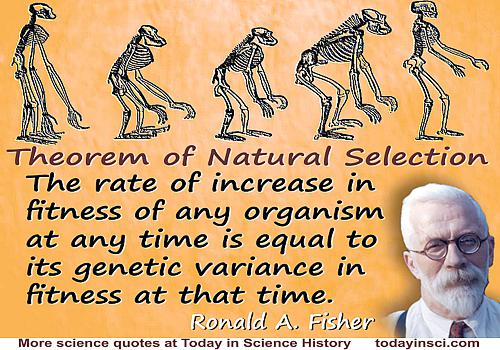
We may consequently state the fundamental theorem of Natural Selection in the form: The rate of increase in fitness of any organism at any time is equal to its genetic variance in fitness at that time.
The Genetical Theory of Natural Selection (1930), 35.
We may consider the renting of a property for several years as a sale of the usufruct during the time of the lease. Now nine years' possession, for example, is equal to more than a third of the value of the property, supposing the annual product to be one twentieth of the capital. It would then be reasonable to apply to this sort of sale the laws which govern that of landed property, and consequently the mutation tax. The person who cannot or will not cultivate his soil, instead of alienating the property itself, binds himself to alienate the usufruct for a time, and the price is paid at stated intervals instead of all at once. There is farm rent.
From Appendix A, 'Extracts From the Unpublished Writings of Carnot', Reflections on the Motive Power of Heat (1890, 2nd ed. 1897), 214.
We may indeed live yet to see, or at least we may feel some confidence that those who come after us will see, such bodies as oxygen and hydrogen in the liquid, perhaps even in the solid state, and the question of their metallic or non-metallic nature thereby finally settled.
In Thomas Andrews, Peter Guthrie Tait (ed.) and Alexander Crum Brown (ed.) The Scientific Papers of the Late Thomas Andrews (1889), lx.
We must make the following remark: a proof, that after a certain time t1, the spheres must necessarily be mixed uniformly, whatever may be the initial distribution of states, cannot be given. This is in fact a consequence of probability theory, for any non-uniform distribution of states, no matter how improbable it may be, is still not absolutely impossible. Indeed it is clear that any individual uniform distribution, which might arise after a certain time from some particular initial state, is just as improbable as an individual non-uniform distribution; just as in the game of Lotto, any individual set of five numbers is as improbable as the set 1, 2, 3, 4, 5. It is only because there are many more uniform distributions than non-uniform ones that the distribution of states will become uniform in the course of time. One therefore cannot prove that, whatever may be the positions and velocities of the spheres at the beginning, the distributions must become uniform after a long time; rather one can only prove that infinitely many more initial states will lead to a uniform one after a definite length of time than to a non-uniform one. Loschmidt's theorem tells us only about initial states which actually lead to a very non-uniform distribution of states after a certain time t1; but it does not prove that there are not infinitely many more initial conditions that will lead to a uniform distribution after the same time. On the contrary, it follows from the theorem itself that, since there are infinitely many more uniform distributions, the number of states which lead to uniform distributions after a certain time t1, is much greater than the number that leads to non-uniform ones, and the latter are the ones that must be chosen, according to Loschmidt, in order to obtain a non-uniform distribution at t1.
From 'On the Relation of a General Mechanical Theorem to the Second Law of Thermodynamics' (1877), in Stephen G. Brush (ed.), Selected Readings in Physics (1966), Vol. 2, Irreversible Processes, 191-2.
We must reject the false choice between combating climate change and fostering strong economic growth. If any country can prove that, it’s the United States.
In Hillary Clinton, 'Hillary Clinton: America Must Lead at Paris Climate Talks', Time (29 Nov 2015).
We ought then to consider the present state of the universe as the effect of its previous state and as the cause of that which is to follow. An intelligence that, at a given instant, could comprehend all the forces by which nature is animated and the respective situation of the beings that make it up, if moreover it were vast enough to submit these data to analysis, would encompass in the same formula the movements of the greatest bodies of the universe and those of the lightest atoms. For such an intelligence nothing would be uncertain, and the future, like the past, would be open to its eyes.
Philosophical Essay on Probabilities (1814), 5th edition (1825), trans. Andrew I. Dale (1995), 2.
We seem to be heading for a state of affairs in which the determination of whether or not Doomsday has arrived will be made either by an automatic device ... or by a pre-programmed president who, whether he knows it or not, will be carrying out orders written years before by some operations analyst.
In The Race to Oblivion, (1970), 232.
We set sail on this new sea because there is new knowledge to be gained, and new rights to be won, and they must be won and used for the progress of all people. For space science, like nuclear science and technology, has no conscience of its own. Whether it will become a force for good or ill depends on man, and only if the United States occupies a position of preeminence can we help decide whether this new ocean will be a sea of peace or a new terrifying theater of war.
Address at Rice University in Houston (12 Sep 1962). On website of John F. Kennedy Presidential Library and Museum. [This go-to-the-moon speech was largely written by presidential advisor and speechwriter Ted Sorensen.]
Were the succession of stars endless, then the background of the sky would present us an uniform luminosity, like that displayed by the Galaxy—since there could be absolutely no point, in all that background, at which would not exist a star. The only mode, therefore, in which, under such a state of affairs, we could comprehend the voids which our telescopes find in innumerable directions, would be by supposing the distance of the invisible background so immense that no ray from it has yet been able to reach us at all.
'Eureka: An Essay on the Material and Spiritual Universe' (1848). Collected in The Works of the Late Edgar Allan Poe (1857), Vol. 2, 183.
What I chiefly admired, and thought altogether unaccountable, was the strong disposition I observed in them [the mathematicians of Laputa] towards news and politics; perpetually inquiring into public affairs; giving their judgments in matters of state; and passionately disputing every inch of party opinion. I have indeed observed the same disposition among most of the mathematicians I have known in Europe, although I could never discover the least analogy between the two sciences.
In Gulliver's Travels, Part 8, chap. 2.
What these two sciences of recognition, evolution and immunology, have in common is not found in nonbiological systems such as 'evolving' stars. Such physical systems can be explained in terms of energy transfer, dynamics, causes, and even 'information transfer'. But they do not exhibit repertoires of variants ready for interaction by selection to give a population response according to a hereditary principle. The application of a selective principle in a recognition system, by the way, does not necessarily mean that genes must be involved—it simply means that any state resulting after selection is highly correlated in structure with the one that gave rise to it and that the correlation continues to be propagated. Nor is it the case that selection cannot itself introduce variation. But a constancy or 'memory' of selected events is necessary. If changes occurred so fast that what was selected could not emerge in the population or was destroyed, a recognition system would not survive. Physics proper does not deal with recognition systems, which are by their nature biological and historical systems. But all the laws of physics nevertheless apply to recognition systems.
Bright and Brilliant Fire, On the Matters of the Mind (1992), 79.
Whatever State of the Human Body doth disorder the Vital, the natural, or even the Animal Functions of the same is call’d a Disease.
Aphorism No. 1 in Boerhaave’s Aphorisms: Concerning The Knowledge and Cure of Diseases (1715), 1
When an observation is made on any atomic system that has been prepared in a given way and is thus in a given state, the result will not in general be determinate, i.e. if the experiment is repeated several times under identical conditions several different results may be obtained. If the experiment is repeated a large number of times it will be found that each particular result will be obtained a definite fraction of the total number of times, so that one can say there is a definite probability of its being obtained any time that the experiment is performed. This probability the theory enables one to calculate. (1930)
The Principles of Quantum Mechanics 4th ed. (1981), 13-14
When George Washington was President of the United States the land transportation here or elsewhere did not differ materially either in manner or magnitude from that of ancient Egypt four thousand years before.
In paper 'Stephenson and Transportation' (1916), collected in Francis Edgar Stanley, Theories Worth Having and Other Papers (1919), 62.
When he [Wilhelm His] set a problem it was concisely stated; he outlined the general plan by which it was to be solved. All of the details were left to the pupil and it annoyed him to be consulted regarding them. He desired that the pupil should have full freedom to work out his own solution and aided him mainly through severe criticism.
As quoted, without citation, in Florence R. Sabin, Franklin Paine Mall: The Story of a Mind. (1934), 39.
When I came home not a single acre of Government, state, or private timberland was under systematic forest management anywhere on the most richly timbered of all continents. … When the Gay Nineties began, the common word for our forests was 'inexhaustible.' To waste timber was a virtue and not a crime. There would always be plenty of timber. … The lumbermen … regarded forest devastation as normal and second growth as a delusion of fools. … And as for sustained yield, no such idea had ever entered their heads. The few friends the forest had were spoken of, when they were spoken of at all, as impractical theorists, fanatics, or ‘denudatics,’ more or less touched in the head. What talk there was about forest protection was no more to the average American that the buzzing of a mosquito, and just about as irritating.
In Breaking New Ground (1947, 1998), 27.
When I read an Italian letter [Saggio by Voltaire] on changes which had occurred on the surface of the earth, published in Paris this year (1746), I believed that these facts were reported by La Loubère. Indeed, they correspond perfectly with the author’s ideas. Petrified fish are according to him merely rare fish thrown away by Roman cooks because they were spoiled; and with respect to shells, he said that they were from the sea of the Levant and brought back by pilgrims from Syria at the time of the crusades. These shells are found today petrified in France, in Italy and in other Christian states. Why did he not add that monkeys transported shells on top of high mountains and to every place where humans cannot live? It would not have harmed his story but made his explanation even more plausible.
In 'Preuves de la Théorie de la Terre', Histoire Naturelle, Générale et Particuliere, Avec la Description du Cabinet du Roi (1749), Vol. I, 281. Trans. Albert V. and Marguerite Carozzi.
When I was in college studying science, I found the experience fundamentally unsatisfying. I was continually oppressed by the feeling that my only role was to “shut up and learn.” I felt there was nothing I could say to my instructors that they would find interesting. … As I sat in the science lecture hall, I was utterly silent. That’s not a good state to be in when you are 19 years old.
In Understanding the Universe: An Inquiry Approach to Astronomy and the Nature of Scientific Research (2013), ix.

When our thoughts—which bring actions—are filled with hate against anyone, Negro or white, we are in a living hell. That is as real as hell will ever be.
While hate for our fellow man puts us in a living hell, holding good thoughts for them brings us an opposite state of living, one of happiness, success, peace. We are then in heaven.
While hate for our fellow man puts us in a living hell, holding good thoughts for them brings us an opposite state of living, one of happiness, success, peace. We are then in heaven.
In Alvin D. Smith, George Washington Carver: Man of God (1954), 27-28. Cited in Linda O. McMurry, George Washington Carver, Scientist and Symbol (1982), 107. Smith's book is about his recollections of G.W. Carver's Sunday School classes at Tuskegee, some 40 years earlier. Webmaster, who has not yet been able to see the original book, cautions this quote may be the gist of Carver's words, rather than a verbatim quote.
When the state is shaken to its foundations by internal or external events, when commerce, industry and all trades shall be at a stand, and perhaps on the brink of ruin; when the property and fortune of all are shaken or changed, and the inhabitants of towns look forward with dread and apprehension to the future, then the agriculturalist holds in his hand the key to the money chest of the rich, and the savings-box of the poor; for political events have not the slightest influence on the natural law, which forces man to take into his system, daily, a certain number of ounces of carbon and nitrogen.
Reflecting on events of 1848.
Reflecting on events of 1848.
Familiar Letters on Chemistry (1851), 3rd edn., 483.
When we make the photon meet a tourmaline crystal, we are subjecting it to an observation. We are observing whether it is polarised parallel or perpendicular to the optic axis. The effect of making the observation is to force the photon entirely into the state of perpendicular polarisation. It has to make a sudden jump from being partly in each of these two states to being entirely in one or other of them. Which of the two states it will jump into cannot be predicted, but is governed only by probability laws. If it jumps into the perpendicular state it passes through the crystal and appears on the other side preserving this state of polarisation.
The Principles of Quantum Mechanics (1930).
When, in an experiment, all known causes being allowed for, there remain certain unexplained effects (excessively slight it may be), these must be carefully investigated, and every conceivable variation of arrangement of apparatus, etc., tried ; until, if possible, we manage so to exaggerate the residual phenomenon as to be able to detect its cause. It is here, perhaps, that in the present state of science we may most reasonably look for extensions of our knowledge
In William Thomson and Peter Guthrie Tait, Treatise on Natural Philosophy (1867), Vol. 1, 306.
Whenever I get gloomy with the state of the world, I think about the arrivals gate at Heathrow Airport. General opinion’s starting to make out that we live in a world of hatred and greed, but I don’t see that. It seems to me that love is everywhere. Often it’s not particularly dignified or newsworthy, but it’s always there - fathers and sons, mothers and daughters, husbands and wives, boyfriends, girlfriends, old friends. When the planes hit the Twin Towers, as far as I know none of the phone calls from the people on board were messages of hate or revenge - they were all messages of love. If you look for it, I’ve got a sneaky feeling you’ll find that love actually is all around.
— Movie
Love Actually (Prime Minister)
Whereas in The Two Towers you have different races, nations, cultures coming together and examining their conscience and unifying against a very real and terrifying enemy. What the United States has been doing for the past year is bombing innocent civilians without having come anywhere close to catching Osama bin Laden or any presumed enemy.
…...
Wherefore also these Kinds [elements] occupied different places even before the universe was organised and generated out of them. Before that time, in truth, all these were in a state devoid of reason or measure, but when the work of setting in order this Universe was being undertaken, fire and water and earth and air, although possessing some traces of their known nature, were yet disposed as everything is likely to be in the absence of God; and inasmuch as this was then their natural condition, God began by first marking them out into shapes by means of forms and numbers.
— Plato
Timaeus 53ab, trans. R. G. Bury, in Plato: Timaeus, Critias, Cleitophon, Menexenus, Epistles (1929), 125-7.
While we maintain the unity of the human species, we at the same time repel the depressing assumption of superior and inferior races of men. There are nations more susceptible of cultivation, more highly civilized, more enobled by mental cultivation than others, but none in themselves nobler than others. All are in like degree designed for freedom; a freedom which, in the ruder conditions of society, belongs only to the individual, but which, in social states enjoying political institutions, appertains as a right to the whole body of the community.
In Cosmos: A Sketch of a Physical Description of the Universe (1850), Vol. 1, 358, as translated by E.C. Otté.
Who … is not familiar with Maxwell’s memoirs on his dynamical theory of gases? … from one side enter the equations of state; from the other side, the equations of motion in a central field. Ever higher soars the chaos of formulae. Suddenly we hear, as from kettle drums, the four beats “put n=5.” The evil spirit v vanishes; and … that which had seemed insuperable has been overcome as if by a stroke of magic … One result after another follows in quick succession till at last … we arrive at the conditions for thermal equilibrium together with expressions for the transport coefficients.
In Ceremonial Speech (15 Nov 1887) celebrating the 301st anniversary of the Karl-Franzens-University Graz. Published as Gustav Robert Kirchhoff: Festrede zur Feier des 301. Gründungstages der Karl-Franzens-Universität zu Graz (1888), 29, as translated in Michael Dudley Sturge, Statistical and Thermal Physics (2003), 343. A more complete alternate translation also appears on the Ludwig Boltzmann Quotes page of this website.
Who does not know Maxwell’s dynamic theory of gases? At first there is the majestic development of the variations of velocities, then enter from one side the equations of condition and from the other the equations of central motions, higher and higher surges the chaos of formulas, suddenly four words burst forth: “Put n = 5.” The evil demon V disappears like the sudden ceasing of the basso parts in music, which hitherto wildly permeated the piece; what before seemed beyond control is now ordered as by magic. There is no time to state why this or that substitution was made, he who cannot feel the reason may as well lay the book aside; Maxwell is no program-musician who explains the notes of his composition. Forthwith the formulas yield obediently result after result, until the temperature-equilibrium of a heavy gas is reached as a surprising final climax and the curtain drops.
In Ceremonial Speech (15 Nov 1887) celebrating the 301st anniversary of the Karl-Franzens-University Graz. Published as Gustav Robert Kirchhoff: Festrede zur Feier des 301. Gründungstages der Karl-Franzens-Universität zu Graz (1888), 29-30, as translated in Robert Édouard Moritz, Memorabilia Mathematica; Or, The Philomath’s Quotation-book (1914), 187. From the original German, “Wer kennt nicht seine dynamische Gastheorie? – Zuerst entwickeln sich majestätisch die Variationen der Geschwindigkeiten, dann setzen von der einen Seite die Zustands-Gleichungen, von der anderen die Gleichungen der Centralbewegung ein, immer höher wogt das Chaos der Formeln; plötzlich ertönen die vier Worte: „Put n=5.“Der böse Dämon V verschwindet, wie in der Musik eine wilde, bisher alles unterwühlende Figur der Bässe plötzlich verstummt; wie mit einem Zauberschlage ordnet sich, was früher unbezwingbar schien. Da ist keine Zeit zu sagen, warum diese oder jene Substitution gemacht wird; wer das nicht fühlt, lege das Buch weg; Maxwell ist kein Programmmusiker, der über die Noten deren Erklärung setzen muss. Gefügig speien nun die Formeln Resultat auf Resultat aus, bis überraschend als Schlusseffect noch das Wärme-Gleichgewicht eines schweren Gases gewonnen wird und der Vorhang sinkt.” A condensed alternate translation also appears on the Ludwig Boltzmann Quotes page of this website.
Whoever would not remain in complete ignorance of the resources which cause him to act; whoever would seize, at a single philosophical glance, the nature of man and animals, and their relations to external objects; whoever would establish, on the intellectual and moral functions, a solid doctrine of mental diseases, of the general and governing influence of the brain in the states of health and disease, should know, that it is indispensable, that the study of the organization of the brain should march side by side with that of its functions.
On the Organ of the Moral Qualities and Intellectual Faculties, and the Plurality of the Cerebral Organs (1835), 45-6.
Why do they [Americans] quarrel, why do they hate Negroes, Indians, even Germans, why do they not have science and poetry commensurate with themselves, why are there so many frauds and so much nonsense? I cannot soon give a solution to these questions ... It was clear that in the United States there was a development not of the best, but of the middle and worst sides of European civilization; the notorious general voting, the tendency to politics... all the same as in Europe. A new dawn is not to be seen on this side of the ocean.
The Oil Industry in the North American State of Pennsylvania and in the Caucasus (1877). Translated by H. M. Leicester, from the original in Russian, in 'Mendeleev's Visit to America', Journal of Chemical Education (1957), 34, 333.
Why may we not say, that all Automata (Engines that move themselves by springs and wheeles as doth a watch) have an artificiall life? For what is the Heart, but a Spring; and the Nerves, but so many Strings; and the Joynts, but so many Wheeles, giving motion to the whole Body, such as was intended by the Artificer? Art goes yet further, imitating the rationall and most excellent worke of Nature, Man. For by Art is created the great LEVIATHAN called a COMMON-WEALTH, or STATE, (in latine CIVITAS) which is but an Artificiall Man; though of greater stature and strength than the Naturall, for whose protection and defence it was intended; and in which, the Soveraignty is an Artificiall Soul, as giving life and motion to the whole body.
Leviathan (1651), ed. C. B. Macpherson (1968), Part I, Introduction, 81.
With a few honorable exceptions the press of the United States is at the beck and call of the patent medicines. Not only do the newspapers modify news possibly affecting these interests, but they sometimes become their agents.
'The Nostrum Evil,' Collier’s Weekly (7 Oct 1905). Reprinted in The Great American Fraud (1907), 5.
With savages, the weak in body or mind are soon eliminated; and those that survive commonly exhibit a vigorous state of health. We civilised men, on the other hand, do our utmost to check the process of elimination; we build asylums for the imbecile, the maimed, and the sick; we institute poor-laws; and our medical men exert their utmost skill to save the life of every one to the last moment.
…...
Without an acquaintance with chemistry, the statesman must remain a stranger to the true vital interests of the state, to the means of its organic development and improvement; ... The highest economic or material interests of a country, the increased and more profitable production of food for man and animals, ... are most closely linked with the advancement and diffusion of the natural sciences, especially of chemistry.
Familiar Letters on Chemistry (1851), 3rd edn., 19.
You frequently state, and in your letter you imply, that I have developed a completely one-sided outlook and look at everything and think of everything in terms of science. Obviously my method of thought and reasoning is influenced by a scientific training—if that were not so my scientific training will have been a waste and a failure.
Letter to her father, Ellis Franklin, undated, perhaps summer 1940 while she was an undergraduate at Cambridge. Excerpted in Brenda Maddox, The Dark Lady of DNA (2002), 60.
 In science it often happens that scientists say, 'You know that's a really good argument; my position is mistaken,' and then they would actually change their minds and you never hear that old view from them again. They really do it. It doesn't happen as often as it should, because scientists are human and change is sometimes painful. But it happens every day. I cannot recall the last time something like that happened in politics or religion.
(1987) --
In science it often happens that scientists say, 'You know that's a really good argument; my position is mistaken,' and then they would actually change their minds and you never hear that old view from them again. They really do it. It doesn't happen as often as it should, because scientists are human and change is sometimes painful. But it happens every day. I cannot recall the last time something like that happened in politics or religion.
(1987) --