Truth Quotes (1120 quotes)
Truths Quotes
Truths Quotes
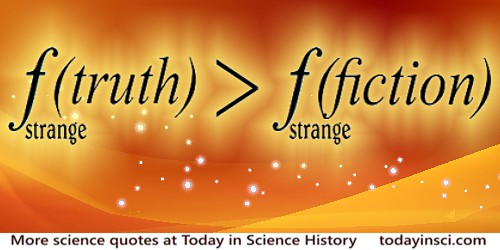
... all the great scientists have one thing in common: each snatched from the subtle motions of nature one irrevocable secret; each caught one feather of the plumage of the Great White Bird that symbolizes everlasting truth.
With co-author Justus J. Schifferes, in The Autobiography of Science (1945).
... the besetting danger is not so much of embracing falsehood for truth, as of mistaking a part of the truth for the whole.
'Coleridge', essay in Dissertations and Discussions: Political, Philosophical, and Historical (1864), Vol. 2, 11.
… the three positive characteristics that distinguish mathematical knowledge from other knowledge … may be briefly expressed as follows: first, mathematical knowledge bears more distinctly the imprint of truth on all its results than any other kind of knowledge; secondly, it is always a sure preliminary step to the attainment of other correct knowledge; thirdly, it has no need of other knowledge.
In Mathematical Essays and Recreations (1898), 35.
… the truth is that the knowledge of external nature and of the sciences which that knowledge requires or includes, is not the great or the frequent business of the human mind. Whether we provide for action or conversation, whether we wish to be useful or pleasing, the first requisite is the religious and moral knowledge of right and wrong; the next is an acquaintance with the history of mankind, and with those examples which may be said to embody truth, and prove by events the reasonableness of opinions. Prudence and justice are virtues, and excellencies, of all times and of all places; we are perpetually moralists, but we are geometricians only by chance. Our intercourse with intellectual nature is necessary; our speculations upon matter are voluntary, and at leisure. Physical knowledge is of such rare emergence, that one man may know another half his life without being able to estimate his skill in hydrostatics or astronomy; but his moral and prudential character immediately appears.
In Lives of the Poets (1779-81).
...I believe there exists, & I feel within me, an instinct for the truth, or knowledge or discovery, of something of the same nature as the instinct of virtue, & that our having such an instinct is reason enough for scientific researches without any practical results ever ensuing from them.
The Correspondence of Charles Darwin, Vol. 4. (1847-50)
…reality is a system, completely ordered and fully intelligible, with which thought in its advance is more and more identifying itself. We may look at the growth of knowledge … as an attempt by our mind to return to union with things as they are in their ordered wholeness…. and if we take this view, our notion of truth is marked out for us. Truth is the approximation of thought to reality … Its measure is the distance thought has travelled … toward that intelligible system … The degree of truth of a particular proposition is to be judged in the first instance by its coherence with experience as a whole, ultimately by its coherence with that further whole, all comprehensive and fully articulated, in which thought can come to rest.
In The Nature of Thought (1921), Vol II, 264.
...they have never affirm'd any thing, concerning the Cause, till the Trial was past: whereas, to do it before, is a most venomous thing in the making of Sciences; for whoever has fix'd on his Cause, before he experimented; can hardly avoid fitting his Experiment to his Observations, to his own Cause, which he had before imagin'd; rather than the Cause to the Truth of the Experiment itself.
Referring to experiments of the Aristotelian mode, whereby a preconceived truth would be illustrated merely to convince people of the validity of the original thought.
Referring to experiments of the Aristotelian mode, whereby a preconceived truth would be illustrated merely to convince people of the validity of the original thought.
Thomas Sprat, Abraham Cowley, History of the Royal Society (1667, 1734), 108.
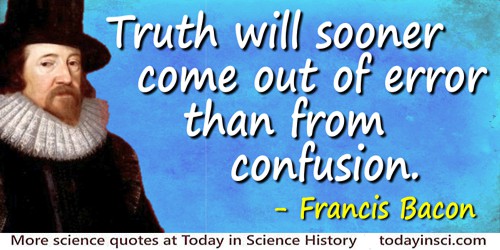
…truth will sooner come out of error than from confusion.
From Novum Organum (1620), Book 2, Aphorism 20. Translated as The New Organon: Aphorisms Concerning the Interpretation of Nature and the Kingdom of Man), collected in James Spedding, Robert Ellis and Douglas Heath (eds.), The Works of Francis Bacon (1857), Vol. 4, 149.
'...no pleasure is comparable to the standing upon the vantage ground of truth … and to see the errors … in the vale below:' so always that this prospect be with pity, and not with swelling or pride.
Quoting an unnamed poet and adding a comment.
Quoting an unnamed poet and adding a comment.
I. Of Truth,' Essays (1597). In Francis Bacon and Basil Montagu, The Works of Francis Bacon, Lord Chancellor of England (1852), 11
’Tis late; the astronomer in his lonely height
Exploring all the dark, descries from far
Orbs that like distant isles of splendor are,
And mornings whitening in the infinite.…
He summons one disheveled, wandering star,—
Return ten centuries hence on such a night.
That star will come. It dare not by one hour
Cheat science, or falsify her calculation;
Men will have passed, but watchful in the tower
Man shall remain in sleepless contemplation;
And should all men have perished there in turn,
Truth in their stead would watch that star’s return.
Exploring all the dark, descries from far
Orbs that like distant isles of splendor are,
And mornings whitening in the infinite.…
He summons one disheveled, wandering star,—
Return ten centuries hence on such a night.
That star will come. It dare not by one hour
Cheat science, or falsify her calculation;
Men will have passed, but watchful in the tower
Man shall remain in sleepless contemplation;
And should all men have perished there in turn,
Truth in their stead would watch that star’s return.
From poem, 'The Appointment', as translated by Arthur O’Shaughnessy, collected in Samuel Waddington (ed.), The Sonnets of Europe (1886), 154.
“Daddy,” she says, “which came first, the chicken or the egg?”
Steadfastly, even desperately, we have been refusing to commit ourselves. But our questioner is insistent. The truth alone will satisfy her. Nothing less. At long last we gather up courage and issue our solemn pronouncement on the subject: “Yes!”
So it is here.
“Daddy, is it a wave or a particle?”
“Yes.”
“Daddy, is the electron here or is it there?”
“Yes.”
“Daddy, do scientists really know what they are talking about?”
“Yes!”
Steadfastly, even desperately, we have been refusing to commit ourselves. But our questioner is insistent. The truth alone will satisfy her. Nothing less. At long last we gather up courage and issue our solemn pronouncement on the subject: “Yes!”
So it is here.
“Daddy, is it a wave or a particle?”
“Yes.”
“Daddy, is the electron here or is it there?”
“Yes.”
“Daddy, do scientists really know what they are talking about?”
“Yes!”
The Strange Story of the Quantum (1947), 156-7.
“Endow scientific research and we shall know the truth, when and where it is possible to ascertain it;” but the counterblast is at hand: “To endow research is merely to encourage the research for endowment; the true man of science will not be held back by poverty, and if science is of use to us, it will pay for itself.” Such are but a few samples of the conflict of opinion which we find raging around us.
From The Grammar of Science (1892), 5.
“Facts, facts, facts,” cries the scientist if he wants to emphasize the necessity of a firm foundation for science. What is a fact? A fact is a thought that is true. But the scientist will surely not recognize something which depends on men's varying states of mind to be the firm foundation of science.
From the first chapter of an unfinished book, The Thought: A Logical Inquiry (1918), collected in Arthur Sullivan (ed.), Logicism and the Philosophy of Language: Selections from Frege and Russell (2003), 215.
“You once said the aim of science was to save the world. You can’t do that if you don’t know what to save it from.” … “We agree that the world needs saving…” “We also agree that the world could save itself by letting scientists save it if they would save it.” “Maybe the world doesn’t want to save itself. It often behaves as if it didn’t. Anyhow, until it makes up its mind, science has enough to do to follow its own natural aim—which is to discover truth simply because it is truth.”
In Nothing So Strange (1947), 96-97.
[Vestiges begins] from principles which are at variance with all sober inductive truth. The sober facts of geology shuffled, so as to play a rogue’s game; phrenology (that sinkhole of human folly and prating coxcombry); spontaneous generation; transmutation of species; and I know not what; all to be swallowed, without tasting and trying, like so much horse-physic!! Gross credulity and rank infidelity joined in unlawful marriage, and breeding a deformed progeny of unnatural conclusions!
Letter to Charles Lyell (9 Apr 1845). In John Willis Clark and Thomas McKenny Hughes (eds.), The Life and Letters of the Reverend Adam Sedgwick (1890), Vol. 2, 83.
[Euclid's Elements] has been for nearly twenty-two centuries the encouragement and guide of that scientific thought which is one thing with the progress of man from a worse to a better state. The encouragement; for it contained a body of knowledge that was really known and could be relied on, and that moreover was growing in extent and application. For even at the time this book was written—shortly after the foundation of the Alexandrian Museum—Mathematics was no longer the merely ideal science of the Platonic school, but had started on her career of conquest over the whole world of Phenomena. The guide; for the aim of every scientific student of every subject was to bring his knowledge of that subject into a form as perfect as that which geometry had attained. Far up on the great mountain of Truth, which all the sciences hope to scale, the foremost of that sacred sisterhood was seen, beckoning for the rest to follow her. And hence she was called, in the dialect of the Pythagoreans, ‘the purifier of the reasonable soul.’
From a lecture delivered at the Royal Institution (Mar 1873), collected postumously in W.K. Clifford, edited by Leslie Stephen and Frederick Pollock, Lectures and Essays, (1879), Vol. 1, 296.
[First use of the term science fiction:] We hope it will not be long before we may have other works of Science-Fiction [like Richard Henry Horne's The Poor Artist], as we believe such books likely to fulfil a good purpose, and create an interest, where, unhappily, science alone might fail.
[Thomas] Campbell says, that “Fiction in Poetry is not the reverse of truth, but her soft and enchanting resemblance.” Now this applies especially to Science-Fiction, in which the revealed truths of Science may be given interwoven with a pleasing story which may itself be poetical and true—thus circulating a knowledge of Poetry of Science, clothed in a garb of the Poetry of life.
[Thomas] Campbell says, that “Fiction in Poetry is not the reverse of truth, but her soft and enchanting resemblance.” Now this applies especially to Science-Fiction, in which the revealed truths of Science may be given interwoven with a pleasing story which may itself be poetical and true—thus circulating a knowledge of Poetry of Science, clothed in a garb of the Poetry of life.
In A Little Earnest Book Upon a Great Old Subject (1851), 137.
[I have a great] distaste for controversy…. I have often seen it do great harm, and yet remember few cases in natural knowledge where it has helped much either to pull down error or advance truth. Criticism, on the other hand, is of much value.
In letter (6 May 1841) to Robert Hare, an American Chemist, collected in Experimental Researches in Electricity (1844), Vol. 2, 275, as a footnote added to a reprint of 'On Dr. Hare’s Second Letter, and on the Chemical and Contact Theories of the Voltaic Battery', London and Edinburgh Philosophical Magazine (1843), 23.
[I]f in other sciences we should arrive at certainty without doubt and truth without error, it behooves us to place the foundations of knowledge in mathematics, in so far as disposed through it we are able to reach certainty in other sciences and truth by the exclusion of error. (c.1267)
Translation by Robert Burke, Opus Majus of Roger Bacon (1928), vol 1, 124. In Fred R. Shapiro, The Yale Book of Quotations (2006), 39.
[I]t is truth alone—scientific, established, proved, and rational truth—which is capable of satisfying nowadays the awakened minds of all classes. We may still say perhaps, 'faith governs the world,'—but the faith of the present is no longer in revelation or in the priest—it is in reason and in science.
Entry for 15 Nov 1876 in Amiel’s Journal: The Journal Intime of Henri-Frédéric Amiel, trans. Humphry Ward (1893), 234.
[In the beginning, before creation] There was neither Aught nor Naught, no air nor sky beyond. …
[There was only]
A self-supporting mass beneath, and energy above.
Who knows, who ever told, from whence this vast creation rose?
No gods had yet been born—who then can e’er the truth disclose?
[There was only]
A self-supporting mass beneath, and energy above.
Who knows, who ever told, from whence this vast creation rose?
No gods had yet been born—who then can e’er the truth disclose?
— Rigveda
In Rigveda. In John Robson, Hinduism and Its Relations to Christianity (1893), 17.
[Kepler] had to realize clearly that logical-mathematical theoretizing, no matter how lucid, could not guarantee truth by itself; that the most beautiful logical theory means nothing in natural science without comparison with the exactest experience. Without this philosophic attitude, his work would not have been possible.
From Introduction that Einstein wrote for Carola Baumgardt and Jamie Callan, Johannes Kepler Life and Letters (1953), 13.
[L]et us not overlook the further great fact, that not only does science underlie sculpture, painting, music, poetry, but that science is itself poetic. The current opinion that science and poetry are opposed is a delusion. … On the contrary science opens up realms of poetry where to the unscientific all is a blank. Those engaged in scientific researches constantly show us that they realize not less vividly, but more vividly, than others, the poetry of their subjects. Whoever will dip into Hugh Miller’s works on geology, or read Mr. Lewes's “Seaside Studies,” will perceive that science excites poetry rather than extinguishes it. And whoever will contemplate the life of Goethe will see that the poet and the man of science can co-exist in equal activity. Is it not, indeed, an absurd and almost a sacrilegious belief that the more a man studies Nature the less he reveres it? Think you that a drop of water, which to the vulgar eye is but a drop of water, loses anything in the eye of the physicist who knows that its elements are held together by a force which, if suddenly liberated, would produce a flash of lightning? Think you that what is carelessly looked upon by the uninitiated as a mere snow-flake, does not suggest higher associations to one who has seen through a microscope the wondrously varied and elegant forms of snow-crystals? Think you that the rounded rock marked with parallel scratches calls up as much poetry in an ignorant mind as in the mind of a geologist, who knows that over this rock a glacier slid a million years ago? The truth is, that those who have never entered upon scientific pursuits know not a tithe of the poetry by which they are surrounded. Whoever has not in youth collected plants and insects, knows not half the halo of interest which lanes and hedge-rows can assume. Whoever has not sought for fossils, has little idea of the poetical associations that surround the places where imbedded treasures were found. Whoever at the seaside has not had a microscope and aquarium, has yet to learn what the highest pleasures of the seaside are. Sad, indeed, is it to see how men occupy themselves with trivialities, and are indifferent to the grandest phenomena—care not to understand the architecture of the Heavens, but are deeply interested in some contemptible controversy about the intrigues of Mary Queen of Scots!—are learnedly critical over a Greek ode, and pass by without a glance that grand epic written by the finger of God upon the strata of the Earth!
In Education: Intellectual, Moral, and Physical (1889), 82-83.
[Louis Rendu, Bishop of Annecy] collects observations, makes experiments, and tries to obtain numerical results; always taking care, however, so to state his premises and qualify his conclusions that nobody shall be led to ascribe to his numbers a greater accuracy than they merit. It is impossible to read his work, and not feel that he was a man of essentially truthful mind and that science missed an ornament when he was appropriated by the Church.
In The Glaciers of the Alps (1860), 299.
[Mathematics] is security. Certainty. Truth. Beauty. Insight. Structure. Architecture. I see mathematics, the part of human knowledge that I call mathematics, as one thing—one great, glorious thing. Whether it is differential topology, or functional analysis, or homological algebra, it is all one thing. … They are intimately interconnected, they are all facets of the same thing. That interconnection, that architecture, is secure truth and is beauty. That’s what mathematics is to me.
From interview with Donald J. Albers. In John H. Ewing and Frederick W. Gehring, Paul Halmos Celebrating 50 Years of Mathematics (1991), 13.
[Music as a] language may be the best we have for explaining what we are like to others in space, with least ambiguity. I would vote for Bach, all of Bach, streamed out into space, over and over again … to put the best possible face on at the beginning of such an acquaintance. We can tell the harder truths later.
In 'Ceti', The Lives of a Cell: Notes of a Biology Watcher (1974), 53.
[My dream dinner guest is] Charles Darwin. It’s an obvious answer, but it’s the truth. Think of any problem and before you start theorising, just check up whether Charles Darwin mentioned it in one of those green books sitting on your shelf. Whether it’s earthworms, human gestures or the origin of species, the observations that man made are unbelievable. He touched on so many subjects. Then, Alexander von Humboldt, the last polymath. There was no aspect of the natural world that he wasn’t curious about or didn’t write about in Kosmos, an extraordinary book.
From interview with Alice Roberts, 'Attenborough: My Life on Earth', The Biologist (Aug 2015), 62, No. 4, 16.
[My friends and I studied science to get away from] the stench of Fascist truths which tainted the sky. ... [T]he chemistry and physics on which we fed, besides being nourishment vital in themselves, were an antidote to Fascism. ... [T]hey were clear and distinct and verifiable at every step, and not a tissue of lies and emptiness like the radio and the newspapers.
The Periodic Table, trans. Raymond Rosenthal (1986), 42. In Vinoth Ramachandra, Subverting Global Myths: Theology and the Public Issues Shaping our World (2008), 170.
[Regarding evolution believers:] Their business is not with the possible, but the actual—not with a world which might be, but with a world that is. This they explore with a courage not unmixed with reverence, and according to methods which, like the quality of a tree, are tested by their fruits. They have but one desire—to know the truth. They have but one fear—to believe a lie.
'Scientific Use of the Imagination', Discourse Delivered Before the British Association at Liverpool, (16 Sep 1870). Fragments of Science for Unscientific People: A Series of Detached Essays, Lectures, and Reviews (1892), Vol. 2, 134.
![James Watson quote: [Science moves] with the spirit of an adventure characterized both by youthful arrogance and by the belief t](https://todayinsci.com/W/Watson_James/WatsonJames-Pretty500x250px.jpg)
[Science proceeds with] the spirit of an adventure characterized both by youthful arrogance and by the belief that the truth, once found, would be simple as well as pretty.
In The Double Helix: A Personal Account of the Discovery of the Structure of DNA (1968, 2001), Preface, xi.
[Science] dissipates errors born of ignorance about our true relations with nature, errors the more damaging in that the social order should rest only on those relations. TRUTH! JUSTICE! Those are the immutable laws. Let us banish the dangerous maxim that it is sometimes useful to depart from them and to deceive or enslave mankind to assure its happiness.
Exposition du Système du Monde (1796), 2, 312, trans. Charles Coulston Gillispie, Pierre-Simon Laplace 1749-1827: A Life in Exact Science (1997), 175.
[Science] intensifies religious truth by cleansing it of ignorance and superstition.
Quoted in 'Antiseptic Christianity', book review of Lindbergh, Of Flight and Life in Time magazine, (6 Sep 1948).
![Carl Sagan quote: [Science] is not perfect. It can be misused. It is only a tool. But it is by far the best tool we have, self-c](https://todayinsci.com/S/Sagan_Carl/SaganCarl-Misused500x250px.jpg)
[Science] is not perfect. It can be misused. It is only a tool. But it is by far the best tool we have, self-correcting, ongoing, applicable to everything. It has two rules. First: there are no sacred truths; all assumptions must be critically examined; arguments from authority are worthless. Second: whatever is inconsistent with the facts must be discarded or revised. ... The obvious is sometimes false; the unexpected is sometimes true.
Cosmos (1985), 277.
[Society's rights to employ the scopolamine (“truth serum”) drug supersede those of a criminal.] It therefore stands to reason, that where there is a safe and humane method existing to evoke the truth from the consciousness of a suspect society is entitled to have that truth.
Quoted from presentation at the first annual meeting of the Eastern Society of Anesthetists at the Hotel McAlpin, as reported in '“Truth Serum” Test Proves Its Power', New York Times (22 Oct 1924), 14.
[T]he 47th proposition in Euclid might now be voted down with as much ease as any proposition in politics; and therefore if Lord Hawkesbury hates the abstract truths of science as much as he hates concrete truth in human affairs, now is his time for getting rid of the multiplication table, and passing a vote of censure upon the pretensions of the hypotenuse.
In 'Peter Plymley's Letters', Essays Social and Political (1877), 530.
[The famous attack of Sir William Hamilton on the tendency of mathematical studies] affords the most express evidence of those fatal lacunae in the circle of his knowledge, which unfitted him for taking a comprehensive or even an accurate view of the processes of the human mind in the establishment of truth. If there is any pre-requisite which all must see to be indispensable in one who attempts to give laws to the human intellect, it is a thorough acquaintance with the modes by which human intellect has proceeded, in the case where, by universal acknowledgment, grounded on subsequent direct verification, it has succeeded in ascertaining the greatest number of important and recondite truths. This requisite Sir W. Hamilton had not, in any tolerable degree, fulfilled. Even of pure mathematics he apparently knew little but the rudiments. Of mathematics as applied to investigating the laws of physical nature; of the mode in which the properties of number, extension, and figure, are made instrumental to the ascertainment of truths other than arithmetical or geometrical—it is too much to say that he had even a superficial knowledge: there is not a line in his works which shows him to have had any knowledge at all.
In Examination of Sir William Hamilton's Philosophy (1878), 607.
[The mathematician's] subject is the most curious of all—there is none in which truth plays such odd pranks. It has the most elaborate and the most fascinating technique, and gives unrivaled openings for the display of sheer professional skill.
In A Mathematician’s Apology (1940, 1967), 80.
[The] erroneous assumption is to the effect that the aim of public education is to fill the young of the species with knowledge and awaken their intelligence, and so make them fit to discharge the duties of citizenship in an enlightened and independent manner. Nothing could be further from the truth. The aim of public education is not to spread enlightenment at all; it is simply to reduce as many individuals as possible to the same safe level, to breed and train a standardised citizenry, to put down dissent and originality.
The American Mercury (24 Apr 1924).
[When nature appears complicated:] The moment we contemplate it as it is, and attain a position from which we can take a commanding view, though but of a small part of its plan, we never fail to recognize that sublime simplicity on which the mind rests satisfied that it has attained the truth.
Concluding remark in Dionysius Lardner (ed.), Cabinet Cyclopaedia, Vol 1, Preliminary Discourse on the Study of Natural Philosophy (1831), 361.
[About Sir Roderick Impey Murchison:] The enjoyments of elegant life you early chose to abandon, preferring to wander for many successive years over the rudest portions of Europe and Asia—regions new to Science—in the hope, happily realized, of winning new truths.
By a rare union of favourable circumstances, and of personal qualifications equally rare, you have thus been enabled to become the recognized Interpreter and Historian (not without illustrious aid) of the Silurian Period.
By a rare union of favourable circumstances, and of personal qualifications equally rare, you have thus been enabled to become the recognized Interpreter and Historian (not without illustrious aid) of the Silurian Period.
Dedication page in Thesaurus Siluricus: The Flora and Fauna of the Silurian Period (1868), iv.
A l’aide de ces sciences expérimentales actives, l’homme devient un inventeur de phénomènes, un véritable contremaître de la création; et l'on ne saurait, sous ce rapport, assigner de limites à la puissance qu’il peut acquérir sur la nature, par les progrès futurs des sciences expérimentales
With the aid of these active experimental sciences man becomes an inventor of phenomena, a real foreman of creation; and under this head we cannot set limits to the power that he may gain over nature through future progress of the experimental sciences.
With the aid of these active experimental sciences man becomes an inventor of phenomena, a real foreman of creation; and under this head we cannot set limits to the power that he may gain over nature through future progress of the experimental sciences.
Original French text in Introduction à l'Étude de la Médecine Expérimentale (1898), 32. English version from An Introduction to the Study of Experimental Medicine (1865), as translated by Henry Copley Greene (1957), 18.
Aber das Leben ist kurz und die Wahrheit wirkt ferne und lebt lange: sagen wir die Wahrheit.
Life is short and truth works far and lives long: let us speak the truth.
Life is short and truth works far and lives long: let us speak the truth.
Concluding remark in Preface, written at Dresden in August 1818, first German edition, Die Welt als Wille und Vorstellung, 4 Bücher nebst einem Anhange der die Kritik der Kentischen Philosophie (1819), xvi. As translated by Richard Burton Haldane and John Kemp in The World as Will and Representation (1883, 1907), Vol. 1, xv.
Amicus Plato amicus Aristoteles magis amica verita.
Plato is my friend, Aristotle is my friend, but my greatest friend is truth.
Plato is my friend, Aristotle is my friend, but my greatest friend is truth.
Written in the margin of a notebook while a student at Cambridge. In Richard S. Westfall, Never at Rest (1980), 89.
Are coral reefs growing from the depths of the oceans? ... [The] reply is a simple negative; and a single fact establishes its truth. The reef-forming coral zoophytes, as has been shown, cannot grow at greater depths than 100 or 120 feet; and therefore in seas deeper than this, the formation or growth of reefs over the bottom is impossible.
On Coral Reefs and Islands (1853), 138.
Aux mathématiciens, il appartient de chercher le vrai; les philosophes doivent se contenter du probable
The concern of mathematicians is to seek the truth; philosophers must be content with the probable.
The concern of mathematicians is to seek the truth; philosophers must be content with the probable.
In 'Divers Opuscules' collected in Oeuvres de Vico (1835), Vol. 1, 159. Translation by Webmaster.
Cogitatio in vero exquirendo maxime versatur. Appetitus impellit ad agendum.
The Intellect engages us in the pursuit of Truth. The Passions impel us to Action.
The Intellect engages us in the pursuit of Truth. The Passions impel us to Action.
D. H. Barnes (Ed.) De Officiis ad Marcum Filium: Libri Tres (1814), 51.
Dans les sciences physiques en général, on ait souvent supposé au lieu de conclure; que les suppositions transmises d’âge en âge, soient devenues de plus en plus imposantes par le poids des autorités qu'elles ont acquises , & qu'elles ayent enfin été adoptées & regardées comme des vérités fondamentales, même par de très-bons esprits.
In the science of physics in general, men have so often formed suppositions, instead of drawing conclusions. These suppositions, handed down from one age to another, acquire additional weight from the authorities by which they are supported, till at last they are received, even by men of genius, as fundamental truths.
In the science of physics in general, men have so often formed suppositions, instead of drawing conclusions. These suppositions, handed down from one age to another, acquire additional weight from the authorities by which they are supported, till at last they are received, even by men of genius, as fundamental truths.
From the original French in Traité élémentaire de chimie (1789, 1793), discours préliminaire, x; and from edition translated into English by Robert Kerr, as Elements of Chemistry (1790), Preface, xvi.
Die durchschnittliche Lebensdauer einer physiologischen Wahrheit ist drei bis vier Jahre.
The average lifespan of a physiological truth is three or four years.
The average lifespan of a physiological truth is three or four years.
Attributed.
Die Gewohnheit einer Meinung erzeugt oft völlige Ueberzeugung von ihrer Richtigkeit, sie verbirgt die schwächeren Theile davon, und macht uns unfähig, die Beweise dagegen anzunehmen.
The habit of an opinion often leads to the complete conviction of its truth, it hides the weaker parts of it, and makes us incapable of accepting the proofs against it.
The habit of an opinion often leads to the complete conviction of its truth, it hides the weaker parts of it, and makes us incapable of accepting the proofs against it.
(1827). German text in Ira Freund, The Study of Chemical Composition (1904), 31. Translated form in Carl Schorlemmer, The Rise and Development of Organic Chemistry (1894), 49.
Dilbert: Evolution must be true because it is a logical conclusion of the scientific method.
Dogbert: But science is based on the irrational belief that because we cannot perceive reality all at once, things called “time” and “cause and effect” exist.
Dilbert: That’s what I was taught and that’s what I believe.
Dogbert: Sounds cultish.
Dogbert: But science is based on the irrational belief that because we cannot perceive reality all at once, things called “time” and “cause and effect” exist.
Dilbert: That’s what I was taught and that’s what I believe.
Dogbert: Sounds cultish.
Dilbert comic strip (8 Feb 1992).
Eine neue wissenschaftliche Wahrheit pflegt sich nicht in der Weise durchzusetzen, daß ihre Gegner überzeugt werden und sich als belehrt erklären, sondern vielmehr dadurch, daß ihre Gegner allmählich aussterben und daß die heranwachsende Generation von vornherein mit der Wahrheit vertraut gemacht ist.
A new scientific truth does not triumph by convincing its opponents and making them see the light, but rather its opponents eventually die, and a new generation grows up that is familiar with it.
A new scientific truth does not triumph by convincing its opponents and making them see the light, but rather its opponents eventually die, and a new generation grows up that is familiar with it.
In Scientific Autobiography and Other Papers, trans. F. Gaynor (1950), 33. Also seen paraphrased in shortened form as: Die Wahrheit triumphiert nie, ihre Gegner sterben nur aus. (Translated as “Truth never triumphs—its opponents just die out.” More loosely paraphrased as “Science advances one funeral at a time.”)
Er riecht die Wahrheit,
He [Faraday] smells the truth.
He [Faraday] smells the truth.
Quoted in John Tyndall, Faraday as a Discoverer (1868), 45.
Haec quippe prima sapientiae clavis definitur, assidua scilicet seu frequens interrogatio … Dubitando enim ad inquisitionem venimus; inquirendo veritatem percipimus.
For this is the first key to wisdom, assiduous and frequent questioning. ... By doubting we come to inquiry; by inquiry we perceive the truth.
For this is the first key to wisdom, assiduous and frequent questioning. ... By doubting we come to inquiry; by inquiry we perceive the truth.
Sic et Non (c. 1120). Latin text in Peter Abelard, E.L.T. Henke and G.S. Lindenkohl (eds.), Sic et Non (1851), 16-17. Title translates as Yes or No. As translated in Frederick Denison Maurice, Mediaeval Philosophy; Or, A Treatise of Moral and Metaphysical Philosophy (1870), 138.
I cannot give any scientist of any age better advice than this: the intensity of the conviction that a hypothesis is true has no bearing on whether it is true or not. The importance of the strength of our conviction is only to provide a proportionally strong incentive to find out if the hypothesis will stand up to critical examination.
In Advice to a Young Scientist (1979), 39.
Ihm in vollem Maaße das Schicksal werde, welches in jeder Erkenntniß, … allezeit der Wahrheit zu Theil ward, der nur ein kurzes Siegesfest beschieden ist, zwischen den beiden langen Zeiträumen, wo sie als parador verdammt und als trivial geringgeschätzt wird.
[It] has always fallen to the lot of truth in every branch of knowledge, … [that] to truth only a brief celebration of victory is allowed between the two long periods during which it is condemned as paradoxical, or disparaged as trivial. The author of truth also usually meets with the former fate.
[It] has always fallen to the lot of truth in every branch of knowledge, … [that] to truth only a brief celebration of victory is allowed between the two long periods during which it is condemned as paradoxical, or disparaged as trivial. The author of truth also usually meets with the former fate.
Conclusion for Preface, written at Dresden in August 1818, first German edition, Die Welt als Wille und Vorstellung, 4 Bücher nebst einem Anhange der die Kritik der Kentischen Philosophie (1819), xvi. As translated by E.F.J. Payne in The World as Will and Representation (1958, 1969), Vol. 1, xvii. In the preface, Schopenhauer is writing his hope that what he has written in the book will be accepted by those it reaches. Notice the statement of three stages of truth: condemnation; acceptance; trivializing. It may be the source of a condensed quote attributed (wrongly?) to Schopenhauer—seen in this collection as the quote that begins, “All truth passes through three stages…”
Il n'y a qu'un demi-siècle, un orateur chrétien, se défiant des hommes de la science leur disait: 'Arrêtez-vous enfin, et ne creusez pas jusqu'aux enfers.' Aujourd'hui, Messieurs, rassurés sur l'inébranlable constance de notre foi, nous vous disons: creusez, creusez encore; plus vous descendrez, plus vous rapprocherez du grand mystère de l'impuissance de l'homme et de la vérité de la religion. Creusez donc, creusez toujours,mundum tradidit disputationibus eorum; et quand la science aura donné son dernier coup de marteau sur les fondements de la terre, vous pourrez à la lueur du feu qu'il fera jaillir, lire encore l'idée de Dieu et contempler l'empreinte de sa main.
Only a half-century ago, a Christian speaker, mistrustful of men of science told them: 'Stop finally, and do not dig to hell.' Today, gentlemen, reassured about the steadfastness of our unshakeable faith, we say: dig, dig again; the further down you, the closer you come to the great mystery of the impotence of man and truth of religion. So dig, always dig: and when science has stuck its final hammer blow on the bosom of the earth, you will be able to ignite a burst of light, read furthermore the mind of God and contemplate the imprint of His hand.
Only a half-century ago, a Christian speaker, mistrustful of men of science told them: 'Stop finally, and do not dig to hell.' Today, gentlemen, reassured about the steadfastness of our unshakeable faith, we say: dig, dig again; the further down you, the closer you come to the great mystery of the impotence of man and truth of religion. So dig, always dig: and when science has stuck its final hammer blow on the bosom of the earth, you will be able to ignite a burst of light, read furthermore the mind of God and contemplate the imprint of His hand.
As Monseigneur Rendu, Bishop of Annecy, Savoy, presiding at the closing session of a meeting of the Geological Society of France at Chambéry, Savoy (27 Aug 1844). In Bulletin de la Société Géologique de France 1843 à 1844, Tome 1, Ser. 2, 857. (1844), li. Google trans., edited by Webmaster.
Imprimisque hominis est propria veri inquisitio atque investigatio.
The first duty of man is the seeking after and the investigation of truth.
The first duty of man is the seeking after and the investigation of truth.
De Officiis I., 4, 18. In Thomas Benfield Harbottle, Dictionary of Quotations (classical) (3rd Ed., 1906), 98.
In primis, hominis est propria VERI inquisitio atque investigato. Itaque cum sumus negotiis necessariis, curisque vacui, tum avemus aliquid videre, audire, ac dicere, cognitionemque rerum, aut occultarum aut admirabilium, ad benè beatéque vivendum necessariam ducimus; —ex quo intelligitur, quod VERUM, simplex, sincerumque sit, id esse naturæ hominis aptissimum. Huic veri videndi cupiditati adjuncta est appetitio quædam principatûs, ut nemini parere animus benè a naturâ informatus velit, nisi præcipienti, aut docenti, aut utilitatis causâ justè et legitimè imperanti: ex quo animi magnitudo existit, et humanarum rerum contemtio.
Before all other things, man is distinguished by his pursuit and investigation of TRUTH. And hence, when free from needful business and cares, we delight to see, to hear, and to communicate, and consider a knowledge of many admirable and abstruse things necessary to the good conduct and happiness of our lives: whence it is clear that whatsoever is TRUE, simple, and direct, the same is most congenial to our nature as men. Closely allied with this earnest longing to see and know the truth, is a kind of dignified and princely sentiment which forbids a mind, naturally well constituted, to submit its faculties to any but those who announce it in precept or in doctrine, or to yield obedience to any orders but such as are at once just, lawful, and founded on utility. From this source spring greatness of mind and contempt of worldly advantages and troubles.
Before all other things, man is distinguished by his pursuit and investigation of TRUTH. And hence, when free from needful business and cares, we delight to see, to hear, and to communicate, and consider a knowledge of many admirable and abstruse things necessary to the good conduct and happiness of our lives: whence it is clear that whatsoever is TRUE, simple, and direct, the same is most congenial to our nature as men. Closely allied with this earnest longing to see and know the truth, is a kind of dignified and princely sentiment which forbids a mind, naturally well constituted, to submit its faculties to any but those who announce it in precept or in doctrine, or to yield obedience to any orders but such as are at once just, lawful, and founded on utility. From this source spring greatness of mind and contempt of worldly advantages and troubles.
In De Officiis, Book 1. Sect. 13. As given in epigraph to John Frederick William Herschel, A Preliminary Discourse on the Study of Natural Philosophy (1830), viii.
In primis, hominis est propria VERI inquisitio atque investigato.
Before all other things, man is distinguished by his pursuit and investigation of TRUTH.
Before all other things, man is distinguished by his pursuit and investigation of TRUTH.
In De Officiis, Book 1. Sect. 13. As given in epigraph to John Frederick William Herschel, A Preliminary Discourse on the Study of Natural Philosophy (1830), viii. This is the start of a longer quote on the Cicero quotes page.
In scientia veritas, in arte honestas.
In science truth, in art honour.
In science truth, in art honour.
In Jon R. Stone, The Routledge Dictionary of Latin Quotations (2005), 170.
Indiana Jones: Archaeology is the search for fact… not truth. If it’s truth you're looking for, Dr. Tyree’s philosophy class is right down the hall. … So forget any ideas you've got about lost cities, exotic travel, and digging up the world. We do not follow maps to buried treasure, and “X” never, ever marks the spot. Seventy percent of all archaeology is done in the library. Research. Reading.
Spoken by actor Harrison Ford as character Indiana Jones in movie, Indiana Jones and the Last Crusade (1989).
L'imagination au contraire qui tend à nous porter continuellement au-delà du vrai, l'amour-propre et la confiance en nous-mêmes, qu'il sait si bien nous inspirer, nous sollicitent à tirer des conséquences qui ne dérivent pas immédiatement des faits.
Imagination, on the contrary, which is ever wandering beyond the bounds of truth, joined to self-love and that self-confidence we are so apt to indulge, prompt us to draw conclusions which are not immediately derived from facts.
Imagination, on the contrary, which is ever wandering beyond the bounds of truth, joined to self-love and that self-confidence we are so apt to indulge, prompt us to draw conclusions which are not immediately derived from facts.
From the original French in Traité élémentaire de chimie (1789, 1793), discours préliminaire, ix; and from edition translated into English by Robert Kerr, as Elements of Chemistry (1790), Preface, xvii.
La science, mon garçon, est faite d’erreurs, mais d’erreurs qu’il est bon de commettre, car elles mènent peu à peu à la vérité.
Science, my boy, is composed of errors, but errors that it is right to make, for they lead step by step to the truth.
Science, my boy, is composed of errors, but errors that it is right to make, for they lead step by step to the truth.
Journey to the Centre of the Earth, translated by William Butcher (1992, 2008), 146.
La verità fu sola figliola del tenpo.
Truth was the only daughter of Time.
Truth was the only daughter of Time.
From manuscript original “Moto, colpo,” 58b, editted and translated by Jean Paul Richter (ed.) compiled in 'Philosphical Maxims, Morals, Polemics and Speculations' The Literary Works of Leonardo da Vinci (1883), Vol. 2, 288, Maxim No. 1152.
La vérité est sur une courbe dont notre ésprit suit éternellement l'asymptote. (Oct 1879)
Truth is on a curve whose asymptote our spirit follows eternally.
Truth is on a curve whose asymptote our spirit follows eternally.
In Recueil d'Œuvres de Léo Errera: Botanique Générale (1908), 193. As translated in John Arthur Thomson, Introduction to Science (1911), 57,
La vérité ne diffère de l'erreur qu'en deux points: elle est un peu plus difficile à prouver et beaucoup plus difficile à faire admettre. (Dec 1880)
Truth is different from error in two respects: it is a little harder to prove and more difficult to admit.
Truth is different from error in two respects: it is a little harder to prove and more difficult to admit.
In Recueil d'Œuvres de Léo Errera: Botanique Générale (1908), 193. Google translation by Webmaster.
Le paradoxe, c'est de la graine de vérité. Il suffit d'un terrain propice pour que cela germe, fleurisse et fructifie.
The paradox is the seed of truth. This germ just needs a fertile ground to flourish and bear fruit.
The paradox is the seed of truth. This germ just needs a fertile ground to flourish and bear fruit.
In Recueil d'Œuvres de Léo Errera: Botanique Générale (1908), 198. Google translation by Webmaster.
Les faits scientifiques, et à fortiori, les lois sont l’œuvre artificielle du savant ; la science ne peut donc rien nous apprendre de la vérité, elle ne peut nous servir que de règle d’action.
The facts of science and, à fortiori, its laws are the artificial work of the scientist; science therefore can teach us nothing of the truth; it can only serve us as rule of action.
The facts of science and, à fortiori, its laws are the artificial work of the scientist; science therefore can teach us nothing of the truth; it can only serve us as rule of action.
In La Valeur de la Science (1904), 214, translated by George Bruce Halsted, in The Value of Science (1907), 112.
Mathematical truth has validity independent of place, personality, or human authority. Mathematical relations are not established, nor can they be abrogated, by edict. The multiplication table is international and permanent, not a matter of convention nor of relying upon authority of state or church. The value of π is not amenable to human caprice. The finding of a mathematical theorem may have been a highly romantic episode in the personal life of the discoverer, but it cannot be expected of itself to reveal the race, sex, or temperament of this discoverer. With modern means of widespread communication even mathematical notation tends to be international despite all nationalistic tendencies in the use of words or of type.
In 'Light Thrown on the Nature of Mathematics by Certain Aspects of Its Development', Mathematics in General Education (1940), 256. This is the Report of the Committee on the Function of Mathematics in General Education of the Commission on Secondary School Curriculum, which was established by the Executive Board of the Progressive Education Association in 1932.
N’oublions pas non plus qu’il ne saurait exister pour la science des vérités acquises.
Nor must we forget that in science there are no final truths.
Nor must we forget that in science there are no final truths.
Original French in Mythologiques, Vol. 1, Le Cru et le Cuit (1964), 15. As translated by John and Doreen Weightman, The Raw and the Cooked (1969, 1990), 7.
Negative Capability, that is when man is capable of being in uncertainties, Mysteries, doubts, without any irritable reaching after fact & reason—Coleridge, for instance, would let go by a fine isolated verisimilitude caught from the Penetralium of mystery, from being incapable of remaining content with half knowledge.
Letter to George and Thomas Keats (21 Dec 1817). In H. E. Rollins (ed.), Letters of John Keats (1958), Vol. 1, 193-4.
Qui est de nous & qui seul peut nous égarer; à le mettre continuellement à épreuve de l'expérience; à ne conserver que les faits qui ne font que des données de la nature , & qui ne peuvent nous tromper; à ne chercher la vérité que dans l'enchaînement naturel des expériences & des observations
We must trust to nothing but facts: These are presented to us by Nature, and cannot deceive. We ought, in every instance, to submit our reasoning to the test of experiment, and never to search for truth but by the natural road of experiment and observation.
We must trust to nothing but facts: These are presented to us by Nature, and cannot deceive. We ought, in every instance, to submit our reasoning to the test of experiment, and never to search for truth but by the natural road of experiment and observation.
From the original French in Traité élémentaire de chimie (1789, 1793), discours préliminaire, x; and from edition translated into English by Robert Kerr, as Elements of Chemistry (1790), Preface, xviii.
Salviati: …Now you see how easy it is to understand.
Sagredo: So are all truths, once they are discovered; the point is in being able to discover them.
[Commonly seen merged in a paraphrase as: All truths are easy to understand once they are discovered; the point is to discover them.]
Sagredo: So are all truths, once they are discovered; the point is in being able to discover them.
[Commonly seen merged in a paraphrase as: All truths are easy to understand once they are discovered; the point is to discover them.]
Lines of two characters in Dialogue Concerning the Two Chief World Systems (1632), as translated by S. Drake (1967). As quoted and cited in Barnaby Sheppard, The Logic of Infinity (2014), 398 & 440 footnote. Galileo’s work is written as a series of dialogues over four days between Salviati (supporting the Copernican system), Sagredo (a neutral layman) and Simplicio (supporting the Ptolemaic system).
Scientia nihil aliud est quam veritatis imago
Science is but an image of the truth.
Science is but an image of the truth.
In James Wood, Dictionary of Quotations from Ancient and Modern, English and Foreign Sources (1893), 383:3.
Simplex non sigillum veri.
Simplicity is no sign of truth.
Simplicity is no sign of truth.
Eijkman’s motto, and the title of a lecture he gave late in his career. As stated in Alfred Jay Bollet, in Plagues & Poxes: The Rise and Fall of Epidemic Disease (1987), 77. This contrasts with the much-quoted motto of Herman Boerhaave, “simplex sigillum veri” (simplicity is the sign of truth).
Simplex sigillum veri.
Simplicity is the sign of truth.
Simplicity is the sign of truth.
Favorite motto. Inscription on a monument to Boerhaave at the church of St. Peter, Leyden, Holland. In 'Memoirs of Boerhaave', The Literary Magazine, and American Register (1 Sep 1807), 8, 67.
Simplicibus itaque verbis gaudet Mathematica Veritas, cum etiam per se simplex sit Veritatis oratio. (So Mathematical Truth prefers simple words since the language of Truth is itself simple.)
Epistolarum astronomicarum liber primus (1596)
Temporis filia veritas; cui me obstetricari non pudet.
Truth is the daughter of time, and I feel no shame in being her midwife.
Truth is the daughter of time, and I feel no shame in being her midwife.
Opening remark from 'Narratio de observatis a se quatuor Jovis satellitibus erronibus, quos Galilaeus Galilaeus Mathematicus Florentinus jure inventionis medicaea sidera nuncupavit' (Account of personal observations of the four moving satellites of Jupiter, which Florentine Mathematician Galileo Galilei had the right of discovery to Name as the Medicicaean Stars) (observed 30 Aug 1610, written 11 Sep 1610, printed about Oct 1610) in which he confirmed having seen the things announced by Galileo in Mar 1610. Collected in Cav. Giambatista Venturi, Memorie e Lettere Inedite Finora o Disperse di Galileo Galilei (Memoirs and Letters, Previously Unpublished or Missing, of Galileo Galilei) (1811), Vol 1, 144.
The Word Reason in the English Language has different Significances: sometimes it is taken for true, and clear Principles: Sometimes for clear, and fair deductions from those Principles: and sometimes for Cause, and particularly the final Cause: but the Consideration I shall have of it here, is in a Signification different from all these; and that is, as it stands for a Faculty of Man, That Faculty, whereby Man is supposed to be distinguished from Beasts; and wherein it is evident he much surpasses them.
In 'Of Reason', Essay Concerning Humane Understanding (1690), Book 4, Ch. 17, Sec. 1, 341.
Thomasina: Every week I plot your equations dot for dot, x’s against y’s in all manner of algebraical relation, and every week they draw themselves as commonplace geometry, as if the world of forms were nothing but arcs and angles. God’s truth, Septimus, if there is an equation for a curve like a bell, there must be an equation for one like a bluebell, and if a bluebell, why not a rose? Do we believe nature is written in numbers?
Septimus: We do.
Thomasina: Then why do your shapes describe only the shapes of manufacture?
Septimus: I do not know.
Thomasina: Armed thus, God could only make a cabinet.
Septimus: We do.
Thomasina: Then why do your shapes describe only the shapes of manufacture?
Septimus: I do not know.
Thomasina: Armed thus, God could only make a cabinet.
In the play, Acadia (1993), Scene 3, 37.
To the Memory of Fourier
Fourier! with solemn and profound delight,
Joy born of awe, but kindling momently
To an intense and thrilling ecstacy,
I gaze upon thy glory and grow bright:
As if irradiate with beholden light;
As if the immortal that remains of thee
Attuned me to thy spirit’s harmony,
Breathing serene resolve and tranquil might.
Revealed appear thy silent thoughts of youth,
As if to consciousness, and all that view
Prophetic, of the heritage of truth
To thy majestic years of manhood due:
Darkness and error fleeing far away,
And the pure mind enthroned in perfect day.
Fourier! with solemn and profound delight,
Joy born of awe, but kindling momently
To an intense and thrilling ecstacy,
I gaze upon thy glory and grow bright:
As if irradiate with beholden light;
As if the immortal that remains of thee
Attuned me to thy spirit’s harmony,
Breathing serene resolve and tranquil might.
Revealed appear thy silent thoughts of youth,
As if to consciousness, and all that view
Prophetic, of the heritage of truth
To thy majestic years of manhood due:
Darkness and error fleeing far away,
And the pure mind enthroned in perfect day.
In R. Graves, Life of W. R. Hamilton (1882), Vol. l, 696.
Truth then seems to me, in the proper import of the Word, to signifie nothing but the joining or separating of Signs, as the Things signified by them do agree or disagree one with another; which way of joining or separating of Signs, we call Proposition. So that Truth properly belongs only to Propositions: whereof there are two sorts, viz. Mental and Verbal; as there are two sorts of Signs commonly made use of, viz. Ideas and Words.
In 'Truth in General', Essay Concerning Human Understanding (1690), book 4, ch. 5, sec. 2, 289.
~~[Attributed, authorship undocumented]~~ Mathematical demonstrations are a logic of as much or more use, than that commonly learned at schools, serving to a just formation of the mind, enlarging its capacity, and strengthening it so as to render the same capable of exact reasoning, and discerning truth from falsehood in all occurrences, even in subjects not mathematical. For which reason it is said, the Egyptians, Persians, and Lacedaemonians seldom elected any new kings, but such as had some knowledge in the mathematics, imagining those, who had not, men of imperfect judgments, and unfit to rule and govern.
From an article which appeared as 'The Usefulness of Mathematics', Pennsylvania Gazette (30 Oct 1735), No. 360. Collected, despite being without clear evidence of Franklin’s authorship, in The Works of Benjamin Franklin (1809), Vol. 4, 377. Evidence of actual authorship by Ben Franklin for the newspaper article has not been ascertained, and scholars doubt it. See Franklin documents at the website founders.archives.gov. The quote is included here to attach this caution.
~~[Attributed]~~ As scarce as truth is, the supply has always been in excess of the demand.
As given, without citation, in Clifton Fadiman (ed.) The American Treasury, 1455-1955 (1955). Other sources give a title of a book of his, but despite many hours of searching, Webmaster has been unable to locate, in any of his various books, a specific page containing the subject quote. Nor anything resembling it. Hence it is annotated here as merely, “Attributed.” In other sources, any book title listed should be considered questionable. Can you help? [Note: the subject quote is shown above in plain English. Search is complicated because the author always wrote with pseudo folksy spellings. For example, if in a printed book, it might begin, “Az skarse az truth iz…,” or some variation thereof.
~~[Misattributed]~~ The shortest path between two truths in the real domain passes through the complex domain.
In fact, this quote is a paraphrase from Paul Painlevé.
In fact, this quote is a paraphrase from Paul Painlevé.
Widely seen incorrectly attributed to Hadamard, and without primary source citation. However, Hadamard did not originate the quote, as shown by his own introductory phrase of, “It has been written that the shortest and best way between two truths of the real domain often passes through the imaginary one,” in An Essay on the Psychology of Invention in the Mathematical Field (1945), 123. The quote in fact originates from Paul Painlevé, Notice sur les travaux scientifiques (1900), 2. See the Paul Painlevé Quotes page on this website.
~~[Misquotation]~~ Every truth starts life as a heresy and ends life as an orthodoxy.
Huxley actually said “It is the customary fate of new truths to begin as heresies and to end as superstitions.” See the original quote, with citation, elsewhere on this webpage. It was restated, without quotation marks, in Garrett Hardin, Nature and Man’s Fate (1961),293, as—T.H. Huxley once remarked that the new truths of science begin as heresy, advance to orthodoxy, and end up as superstition. Variants including “orthodoxy” have appeared in various publications since then. (See further discussion on the quoteinvestigator.com website.)
~~[Orphan ?]~~ Reason is the slow and tortuous method by which those who do not know the truth discover it.
Webmaster presently believes this is an orphan quote, best attributed to Anonymous. It seem to be unsupported when attributed to Blaise Pascal, for example, as quoted, without citation, in Morris Kline, 'Ancients versus Moderns, A New Battle of the Books', The Mathematics Teacher (Oct 1958), 51, No. 6, 423. Also later published, without citation, in Morris Kline, Mathematical Thought From Ancient to Modern Times (1972), 296. Webmaster has not yet found a primary source for this as a quote by Pascal - not in English, not in French, and not in any earlier books. This is suspicious. (Can you help?) Furthermore, this sentence is also often seen in more recent books and online quotes pages as a first sentence, followed by a second sentence, “The heart has its reasons, which reason does not know.” The second sentence is a known Pascal quote verified in original French texts. However, Webmaster has not yet found, in any original French text, any instance of these two sentences together. Thus, putting them together more definitely appears to be a misquote. Can you help? [It is included on the Blaise Pascal page to link it with this cautionary note. —Webmaster]
~~[Orphan]~~ The truth of a theory is in your mind, not in your eyes.
Attributed, without citation, in Howard W. Eves Mathematical Circles Squared (1972), 57. Webmaster has so far not been able to verify from a primary source. Can you help?
A definition of what we mean by “probability”. … The German Dictionary by Jakob and Wilhelm Grimm gives us detailed information: The Latin term “probabilis”, we are told, was at one time translated by “like truth”, or, by “with an appearance of truth” (“mit einem Schein der Wahrheit”). Only since the middle of the seventeenth century has it been rendered by “wahrscheinlich” (lit. truth-resembling).
In Probability, Statistics, and Truth (1939, 2nd. ed., 1957), 2.
A fool must now and then be right, by chance
In 'Conversation' (published 1782). In William Cowper and Humphrey Sumner Milford (ed.), The Complete Poetical Works of William Cowper (1905), 92.
A frequent misunderstanding of my vision of Gaia is that I champion complacence, that I claim feedback will always protect the environment from any serious harm that humans might do. It is sometimes more crudely put as “Lovelock’s Gaia gives industry the green light to pollute at will.” The truth is almost diametrically opposite. Gaia, as I see her, is no doting mother tolerant of misdemeanors, nor is she some fragile and delicate damsel in danger from brutal mankind. She is stern and tough, always keeping the world warm and comfortable for those who obey the rules, but ruthless in her destruction of those who transgress. Her unconscious goal is a planet fit for life. If humans stand in the way of this, we shall be eliminated with as little pity as would be shown by the micro-brain of an intercontinental ballistic nuclear missile in full flight to its target.
In The Ages of Gaia: A Biography of Our Living Earth (1999), 199.
A game is on, at the other end of this infinite distance, and heads or tails will turn up. What will you wager? According to reason you cannot leave either; according to reason you cannot leave either undone... Yes, but wager you must; there is no option, you have embarked on it. So which will you have. Come. Since you must choose, let us see what concerns you least. You have two things to lose: truth and good, and two things to stake: your reason and your will, your knowledge and your happiness. And your nature has two things to shun: error and misery. Your reason does not suffer by your choosing one more than the other, for you must choose. That is one point cleared. But your happiness? Let us weigh gain and loss in calling heads that God is. Reckon these two chances: if you win, you win all; if you lose, you lose naught. Then do not hesitate, wager that He is.
Pensées (1670), Section I, aphorism 223. In H. F. Stewart (ed.), Pascal's Pensées (1950), 117-119.
A good theoretical physicist today might find it useful to have a wide range of physical viewpoints and mathematical expressions of the same theory (for example, of quantum electrodynamics) available to him. This may be asking too much of one man. Then new students should as a class have this. If every individual student follows the same current fashion in expressing and thinking about electrodynamics or field theory, then the variety of hypotheses being generated to understand strong interactions, say, is limited. Perhaps rightly so, for possibly the chance is high that the truth lies in the fashionable direction. But, on the off-chance that it is in another direction—a direction obvious from an unfashionable view of field theory—who will find it?
In his Nobel Prize Lecture (11 Dec 1965), 'The Development of the Space-Time View of Quantum Electrodynamics'. Collected in Stig Lundqvist, Nobel Lectures: Physics, 1963-1970 (1998), 177.
A great man, [who] was convinced that the truths of political and moral science are capable of the same certainty as those that form the system of physical science, even in those branches like astronomy that seem to approximate mathematical certainty.
He cherished this belief, for it led to the consoling hope that humanity would inevitably make progress toward a state of happiness and improved character even as it has already done in its knowledge of the truth.
He cherished this belief, for it led to the consoling hope that humanity would inevitably make progress toward a state of happiness and improved character even as it has already done in its knowledge of the truth.
Describing administrator and economist Anne-Robert-Jacques Turgot in Essai sur l’application de l’analyse à la probabilité des décisions rendues à la pluralité des voix (1785), i. Cited epigraph in Charles Coulston Gillispie, Science and Polity in France: The End of the Old Regime (2004), 3
A great truth is a truth whose opposite is also a great truth.
Essay on Freud (1937). Quoted in Charles W. Misner, Kip S. Thorne and John Archibald Wheeler, Gravitation (1973), 1208.
A greater gain to the world … than all the growth of scientific knowledge is the growth of the scientific spirit, with its courage and serenity, its disciplined conscience, its intellectual morality, its habitual response to any disclosure of the truth.
In The Religion of an Educated Man (1903), 54.
A little science is something that they must have. I should like my nephews to know what air is, and water; why we breathe, and why wood burns; the nutritive elements essential to plant life, and the constituents of the soil. And it is no vague and imperfect knowledge from hearsay I would have them gain of these fundamental truths, on which depend agriculture and the industrial arts and our health itself; I would have them know these things thoroughly from their own observation and experience. Books here are insufficient, and can serve merely as aids to scientific experiment.
A man avails himself of the truth so long as it is serviceable; but he seizes on what is false with a passionate eloquence as soon as he can make a momentary use of it; whether it be to dazzle others with it as a kind of half-truth, or to employ it as a stopgap for effecting all apparent union between things that have been disjointed.
In The Maxims and Reflections of Goethe (1906), 193.
A man may be in as just possession of truth as of a city, and yet be forced to surrender.
In T. Chapman (ed.), Religio Medici (1643, 1831), part 1, sect. 6, 11.
A man of science rises ever, in seeking truth; and if he never finds it in its wholeness, he discovers nevertheless very significant fragments; and these fragments of universal truth are precisely what constitutes science.
From An Introduction to the Study of Experimental Medicine (1927, 1957), as translated by Henry Copley Greene (1927, 1957), 222. From the original French by Claude Bernard: “le savant monte toujours en cherchant la vérité, et s'il ne la trouve jamais tout entière, il en découvre néanmoins des fragments très-importants, et ce sont précisément ces fragments de la vérité générale qui constituent la science.” (1865), 389. A Google translation gives: “The scientist always rises by seeking the truth, and if he never finds it entirely, he nevertheless discovers very important fragments of it, and it is precisely these fragments of the general truth which constitute science.”
A man who is convinced of the truth of his religion is indeed never tolerant. At the least, he is to feel pity for the adherent of another religion but usually it does not stop there. The faithful adherent of a religion will try first of all to convince those that believe in another religion and usually he goes on to hatred if he is not successful. However, hatred then leads to persecution when the might of the majority is behind it.
…...
A mathematical problem should be difficult in order to entice us, yet not completely inaccessible, lest it mock at our efforts. It should be to us a guide post on the mazy paths to hidden truths, and ultimately a reminder of our pleasure in the successful solution.
In Mathematical Problems', Bulletin American Mathematical Society, 8, 438.
A mathematical truth is timeless, it does not come into being when we discover it. Yet its discovery is a very real event, it may be an emotion like a great gift from a fairy.
In 'Science and Religion', Mind and Matter (1958), collected in What is Life?: With Mind and Matter and Autobiographical Sketches (2012), 142.

A mathematician may say anything he pleases, but a physicist must be at least partially sane.
Attributed. Cited in R. B. Lindsay, 'On the Relation of Mathematics and Physics', The Scientific Monthly, Dec 1944, 59, 456.
A men whose every word is nothing but the truth is not a human being but a god! Gods do not die, whereas Aristotle is lying in a grave now.
From the play Galileo Galilei (2001) .
A mere inference or theory must give way to a truth revealed; but a scientific truth must be maintained, however contradictory it may appear to the most cherished doctrines of religion.
More Worlds Than One: The Creed of the Philosopher and the Hope of the Christian (1856), 132.
A mind not wholly wishful to reach the truth, or to rest it in or obey it when found, is to that extent a mind impervious to truth an incapable of unbiased belief.
Recent Theistic Discussion: the twentieth series of Croall Lectures (1921), 78. In The Homiletic Review, Vol. 83-84 (1922), Vol. 84, 290.
A new truth is a truth, an old error is an error.
In Poor Richard's Almanack (1734).
A person by study must try to disengage the subject from useless matter, and to seize on points capable of improvement. ... When subjects are viewed through the mists of prejudice, useful truths may escape.
In An Essay on Aërial Navigation, With Some Observations on Ships (1844), 80.
A poem in my opinion, is opposed to a work of science by having for its immediate object, pleasure, not truth.
'Letter to B——— ———', in Southern Literary Messenger (Jul 1836). Quoted in Poems of Edgar Allan Poe (1917), 169, and Appendix, 311. According to different commentators, B——— may be merely a fictional character, or Bulwer-Lyton, or the publisher Elam Bliss.
A political law or a scientific truth may be perilous to the morals or the faith of individuals; but it cannot on this ground be resisted by the Church. … A discovery may be made in science which will shake the faith of thousands; yet religion cannot regret it or object to it. The difference in this respect between a true and a false religion is, that one judges all things by the standard of their truth, the other by the touchstone of its own interests. A false religion fears the progress of all truth; a true religion seeks and recognises truth wherever it can be found.
From 'Cardinal Wiseman and the Home and Foreign Review' (1862), collected in John Emerich Edward Dalberg Acton Baron Acton, John Neville Figgis (ed.) and Reginald Vere Laurence (ed.), The History of Freedom and Other Essays (1907), 449-450. The Darwinian controversy was at its height when this was written.
A principle of induction would be a statement with the help of which we could put inductive inferences into a logically acceptable form. In the eyes of the upholders of inductive logic, a principle of induction is of supreme importance for scientific method: “... this principle”, says Reichenbach, “determines the truth of scientific theories. To eliminate it from science would mean nothing less than to deprive science of the power to decide the truth or falsity of its theories. Without it, clearly, science would no longer have the right to distinguish its theories from the fanciful and arbitrary creations of the poet’s mind.” Now this principle of induction cannot be a purely logical truth like a tautology or an analytic statement. Indeed, if there were such a thing as a purely logical principle of induction, there would be no problem of induction; for in this case, all inductive inferences would have to be regarded as purely logical or tautological transformations, just like inferences in inductive logic. Thus the principle of induction must be a synthetic statement; that is, a statement whose negation is not self-contradictory but logically possible. So the question arises why such a principle should be accepted at all, and how we can justify its acceptance on rational grounds.
…...
A scientifically unimportant discovery is one which, however true and however interesting for other reasons, has no consequences for a system of theory with which scientists in that field are concerned.
The Structure of Social Action (1937), Vol. 1, 7.
A scientist has to be neutral in his search for the truth, but he cannot be neutral as to the use of that truth when found. If you know more than other people, you have more responsibility, rather than less.
Attributed as a quote, without citation, in J. Robert Moskin, Morality in America (1966), 61. Please contact webmaster if you know a primary print source.
A scientist strives to understand the work of Nature. But with our insufficient talents as scientists, we do not hit upon the truth all at once. We must content ourselves with tracking it down, enveloped in considerable darkness, which leads us to make new mistakes and errors. By diligent examination, we may at length little by little peel off the thickest layers, but we seldom get the core quite free, so that finally we have to be satisfied with a little incomplete knowledge.
Lecture to the Royal Swedish Academy of Science, 23 May 1764. Quoted in J. A. Schufle 'Torbern Bergman, Earth Scientist', Chymia, 1967, 12, 78.
A subtle thought that is in error may yet give rise to fruitful inquiry that can establish truths of great value.
In Steven D. Price, 1001 Smartest Things Ever Said (2005), 163.
A teacher … is never a giver of "truth”; he is a guide, a pointer to the truth that the student must discover for himself. … For example, a skillful teacher might spur his student’s growth by confronting him with certain frustrations. A good teacher is a catalyst.
In 'Liberate Yourself From Classical Karate', Black Belt (Sep 1971), 27.
A truer image of the world, I think, is obtained by picturing things as entering into the stream of time from an eternal world outside, than from a view which regards time as the devouring tyrant of all that is.
Essay, 'Mysticism and Logic' in Hibbert Journal (Jul 1914). Collected in Mysticism and Logic: And Other Essays (1919), 21.
About eight days ago I discovered that sulfur in burning, far from losing weight, on the contrary, gains it; it is the same with phosphorus; this increase of weight arises from a prodigious quantity of air that is fixed during combustion and combines with the vapors. This discovery, which I have established by experiments, that I regard as decisive, has led me to think that what is observed in the combustion of sulfur and phosphorus may well take place in the case of all substances that gain in weight by combustion and calcination; and I am persuaded that the increase in weight of metallic calxes is due to the same cause... This discovery seems to me one of the most interesting that has been made since Stahl and since it is difficult not to disclose something inadvertently in conversation with friends that could lead to the truth I have thought it necessary to make the present deposit to the Secretary of the Academy to await the time I make my experiments public.
Sealed note deposited with the Secretary of the French Academy 1 Nov 1772. Oeuvres de Lavoisier, Correspondance, Fasc. II. 1770-75 (1957), 389-90. Adapted from translation by A. N. Meldrum, The Eighteenth-Century Revolution in Science (1930), 3.
Abstruse mathematical researches … are … often abused for having no obvious physical application. The fact is that the most useful parts of science have been investigated for the sake of truth, and not for their usefulness. A new branch of mathematics, which has sprung up in the last twenty years, was denounced by the Astronomer Royal before the University of Cambridge as doomed to be forgotten, on account of its uselessness. Now it turns out that the reason why we cannot go further in our investigations of molecular action is that we do not know enough of this branch of mathematics.
In 'Conditions of Mental Development', Lectures and Essays (1901), Vol. 1, 115.
According to the theory of aerodynamics, as may be readily demonstrated through wind tunnel experiments, the bumblebee is unable to fly. This is because the size, weight and shape of his body in relation to the total wingspread make flying impossible. But the bumblebee, being ignorant of these scientific truths, goes ahead and flies anyway—and makes a little honey every day.
Sign in a General Motors Corporation factory. As quoted in Ralph L. Woods, The Businessman's
Book of Quotations (1951), 249-50. Cited in Suzy Platt (ed)., Respectfully Quoted: A Dictionary of Quotations (1989), 118.
Active experimentation must force the apparent facts of nature into forms different to those in which they familiarly present themselves; and thus make them tell the truth about themselves, as torture may compel an unwilling witness to reveal what he has been concealing.
In Reconstruction in Philosophy (1920), 32.
After that, I thought about what a proposition generally needs in order to be true and certain because, since I had just found one that I knew was such, I thought I should also know what this certainty consists in. Having noticed that there is nothing at all in the proposition “I think, therefore I am” [cogito ergo sum] which convinces me that I speak the truth, apart from the fact that I see very clearly that one has to exist in order to think, I judged that I could adopt as a general rule that those things we conceive very clearly and distinctly are all true. The only outstanding difficulty is in recognizing which ones we conceive distinctly.
Discourse on Method in Discourse on Method and Related Writings (1637), trans. Desmond M. Clarke, Penguin edition (1999), Part 4, 25.
All err the more dangerously because each follows a truth. Their mistake lies not in following a falsehood but in not following another truth.
From Pensées, as translated in W.H. Auden and L. Kronenberger (eds.) The Viking Book of Aphorisms (1966), 325. From the original French, “Tous errent d'autant plus dangereusement qu’ils suivent chacun une vérité. Leur faute n’est pas de suivre une fausseté, mais de ne pas suivre une autre vérité,” in Oeuvres Complètes (1864), Vol. 1, 363.
All great truths begin as blasphemies.
Spoken by the character the Grand Duchess in the play Annajanska, collected in Heartbreak House, Great Catherine, and Playlets of the War (1919), 262.
All human discoveries seem to be made only for the purpose of confirming more strongly the truths come from on high, and contained in the sacred writings.
Quoted in Marcel de Serres, 'On the Physical Facts in the Bible Compared with the Discoveries of the Modern Sciences', The Edinburgh New Philosophical Journal (1845), Vol. 38, 260.
All knowledge and understanding of the Universe was no more than playing with stones and shells on the seashore of the vast imponderable ocean of truth.
…...
All Nature is but Art, unknown to thee;
All Chance, Direction, which thou canst not see;
All Discord, Harmony, not understood;
All partial Evil, universal Good:
And, spite of Pride, in erring Reason’s spite,
One truth is clear, “Whatever IS, is RIGHT.”
All Chance, Direction, which thou canst not see;
All Discord, Harmony, not understood;
All partial Evil, universal Good:
And, spite of Pride, in erring Reason’s spite,
One truth is clear, “Whatever IS, is RIGHT.”
'An Essay on Man' (1733-4), Epistle I. In John Butt (ed.), The Poems of Alexander Pope (1965), 515.
All our knowledge has been built communally; there would be no astrophysics, there would be no history, there would not even be language, if man were a solitary animal. What follows? It follows that we must be able to rely on other people; we must be able to trust their word. That is, it follows that there is a principle, which binds society together because without it the individual would be helpless to tell the truth from the false. This principle is truthfulness.
In Lecture at M.I.T. (19 Mar 1953), collected in 'The Sense of Human Dignity', Science and Human Values (1956, 1990), 57.
All possible truth is practical. To ask whether our conception of chair or table corresponds to the real chair or table apart from the uses to which they may be put, is as utterly meaningless and vain as to inquire whether a musical tone is red or yellow. No other conceivable relation than this between ideas and things can exist. The unknowable is what I cannot react upon. The active part of our nature is not only an essential part of cognition itself, but it always has a voice in determining what shall be believed and what rejected.
The Muscular Perception of Space (1878), 446.
All Pretences of foretelling by Astrology, are Deceits; for this manifest Reason, because the Wise and Learned, who can only judge whether there be any Truth in this Science, do all unanimously agree to laugh at and despise it; and none but the poor ignorant Vulgar give it any Credit.
'An Account of the Death of Mr. Patrige' (1708), collected in The Works of Jonathan Swift (1746), Vol. 1, 124.
All science has God as its author and giver. Much is heard of the conflict between science and religion, and of the contrast between sacred and secular. There may be aspects of truth to which religion is the gate, as indeed there are aspects of truth to which particular sciences are the gate. But if there be a Creator, and if truth be one of his attributes, then everything that is true can claim his authorship, and every search for truth can claim his authority.
In Margaret Duggan (ed.), Through the Year with Michael Ramsey: Devotional Readings for Every Day (1975).
All the truths of mathematics are linked to each other, and all means of discovering them are equally admissible.
In article by Jean Itard, 'Legendre, Adrien-Marie', in Charles Coulston Gillespie (ed.), Dictionary of Scientific Biography (1973), Vol. 8, 142.
All these delusions of Divination have their root and foundation from Astrology. For whether the lineaments of the body, countenance, or hand be inspected, whether dream or vision be seen, whether marking of entrails or mad inspiration be consulted, there must be a Celestial Figure first erected, by the means of whole indications, together with the conjectures of Signs and Similitudes, they endeavour to find out the truth of what is desired.
In The Vanity of the Arts and Sciences (1530), translation (1676), 108.
All true science must aim at objective truth, and that means that the human observer must never allow himself to get emotionally mixed up with his subject-matter. His concern is to understand the universe, not to improve it. Detachment is obligatory.
From transcript of BBC radio Reith Lecture (12 Nov 1967), 'A Runaway World', on the bbc.co.uk website.
All truth is a shadow except the last—yet every Truth is true in its kind. It is substance in its own place, though it be but a shadow in another place, (for it is but a shadow from an intenser substance;) and the shadow is a true shadow, as the substance is a true substance.
The Life of a Christian (1653), first page (unnumbered). In Elizabeth Waterhouse, et al., A Little Book of Life and Death (1902), 145.
All truth passes through three stages. First, it is ridiculed. Second, it is violently opposed. Third, it is accepted as being self-evident. [Caution: expressed in this wording, it is likely misattributed.]
Schopenhauer did write a different reflection with this theme, much less tersely, on how the acceptance of truth has “only one short victory celebration is granted between the two long periods where it is despised as paradox and condemned as trivial.” See the Introduction to The World as Will and Representation (1819), xvi. The “three stages” quote is included here so it may be found with this caution: it is questionable that Schopenhauer expressed this idea with this wording. Although widely repeated, Webmaster has not yet found any citation to a primary source for these words. (Schopenhauer was German, so any quote in English represents a translation.) According to Ralph Keys, diligent search by scholars has found no written source in German, either. The sentiment has been variously restated and attributed to other authors. A somewhat better-documented version of the “three stages of truth” is attributed to Louis Agassiz, though still with only second-person references. See Ralph Keyes, The Quote Verifier (2006), 225-226.
All truths wait in all things,
They neither hasten their own delivery nor resist it,
They do not need the obstetric forceps of the surgeon.
They neither hasten their own delivery nor resist it,
They do not need the obstetric forceps of the surgeon.
In Leaves of Grass (1855), 34.
Although I am a typical loner in daily life, my consciousness of belonging to the invisible community of those who strive for truth, beaut y, and justice has preserved me from feeling isolated.
…...
Although this may seem a paradox, all exact science is dominated by the idea of approximation. When a man tells you that he knows the exact truth about anything, you are safe in infering that he is an inexact man. Every careful measurement in science is always given with the probable error ... every observer admits that he is likely wrong, and knows about how much wrong he is likely to be.
In The Scientific Outlook (1931, 2009), 42.
Although with the majority of those who study and practice in these capacities [engineers, builders, surveyors, geographers, navigators, hydrographers, astronomers], secondhand acquirements, trite formulas, and appropriate tables are sufficient for ordinary purposes, yet these trite formulas and familiar rules were originally or gradually deduced from the profound investigations of the most gifted minds, from the dawn of science to the present day. … The further developments of the science, with its possible applications to larger purposes of human utility and grander theoretical generalizations, is an achievement reserved for a few of the choicest spirits, touched from time to time by Heaven to these highest issues. The intellectual world is filled with latent and undiscovered truth as the material world is filled with latent electricity.
In Orations and Speeches, Vol. 3 (1870), 513.
Among all highly civilized peoples the golden age of art has always been closely coincident with the golden age of the pure sciences, particularly with mathematics, the most ancient among them.
This coincidence must not be looked upon as accidental, but as natural, due to an inner necessity. Just as art can thrive only when the artist, relieved of the anxieties of existence, can listen to the inspirations of his spirit and follow in their lead, so mathematics, the most ideal of the sciences, will yield its choicest blossoms only when life’s dismal phantom dissolves and fades away, when the striving after naked truth alone predominates, conditions which prevail only in nations while in the prime of their development.
This coincidence must not be looked upon as accidental, but as natural, due to an inner necessity. Just as art can thrive only when the artist, relieved of the anxieties of existence, can listen to the inspirations of his spirit and follow in their lead, so mathematics, the most ideal of the sciences, will yield its choicest blossoms only when life’s dismal phantom dissolves and fades away, when the striving after naked truth alone predominates, conditions which prevail only in nations while in the prime of their development.
From Die Entwickelung der Mathematik im Zusammenhange mit der Ausbreitung der Kultur (1893), 4. As translated in Robert Édouard Moritz, Memorabilia Mathematica; Or, The Philomath’s Quotation-Book (1914), 191-192. From the original German, “Bei allen Kulturvölkern ist die Blüthezeit der Kunst auch immer zeitlich eng verbunden mit einer Blüthezeit der reinen Wissenschaften, insbesondere der ältesten unter ihnen, der Mathematik.
Dieses Zusammentreffen dürfte auch nicht ein zufälliges, sondern ein natürliches, ein Ergebniss innerer Notwendigkeit sein. Wie die Kunst nur gedeihen kann, wenn der Künstler, unbekümmert um die Bedrängnisse des Daseins, den Eingebungen seines Geistes lauschen und ihnen folgen kann, so kann die idealste Wissenschaft, die Mathematik, erst dann ihre schönsten Blüthen treiben, wenn des Erdenlebens schweres Traumbild sinkt und sinkt und sinkt, wenn das Streben nach der nackten Wahrheit allein bestimmend ist, was nur bei Nationen in der Vollkraft ihrer Entwickelung vorkommt.”
Dieses Zusammentreffen dürfte auch nicht ein zufälliges, sondern ein natürliches, ein Ergebniss innerer Notwendigkeit sein. Wie die Kunst nur gedeihen kann, wenn der Künstler, unbekümmert um die Bedrängnisse des Daseins, den Eingebungen seines Geistes lauschen und ihnen folgen kann, so kann die idealste Wissenschaft, die Mathematik, erst dann ihre schönsten Blüthen treiben, wenn des Erdenlebens schweres Traumbild sinkt und sinkt und sinkt, wenn das Streben nach der nackten Wahrheit allein bestimmend ist, was nur bei Nationen in der Vollkraft ihrer Entwickelung vorkommt.”
An apple falls in front of Newton, a pot boils before Papin, a flaming sheet of paper floats before the eyes of Montgolfier. At intervals a discovery bursts forth like a mine explosion in the deeps of science, and a whole ledge of prejudice crumbles, and the living rock of truth is suddenly laid bare.
In Victor Hugo and Lorenzo O'Rourke (trans.) Victor Hugo’s Intellectual Autobiography: (Postscriptum de ma vie) (1907), 323-324.
An error is the more dangerous in proportion to the degree of truth which it contains.
Entry for 26 Dec 1852 in Amiel’s Journal: The Journal Intime of Henri-Frédéric Amiel, trans. Humphry Ward (1893), 34.
And science, we should insist, better than other discipline, can hold up to its students and followers an ideal of patient devotion to the search to objective truth, with vision unclouded by personal or political motive, not tolerating any lapse from precision or neglect of any anomaly, fearing only prejudice and preconception, accepting nature’s answers humbly and with courage, and giving them to the world with an unflinching fidelity. The world cannot afford to lose such a contribution to the moral framework of its civilisation.
Concluding statements of Pilgrim Trust Lecture (22 Oct 1946) delivered at National Academy of Science Washington, DC. Published in 'The Freedom of Science', Proceedings of the American Philosophical Society (25 Feb 1947), 91, No. 1, 72.
And so the great truth, now a paradox, may become a commonplace, that man is greater than his surroundings, and that the production of a breed of men and women, even in our great cities, less prone to disease, and pain, more noble in aspect, more rational in habits, more exultant in the pure joy of living, is not only scientifically possible, but that even the partial fulfillment of this dream, if dream it be, is the most worthy object towards which the lover of his kind can devote the best energies of his life.
In 'The Breed of Man', The Nineteenth Century, (Oct 1900), 669, as collected in Martin Polley (ed.), The History of Sport in Britain, 1880-1914: Sport, Education, and Improvement (2004), Vol. 2, 181.
Animals, even plants, lie to each other all the time, and we could restrict the research to them, putting off the real truth about ourselves for the several centuries we need to catch our breath. What is it that enables certain flowers to resemble nubile insects, or opossums to play dead, or female fireflies to change the code of their flashes in order to attract, and then eat, males of a different species?
In Late Night Thoughts on Listening to Mahler's Ninth Symphony(1984), 131.
Another error is a conceit that … the best has still prevailed and suppressed the rest: so as, if a man should begin the labor of a new search, he were but like to light upon somewhat formerly rejected, and by rejection brought into oblivion; as if the multitude, or the wisest for the multitude’s sake, were not ready to give passage rather to that which is popular and superficial, than to that which is substantial and profound: for the truth is, that time seemeth to be of the nature of a river or stream, which carrieth down to us that which is light and blown up, and sinketh and drowneth that which is weighty and solid.
Advancement of Learning, Book 1. Collected in The Works of Francis Bacon (1826), Vol 1, 36.
Anyone who doesn’t take truth seriously in small matters cannot be trusted in large ones either.
…...
Apart from blunt truth, our lives sink decadently amid the perfume of hints and suggestions.
In Adventures of Ideas (1933), 321.
Archimedes had discovered the truth about several important natural laws, but more significant—at least from Galileo’s standpoint—was Archimedes’s discovery of a way for a scientist to solve problems: first separating what he truly wants to solve from irrelevant externals and then attacking the core of the problem with boldness and imagination. Galileo realized that this approach was suitable for his own studies.
In Galileo and Newton (1964), 23.
Aristotle discovered all the half-truths which were necessary to the creation of science.
From Dialogue XLII in Alfred North Whitehead and Lucien Price (ed.), Dialogues of Alfred North Whitehead (1954, 1977), 344.
Art has a double face, of expression and illusion, just like science has a double face: the reality of error and the phantom of truth.
'The Lie of the Truth'. (1938) translated by Phil Powrie (1989). In Carol A. Dingle, Memorable Quotations (2000), 61.
As a graduate student at Columbia University, I remember the a priori derision of my distinguished stratigraphy professor toward a visiting Australian drifter ... Today my own students would dismiss with even more derision anyone who denied the evident truth of continental drift–a prophetic madman is at least amusing; a superannuated fuddy-duddy is merely pitiful.
…...
As children we all possess a natural, uninhibited curiosity, a hunger for explanation, which seems to die slowly as we age—suppressed, I suppose, by the high value we place on conformity and by the need not to appear ignorant.
It betokens a conviction that somehow science is innately incomprehensible. It precludes reaching deeper, thereby denying the profound truth that understanding enriches experience, that explanation vastly enhances the beauty of the natural world in the eye of the beholder.
It betokens a conviction that somehow science is innately incomprehensible. It precludes reaching deeper, thereby denying the profound truth that understanding enriches experience, that explanation vastly enhances the beauty of the natural world in the eye of the beholder.
In Toward the Habit of Truth (1990).
As for the search for truth, I know from my own painful searching, with its many blind alleys, how hard it is to take a reliable step, be it ever so small, towards the understanding of that which is truly significant.
Letter to an interested layman (13 Feb 1934). In Helen Dukas and Banesh Hoffman, Albert Einstein: The Human Side: New Glipses From His Archives (1981), 18.
As for what I have done as a poet, I take no pride in whatever. Excellent poets have lived at the same time with me, poets more excellent lived before me, and others will come after me. But that in my country I am the only person who knows the truth in the difficult science of colors—of that, I say, I am not a little proud, and here have a consciousness of superiority to many.
Wed 18 Feb 1829. Johann Peter Eckermann, Conversations with Goethe, ed. J. K. Moorhead and trans. J. Oxenford, (1971), 302.
As in Mathematicks, so in Natural Philosophy, the Investigation of difficult Things by the Method of Analysis, ought ever to precede the Method of Composition. This Analysis consists in making Experiments and Observations, and in drawing general Conclusions from them by Induction, and admitting of no Objections against the Conclusions, but such as are taken from Experiments, or other certain Truths. For Hypotheses are not to be regarded in experimental Philosophy.
From Opticks, (1704, 2nd ed. 1718), Book 3, Query 31, 380.
As in the experimental sciences, truth cannot be distinguished from error as long as firm principles have not been established through the rigorous observation of facts.
Ésur la maladie des vers ásoie (1870), 39.
As Love is too young to know what conscience is, so Truth and Genius are too old to know what definition is.
Samuel Butler, Henry Festing Jones (ed.), The Note-Books of Samuel Butler (1917), 221.
As pure truth is the polar star of our science [mathematics], so it is the great advantage of our science over others that it awakens more easily the love of truth in our pupils. … If Hegel justly said, “Whoever does not know the works of the ancients, has lived without knowing beauty,” Schellbach responds with equal right, “Who does not know mathematics, and the results of recent scientific investigation, dies without knowing truth.”
From Didaktik und Methodik des Rechnens und der Mathematik (1908), 37. As quoted and translated in J.W.A. Young, Teaching of Mathematics in the Elementary and the Secondary School (1907), 44. From the original German, “Wenn Hegel mit Recht sagt: ‘Wer die Werke der Alten nicht kennt, der hat gelebt, ohne die Schönheit gekannt zu haben’, so erwidert Schellbach mit nicht minderem Recht: ‘Wer die Math. und die Resultate der neueren Naturforschung nicht gekannt hat, der stirbt, ohne die Wahrheit zu kennen.’”
As regards authority I so proceed. Boetius says in the second prologue to his Arithmetic, “If an inquirer lacks the four parts of mathematics, he has very little ability to discover truth.” And again, “Without this theory no one can have a correct insight into truth.” And he says also, “I warn the man who spurns these paths of knowledge that he cannot philosophize correctly.” And Again, “It is clear that whosoever passes these by, has lost the knowledge of all learning.”
Opus Majus [1266-1268], Part IV, distinction I, chapter I, trans. R. B. Burke, The Opus Majus of Roger Bacon (1928), Vol. I, 117.
As soon as the circumstances of an experiment are well known, we stop gathering statistics. … The effect will occur always without exception, because the cause of the phenomena is accurately defined. Only when a phenomenon includes conditions as yet undefined,Only when a phenomenon includes conditions as yet undefined, can we compile statistics. … we must learn therefore that we compile statistics only when we cannot possibly help it; for in my opinion, statistics can never yield scientific truth.
From An Introduction to the Study of Experimental Medicine (1865), as translated by Henry Copley Greene (1957), 134-137.
As to the Christian religion, Sir, … there is a balance in its favor from the number of great men who have been convinced of its truth after a serious consideration of the question. Grotius was an acute man, a lawyer, a man accustomed to examine evidence, and he was convinced. Grotius was not a recluse, but a man of the world, who surely had no bias on the side of religion. Sir Isaac Newton set out an infidel, and came to be a very firm believer.
(1763). In George Birkbeck Hill (ed.), Boswell’s Life of Johnson (1799), Vol. 1, 524.
As true as steel, as plantage to the moon,
As sun to day, at turtle to her mate,
As iron to adamant, as earth to centre.
As sun to day, at turtle to her mate,
As iron to adamant, as earth to centre.
Character Troilus speaking to Cressida, in play Troilus and Cressida (c.1601), Act 3, lines 352-354. In Troilus and Cressida (1811), 72.
As we conquer peak after peak we see in front of us regions full of interest and beauty, but we do not see our goal, we do not see the horizon; in the distance tower still higher peaks, which will yield to those who ascend them still wider prospects, and deepen the feeling, the truth of which is emphasised by every advance in science, that “Great are the Works of the Lord.”
In Presidential Address to the British Association, as quoted in Arthur L. Foley, 'Recent Developments in Physical Science, The Popular Science Monthly (1910), 456.
Astronomy has revealed the great truth that the whole universe is bound together by one all-pervading influence.
God's Glory in the Heavens (1862, 3rd Ed. 1867) 327.
At the heart of science is an essential balance between two seemingly contradictory attitudes—an openness to new ideas, no matter how bizarre or counterintuitive they may be, and the most ruthless skeptical scrutiny of all ideas, old and new. This is how deep truths are winnowed from deep nonsense.
The Demon-Haunted World: Science as a Candle in the Dark (1997), 304.
At the outset do not be worried about this big question—Truth. It is a very simple matter if each one of you starts with the desire to get as much as possible. No human being is constituted to know the truth, the whole truth, and nothing but the truth; and even the best of men must be content with fragments, with partial glimpses, never the full fruition. In this unsatisfied quest the attitude of mind, the desire, the thirst—a thirst that from the soul must arise!—the fervent longing, are the be-all and the end-all.
'The Student Life' (1905). In G. L. Keynes (ed.), Selected Writings of Sir William Osler (1951), 172.
At this point, however, I have no intention whatever of criticizing the false teachings of Galen, who is easily first among the professors of dissection, for I certainly do not wish to start off by gaining a reputation for impiety toward him, the author of all good things, or by seeming insubordinate to his authority. For I am well aware how upset the practitioners (unlike the followers of Aristotle) invariably become nowadays, when they discover in the course of a single dissection that Galen has departed on two hundred or more occasions from the true description of the harmony, function, and action of the human parts, and how grimly they examine the dissected portions as they strive with all the zeal at their command to defend him. Yet even they, drawn by their love of truth, are gradually calming down and placing more faith in their own not ineffective eyes and reason than in Galen’s writings.
From De Humani Corporis Fabrica Libri Septem: (1543), Book I, iv, as translated by William Frank Richardson, in On The Fabric of the Human Body: Book I: The Bones and Cartilages (1998), Preface, liv.
Authority. Man cannot exist without it, and yet it brings in its train just as much of error as of truth. It perpetuates one by one things which should pass away one by one; it rejects that which should be preserved and allows it to pass away; and it is chiefly to blame for mankind’s want of progress.
In The Maxims and Reflections of Goethe (1906), 188.
Be conscious of God and speak always the truth.
Quoting from the Quran. Quoted in Kim Lim (ed.), 1,001 Pearls of Spiritual Wisdom: Words to Enrich, Inspire, and Guide Your Life (2014), 238
Because science flourishes, must poesy decline? The complaint serves but to betray the weakness of the class who urge it. True, in an age like the present,—considerably more scientific than poetical,—science substitutes for the smaller poetry of fiction, the great poetry of truth.
Lecture Second, collected in Popular Geology: A Series of Lectures Read Before the Philosophical Institution of Edinburgh, with Descriptive Sketches from a Geologist's Portfolio (1859), 123.
Before Kuhn, most scientists followed the place-a-stone-in-the-bright-temple-of-knowledge tradition, and would have told you that they hoped, above all, to lay many of the bricks, perhaps even the keystone, of truth’s temple. Now most scientists of vision hope to foment revolution. We are, therefore, awash in revolutions, most self-proclaimed.
…...
Before you tell the ‘truth’ to the patient, be sure you know the ‘truth’ and that the patient wants to hear it.
Chinese proverb.
Behind and permeating all our scientific activity, whether in critical analysis or in discovery, there is an elementary and overwhelming faith in the possibility of grasping the real world with out concepts, and, above all, faith in the truth over which we have no control but in the service of which our rationality stands or falls. Faith and intrinsic rationality are interlocked with one another
Christian Theology of Scientific Culture (1981), 63. In Vinoth Ramachandra, Subverting Global Myths: Theology and the Public Issues Shaping our World (2008), 187.
Besides accustoming the student to demand, complete proof, and to know when he has not obtained it, mathematical studies are of immense benefit to his education by habituating him to precision. It is one of the peculiar excellencies of mathematical discipline, that the mathematician is never satisfied with à peu près. He requires the exact truth. Hardly any of the non-mathematical sciences, except chemistry, has this advantage. One of the commonest modes of loose thought, and sources of error both in opinion and in practice, is to overlook the importance of quantities. Mathematicians and chemists are taught by the whole course of their studies, that the most fundamental difference of quality depends on some very slight difference in proportional quantity; and that from the qualities of the influencing elements, without careful attention to their quantities, false expectation would constantly be formed as to the very nature and essential character of the result produced.
In An Examination of Sir William Hamilton’s Philosophy (1878), 611. [The French phrase, à peu près means “approximately”. —Webmaster]
Better a cruel truth than a comfortable delusion.
In 'Philosophy, Religion, and So Forth', A Voice Crying in the Wilderness (1989), 12.
Between two truths of the real domain, the easiest and shortest path quite often passes through the complex domain.
From the French, “…entre deux vérités du domaine réel, le chemin le plus facile et le plus court passe bien souvent par le domaine complexe,” in Notice sur les Travaux Scientifiques (1900), 2. Widely seen incorrectly attributed to Hadamard, who quoted it himself as from an unnamed source, and paraphrased thus, “It has been written that the shortest path between two truths in the real domain passes through the complex domain,” in Jacques Hadamard, An Essay on the Psychology of Invention in the Mathematical Field (1945), 123. Now often seen misattributed to Hadamard in a shorter paraphrase, for example as, “The shortest path between two truths in the real domain passes through the complex domain,” in Craig Smorynski, 'The Need for Abstraction', The College Mathematics Journal (Jan 1985), 16, No. 1, 11. For a longer discussion of the Painlevé source, see homepage.math.uiowa.edu/~jorgen/hadamardquotesource.html, which is the source for the English translation in the subject quote.
Both died, ignored by most; they neither sought nor found public favour, for high roads never lead there. Laurent and Gerhardt never left such roads, were never tempted to peruse those easy successes which, for strongly marked characters, offer neither allure nor gain. Their passion was for the search for truth; and, preferring their independence to their advancement, their convictions to their interests, they placed their love for science above that of their worldly goods; indeed above that for life itself, for death was the reward for their pains. Rare example of abnegation, sublime poverty that deserves the name nobility, glorious death that France must not forget!
'Éloge de Laurent et Gerhardt', Moniteur Scientifique (1862), 4, 473-83, trans. Alan J. Rocke.
But although in theory physicists realize that their conclusions are ... not certainly true, this ... does not really sink into their consciousness. Nearly all the time ... they ... act as if Science were indisputably True, and what's more, as if only science were true.... Any information obtained otherwise than by the scientific method, although it may be true, the scientists will call “unscientific,” using this word as a smear word, by bringing in the connotation from its original [Greek] meaning, to imply that the information is false, or at any rate slightly phony.
In Science is a Sacred Cow (1950), 176-77.
But from the time I was in college I learned that there is nothing one could imagine which is so strange and incredible that it was not said by some philosopher; and since that time, I have recognized through my travels that all those whose views are different from our own are not necessarily, for that reason, barbarians or savages, but that many of them use their reason either as much as or even more than we do. I also considered how the same person, with the same mind, who was brought up from infancy either among the French or the Germans, becomes different from what they would have been if they had always lived among the Chinese or among the cannibals, and how, even in our clothes fashions, the very thing that we liked ten years ago, and that we may like again within the next ten years, appears extravagant and ridiculous to us today. Thus our convictions result from custom and example very much more than from any knowledge that is certain... truths will be discovered by an individual rather than a whole people.
Discourse on Method in Discourse on Method and Related Writings (1637), trans. Desmond M. Clarke, Penguin edition (1999), Part 2, 14-5.
But just one gram of suspicion weighs heavier than a kilo of truth!
From the play Galileo Galilei (2001) .
But neither thirty years, nor thirty centuries, affect the clearness, or the charm, of Geometrical truths. Such a theorem as “the square of the hypotenuse of a right-angled triangle is equal to the sum of the squares of the sides” is as dazzlingly beautiful now as it was in the day when Pythagoras first discovered it, and celebrated its advent, it is said, by sacrificing a hecatomb of oxen—a method of doing honour to Science that has always seemed to me slightly exaggerated and uncalled-for. One can imagine oneself, even in these degenerate days, marking the epoch of some brilliant scientific discovery by inviting a convivial friend or two, to join one in a beefsteak and a bottle of wine. But a hecatomb of oxen! It would produce a quite inconvenient supply of beef.
Written without pseudonym as Charles L. Dodgson, in Introduction to A New Theory of Parallels (1888, 1890), xvi. Note: a hecatomb is a great public sacrifice, originally of a hundred oxen.
But notwithstanding these Arguments are so convictive and demonstrative, its marvellous to see how some Popish Authors (Jesuites especially) strain their wits to defend their Pagan Master Aristotle his Principles. Bullialdus speaks of a Florentine Physitian, that all the Friends he had could ever perswade him once to view the Heavens through a Telescope, and he gave that reason for his refusal, because he was afraid that then his Eyes would make him stagger concerning the truth of Aristotle’s Principles, which he was resolved he would not call into question. It were well, if these Men had as great veneration for the Scripture as they have, for Aristotles (if indeed they be his) absurd Books de cælo Sed de his satis.
(Indicating a belief that the Roman Catholic church impeded the development of modern science.)
(Indicating a belief that the Roman Catholic church impeded the development of modern science.)
Kometographia, Or a Discourse Concerning Comets (Boston 1684). Quoted in Michael Garibaldi Hall, The Last American Puritan: The Life of Increase Mather, 1639-1723 (1988), 167.
But the idea that any of the lower animals have been concerned in any way with the origin of man—is not this degrading? Degrading is a term, expressive of a notion of the human mind, and the human mind is liable to prejudices which prevent its notions from being invariably correct. Were we acquainted for the first time with the circumstances attending the production of an individual of our race, we might equally think them degrading, and be eager to deny them, and exclude them from the admitted truths of nature.
But Truth is that besides which there is nothing: nothing to modify it, nothing to question it, nothing to form an exception: the all-inclusive, the complete — By Truth, I mean the Universal.
The Book of the Damned (1932). In The Complete Books of Charles Fort (1975), 9.
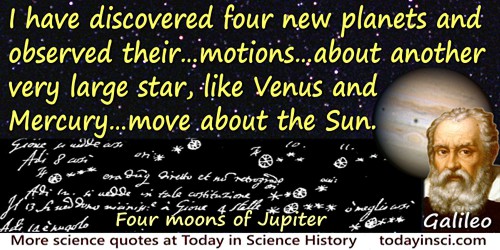
But what exceeds all wonders, I have discovered four new planets and observed their proper and particular motions, different among themselves and from the motions of all the other stars; and these new planets move about another very large star [Jupiter] like Venus and Mercury, and perchance the other known planets, move about the Sun. As soon as this tract, which I shall send to all the philosophers and mathematicians as an announcement, is finished, I shall send a copy to the Most Serene Grand Duke, together with an excellent spyglass, so that he can verify all these truths.
Letter to the Tuscan Court, 30 Jan 1610. Quoted in Albert van Heiden (ed.), Siderius Nuncius or The Sidereal Messenger (1989), 18.
But when we face the great questions about gravitation Does it require time? Is it polar to the 'outside of the universe' or to anything? Has it any reference to electricity? or does it stand on the very foundation of matter–mass or inertia? then we feel the need of tests, whether they be comets or nebulae or laboratory experiments or bold questions as to the truth of received opinions.
Letter to Michael Faraday, 9 Nov 1857. In P. M. Harman (ed.), The Scientific Letters and Papers of James Clerk Maxwell (1990), Vol. 1, 1846-1862, 551-2.
But, as Bacon has well pointed out, truth is more likely to come out of error, if this is clear and definite, than out of confusion, and my experience teaches me that it is better to hold a well-understood and intelligible opinion, even if it should turn out to be wrong, than to be content with a muddle-headed mixture of conflicting views, sometimes miscalled impartiality, and often no better than no opinion at all.
Principles of General Physiology (1915), x.
By convention sweet is sweet, by convention bitter is bitter, by convention hot is hot, by convention cold is cold, by convention colour is colour. But in reality there are atoms and the void. That is, the objects of sense are supposed to be real and it is customary to regard them as such, but in truth they are not. Only the atoms and the void are real.
Cited as from Sext. Emp. Math. VII. 135, in Charles Montague Bakewell, Source Book in Ancient Philosophy (1907), 60.
By introspection we drag out the truth for external survey.
In 'Science and Mysticism', The Nature of the Physical World (1928), 321.
By natural selection our mind has adapted itself to the conditions of the external world. It has adopted the geometry most advantageous to the species or, in other words, the most convenient. Geometry is not true, it is advantageous.
Science and Hypothesis (1902), in The Foundations of Science: Science and Hypothesis, The Value of Science, Science and Method(1946), trans. by George Bruce Halsted, 91.
By this we may understand, there be two sorts of knowledge, whereof the one is nothing else but sense, or knowledge original (as I have said at the beginning of the second chapter), and remembrance of the same; the other is called science or knowledge of the truth of propositions, and how things are called, and is derived from understanding.
The Elements of Law: Natural and Politic (1640), Ferdinand Tonnies edn. (1928), Part 1, Chapter 6, 18-9.
By what process of reasoning should the State of Texas be more concerned in the conviction of the guilty than in the acquittal of the innocent? [Urging the use of scopolamine “truth serum” to determine innocence.]
From paper read at the Section on State Medicine and Public Hygiene of the State Medical Association of Texas at El Paso (11 May 1922), 'The Use Of Scopolamine In Criminology', published in Texas State Journal of Medicine (Sep 1922). Reprinted in The American Journal of Police Science (Jul-Aug 1931), 2, No. 4, 328.
Can I pay any higher tribute to a man [George Gaylord Simpson] than to state that his work both established a profession and sowed the seeds for its own revision? If Simpson had reached final truth, he either would have been a priest or would have chosen a dull profession. The history of life cannot be a dull profession.
From 'G.G. Simpson, Paleontology, and the Modern Synthesis', collected in Ernst Mayr, William B. Provine (eds.), The Evolutionary Synthesis: Perspectives on the Unification of Biology (1998), 171.
Can it be that all great scientists of the past were really playing a game, a game in which the rules are written not by man but by God? . . . When we play we do not ask why we are playing—we just play. Play serves no moral code except that strange code which for some unknown reason, imposes itself on the play. . . . You will search in vain through scientific literature for hints of motivation. And as for the strange moral code observed by scientists, what could be stranger than an abstract regard for truth in a world which is full of concealment, deception, and taboos…? . . . In submitting to your consideration the idea that the human is at its best when playing, I am myself playing, and that makes me feel that what I am saying may have in it an element of truth.
From Lecture (28 Nov 1957) in the Queen’s University, Belfast, 'Is the Study of its History a Brake on the Progress of Science', printed in Hermethena (1958), 19, 40-41.
Certainly, it is heaven upon earth, to have a man's mind move in charity, rest in providence, and turn upon the poles of truth.
'Essays or Counsels: Civil and Moral. I. Of Truth'. In Francis Bacon, James Spedding, The Works of Francis Bacon (1864), Vol. 6, 378.
Charles Darwin, the Abraham of scientific men—a searcher as obedient to the command of truth as was the patriarch to the command of God.
In 'Science and Man', Fragments of Science (1879), Vol. 2, 370.
Pesidential Address to the Birmingham and Midland Institute, 1877, in 'Science and Man', Fragments of Science for Unscientific People: A Series of Detached Essays, Addresses, and Reviews (1879), Vol. 2, 370.
Chemical research conducts to the knowledge of philosophical truth, and forms the mind to philosophical enlargement and accuracy of thought, more happily than almost any other species of investigation in which the human intellect can be employed.
Quote following title page of Samuel Parkes, A Chemical Catechism With Notes, Illustrations and Experiments (8th ed. 1818).
Chemistry is one of those branches of human knowledge which has built itself upon methods and instruments by which truth can presumably be determined. It has survived and grown because all its precepts and principles can be re-tested at any time and anywhere. So long as it remained the mysterious alchemy by which a few devotees, by devious and dubious means, presumed to change baser metals into gold, it did not flourish, but when it dealt with the fact that 56 g. of fine iron, when heated with 32 g. of flowers of sulfur, generated extra heat and gave exactly 88 g. of an entirely new substance, then additional steps could be taken by anyone. Scientific research in chemistry, since the birth of the balance and the thermometer, has been a steady growth of test and observation. It has disclosed a finite number of elementary reagents composing an infinite universe, and it is devoted to their inter-reaction for the benefit of mankind.
Address upon receiving the Perkin Medal Award, 'The Big Things in Chemistry', The Journal of Industrial and Engineering Chemistry (Feb 1921), 13, No. 2, 163.
Christian Science … is the direct denial both of science and of Christianity, for Science rests wholly on the recognition of truth and Christianity on the recognition of pain.
From The Illustrated London News (1 Nov 1930), 177, Part 2, 750. In 'More on American Optimism', Collected Works (1990), Vol. 35, 406-407.
Come celebrate with me in song the nameOf Newton, to the Muses dear, for he
Unlocked the hidden treasures of truth …
Nearer the gods no mortal may approach.
Unlocked the hidden treasures of truth …
Nearer the gods no mortal may approach.
From final verse of his much longer 'Ode to Newton'. As translated from the Latin of the version in the first edition, by Leon J. Richardson. In Isaac Newton, Sir Isaac Newton’s Mathematical Principles of Natural Philosophy and His System of the World: Newton’s Principia: Motte’s Translation Revised (1934, 2022), xv. The Ode was prefaced to all three editions of Isaac Newton’s Principia, which Halley funded, edited and oversaw for its printing.
Common sense, (which, in truth, is very uncommon) is the best sense I know of: abide by it; it will counsel you best.
From Letter (27 Sep 1748, O.S.) to his son, collected in Letters Written by Philip Dormer Stanhope, Earl of Chesterfield, to his son, Philip Stanhope (1777), Vol. 2, 65.
Common sense, the half-truths of a deceitful society, is honored as the honest truths of a frank world.
In Social Amnesia (1975), 25.
Consider the very roots of our ability to discern truth. Above all (or perhaps I should say “underneath all”), common sense is what we depend on—that crazily elusive, ubiquitous faculty we all have to some degree or other. … If we apply common sense to itself over and over again, we wind up building a skyscraper. The ground floor of the structure is the ordinary common sense we all have, and the rules for building news floors are implicit in the ground floor itself. However, working it all out is a gigantic task, and the result is a structure that transcends mere common sense.
In Metamagical Themas: Questing for the Essence of Mind and Pattern (1985), 93–94.
Considering that, among all those who up to this time made discoveries in the sciences, it was the mathematicians alone who had been able to arrive at demonstrations—that is to say, at proofs certain and evident—I did not doubt that I should begin with the same truths that they have investigated, although I had looked for no other advantage from them than to accustom my mind to nourish itself upon truths and not to be satisfied with false reasons.
In Discourse upon Method, Part 2, in Henry A. Torrey (ed., trans. )Philosophy of Descartes in Extracts from His Writings , (1892), 47-48.
Contradiction is not a sign of falsity, nor the lack of contradiction a sign of truth.
From Pensées as translated in W.H. Auden and L. Kronenberger (eds.) The Viking Book of Aphorisms (1966), 325. From the original French, “Ni la contradiction n’est marque de fausseté ni l’incontradiction n’est marque de vérité,” in 'Pensées', Oeuvres Complètes (1864), Vol. 1, 261.
Convictions are more dangerous enemies of truth than lies.
As translated by R.J. Hollingdale (trans.) in Human, All Too Human: A book for Free Spirits (1878/1996), Part 1, 179, aphorism 483.
Crooked things may be as stiff and unflexible as streight: and Men may be as positive and peremptory in Error as in Truth.
An Essay Concerning Human Understanding (1690). Edited by Peter Nidditch (1975), Book 4, Chapter 19, Section 11, 703.
Darwin grasped the philosophical bleakness with his characteristic courage. He argued that hope and morality cannot, and should not, be passively read in the construction of nature. Aesthetic and moral truths, as human concepts, must be shaped in human terms, not ‘discovered’ in nature. We must formulate these answers for ourselves and then approach nature as a partner who can answer other kinds of questions for us–questions about the factual state of the universe, not about the meaning of human life. If we grant nature the independence of her own domain–her answers unframed in human terms–then we can grasp her exquisite beauty in a free and humble way. For then we become liberated to approach nature without the burden of an inappropriate and impossible quest for moral messages to assuage our hopes and fears. We can pay our proper respect to nature’s independence and read her own ways as beauty or inspiration in our different terms.
…...
Data is not necessarily information. Information does not necessarily lead to knowledge. And knowledge is not always sufficient to discover truth and breed wisdom.
From post 're:The Pursuit of Knowledge, from Genesis to Google' to the 'Interesting People' List (6 Jan 2005), now archived at interesting-people.org website
Debate is an art form. It is about the winning of arguments. It is not about the discovery of truth. There are certain rules and procedures to debate that really have nothing to do with establishing fact–which creationists have mastered. Some of those rules are: never say anything positive about your own position because it can be attacked, but chip away at what appear to be the weaknesses in your opponent’s position. They are good at that. I don’t think I could beat the creationists at debate. I can tie them. But in courtrooms they are terrible, because in courtrooms you cannot give speeches. In a courtroom you have to answer direct questions about the positive status of your belief. We destroyed them in Arkansas. On the second day of the two-week trial we had our victory party!
…...
Democritus said; “That truth did lie in profound pits, and when it was got it need much refining.”
In 'A Collection of Apophthegms, New and Old' (1625). As given in Essays, Moral, Economical, and Political: A New Edition, With the Latin Quotations Translated (1813), 'Contained in the original edition in octavo but omitted in later copies', No. 263, 353.
Democritus sometimes does away with what appears to the senses, and says that none of these appears according to truth but only according to opinion: the truth in real things is that there are atoms and void. “By convention sweet”, he says, “by convention bitter, by convention hot, by convention cold, by convention colour: but in reality atoms and void.”
Against the Professors, 7, 135. In G. S. Kirk, J. E. Raven and M. Schofield (eds.), The Presocratic Philosophers: A Critical History with a Selection of Texts (1983), 410.
Descriptive geometry has two objects: the first is to establish methods to represent on drawing paper which has only two dimensions,—namely, length and width,—all solids of nature which have three dimensions,—length, width, and depth,—provided, however, that these solids are capable of rigorous definition.
The second object is to furnish means to recognize accordingly an exact description of the forms of solids and to derive thereby all truths which result from their forms and their respective positions.
The second object is to furnish means to recognize accordingly an exact description of the forms of solids and to derive thereby all truths which result from their forms and their respective positions.
From On the Purpose of Descriptive Geometry as translated by Arnold Emch in David Eugene Smith, A Source Book in Mathematics (1929), 426.
Dissections daily convince us of our ignorance of disease, and cause us to blush at our prescriptions. What mischief have we done under the belief of false facts and false theories! We have assisted in multiplying diseases; we have done more; we have increased their mortality. ... I am pursuing Truth, and am indifferent whither I am led, if she is my only leader.
From a public lecture by Rush. Quoted by Isaac Jennings, in Medical Reform; a Treatise on Man's Physical Being and Disorders (1847), 33.
Don’t despise empiric truth. Lots of things work in practice for which the laboratory has never found proof.
Martin H. Fischer, Howard Fabing (ed.) and Ray Marr (ed.), Fischerisms (1944).
During the last two centuries and a half, physical knowledge has been gradually made to rest upon a basis which it had not before. It has become mathematical. The question now is, not whether this or that hypothesis is better or worse to the pure thought, but whether it accords with observed phenomena in those consequences which can be shown necessarily to follow from it, if it be true
In Augustus De Morgan and Sophia Elizabeth De Morgan (ed.), A Budget of Paradoxes (1872), 2.
Ecclesiasticism in science is only unfaithfulness to truth.
More Criticisms on Darwin, and Administrative Nihilism (1872), 26.
Einstein’s space is no closer to reality than Van Gogh’s sky. The glory of science is not in a truth more absolute than the truth of Bach or Tolstoy, but in the act of creation itself. The scientist’s discoveries impose his own order on chaos, as the composer or painter imposes his; an order that always refers to limited aspects of reality, and is based on the observer's frame of reference, which differs from period to period as a Rembrandt nude differs from a nude by Manet.
In The Act of Creation (1964), 252.
Either one or the other [analysis or synthesis] may be direct or indirect. The direct procedure is when the point of departure is known-direct synthesis in the elements of geometry. By combining at random simple truths with each other, more complicated ones are deduced from them. This is the method of discovery, the special method of inventions, contrary to popular opinion.
Ampère gives this example drawn from geometry to illustrate his meaning for “direct synthesis” when deductions following from more simple, already-known theorems leads to a new discovery. In James R. Hofmann, André-Marie Ampère (1996), 159. Cites Académie des Sciences Ampère Archives, box 261.
Engineering training deals with the exact sciences. That sort of exactness makes for truth and conscience. It might be good for the world if more men had that sort of mental start in life even if they did not pursue the profession.
Reprint of his 1916 statement in 'Engineering as a Profession', Engineer’s Week (1954).
Enormous numbers of people are taken in, or at least beguiled and fascinated, by what seems to me to be unbelievable hocum, and relatively few are concerned with or thrilled by the astounding—yet true—facts of science, as put forth in the pages of, say, Scientific American.
Metamagical Themas (1985), 93.
Enthusiasm is the genius of sincerity, and truth accomplishes no victories without it.
In The Last Days of Pompeii (1834), Vol. 1, 78.
Eradication of microbial disease is a will-o’-the-wisp; pursuing it leads into a morass of hazy biological concepts and half truths.
Man Adapting (1965), 381.
Error held as truth has much the effect of truth. In politics and religion this fact upsets many confident predictions.
From chapter 'Jottings from a Note-Book', in Canadian Stories (1918), 177.
Error, never can be consistent, nor can truth fail of having support from the accurate examination of every circumstance.
'Theory of the Earth', Transactions of the Royal Society of Edinburgh (1788), 1, 259.
Errors, like straws, upon the surface flow;
He who would search for pearls must dive below.
He who would search for pearls must dive below.
Prologue, All For Love: Or, The World Well Lost (1678), collected in The Modern British Drama, (1811), Vol. 1, 337.
Ethical axioms are found and tested not very differently from the axioms of science. Truth is what stands the test of experience.
…...
Euler was a believer in God, downright and straightforward. The following story is told by Thiebault, in his Souvenirs de vingt ans de séjour à Berlin, … Thiebault says that he has no personal knowledge of the truth of the story, but that it was believed throughout the whole of the north of Europe. Diderot paid a visit to the Russian Court at the invitation of the Empress. He conversed very freely, and gave the younger members of the Court circle a good deal of lively atheism. The Empress was much amused, but some of her counsellors suggested that it might be desirable to check these expositions of doctrine. The Empress did not like to put a direct muzzle on her guest’s tongue, so the following plot was contrived. Diderot was informed that a learned mathematician was in possession of an algebraical demonstration of the existence of God, and would give it him before all the Court, if he desired to hear it. Diderot gladly consented: though the name of the mathematician is not given, it was Euler. He advanced toward Diderot, and said gravely, and in a tone of perfect conviction:
Monsieur, (a + bn) / n = x, donc Dieu existe; repondez!
Diderot, to whom algebra was Hebrew, was embarrassed and disconcerted; while peals of laughter rose on all sides. He asked permission to return to France at once, which was granted.
Diderot, to whom algebra was Hebrew, was embarrassed and disconcerted; while peals of laughter rose on all sides. He asked permission to return to France at once, which was granted.
In Budget of Paradoxes (1878), 251. [The declaration in French expresses, “therefore God exists; please answer!” This Euler-Diderot anecdote, as embellished by De Morgan, is generally regarded as entirely fictional. Diderot before he became an encyclopedist was an accomplished mathematician and fully capable of recognizing—and responding to—the absurdity of an algebraic expression in proving the existence of God. See B.H. Brown, 'The Euler-Diderot Anecdote', The American Mathematical Monthly (May 1942), 49, No. 5, 392-303. —Webmaster.]
Even if the open windows of science at first make us shiver after the cozy indoor warmth of traditional humanizing myths, in the end the fresh air brings vigor, and the great spaces have a splendor of their own.
What I Believe (1925). In The Basic Writings of Bertrand Russell, 1903-1959 (1992), 370.
Even if the received opinion be not only true, but the whole truth; unless it is suffered to be, and actually is, vigorously and earnestly contested, it will, by most of those who receive it, be held in the manner of a prejudice, with little comprehension or feeling of its rational grounds
On Liberty (1859), 95.
Even if you are a minority of one, the truth is the truth.
Quoted in Kim Lim (ed.), 1,001 Pearls of Spiritual Wisdom: Words to Enrich, Inspire, and Guide Your Life (2014), 15
Even in the vast and mysterious reaches of the sea we are brought back to the fundamental truth that nothing lives to itself.
Silent Spring, Introduction.
Even mistaken hypotheses and theories are of use in leading to discoveries. This remark is true in all the sciences. The alchemists founded chemistry by pursuing chimerical problems and theories which are false. In physical science, which is more advanced than biology, we might still cite men of science who make great discoveries by relying on false theories. It seems, indeed, a necessary weakness of our mind to be able to reach truth only across a multitude of errors and obstacles.
An Introduction to the Study of Experimental Medicine (1865, translation 1927, 1957), 170.
Even the facts of science may dust the mind by their dryness, unless they are … rendered fertile by the dews of fresh and living truth. Knowledge does not come to us by details, but in flashes of light from heaven.
Essay, first published as 'Life Without Principle', Atlantic Monthly (Oct 1863). Collected in Yankee in Canada, Etc., (1866) 267. Also excerpted in H.G.O. Blake (ed.), Thoreau's Thoughts: Selections From the Writings of Henry David Thoreau (1890, 2005), 102.
Even though the realms of religion and science in themselves are clearly marked off from each other, nevertheless there exist between the two strong reciprocal relationships and dependencies. Though religion may be that which determines the goal, it has, nevertheless, learned from science, in the broadest sense, what means will contribute to the attainment of the goals it has set up. But science can only be created by those who are thoroughly imbued with the aspiration toward truth and understanding. This source of feeling, however, springs from the sphere of religion. To this there also belongs the faith in the possibility that the regulations valid for the world of existence are rational, that is, comprehensible to reason. I cannot conceive of a genuine scientist without that profound faith. The situation may be expressed by an image: science without religion is lame, religion without science is blind.
From paper 'Science, Philosophy and Religion', prepared for initial meeting of the Conference on Science, Philosophy and Religion in Their Relation to the Democratic Way of Life, at the Jewish Theological Seminary of America, New York City (9-11 Sep 1940). Collected in Albert Einstein: In His Own Words (2000), 212.
Every definition implies an axiom, since it asserts the existence of the object defined. The definition then will not be justified, from the purely logical point of view, until we have ‘proved’ that it involves no contradiction either in its terms or with the truths previously admitted.
…...
Every detection of what is false directs us towards what is true: every trial exhausts some tempting form of error.
In 'Lecture 7', Lectures on the History of Moral Philosophy in England (1852), 101.
Every discoverer of a new truth, or inventor of the method which evolves it, makes a dozen, perhaps fifty, useless combinations, experiments, or trials for one successful one. In the realm of electricity or of mechanics there is no objection to this. But when such rejected failures involve a torture of animals, sometimes fearful in its character, there is a distinct objection to it.
From 'Vivisection', an original paper in Surgical Anaesthesia: Addresses, and Other Papers (1894, 1900), 369-370.
Every discovery, every enlargement of the understanding, begins as an imaginative preconception of what the truth might be. The imaginative preconception—a “hypothesis”—arises by a process as easy or as difficult to understand as any other creative act of mind; it is a brainwave, an inspired guess, a product of a blaze of insight. It comes anyway from within and cannot be achieved by the exercise of any known calculus of discovery.
In Advice to a Young Scientist (1979), 84.
Every great scientific truth goes through three states: first, people say it conflicts with the Bible; next, they say it has been discovered before; lastly, they say they always believed it.
Attributed; it does not appear directly in this form in any writings by Agassiz. This version of the quote comes from the Saturday Evening Post (1890), as cited in Ralph Keyes, The Quote Verifier (2006), 226. Since the quote was not printed within quotation marks, it is unlikely that this is a verbatim statement. Keyes discusses variations of the “three stages of truth” that have been attributed to a various other authors, but provides some substantiation with examples of similar quotes linked to Agassiz as related in second-person accounts.
Every great scientist becomes a great scientist because of the inner self-abnegation with which he stands before truth, saying: “Not my will, but thine, be done.” What, then, does a man mean by saying, Science displaces religion, when in this deep sense science itself springs from religion?
In 'The Real Point of Conflict between Science and Religion', collected in Living Under Tension: Sermons On Christianity Today (1941), 148.
Every scientist is an agent of cultural change. He may not be a champion of change; he may even resist it, as scholars of the past resisted the new truths of historical geology, biological evolution, unitary chemistry, and non-Euclidean geometry. But to the extent that he is a true professional, the scientist is inescapably an agent of change. His tools are the instruments of change—skepticism, the challenge to establish authority, criticism, rationality, and individuality.
In Science in Russian Culture: A History to 1860 (1963).
Every scientist, through personal study and research, completes himself and his own humanity. ... Scientific research constitutes for you, as it does for many, the way for the personal encounter with truth, and perhaps the privileged place for the encounter itself with God, the Creator of heaven and earth. Science shines forth in all its value as a good capable of motivating our existence, as a great experience of freedom for truth, as a fundamental work of service. Through research each scientist grows as a human being and helps others to do likewise.
Address to the members of the Pontifical Academy of Sciences (13 Nov 2000). In L’Osservatore Romano (29 Nov 2000), translated in English edition, 5.
Every well established truth is an addition to the sum of human power, and though it may not find an immediate application to the economy of every day life, we may safely commit it to the stream of time, in the confident anticipation that the world will not fail to realize its beneficial results.
In 'Report of the Secretary', Annual Report of the Board of Regents of the Smithsonian Institution for 1856 (1857), 20.
Everything that we call Invention or Discovery in the higher sense of the word is the serious exercise and activity of an original feeling for truth, which, after a long course of silent cultivation, suddenly flashes out into fruitful knowledge.
In The Maxims and Reflections of Goethe (1906), 193.
Examine your words well, and you will find that even when you have no motive to be false, it is a very hard thing to say the exact truth, even about your own immediate feelings—much harder than to say something fine about them which is not the exact truth.
In Adam Bede (1859, 1860), 151.
Exercise in the most rigorous thinking that is possible will of its own accord strengthen the sense of truth and right, for each advance in the ability to distinguish between correct and false thoughts, each habit making for rigour in thought development will increase in the sound pupil the ability and the wish to ascertain what is right in life and to defend it.
In Anleitung zum mathematischen Unterricht in den höheren Schulen (1906), 28.
Experience is the sole source of truth: it alone can teach us something new; it alone can give us certainty.
In La Science et l’Hypothèse (1901, 1908), 167, as translated in Henri Poincaré and William John Greenstreet (trans.), Science and Hypothesis (1902, 1905), 140. From the original French, “L'expérience est la source unique de la vérité: elle seule peut nous apprendre quelque chose de nouveau; elle seule peut nous donner la certitude. Voilà deux points que nul ne peut contester.”
Experiment is the sole source of truth. It alone can teach us something new; it alone can give us certainty.
Science and Hypothesis (1902), trans. W. J. G. and preface by J. Larmor (1905), 140.
Facts are certainly the solid and true foundation of all sectors of nature study ... Reasoning must never find itself contradicting definite facts; but reasoning must allow us to distinguish, among facts that have been reported, those that we can fully believe, those that are questionable, and those that are false. It will not allow us to lend faith to those that are directly contrary to others whose certainty is known to us; it will not allow us to accept as true those that fly in the face of unquestionable principles.
Memoires pour Servir a l'Histoire des Insectes (1736), Vol. 2, xxxiv. Quoted in Jacques Roger, The Life Sciences in Eighteenth-Century French Thought, ed. Keith R. Benson and trans. Robert Ellrich (1997), 165.
False facts are highly injurious to the progress of science, for they often long endure; but false views, if supported by some evidence, do little harm, as every one takes a salutary pleasure in proving their falseness; and when this is done, one path towards error is closed and the road to truth is often at the same time opened.
The Descent of Man (1871), Vol. 2, 385.
Falsehood is so easy, truth so difficult.
In Adam Bede (1859, 1860), 151.
Far from becoming discouraged, the philosopher should applaud nature, even when she appears miserly of herself or overly mysterious, and should feel pleased that as he lifts one part of her veil, she allows him to glimpse an immense number of other objects, all worthy of investigation. For what we already know should allow us to judge of what we will be able to know; the human mind has no frontiers, it extends proportionately as the universe displays itself; man, then, can and must attempt all, and he needs only time in order to know all. By multiplying his observations, he could even see and foresee all phenomena, all of nature's occurrences, with as much truth and certainty as if he were deducing them directly from causes. And what more excusable or even more noble enthusiasm could there be than that of believing man capable of recognizing all the powers, and discovering through his investigations all the secrets, of nature!
'Des Mulets', Oeuvres Philosophiques, ed. Jean Piveteau (1954), 414. Quoted in Jacques Roger, The Life Sciences in Eighteenth-Century French Thought, ed. Keith R. Benson and trans. Robert Ellrich (1997), 458.
Far must thy researches go
Wouldst thou learn the world to know;
Thou must tempt the dark abyss
Wouldst thou prove what Being is;
Naught but firmness gains the prize,—
Naught but fullness makes us wise,—
Buried deep truth ever lies!
Wouldst thou learn the world to know;
Thou must tempt the dark abyss
Wouldst thou prove what Being is;
Naught but firmness gains the prize,—
Naught but fullness makes us wise,—
Buried deep truth ever lies!
In Edgar A. Bowring (trans.), The Poems of Schiller (1875), 260.
Fear is the main source of superstition, and one of the main sources of cruelty. To conquer fear is the beginning of wisdom, in the pursuit of truth as in the endeavour after a worthy manner of life.
In An Outline of Intellectual Rubbish (1943), 23.
Fear of something is at the root of hate for others and hate within will eventually destroy the hater. Keep your thoughts free from hate, and you will have no fear from those who hate you. ...
David, though small, was filled with truth, right thinking and good will for others. Goliath represents one who let fear into his heart, and it stayed there long enough to grow into hate for others.
David, though small, was filled with truth, right thinking and good will for others. Goliath represents one who let fear into his heart, and it stayed there long enough to grow into hate for others.
In Alvin D. Smith, George Washington Carver: Man of God (1954), 43. Cited in Linda O. McMurry, George Washington Carver, Scientist and Symbol (1982), 107. Smith's book is about his recollections of G.W. Carver's Sunday School classes at Tuskegee, some 40 years earlier. Webmaster, who has not yet been able to see the original book, cautions this quote may be the gist of Carver's words, rather than a verbatim quote.
Few intellectual tyrannies can be more recalcitrant than the truths that everybody knows and nearly no one can defend with any decent data (for who needs proof of anything so obvious). And few intellectual activities can be more salutary than attempts to find out whether these rocks of ages might crumble at the slightest tap of an informational hammer.
…...
Fiction is, indeed, an indispensable supplement to logic, or even a part of it; whether we are working inductively or deductively, both ways hang closely together with fiction: and axioms, though they seek to be primary verities, are more akin to fiction. If we had realized the nature of axioms, the doctrine of Einstein, which sweeps away axioms so familiar to us that they seem obvious truths, and substitutes others which seem absurd because they are unfamiliar, might not have been so bewildering.
In The Dance of Life (1923), 86.
Finally, I aim at giving denominations to things, as agreeable to truth as possible. I am not ignorant that words, like money, possess an ideal value, and that great danger of confusion may be apprehended from a change of names; in the mean time it cannot be denied that chemistry, like the other sciences, was formerly filled with improper names. In different branches of knowledge, we see those matters long since reformed: why then should chemistry, which examines the real nature of things, still adopt vague names, which suggest false ideas, and favour strongly of ignorance and imposition? Besides, there is little doubt but that many corrections may be made without any inconvenience.
Physical and Chemical Essays (1784), Vol. I, xxxvii.
Finally, since I thought that we could have all the same thoughts, while asleep, as we have while we are awake, although none of them is true at that time, I decided to pretend that nothing that ever entered my mind was any more true than the illusions of my dreams. But I noticed, immediately afterwards, that while I thus wished to think that everything was false, it was necessarily the case that I, who was thinking this, was something. When I noticed that this truth “I think, therefore I am” was so firm and certain that all the most extravagant assumptions of the sceptics were unable to shake it, I judged that I could accept it without scruple as the first principle of the philosophy for which I was searching. Then, when I was examining what I was, I realized that I could pretend that I had no body, and that there was no world nor any place in which I was present, but I could not pretend in the same way that I did not exist. On the contrary, from the very fact that I was thinking of doubting the truth of other things, it followed very evidently and very certainly that I existed; whereas if I merely ceased to think, even if all the rest of what I had ever imagined were true, I would have no reason to believe that I existed. I knew from this that I was a substance, the whole essence or nature of which was to think and which, in order to exist, has no need of any place and does not depend on anything material. Thus this self—that is, the soul by which I am what I am—is completely distinct from the body and is even easier to know than it, and even if the body did not exist the soul would still be everything that it is.
Discourse on Method in Discourse on Method and Related Writings (1637), trans. Desmond M. Clarke, Penguin edition (1999), Part 4, 24-5.
For chemistry is no science form’d à priori; ’tis no production of the human mind, framed by reasoning and deduction: it took its rise from a number of experiments casually made, without any expectation of what follow’d; and was only reduced into an art or system, by collecting and comparing the effects of such unpremeditated experiments, and observing the uniform tendency thereof. So far, then, as a number of experimenters agree to establish any undoubted truth; so far they may be consider'd as constituting the theory of chemistry.
From 'The Author's Preface', in A New Method of Chemistry (1727), vi.
For FRICTION is inevitable because the Universe is FULL of God's works.
For the PERPETUAL MOTION is in all works of Almighty GOD.
For it is not so in the engines of man, which are made of dead materials, neither indeed can be.
For the Moment of bodies, as it is used, is a false term—bless God ye Speakers on the Fifth of November.
For Time and Weight are by their several estimates.
For I bless GOD in the discovery of the LONGITUDE direct by the means of GLADWICK.
For the motion of the PENDULUM is the longest in that it parries resistance.
For the WEDDING GARMENTS of all men are prepared in the SUN against the day of acceptation.
For the wedding Garments of all women are prepared in the MOON against the day of their purification.
For CHASTITY is the key of knowledge as in Esdras, Sir Isaac Newton & now, God be praised, in me.
For Newton nevertheless is more of error than of the truth, but I am of the WORD of GOD.
For the PERPETUAL MOTION is in all works of Almighty GOD.
For it is not so in the engines of man, which are made of dead materials, neither indeed can be.
For the Moment of bodies, as it is used, is a false term—bless God ye Speakers on the Fifth of November.
For Time and Weight are by their several estimates.
For I bless GOD in the discovery of the LONGITUDE direct by the means of GLADWICK.
For the motion of the PENDULUM is the longest in that it parries resistance.
For the WEDDING GARMENTS of all men are prepared in the SUN against the day of acceptation.
For the wedding Garments of all women are prepared in the MOON against the day of their purification.
For CHASTITY is the key of knowledge as in Esdras, Sir Isaac Newton & now, God be praised, in me.
For Newton nevertheless is more of error than of the truth, but I am of the WORD of GOD.
From 'Jubilate Agno' (c.1758-1763), in N. Callan (ed.), The Collected Poems of Christopher Smart (1949), Vol. 1, 276.
For if as scientists we seek simplicity, then obviously we try the simplest surviving theory first, and retreat from it only when it proves false. Not this course, but any other, requires explanation. If you want to go somewhere quickly, and several alternate routes are equally likely to be open, no one asks why you take the shortest. The simplest theory is to be chosen not because it is the most likely to be true but because it is scientifically the most rewarding among equally likely alternatives. We aim at simplicity and hope for truth.
Problems and Projects (1972), 352.
For if there is any truth in the dynamical theory of gases the different molecules in a gas at uniform temperature are moving with very different velocities. Put such a gas into a vessel with two compartments [A and B] and make a small hole in the wall about the right size to let one molecule through. Provide a lid or stopper for this hole and appoint a doorkeeper, very intelligent and exceedingly quick, with microscopic eyes but still an essentially finite being.
Whenever he sees a molecule of great velocity coming against the door from A into B he is to let it through, but if the molecule happens to be going slow he is to keep the door shut. He is also to let slow molecules pass from B to A but not fast ones ... In this way the temperature of B may be raised and that of A lowered without any expenditure of work, but only by the intelligent action of a mere guiding agent (like a pointsman on a railway with perfectly acting switches who should send the express along one line and the goods along another).
I do not see why even intelligence might not be dispensed with and the thing be made self-acting.
Moral The 2nd law of Thermodynamics has the same degree of truth as the statement that if you throw a tumblerful of water into the sea you cannot get the same tumblerful of water out again.
Whenever he sees a molecule of great velocity coming against the door from A into B he is to let it through, but if the molecule happens to be going slow he is to keep the door shut. He is also to let slow molecules pass from B to A but not fast ones ... In this way the temperature of B may be raised and that of A lowered without any expenditure of work, but only by the intelligent action of a mere guiding agent (like a pointsman on a railway with perfectly acting switches who should send the express along one line and the goods along another).
I do not see why even intelligence might not be dispensed with and the thing be made self-acting.
Moral The 2nd law of Thermodynamics has the same degree of truth as the statement that if you throw a tumblerful of water into the sea you cannot get the same tumblerful of water out again.
Letter to John William Strutt (6 Dec 1870). In P. M. Hannan (ed.), The Scientific Letters and Papers of James Clerk Maxwell (1995), Vol. 2, 582-3.
For it is too bad that there are so few who seek the truth and so few who do not follow a mistaken method in philosophy. This is not, however, the place to lament the misery of our century, but to rejoice with you over such beautiful ideas for proving the truth. So I add only, and I promise, that I shall read your book at leisure; for I am certain that I shall find the noblest things in it. And this I shall do the more gladly, because I accepted the view of Copernicus many years ago, and from this standpoint I have discovered from their origins many natural phenomena, which doubtless cannot be explained on the basis of the more commonly accepted hypothesis.
Letter (4 Aug 1597) to Kepler, expressing thanks and interest in the book Kepler sent him. As quoted in translation in Jackson J. Spielvogel, Western Civilization: Alternate Volume: Since 1300 (2010), Vol. 2, 494.
For it is too bad that there are so few who seek the truth and so few who do not follow a mistaken method in philosophy. This is not, however, the place to lament the misery of our century, but to rejoice with you over such beautiful ideas for proving the truth. So I add only, and I promise, that I shall read your book at leisure; for I am certain that I shall find the noblest things in it. And this I shall do the more gladly, because I accepted the view of Copernicus many years ago, and from this standpoint I have discovered from their origins many natural phenomena, which doubtless cannot be explained on the basis of the more commonly accepted hypothesis.
In Letter to Johannes Kepler. As quoted in The Portable Renaissance Reader (1968), 597.
For my part, I too much value the pursuit of truth and the discovery of any new fact in nature, to avoid inquiry because it appears to clash with prevailing opinions.
In 'Experimental Investigation of a New Force', The Quarterly Journal of Science, and Annals of Astronomy, Biology, Geology, Industrial Arts, Manufactures, and Technology (Jul 1871), New Series, 1, 341.
For myself, I found that I was fitted for nothing so well as for the study of Truth; as having a mind nimble and versatile enough to catch the resemblances of things (which is the chief point) , and at the same time steady enough to fix and distinguish their subtler differences; as being gifted by nature with desire to seek, patience to doubt, fondness to meditate, slowness to assert, readiness to reconsider, carefulness to dispose and set in order; and as being a man that neither affects what is new nor admires what is old, and that hates every kind of imposture. So I thought my nature had a kind of familiarity and relationship with Truth.
From 'Progress of philosophical speculations. Preface to intended treatise De Interpretatione Naturæ (1603), in Francis Bacon and James Spedding (ed.), Works of Francis Bacon (1868), Vol. 3, 85.
For science, in so far as it is a substitute for religion, and reason, in so far as it is a substitute for faith, have always foundered. Science will be able to satisfy in an increasing measure, and in fact does satisfy, our increasing logical and intellectual needs, our desire to know and understand the truth; but science does not satisfy the needs of our heart and our will, our hunger for immortality—far from satisfying it, it contradicts it.
From Miguel Unamuno and J. E. Crawford Flitch (trans.), Essays and Soliloquies (1926), 209.
For that which can shewn only in a certain Light is questionable. Truth, ’tis suppos’d, may bear all Lights: and one of those principal Lights or natural Mediums, by which Things are to be view’d, in order to a thorow Recognition, is Ridicule it-self.
Also seen in short form: “Ridicule is the test of truth.”
Also seen in short form: “Ridicule is the test of truth.”
In 'An Essay on the Freedom of Wit and Humour', Characteristicks of Men, Manners, Opinions, Times (1723), Vol. 1, 61.
For the holy Bible and the phenomena of nature proceed alike from the divine Word, the former as the dictate of the Holy Ghost and the latter as the observant executrix of God's commands. It is necessary for the Bible, in order to be accommodated to the understanding of every man, to speak many things which appear to differ from the absolute truth so far as the bare meaning of the words is concerned. But Nature, on the other hand, is inexorable and immutable; she never transgresses the laws imposed upon her, or cares a whit whether her abstruse reasons and methods of operation are understandable to men. For that reason it appears that nothing physical which sense-experience sets before our eyes, or which necessary demonstrations prove to us, ought to be called in question (much less condemned) upon the testimony of biblical passages which may have some different meaning beneath their words.
Letter to Madame Christina of Lorraine, Grand Duchess of Tuscany: Concerning the Use of Biblical Quotations in Matters of Science (1615), trans. Stillman Drake, Discoveries and Opinions of Galileo (1957), 182-3.
For the sake of persons of ... different types, scientific truth should be presented in different forms, and should be regarded as equally scientific, whether it appears in the robust form and the vivid coloring of a physical illustration, or in the tenuity and paleness of a symbolic expression.
…...
For the saving the long progression of the thoughts to remote and first principles in every case, the mind should provide itself several stages; that is to say, intermediate principles, which it might have recourse to in the examining those positions that come in its way. These, though they are not self-evident principles, yet, if they have been made out from them by a wary and unquestionable deduction, may be depended on as certain and infallible truths, and serve as unquestionable truths to prove other points depending upon them, by a nearer and shorter view than remote and general maxims. … And thus mathematicians do, who do not in every new problem run it back to the first axioms through all the whole train of intermediate propositions. Certain theorems that they have settled to themselves upon sure demonstration, serve to resolve to them multitudes of propositions which depend on them, and are as firmly made out from thence as if the mind went afresh over every link of the whole chain that tie them to first self-evident principles.
In The Conduct of the Understanding, Sect. 21.
For the truth of the conclusions of physical science, observation is the supreme Court of Appeal. It does not follow that every item which we confidently accept as physical knowledge has actually been certified by the Court; our confidence is that it would be certified by the Court if it were submitted. But it does follow that every item of physical knowledge is of a form which might be submitted to the Court. It must be such that we can specify (although it may be impracticable to carry out) an observational procedure which would decide whether it is true or not. Clearly a statement cannot be tested by observation unless it is an assertion about the results of observation. Every item of physical knowledge must therefore be an assertion of what has been or would be the result of carrying out a specified observational procedure.
In ’Scientific Epistemology', The Philosophy of Physical Science (1938, 2012), 9.
For there are two modes of acquiring knowledge, namely, by reasoning and experience. Reasoning draws a conclusion and makes us grant the conclusion, but does not make the conclusion certain, nor does it remove doubt so that the mind may rest on the intuition of truth, unless the mind discovers it by the path of experience; since many have the arguments relating to what can be known, but because they lack experience they neglect the arguments, and neither avoid what is harmful nor follow what is good. For if a man who has never seen fire should prove by adequate reasoning that fire burns and injures things and destroys them, his mind would not be satisfied thereby, nor would he avoid fire, until he placed his hand or some combustible substance in the fire, so that he might prove by experience that which reasoning taught. But when he has had actual experience of combustion his mind is made certain and rests in the full light of truth. Therefore reasoning does not suffice, but experience does.
Opus Majus [1266-1268], Part VI, chapter I, trans. R. B. Burke, The Opus Majus of Roger Bacon (1928), Vol. 2, 583.
For they are, in truth, textbooks of life: they gather outer and inner experiences into a general and connected whole.
In The Maxims and Reflections of Goethe (1906), 189.
For to define true madness,
What is't but to be nothing else but mad?
What is't but to be nothing else but mad?
Hamlet (1601), II, ii.
For, dear me, why abandon a belief
Merely because it ceases to be true.
Cling to it long enough, and not a doubt
It will turn true again, for so it goes.
Most of the change we think we see in life
Is due to truths being in and out of favour.
Merely because it ceases to be true.
Cling to it long enough, and not a doubt
It will turn true again, for so it goes.
Most of the change we think we see in life
Is due to truths being in and out of favour.
'The Black Cottage'. In Edward Connery Latham (ed.), The Poetry of Robert Frost (1971), 77.
For, Mathematical Demonstrations being built upon the impregnable Foundations of Geometry and Arithmetick, are the only Truths, that can sink into the Mind of Man, void of all Uncertainty; and all other Discourses participate more or less of Truth, according as their Subjects are more or less capable of Mathematical Demonstration.
Inaugural lecture of Christopher Wren in his chair of astronomy at Gresham College (1657). From Parentelia (1741, 1951), 200-201.
For, the great enemy of knowledge is not error, but inertness. All that we want is discussion, and then we are sure to do well, no matter what our blunders may be. One error conflicts with another; each destroys its opponent, and truth is evolved.
In History of Civilization in England (1861), Vol. 2, 408.
Freud becomes one of the dramatis personae, in fact, as discoverer of the great and beautiful modern myth of psychoanalysis. By myth, I mean a poetic, dramatic expression of a hidden truth; and in placing this emphasis, I do not intend to put into question the scientific validity of psychoanalysis.
The White Hotel (1981,1993), vii.
From a certain temperature on, the molecules 'condense' without attractive forces; that is, they accumulate at zero velocity. The theory is pretty, but is there some truth in it.
Letter to Ehrenfest (Dec 1924). Quoted in Abraham Pais, Roger Penrose, Subtle Is the Lord: The Science and the Life of Albert Einstein (2005), 432.
From the infinitely great down to the infinitely small, all things are subject to [the laws of nature]. The sun and the planets follow the laws discovered by Newton and Laplace, just as the atoms in their combinations follow the laws of chemistry, as living creatures follow the laws of biology. It is only the imperfections of the human mind which multiply the divisions of the sciences, separating astronomy from physics or chemistry, the natural sciences from the social sciences. In essence, science is one. It is none other than the truth.
From Cours d’Economie Politique (1896-97), as given in Archives Internationales d’Histoire des Sciences (1993), Issues 131-133, 67.
From the medical theoretical standpoint, it suffices to deliberate and speculate regarding most illnesses. However, therapeutically, speculation is not adequate, and true and correct knowledge is imperative.
As quoted in Fred Rosner, The Medical Legacy of Moses Maimonides (1998), 54.
From the point of view of the pure morphologist the recapitulation theory is an instrument of research enabling him to reconstruct probable lines of descent; from the standpoint of the student of development and heredity the fact of recapitulation is a difficult problem whose solution would perhaps give the key to a true understanding of the real nature of heredity.
Form and Function: A Contribution to the History of Animal Morphology (1916), 312-3.
General Relativity is at least very close to the truth.
…...
Generalisations which are fruitful because they reveal in a single general principle the rationale of a great many particular truths, the connections and common origins of which had not previously been seen, are found in all the sciences, and particularly in mathematics. Such generalisations are the most important of all, and their discovery is the work of genius.
From Essai sur les Fondements de nos Connaissances et sur les Caractères de la Critique Philosophique (1851), 28, as translated by Merritt H Moore in An Essay on the Foundations of Our Knowledge (1956), 24. From the original French: “Il y a dans toutes les sciences, et en mathématiques particulièrement, des généralisations fécondes, parce qu’elles nous montrent dans une vérité générale la raison d’une multitude de vérités particulières dont les liens et la commune origine n’étaient point aperçus. De telles généralisations sont des découvertes du génie, et les plus importantes de toutes.”
Genetics has enticed a great many explorers during the past two decades. They have labored with fruit-flies and guinea-pigs, with sweet peas and corn, with thousands of animals and plants in fact, and they have made heredity no longer a mystery but an exact science to be ranked close behind physics and chemistry in definiteness of conception. One is inclined to believe, however, that the unique magnetic attraction of genetics lies in the vision of potential good which it holds for mankind rather than a circumscribed interest in the hereditary mechanisms of the lowly species used as laboratory material. If man had been found to be sharply demarcated from the rest of the occupants of the world, so that his heritage of physical form, of physiological function, and of mental attributes came about in a superior manner setting him apart as lord of creation, interest in the genetics of the humbler organisms—if one admits the truth—would have flagged severely. Biologists would have turned their attention largely to the ways of human heredity, in spite of the fact that the difficulties encountered would have rendered progress slow and uncertain. Since this was not the case, since the laws ruling the inheritance of the denizens of the garden and the inmates of the stable were found to be applicable to prince and potentate as well, one could shut himself up in his laboratory and labor to his heart's content, feeling certain that any truth which it fell to his lot to discover had a real human interest, after all.
Mankind at the Crossroads (1923), v-vi.
Genius, in truth, means little more than the faculty of perceiving in an unhabitual way.
In Psychology (1904), 328.
Gentlemen, that is surely true, it is absolutely paradoxical; we cannot understand it, and we don’t know what it means. But we have proved it, and therefore we know it is the truth.
In a lecture, after establishing the relation eπ/2 = i√i in a lecture, “which evidently had a strong hold on his imagination. He dropped his chalk and rubber, put his hands in his pockets, and after contemplating the formula a few minutes turned to his class and said [this quote] very slowly and impressively.” As quoted in W. E. Byerly (writing as a Professor Emeritus at Harvard University, but a former student of Peirce), 'Benjamin Peirce: II. Reminiscences', The American Mathematical Monthly (Jan 1925), 32, No. 1, 6.
Give me a fruitful error any time, full of seeds, bursting with its own corrections. You can keep your sterile truth for yourself.
Pareto’s comment on Kepler. In John Bartlett, Familiar Quotations (12th ed. 1949), 1198. Also in Francis Crick, The Astonishing Hypothesis: the Scientific Search for the Soul (1995), 231.
Given a large mass of data, we can by judicious selection construct perfectly plausible unassailable theories—all of which, some of which, or none of which may be right.
I-Ching and the citric acid cycle. Unpublished manuscript/seminar notes quoted in Frederick Grinnell, Everyday Practice of Science (2008), 86.
God forbid that Truth should be confined to Mathematical Demonstration! He who does not know truth at sight is unworthy of Her Notice.
Marginal note (c. 1808) written in his copy of 'Discourse VII', The Works of Sir Joshua Reynolds (1798), beside “…as true as mathematical demonstration…”. As given in William Blake, Edwin John Ellis (ed.) and William Butler Yeats (ed.), The Works of William Blake (1893), Vol. 2, 340.
Google can aggregate all web and paper-based information, and they can build fantastic search engines, but that will not directly lead to truth or wisdom. For that we will continue to need education, training in critical thought, and good editors who can help us winnow the fact from the fiction.
From post 're:The Pursuit of Knowledge, from Genesis to Google' to the 'Interesting People' List (6 Jan 2005) maintained by David J. Farber, now archived at interesting-people.org website.
Gradually, … the aspect of science as knowledge is being thrust into the background by the aspect of science as the power of manipulating nature. It is because science gives us the power of manipulating nature that it has more social importance than art. Science as the pursuit of truth is the equal, but not the superior, of art. Science as a technique, though it may have little intrinsic value, has a practical importance to which art cannot aspire.
In The Scientific Outlook (1931, 2009), xxiv.
Great truths can only be forgotten and can never be falsified.
From Illustrated London News (30 Sep 1933). In 'The Idolatry of the Clock', The Collected Works of G.K. Chesterton (2011), Vol. 36, 349.
He [said of one or other eminent colleagues] is a very busy man, and half of what he publishes is true, but I don't know which half.
'Triviality in Science: A Brief Meditation on Fashions', Perspectives in Biology and Medicine, 1976, 19, 324.
He that believes, without having any Reason for believing, may be in love with his own Fancies; but neither seeks Truth as he ought, nor pays the Obedience due to his Maker, who would have him use those discerning Faculties he has given him, to keep him out of Mistake and Errour.
In 'Of Reason', Essay Concerning Humane Understanding (1690), Book 4, Ch. 17, Sec. 24, 347.
He that could teach mathematics well, would not be a bad teacher in any of [physics, chemistry, biology or psychology] unless by the accident of total inaptitude for experimental illustration; while the mere experimentalist is likely to fall into the error of missing the essential condition of science as reasoned truth; not to speak of the danger of making the instruction an affair of sensation, glitter, or pyrotechnic show.
In Education as a Science (1879), 298.
He that desires to learn Truth should teach himself by Facts and Experiments; by which means he will learn more in a Year than by abstract reasoning in an Age.
In Academical Lectures on the Theory of Physic (1751), Vol. 1. As quoted in Thomas Steele Hall, A Source Book in Animal Biology (1951), 485.
He who gives a portion of his time and talent to the investigation of mathematical truth will come to all other questions with a decided advantage over his opponents. He will be in argument what the ancient Romans were in the field: to them the day of battle was a day of comparative recreation, because they were ever accustomed to exercise with arms much heavier than they fought; and reviews differed from a real battle in two respects: they encountered more fatigue, but the victory was bloodless.
Reflection 352, in Lacon: or Many things in Few Words; Addressed to Those Who Think (1820), 159.
He who would know what geometry is, must venture boldly into its depths and learn to think and feel as a geometer. I believe that it is impossible to do this, and to study geometry as it admits of being studied and am conscious it can be taught, without finding the reason invigorated, the invention quickened, the sentiment of the orderly and beautiful awakened and enhanced, and reverence for truth, the foundation of all integrity of character, converted into a fixed principle of the mental and moral constitution, according to the old and expressive adage “abeunt studia in mores”.
In 'A Probationary Lecture on Geometry, in Collected Mathematical Papers (1908), Vol. 2, 9. [The Latin phrase, “abeunt studia in mores” translates as “studies pass on into character”. —Webmaster]
Hence, a devout Christian must avoid astrologers and all impious soothsayers, especially when they tell the truth, for fear of leading his soul into error by consorting with demons and entangling himself with the bonds of such association.
De Genesi ad Uteram (On The Uteral Interpretation of Genesis) [401/415], Book II, chapter 17, section 37, trans. J. H. Taylor (1982), Vol. I, 72-3.
Here I shall present, without using Analysis [mathematics], the principles and general results of the Théorie, applying them to the most important questions of life, which are indeed, for the most part, only problems in probability. One may even say, strictly speaking, that almost all our knowledge is only probable; and in the small number of things that we are able to know with certainty, in the mathematical sciences themselves, the principal means of arriving at the truth—induction and analogy—are based on probabilities, so that the whole system of human knowledge is tied up with the theory set out in this essay.
Philosophical Essay on Probabilities (1814), 5th edition (1825), trans. Andrew I. Dale (1995), 1.
Heresies are experiments in man’s unsatisfied search for truth.
Crux Ansata: An Indictment of the Roman Catholic Church (1943, 2000), 15.
Herrmann Pidoux and Armand Trousseau stated 'Disease exists within us, because of us, and through us', Pasteur did not entirely disagree, 'This is true for certain diseases', he wrote cautiously, only to add immediately: 'I do not think that it is true for all of them'.
Pasteur Vallery-Radot (ed.), Oeuvres de Pasteur (1922-1939), Vol. 6, 167. Quoted in Patrice Debré, Louis Pasteur, trans. Elborg Forster (1994), 261.
Hipparchus displayed his love of truth in confining to the sun and moon his demonstration of
circular and uniform motions, and in not extending them to the five planets. Inasmuch as his predecessors had not left him a sufficient number of accurate observations, he judged rightly, with reference to the planets, in attempting nothing beyond a collection of good observations for the use of his successors, and a demonstration, by means of these observations, that the hypotheses of the mathematicians of his time did not agree with the phenomena.
— Ptolemy
Translated from Syntaxis, ix, 2. As quoted and cited in George Cornewall Lewis, An Historical Survey of the Astronomy of the Ancients (1862), 214.
History warns us … that it is the customary fate of new truths to begin as heresies and to end as superstitions; and, as matters now stand, it is hardly rash to anticipate that, in another twenty years, the new generation, educated under the influences of the present day, will be in danger of accepting the main doctrines of the “Origin of Species,” with as little reflection, and it may be with as little justification, as so many of our contemporaries, twenty years ago, rejected them.
'The Coming of Age of the Origin of Species' (1880). In Collected Essays, Vol. 2: Darwiniana (1893), 229.
Hogwash! … On our way to the moon, and on the moon, I worked as hard as John Young and it took me another six years before I found out the truth about God. In the days of Apollo and long afterwards I still believed in the theory of evolution and rejected the Biblical creation story. [Commenting on an American reporter’s printed intimation that Lunar Module pilots “had less things to do and had time to look out the spaceship’s window, or to explore the surroundings. Afterwards they could not cope with what they had seen, felt and experienced.”]
As quoted in Colin Burgess, Footprints in the Dust: The Epic Voyages of Apollo, 1969-1975 (2010), 422. Burgess introduced the quote with: “Charles Moss Duke Jr. has always been wrongly labeled as the astronaut who found God during his Apollo 16 mission, but even though he did eventually become a born-again Christian, this life-altering epiphany came some years after the event.” Burgess explained that Duke dislikes “misinformed characterizations of himself and his Apollo colleagues and of the religious impact of his own lunar mission.” [The ellipsis in the subject quote spans from one paragraph to the next in Burgess’ book. The ellipsis was added by Webmaster, on the assumption that the word “Hogwash!” belongs with the statement in the following paragraph.]
How do we tell truths that might hurt?
…...
How indispensable to a correct study of Nature is a perception of her true meaning. The fact will one day flower out into a truth. The season will mature and fructify what the understanding had cultivated. Mere accumulators of facts—collectors of materials for the master-workmen—are like those plants growing in dark forests, which “put forth only leaves instead of blossoms.”
(16 Dec 1837). In Henry David Thoreau and Bradford Torrey (ed.), The Writings of Henry Thoreau: Journal: I: 1837-1846 (1906), 18.
How often have I said to you that when you have eliminated the impossible, whatever remains, however improbable, must be the truth?
From Chapter 6, 'Sherlock Holmes Gives a Demonstration', The Sign of Four; or, The Problem of the Sholtos, in Lippincott’s Magazine (Feb 1890), Vol. 45, 172.
How peacefully he sleep!
Yet may his ever-questing spirit, freed at length
from all the frettings of this little world,
Wander at will among the uncharted stars.
Fairfield his name. Perchance celestial fields
disclosing long sought secrets of the past
Spread 'neath his enraptured gaze
And beasts and men that to his earthly sight
were merely bits of stone shall live again to
gladden those eager eyes.
o let us picture him—enthusiast—scientist—friend—
Seeker of truth and light through all eternity!
Yet may his ever-questing spirit, freed at length
from all the frettings of this little world,
Wander at will among the uncharted stars.
Fairfield his name. Perchance celestial fields
disclosing long sought secrets of the past
Spread 'neath his enraptured gaze
And beasts and men that to his earthly sight
were merely bits of stone shall live again to
gladden those eager eyes.
o let us picture him—enthusiast—scientist—friend—
Seeker of truth and light through all eternity!
New York Sun (13 Nov 1935). Reprinted in 'Henry Fairfield Osborn', Supplement to Natural History (Feb 1936), 37:2, 135. Bound in Kofoid Collection of Pamphlets on Biography, University of California.
However, all scientific statements and laws have one characteristic in common: they are “true or false” (adequate or inadequate). Roughly speaking, our reaction to them is “yes” or “no.” The scientific way of thinking has a further characteristic. The concepts which it uses to build up its coherent systems are not expressing emotions. For the scientist, there is only “being,” but no wishing, no valuing, no good, no evil; no goal. As long as we remain within the realm of science proper, we can never meet with a sentence of the type: “Thou shalt not lie.” There is something like a Puritan's restraint in the scientist who seeks truth: he keeps away from everything voluntaristic or emotional.
Essays in Physics (1950), 68.
I always love geology. In winter, particularly, it is pleasant to listen to theories about the great mountains one visited in the summer; or about the Flood or volcanoes; about great catastrophes or about blisters; above all about fossils … Everywhere there are hypotheses, but nowhere truths; many workmen, but no experts; priests, but no God. In these circumstances each man can bring his hypothesis like a candle to a burning altar, and on seeing his candle lit declare ‘Smoke for smoke, sir, mine is better than yours’. It is precisely for this reason that I love geology.
In Nouvelles Genevoises (1910), 306. First edition, 1841.
I am certain of nothing but the holiness of the Heart’s affections and the truth of Imagination—What the imagination seizes as Beauty must be truth—whether it existed before or not.
Letter to Benjamin Bailey (22 Nov 1817). In H. E. Rollins (ed.), Letters of John Keats (1958), Vol. 1, 184.
I am curious in a super-apish way. I like finding out things. That … is all that the “noble self-sacrificing devotion to truth” of 99-44/100% of all scientists amounts to—simple curiosity. That is the spirit in which nearly all productive scientific research is carried on.
Letter from London (20 Apr 1937), No. 81, in George Gaylord Simpson and Léo F. LaPorte (ed.), Simple Curiosity: Letters from George Gaylord Simpson to His Family, 1921-1970 (1987), 34.
I am persuaded that there is not in the nature of science anything unfavourable to religious feelings, and if I were not so persuaded I should be much puzzled to account for our being invested, as we so amply are, with the facilities that lead us to the discovery of scientific truth. It would be strange if our Creator should be found to be urging us on in a career which tended to be a forgetfulness of him.
Letter to H. J. Rose (19 Nov 1826). Quoted in I. Todhunter (ed.), William Whewell: An Account of His Writings with Selections From His Literary and Scientific Correspondence (1876), Vol. 2, 76.
I am pleased, however, to see the efforts of hypothetical speculation, because by the collisions of different hypotheses, truth may be elicited and science advanced in the end.
Letter (5 Sep 1822) to Mr. George F. Hopkins. Collected in The Writings of Thomas Jefferson: Correspondence (1854), Vol. 7, 260.
I am the most hesitating of men, the most fearful of committing myself when I lack evidence. But on the contrary, no consideration can keep me from defending what I hold as true when I can rely on solid scientific proof.
As quoted in René J. Dubos, Louis Pasteur, Free Lance of Science (1960, 1986), 76.
I believe that the Dayton trial marked the beginning of the decline of fundamentalism. … I feel that restrictive legislation on academic freedom is forever a thing of the past, that religion and science may now address one another in an atmosphere of mutual respect and of a common quest for truth. I like to think that the Dayton trial had some part in bringing to birth this new era.
From 'Reflections—Forty Years After', in Jerry R. Tompkins (ed.), D-Days at Dayton: Reflections on the Scopes Trial(1965), 31. As quoted in Stephen Jay Gould, Hen’s Teeth and Horse’s Toes: Further Reflections in Natural History (1983), 274.
I believe that the laws of physics such as they are, such as they have been taught to us, are not the inevitable truth. We believe in the laws, or we experiment* with them each day, yet I believe it is possible to consider the existence of a universe in which these laws would be extended, changed a very tiny bit, in a precisely demarcated way. Consequently we immediately achieve extraordinary results, different yet certainly not far from the truth. After all, every century or two a new scientist comes along who changes the laws of physics, isn’t that so? After Newton there were many who did, and there were even more after Einstein, right? We have to wait to see how the laws in question will change over time, then… In any case, without being a scientist myself I can still hope to reach parallel results, if you will, in art.
Epigraph, in James Housefield, Playing with Earth and Sky: Astronomy, Geography, and the Art of Marcel Duchamp (2016), ix. As modified by James Housefield, from Guy Viau interview of Marcel Duchamp on Canadian Radio Television (17 July 1960), 'Simply Change Your Name', translated by Sarah Skinner Kilborne in Tout-Fait: the Marcel Duchamp Studies Online Journal 2, no. 4 (2002). [*Note: Where the Housefield in the Epigraph uses the word “experiment”, the original French gives “expérimentons”, which in the unmodified translation by Sarah Skinner Kilborne is written more correctly as “experience.” —Webmaster]
I can see him now at the blackboard, chalk in one hand and rubber in the other, writing rapidly and erasing recklessly, pausing every few minutes to face the class and comment earnestly, perhaps on the results of an elaborate calculation, perhaps on the greatness of the Creator, perhaps on the beauty and grandeur of Mathematics, always with a capital M. To him mathematics was not the handmaid of philosophy. It was not a humanly devised instrument of investigation, it was Philosophy itself, the divine revealer of TRUTH.
Writing as a Professor Emeritus at Harvard University, a former student of Peirce, in 'Benjamin Peirce: II. Reminiscences', The American Mathematical Monthly (Jan 1925), 32, No. 1, 5.
I cannot but be astonished that Sarsi should persist in trying to prove by means of witnesses something that I may see for myself at any time by means of experiment. Witnesses are examined in doutbful matters which are past and transient, not in those which are actual and present. A judge must seek by means of witnesses to determine whether Peter injured John last night, but not whether John was injured, since the judge can see that for himself.
'The Assayer' (1623), trans. Stillman Drake, Discoveries and Opinions of Galileo (1957), 271.
I conclude that, while it is true that science cannot decide questions of value, that is because they cannot be intellectually decided at all, and lie outside the realm of truth and falsehood. Whatever knowledge is attainable, must be attained by scientific methods; and what science cannot discover, mankind cannot know.
Religion and Science (1935), 243.
I deal not with the perishing things of the hour—with statistics, … so fugitive,—that truth to-day is falsehood almost on the morrow.
In The Shoe and Canoe: Or Pictures of Travel in the Canadas (1850), viii.
I do believe that a scientist is a freelance personality. We’re driven by an impulse which is one of curiosity, which is one of the basic instincts that a man has. So we are … driven … not by success, but by a sort of passion, namely the desire of understanding better, to possess, if you like, a bigger part of the truth. I do believe that science, for me, is very close to art.
From 'Asking Nature', collected in Lewis Wolpert and Alison Richards (eds.), Passionate Minds: The Inner World of Scientists (1997), 197.
I do not know if I am mistaken, but it seems that one can obtain more truths, important to Humanity, from Chemistry than from any other Science.
In Chemische Annalen (Crell;s) I:291-305, 1788. As cited in Israel S. Kleiner, 'Hahnemann as a Chemist', The Scientific Monthly (May 1938), 46, 450. The quote is the opening words of an article describing his test for lead and iron in wine.
![Isaac Newton Quote: like a boy playing on the seashore [pebbles]…whilst the great ocean of truth lay all undiscovered before me](https://todayinsci.com/N/Newton_Isaac/NewtonIsaac-SeashoreQuoteThm.jpg)
I do not know what I may appear to the world, but to myself I seem to have been only like a boy playing on the seashore, and diverting myself in now and then finding a smoother pebble or a prettier shell than ordinary, whilst the great ocean of truth lay all undiscovered before me.
First reported in Joseph Spence, Anecdotes, Observations and Characters, of Books and Men (1820), Vol. 1 of 1966 edn, sect. 1259, p. 462. Purported to have been addressed by Newton in the final year of his life (1727) to Chevalier Andrew Michael Ramsey (which conflicts with the Dictionary of National Biography article giving that he was in France at the time). Quoted in David Brewster, Memoirs of the Life, Writings, and Discoveries of Sir Isaac Newton (1855), Vol. 2, 407.
I do not maintain that the chief value of the study of arithmetic consists in the lessons of morality that arise from this study. I claim only that, to be impressed from day to day, that there is something that is right as an answer to the questions with which one is able to grapple, and that there is a wrong answer—that there are ways in which the right answer can be established as right, that these ways automatically reject error and slovenliness, and that the learner is able himself to manipulate these ways and to arrive at the establishment of the true as opposed to the untrue, this relentless hewing to the line and stopping at the line, must color distinctly the thought life of the pupil with more than a tinge of morality. … To be neighborly with truth, to feel one’s self somewhat facile in ways of recognizing and establishing what is right, what is correct, to find the wrong persistently and unfailingly rejected as of no value, to feel that one can apply these ways for himself, that one can think and work independently, have a real, a positive, and a purifying effect upon moral character. They are the quiet, steady undertones of the work that always appeal to the learner for the sanction of his best judgment, and these are the really significant matters in school work. It is not the noise and bluster, not even the dramatics or the polemics from the teacher’s desk, that abide longest and leave the deepest and stablest imprint upon character. It is these still, small voices that speak unmistakably for the right and against the wrong and the erroneous that really form human character. When the school subjects are arranged on the basis of the degree to which they contribute to the moral upbuilding of human character good arithmetic will be well up the list.
In Arithmetic in Public Education (1909), 18. As quoted and cited in Robert Édouard Moritz, Memorabilia Mathematica; Or, The Philomath’s Quotation-book (1914), 69.
I do not think we can impose limits on research. Through hundreds of thousands of years, man’s intellectual curiosity has been essential to all the gains we have made. Although in recent times we have progressed from chance and hit-or-miss methods to consciously directed research, we still cannot know in advance what the results may be. It would be regressive and dangerous to trammel the free search for new forms of truth.
In Margaret Mead and Rhoda Bubendey Métraux (ed.), Margaret Mead, Some Personal Views (1979), 89.
I hardly know of a great physical truth whose universal reception has not been preceded by an epoch in which the most estimable persons have maintained that the phenomena investigated were directly dependent on the Divine Will, and that the attempt to investigate them was not only futile but blasphemous. And there is a wonderful tenacity of life about this sort of opposition to physical science. Crushed and maimed in every battle, it yet seems never to be slain; and after a hundred defeats it is at this day as rampant, though happily not so mischievous, as in the time of Galileo.
In Address (10 Feb 1860) to weekly evening meeting, 'On Species and Races, and their Origin', Notices of the Proceedings at the Meetings of the Members of the Royal Institution: Vol. III: 1858-1862 (1862), 199.
I have been scientifically studying the traits and dispositions of the “lower animals” (so-called,) and contrasting them with the traits and dispositions of man. I find the result profoundly humiliating to me. For it obliges me to renounce my allegiance to the Darwinian theory of the Ascent of Man from the Lower Animals; since it now seems plain to me that that theory ought to be vacated in favor of a new and truer one, this new and truer one to be named the Descent of Man from the Higher Animals.
From 'Man's Place in the Animal World' (1896) in What is Man?: and Other Philosophical Writings (1973), 81.
I have just received copies of “To-day” containing criticisms of my letter. I am in no way surprised to find that these criticisms are not only unfair and misleading in the extreme. They are misleading in so far that anyone reading them would be led to believe the exact opposite of the truth. It is quite possible that I, an old and trained engineer and chronic experimenter, should put an undue value upon truth; but it is common to all scientific men. As nothing but the truth is of any value to them, they naturally dislike things that are not true. ... While my training has, perhaps, warped my mind so that I put an undue value upon truth, their training has been such as to cause them to abhor exact truth and logic.
[Replying to criticism by Colonel Acklom and other religious parties attacking Maxim's earlier contribution to the controversy about the modern position of Christianity.]
[Replying to criticism by Colonel Acklom and other religious parties attacking Maxim's earlier contribution to the controversy about the modern position of Christianity.]
In G.K. Chesterton, 'The Maxims of Maxim', Daily News (25 Feb 1905). Collected in G. K. Chesterton and Dale Ahlquist (ed.), In Defense of Sanity: The Best Essays of G.K. Chesterton (2011), 86.
I have learnt that all our theories are not Truth itself, but resting places or stages on the way to the conquest of Truth, and that we must be contented to have obtained for the strivers after Truth such a resting place which, if it is on a mountain, permits us to view the provinces already won and those still to be conquered.
Liebig to Gilbert (25 Dec 1870). Rothamsted Archives. Quotation supplied by W. H. Brock.
I have never looked upon ease and happiness as ends in themselves–this critical basis I call the ideal of a pigsty. The ideals that have lighted my way, and time after time have given me new courage to face life cheerfully, have been Kindness, Beauty, and Truth. Without the sense of kinship with men of like mind, without the occupation with the objective world, the eternally unattainable in the field of art and scientific endeavors, life would have seemed empty to me. The trite objects of human efforts–possessions, outward success, luxury–have always seemed to me contemptible.
In 'What I Believe,' Forum and Century (1930).
I have no fault to find with those who teach geometry. That science is the only one which has not produced sects; it is founded on analysis and on synthesis and on the calculus; it does not occupy itself with the probable truth; moreover it has the same method in every country.
In Oeuvres de Frederic Le Grand edited by J.D.E. Preuss (1849), Vol. 7, 100. In Robert Édouard Moritz, Memorabilia Mathematica (1917), 310.
I have occasionally had the exquisite thrill of putting my finger on a little capsule of truth, and heard it give the faint squeak of mortality under my pressure.
Letter to Stanley Hart White (Jan 1929), collected in The Letters of E.B. White (1976, 1989), 85.
I hereby bequeath to the Bide-a-Wee Home all people who have statistics to prove that a human
Is nothing but a combination of iron and water and potash and albumen.
That may very well be the truth
But it’s just like saying that a cocktail is nothing but ice and gin and vermouth.
Is nothing but a combination of iron and water and potash and albumen.
That may very well be the truth
But it’s just like saying that a cocktail is nothing but ice and gin and vermouth.
From 'Lines in Dispraise of Dispraise', Hard Lines (1931), 40.
I know that certain minds would regard as audacious the idea of relating the laws which preside over the play of our organs to those laws which govern inanimate bodies; but, although novel, this truth is none the less incontestable. To hold that the phenomena of life are entirely distinct from the general phenomena of nature is to commit a grave error, it is to oppose the continued progress of science.
Leçons sur les Phenomenes Physiques de la Vie (1836-38), Vol. 1, 6. Trans. J. M. D. Olmsted, François Magendie (1944), 203.
I know that most men, including those at ease with problems of the greatest complexity, can seldom accept even the simplest and most obvious truth if it be such as would oblige them to admit the falsity of conclusions which they have delighted in explaining to colleagues, which they have proudly taught to others, and which they have woven, thread by thread, into the fabric of their lives.
First sentence in Chap. 14, of What is Art?, (1898), collected in The Works of Tolstóy (1929), Vol. 18, 218, as translated from the original Russian manuscript, by Aylmer Maude.
I know that the majority of those who are not only considered intellectual people, but actually are very intellectual, able to understand the most difficult scientic, mathematical, and philosophical discussions, are very rarely able to understand even the simplest and most obvious truth, if it involves a consequent admission that a judgment concerning some subject, which they have reached often with great effort, a judgment of which they are proud, with which they have indoctrinated others, and on the foundation of which they have built their whole lives-that this judgment may possibly be false.
First sentence of Chap. 14, 'The Sense of Art is Atrophied', What is Art? (1898), 207, as translated by Charles Johnston. [Note: scientic (sic) is as printed.]
I maintain there is much more wonder in science than in pseudoscience. And in addition, to whatever measure this term has any meaning, science has the additional virtue, and it is not an inconsiderable one, of being true.
Concluding remarks of keynote address at CSICOP conference, Pasadena, California (3 Apr 1987). Printed in 'The Burden of Skepticism', Skeptical Inquirer (1987), 12, No. 1. Collected in Kendrick Frazier (ed.), The Hundredth Monkey: And Other Paradigms of the Paranormal (1991), 9.
I may conclude this chapter by quoting a saying of Professor Agassiz, that whenever a new and startling fact is brought to light in science, people first say, 'it is not true,' then that 'it is contrary to religion,' and lastly, 'that everybody knew it before.'
The Antiquity of Man (1863), 105.
I never said it was possible. I only said it was true.
I no longer count as one of my merits that I always tell the truth as much as possible; it has become my metier.
Letter to Albert Einstein, 8 Dec 1932. Quoted in P. Gay, Freud: A Life for Our Time (1988), xvii.
I often get letters … from people who say … I never give credit to the almighty power that created nature. … I reply … “Well, it’s funny that the people, when they say that this is evidence of the Almighty, always quote beautiful things … orchids and hummingbirds and butterflies and roses.” But I always have to think too of a little boy sitting on the banks of a river in west Africa who has a worm boring through his eyeball, turning him blind before he’s five years old. And I … say, “Well, presumably the God you speak about created the worm as well,” and now, I find that baffling to credit a merciful God with that action. And therefore it seems to me safer to show things that I know to be truth, truthful and factual, and allow people to make up their own minds about the moralities of this thing, or indeed the theology of this thing.
From BBC TV, Life on Air (2002).
I propose to raise a revolution against the lie that the majority has the monopoly of the truth.
An Enemy of the People (1882), Act IV. In Ghosts and two Other Plays (1911), 218.
I should object to any experimentation which can justly be called painful, for the purpose of elementary instruction ... [but I regret] a condition of the law which permits a boy to troll for pike, or set lines with live frog bait, for idle amusement; and, at the same time, lays the teacher of that boy open to the penalty of fine and imprisonment, if he uses the same animal for the purpose of exhibiting one of the most beautiful and instructive of physiological spectacles, the circulation in the web of the foot. ... [Maybe the frog is] inconvenienced by being wrapped up in a wet rag, and having his toes tied out ... But you must not inflict the least pain on a vertebrated animal for scientific purposes (though you may do a good deal in that way for gain or for sport) without due licence of the Secretary of State for the Home Department, granted under the authority of the Vivisection Act.
... [Yet, in] 1877, two persons may be charged with cruelty to animals. One has impaled a frog, and suffered the creature to writhe about in that condition for hours; the other has pained the animal no more than one of us would be pained by tying strings round his fingers, and keeping him in the position of a hydropathic patient. The first offender says, 'I did it because I find fishing very amusing,' and the magistrate bids him depart in peace; nay, probably wishes him good sport. The second pleads, 'I wanted to impress a scientific truth, with a distinctness attainable in no other way, on the minds of my scholars,' and the magistrate fines him five pounds.
I cannot but think that this is an anomalous and not wholly creditable state of things.
... [Yet, in] 1877, two persons may be charged with cruelty to animals. One has impaled a frog, and suffered the creature to writhe about in that condition for hours; the other has pained the animal no more than one of us would be pained by tying strings round his fingers, and keeping him in the position of a hydropathic patient. The first offender says, 'I did it because I find fishing very amusing,' and the magistrate bids him depart in peace; nay, probably wishes him good sport. The second pleads, 'I wanted to impress a scientific truth, with a distinctness attainable in no other way, on the minds of my scholars,' and the magistrate fines him five pounds.
I cannot but think that this is an anomalous and not wholly creditable state of things.
'On Elementary Instruction in Physiology'. Science and Culture (1882), 92.
I suppose I should be run after for a professorship if I had studied at Giessen, as it seems to be a settled point that no young man can be expected to know anything of chemistry unless he has studied with Liebig; while the truth is, that any one who goes there and does not afterwards correct the bad habits acquired there, in some other laboratory, is almost unfitted for doing things in Chemistry. No doubt Liebig is a remarkable man, who has done much for organic Chemistry, not to speak of his having quarreled with all the Chemists in Europe...
Letter to his brother, William Dwight Whitney (25 Apr 1846). In Edwin Tenney Brewster and Josiah Dwight Whitney, Life and Letters of Josiah Dwight Whitney (1909), 79-80.
I suppose the truth is that when it comes to believing things without actual evidence, we all incline to what we find most attractive.
In Lost Horizon (1933, 1962), 194.
I think that it is a relatively good approximation to truth—which is much too complicated to allow anything but approximations—that mathematical ideas originate in empirics.
From 'The Mathematician', collected in James Roy Newman (ed.), The World of Mathematics (1956), Vol. 4, 2063.
I think that we shall have to get accustomed to the idea that we must not look upon science as a 'body of knowledge,' but rather as a system of hypotheses; that is to say, as a system of guesses or anticipations which in principle cannot be justified, but with which we work as long as they stand up to tests, and of which we are never justified in saying that we know they are 'true' or 'more or less certain' or even 'probable.'
The Logic of Scientific Discovery (1959), 317.
I thought that the wisdom of our City had certainly designed the laudable practice of taking and distributing these accompts [parish records of christenings and deaths] for other and greater uses than [merely casual comments], or, at least, that some other uses might be made of them; and thereupon I ... could, and (to be short) to furnish myself with as much matter of that kind ... the which when I had reduced into tables ... so as to have a view of the whole together, in order to the more ready comparing of one Year, Season, Parish, or other Division of the City, with another, in respect of all Burials and Christnings, and of all the Diseases and Casualties happening in each of them respectively...
Moreover, finding some Truths and not-commonly-believed opinions to arise from my meditations upon these neglected Papers, I proceeded further to consider what benefit the knowledge of the same would bring to the world, ... with some real fruit from those ayrie blossoms.
Moreover, finding some Truths and not-commonly-believed opinions to arise from my meditations upon these neglected Papers, I proceeded further to consider what benefit the knowledge of the same would bring to the world, ... with some real fruit from those ayrie blossoms.
From Natural and Political Observations Mentioned in a Following Index and Made upon Bills of Mortality (1662), Preface. Reproduced in Cornelius Walford, The Insurance Cyclopaedia (1871), Vol. 1, 286-287.
I told him that for a modern scientist, practicing experimental research, the least that could be said, is that we do not know. But I felt that such a negative answer was only part of the truth. I told him that in this universe in which we live, unbounded in space, infinite in stored energy and, who knows, unlimited in time, the adequate and positive answer, according to my belief, is that this universe may, also, possess infinite potentialities.
Nobel Lecture, The Coming Age of the Cell, 12 Dec 1974
I was interested in truth from the point of view of salvation just as much as in truth from the point of view of scientific certainty. It appeared to me that there were two paths to truth, and I decided to follow both of them.
Explaining his decision, made at age 9, to become a scientist, followed within a month by his decision to also become a priest. In interview with Duncan Aikman, 'Lemaître Follows Two Paths to Truth', New York Times Magazine (19 Feb 1933), 3.
I was sitting writing at my textbook but the work did not progress; my thoughts were elsewhere. I turned my chair to the fire and dozed. Again the atoms were gambolling before my eyes. This time the smaller groups kept modestly in the background. My mental eye, rendered more acute by the repeated visions of the kind, could now distinguish larger structures of manifold confirmation: long rows, sometimes more closely fitted together all twining and twisting in snake like motion. But look! What was that? One of the snakes had seized hold of its own tail, and the form whirled mockingly before my eyes. As if by a flash of lightning I awoke; and this time also I spent the rest of the night in working out the rest of the hypothesis. Let us learn to dream, gentlemen, then perhaps we shall find the truth... But let us beware of publishing our dreams till they have been tested by waking understanding.
Kekule at Benzolfest in Berichte (1890), 23, 1302.
I was unable to devote myself to the learning of this al-jabr [algebra] and the continued concentration upon it, because of obstacles in the vagaries of Time which hindered me; for we have been deprived of all the people of knowledge save for a group, small in number, with many troubles, whose concern in life is to snatch the opportunity, when Time is asleep, to devote themselves meanwhile to the investigation and perfection of a science; for the majority of people who imitate philosophers confuse the true with the false, and they do nothing but deceive and pretend knowledge, and they do not use what they know of the sciences except for base and material purposes; and if they see a certain person seeking for the right and preferring the truth, doing his best to refute the false and untrue and leaving aside hypocrisy and deceit, they make a fool of him and mock him.
A. P. Youschkevitch and B. A. Rosenfeld, 'Al-Khayyami', in C. C. Gillispie (ed.), Dictionary of Scientific Biography (1973), Vol. 7, 324.
I would liken science and poetry in their natural independence to those binary stars, often different in colour, which Herschel’s telescope discovered to revolve round each other. “There is one light of the sun,” says St. Paul, “and another of the moon, and another of the stars: star differeth from star in glory.” It is so here. That star or sun, for it is both, with its cold, clear, white light, is SCIENCE: that other, with its gorgeous and ever-shifting hues and magnificent blaze, is POETRY. They revolve lovingly round each other in orbits of their own, pouring forth and drinking in the rays which they exchange; and they both also move round and shine towards that centre from which they came, even the throne of Him who is the Source of all truth and the Cause of all beauty.
'The Alleged Antagonism between Poetry and Chemistry.' In Jesse Aitken Wilson, Memoirs of George Wilson. Quoted in Natural History Society of Montreal, 'Reviews and Notices of Books,' The Canadian Naturalist and Geologist (1861) Vol. 6, 393.
I would proclaim that the vast majority of what [say, Scientific American] is true—yet my ability to defend such a claim is weaker than I would like. And most likely the readers, authors, and editors of that magazine would be equally hard pressed to come up with cogent, non-technical arguments convincing a skeptic of this point, especially if pitted against a clever lawyer arguing the contrary. How come Truth is such a slippery beast?
Metamagical Themas (1985), 93.
I’m saying that the leaders of the church have locked the sacred cow called science in the stable and they won’t let anybody enter; they should open it immediately so that we can milk that cow in the name of humanity and thus find the truth.
From the play Galileo Galilei (2001) .
I’ve always been inspired by Dr. Martin Luther King, who articulated his Dream of an America where people are judged not by skin color but “by the content of their character.” In the scientific world, people are judged by the content of their ideas. Advances are made with new insights, but the final arbitrator of any point of view are experiments that seek the unbiased truth, not information cherry picked to support a particular point of view.
In letter (1 Feb 2013) to Energy Department employees announcing his decision not to serve a second term.
If a solution fails to appear … and yet we feel success is just around the corner, try resting for a while. … Like the early morning frost, this intellectual refreshment withers the parasitic and nasty vegetation that smothers the good seed. Bursting forth at last is the flower of truth.
From Reglas y Consejos sobre Investigacíon Cientifica: Los tónicos de la voluntad. (1897), as translated by Neely and Larry W. Swanson, in Advice for a Young Investigator (1999), 35.
If anyone could prove to me that Christ is outside the truth, and if the truth really did exclude Christ, I should prefer to stay with Christ and not with truth.
Quoted in Kim Lim (ed.), 1,001 Pearls of Spiritual Wisdom: Words to Enrich, Inspire, and Guide Your Life (2014), 155
If even in science there is no a way of judging a theory but by assessing the number, faith and vocal energy of its supporters, then this must be even more so in the social sciences: truth lies in power.
In Radio Lecture (30 Jun 1973) broadcast by the Open University, collected in Imre Lakatos, John Worrall (ed.) and Gregory Currie (ed.), 'Introduction: Science and Pseudoscience', The Methodology of Scientific Research Programmes (1978, 1980), Vol. 1, 9.
If history and science have taught us anything, it is that passion and desire are not the same as truth. The human mind evolved to believe in the gods. It did not evolve to believe in biology.
Consilience: The Unity of Knowledge (1998, 1999), 286
If I had been taught from my youth all the truths of which I have since sought out demonstrations, and had thus learned them without labour, I should never, perhaps, have known any beyond these; at least, I should never have acquired the habit and the facility which I think I possess in always discovering new truths in proportion as I give myself to the search.
In Discours de la Méthode (1637). In English from John Veitch (trans.), A Discourse on Method (1912), 57.
If I have sometimes disturbed our academies by somewhat livelier discussions, it is because I was passionately defending truth.
In Speech (27 Dec 1892) at the Golden Jubilee celebration for Pasteur's 70th birthday. As translated in Nature (1893), 47, 205. Note: Indeed, Pasteur had argued long and hard to convince his colleagues about his Germ Theory.
If I have succeeded in discovering any truths in the sciences…, I can declare that they are but the consequences and results of five or six principal difficulties which I have surmounted, and my encounters with which I reckoned as battles in which victory declared for me.
In Discours de la Méthode (1637), as translated by J. Veitch, A Discourse on Method (1912), 53. Also seen translated as, “If I found any new truths in the sciences…, I can say that they follow from, or depend on, five or six principal problems which I succeeded in solving and which I regard as so many battles where the fortunes of war were on my side.”
If I were to suggest that between the Earth and Mars there is a china teapot revolving about the sun in an elliptical orbit, nobody would be able to disprove my assertion provided I were careful to add that the teapot is too small to be revealed even by our most powerful telescopes. But if I were to go on to say that, since my assertion cannot be disproved, it is intolerable presumption on the part of human reason to doubt it, I should rightly be thought to be talking nonsense. If, however, the existence of such a teapot were affirmed in ancient books, taught as the sacred truth every Sunday, and instilled into the minds of children at school, hesitation to believe in its existence would become a mark of eccentricity and entitle the doubter to the attentions of the psychiatrist in an enlightened age or of the Inquisitor in an earlier time.
In unpublished manuscript, 'Is There a God', (5 Mar 1952) written for the magazine, Illustrated. Collected in Bertrand Russell, John G. Slater (ed.) and Peter Köllner (ed.) The Collected Papers of Bertran Russell: Volume II: Last Philosophical Testament: 1943-68 (1997), 547-548.
If it were always necessary to reduce everything to intuitive knowledge, demonstration would often be insufferably prolix. This is why mathematicians have had the cleverness to divide the difficulties and to demonstrate separately the intervening propositions. And there is art also in this; for as the mediate truths (which are called lemmas, since they appear to be a digression) may be assigned in many ways, it is well, in order to aid the understanding and memory, to choose of them those which greatly shorten the process, and appear memorable and worthy in themselves of being demonstrated. But there is another obstacle, viz.: that it is not easy to demonstrate all the axioms, and to reduce demonstrations wholly to intuitive knowledge. And if we had chosen to wait for that, perhaps we should not yet have the science of geometry.
In Gottfried Wilhelm Leibnitz and Alfred Gideon Langley (trans.), New Essays Concerning Human Understanding (1896), 413-414.
If it were true what in the end would be gained? Nothing but another truth. Is this such a mighty advantage? We have enough old truths still to digest, and even these we would be quite unable to endure if we did not sometimes flavor them with lies.
Aphorism 10 in Notebook E (1775-1776), as translated by R.J. Hollingdale in Aphorisms (1990). Reprinted as The Waste Books (2000), 63.
If materialism is true, it seems to me that we cannot know that it is true. If my opinions are the result of the chemical processes going on in my brain, they are determined by the laws of chemistry, not those of logic.
The Inequality of Man (1932), 162.
If others would but reflect on mathematical truths as deeply and as continuously as I have, they would make my discoveries.
As quoted, without citation, in Eric Temple Bell, Men of Mathematics (1945), 254.
If our so-called facts are changing shadows, they are shadows cast by the light of constant truth. So too in religion we are repelled by that confident theological doctrine… but we need not turn aside from the measure of light that comes into our experience showing us a Way through the unseen world.
Swarthmore Lecture (1929) at Friends’ House, London, printed in Science and the Unseen World (1929), 91.
If the question were, “What ought to be the next objective in science?” my answer would be the teaching of science to the young, so that when the whole population grew up there would be a far more general background of common sense, based on a knowledge of the real meaning of the scientific method of discovering truth.
Marion Savin Selections from the Scientific Correspondence of Elihu Thomson (1971), v.
If the universe is not meaningless, what is its meaning? For me, this meaning is to be found in the structure of the universe, which happens to be such as to produce thought by way of life and mind. Thought, in turn, is a faculty whereby the universe can reflect upon itself, discover its own structure, and apprehend such immanent entities as truth, beauty, goodness, and love. Such is the meaning of the universe, as I see it.
In Vital Dust: Life as a Cosmic Imperative (1995), 301.
If we are to define science, ... it does not consist so much in knowing, nor even in “organized knowledge,” as it does in diligent inquiry into truth for truth’s sake, without any sort of axe to grind, nor for the sake of the delight of contemplating it, but from an impulse to penetrate into the reason of things.
From 'Lessons from the History of Science: The Scientific Attitude' (c.1896), in Collected Papers (1931), Vol. 1, 19.
If we had nothing but pecuniary rewards and worldly honours to look to, our profession would not be one to be desired. But in its practice you will find it to be attended with peculiar privileges, second to none in intense interest and pure pleasures. It is our proud office to tend the fleshly tabernacle of the immortal spirit, and our path, rightly followed, will be guided by unfettered truth and love unfeigned. In the pursuit of this noble and holy calling I wish you all God-speed.
Conclusion of Graduation Address, University of Edinburgh (1876). In John Vaughan, 'Lord Lister', The Living Age (1918), 297, 361.
If we ought not to fear mortal truth, still less should we dread scientific truth. In the first place it can not conflict with ethics? But if science is feared, it is above all because it can give no happiness? Man, then, can not be happy through science but today he can much less be happy without it.
Henri Poincaré and George Bruce Halsted (trans.), The Value of Science (1907), 12.
If you advertise to tell lies, it will ruin you, but if you advertise to tell the public the truth, and particularly to give information, it will bring you success. I learned early that to tell a man how best to use tires, and to make him want them, was far better than trying to tell him that your tire is the best in the world. If you believe that yours is, let your customer find it out.
As quoted by H.M. Davidson, in System: The Magazine of Business (Apr 1922), 41, 446.
If you are out to describe the truth, leave elegance to the tailor.
On being reproached that his formula of gravitation was longer and more cumbersome than Newton’s.
On being reproached that his formula of gravitation was longer and more cumbersome than Newton’s.
Quoted in J. H. Mitchell, Writing for Professional and Technical Journals (1968), Introduction.
If you go out to fight for freedom and truth, you should never wear your best trousers.
Dialog for Dr. Stockmann in play, An Enemy of the People (1882, 2001), 102.
If you have to prove a theorem, do not rush. First of all, understand fully what the theorem says, try to see clearly what it means. Then check the theorem; it could be false. Examine the consequences, verify as many particular instances as are needed to convince yourself of the truth. When you have satisfied yourself that the theorem is true, you can start proving it.
In How to Solve It: A New Aspect of Mathematical Method (2004), 15.
If, in the course of a thousand or two thousand years, science arrives at the necessity of renewing its points of view, that will not mean that science is a liar. Science cannot lie, for it’s always striving, according to the momentary state of knowledge, to deduce what is true. When it makes a mistake, it does so in good faith. It’s Christianity that’s the liar. It’s in perpetual conflict with itself.
In Adolf Hitler, Hugh Redwald Trevor-Roper, translated by Norman Cameron and R. H. Stevens, '14 October 1941', Secret Conversations (1941 - 1944) (1953), 51
Ignorance may find a truth on its doorstep that erudition vainly seeks in the stars.
From chapter 'Jottings from a Note-book', in Canadian Stories (1918), 168.
In a sense, of course, probability theory in the form of the simple laws of chance is the key to the analysis of warfare;… My own experience of actual operational research work, has however, shown that its is generally possible to avoid using anything more sophisticated. … In fact the wise operational research worker attempts to concentrate his efforts in finding results which are so obvious as not to need elaborate statistical methods to demonstrate their truth. In this sense advanced probability theory is something one has to know about in order to avoid having to use it.
In 'Operations Research', Physics Today (Nov 1951), 19. As cited by Maurice W. Kirby and Jonathan Rosenhead, 'Patrick Blackett (1897)' in Arjang A. Assad (ed.) and Saul I. Gass (ed.),Profiles in Operations Research: Pioneers and Innovators (2011), 25.
In abstract mathematical theorems, the approximation to absolute truth is perfect. … In physical science, on the contrary, we treat of the least quantities which are perceptible.
In The Principles of Science: A Treatise on Logic and Scientific Method (1913), 478.
In all science error precedes the truth, and it is better it should go first than last.
In H. Southgate (ed.), Many Thoughts of Many Minds (1862), 195. Widely repeated, but with a primary source—can you help? [Since this publication predates the birth of novelist Sir Hugh Seymour Walpole on 13 Mar 1884, any attribution to Hugh Walpole cannot be correct. That includes seeing it on the cover of Hugh Walpole’s, The Wooden Horse (republished by Horse’s Mouth, 2016) —Webmaster]
In an objective system … any mingling of knowledge with values is unlawful, forbidden. But [the] … “first commandment” which ensures the foundation of objective knowledge, is not itself objective. It cannot be objective: it is an ethical guideline, a rule for conduct. True knowledge is ignorant of values, but it cannot be grounded elsewhere than upon a value judgment…
In Chance and Necessity (1970), 176.
In departing from any settled opinion or belief, the variation, the change, the break with custom may come gradually; and the way is usually prepared; but the final break is made, as a rule, by some one individual, … who sees with his own eyes, and with an instinct or genius for truth, escapes from the routine in which his fellows live. But he often pays dearly for his boldness.
In The Harveian Oration, delivered before the Royal College of Physicians of London (18 Oct 1906). Printed in 'The Growth of Truth, as Illustrated in the Discovery of the Circulation of Blood', The Lancet (27 Oct 1906), Vol. 2, Pt. 2, 1114.
In entering upon any scientific pursuit, one of the student’s first endeavours ought to be, to prepare his mind for the reception of truth, by dismissing, or at least loosening his hold on, all such crude and hastily adopted notions respecting the objects and relations he is about to examine as may tend to embarrass or mislead him.
From opening paragraph, J.F.W. Herschel, 'Introduction', A Treatise on Astronomy (1833), 1.
In general, the more one augments the number of divisions of the productions of nature, the more one approaches the truth, since in nature only individuals exist, while genera, orders, and classes only exist in our imagination.
Histoire Naturelle (1749), trans. by John Lyon, The 'Initial Discourse' to Buffon’s Histoire Naturelle: The First Complete English Translation, Journal of the History of Biology, 9(1), 1976, 164.
In geology we cannot dispense with conjectures: [but] because we are condemned to dream let us ensure that our dreams are like those of sane men—e.g. that they have their foundations in truth—and are not like the dreams of the sick, formed by strange combinations of phantasms, contrary to nature and therefore incredible.
Introducione alla Geologia, Part I (1811), trans. Ezio Vaccari, 81.
In many cases a dull proof can be supplemented by a geometric analogue so simple and beautiful that the truth of a theorem is almost seen at a glance.
In 'Mathematical Games', Scientific American (Oct 1973), 229, 114.
In mathematics, … and in natural philosophy since mathematics was applied to it, we see the noblest instance of the force of the human mind, and of the sublime heights to which it may rise by cultivation. An acquaintance with such sciences naturally leads us to think well of our faculties, and to indulge sanguine expectations concerning the improvement of other parts of knowledge. To this I may add, that, as mathematical and physical truths are perfectly uninteresting in their consequences, the understanding readily yields its assent to the evidence which is presented to it; and in this way may be expected to acquire the habit of trusting to its own conclusions, which will contribute to fortify it against the weaknesses of scepticism, in the more interesting inquiries after moral truth in which it may afterwards engage.
In Elements of the Philosophy of the Human Mind (1827), Vol. 3, Chap. 1, Sec. 3, 182.
In medical practice a man may die when, scientifically speaking, he ought to have lived. I have actually known a man to die of a disease from which he was, scientifically speaking, immune. But that does not affect the fundamental truth of science.
B.B. character in The Doctor's Dilemma, Act 3 (First produced in 1906). In The Doctor's Dilemma: With a Preface on Doctors (1911), 70.
In modern times the belief that the ultimate explanation of all things was to be found in Newtonian mechanics was an adumbration of the truth that all science, as it grows towards perfection, becomes mathematical in its ideas.
In An Introduction to Mathematics (1911), 13-14. [To suggest, disclose, or outline partially, produces an “adumbration”, which gives only the main facts and not the details. —Webmaster]
In my first publication I might have claimed that I had come to the conclusion, as a result of serious study of the literature and deep thought, that valuable antibacterial substances were made by moulds and that I set out to investigate the problem. That would have been untrue and I preferred to tell the truth that penicillin started as a chance observation. My only merit is that I did not neglect the observation and that I pursued the subject as a bacteriologist. My publication in 1929 was the starting-point of the work of others who developed penicillin especially in the chemical field.
'Penicillin', Nobel Lecture, 11 Dec 1945. In Nobel Lectures: Physiology or Medicine 1942-1962 (1964), 83.
In my understanding of God I start with certain firm beliefs. One is that the laws of nature are not broken. We do not, of course, know all these laws yet, but I believe that such laws exist. I do not, therefore, believe in the literal truth of some miracles which are featured in the Christian Scriptures, such as the Virgin Birth or water into wine. ... God works, I believe, within natural laws, and, according to natural laws, these things happen.
Essay 'Science Will Never Give Us the Answers to All Our Questions', collected in Henry Margenau, and Roy Abraham Varghese (eds.), Cosmos, Bios, Theos (1992), 66.
In natural science the principles of truth ought to be confirmed by observation.
Philosophia Botanica (1751), final sentence. Trans. Frans A. Stafleu, Linnaeus and the Linneans: The Spreading of their Ideas in Systematic Botany, 1735-1789 (1971), 31.
In order to discover Truth in this manner by observation and reason, it is requisite we should fix on some principles whose certainty and effects are demonstrable to our senses, which may serve to explain the phenomena of natural bodies and account for the accidents that arise in them; such only are those which are purely material in the human body with mechanical and physical experiments … a physician may and ought to furnish himself with, and reason from, such things as are demonstrated to be true in anatomy, chemistry, and mechanics, with natural and experimental philosophy, provided he confines his reasoning within the bounds of truth and simple experiment.
As quoted in selection from the writings of Herman Boerhaave, collected in Oliver Joseph Thatcher (ed.), The Ideas that Have Influenced Civilization, in the Original Documents (1800), Vol. 6, 242.
In order to seek truth, it is necessary once in the course of our life, to doubt, as far as possible, of all things.
From the original Latin: “Veritatem inquirenti, semel in vita de omnibus, quantum fieri potest, esse dubitandum,” Principles of Philosophy (1644). Pars Prima, as collected in Charles Adam and Paul Tannery, Œuvres de Descartes (1905), Vol. 8, Proposition I, 5. English version as given in John Veitch (trans.), The Method, Meditations, and Selections from the Principles of Descartes (1880), 193. Also seen translated as: “If you would be a real seeker after truth, you must at least once in your life doubt, as far as possible, all things.”
In our search after the Knowledge of Substances, our want of Ideas, that are suitable to such a way of proceeding, obliges us to a quite different method. We advance not here, as in the other (where our abstract Ideas are real as well as nominal Essences) by contemplating our Ideas, and considering their Relations and Correspondencies; that helps us very little, for the Reasons, and in another place we have at large set down. By which, I think it is evident, that Substances afford Matter of very little general Knowledge; and the bare Contemplation of their abstract Ideas, will carry us but a very little way in the search of Truth and Certainty. What then are we to do for the improvement of our Knowledge in Substantial beings? Here we are to take a quite contrary Course, the want of Ideas of their real essences sends us from our own Thoughts, to the Things themselves, as they exist.
An Essay Concerning Human Understanding (1690). Edited by Peter Nidditch (1975), Book 4, Chapter 12, Section 9, 644.
In Pure Mathematics, where all the various truths are necessarily connected with each other, (being all necessarily connected with those hypotheses which are the principles of the science), an arrangement is beautiful in proportion as the principles are few; and what we admire perhaps chiefly in the science, is the astonishing variety of consequences which may be demonstrably deduced from so small a number of premises.
In Elements of the Philosophy of the Human Mind (1827), Vol. 3, Chap. 1, Sec. 8, 186.
In science as in life the greatest truths are the simplest.
In 'Mathematical Emancipations', The Monist (Jan 1906), 16, No. 1, 65.
In science it is a service of the highest merit to seek out those fragmentary truths attained by the ancients, and to develop them further.
In The Maxims and Reflections of Goethe (1906), 198.
In science it is no crime to be wrong, unless you are (inappropriately) laying claim to truth. What matters is that science as a whole is a self-correcting mechanism in which both new and old notions are constantly under scrutiny. In other words, the edifice of scientific knowledge consists simply of a body of observations and ideas that have (so far) proven resistant to attack, and that are thus accepted as working hypotheses about nature.
In The Monkey in the Mirror: Essays on the Science of What Makes Us Human (2003), 9.
In science nothing can be permanently accepted but that which is true, and whatever is accepted as true is challenged again and again. It is an axiom in science that no truth can be so sacred that it may not be questioned. When that which has been accepted as true has the least doubt thrown upon it, scientific men at once re-examine the subject. No opinion is sacred. “It ought to be” is never heard in scientific circles. “It seems to be” and “we think it is” is the modest language of scientific literature.
From address (1 Oct 1884), at inauguration of the Corcoran School of Science and Arts, Columbian University, Washington, D.C. Published in 'The Larger Import of Scientific Education', Popular Science Monthly (Feb 1885), 26, 455.
In science, reason is the guide; in poetry, taste. The object of the one is truth, which is uniform and indivisible; the object of the other is beauty, which is multiform and varied.
Lacon: Many Things in Few Words (1820-22, 1866), 33.
In scientific study, or, as I prefer to phrase it, in creative scholarship, the truth is the single end sought; all yields to that. The truth is supreme, not only in the vague mystical sense in which that expression has come to be a platitude, but in a special, definite, concrete sense. Facts and the immediate and necessary inductions from facts displace all pre-conceptions, all deductions from general principles, all favourite theories. Previous mental constructions are bowled over as childish play-structures by facts as they come rolling into the mind. The dearest doctrines, the most fascinating hypotheses, the most cherished creations of the reason and of the imagination perish from a mind thoroughly inspired with the scientific spirit in the presence of incompatible facts. Previous intellectual affections are crushed without hesitation and without remorse. Facts are placed before reasonings and before ideals, even though the reasonings and the ideals be more beautiful, be seemingly more lofty, be seemingly better, be seemingly truer. The seemingly absurd and the seemingly impossible are sometimes true. The scientific disposition is to accept facts upon evidence, however absurd they may appear to our pre-conceptions.
The Ethical Functions of Scientific Study: An Address Delivered at the Annual Commencement of the University of Michigan, 28 June 1888, 7-8.
In submitting to your consideration the idea that the human mind is at best when playing, I am myself playing, and that makes me feel that what I am saying may have in it an element of truth.
From Lecture (28 Nov 1957) in the Queen’s University, Belfast, 'Is the Study of its History a Brake on the Progress of Science', printed in Hermethena (1958), 19, 42.
In that pure enjoyment experienced on approaching to the ideal, in that eagerness to draw aside the veil from the hidden truth, and even in that discord which exists between the various workers, we ought to see the surest pledges of further scientific success. Science thus advances, discovering new truths, and at the same time obtaining practical results.
In The Principles of Chemistry (1891), Vol. 1, preface, footnote, ix, as translated from the Russian 5th edition by George Kamensky, edited by A. J. Greenaway.
In the 1920s, there was a dinner at which the physicist Robert W. Wood was asked to respond to a toast … “To physics and metaphysics.” Now by metaphysics was meant something like philosophy—truths that you could get to just by thinking about them. Wood took a second, glanced about him, and answered along these lines: The physicist has an idea, he said. The more he thinks it through, the more sense it makes to him. He goes to the scientific literature, and the more he reads, the more promising the idea seems. Thus prepared, he devises an experiment to test the idea. The experiment is painstaking. Many possibilities are eliminated or taken into account; the accuracy of the measurement is refined. At the end of all this work, the experiment is completed and … the idea is shown to be worthless. The physicist then discards the idea, frees his mind (as I was saying a moment ago) from the clutter of error, and moves on to something else. The difference between physics and metaphysics, Wood concluded, is that the metaphysicist has no laboratory.
In 'Wonder and Skepticism', Skeptical Enquirer (Jan-Feb 1995), 19, No. 1.
In the case of the Sun, we have a new understanding of the cosmological meaning of sacrifice. The Sun is, with each second, transforming four million tons of itself into light—giving itself over to become energy that we, with every meal, partake of. The Sun converts itself into a flow of energy that photosynthesis changes into plants that are consumed by animals. Humans have been feasting on the Sun’s energy stored in the form of wheat or maize or reindeer as each day the Sun dies as Sun and is reborn as the vitality of Earth. These solar flares are in fact the very power of the vast human enterprise. Every child of ours needs to learn the simple truth: she is the energy of the Sun. And we adults should organize things so her face shines with the same radiant joy.
In The Hidden Heart of the Cosmos: Humanity and the New Story (1996), 40-41.
In the distance tower still higher peaks which will yield to those who ascend them still wider prospects, and deepen the feeling whose truth is emphasized by every advance in science: that “Great are the Works of the Lord.”
From Inaugural Address to the Annual Meeting of the British Association for the Advancement of Science at Winnipeg. Collected in 'The British Association at Winnipeg',Nature (26 Aug 1909), 81. No. 2078, 257.
In the higher walks of politics the same sort of thing occurs. The statesman who has gradually concentrated all power within himself … may have had anything but a public motive… The phrases which are customary on the platform and in the Party Press have gradually come to him to seem to express truths, and he mistakes the rhetoric of partisanship for a genuine analysis of motives… He retires from the world after the world has retired from him.
In The Conquest of Happiness (1930, 2006), 79.
In the modern world, science and society often interact in a perverse way. We live in a technological society, and technology causes political problems. The politicians and the public expect science to provide answers to the problems. Scientific experts are paid and encouraged to provide answers. The public does not have much use for a scientist who says, “Sorry, but we don’t know.” The public prefers to listen to scientists who give confident answers to questions and make confident predictions of what will happen as a result of human activities. So it happens that the experts who talk publicly about politically contentious questions tend to speak more clearly than they think. They make confident predictions about the future, and end up believing their own predictions. Their predictions become dogmas which they do not question. The public is led to believe that the fashionable scientific dogmas are true, and it may sometimes happen that they are wrong. That is why heretics who question the dogmas are needed.
Frederick S. Pardee Distinguished Lecture (Oct 2005), Boston University. Collected in 'Heretical Thoughts About Science and Society', A Many-Colored Glass: Reflections on the Place of Life in the Universe (2007), 43-44.
In the pure mathematics we contemplate absolute truths which existed in the divine mind before the morning stars sang together, and which will continue to exist there when the last of their radiant host shall have fallen from heaven.
From Address (22 Apr 1857) for Inauguration of Washington University, St. Louis, Missouri, collected in 'Academical Education', Orations and Speeches on Various Occasions (1870), Vol. 3, 514. This is seen misattributed to Eric Temple Bell, who only quoted it, attributing it to Everett, in for example, Mathematics: Queen and Servant of Sciences (1938), 20.
In the school of political projectors, I was but ill entertained, the professors appearing, in my judgment, wholly out of their senses; which is a scene that never fails to make me melancholy. These unhappy people were proposing schemes for persuading monarchs to choose favourites upon the score of their wisdom, capacity, and virtue; of teaching ministers to consult the public good; of rewarding merit, great abilities, and eminent services; of instructing princes to know their true interest, by placing it on the same foundation with that of their people; of choosing for employment persons qualified to exercise them; with many other wild impossible chimeras, that never entered before into the heart of man to conceive, and confirmed in me the old observation, that there is nothing so extravagant and irrational which some philosophers have not maintained for truth.
Gulliver's Travels (1726, Penguin ed. 1967), Part III, Chap. 6, 232.
In the sciences hypothesis always precedes law, which is to say, there is always a lot of tall guessing before a new fact is established. The guessers are often quite as important as the factfinders; in truth, it would not be difficult to argue that they are more important.
From Baltimore Evening Sun (6 Apr 1931). Collected in A Mencken Chrestomathy (1949, 1956), 329.
In the search for truth there are certain questions that are not important. Of what material is the universe constructed? Is the universe eternal? Are there limits or not to the universe? ... If a man were to postpone his search and practice for Enlightenment until such questions were solved, he would die before he found the path.
— Budha
…...
In the sense that [truth] means the reality about a human being it is probably impossible for a biographer to achieve. In the sense that it means a reasonable presentation of all the available facts it is more nearly possible, but even this limited goal is harder to reach than it appears to be. A biographer needs to be both humble and cautious.
Describing the difficulty of historical sources giving conflicting facts. From 'Getting at the Truth', The Saturday Review (19 Sep 1953), 36, No. 38, 11. Excerpted in Meta Riley Emberger and Marian Ross Hall, Scientific Writing (1955), 399.
In the twenties the late Dr. Glenn Frank, an eminent social scientist, developed a new statement of the scientific code, which has been referred to as the “Five Fingers of the Scientific Method.” It may be outlined as follows: find the facts; filter the facts; focus the facts; face the facts; follow the facts. The facts or truths are found by experimentation; the motivation is material. The facts are filtered by research into the literature; the motivation is material. The facts are focused by the publication of results; again the motivation is material. Thus the first three-fifths of the scientific method have a material motivation. It is about time scientists acknowledge that there is more to the scientific convention than the material aspect. Returning to the fourth and fifth fingers of Dr. Frank's conception of the scientific method, the facts should be faced by the proper interpretation of them for society. In other words, a scientist must assume social responsibility for his discoveries, which means that he must have a moral motivation. Finally, in the fifth definition of the scientific method, the facts are to be followed by their proper application to everyday life in society, which means moral motivation through responsibility to society.
From 'Scientists and Society', American Scientist (Jul 1954), 42, No. 3, 495.
In the year 1692, James Bernoulli, discussing the logarithmic spiral [or equiangular spiral, ρ = αθ] … shows that it reproduces itself in its evolute, its involute, and its caustics of both reflection and refraction, and then adds: “But since this marvellous spiral, by such a singular and wonderful peculiarity, pleases me so much that I can scarce be satisfied with thinking about it, I have thought that it might not be inelegantly used for a symbolic representation of various matters. For since it always produces a spiral similar to itself, indeed precisely the same spiral, however it may be involved or evolved, or reflected or refracted, it may be taken as an emblem of a progeny always in all things like the parent, simillima filia matri. Or, if it is not forbidden to compare a theorem of eternal truth to the mysteries of our faith, it may be taken as an emblem of the eternal generation of the Son, who as an image of the Father, emanating from him, as light from light, remains ὁμοούσιος with him, howsoever overshadowed. Or, if you prefer, since our spira mirabilis remains, amid all changes, most persistently itself, and exactly the same as ever, it may be used as a symbol, either of fortitude and constancy in adversity, or, of the human body, which after all its changes, even after death, will be restored to its exact and perfect self, so that, indeed, if the fashion of Archimedes were allowed in these days, I should gladly have my tombstone bear this spiral, with the motto, ‘Though changed, I arise again exactly the same, Eadem numero mutata resurgo.’”
In 'The Uses of Mathesis', Bibliotheca Sacra, Vol. 32, 516-516. [The Latin phrase “simillima filia matri” roughly translates as “the daughter resembles the mother”. “Spira mirabilis” is Latin for “marvellous spiral”. The Greek word (?µ???s???) translates as “consubstantial”, meaning of the same substance or essence (used especially of the three persons of the Trinity in Christian theology). —Webmaster]
In this manner the whole substance of our geometry is reduced to the definitions and axioms which we employ in our elementary reasonings; and in like manner we reduce the demonstrative truths of any other science to the definitions and axioms which we there employ.
In The Philosophy of the Inductive Sciences: Founded Upon Their History (1840), Vol. 1, 67.
In truth, ideas and principles are independent of men; the application of them and their illustration is man's duty and merit. The time will come when the author of a view shall be set aside, and the view only taken cognizance of. This will be the millennium of Science.
Notes of hints to Mr Ramsey, Professor of Geology, University College London, 1847. In George Wilson and Archibald Geikie, Memoir of Edward Forbes F.R.S. (1861), 429.
In truth, people can generally make time for what they choose to do; it is not really the time but the will that is wanting
The Pleasures of Life (1887, 2007), 44.
In truth, we know causes only by their effects; and in order to learn the nature of the causes which modify the earth, we must study them through all ages of their action, and not select arbitrarily the period in which we live as the standard for all other epochs.
In History of the Inductive Sciences (1857), Vol. 3, 514.
Induction and analogy are the special characteristics of modern mathematics, in which theorems have given place to theories and no truth is regarded otherwise than as a link in an infinite chain. “Omne exit in infinitum” is their favorite motto and accepted axiom.
In 'A Plea for the Mathematician', Nature, Vol. 1, 861. [The Latin phrase “Omne exit in infinitum” means “Everything goes to infinity”.
Induction. The mental operation by which from a number of individual instances, we arrive at a general law. The process, according to Hamilton, is only logically valid when all the instances included in the law are enumerated. This being seldom, if ever, possible, the conclusion of an Induction is usually liable to more or less uncertainty, and Induction is therefore incapable of giving us necessary (general) truths.
Stated as narrative, not a direct quote, by his biographer W.H.S. Monck in 'Glossary of Philosophical Terms', appended in Sir William Hamilton (1881), 181.
Instead of dismissing professors for finding something out, let us rather discharge those who do not. Let each teacher understand that investigation is not dangerous for him; that his bread is safe, no matter how much truth he may discover, and that his salary will not be reduced, simply because he finds that the ancient Jews did not know the entire history of the world.
In Some Mistakes of Moses (1879), 27.
Inventions and discoveries are of two kinds. The one which we owe to chance, such as those of the mariner’s compass, gunpowder, and in general almost all the discoveries we have made in the arts. The other which we owe to genius: and here we ought to understand by the word discovery, a new combination, or a new relation perceived between certain objects or ideas. A person obtains the title of a man of genius, if the ideas which result from this combination form one grand whole, are fruitful in truths, and are of importance with respect to mankind.
From the original French, “Les inventions ou les découvertes sont de deux espèces. Il en est que nous devons au hazard; telles sont la boussole, la poudre à canon, & généralement presque toutes les découvertes que nous avons faites dans les arts. Il en est d'autres que nous devons au génie: &, par ce mot de découverte, on doit alors entendre une nouvelle combinaison, un rapport nouveau aperçu entre certains objets ou certaines idées. On obtient le titre d'homme de génie, si les idées qui résultent de ce rapport forment un grand ensemble, sont fécondes en vérités & intéressantes pour l'humanité,” in 'Du Génie', L’Esprit (1758), Discourse 4, 476. English version from Claude Adrien Helvétius and William Mudford (trans.), 'Of Genius', De l’Esprit or, Essays on the Mind and its several Faculties (1759), Essay 4, Chap. 1, 241-242.
Inventive genius requires pleasurable mental activity as a condition for its vigorous exercise. “Necessity is the mother of invention” is a silly proverb. “Necessity is the mother of futile dodges” is much closer to the truth. The basis of growth of modern invention is science, and science is almost wholly the outgrowth of pleasurable intellectual curiosity.
In 'Technical Education and Its Relation to Science and Literature', The Aims of Education and Other Essays (1917), 69.
Investigators are commonly said to be engaged in a search for the truth. I think they themselves would usually state their aims less pretentiously. What the experimenter is really trying to do is to learn whether facts can be established which will be recognized as facts by others and which will support some theory that in imagination he has projected. But he must be ingenuously honest. He must face facts as they arise in the course of experimental procedure, whether they are favourable to his idea or not. In doing this he must be ready to surrender his theory at any time if the facts are adverse to it.
The Way of an Investigator: A Scientist's Experiences in Medical Research (1945), 34.
Irrationally held truths may be more harmful than reasoned errors.
Science and Culture, and Other Essays (1890), 335.
Is it not true that for every person the course of life is along the line of least resistance, and that in this the movement of humanity is like the movement of material bodies?
In preface to Scientific Memoirs (1878), xiv.
Is there perhaps some magical power in the subject [mathematics] that, although it had fought under the invincible banner of truth, has actually achieved its victories through some inner mysterious strength?
…...
Is this your triumph—this your proud applause,
Children of Truth, and champions of her cause?
For this has Science search’d, on weary wing,
By shore and sea—each mute and living thing!
Children of Truth, and champions of her cause?
For this has Science search’d, on weary wing,
By shore and sea—each mute and living thing!
'Pleasures of Hope', Part 2. In Samuel Rogers, Thomas Campbell, et al, The Poetical Works of Rogers, Campbell, J. Montgomery, Lamb, and Kirke White (1830), 121.
It appears … [Descartes] has inverted the order of philosophising, … it seemed good to him not to learn from things, but to impose his own laws on things.… First he collected … truths which he thought suitable …; and then gradually advanced to particulars explicable from principles which … he had framed without consulting Nature.
As quoted in B.J.T. Dobbs, The Foundations of Newton's Alchemy (1983), 101. Cited as Osmond’s translation in Percy Herbert Osmond, Isaac Barrow, His Life and Times (1944), 30-31.
It appears to me that those who rely simply on the weight of authority to prove any assertion, without searching out the arguments to support it, act absurdly. I wish to question freely and to answer freely without any sort of adulation. That well becomes any who are sincere in the search for truth.
Quoted in James Reston, Jr., Galileo, a Life, p. 9.
It has been asserted … that the power of observation is not developed by mathematical studies; while the truth is, that; from the most elementary mathematical notion that arises in the mind of a child to the farthest verge to which mathematical investigation has been pushed and applied, this power is in constant exercise. By observation, as here used, can only be meant the fixing of the attention upon objects (physical or mental) so as to note distinctive peculiarities—to recognize resemblances, differences, and other relations. Now the first mental act of the child recognizing the distinction between one and more than one, between one and two, two and three, etc., is exactly this. So, again, the first geometrical notions are as pure an exercise of this power as can be given. To know a straight line, to distinguish it from a curve; to recognize a triangle and distinguish the several forms—what are these, and all perception of form, but a series of observations? Nor is it alone in securing these fundamental conceptions of number and form that observation plays so important a part. The very genius of the common geometry as a method of reasoning—a system of investigation—is, that it is but a series of observations. The figure being before the eye in actual representation, or before the mind in conception, is so closely scrutinized, that all its distinctive features are perceived; auxiliary lines are drawn (the imagination leading in this), and a new series of inspections is made; and thus, by means of direct, simple observations, the investigation proceeds. So characteristic of common geometry is this method of investigation, that Comte, perhaps the ablest of all writers upon the philosophy of mathematics, is disposed to class geometry, as to its method, with the natural sciences, being based upon observation. Moreover, when we consider applied mathematics, we need only to notice that the exercise of this faculty is so essential, that the basis of all such reasoning, the very material with which we build, have received the name observations. Thus we might proceed to consider the whole range of the human faculties, and find for the most of them ample scope for exercise in mathematical studies. Certainly, the memory will not be found to be neglected. The very first steps in number—counting, the multiplication table, etc., make heavy demands on this power; while the higher branches require the memorizing of formulas which are simply appalling to the uninitiated. So the imagination, the creative faculty of the mind, has constant exercise in all original mathematical investigations, from the solution of the simplest problems to the discovery of the most recondite principle; for it is not by sure, consecutive steps, as many suppose, that we advance from the known to the unknown. The imagination, not the logical faculty, leads in this advance. In fact, practical observation is often in advance of logical exposition. Thus, in the discovery of truth, the imagination habitually presents hypotheses, and observation supplies facts, which it may require ages for the tardy reason to connect logically with the known. Of this truth, mathematics, as well as all other sciences, affords abundant illustrations. So remarkably true is this, that today it is seriously questioned by the majority of thinkers, whether the sublimest branch of mathematics,—the infinitesimal calculus—has anything more than an empirical foundation, mathematicians themselves not being agreed as to its logical basis. That the imagination, and not the logical faculty, leads in all original investigation, no one who has ever succeeded in producing an original demonstration of one of the simpler propositions of geometry, can have any doubt. Nor are induction, analogy, the scrutinization of premises or the search for them, or the balancing of probabilities, spheres of mental operations foreign to mathematics. No one, indeed, can claim preeminence for mathematical studies in all these departments of intellectual culture, but it may, perhaps, be claimed that scarcely any department of science affords discipline to so great a number of faculties, and that none presents so complete a gradation in the exercise of these faculties, from the first principles of the science to the farthest extent of its applications, as mathematics.
In 'Mathematics', in Henry Kiddle and Alexander J. Schem, The Cyclopedia of Education, (1877.) As quoted and cited in Robert Édouard Moritz, Memorabilia Mathematica; Or, The Philomath’s Quotation-book (1914), 27-29.
It has been pointed out already that no knowledge of probabilities, less in degree than certainty, helps us to know what conclusions are true, and that there is no direct relation between the truth of a proposition and its probability. Probability begins and ends with probability. That a scientific investigation pursued on account of its probability will generally lead to truth, rather than falsehood, is at the best only probable.
In A Treatise on Probability (1921), 322.
It has often been said that, to make discoveries, one must be ignorant. This opinion, mistaken in itself, nevertheless conceals a truth. It means that it is better to know nothing than to keep in mind fixed ideas based on theories whose confirmation we constantly seek, neglecting meanwhile everything that fails to agree with them.
From An Introduction to the Study of Experimental Medicine (1865), as translated by Henry Copley Greene (1957), 37.
It has sometimes been said that the success of the Origin proved “that the subject was in the air,” or “that men's minds were prepared for it.” I do not think that this is strictly true, for I occasionally sounded not a few naturalists, and never happened to come across a single one who seemed to doubt about the permanence of species.
In Charles Darwin and Francis Darwin (ed.), Charles Darwin: His Life Told in an Autobiographical Chapter, and in a Selected Series of His Published Letters (1892), 42.
It hath been an old remark, that Geometry is an excellent Logic. And it must be owned that when the definitions are clear; when the postulata cannot be refused, nor the axioms denied; when from the distinct contemplation and comparison of figures, their properties are derived, by a perpetual well-connected chain of consequences, the objects being still kept in view, and the attention ever fixed upon them; there is acquired a habit of reasoning, close and exact and methodical; which habit strengthens and sharpens the mind, and being transferred to other subjects is of general use in the inquiry after truth.
In 'The Analyst', in The Works of George Berkeley (1898), Vol. 3, 10.
It is a matter of primary importance in the cultivation of those sciences in which truth is discoverable by the human intellect that the investigator should be free, independent, unshackled in his movement; that he should be allowed and enabled to fix his mind intently, nay, exclusively, on his special object, without the risk of being distracted every other minute in the process and progress of his inquiry by charges of temerariousness, or by warnings against extravagance or scandal.
In The Idea of a University Defined and Illustrated (1905), 471.
It is a peculiar feature in the fortune of principles of such high elementary generality and simplicity as characterise the laws of motion, that when they are once firmly established, or supposed to be so, men turn with weariness and impatience from all questionings of the grounds and nature of their authority. We often feel disposed to believe that truths so clear and comprehensive are necessary conditions, rather than empirical attributes of their subjects: that they are legible by their own axiomatic light, like the first truths of geometry, rather than discovered by the blind gropings of experience.
In An Introduction to Dynamics (1832), x.
It is a profound and necessary truth that the deep things in science are not found because they are useful; they are found because it was possible to find them.
Epigraph in Richard Rhodes, The Making of the Atomic Bomb (1986), 11.
It is a vulgar belief that our astronomical knowledge dates only from the recent century when it was rescued from the monks who imprisoned Galileo; but Hipparchus…who among other achievements discovered the precession of the eqinoxes, ranks with the Newtons and the Keplers; and Copernicus, the modern father of our celestial science, avows himself, in his famous work, as only the champion of Pythagoras, whose system he enforces and illustrates. Even the most modish schemes of the day on the origin of things, which captivate as much by their novelty as their truth, may find their precursors in ancient sages, and after a careful analysis of the blended elements of imagination and induction which charaterise the new theories, they will be found mainly to rest on the atom of Epicurus and the monad of Thales. Scientific, like spiritual truth, has ever from the beginning been descending from heaven to man.
Lothair (1879), preface, xvii.
It is a wrong business when the younger cultivators of science put out of sight and deprecate what their predecessors have done; but obviously that is the tendency of Huxley and his friends … It is very true that Huxley was bitter against the Bishop of Oxford, but I was not present at the debate. Perhaps the Bishop was not prudent to venture into a field where no eloquence can supersede the need for precise knowledge. The young naturalists declared themselves in favour of Darwin’s views which tendency I saw already at Leeds two years ago. I am sorry for it, for I reckon Darwin’s book to be an utterly unphilosophical one.
Letter to James D, Forbes (24 Jul 1860). Trinity College Cambridge, Whewell Manuscripts.
It is above all the duty of the methodical text-book to adapt itself to the pupil’s power of comprehension, only challenging his higher efforts with the increasing development of his imagination, his logical power and the ability of abstraction. This indeed constitutes a test of the art of teaching, it is here where pedagogic tact becomes manifest. In reference to the axioms, caution is necessary. It should be pointed out comparatively early, in how far the mathematical body differs from the material body. Furthermore, since mathematical bodies are really portions of space, this space is to be conceived as mathematical space and to be clearly distinguished from real or physical space. Gradually the student will become conscious that the portion of the real space which lies beyond the visible stellar universe is not cognizable through the senses, that we know nothing of its properties and consequently have no basis for judgments concerning it. Mathematical space, on the other hand, may be subjected to conditions, for instance, we may condition its properties at infinity, and these conditions constitute the axioms, say the Euclidean axioms. But every student will require years before the conviction of the truth of this last statement will force itself upon him.
In Methodisches Lehrbuch der Elementar-Mathemalik (1904), Teil I, Vorwort, 4-5.
It is admitted by all that a finished or even a competent reasoner is not the work of nature alone; the experience of every day makes it evident that education develops faculties which would otherwise never have manifested their existence. It is, therefore, as necessary to learn to reason before we can expect to be able to reason, as it is to learn to swim or fence, in order to attain either of those arts. Now, something must be reasoned upon, it matters not much what it is, provided it can be reasoned upon with certainty. The properties of mind or matter, or the study of languages, mathematics, or natural history, may be chosen for this purpose. Now of all these, it is desirable to choose the one which admits of the reasoning being verified, that is, in which we can find out by other means, such as measurement and ocular demonstration of all sorts, whether the results are true or not. When the guiding property of the loadstone was first ascertained, and it was necessary to learn how to use this new discovery, and to find out how far it might be relied on, it would have been thought advisable to make many passages between ports that were well known before attempting a voyage of discovery. So it is with our reasoning faculties: it is desirable that their powers should be exerted upon objects of such a nature, that we can tell by other means whether the results which we obtain are true or false, and this before it is safe to trust entirely to reason. Now the mathematics are peculiarly well adapted for this purpose, on the following grounds:
1. Every term is distinctly explained, and has but one meaning, and it is rarely that two words are employed to mean the same thing.
2. The first principles are self-evident, and, though derived from observation, do not require more of it than has been made by children in general.
3. The demonstration is strictly logical, taking nothing for granted except self-evident first principles, resting nothing upon probability, and entirely independent of authority and opinion.
4. When the conclusion is obtained by reasoning, its truth or falsehood can be ascertained, in geometry by actual measurement, in algebra by common arithmetical calculation. This gives confidence, and is absolutely necessary, if, as was said before, reason is not to be the instructor, but the pupil.
5. There are no words whose meanings are so much alike that the ideas which they stand for may be confounded. Between the meaning of terms there is no distinction, except a total distinction, and all adjectives and adverbs expressing difference of degrees are avoided.
1. Every term is distinctly explained, and has but one meaning, and it is rarely that two words are employed to mean the same thing.
2. The first principles are self-evident, and, though derived from observation, do not require more of it than has been made by children in general.
3. The demonstration is strictly logical, taking nothing for granted except self-evident first principles, resting nothing upon probability, and entirely independent of authority and opinion.
4. When the conclusion is obtained by reasoning, its truth or falsehood can be ascertained, in geometry by actual measurement, in algebra by common arithmetical calculation. This gives confidence, and is absolutely necessary, if, as was said before, reason is not to be the instructor, but the pupil.
5. There are no words whose meanings are so much alike that the ideas which they stand for may be confounded. Between the meaning of terms there is no distinction, except a total distinction, and all adjectives and adverbs expressing difference of degrees are avoided.
In On the Study and Difficulties of Mathematics (1898), chap. 1.
It is almost as difficult to make a man unlearn his errors, as his knowledge. Mal-information is more hopeless than non-information: for error is always more busy than ignorance. Ignorance is a blank sheet on which we may write; but error is a scribbled one on which we first erase. Ignorance is contented to stand still with her back to the truth; but error is more presumptuous, and proceeds, in the same direction. Ignorance has no light, but error follows a false one. The consequence is, that error, when she retraces her footsteps, has farther to go, before we can arrive at the truth, than ignorance.
Reflection 1, in Lacon: or Many things in Few Words; Addressed to Those Who Think (1820), 15.
It is better to go near the truth and be imprisoned than to stay with the wrong and roam about freely, master Galilei. In fact, getting attached to falsity is terrible slavery, and real freedom is only next to the right.
From the play Galileo Galilei (2001) .
It is clear, then, that the idea of a fixed method, or of a fixed theory of rationality, rests on too naive a view of man and his social surroundings. To those who look at the rich material provided by history, and who are not intent on impoverishing it in order to please their lower instincts, their craving for intellectual security in the form of clarity, precision, “objectivity”, “truth”, it will become clear that there is only one principle that can be defended under all circumstances and in all stages of human development. It is the principle: anything goes.
Against Method: Outline of an Anarchistic Theory of Knowledge (1975, 1993), 18-19.
It is commonly considered that mathematics owes its certainty to its reliance on the immutable principles of formal logic. This … is only half the truth imperfectly expressed. The other half would be that the principles of formal logic owe such a degree of permanence as they have largely to the fact that they have been tempered by long and varied use by mathematicians. “A vicious circle!” you will perhaps say. I should rather describe it as an example of the process known by mathematicians as the method of successive approximation.
In 'The Fundamental Conceptions And Methods Of Mathematics', Bulletin of the American Mathematical Society (3 Nov 1904), 11, No. 3, 120.
It is curious to observe how differently these great men [Plato and Bacon] estimated the value of every kind of knowledge. Take Arithmetic for example. Plato, after speaking slightly of the convenience of being able to reckon and compute in the ordinary transactions of life, passes to what he considers as a far more important advantage. The study of the properties of numbers, he tells us, habituates the mind to the contemplation of pure truth, and raises us above the material universe. He would have his disciples apply themselves to this study, not that they may be able to buy or sell, not that they may qualify themselves to be shop-keepers or travelling merchants, but that they may learn to withdraw their minds from the ever-shifting spectacle of this visible and tangible world, and to fix them on the immutable essences of things.
Bacon, on the other hand, valued this branch of knowledge only on account of its uses with reference to that visible and tangible world which Plato so much despised. He speaks with scorn of the mystical arithmetic of the later Platonists, and laments the propensity of mankind to employ, on mere matters of curiosity, powers the whole exertion of which is required for purposes of solid advantage. He advises arithmeticians to leave these trifles, and employ themselves in framing convenient expressions which may be of use in physical researches.
Bacon, on the other hand, valued this branch of knowledge only on account of its uses with reference to that visible and tangible world which Plato so much despised. He speaks with scorn of the mystical arithmetic of the later Platonists, and laments the propensity of mankind to employ, on mere matters of curiosity, powers the whole exertion of which is required for purposes of solid advantage. He advises arithmeticians to leave these trifles, and employ themselves in framing convenient expressions which may be of use in physical researches.
In 'Lord Bacon', Edinburgh Review (Jul 1837). Collected in Critical and Miscellaneous Essays: Contributed to the Edinburgh Review (1857), Vol. 1, 394.
It is difficult even to attach a precise meaning to the term “scientific truth.” So different is the meaning of the word “truth” according to whether we are dealing with a fact of experience, a mathematical proposition or a scientific theory. “Religious truth” conveys nothing clear to me at all.
From 'Scientific Truth' in Essays in Science (1934, 2004), 11.
It is difficult to discriminate the voice of truth from amid the clamour raised by heated partisans.
From Schillers Sammtliche Werke (1834), 934. Given with translation, in James Wood, Dictionary of Quotations from Ancient and Modern, English and Foreign Sources (1893), 382. The original German is: Schwer ist es, aus dem Geschrei erhitzter Parteien die Stimme der Wahrheit zu unterscheiden.
It is easier to perceive error than to find truth, for the former lies on the surface and is easily seen, while the latter lies in the depth, where few are willing to search for it.
…...
It is error only, and not truth, that shrinks from inquiry.
In 'Address to the Addressers', The Political Writings of Thomas Paine (1824), Vol. 2, 284.
It is from this absolute indifference and tranquility of the mind, that mathematical speculations derive some of their most considerable advantages; because there is nothing to interest the imagination; because the judgment sits free and unbiased to examine the point. All proportions, every arrangement of quantity, is alike to the understanding, because the same truths result to it from all; from greater from lesser, from equality and inequality.
In On the Sublime and Beautiful, Part 3, sect. 2.
It is hard to believe that a man is telling the truth when you know that you would lie if you were in his place.
…...
It is in the name of Moses that Bellarmin thunderstrikes Galileo; and this great vulgarizer of the great seeker Copernicus, Galileo, the old man of truth, the magian of the heavens, was reduced to repeating on his knees word for word after the inquisitor this formula of shame: “Corde sincera et fide non ficta abjuro maledico et detestor supradictos errores et hereses.” Falsehood put an ass's hood on science.
[With a sincere heart, and of faith unfeigned, I deny by oath, condemn and detest the aforesaid errors and heresies.]
[With a sincere heart, and of faith unfeigned, I deny by oath, condemn and detest the aforesaid errors and heresies.]
In Victor Hugo and Lorenzo O'Rourke (trans.) Victor Hugo's Intellectual Autobiography: (Postscriptum de ma vie) (1907), 313.
It is interesting thus to follow the intellectual truths of analysis in the phenomena of nature. This correspondence, of which the system of the world will offer us numerous examples, makes one of the greatest charms attached to mathematical speculations.
Exposition du système du monde (1799)
It is interesting to transport one’s self back to the times when Astronomy began; to observe how discoveries were connected together, how errors have got mixed up with truth, have delayed the knowledge of it, and retarded its progress; and, after having followed the various epochs and traversed every climate, finally to contemplate the edifice founded on the labours of successive centuries and of various nations.
Description of Bailly’s plan when writing his history of astronomy books, quoted by François Arago, trans. by William Henry Smyth, Baden Powell and Robert Grant, in 'Bailly', Biographies of Distinguished Scientific Men (1859), Vol. 1, 114. Arago first presented this biography of Bailly when he read it to the Academy of Sciences (26 Feb 1844).
It is more important that a proposition be interesting than it be true. … But of course a true proposition is more apt to be interesting than a false one.
In Adventures of Ideas (1933, 1967), 244.
It is no way derogatory to Newton, or Kepler, or Galileo, that Science in these days should have advanced far beyond them. Rather is this itself their crown of glory. Their works are still bearing fruit, and will continue to do so. The truths which they discovered are still living in our knowledge, pregnant with infinite consequences.
Co-author with his brother Augustus William Hare Guesses At Truth, By Two Brothers: Second Edition: With Large Additions (1848), Second Series, 251. (The volume is introduced as “more than three fourths new.” This quote is identified as by Julius; Augustus had died in 1833.)
It is not always the truth that tells us where to look for new knowledge. We don’t search for the penny under the lamp post where the light is. We know we are more likely to find it out there in the darkness. My favorite way of expressing this notion to graduate students who are trying to do very hard experiments is to remind them that “God loves the noise as much as he does the signal.”
In 'Physics and the APS in 1979', Physics Today (Apr 1980), 33, No. 4, 50.
It is not enough to discover and prove a useful truth previously unknown, but that it is necessary also to be able to propagate it and get it recognized.
Philosophie Zoologique (1809), Vol. 2, 450, trans. Hugh Elliot (1914), 404
It is not error which opposes the progress of truth; it is indolence, obstinacy, the spirit of routine, every thing which favors inaction.
In Fielding Hudson Garrison, An Introduction to the History of Medicine (1929), 33.
It is not his possession of knowledge, of irrefutable truth, that makes the man of science, but his persistent and recklessly critical quest for truth.
In The Logic of Scientific Discovery (1959, 1972), 281.
It is not merely as an investigator and discoverer, but as a high-principled and unassuming man, that Scheele merits our warmest admiration. His aim and object was the discovery of truth. The letters of the man reveal to us in the most pleasant way his high scientific ideal, his genuinely philosophic temper, and his simple mode of thought. “It is the truth alone that we desire to know, and what joy there is in discovering it!” With these words he himself characterizes his own efforts.
From History of Chemistry (1899). As quoted in Victor Robinson, Pathfinders in Medicine (1912), 121.
It is not so difficult a task as to plant new truths, as to root out old errors
Lacon: Many Things in Few Words (1820-22, 1866), 276.
It is not the possession of truth, but the success which attends the seeking after it, that enriches the seeker and brings happiness to him.
In Max Planck and James Vincent Murphy (trans.), Where is Science Going?, (1932), 200.
It is of priceless value to the human race to know that the sun will supply the needs of the earth, as to light and heat, for millions of years; that the stars are not lanterns hung out at night, but are suns like our own; and that numbers of them probably have planets revolving around them, perhaps in many cases with inhabitants adapted to the conditions existing there. In a sentence, the main purpose of the science is to learn the truth about the stellar universe; to increase human knowledge concerning our surroundings, and to widen the limits of intellectual life.
In 'The Nature of the Astronomer’s Work', North American Review (Jun 1908), 187, No. 631, 915.
It is often claimed that knowledge multiplies so rapidly that nobody can follow it. I believe this is incorrect. At least in science it is not true. The main purpose of science is simplicity and as we understand more things, everything is becoming simpler. This, of course, goes contrary to what everyone accepts.
Edward Teller, Wendy Teller, Wilson Talley, Conversations on the Dark Secrets of Physics (1991, 2002), 2.
It is often the scientist’s experience that he senses the nearness of truth when … connections are envisioned. A connection is a step toward simplification, unification. Simplicity is indeed often the sign of truth and a criterion of beauty.
In Toward the Habit of Truth (1990).
It is one thing, to shew a Man that he is in an Error; and another, to put him in possession of Truth.
An Essay Concerning Human Understanding (1690). Edited by Peter Nidditch (1975), Book 4, Chapter 7, Section 11, 602.
It is open to every man to choose the direction of his striving; and also every man may draw comfort from Lessing's fine saying, that the search for truth is more precious than its possession.
From 'E=mc2', in Science Illustrated (Apr 1946). In Albert Einstein, The Einstein Reader (2006), 99.
It is raining DNA outside. On the bank of the Oxford canal at the bottom of my garden is a large willow tree, and it is pumping downy seeds into the air. ... [spreading] DNA whose coded characters spell out specific instructions for building willow trees that will shed a new generation of downy seeds. … It is raining instructions out there; it’s raining programs; it’s raining tree-growing, fluff-spreading, algorithms. That is not a metaphor, it is the plain truth. It couldn’t be any plainer if it were raining floppy discs.
The Blind Watchmaker (1986), 111.
It is rigid dogma that destroys truth; and, please notice, my emphasis is not on the dogma, but on the rigidity. When men say of any question, “This is all there is to be known or said of the subject; investigation ends here,” that is death. It may be that the mischief comes not from the thinker but for the use made of his thinking by late-comers. Aristotle, for example, gave us our scientific technique … yet his logical propositions, his instruction in sound reasoning which was bequeathed to Europe, are valid only within the limited framework of formal logic, and, as used in Europe, they stultified the minds of whole generations of mediaeval Schoolmen. Aristotle invented science, but destroyed philosophy.
Dialogues of Alfred North Whitehead, as recorded by Lucien Price (1954, 2001), 165.
It is sometimes well for a blatant error to draw attention to overmodest truths.
Pensées d'un Biologiste (1939). Translated in The Substance of Man (1962), 89.
It is terrifying to think how much research is needed to determine the truth of even the most unimportant fact.
Attributed.
It is the customary fate of new truths to begin as heresies and to end as superstitions.
From Lecture (19 Mar 1880) delivered at the Royal Institute 'The Coming of Age of The Origin of Species', printed in John Michels (ed.), Science (3 Jul 1880), 1, 15. Also seen misquoted as, “Every truth starts life as a heresy and ends life as an orthodoxy.”
It is the function of notions in science to be useful, to be interesting, to be verifiable and to acquire value from anyone of these qualities. Scientific notions have little to gain as science from being forced into relation with that formidable abstraction, “general truth.”
In paper delivered before the Royal College of Surgeons of England (15 Feb 1932), in 'The Commemoration of Great Men', British Medical Journal (1932), 1, 32. Collected in The Collected Papers of Wilfred Trotter, FRS (1941), 29.
It is the man of science, eager to have his every opinion regenerated, his every idea rationalised, by drinking at the fountain of fact, and devoting all the energies of his life to the cult of truth, not as he understands it, but as he does not understand it, that ought properly to be called a philosopher. To an earlier age knowledge was power—merely that and nothing more—to us it is life and the summum bonum.
As quoted in Sir Richard Gregory, Discovery: Or, The Spirit and Service of Science (1916), 24.
It is the modest, not the presumptuous, inquirer who makes a real and safe progress in the discovery of divine truths. One follows Nature and Nature’s God; that is, he follows God in his works and in his word.
Letter to Alexander Pope. As cited in John Bartlett, Familiar Quotations (1875, 10th ed., 1919), 304. The quote has a footnote to compare from Pope’s philosophical poem, Essay on Man (1733-34), epistle iv, lines 331-32: “Slave to no sect, who takes no private road, But looks through Nature up to Nature’s God.”
It is the truth alone that we desire to know and what a joy there is in discovering it.
Epigraph, without citation, in Victor Robinson, Pathfinders in Medicine (1912), 121. (Chapter originally printed as an article by Robinson in the Alumni Journal of the New York College of Pharmacy.)
It is they who hold the secret of the mysterious property of the mind by which error ministers to truth, and truth slowly but irrevocably prevails. Theirs is the logic of discovery, the demonstration of the advance of knowledge and the development of ideas, which as the earthly wants and passions of men remain almost unchanged, are the charter of progress, and the vital spark in history.
Lecture, 'The Study of History' (11 Jun 1895) delivered at Cambridge, published as A Lecture on The Study of History (1895), 54-55.
It is true that the trees are for human use. But these are aesthetic uses as well as commercial uses—uses for the spiritual wealth of all, as well as the material wealth of some.
In an early issue of the Sierra Club Bulletin. Quoted in Stephen Fox, John Muir and His Legacy (1981), 115. As cited in Bryan G. Norton, Toward Unity Among Environmentalists (), 32.
317
It is undesirable to believe a proposition when there is no ground whatever for supposing it to be true.
In Sceptical Essays (1928), ii.
It is worth remembering (though there is nothing that we can do about it) that the world as it really is may easily be a far nastier place than it would be if scientific materialism were the whole truth and nothing but the truth about it.
Lectures on Psychical Research, Incorporating the Perrot Lectures Given in Cambridge University in 1959 and 1960 (1962), 430.
It may be observed of mathematicians that they only meddle with such things as are certain, passing by those that are doubtful and unknown. They profess not to know all things, neither do they affect to speak of all things. What they know to be true, and can make good by invincible arguments, that they publish and insert among their theorems. Of other things they are silent and pass no judgment at all, chusing [choosing] rather to acknowledge their ignorance, than affirm anything rashly. They affirm nothing among their arguments or assertions which is not most manifestly known and examined with utmost rigour, rejecting all probable conjectures and little witticisms. They submit nothing to authority, indulge no affection, detest subterfuges of words, and declare their sentiments, as in a Court of Judicature [Justice], without passion, without apology; knowing that their reasons, as Seneca testifies of them, are not brought to persuade, but to compel.
Mathematical Lectures (1734), 64.
It may be that the old astrologers had the truth exactly reversed, when they believed that the stars controlled the destinies of men. The time may come when men control the destinies of stars.
The View from Serendip (1977), 79.
It must be for truth’s sake, and not for the sake of its usefulness to humanity, that the scientific man studies Nature. The application of science to the useful arts requires other abilities, other qualities, other tools than his; and therefore I say that the man of science who follows his studies into their practical application is false to his calling. The practical man stands ever ready to take up the work where the scientific man leaves it, and adapt it to the material wants and uses of daily life.
Methods of Study in Natural History (1863),24.
It seems to me farther, that these Particles have not only a Vis inertiae, accompanied with such passive Laws of Motion as naturally result from that Force, but also that they are moved by certain active Principles, such as that of Gravity, and that which causes Fermentation, and the Cohesion of Bodies. These Principles I consider, not as occult Qualities, supposed to result from the specifick Forms of Things, but as general Laws of Nature, by which the Things themselves are form'd; their Truth appearing to us by Phaenomena, though their Causes be not yet discover'd. For these are manifest Qualities, and their Causes only are occult.
From Opticks, (1704, 2nd ed. 1718), Book 3, Query 31, 376-377.
It seems to me that every phenomenon, every fact, itself is the really interesting object. Whoever explains it, or connects it with other events, usually only amuses himself or makes sport of us, as, for instance, the naturalist or historian. But a single action or event is interesting, not because it is explainable, but because it is true.
Quoted in translated from Unterhaltungen deutscher Ausgewanderten in Franz Boas, 'The Study of Geography', Science Supplement (11 Feb 1881), 9, No. 210, 139.
It seems to me that your Reverence and Signor Galileo act prudently when you content yourselves with speaking hypothetically and not absolutely, as I have always understood that Copernicus spoke. To say that on the supposition of the Earth’s movement and the Sun's quiescence all the celestial appearances are explained better than by the theory of eccentrics and epicycles is to speak with excellent good sense and to run no risk whatsoever. Such a manner of speaking is enough for a mathematician. But to want to affirm that the Sun, in very truth, is at the center of the universe and only rotates on its axis without going from east to west, is a very dangerous attitude and one calculated not only to arouse all Scholastic philosophers and theologians but also to injure our holy faith by contradicting the Scriptures.
Letter to Paolo Antonio Foscarini, 12 April 1615. Quoted in Giorgio De Santillana, The Crime of Galileo (1955), 99.
It takes two of us to discover truth: one to utter it and one to understand it.
In Kahlil Gibran - The Collected Works (2007), 176.
It was badly received by the generation to which it was first addressed, and the outpouring of angry nonsense to which it gave rise is sad to think upon. But the present generation will probably behave just as badly if another Darwin should arise, and inflict upon them that which the generality of mankind most hate—the necessity of revising their convictions. Let them, then, be charitable to us ancients; and if they behave no better than the men of my day to some new benefactor, let them recollect that, after all, our wrath did not come to much, and vented itself chiefly in the bad language of sanctimonious scolds. Let them as speedily perform a strategic right-about-face, and follow the truth wherever it leads.
'On the Reception of the Origin of Species'. In F. Darwin (ed.), The Life and Letters of Charles Darwin, Including an Autobiographical Chapter (1888), Vol. 2, 204.
It will be! the mass is working clearer!
Conviction gathers, truer, nearer!
The mystery which for Man in Nature lies
We dare to test, by knowledge led;
And that which she was wont to organize
We crystallize, instead.
Conviction gathers, truer, nearer!
The mystery which for Man in Nature lies
We dare to test, by knowledge led;
And that which she was wont to organize
We crystallize, instead.
As spoken by character Wagner, in Johann Goethe and Bayard Taylr (trans.), Faust: A tragedy by Johann Wolfgang von Goethe, translated, in the original metres: The Second Part (1871), Act 2, Scene 2, Laboratory, 119.
It would appear that Deductive and Demonstrative Sciences are all, without exception, Inductive Sciences: that their evidence is that of experience, but that they are also, in virtue of the peculiar character of one indispensable portion of the general formulae according to which their inductions are made, Hypothetical Sciences. Their conclusions are true only upon certain suppositions, which are, or ought to be, approximations to the truth, but are seldom, if ever, exactly true; and to this hypothetical character is to be ascribed the peculiar certainty, which is supposed to be inherent in demonstration.
In System of Logic, Bk. 2, chap. 6, 1.
It would seem at first sight as if the rapid expansion of the region of mathematics must be a source of danger to its future progress. Not only does the area widen but the subjects of study increase rapidly in number, and the work of the mathematician tends to become more and more specialized. It is, of course, merely a brilliant exaggeration to say that no mathematician is able to understand the work of any other mathematician, but it is certainly true that it is daily becoming more and more difficult for a mathematician to keep himself acquainted, even in a general way, with the progress of any of the branches of mathematics except those which form the field of his own labours. I believe, however, that the increasing extent of the territory of mathematics will always be counteracted by increased facilities in the means of communication. Additional knowledge opens to us new principles and methods which may conduct us with the greatest ease to results which previously were most difficult of access; and improvements in notation may exercise the most powerful effects both in the simplification and accessibility of a subject. It rests with the worker in mathematics not only to explore new truths, but to devise the language by which they may be discovered and expressed; and the genius of a great mathematician displays itself no less in the notation he invents for deciphering his subject than in the results attained. … I have great faith in the power of well-chosen notation to simplify complicated theories and to bring remote ones near and I think it is safe to predict that the increased knowledge of principles and the resulting improvements in the symbolic language of mathematics will always enable us to grapple satisfactorily with the difficulties arising from the mere extent of the subject.
In Presidential Address British Association for the Advancement of Science, Section A., (1890), Nature, 42, 466.
It’s humbling to realise that the developmental gulf between a miniscule ant colony and our modern human civilisation is only a tiny fraction of the distance between a Type 0 and a Type III civilisation – a factor of 100 billion billion, in fact. Yet we have such a highly regarded view of ourselves, we believe a Type III civilisation would find us irresistible and would rush to make contact with us. The truth is, however, they may be as interested in communicating with humans as we are keen to communicate with ants.
'Star Makers', Cosmos (Feb 2006).
It’s the lies that undo us. It’s the lies we think we need to survive. When was the last time you told the truth?
Character in TV series, Homeland.
Just as the introduction of the irrational numbers … is a convenient myth [which] simplifies the laws of arithmetic … so physical objects are postulated entities which round out and simplify our account of the flux of existence… The conceptional scheme of physical objects is [likewise] a convenient myth, simpler than the literal truth and yet containing that literal truth as a scattered part.
In J. Koenderink Solid Shape (1990.), 16.
Just now nuclear physicists are writing a great deal about hypothetical particles called neutrinos supposed to account for certain peculiar facts observed in β-ray disintegration. We can perhaps best describe the neutrinos as little bits of spin-energy that have got detached. I am not much impressed by the neutrino theory. In an ordinary way I might say that I do not believe in neutrinos… But I have to reflect that a physicist may be an artist, and you never know where you are with artists. My old-fashioned kind of disbelief in neutrinos is scarcely enough. Dare I say that experimental physicists will not have sufficient ingenuity to make neutrinos? Whatever I may think, I am not going to be lured into a wager against the skill of experimenters under the impression that it is a wager against the truth of a theory. If they succeed in making neutrinos, perhaps even in developing industrial applications of them, I suppose I shall have to believe—though I may feel that they have not been playing quite fair.
From Tarner Lecture, 'Discovery or Manufacture?' (1938), in The Philosophy of Physical Science (1939, 2012), 112.
Kepler’s laws, although not rigidly true, are sufficiently near to the truth to have led to the discovery of the law of attraction of the bodies of the solar system. The deviation from complete accuracy is due to the facts, that the planets are not of inappreciable mass, that, in consequence, they disturb each other's orbits about the Sun, and, by their action on the Sun itself, cause the periodic time of each to be shorter than if the Sun were a fixed body, in the subduplicate ratio of the mass of the Sun to the sum of the masses of the Sun and Planet; these errors are appreciable although very small, since the mass of the largest of the planets, Jupiter, is less than 1/1000th of the Sun's mass.
In Isaac Newton and Percival Frost (ed.) Newton’s Principia: Sections I, II, III (1863), 216.
Know then thyself, presume not God to scan;
The proper study of Mankind is Man.
Plac'd on this isthmus of a middle state,
A being darkly wise, and rudely great:
With too much knowledge for the Sceptic side,
With too much weakness for the Stoic's pride,
He hangs between; in doubt to act, or rest;
In doubt to deem himself a God, or Beast;
In doubt his Mind or Body to prefer,
Born but to die, and reas'ning but to err;
Alike in ignorance, his reason such,
Whether he thinks too little, or too much:
Chaos of Thought and Passion, all confus'd;
Still by himself abus'd, or disabus'd;
Created half to rise, and half to fall;
Great lord of all things, yet a prey to all;
Sole judge of Truth, in endless Error hurl'd:
The glory, jest, and riddle of the world!
... Superior beings, when of late they saw
A mortal Man unfold all Nature's law,
Admir'd such wisdom in an earthly shape,
And shew'd a NEWTON as we shew an Ape.
The proper study of Mankind is Man.
Plac'd on this isthmus of a middle state,
A being darkly wise, and rudely great:
With too much knowledge for the Sceptic side,
With too much weakness for the Stoic's pride,
He hangs between; in doubt to act, or rest;
In doubt to deem himself a God, or Beast;
In doubt his Mind or Body to prefer,
Born but to die, and reas'ning but to err;
Alike in ignorance, his reason such,
Whether he thinks too little, or too much:
Chaos of Thought and Passion, all confus'd;
Still by himself abus'd, or disabus'd;
Created half to rise, and half to fall;
Great lord of all things, yet a prey to all;
Sole judge of Truth, in endless Error hurl'd:
The glory, jest, and riddle of the world!
... Superior beings, when of late they saw
A mortal Man unfold all Nature's law,
Admir'd such wisdom in an earthly shape,
And shew'd a NEWTON as we shew an Ape.
'An Essay on Man' (1733-4), Epistle II. In John Butt (ed.), The Poems of Alexander Pope (1965), 516-7.
Knowledge does not keep any better than fish. You may be dealing with knowledge of the old species, with some old truth; but somehow or other it must come to the students, as it were, just drawn out of the sea and with the freshness of its immediate importance.
In 'Universities and Their Function', The Aims of Education and Other Essays (1929), 98.
Knowledge is an attitude, a passion, actually an illicit attitude. For the compulsion to know is just like dipsomania, erotomania, homicidal mania, in producing a character that is out of balance. It is not true that the scientist goes after truth. It goes after him.
In Der Mann ohne Eigenschafter (1930).
Kuhn … [like Popper] rejects the idea that science grows by accumulation of eternal truths. … But while according to Popper science is “revolution in permanence”, and criticism the heart of the scientific enterprise, according to Kuhn revolution is exceptional and, indeed, extra-scientific, and criticism is, in “normal” times, anathema. … The clash between Popper and Kuhn is not about a mere technical point in epistemology. It concerns our central intellectual values, and has implications not only for theoretical physics but also for the underdeveloped social sciences and even for moral and political philosophy.
In Radio Lecture (30 Jun 1973) broadcast by the Open University, collected in Imre Lakatos, John Worrall (ed.) and Gregory Currie (ed.), 'Introduction: Science and Pseudoscience', The Methodology of Scientific Research Programmes (1978, 1980), Vol. 1, 9.
Learning how to access a continuity of common sense can be one of your most efficient accomplishments in this decade. Can you imagine common sense surpassing science and technology in the quest to unravel the human stress mess? In time, society will have a new measure for confirming truth. It’s inside the people-not at the mercy of current scientific methodology. Let scientists facilitate discovery, but not invent your inner truth.
…...
Let truth be a banner big enough to hide the man who holds it up.
From chapter 'Jottings from a Note-Book', in Canadian Stories (1918), 169.
Let us be well assured of the Matter of Fact, before we trouble our selves with enquiring into the Cause. It is true, that this Method is too slow for the greatest part of Mankind, who run naturally to the Cause, and pass over the Truth of the Matter of Fact.
The History of Oracles. In two Dissertations (1687), trans. S. Whatley (1750), 20.
Let us not fear that the issues of natural science shall be scepticism or anarchy. Through all God's works there runs a beautiful harmony. The remotest truth in his universe is linked to that which lies nearest the Throne.
Living Words (1861), 117.
Let us not, in the pride of our superior knowledge, turn with contempt from the follies of our predecessors. The study of the errors into which great minds have fallen in the pursuit of truth can never be uninstructive.
From Memoirs of Extraordinary Popular Delusions (1841), Vol. 3, 3.
Lies are crafted to match the hopes and desires and the fears of the intended listener… truth, on the other hand, is what it is, neither what you want it to be, nor what you are afraid it will be. So that is why lies are always more believable than the truth.
In 'Why We Believe Lies' (2011), on web site geoffreylandis.com.
Life, in a body whose order and state of affairs can make it manifest, is assuredly, as I have said, a real power that gives rise to numerous phenomena. This power has, however, neither goal nor intention. It can do only what it does; it is only a set of acting causes, not a particular being. I was the first to establish this truth at a time when life was still thought to be a principle, an archeia, a being of some sort.
'Système Analytique des Connaissances Positives de l’Homme, restreintes a celles qui proviennent directement ou indirectement de I'observation' (1820), trans. M. H. Shank and quoted in Madeleine Barthélemy-Madaule, Lamarck the Mythical Precursor: A Study of the Relations between Science and Ideology (1982), 102.
Like almost every subject of human interest, this one [mathematics] is just as easy or as difficult as we choose to make it. A lifetime may be spent by a philosopher in discussing the truth of the simplest axiom. The simplest fact as to our existence may fill us with such wonder that our minds will remain overwhelmed with wonder all the time. A Scotch ploughman makes a working religion out of a system which appalls a mental philosopher. Some boys of ten years of age study the methods of the differential calculus; other much cleverer boys working at mathematics to the age of nineteen have a difficulty in comprehending the fundamental ideas of the calculus.
In Teaching of Mathematics (1902), 19-20.
Like truths of Science waiting to be caught—
Catch me who can…
Catch me who can…
In poem, 'The Golden Year', collected in The Poetical Works of Alfred Tennyson (1861), 180.
Logic is not concerned with human behavior in the same sense that physiology, psychology, and social sciences are concerned with it. These sciences formulate laws or universal statements which have as their subject matter human activities as processes in time. Logic, on the contrary, is concerned with relations between factual sentences (or thoughts). If logic ever discusses the truth of factual sentences it does so only conditionally, somewhat as follows: if such-and-such a sentence is true, then such-and-such another sentence is true. Logic itself does not decide whether the first sentence is true, but surrenders that question to one or the other of the empirical sciences.
Logic (1937). In The Language of Wisdom and Folly: Background Readings in Semantics (1967), 44.
Lord Kelvin was so satisfied with this triumph of science that he declared himself to be as certain of the existence of the ether as a man can be about anything.... “When you can measure what you are speaking about, and express it in numbers, you know something about it....” Thus did Lord Kelvin lay down the law. And though quite wrong, this time he has the support of official modern Science. It is NOT true that when you can measure what you are speaking about, you know something about it. The fact that you can measure something doesn't even prove that that something exists.... Take the ether, for example: didn't they measure the ratio of its elasticity to its density?
In Science is a Sacred Cow (1950), 69-70; 85.
Malthus argued a century and a half ago that man, by using up all his available resources, would forever press on the limits of subsistence, thus condemning humanity to an indefinite future of misery and poverty. We can now begin to hope and, I believe, know that Malthus was expressing not a law of nature, but merely the limitation then of scientific and social wisdom. The truth or falsity of his prediction will depend now, with the tools we have, on our own actions, now and in the years to come.
From Address to the Centennial Convocation of the National Academy of Sciences (22 Oct 1963), 'A Century of Scientific Conquest'. Online at The American Presidency Project.
Man is the Reasoning Animal. Such is the claim. I think it is open to dispute. Indeed, my experiments have proven to me that he is the Unreasoning Animal. … It seems plain to me that whatever he is he is not a reasoning animal. His record is the fantastic record of a maniac. I consider that the strongest count against his intelligence is the fact that with that record back of him he blandly sets himself up as the head animal of the lot: whereas by his own standards he is the bottom one.
In truth, man is incurably foolish. Simple things which the other animals easily learn, he is incapable of learning. Among my experiments was this. In an hour I taught a cat and a dog to be friends. I put them in a cage. In another hour I taught them to be friends with a rabbit. In the course of two days I was able to add a fox, a goose, a squirrel and some doves. Finally a monkey. They lived together in peace; even affectionately.
Next, in another cage I confined an Irish Catholic from Tipperary, and as soon as he seemed tame I added a Scotch Presbyterian from Aberdeen. Next a Turk from Constantinople; a Greek Christian from Crete; an Armenian; a Methodist from the wilds of Arkansas; a Buddhist from China; a Brahman from Benares. Finally, a Salvation Army Colonel from Wapping. Then I stayed away two whole days. When I came back to note results, the cage of Higher Animals was all right, but in the other there was but a chaos of gory odds and ends of turbans and fezzes and plaids and bones and flesh—not a specimen left alive. These Reasoning Animals had disagreed on a theological detail and carried the matter to a Higher Court.
In truth, man is incurably foolish. Simple things which the other animals easily learn, he is incapable of learning. Among my experiments was this. In an hour I taught a cat and a dog to be friends. I put them in a cage. In another hour I taught them to be friends with a rabbit. In the course of two days I was able to add a fox, a goose, a squirrel and some doves. Finally a monkey. They lived together in peace; even affectionately.
Next, in another cage I confined an Irish Catholic from Tipperary, and as soon as he seemed tame I added a Scotch Presbyterian from Aberdeen. Next a Turk from Constantinople; a Greek Christian from Crete; an Armenian; a Methodist from the wilds of Arkansas; a Buddhist from China; a Brahman from Benares. Finally, a Salvation Army Colonel from Wapping. Then I stayed away two whole days. When I came back to note results, the cage of Higher Animals was all right, but in the other there was but a chaos of gory odds and ends of turbans and fezzes and plaids and bones and flesh—not a specimen left alive. These Reasoning Animals had disagreed on a theological detail and carried the matter to a Higher Court.
In Mark Twain and Bernard DeVoto (ed.), Letters from the Earth: Uncensored Writings (1962), 180-181. [Note: As a humorous, irreverent consideration of Man and Christianity, these essays (written c.1909) remained unpublished for over 50 years after Twain’s death (1910), because his daughter and literary executor (Clara Clemens Samossoud) felt that some of the pieces did not accurately represent her father’s beliefs, but eventually, she consented to their publication.]
Man may be excused for feeling some pride at having risen, though not through his own exertions, to the very summit of the organic scale; and the fact of his having thus risen, instead of having been aboriginally placed there, may give him hopes for a still higher destiny in the distant future. But we are not here concerned with hopes or fears, only with the truth as far as our reason allows us to discover it. I have given the evidence to the best of my ability; and we must acknowledge, as it seems to me, that man with all his noble qualities, with sympathy which feels for the most debased, with benevolence which extends not only to other men but to the humblest living creature, with his god-like intellect which has penetrated into the movements and constitution of the solar system—with all these exalted powers—Man still bears in his bodily frame the indelible stamp of his lowly origin.
Concluding remarks. The Descent of Man (1871), Vol. 2, 405.
Man occasionally stumbles on the truth, but then just picks himself up and hurries on regardless.
Saying.
Mankind have been slow to believe that order reigns in the universe—that the world is a cosmos and a chaos.
… The divinities of heathen superstition still linger in one form or another in the faith of the ignorant, and even intelligent men shrink from the contemplation of one supreme will acting regularly, not fortuitously, through laws beautiful and simple rather than through a fitful and capricious system of intervention.
... The scientific spirit has cast out the demons, and presented us with nature clothed in her right mind and living under the reign of law. It has given us, for the sorceries of the alchemist, the beautiful laws of chemistry; for the dreams of the astrologer, the sublime truths of astronomy; for the wild visions of cosmogony, the monumental records of geology; for the anarchy of diabolism, the laws of God.
… The divinities of heathen superstition still linger in one form or another in the faith of the ignorant, and even intelligent men shrink from the contemplation of one supreme will acting regularly, not fortuitously, through laws beautiful and simple rather than through a fitful and capricious system of intervention.
... The scientific spirit has cast out the demons, and presented us with nature clothed in her right mind and living under the reign of law. It has given us, for the sorceries of the alchemist, the beautiful laws of chemistry; for the dreams of the astrologer, the sublime truths of astronomy; for the wild visions of cosmogony, the monumental records of geology; for the anarchy of diabolism, the laws of God.
Speech (16 Dec 1867) given while a member of the U.S. House of Representatives, introducing resolution for the appointment of a committee to examine the necessities for legislation upon the subject of the ninth census to be taken the following year. Quoted in John Clark Ridpath, The Life and Work of James A. Garfield (1881), 216.
Many climate sceptics seem to review scientific data and studies not as scientists but as attorneys, magnifying doubts and treating incomplete explanations as falsehoods rather than signs of progress towards the truth.
Editorial, Nature (28 Jul 2011), 475, 423-424.
Many errors, of a truth, consist merely in the application of the wrong names of things. For if a man says that the lines which are drawn from the centre of the circle to the circumference are not equal, he understands by the circle, at all events for the time, something else than mathematicians understand by it.
In 'Prop. 47: The human mind possesses an adequate knowledge of the eternal and infinite essence of God', Ethic, translated by William Hale White (1883), 93-94. Collected in The English and Foreign Philosophical Library, Vol. 21.
Many from … an inconsiderate zeal unto truth, have too rashly charged the troops of error, and remain as trophies unto the enemies of truth.
In T. Chapman (ed.), Religio Medici (1643, 1831), part 1, sect. 6, 11.
Mathematical “truth” is no “truer” than any other, and Pilate’s question is still meaningless. There are no absolutes, even in mathematics.
In 'What Mathematics Has Meant to Me', Mathematics Magazine (Jan-Feb 1951), 24, 161. [Note: Pontius Pilate questioned Jesus, “What is truth?” (John 18:38). —Webmaster]
Mathematics … engages, it fructifies, it quickens, compels attention, is as circumspect as inventive, induces courage and self-confidence as well as modesty and submission to truth. It yields the essence and kernel of all things, is brief in form and overflows with its wealth of content. It discloses the depth and breadth of the law and spiritual element behind the surface of phenomena; it impels from point to point and carries within itself the incentive toward progress; it stimulates the artistic perception, good taste in judgment and execution, as well as the scientific comprehension of things.
In Die Mathematik die Fackelträgerin einer neuen Zeit (1889), 40. As translated in Robert Édouard Moritz, Memorabilia Mathematica; Or, The Philomath’s Quotation-book (1914), 49.
Mathematics gives the young man a clear idea of demonstration and habituates him to form long trains of thought and reasoning methodically connected and sustained by the final certainty of the result; and it has the further advantage, from a purely moral point of view, of inspiring an absolute and fanatical respect for truth. In addition to all this, mathematics, and chiefly algebra and infinitesimal calculus, excite to a high degree the conception of the signs and symbols—necessary instruments to extend the power and reach of the human mind by summarizing an aggregate of relations in a condensed form and in a kind of mechanical way. These auxiliaries are of special value in mathematics because they are there adequate to their definitions, a characteristic which they do not possess to the same degree in the physical and mathematical [natural?] sciences.
There are, in fact, a mass of mental and moral faculties that can be put in full play only by instruction in mathematics; and they would be made still more available if the teaching was directed so as to leave free play to the personal work of the student.
There are, in fact, a mass of mental and moral faculties that can be put in full play only by instruction in mathematics; and they would be made still more available if the teaching was directed so as to leave free play to the personal work of the student.
In 'Science as an Instrument of Education', Popular Science Monthly (1897), 253.
Mathematics is a body of knowledge, but it contains no truths.
In Mathematics in Western Culture (1954), 9.
Mathematics is a form of poetry which transcends poetry in that it proclaims a truth; a form of reasoning which transcends reasoning in that it wants to bring about the truth it proclaims; a form of action, of ritual behavior, which does not find fulfilment in the act but must proclaim and elaborate a poetic form of truth.
'Why Mathematics Grows', Journal of the History of Ideas (Jan-Mar 1965), 26, No. 1, 3. In Salomon Bochner and Robert Clifford Gunning (ed.) Collected Papers of Salomon Bochner (1992), Vol. 4, 191. Footnoted as restating about Mathematics what was written about Myth by Henri Frankfort, et al., in The Intellectual Adventures of Ancient Man (1946), 8.
Mathematics is the most exact science, and its conclusions are capable of absolute proof. But this is so only because mathematics does not attempt to draw absolute conclusions. All mathematical truths are relative, conditional.
(1923). Quoted, without source, in E.T. Bell, Men of Mathematics (1937), Vol. 1, li.
Mathematics make the mind attentive to the objects which it considers. This they do by entertaining it with a great variety of truths, which are delightful and evident, but not obvious. Truth is the same thing to the understanding as music to the ear and beauty to the eye. The pursuit of it does really as much gratify a natural faculty implanted in us by our wise Creator as the pleasing of our senses: only in the former case, as the object and faculty are more spiritual, the delight is more pure, free from regret, turpitude, lassitude, and intemperance that commonly attend sensual pleasures.
In An Essay on the Usefulness of Mathematical Learning (1701), 3-4.
Mathematics vindicates the right … to stand in the front rank of the pioneers that search the real truth and find it crystallized forever in brilliant gems.
In Lectures on the Philosophy of Mathematics (1918), 194.
Mathematics, including not merely Arithmetic, Algebra, Geometry, and the higher Calculus, but also the applied Mathematics of Natural Philosophy, has a marked and peculiar method or character; it is by preeminence deductive or demonstrative, and exhibits in a
nearly perfect form all the machinery belonging to this mode of obtaining truth. Laying down a very small number of first principles, either self-evident or requiring very little effort to prove them, it evolves a vast number of deductive truths and applications, by a procedure in the highest degree mathematical and systematic.
In Education as a Science (1879), 148.
Mathematics, like dialectics, is an organ of the inner higher sense; in its execution it is an art like eloquence. Both alike care nothing for the content, to both nothing is of value but the form. It is immaterial to mathematics whether it computes pennies or guineas, to rhetoric whether it defends truth or error.
From Wilhelm Meislers Wanderjahre (1829), Zweites Buch. Collected in Goethe’s Werke (1830), Vol. 22, 252. As translated in Robert Édouard Moritz, Memorabilia Mathematica; Or, The Philomath’s Quotation-Book (1914), 36-37. The same book has another translation on p.202: “Mathematics, like dialectics, is an organ of the higher sense, in its execution it is an art like eloquence. To both nothing but the form is of value; neither cares anything for content. Whether mathematics considers pennies or guineas, whether rhetoric defends truth or error, is perfectly immaterial to either.” From the original German, “Die Mathematik ist, wie die Dialektik, ein Organ des inneren höheren Sinnes, in der Ausübung ist sie eine Kunst wie die Beredsamkeit. Für beide hat nichts Wert als die Form; der Gehalt ist ihnen gleichgültig. Ob die Mathematik Pfennige oder oder Guineen berechne, die Rhetorik Wahres oder Falsches verteidige, ist beiden vollkommen gleich.”
Mathematics, rightly viewed, possesses not only truth, but supreme beauty—a beauty cold and austere, like that of sculpture, without appeal to any part of our weaker nature, without the gorgeous trappings of painting or music, yet sublimely pure, and capable of a stern perfection such as only the greatest art can show.
Essay, 'The Study of Mathematics' (1902), collected in Philosophical Essays (1910), 73-74. Also collected in Mysticism and Logic: And Other Essays (1918), 60.
Mathematics, while giving no quick remuneration, like the art of stenography or the craft of bricklaying, does furnish the power for deliberate thought and accurate statement, and to speak the truth is one of the most social qualities a person can possess. Gossip, flattery, slander, deceit, all spring from a slovenly mind that has not been trained in the power of truthful statement, which is one of the highest utilities.
In Social Phases of Education in the School and the Home (1900), 30.
Measured objectively, what a man can wrest from Truth by passionate striving is utterly infinitesimal. But the striving frees us from the bonds of the self and makes us comrades of those who are the best and the greatest.
…...
Medicine is the science by which we learn the various states of the human body in health and when not in health, and the means by which health is likely to be lost and, when lost, is likely to be restored back to health. In other words, it is the art whereby health is conserved and the art whereby it is restored after being lost. While some divide medicine into a theoretical and a practical [applied] science, others may assume that it is only theoretical because they see it as a pure science. But, in truth, every science has both a theoretical and a practical side.
— Avicenna
'The Definition of Medicine', in The Canon of Medicine, adapted by L. Bakhtiar (1999), 9.
Men are probably nearer the essential truth in their superstitions than in their science.
Journal, 27 Jun 1852, in The Writings of Henry David Thoreau (1906), Vol. 10, 158.
Men today who have had an irreproachable training in the art are seen to abstain from the use of the hand as from the plague, and for this very reason, lest they should be slandered by the masters of the profession as barbers… . For it is indeed above all things the wide prevalence of this hateful error that prevents us even in our age from taking up the healing art as a whole, makes us confine ourselves merely to the treatment of internal complaints, and, if I may utter the blunt truth once for all, causes us, to the great detriment of mankind, to study to be healers only in a very limited degree.
As given in George I. Schwartz and Philip W. Bishop, 'Andreas Vesalius', Moments of Discovery: The Development of Modern Science (1958), Vol. 1, 521.
Men who believe too firmly in their theories, do not believe enough in the theories of others. So … these despisers of their fellows … make experiments only to destroy a theory, instead of to seek the truth.
From An Introduction to the Study of Experimental Medicine (1927, 1957), as translated by Henry Copley Greene (1957), 38. From the original French by Claude Bernard: “Ceux qui croient trop à leurs théories ne croient pas assez à celles des autres. Alors … ces contempteurs d'autrui … font des expériences que pour détruire une théorie, au lieu de les faire pour chercher la vérité.” (1865), 68. A Google translation gives: “Those who believe too much in their theories do not believe enough in those of others. So … these despisers of others … do experiments only to destroy a theory, instead of doing them to seek the truth.”
Men who do not know the truth of things try to reach certainty about them, so that, if they cannot satisfy their intellects by science, their wills at least may rest on conscience.
In The New Science (3rd ed., 1744), Book 1, Para. 137, as translated by Thomas Goddard Bergin and Max Harold Fisch, The New Science of Giambattista Vico (1948), 56.
Modern discoveries have not been made by large collections of facts, with subsequent discussion, separation, and resulting deduction of a truth thus rendered perceptible. A few facts have suggested an hypothesis, which means a supposition, proper to explain them. The necessary results of this supposition are worked out, and then, and not till then, other facts are examined to see if their ulterior results are found in Nature.
In A Budget of Paradoxes (1872), 55.
Modern Physics impresses us particularly with the truth of the old doctrine which teaches that there are realities existing apart from our sense-perceptions, and that there are problems and conflicts where these realities are of greater value for us than the richest treasures of the world of experience.
In The Universe in the Light of Modern Physics (1931), 107.
More about the selection theory: Jerne meant that the Socratic idea of learning was a fitting analogy for 'the logical basis of the selective theories of antibody formation': Can the truth (the capability to synthesize an antibody) be learned? If so, it must be assumed not to pre-exist; to be learned, it must be acquired. We are thus confronted with the difficulty to which Socrates calls attention in Meno [ ... ] namely, that it makes as little sense to search for what one does not know as to search for what one knows; what one knows, one cannot search for, since one knows it already, and what one does not know, one cannot search for, since one does not even know what to search for. Socrates resolves this difficulty by postulating that learning is nothing but recollection. The truth (the capability to synthesize an antibody) cannot be brought in, but was already inherent.
'The Natural Selection Theory', in John Cairns, Gunther S. Stent, and James D. Watson (eds.) Phage and the Origins of Molecular Biology (1966), 301.
More than any other scientists we psychologists have to contend with the astonishing fact of resistance to the truth.
In The Psychology of Science: A Reconnaissance (1966), 16.
Most people like to believe something is or is not true. Great scientists tolerate ambiguity very well. They believe the theory enough to go ahead; they doubt it enough to notice the errors and faults so they can step forward and create the new replacement theory. If you believe too much you’ll never notice the flaws; if you doubt too much you won’t get started. It requires a lovely balance.
'You and Your Research', Bell Communications Research Colloquium Seminar, 7 Mar 1986.
Mr. Lyell’s system of geology is just half the truth, and no more. He affirms a great deal that is true, and he denies a great deal which is equally true; which is the general characteristic of all systems not embracing the whole truth. .
29 June 1833. Table Talk (1836). In The Collected Works of Samuel Taylor Coleridge: Table Talk (1990), Vol. 14, 2, Carl Woodring (ed.), 235.
Much scientific truth proved to be as hypothetical as poetic allegory. The relationshiip of those rod-connected blue and red balls to an actual atomic structure was about the same as the relationship of Christianity to the fish or the Lamb.
Another Roadside Attraction (1990), 240.
Multiplicity is only apparent, in truth, there is only one mind.
…...
My Opinion is this—that deep Thinking is attainable only by a man of deep Feeling, and that all Truth is a species of Revelation. The more I understand of Sir Isaac Newton’s works, the more boldly I dare utter to my own mind … that I believe the Souls of 500 Sir Isaac Newtons would go to the making up of a Shakspere [sic] or a Milton… Mind in his system is always passive—a lazy Looker-on on an external World. If the mind be not passive, if it be indeed made in God's Image, & that too in the sublimest sense—the image of the Creator—there is ground for suspicion, that any system built on the passiveness of the mind must be false, as a system.
Letter to Thomas Poole, 23 March 1801. In Earl Leslie Griggs (ed.), The Collected Letters of Samuel Taylor Coleridge (1956), Vol. 2, 709.
My work always tried to unite the true with the beautiful, but when I had to choose one or the other, I usually chose the beautiful.
As quoted by Freeman Dyson in Obituary for Hermann Weyl in Nature (10 Mar 1956). In James Roy Newman, The World of Mathematics (2000), Vol. 3, 1831.
Natural knowledge has not forgone emotion. It has simply taken for itself new ground of emotion, under impulsion from and in sacrifice to that one of its 'values', Truth.
Man on His Nature (1940), 404.
Nature is a source of truth. Experience does not ever err, it is only your judgment that errs in promising itself results which are not caused by your experiments.
The Notebook. As cited in Edward Schwartz, One Step Forward, Two Steps Backward (2003), 38, with caption “examining objects in all their diversity.” Also quoted in Daniel J. Boorstin, The Discoverers (1983), 350.
Nearly all the great inventions which distinguish the present century are the results, immediately or remotely, of the application of scientific principles to practical purposes, and in most cases these applications have been suggested by the student of nature, whose primary object was the discovery of abstract truth.
In 'Report of the Secretary', Annual Report of the Board of Regents of the Smithsonian Institution for 1859 (1860), 15.
Neither art nor science knows anything of moral approval or disapproval. Science is out of the reach of morals, for her eyes are fixed upon eternal truths. Art is out of the reach of morals, for her eyes are fixed upon things beautiful and immortal and ever-changing.
In his dialogue 'The Critic As Artist', collected in Intentions (1891), 156. Also collected in Oscariana: Epigrams (1895), 27.
Never tell the truth to people who are not worthy of it.
…...
Next to the promulgation of the truth, the best thing I can conceive that man can do is the public recantation of an error.
In Collected Papers of Joseph Baron Lister (1909), Vol. 1, 366. As quoted and cited in Sir Rickman John Godlee, Lord Lister (1918), 278.
No doubt science cannot admit of compromises, and can only bring out the complete truth. Hence there must be controversy, and the strife may be, and sometimes must be, sharp. But must it even then be personal? Does it help science to attack the man as well as the statement? On the contrary, has not science the noble privilege of carrying on its controversies without personal quarrels?
In his collected writings of 1861, preface. Quoted in Proceedings of the Royal Society of London, Vol. 75, 300.
No idea should be suppressed. … And it applies to ideas that look like nonsense. We must not forget that some of the best ideas seemed like nonsense at first. The truth will prevail in the end. Nonsense will fall of its own weight, by a sort of intellectual law of gravitation. If we bat it about, we shall only keep an error in the air a little longer. And a new truth will go into orbit.
In Cecilia Payne-Gaposchkin: An Autobiography and Other Recollections (1996), 233.
No man treats a motorcar as foolishly as he treats another human being. When the car will not go, he does not attribute its annoying behavior to sin; he does not say, “You are a wicked motorcar, and I shall not give you any more petrol until you go.” He attempts to find out what is wrong and to set it right. An analogous way of treating human beings is, however, considered to be contrary to the truths of our holy religion.
In 'Has Religion Made Useful Contributions to Civilization?' (1930). Collected in The Collected Papers of Bertrand Russell: A Fresh Look at Empiricism 1927-42 (1996) 224.
No one thinks of concealing the truth from a cardiac patient: there is nothing shameful about a heart attack. Cancer patients are lied to, not just because the disease is (or is thought to be) a death sentence, but because it is felt to be obscene—in the original meaning of that word: ill-omened, abominable, repugnant to the senses.
In Illness as a Metaphor (1978), 8,
No physiologist who calmly considers the question in connection with the general truths of his science, can long resist the conviction that different parts of the cerebrum subserve different kinds of mental action. Localization of function is the law of all organization whatever: separateness of duty is universally accompanied with separateness of structure: and it would be marvellous were an exception to exist in the cerebral hemispheres.
The Principles of Psychology (1855), 607.
No true geologist holds by the development hypothesis;—it has been resigned to sciolists and smatterers;—and there is but one other alternative. They began to be, through the miracle of creation. From the evidence furnished by these rocks we are shut down either to belief in miracle, or to something else infinitely harder of reception, and as thoroughly unsupported by testimony as it is contrary to experience. Hume is at length answered by the severe truths of the stony science.
The Foot-prints of the Creator: Or, The Asterolepis of Stromness (1850, 1859), 301.
Nobody knows how the stand of our knowledge about the atom would be without him. Personally, [Niels] Bohr is one of the amiable colleagues I have met. He utters his opinions like one perpetually groping and never like one who believes himself to be in possession of the truth.
Quoted in Bill Becker, 'Pioneer of the Atom', New York Times Sunday Magazine (20 Oct 1957), 52.
Nobody, I suppose, could devote many years to the study of chemical kinetics without being deeply conscious of the fascination of time and change: this is something that goes outside science into poetry; but science, subject to the rigid necessity of always seeking closer approximations to the truth, itself contains many poetical elements.
From Nobel Lecture (11 Dec 1956), collected in Nobel Lectures in Chemistry (1999), 474.
Nominally a great age of scientific inquiry, ours has become an age of superstition about the infallibility of science; of almost mystical faith in its non-mystical methods; above all—which perhaps most explains the expert's sovereignty—of external verities; of traffic-cop morality and rabbit-test truth.
In Company Manners: A Cultural Inquiry into American Life (1954), 94.
Non-standard analysis frequently simplifies substantially the proofs, not only of elementary theorems, but also of deep results. This is true, e.g., also for the proof of the existence of invariant subspaces for compact operators, disregarding the improvement of the result; and it is true in an even higher degree in other cases. This state of affairs should prevent a rather common misinterpretation of non-standard analysis, namely the idea that it is some kind of extravagance or fad of mathematical logicians. Nothing could be farther from the truth. Rather, there are good reasons to believe that non-standard analysis, in some version or other, will be the analysis of the future.
In 'Remark on Non-standard Analysis' (1974), in S. Feferman (ed.), Kurt Gödel Collected Works: Publications 1938-1974 (1990), Vol. 2, 311.
None of us deny evolution. We know it and study it with pleasure. Catholic universities do not see anything in evolution to prevent a Christian accepting it, but with the reservation that the great problem of the origin of the world and of the creation of man is the secret of God. The Catholic church accepts what science gives it on condition that science reports facts which can be proved, for it is a fact that there is no scientific truth which can contradict eternal truth.
The position of the Catholic Church on the theory of evolution, as stated by Monseigneur Piette, as he introduced the next speaker Dr. Thomas Hunt Morgan, professor of experimental zoology at Columbia University. As given in The School of Education Record of the University of North Dakota (Jun 1926), Vol.11, No. 9, 72.
Nonmathematical people sometimes ask me, “You know math, huh? Tell me something I’ve always wondered, What is infinity divided by infinity?” I can only reply, “The words you just uttered do not make sense. That was not a mathematical sentence. You spoke of ‘infinity’ as if it were a number. It’s not. You may as well ask, 'What is truth divided by beauty?’ I have no clue. I only know how to divide numbers. ‘Infinity,’ ‘truth,’ ‘beauty’—those are not numbers.”
From Prime Obsession: Bernhard Riemann and the Greatest Unsolved Problem in Mathematics (2003), 16.
Nothing can so quickly blur and distort the facts as desire—the wish to use the facts for some purpose of your own—and nothing can so surely destroy the truth. As soon as the witness wants to prove something he is no longer impartial and his evidence is no longer to be trusted.
From 'Getting at the Truth', The Saturday Review (19 Sep 1953), 36, No. 38, 12. Excerpted in Meta Riley Emberger and Marian Ross Hall, Scientific Writing (1955), 400.
Nothing is too wonderful to be true if it be consistent with the laws of nature.
Laboratory notebook (19 Mar 1850), while musing on the possible relation of gravity to electricy. In Michael Faraday and Bence Jones (ed.), The Life and Letters of Faraday (1870), 253
Nothing leads the scientist so astray as a premature truth.
Pensées d'un Biologiste (1939). Translated in The Substance of Man (1962), 89.
Nowhere is it more true that “prevention is better than cure,” than in the case of Parasitic Diseases.
From Author's Preface to English edition, trans. by William E. Hoyle, The Parasites of Man, and the Diseases which Proceed from Them: A Textbook for Students and Practitioners (1886), vii.
O truth of the earth! O truth of things! I am determin’d to press my way toward you;
Sound your voice! I scale mountains, or dive in the sea after you.
Sound your voice! I scale mountains, or dive in the sea after you.
In poem, 'Great are the Myths', Leaves of Grass (1867), 292.
O’ Great Spirit, help me always to speak the truth quietly, to listen with an open mind when others speak, and to remember the peace that may be found in silence.
— Cherokee
Quoted in Kim Lim (ed.), 1,001 Pearls of Spiritual Wisdom: Words to Enrich, Inspire, and Guide Your Life (2014), 180
Objections … inspired Kronecker and others to attack Weierstrass’ “sequential” definition of irrationals. Nevertheless, right or wrong, Weierstrass and his school made the theory work. The most useful results they obtained have not yet been questioned, at least on the ground of their great utility in mathematical analysis and its implications, by any competent judge in his right mind. This does not mean that objections cannot be well taken: it merely calls attention to the fact that in mathematics, as in everything else, this earth is not yet to be confused with the Kingdom of Heaven, that perfection is a chimaera, and that, in the words of Crelle, we can only hope for closer and closer approximations to mathematical truth—whatever that may be, if anything—precisely as in the Weierstrassian theory of convergent sequences of rationals defining irrationals.
In Men of Mathematics (1937), 431-432.
Observation is simple, indefatigable, industrious, upright, without any preconceived opinion. Experiment is artificial, impatient, busy, digressive; passionate, unreliable. We see every day one experiment after another, the second outweighing the impression gained from the first, both, often enough, carried out by men who are neither much distinguished for their spirit, nor for carrying with them the truth of personality and self denial. Nothing is easier than to make a series of so-called interesting experiments. Nature can only in some way be forced, and in her distress, she will give her suffering answer. Nothing is more difficult than to explain it, nothing is more difficult than a valid physiological experiment. We consider as the first task of current physiology to point at it and comprehend it.
Inaugural lecture as docent of physiology at the University of Bonn (19 Oct) 1824. Published in Johannes Muller, Zur vergleichenden Physiologie des Gesichtssinnes des Menschen und der Thiere (1826), 20.
Occasionally he stumbled over the truth but he always picked himself up and hurried on as if nothing had happened.
As given in 'Picturesque Speech', Reader’s Digest (April 1942), 40, 92. Churchill was describing his political adversary Prime Minister Stanley Baldwin, according to an “ear-witness”, estimated as said “around 1936”, printed in Kay Halle, Irrepressible Churchill: A Treasury of Winston Churchill's Wit (1966), 133; therein given as: “Occasionally he stumbled over the truth, but hastily picked himself up and hurried on as if nothing had happened.” Also seen variously misquoted for example, such as: “man will occasionally stumble over the truth, but usually manages to pick himself up, walk over or around it, and carry on.” There is a full discussion on the quoteinvestigator.com website. [Note: the date estimate may have been inferred from Baldwin’s 1935-1937 term in office. —Webmaster.
Of all the offspring of Time, Error is the most ancient, and is so old and familiar an acquaintance, that Truth, when discovered, comes upon most of us like an intruder, and meets the intruder’s welcome.
From Memoirs of Extraordinary Popular Delusions (1841), Vol. 1, 314.
Of Science generally we can remark, first, that it is the most perfect embodiment of Truth, and of the ways of getting at Truth. More than anything else does it impress the mind with the nature of Evidence, with the labour and precautions necessary to prove a thing. It is the grand corrective of the laxness of the natural man in receiving unaccredited facts and conclusions. It exemplifies the devices for establishing a fact, or a law, under every variety of circumstances; it saps the credit of everything that is affirmed without being properly attested.
In Education as a Science (1879), 147-148.
Of these austerer virtues the love of truth is the chief, and in mathematics, more than elsewhere, the love of truth may find encouragement for waning faith. Every great study is not only an end in itself, but also a means of creating and sustaining a lofty habit of mind; and this purpose should be kept always in view throughout the teaching and learning of mathematics.
Essay, 'The Study of Mathematics' (1902), collected in Philosophical Essays (1910), 73-74. Also collected in Mysticism and Logic: And Other Essays (1919), 73.
On a huge hill, Cragged, and steep, Truth stands, and hee that will
Reach her, about must, and about must goo.
Reach her, about must, and about must goo.
Satyre, III, I. 79-81. The Works of John Donne (Wordsworth edition 1994), 113.
On poetry and geometric truth,
And their high privilege of lasting life,
From all internal injury exempt,
I mused; upon these chiefly: and at length,
My senses yielding to the sultry air,
Sleep seized me, and I passed into a dream.
And their high privilege of lasting life,
From all internal injury exempt,
I mused; upon these chiefly: and at length,
My senses yielding to the sultry air,
Sleep seized me, and I passed into a dream.
From 'The Prelude' in Book 5, collected in Henry Reed (ed.), The Complete Poetical Works of William Wordsworth (1851), 497.
Once I dipt into the future far as human eye could see,
And I saw the Chief Forecaster, dead as any one can be-
Dead and damned and shut in Hades as a liar from his birth,
With a record of unreason seldom paralleled on earth.
While I looked he reared him solemnly, that incandescent youth,
From the coals that he’s preferred to the advantages of truth.
He cast his eyes about him and above him; then he wrote
On a slab of thin asbestos what I venture here to quote-
For I read it in the rose-light of the everlasting glow:
Cloudy; variable winds, with local showers; cooler; snow.
And I saw the Chief Forecaster, dead as any one can be-
Dead and damned and shut in Hades as a liar from his birth,
With a record of unreason seldom paralleled on earth.
While I looked he reared him solemnly, that incandescent youth,
From the coals that he’s preferred to the advantages of truth.
He cast his eyes about him and above him; then he wrote
On a slab of thin asbestos what I venture here to quote-
For I read it in the rose-light of the everlasting glow:
Cloudy; variable winds, with local showers; cooler; snow.
Once we thought, journalists and readers alike, that if we put together enough “facts” and gave them a fast stir, we would come up with something that, at least by the standards of short-order cooks, could be called the truth.
In 'How Journalists Regard Their Field', Christian Science Monitor (23 Jan 1985).
One and all
We lend an ear—nay, Science takes thereto—
Encourages the meanest who has racked
Nature until he gains from her some fact,
To state what truth is from his point of view,
Mere pin-point though it be: since many such
Conduce to make a whole, she bids our friend
Come forward unabashed and haply lend
His little life-experience to our much
Of modern knowledge.
We lend an ear—nay, Science takes thereto—
Encourages the meanest who has racked
Nature until he gains from her some fact,
To state what truth is from his point of view,
Mere pin-point though it be: since many such
Conduce to make a whole, she bids our friend
Come forward unabashed and haply lend
His little life-experience to our much
Of modern knowledge.
'With Francis Furini', The Complete Poetic and Dramatic Works of Robert Browning (1895), 967.
One can only say that the truth will be pursued, whatever the ultimate result may be.
Written to Dr. Tuttle, Secretary of the Montana Board of Health, two months after Ricketts had begun his research on spotted fever. As quoted in W. Malcolm Reid and C. Donald Vogel, 'Three Glimpses into the Life of Howard Taylor Ricketts', Bios (May 1951), 22, No. 2, 98.
One feature which will probably most impress the mathematician accustomed to the rapidity and directness secured by the generality of modern methods is the deliberation with which Archimedes approaches the solution of any one of his main problems. Yet this very characteristic, with its incidental effects, is calculated to excite the more admiration because the method suggests the tactics of some great strategist who foresees everything, eliminates everything not immediately conducive to the execution of his plan, masters every position in its order, and then suddenly (when the very elaboration of the scheme has almost obscured, in the mind of the spectator, its ultimate object) strikes the final blow. Thus we read in Archimedes proposition after proposition the bearing of which is not immediately obvious but which we find infallibly used later on; and we are led by such easy stages that the difficulties of the original problem, as presented at the outset, are scarcely appreciated. As Plutarch says: “It is not possible to find in geometry more difficult and troublesome questions, or more simple and lucid explanations.” But it is decidedly a rhetorical exaggeration when Plutarch goes on to say that we are deceived by the easiness of the successive steps into the belief that anyone could have discovered them for himself. On the contrary, the studied simplicity and the perfect finish of the treatises involve at the same time an element of mystery. Though each step depends on the preceding ones, we are left in the dark as to how they were suggested to Archimedes. There is, in fact, much truth in a remark by Wallis to the effect that he seems “as it were of set purpose to have covered up the traces of his investigation as if he had grudged posterity the secret of his method of inquiry while he wished to extort from them assent to his results.” Wallis adds with equal reason that not only Archimedes but nearly all the ancients so hid away from posterity their method of Analysis (though it is certain that they had one) that more modern mathematicians found it easier to invent a new Analysis than to seek out the old.
In The Works of Archimedes (1897), Preface, vi.
One has a feeling that one has a kind of home in this timeless community of human beings that strive for truth ... I have always believed that Jesus meant by the Kingdom of God the small group scattered all through time of intellectually and ethically valuable people.
…...
One of the chiefest triumphs of modern mathematics consists in having discovered what mathematics really is.
International Monthly (1901), 4, 84. In Robert Édoward Moritz, Memorabilia Mathematica (1914), 109.
One of the largest promises of science is, that the sum of human happiness will be increased, ignorance destroyed, and, with ignorance, prejudice and superstition, and that great truth taught to all, that this world and all it contains were meant for our use and service; and that where nature by her own laws has defined the limits of original unfitness, science may by extract so modify those limits as to render wholesome that which by natural wildness was hurtful, and nutritious that which by natural poverty was unnourishing. We do not yet know half that chemistry may do by way of increasing our food.
'Common Cookery'. Household Words (26 Jan 1856), 13, 45. An English weekly magazine edited by Charles Dickens.
One of the most pernicious falsehoods ever to be universally accepted is that scientific method is the only reliable way to truth.
As quoted, without citation, in 'Second Thoughts about Man - IV', Time (23 Apr 1973), 101. No. 17, 65.
One of the most self-evident principles … is that in science “You can’t vote on the truth.”
In Seeing Red: Redshifts, Cosmology and Academic Science (1998), 273.
One would have to have been brought up in the “spirit of militarism” to understand the difference between Hiroshima and Nagasaki on the one hand, and Auschwitz and Belsen on the other. The usual reasoning is the following: the former case is one of warfare, the latter of cold-blooded slaughter. But the plain truth is that the people involved are in both instances nonparticipants, defenseless old people, women, and children, whose annihilation is supposed to achieve some political or military objective.… I am certain that the human race is doomed, unless its instinctive detestation of atrocities gains the upper hand over the artificially constructed judgment of reason.
— Max Born
In The Born-Einstein Letters: Correspondence Between Albert Einstein and Max Born (1971), 205. Born’s commentary (at age 86) added for the book, printed after letter to Albert Einstein, 8 Nov 1953.
Only persistence leads to the goal,
Only fullness leads to clarity,
And truth dwells in the abyss.
Only fullness leads to clarity,
And truth dwells in the abyss.
Last stanza of poem, 'Spruch des Konfucius' ('Sayings of Confucius', 1796), translated using DeepL from the original German: “Nur Beharrung führt zum Ziel,/Nur die Fülle führt zur Klarheit,/Und im Abgrund wohnt die Wahrheit.” From Musen-Almanach für das Jahr 1800 (1800), 209-210. Said to be a favorite aphorism of Niels Bohr.
Nur die Fülle führt zur Klarheit, Und im Abgrund wohnt die Wahrheit.”
Only reason can convince us of those three fundamental truths without a recognition of which there can be no effective liberty: that what we believe is not necessarily true; that what we like is not necessarily good; and that all questions are open.
In Civilization: An Essay (1928), 125.
Ordinarily logic is divided into the examination of ideas, judgments, arguments, and methods. The two latter are generally reduced to judgments, that is, arguments are reduced to apodictic judgments that such and such conclusions follow from such and such premises, and method is reduced to judgments that prescribe the procedure that should be followed in the search for truth.
Ampére expresses how arguments have a logical structure which he expected should be applied to relate scientific theories to experimental evidence. In James R. Hofmann, André-Marie Ampère (1996), 158. Cites Académie des Sciences Ampère Archives, École Normale lecture 15 notes, box 261.
Orthodoxy can be as stubborn in science as in religion. I do not know how to shake it except by vigorous imagination that inspires unconventional work and contains within itself an elevated potential for inspired error. As the great Italian economist Vilfredo Pareto wrote: ‘Give me a fruitful error any time, full of seeds, bursting with its own corrections. You can keep your sterile truth for yourself.’ Not to mention a man named Thomas Henry Huxley who, when not in the throes of grief or the wars of parson hunting, argued that ‘irrationally held truths may be more harmful than reasoned errors.’
…...
Our experience up to date justifies us in feeling sure that in Nature is actualized the ideal of mathematical simplicity. It is my conviction that pure mathematical construction enables us to discover the concepts and the laws connecting them, which gives us the key to understanding nature… In a certain sense, therefore, I hold it true that pure thought can grasp reality, as the ancients dreamed.
In Herbert Spencer Lecture at Oxford (10 Jun 1933), 'On the Methods of Theoretical Physics'. Printed in Discovery (Jul 1933), 14, 227. Also quoted in Stefano Zambelli and Donald A. R. George, Nonlinearity, Complexity and Randomness in Economics (2012).
Our purpose is to be able to measure the intellectual capacity of a child who is brought to us in order to know whether he is normal or retarded. ... We do not attempt to establish or prepare a prognosis and we leave unanswered the question of whether this retardation is curable, or even improveable. We shall limit ourselves to ascertaining the truth in regard to his present mental state.
Alfred Binet and Theodore Simon (1873-1961, French psychologist) 'New Methods for the Diagnosis of the Intellectual Level of Subnormals' (1905), in The Development of Intelligence in Children, trans. Elizabeth Kite (1916), 37.
Our time is distinguished by wonderful achievements in the fields of scientific understanding and the technical application of those insights. Who would not be cheered by this? But let us not forget that human knowledge and skills alone cannot lead humanity to a happy and dignified life. Humanity has every reason to place the proclaimers of high moral standards and values above the discoverers of objective truth. What humanity owes to personalities like Buddha, Moses, and Jesus ranks for me higher than all the achievements of the inquiring constructive mind.
(Sep 1937). In Helen Dukas and Banesh Hoffman (eds.), Albert Einstein, the Human Side (1979), 70. The editors state that except being unrelated to “a ‘Preaching Mission’, nothing of any consequence is known of the circumstances that prompted its composition.”
Owing to the imperfection of language the offspring is termed a new animal, but it is in truth a branch or elongation of the parent; since a part of the embryon-animal is, or was, a part of the parent; and therefore in strict language it cannot be said to be entirely new at the time of its production; and therefore it may retain some of the habits of the parent-system. (1794)
Zoonomia, Or, The Laws of Organic Life, in three parts (1803), Vol. 1, 395.
Panic of error is the death of progress; and love of truth is its safeguard.
From 'Importance', Lecture One in Modes of Thought (1938), 22.
Paradox has been defined as “Truth standing on her head to get attention.”
In 'When Doctors Agree', The Paradoxes of Mr Pond (1937), 71.
People are usually surprised to discover that I hate the phrase “constitutional rights.” I hate the phrase because it is terribly misleading. Most of the people who say it or hear it have the impression that the Constitution “grants” them their rights. Nothing could be further from the truth. Strictly speaking it is the Bill of Rights that enumerates our rights, but none of our founding documents bestow anything on you at all [...] The government can burn the Constitution and shred the Bill of Rights, but those actions wouldn’t have the slightest effect on the rights you’ve always had.
…...
People exaggerate the value of things they haven’t got: everybody worships truth and unselfishness because they have no experience with them.
…...
People wonder why the novel is the most popular form of literature; people wonder why it is read more than books of science or books of metaphysics. The reason is very simple; it is merely that the novel is more true than they are. … In the fiery alphabet of every sunset is written “to be continued in our next.”
'On Certain Modern Writers and the institution of the Family' Heretics (1903). Collected in G. K. Chesterton and Dale Ahlquist (ed.), In Defense of Sanity: The Best Essays of G.K. Chesterton (2011), 82.
Perfect concordance among reformers is not to be expected; and men who are honestly struggling towards the light cannot hope to attain at one bound to the complete truth. There is always a danger lest the fascination of a new discovery should lead us too far. Men of science, being human, are apt, like lovers, to exaggerate the perfections and be a little blind to the faults of the object of their choice.
'The Anniversary Address of the President', Quarterly Journal of the Geological Society of London, 1885, 41, 55.
Personally, learning about science has helped me to understand Buddhism more deeply. I agree with Einstein that if there is a religion that can go along with science, it is Buddhism. That is because Buddhism has the spirit of nonattachment to rules. You may have a view that you consider to be the truth, but if you cling to it, then that is the end of your free inquiring. You have to be aware that with the practice of looking deeply, you may see things more clearly. That is why you should not be so dogmatic about what you have found; you have to be ready to release your view in order to get a higher insight. That is very exciting.
In Melvin McLeod (ed.), 'Love without Limit: An Interview with Thich Nhat Hanh', The Best Buddhist Writing 2007 (2007), 74.
Philosophically, I liked the steady-state cosmology. So I thought that we should report our results as a simple measurement; the measurement might be true after the cosmology was no longer true!
Remarking on the measurement he made with Arno Penzias of the 3 K cosmic background radiation. From Proceedings of workshop, National Radio Astronomy Observatory, Green Bank, West Virginia (4-6 May 1983), 'Discovery of the Cosmic Microwave Background', Serendipitous Discoveries in Radio Astronomy (1983), 195. Also collected in B. Bertotti (ed.) Modern Cosmology in Retrospect (1990), 303.
Philosophy became a gloomy science, in the labyrinth of which people vainly tried to find the exit, called The Truth.
One Step Forward, Two Steps Backward (2003), 145.
Philosophy is the science which considers truth.
In Tryon Edwards, A Dictionary of Thoughts (1908), 410.
Philosophy would long ago have reached a high level if our predecessors and fathers had put this into practice; and we would not waste time on the primary difficulties, which appear now as severe as in the first centuries which noticed them. We would have the experience of assured phenomena, which would serve as principles for a solid reasoning; truth would not be so deeply sunken; nature would have taken off most of her envelopes; one would see the marvels she contains in all her individuals. ...
Les Préludes de l'Harmonie Universelle (1634), 135-139. In Charles Coulston Gillispie (ed.), Dictionary of Scientific Biography (1974), Vol. 9, 316.
Physical concepts are free creations of the human mind, and are not, however it may seem, uniquely determined by the external world. In our endeavour to understand reality we are somewhat like a man trying to understand the mechanism of a closed watch. He sees the face and the moving hands, even hears its ticking, but he has no way of opening the case. If he is ingenious he may form some picture of a mechanism which could be responsible for all the things he observes, but he may never be quite sure his picture is the only one which could explain his observations. He will never be able to compare his picture with the real mechanism and he cannot even imagine the possibility or the meaning of such a comparison. But he certainly believes that, as his knowledge increases, his picture of reality will become simpler and simpler and will explain a wider and wider range of his sensuous impressions. He may also believe in the existence of the ideal limit of knowledge and that it is approached by the human mind. He may call this ideal limit the objective truth.
Albert Einstein and Leopold Infeld, The Evolution of Physics (1938), 33.
Physical scientists probably deserve the reputation they enjoy for incorruptibility and unswerving devotion to pure truth. The reason for this is that it is not worth while to bribe them.
In Science is a Sacred Cow (1950), 168-69.
Physics is NOT a body of indisputable and immutable Truth; it is a body of well-supported probable opinion only .... Physics can never prove things the way things are proved in mathematics, by eliminating ALL of the alternative possibilities. It is not possible to say what the alternative possibilities are.... Write down a number of 20 figures; if you multiply this by a number of, say, 30 figures, you would arrive at some enormous number (of either 49 or 50 figures). If you were to multiply the 30-figure number by the 20-figure number you would arrive at the same enormous 49- or 50-figure number, and you know this to be true without having to do the multiplying. This is the step you can never take in physics.
In Science is a Sacred Cow (1950), 68, 88, 179.
Poetry is not the proper antithesis to prose, but to science…. The proper and immediate object of science is the acquirement, or communication, of truth; the proper and immediate object of poetry is the communication of immediate pleasure.
From 'Definition of Poetry' (1811), in Henry Nelson Coleridge (ed.), The Literary Remains of Samuel Taylor Coleridge (1836), Vol. 2, 7.
Poets say science takes away from the beauty of the stars—mere globs of gas atoms. Nothing is “mere.” I too can see the stars on a desert night, and feel them. But do I see less or more? The vastness of the heavens stretches my imagination—stuck on this carousel my little eye can catch one-million-year-old light. A vast pattern—of which I am a part. … What is the pattern, or the meaning, or the “why?” It does not do harm to the mystery to know a little about it. For far more marvelous is the truth than any artists of the past imagined it. Why do the poets of the present not speak of it? What men are poets who can speak of Jupiter if he were a man, but if he is an immense spinning sphere of methane and ammonia must be silent?
In 'Astronomy', The Feynman Lectures on Physics (1961), Vol. 1, 3-6, footnote.
Pressure, no doubt, has always been a most important factor in the metamorphism of rocks; but there is, I think, at present some danger in over-estimating this, and representing a partial statement of truth as the whole truth. Geology, like many human beings, suffered from convulsions in its infancy; now, in its later years, I apprehend an attack of pressure on the brain.
In 'The Foundation-Stones of the Earth’s Crust', Nature, 1888, 39, 93.
Professors in every branch of the sciences, prefer their own theories to truth: the reason is that their theories are private property, but truth is common stock.
Reflection 378, in Lacon: or Many things in Few Words; Addressed to Those Who Think (1820), 169.
Proper Experiments have always Truth to defend them; also Reasoning join’d with Mathematical Evidence, and founded upon Experiment, will hold equally true; but should it be true, without those Supports it must be altogether useless.
In Academical Lectures on the Theory of Physic (1751), Vol. 1. As quoted in Thomas Steele Hall, A Source Book in Animal Biology (1951), 485.
Psychology appeared to be a jungle of confusing, conflicting, and arbitrary concepts. These pre-scientific theories doubtless contained insights which still surpass in refinement those depended upon by psychiatrists or psychologists today. But who knows, among the many brilliant ideas offered, which are the true ones? Some will claim that the statements of one theorist are correct, but others will favour the views of another. Then there is no objective way of sorting out the truth except through scientific research.
From The Scientific Analysis of Personality (1965), 14.
Pure mathematics consists entirely of such asseverations as that, if such and such is a proposition is true of anything, then such and such another propositions is true of that thing. It is essential not to discuss whether the first proposition is really true, and not to mention what the anything is of which it is supposed to be true. Both these points would belong to applied mathematics. … If our hypothesis is about anything and not about some one or more particular things, then our deductions constitute mathematics. Thus mathematics may be defined as the the subject in which we never know what we are talking about, not whether what we are saying is true. People who have been puzzled by the beginnings of mathematics will, I hope, find comfort in this definition, and will probably agree that it is accurate.
In 'Recent Work on the Principles of Mathematics', International Monthly (1901), 4, 84.
Pure Mathematics is the class of all propositions of the form “p implies q,” where p and q are propositions containing one or more variables, the same in the two propositions, and neither p nor q contains any constants except logical constants. And logical constants are all notions definable in terms of the following: Implication, the relation of a term to a class of which it is a member, the notion of such that, the notion of relation, and such further notions as may be involved in the general notion of propositions of the above form. In addition to these, mathematics uses a notion which is not a constituent of the propositions which it considers, namely the notion of truth.
In 'Definition of Pure Mathematics', Principles of Mathematics (1903), 3.
Pure reasoning as a means of arriving at truth is like the spider who spins a web out of himself. The web is orderly and elaborate, but it is only a trap.
In Reconstruction in Philosophy (1920), 32.
Pure truth cannot be assimilated by the crowd; it must be communicated by contagion.
Entry for 26 Oct 1875 in Amiel’s Journal: The Journal Intime of Henri-Frédéric Amiel, trans. Humphry Ward (1893), 227.
Rachel Carson. Her very name evokes the beatific luminosity of the canonized. Yet Carson was not a saint, but better, a prophet—that rare soul who diverts our attention into the path of the oncoming truth.
In his Foreward to Rachel Carson, The Sea Around Us (1950, 2003), xvi.
Read Nature; Nature is a Friend to Truth;
Nature is Christian; preaches to Mankind.
Nature is Christian; preaches to Mankind.
The Complaint: or, Night-Thoughts on Life, Death, and Immortality (1742, 1750), Night 4, 78.
Reason is man’s faculty for grasping the world by thought, in contradiction to intelligence, which is man’s ability to manipulate the world with the help of thought. Reason is man’s instrument for arriving at the truth, intelligence is man's instrument for manipulating the world more successfully; the former is essentially human, the latter belongs to the animal part of man.
In The Sane Society (1955), 64.
Reason is the slow and tortuous method by which those who do not know the truth discover it.
Webmaster presently believes this is an orphan quote, best attributed to Anonymous. It seem to be unsupported when attributed to Blaise Pascal, for example, as quoted, without citation, in Morris Kline, 'Ancients versus Moderns, A New Battle of the Books', The Mathematics Teacher (Oct 1958), 51, No. 6, 423. Also later published, without citation, in Morris Kline, Mathematical Thought From Ancient to Modern Times (1972), 296. Webmaster has not yet found a primary source for this as a quote by Pascal - not in English, not in French, and not in any earlier books. This is suspicious. (Can you help?) Furthermore, this sentence is also often seen in more recent books and online quotes pages as a first sentence, followed by a second sentence, “The heart has its reasons, which reason does not know.” The second sentence is a known Pascal quote verified in original French texts. However, Webmaster has not yet found, in any original French text, any instance of these two sentences together. Thus, putting them together more definitely appears to be a misquote. Can you help? [It is included on the Blaise Pascal page to link it with this cautionary note. —Webmaster]
Rejoice when other scientists do not believe what you know to be true. It will give you extra time to work on it in peace. When they start claiming that they have discovered it before you, look for a new project.
'Resolution and Reconstitution of Biological Pathways from 1919 to 1984', Federation Proceedings (1983), 12, 2902.
Religion and science ... constitute deep-rooted and ancient efforts to find richer experience and deeper meaning than are found in the ordinary biological and social satisfactions. As pointed out by Whitehead, religion and science have similar origins and are evolving toward similar goals. Both started from crude observations and fanciful concepts, meaningful only within a narrow range of conditions for the people who formulated them of their limited tribal experience. But progressively, continuously, and almost simultaneously, religious and scientific concepts are ridding themselves of their coarse and local components, reaching higher and higher levels of abstraction and purity. Both the myths of religion and the laws of science, it is now becoming apparent, are not so much descriptions of facts as symbolic expressions of cosmic truths.
'On Being Human,' A God Within, Scribner (1972).
Religions die when they are proved to be true. Science is the record of dead religions.
In 'Phrases and Philosophies', The Writings of Oscar Wilde:Epigrams: Phrases and Philosophies for the Use of the Young (1907), 141.
Remember that [scientific thought] is the guide of action; that the truth which it arrives at is not that which we can ideally contemplate without error, but that which we may act upon without fear; and you cannot fail to see that scientific thought is not an accompaniment or condition of human progress, but human progress itself.
'Aims and Instruments of Scientific Thought,' a lecture delivered to the British Association on 19 Aug 1872. In Leslie Stephen and Frederick Pollock (eds.), Lectures and Essays, by the Late William Kingdon Clifford (1886), 109.
Research into the prehistory of China has only just begun… Certain stages of development appear in the full daylight, but in others we can only grope our way to the truth! At other times there is impenetrable darkness.
In 'Foreword', J. Gunnar Andersson and E. Classen (trans.), Children of the Yellow Earth; Studies in Prehistoric China (1934).
Revolutions of ages do not oft recover the loss of a rejected truth, for the want of which whole nations fare the worse.
In Areopagitica: A speech of Mr John Milton for the Liberty of Unlicenced printing to the Parliament of England (23 Nov 1644), 4.
Rivers, ponds, lakes and streams—they all have different names, but they all contain water. Just as religions do—they all contain truths.
Quoted in Kim Lim (ed.), 1,001 Pearls of Spiritual Wisdom: Words to Enrich, Inspire, and Guide Your Life (2014), 14
Rules of Thumb
Thumb’s First Postulate: It is better to use a crude approximation and know the truth, plus or minus 10 percent, than demand an exact solution and know nothing at all.
Thumb’s Second Postulate: An easily understood, workable falsehood is more useful than a complex incomprehensible truth.
Thumb’s First Postulate: It is better to use a crude approximation and know the truth, plus or minus 10 percent, than demand an exact solution and know nothing at all.
Thumb’s Second Postulate: An easily understood, workable falsehood is more useful than a complex incomprehensible truth.
In Arthur Bloch, The Complete Murphy's Law: A Definitive Collection (1991), 126.
Scarcely any attempt is entirely a failure; scarcely any theory, the result of steady thought, is altogether false; no tempting form of Error is without some latent charm derived from Truth.
In 'Lecture 7', Lectures on the History of Moral Philosophy in England (1852), 101.
Science and mathematics [are] much more compelling and exciting than the doctrines of pseudoscience, whose practitioners were condemned as early as the fifth century B.C. by the Ionian philosopher Heraclitus as “night walkers, magicians, priests of Bacchus, priestesses of the wine-vat, mystery-mongers.” But science is more intricate and subtle, reveals a much richer universe, and powerfully evokes our sense of wonder. And it has the additional and important virtue—to whatever extent the word has any meaning—of being true.
Broca's Brain: Reflections on the Romance of Science (1979, 1986), 76.
Science does not present its truths as anybody’s states of consciousness, but as cosmical facts, acknowledgment of which is binding upon all sane minds.
As quoted in Sydney E. Ahlstrom and Robert Bruce Mullin, The Scientific Theist: A Life of Francis Ellingwood Abbot (1987), 140 .
Science doesn’t purvey absolute truth. Science is a mechanism, a way of trying to improve your knowledge of nature. It’s a system for testing your thoughts against the universe, and seeing whether they match.
'Isaac Asimov Speaks' with Bill Moyers in The Humanist (Jan/Feb 1989), 49. Reprinted in Carl Howard Freedman (ed.), Conversations with Isaac Asimov (2005), 143-144. Bill Moyers asked “What’s real knowledge?” Asimov replied, “Well, we can’t be absolutely certain.” He continued answering as in the quote above.
Science enhances the moral value of life, because it furthers a love of truth and reverence—love of truth displaying itself in the constant endeavor to arrive at a more exact knowledge of the world of mind and matter around us, and reverence, because every advance in knowledge brings us face to face with the mystery of our own being.
In Max Planck and James Vincent Murphy (trans.), Where is Science Going?, (1932), 169.
Science gives us the grounds of premises from which religious truths are to be inferred; but it does not set about inferring them, much less does it reach the inference; that is not its province. It brings before us phenomena, and it leaves us, if we will, to call them works of design, wisdom, or benevolence; and further still, if we will, to proceed to confess an Intelligent Creator. We have to take its facts, and to give them a meaning, and to draw our own conclusions from them. First comes Knowledge, then a view, then reasoning, then belief. This is why Science has so little of a religious tendency; deductions have no power of persuasion. The heart is commonly reached, not through the reason, but through the imagination, by means of direct impressions, by the testimony of facts and events, by history, by description. Persons influence us, voices melt us, looks subdue us, deeds inflame us. Many a man will live and die upon a dogma; no man will be a martyr for a conclusion.
Letter collected in Tamworth Reading Room: Letters on an Address Delivered by Sir Robert Peel, Bart., M.P. on the Establishment of a Reading Room at Tamworth (1841), 32. Excerpted in John Henry Newman, An Essay in Aid of a Grammar of Assent (1870), 89 & 94 footnote.
Science has fulfilled her function when she has ascertained and enunciated truth.
From Man’s Place in Nature (1894), 108-109.
Science has hitherto been proceeding without the guidance of any rational theory of logic, and has certainly made good progress. It is like a computer who is pursuing some method of arithmetical approximation. Even if he occasionally makes mistakes in his ciphering, yet if the process is a good one they will rectify themselves. But then he would approximate much more rapidly if he did not commit these errors; and in my opinion, the time has come when science ought to be provided with a logic. My theory satisfies me; I can see no flaw in it. According to that theory universality, necessity, exactitude, in the absolute sense of these words, are unattainable by us, and do not exist in nature. There is an ideal law to which nature approximates; but to express it would require an endless series of modifications, like the decimals expressing surd. Only when you have asked a question in so crude a shape that continuity is not involved, is a perfectly true answer attainable.
Letter to G. F. Becker, 11 June 1893. Merrill Collection, Library of Congress. Quoted in Nathan Reingold, Science in Nineteenth-Century America: A Documentary History (1966), 231-2.
Science has promised us truth. … It has never promised us either peace or happiness.
From the original French, “La science … nous a promis la vérité … ; elle ne nous a jamais promis ni la paix ni le bonheur,” in La Psychologie des Foules, 5. Translated in The Crowd: A Study of the Popular Mind (1897), xvii.
Science is a body of truths which offers clear and certain knowledge about the real world and is therefore superior to tradition philosophy religion dogma and superstition which offer shadowy knowledge about an ideal world.
Need primary source (can you help?).
Science is a method for testing claims about the natural world, not an immutable compendium of absolute truths. The fundamentalists, by ‘knowing’ the answers before they start, and then forcing nature into the straitjacket of their discredited preconceptions, lie outside the domain of science–or of any honest intellectual inquiry.
…...
Science is always simple and profound. It is only the half truths that are dangerous.
…...
Science is an enterprise that can only flourish if it puts the truth ahead of nationality, ethnicity, class and color.
from a speech at the University of California at Berkeley (1994) quoted in Encyclopedia of World Biography, 2nd ed., Gale Research, (1998)
Science is but a mere heap of facts, not a golden chain of truths, if we refuse to link it to the throne of God.
The Peak in Darien: an octave of essays (1882), 50-51.
Science is but the statement of truth found out.
In Tryon Edwards (ed.), A Dictionary of Thoughts: Being a Cyclopedia of Laconic Quotations from the Best Authors, Both Ancient and Modern (1891), 507. Please contact Webmaster if you known the primary source.
Science is certainty, is truth found out.
In The Evangel: in Verse (1874), 5.
Science is knowledge arranged and classified according to truth, facts, and the general laws of nature.
Interview in San Francisco Bulletin (22 Jan 1926). As cited in Michael C. and Linda Rose Thomsett, A Speaker's Treasury of Quotations: Maxims, Witticisms and Quips for Speeches and Presentations (2009), 102-103. Also in 'Science and Civilization', Prescott Evening Courier (3 Nov 1925), 6.
Science is knowledge certain and evident in itself, or by the principles from which it is deducted, or with which it is certainly connected. It is subjective, as existing in the mind; objective, as embodied in truths; speculative, as leading to do something, as in practical science.
…...
Science is not, as so many seem to think, something apart, which has to do with telescopes, retorts, and test-tubes, and especially with nasty smells, but it is a way of searching out by observation, trial and classification; whether the phenomena investigated be the outcome of human activities, or of the more direct workings of nature's laws. Its methods admit of nothing untidy or slip-shod; its keynote is accuracy and its goal is truth.
The University of Utopia (1918), 17.
Science is often regarded as the most objective and truth-directed of human enterprises, and since direct observation is supposed to be the favored route to factuality, many people equate respectable science with visual scrutiny–just the facts ma’am, and palpably before my eyes. But science is a battery of observational and inferential methods, all directed to the testing of propositions that can, in principle, be definitely proven false ... At all scales, from smallest to largest, quickest to slowest, many well-documented conclusions of science lie beyond the strictly limited domain of direct observation. No one has ever seen an electron or a black hole, the events of a picosecond or a geological eon.
In Eight Little Piggies: Reflections in Natural History (1994), 200.
Science is rooted in the will to truth. With the will to truth it stands or falls. Lower the standard even slightly and science becomes diseased at the core. Not only science, but man. The will to truth, pure and unadulterated, is among the essential conditions of his existence; if the standard is compromised he easily becomes a kind of tragic caricature of himself.
Opening statement in 'On Truth', Social Research (May 1934), 1, No. 2, 135.
Science is teaching man to know and reverence truth, and to believe that only so far as he knows and loves it can he live worthily on earth, and vindicate the dignity of his spirit.
In Where are We and Whither Tending?: Three Lectures on the Reality and Worth of Human Progress (1886), 26.
Science is the only truth and it is the great lie. It knows nothing, and people think it knows everything. It is misrepresented. People think that science is electricity, automobilism, and dirigible balloons. It is something very different. It is life devouring itself. It is the sensibility transformed into intelligence. It is the need to know stifling the need to live. It is the genius of knowledge vivisecting the vital genius.
repr. In Selected Writings, ed. and trans. by Glen S. Burne (1966). 'Art and Science,' Promenades Philosophiques (1905-1909).
Science is the search for truth. It is not a game in which one tries to beat his opponent, to do harm to others. We need to have the spirit of science in international affairs, to make the conduct of international affairs the effort to find the right solution, the just solution of international problems, not the effort by each nation to get the better of other nations, to do harm to them when it is possible.
In No More War! (1958).
Science itself, no matter whether it is the search for truth or merely the need to gain control over the external world, to alleviate suffering, or to prolong life, is ultimately a matter of feeling, or rather, of desire—the desire to know or the desire to realize.
In New Perspectives in Physics (1962), 196.
Science makes people reach selflessly for truth and objectivity; it teaches people to accept reality, with wonder and admiration, not to mention the deep awe and joy that the natural order of things brings to the true scientist.
Lecture, Austrian UNESCO Commision (30 Mar 1953), in Atomenergie und Frieden: Lise Meitner und Otto Hahn (1953), 23-4. Trans. Ruth Sime, Lise Meitner: A Life in Physics (1996), 375.
Science never cheered up anyone. The truth about the human situation is just too awful.
Timequake (1997), 105.
Science only means knowledge; and for [Greek] ancients it did only mean knowledge. Thus the favorite science of the Greeks was Astronomy, because it was as abstract as Algebra. ... We may say that the great Greek ideal was to have no use for useful things. The Slave was he who learned useful things; the Freeman was he who learned useless things. This still remains the ideal of many noble men of science, in the sense they do desire truth as the great Greeks desired it; and their attitude is an external protest against vulgarity of utilitarianism.
'About Beliefs', in As I was Saying: A Book of Essays (1936), 65-66. Collected in G. K. Chesterton and Dale Ahlquist (ed.), In Defense of Sanity: The Best Essays of G.K. Chesterton (2011), 318.
Science progresses by a series of combinations in which chance plays not the least role. Its life is rough and resembles that of minerals which grow by juxtaposition [accretion]. This applies not only to science such as it emerges [results] from the work of a series of scientists, but also to the particular research of each one of them. In vain would analysts dissimulate: (however abstract it may be, analysis is no more our power than that of others); they do not deduce, they combine, they compare: (it must be sought out, sounded out, solicited.) When they arrive at the truth it is by cannoning from one side to another that they come across it.
English translation from manuscript, in Évariste Galois and Peter M. Neumann, 'Dossier 12: On the progress of pure analysis', The Mathematical Writings of Évariste Galois (2011), 263. A transcription of the original French is on page 262. In the following quote from that page, indicated deletions are omitted, and Webmaster uses parentheses to enclose indications of insertions above the original written line. “La science progresse par une série de combinaisons où le hazard ne joue pas le moindre rôle; sa vie est brute et ressemble à celle des minéraux qui croissent par juxtà position. Cela s’applique non seulement à la science telle qu’elle résulte des travaux d’une série de savants, mais aussi aux recherches particulières à chacun d’eux. En vain les analystes voudraient-ils se le dissimuler: (toute immatérielle qu’elle wst analyse n’est pas pas plus en notre pouvoir que des autres); ils ne déduisent pas, ils combinent, ils comparent: (il faut l’epier, la sonder, la solliciter) quand ils arrivent à la vérité, c’est en heurtant de côté et d’autre qu’il y sont tombés.” Webmaster corrected from typo “put” to “but” in the English text.
Science repudiates philosophy. In other words, it has never cared to justify its truth or explain its meaning.
Lowell Lecture (Feb 1925), 'The Origins of Modern Science', collected in Science and the Modern World (1925), 17.
Science seems to me to teach in the highest and strongest manner the great truth which is embodied in the Christian conception of entire surrender to the will of God. Sit down before fact as a little child, be prepared to give up every preconceived notion, follow humbly wherever and to whatever abysses nature leads, or you shall learn nothing. I have only begun to learn content and peace of mind since I have resolved at all risks to do this.
Letter to Charles Kingsley (23 Sep 1860). In L. Huxley, The Life and Letters of Thomas Henry Huxley (1903), Vol. 1, 316.
Science teaches us, in effect, to submit our reason to the truth and to know and judge of things as they are—that is to say, as they themselves choose to be and not as we would have them to be.
In Tragic Sense of Life (1913), translated by John Ernest Crawford Flitch (1954), 193.
Science tries to answer the question: ‘How?’ How do cells act in the body? How do you design an airplane that will fly faster than sound? How is a molecule of insulin constructed? Religion, by contrast, tries to answer the question: ‘Why?’ Why was man created? Why ought I to tell the truth? Why must there be sorrow or pain or death? Science attempts to analyze how things and people and animals behave; it has no concern whether this behavior is good or bad, is purposeful or not. But religion is precisely the quest for such answers: whether an act is right or wrong, good or bad, and why.
Science and Imagination, ch. 4, Basic Books (1967).
Science will never be able to reduce the value of a sunset to arithmetic. Nor can it reduce friendship or statesmanship to a formula. Laughter and love, pain and loneliness, the challenge of beauty and truth: these will always surpass the scientific mastery of nature.
As President, American Medical Association. From Commencement address at Emory University, Atlanta, 6 Jun 60
Science would have us believe that such accuracy, leading to certainty, is the only criterion of knowledge, would make the trial of Galileo the paradigm of the two points of view which aspire to truth, would suggest, that is, that the cardinals represent only superstition and repression, while Galileo represents freedom. But there is another criterion which is systematically neglected in this elevation of science. Man does not now—and will not ever—live by the bread of scientific method alone. He must deal with life and death, with love and cruelty and despair, and so must make conjectures of great importance which may or may not be true and which do not lend themselves to experimentation: It is better to give than to receive; Love thy neighbor as thyself; Better to risk slavery through non-violence than to defend freedom with murder. We must deal with such propositions, must decide whether they are true, whether to believe them, whether to act on them—and scientific method is no help for by their nature these matters lie forever beyond the realm of science.
In The End of the Modern Age (1973), 89.
Science, also, is most largely indebted to these beauty-loving Greeks, for truth is one form of loveliness.
In The Collected Works of Theodore Parker: Discourses of Politics (1863), 78.
Science, regarded as the pursuit of truth, which can only be attained by patient and unprejudiced investigation, wherein nothing is to be attempted, nothing so minute as to be justly disregarded, must ever afford occupation of consummate interest, and subject of elevated meditation.
On the Connexion of the Physical Sciences (1858), 2-3.
Science, that gives man hope to live without lies
Or blast himself off the earth; curb science
Until morality catches up?
But look:
At present morality is running rapidly retrograde.
You’d have to turn science, too, back to the witch doctors,
the myth drunkards. Besides that,
Morality is not an end in itself; truth is an end.
To seek the truth is
better than good works, better than survival
Holier than innocence, and higher than love.
Or blast himself off the earth; curb science
Until morality catches up?
But look:
At present morality is running rapidly retrograde.
You’d have to turn science, too, back to the witch doctors,
the myth drunkards. Besides that,
Morality is not an end in itself; truth is an end.
To seek the truth is
better than good works, better than survival
Holier than innocence, and higher than love.
Poem, 'Curb Science?', in The Collected Poetry of Robinson Jeffers: 1938-1962 (1988), 199. The poem was suppressed until 1977.
Scientific truth is marvellous, but moral truth is divine; and whoever breathes its air and walks by its light has found the lost paradise.
'A Few Thoughts for a Young Man', Monthly Literary Miscellany (1851), Vol. 4 & 5, 155.
Scientific truth is universal, because it is only discovered by the human brain and not made by it, as art is.
In On Aggression (2002), 279.
Scientific truth will out, you can't hide the sun under a stone.
The Disposessed: An Ambiguous Utopia (1974). Quoted in Gary Westfahl, Science Fiction Quotations (2005), 322.
Scientific truth, like juristic truth, must come about by controversy. Personally this view is abhorrent to me. It seems to mean that scientific truth must transcend the individual, that the best hope of science lies in its greatest minds being often brilliantly and determinedly wrong, but in opposition, with some third, eclectically minded, middle-of-the-road nonentity seizing the prize while the great fight for it, running off with it, and sticking it into a textbook for sophomores written from no point of view and in defense of nothing whatsoever. I hate this view, for it is not dramatic and it is not fair; and yet I believe that it is the verdict of the history of science.
From Address of the President before the American Psychological Association at New York (28 Dec 1928) 'The Psychology of Controversy', Psychological Review (1929), 36, 98. Collected in Robert I. Watson and Donald T. Campbell (eds.), History, Psychology and Science: Selected Papers by Edwin Boring (1963), 68.
Scientific, like spiritual truth, has ever from the beginning been descending from heaven to man.
In James Wood, Dictionary of Quotations from Ancient and Modern, English and Foreign Sources (1893), 383:6.
Scientists still do not appear to understand sufficiently that all earth sciences must contribute evidence toward unveiling the state of our planet in earlier times, and that the truth of the matter can only be reached by combing all this evidence. ... It is only by combing the information furnished by all the earth sciences that we can hope to determine 'truth' here, that is to say, to find the picture that sets out all the known facts in the best arrangement and that therefore has the highest degree of probability. Further, we have to be prepared always for the possibility that each new discovery, no matter what science furnishes it, may modify the conclusions we draw.
The Origins of Continents and Oceans
Secondly, the study of mathematics would show them the necessity there is in reasoning, to separate all the distinct ideas, and to see the habitudes that all those concerned in the present inquiry have to one another, and to lay by those which relate not to the proposition in hand, and wholly to leave them out of the reckoning. This is that which, in other respects besides quantity is absolutely requisite to just reasoning, though in them it is not so easily observed and so carefully practised. In those parts of knowledge where it is thought demonstration has nothing to do, men reason as it were in a lump; and if upon a summary and confused view, or upon a partial consideration, they can raise the appearance of a probability, they usually rest content; especially if it be in a dispute where every little straw is laid hold on, and everything that can but be drawn in any way to give color to the argument is advanced with ostentation. But that mind is not in a posture to find truth that does not distinctly take all the parts asunder, and, omitting what is not at all to the point, draws a conclusion from the result of all the particulars which in any way influence it.
In Conduct of the Understanding, Sect. 7.
See skulking Truth to her old cavern fled,
Mountains of Casuistry heap’d o’er her head!
Philosophy, that lean’d on Heav’n before,
Shrinks to her second cause, and is no more.
Physic of Metaphysic begs defence,
And Metaphysic calls for aid on Sense!
See Mystery to Mathematics fly!
Mountains of Casuistry heap’d o’er her head!
Philosophy, that lean’d on Heav’n before,
Shrinks to her second cause, and is no more.
Physic of Metaphysic begs defence,
And Metaphysic calls for aid on Sense!
See Mystery to Mathematics fly!
In The Dunciad, collected in The Poetical Works of Alexander Pope (1828), Vol. 3, 211.
Since my logic aims to teach and instruct the understanding, not that it may with the slender tendrils of the mind snatch at and lay hold of abstract notions (as the common logic does), but that it may in very truth dissect nature, and discover the virtues and actions of bodies, with their laws as determined in matter; so that this science flows not merely from the nature of the mind, but also from the nature of things.
In Novum Organum (1620), Book 2, Aphorism 42.
So erst the Sage [Pythagoras] with scientific truth
In Grecian temples taught the attentive youth;
With ceaseless change how restless atoms pass
From life to life, a transmigrating mass;
How the same organs, which to-day compose
The poisonous henbane, or the fragrant rose,
May with to-morrow's sun new forms compile,
Frown in the Hero, in the Beauty smile.
Whence drew the enlighten'd Sage the moral plan,
That man should ever be the friend of man;
Should eye with tenderness all living forms,
His brother-emmets, and his sister-worms.
In Grecian temples taught the attentive youth;
With ceaseless change how restless atoms pass
From life to life, a transmigrating mass;
How the same organs, which to-day compose
The poisonous henbane, or the fragrant rose,
May with to-morrow's sun new forms compile,
Frown in the Hero, in the Beauty smile.
Whence drew the enlighten'd Sage the moral plan,
That man should ever be the friend of man;
Should eye with tenderness all living forms,
His brother-emmets, and his sister-worms.
The Temple of Nature (1803), canto 4, lines 417-28, page 163.
So many people today–and even professional scientists–seem to me like someone who has seen thousands of trees but has never seen a forest . A knowledge of the historic and philosophical background gives that kind of independence from prejudices of his generation from which most scientists are suffering. This independence created by philosophical insight is–in my opinion–the mark of distinction between a mere artisan or specialist and a real seeker after truth.
In unpublished Letter (7 Dec 1944) to R.A. Thornton, Einstein Archive, EA 6-574, Hebrew University, Jerusalem, Israel. As quoted and cited in Don A. Howard, 'Albert Einstein as a Philosopher of Science', Physics Today (Dec 2006), 34.
Socrates said, our only knowledge was
“To know that nothing could be known;” a pleasant
Science enough, which levels to an ass
Each Man of Wisdom, future, past, or present.
Newton, (that Proverb of the Mind,) alas!
Declared, with all his grand discoveries recent,
That he himself felt only “like a youth
Picking up shells by the great Ocean—Truth.”
“To know that nothing could be known;” a pleasant
Science enough, which levels to an ass
Each Man of Wisdom, future, past, or present.
Newton, (that Proverb of the Mind,) alas!
Declared, with all his grand discoveries recent,
That he himself felt only “like a youth
Picking up shells by the great Ocean—Truth.”
From poem, 'Don Juan,' (1822), canto 7, verse V. In Lord Byron, Don Juan: Cantos VI, VII and VIII (1823), 67.
Somebody once observed to the eminent philosopher Wittgenstein how stupid medieval Europeans living before the time of Copernicus must have been that they could have looked at the sky and thought that the sun was circling the earth. Surely a modicum of astronomical good sense would have told them that the reverse was true. Wittgenstein is said to have replied: “I agree. But I wonder what it would have looked like if the sun had been circling the earth.”
In Day the Universe Changed (1985), 11.
Sometimes truth frightens us. And in fact we know that it is sometimes deceptive, that it is a phantom never showing itself for a moment except to ceaselessly flee, that it must be pursued further and ever further without ever being attained. … Yet truth should not be feared, for it alone is beautiful.
As translated by George Bruce Halsted, in 'The Value of Science', Popular Science Monthly (Sep 1906), 69 193.
Sound travels farthest as music; the most telling form of truth is poetry.
From chapter 'Jottings from a Note-book', in Canadian Stories (1918), 167.
Speculative genius should from time to time arise, inflamed by the love of truth alone. Such a one, we may be sure, would dive into the deepest mysteries of nature, whatever be the spirit of his country or his age.
In Alexis de Tocqueville and Henry Reeve (trans.), Democracy in America (1840, 1899), Vol. 2, 47.
Statistics can be made to prove anything—even the truth.
In Evan Esar, 20,000 Quips and Quotes (1995), 765.
Study and, in general, the pursuit of truth and beauty is a sphere of activity in which we are permitted to remain children all of our lives.
…...
Such propositions are therefore called Eternal Truths, not because they are Eternal Truths, not because they are External Propositions actually formed, and antecedent to the Understanding, that at any time makes them; nor because they are imprinted on the Mind from any patterns, that are any where out of the mind, and existed before: But because, being once made, about abstract Ideas, so as to be true, they will, whenever they can be supposed to be made again at any time, past or to come, by a Mind having those Ideas, always actually be true. For names being supposed to stand perpetually for the same ideas, and the same ideas having immutably the same habitudes one to another, Propositions concerning any abstract Ideas that are once true, must needs be eternal Verities.
An Essay Concerning Human Understanding (1690). Edited by Peter Nidditch (1975), Book 4, Chapter 11, Section 14, 638-9.
Suppose an individual believes something with his whole heart; suppose further that he has a commitment to this belief and he has taken irrevocable actions because of it; finally, suppose that he is presented with evidence, unequivocal and undeniable evidence, that his belief is wrong: what will happen? The individual will frequently emerge, not only unshaken, but even more convinced of the truth of his beliefs than ever before. Indeed, he may even show a new fervor for convincing and converting other people to his view.
In When Prophecy Fails (1956), 3.
Suppose it were perfectly certain that the life and fortune of every one of us would, one day or other, depend upon his winning or losing a game of chess. Don't you think that we should all consider it to be a primary duty to learn at least the names and the moves of the pieces; to have a notion of a gambit, and a keen eye for all the means of giving and getting out of check? Do you not think that we should look with a disapprobation amounting to scorn upon the father who allowed his son, or the state which allowed its members, to grow up without knowing a pawn from a knight?
Yet, it is a very plain and elementary truth that the life, the fortune, and the happiness of every one of us, and, more or less, of those who are connected with us, do depend upon our knowing something of the rules of a game infinitely more difficult and complicated than chess. It is a game which has been played for untold ages, every man and woman of us being one of the two players in a game of his or her own. The chess-board is the world, the pieces are the phenomena of the universe, the rules of the game are what we call the laws of nature. The player on the other side is hidden from us. We know that his play is always fair, just, and patient. But also we know, to our cost, that he never overlooks a mistake, or makes the smallest allowance for ignorance. To the man who plays well the highest stakes are paid with that sort of overflowing generosity with which the strong shows delight in strength. And one who plays ill is checkmated—without haste, but without remorse.
Yet, it is a very plain and elementary truth that the life, the fortune, and the happiness of every one of us, and, more or less, of those who are connected with us, do depend upon our knowing something of the rules of a game infinitely more difficult and complicated than chess. It is a game which has been played for untold ages, every man and woman of us being one of the two players in a game of his or her own. The chess-board is the world, the pieces are the phenomena of the universe, the rules of the game are what we call the laws of nature. The player on the other side is hidden from us. We know that his play is always fair, just, and patient. But also we know, to our cost, that he never overlooks a mistake, or makes the smallest allowance for ignorance. To the man who plays well the highest stakes are paid with that sort of overflowing generosity with which the strong shows delight in strength. And one who plays ill is checkmated—without haste, but without remorse.
Address to the South London Working Men’s College. 'A Liberal Education; and Where to Find It', in David Masson, (ed.), Macmillan’s Magazine (Mar 1868), 17, 369. Also in 'A Liberal Education and Where to Find it' (1868). In Collected Essays (1893), Vol. 3, 82.
Suppose then I want to give myself a little training in the art of reasoning; suppose I want to get out of the region of conjecture and probability, free myself from the difficult task of weighing evidence, and putting instances together to arrive at general propositions, and simply desire to know how to deal with my general propositions when I get them, and how to deduce right inferences from them; it is clear that I shall obtain this sort of discipline best in those departments of thought in which the first principles are unquestionably true. For in all our thinking, if we come to erroneous conclusions, we come to them either by accepting false premises to start with—in which case our reasoning, however good, will not save us from error; or by reasoning badly, in which case the data we start from may be perfectly sound, and yet our conclusions may be false. But in the mathematical or pure sciences,—geometry, arithmetic, algebra, trigonometry, the calculus of variations or of curves,— we know at least that there is not, and cannot be, error in our first principles, and we may therefore fasten our whole attention upon the processes. As mere exercises in logic, therefore, these sciences, based as they all are on primary truths relating to space and number, have always been supposed to furnish the most exact discipline. When Plato wrote over the portal of his school. “Let no one ignorant of geometry enter here,” he did not mean that questions relating to lines and surfaces would be discussed by his disciples. On the contrary, the topics to which he directed their attention were some of the deepest problems,— social, political, moral,—on which the mind could exercise itself. Plato and his followers tried to think out together conclusions respecting the being, the duty, and the destiny of man, and the relation in which he stood to the gods and to the unseen world. What had geometry to do with these things? Simply this: That a man whose mind has not undergone a rigorous training in systematic thinking, and in the art of drawing legitimate inferences from premises, was unfitted to enter on the discussion of these high topics; and that the sort of logical discipline which he needed was most likely to be obtained from geometry—the only mathematical science which in Plato’s time had been formulated and reduced to a system. And we in this country [England] have long acted on the same principle. Our future lawyers, clergy, and statesmen are expected at the University to learn a good deal about curves, and angles, and numbers and proportions; not because these subjects have the smallest relation to the needs of their lives, but because in the very act of learning them they are likely to acquire that habit of steadfast and accurate thinking, which is indispensable to success in all the pursuits of life.
In Lectures on Teaching (1906), 891-92.
Suppose…a boy thrown upon his own choice, fresh from the limitations of a schoolroom, to believe that science is an epitome of human desires. There is so much to fire his imagination and lend eagerness to his pursuit, that it is no wonder if he thinks it. Men of today are so astounded with the advance of empirical observation beyond what their fathers had accomplished, they have results that would so have exceeded even their predecessors’ fancy, that they go mad in the search for scientific truth, and shall not the rasher judgment of a boy be likewise moved? The mere ideals strain his imagination and extend his view into the eternities, backward or forward. His power is absolute, he is the only real prophet, the prophet who after his baptism of patience and of faith finds the whole world at his feet, if only he has the determination and the courage to make it his. The contempt with which the prophet may regard the loose and inaccurate babblings of other men who have less scope and make less splendid promises, is after all excusable when his prophecies are found so often true and his results so useful.
In Learned Hand and Irving Dilliard (ed.), The Spirit of Liberty: Papers and Addresses of Learned Hand (1952), 4.
Surround truth with bitter denial and contradiction and you furnish it with the soil for its permanent growth.
As quoted in A.V. Morganstern, 'Misokainia', The Medico-legal Journal (1906), 24, 439. Caveat emptor! Webmaster has not yet been able to find this wording in a primary source by Carlyle, and reserves judgment on its authenticity. It is included here as an interesting aphorism, even if the authorship is uncertain. Perhaps Carlisle expressed the idea in a longer quote, which has been popularly summarized as shown here. If you know the primary source, please contact Webmaster.
Talent deals with the actual, with discovered and realized truths, any analyzing, arranging, combining, applying positive knowledge, and, in action, looking to precedents. Genius deals with the possible, creates new combinations, discovers new laws, and acts from an insight into new principles.
In 'Genius', Wellman’s Miscellany (Dec 1871), 4, No. 6, 203.
That a country, [England], eminently distinguished for its mechanical and manufacturing ingenuity, should be indifferent to the progress of inquiries which form the highest departments of that knowledge on whose more elementary truths its wealth and rank depend, is a fact which is well deserving the attention of those who shall inquire into the causes that influence the progress of nations.
Reflections on the Decline of Science in England and on Some of its Causes (1830), 1.
The [Ascension] island is entirely destitute of trees, in which, and in every other respect, it is very far inferior to St. Helena. Mr. Dring tells me, that the witty people of the latter place say, “we know we live on a rock, but the poor people of Ascension live on a cinder:” the distinction in truth is very just.
In Journal of Researches Into the Geology and Natural History of the Various Countries Visited by H.M.S. Beagle Under the Command of Captain Fitzroy, R.N. From 1832 to 1836 (1840), 587.
The Mathematics are Friends to Religion, inasmuch as they charm the Passions, restrain the Impetuosity of the Imagination, and purge the Mind from Error and Prejudice. Vice is Error, Confusion, and false Reasoning; and all Truth is more or less opposite to it. Besides, Mathematical Studies may serve for a pleasant Entertainment for those Hours which young Men are apt to throw away upon their Vices; the Delightfulness of them being such as to make Solitude not only easy, but desirable.
In An Essay On the Usefulness of Mathematical Learning, (1701) 8-9.
The actions of bad men produce only temporary evil, the actions of good men only temporary good ; and eventually the good and the evil altogether subside, are neutralized by subsequent generations, absorbed by the incessant movements of future ages. But the discoveries of great men never leave us; they are immortal; they contain those eternal truths which survive the shock of empires, outlive the struggles of rival creeds, and witness the decay of successive religions.
In History of Civilization in England (1858), Vol. 1, 206.
The advancement of science is slow; it is effected only by virtue of hard work and perseverance. And when a result is attained, should we not in recognition connect it with the efforts of those who have preceded us, who have struggled and suffered in advance? Is it not truly a duty to recall the difficulties which they vanquished, the thoughts which guided them; and how men of different nations, ideas, positions, and characters, moved solely by the love of science, have bequeathed to us the unsolved problem? Should not the last comer recall the researches of his predecessors while adding in his turn his contribution of intelligence and of labor? Here is an intellectual collaboration consecrated entirely to the search for truth, and which continues from century to century.
[Respecting how the work of prior researchers had enabled his isolation of fluorine.]
[Respecting how the work of prior researchers had enabled his isolation of fluorine.]
Proceedings of the Royal Institution (1897). In Annual Report of the Board of Regents of the Smithsonian Institution to July 1897 (1898), 262.
The advancement of science rests upon freedom to seek and test and proclaim the truth.
From Address as retiring president before the American Association for the Advancement of Science, Indianapolis (27 Dec 1937). Published in 'Science and Ethics', Science (31 Dec 1937), 86, No. 2244, 601.
The aim of science is to discover and illuminate truth. And that, I take it, is the aim of literature, whether biography or history or fiction. It seems to me, then, that there can be no separate literature of science.
Address upon receiving National Book Award at reception, Hotel Commodore, New York (27 Jan 1952). As cited in Linda Lear, Rachel Carson: Witness for Nature (1997), 219.
The aim of scientific thought, then, is to apply past experience to new circumstances; the instrument is an observed uniformity in the course of events. By the use of this instrument it gives us information transcending our experience, it enables us to infer things that we have not seen from things that we have seen; and the evidence for the truth of that information depends on our supposing that the uniformity holds good beyond our experience.
'On the Aims and Instruments of Scientific Thought,' a Lecture delivered before the members of the British Association, at Brighton, on 19 Aug 1872, in Leslie Stephen and Frederick Pollock (eds.), Lectures and Essays, by the Late William Kingdon Clifford (1886), 90.
The aim of scientific work is truth. While we internally recognise something as true, we judge, and while we utter judgements, we assert.
In Manuscripts 2 (after 1879). As cited and translated by Ivor Grattan-Guinness in The Search for Mathematical Roots, 1870-1940 (2011), 177.
The Analytical Engine has no pretensions whatever to originate anything. It can do whatever we know how to order it to perform. It can follow analysis; but it has no power of anticipating any analytical relations or truths. Its province is to assist us to making available what we are already acquainted with.
[Describing Charles Babbage's machine.]
[Describing Charles Babbage's machine.]
In her notes as translator, following her translation of I. F. Menabrea, 'Sketch of the Analytical Engine Invented by Charles Babbage, Esq.', (from Bibliothègue Universelle de Génève (Oct 1842), No. 82) in Richard Taylor (ed.), Scientific Memoirs (1843), 3, 722.
The ancients devoted a lifetime to the study of arithmetic; it required days to extract a square root or to multiply two numbers together. Is there any harm in skipping all that, in letting the school boy learn multiplication sums, and in starting his more abstract reasoning at a more advanced point? Where would be the harm in letting the boy assume the truth of many propositions of the first four books of Euclid, letting him assume their truth partly by faith, partly by trial? Giving him the whole fifth book of Euclid by simple algebra? Letting him assume the sixth as axiomatic? Letting him, in fact, begin his severer studies where he is now in the habit of leaving off? We do much less orthodox things. Every here and there in one’s mathematical studies one makes exceedingly large assumptions, because the methodical study would be ridiculous even in the eyes of the most pedantic of teachers. I can imagine a whole year devoted to the philosophical study of many things that a student now takes in his stride without trouble. The present method of training the mind of a mathematical teacher causes it to strain at gnats and to swallow camels. Such gnats are most of the propositions of the sixth book of Euclid; propositions generally about incommensurables; the use of arithmetic in geometry; the parallelogram of forces, etc., decimals.
In Teaching of Mathematics (1904), 12.
The attempted synthesis of paleontology and genetics, an essential part of the present study, may be particularly surprising and possibly hazardous. Not long ago, paleontologists felt that a geneticist was a person who shut himself in a room, pulled down the shades, watched small flies disporting themselves in milk bottles, and thought that he was studying nature. A pursuit so removed from the realities of life, they said, had no significance for the true biologist. On the other hand, the geneticists said that paleontology had no further contributions to make to biology, that its only point had been the completed demonstration of the truth of evolution, and that it was a subject too purely descriptive to merit the name 'science'. The paleontologist, they believed, is like a man who undertakes to study the principles of the internal combustion engine by standing on a street corner and watching the motor cars whiz by.
Tempo and Mode in Evolution (1944), 1.
The average English author [of mathematical texts] leaves one under the impression that he has made a bargain with his reader to put before him the truth, the greater part of the truth, and nothing but the truth; and that if he has put the facts of his subject into his book, however difficult it may be to unearth them, he has fulfilled his contract with his reader. This is a very much mistaken view, because effective teaching requires a great deal more than a bare recitation of facts, even if these are duly set forth in logical order—as in English books they often are not. The probable difficulties which will occur to the student, the objections which the intelligent student will naturally and necessarily raise to some statement of fact or theory—these things our authors seldom or never notice, and yet a recognition and anticipation of them by the author would be often of priceless value to the student. Again, a touch of humour (strange as the contention may seem) in mathematical works is not only possible with perfect propriety, but very helpful; and I could give instances of this even from the pure mathematics of Salmon and the physics of Clerk Maxwell.
In Perry, Teaching of Mathematics (1902), 59-61.
The beauty of his better self lives on
In minds he touched with fire, in many an eye
He trained to Truth’s exact severity;
He was a teacher: why be grieved for him
Whose living word still stimulates the air?
In minds he touched with fire, in many an eye
He trained to Truth’s exact severity;
He was a teacher: why be grieved for him
Whose living word still stimulates the air?
[On Jean Louis Rodolphe Agassiz.] 'Ode on the Death of Agassiz' (1888). In The Poetical Works of James Russell Lowell (1978),381.
The belief in the immortality of the human soul is a dogma which is in hopeless contradiction with the most solid empirical truths of modern science.
In Wonders of Life (1904), 66.
The best test of truth is the power of the thought to get itself accepted in the competition of the market.
Dissent in U.S. Supreme Court Case 250 U.S. 616 (1919), Abrams v. United States (1919).
The body of science is not, as it is sometimes thought, a huge coherent mass of facts, neatly arranged in sequence, each one attached to the next by a logical string. In truth, whenever we discover a new fact it involves the elimination of old ones. We are always, as it turns out, fundamentally in error.
In 'On Science and Certainty', Discover Magazine (Oct 1980)
The calculus is the greatest aid we have to the appreciation of physical truth in the broadest sense of the word.
Conclusion of Presidential Address (27 Apr 1907) to the American Mathematical Society, 'The Calculus in Colleges and Technical Schools', published in Bulletin of the American Mathematical Society (Jun 1907), 13, 467.
The calculus is to mathematics no more than what experiment is to physics, and all the truths produced solely by the calculus can be treated as truths of experiment. The sciences must proceed to first causes, above all mathematics where one cannot assume, as in physics, principles that are unknown to us. For there is in mathematics, so to speak, only what we have placed there… If, however, mathematics always has some essential obscurity that one cannot dissipate, it will lie, uniquely, I think, in the direction of the infinite; it is in that direction that mathematics touches on physics, on the innermost nature of bodies about which we know little….
In Elements de la géométrie de l'infini (1727), Preface, ciii. Quoted as a footnote to Michael S. Mahoney, 'Infinitesimals and Transcendent Relations: The Mathematics of Motion in the Late Seventeenth Century', collected in David C. Lindberg and Robert S. Westman (eds.), Reappraisals of the Scientific Revolution (1990), 489-490, footnote 46
The classification of facts and the formation of absolute judgments upon the basis of this classification—judgments independent of the idiosyncrasies of the individual mind—essentially sum up the aim and method of modern science. The scientific man has above all things to strive at self-elimination in his judgments, to provide an argument which is as true for each individual mind as for his own.
From The Grammar of Science (1892), 7-8.
The consideration of mathematics is at the base of knowledge of the mind as it is at the base of the natural sciences, and for the same reason: the free and fertile work of thought dates from that epoch when mathematics brought to man the true norm of truth.
As translated in James Byrnie Shaw, Lectures on the Philosophy of Mathematics (1918), 193. From Léon Brunschvicg, Les Étapes de La Philosophie Mathématique (1912), 577, “La considération de la mathématique est à la base de la connaissance de l’esprit comme elle est à la
base des sciences de la nature, et pour une même raison: l’œuvre libre et féconde de la pensée date de l’époque où la mathématique vint apporter à l’homme la norme véritable de la vérité.”
The contents of this section will furnish a very striking illustration of the truth of a remark, which I have more than once made in my philosophical writings, and which can hardly be too often repeated, as it tends greatly to encourage philosophical investigations viz. That more is owing to what we call chance, that is, philosophically speaking, to the observation of events arising from unknown causes, than to any proper design, or pre-conceived theory in this business. This does not appear in the works of those who write synthetically upon these subjects; but would, I doubt not, appear very strikingly in those who are the most celebrated for their philosophical acumen, did they write analytically and ingenuously.
'On Dephlogisticated Air, and the Constitution of the Atmosphere', in The Discovery of Oxygen, Part I, Experiments by Joseph Priestley 1775 (Alembic Club Reprint, 1894), 5.
The critical mathematician has abandoned the search for truth. He no longer flatters himself that his propositions are or can be known to him or to any other human being to be true; and he contents himself with aiming at the correct, or the consistent. The distinction is not annulled nor even blurred by the reflection that consistency contains immanently a kind of truth. He is not absolutely certain, but he believes profoundly that it is possible to find various sets of a few propositions each such that the propositions of each set are compatible, that the propositions of each such set imply other propositions, and that the latter can be deduced from the former with certainty. That is to say, he believes that there are systems of coherent or consistent propositions, and he regards it his business to discover such systems. Any such system is a branch of mathematics.
In George Edward Martin, The Foundations of Geometry and the Non-Euclidean Plane (1982), 94. Also in Science (1912), New Series, 35, 107.
The desire for truth so prominent in the quest of science, a reaching out of the spirit from its isolation to something beyond, a response to beauty in nature and art, an Inner Light of conviction and guidance—are these as much a part of our being as our sensitivity to sense impressions?
Swarthmore Lecture (1929) at Friends’ House, London, printed in Science and the Unseen World (1929), 42-43.
The determination of the relationship and mutual dependence of the facts in particular cases must be the first goal of the Physicist; and for this purpose he requires that an exact measurement may be taken in an equally invariable manner anywhere in the world… Also, the history of electricity yields a well-known truth—that the physicist shirking measurement only plays, different from children only in the nature of his game and the construction of his toys.
In 'Mémoire sur la mesure de force de l'électricité', Journal de Physique (1782), 21, 191. English version by Google Translate tweaked by Webmaster. From the original French, “La determination de la relation & de la dépendance mutuelle de ces données dans certains cas particuliers, doit être le premier but du Physicien; & pour cet effet, il falloit one mesure exacte qui indiquât d’une manière invariable & égale dans tous les lieux de la terre, le degré de l'électricité au moyen duquel les expéiences ont été faites… Aussi, l’histoire de l'électricité prouve une vérité suffisamment reconnue; c’est que le Physicien sans mesure ne fait que jouer, & qu’il ne diffère en cela des enfans, que par la nature de son jeu & la construction de ses jouets.”
The difficulties connected with my criterion of demarcation (D) are important, but must not be exaggerated. It is vague, since it is a methodological rule, and since the demarcation between science and nonscience is vague. But it is more than sharp enough to make a distinction between many physical theories on the one hand, and metaphysical theories, such as psychoanalysis, or Marxism (in its present form), on the other. This is, of course, one of my main theses; and nobody who has not understood it can be said to have understood my theory.
The situation with Marxism is, incidentally, very different from that with psychoanalysis. Marxism was once a scientific theory: it predicted that capitalism would lead to increasing misery and, through a more or less mild revolution, to socialism; it predicted that this would happen first in the technically highest developed countries; and it predicted that the technical evolution of the 'means of production' would lead to social, political, and ideological developments, rather than the other way round.
But the (so-called) socialist revolution came first in one of the technically backward countries. And instead of the means of production producing a new ideology, it was Lenin's and Stalin's ideology that Russia must push forward with its industrialization ('Socialism is dictatorship of the proletariat plus electrification') which promoted the new development of the means of production.
Thus one might say that Marxism was once a science, but one which was refuted by some of the facts which happened to clash with its predictions (I have here mentioned just a few of these facts).
However, Marxism is no longer a science; for it broke the methodological rule that we must accept falsification, and it immunized itself against the most blatant refutations of its predictions. Ever since then, it can be described only as nonscience—as a metaphysical dream, if you like, married to a cruel reality.
Psychoanalysis is a very different case. It is an interesting psychological metaphysics (and no doubt there is some truth in it, as there is so often in metaphysical ideas), but it never was a science. There may be lots of people who are Freudian or Adlerian cases: Freud himself was clearly a Freudian case, and Adler an Adlerian case. But what prevents their theories from being scientific in the sense here described is, very simply, that they do not exclude any physically possible human behaviour. Whatever anybody may do is, in principle, explicable in Freudian or Adlerian terms. (Adler's break with Freud was more Adlerian than Freudian, but Freud never looked on it as a refutation of his theory.)
The point is very clear. Neither Freud nor Adler excludes any particular person's acting in any particular way, whatever the outward circumstances. Whether a man sacrificed his life to rescue a drowning, child (a case of sublimation) or whether he murdered the child by drowning him (a case of repression) could not possibly be predicted or excluded by Freud's theory; the theory was compatible with everything that could happen—even without any special immunization treatment.
Thus while Marxism became non-scientific by its adoption of an immunizing strategy, psychoanalysis was immune to start with, and remained so. In contrast, most physical theories are pretty free of immunizing tactics and highly falsifiable to start with. As a rule, they exclude an infinity of conceivable possibilities.
The situation with Marxism is, incidentally, very different from that with psychoanalysis. Marxism was once a scientific theory: it predicted that capitalism would lead to increasing misery and, through a more or less mild revolution, to socialism; it predicted that this would happen first in the technically highest developed countries; and it predicted that the technical evolution of the 'means of production' would lead to social, political, and ideological developments, rather than the other way round.
But the (so-called) socialist revolution came first in one of the technically backward countries. And instead of the means of production producing a new ideology, it was Lenin's and Stalin's ideology that Russia must push forward with its industrialization ('Socialism is dictatorship of the proletariat plus electrification') which promoted the new development of the means of production.
Thus one might say that Marxism was once a science, but one which was refuted by some of the facts which happened to clash with its predictions (I have here mentioned just a few of these facts).
However, Marxism is no longer a science; for it broke the methodological rule that we must accept falsification, and it immunized itself against the most blatant refutations of its predictions. Ever since then, it can be described only as nonscience—as a metaphysical dream, if you like, married to a cruel reality.
Psychoanalysis is a very different case. It is an interesting psychological metaphysics (and no doubt there is some truth in it, as there is so often in metaphysical ideas), but it never was a science. There may be lots of people who are Freudian or Adlerian cases: Freud himself was clearly a Freudian case, and Adler an Adlerian case. But what prevents their theories from being scientific in the sense here described is, very simply, that they do not exclude any physically possible human behaviour. Whatever anybody may do is, in principle, explicable in Freudian or Adlerian terms. (Adler's break with Freud was more Adlerian than Freudian, but Freud never looked on it as a refutation of his theory.)
The point is very clear. Neither Freud nor Adler excludes any particular person's acting in any particular way, whatever the outward circumstances. Whether a man sacrificed his life to rescue a drowning, child (a case of sublimation) or whether he murdered the child by drowning him (a case of repression) could not possibly be predicted or excluded by Freud's theory; the theory was compatible with everything that could happen—even without any special immunization treatment.
Thus while Marxism became non-scientific by its adoption of an immunizing strategy, psychoanalysis was immune to start with, and remained so. In contrast, most physical theories are pretty free of immunizing tactics and highly falsifiable to start with. As a rule, they exclude an infinity of conceivable possibilities.
'The Problem of Demarcation' (1974). Collected in David Miller (ed.) Popper Selections (1985), 127-128.
The discovery of an interaction among the four hemes made it obvious that they must be touching, but in science what is obvious is not necessarily true. When the structure of hemoglobin was finally solved, the hemes were found to lie in isolated pockets on the surface of the subunits. Without contact between them how could one of them sense whether the others had combined with oxygen? And how could as heterogeneous a collection of chemical agents as protons, chloride ions, carbon dioxide, and diphosphoglycerate influence the oxygen equilibrium curve in a similar way? It did not seem plausible that any of them could bind directly to the hemes or that all of them could bind at any other common site, although there again it turned out we were wrong. To add to the mystery, none of these agents affected the oxygen equilibrium of myoglobin or of isolated subunits of hemoglobin. We now know that all the cooperative effects disappear if the hemoglobin molecule is merely split in half, but this vital clue was missed. Like Agatha Christie, Nature kept it to the last to make the story more exciting. There are two ways out of an impasse in science: to experiment or to think. By temperament, perhaps, I experimented, whereas Jacques Monod thought.
From essay 'The Second Secret of Life', collected in I Wish I'd Made You Angry Earlier (1998), 263-5.
The discovery of truth by slow, progressive meditation is talent. Intuition of the truth, not preceded by perceptible meditation, is genius.
Aphorism 93 (1787), in Aphorisms on Man. Translated from the original manuscript of the Rev. John Caspar Lavater (3rd ed. 1790), 36.
The doctrine that logical reasoning produces no new truths, but only unfolds and brings into view those truths which were, in effect, contained in the first principles of the reasoning, is assented to by almost all who, in modern times, have attended to the science of logic.
In
The Philosophy of the Inductive Sciences: Founded Upon Their History (1840), Vol. 1, 67.
The ends to be attained [in Teaching of Mathematics in the secondary schools] are the knowledge of a body of geometrical truths, the power to draw correct inferences from given premises, the power to use algebraic processes as a means of finding results in practical problems, and the awakening of interest in the science of mathematics.
In 'Aim of the Mathematical Instruction', International Commission on Teaching of Mathematics, American Report: United States Bureau of Education: Bulletin 1912, No. 4, 7.
The enthusiasm of Sylvester for his own work, which manifests itself here as always, indicates one of his characteristic qualities: a high degree of subjectivity in his productions and publications. Sylvester was so fully possessed by the matter which for the time being engaged his attention, that it appeared to him and was designated by him as the summit of all that is important, remarkable and full of future promise. It would excite his phantasy and power of imagination in even a greater measure than his power of reflection, so much so that he could never marshal the ability to master his subject-matter, much less to present it in an orderly manner.
Considering that he was also somewhat of a poet, it will be easier to overlook the poetic flights which pervade his writing, often bombastic, sometimes furnishing apt illustrations; more damaging is the complete lack of form and orderliness of his publications and their sketchlike character, … which must be accredited at least as much to lack of objectivity as to a superfluity of ideas. Again, the text is permeated with associated emotional expressions, bizarre utterances and paradoxes and is everywhere accompanied by notes, which constitute an essential part of Sylvester’s method of presentation, embodying relations, whether proximate or remote, which momentarily suggested themselves. These notes, full of inspiration and occasional flashes of genius, are the more stimulating owing to their incompleteness. But none of his works manifest a desire to penetrate the subject from all sides and to allow it to mature; each mere surmise, conceptions which arose during publication, immature thoughts and even errors were ushered into publicity at the moment of their inception, with utmost carelessness, and always with complete unfamiliarity of the literature of the subject. Nowhere is there the least trace of self-criticism. No one can be expected to read the treatises entire, for in the form in which they are available they fail to give a clear view of the matter under contemplation.
Sylvester’s was not a harmoniously gifted or well-balanced mind, but rather an instinctively active and creative mind, free from egotism. His reasoning moved in generalizations, was frequently influenced by analysis and at times was guided even by mystical numerical relations. His reasoning consists less frequently of pure intelligible conclusions than of inductions, or rather conjectures incited by individual observations and verifications. In this he was guided by an algebraic sense, developed through long occupation with processes of forms, and this led him luckily to general fundamental truths which in some instances remain veiled. His lack of system is here offset by the advantage of freedom from purely mechanical logical activity.
The exponents of his essential characteristics are an intuitive talent and a faculty of invention to which we owe a series of ideas of lasting value and bearing the germs of fruitful methods. To no one more fittingly than to Sylvester can be applied one of the mottos of the Philosophic Magazine:
“Admiratio generat quaestionem, quaestio investigationem investigatio inventionem.”
Considering that he was also somewhat of a poet, it will be easier to overlook the poetic flights which pervade his writing, often bombastic, sometimes furnishing apt illustrations; more damaging is the complete lack of form and orderliness of his publications and their sketchlike character, … which must be accredited at least as much to lack of objectivity as to a superfluity of ideas. Again, the text is permeated with associated emotional expressions, bizarre utterances and paradoxes and is everywhere accompanied by notes, which constitute an essential part of Sylvester’s method of presentation, embodying relations, whether proximate or remote, which momentarily suggested themselves. These notes, full of inspiration and occasional flashes of genius, are the more stimulating owing to their incompleteness. But none of his works manifest a desire to penetrate the subject from all sides and to allow it to mature; each mere surmise, conceptions which arose during publication, immature thoughts and even errors were ushered into publicity at the moment of their inception, with utmost carelessness, and always with complete unfamiliarity of the literature of the subject. Nowhere is there the least trace of self-criticism. No one can be expected to read the treatises entire, for in the form in which they are available they fail to give a clear view of the matter under contemplation.
Sylvester’s was not a harmoniously gifted or well-balanced mind, but rather an instinctively active and creative mind, free from egotism. His reasoning moved in generalizations, was frequently influenced by analysis and at times was guided even by mystical numerical relations. His reasoning consists less frequently of pure intelligible conclusions than of inductions, or rather conjectures incited by individual observations and verifications. In this he was guided by an algebraic sense, developed through long occupation with processes of forms, and this led him luckily to general fundamental truths which in some instances remain veiled. His lack of system is here offset by the advantage of freedom from purely mechanical logical activity.
The exponents of his essential characteristics are an intuitive talent and a faculty of invention to which we owe a series of ideas of lasting value and bearing the germs of fruitful methods. To no one more fittingly than to Sylvester can be applied one of the mottos of the Philosophic Magazine:
“Admiratio generat quaestionem, quaestio investigationem investigatio inventionem.”
In Mathematische Annalen (1898), 50, 155-160. As translated in Robert Édouard Moritz, Memorabilia Mathematica; Or, The Philomath’s Quotation-book (1914), 176-178.
The errors of a wise man are literally more instructive than the truths of a fool. The wise man travels in lofty, far-seeing regions; the fool in low-lying, high-fenced lanes; retracing the footsteps of the former, to discover where he diviated, whole provinces of the universe are laid open to us; in the path of the latter, granting even that he has not deviated at all, little is laid open to us but two wheel-ruts and two hedges.
In James Wood, Dictionary of Quotations from Ancient and Modern, English and Foreign Sources (1893), 425:26.
The errors of great men are venerable because they are more fruitful than the truths of little men.
Friedrich Wilhelm Nietzsche and Walter Kaufmann (ed. & trans.), The Portable Nietzsche (1954), 30.
The essence of modernity is that progress no longer waits on genius; instead we have learned to put our faith in the organized efforts of ordinary men. Science is as old as the race, but the effective organization of science is new. Ancient science, like placer mining, was a pursuit of solitary prospectors. Nuggets of truth were found, but the total wealth of knowledge increased slowly. Modern man began to transform this world when he began to mine the hidden veins of knowledge systematically.
In School and Society (1930), 31, 581.
The essential characteristic of science is the simple idea of attempting “to ascertain objective truth without regard to personal desires.”
The Nature of Science and Other Lectures (1954), 8.
The ethics of science regards the search for truth as one of the highest duties of man; it regards noble human character as the finest product of evolution; it considers the service of all mankind as the universal good; it teaches that human nature and humane nurture may be improved, that reason may replace unreason, cooperation supplement competition, and the progress of the human race through future ages be promoted by intelligence and goodwill.
From Address as retiring president before the American Association for the Advancement of Science, Indianapolis (27 Dec 1937). Published in 'Science and Ethics', Science (31 Dec 1937), 86, No. 2244, 602.
The eye which can appreciate the naked and absolute beauty of a scientific truth is far more rare than that which is attracted by a moral one.
In A Week on the Concord and Merrimack Rivers (1862), 381.
The fact that astronomies change while the stars abide is a true analogy of every realm of human life and thought, religion not least of all.
In The Living of These Days: An Autobiography (1956), 230.
The fact that stares one in the face is that people of the greatest sincerity and of all levels of intelligence differ and have always differed in their religious beliefs. Since at most one faith can be true, it follows that human beings are extremely liable to believe firmly and honestly in something untrue in the field of revealed religion. One would have expected this obvious fact to lead to some humility, to some thought that however deep one's faith, one may conceivably be mistaken. Nothing is further from the believer, any believer, than this elementary humility. All in his power … must have his faith rammed down their throats. In many cases children are indeed indoctrinated with the disgraceful thought that they belong to the one group with superior knowledge who alone have a private wire to the office of the Almighty, all others being less fortunate than they themselves.
From 'Religion is a Good Thing', collected in R. Duncan and M. Wesson-Smith (eds.) Lying Truths: A Critical Scruting of Current Beliefs and Conventions (1979), 205. As quoted in Paul Davies, God and the New Physics (1984), 6-7.
The fairest thing we can experience is the mysterious. It is the fundamental emotion which stands at the cradle of true science. He who knows it not, and can no longer wonder, no longer feel amazement, is as good as dead. We all had this priceless talent when we were young. But as time goes by, many of us lose it. The true scientist never loses the faculty of amazement. It is the essence of his being.
Newsweek (31 Mar 1958).
The faith of scientists in the power and truth of mathematics is so implicit that their work has gradually become less and less observation, and more and more calculation. The promiscuous collection and tabulation of data have given way to a process of assigning possible meanings, merely supposed real entities, to mathematical terms, working out the logical results, and then staging certain crucial experiments to check the hypothesis against the actual empirical results. But the facts which are accepted by virtue of these tests are not actually observed at all. With the advance of mathematical technique in physics, the tangible results of experiment have become less and less spectacular; on the other hand, their significance has grown in inverse proportion. The men in the laboratory have departed so far from the old forms of experimentation—typified by Galileo's weights and Franklin's kite—that they cannot be said to observe the actual objects of their curiosity at all; instead, they are watching index needles, revolving drums, and sensitive plates. No psychology of 'association' of sense-experiences can relate these data to the objects they signify, for in most cases the objects have never been experienced. Observation has become almost entirely indirect; and readings take the place of genuine witness.
Philosophy in a New Key; A Study in Inverse the Symbolism of Reason, Rite, and Art (1942), 19-20.
The familiar idea of a god who is omniscient: someone who knows everything … does not immediately ring alarm bells in our brains; it is plausible that such a being could exist. Yet, when it is probed more closely one can show that omniscience of this sort creates a logical paradox and must, by the standards of human reason, therefore be judged impossible or be qualified in some way. To see this consider this test statement:
This statement is not known to be true by anyone. Now consider the plight of our hypothetical Omniscient Being (“Big O”). Suppose first that this statement is true and Big O does not know it. Then Big O would not be omniscient. So, instead, suppose our statement is false. This means that someone must know the statement to be true; hence it must be true. So regardless of whether we assume at the outset that this statement is true or false, we are forced to conclude that it must be true! And therefore, since the statement is true, nobody (including Big O) can know that it is true. This shows that there must always be true statements that no being can know to be true. Hence there cannot be an Omniscient Being who knows all truths. Nor, by the same argument, could we or our future successors, ever attain such a state of omniscience. All that can be known is all that can be known, not all that is true.
In Impossibility: The Limits of Science and the Science of Limits (1999), 11.
The fascination of any search after truth lies not in the attainment, which at best is found to be very relative, but in the pursuit, where all the powers of the mind and character are brought into play and are absorbed by the task. One feels oneself in contact with something that is infinite and one finds joy that is beyond expression in sounding the abyss of science and the secrets of the infinite mind.
In Isabel Fothergill Smith, The Stone Lady: a Memoir of Florence Bascom (1981). Cited in Earth Sciences History: Journal of the History of the Earth Sciences Society (992), Vols. 11-12, 39.
The fate of the physiology of the brain is independent of the truth and falsity of my assertions relative to the laws of the organization of the nervous system, in general, and of the brain in particular, just as the knowledge of the functions of a sense is independent of the knowledge of the structure of its apparatus.
Critical Review of Some Anatomical- Physiological Works; With an Explanation of a New Philosophy of the Moral Qualities and Intellectual Faculties (1835), 237-8.
The final results [of work on the theory of relativity] appear almost simple; any intelligent undergraduate can understand them without much trouble. But the years of searching in the dark for a truth that one feels, but cannot express; the intense effort and the alternations of confidence and misgiving, until one breaks through to clarity and understanding, are only known to him who has himself experienced them.
Concluding remark of George Gibson lecture at the University of Glasgow, 'The Origins of the General Theory of Relativity', (20 Jun 1933). Published by Glasgow University as The Origins of the General Theory of Relativity: Being the First Lecture on the George A. Gibson Foundation in the University of Glasgow, Delivered on June 20th, 1933 (1933), 11. Also quoted in 'No Hitching Posts' The Atlantic (1936), 157, 251.
The first and last thing demanded of Genius is love of truth.
In George Henry Lewes, Life of J.W. von Goethe (1902), 75.
The first business of a man of science is to proclaim the truth as he finds it, and let the world adjust itself as best it can to the new knowledge.
Letter to R. M. Hunter, 23 October 1919. In Maila L. Walter, Science and Cultural Crisis: An Intellectual Biography of Percy Williams Bridgman (1990), 32.
The first quality we know in matter is centrality,—we call it gravity,—which holds the universe together, which remains pure and indestructible in each mote, as in masses and planets, and from each atom rays out illimitable influence. To this material essence answers Truth, in the intellectual world,—Truth, whose centre is everywhere, and its circumference nowhere, whose existence we cannot disimagine,—the soundness and health of things, against which no blow can be struck but it recoils on the striker,—Truth, on whose side we always heartily are. And the first measure of a mind is its centrality, its capacity of truth, and its adhesion to it.
In 'Progress of Culture', an address read to the Phi Beta Kappa Society at Cambridge, 18 July 1867. Collected in Works of Ralph Waldo Emerson (1883), 477.
The first two rules of science are: 1. The truth at any price including the price of your life. 2. Look at things right under your nose as if you’ve never seen them before, then proceed from there.
In The God Problem: How a Godless Cosmos Creates (2012), 16.
The following story is true. There was a little boy, and his father said, “Do try to be like other people. Don’t frown.” And he tried and tried, but could not. So his father beat him with a strap; and then he was eaten up by lions. Reader, if young, take warning by his sad life and death. For though it may be an honour to be different from other people, if Carlyle’s dictum about the 30 million be still true, yet other people do not like it. So, if you are different, you had better hide it, and pretend to be solemn and wooden-headed. Until you make your fortune. For most wooden-headed people worship money; and, really, I do not see what else they can do. In particular, if you are going to write a book, remember the wooden-headed. So be rigorous; that will cover a multitude of sins. And do not frown.
From 'Electromagnetic Theory, CXII', The Electrician (23 Feb 1900), Vol. 44, 615.
The folly of mistaking a paradox for a discovery, a metaphor for a proof, a torrent of verbiage for a spring of capital truths, and oneself for an oracle, is inborn in us.
In John Bartlett, Familiar Quotations: A Collection of Passages, Phrases, and Proverbs Traced (1968), 857.
The forces which displace continents are the same as those which produce great fold-mountain ranges. Continental drift, faults and compressions, earthquakes, volcanicity, transgression cycles and polar wandering are undoubtedly connected causally on a grand scale. Their common intensification in certain periods of the earth’s history shows this to be true. However, what is cause and what effect, only the future will unveil.
In The Origins of Continents and Oceans (4th ed. 1929), trans. John Biram (1966), 179.
The framing of hypotheses is, for the enquirer after truth, not the end, but the beginning of his work. Each of his systems is invented, not that he may admire it and follow it into all its consistent consequences, but that he may make it the occasion of a course of active experiment and observation. And if the results of this process contradict his fundamental assumptions, however ingenious, however symmetrical, however elegant his system may be, he rejects it without hesitation. He allows no natural yearning for the offspring of his own mind to draw him aside from the higher duty of loyalty to his sovereign, Truth, to her he not only gives his affections and his wishes, but strenuous labour and scrupulous minuteness of attention.
Philosophy of the Inductive Sciences (1847), Vol. 2, 57.
The genius of Laplace was a perfect sledge hammer in bursting purely mathematical obstacles; but, like that useful instrument, it gave neither finish nor beauty to the results. In truth, in truism if the reader please, Laplace was neither Lagrange nor Euler, as every student is made to feel. The second is power and symmetry, the third power and simplicity; the first is power without either symmetry or simplicity. But, nevertheless, Laplace never attempted investigation of a subject without leaving upon it the marks of difficulties conquered: sometimes clumsily, sometimes indirectly, always without minuteness of design or arrangement of detail; but still, his end is obtained and the difficulty is conquered.
In 'Review of “Théorie Analytique des Probabilites” par M. le Marquis de Laplace, 3eme edition. Paris. 1820', Dublin Review (1837), 2, 348.
The glory of science is not that it discovers “truth”; rather it advances inexorably by discovering and correcting error.
In Francis Bello, Lawrence Lessing and George A.W. Boehm, Great American Scientists (1960, 1961), 116.
The gold of truth cannot be altered by the acid of falsehood.
End of page filler in The Medico-pharmaceutical Critic and Guide (1910), 13, 261.
The good thing about science is that it’s true whether or not you believe in it.
Catchphrase used in various broadcast interviews, for example, Real Time with Bill Maher (4 Feb 2011).
The great artifice of regarding small deviations from the truth as being the truth itself is at the same time the foundation of wit, where the whole thing would often collapse if we were to regard these deviations in a spirit of philosophical rigor.
Aphorism from Georg Christoph Lichtenberg and R.J. Hollingdale (trans.) 'Notebook A: 1765-1770', The Waste Books (1990), 4. Also seen translated as, “The great trick of regarding small departures from the truth as the truth itself—on which is founded the entire integral calculus—is also the basis of our witty speculations, where the whole thing would often collapse if we considered the departures with philosophical rigour,” for example, as quoted in FractalVision: Put Fractals to Work For You (1992), 5, citing Aphorisms: 1764-1799.
The great object of human thought is the discovery of truth or, in other words, to arrive at conceptions and expressions of things which shall agree with the nature of things.
Lecture (c. 1840s) on 'Geology and Revelation', in Joseph Henry and Arthur P. Molella et al. (eds.), A Scientist in American Life: Essays and Lectures of Joseph Henry (1980), 24.
The great truths with which it [mathematics] deals, are clothed with austere grandeur, far above all purposes of immediate convenience or profit. It is in them that our limited understandings approach nearest to the conception of that absolute and infinite, towards which in most other things they aspire in vain. In the pure mathematics we contemplate absolute truths, which existed in the divine mind before the morning stars sang together, and which will continue to exist there, when the last of their radiant host shall have fallen from heaven. They existed not merely in metaphysical possibility, but in the actual contemplation of the supreme reason. The pen of inspiration, ranging all nature and life for imagery to set forth the Creator’s power and wisdom, finds them best symbolized in the skill of the surveyor. "He meted out heaven as with a span;" and an ancient sage, neither falsely nor irreverently, ventured to say, that “God is a geometer”.
In Orations and Speeches (1870), Vol. 3, 614.
The greater the mind, the greater are the truths self-evident to it, and the greater also is its power to induce complex from simple truths—complex truths of which we may be as certain
as we are of the primary self-evident truths themselves.
In The Science of Poetry and the Philosophy of Language (1910), x.
The greatest and noblest pleasure which we can have in this world is to discover new truths; and the next is to shake off old prejudices.
Epigraph, without citation, in Sir Richard Gregory, Discovery: Or, The Spirit and Service of Science (1916), 23.
The greatest challenge facing mankind is the challenge of distinguishing reality from fantasy, truth from propaganda. We must daily decide whether the threats we face are real, whether the solutions we are offered will do any good, whether the problems we’re told exist are in fact real problems, or non-problems.
…...
The greatest gift of the essayistic mind: to extract a momentous truth from the most seemingly trivial event or artifact.
In a review of E.B. White’s collected essays
The Greeks in the first vigour of their pursuit of mathematical truth, at the time of Plato and soon after, had by no means confined themselves to those propositions which had a visible bearing on the phenomena of nature; but had followed out many beautiful trains of research concerning various kinds of figures, for the sake of their beauty alone; as for instance in their doctrine of Conic Sections, of which curves they had discovered all the principal properties. But it is curious to remark, that these investigations, thus pursued at first as mere matters of curiosity and intellectual gratification, were destined, two thousand years later, to play a very important part in establishing that system of celestial motions which succeeded the Platonic scheme of cycles and epicycles. If the properties of conic sections had not been demonstrated by the Greeks and thus rendered familiar to the mathematicians of succeeding ages, Kepler would probably not have been able to discover those laws respecting the orbits and motions of planets which were the occasion of the greatest revolution that ever happened in the history of science.
In History of Scientific Ideas, Bk. 9, chap. 14, sect. 3.
The Greeks made Space the subject-matter of a science of supreme simplicity and certainty. Out of it grew, in the mind of classical antiquity, the idea of pure science. Geometry became one of the most powerful expressions of that sovereignty of the intellect that inspired the thought of those times. At a later epoch, when the intellectual despotism of the Church, which had been maintained through the Middle Ages, had crumbled, and a wave of scepticism threatened to sweep away all that had seemed most fixed, those who believed in Truth clung to Geometry as to a rock, and it was the highest ideal of every scientist to carry on his science “more geometrico.”
In Space,Time, Matter, translated by Henry Leopold Brose (1952), 1.
The highest purpose of science is the search for knowledge, truth and a greater understanding of the world around us. That will be my goal as President of the United States.
From weekly Democratic address as President-Elect, online video (20 Dec 2008), announcing his selection of science and technology advisers. C-Span video 282995-102.
The history of mathematics, as of any science, is to some extent the story of the continual replacement of one set of misconceptions by another. This is of course no cause for despair, for the newly instated assumptions very often possess the merit of being closer approximations to truth than those that they replace.
In 'Consistency and Completeness—A Résumé', The American Mathematical Monthly (May 1956), 63, No.5, 295.
The history of science should not be an instrument to defend any kind of social or philosophic theory; it should be used only for its own purpose, to illustrate impartially the working of reason against unreason, the gradual unfolding of truth, in all its forms, whether pleasant or unpleasant, useful of useless, welcome or unwelcome.
In A History of Science: Volume 1: Ancient Science Through the Golden Age of Greece (1952), xiv.
The ideals which have always shone before me and filled me with the joy of living are goodness, beauty, and truth. To make a goal of comfort or happiness has never appealed to me.
…...
The imagination is … the most precious faculty with which a scientist can be equipped. It is a risky possession, it is true, for it leads him astray a hundred times for once that it conducts him to truth; but without it he has no chance at all of getting at the meaning of the facts he has learned or discovered.
In Respiratory Proteids: Researches in Biological Chemistry (1897), Preface, iv.
The immediate object of all art is either pleasure or utility: the immediate object of all science is solely truth.
Lecture (19 Mar 1858) at the Royal Institution, 'The Influence Of Women On The Progress Of Knowledge', collected in The Miscellaneous and Posthumous Works of Henry Thomas Buckle (1872), Vol. 1, 4. Published in Frazier’s Magazine (Apr 1858).
The indescribable pleasure—which pales the rest of life's joys—is abundant compensation for the investigator who endures the painful and persevering analytical work that precedes the appearance of the new truth, like the pain of childbirth. It is true to say that nothing for the scientific scholar is comparable to the things that he has discovered. Indeed, it would be difficult to find an investigator willing to exchange the paternity of a scientific conquest for all the gold on earth. And if there are some who look to science as a way of acquiring gold instead of applause from the learned, and the personal satisfaction associated with the very act of discovery, they have chosen the wrong profession.
From Reglas y Consejos sobre Investigacíon Cientifica: Los tónicos de la voluntad. (1897), as translated by Neely and Larry W. Swanson, in Advice for a Young Investigator (1999), 50.
The intricate edifice of verifiable fact and tested theory that has been patiently created in just a brief few hundred years is man’s most solid achievement on earth.
In Francis Bello, Lawrence Lessing and George A.W. Boehm, Great American Scientists (1960, 1961), 117.
The intrinsic character of mathematical research and knowledge is based essentially on three properties: first, on its conservative attitude towards the old truths and discoveries of mathematics; secondly, on its progressive mode of development, due to the incessant acquisition of new knowledge on the basis of the old; and thirdly, on its self-sufficiency and its consequent absolute independence.
In Mathematical Essays and Recreations (1898), 87.
The investigation of the truth is in one way hard, in another easy. An indication of this is found in the fact that no one is able to attain the truth adequately, while, on the other hand, no one fails entirely, but every one says something true about the nature of things, and while individually they contribute little or nothing to the truth, by the union of all a considerable amount is amassed. Therefore, since the truth seems to be like the proverbial door, which no one can fail to hit, in this way it is easy, but the fact that we can have a whole truth and not the particular part we aim at shows the difficulty of it. Perhaps, as difficulties are of two kinds, the cause of the present difficulty is not in the facts but in us.
Metaphysics, 993a, 30-993b, 9. In Jonathan Barnes (ed.), The Complete Works of Aristotle (1984), Vol. 2, 1569-70.
The Jewish scriptures admirably illustrate the development from the religion of fear to moral religion, a development continued in the New Testament. The religions of all civilized peoples, especially the peoples of the Orient, are primarily moral religions. The development from a religion of fear to moral religion is a great step in peoples’ lives. And yet, that primitive religions are based entirely on fear and the religions of civilized peoples purely on morality is a prejudice against which we must be on our guard. The truth is that all religions are a varying blend of both types, with this differentiation: that on the higher levels of social life the religion of morality predominates.
…...
The joy of suddenly learning a former secret and the joy of suddenly discovering a hitherto unknown truth are the same to me—both have the flash of enlightenment, the almost incredibly enhanced vision, and the ecstasy and euphoria of released tension.
In I Want to be a Mathematician: An Automathography (1985), 3.
The Law of Causation, the recognition of which is the main pillar of inductive science, is but the familiar truth that invariability of succession is found by observation to obtain between every fact in nature and some other fact which has preceded it.
In 'On the Law of Universal Causation', A System of Logic, Ratiocinative and Inductive: Being a Connected View of the Principles of Evidence and the Methods of Scientific Investigation, (1846), 197.
The law of gravitation is indisputably and incomparably the greatest scientific discovery ever made, whether we look at the advance which it involved, the extent of truth disclosed, or the fundamental and satisfactory nature of this truth.
In History of the Inductive Sciences, Bk. 7, chap. 8, sect. 6.
The laws and conditions of the production of wealth partake of the character of physical truths. There is nothing optional or arbitrary in them ... It is not so with the Distribution of Wealth. That is a matter of human institution solely. The things once there, mankind, individually or collectively, can do with them as they like.
Principles of Political Economy (1848), Book 2, 199.
The life of the spirit is a life of thought; the ideal of thought is truth; everlasting truth is the goal of mathematics.
In The American Mathematical Monthly (1949), 56, 19. Excerpted in John Ewing (ed,), A Century of Mathematics: Through the Eyes of the Monthly (1996), 186.
The logic now in use serves rather to fix and give stability to the errors which have their foundation in commonly received notions than to help the search for truth. So it does more harm than good.
From Novum Organum (1620), Book 1, Aphorism 12. Translated as The New Organon: Aphorisms Concerning the Interpretation of Nature and the Kingdom of Man), collected in James Spedding, Robert Ellis and Douglas Heath (eds.), The Works of Francis Bacon (1857), Vol. 4, 48-49.
The longest tyranny that ever sway’d
Was that wherein our ancestors betray’d
Their free-born reason to the Stagirite [Aristotle],
And made his torch their universal light.
So truth, while only one suppli'd the state,
Grew scarce, and dear, and yet sophisticate.
Was that wherein our ancestors betray’d
Their free-born reason to the Stagirite [Aristotle],
And made his torch their universal light.
So truth, while only one suppli'd the state,
Grew scarce, and dear, and yet sophisticate.
'To my Honour’d Friend, Dr Charleton' (1663), lines 1-6, in James Kinsley (ed.), The Poems and Fables of John Dryden (1962), 32.
The major religions on the Earth contradict each other left and right. You can’t all be correct. And what if all of you are wrong? It’s a possibility, you know. You must care about the truth, right? Well, the way to winnow through all the differing contentions is to be skeptical. I’m not any more skeptical about your religious beliefs than I am about every new scientific idea I hear about. But in my line of work, they’re called hypotheses, not inspiration and not revelation.
Contact (1997), 162.
The majority of mathematical truths now possessed by us presuppose the intellectual toil of many centuries. A mathematician, therefore, who wishes today to acquire a thorough understanding of modern research in this department, must think over again in quickened tempo the mathematical labors of several centuries. This constant dependence of new truths on old ones stamps mathematics as a science of uncommon exclusiveness and renders it generally impossible to lay open to uninitiated readers a speedy path to the apprehension of the higher mathematical truths. For this reason, too, the theories and results of mathematics are rarely adapted for popular presentation … This same inaccessibility of mathematics, although it secures for it a lofty and aristocratic place among the sciences, also renders it odious to those who have never learned it, and who dread the great labor involved in acquiring an understanding of the questions of modern mathematics. Neither in the languages nor in the natural sciences are the investigations and results so closely interdependent as to make it impossible to acquaint the uninitiated student with single branches or with particular results of these sciences, without causing him to go through a long course of preliminary study.
In Mathematical Essays and Recreations (1898), 32.
The man who discovers a new scientific truth has previously had to smash to atoms almost everything he had learnt, and arrives at the new truth with hands blood stained from the slaughter of a thousand platitudes.
The Revolt of the Masses: Authorised Translation From the Spanish (1950), 116
The masses have never thirsted after truth. Whoever can supply them with illusions is easily their master; whoever attempts to destroy their illusions is always their victim.
From Psychologie des Foules (1895), 98. English text in The Crowd: A Study of the Popular Mind (1897), Book 2, Chap. 2, 105. The original French text is, “Les foules n’ont jamais eu soif de vérités. Devant les évidences qui leur déplaisent, elles se detournent, preferant déifier l’erreur, si l’erreur les séduit. Qui sait les illusionner est aisément leur maître; qui tente de les désillusionner est toujours leur victime.”
The mathematician is fascinated with the marvelous beauty of the forms he constructs, and in their beauty he finds everlasting truth.
In Lectures on the Philosophy of Mathematics (1918), 194. This quote by J.B. Shaw is also seen incorrectly attributed to G.B. Shaw, or George Bernard Shaw.
The mathematician is perfect only in so far as he is a perfect being, in so far as he perceives the beauty of truth; only then will his work be thorough, transparent, comprehensive, pure, clear, attractive and even elegant. All this is necessary to resemble Lagrange.
In Wilhelm Meister, Wanderjahre, Zweites Buch, in 'Sprüche in Prosa' Natur, VI, 950.
The mathematician, carried along on his flood of symbols, dealing apparently with purely formal truths, may still reach results of endless importance for our description of the physical universe.
In The Grammar of Science (1900), 505.
The method of science depends on our attempts to describe the world with simple theories: theories that are complex may become untestable, even if they happen to be true. Science may be described as the art of systematic over-simplification—the art of discerning what we may with advantage omit.
Karl Raimund Popper and William Warren Bartley (ed.), The Open Universe: an Argument for Indeterminism (1991), 44.
by Karl Raimund Popper, William Warren Bartley - Science - 1991
The methods of science aren’t foolproof, but they are indefinitely perfectible. Just as important: there is a tradition of criticism that enforces improvement whenever and wherever flaws are discovered. The methods of science, like everything else under the sun, are themselves objects of scientific scrutiny, as method becomes methodology, the analysis of methods. Methodology in turn falls under the gaze of epistemology, the investigation of investigation itself—nothing is off limits to scientific questioning. The irony is that these fruits of scientific reflection, showing us the ineliminable smudges of imperfection, are sometimes used by those who are suspicious of science as their grounds for denying it a privileged status in the truth-seeking department—as if the institutions and practices they see competing with it were no worse off in these regards. But where are the examples of religious orthodoxy being simply abandoned in the face of irresistible evidence? Again and again in science, yesterday’s heresies have become today’s new orthodoxies. No religion exhibits that pattern in its history.
…...
The moment of truth, the sudden emergence of new insight, is an act of intuition. Such intuitions give the appearance of miraculous flashes, or short circuits of reasoning. In fact they may be likened to an immersed chain, of which only the beginning and the end are visible above the surface of consciousness. The diver vanishes at one end of the chain and comes up at the other end, guided by invisible links.
In The Act of Creation (1964).
The moment one has offered an original explanation for a phenomenon which seems satisfactory, that moment affection for his intellectual child springs into existence, and as the explanation grows into a definite theory his parental affections cluster about his offspring and it grows more and more dear to him. ... There springs up also unwittingly a pressing of the theory to make it fit the facts and a pressing of the facts to make them fit the theory... To avoid this grave danger, the method of multiple working hypotheses is urged. It differs from the simple working hypothesis in that it distributes the effort and divides the affections... In developing the multiple hypotheses, the effort is to bring up into view every rational exploration of the phenomenon in hand and to develop every tenable hypothesis relative to its nature, cause or origin, and to give to all of these as impartially as possible a working form and a due place in the investigation. The investigator thus becomes the parent of a family of hypotheses; and by his parental relations to all is morally forbidden to fasten his affections unduly upon anyone. ... Each hypothesis suggests its own criteria, its own method of proof, its own method of developing the truth, and if a group of hypotheses encompass the subject on all sides, the total outcome of means and of methods is full and rich.
'Studies for Students. The Method of Multiple Working Hypotheses', Journal of Geology (1897), 5, 840-6.
The more I meditate on the principles of the theory of functions—and I do this unremittingly the stronger becomes my conviction that the foundations upon which these must be built are the truths of Algebra…
From Letter (3 Oct 1875), to Professor Schwartz. As quoted and translated in Ernst Hairer and Gerhard Wanner, Analysis by Its History (2008), 177. From the original German in Mathematische Werke (1875, 1895), Vol. 2, 235, “Je mehr ich über die Principien der Functionentheorie nachdenke—und ich thue dies unablässig—, um so fester wird meine Überzeugung, dass diese auf dem Fundamente algebraischer Wahrheiten aufgebaut werden muss…”
The most dangerous untruths are truths slightly distorted.
Aphorism 7 in Notebook H, as translated by R.J. Hollingdale in Aphorisms (1990).
The most distinct and beautiful statement of any truth [in science] must take at last the mathematical form.
A Week on the Concord and Merrimack Rivers (1862), 381.
The most important and lasting truths are the most obvious ones. Nature cheats us with her mysteries, one after another, like a juggler with his tricks; but shews us her plain honest face, without our paying for it.
Characteristics: In the Manner of Rochefoucault's Maxims (1837), 149.
The motive for the study of mathematics is insight into the nature of the universe. Stars and strata, heat and electricity, the laws and processes of becoming and being, incorporate mathematical truths. If language imitates the voice of the Creator, revealing His heart, mathematics discloses His intellect, repeating the story of how things came into being. And Value of Mathematics, appealing as it does to our energy and to our honor, to our desire to know the truth and thereby to live as of right in the household of God, is that it establishes us in larger and larger certainties. As literature develops emotion, understanding, and sympathy, so mathematics develops observation, imagination, and reason.
In A Theory of Motives, Ideals and Values in Education (1907), 406.
The object of science is knowledge; the objects of art are works. In art, truth is the means to an end; in science, it is the only end. Hence the practical arts are not to be classed among the sciences
Aphorism 25, 'Aphorisms Respecting Knowledge', The Philosophy of the Inductive Sciences (1840), Vol. 1, xli.
The oil industry is a stunning example of how science, technology, and mass production can divert an entire group of companies from their main task. ... No oil company gets as excited about the customers in its own backyard as about the oil in the Sahara Desert. ... But the truth is, it seems to me, that the industry begins with the needs of the customer for its products. From that primal position its definition moves steadily back stream to areas of progressively lesser importance until it finally comes to rest at the search for oil.
In 'Marketing Myopia' originally published in Harvard Business Review (). Reprinted in Harvard Business Review Classics: Marketing Myopia (2008), 66-71.
The old saying of the two kinds of truth. To the one kind belongs statements so simple and clear that the opposite assertion obviously could not be defended. The other kind, the so-called “deep truths”, are statements in which the opposite also contains deep truth.
Niels Bohr, 'Discussion with Einstein on Epistemological Problems in Atomic Physics', in P. A. Schilpp (ed.), Albert Einstein: Philosopher-Scientist (1949), 240.
The only ethical principle which has made science possible is that the truth shall be told all the time. If we do not penalize false statements made in error, we open up the way for false statements by intention. And a false statement of fact, made deliberately, is the most serious crime a scientist can commit.
In The Search (1934, rev. ed. 1959), 273.
The only solid piece of scientific truth about which I feel totally confident is that we are profoundly ignorant about nature. ... It is this sudden confrontation with the depth and scope of ignorance that represents the most significant contribution of twentieth-century science to the human intellect.
In Medusa and the Snail: More Notes of a Biology Watcher (1974, 1979), 58.
The only truths which are universal are those gross enough to be thought so.
Mauvaises pensées et autres (1942). In Bill Swainson and Anne H. Soukhanov. Encarta Book of Quotations (2000), 951.
The opinion appears to be gaining ground that this very general conception of functionality, born on mathematical ground, is destined to supersede the narrower notion of causation, traditional in connection with the natural sciences. As an abstract formulation of the idea of determination in its most general sense, the notion of functionality includes and transcends the more special notion of causation as a one-sided determination of future phenomena by means of present conditions; it can be used to express the fact of the subsumption under a general law of past, present, and future alike, in a sequence of phenomena. From this point of view the remark of Huxley that Mathematics “knows nothing of causation” could only be taken to express the whole truth, if by the term “causation” is understood “efficient causation.” The latter notion has, however, in recent times been to an increasing extent regarded as just as irrelevant in the natural sciences as it is in Mathematics; the idea of thorough-going determinancy, in accordance with formal law, being thought to be alone significant in either domain.
In Presidential Address British Association for the Advancement of Science, Sheffield, Section A,
Nature (1 Sep 1910), 84, 290.
The opposite of a correct statement is a false statement. But the opposite of a profound truth may well be another profound truth.
Webmaster has not yet found a primary source for this quote verbatim. However, it is very widely seen quoted in this wording, and seemingly always without a citation to the original source. Hans Bohr, the son of Niels Bohr, gives his first-hand knowledge that: “One of the favorite maxims of my father was the distinction between the two sorts of truth, profound truths recognized by the fact that the opposite is also a profound truth, in contrast to trivialities where opposites are obviously absurd.” (Webmaster has not been able to verify a source for that which cited it as Hans Bohr, My Father: His Life and Work (1967), 328. In any case, notice that the son’s narrative does not give his father’s words in quotation marks.
The orchestration of truth demands many diverse instruments, and a consummate wielder of the baton.
The orchestration of truth demands many diverse instruments, and a consummate wielder of the baton.
The original Hippocratic oath… says that you should keep the patient alive under all circumstances. … And that’s a reasonably well defined goal since keeping the patient alive is biologically unambiguous. But to use science for the good of society is not so well defined, therefore I think [a scientific oath analogous to the Hippocratic oath] could never be written. The only unwritten oath is, of course, that you should be reasonably honest. That is, in fact, carried out to the extent that, although many things you read in the journals are wrong, it is assumed that the author at least believed that he was right. So much so that if somebody deliberately sets out to cheat he can get away with it for years. The number of celebrated cases of cheating or hoaxes would make a long story. But our whole scientific discourse is based on the premise that everybody is trying at least to tell the truth, within the limits of his personality; that can be some limit. … HIPPOCRATIC OATH FOR SCIENTISTS? IMPOSSIBLE TO BE UNAMBIGUOUS.
In 'Homo Scientificus According to Beckett', collected in William Beranek, Jr. (ed.),Science, Scientists, and Society, (1972), 135-. Excerpted in Ann E. Kammer, Science, Sex, and Society (1979), 279-280.
The originator of a new concept … finds, as a rule, that it is much more difficult to find out why other people do not understand him than it was to discover the new truths.
From address on Michael Faraday. As given in Michael Pupin, From Immigrant to Inventor (1923), 225.
The path isn’t a straight line; it’s a spiral. You continually come back to things you thought you understood and see deeper truths.
Quoted in Kim Lim (ed.), 1,001 Pearls of Spiritual Wisdom: Words to Enrich, Inspire, and Guide Your Life (2014), 246
The peculiar character of mathematical truth is, that it is necessarily and inevitably true; and one of the most important lessons which we learn from our mathematical studies is a knowledge that there are such truths, and a familiarity with their form and character.
This lesson is not only lost, but read backward, if the student is taught that there is no such difference, and that mathematical truths themselves are learned by experience.
This lesson is not only lost, but read backward, if the student is taught that there is no such difference, and that mathematical truths themselves are learned by experience.
In Thoughts on the Study of Mathematics. Principles of English University Education (1838).
The philosophy of mathematics still consists essentially in discerning the rational order of dependence of as many abstract truths as the sagacity of inventive minds has successfully and laboriously discovered, often by very roundabout means.
From Essai sur les Fondements de nos Connaissances et sur les Caractères de la Critique Philosophique (1851), Vol. 2, 235, as translated by Merritt H Moore in An Essay on the Foundations of Our Knowledge (1956), 475. From the original French: “La philosophie des mathématiques consiste encore essentiellement à discerner l'ordre et la dépendance rationnelle de tant de vérités abstraites que la sagacité des inventeurs a successivement et laborieusement découvertes, souvent par des voies si détournées.”
The physics of undergraduate text-books is 90% true; the contents of the primary research journals of physics is 90% false.
In Reliable Knowledge: An Exploration of the Grounds for Belief in Science (1978, 1991), 40.
The picture of scientific method drafted by modern philosophy is very different from traditional conceptions. Gone is the ideal of a universe whose course follows strict rules, a predetermined cosmos that unwinds itself like an unwinding clock. Gone is the ideal of the scientist who knows the absolute truth. The happenings of nature are like rolling dice rather than like revolving stars; they are controlled by probability laws, not by causality, and the scientist resembles a gambler more than a prophet. He can tell you only his best posits—he never knows beforehand whether they will come true. He is a better gambler, though, than the man at the green table, because his statistical methods are superior. And his goal is staked higher—the goal of foretelling the rolling dice of the cosmos. If he is asked why he follows his methods, with what title he makes his predictions, he cannot answer that he has an irrefutable knowledge of the future; he can only lay his best bets. But he can prove that they are best bets, that making them is the best he can do—and if a man does his best, what else can you ask of him?
The Rise of Scientific Philosophy (1951, 1973), 248-9. Collected in James Louis Jarrett and Sterling M. McMurrin (eds.), Contemporary Philosophy: A Book of Readings (1954), 376.
The poetic beauty of Davy's mind never seems to have left him. To that circumstance I would ascribe the distinguishing feature in his character, and in his discoveries,—a vivid imagination sketching out new tracts in regions unexplored, for the judgement to select those leading to the recesses of abstract truth.
Presidential Address to the Royal Society on Davy's Death, 1829. Quoted in J. Davy, Fragmentary Remains of Sir Humphry Davy (1858), 314.
The point of mathematics is that in it we have always got rid of the particular instance, and even of any particular sorts of entities. So that for example, no mathematical truths apply merely to fish, or merely to stones, or merely to colours. … Mathematics is thought moving in the sphere of complete abstraction from any particular instance of what it is talking about.
In 'Mathematics', Science and the Modern World (1926, 2011), 27.
The point of mathematics is that in it we have always got rid of the particular instance, and even of any particular sorts of entities. So that for example, no mathematical truths apply merely to fish, or merely to stones, or merely to colours. So long as you are dealing with pure mathematics, you are in the realm of complete and absolute abstraction. … Mathematics is thought moving in the sphere of complete abstraction from any particular instance of what it is talking about.
In Science and the Modern World: Lowell Lectures, 1925 (1925), 31.
The presence of those seeking the truth is infinitely to be preferred to the presence of those who think they’ve found it.
In Monstrous Regiment (2004), 211.
The Primal Plant is going be the strangest creature in the world, which Nature herself must envy me. With this model and the key to it, it will be possible to go on for ever inventing plants and know that their existence is logical; that is to say, if they do not actually exist, they could, for they are not the shadowy phantoms of a vain imagination, but possess an inner necessity and truth. The same law will be applicable to all other living organisms.
To Herder, 17 May 1787. Italian Journey (1816-17), trans. W. H. Auden and Elizabeth Mayer (1970), 310-11.
The principles of logic and mathematics are true universally simply because we never allow them to be anything else. And the reason for this is that we cannot abandon them without contradicting ourselves, without sinning against the rules which govern the use of language, and so making our utterances self-stultifying. In other words, the truths of logic and mathematics are analytic propositions or tautologies.
Language, Truth and Logic (1960), 77.
The principles which constituted the triumph of the preceding stages of the science, may appear to be subverted and ejected by the later discoveries, but in fact they are, (so far as they were true), taken up into the subsequent doctrines and included in them. They continue to be an essential part of the science. The earlier truths are not expelled but absorbed, not contradicted but extended; and the history of each science, which may thus appear like a succession of revolutions, is, in reality, a series of developments.
In History of the Inductive Sciences (1837) Vol. 1, 10.
The problem of modern democracy is not that the people have lost their power, but that they have lost their appreciation for the extraordinary power they wield. Consider one astonishing truth: Famine has never struck a democracy.
In Jacques Cousteau and Susan Schiefelbein, The Human, the Orchid, and the Octopus: Exploring and Conserving Our Natural World (2007), 102.
The process of natural selection has been summed up in the phrase “survival of the fittest.” This, however, tells only part of the story. “Survival of the existing” in many cases covers more of the truth. For in hosts of cases the survival of characters rests not on any special usefulness or fitness, but on the fact that individuals possessing these characters have inhabited or invaded a certain area. The principle of utility explains survivals among competing structures. It rarely accounts for qualities associated with geographic distribution.
The nature of animals which first colonize a district must determine what the future fauna will be. From their specific characters, which are neither useful nor harmful, will be derived for the most part the specific characters of their successors.
It is not essential to the meadow lark that he should have a black blotch on the breast or the outer tail-feather white. Yet all meadow larks have these characters just as all shore larks have the tiny plume behind the ear. Those characters of the parent stock, which may be harmful in the new relations, will be eliminated by natural selection. Those especially helpful will be intensified and modified, but the great body of characters, the marks by which we know the species, will be neither helpful nor hurtful. These will be meaningless streaks and spots, variations in size of parts, peculiar relations of scales or hair or feathers, little matters which can neither help nor hurt, but which have all the persistence heredity can give.
The nature of animals which first colonize a district must determine what the future fauna will be. From their specific characters, which are neither useful nor harmful, will be derived for the most part the specific characters of their successors.
It is not essential to the meadow lark that he should have a black blotch on the breast or the outer tail-feather white. Yet all meadow larks have these characters just as all shore larks have the tiny plume behind the ear. Those characters of the parent stock, which may be harmful in the new relations, will be eliminated by natural selection. Those especially helpful will be intensified and modified, but the great body of characters, the marks by which we know the species, will be neither helpful nor hurtful. These will be meaningless streaks and spots, variations in size of parts, peculiar relations of scales or hair or feathers, little matters which can neither help nor hurt, but which have all the persistence heredity can give.
Foot-notes to Evolution. A Series of Popular Addresses on the Evolution of Life (1898), 218.
The pursuit of mathematical science makes its votary appear singularly indifferent to the ordinary interests and cares of men. Seeking eternal truths, and finding his pleasures in the realities of form and number, he has little interest in the disputes and contentions of the passing hour. His views on social and political questions partake of the grandeur of his favorite contemplations, and, while careful to throw his mite of influence on the side of right and truth, he is content to abide the workings of those general laws by which he doubts not that the fluctuations of human history are as unerringly guided as are the perturbations of the planetary hosts.
In 'Imagination in Mathematics', North American Review, 85, 227.
The qualities of number appear to lead to the apprehension of truth.
— Plato
The Republic 7 525b, trans. P. Shorey (1935), Vol. 2, Book 7, 161.
The question of relevance comes before that of truth, because to ask whether a statement is true or false presupposes that it is relevant (so that to try to assert the truth or falsity of an irrelevant statement is a form of confusion)...
From Wholeness and the Implicate Order (1980, 2002), 42.
The rallying motto of a sectarian name is incapable of exciting to sober, calm, scientific investigation; it only rouses the explosive spirit of accusations of heresy to a fierce volcanic flame. Truth and the weal of humanity should be the only motto of the genuine elucidators of the art, and the watchword of their brotherly, peaceful bond of union, without slavish adherence to any sectarian leader, if we would not see the little good that we know completely sacrificed to party spirit and discord.
In 'View of Professional Liberality at the Commencement of the Nineteenth Century' from the Allgemeiner Anzeiger d. D. No. 32 (1801), collected in R.E. Dudgeon (ed., trans.) The Lesser Writings of Samuel Hahnemann (1851), 363.
The real question is, Did God use evolution as His plan? If it could be shown that man, instead of being made in the image of God, is a development of beasts we would have to accept it, regardless of its effort, for truth is truth and must prevail. But when there is no proof we have a right to consider the effect of the acceptance of an unsupported hypothesis.
'God and Evolution', New York Times (26 Feb 1922), 84. Rebuttals were printed a few days later from Henry Fairfield Osborn and Edwin Grant Conklin.
The Religion that is afraid of science dishonours God and commits suicide. It acknowledges that it is not equal to the whole of truth, that it legislates, tyrannizes over a village of God's empires but is not the immutable universal law. Every influx of atheism, of skepticism is thus made useful as a mercury pill assaulting and removing a diseased religion and making way for truth.
(4 Mar 1831). In William H. Gilman (ed.) The Journals and Miscellaneous Notebooks of Ralph Waldo Emerson: Vol III, 1826-1832 (1963), 239.
The reputation of science which ought to be the most lasting, as synonymous with truth, is often the least so. One discovery supersedes another; and the progress of light throws the past into obscurity. What is become of the Blacks, the Lavoisiers, the Priestleys, in chemistry? … When any set of men think theirs the only science worth studying, and themselves the only infallible persons in it, it is a sign how frail the traces are of past excellence in it.
Characteristics: In the Manner of Rochefoucault's Maxims (1837), 148-149.
The Requisites of a good Hypothesis are:
That It be Intelligible.
That It neither Assume nor Suppose anything Impossible, unintelligible, or demonstrably False.
That It be consistent with Itself.
That It be lit and sufficient to Explicate the Phaenomena, especially the chief.
That It be, at least, consistent, with the rest of the Phaenomena It particularly relates to, and do not contradict any other known Phaenomena of nature, or manifest Physical Truth.
The Qualities and Conditions of an Excellent Hypothesis are:
That It be not Precarious, but have sufficient Grounds In the nature of the Thing Itself or at least be well recommended by some Auxiliary Proofs.
That It be the Simplest of all the good ones we are able to frame, at least containing nothing that is superfluous or Impertinent.
That It be the only Hypothesis that can Explicate the Phaenomena; or at least, that do’s Explicate them so well.
That it enable a skilful Naturailst to foretell future Phaenomena by the Congruity or Incongruity to it; and especially the event of such Experlm’ts as are aptly devis’d to examine It, as Things that ought, or ought not, to be consequent to It.
That It be Intelligible.
That It neither Assume nor Suppose anything Impossible, unintelligible, or demonstrably False.
That It be consistent with Itself.
That It be lit and sufficient to Explicate the Phaenomena, especially the chief.
That It be, at least, consistent, with the rest of the Phaenomena It particularly relates to, and do not contradict any other known Phaenomena of nature, or manifest Physical Truth.
The Qualities and Conditions of an Excellent Hypothesis are:
That It be not Precarious, but have sufficient Grounds In the nature of the Thing Itself or at least be well recommended by some Auxiliary Proofs.
That It be the Simplest of all the good ones we are able to frame, at least containing nothing that is superfluous or Impertinent.
That It be the only Hypothesis that can Explicate the Phaenomena; or at least, that do’s Explicate them so well.
That it enable a skilful Naturailst to foretell future Phaenomena by the Congruity or Incongruity to it; and especially the event of such Experlm’ts as are aptly devis’d to examine It, as Things that ought, or ought not, to be consequent to It.
Boyle Papers, 37. Quoted In Barbara Kaplan (ed.), Divulging of Useful Truths in Physick:The Medical Agenda of Robert Boyle (1993), 50.
The researcher might be tempted again and again to abandon his efforts as vain and fruitless, except that every now and then a light strikes across his path which furnishes him with irrefutable proof that, after all his mistakes in taking one by-path after another, he has at least made one step forward towards the discovery of the truth that he is seeking.
From Nobel Prize acceptance speech (2 Jun 1920), as quoted and translated by James Murphy in 'Introduction: Max Planck: a Biographical Sketch' to Max Planck (trans.), Where is Science Going (1932), 24. This passage of Planck’s speech is translated very differently for the Nobel Committee. See elsewhere on this web page, beginning, “The whole strenuous…”.
The results of science are never quite true. By a healthy independence of thought perhaps we sometimes avoid adding other people’s errors to our own.
In 'Space, Time and Relativity', The Aims of Education and Other Essays (1929), 149.
The results of systematic symbolical reasoning must always express general truths, by their nature; and do not, for their justification, require each of the steps of the process to represent some definite operation upon quantity. The absolute universality of the interpretation of symbols is the fundamental principle of their use.
In 'The Foundations of Higher Mathematics', The Philosophy of the Inductive Sciences (1847), Part I, Bk. 2, 149.
The school of Plato has advanced the interests of the race as much through geometry as through philosophy. The modern engineer, the navigator, the astronomer, built on the truths which those early Greeks discovered in their purely speculative investigations. And if the poetry, statesmanship, oratory, and philosophy of our day owe much to Plato’s divine Dialogues, our commerce, our manufactures, and our science are equally indebted to his Conic Sections. Later instances may be abundantly quoted, to show that the labors of the mathematician have outlasted those of the statesman, and wrought mightier changes in the condition of the world. Not that we would rank the geometer above the patriot, but we claim that he is worthy of equal honor.
In 'Imagination in Mathematics', North American Review, 85, 228.
The scientific method is a potentiation of common sense, exercised with a specially firm determination not to persist in error if any exertion of hand or mind can deliver us from it. Like other exploratory processes, it can be resolved into a dialogue between fact and fancy, the actual and the possible; between what could be true and what is in fact the case. The purpose of scientific enquiry is not to compile an inventory of factual information, nor to build up a totalitarian world picture of Natural Laws in which every event that is not compulsory is forbidden. We should think of it rather as a logically articulated structure of justifiable beliefs about nature. It begins as a story about a Possible World—a story which we invent and criticise and modify as we go along, so that it ends by being, as nearly as we can make it, a story about real life.
Induction and Intuition in Scientific Thought (1969), 59.
The scientific spirit is of more value than its products, and irrationally held truths may be more harmful than reasoned errors.
In 'The Coming of Age of the Origin of Species' (1880). In Collected Essays (1893), Vol. 2, 229.
The scientific value of truth is not, however, ultimate or absolute. It rests partly on practical, partly on aesthetic interests. As our ideas are gradually brought into conformity with the facts by the painful process of selection,—for intuition runs equally into truth and into error, and can settle nothing if not controlled by experience,—we gain vastly in our command over our environment. This is the fundamental value of natural science
In The Sense of Beauty: Being the Outlines of Aesthetic Theory (1896), 22.
The scientist is a lover of truth for the very love of truth itself, wherever it may lead.
Quoted in Dr. D. M. Brooks, The Necessity of Atheism (1933), 341.
The scientist knows very well that he is approaching ultimate truth only in an asymptotic curve and is barred from ever reaching it; but at the same time he is proudly aware of being indeed able to determine whether a statement is a nearer or a less near approach to the truth.
In On Aggression (1966, 2002), 279.
The scientist only imposes two things, namely truth and sincerity, imposes them upon himself and upon other scientists.
In Lecture, 'The Principle of Objectivation', the Tarner Lectures Delivered at Trinity College, Cambridge (Oct 1956), published in Mind and Matter (1958), 37.
The seeker after truth must, once in the course of his life, doubt everything, as far as is possible.
In Principles of Philosophy Part 1, 1, As translated by Cottingham, Stoothoff and Murdoch in Descartes: Selected Philosophical Writings (1988, 1999), 160.
The solution of fallacies, which give rise to absurdities, should be to him who is not a first beginner in mathematics an excellent means of testing for a proper intelligible insight into mathematical truth, of sharpening the wit, and of confining the judgment and reason within strictly orderly limits
In 'Vorwort', Mathematische Sophismen (1864), 3. As translated and cited in Robert Édouard Moritz, Memorabilia Mathematica; Or, The Philomath's Quotation-Book (1914), 89. From the original German, “Das Aufsuchen der Trugschlüsse, durch welche Ungereimtheiten entstellen, dürfte nun für den nicht ganz ersten Anfänger in der Mathematik ein vorzügliches Mittel sein, eine richtige begriffliche Einsicht in die mathematischen Wahrheiten zu erproben, den Verstand zu schärfen und das Urtheilen und Schliessen in streng geregelte Grenzen zu dämmen.”
The Spacious Firmament on high,
With all the blue Etherial Sky,
And spangled Heav’ns, a Shining Frame, Their great Original proclaim:
Th’unwearied Sun, from day to day
Does his Creator’s Pow’r display,
And publishes to every Land
The Work of an Almighty Hand.
Soon as the Evening Shades prevail,
The Moon takes up the wondrous Tale,
And nightly to the listning Earth Repeats the Story of her Birth:
Whilst all the Stars that round her burn,
And all the Planets, in their turn,
Confirm the Tidings as they rowl,
And spread the Truth from Pole to Pole.
What though, in solemn Silence, all
Move round the dark terrestrial Ball?
What tho’ nor real Voice nor Sound
Amid their radiant Orbs be found?
In Reason’s Ear they all rejoice,
And utter forth a glorious Voice,
For ever singing, as they shine,
“The Hand that made us is Divine”.
With all the blue Etherial Sky,
And spangled Heav’ns, a Shining Frame, Their great Original proclaim:
Th’unwearied Sun, from day to day
Does his Creator’s Pow’r display,
And publishes to every Land
The Work of an Almighty Hand.
Soon as the Evening Shades prevail,
The Moon takes up the wondrous Tale,
And nightly to the listning Earth Repeats the Story of her Birth:
Whilst all the Stars that round her burn,
And all the Planets, in their turn,
Confirm the Tidings as they rowl,
And spread the Truth from Pole to Pole.
What though, in solemn Silence, all
Move round the dark terrestrial Ball?
What tho’ nor real Voice nor Sound
Amid their radiant Orbs be found?
In Reason’s Ear they all rejoice,
And utter forth a glorious Voice,
For ever singing, as they shine,
“The Hand that made us is Divine”.
The Spectator, no. 465, Saturday 23 August 1712. In D. F. Bond (ed.) The Spectator (1965), Vol. 4, 144-5.
The speculative propositions of mathematics do not relate to facts; … all that we are convinced of by any demonstration in the science, is of a necessary connection subsisting between certain suppositions and certain conclusions. When we find these suppositions actually take place in a particular instance, the demonstration forces us to apply the conclusion. Thus, if I could form a triangle, the three sides of which were accurately mathematical lines, I might affirm of this individual figure, that its three angles are equal to two right angles; but, as the imperfection of my senses puts it out of my power to be, in any case, certain of the exact correspondence of the diagram which I delineate, with the definitions given in the elements of geometry, I never can apply with confidence to a particular figure, a mathematical theorem. On the other hand, it appears from the daily testimony of our senses that the speculative truths of geometry may be applied to material objects with a degree of accuracy sufficient for the purposes of life; and from such applications of them, advantages of the most important kind have been gained to society.
In Elements of the Philosophy of the Human Mind (1827), Vol. 3, Chap. 1, Sec. 3, 180.
The strangest thing of all is that our ulama these days have divided science into two parts. One they call Muslim science, and one European science. Because of this they forbid others to teach some of the useful sciences. They have not understood that science is that noble thing that has no connection with any nation, and is not distinguished by anything but itself. Rather, everything that is known is known by science, and every nation that becomes renowned becomes renowned through science. Men must be related to science, not science to men. How very strange it is that the Muslims study those sciences that are ascribed to Aristotle with the greatest delight, as if Aristotle were one of the pillars of the Muslims. However, if the discussion relates to Galileo, Newton, and Kepler, they consider them infidels. The father and mother of science is proof, and proof is neither Aristotle nor Galileo. The truth is where there is proof, and those who forbid science and knowledge in the belief that they are safeguarding the Islamic religion are really the enemies of that religion. Lecture on Teaching and Learning (1882).
In Nikki R. Keddie, An Islamic Response to Imperialism (1983), 107.
The student of medicine can no more hope to advance in the mastery of his subject with a loose and careless mind than the student of mathematics. If the laws of abstract truth require such rigid precision from those who study them, we cannot believe the laws of nature require less. On the contrary, they would seem to require more; for the facts are obscure, the means of inquiry imperfect, and in every exercise of the mind there are peculiar facilities to err.
From Address (Oct 1874) delivered at Guy’s Hospital, 'On The Study of Medicine', printed in British Medical journal (1874), 2, 425. Collected in Sir William Withey Gull and Theodore Dyke Acland (ed.), A Collection of the Published Writings of William Withey Gull (1896), 6.
The study of Nature is intercourse with the highest mind. You should never trifle with Nature. At her lowest her works are the works of the highest powers, the highest something in the universe, in whichever way we look at it… This is the charm of Study from Nature itself; she brings us back to absolute truth wherever we wander.
Lecture at a teaching laboratory on Penikese Island, Buzzard's Bay. Quoted from the lecture notes by David Starr Jordan, Science Sketches (1911), 147. Last sentence included with the quote in Peter Haring Judd (ed.), Affection: Ninety Years of Family Letters, 1850s-1930s: Haring, White, Griggs, Judd Families of New York and Waterbury, Connecticut (206), 102, where it is also noted that this comes from what must have been one of his last lectures since Agassiz died shortly thereafter.
The sublime discoveries of Newton, and, together with these, his not less fruitful than wonderful application, of the higher mathesis to the movement of the celestial bodies, and to the laws of light, gave almost religious sanction to the corpuscular system and mechanical theory. It became synonymous with philosophy itself. It was the sole portal at which truth was permitted to enter. The human body was treated an hydraulic machine... In short, from the time of Kepler to that of Newton, and from Newton to Hartley, not only all things in external nature, but the subtlest mysteries of life, organization, and even of the intellect and moral being, were conjured within the magic circle of mathematical formulae.
Hints Towards the Formation of a more Comprehensive Theory of Life (1848). In The Collected Works of Samuel Taylor Coleridge: Shorter Works and Fragments (1995), H. J. Jackson and J. R. de J. Jackson (eds.), Vol. 11, 1, 498.
The sun-awakened avalanche! whose mass,
Thrice sifted by the storm, had gathered there
Flake after flake, in heaven-defying minds
As thought by thought is piled, till some great truth
Is loosened, and the nations echo round,
Shaken to their roots, as do the mountains now.
Thrice sifted by the storm, had gathered there
Flake after flake, in heaven-defying minds
As thought by thought is piled, till some great truth
Is loosened, and the nations echo round,
Shaken to their roots, as do the mountains now.
From Prometheus Unbound: A Lyrical Drama in Four Acts (1820), Act 2, Scene 3, 78.
The superstition that the hounds of truth will rout the vermin of error seems, like a fragment of Victorian lace, quaint, but too brittle to be lifted out of the showcase.
In National Review (16 Jan 1962), 12, 21.
The totality of our so-called knowledge or beliefs, from the most casual matters of geography and history to the profoundest laws of atomic physics or even of pure mathematics and logic, is a man-made fabric which impinges on experience only along the edges. Or, to change the figure, total science is like a field of force whose boundary conditions are experience. A conflict with experience at the periphery occasions readjustments in the interior of the field. Truth values have to be redistributed over some of our statements. Reevaluation of some statements entails reevaluation of others, because of their logical interconnections—the logical laws being in turn simply certain further statements of the system, certain further elements of the field.
'Two Dogmas of Experience,' in Philosophical Review (1951). Reprinted in From a Logical Point of View (1953), 42.
The traditional disputes of philosophers are, for the most part, as unwarranted as they are unfruitful. The surest way to end them is to establish beyond question what should be the purpose and method of a philosophical enquiry. And this is by no means so difficult a task as the history of philosophy would lead one to suppose. For if there are any questions which science leaves it to philosophy to answer, a straightforward process of elimination must lead to their discovery.
Language, Truth and Logic (1960), 33.
The true contrast between science and religion is that science unites the world and makes it possible for people of widely differing backgrounds to work together and to cooperate. Religion, on the other hand, by its very claim to know “The Truth” through “revelation,” is inherently divisive and a creator of separatism and hostility.
Conclusion to 'Uniting the World—Or Dividing It: Which Outlook Is Truly Universal, which Parochial in the Extreme?', Free Inquiry (Spring 1998), 18, No.2. Collected in Science and Religion: Are They Compatible?, 148. Not found in that article, a widely circulated, brief form of this idea is: “Religion divides us, while it is our human characteristics that bind us to each other.” but Webmaster has not yet confirmed any source for that form. If you know a primary source for it, please contact Webmaster.
The true laboratory is the mind, where behind illusions we uncover the laws of truth.
Quoted in India Today (Apr 2008), 33, No 16, as cited on webpage of Dhirubhai Ambani Institute of Information and Communication Technology.
The true worth of an experimenter consists in his pursuing not only what he seeks in his experiment, but also what he did not seek.
Unverified in these exact words. Contact webmaster if you know the primary source. Perhaps the quote is a summary of a longer passage. Claude lays out his experimental philosophy in An Introduction to the Study of Experimental Medicine (1865).
The truly scientific mind is altogether unafraid of the new, and while having no mercy for ideas which have served their turn or shown their uselessness, it will not grudge to any unfamiliar conception its moment of full and friendly attention, hoping to expand rather than to minimize what small core of usefulness it may happen to contain.
In 'Observation and Experiment and Their Use in the Medical Sciences', British Medical Journal (1930), 2, 129-34. As cited in Edward J. Huth and T.J. Murray, Medicine in Quotations: Views of Health and Disease Through the Ages (2006), 357 and 512.
The truth in one sphere does not contradict the truth in another sphere. Truth is one and in harmony with itself.
The Homiletic Review, Vol. 83-84 (1922), Vol. 84, 380.
The truth is out there, and we will find it.
…...
The truth is rather in what God reveals than in what groping men surmise.
De Genesi ad Uteram (On The Uteral Interpretation of Genesis) [401/415], Book II, chapter 9, section 2 I, trans. J. H. Taylor (1982), Vol. I, 59.
The truth is that other systems of geometry are possible, yet after all, these other systems are not spaces but other methods of space measurements. There is one space only, though we may conceive of many different manifolds, which are contrivances or ideal constructions invented for the purpose of determining space.
In Science (1903), 18, 106. In Robert Édouard Moritz, Memorabilia Mathematica (1914), 352.
The truth is that the scientific value of Polar exploration is greatly exaggerated. The thing that takes men on such hazardous trips is really not any thirst for knowledge, but simply a yearning for adventure. ... A Polar explorer always talks grandly of sacrificing his fingers and toes to science. It is an amiable pretention, but there is no need to take it seriously.
'Penguin's Eggs'. From the American Mercury (Sep 1930), 123-24. Reprinted in A Second Mencken Chrestomathy: A New Selection from the Writings of America's Legendary Editor, Critic, and Wit (2006), 166.
The truth is, Pavlov’s dog trained Pavlov to ring this bell just before the dog salivated.
Brain Droppings (1998), 187.
The truth is, the Science of Nature has been already too long made only a work of the Brain and the Fancy: It is now high time that it should return to the plainness and soundness of Observations on material and obvious things.
Micrographia (1665). In Extracts from Micrographia (1906), 10.
The truth is, there are only two things in life, reasons and results, and reasons simply don't count.
In Webster's 21st Century Book of Quotations (1992), 143.
The truth is, when all is said and done, one does not teach a subject, one teaches a student how to learn it.
Begin Here: The Forgotten Conditions of Teaching and Learning (1991), 35. In Richard J. Cox, Managing Records as Evidence and Information (2001), 217.
The truth may be puzzling. It may take some work to grapple with. It may be counterintuitive. It may contradict deeply held prejudices. It may not be consonant with what we desperately want to be true. But our preferences do not determine what's true. We have a method, and that method helps us to reach not absolute truth, only asymptotic approaches to the truth—never there, just closer and closer, always finding vast new oceans of undiscovered possibilities. Cleverly designed experiments are the key.
In 'Wonder and Skepticism', Skeptical Enquirer (Jan-Feb 1995), 19, No. 1.
The truth may not be helpful, but the concealment of it cannot be.
…...
The truth of a proposition has nothing to do with its credibility. And vice versa.
In Time Enough for Love: The Lives of Lazarus Long (1973), 265.
The truth of art keeps science from becoming inhuman, and the truth of science keeps art from becoming ridiculous.
In 'Great Thought' (19 Feb 1938), The Notebooks of Raymond Chandler and English Summer: A Gothic Romance, (1976), 7.
The truth of Nature is a part of the truth of God; to him who does not search it out, darkness; to him who does, infinity.
From chapter 'That the Truth of Nature is not to be Discerned by the Uneducated Senses', Modern Painters (1st American Ed. from the 3rd London ed., 1855), Vol. 1, Part 2, Sec 1, Chap 2, 50. Originally published anonymously, identified on the title page only as “A Graduate of Oxford.”
The truth of the matter is that, though mathematics truth may be beauty, it can be only glimpsed after much hard thinking. Mathematics is difficult for many human minds to grasp because of its hierarchical structure: one thing builds on another and depends on it.
As co-author with D.T.E. Marjoram, Mathematics in a Changing World (1973).
The understanding must not however be allowed to jump and fly from particulars to axioms remote and of almost the highest generality (such as the first principles, as they are called, of arts and things), and taking stand upon them as truths that cannot be shaken, proceed to prove and frame the middle axioms by reference to them; which has been the practice hitherto, the understanding being not only carried that way by a natural impulse, but also by the use of syllogistic demonstration trained and inured to it. But then, and then only, may we hope well of the sciences when in a just scale of ascent, and by successive steps not interrupted or broken, we rise from particulars to lesser axioms; and then to middle axioms, one above the other; and last of all to the most general. For the lowest axioms differ but slightly from bare experience, while the highest and most general (which we now have) are notional and abstract and without solidity. But the middle are the true and solid and living axioms, on which depend the affairs and fortunes of men; and above them again, last of all, those which are indeed the most general; such, I mean, as are not abstract, but of which those intermediate axioms are really limitations.
The understanding must not therefore be supplied with wings, but rather hung with weights, to keep it from leaping and flying. Now this has never yet been done; when it is done, we may entertain better hopes of science.
The understanding must not therefore be supplied with wings, but rather hung with weights, to keep it from leaping and flying. Now this has never yet been done; when it is done, we may entertain better hopes of science.
From Novum Organum (1620), Book 1, Aphorism 104. Translated as The New Organon: Aphorisms Concerning the Interpretation of Nature and the Kingdom of Man), collected in James Spedding, Robert Ellis and Douglas Heath (eds.), The Works of Francis Bacon (1857), Vol. 4, 97.
The universe flows, carrying with it milky ways and worlds, Gondwanas and Eurasias, inconsistent visions and clumsy systems. But the good conceptual models, these serena templa of intelligence on which several masters have worked, never disappear entirely. They are the great legacy of the past. They linger under more and more harmonious forms and actually never cease to grow. They bring solace by the great art that is inseparable from them. Their permanence relies on the immortal poetry of truth, of the truth that is given to us in minute amounts, foretelling an order whose majesty dominates time.
In Tectonics of Asia (1924, 1977), 164, trans. Albert V. and Marguerite Carozzi.
The universe, then, has no circumference, for, if it had a center and a circumference, it would thus have in itself its beginning and its end, and the universe itself would be terminated by relation to something else; there would be outside the universe another thing and a place—but all this contains no truth.
The variety of minds served the economy of nature in many ways. The Creator, who designed the human brain for activity, had insured the restlessness of all minds by enabling no single one to envisage all the qualities of the creation. Since no one by himself could aspire to a serene knowledge of the whole truth, all men had been drawn into an active, exploratory and cooperative attitude.
In The Lost World of Thomas Jefferson (1948, 1993), 125.
The weakness of a soul is proportionate to the number of truths that must be kept from it.
In The Passionate State of Mind (1955), 40.
The whole strenuous intellectual work of an industrious research worker would appear, after all, in vain and hopeless, if he were not occasionally through some striking facts to find that he had, at the end of all his criss-cross journeys, at last accomplished at least one step which was conclusively nearer the truth.
Nobel Lecture (2 Jun 1920), in Nobel Lectures in Physics, 1901-1921 (1998), 407.
The wintry clouds drop spangles on the mountains. If the thing occurred once in a century historians would chronicle and poets would sing of the event; but Nature, prodigal of beauty, rains down her hexagonal ice-stars year by year, forming layers yards in thickness. The summer sun thaws and partially consolidates the mass. Each winter's fall is covered by that of the ensuing one, and thus the snow layer of each year has to sustain an annually augmented weight. It is more and more compacted by the pressure, and ends by being converted into the ice of a true glacier, which stretches its frozen tongue far down beyond the limits of perpetual snow. The glaciers move, and through valleys they move like rivers.
The Glaciers of the Alps & Mountaineering in 1861 (1911), 247.
The wonderful structure of the animal system will probably never permit us to look upon it as a merely physical apparatus, yet the demands of science require that the evidently magnified principles of vitality should be reduced to their natural spheres, or if truth requires, wholly subverted in favor of those more cognizable by the human understanding. The spirit of the age will not tolerate in the devotee of science a quiet indifference. ...
In 'An Inquiry, Analogical and Experimental, into the Different Electrical conditions of Arterial and Venous Blood', New Orleans Medical and Surgical Journal (1853-4), 10, 584-602 & 738-757. As cited in George B. Roth, 'Dr. John Gorrie—Inventor of Artificial Ice and Mechanical Refrigeration', The Scientific Monthly (May 1936) 42 No. 5, 464-469.
The world always makes the assumption that the exposure of an error is identical with the discovery of truth that the error and truth are simply opposite. They are nothing of the sort. What the world turns to, when it is cured on one error, is usually simply another error, and maybe one worse than the first one.
…...
The world is comparable to ice, and the Truth to water, the origin of this ice. The name “ice” is only lent to this coagulation; it is the name of water which is restored to it, according to its essential reality.
— Al- Jill
Universal Man. In Seyyed Hossein Nasr, Science and Civilisation in Islam (1968), 341.
The world of ideas which it [mathematics] discloses or illuminates, the contemplation of divine beauty and order which it induces, the harmonious connexion of its parts, the infinite hierarchy and absolute evidence of the truths with which it is concerned, these, and such like, are the surest grounds of the title of mathematics to human regard, and would remain unimpeached and unimpaired were the plan of the universe unrolled like a map at our feet, and the mind of man qualified to take in the whole scheme of creation at a glance.
In Presidential Address to British Association (19 Aug 1869), 'A Plea for the Mathematician', published in Nature (6 Jan 1870), 1, 262. Collected in Collected Mathematical Papers (1908), Vol. 2, 659.
Theories rarely arise as patient inferences forced by accumulated facts. Theories are mental constructs potentiated by complex external prods (including, in idealized cases, a commanding push from empirical reality) . But the prods often in clude dreams, quirks, and errors–just as we may obtain crucial bursts of energy from foodstuffs or pharmaceuticals of no objective or enduring value. Great truth can emerge from small error. Evolution is thrilling, liberating, and correct. And Macrauchenia is a litoptern.
…...
There are also two kinds of truths, those of reasoning and those of fact. Truths of reasoning are necessary and their opposite is impossible: truths of fact are contingent and their opposite is possible. When a truth is necessary, reason can be found by analysis, resolving it into more simple ideas and truths, until we come to those which are primary.
The Monadology and Other Philosophical Writings (1714), trans. Robert Latta (1898), 235-6.
There are and can be only two ways of searching into and discovering truth. The one flies from the senses and particulars to the most general axioms, and from these principles, the truth of which it takes for settled and immovable, proceeds to judgment and to the discovery of middle axioms. And this way is now in fashion. The other derives axioms from the senses and particulars, rising by a gradual and unbroken ascent, so that it arrives at the most general axioms last of all. This is the true way, but as yet untried.
From Novum Organum (1620), Book 1, Aphorism 20. Translated as The New Organon: Aphorisms Concerning the Interpretation of Nature and the Kingdom of Man), collected in James Spedding, Robert Ellis and Douglas Heath (eds.), The Works of Francis Bacon (1857), Vol. 4, 50.
There are big and little truths, but all belong to the same race.
Pensées d'un Biologiste (1939). Translated in The Substance of Man (1962), 89.
There are but few saints among scientists, as among other men, but truth itself is a goal comparable to sanctity. As the Pythagoreans had already understood it more than twenty-four centuries ago, there is sanctity in pure knowledge, as there is in pure beauty, and the disinterested quest of truth is perhaps the greatest purification.
In The History of Science and the New Humanism (1987), 46-47.
There are infinite possibilities of error, and more cranks take up fashionable untruths than unfashionable truths.
Principles of Social Reconstruction (1916). Also in An Outline of Intellectual Rubbish (1943), reprinted in Unpopular Essays (1950) and collected in 'An Outline of Intellectual Rubbish', The Basic Writings of Bertrand Russell (2009), 61.
There are many hypotheses in science which are wrong. That’s perfectly all right; they’re the aperture to finding out what’s right. Science is a self-correcting process. To be accepted, new ideas must survive the most rigorous standards of evidence and scrutiny.
Quoted in Donald R. Prothero and Carl Dennis Buell, Evolution: What the Fossils Say and Why it Matters (2007), 3.
There are moments when very little truth would be enough to shape opinion. One might be hated at extremely low cost.
Pensées d'un Biologiste (1939). Translated in The Substance of Man (1962), 151.
There are no new truths, but only truths that have not been recognized by those who have perceived them without noticing.
In essay, 'Vita Activa' (Oct 1958), collected in On The Contrary (1961).
There are no royal roads to knowledge, and we can only advance to new and important truths along the rugged path of experience, guided by cautious induction.
In 'Report of the Secretary', Annual Report of the Board of Regents of the Smithsonian Institution for 1856 (1857), 36.
There are no whole truths; all truths are half-truths. It is trying to treat them as whole truths
that plays the devil.
In Dialogues of Alfred North Whitehead (1954), 16.
There are sadistic scientists who hurry to hunt down errors instead of establishing the truth.
Quotation translated by A.L. Mackay in Alan Lindsay Mackay and Maurice Ebison, The Harvest of a Quiet Eye (1977), 40.
There are several kinds of truths, and it is customary to place in the first order mathematical truths, which are, however, only truths of definition. These definitions rest upon simple, but abstract, suppositions, and all truths in this category are only constructed, but abstract, consequences of these definitions ... Physical truths, to the contrary, are in no way arbitrary, and do not depend on us.
'Premier Discours: De la Manière d'Étudier et de Traiter l'Histoire naturelle', Histoire Naturelle, Generale et Particulière, Avec la Description du Cabinet du Roi (1749), Vol. I, 53-4. Trans. Phillip R. Sloan.
There are three leading objects in the study of truth:—one, to discover it; another, to demonstrate it when discovered; the last, to separate it from all admixture of falsehood.
As translated in Blaise Pascal and M.P. Faugère (trans.), 'On The Geometrical Spirit', collected in The Miscellaneous Writings of Pascal; Consisting of Letters, Essays, Conversations, and Miscellaneous Thoughts (1849), 73. From the original French, “On peut avoir trois principaux objets dans l’etude de la vérité: l’un, de la découvrir quand on la cherche; l’autre, de la démontrer quand on la possède; le dernier, de la discerner d'avec le faux quand on l’examine,” in 'De l'Esprit Géométrique', Pascal: Opuscules Philosophiques (1887), 82. For an alternative translation, see the quote beginning, “We may have three principal objects…” on the Blaise Pascal Quotes page of this website.
There are three ruling ideas, three so to say, spheres of thought, which pervade the whole body of mathematical science, to some one or other of which, or to two or all three of them combined, every mathematical truth admits of being referred; these are the three cardinal notions, of Number, Space and Order.
Arithmetic has for its object the properties of number in the abstract. In algebra, viewed as a science of operations, order is the predominating idea. The business of geometry is with the evolution of the properties of space, or of bodies viewed as existing in space.
Arithmetic has for its object the properties of number in the abstract. In algebra, viewed as a science of operations, order is the predominating idea. The business of geometry is with the evolution of the properties of space, or of bodies viewed as existing in space.
In 'A Probationary Lecture on Geometry, York British Association Report (1844), Part 2; Collected Mathematical Papers, Vol. 2, 5.
There are two kinds of equality, one potential and the other actual, one theoretical and the other practical. We should not be satisfied by merely quoting the doctrine of equality as laid down in the Declaration of Independence, but we should give it practical illustration. We have to do as well as to be. If we had built great ships, sailed around the world, taught the science of navigation, discovered far-off islands, capes, and continents, enlarged the boundaries of human knowledge, improved the conditions of man’s existence, brought valuable contributions of art, science, and literature, revealed great truths, organized great states, administered great governments, defined the laws of the universe, formulated systems of mental and moral philosophy, invented railroads, steam engines, mowing machines, sewing machines, taught the sun to take pictures, the lightning to carry messages, we then might claim, not only potential and theoretical equality, but actual and practical equality.
From Speech (16 Apr 1889) delivered to the Bethel Literary and Historical Society, Washington D.C., 'The Nation’s Problem'. Collected in Philip S. Foner, Yuval Taylor (eds.), Frederick Douglass: Selected Speeches and Writings (2000), 731.
There are two kinds of truth; the truth that lights the way and the truth that warms the heart. The first of these is science, and the second is art. Without art, science would be as useless as a pair of high forceps in the hands of a plumber. Without science, art would become a crude mess of folklore and emotional quackery.
In 'Great Thought' (19 Feb 1938), The Notebooks of Raymond Chandler and English Summer: A Gothic Romance, (1976), 7.
There are, and can be, but these two ways of seeking truth; the former, the anticipatory, is the one now in use; the latter is the true but yet untried path.
Cited as Aphorism 19 in book review 'A Preliminary Discourse on the Study of Natural Philosophy' in The Quarterly Review (Jul 1831), 45, No. 90, 399. This appears to be an abridged version of Aphorism 20 shown on this web page.
There can be no final truth in ethics any more than in physics, until the last man has had his experience and his say.
In 'The Moral Philosopher and the Moral Life,' The Will to Believe and Other Essays in Popular Philosophy (1910).
There exists, if I am not mistaken, an entire world which is the totality of mathematical truths, to which we have access only with our mind, just as a world of physical reality exists, the one like the other independent of ourselves, both of divine creation.
As quoted, without citation, in the original French, “Il existe, si je ne me trompe, tout un monde qui est l'ensemble des vérités mathématiques, dans lequel nous n’avons accès que par l'intelligence, comme existe le monde des réalités physiques; l’un et l’autre indépendants de nous, tous deux de création divine,” in Gaston Darboux, 'La Vie et l’Oeuvre de Charles Hermite', La Revue du Mois (10 Jan 1906), 46. As translated in Armand Borel, 'On the Place of Mathematics in Culture', in Armand Borel: Œvres: Collected Papers (1983), Vol. 4, 428.
There is synthesis when, in combining therein judgments that are made known to us from simpler relations, one deduces judgments from them relative to more complicated relations.
There is analysis when from a complicated truth one deduces more simple truths.
There is analysis when from a complicated truth one deduces more simple truths.
In James R. Hofmann, André-Marie Ampère (1996), 158. Cites Académie des Sciences Ampère Archives, lecture notes, box 261.
There is a certain way of searching for the truth in mathematics that Plato is said first to have discovered. Theon called this analysis.
…...
There is a curious illusion today that nature is both wise and good. The awful truth is that nature is a bitch from the human point of view I care about the whooping crane a little. I would even give $10 to save the whooping crane. The whooping crane doesn’t give a damn about me.
From paper presented at Laramie College of Commerce and Industry, University of Wyoming, 'Energy and the Environment' (Jan 1976), 12, as quoted in Kenneth Ewart Boulding and Richard P. Beilock (ed.), Illustrating Economics: Beasts, Ballads and Aphorisms (1980, 2009), 153.
There is a popular cliché ... which says that you cannot get out of computers any more than you have put in..., that computers can only do exactly what you tell them to, and that therefore computers are never creative. This cliché is true only in a crashingly trivial sense, the same sense in which Shakespeare never wrote anything except what his first schoolteacher taught him to write—words.
In The Blind Watchmaker: Why the Evidence of Evolution Reveals a Universe Without Design (1966, 1986), 64. Excerpted in Richard Dawkins, ‘Creation and Natural Selection’. New Scientist (25 Sep 1986), 111, 38.
There is more than a germ of truth in the suggestion that, in a society where statisticians thrive, liberty and individuality are likely to be emasculated.
In Facts From Figures (1951), 1
There is no art so difficult as the art of observation: it requires a skillful, sober spirit and a well-trained experience, which can only be acquired by practice; for he is not an observer who only sees the thing before him with his eyes, but he who sees of what parts the thing consists, and in what connexion the parts stand to the whole. One person overlooks half from inattention; another relates more than he sees while he confounds it with that which he figures to himself; another sees the parts of the whole, but he throws things together that ought to be separated. ... When the observer has ascertained the foundation of a phenomenon, and he is able to associate its conditions, he then proves while he endeavours to produce the phenomena at his will, the correctness of his observations by experiment. To make a series of experiments is often to decompose an opinion into its individual parts, and to prove it by a sensible phenomenon. The naturalist makes experiments in order to exhibit a phenomenon in all its different parts. When he is able to show of a series of phenomena, that they are all operations of the same cause, he arrives at a simple expression of their significance, which, in this case, is called a Law of Nature. We speak of a simple property as a Law of Nature when it serves for the explanation of one or more natural phenomena.
'The Study of the Natural Sciences: An Introductory Lecture to the Course of Experimental Chemistry in the University of Munich, for the Winter Session of 1852-53,' as translated and republished in The Medical Times and Gazette (22 Jan 1853), N.S. Vol. 6, 82.
There is no great harm in the theorist who makes up a new theory to fit a new event. But the theorist who starts with a false theory and then sees everything as making it come true is the most dangerous enemy of human reason.
In The Flying Inn (1914), 103.
There is no kind of material, no body, and no thing that can be produced or conceived of, which is not made up of elementary particles; and nature does not admit of a truthful exploration in accordance with the doctrines of the physicists without an accurate demonstration of the primary causes of things, showing how and why they are as they are.
In De Architectura, Book 2, Chap 1, Sec. 9. As translated in Morris Hicky Morgan (trans.), Vitruvius: The Ten Books on Architecture (1914), 41.
There is no more convincing proof of the truth of a comprehensive theory than its power of absorbing and finding a place for new facts, and its capability of interpreting phenomena which had been previously looked upon as unaccountable anomalies. It is thus that the law of universal gravitation and the undulatory theory of light have become established and universally accepted by men of science. Fact after fact has been brought forward as being apparently inconsistent with them, and one alter another these very facts have been shown to be the consequences of the laws they were at first supposed to disprove. A false theory will never stand this test. Advancing knowledge brings to light whole groups of facts which it cannot deal with, and its advocates steadily decrease in numbers, notwithstanding the ability and scientific skill with which it may have been supported.
From a review of four books on the subject 'Mimicry, and Other Protective Resemblances Among Animals', in The Westminster Review (Jul 1867), 88, 1. Wallace is identified as the author in the article as reprinted in William Beebe, The Book of Naturalists: An Anthology of the Best Natural History (1988), 108.
There is no such source of error as the pursuit of absolute truth.
Samuel Butler, Henry Festing Jones (ed.), The Note-Books of Samuel Butler (1917), 298.
There is no such thing as absolute truth and absolute falsehood. The scientific mind should never recognise the perfect truth or the perfect falsehood of any supposed theory or observation. It should carefully weigh the chances of truth and error and grade each in its proper position along the line joining absolute truth and absolute error.
In 'The Highest Aim of the Physicist: Presidential Address Delivered at the 2nd Meeting of the Society, October 28th, 1899', Bulletin of the American Physical Society (1899), 1, 13.
There is nothing distinctively scientific about the hypothetico-deductive process. It is not even distinctively intellectual. It is merely a scientific context for a much more general stratagem that underlies almost all regulative processes or processes of continuous control, namely feedback, the control of performance by the consequences of the act performed. In the hypothetico-deductive scheme the inferences we draw from a hypothesis are, in a sense, its logical output. If they are true, the hypothesis need not be altered, but correction is obligatory if they are false. The continuous feedback from inference to hypothesis is implicit in Whewell’s account of scientific method; he would not have dissented from the view that scientific behaviour can be classified as appropriately under cybernetics as under logic.
Induction and Intuition in Scientific Thought (1969), 54-5.
There is obviously only one alternative, namely the unification of minds or consciousnesses. Their multiplicity is only apparent, in truth there is only one mind.
…...
There is one thing even more vital to science than intelligent methods; and that is, the sincere desire to find out the truth, whatever it may be.
Pragmatism as a Principle and Method of Right Thinking (1997), 266.
There is scarce any one invention, which this nation has produced in our age, but it has some way or other been set forward by his assistance. ... He is indeed a man born for the good of mankind, and for the honour of his country. ... So I may thank God, that Dr. Wilkins was an Englishman, for wherever he had lived, there had been the chief seat of generous knowledge and true philosophy.
In Micrographia, Preface. Cited in Charles Coulston Gillispie, Dictionary of Scientific Biography (1976), Vol. 14, 369-370.
There is, in fact, no reason whatever for believing that such a game as, say, football improves the health of those who play it. On the contrary, there is every reason for believing that it is deleterious. The football player is not only exposed constantly to a risk of grave injury, often of an irremediable kind; he is also damaged in his normal physiological processes by the excessive strains of the game, and the exposure that goes with playing it. … The truth is that athletes, as a class, are not above the normal in health, but below it. … Some are crippled on the field, but more succumb to the mere wear and tear.
From American Mercury (Jun 1931). Collected in A Mencken Chrestomathy (1949, 1956), 370-371.
There’s always wan encouragin’ thing about th’ sad scientific facts that come out ivrv week in th’ pa-apers. They’re usually not thrue.
In 'On the Descent of Man', Mr. Dooley on Making a Will (1919), 90.
There's many a true word spoken in jest; scientists are abominably solemn; therefore scientists miss many a true word.
In Science is a Sacred Cow (1950), 140.
These Disciplines [mathematics] serve to inure and corroborate the Mind to a constant Diligence in Study; to undergo the Trouble of an attentive Meditation, and cheerfully contend with such Difficulties as lie in the Way. They wholly deliver us from a credulous Simplicity, most strongly fortify us against the Vanity of Scepticism, effectually restrain from a rash Presumption, most easily incline us to a due Assent, perfectly subject us to the Government of right Reason, and inspire us with Resolution to wrestle against the unjust Tyranny of false Prejudices. If the Fancy be unstable and fluctuating, it is to be poized by this Ballast, and steadied by this Anchor, if the Wit be blunt it is sharpened upon this Whetstone; if luxuriant it is pared by this Knife; if headstrong it is restrained by this Bridle; and if dull it is rouzed by this Spur. The Steps are guided by no Lamp more clearly through the dark Mazes of Nature, by no Thread more surely through the intricate Labyrinths of Philosophy, nor lastly is the Bottom of Truth sounded more happily by any other Line. I will not mention how plentiful a Stock of Knowledge the Mind is furnished from these, with what wholesome Food it is nourished, and what sincere Pleasure it enjoys. But if I speak farther, I shall neither be the only Person, nor the first, who affirms it; that while the Mind is abstracted and elevated from sensible Matter, distinctly views pure Forms, conceives the Beauty of Ideas, and investigates the Harmony of Proportions; the Manners themselves are sensibly corrected and improved, the Affections composed and rectified, the Fancy calmed and settled, and the Understanding raised and excited to more divine Contemplations. All which I might defend by Authority, and confirm by the Suffrages of the greatest Philosophers.
Prefatory Oration in Mathematical Lectures (1734), xxxi.
These machines [used in the defense of the Syracusans against the Romans under Marcellus] he [Archimedes] had designed and contrived, not as matters of any importance, but as mere amusements in geometry; in compliance with king Hiero’s desire and request, some time before, that he should reduce to practice some part of his admirable speculation in science, and by accommodating the theoretic truth to sensation and ordinary use, bring it more within the appreciation of people in general. Eudoxus and Archytas had been the first originators of this far-famed and highly-prized art of mechanics, which they employed as an elegant illustration of geometrical truths, and as means of sustaining experimentally, to the satisfaction of the senses, conclusions too intricate for proof by words and diagrams. As, for example, to solve the problem, so often required in constructing geometrical figures, given the two extremes, to find the two mean lines of a proportion, both these mathematicians had recourse to the aid of instruments, adapting to their purpose certain curves and sections of lines. But what with Plato’s indignation at it, and his invectives against it as the mere corruption and annihilation of the one good of geometry,—which was thus shamefully turning its back upon the unembodied objects of pure intelligence to recur to sensation, and to ask help (not to be obtained without base supervisions and depravation) from matter; so it was that mechanics came to be separated from geometry, and, repudiated and neglected by philosophers, took its place as a military art.
— Plutarch
In John Dryden (trans.), Life of Marcellus.
These were errors in thinking which caused me two years of hard work before at last, in 1915, I recognised them as such. … The final results appear almost simple; any intelligent undergraduate can understand them without much trouble. But the years of searching in the dark for a truth that one feels, but cannot express; the intense desire and the alternations of confidence and misgiving, until one breaks through to clarity and understanding, are only known to him who has himself experienced them.
From address, 'Notes on the Origin of the General Theory of Relativity', part of the collection of essays in Mein Weltbild (1934), translated from the original German. This translation as quoted in W.I.B. Beveridge, The Art of Scientific Investigation (1957), 60. Another translation is given on this web page, beginning: “These were errors of thought…”.
They decided that all liars should be whipped.
And a man came along and told them the truth.
And they hanged him.
And a man came along and told them the truth.
And they hanged him.
'Truth be Hanged!' in Little Stings (1907, 1908), 19.
They often say, “What’s the point in astrology if you can’t change your destiny?” Well, it’s true that you can’t change your destiny, but still it helps knowing about gravity.
Quotations: Superultramodern Science and Philosophy (2005), 1
Think of it: zillions and zillions of organisms running around, each under the hypnotic spell of a single truth, all these truths identical, and all logically incompatible with one another.
The Moral Animall: Evolutionary Psychology and Everyday Life (1994), 238.
Thinking is merely the comparing of ideas, discerning relations of likeness and of difference between ideas, and drawing inferences. It is seizing general truths on the basis of clearly apprehended particulars. It is but generalizing and particularizing. Who will deny that a child can deal profitably with sequences of ideas like: How many marbles are 2 marbles and 3 marbles? 2 pencils and 3 pencils? 2 balls and 3 balls? 2 children and 3 children? 2 inches and 3 inches? 2 feet and 3 feet? 2 and 3? Who has not seen the countenance of some little learner light up at the end of such a series of questions with the exclamation, “Why it’s always that way. Isn’t it?” This is the glow of pleasure that the generalizing step always affords him who takes the step himself. This is the genuine life-giving joy which comes from feeling that one can successfully take this step. The reality of such a discovery is as great, and the lasting effect upon the mind of him that makes it is as sure as was that by which the great Newton hit upon the generalization of the law of gravitation. It is through these thrills of discovery that love to learn and intellectual pleasure are begotten and fostered. Good arithmetic teaching abounds in such opportunities.
In Arithmetic in Public Education (1909), 13. As quoted and cited in Robert Édouard Moritz, Memorabilia Mathematica; Or, The Philomath’s Quotation-book (1914), 68.
This “truth for truth's sake” is a delusion of so-called savants.
'Industrial Physics', The Review of Scientific Instruments with Physics News and Events, 1934, 5(1), 60.
This also explains how it is that truths which have been recognised are at first tacitly admitted, and then gradually spread, so that the very thing which was obstinately denied appears at last as something quite natural.
In The Maxims and Reflections of Goethe (1906), 187.
This is, in truth, the first charm of chemistry, and the secret of the almost universal interest excited by its discoveries. The serious complacency which is afforded by the sense of truth, utility, permanence, and progression, blends with and ennobles the exhilarating surprise and the pleasurable sting of curiosity, which accompany the propounding and the solving of an Enigma... If in SHAKPEARE [sic] we find Nature idealized into Poetry, through the creative power of a profound yet observant meditation, so through the meditative observation of a DAVY, a WOOLLASTON [sic], or a HATCHETT; we find poetry, as if were, substantiated and realized in nature.
Essays on the Principle of Method, Essay VI (1818). In The Collected Works of Samuel Taylor Coleridge: The Friend (1969), Vol. 4, 1, Barbara E. Rooke (ed.), 471.
This missing science of heredity, this unworked mine of knowledge on the borderland of biology and anthropology, which for all practical purposes is as unworked now as it was in the days of Plato, is, in simple truth, ten times more important to humanity than all the chemistry and physics, all the technical and indsutrial science that ever has been or ever will be discovered.
Mankind in the Making (1903), 72.
This notion that “science” is something that belongs in a separate compartment of its own, apart from everyday life, is one that I should like to challenge. We live in a scientific age; yet we assume that knowledge of science is the prerogative of only a small number of human beings, isolated and priest-like in their laboratories. This is not true. It cannot be true. The materials of science are the materials of life itself. Science is part of the reality of living; it is the what, the how, and the why of everything in our experience. It is impossible to understand man without understanding his environment and the forces that have molded him physically and mentally.
Address upon receiving National Book Award at reception, Hotel Commodore, New York (27 Jan 1952). As cited in Linda Lear, Rachel Carson: Witness for Nature (1997), 218-219.
This paper contains much that is new and much that is true. Unfortunately, that which is true is not new and that which is new is not true.
Attribued as a referee’s report in H. Eves, Return to Mathematical Circles (1988). Also attributed to a 19th century scientist commenting on one of his competitor’s papers, cited in I. M. Klotz, 'How to become famous by being wrong in science', International Journal of Quantitative Chemistry, 24, 881-890, which is quoted in Frederick Grinnell, Everyday Practice of Science (2008), 86.
This quality of genius is, sometimes, difficult to be distinguished from talent, because high genius includes talent. It is talent, and something more. The usual distinction between genius and talent is, that one represents creative thought, the other practical skill: one invents, the other applies. But the truth is, that high genius applies its own inventions better than talent alone can do. A man who has mastered the higher mathematics, does not, on that account, lose his knowledge of arithmetic. Hannibal, Napoleon, Shakespeare, Newton, Scott, Burke, Arkwright, were
they not men of talent as well as men of genius?
In 'Genius', Wellman’s Miscellany (Dec 1871), 4, No. 6, 203.
This science [experimental science] alone, therefore, knows how to test perfectly what can be done by nature, what by the effort of art, what by trickery, what the incantations, conjurations, invocations, deprecations, sacrifices that belong to magic mean and dream of, and what is in them, so that all falsity may be removed and the truth alone of art and nature may be retained. This science alone teaches us how to view the mad acts of magicians, that they may be not ratified but shunned, just as logic considers sophistical reasoning.
In Opus Majus (1267).
This science, Geometry, is one of indispensable use and constant reference, for every student of the laws of nature; for the relations of space and number are the alphabet in which those laws are written. But besides the interest and importance of this kind which geometry possesses, it has a great and peculiar value for all who wish to understand the foundations of human knowledge, and the methods by which it is acquired. For the student of geometry acquires, with a degree of insight and clearness which the unmathematical reader can but feebly imagine, a conviction that there are necessary truths, many of them of a very complex and striking character; and that a few of the most simple and self-evident truths which it is possible for the mind of man to apprehend, may, by systematic deduction, lead to the most remote and unexpected results.
In The Philosophy of the Inductive Sciences Part 1, Bk. 2, chap. 4, sect. 8 (1868).
This theme of mutually invisible life at widely differing scales bears an important implication for the ‘culture wars’ that supposedly now envelop our universities and our intellectual discourse in general ... One side of this false dichotomy features the postmodern relativists who argue that all culturally bound modes of perception must be equally valid, and that no factual truth therefore exists. The other side includes the benighted, old-fashioned realists who insist that flies truly have two wings, and that Shakespeare really did mean what he thought he was saying. The principle of scaling provides a resolution for the false parts of this silly dichotomy. Facts are facts and cannot be denied by any rational being. (Often, facts are also not at all easy to determine or specify–but this question raises different issues for another time.) Facts, however, may also be highly scale dependent–and the perceptions of one world may have no validity or expression in the domain of another. The one-page map of Maine cannot recognize the separate boulders of Acadia, but both provide equally valid representations of a factual coastline.
The World as I See It (1999)
Those who take refuge behind theological barbed wire fences, quite often wish they could have more freedom of thought, but fear the change to the great ocean of truth as they would a cold bath.
Quoted in Dr. D. M. Brooks, The Necessity of Atheism (1933), 341.
Those who would legislate against the teaching of evolution should also legislate against gravity, electricity and the unreasonable velocity of light, and also should introduce a clause to prevent the use of the telescope, the microscope and the spectroscope or any other instrument of precision which may in the future be invented, constructed or used for the discovery of truth.
In 'Science and Civilization', Prescott Evening Courier (3 Nov 1925), 6.
Though all the winds of doctrine were let loose to play upon the earth, so Truth be in the field…. Let her and Falsehood grapple; who ever knew Truth put to the worse, in a free and open encounter?
In Areopagitica: A speech of Mr John Milton for the Liberty of Unlicenced printing to the Parliament of England (23 Nov 1644), 35.
Thus identified with astronomy, in proclaiming truths supposed to be hostile to Scripture, Geology has been denounced as the enemy of religion. The twin sisters of terrestrial and celestial physics have thus been joint-heirs of intolerance and persecution—unresisting victims in the crusade which ignorance and fanaticism are ever waging against science. When great truths are driven to make an appeal to reason, knowledge becomes criminal, and philosophers martyrs. Truth, however, like all moral powers, can neither be checked nor extinguished. When compressed, it but reacts the more. It crushes where it cannot expand—it burns where it is not allowed to shine. Human when originally divulged, it becomes divine when finally established. At first, the breath of a rage—at last it is the edict of a god. Endowed with such vital energy, astronomical truth has cut its way through the thick darkness of superstitious times, and, cheered by its conquests, Geology will find the same open path when it has triumphed over the less formidable obstacles of a civilized age.
More Worlds than One: The Creed of the Philosopher and the Hope of the Christian (1854), 42.
Time is precious, but truth is more precious than time.
Speech to the Royal and Central Bucks Agricultural Association, Aylesbury (21 Sep 1865). Wit and wisdom of Benjamin Disraeli, collected from his writings and speeches (1881), 356.
Time, whose tooth gnaws away everything else, powerless against truth.
By Thomas Henry Huxley and Henrietta A. Huxley (ed.), Aphorisms and Reflections (1908), 7.
Time’s glory is to calm contending kings,
To unmask falsehood and bring truth to light.
To unmask falsehood and bring truth to light.
In 'Rape of Lucrece', The Plays and Poems of William Shakspeare (1821), Vol. 20, 159.
To a new truth there is nothing more hurtful than an old error.
In The Maxims and Reflections of Goethe (1906), 192.
To a sound judgment, the most abstract truth is the most practical. Whenever a true theory appears, it will be its own evidence. Its test is, that it will explain all phenomena.
In 'Introduction', Nature: Addresses, and Lectures (1849), 2.
To arrive at the simplest truth, as Newton knew and practiced, requires years of contemplation. Not activity Not reasoning. Not calculating. Not busy behaviour of any kind. Not reading. Not talking. Not making an effort. Not thinking. Simply bearing in mind what it is one needs to know. And yet those with the courage to tread this path to real discovery are not only offered practically no guidance on how to do so, they are actively discouraged and have to set about it in secret, pretending meanwhile to be diligently engaged in the frantic diversions and to conform with the deadening personal opinions which are continually being thrust upon them.
In 'Appendix 1', The Laws of Form (1969), 110.
To be acceptable as scientific knowledge a truth must be a deduction from other truths.
Unverified. Webmaster has not yet pinpointed the source in these words. In Astounding Science Fiction (1945), 35, No. 5, it appears as an epigraph, and cites 'Nichomachean Ethics'. This may only be a summary of a theme of Archimedes. Please contact Webmaster if you have a specific reference to the primary source.
To call ourselves a Microcosme, or little world, I thought it onely a pleasant trope of Rhetorick, till my neare judgement and second thoughts told me there was a reall truth therein: for first wee are a rude masse, and in the ranke of creatures, which only are, and have a dull kinde of being not yet priviledged with life, or preferred to sense or reason; next we live the life of plants, the life of animals, the life of men, and at last the life of spirits, running on in one mysterious nature those five kinds of existence, which comprehend the creatures not onely of world, but of the Universe.
Religio Medici (1642), Part I, Section 34. In L. C. Martin (ed.), Thomas Browne: Religio Medici and Other Works (1964), 33.
To come very near to a true theory, and to grasp its precise application, are two different things, as the history of science teaches us. Everything of importance has been said before by someone who did not discover it.
In The Organisation of Thought (1917), 127. Collected in The Interpretation of Science: Selected Essays (1961), 33.
To discover not more and more things but the truth or real relation of things is what distinguishes men from the animals.
In On Love & Psychological Exercises: With Some Aphorisms & Other Essays (1998), 57.
To err is to be as though truth did not exist. To lay bare the error to oneself and others is retrospective discovery.
In The Maxims and Reflections of Goethe (1906), 186.
To him [Faraday], as to all true philosophers, the main value of a fact was its position and suggestiveness in the general sequence of scientific truth.
In Faraday as a Discoverer (1868), 84.
To illustrate the apparent contrast between statistics and truth … may I quote a remark I once overheard: “There are three kinds of lies: white lies, which are justifiable; common lies—these have no justification; and statistics.” Our meaning is similar when we say: “Anything can be proved by figures”; or, modifying a well-known quotation from Goethe, with numbers “all men may contend their charming systems to defend.”
In Probability, Statistics, and Truth (1939), 1.
To know the history of science is to recognize the mortality of any claim to universal truth.
Reflections on Gender and Science, 1995
To most of us nothing is so invisible as an unpleasant truth. Though it is held before our eyes, pushed under our noses, rammed down our throats- we know it not.
In The Passionate State of Mind (1955), 39.
To Nature nothing can be added; from Nature nothing can be taken away; the sum of her energies is constant, and the utmost man can do in the pursuit of physical truth, or in the applications of physical knowledge, is to shift the constituents of the never-varying total. The law of conservation rigidly excludes both creation and annihilation. Waves may change to ripples, and ripples to waves; magnitude may be substituted for number, and number for magnitude; asteroids may aggregate to suns, suns may resolve themselves into florae and faunae, and floras and faunas melt in air: the flux of power is eternally the same. It rolls in music through the ages, and all terrestrial energy—the manifestations of life as well as the display of phenomena—are but the modulations of its rhythm.
Conclusion of Heat Considered as a Mode of Motion: Being a Course of Twelve Lectures Delivered at the Royal Institution of Great Britain in the Season of 1862 (1863), 449.
To prove to an indignant questioner on the spur of the moment that the work I do was useful seemed a thankless task and I gave it up. I turned to him with a smile and finished, “To tell you the truth we don’t do it because it is useful but because it’s amusing.” The answer was thought of and given in a moment: it came from deep down in my soul, and the results were as admirable from my point of view as unexpected. My audience was clearly on my side. Prolonged and hearty applause greeted my confession. My questioner retired shaking his head over my wickedness and the newspapers next day, with obvious approval, came out with headlines “Scientist Does It Because It’s Amusing!” And if that is not the best reason why a scientist should do his work, I want to know what is. Would it be any good to ask a mother what practical use her baby is? That, as I say, was the first evening I ever spent in the United States and from that moment I felt at home. I realised that all talk about science purely for its practical and wealth-producing results is as idle in this country as in England. Practical results will follow right enough. No real knowledge is sterile. The most useless investigation may prove to have the most startling practical importance: Wireless telegraphy might not yet have come if Clerk Maxwell had been drawn away from his obviously “useless” equations to do something of more practical importance. Large branches of chemistry would have remained obscure had Willard Gibbs not spent his time at mathematical calculations which only about two men of his generation could understand. With this faith in the ultimate usefulness of all real knowledge a man may proceed to devote himself to a study of first causes without apology, and without hope of immediate return.
From lecture to a scientific society in Philadelphia on “The Mechanism of the Muscle” given by invitation after he received a Nobel Prize for that work. The quote is Hill’s response to a post-talk audience question asking disapprovingly what practical use the speaker thought there was in his research. The above quoted answer, in brief, is—for the intellectual curiosity. As quoted about Hill by Bernard Katz in his own autobiographical chapter, 'Sir Bernard Katz', collected in Larry R. Squire (ed.), The History of Neuroscience in Autobiography (1996), Vol. 1, 350-351. Two excerpts from the above have been highlighted as standalone quotes here in this same quote collection for A. V. Hill. They begin “All talk about science…” and “The most useless investigation may prove…”.
To rest content with the bare enunciation of a truth, is to perform but one half of a task. As each atom of matter is involved in an atmosphere of properties and powers, which unites it to every mass of the universe, so each truth, however common it may be, is surrounded by impulses which, being awakened, pass from soul to soul like musical undulations, and which will be repeated through the echoes of space, and prolonged for all eternity.
In The Poetry of Science, Or: Studies of the Physical Phenomena of Nature (1848), xxii.
To say that, a scientific man puts forth a theory and, supports it and adheres to it, not because he thinks it true, but because he wishes it to be true, is the same thing as saying that he is not a seeker after truth at all, and is therefore a traitor to his profession.
In Reason and Belief (1910), 136.
To see every day how people get the name “genius” just as the wood-lice in the
cellar the name “millipede”—not because they have that many feet, but because most people don't want to count to 14—this has had the result that I don't believe anyone any more without checking.
Lichtenberg: Aphorisms & Letters (1969), 48, translated by Franz H. Mautner and Henry Hatfield.
To the Victorian scientist, science was the pursuit of truth about Nature. In imagination, each new truth discovered could be ticked off on a list kept perhaps in a celestial planning office, so reducing by one the total number of truths to be discovered. But the practising scientist now knows that he is dealing with a living, growing thing. His task is never done.
Opening remark in article 'Musical Acoustics Today', New Scientist (1 Nov 1962), 16 No. 311, 256.
Traditional scientific method has always been at the very best, 20-20 hindsight. It’s good for seeing where you’ve been. It’s good for testing the truth of what you think you know, but it can’t tell you where you ought to go.
Zen and the Art of Motorcycle Maintenance (1974), 251.
True science investigates and brings to human perception such truths and such knowledge as the people of a given time and society consider most important. Art transmits these truths from the region of perception to the region of emotion.
…...
True science is at length disencumbered of the empirical determinations which had accumulated in the course of many centuries.
Franz Cumont, translated by J.B. Baker, Astrology and Religion Among the Greeks and Romans (1912, 2007), 6.
True science teaches, above all, to doubt and to be ignorant.
Tragic Sense of Life (1913), translated by John Ernest Crawford Flitch (1954), 93.
Truth … and if mine eyes
Can bear its blaze, and trace its symmetries,
Measure its distance, and its advent wait,
I am no prophet—I but calculate.
Can bear its blaze, and trace its symmetries,
Measure its distance, and its advent wait,
I am no prophet—I but calculate.
From poem, 'The Prospects of the Future', collected in The Poetical Works of Charles Mackay: Now for the First Time Collected Complete in One Volume (1876), 447.
Truth and falsity, indeed understanding, is not necessarily something purely intellectual, remote from feelings and attitudes. ... It is in the total conduct of men rather than in their statements that truth or falsehood lives, more in what a man does, in his real reaction to other men and to things, in his will to do them justice, to live at one with them. Here lies the inner connection between truth and justice. In the realm of behavior and action, the problem recurs as to the difference between piece and part.
From 'On Truth', collected in Mary Henle (ed.), Documents of Gestalt Psychology (1961), 28.
Truth and understanding are not such wares as to be monopolized and traded in by tickets and statutes and standards. We must not think to make a staple commodity of all the knowledge in the land, to mark and license it like our broadcloth and our woolpacks.
In Areopagitica: A speech of Mr John Milton for the Liberty of Unlicenced printing to the Parliament of England (23 Nov 1644), 23.
Truth can only be found by the human intellect, exercised in perfect freedom, and trained to submit itself to the facts of nature. This is the essence of the Scientific Method, which is the exact opposite of the Theological Method. Science teaches men to think with absolute independence of all arbitrary authority, but to submit all their thoughts to the test of actual experiences of Nature. Christianity teaches them to think only according to its own foregone dogmatic conclusions, and to stick to these dogmatic conclusion in defiance of all possible experience.
Leading article in Francis Ellingwood Abbot (ed.), The Index (1 Jan 1880), Volume 11, No. 523, 1.
Truth comes out of error more readily than out of confusion.
In Novum Organum (1620).
Truth forever on the scaffold, Wrong forever on the throne,—
Yet that scaffold sways the Future, and, behind the dim unknown,
Standeth God within the shadow, keeping watch above his own.
Yet that scaffold sways the Future, and, behind the dim unknown,
Standeth God within the shadow, keeping watch above his own.
'The Present Crisis', The poetical works of James R. Lowell (1858), 161.
Truth in politics is optional — Truth in engineering is mandatory.
From 'Igor Sikorsky the Aviation Pioneer Speaks', Igor I. Sikorsky Historical Archives, sikorskyarchives.com.
Truth in science can be defined as the working hypothesis best suited to open the way to the next better one.
In On Aggression (1966, 2002), 279.
Truth is a dangerous word to incorporate within the vocabulary of science. It drags with it, in its train, ideas of permanence and immutability that are foreign to the spirit of a study that is essentially an historically changing movement, and that relies so much on practical examination within restricted circumstances. … Truth is an absolute notion that science, which is not concerned with any such permanency, had better leave alone.
In The Universe of Science (1933).
Truth is a naked and open daylight, that doth not shew the masks and mummeries and triumphs of the world, half so stately and daintily as candlelights.
Essays Civil and Moral,' I, 'Of Truth'. In The Works of Francis Bacon (1824), Vol. 2, 253.
Truth is a remarkable thing. We cannot miss knowing some of it. But we cannot know it entirely.
Free translation of inscription on the building of the National Academy of Sciences, as given as epigraph in Frederick Seitz, The Science Matrix (1998), 1.
Truth is a totality, the sum of many overlapping partial images. History, on the other hand, sacrifices totality in the interest of continuity.
Unverified. Can you help?
Truth is a tyrant-the only tyrant to whom we can give our allegiance. The service of truth is a matter of heroism.
Letter to Monsignor Schieder regarding Catholic Youth Week. On web site of John F. Kennedy Presidential Library and Museum.
Truth is an abstract word which most men use indifferently in their books and judgments, for error and falsehood.
In 'Truth', Philosophical Dictionary (1824), Vol. 6, 297.
Truth is beautiful and divine, no matter how humble its origin; it is the same in the musty boiler-room as it is in the glorious stars of heaven.
In 'From Chaos to Cosmos', Scribner's Magazine (July 1924), 76, No. 1, 9. Reprinted in The New Reformation: From Physical to Spiritual Realities (1927), 205.
Truth is better disengaged from error than torn from it.
From chapter 'Jottings from a Note-Book', in Canadian Stories (1918), 177.
Truth is born into this world only with pangs and tribulations, and every fresh truth is received unwillingly. To expect the world to receive a new truth, or even an old truth, without challenging it, is to look for one of those miracles which do not occur.
In 'Alfred Russel Wallace: An interview by W. B. Northrop', The Outlook (1913), 105, 622.
Truth is compared in Scripture to a streaming fountain; if her waters flow not in perpetual progression, they sicken into a muddy pool of conformity and tradition.
The Homiletic Review, Vol. 83-84 (1922), Vol. 83, 208.
Truth is ever to be found in simplicity, and not in the multiplicity and confusion of things.
'Fragments from a Treatise on Revelation'. In Frank E. Manuel, The Religion of Isaac Newton (1974), 120.
Truth is hardest to find when anything could be the truth.
Unkempt Thoughts (1962), 80.
Truth is not by nature free—nor error servile—its production is thoroughly imbued with relations of power.
History of Sexuality (1976), trans. Robert Hurley (1978), Vol. 1, 60.
Truth is rarely writ in ink; it lives in nature.
Truth is something that we can attempt to doubt, and then perhaps, after much exertion, discover that part of the doubt is not justified.
Quoted in Bill Becker, 'Pioneer of the Atom', New York Times Sunday Magazine (20 Oct 1957), 52.
Truth is the daughter of time.
(Alice Stewart’s favorite quotation)
(Alice Stewart’s favorite quotation)
Quoted in Gayle Jacoba Greene, The Woman Who Knew Too Much. The quote comes from the Notebooks of Leonardo da Vinci: “Truth was the only daughter of Time.”
Truth is the most powerful thing in the world, since even fiction itself must be governed by it, and can only please by its resemblance.
In 'A Letter Concerning Enthusiasm', Characteristicks of Men, Manners, Opinions, Times (1723), Vol. 1, 4.
Truth more easily comes out of error than out of confusion.
As quoted by Thomas Huxley, Address delivered to the Working Men's Club and Institute, 'Technical Education' (1 Dec 1877), in Nineteenth Century (1878), 65-85. Collected in Science and Culture, and Other Essays (1881), 66.
Truth scarce ever yet carried it by Vote any where at its first appearance: New Opinions are always suspected, and usually opposed, without any other Reason, but because they are not already common.
An Essay Concerning Human Understanding (1690). Edited by Peter Nidditch (1975), The Epistle Dedicatory, 4.
Truth travels down from the heights of philosophy to the humblest walks of life, and up from the simplest perceptions of an awakened intellect to the discoveries which almost change the face of the world. At every stage of its progress it is genial, luminous, creative. When first struck out by some distinguished and fortunate genius, it may address itself only to a few minds of kindred power. It exists then only in the highest forms of science; it corrects former systems, and authorizes new generalizations. Discussion, controversy begins; more truth is elicited, more errors exploded, more doubts cleared up, more phenomena drawn into the circle, unexpected connexions of kindred sciences are traced, and in each step of the progress, the number rapidly grows of those who are prepared to comprehend and carry on some branches of the investigation,— till, in the lapse of time, every order of intellect has been kindled, from that of the sublime discoverer to the practical machinist; and every department of knowledge been enlarged, from the most abstruse and transcendental theory to the daily arts of life.
In An Address Delivered Before the Literary Societies of Amherst College (25 Aug 1835), 16-17.
TRUTH, n. An ingenious compound of desirability and appearance. Discovery of truth is the sole purpose of philosophy, which is the most ancient occupation of the human mind and has a fair prospect of existing with increasing activity to the end of time.
The Collected Works of Ambrose Bierce (1911), Vol. 7, The Devil's Dictionary, 352.
Truth, indeed, may not exist;… but what men took for truth stares one everywhere in the eye and begs for sympathy. The architects of the twelfth and thirteenth centuries took the Church and the universe for truths, and tried to express them in a structure which should be final.
In Mont-Saint-Michel and Chartres (1913), 382.
Truth, like Gold, is not the less so, for being newly brought out of the Mine. ’Tis Trial and Examination must give it price, and not any antick Fashion: And though it be not yet current by the publick stamp; yet it may, for all that, be as old as Nature, and is certainly not the less genuine.
In 'The Epistle Dedicatory', Essay Concerning Human Understanding (1690), second unnumbered page.
Truths are immortal, my dear friend; they are immortal like God! What we call a falsity is like a fruit; it has a certain number of days; it is bound to decay. Whereas, what we call truth is like gold; days, months, even centuries can hide gold, can overlook it but they can never make it decay.
From the play Galileo Galilei (2001) .
Truths are known to us in two ways: some are known directly, and of themselves; some through the medium of other truths. The former are the subject of Intuition, or Consciousness; the latter, of Inference; the latter of Inference. The truths known by Intuition are the original premisses, from which all others are inferred.
A System of Logic, Ratiocinative and Inductive (1858), 3.
Truths physical have an origin as divine as truths religious.
More Worlds Than One: The Creed of the Philosopher and the Hope of the Christian (1856), 132.
Two half-truths do not make a truth, and two half-cultures do not make a culture.
In The Ghost in the Machine (1967), Preface, xii.
Two truths cannot contradict one another.
Letter to Madame Christina of Lorraine, Grand Duchess of Tuscany: concerning the Use of Biblical Quotations in Matters of Science (1615), Maurice A. Finocchiaro (trans.) The Essential Galileo (2008), 120. Also expressed in Letter to Castelli (1613) as “it is impossible for two truths to contradict each other” (p.107). However, the concept predates Galileo, and was, for example, expressed by Averroes.
Unfortunately, where there is no experiment of exact science to settle the matter, it takes as much time and trouble to pull down a falsehood as to build up a truth.
In Robert Martin (ed.), 'General Remarks on the Practice of Medicine', The Collected Works of Dr. P. M. Latham (1873), Vol. 2, 398.
Uniform ideas originating among entire peoples unknown to each other must have a common ground of truth.
In The New Science (3rd ed., 1744), Book 1, Para. 144, as translated by Thomas Goddard Bergin and Max Harold Fisch, The New Science of Giambattista Vico (1948), 57.
Unthinking respect for authority is the greatest enemy of truth.
…...
Untruth naturally afflicts historical information. There are various reasons that make this unavoidable. One of them is partisanship for opinions and schools … Another reason making untruth unavoidable in historical information is reliance upon transmitters … Another reason is unawareness of the purpose of an event … Another reason is unfounded assumption as to the truth of a thing. … Another reason is ignorance of how conditions conform with reality … Another reason is the fact that people as a rule approach great and high-ranking persons with praise and encomiums … Another reason making untruth unavoidable—and this one is more powerful than all the reasons previously mentioned—is ignorance of the nature of the various conditions arising in civilization. Every event (or phenomenon), whether (it comes into being in connection with some) essence or (as the result of an) action, must inevitably possess a nature peculiar to its essence as well as to the accidental conditions that may attach themselves to it.
In Ibn Khaldûn, Franz Rosenthal (trans.) and N.J. Dawood (ed.), The Muqaddimah: An Introduction to History (1967, 1969), Vol. 1, 35-36.
Vehemence was no guarantee of truth.
Aphorism as given by the fictional character Dezhnev Senior, in Fantastic Voyage II: Destination Brain (1987), 303.
Vulnerable, like all men, to the temptations of arrogance, of which intellectual pride is the worst, he [the scientist] must nevertheless remain sincere and modest, if only because his studies constantly bring home to him that, compared with the gigantic aims of science, his own contribution, no matter how important, is only a drop in the ocean of truth.
New Perspectives in Physics (1962), 215.
We … find a number of quotations illustrating the use of the word [probability], most of them taken from philosophical works. I shall only refer to a few examples: “The probable is something which lies midway between truth and error” (Thomasius, 1688); “An assertion, of which the contrary is not completely self-contradictory or impossible, is called probable” (Reimarus). Kant says: “That which, if it were held as truth, would be more than half certain, is called probable.”
In Probability, Statistics, and Truth (1939), 3.
We all pay an involuntary homage to antiquity – a “blind homage,” as Bacon calls it in his “Novum Organum,” which tends greatly to the obstruction of truth. To the great majority of mortal eyes, Time sanctifies everything that he does not destroy. The mere fact of anything being spared by the great foe makes it a favourite with us, who are sure to fall his victims.
From Memoirs of Extraordinary Popular Delusions (1841), Vol. 1, 314.
We are not afraid to follow truth wherever it may lead, nor to tolerate any error so long as reason is left free to combat it.
Letter to William Roscoe (27 Dec 1820).
We are not very pleased when we are forced to accept a mathematical truth by virtue of a complicated chain of formal conclusions and computations, which we traverse blindly, link by link, feeling our way by touch. We want first an overview of the aim and of the road; we want to understand the idea of the proof, the deeper context.
Unterrichtsblätter für Mathematik und Naturwissenschaften (1932), 38, 177-188. As translated by Abe Shenitzer, in 'Part I. Topology and Abstract Algebra as Two Roads of Mathematical Comprehension', The American Mathematical Monthly (May 1995), 102, No. 7, 453.
We are survival machines—robot vehicles blindly programmed to preserve the selfish molecules known as genes. This is a truth which still fills me with astonishment.
From Preface to The Selfish Gene (1976, 2006), xxi.
We cannot … prove geometrical truths by arithmetic.
In Posterior Analytics.
We do not dwell in the Palace of Truth. But, as was mentioned to me not long since, “There is a time coming when all things shall be found out.” I am not so sanguine myself, believing that the well in which Truth is said to reside is really a bottomless pit.
From 'Electromagnetic Theory, I' in The Electrician (2 Jan 1891), 26, 257.
We do not know a truth without knowing its cause.
Nicomachean Ethics, bk. 1, ch. 1.
We do not know the mode of action of almost all remedies. Why therefore fear to confess our ignorance? In truth, it seems that the words “I do not know” stick in every physicians throat.
In Bulletin de l’Académie impériale de médecine (1860), 25, 733.
We find that one of the most rewarding features of being scientists these days ... is the common bond which the search for truth provides to scholars of many tongues and many heritages. In the long run, that spirit will inevitably have a constructive effect on the benefits which man can derive from knowledge of himself and his environment.
Nobel Prize Banquet Speech (10 Dec 1972).
We have corrupted the term research to mean study and experiment and development toward selected objectives, and we have even espoused secret and classified projects. This was not the old meaning of university research. We need a new term, or the revival of a still older one, to refer to the dedicated activities of the scholar, the intensive study of special aspects of a subject for its own sake, motivated by the love of knowledge and truth.
In 'Technology and National Research Policy', Bulletin of the Atomic Scientists (Oct 1953), 292.
We have heard much about the poetry of mathematics, but very little of it has yet been sung. The ancients had a juster notion of their poetic value than we. The most distinct and beautiful statements of any truth must take at last the mathematical form.
In A Week on the Concord and Merrimack Rivers (1862), 381.
We have here spoken of the prediction of facts of the same kind as those from which our rule was collected. But the evidence in favour of our induction is of a much higher and more forcible character when it enables us to explain and determine cases of a kind different from those which were contemplated in the formation of our hypothesis. The instances in which this has occurred, indeed, impress us with a conviction that the truth of our hypothesis is certain. No accident could give rise to such an extraordinary coincidence. No false supposition could, after being adjusted to one class of phenomena, so exactly represent a different class, when the agreement was unforeseen and contemplated. That rules springing from remote and unconnected quarters should thus leap to the same point, can only arise from that being where truth resides.
In The Philosophy of the Inductive Sciences (1840), Vol. 2, 230.
We have no organ at all for knowledge, for ‘truth’: we ‘know’ (or believe or imagine) precisely as much as may be useful in the interest of the human herd, the species: and even what is here called ‘usefulness’ is in the end only a belief, something imagined and perhaps precisely that most fatal piece of stupidity by which we shall one day perish.
Sämtliche Werke: Kritische Studienausgabe, vol. 3, p. 593, eds. Giorgio Colli and Mazzino Montinari, Berlin, de Gruyter (1980). The Gay Science, second edition, 'Fifth Book: We Fearless Ones,' section 354 (1887).
We have overcome the notion that mathematical truths have an existence independent and apart from our own minds. It is even strange to us that such a notion could ever have existed.
With co-author James R. Newman, Mathematics and the Imagination (1940), 359.
We have overcome the notion that mathematical truths have an existence independent and apart from our own minds. It is even strange to us that such a notion could ever have existed. [Coauthor with James R. Newman]
In Edward Kasner and James Newman, Mathematics and the Imagination (1940, 1949), 359.
We have sought truth, and sometimes perhaps found it. But have we had any fun?
As quoted in Geoffrey Madan’s Notebooks: A Selection (1984), 61.
We have theories of races and of functions, but scarcely yet a remote approach to an idea of creation. We are now so far from the road to truth, that religious teachers dispute and hate each other, and speculative men are esteemed unsound and frivolous.
In 'Introduction', Nature: Addresses, and Lectures (1849), 2.
We have to be ready to live today by what truth we can get today and be ready tomorrow to call it falsehood.
Pragmatism (1907, 2008), 98.
We hold these truths to be self-evident.
Franklin's edit to the assertion of religion in Thomas Jefferson's original wording, “We hold these truths to be sacred and undeniable” in a draft of the Declaration of Independence changes it instead into an assertion of rationality. The scientific mind of Franklin drew on the scientific determinism of Isaac Newton and the analytic empiricism of David Hume and Gottfried Leibniz. In what became known as “Hume's Fork” the latters' theory distinguished between synthetic truths that describe matters of fact, and analytic truths that are self-evident by virtue of reason and definition.
Franklin's edit to the assertion of religion in Thomas Jefferson's original wording, “We hold these truths to be sacred and undeniable” in a draft of the Declaration of Independence changes it instead into an assertion of rationality. The scientific mind of Franklin drew on the scientific determinism of Isaac Newton and the analytic empiricism of David Hume and Gottfried Leibniz. In what became known as “Hume's Fork” the latters' theory distinguished between synthetic truths that describe matters of fact, and analytic truths that are self-evident by virtue of reason and definition.
As explained by Walter Isaacson in Benjamin Franklin: An American Life (2004), 312.
We know the truth not only through our reason but also through our heart. It is through the latter that we know first principles, and reason, which has nothing to do with it, tries in vain to refute them.
Pensées (1670), trans. A.J. Krailsheimer (1966), Section 1, VI, aphorism 110, 58.
We know truth, not only by the reason, but also by the heart.
In Pensées (1670), Section 8, No. 6. As translated in Blaise Pascal and W.F. Trotter (trans.), 'Thoughts', No. 282, collected in Charles W. Eliot (ed.), The Harvard Classics (1910), Vol. 48, 99. Translated as “We arrive at truth, not by reason only, but also by the heart,” in W.H. Auden and L. Kronenberger (eds.) The Viking Book of Aphorisms (1966). From the original French, “Nous connaissons la vérité, non seulement par la raison, mais encore par le cœur,” in Ernest Havet (ed.), Pensées de Pascal (1892), 238.
We live at a time when emotions and feelings count more than truth, and there is a vast ignorance of science.
In The Revenge of Gaia: Earth’s Climate Crisis & The Fate of Humanity (2006, 2007), 16.
We may be sure, that if Lyell were now living he would frankly recognize new facts, as soon as they were established, and would not shrink from any modification of his theory which these might demand. Great as were his services to geology, this, perhaps, is even greater—for the lesson applies to all sciences and to all seekers alter knowledge—that his career, from first to lost, was the manifestation of a judicial mind, of a noble spirit, raised far above all party passions and petty considerations, of an intellect great in itself, but greater still in its grand humility; that he was a man to whom truth was as the “pearl of price,” worthy of the devotion and, if need be, the sacrifice of a life.
Conclusion in Charles Lyell and Modern Geology (1895), 213.
We may best hope to understand the nature and conditions of real knowledge, by studying the nature and conditions of the most certain and stable portions of knowledge which we already possess: and we are most likely to learn the best methods of discovering truth, by examining how truths, now universally recognised, have really been discovered.
In The Philosophy of the Inductive Sciences (1840), Vol. I, 3-4.
We may fondly imagine that we are impartial seekers after truth, but with a few exceptions, to which I know that I do not belong, we are influenced—and sometimes strongly—by our personal bias; and we give our best thoughts to those ideas which we have to defend.
(Said in Boston, 1929.) As quoted by E. Snorrason, 'Krogh, Schack August Steenberg', in Charles Coulton Gillispie (ed.), Dictionary of Scientific Biography (1973), Vol 7, 503.
We may have three principal objects in the study of truth: one to discover it when it is sought; another to demonstrate it when it is possessed; and a third, to discriminate it from the false when it is examined.
As translated in Blaise Pascal and G.W. Wight (trans.), Of the Geometrical Spirit, collected in Charles William Eliot, The Harvard Classics (1910), Vol. 48, 427. From the original French, “On peut avoir trois principaux objets dans l’etude de la vérité: l’un, de la découvrir quand on la cherche; l’autre, de la démontrer quand on la possède; le dernier, de la discerner d'avec le faux quand on l’examine,” in 'De l'Ésprit Géométrique', Pascal: Opuscules Philosophiques (1887), 82. For an alternative translation, see the quote beginning, “There are three leading objects…” on the Blaise Pascal Quotes page of this website.
We may regard geometry as a practical logic, for the truths which it considers, being the most simple and most sensible of all, are, for this reason, the most susceptible to easy and ready application of the rules of reasoning.
From 'De la Géométrie', Pensées de Monsieur d’Alembert (1774), 137. As translated in Robert Édouard Moritz, Memorabilia Mathematica; Or, The Philomath’s Quotation-Book (1914), 203. From the original French, “On peut regarder la géométrie comme une logique pratique, parce que les vérités dont elle s'occupe, étant les plus simples et les plus sensibles de toutes, sont par cette raison, les plus susceptibles d'une application facile et palpable des règles du raisonnement.”
We may therefore say in the future, strictly within the limits of observation, that in certain respects the fossil species of a class traverse in their historical succession metamorphoses similar to those which the embryos undergo in themselves. … The development of a class in the history of the earth offers, in many respects, the greatest analogy with the development of an individual at different periods of his life. The demonstration of this truth is one of the most beautiful results of modern paleontology.
From Embryologie des Salmones, collected in L. Agassiz, Poissons d'Eau Douce de l’Europe Centrale (1842), 260. Translated by Webmaster using Google Translate, from the original French, “On pourra donc dire à l'avenir, en restant rigoureusement dans les limites de l'observation, qu'à certains égards, les espèces fossiles d'une classe parcourent dans leur succession historique des métamorphoses semblables à celles que subissent les embryons en se développant … Le développement d’une classe dans l’histoire de la terre offre, à divers égards, la plus grande analogie avec le dévelopment d’un individu aux différentes époques de sa vie. La démonstration de cette vérité est un des plus beaux résultat de la paléontologie moderne.”
We may... have to relinquish the notion, explicit or implicit, that changes of paradigm carry scientists and those who learn from them closer and closer to the truth... The developmental process described in this essay has been a process of evolution from primitive beginnings—a process whose successive stages are characterized by an increasingly detailed and refined understanding of nature. But nothing that has been or will be said makes it a process of evolution toward anything.
The Structure of Scientific Revolutions (1962), 169-70.
We need constantly new accessions of truth as to the universe and better definition of the truths which are old. Such knowledge, tested and placed in order, we call science. Science is the gathered wisdom of the race.
From Presidential Address (5 Dec 1896) to the Biological Society of Washington, 'The Malarial Parasite and Other Pathogenic Protozoa', Popular Science Monthly (Mar 1897), 642.
We say that, in very truth the productive cause is a mineralizing power which is active in forming stones… . This power, existing in the particular material of stones, has two instruments according to different natural conditions.
One of these is heat, which is active in drawing out moisture and digesting the material and bringing about its solidification into the form of stone, in Earth that has been acted upon by unctuous moisture… .
The other instrument is in watery moist material that has been acted upon by earthy dryness; and this [instrument] is cold, which … is active in expelling moisture.
One of these is heat, which is active in drawing out moisture and digesting the material and bringing about its solidification into the form of stone, in Earth that has been acted upon by unctuous moisture… .
The other instrument is in watery moist material that has been acted upon by earthy dryness; and this [instrument] is cold, which … is active in expelling moisture.
From De Mineralibus (c.1261-1263), as translated by Dorothy Wyckoff, Book of Minerals (1967), 22.
We thus begin to see that the institutionalized practice of citations and references in the sphere of learning is not a trivial matter. While many a general reader–that is, the lay reader located outside the domain of science and scholarship–may regard the lowly footnote or the remote endnote or the bibliographic parenthesis as a dispensable nuisance, it can be argued that these are in truth central to the incentive system and an underlying sense of distributive justice that do much to energize the advancement of knowledge.
In ''he Matthew Effect in Science, II: Cumulative Advantage and the Symbolism of Intellectual Property', Isis (1988), 79, 621.
Well, evolution is a theory. It is also a fact. And facts and theories are different things, not rungs in a hierarchy of increasing certainty. Facts are the world’s data. Theories are structures of ideas that explain and interpret facts. Facts do not go away while scientists debate rival theories for explaining them. Einstein’s theory of gravitation replaced Newton’s, but apples did not suspend themselves in mid-air pending the outcome. And human beings evolved from apelike ancestors whether they did so by Darwin’s proposed mechanism or by some other, yet to be discovered … Evolutionists make no claim for perpetual truth, though creationists often do (and then attack us for a style of argument that they themselves favor).
'Evolution as Fact and Theory', in Hen’s Teeth and Horse’s Toes: Further Reflections in Natural History (1983), 254-255.
Were I disposed to consider the comparative merit of each of them [facts or theories in medical practice], I should derive most of the evils of medicine from supposed facts, and ascribe all the remedies which have been uniformly and extensively useful, to such theories as are true. Facts are combined and rendered useful only by means of theories, and the more disposed men are to reason, the more minute and extensive they become in their observations.
Quoted in John Edmonds Stock, Memoirs of the life of Thomas Beddoes (1810), 401.
What a chimera ... is man ! What a novelty, what a monster, what a chaos, what a subject of contradiction, what a prodigy! A judge of all things, feeble worm of the earth, depository of the truth, cloacae of uncertainty and error, the glory and the shame of the universe!
…...
What Art was to the ancient world, Science is to the modern: the distinctive faculty. In the minds of men the useful has succeeded to the beautiful. … There are great truths to tell, if we had either the courage to announce them or the temper to receive them.
In Coningsby: or the New Generation (1844), Vol. 2, Book 4, Chap. 1, 2.
What I may attempt is to dispel the feeling that in using the eye of the body or the eye of the soul, and incorporating what is thereby revealed in our conception of reality, we are doing something irrational and disobeying the leading of truth which as scientists we are pledged to serve.
Swarthmore Lecture (1929) at Friends’ House, London, printed in Science and the Unseen World (1929), 49.
What is a scientist?… We give the name scientist to the type of man who has felt experiment to be a means guiding him to search out the deep truth of life, to lift a veil from its fascinating secrets, and who, in this pursuit, has felt arising within him a love for the mysteries of nature, so passionate as to annihilate the thought of himself.
The Montessori Method, trans. Anne E. George,(1964), 8.
What is called science today consists of a haphazard heap of information, united by nothing, often utterly unnecessary, and not only failing to present one unquestionable truth, but as often as not containing the grossest errors, today put forward as truths, and tomorrow overthrown.
In Leo Tolstoy and Charles R. Joy (ed.), Lyof Tolstoy: An Anthology (1958), 34.
What is exact about mathematics but exactness? And is not this a consequence of the inner sense of truth?
In 'Sprüche in Prosa', Natur, 6, 948.
What is laid down, ordered, factual, is never enough to embrace the whole truth: life always spills over the rim of every cup.
As quoted, without source, in Philip J. Davis and Reuben Hersh, The Mathematical Experience (1981, 2012), xxv.
What is truth ? A man may prove much that has no other truth but in him, and all be a turnip lantern leading to a precipice over the sea.
In Sir William Withey Gull and Theodore Dyke Acland (ed.), A Collection of the Published Writings of William Withey Gull (1896), li.
What is truth? In matters of religion it is simply the opinion that has survived. In matters of science it is the ultimate sensation. In matters of art it is one’s last mood.
In 'The Critic As Artist', Oscariana: Epigrams (1895), 8. Also in Sebastian Melmoth (1908), 42.
What makes planets go around the sun? At the time of Kepler, some people answered this problem by saying that there were angels behind them beating their wings and pushing the planets around an orbit. As you will see, the answer is not very far from the truth. The only difference is that the angels sit in a different direction and their wings push inward.
In The Character of Physical Law (1965), 18.
What scientist would not long to go on living, if only to see how the little truths he has brought to light will grow up?
Pensées d'un Biologiste (1939). Translated in The Substance of Man (1962), 254.
What struck me most in England was the perception that only those works which have a practical tendency awake attention and command respect, while the purely scientific, which possess far greater merit are almost unknown. And yet the latter are the proper source from which the others flow. Practice alone can never lead to the discovery of a truth or a principle. In Germany it is quite the contrary. Here in the eyes of scientific men no value, or at least but a trifling one, is placed upon the practical results. The enrichment of science is alone considered worthy attention.
Letter to Michael Faraday (19 Dec 1844). In Bence Jones (ed.), The life and letters of Faraday (1870), Vol. 2, 188-189.
Whatever the common-sense of earlier generations may have held in this respect, modern common-sense holds that the scientist’s answer is the only ultimately true one. In the last resort enlightened common-sense sticks by the opaque truth and refuses to go behind the returns given by the tangible facts.
From 'The Place of Science in Modern Civilisation', American Journal of Sociology (Mar 1906), 11, collected in The Place of Science in Modern Civilisation and Other Essays (1919), 4.
When a [mercury] thermometer … was made (perhaps imperfect in many ways) the result answered to my prayer; and with great pleasure of mind I observed the truth [that water boils at a fixed degree of heat].
From 'Experimenta circa gradum caloris liquorum nonnullorum ebullientium instituta', Philosophical Transactions (1724), 33, 1, as translated in William Francis Magie, A Source Book in Physics (1935), 131.
When a learner, in the fullness of his powers, comes to great truths unstaled by premature familiarity, he rejoices in the lateness of his lessons.
From chapter 'Jottings from a Note-Book', in Canadian Stories (1918), 168.
When a philosopher says something that is true then it is trivial. When he says something that is not trivial then it is false.
When a physician is called to a patient, he should decide on the diagnosis, then the prognosis, and then the treatment. … Physicians must know the evolution of the disease, its duration and gravity in order to predict its course and outcome. Here statistics intervene to guide physicians, by teaching them the proportion of mortal cases, and if observation has also shown that the successful and unsuccessful cases can be recognized by certain signs, then the prognosis is more certain.
From An Introduction to the Study of Experimental Medicine (1865), as translated by Henry Copley Greene (1957), 213.
When a scientist is ahead of his times, it is often through misunderstanding of current, rather than intuition of future truth. In science there is never any error so gross that it won't one day, from some perspective, appear prophetic.
Pensées d'un Biologiste (1939). Translated in The Substance of Man (1962), Chap. 7.
When a thing is said to be not worth refuting you may be sure that either it is flagrantly stupid—in which case all comment is superfluous—or it is something formidable, the very crux of the problem.
In Tragic Sense of Life (1913), translated by John Ernest Crawford Flitch (1954), 99.
When by night the frogs are croaking, kindle but a torch’s fire,
Ha! how soon they all are silent! Thus Truth silences the liar.
Ha! how soon they all are silent! Thus Truth silences the liar.
Translated by Longfellow as a poetic aphorism from the Sinngedichte of Frifjjrich von Logau (17th century), 'Truth' Poems (1856), 255.
When experimental results are found to be in conflict with those of an earlier investigator, the matter is often taken too easily and disposed of for an instance by pointing out a possible source of error in the experiments of the predessessor, but without enquiring whether the error, if present, would be quantitatively sufficient to explain the discrepancy. I think that disagreement with former results should never be taken easily, but every effort should be made to find a true explanation. This can be done in many more cases than it actually is; and as a result, it can be done more easily by the man “on the spot” who is already familiar with the essential details. But it may require a great deal of imagination, and very often it will require supplementary experiments.
From 'August Krogh' in Festkrift Københavns Universitet 1950 (1950), 18, as cited by E. Snorrason, 'Krogh, Schack August Steenberg', in Charles Coulton Gillispie (ed.), Dictionary of Scientific Biography (1973), Vol 7, 501. The DSB quote is introduced, “All his life Krogh was more interested in physical than in chemiical problems in biology, and he explained his critical attitude thus.”
When first I applied my mind to Mathematics I read straight away most of what is usually given by the mathematical writers, and I paid special attention to Arithmetic and Geometry because they were said to be the simplest and so to speak the way to all the rest. But in neither case did I then meet with authors who fully satisfied me. I did indeed learn in their works many propositions about numbers which I found on calculation to be true. As to figures, they in a sense exhibited to my eyes a great number of truths and drew conclusions from certain consequences. But they did not seem to make it sufficiently plain to the mind itself why these things are so, and how they discovered them. Consequently I was not surprised that many people, even of talent and scholarship, should, after glancing at these sciences, have either given them up as being empty and childish or, taking them to be very difficult and intricate, been deterred at the very outset from learning them. … But when I afterwards bethought myself how it could be that the earliest pioneers of Philosophy in bygone ages refused to admit to the study of wisdom any one who was not versed in Mathematics … I was confirmed in my suspicion that they had knowledge of a species of Mathematics very different from that which passes current in our time.
In Elizabeth S. Haldane (trans.) and G.R.T. Ross (trans.), 'Rules for the Direction of the Mind', The Philosophical Works of Descartes (1911, 1973), Vol. 1, Rule 4, 11.
When the great truth accidentally revealed and experimentally confirmed is fully recognized, that this planet, with all its appalling immensity, is to electric currents virtually no more than a small metal ball and that by this fact many possibilities, each baffling imagination and of incalculable consequence, are rendered absolutely sure of accomplishment; when the first plant is inaugurated and it is shown that a telegraphic message, almost as secret and non-interferable as a thought, can be transmitted to any terrestrial distance, the sound of the human voice, with all its intonations and inflections, faithfully and instantly reproduced at any other point of the globe, the energy of a waterfall made available for supplying light, heat or motive power, anywhere—on sea, or land, or high in the air—humanity will be like an ant heap stirred up with a stick: See the excitement coming!
In 'The Transmission of Electric Energy Without Wires', Electrical World and Engineer (5 Mar 1904), 43, No. 10, 431.
When they have discovered truth in nature they fling it into a book, where it is in even worse hands.
Aphorism 62 in Notebook E (1775-1776), as translated by R.J. Hollingdale in Aphorisms (1990). Reprinted as The Waste Books (2000), 73.
When truth is made subservient to anything else, however great (say religion), it becomes impure and sordid.
In A History of Science: Volume 1: Ancient Science Through the Golden Age of Greece (1952), xi.
When we seek a textbook case for the proper operation of science, the correction of certain error offers far more promise than the establishment of probable truth. Confirmed hunches, of course, are more upbeat than discredited hypotheses. Since the worst traditions of ‘popular’ writing falsely equate instruction with sweetness and light, our promotional literature abounds with insipid tales in the heroic mode, although tough stories of disappointment and loss give deeper insight into a methodology that the celebrated philosopher Karl Popper once labeled as ‘conjecture and refutation.’
…...
When we trace the history of psychology we are led into a labyrinth of fanciful opinions, contradictions, and absurdities intermixed with some truths.
In Francis Crick, The Astonishing Hypothesis: the Scientific Search for the Soul (1995), 35.
Whenever … a controversy arises in mathematics, the issue is not whether a thing is true or not, but whether the proof might not be conducted more simply in some other way, or whether the proposition demonstrated is sufficiently important for the advancement of the science as to deserve especial enunciation and emphasis, or finally, whether the proposition is not a special case of some other and more general truth which is as easily discovered.
In Mathematical Essays and Recreations (1898), 88.
Wherefore also these Kinds [elements] occupied different places even before the universe was organised and generated out of them. Before that time, in truth, all these were in a state devoid of reason or measure, but when the work of setting in order this Universe was being undertaken, fire and water and earth and air, although possessing some traces of their known nature, were yet disposed as everything is likely to be in the absence of God; and inasmuch as this was then their natural condition, God began by first marking them out into shapes by means of forms and numbers.
— Plato
Timaeus 53ab, trans. R. G. Bury, in Plato: Timaeus, Critias, Cleitophon, Menexenus, Epistles (1929), 125-7.
Wherever modern Science has exploded a superstitious fable or even a picturesque error, she has replaced it with a grander and even more poetical truth.
'The Study of Nature', The Christian Examiner, 1860, 67, 40.
Wherever possible, scientists experiment. Which experiments suggest themselves often depends on which theories currently prevail. Scientists are intent of testing those theories to the breaking point. They do not trust what is intuitively obvious. That the Earth is flat was once obvious. That heavy bodies fall faster than light ones was once obvious. That bloodsucking leeches cure most diseases was once obvious. That some people are naturally and by divine decree slaves was once obvious. That there is such a place as the center of the Universe, and that the Earth sits in that exalted spot was once obvious. That there is an absolute standard of rest was once obvious. The truth may be puzzling or counterintuitive. It may contradict deeply held beliefs. Experiment is how we get a handle on it.
In The Demon-Haunted World: Science As A Candle in the Dark (1995), 36.
Whether moral and social phenomena are really exceptions to the general certainty and uniformity of the course of nature; and how far the methods, by which so many of the laws of the physical world have been numbered among truths irrevocably acquired and universally assented to, can be made instrumental to the gradual formation of a similar body of received doctrine in moral and political science.
A System of Logic, Ratiocinative and Inductive (1858), v.
Whether statistics be an art or a science... or a scientific art, we concern ourselves little. It is the basis of social and political dynamics, and affords the only secure ground on which the truth or falsehood of the theories and hypotheses of that complicated science can be brought to the test.
Letters on the Theory of Probabilities (1846), trans. O. G. Downes (1849).
Whether true or false, others must judge; for the firmest conviction of the truth of a doctrine by its author, seems, alas, not to be the slightest guarantee of truth.
Letter (1 May 1857) to Alfred Russel Wallace. In Sir Francis Darwin (ed.), The Life and Letters of Charles Darwin (1887), 454.
Whether we like it or not, quantification in history is here to stay for reasons which the quantifiers themselves might not actively approve. We are becoming a numerate society: almost instinctively there seems now to be a greater degree of truth in evidence expressed numerically than in any literary evidence, no matter how shaky the statistical evidence, or acute the observing eye.
Is History Sick? (1973), 64.
While it is never safe to affirm that the future of Physical Science has no marvels in store even more astonishing than those of the past, it seems probable that most of the grand underlying principles have been firmly established, and that further advances are to be sought chiefly in the rigorous applications of these principles to all the phenomena which come under our notice. It is here that the science of measurement shows its importance—where the quantitative results are more to be desired than qualitative work. An eminent physicist has remarked that the future truths of Physical Science are to be looked for in the sixth place of decimals.
University of Chicago, Annual Register 1894-1895 (1894), 150. Michelson also incorporated these lines in his address, 'Some of the Objects and Methods of Physical Science', at the opening of the Physics and Electrical Engineering Laboratory at the University of Kansas, reprinted in The Electrical Engineer (1 Jan 1896), 21, No. 400, 9.
While men believe themselves to be seeking truth for its own sake, they are in fact seeking life in truth.
Tragic Sense of Life (1913), translated by John Ernest Crawford Flitch (1954), 23.
While speaking, M. Bertrand is always in motion; now he seems in combat with some outside enemy, now he outlines with a gesture of the hand the figures he studies. Plainly he sees and he is eager to paint, this is why he calls gesture to his aid. With M. Hermite, it is just the opposite; his eyes seem to shun contact with the world; it is not without, it is within he seeks the vision of truth.
From La Valeur de la Science (1904), 14, as translated by George Bruce Halsted (trans.), in The Value of Science (1907), 16. From the French, “Tout en parlant, M. Bertrand est toujours en action; tantôt il semble aux prises avec quelque ennemi extérieur, tantôt il dessine d'un geste de la main les figures qu’il étudie. Évidemment, il voit et il cherche à peindre, c’est pour cela qu’il appelle le geste à son secours. Pour M. Hermite, c’est tout le contraire; ses yeux semblent fuir le contact du monde; ce n’est pas au dehors, c’est au dedans qu’il cherche la vision de la vérité.”
Who could have believed that … the introduction into the human body of a small particle of matter from a cow’s udder might be the means of saving thousands of human lives? We learn from these and innumerable similar instances that the highest truths lie hid in the simplest facts; that, unlike human proclamations, nature’s teachings are not by sound of trumpet, but often in the stillest voice, by indirect hints and obscure suggestions.
From Address (Oct 1874) delivered at Guy’s Hospital, 'On The Study of Medicine', printed in British Medical journal (1874), 2, 425. Collected in Sir William Withey Gull and Theodore Dyke Acland (ed.), A Collection of the Published Writings of William Withey Gull (1896), 109.
Who knows not mathematics and the results of recent scientific investigation dies without knowing truth.
As qoted in Jacob William Albert Young, Teaching of Mathematics in the Elementary and the Secondary School (1907), 44. Footnoted with cite to Simon, Mathematischer Unterricht, 21
Who never found what good from science grew,
Save the grand truth, that one and one make two.
Save the grand truth, that one and one make two.
From poem delivered to the Harvard Chapter, Phi Beta Kappa Society, Cambridge, Mass. (27 Aug 1829). Curiosity: a Poem (1829), 16.
Whoever … proves his point and demonstrates the prime truth geometrically should be believed by all the world, for there we are captured.
In J. Heidrich (ed.), 'Von Menschlicher Proportion', Albrecht Dürer’s Schriftlicher Nachlass (1920), 270. From the original German: “Welcher aber … durch die Geometria sein Ding beweist und die gründliche Wahrheit anzeigt, dem soll alle Welt glauben. Denn da ist man gefangen.”
Whoever undertakes to set himself up as a judge of Truth and knowledge is shipwrecked by the laughter of the gods.
In 'Aphorisms for Leo Baeck', Ideas and Opinions (1954), 28. German version, “Wer es untemimmt, auf dem Gebiete der Wahrheit und der Erkenntnis als Autorität, scheitert an dem Gelächter der Götter,” in Lewis Samuel Feuer, Einstein and the Generations of Science (1982), 105.
Whoever wins to a great scientific truth will find a poet before him in the quest.
…...
Why do you so earnestly seek the truth in distant places?
Look for delusion and truth in the bottom of your own hearts.
Look for delusion and truth in the bottom of your own hearts.
Quoted in Kim Lim (ed.), 1,001 Pearls of Spiritual Wisdom: Words to Enrich, Inspire, and Guide Your Life (2014), 247
Why should an hypothesis, suggested by a scientist, be accepted as true until its truth is established? Science should be the last to make such a demand because science to be truly science is classified knowledge; it is the explanation of facts. Tested by this definition, Darwinism is not science at all; it is guesses strung together.
In chapter, 'The Origin of Man', In His Image (1922), 94.
Will fluorine ever have practical applications?
It is very difficult to answer this question. I may, however, say in all sincerity that I gave this subject little thought when I undertook my researches, and I believe that all the chemists whose attempts preceded mine gave it no more consideration.
A scientific research is a search after truth, and it is only after discovery that the question of applicability can be usefully considered.
It is very difficult to answer this question. I may, however, say in all sincerity that I gave this subject little thought when I undertook my researches, and I believe that all the chemists whose attempts preceded mine gave it no more consideration.
A scientific research is a search after truth, and it is only after discovery that the question of applicability can be usefully considered.
Proceedings of the Royal Institution (1897). In Annual Report of the Board of Regents of the Smithsonian Institution to July 1897 (1898), 261.
Will our Philosophy to later Life
Seem but a crudeness of the planet's youth,
Our Wisdom but a parasite of Truth?
Seem but a crudeness of the planet's youth,
Our Wisdom but a parasite of Truth?
Essay read at the Heretics Club, Cambridge (May 1922), 'Philosophic Ants', collected in Essays of a Biologist (1923), 176.
Without preparing fluorine, without being able to separate it from the substances with which it is united, chemistry has been able to study and to analyze a great number of its compounds. The body was not isolated, and yet its place was marked in our classifications. This well demonstrates the usefulness of a scientific theory, a theory which is regarded as true during a certain time, which correlates facts and leads the mind to new hypotheses, the first causes of experimentation; which, little by little, destroy the theory itself, in order to replace it by another more in harmony with the progress of science.
[Describing the known history of fluorine compounds before his isolation of the element.]
[Describing the known history of fluorine compounds before his isolation of the element.]
'Fluorine', lecture at the Royal Institution (28 May 1897), translated from the French, in Proceedings of the Royal Institution (1897). In Annual Report of the Board of Regents of the Smithsonian Institution to July 1897 (1898), 262.
Without seeking, truth cannot be known at all. It can neither be declared from pulpits, nor set down in articles, nor in any wise prepared and sold in packages ready for use. Truth must be ground for every man by itself out of its husk, with such help as he can get, indeed, but not without stern labor of his own.
…...
Without the slightest doubt there is something through which material and spiritual energy hold togehter and are complementary. In the last analysis, somehow or other, there must be a single energy operating in the world. And the first idea that occurs to us is that the 'soul' must be as it were the focal point of transformation at which, from all the points of nature, the forces of bodies converge, to become interiorised and sublimated in beauty and truth.
In Teilhard de Chardin and Bernard Wall (trans.), The Phenomenon of Man (1959, 2008), 63. Originally published in French as Le Phénomene Humain (1955).
Without this language [mathematics] most of the intimate analogies of things would have remained forever unknown to us; and we should forever have been ignorant of the internal harmony of the world, which is the only true objective reality. …
This harmony … is the sole objective reality, the only truth we can attain; and when I add that the universal harmony of the world is the source of all beauty, it will be understood what price we should attach to the slow and difficult progress which little by little enables us to know it better.
This harmony … is the sole objective reality, the only truth we can attain; and when I add that the universal harmony of the world is the source of all beauty, it will be understood what price we should attach to the slow and difficult progress which little by little enables us to know it better.
From La Valeur de la Science, as translated by George Bruce Halsted, in 'The Value of Science', Popular Science Monthly (Sep 1906), 69 195-196.
Words are to the Anthropologist what rolled pebbles are to the Geologist—Battered relics of past ages often containing within them indelible records capable of intelligible interpretion—and when we see what amount of change 2000 years has been able to produce in the languages of Greece & Italy or 1000 in those of Germany, France & Spain we naturally begin to ask how long a period must have lapsed since the Chinese, the Hebrew, the Delaware & the Malesass had a point in common with the German & Italian & each other.—Time! Time! Time!—we must not impugn the Scripture Chronology, but we must interpret it in accordance with whatever shall appear on fair enquiry to be the truth for there cannot be two truths. And really there is scope enough: for the lives of the Patriarchs may as reasonably be extended to 5000 or 50000 years apiece as the days of Creation to as many thousand millions of years.
Letter to Charles Lyell, 20 Feb 1836, In Walter F. Cannon, 'The Impact of Uniformitarianism', Proceedings of the American Philosophical Society, 1961, 105, 308.
Yes indeed: the human mind, so blind and languid, shamefully and dishonourably wishes to hide, and yet does not wish anything to be concealed from itself. But it is repaid on the principle that while the human mind lies open to the truth, truth remains hidden from it. Yet even thus, in its miserable condition, it prefers to find joy in true rather than false things. It will be happy if it comes to find joy only in that truth by which all things are true—without any distraction interfering.
Confessions [c.397], Book X, chapter 23 (34), trans. H. Chadwick (1991), 200.
You are surprised at my working simultaneously in literature and in mathematics. Many people who have never had occasion to learn what mathematics is confuse it with arithmetic and consider it a dry and arid science. In actual fact it is the science which demands the utmost imagination. One of the foremost mathematicians of our century says very justly that it is impossible to be a mathematician without also being a poet in spirit. It goes without saying that to understand the truth of this statement one must repudiate the old prejudice by which poets are supposed to fabricate what does not exist, and that imagination is the same as “making things up”. It seems to me that the poet must see what others do not see, and see more deeply than other people. And the mathematician must do the same.
In letter (1890), quoted in S. Kovalevskaya and Beatrice Stillman (trans. and ed.), Sofia Kovalevskaya: A Russian Childhood (2013), 35. Translated the Russian edition of Vospominaniya detstva (1974).
You can only find truth with logic if you have already found truth without it.
In G.K. Chesterton, 'The Maxims of Maxim', Daily News (25 Feb 1905). Collected in G. K. Chesterton and Dale Ahlquist (ed.), In Defense of Sanity: The Best Essays of G.K. Chesterton (2011), 90.
You can recognize truth by its beauty and simplicity. When you get it right, it is obvious that it is right—at least if you have any experience—because usually what happens is that more comes out than goes in. … The inexperienced, the crackpots, and people like that, make guesses that are simple, but you can immediately see that they are wrong, so that does not count. Others, the inexperienced students, make guesses that are very complicated, and it sort of looks as if it is all right, but I know it is not true because the truth always turns out to be simpler than you thought.
In The Character of Physical Law (1965), 171.
You may object that by speaking of simplicity and beauty I am introducing aesthetic criteria of truth, and I frankly admit that I am strongly attracted by the simplicity and beauty of mathematical schemes which nature presents us. You must have felt this too: the almost frightening simplicity and wholeness of the relationship, which nature suddenly spreads out before us.
Letter to Albert Einstein. In Ian Stewart, Why Beauty is Truth (), 278.
You must simply show the thing so truthfully that it lends strength to people’s awareness of what you might call the politics of the environment. … People do not want to sit in their armchairs and be made to feel that everything is awful and it's all their fault.
Attenborough felt—in the reporter’s narrative words—it would be a misuse of his position to waggle his finger at people and put across film-laden messages. In Justine de Lacy, 'Around the World With Attenborough', New York Times (27 Jan 1985), Sec. 2, 25.
YOUTH AND AGE
Though leaves are many, the root is one;
Through all the lying days of my youth
I swayed my leaves and flowers in the sun;
Now I may wither into the truth.
Though leaves are many, the root is one;
Through all the lying days of my youth
I swayed my leaves and flowers in the sun;
Now I may wither into the truth.
In McClure's Magazine (Dec 1910), 36, No. 2, 168.
 In science it often happens that scientists say, 'You know that's a really good argument; my position is mistaken,' and then they would actually change their minds and you never hear that old view from them again. They really do it. It doesn't happen as often as it should, because scientists are human and change is sometimes painful. But it happens every day. I cannot recall the last time something like that happened in politics or religion.
(1987) --
In science it often happens that scientists say, 'You know that's a really good argument; my position is mistaken,' and then they would actually change their minds and you never hear that old view from them again. They really do it. It doesn't happen as often as it should, because scientists are human and change is sometimes painful. But it happens every day. I cannot recall the last time something like that happened in politics or religion.
(1987) -- 





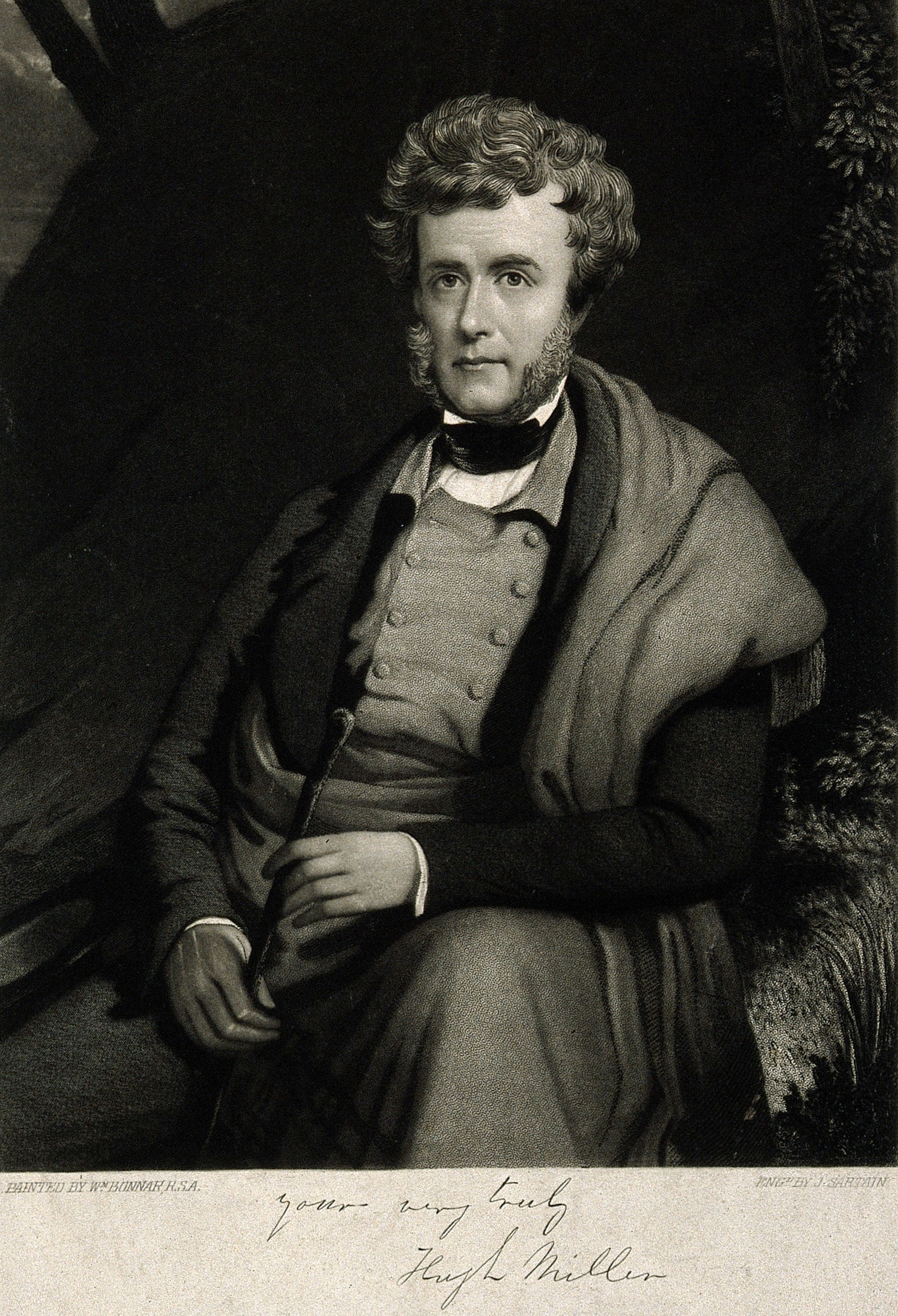
.jpg)