Will Quotes (2350 quotes)
... semantics ... is a sober and modest discipline which has no pretensions of being a universal patent-medicine for all the ills and diseases of mankind, whether imaginary or real. You will not find in semantics any remedy for decayed teeth or illusions of grandeur or class conflict. Nor is semantics a device for establishing that everyone except the speaker and his friends is speaking nonsense
In 'The Semantic Conception of Truth and the Foundations of Semantics', collected in
Leonard Linsky (ed.), Semantics and the Philosophy of Language: A Collection of Readings (1952), 17.
… the United States was not built by those who waited and rested and wished to look behind them. This country was conquered by those who moved forward, and so will space.
From Address at Rice Stadium (12 Sep 1962). On website of John F. Kennedy Presidential Library and Museum. [This go-to-the-moon speech was largely written by presidential advisor and speechwriter Ted Sorensen.]
…I distinguish two parts of it, which I call respectively the brighter and the darker. The brighter seems to surround and pervade the whole hemisphere; but the darker part, like a sort of cloud, discolours the Moon’s surface and makes it appear covered with spots. Now these spots, as they are somewhat dark and of considerable size, are plain to everyone and every age has seen them, wherefore I will call them great or ancient spots, to distinguish them from other spots, smaller in size, but so thickly scattered that they sprinkle the whole surface of the Moon, but especially the brighter portion of it. These spots have never been observed by anyone before me; and from my observations of them, often repeated, I have been led to the opinion which I have expressed, namely, that I feel sure that the surface of the Moon is not perfectly smooth, free from inequalities and exactly spherical… but that, on the contrary, it is full of inequalities, uneven, full of hollows and protuberances, just like the surface of the Earth itself, which is varied everywhere by lofty mountains and deep valleys.
Describing his pioneering telescope observations of the Moon made from Jan 1610. In The Starry Messenger (Mar 1610). Quoted in Patrick Moore, Patrick Moore on the Moon (2006), 56.
...I may perhaps venture a short word on the question much discussed in certain quarters, whether in the work of excavation it is a good thing to have cooperation between men and women ... Of a mixed dig ... I have seen something, and it is an experiment that I would be reluctant to try again. I would grant if need be that women are admirable fitted for the work, yet I would uphold that they should undertake it by themselves ... the work of an excavator on the dig and off it lays on those who share it a bond of closer daily intercourse than is conceivable ... between men and women, except in chance cases, I do not believe that such close and unavoidable companionship can ever be other than a source of irritation; at any rate, I believe that however it may affect women, the ordinary male at least cannot stand it ... A minor ... objection lies in one particular form of contraint ... moments will occur on the best regulated dig when you want to say just what you think without translation, which before the ladies, whatever their feelings about it, cannot be done.
Archaeological Excavation (1915), 63-64. In Getzel M. Cohen and Martha Sharp Joukowsky Breaking Ground (2006), 557-558.
By (), 163-164.
...learning chiefly in mathematical sciences can so swallow up and fix one's thought, as to possess it entirely for some time; but when that amusement is over, nature will return, and be where it was, being rather diverted than overcome by such speculations.
An Exposition of the Thirty-nine Articles of the Church of England (1850), 154
…resort to science has rendered modern war so destructive of life and property that it presents a new problem to mankind, such, that unless our civilization shall find some means of making an end to war, war will make an end to our civilization.
America and World Peace (1925), 37. In Edward C. Luck, Mixed Messages: American Politics and International Organization, 1919-1999 (1999), 143.
…The present revolution of scientific thought follows in natural sequence on the great revolutions at earlier epochs in the history of science. Einstein’s special theory of relativity, which explains the indeterminateness of the frame of space and time, crowns the work of Copernicus who first led us to give up our insistence on a geocentric outlook on nature; Einstein's general theory of relativity, which reveals the curvature or non-Euclidean geometry of space and time, carries forward the rudimentary thought of those earlier astronomers who first contemplated the possibility that their existence lay on something which was not flat. These earlier revolutions are still a source of perplexity in childhood, which we soon outgrow; and a time will come when Einstein’s amazing revelations have likewise sunk into the commonplaces of educated thought.
In The Theory of Relativity and its Influence on Scientific Thought (1922), 31-32
...the question undoubtedly is, or soon will be, not whether or no we shall employ notation in chemistry, but whether we shall use a bad and incongruous, or a consistent and regular notation.
'On the Employment of Notation in Chemistry', Journal of the Royal Institution (1838), 1, 438. Cited in Timothy L. Alborn, 'Negotiating Notation: Chemical Symbols and British Society, 1831-1835', Annals of Science (1989), 46, 437.
...the scientific cast of mind examines the world critically, as if many alternative worlds might exist, as if other things might be here which are not. Then we are forced to ask why what we see is present and not something else. Why are the Sun and moon and the planets spheres? Why not pyramids, or cubes, or dodecahedra? Why not irregular, jumbly shapes? Why so symmetrical, worlds? If you spend any time spinning hypotheses, checking to see whether they make sense, whether they conform to what else we know. Thinking of tests you can pose to substantiate or deflate hypotheses, you will find yourself doing science.
…...
...the study of butterflies—creatures selected as the types of airiness and frivolity—instead of being despised, will some day be valued as one of the most important branches of Biological science.
From The Naturalist on the River Amazons: A record of Adventures, Habits of Animals, Sketches of Brazilian and Indian life, and Aspects of Nature under the Equator, During Eleven Years of Travel (1864), 413.
…truth will sooner come out of error than from confusion.
From Novum Organum (1620), Book 2, Aphorism 20. Translated as The New Organon: Aphorisms Concerning the Interpretation of Nature and the Kingdom of Man), collected in James Spedding, Robert Ellis and Douglas Heath (eds.), The Works of Francis Bacon (1857), Vol. 4, 149.
…we are all inclined to ... direct our inquiry not by the matter itself, but by the views of our opponents; and, even when interrogating oneself, one pushes the inquiry only to the point at which one can no longer offer any opposition. Hence a good inquirer will be one who is ready in bringing forward the objections proper to the genus, and that he will be when he has gained an understanding of the differences.
'On the Heavens', The Works of Aristotle editted by William David Ross and John Alexander Smith (1930), Vol. 2, 15.
…where the electron behaves and misbehaves as it will,
where the forces tie themselves up into knots of atoms
and come united…
where the forces tie themselves up into knots of atoms
and come united…
'Give Us Gods', David Herbert Lawrence, The Works of D.H. Lawrence (1994), 354.
...while science gives us implements to use, science alone does not determine for what ends they will be employed. Radio is an amazing invention. Yet now that it is here, one suspects that Hitler never could have consolidated his totalitarian control over Germany without its use. One never can tell what hands will reach out to lay hold on scientific gifts, or to what employment they will be put. Ever the old barbarian emerges, destructively using the new civilization.
In 'The Real Point of Conflict between Science and Religion', collected in Living Under Tension: Sermons On Christianity Today (1941), 142.
'O tell me, when along the line
From my full heart the message flows,
What currents are induced in thine?
One click from thee will end my woes'.
Through many an Ohm the Weber flew,
And clicked the answer back to me,
'I am thy Farad, staunch and true,
Charged to a Volt with love for thee'.
From my full heart the message flows,
What currents are induced in thine?
One click from thee will end my woes'.
Through many an Ohm the Weber flew,
And clicked the answer back to me,
'I am thy Farad, staunch and true,
Charged to a Volt with love for thee'.
From 'Valentine from A Telegraph Clerk ♂ to a Telegraph Clerk ♀'. In Lewis Campbell and William Garnett, The Life of James Clerk Maxwell (1882), 631.
‘Be not afraid of life. Believe that life is worth living, and your belief will help create the fact.
Quoted in Kim Lim (ed.), 1,001 Pearls of Spiritual Wisdom: Words to Enrich, Inspire, and Guide Your Life (2014), 245
’Tis a short sight to limit our faith in laws to those of gravity, of chemistry, of botany, and so forth. Those laws do not stop where our eyes lose them, but push the same geometry and chemistry up into the invisible plane of social and rational life, so that, look where we will, in a boy's game, or in the strifes of races, a perfect reaction, a perpetual judgment keeps watch and ward.
From 'Worship', The Conduct of Life (1860) collected in The Complete Works of Ralph Waldo Emerson (1866), Vol.2, 401.
’Tis late; the astronomer in his lonely height
Exploring all the dark, descries from far
Orbs that like distant isles of splendor are,
And mornings whitening in the infinite.…
He summons one disheveled, wandering star,—
Return ten centuries hence on such a night.
That star will come. It dare not by one hour
Cheat science, or falsify her calculation;
Men will have passed, but watchful in the tower
Man shall remain in sleepless contemplation;
And should all men have perished there in turn,
Truth in their stead would watch that star’s return.
Exploring all the dark, descries from far
Orbs that like distant isles of splendor are,
And mornings whitening in the infinite.…
He summons one disheveled, wandering star,—
Return ten centuries hence on such a night.
That star will come. It dare not by one hour
Cheat science, or falsify her calculation;
Men will have passed, but watchful in the tower
Man shall remain in sleepless contemplation;
And should all men have perished there in turn,
Truth in their stead would watch that star’s return.
From poem, 'The Appointment', as translated by Arthur O’Shaughnessy, collected in Samuel Waddington (ed.), The Sonnets of Europe (1886), 154.
“Any specialty, if important, is too important to be left to the specialists.” After all, the specialist cannot function unless he concentrates more or less entirely on his specialty and, in doing so, he will ignore the vast universe lying outside and miss important elements that ought to help guide his judgment. He therefore needs the help of the nonspecialist, who, while relying on the specialist for key information, can yet supply the necessary judgment based on everything else… Science, therefore, has become too important to be left to the scientists.
In 'The Fascination of Science', The Roving Mind (1983), 123. Asimov begins by extending a quote by George Clemenceau: “War is too important to be left to the generals.”
“Daddy,” she says, “which came first, the chicken or the egg?”
Steadfastly, even desperately, we have been refusing to commit ourselves. But our questioner is insistent. The truth alone will satisfy her. Nothing less. At long last we gather up courage and issue our solemn pronouncement on the subject: “Yes!”
So it is here.
“Daddy, is it a wave or a particle?”
“Yes.”
“Daddy, is the electron here or is it there?”
“Yes.”
“Daddy, do scientists really know what they are talking about?”
“Yes!”
Steadfastly, even desperately, we have been refusing to commit ourselves. But our questioner is insistent. The truth alone will satisfy her. Nothing less. At long last we gather up courage and issue our solemn pronouncement on the subject: “Yes!”
So it is here.
“Daddy, is it a wave or a particle?”
“Yes.”
“Daddy, is the electron here or is it there?”
“Yes.”
“Daddy, do scientists really know what they are talking about?”
“Yes!”
The Strange Story of the Quantum (1947), 156-7.
“Endow scientific research and we shall know the truth, when and where it is possible to ascertain it;” but the counterblast is at hand: “To endow research is merely to encourage the research for endowment; the true man of science will not be held back by poverty, and if science is of use to us, it will pay for itself.” Such are but a few samples of the conflict of opinion which we find raging around us.
From The Grammar of Science (1892), 5.
“Facts, facts, facts,” cries the scientist if he wants to emphasize the necessity of a firm foundation for science. What is a fact? A fact is a thought that is true. But the scientist will surely not recognize something which depends on men's varying states of mind to be the firm foundation of science.
From the first chapter of an unfinished book, The Thought: A Logical Inquiry (1918), collected in Arthur Sullivan (ed.), Logicism and the Philosophy of Language: Selections from Frege and Russell (2003), 215.
“I think you’re begging the question,” said Haydock, “and I can see looming ahead one of those terrible exercises in probability where six men have white hats and six men have black hats and you have to work it out by mathematics how likely it is that the hats will get mixed up and in what proportion. If you start thinking about things like that, you would go round the bend. Let me assure you of that!”
In The Mirror Crack’d (1962), 190.
“Mother like son” is a saying so true, the world will judge largely of mother by you.
In Silk Parachute.
“There is no expedient to which a man will not resort to avoid the real labor of thinking.
Sir Joshua Reynolds.”
Sir Joshua Reynolds.”
Sign motto used by Edison in his plant. It is a compacted paraphrase of an original quote by the painter, Joshua Reynolds, (which can been seen on the Reynolds quote page on this site). This form of the quote, was published by B.C. Forbes in The American Magazine (Jan 1921), 10. Forbes wrote about his visit to the Edison’s office, where he was shown a placard bearing the motto and attribution to Sir Joshua Reynolds, and told by Edison that he intended to have copies “put all over the plant.”
“There’s no need for fiction in medicine,” remarks Foster, “for the facts will always beat anything you fancy.”
'A Medical Document', in Round the Red Lamp: Being Facts and Fancies of Medical Life (1894), 199-200.
“They were apes only yesterday. Give them time.”
“Once an ape—always an ape.”…
“No, it will be different. … Come back here in an age or so and you shall see. …”
[The gods, discussing the Earth, in the movie version of Wells’ The Man Who Could Work Miracles (1936).]
“Once an ape—always an ape.”…
“No, it will be different. … Come back here in an age or so and you shall see. …”
[The gods, discussing the Earth, in the movie version of Wells’ The Man Who Could Work Miracles (1936).]
The Man Who Could Work Miracles: a film by H.G. Wells based on the short story (1936), 105-106. Quoted in Carl Sagan, Broca’s Brain (1979, 1986), 3.
“Unless,” said I [Socrates], “either philosophers become kings in our states or those whom we now call our kings and rulers take to the pursuit of' philosophy seriously and adequately, and there is a conjunction of these two things, political power and philosophic intelligence, while the motley horde of the natures who at present pursue either apart from the other are compulsorily excluded, there can be no cessation of troubles, dear Glaucon, for our states, nor, I fancy for the human race either. Nor, until this happens, will this constitution which we have been expounding in theory ever be put into practice within the limits of possibility and see the light of the sun.”
— Plato
From The Republic 5 473 c-e, in Paul Shorey (trans.), Plato in Twelve Volumes (1930, 1969), Vol. 5, 509.
“Yes,” he said. “But these things (the solutions to problems in solid geometry such as the duplication of the cube) do not seem to have been discovered yet.” “There are two reasons for this,” I said. “Because no city holds these things in honour, they are investigated in a feeble way, since they are difficult; and the investigators need an overseer, since they will not find the solutions without one. First, it is hard to get such an overseer, and second, even if one did, as things are now those who investigate these things would not obey him, because of their arrogance. If however a whole city, which did hold these things in honour, were to oversee them communally, the investigators would be obedient, and when these problems were investigated continually and with eagerness, their solutions would become apparent.”
— Plato
In The Republic 7 528bc, trans. R.W. Sharples.
[1665-06-07] ...This day, much against my will, I did in Drury Lane see two or three houses marked with a red cross upon the doors, and 'Lord have mercy upon us' writ there - which was a sad sight to me, being the first of that kind that to my remembrance I ever saw. It put me into an ill conception of myself and my smell, so that I was forced to buy some roll-tobacco to smell to and chaw - which took away the apprehension.
Diary of Samuel Pepys (7 Jun 1665)
[1665-06-20] ...This day I informed myself that there died four or five at Westminster of the Plague, in one alley in several houses upon Sunday last - Bell Alley, over against the Palace gate. yet people do think that the number will be fewer in the town then it was last week. ...
Diary of Samuel Pepys (20 Jun 1665)
[1665-08-31] Up, and after putting several things in order to my removal to Woolwich, the plague having a great increase this week beyond all expectation, of almost 2000 - making the general Bill 7000, odd 100 and the plague above 6000 .... Thus this month ends, with great sadness upon the public through the greateness of the plague, everywhere through the Kingdom almost. Every day sadder and sadder news of its increase. In the City died this week 7496; and all of them, 6102 of the plague. But it is feared that the true number of the dead this week is near 10000 - partly from the poor that cannot be taken notice of through the greatness of the number, and partly from the Quakers and others that will not have any bell ring for them. As to myself, I am very well; only, in fear of the plague, and as much of an Ague, by being forced to go early and late to Woolwich, and my family to lie there continually.
Diary of Samuel Pepys (31 August 1665)
[1665-09-03] Up, and put on my coloured suit on, very fine, and my new periwig, bought a good while since, but durst not wear, because the plague was in westminster when I bought it; and it is a wonder what will be the fashion after the plague is done as to periwigs, for nobody will dare to buy any haire for fear of the infection - that it had been cut off of heads of people dead of the plague. ... but Lord, to consider the madness of people of the town, who will (because they are forbid) come in crowds along with the dead corps to see them buried. ...
Diary of Samuel Pepys (3 Sep 1665)
[A contemporary study] predicted the loss of two-thirds of all tropical forests by the turn of the century. Hundreds of thousands of species will perish, and this reduction of 10 to 20 percent of the earth’s biota will occur in about half a human life span. … This reduction of the biological diversity of the planet is the most basic issue of our time.
Foreword, written for Michael Soulé and Bruce Wilcox (eds.), papers from the 1978 International Conference on Conservation Biology, collected as Conservation Biology (1980), ix. As quoted and cited in Timothy J. Farnham, Saving Nature's Legacy: Origins of the Idea of Biological Diversity (2007), 208.
[After science lost] its mystical inspiration … man’s destiny was no longer determined from “above” by a super-human wisdom and will, but from “below” by the sub-human agencies of glands, genes, atoms, or waves of probability. … A puppet of the Gods is a tragic figure, a puppet suspended on his chromosomes is merely grotesque.
In 'Epilogue', The Sleepwalkers: A History of Man’s Changing Vision of the Universe (1959), 539.
[An artist] will sooner and with more certainty, establish the character of skeletons, than the most learned anatomist, whose eye has not been accustomed to seize on every peculiarity.
Asserting his (incorrect) belief that the fossil teeth of the mastodon revealed it was a carnivorous animal.]
Asserting his (incorrect) belief that the fossil teeth of the mastodon revealed it was a carnivorous animal.]
In An Historical Disquisition on the Mammoth, or, Great American Incognitum, an Extinct, Immense, Carnivorous Animal, whose Fossil Remains Have Been Found in North America (1903), 38-39, which was published for his London exhibit of a mastodon skeleton. As cited in Michele L. Aldrich article on Peale, in Charles Coulston Gillespie, Dictionary of Scientific Biography (1978), Vol. 15-16, 472.
[Antarctica has 90 percent of the world’s ice, and God help us if it melts,] whales will be swimming in the streets of New York.
From address (20 Sep 1989) to the National Press Club, as quoted in Phil McCombs, The Washington Post (21 Sep 1989).
[At the end of the story, its main character, Tom] is now a great man of science, and can plan railroads, and steam-engines, and electric telegraphs, and rifled guns, and so forth; and knows everything about everything, except why a hen's egg don't turn into a crocodile, and two or three other little things that no one will know till the coming of the Cocqcigrues.
The Water-babies (1886), 368-9.
[Blackett] came one morning, deep in thought, into the G (technical) Office at Stanmore. It was a bitterly cold day, and the staff were shivering in a garret warmed over only with an oil-stove. Without a word of greeting, Blackett stepped silently up on to the table and stood there pondering with his feet among the plans. After ten minutes somebody coughed uneasily and said, diffidently: “Wouldn’t you like a chair, sir … or something?” “No, thank you,” said Professor Blackett, “it is necessary to apply scientific methods. Hot air rises. The warmest spot in this room, therefore, will be near the ceiling.” At this, Colonel Krohn, my technical G.S.O., stepped up on the table beside the Professor, and for the next half-hour, the two stayed there in silence. At the end of this period Professor Blackett stepped down from the table saying: “Well! That’s that problem solved.” And so it was.
Anecdote as told by General Sir Frederick Pile, in Frederick Pile, Ack-Ack: Britain’s Defence Against Air Attack During Second World War (1949), 161. As cited by Maurice W. Kirby and Jonathan Rosenhead, 'Patrick Blackett (1897)' in Arjang A. Assad (ed.) and Saul I. Gass (ed.),Profiles in Operations Research: Pioneers and Innovators (2011), 7.
[Cloning] can't make you immortal because clearly the clone is a different person. If I take twins and shoot one of them, it will be faint consolation to the dead one that the other one is still running around, even though they are genetically identical. So the road to immortality is not through cloning.
Quoted in 'Baby, It's You! And You, And You...', Time magazine (19 Feb 2001).
[Consider] a fence or gate erected across a road] The more modern type of reformer goes gaily up to it and says, “I don't see the use of this; let us clear it away.” To which the more intelligent type of reformer will do well to answer: “If you don't see the use of it, I certainly won't let you clear it away. Go away and think. Then, when you can come back and tell me that you do see the use of it, I may allow you to destroy it.”
In The Thing (1929). Excerpt in Gilbert Keith Chesterton and Alvaro De Silva (ed.), Brave New Family: G.K. Chesterton on Men and Women, Children, Sex, Divorce (1990), 53. Note: This passage may be the source which John F. Kennedy had in mind when he wrote in his personal notebook, “Don't ever take a fence down until you know the reason why it was put up.” (see John F. Kennedy quotes on this site). The words in that terse paraphrase are those of Kennedy, and are neither those of Chesterton, or, as often attributed, Robert Frost (q.v.).
[Davy's] March of Glory, which he has run for the last six weeks—within which time by the aid and application of his own great discovery, of the identity of electricity and chemical attractions, he has placed all the elements and all their inanimate combinations in the power of man; having decomposed both the Alkalies, and three of the Earths, discovered as the base of the Alkalies a new metal... Davy supposes there is only one power in the world of the senses; which in particles acts as chemical attractions, in specific masses as electricity, & on matter in general, as planetary Gravitation... when this has been proved, it will then only remain to resolve this into some Law of vital Intellect—and all human knowledge will be Science and Metaphysics the only Science.
In November 1807 Davy gave his famous Second Bakerian Lecture at the Royal Society, in which he used Voltaic batteries to “decompose, isolate and name” several new chemical elements, notably sodium and potassium.
In November 1807 Davy gave his famous Second Bakerian Lecture at the Royal Society, in which he used Voltaic batteries to “decompose, isolate and name” several new chemical elements, notably sodium and potassium.
Letter to Dorothy Wordsworth, 24 November 1807. In Earl Leslie Griggs (ed.), The Collected Letters of Samuel Taylor Coleridge (1956), Vol. 3, 38.
[Decoding the human genome sequence] is the most significant undertaking that we have mounted so far in an organized way in all of science. I believe that reading our blueprints, cataloguing our own instruction book, will be judged by history as more significant than even splitting the atom or going to the moon.
Interview (23 May 1998), 'Cracking the Code to Life', Academy of Achievement web site.
[First use of the term science fiction:] We hope it will not be long before we may have other works of Science-Fiction [like Richard Henry Horne's The Poor Artist], as we believe such books likely to fulfil a good purpose, and create an interest, where, unhappily, science alone might fail.
[Thomas] Campbell says, that “Fiction in Poetry is not the reverse of truth, but her soft and enchanting resemblance.” Now this applies especially to Science-Fiction, in which the revealed truths of Science may be given interwoven with a pleasing story which may itself be poetical and true—thus circulating a knowledge of Poetry of Science, clothed in a garb of the Poetry of life.
[Thomas] Campbell says, that “Fiction in Poetry is not the reverse of truth, but her soft and enchanting resemblance.” Now this applies especially to Science-Fiction, in which the revealed truths of Science may be given interwoven with a pleasing story which may itself be poetical and true—thus circulating a knowledge of Poetry of Science, clothed in a garb of the Poetry of life.
In A Little Earnest Book Upon a Great Old Subject (1851), 137.
[From uranium] there are present at least two distinct types of radiation one that is very readily absorbed, which will be termed for convenience the α radiation, and the other of a more penetrative character, which will be termed the β radiation.
Originating the names for these two types of radiation. In 'Uranium Radiation and the Electrical Conduction Produced by It', Philosophical Magazine (1899), 47, 116.
[I predict] the electricity generated by water power is the only thing that is going to keep future generations from freezing. Now we use coal whenever we produce electric power by steam engine, but there will be a time when there’ll be no more coal to use. That time is not in the very distant future. … Oil is too insignificant in its available supply to come into much consideration.
As quoted in 'Electricity Will Keep The World From Freezing Up', New York Times (12 Nov 1911), SM4.
[In Adelie Land, Antarctica, a howling river of] wind, 50 miles wide, blows off the plateau, month in and month out, at an average velocity of 50 m.p.h. As a source of power this compares favorably with 6,000 tons of water falling every second over Niagara Falls. I will not further anticipate some H. G. Wells of the future who will ring the antarctic with power-producing windmills; but the winds of the Antarctic have to be felt to be believed, and nothing is quite impossible to physicists and engineers.
Speaking at convention of the British Association for the Advancement of Science, Norwich (1935). As quoted in 'Science: One Against Darwin', Time (23 Sep 1935).
[In] the realm of science, … what we have achieved will be obsolete in ten, twenty or fifty years. That is the fate, indeed, that is the very meaning of scientific work. … Every scientific “fulfillment” raises new “questions” and cries out to be surpassed and rendered obsolete. Everyone who wishes to serve science has to resign himself to this.
From a Speech (1918) presented at Munich University, published in 1919, and collected in 'Wissenschaft als Beruf', Gessammelte Aufsätze zur Wissenschaftslehre (1922), 524-525. As translated by Rodney Livingstone in David Owen (ed.), The Vocation Lectures: Science as a Vocation: Politics as a Vocation (2004), 11. A different translation of a longer excerpt for this quote, beginning “In science, each of us knows …”, is also on the Max Weber Quotes web page on this site.
[J.J.] Sylvester’s methods! He had none. “Three lectures will be delivered on a New Universal Algebra,” he would say; then, “The course must be extended to twelve.” It did last all the rest of that year. The following year the course was to be Substitutions-Théorie, by Netto. We all got the text. He lectured about three times, following the text closely and stopping sharp at the end of the hour. Then he began to think about matrices again. “I must give one lecture a week on those,” he said. He could not confine himself to the hour, nor to the one lecture a week. Two weeks were passed, and Netto was forgotten entirely and never mentioned again. Statements like the following were not unfrequent in his lectures: “I haven’t proved this, but I am as sure as I can be of anything that it must be so. From this it will follow, etc.” At the next lecture it turned out that what he was so sure of was false. Never mind, he kept on forever guessing and trying, and presently a wonderful discovery followed, then another and another. Afterward he would go back and work it all over again, and surprise us with all sorts of side lights. He then made another leap in the dark, more treasures were discovered, and so on forever.
As quoted by Florian Cajori, in Teaching and History of Mathematics in the United States (1890), 265-266.
[John Scott Haldane] preferred to work on himself or other human beings who were sufficiently interested in the work to ignore pain or fear … [His] object was not to achieve this state of [pain or fear] but to achieve knowledge which could save other men's lives. His attitute was much more like a good soldier who will risk his life and endure wounds in order to gain victory than that of an ascetic who deliberately undergoes pain. The soldier does not get himself wounded deliberately, and my father did not seek pain in his work though he greeted pain which would have made some people writhe or groan, with laughter.
In R.W. Clark, JBS: The Life and Work of J.B.S. Haldane (1968), quoted in Lawrence K. Altman, Who Goes First? (1986), 215.
[Learning is] the actual process of broadening yourself, of knowing there’s a little extra facet of the universe you know about and can think about and can understand. It seems to me that when it’s time to die, and that will come to all of us, there’ll be a certain pleasure in thinking that you had utilized your life well, that you had learned as much as you could, gathered in as much as possible of the universe, and enjoyed it. I mean, there’s only this universe and only this one lifetime to try to grasp it. And, while it is inconceivable that anyone can grasp more than a tiny portion of it, at least do that much. What a tragedy to just pass through and get nothing out of it.
'Isaac Asimov Speaks' with Bill Moyers in The Humanist (Jan/Feb 1989), 49. Reprinted in Carl Howard Freedman (ed.), Conversations with Isaac Asimov (2005), 139.
[Lecturing:] This has been done elegantly by Minkowski; but chalk is cheaper than grey matter, and we will do it as it comes.
Via George Pólya, present at an early lecture on Special Relativity by Einstein, who at the time preferred to show his own old formulation, not yet embracing Minkowski’s geometrical reformulation. Quote given as Pólya’s recollection in J.E. Littlewood, A Mathematician’s Miscellany, (1953). Also in the expanded edition, Béla Bollobás (ed.), 'Odds and Ends',
Littlewood’s Miscellany (1986), 152.
[My advice] will one day be found
With other relics of 'a former world,'
When this world shall be former, underground,
Thrown topsy-turvy, twisted, crisped, and curled,
Baked, fried or burnt, turned inside-out, or drowned,
Like all the worlds before, which have been hurled
First out of, and then back again to Chaos,
The Superstratum which will overlay us.
With other relics of 'a former world,'
When this world shall be former, underground,
Thrown topsy-turvy, twisted, crisped, and curled,
Baked, fried or burnt, turned inside-out, or drowned,
Like all the worlds before, which have been hurled
First out of, and then back again to Chaos,
The Superstratum which will overlay us.
Don Juan (1821), Canto 9, Verse 37. In Jerome J. McGann (ed.), Lord Byron: The Complete Poetical Works (1986), Vol. 5, 420.
[My Book] will endeavour to establish the principle[s] of reasoning in ... [geology]; and all my geology will come in as illustration of my views of those principles, and as evidence strengthening the system necessarily arising out of the admission of such principles, which... are neither more nor less than that no causes whatever have from the earliest time to which we can look back, to the present, ever acted, but those now acting; and that they never acted with different degrees of energy from that which they now exert.
Letter to Roderick Murchison Esq. (15 Jan 1829). In Mrs Lyell (ed.), The Life, Letters and Journals of Sir Charles Lyell, Bart (1881), Vol. 1, 234.
[My] numberless observations... made on the Strata... [have] made me confident of their uniformity throughout this Country & [have] led me to conclude that the same regularity... will be found to extend to every part of the Globe for Nature has done nothing by piecemeal. [T]here is no inconsistency in her productions. [T]he Horse never becomes an Ass nor the Crab an Apple by any intermixture or artificial combination whatever[. N]or will the Oak ever degenerate into an Ash or an Ash into an Elm. [H]owever varied by Soil or Climate the species will still be distinct on this ground. [T]hen I argue that what is found here may be found elsewhere[.] When proper allowances are made for such irregularities as often occur and the proper situation and natural agreement is well understood I am satisfied there will be no more difficulty in ascertaining the true quality of the Strata and the place of its possition [sic] than there is now in finding the true Class and Character of Plants by the Linean [sic] System.
Natural Order of the Strata in England and Wales Accurately Delineated and Described, unpublished manuscript, Department of Geology, University of Oxford, 1801, f. 7v.
[No one will be able to] deter the scientific mind from probing into the unknown any more than Canute could command the tides.
Comment upon the U.S. Supreme Court's 1980 decision permitting the patenting of life forms.
Comment upon the U.S. Supreme Court's 1980 decision permitting the patenting of life forms.
'Shaping Life in the Lab'. In Time (9 Mar 1981).
[Philosopher Lao-tse] is not dogmatic, and he does not go in for big, universal ideas. For instance, I like what he says about failure and success, “Failure is the foundation of success and the means by which it is achieved. Success is the lurking place of failure; but who can tell when the turning point will come?”
As quoted in Robert Coughlan, 'Dr. Edward Teller’s Magnificent Obsession', Life (6 Sep 1954), 74.
[Radius]: You will work. You will build ... You will serve them... Robots of the world... The power of man has fallen... A new world has arisen. The rule of the Robots... March!
The word 'robot' was coined in this play for a new working class of automatons (from the Czech word robota meaning compulsory labour)
The word 'robot' was coined in this play for a new working class of automatons (from the Czech word robota meaning compulsory labour)
R.U.R. (1920), 89-90 in 1961 ed.
[S]uppose you make a hole in an ordinary evacuated electric light bulb and allow the air molecules to pass in at the rate of 1,000,000 a second, the bulb will become full of air in approximately 100,000,000 years.
In Lecture (1936) on 'Forty Years of Atomic Theory', collected in Needham and Pagel (eds.) in Background to Modern Science: Ten Lectures at Cambridge Arranged by the History of Science Committee, (1938), 99.
[T]here are some common animal behaviors that seem to favor the development of intelligence, behaviors that might lead to brainy beasts on many worlds. Social interaction is one of them. If you're an animal that hangs out with others, then there's clearly an advantage in being smart enough to work out the intentions of the guy sitting next to you (before he takes your mate or your meal). And if you're clever enough to outwit the other members of your social circle, you'll probably have enhanced opportunity to breed..., thus passing on your superior intelligence. ... Nature—whether on our planet or some alien world—will stumble into increased IQ sooner or later.
Seth Shostak, Alex Barnett, Cosmic Company: the Search for Life in the Universe (2003), 62 & 67.
[T]here is little chance that aliens from two societies anywhere in the Galaxy will be culturally close enough to really 'get along.' This is something to ponder as you watch the famous cantina scene in Star Wars. ... Does this make sense, given the overwhelmingly likely situation that galactic civilizations differ in their level of evolutionary development by thousands or millions of years? Would you share drinks with a trilobite, an ourang-outang, or a saber-toothed tiger? Or would you just arrange to have a few specimens stuffed and carted off to the local museum?
Quoted in 'Do Aliens Exist in the Milky Way', PBS web page for WGBH Nova, 'Origins.'
[The Book of Genesis is] [p]rofoundly interesting and indeed pathetic to me are those attempts of the opening mind of man to appease its hunger for a Cause. But the Book of Genesis has no voice in scientific questions. It is a poem, not a scientific treatise. In the former aspect it is for ever beautiful; in the latter it has been, and it will continue to be, purely obstructive and hurtful.'
In 'Professor Virchow and Evolution', Fragments of Science (1879), Vol. 2, 377. Tyndall is quoting himself from “four years ago”&mdashthus c.1875.
[The chemical bond] First, it is related to the disposition of two electrons (remember, no one has ever seen an electron!): next, these electrons have their spins pointing in opposite directions (remember, no one can ever measure the spin of a particular electron!): then, the spatial distribution of these electrons is described analytically with some degree of precision (remember, there is no way of distinguishing experimentally the density distribution of one electron from another!): concepts like hybridization, covalent and ionic structures, resonance, all appear, not one of which corresponds to anything that is directly measurable. These concepts make a chemical bond seem so real, so life-like, that I can almost see it. Then I wake with a shock to the realization that a chemical bond does not exist; it is a figment of the imagination that we have invented, and no more real than the square root of - 1. I will not say that the known is explained in terms of the unknown, for that is to misconstrue the sense of intellectual adventure. There is no explanation: there is form: there is structure: there is symmetry: there is growth: and there is therefore change and life.
Quoted in his obituary, Biographical Memoirs of the Fellows of the Royal Society 1974, 20, 96.
[The error in the teaching of mathematics is that] mathematics is expected either to be immediately attractive to students on its own merits or to be accepted by students solely on the basis of the teacher’s assurance that it will be helpful in later life. [And yet,] mathematlcs is the key to understanding and mastering our physical, social and biological worlds.
In editorial in Focus, a Journal of the Mathematical Association of America (1986), quoted in obituary by Eric Pace, New York Times (11 Jun 1992).
[The heart is] really a fascinating organ. It's about the only organ in the body that you can really witness its function. Doing things. And so on. Some of the other organs you can witness, like the intestines, will have this sort of peristaltic motion. But nothing that can compare with the activity of the human heart.
[The infinitely small] neither have nor can have theory; it is a dangerous instrument in the hands of beginners [ ... ] anticipating, for my part, the judgement of posterity, I would dare predict that this method will be accused one day, and rightly, of having retarded the progress of the mathematical sciences.
Annales des Mathematiques Pures et Appliquées (1814-5), 5, 148.
[The octopus has] an amazing skin, because there are up to 20 million of these chromatophore pigment cells and to control 20 million of anything is going to take a lot of processing power. ... These animals have extraordinarily large, complicated brains to make all this work. ... And what does this mean about the universe and other intelligent life? The building blocks are potentially there and complexity will arise. Evolution is the force that's pushing that. I would expect, personally, a lot of diversity and a lot of complicated structures. It may not look like us, but my personal view is that there is intelligent life out there.
From transcript of PBS TV program Nova episode 'Origins: Where are the Aliens?' (2004).
[The steamboat] will answer for sea voyages as well as for inland navigation, in particular for packets, where there may be a great number of passengers. He is also of opinion, that fuel for a short voyage would not exceed the weight of water for a long one, and it would produce a constant supply of fresh water. ... [T]he boat would make head against the most violent tempests, and thereby escape the danger of a lee shore; and that the same force may be applied to a pump to free a leaky ship of her water. ... [T]he good effects of the machine, is the almost omnipotent force by which it is actuated, and the very simple, easy, and natural way by which the screws or paddles are turned to answer the purpose of oars.
[This letter was written in 1785, before the first steamboat carried a man (Fitch) on 27 Aug 1787.]
[This letter was written in 1785, before the first steamboat carried a man (Fitch) on 27 Aug 1787.]
Letter to Benjamin Franklin (12 Oct 1785), in The Works of Benjamin Franklin (1882), Vol. 10, 232.
[The surplus of basic knowledge of the atomic nucleus was] largely used up [during the war with the atomic bomb as the dividend.] We must, without further delay restore this surplus in preparation for the important peacetime job for the nucleus - power production. ... Many of the proposed applications of atomic power - even for interplanetary rockets - seem to be within the realm of possibility provided the economic factor is ruled out completely, and the doubtful physical and chemical factors are weighted heavily on the optimistic side. ... The development of economic atomic power is not a simple extrapolation of knowledge gained during the bomb work. It is a new and difficult project to reach a satisfactory answer. Needless to say, it is vital that the atomic policy legislation now being considered by the congress recognizes the essential nature of this peacetime job, and that it not only permits but encourages the cooperative research-engineering effort of industrial, government and university laboratories for the task. ... We must learn how to generate the still higher energy particles of the cosmic rays - up to 1,000,000,000 volts, for they will unlock new domains in the nucleus.
Addressing the American Institute of Electrical Engineering, in New York (24 Jan 1946). In Schenectady Gazette (25 Jan 1946),
[The toughest part of being in charge is] killing ideas that are great but poorly timed. And delivering tough feedback that’s difficult to hear but that I know will help people—and the team—in the long term.
In Issie Lapowsky, 'Scott Belsky', Inc. (Nov 2013), 140. Biography in Context,
[The] complex pattern of the misallocation of credit for scientific work must quite evidently be described as “the Matthew effect,” for, as will be remembered, the Gospel According to St. Matthew puts it this way: For unto every one that hath shall be given, and he shall have abundance: but from him that hath not shall be taken away even that which he hath. Put in less stately language, the Matthew effect consists of the accruing of greater increments of recognition for particular scientific contributions to scientists of considerable repute and the withholding of such recognition from scientists who have not yet made their mark.
'The Matthew Effect in Science', Science (1968), 159, 58.
[This] may prove to be the beginning of some embracing generalization, which will throw light, not only on radioactive processes, but on elements in general and the Periodic Law.... Chemical homogeneity is no longer a guarantee that any supposed element is not a mixture of several of different atomic weights, or that any atomic weight is not merely a mean number.
From Chemical Society's Annual Reports (1910), Vol. 7, 285. As quoted in Francis Aston in Lecture (1936) on 'Forty Years of Atomic Theory', collected in Needham and Pagel (eds.) in Background to Modern Science: Ten Lectures at Cambridge Arranged by the History of Science Committee, (1938), 100. Cited in Alfred Walter Stewart, Recent Advances in Physical and Inorganic Chemistry (1920), 198.
[To] mechanical progress there is apparently no end: for as in the past so in the future, each step in any direction will remove limits and bring in past barriers which have till then blocked the way in other directions; and so what for the time may appear to be a visible or practical limit will turn out to be but a bend in the road.
Opening address to the Mechanical Science Section, Meeting of the British Association, Manchester. In Nature (15 Sep 1887), 36, 475.
[Using mice as model systems for genetic engineering in biomedicine, instead of bacterial or yeast systems matters because] this transition will have as big an impact on the future of biology as the shift from printing presses to video technology has had on pop culture. A mouse-based world looks and feels different from one viewed through microorganisms.
Quoted in Michael Schrage, 'Biomedical Researchers Scurry to Make Genetically Altered Mice', San Jose Mercury News (8 Feb 1993), 3D. In Donna Jeanne Haraway and Lynn M. Randolph, [email protected]: Feminism and Technoscience (1996), 98.
'[R]eductionism' is one of those things, like sin, that is only mentioned by people who are against it. To call oneself a reductionist will sound, in some circles, a bit like admitting to eating babies. But, just as nobody actually eats babies, so nobody is really a reductionist in any sense worth being against.
The Blind Watchmaker (1996), 13.
Πάντα ῥεῖ : all things are in flux. It is inevitable that you are indebted to the past. You are fed and formed by it. The old forest is decomposed for the composition of the new forest. The old animals have given their bodies to the earth to furnish through chemistry the forming race, and every individual is only a momentary fixation of what was yesterday another’s, is today his and will belong to a third to-morrow. So it is in thought.
In Lecture, second in a series given at Freeman Place Chapel, Boston (Mar 1859), 'Quotation and Originality', collected in Letters and Social Aims (1875, 1917), 200. The Greek expression, “panta rei” is a quote from Heraclitus.
“The Universe repeats itself, with the possible exception of history.” Of all earthly studies history is the only one that does not repeat itself. ... Astronomy repeats itself; botany repeats itself; trigonometry repeats itself; mechanics repeats itself; compound long division repeats itself. Every sum if worked out in the same way at any time will bring out the same answer. ... A great many moderns say that history is a science; if so it occupies a solitary and splendid elevation among the sciences; it is the only science the conclusions of which are always wrong.
In 'A Much Repeated Repetition', Daily News (26 Mar 1904). Collected in G. K. Chesterton and Dale Ahlquist (ed.), In Defense of Sanity: The Best Essays of G.K. Chesterton (2011), 82.
[About Francis Baily] The history of the astronomy of the nineteenth century will be incomplete without a catalogue of his labours. He was one of the founders of the Astronomical Society, and his attention to its affairs was as accurate and minute as if it had been a firm of which he was the chief clerk, with expectation of being taken into partnership.
In Supplement to the Penny Cyclopaedia. Quoted in Sophia Elizabeth De Morgan, Memoir of Augustus De Morgan (1882), 46
[About the demand of the Board of Regents of the University of California that professors sign non-Communist loyalty oaths or lose their jobs within 65 days.] No conceivable damage to the university at the hands of hypothetical Communists among us could possibly have equaled the damage resulting from the unrest, ill-will and suspicion engendered by this series of events.
As quoted in 'Professors in West Call Oath “Indignity”', New York Times (26 Feb 1950), 38.
[As Chief Scientific Adviser to the British Ministry of Defence] We persist in regarding ourselves as a Great Power, capable of everything and only temporarily handicapped by economic difficulties. We are not a great power and never will be again. We are a great nation, but if we continue to behave like a Great Power we shall soon cease to be a great nation. Let us take warning from the fate of the Great Powers of the past and not burst ourselves with pride (see Aesop’s fable of the frog). (1949)
As quoted by Peter Hennessy, Whitehall (1989), 155.
[Et peut-être la posterité me saura gré de lui avoir fait connaître que les Anciens n’ont pas tout su.]
And perhaps, posterity will thank me for having shown that the ancients did not know everything.
And perhaps, posterity will thank me for having shown that the ancients did not know everything.
'Relation of New Discoveries in the Science of Numbers', in Letter (Aug 1659) to Pierre de Carcavi, an amateur mathematician, collected in OEuvres de Fermat: Correspondance (1894), 436. Translation, used as an epigraph, in D.M. Burton, Elementary Number Theory (1976, 1989), 107.
[Students or readers about teachers or authors.] They will listen with both ears to what is said by the men just a step or two ahead of them, who stand nearest to them, and within arm’s reach. A guide ceases to be of any use when he strides so far ahead as to be hidden by the curvature of the earth.
From Lecture (5 Apr 1917) at Hackley School, Tarrytown, N.Y., 'Choosing Books', collected in Canadian Stories (1918), 150.
Ac astronomye is an hard thyng,
And yvel for to knowe;
Geometrie and geomesie,
So gynful of speche,
Who so thynketh werche with tho two
Thryveth ful late,
For sorcerie is the sovereyn book
That to tho sciences bilongeth.
Now, astronomy is a difficult discipline, and the devil to learn;
And geometry and geomancy have confusing terminology:
If you wish to work in these two, you will not succeed quickly.
For sorcery is the chief study that these sciences entail.
And yvel for to knowe;
Geometrie and geomesie,
So gynful of speche,
Who so thynketh werche with tho two
Thryveth ful late,
For sorcerie is the sovereyn book
That to tho sciences bilongeth.
Now, astronomy is a difficult discipline, and the devil to learn;
And geometry and geomancy have confusing terminology:
If you wish to work in these two, you will not succeed quickly.
For sorcery is the chief study that these sciences entail.
In William Langland and B. Thomas Wright (ed.) The Vision and Creed of Piers Ploughman (1842), 186. Modern translation by Terrence Tiller in Piers Plowman (1981, 1999), 94.
Between the frontiers of the three super-states Eurasia, Oceania, and Eastasia, and not permanently in possession of any of them, there lies a rough quadrilateral with its corners at Tangier, Brazzaville, Darwin, and Hongkong. These territories contain a bottomless reserve of cheap labour. Whichever power controls equatorial Africa, or the Middle East or Southern India or the Indonesian Archipelago, disposes also of the bodies of hundreds of millions of ill-paid and hardworking coolies, expended by their conquerors like so much coal or oil in the race to turn out more armaments, to capture more territory, to control more labour, to turn out more armaments, to capture more territory, to control…
Thus George Orwell—in his only reference to the less-developed world.
I wish I could disagree with him. Orwell may have erred in not anticipating the withering of direct colonial controls within the “quadrilateral” he speaks about; he may not quite have gauged the vehemence of urges to political self-assertion. Nor, dare I hope, was he right in the sombre picture of conscious and heartless exploitation he has painted. But he did not err in predicting persisting poverty and hunger and overcrowding in 1984 among the less privileged nations.
I would like to live to regret my words but twenty years from now, I am positive, the less-developed world will be as hungry, as relatively undeveloped, and as desperately poor, as today.
Thus George Orwell—in his only reference to the less-developed world.
I wish I could disagree with him. Orwell may have erred in not anticipating the withering of direct colonial controls within the “quadrilateral” he speaks about; he may not quite have gauged the vehemence of urges to political self-assertion. Nor, dare I hope, was he right in the sombre picture of conscious and heartless exploitation he has painted. But he did not err in predicting persisting poverty and hunger and overcrowding in 1984 among the less privileged nations.
I would like to live to regret my words but twenty years from now, I am positive, the less-developed world will be as hungry, as relatively undeveloped, and as desperately poor, as today.
'The Less-Developed World: How Can We be Optimists?' (1964). Reprinted in Ideals and Realities (1984), xv-xvi. Referencing a misquote from George Orwell, Nineteen Eighty Four (1949), Ch. 9.
Ces détails scientifiques qui effarouchent les fabricans d’un certain âge, ne seront qu’un
jeu pour leurs enfans, quand ils auront apprit dans leurs collèges un peu plus de mathématiques et un peu moins de Latin; un peu plus de Chimie, et un peu moins de Grec!
The scientific details which now terrify the adult manufacturer will be mere trifles to his children when they shall be taught at school, a little more Mathematics and a little less Latin, a little more Chemistry, and a little less Greek.
The scientific details which now terrify the adult manufacturer will be mere trifles to his children when they shall be taught at school, a little more Mathematics and a little less Latin, a little more Chemistry, and a little less Greek.
As quoted in 'Sketches From Life of Some Eminent Foreign Scientific Lecturers: Dumas', Magazine of Popular Science, and Journal of the Useful Arts (1836). Vol. 1, 177.
Error of confounding cause and effect.—There is no more dangerous error than confounding consequence with cause: I call it the intrinsic depravity of reason. … I take an
example: everybody knows the book of the celebrated Comaro, in which he recommends his spare diet as a recipe for a long and happy life,—for a virtuous life also. Few books have been read so much… I believe hardly any book … has caused so much harm, has shortened so many lives, as this well-meant curiosity. The source of this mischief is in confounding consequence with cause. The candid Italian saw in his diet the cause of his long life, while the prerequisite to long life, the extraordinary slowness of the metabolic process, small consumption, was the cause of his spare diet. He was not at liberty to eat little or much; his frugality—was not of “free will;” he became sick when he ate more.
From 'The Four Great Errors', The Twilight of the Idols (1888), collected in Thomas Common (trans.), The Works of Friedrich Nietzsche (1896), Vol. 11, 139.
Et j’espère que nos neveux me sauront gré, non seulement des choses que j'ai ici expliquées, mais aussi de celles que j'ai omises volontairement, afin de leur laisser le plaisir de les inventer.
I hope that posterity will judge me kindly, not only as to the things which I have explained, but also as to those which I have intentionally omitted so as to leave to others the pleasure of discovery.
I hope that posterity will judge me kindly, not only as to the things which I have explained, but also as to those which I have intentionally omitted so as to leave to others the pleasure of discovery.
Concluding remark in Géométrie (1637), as translated by David Eugene Smith and Marcia L. Latham, in The Geometry of René Descartes (1925, 1954), 240.
Goldsmith: If you put a tub full of blood into a stable, the horses are like to go mad.
Johnson: I doubt that.
Goldsmith: Nay, sir, it is a fact well authenticated.
Thrale: You had better prove it before you put it into your book on natural history. You may do it in my stable if you will.
Johnson: Nay, sir, I would not have him prove it. If he is content to take his information from others, he may get through his book with little trouble, and without much endangering his reputation. But if he makes experiments for so comprehensive a book as his, there would be no end to them; his erroneous assertions would then fall upon himself: and he might be blamed for not having made experiments as to every particular.
Johnson: I doubt that.
Goldsmith: Nay, sir, it is a fact well authenticated.
Thrale: You had better prove it before you put it into your book on natural history. You may do it in my stable if you will.
Johnson: Nay, sir, I would not have him prove it. If he is content to take his information from others, he may get through his book with little trouble, and without much endangering his reputation. But if he makes experiments for so comprehensive a book as his, there would be no end to them; his erroneous assertions would then fall upon himself: and he might be blamed for not having made experiments as to every particular.
In James Boswell, The Life of Samuel Johnson, LL.D.: Comprehending an Account of His Studies and Numerous Works (1785, 1830), 229-230.
I cannot give any scientist of any age better advice than this: the intensity of the conviction that a hypothesis is true has no bearing on whether it is true or not. The importance of the strength of our conviction is only to provide a proportionally strong incentive to find out if the hypothesis will stand up to critical examination.
In Advice to a Young Scientist (1979), 39.
Ich have auf eine geringe Vermutung eine gefährliche Reise gewagt und erblicke schon die Vorgebirge neuer Länder. Diejenigen, welche die Herzhaftigheit haben die Untersuchung fortzusetzen, werden sie betreten.
Upon a slight conjecture [on the origin of the solar system] I have ventured on a dangerous journey and I already behold the foothills of new lands. Those who have the courage to continue the search will set foot on them.
Upon a slight conjecture [on the origin of the solar system] I have ventured on a dangerous journey and I already behold the foothills of new lands. Those who have the courage to continue the search will set foot on them.
From Allgemeine Naturgeschichte und Theorie des Himmels (Natural History and Theory of the Heavens (1755). As quoted in D. ter Haar and A.G.W. Cameron, 'Historical Review of Theories of the Origin of the Solar System', collected in Robert Jastrow and A. G. W. Cameron (eds.), Origin of the Solar System: Proceedings of a Conference Held at the Goddard Institute for Space Studies, New York, January 23-24, 1962, (1963), 3.
'Cosmogonical Hypotheses' (1913), collected in Harlow Shapley, Source Book in Astronomy, 1900-1950 (1960), 347.
Il n'y a qu'un demi-siècle, un orateur chrétien, se défiant des hommes de la science leur disait: 'Arrêtez-vous enfin, et ne creusez pas jusqu'aux enfers.' Aujourd'hui, Messieurs, rassurés sur l'inébranlable constance de notre foi, nous vous disons: creusez, creusez encore; plus vous descendrez, plus vous rapprocherez du grand mystère de l'impuissance de l'homme et de la vérité de la religion. Creusez donc, creusez toujours,mundum tradidit disputationibus eorum; et quand la science aura donné son dernier coup de marteau sur les fondements de la terre, vous pourrez à la lueur du feu qu'il fera jaillir, lire encore l'idée de Dieu et contempler l'empreinte de sa main.
Only a half-century ago, a Christian speaker, mistrustful of men of science told them: 'Stop finally, and do not dig to hell.' Today, gentlemen, reassured about the steadfastness of our unshakeable faith, we say: dig, dig again; the further down you, the closer you come to the great mystery of the impotence of man and truth of religion. So dig, always dig: and when science has stuck its final hammer blow on the bosom of the earth, you will be able to ignite a burst of light, read furthermore the mind of God and contemplate the imprint of His hand.
Only a half-century ago, a Christian speaker, mistrustful of men of science told them: 'Stop finally, and do not dig to hell.' Today, gentlemen, reassured about the steadfastness of our unshakeable faith, we say: dig, dig again; the further down you, the closer you come to the great mystery of the impotence of man and truth of religion. So dig, always dig: and when science has stuck its final hammer blow on the bosom of the earth, you will be able to ignite a burst of light, read furthermore the mind of God and contemplate the imprint of His hand.
As Monseigneur Rendu, Bishop of Annecy, Savoy, presiding at the closing session of a meeting of the Geological Society of France at Chambéry, Savoy (27 Aug 1844). In Bulletin de la Société Géologique de France 1843 à 1844, Tome 1, Ser. 2, 857. (1844), li. Google trans., edited by Webmaster.
Il y aura toujours une valeur (ou plusieurs) qui dépassera toutes les autres.
There will always be one (or more) value that will exceed all others.
There will always be one (or more) value that will exceed all others.
Origin French in 'Les Valeurs Extrêmes des Distributions Statistiques', Annales de l'Institut Henri Poincaré (1935), 5, 115. English by Webmaster using Google Translate.

La chaleur pénètre, comme la gravité, toutes les substances de l’univers, ses rayons occupent toutes les parties de l’espace. Le but de notre ouvrage est d’exposer les lois mathématiques que suit cet élément. Cette théorie formera désormais une des branches les plus importantes de la physique générale.
Heat, like gravity, penetrates every substance of the universe, its rays occupy all parts of space. The object of our work is to set forth the mathematical laws which this element obeys. The theory of heat will hereafter form one of the most important branches of general physics.
Heat, like gravity, penetrates every substance of the universe, its rays occupy all parts of space. The object of our work is to set forth the mathematical laws which this element obeys. The theory of heat will hereafter form one of the most important branches of general physics.
From 'Discours Préliminaire' to Théorie Analytique de la Chaleur (1822), i, translated by Alexander Freeman in The Analytical Theory of Heat (1878), 1.
La nature veut que dans certains temps les hommes se succèdent les uns aux autres par le moyen de la mort; il leur est permis de se défendre contr’elle jusqu’à un certain point; mais passé cela, on aura beau faire de nouvelles découvertes dans l’Anatomie, on aura beau pénétrer de plus en plus dans les secrets de la structure du corps humain, on ne prendra point la Nature pour dupe, on mourra comme à l’ordinaire.
Nature intends that at fixed periods men should succeed each other by the instrumentality of death. They are allowed to keep it at bay up to a certain point; but when that is passed, it will be of no use to make new discoveries in anatomy, or to penetrate more and more into the secrets of the structure of the human body; we shall never outwit nature, we shall die as usual.
Nature intends that at fixed periods men should succeed each other by the instrumentality of death. They are allowed to keep it at bay up to a certain point; but when that is passed, it will be of no use to make new discoveries in anatomy, or to penetrate more and more into the secrets of the structure of the human body; we shall never outwit nature, we shall die as usual.
In 'Dialogue 5: Dialogues De Morts Anciens', Nouveaux Dialogues des Morts (2nd Ed., 1683), Vol. 1, 154-155. As translated in Craufurd Tait Ramage, Beautiful Thoughts from French and Italian Authors (1866), 113.
Les Leucocytes Et L'esprit De Sacrifice. — Il semble, d'après les recherches de De Bruyne (Phagocytose, 1895) et de ceux qui le citent, que les leucocytes des Lamellibranches — probablement lorsqu'ils ont phagocyté, qu'ils se sont chargés de résidus et de déchets, qu'ils ont, en un mot, accompli leur rôle et bien fait leur devoir — sortent du corps de l'animal et vont mourir dans le milieu ambiant. Ils se sacrifient. Après avoir si bien servi l'organisme par leur activité, ils le servent encore par leur mort en faisant place aux cellules nouvelles, plus jeunes.
N'est-ce pas la parfaite image du désintéressement le plus noble, et n'y a-t-il point là un exemple et un modèle? Il faut s'en inspirer: comme eux, nous sommes les unités d'un grand corps social; comme eux, nous pouvons le servir et envisager la mort avec sérénité, en subordonnant notre conscience individuelle à la conscience collective. (30 Jan 1896)
Leukocytes and The Spirit Of Sacrifice. - It seems, according to research by De Bruyne (Phagocytosis, 1885) and those who quote it, that leukocytes of Lamellibranches [bivalves] - likely when they have phagocytized [ingested bacteria], as they become residues and waste, they have, in short, performed their role well and done their duty - leave the body of the animal and will die in the environment. They sacrifice themselves. Having so well served the body by their activities, they still serve in their death by making room for new younger cells.
Isn't this the perfect image of the noblest selflessness, and thereby presents an example and a model? It should be inspiring: like them, we are the units of a great social body, like them, we can serve and contemplate death with equanimity, subordinating our individual consciousness to collective consciousness.
N'est-ce pas la parfaite image du désintéressement le plus noble, et n'y a-t-il point là un exemple et un modèle? Il faut s'en inspirer: comme eux, nous sommes les unités d'un grand corps social; comme eux, nous pouvons le servir et envisager la mort avec sérénité, en subordonnant notre conscience individuelle à la conscience collective. (30 Jan 1896)
Leukocytes and The Spirit Of Sacrifice. - It seems, according to research by De Bruyne (Phagocytosis, 1885) and those who quote it, that leukocytes of Lamellibranches [bivalves] - likely when they have phagocytized [ingested bacteria], as they become residues and waste, they have, in short, performed their role well and done their duty - leave the body of the animal and will die in the environment. They sacrifice themselves. Having so well served the body by their activities, they still serve in their death by making room for new younger cells.
Isn't this the perfect image of the noblest selflessness, and thereby presents an example and a model? It should be inspiring: like them, we are the units of a great social body, like them, we can serve and contemplate death with equanimity, subordinating our individual consciousness to collective consciousness.
In Recueil d'Œuvres de Léo Errera: Botanique Générale (1908), 194. Google translation by Webmaster. Please give feedback if you can improve it.
Mahomet’s tombe at Mecha is said strangely to hang up, attracted by some invisible Loadstone, but the Memory of this Doctor will never fall to the ground, which his incomparable Book ‘De Magnete’ will support to Eternity.
In The History of the The Worthies of England (1662, 1840), Vol. 1, 515.
Mit dem Schwerte der Wissenschaft, mit dem Panzer der Praxis, so wird Deutsche Bier die Welt erringen.
With the sword of Science and the armour of Practice, German beer will encircle the world.
With the sword of Science and the armour of Practice, German beer will encircle the world.
From address about yeast and fermentation in the brewery, to the German Brewing Congress (Jun 1884) as Director of the Experimental and Teaching Institute for Brewing in Berlin. In 'Ueber Hefe und Gärung in der Bierbrauerei', Bayerische Bierbauer, 1884, 19, 312. As cited in Ray Anderson, Brewery History (Summer 2006), No. 123, 55. Indeed, as quoting Anderson, “In 1887 beer output in the German states exceeded that in the UK for the first time and Germany became the largest producer of beer in the world.” Using Google translation, the word “armour” might also be read as “breast-plate.”
Nautae etiam mare legentes, cum beneficium claritatis solis in tempore nubilo non sentiunt, aut etiam cum caligne nocturnarum tenebrarum mundus obvolvitur, et ignorant in quem mundi cardinem prora tendat, acum super mangentem ponunt, quae circulariter circumvolvitur usque dum, ejus motu cessante.
Mariners at sea, when, through cloudy weather in the day which hides the sun, or through the darkness of night, they lose knowlege of the quarter of the world to which they are sailing, touch a needle with a magnet, which will turn round till, on its motion ceasing, its point will be directed towards the north.
Mariners at sea, when, through cloudy weather in the day which hides the sun, or through the darkness of night, they lose knowlege of the quarter of the world to which they are sailing, touch a needle with a magnet, which will turn round till, on its motion ceasing, its point will be directed towards the north.
De naturis rerum. Original Latin text quoted in Thomas Wright, A Volume of Vocabularies... (1873), 114. Translation from Lloyd A Brown, The Story of Maps (1980), 127.

Nicht Kunst und Wissenschaft allein,
Geduld will bei dem Werke sein.
Not Art and Science serve alone; Patience must in the work be shown.
Geduld will bei dem Werke sein.
Not Art and Science serve alone; Patience must in the work be shown.
Lines for character Mephistopheles in Faust I. As translated by Bayard Taylor in Lilian Dalbiac, Dictionary of Quotations (German) (1909, 256. Also translated as “Not art and science only, but patience will be required for the work”, in James Wood, Dictionary of Quotations from Ancient and Modern, English and Foreign Sources (1893), 298, No. 11.
Nisi credideritis, non intelligitis.
Unless you believe, you will not understand.
Unless you believe, you will not understand.
De Ubero Arbitrio (On Free Choice of the Will) [386], Book I, chapter 2, section 4 (Augustine quoting from Isaiah 7:9).
Of Cooking. This is an art of various forms, the object of which is to give ordinary observations the appearance and character of those of the highest degree of accuracy. One of its numerous processes is to make multitudes of observations, and out of these to select only those which agree, or very nearly agree. If a hundred observations are made, the cook must be very unhappy if he cannot pick out fifteen or twenty which will do for serving up.
Reflections on the Decline of Science in England (1830). In Calyampudi Radhakrishna Rao, Statistics and Truth (1997), 84.
Qu'une goutee de vin tombe dans un verre d'eau; quelle que soit la loi du movement interne du liquide, nous verrons bientôt se colorer d'une teinte rose uniforme et à partir de ce moment on aura beau agiter le vase, le vin et l'eau ne partaîtront plus pouvoir se séparer. Tout cela, Maxwell et Boltzmann l'ont expliqué, mais celui qui l'a vu plus nettement, dans un livre trop peu lu parce qu'il est difficile à lire, c'est Gibbs dans ses principes de la Mécanique Statistique.
Let a drop of wine fall into a glass of water; whatever be the law that governs the internal movement of the liquid, we will soon see it tint itself uniformly pink and from th at moment on, however we may agitate the vessel, it appears that the wine and water can separate no more. All this, Maxwell and Boltzmann have explained, but the one who saw it in the cleanest way, in a book that is too little read because it is difficult to read, is Gibbs, in his Principles of Statistical Mechanics.
Let a drop of wine fall into a glass of water; whatever be the law that governs the internal movement of the liquid, we will soon see it tint itself uniformly pink and from th at moment on, however we may agitate the vessel, it appears that the wine and water can separate no more. All this, Maxwell and Boltzmann have explained, but the one who saw it in the cleanest way, in a book that is too little read because it is difficult to read, is Gibbs, in his Principles of Statistical Mechanics.
La valeur de la science. In Anton Bovier, Statistical Mechanics of Disordered Systems (2006), 3.
Quand le sol aura été interrogé, il répondra.
When the soil has been questioned, it will answer.
When the soil has been questioned, it will answer.
From La Seine-Inférieure Historique et Archéologique: Époques Gauloise, Romaine et Franque (1866), 388. Used as epigraph in Mortimer Wheeler, Archaeology from the Earth (1954), xii. English by Webmaster using Google translate.
Question: A hollow indiarubber ball full of air is suspended on one arm of a balance and weighed in air. The whole is then covered by the receiver of an air pump. Explain what will happen as the air in the receiver is exhausted.
Answer: The ball would expand and entirely fill the vessell, driving out all before it. The balance being of greater density than the rest would be the last to go, but in the end its inertia would be overcome and all would be expelled, and there would be a perfect vacuum. The ball would then burst, but you would not be aware of the fact on account of the loudness of a sound varying with the density of the place in which it is generated, and not on that in which it is heard.
Answer: The ball would expand and entirely fill the vessell, driving out all before it. The balance being of greater density than the rest would be the last to go, but in the end its inertia would be overcome and all would be expelled, and there would be a perfect vacuum. The ball would then burst, but you would not be aware of the fact on account of the loudness of a sound varying with the density of the place in which it is generated, and not on that in which it is heard.
Genuine student answer* to an Acoustics, Light and Heat paper (1880), Science and Art Department, South Kensington, London, collected by Prof. Oliver Lodge. Quoted in Henry B. Wheatley, Literary Blunders (1893), 181, Question 21. (*From a collection in which Answers are not given verbatim et literatim, and some instances may combine several students' blunders.)
Question: Account for the delicate shades of colour sometimes seen on the inside of an oyster shell. State and explain the appearance presented when a beam of light falls upon a sheet of glass on which very fine equi-distant parallel lines have been scratched very close to one another.
Answer: The delicate shades are due to putrefaction; the colours always show best when the oyster has been a bad one. Hence they are considered a defect and are called chromatic aberration.
The scratches on the glass will arrange themselves in rings round the light, as any one may see at night in a tram car.
Answer: The delicate shades are due to putrefaction; the colours always show best when the oyster has been a bad one. Hence they are considered a defect and are called chromatic aberration.
The scratches on the glass will arrange themselves in rings round the light, as any one may see at night in a tram car.
Genuine student answer* to an Acoustics, Light and Heat paper (1880), Science and Art Department, South Kensington, London, collected by Prof. Oliver Lodge. Quoted in Henry B. Wheatley, Literary Blunders (1893), 182, Question 27. (*From a collection in which Answers are not given verbatim et literatim, and some instances may combine several students' blunders.)
Question: If you were to pour a pound of molten lead and a pound of molten iron, each at the temperature of its melting point, upon two blocks of ice, which would melt the most ice, and why?
Answer: This question relates to diathermancy. Iron is said to be a diathermanous body (from dia, through, and thermo, I heat), meaning that it gets heated through and through, and accordingly contains a large quantity of real heat. Lead is said to be an athermanous body (from a, privative, and thermo, I heat), meaning that it gets heated secretly or in a latent manner. Hence the answer to this question depends on which will get the best of it, the real heat of the iron or the latent heat of the lead. Probably the iron will smite furthest into the ice, as molten iron is white and glowing, while melted lead is dull.
Answer: This question relates to diathermancy. Iron is said to be a diathermanous body (from dia, through, and thermo, I heat), meaning that it gets heated through and through, and accordingly contains a large quantity of real heat. Lead is said to be an athermanous body (from a, privative, and thermo, I heat), meaning that it gets heated secretly or in a latent manner. Hence the answer to this question depends on which will get the best of it, the real heat of the iron or the latent heat of the lead. Probably the iron will smite furthest into the ice, as molten iron is white and glowing, while melted lead is dull.
Genuine student answer* to an Acoustics, Light and Heat paper (1880), Science and Art Department, South Kensington, London, collected by Prof. Oliver Lodge. Quoted in Henry B. Wheatley, Literary Blunders (1893), 180-1, Question 14. (*From a collection in which Answers are not given verbatim et literatim, and some instances may combine several students' blunders.)
Question: Why do the inhabitants of cold climates eat fat? How would you find experimentally the relative quantities of heat given off when equal weights of sulphur, phosphorus, and carbon are thoroughly burned?
Answer: An inhabitant of cold climates (called Frigid Zoans) eats fat principally because he can't get no lean, also because he wants to rise is temperature. But if equal weights of sulphur phosphorus and carbon are burned in his neighbourhood he will give off eating quite so much. The relative quantities of eat given off will depend upon how much sulphur etc. is burnt and how near it is burned to him. If I knew these facts it would be an easy sum to find the answer.
Answer: An inhabitant of cold climates (called Frigid Zoans) eats fat principally because he can't get no lean, also because he wants to rise is temperature. But if equal weights of sulphur phosphorus and carbon are burned in his neighbourhood he will give off eating quite so much. The relative quantities of eat given off will depend upon how much sulphur etc. is burnt and how near it is burned to him. If I knew these facts it would be an easy sum to find the answer.
Genuine student answer* to an Acoustics, Light and Heat paper (1880), Science and Art Department, South Kensington, London, collected by Prof. Oliver Lodge. Quoted in Henry B. Wheatley, Literary Blunders (1893), 183, Question 32. (*From a collection in which Answers are not given verbatim et literatim, and some instances may combine several students' blunders.)
Qui ergo munitam vult habere navem habet etiam acum jaculo suppositam. Rotabitur enim et circumvolvetur acus, donec cuspis acus respiciat orientem sicque comprehendunt quo tendere debeant nautaw cum Cynosura latet in aeris turbatione; quamvis ad occasum numquam tendat, propter circuli brevitatem.
If then one wishes a ship well provided with all things, then one must have also a needle mounted on a dart. The needle will be oscillated and turn until the point of the needle directs itself to the East* [North], thus making known to sailors the route which they should hold while the Little Bear is concealed from them by the vicissitudes of the atmosphere; for it never disappears under the horizon because of the smallness of the circle it describes.
If then one wishes a ship well provided with all things, then one must have also a needle mounted on a dart. The needle will be oscillated and turn until the point of the needle directs itself to the East* [North], thus making known to sailors the route which they should hold while the Little Bear is concealed from them by the vicissitudes of the atmosphere; for it never disappears under the horizon because of the smallness of the circle it describes.
Latin text from Thomas Wright, 'De Utensilibus', A Volume of Vocabularies, (1857) as cited with translation in Park Benjamin, The Intellectual Rise in Electricity: A History (1895), 129.
Science for the Citizen is ... also written for the large and growing number of adolescents, who realize that they will be the first victims of the new destructive powers of science misapplied.
Science for the Citizen: A Self-Educator based on the Social Background of Scientific Discovery (1938), Author's Confessions, 9.
Sed tamen salis petrae. VI. Part V. NOV. CORVLI. ET V. sulphuris, et sic facies toniitrum et coruscationem: sic facies artificium.
But, however, of saltpetre take six parts, live of young willow (charcoal), and five of sulphur, and so you will make thunder and lightning, and so you will turn the trick.
Bacon’s recipe for Gunpowder, partly expressed as an anagram in the original Latin.
But, however, of saltpetre take six parts, live of young willow (charcoal), and five of sulphur, and so you will make thunder and lightning, and so you will turn the trick.
Bacon’s recipe for Gunpowder, partly expressed as an anagram in the original Latin.
Roger Bacon's Letter Concerning the Marvelous Power of Art and of Nature and Concerning the Nullity of Magic, trans. T. L. Davis (1922), 48.
Steckt keine Poesie in der Lokomotive, die brausend durch die Nacht zieht und über die zitternde Erde hintobt, als wollte sie Raum und Zeit zermalmen, in dem hastigen, aber wohl geregelten Zucken und Zerren ihrer gewaltigen Glieder, in dem stieren, nur auf ein Ziel losstürmenden Blick ihrer roten Augen, in dem emsigen, willenlosen Gefolge der Wagen, die kreischend und klappernd, aber mit unfehlbarer Sicherheit dem verkörperten Willen aus Eisen
und Stahl folge leisten?
Is there no poetry in the locomotive roaring through the night and charging over the quivering earth as if it wanted to crush time and space? Is there no poetry in the hasty but regular jerking and tugging of its powerful limbs, in the stare of its red eyes that never lose sight of their goal? Is there no poetry in the bustling, will-less retinue of cars that follow, screeching and clattering with unmistakable surety, the steel and iron embodiment of will?
Is there no poetry in the locomotive roaring through the night and charging over the quivering earth as if it wanted to crush time and space? Is there no poetry in the hasty but regular jerking and tugging of its powerful limbs, in the stare of its red eyes that never lose sight of their goal? Is there no poetry in the bustling, will-less retinue of cars that follow, screeching and clattering with unmistakable surety, the steel and iron embodiment of will?
— Max Eyth
From 'Poesie und Technik' (1904) (Poetry and Technology), in Schweizerische Techniker-Zeitung (1907), Vol 4, 306, as translated in Paul A. Youngman, Black Devil and Iron Angel: The Railway in Nineteenth-Century German Realism (2005), 128.
That the Sun will not rise Tomorrow is no less intelligible a Proposition and implies no more contradiction than the Affirmation that it will rise. We should in vain, therefore, attempt to demonstrate its falsehood.
An Enquiry Concerning Human Understanding (1748), 48.
The Devil: Reformers … will thrust you first into religion, where you will sprinkle water on babies to save their souls from me ; then it will drive you from religion into science, where you will snatch the babies from the water sprinkling and inoculate them with disease to save them from catching it accidentally.
In Man and Superman: A Comedy and a Philosophy (1903), 135.
To Laplace, on receiving a copy of the Mécanique Céleste:
The first six months, which I can spare will be employed in reading it.
The first six months, which I can spare will be employed in reading it.
Correspondance de Napoléon ler, 27 vendémiaire an VIII [19 October 1799] no. 4384 (1861), Vol. 6, I. Trans. Charles Coulston Gillispie, Pierre-Simon Laplace 1749-1827: A Life in Exact Science (1997), 176.
Wenn sich für ein neues Fossil kein, auf eigenthümliche Eigenschaften desselben hinweisender, Name auffinden lassen Will; als in welchem Falle ich mich bei dem gegenwärtigen zu befinden gestehe; so halte ich es für besser, eine solche Benennung auszuwählen, die an sich gar nichts sagt, und folglich auch zu keinen unrichtigen Begriffen Anlass geben kann. Diesem zufolge will ich den Namen für die gegenwärtige metallische Substanz, gleichergestalt wie bei dem Uranium geschehen, aus der Mythologie, und zwar von den Ursöhnen der Erde, den Titanen, entlehnen, und benenne also dieses neue Metallgeschlecht: Titanium.
Wherefore no name can be found for a new fossil [element] which indicates its peculiar and characteristic properties (in which position I find myself at present), I think it is best to choose such a denomination as means nothing of itself and thus can give no rise to any erroneous ideas. In consequence of this, as I did in the case of Uranium, I shall borrow the name for this metallic substance from mythology, and in particular from the Titans, the first sons of the earth. I therefore call this metallic genus TITANIUM.
Wherefore no name can be found for a new fossil [element] which indicates its peculiar and characteristic properties (in which position I find myself at present), I think it is best to choose such a denomination as means nothing of itself and thus can give no rise to any erroneous ideas. In consequence of this, as I did in the case of Uranium, I shall borrow the name for this metallic substance from mythology, and in particular from the Titans, the first sons of the earth. I therefore call this metallic genus TITANIUM.
Martin Heinrich Klaproth. Original German edition, Beiträge Zur Chemischen Kenntniss Der Mineralkörper (1795), Vol. 1 , 244. English edition, translator not named, Analytical Essays Towards Promoting the Chemical Knowledge of Mineral Substances (1801), Vol. 1, 210. Klaproth's use of the term fossil associates his knowledge of the metal as from ore samples dug out of a mine.
Wir mussen wissen. Wir werden wissen.
We must know. We will know.
We must know. We will know.
Engraved on his tombstone in Göttingen. Lecture at Konigsberg, 1930. Gesammelte Abhandlungen, Vol. 3, 387, trans. Ivor Grattan-Guinness.
CALPURNIA: When beggars die there are no comets seen;
The heavens themselves blaze forth the death of princes.
CAESAR: Cowards die many times before their deaths;
The valiant never taste of death but once.
Of all the wonders that I have yet heard,
It seems to me most strange that men should fear,
Seeing that death, a necessary end,
Will come when it will come.
The heavens themselves blaze forth the death of princes.
CAESAR: Cowards die many times before their deaths;
The valiant never taste of death but once.
Of all the wonders that I have yet heard,
It seems to me most strange that men should fear,
Seeing that death, a necessary end,
Will come when it will come.
Julius Caesar (1599), II, ii.
GLENDOWER: I can call spirits from the vasty deep.
HOTSPUR: Why, so can I, or so can any man;
But will they come when you do call for them?
HOTSPUR: Why, so can I, or so can any man;
But will they come when you do call for them?
Henry IV, Part I (1597), III, i.
~~[Attributed without source]~~ All scientific men will be delighted to extend their warmest congratulations to Tesla and to express their appreciation of his great contributions to science.
Often seen, virally spread, but always without a source citation. If you can provide a primary source, please contact Webmaster. Until then the quote should be regarded as not authenticated.
~~[Houghton did NOT write]~~ Unless we announce disasters, no-one will listen.
This IS NOT written in his book Global Warming: The Complete Briefing (1994). Houghton has explicitly denied writing it, saying it, or even believing it, in Steve Connor, 'Fabricated quote used to discredit climate scientist', The Independent (10 Feb 2010). Perhaps the earliest example of this being falsely quoted is by Piers Akerman, in a Australian newspaper, The Sunday Telegraph (Nov 2006). Spreading virally, climate change skeptics now gleefully repeat the false quote, without verifying it.
~~[Misattributed]~~ Only those who attempt the absurd will achieve the impossible.
No known primary source exists for this quote in Escher’s works. It is likely misattributed from a quote by Miguel de Unamuno translated as, “Only one who attempts the absurd is capable of achieving the impossible.” See the Miguel de Unamuno Quotes page on this site.
~~[No known source]~~ Later generations will regard Mengenlehre [set theory] as a disease from which one has recovered.
Webmaster finds zero support for the authenticity of this quote. Speculations on how it may have evolved include reference to a beau cas pathologique (a beautiful pathological case) in a very different quote which begins “I think, and I am not the only one…”. (See the Henri Poincaré Quotes web page of this site.) More details readily available with a Google search (for example): Did Poincaré say “set theory is a disease”. The quote is included here to provide this caution.
~~[No known source]~~ Once you have flown, you will walk the earth with your eyes turned skyward, for there you have been, there you long return.
Best attributed simply to “Anonymous” because there seems to be no known reliable primary source. Another example of a feral quote that is almost certainly not authentic, yet spreads virally like a lexicographic plague. It must be centuries old, but does not show up in major 19th-century quote collections. It is simply too good to be true. Included here to attach this caution.
~~[Orphan]~~ Mathematicians are like lovers. Grant a mathematician the least principle, and he will draw from it a consequence which you must also grant him, and from this consequence another.
As quoted, without citation, in Eric Temple Bell, Men of Mathematics (1937), Vol. 2, xlix. Webmaster has so far been unable to find the primary source. Can you help? Until then, consider it an unverified orphan quote.
230(231-1) ... is the greatest perfect number known at present, and probably the greatest that ever will be discovered; for; as they are merely curious without being useful, it is not likely that any person will attempt to find a number beyond it.
In An Elementary Investigation of the Theory of Numbers (1811), 43. The stated number, which evaluates as 2305843008139952128 was discovered by Euler in 1772 as the eighth known perfect number. It has 19 digits. By 2013, the 48th perfect number found had 34850340 digits.
A carriage (steam) will set out from Washington in the morning, the passengers will breakfast at Baltimore, dine at Philadelphia, and sup in New York the same day.
(about 1804). As quoted in Henry Howe, 'Oliver Evans', Memoirs of the Most Eminent American Mechanics: (1840), 80.
A cis-immunologist will sometimes speak to a trans-immunologist; but the latter rarely answers.
'Summary: Waiting for the end', Cold Spring Harbor Symposia on Quantitative Biology (1967), 32, 591.
A closer look at the course followed by developing theory reveals for a start that it is by no means as continuous as one might expect, but full of breaks and at least apparently not along the shortest logical path. Certain methods often afforded the most handsome results only the other day, and many might well have thought that the development of science to infinity would consist in no more than their constant application. Instead, on the contrary, they suddenly reveal themselves as exhausted and the attempt is made to find other quite disparate methods. In that event there may develop a struggle between the followers of the old methods and those of the newer ones. The former's point of view will be termed by their opponents as out-dated and outworn, while its holders in turn belittle the innovators as corrupters of true classical science.
In 'On the Development of the Methods of Theoretical Physics in Recent Times', Populäre Schriften, Essay 14. Address (22 Sep 1899) to the Meeting of Natural Scientists at Munich. Collected in Brian McGuinness (ed.), Ludwig Boltzmann: Theoretical Physics and Philosophical Problems, Selected Writings (1974), 79.
A designer must always think about the unfortunate production engineer who will have to manufacture what you have designed; try to understand his problems.
On the official Raymond Loewry website.
A discovery in science, or a new theory, even when it appears most unitary and most all-embracing, deals with some immediate element of novelty or paradox within the framework of far vaster, unanalysed, unarticulated reserves of knowledge, experience, faith, and presupposition. Our progress is narrow; it takes a vast world unchallenged and for granted. This is one reason why, however great the novelty or scope of new discovery, we neither can, nor need, rebuild the house of the mind very rapidly. This is one reason why science, for all its revolutions, is conservative. This is why we will have to accept the fact that no one of us really will ever know very much. This is why we shall have to find comfort in the fact that, taken together, we know more and more.
Science and the Common Understanding (1954), 53-4.
A discussion between Haldane and a friend began to take a predictable turn. The friend said with a sigh, “It’s no use going on. I know what you will say next, and I know what you will do next.” The distinguished scientist promptly sat down on the floor, turned two back somersaults, and returned to his seat. “There,” he said with a smile. “That’s to prove that you’re not always right.”
As quoted in Clifton Fadiman (ed.), André Bernard (ed.), Bartlett's Book of Anecdotes (2000), 253.

A disease which new and obscure to you, Doctor, will be known only after death; and even then not without an autopsy will you examine it with exacting pains. But rare are those among the extremely busy clinicians who are willing or capable of doing this correctly.
In Atrocis, nee Descipti Prius, Morbi Historia as translated in Bulletin of the Medical Library Association (1944), 43, 217.
A distinguished writer [Siméon Denis Poisson] has thus stated the fundamental definitions of the science:
“The probability of an event is the reason we have to believe that it has taken place, or that it will take place.”
“The measure of the probability of an event is the ratio of the number of cases favourable to that event, to the total number of cases favourable or contrary, and all equally possible” (equally like to happen).
From these definitions it follows that the word probability, in its mathematical acceptation, has reference to the state of our knowledge of the circumstances under which an event may happen or fail. With the degree of information which we possess concerning the circumstances of an event, the reason we have to think that it will occur, or, to use a single term, our expectation of it, will vary. Probability is expectation founded upon partial knowledge. A perfect acquaintance with all the circumstances affecting the occurrence of an event would change expectation into certainty, and leave neither room nor demand for a theory of probabilities.
“The probability of an event is the reason we have to believe that it has taken place, or that it will take place.”
“The measure of the probability of an event is the ratio of the number of cases favourable to that event, to the total number of cases favourable or contrary, and all equally possible” (equally like to happen).
From these definitions it follows that the word probability, in its mathematical acceptation, has reference to the state of our knowledge of the circumstances under which an event may happen or fail. With the degree of information which we possess concerning the circumstances of an event, the reason we have to think that it will occur, or, to use a single term, our expectation of it, will vary. Probability is expectation founded upon partial knowledge. A perfect acquaintance with all the circumstances affecting the occurrence of an event would change expectation into certainty, and leave neither room nor demand for a theory of probabilities.
An Investigation of the Laws of Thought (1854), 243-244. The Poisson quote is footnoted as from Recherches sur la Probabilité des Jugemens.
A fat kitchin, a lean Will.
In Poor Richard's Almanack (1733).
A few drops of science will often disinfect an entire barrel full of ignorance and prejudice.
In The Story of America (1921, 1934)
A few of the results of my activities as a scientist have become embedded in the very texture of the science I tried to serve—this is the immortality that every scientist hopes for. I have enjoyed the privilege, as a university teacher, of being in a position to influence the thought of many hundreds of young people and in them and in their lives I shall continue to live vicariously for a while. All the things I care for will continue for they will be served by those who come after me. I find great pleasure in the thought that those who stand on my shoulders will see much farther than I did in my time. What more could any man want?
In 'The Meaning of Death,' in The Humanist Outlook edited by A. J. Ayer (1968) [See Gerald Holton and Sir Isaac Newton].
A field is the most just possession for men. For what nature requires it carefully bears: barley, oil, wine, figs, honey. Silver-plate and purple will do for the tragedians, not for life.
— Philemon
Fragment 105 K-A quoted by Stobaeus 4. 15a. 15. In Matthew Leigh, Comedy and the Rise of Rome (2005), 112.
A fool will not only pay for a “cure” that does him no good, but will write a testimonial to the effect that he was cured.
In Sinner Sermons: A Selection of the Best Paragraphs of E. W. Howe (1926), 33.
A fox looked at his shadow at sunrise and said, “I will have a camel for lunch today.” And all morning he went about looking for camels. But at noon he saw his shadow again - and he said, “A mouse will do.”
In Kahlil Gibran: The Collected Works (2007), 18.
A Frenchman who arrives in London, will find Philosophy, like every Thing else, very much chang’d there. He had left the World a plenum, and he now finds it a vacuum. At Paris the Universe is seen, compos’d of Vortices of subtile Matter; but nothing like it is seen in London. In France, ‘tis the Pressure of the Moon that causes the Tides; but in England ‘tis the Sea that gravitates towards the Moon; so what when you think that the Moon should make it flood with us, those Gentlemen fancy it should be Ebb, which, very unluckily, cannot be prov’d. For to be able to do this, ‘tis necessary the Moon and the Tides should have been enquir’d into, at the very instant of the Creation.
Letter XIV. 'On DesCartes and Sir Isaac Newton', in Letters Concerning the English Nation (1733), 109-110.
A friend called me up the other day and talked about investing in a dot-com that sells lobsters. Internet lobsters. Where will this end? The next day he sent me a huge package of lobsters on ice. How low can you stoop?
…...
A game is on, at the other end of this infinite distance, and heads or tails will turn up. What will you wager? According to reason you cannot leave either; according to reason you cannot leave either undone... Yes, but wager you must; there is no option, you have embarked on it. So which will you have. Come. Since you must choose, let us see what concerns you least. You have two things to lose: truth and good, and two things to stake: your reason and your will, your knowledge and your happiness. And your nature has two things to shun: error and misery. Your reason does not suffer by your choosing one more than the other, for you must choose. That is one point cleared. But your happiness? Let us weigh gain and loss in calling heads that God is. Reckon these two chances: if you win, you win all; if you lose, you lose naught. Then do not hesitate, wager that He is.
Pensées (1670), Section I, aphorism 223. In H. F. Stewart (ed.), Pascal's Pensées (1950), 117-119.
A good theoretical physicist today might find it useful to have a wide range of physical viewpoints and mathematical expressions of the same theory (for example, of quantum electrodynamics) available to him. This may be asking too much of one man. Then new students should as a class have this. If every individual student follows the same current fashion in expressing and thinking about electrodynamics or field theory, then the variety of hypotheses being generated to understand strong interactions, say, is limited. Perhaps rightly so, for possibly the chance is high that the truth lies in the fashionable direction. But, on the off-chance that it is in another direction—a direction obvious from an unfashionable view of field theory—who will find it?
In his Nobel Prize Lecture (11 Dec 1965), 'The Development of the Space-Time View of Quantum Electrodynamics'. Collected in Stig Lundqvist, Nobel Lectures: Physics, 1963-1970 (1998), 177.
A graduate with a science degree asks: 'Why does it work?'
A graduate with an engineering degree asks: 'How does it work?'
A graduate with an accounting degree asks: 'How much will it cost?'
A graduate with an arts degree asks: 'Do you want fries with that?'
A graduate with an engineering degree asks: 'How does it work?'
A graduate with an accounting degree asks: 'How much will it cost?'
A graduate with an arts degree asks: 'Do you want fries with that?'
In Geoff Tibballs, The Mammoth Book of Humor (2000), 83.
A great deal of the universe does not need any explanation. Elephants, for instance. Once molecules have learnt to compete and to create other molecules in their own image, elephants, and things resembling elephants, will in due course be found roaming around the countryside ... Some of the things resembling elephants will be men.
The Creation (1981), 3.
A great department of thought must have its own inner life, however transcendent may be the importance of its relations to the outside. No department of science, least of all one requiring so high a degree of mental concentration as Mathematics, can be developed entirely, or even mainly, with a view to applications outside its own range. The increased complexity and specialisation of all branches of knowledge makes it true in the present, however it may have been in former times, that important advances in such a department as Mathematics can be expected only from men who are interested in the subject for its own sake, and who, whilst keeping an open mind for suggestions from outside, allow their thought to range freely in those lines of advance which are indicated by the present state of their subject, untrammelled by any preoccupation as to applications to other departments of science. Even with a view to applications, if Mathematics is to be adequately equipped for the purpose of coping with the intricate problems which will be presented to it in the future by Physics, Chemistry and other branches of physical science, many of these problems probably of a character which we cannot at present forecast, it is essential that Mathematics should be allowed to develop freely on its own lines.
In Presidential Address British Association for the Advancement of Science, Sheffield, Section A,
Nature (1 Sep 1910), 84, 286.
A great man quotes bravely, and will not draw on his invention when his memory serves him with a word as good.
In Lecture, second in a series given at Freeman Place Chapel, Boston (Mar 1859), 'Quotation and Originality', collected in Letters and Social Aims (1875, 1917), 183.
A great surgeon performs operations for stone by a single method; later he makes a statistical summary of deaths and recoveries, and he concludes from these statistics that the mortality law for this operation is two out of five. Well, I say that this ratio means literally nothing scientifically and gives us no certainty in performing the next operation; for we do not know whether the next case will be among the recoveries or the deaths. What really should be done, instead of gathering facts empirically, is to study them more accurately, each in its special determinism. We must study cases of death with great care and try to discover in them the cause of mortal accidents so as to master the cause and avoid the accidents.
From An Introduction to the Study of Experimental Medicine (1865), as translated by Henry Copley Greene (1957), 137-138. (Note that Bernard overlooks how the statistical method can be useful: a surgeon announcing a mortality rate of 40% invites comparison. A surgeon with worse outcomes should adopt this method. If a surgeon has a better results, that method should be adopted.)
A hundred years ago … an engineer, Herbert Spencer, was willing to expound every aspect of life, with an effect on his admiring readers which has not worn off today.
Things do not happen quite in this way nowadays. This, we are told, is an age of specialists. The pursuit of knowledge has become a profession. The time when a man could master several sciences is past. He must now, they say, put all his efforts into one subject. And presumably, he must get all his ideas from this one subject. The world, to be sure, needs men who will follow such a rule with enthusiasm. It needs the greatest numbers of the ablest technicians. But apart from them it also needs men who will converse and think and even work in more than one science and know how to combine or connect them. Such men, I believe, are still to be found today. They are still as glad to exchange ideas as they have been in the past. But we cannot say that our way of life is well-fitted to help them. Why is this?
Things do not happen quite in this way nowadays. This, we are told, is an age of specialists. The pursuit of knowledge has become a profession. The time when a man could master several sciences is past. He must now, they say, put all his efforts into one subject. And presumably, he must get all his ideas from this one subject. The world, to be sure, needs men who will follow such a rule with enthusiasm. It needs the greatest numbers of the ablest technicians. But apart from them it also needs men who will converse and think and even work in more than one science and know how to combine or connect them. Such men, I believe, are still to be found today. They are still as glad to exchange ideas as they have been in the past. But we cannot say that our way of life is well-fitted to help them. Why is this?
In 'The Unification of Biology', New Scientist (11 Jan 1962), 13, No. 269, 72.
A hundred years ago, Auguste Compte, … a great philosopher, said that humans will never be able to visit the stars, that we will never know what stars are made out of, that that's the one thing that science will never ever understand, because they're so far away. And then, just a few years later, scientists took starlight, ran it through a prism, looked at the rainbow coming from the starlight, and said: “Hydrogen!” Just a few years after this very rational, very reasonable, very scientific prediction was made, that we'll never know what stars are made of.
Quoted in Nina L. Diamond, Voices of Truth (2000), 332.
A hundred years ago, the electric telegraph made possible—indeed, inevitable—the United States of America. The communications satellite will make equally inevitable a United Nations of Earth; let us hope that the transition period will not be equally bloody.
Neil Armstrong, Michael Collins, Buzz Aldrin, Edwin E. Aldrin et al., First on the Moon (1970), 389.
A just society must strive with all its might to right wrongs even if righting wrongs is a highly perilous undertaking. But if it is to survive, a just society must be strong and resolute enough to deal swiftly and relentlessly with those who would mistake its good will for weakness.
In 'Thoughts on the Present', First Things, Last Things (1971), 101.
A large proportion of mankind, like pigeons and partridges, on reaching maturity, having passed through a period of playfulness or promiscuity, establish what they hope and expect will be a permanent and fertile mating relationship. This we call marriage.
Genetics And Man (1964), 298.
A layman will no doubt find it hard to understand how pathological disorders of the body and mind can be eliminated by 'mere' words. He will feel that he is being asked to believe in magic. And he will not be so very wrong, for the words which we use in our everyday speech are nothing other than watered-down magic. But we shall have to follow a roundabout path in order to explain how science sets about restoring to words a part at least of their former magical power.
Psychical (or Mental) Treatment (1905), In James Strachey (ed.), The Standard Edition of the Complete Psychological Works of Sigmund Freud (1953), Vol. 7, 283.
A love affair with knowledge will never end in heartbreak.
…...
A machine is not a genie, it does not work by magic, it does not possess a will, and … nothing comes out which has not been put in, barring of course, an infrequent case of malfunctioning. … The “intentions” which the machine seems to manifest are the intentions of the human programmer, as specified in advance, or they are subsidiary intentions derived from these, following rules specified by the programmer. … The machine will not and cannot do any of these things until it has been instructed as to how to proceed. ... To believe otherwise is either to believe in magic or to believe that the existence of man’s will is an illusion and that man’s actions are as mechanical as the machine’s.
In Science, September 16, 1960.
A man in twenty-four hours converts as much as seven ounces of carbon into carbonic acid; a milch cow will convert seventy ounces, and a horse seventy-nine ounces, solely by the act of respiration. That is, the horse in twenty-four hours burns seventy-nine ounces of charcoal, or carbon, in his organs of respiration to supply his natural warmth in that time ..., not in a free state, but in a state of combination.
In A Course of Six Lectures on the Chemical History of a Candle (1861), 117.
A man who has once looked with the archaeological eye will never see quite normally. He will be wounded by what other men call trifles. It is possible to refine the sense of time until an old shoe in the bunch grass or a pile of nineteenth century beer bottles in an abandoned mining town tolls in one’s head like a hall clock.
The Night Country (1971), 81.
A man who is convinced of the truth of his religion is indeed never tolerant. At the least, he is to feel pity for the adherent of another religion but usually it does not stop there. The faithful adherent of a religion will try first of all to convince those that believe in another religion and usually he goes on to hatred if he is not successful. However, hatred then leads to persecution when the might of the majority is behind it.
…...
A man who keeps company with glaciers comes to feel tolerably insignificiant by and by. The Alps and the glaciers together are able to take every bit of conceit out of a man and reduce his self-importance to zero if he will only remain within the influence of their sublime presence long enough to give it a fair and reasonable chance to do its work.
In A Tramp Abroad (1880), 466.
A man who speaks out honestly and fearlessly that which he knows, and that which he believes, will always enlist the good will and the respect, however much he may fail in winning the assent, of his fellow men.
Reflection #295, Thomas Henry Huxley and Henrietta A. Huxley (ed.), Aphorisms and Reflections from the Works of T.H. Huxley (1907).
A man would have to be an idiot to write a book of laws for an apple tree telling it to bear apples and not thorns, seeing that the apple-tree will do it naturally and far better than any laws or teaching can prescribe.
On Secular Authority (1523). In Harro Höpfl (ed.), Luther and Calvin on Secular Authority (1991), 9.
A modern branch of mathematics, having achieved the art of dealing with the infinitely small, can now yield solutions in other more complex problems of motion, which used to appear insoluble. This modern branch of mathematics, unknown to the ancients, when dealing with problems of motion, admits the conception of the infinitely small, and so conforms to the chief condition of motion (absolute continuity) and thereby corrects the inevitable error which the human mind cannot avoid when dealing with separate elements of motion instead of examining continuous motion. In seeking the laws of historical movement just the same thing happens. The movement of humanity, arising as it does from innumerable human wills, is continuous. To understand the laws of this continuous movement is the aim of history. … Only by taking an infinitesimally small unit for observation (the differential of history, that is, the individual tendencies of man) and attaining to the art of integrating them (that is, finding the sum of these infinitesimals) can we hope to arrive at the laws of history.
War and Peace (1869), Book 11, Chap. 1.
A nation has a fixed quantity of invention, and it will make itself felt.
Endymion (1880), 195.
A nation which depends upon others for its new basic scientific knowledge will be slow in its industrial progress and weak in its competitive position in world trade, regardless of its mechanical skill.
Quoted by Edwin T. Layton, Jr., in 'American Ideologies of Science and Engineering', Technology and Culture (1976), 17, 689. As cited in Arie Leegwater, 'Technology and Science', Stephen V. Monsma (ed.), Responsible Technology: A Christian Perspective (1986), 79.
A new era of ocean exploration can yield discoveries that will help inform everything from critical medical advances to sustainable forms of energy. Consider that AZT, an early treatment for HIV, is derived from a Caribbean reef sponge, or that a great deal of energy—from offshore wind, to OTEC (ocean thermal energy conservation), to wind and wave energy—is yet untapped in our oceans.
In 'Why Exploring the Ocean is Mankind’s Next Giant Leap', contributed to CNN 'Lightyears Blog' (13 Mar 2012).
A noble, logical diagram once recorded will never die, but long after we are gone be a living thing, asserting itself with ever-growing insistency. Remember that our sons and our grandsons are going to do things that would stagger us.
(1907) As quoted in 'Closing In', Charles Moore, Daniel H. Burnham, Architect, Planner of Cities (1921), Vol. 2, 147.
A page from a journal of modern experimental physics will be as mysterious to the uninitiated as a Tibetan mandala. Both are records of enquiries into the nature of the universe.
In The Tao of Physics (1975), 36.
A perfect thermo-dynamic engine is such that, whatever amount of mechanical effect it can derive from a certain thermal agency; if an equal amount be spent in working it backwards, an equal reverse thermal effect will be produced.
'Thomson on Carnot’s Motive Power of Heat' (appended to 'Réflexions sur la puissance motrice du feu' (1824) translated by R.H. Thurston) in Reflections on the Motive Power of Fire, and on Machines Fitted to Develop that Power (1890), 139.
A plain, reasonable working man supposes, in the old way which is also the common-sense way, that if there are people who spend their lives in study, whom he feeds and keeps while they think for him—then no doubt these men are engaged in studying things men need to know; and he expects of science that it will solve for him the questions on which his welfare, and that of all men, depends. He expects science to tell him how he ought to live: how to treat his family, his neighbours and the men of other tribes, how to restrain his passions, what to believe in and what not to believe in, and much else. And what does our science say to him on these matters?
It triumphantly tells him: how many million miles it is from the earth to the sun; at what rate light travels through space; how many million vibrations of ether per second are caused by light, and how many vibrations of air by sound; it tells of the chemical components of the Milky Way, of a new element—helium—of micro-organisms and their excrements, of the points on the hand at which electricity collects, of X rays, and similar things.
“But I don't want any of those things,” says a plain and reasonable man—“I want to know how to live.”
It triumphantly tells him: how many million miles it is from the earth to the sun; at what rate light travels through space; how many million vibrations of ether per second are caused by light, and how many vibrations of air by sound; it tells of the chemical components of the Milky Way, of a new element—helium—of micro-organisms and their excrements, of the points on the hand at which electricity collects, of X rays, and similar things.
“But I don't want any of those things,” says a plain and reasonable man—“I want to know how to live.”
In 'Modern Science', Essays and Letters (1903), 221-222.
A political law or a scientific truth may be perilous to the morals or the faith of individuals; but it cannot on this ground be resisted by the Church. … A discovery may be made in science which will shake the faith of thousands; yet religion cannot regret it or object to it. The difference in this respect between a true and a false religion is, that one judges all things by the standard of their truth, the other by the touchstone of its own interests. A false religion fears the progress of all truth; a true religion seeks and recognises truth wherever it can be found.
From 'Cardinal Wiseman and the Home and Foreign Review' (1862), collected in John Emerich Edward Dalberg Acton Baron Acton, John Neville Figgis (ed.) and Reginald Vere Laurence (ed.), The History of Freedom and Other Essays (1907), 449-450. The Darwinian controversy was at its height when this was written.
A pound of energy with an ounce of talent will achieve greater results than a pound of talent with an ounce of energy.
In Getting on in the World; Or, Hints on Success in Life (1873), 55.
A practical botanist will distinguish, at the first glance, the plant of different quarters of the globe, and yet will be at a loss to tell by what mark he detects them. There is, I know not what look—sinister, dry, obscure, in African plants; superb and elevated in the Asiatic; smooth and cheerful in the American; stunted and indurated in the Alpine.
Quoted in William Whewell, History of the Inductive Sciences (1847), Vol. 3, 355-356, citing ‘Philosophia Botanica’ (1751), 171.
A premature attempt to explain something that thrills you will destroy your perceptivity rather than increase it, because your tendency will be to explain away rather than seek out.
Victor K. McElhenty, Insisting on the Impossible, 245.
A propos of Distempers, I am going to tell you a thing that I am sure will make you wish your selfe here. The Small Pox so fatal and so general amongst us is here entirely harmless by the invention of engrafting (which is the term they give it). There is a set of old Women who make it their business to perform the Operation.
Letter to Sarah Chiswell (1 Apr 1717). In Robert Halsband (ed.), The Complete Letters of the Lady Mary Wortley Montagu (1965), Vol. 1, 338.
A railroad may have to be carried over a gorge or arroya. Obviously it does not need an Engineer to point out that this may be done by filling the chasm with earth, but only a Bridge Engineer is competent to determine whether it is cheaper to do this or to bridge it, and to design the bridge which will safely and most cheaply serve.
From Address on 'Industrial Engineering' at Purdue University (24 Feb 1905). Reprinted by Yale & Towne Mfg Co of New York and Stamford, Conn. for the use of students in its works.
A religion old or new, that stressed the magnificence of the universe as revealed by modern science, might be able to draw forth reserves of reverence and awe hardly tapped by the conventional faiths. Sooner or later such a religion will emerge.
Pale Blue Dot: a Vision of the Human Future in Space (1994), 52.
A scientist is as weak and human as any man, but the pursuit of science may ennoble him even against his will.
Unverified. Contact webmaster if you know a primary source.
A scientist who would know the laws of nature must sit passively before nature. He may not dictate to nature its laws, nor may he impose his own intelligence upon nature; rather, the more passive he is before nature, the more nature will reveal its secrets.
In The World's First Love (1952, 2010), 107.
A solid heavier than a fluid will, if placed in it, descend to the bottom of the fluid, and the solid will, when placed in the fluid, be lighter than its true weight by the weight of the fluid displaced.
In Thomas L. Heath (ed.), 'On Floating Bodies', The Works of Archimedes (1897), Vol. 1, Proposition 7, 258.
A space station will permit quantum leaps in our research in science, communications, in metals, and in lifesaving medicines which could be manufactured only in space.
From State of the Union Address (25 Jan 1984).
A star is drawing on some vast reservoir of energy by means unknown to us. This reservoir can scarcely be other than the subatomic energy which, it is known exists abundantly in all matter; we sometimes dream that man will one day learn how to release it and use it for his service. The store is well nigh inexhaustible, if only it could be tapped. There is sufficient in the Sun to maintain its output of heat for 15 billion years.
Address to the British Association in Cardiff, (24 Aug 1920), in Observatory (1920), 43 353. Reprinted in Foreward to Arthur S. Eddington, The Internal Constitution of the Stars (1926, 1988), x.
A student who wishes now-a-days to study geometry by dividing it sharply from analysis, without taking account of the progress which the latter has made and is making, that student no matter how great his genius, will never be a whole geometer. He will not possess those powerful instruments of research which modern analysis puts into the hands of modern geometry. He will remain ignorant of many geometrical results which are to be found, perhaps implicitly, in the writings of the analyst. And not only will he be unable to use them in his own researches, but he will probably toil to discover them himself, and, as happens very often, he will publish them as new, when really he has only rediscovered them.
From 'On Some Recent Tendencies in Geometrical Investigations', Rivista di Matematica (1891), 43. In Bulletin American Mathematical Society (1904), 443.
A superficial knowledge of mathematics may lead to the belief that this subject can be taught incidentally, and that exercises akin to counting the petals of flowers or the legs of a grasshopper are mathematical. Such work ignores the fundamental idea out of which quantitative reasoning grows—the equality of magnitudes. It leaves the pupil unaware of that relativity which is the essence of mathematical science. Numerical statements are frequently required in the study of natural history, but to repeat these as a drill upon numbers will scarcely lend charm to these studies, and certainly will not result in mathematical knowledge.
In Primary Arithmetic: First Year, for the Use of Teachers (1897), 26-27.
A superficial knowledge of mathematics may lead to the belief that this subject can be taught incidentally, and that exercises akin to counting the petals of flowers or the legs of a grasshopper are mathematical. Such work ignores the fundamental idea out of which quantitative reasoning grows—the equality of magnitudes. It leaves the pupil unaware of that relativity which is the essence of mathematical science. Numerical statements are frequently required in the study of natural history, but to repeat these as a drill upon numbers will scarcely lend charm to these studies, and certainly will not result in mathematical knowledge.
In Primary Arithmetic: First Year, for the Use of Teachers (1897), 26-27.
A theory is the more impressive the greater the simplicity of its premises is, the more different kinds of things it relates, and the more extended is its area of applicability. Therefore the deep impression which classical thermodynamics made upon me. It is the only physical theory of universal content concerning which I am convinced that within the framework of the applicability of its basic concepts, it will never be overthrown.
Autobiographical Notes (1946), 33. Quoted in Gerald Holton and Yehuda Elkana, Albert Einstein: Historical and Cultural Perspectives (1997), 227.
A thesis has to be presentable… but don't attach too much importance to it. If you do succeed in the sciences, you will do later on better things and then it will be of little moment. If you don’t succeed in the sciences, it doesn’t matter at all.
Quoted in Leidraad (1985), 2. (This is a periodical of the University of Leiden, Holland.)
A time will come when men will stretch out their eyes. They should see planets like our Earth.
Inaugural Lecture as Professor of Astronomy, Gresham College. In Stephen Webb, If the Universe is Teeming With Aliens—Where is Everybody? (2002), 150.
A time will come when science will transform [our bodies] by means which we cannot conjecture... And then, the earth being small, mankind will migrate into space, and will cross the airless Saharas which separate planet from planet, and sun from sun. The earth will become a Holy Land which will be visited by pilgrims from all quarters of the universe.
…...
A time will come, when fields will be manured with a solution of glass (silicate of potash), with the ashes of burnt straw, and with the salts of phosphoric acid, prepared in chemical manufactories, exactly as at present medicines are given for fever and goitre.
Agricultural Chemistry (1847), 4th edn., 186.
A time will however come (as I believe) when physiology will invade and destroy mathematical physics, as the latter has destroyed geometry.
In Daedalus, or Science and the Future (1923). Reprinted in Krishna R. Dronamraju (ed.),
Haldane’s Daedalus Revisited (1995), 27.
A troubling question for those of us committed to the widest application of intelligence in the study and solution of the problems of men is whether a general understanding of the social sciences will be possible much longer. Many significant areas of these disciplines have already been removed by the advances of the past two decades beyond the reach of anyone who does not know mathematics; and the man of letters is increasingly finding, to his dismay, that the study of mankind proper is passing from his hands to those of technicians and specialists. The aesthetic effect is admittedly bad: we have given up the belletristic “essay on man” for the barbarisms of a technical vocabulary, or at best the forbidding elegance of mathematical syntax.
Opening paragraph of 'The Study of Man: Sociology Learns the Language of Mathematics' in Commentary (1 Sep 1952). Reprinted in James Roy Newman, The World of Mathematics (1956), Vol. 2, 1294.
A universe that came from nothing in the big bang will disappear into nothing in the big crunch, its glorious few zillion years of existence not even a memory.
In The Last Three Minutes: Conjectures About The Ultimate Fate Of The Universe (1994, 2008), 123.
A visitor to Niels Bohr's country cottage, noticing a horseshoe hanging on the wall, teasing the eminent scientist about this ancient superstition. “Can it be true that you, of all people, believe it will bring you luck?'
'Of course not,' replied Bohr, 'but I understand it brings you luck whether you believe it or not.'”
'Of course not,' replied Bohr, 'but I understand it brings you luck whether you believe it or not.'”
As described in Clifton Fadiman (ed.), André Bernard (ed.), Bartlett's Book of Anecdotes (2000), 68.
A wealthy doctor who can help a poor man, and will not without a fee, has less sense of humanity than a poor ruffian who kills a rich man to supply his necessities. It is something monstrous to consider a man of a liberal education tearing out the bowels of a poor family by taking for a visit what would keep them a week.
In The Tatler: Or, Lucubrations of Isaac Bickerstaff, Esq (8 Oct 1709), collected in Harrison’s British Classicks (1785), Vol. 3, No. 78, 220. Isaac Bickerstaff was the nom de plume used by Richard Steele, who published it—with uncredited contributions from Joseph Addison under the same invented name. The original has no authorship indicated for the item, but (somehow?) later publications attribute it to Addison. For example, in Samuel Austin Allibone (ed.), Prose Quotations from Socrates to Macaulay (1876), 535.
A wise system of education will at least teach us how little man yet knows, how much he has still to learn.
The Pleasures of Life (Appleton, 1887), 132, or (2007), 73.
A work of genius is something like the pie in the nursery song, in which the four and twenty blackbirds are baked. When the pie is opened, the birds begin to sing. Hereupon three fourths of the company run away in a fright; and then after a time, feeling ashamed, they would fain excuse themselves by declaring, the pie stank so, they could not sit near it. Those who stay behind, the men of taste and epicures, say one to another, We came here to eat. What business have birds, after they have been baked, to be alive and singing? This will never do. We must put a stop to so dangerous an innovation: for who will send a pie to an oven, if the birds come to life there? We must stand up to defend the rights of all the ovens in England. Let us have dead birds..dead birds for our money. So each sticks his fork into a bird, and hacks and mangles it a while, and then holds it up and cries, Who will dare assert that there is any music in this bird’s song?
Co-author with his brother Augustus William Hare Guesses At Truth, By Two Brothers: Second Edition: With Large Additions (1848), Second Series, 86. (The volume is introduced as “more than three fourths new.” This quote is identified as by Julius; Augustus had died in 1833.)
A work of morality, politics, criticism will be more elegant, other things being equal, if it is shaped by the hand of geometry.
From Préface sur l'Utilité des Mathématiques et de la Physique (1729), as translated in Florian Cajori, Mathematics in Liberal Education (1928), 61.
A world that did not lift a finger when Hitler was wiping out six million Jewish men, women, and children is now saying that the Jewish state of Israel will not survive if it does not come to terms with the Arabs. My feeling is that no one in this universe has the right and the competence to tell Israel what it has to do in order to survive. On the contrary, it is Israel that can tell us what to do. It can tell us that we shall not survive if we do not cultivate and celebrate courage, if we coddle traitors and deserters, bargain with terrorists, court enemies, and scorn friends.
In Before the Sabbath (1979), 6.
Absolute space, of its own nature without reference to anything external, always remains homogenous and immovable. Relative space is any movable measure or dimension of this absolute space; such a measure or dimension is determined by our senses from the situation of the space with respect to bodies and is popularly used for immovable space, as in the case of space under the earth or in the air or in the heavens, where the dimension is determined from the situation of the space with respect to the earth. Absolute and relative space are the same in species and in magnitude, but they do not always remain the same numerically. For example, if the earth moves, the space of our air, which in a relative sense and with respect to the earth always remains the same, will now be one part of the absolute space into which the air passes, now another part of it, and thus will be changing continually in an absolute sense.
The Principia: Mathematical Principles of Natural Philosophy (1687), 3rd edition (1726), trans. I. Bernard Cohen and Anne Whitman (1999), Definitions, Scholium, 408-9.
According to astronomers, next week Wednesday will occur twice. They say such a thing happens only once every 60,000 years and although they don’t know why it occurs, they’re glad they have an extra day to figure it out.
In Napalm and Silly Putty (2002), 105.
Accountants and second-rate business school jargon are in the ascendant. Costs, which rise rapidly, and are easily ascertained and comprehensible, now weigh more heavily in the scales than the unquantifiable and unpredictable values and future material progress. Perhaps science will only regain its lost primacy as peoples and government begin to recognize that sound scientific work is the only secure basis for the construction of policies to ensure the survival of Mankind without irreversible damage to Planet Earth.
In New Scientist, March 3, 1990.
Adrenalin does not excite sympathetic ganglia when applied to them directly, as does nicotine. Its effective action is localised at the periphery. The existence upon plain muscle of a peripheral nervous network, that degenerates only after section of both the constrictor and inhibitory nerves entering it, and not after section of either alone, has been described. I find that even after such complete denervation, whether of three days' or ten months' duration, the plain muscle of the dilatator pupillae will respond to adrenalin, and that with greater rapidity and longer persistence than does the iris whose nervous relations are uninjured. Therefore it cannot be that adrenalin excites any structure derived from, and dependent for its persistence on, the peripheral neurone. But since adrenalin does not evoke any reaction from muscle that has at no time of its life been innervated by the sympathetic, the point at which the stimulus of the chemical excitant is received, and transformed into what may cause the change of tension of the muscle fibre, is perhaps a mechanism developed out of the muscle cell in response to its union with the synapsing sympathetic fibre, the function of which is to receive and transform the nervous impulse. Adrenalin might then be the chemical stimulant liberated on each occasion when the impulse arrives at the periphery.
'On the Action of Adrenalin', Proceedings of the Physiological Society, 21 May 1904, in The Journal of Physiology 1904, 31, xxi.
After death, life reappears in a different form and with different laws. It is inscribed in the laws of the permanence of life on the surface of the earth and everything that has been a plant and an animal will be destroyed and transformed into a gaseous, volatile and mineral substance.
Quoted in Patrice Debré, Louis Pasteur, trans. Elborg Forster (1994), 110.
After the discovery of spectral analysis no one trained in physics could doubt the problem of the atom would be solved when physicists had learned to understand the language of spectra. So manifold was the enormous amount of material that has been accumulated in sixty years of spectroscopic research that it seemed at first beyond the possibility of disentanglement. An almost greater enlightenment has resulted from the seven years of Röntgen spectroscopy, inasmuch as it has attacked the problem of the atom at its very root, and illuminates the interior. What we are nowadays hearing of the language of spectra is a true 'music of the spheres' in order and harmony that becomes ever more perfect in spite of the manifold variety. The theory of spectral lines will bear the name of Bohr for all time. But yet another name will be permanently associated with it, that of Planck. All integral laws of spectral lines and of atomic theory spring originally from the quantum theory. It is the mysterious organon on which Nature plays her music of the spectra, and according to the rhythm of which she regulates the structure of the atoms and nuclei.
Atombau und Spektrallinien (1919), viii, Atomic Structure and Spectral Lines, trans. Henry L. Brose (1923), viii.
After the planet becomes theirs, many millions of years will have to pass before a beetle particularly loved by God, at the end of its calculations will find written on a sheet of paper in letters of fire that energy is equal to the mass multiplied by the square of the velocity of light. The new kings of the world will live tranquilly for a long time, confining themselves to devouring each other and being parasites among each other on a cottage industry scale.
'Beetles' Other People’s Trades (1985, trans. 1989).
Alexander the king of the Macedonians, began like a wretch to learn geometry, that he might know how little the earth was, whereof he had possessed very little. Thus, I say, like a wretch for this, because he was to understand that he did bear a false surname. For who can be great in so small a thing? Those things that were delivered were subtile, and to be learned by diligent attention: not which that mad man could perceive, who sent his thoughts beyond the ocean sea. Teach me, saith he, easy things. To whom his master said: These things be the same, and alike difficult unto all. Think thou that the nature of things saith this. These things whereof thou complainest, they are the same unto all: more easy things can be given unto none; but whosoever will, shall make those things more easy unto himself. How? With uprightness of mind.
In Thomas Lodge (trans.), 'Epistle 91', The Workes of Lucius Annaeus Seneca: Both Morrall and Naturall (1614), 383. Also in Robert Édouard Moritz, Memorabilia Mathematica (1914), 135.
All change is relative. The universe is expanding relatively to our common material standards; our material standards are shrinking relatively to the size of the universe. The theory of the “expanding universe” might also be called the theory of the “shrinking atom”. …
:Let us then take the whole universe as our standard of constancy, and adopt the view of a cosmic being whose body is composed of intergalactic spaces and swells as they swell. Or rather we must now say it keeps the same size, for he will not admit that it is he who has changed. Watching us for a few thousand million years, he sees us shrinking; atoms, animals, planets, even the galaxies, all shrink alike; only the intergalactic spaces remain the same. The earth spirals round the sun in an ever-decreasing orbit. It would be absurd to treat its changing revolution as a constant unit of time. The cosmic being will naturally relate his units of length and time so that the velocity of light remains constant. Our years will then decrease in geometrical progression in the cosmic scale of time. On that scale man’s life is becoming briefer; his threescore years and ten are an ever-decreasing allowance. Owing to the property of geometrical progressions an infinite number of our years will add up to a finite cosmic time; so that what we should call the end of eternity is an ordinary finite date in the cosmic calendar. But on that date the universe has expanded to infinity in our reckoning, and we have shrunk to nothing in the reckoning of the cosmic being.
We walk the stage of life, performers of a drama for the benefit of the cosmic spectator. As the scenes proceed he notices that the actors are growing smaller and the action quicker. When the last act opens the curtain rises on midget actors rushing through their parts at frantic speed. Smaller and smaller. Faster and faster. One last microscopic blurr of intense agitation. And then nothing.
:Let us then take the whole universe as our standard of constancy, and adopt the view of a cosmic being whose body is composed of intergalactic spaces and swells as they swell. Or rather we must now say it keeps the same size, for he will not admit that it is he who has changed. Watching us for a few thousand million years, he sees us shrinking; atoms, animals, planets, even the galaxies, all shrink alike; only the intergalactic spaces remain the same. The earth spirals round the sun in an ever-decreasing orbit. It would be absurd to treat its changing revolution as a constant unit of time. The cosmic being will naturally relate his units of length and time so that the velocity of light remains constant. Our years will then decrease in geometrical progression in the cosmic scale of time. On that scale man’s life is becoming briefer; his threescore years and ten are an ever-decreasing allowance. Owing to the property of geometrical progressions an infinite number of our years will add up to a finite cosmic time; so that what we should call the end of eternity is an ordinary finite date in the cosmic calendar. But on that date the universe has expanded to infinity in our reckoning, and we have shrunk to nothing in the reckoning of the cosmic being.
We walk the stage of life, performers of a drama for the benefit of the cosmic spectator. As the scenes proceed he notices that the actors are growing smaller and the action quicker. When the last act opens the curtain rises on midget actors rushing through their parts at frantic speed. Smaller and smaller. Faster and faster. One last microscopic blurr of intense agitation. And then nothing.
In The Expanding Universe (1933) , 90-92.
All frescoes are as high finished as miniatures or enamels, and they are known to be unchangeable; but oil, being a body itself, will drink or absorb very little colour, and changing yellow, and at length brown, destroys every colour it is mixed with, especially every delicate colour. It turns every permanent white to a yellow and brown putty, and has compelled the use of that destroyer of colour, white lead, which, when its protecting oil is evaporated, will become lead again. This is an awful thing to say to oil painters ; they may call it madness, but it is true. All the genuine old little pictures, called cabinet pictures, are in fresco and not in oil. Oil was not used except by blundering ignorance till after Vandyke’s time ; but the art of fresco painting being lost, oil became a fetter to genius and a dungeon to art.
In 'Opinions', The Poems: With Specimens of the Prose Writings of William Blake (1885), 276-277.
All I ever aim to do is to put the Development hypothesis in the same coach as the creation one. It will only be a question of who is to ride outside & who in after all.
Letter to Asa Gray (31 May 1859). Quoted in A. Hunter Dupree, Asa Gray: American Botanist, Friend of Darwin (1988), 265. Originally published as Asa Gray: 1810-1888 (1959).
All knowledge has an ultimate goal. Knowledge for the sake of knowledge is, say what you will, nothing but a dismal begging of the question.
Tragic Sense of Life (1913), translated by John Ernest Crawford Flitch (1954), 90.
All of our experience indicates that life can manifest itself only in a concrete form, and that it is bound to certain substantial loci. These loci are cells and cell formations. But we are far from seeking the last and highest level of understanding in the morphology of these loci of life. Anatomy does not exclude physiology, but physiology certainly presupposes anatomy. The phenomena that the physiologist investigates occur in special organs with quite characteristic anatomical arrangements; the various morphological parts disclosed by the anatomist are the bearers of properties or, if you will, of forces probed by the physiologist; when the physiologist has established a law, whether through physical or chemical investigation, the anatomist can still proudly state: This is the structure in which the law becomes manifest.
In 'Cellular-Pathologie', Archiv für pathologische Anatomie und Physiologie und fur klinische Medizin (1855), 8, 19, as translated in LellandJ. Rather, 'Cellular Pathology', Disease, Life, and Man: Selected Essays by Rudolf Virchow (1958), 84.
All of us who are concerned for peace and triumph of reason and justice must be keenly aware how small an influence reason and honest good will exert upon events in the political field.
…...
All our knowledge merely helps us to die a more painful death than the animals that know nothing. A day will come when science will turn upon its error and no longer hesitate to shorten our woes. A day will come when it will dare and act with certainty; when life, grown wiser, will depart silently at its hour, knowing that it has reached its term.
Our Eternity, translated by Alexander Teixeira de Mattos (1913), 24.
All palaetiological sciences, all speculations which attempt to ascend from the present to the remote past, by the chain of causation, do also, by an inevitable consequence, urge us to look for the beginning of the state of things which we thus contemplate; but in none of these cases have men been able, by the aid of science, to arrive at a beginning which is homogeneous with the known course of events. The first origin of language, of civilization, of law and government, cannot be clearly made out by reasoning and research; and just as little, we may expect, will a knowledge of the origin of the existing and extinct species of plants and animals, be the result of physiological and geological investigation.
In History of the Inductive Sciences (1837), Vol. 3, 581.
All rivers, small or large, agree in one character; they like to lean a little on one side; they cannot bear to have their channels deepest in the middle, but will always, if they can, have one bank to sun themselves upon, and another to get cool under.
In 'Water', The True and the Beautiful in Nature, Art, Morals, and Religion (1872), 62.
All scientific men were formerly accused of practicing magic. And no wonder, for each said to himself: “I have carried human intelligence as far as it will go, and yet So-and-so has gone further than I. Ergo, he has taken to sorcery.”
Tous les savants étoient autrefois accusés de magie. Je n’en suis point étonné. Chacun disoit en lui-même: J’ai porté les talents naturels aussi loin qu’ils peuvent aller; cependant un certain savant a des avantages sur moi: il faut bien qu’il y ait là quelque diablerie.
Tous les savants étoient autrefois accusés de magie. Je n’en suis point étonné. Chacun disoit en lui-même: J’ai porté les talents naturels aussi loin qu’ils peuvent aller; cependant un certain savant a des avantages sur moi: il faut bien qu’il y ait là quelque diablerie.
English translation from Isaac Asimov's Book of Science and Nature Quotations (1988), 296. Original French from Lettres Persanes de Montesquieu (1721, 1831), 382. Webmaster has not identified the source of the above translation (can you help?), but it is more fluent than ones published earlier. For example, “All scientific men were formerly accused of magic. I am not surprised at it. Each one said to himself, ‘I have carried human capacity as far as it can go; and yet a certain savant has distanced me: beyond doubt he deals in sorcery.’” by John Davidson (trans.), in Persian and Chinese Letters: Being the Lettres Persanes (1892), 173. Compare with the very early: “Formerly the Virtuosi were all accused of Magic; nor do I wonder at it; every one said to himself: I have carried the Talents of Nature as far as they can go; and yet a certain Virtuoso has the advantage of me, he must certainly deal with the Devil,” by John Ozell (trans), in Persian Letters (1736), Vol. 1, 257-258.
All scientists must focus closely on limited targets. Whether or not one’s findings on a limited subject will have wide applicability depends to some extent on chance, but biologists of superior ability repeatedly focus on questions the answers to which either have wide ramifications or lead to new areas of investigation. One procedure that can be effective is to attempt both reduction and synthesis; that is, direct a question at a phenomenon on one integrative level, identify its mechanism at a simpler level, then extrapolate its consequences to a more complex level of integration.
In 'Scientific innovation and creativity: a zoologist’s point of view', American Zoologist (1982), 22, 230-231,
All that Anatomie can doe is only to shew us the gross and sensible parts of the body, or the vapid and dead juices all which, after the most diligent search, will be noe more able to direct a physician how to cure a disease than how to make a man; for to remedy the defects of a part whose organicall constitution and that texture whereby it operates, he cannot possibly know, is alike hard, as to make a part which he knows not how is made. Now it is certaine and beyond controversy that nature performs all her operations on the body by parts so minute and insensible that I thinke noe body will ever hope or pretend, even by the assistance of glasses or any other intervention, to come to a sight of them, and to tell us what organicall texture or what kinde offerment (for whether it be done by one or both of these ways is yet a question and like to be soe always notwithstanding all the endeavours of the most accurate dissections) separate any part of the juices in any of the viscera, or tell us of what liquors the particles of these juices are, or if this could be donne (which it is never like to be) would it at all contribute to the cure of the diseases of those very parts which we so perfectly knew.
'Anatomie' (1668). Quoted in Kenneth Dewhurst (ed.), Dr. Thomas Sydenham (1624-1689): His Life and Original Writings (1966), 85-6.
All the different classes of beings which taken together make up the universe are, in the ideas of God who knows distinctly their essential gradations, only so many ordinates of a single curve so closely united that it would be impossible to place others between any two of them, since that would imply disorder and imperfection. Thus men are linked with the animals, these with the plants and these with the fossils which in turn merge with those bodies which our senses and our imagination represent to us as absolutely inanimate. And, since the law of continuity requires that when the essential attributes of one being approximate those of another all the properties of the one must likewise gradually approximate those of the other, it is necessary that all the orders of natural beings form but a single chain, in which the various classes, like so many rings, are so closely linked one to another that it is impossible for the senses or the imagination to determine precisely the point at which one ends and the next begins?all the species which, so to say, lie near the borderlands being equivocal, at endowed with characters which might equally well be assigned to either of the neighboring species. Thus there is nothing monstrous in the existence zoophytes, or plant-animals, as Budaeus calls them; on the contrary, it is wholly in keeping with the order of nature that they should exist. And so great is the force of the principle of continuity, to my thinking, that not only should I not be surprised to hear that such beings had been discovered?creatures which in some of their properties, such as nutrition or reproduction, might pass equally well for animals or for plants, and which thus overturn the current laws based upon the supposition of a perfect and absolute separation of the different orders of coexistent beings which fill the universe;?not only, I say, should I not be surprised to hear that they had been discovered, but, in fact, I am convinced that there must be such creatures, and that natural history will perhaps some day become acquainted with them, when it has further studied that infinity of living things whose small size conceals them for ordinary observation and which are hidden in the bowels of the earth and the depth of the sea.
Lettre Prétendue de M. De Leibnitz, à M. Hermann dont M. Koenig a Cité le Fragment (1753), cxi-cxii, trans. in A. O. Lovejoy, Great Chain of Being: A Study of the History of an Idea (1936), 144-5.
All the events which occur upon the earth result from Law: even those actions which are entirely dependent on the caprices of the memory, or the impulse of the passions, are shown by statistics to be, when taken in the gross, entirely independent of the human will. As a single atom, man is an enigma; as a whole, he is a mathematical problem. As an individual, he is a free agent; as a species, the offspring of necessity.
In The Martyrdom of Man (1876), 185-186.
All the experiments which have been hitherto carried out, and those that are still being daily performed, concur in proving that between different bodies, whether principles or compounds, there is an agreement, relation, affinity or attraction (if you will have it so), which disposes certain bodies to unite with one another, while with others they are unable to contract any union: it is this effect, whatever be its cause, which will help us to give a reason for all the phenomena furnished by chemistry, and to tie them together.
From Elemens de Chymie Theorique (1749). As quoted, in Trevor Harvey Levere, Affinity and Matter: Elements of Chemical Philosophy, 1800-1865 (1971), 17.
All the scientist creates in a fact is the language in which he enunciates it. If he predicts a fact, he will employ this language, and for all those who can speak and understand it, his prediction is free from ambiguity. Moreover, this prediction once made, it evidently does not depend upon him whether it is fulfilled or not.
The Value of Science (1905), in The Foundations of Science: Science and Hypothesis, The Value of Science, Science and Method(1946), trans. by George Bruce Halsted, 332.
All the species recognized by Botanists came forth from the Almighty Creator’s hand, and the number of these is now and always will be exactly the same, while every day new and different florists’ species arise from the true species so-called by Botanists, and when they have arisen they finally revert to the original forms. Accordingly to the former have been assigned by Nature fixed limits, beyond which they cannot go: while the latter display without end the infinite sport of Nature.
In Philosophia Botanica (1751), aphorism 310. Trans. Frans A. Stafleu, Linnaeus and the Linnaeans: The Spreading of their Ideas in Systematic Botany, 1735-1789 (1971), 90.
All your names I and my friend approve of or nearly all as to sense & expression, but I am frightened by their length & sound when compounded. As you will see I have taken deoxide and skaiode because they agree best with my natural standard East and West. I like Anode & Cathode better as to sound, but all to whom I have shewn them have supposed at first that by Anode I meant No way.
Letter (3 May 1834) to William Whewell, who coined the terms. In Frank A. J. L. James (ed.), The Correspondence of Michael Faraday (1993), Vol. 2, 181. Note: Here “No way” is presumably not an idiomatic exclamation, but a misinterpretation from the Greek prefix, -a “not”or “away from,” and hodos meaning “way.” The Greek ἄνοδος anodos means “way up” or “ascent.”
Almost daily we shudder as prophets of doom announce the impending end of civilization and universe. We are being asphyxiated, they say, by the smoke of the industry; we are suffocating in the ever growing mountain of rubbish. Every new project depicts its measureable effects and is denounced by protesters screaming about catastrophe, the upsetting of the land, the assault on nature. If we accepted this new mythology we would have to stop pushing roads through the forest, harnessing rivers to produce the electricity, breaking grounds to extract metals, enriching the soil with chemicals, killing insects, combating viruses … But progress—basically, an effort to organise a corner of land and make it more favourable for human life—cannot be baited. Without the science of pomiculture, for example, trees will bear fruits that are small, bitter, hard, indigestible, and sour. Progress is desirable.
Uncredited. In Lachman Mehta, Stolen Treasure (2012), 117.
Although a science fair can seem like a big “pain” it can help you understand important scientific principles, such as Newton’s First Law of Inertia, which states: “A body at rest will remain at rest until 8:45 p.m. the night before the science fair project is due, at which point the body will come rushing to the body’s parents, who are already in their pajamas, and shout, “I JUST REMEMBERED THE SCIENCE FAIR IS TOMORROW AND WE GOTTA GO TO THE STORE RIGHT NOW!”
'Science: It’s Just Not Fair', Miami Herald (22 Mar 1998)
Among all highly civilized peoples the golden age of art has always been closely coincident with the golden age of the pure sciences, particularly with mathematics, the most ancient among them.
This coincidence must not be looked upon as accidental, but as natural, due to an inner necessity. Just as art can thrive only when the artist, relieved of the anxieties of existence, can listen to the inspirations of his spirit and follow in their lead, so mathematics, the most ideal of the sciences, will yield its choicest blossoms only when life’s dismal phantom dissolves and fades away, when the striving after naked truth alone predominates, conditions which prevail only in nations while in the prime of their development.
This coincidence must not be looked upon as accidental, but as natural, due to an inner necessity. Just as art can thrive only when the artist, relieved of the anxieties of existence, can listen to the inspirations of his spirit and follow in their lead, so mathematics, the most ideal of the sciences, will yield its choicest blossoms only when life’s dismal phantom dissolves and fades away, when the striving after naked truth alone predominates, conditions which prevail only in nations while in the prime of their development.
From Die Entwickelung der Mathematik im Zusammenhange mit der Ausbreitung der Kultur (1893), 4. As translated in Robert Édouard Moritz, Memorabilia Mathematica; Or, The Philomath’s Quotation-Book (1914), 191-192. From the original German, “Bei allen Kulturvölkern ist die Blüthezeit der Kunst auch immer zeitlich eng verbunden mit einer Blüthezeit der reinen Wissenschaften, insbesondere der ältesten unter ihnen, der Mathematik.
Dieses Zusammentreffen dürfte auch nicht ein zufälliges, sondern ein natürliches, ein Ergebniss innerer Notwendigkeit sein. Wie die Kunst nur gedeihen kann, wenn der Künstler, unbekümmert um die Bedrängnisse des Daseins, den Eingebungen seines Geistes lauschen und ihnen folgen kann, so kann die idealste Wissenschaft, die Mathematik, erst dann ihre schönsten Blüthen treiben, wenn des Erdenlebens schweres Traumbild sinkt und sinkt und sinkt, wenn das Streben nach der nackten Wahrheit allein bestimmend ist, was nur bei Nationen in der Vollkraft ihrer Entwickelung vorkommt.”
Dieses Zusammentreffen dürfte auch nicht ein zufälliges, sondern ein natürliches, ein Ergebniss innerer Notwendigkeit sein. Wie die Kunst nur gedeihen kann, wenn der Künstler, unbekümmert um die Bedrängnisse des Daseins, den Eingebungen seines Geistes lauschen und ihnen folgen kann, so kann die idealste Wissenschaft, die Mathematik, erst dann ihre schönsten Blüthen treiben, wenn des Erdenlebens schweres Traumbild sinkt und sinkt und sinkt, wenn das Streben nach der nackten Wahrheit allein bestimmend ist, was nur bei Nationen in der Vollkraft ihrer Entwickelung vorkommt.”
Among the authorities it is generally agreed that the Earth is at rest in the middle of the universe, and they regard it as inconceivable and even ridiculous to hold the opposite opinion. However, if we consider it more closely the question will be seen to be still unsettled, and so decidedly not to be despised. For every apparent change in respect of position is due to motion of the object observed, or of the observer, or indeed to an unequal change of both.
'Book One. Chapter V. Whether Circular Motion is Proper to the Earth, and of its Place', in Copernicus: On the Revolutions of the Heavenly Spheres (1543), trans. A. M. Duncan (1976), 40.
Among those whom I could never pursuade to rank themselves with idlers, and who speak with indignation of my morning sleeps and nocturnal rambles, one passes the day in catching spiders, that he may count their eyes with a microscope; another exhibits the dust of a marigold separated from the flower with a dexterity worthy of Leuwenhoweck himself. Some turn the wheel of electricity; some suspend rings to a lodestone, and find that what they did yesterday, they can do again to-day.—Some register the changes of the wind, and die fully convinced that the wind is changeable.—There are men yet more profound, who have heard that two colorless liquors may produce a color by union, and that two cold bodies will grow hot of they are mingled: they mingle them, and produce the effect expected, say it is strange, and mingle them again.
In Tryon Edwards, A Dictionary of Thoughts (1908), 243.
Among your pupils, sooner or later, there must be one. who has a genius for geometry. He will be Sylvester’s special pupil—the one pupil who will derive from his master, knowledge and enthusiasm—and that one pupil will give more reputation to your institution than the ten thousand, who will complain of the obscurity of Sylvester, and for whom you will provide another class of teachers.
Letter (18 Sep 1875) recommending the appointment of J.J. Sylvester to Daniel C. Gilman. In Daniel C. Gilman Papers, Ms. 1, Special Collections Division, Milton S. Eisenhower Library, Johns Hopkins University. As quoted in Karen Hunger Parshall, 'America’s First School of Mathematical Research: James Joseph Sylvester at The Johns Hopkins University 1876—1883', Archive for History of Exact Sciences (1988), 38, No. 2, 167.
An article in Bioscience in November 1987 by Julie Ann Miller claimed the cortex was a “quarter-meter square.” That is napkin-sized, about ten inches by ten inches. Scientific American magazine in September 1992 upped the ante considerably with an estimate of 1½ square meters; that’s a square of brain forty inches on each side, getting close to the card-table estimate. A psychologist at the University of Toronto figured it would cover the floor of his living room (I haven’t seen his living room), but the prize winning estimate so far is from the British magazine New Scientist’s poster of the brain published in 1993 which claimed that the cerebral cortex, if flattened out, would cover a tennis court. How can there be such disagreement? How can so many experts not know how big the cortex is? I don’t know, but I’m on the hunt for an expert who will say the cortex, when fully spread out, will cover a football field. A Canadian football field.
In The Burning House: Unlocking the Mysteries of the Brain (1994, 1995), 11.
An experiment is an observation that can be repeated, isolated and varied. The more frequently you can repeat an observation, the more likely are you to see clearly what is there and to describe accurately what you have seen. The more strictly you can isolate an observation, the easier does your task of observation become, and the less danger is there of your being led astray by irrelevant circumstances, or of placing emphasis on the wrong point. The more widely you can vary an observation, the more clearly will the uniformity of experience stand out, and the better is your chance of discovering laws.
In A Text-Book of Psychology (1909), 20.
An immune system of enormous complexity is present in all vertebrate animals. When we place a population of lymphocytes from such an animal in appropriate tissue culture fluid, and when we add an antigen, the lymphocytes will produce specific antibody molecules, in the absence of any nerve cells. I find it astonishing that the immune system embodies a degree of complexity which suggests some more or less superficial though striking analogies with human language, and that this cognitive system has evolved and functions without assistance of the brain.
'The Generative Grammar of the Immune System', Nobel Lecture, 8 Dec 1984. In Nobel Lectures: Physiology or Medicine 1981-1990 (1993), 223.
An infallible Remedy for the Tooth-ach, viz Wash the Root of an aching Tooth, in Elder Vinegar, and let it dry half an hour in the Sun; after which it will never ach more; Probatum est.
In Poor Richard's Almanack (1739).
An invention that is quickly accepted will turn out to be a rather trivial alteration of something that has already existed.
Speaking at a shareholders’ meeting (1975). As quoted by Victor K. McElheny, in Insisting On The Impossible: The Life Of Edwin Land (1999), 403.
An inventor is simply a fellow who doesn’t take his education too seriously. You see, from the time a person is six years old until he graduates form college he has to take three or four examinations a year. If he flunks once, he is out. But an inventor is almost always failing. He tries and fails maybe a thousand times. It he succeeds once then he’s in. These two things are diametrically opposite. We often say that the biggest job we have is to teach a newly hired employee how to fail intelligently. We have to train him to experiment over and over and to keep on trying and failing until he learns what will work.
In 'How Can We Develop Inventors?' presented to the Annual meeting of the American Society of Society Engineers. Reprinted in Mechanical Engineering (Apr 1944). Collected in Prophet of Progress: Selections from the Speeches of Charles F. Kettering (1961), 108.
An iron rod being placed on the outside of a building from the highest part continued down into the moist earth, in any direction strait or crooked, following the form of the roof or other parts of the building, will receive the lightning at its upper end, attracting it so as to prevent it's striking any other part; and, affording it a good conveyance into the earth, will prevent its damaging any part of the building.
Of Lightning, and the Method (now used in America) of securing Buildings and Persons from its mischievous Effects', Paris 1767. In I. Bernard Cohen (ed.), Benjamin Franklin's Experiments (1941), 390.
An observer situated in a nebula and moving with the nebula will observe the same properties of the universe as any other similarly situated observer at any time.
'Review of Cosmology', Monthly Notices of the Royal Astronomical Society, 1948, 108, 107.
An old foundation is worthy of all respect, but it must not take from us the right to build afresh wherever we will.
In The Maxims and Reflections of Goethe (1906), 188.
An old medical friend gave me some excellent practical advice. He said: “You will have for some time to go much oftener down steps than up steps. Never mind! win the good opinions of washerwomen and such like, and in time you will hear of their recommendations of you to the wealthier families by whom they are employed.” I did so, and found it succeed as predicted.
[On beginning a medical practice.]
[On beginning a medical practice.]
From Reminiscences of a Yorkshire Naturalist (1896), 94. Going “down steps” refers to the homes of lower-class workers of the era that were often in basements and entered by exterior steps down from street level.
An old Scotch physician, for whom I had a great respect, and whom I frequently met professionally in the city, used to say, as we were entering the patient's room together, 'Weel, Mister Cooper, we ha' only twa things to keep in meend, and they'll searve us for here and herea'ter; one is always to have the fear of the Laird before our ees; that 'ill do for herea'ter; and t'other is to keep your booels open, and that will do for here.'
'Lecture 3, Treatment of Inflammation', The Lectures of Sir Astley Cooper (1825), Vol. 1, 58.Lectures on surgery, Lect. 3.
An optical unit has been devised which will convey optical images along a flexible axis. The unit comprises a bundle of fibres of glass, or other transparent material, and it therefore appears appropriate to introduce the term 'fibrescope' to denote it.
Co-author with Indian-American physicist Narinder Singh Kapany..
Co-author with Indian-American physicist Narinder Singh Kapany..
'A Flexible Fibrescope, using Static Scanning', Nature (1954), 173, 39.
Anatomists have ever been engaged in contention. And indeed, if a man has not such a degree of enthusiasm, and love of the art, as will make him impatient of unreasonable opposition and of encroachments upon his discoveries and his reputation, he will hardly become considerable in Anatomy or in any branch of natural knowledge.
Medical Commentaries (1764), Introduction, iii. In Charles Coulston Gillespie (ed.), Dictionary of Scientific Biography (1972), Vol. 6, 569.
And above all things, never think that you’re not good enough yourself. A man should never think that. My belief is that in life people will take you at your own reckoning.
…...
And do you know what “the world” is to me? Shall I show it to you in my mirror? This world: a monster of energy, without beginning, without end; a firm, iron magnitude of force that does not grow bigger or smaller, that does not expend itself but only transforms itself; as a whole, of unalterable size, a household without expenses or losses, but likewise without increase or income; enclosed by “nothingness”' as by a boundary; not by something blurry or wasted, not something endlessly extended, but set in a definite space as a definite force, and not a space that might be “empty” here or there, but rather as force throughout, as a play of forces and waves of forces, at the same time one and many, increasing here and at the same time decreasing there; a sea of forces flowing and rushing together, eternally changing, eternally flooding back, with tremendous years of recurrence, with an ebb and a flood of its forms; out of the simplest forms striving toward the most complex, out of the stillest, most rigid, coldest forms toward the hottest, most turbulent, most self-contradictory, and then again returning home to the simple out of this abundance, out of the play of contradictions back to the joy of concord, still affirming itself in this uniformity of its courses and its years, blessing itself as that which must return eternally, as a becoming that knows no satiety, no disgust, no weariness: this, my Dionysian world of the eternally self-creating, the eternally self-destroying, this mystery world of the twofold voluptuous delight, my “beyond good and evil,” without goal, unless the joy of the circle itself is a goal; without will, unless a ring feels good will toward itself-do you want a name for this world? A solution for all its riddles? A light for you, too, you best-concealed, strongest, most intrepid, most midnightly men?—This world is the will to power—and nothing besides! And you yourselves are also this will to power—and nothing besides!
The Will to Power (Notes written 1883-1888), book 4, no. 1067. Trans. W. Kaufmann and R. J. Hollingdale and ed. W. Kaufmann (1968), 549-50.
And from this such small difference of eight minutes [of arc] it is clear why Ptolemy, since he was working with bisection [of the linear eccentricity], accepted a fixed equant point… . For Ptolemy set out that he actually did not get below ten minutes [of arc], that is a sixth of a degree, in making observations. To us, on whom Divine benevolence has bestowed the most diligent of observers, Tycho Brahe, from whose observations this eight-minute error of Ptolemy’s in regard to Mars is deduced, it is fitting that we accept with grateful minds this gift from God, and both acknowledge and build upon it. So let us work upon it so as to at last track down the real form of celestial motions (these arguments giving support to our belief that the assumptions are incorrect). This is the path I shall, in my own way, strike out in what follows. For if I thought the eight minutes in [ecliptic] longitude were unimportant, I could make a sufficient correction (by bisecting the [linear] eccentricity) to the hypothesis found in Chapter 16. Now, because they could not be disregarded, these eight minutes alone will lead us along a path to the reform of the whole of Astronomy, and they are the matter for a great part of this work.
Astronomia Nova, New Astronomy (1609), ch. 19, 113-4, Johannes Kepler Gesammelte Werke (1937-), Vol. 3, 177-8.
And I do not take my medicines from the apothecaries; their shops are but foul sculleries, from which comes nothing but foul broths. As for you, you defend your kingdom with belly-crawling and flattery. How long do you think this will last? ... let me tell you this: every little hair on my neck knows more than you and all your scribes, and my shoebuckles are more learned than your Galen and Avicenna, and my beard has more experience than all your high colleges.
'Credo', in J. Jacobi (ed.), Paracelsus: Selected Writings (1951), 80.
And if one look through a Prism upon a white Object encompassed with blackness or darkness, the reason of the Colours arising on the edges is much the same, as will appear to one that shall a little consider it. If a black Object be encompassed with a white one, the Colours which appear through the Prism are to be derived from the Light of the white one, spreading into the Regions of the black, and therefore they appear in a contrary order to that, when a white Object is surrounded with black. And the same is to be understood when an Object is viewed, whose parts are some of them less luminous than others. For in the borders of the more and less luminous Parts, Colours ought always by the same Principles to arise from the Excess of the Light of the more luminous, and to be of the same kind as if the darker parts were black, but yet to be more faint and dilute.
Opticks (1704), Book I, Part 2, Prop. VIII, Prob. III, 123.
And it shall come to pass in that day, saith the Lord God, that I will cause the sun to go down at noon, and I will darken the earth in the clear day.
— Bible
Amos 8:9. As in The Holy Bible, Or Divine Treasury (1804), 75.
And let me adde, that he that throughly understands the nature of Ferments and Fermentations, shall probably be much better able than he that Ignores them, to give a fair account of divers Phænomena of severall diseases (as well Feavers and others) which will perhaps be never throughly understood, without an insight into the doctrine of Fermentation.
Essay 2, 'Offering some Particulars relating to the Pathologicall Part of Physick', in the Second Part of Some Considerations Touching The Usefulnesse of Naturall Philosophy (1663, 1664), 43.
And no one has the right to say that no water-babies exist, till they have seen no water-babies existing; which is quite a different thing, mind, from not seeing water-babies; and a thing which nobody ever did, or perhaps will ever do. But surely [if one were caught] ... they would have put it into spirits, or into the Illustrated News, or perhaps cut it into two halves, poor dear little thing, and sent one to Professor Owen, and one to Professor Huxley, to see what they would each say about it.
The Water-babies (1886), 79-80.
And so to those of you who may be vitalists I would make this prophecy: what everyone believed yesterday, and you believe today, only cranks will believe tomorrow.
In 'The Prospect Before Us', Of Molecules and Men (1966), 99.
And so, after many years, victory has come, and the romance of exploration, of high hopes and bitter disappointment, will in a few years simply be recorded in the text-books of organic chemistry in a few terse sentences.
Recent Developments in the Vitamin A Field', The Pedlar Lecture, 4 Dec 1947, Journal of the Chemical Society, Part I (1948), 393.
And thus Nature will be very conformable to her self and very simple, performing all the great Motions of the heavenly Bodies by the Attraction of Gravity which intercedes those Bodies, and almost all the small ones of their Particles by some other attractive and repelling Powers which intercede the Particles. The Vis inertiae is a passive Principle by which Bodies persist in their Motion or Rest, receive Motion in proportion to the Force impressing it, and resist as much as they are resisted. By this Principle alone there never could have been any Motion in the World. Some other Principle was necessary for putting Bodies into Motion; and now they are in Motion, some other Principle is necessary for conserving the Motion.
From Opticks, (1704, 2nd ed. 1718), Book 3, Query 31, 372-3.
And what a science Natural History will be, when we are in our graves, when all the laws of change are thought one of the most important parts of Natural History.
From Letter (1856) to J.D. Hooker, collected in in Francis Darwin, The Life and Letters of Charles Darwin (1896), 439. [Darwin was contemplating natural history as the synthesis of evolution (change) and forces of the environment.]
And who can doubt that it will lead to the worst disorders when minds created free by God are compelled to submit slavishly to an outside will? When we are told to deny our senses and subject them to the whim of others? When people devoid of whatsoever competence are made judges over experts and are granted authority to treat them as they please? These are the novelties which are apt to bring about the ruin of commonwealths and the subversion of the state.
In Galileo’s handwriting is his personal copy of Dialogue on the Great World Systems, x. As quoted in Edward Aloysius Pace and James Hugh Ryan, The New Scholasticism (1954),
And ye who wish to represent by words the form of man and all the aspects of his membrification, get away from that idea. For the more minutely you describe, the more you will confuse the mind of the reader and the more you will prevent him from a knowledge of the thing described. And so it is necessary to draw and describe.
From Notebooks (AnA, 14v; Cf. QII, 1), as translated by J. Playfair McMurrich, in Leonardo da Vinci the Anatomist (1930), 76, (Institution Publication 411, Carnegie Institution of Washington).
And yet, it will be no cool process of mere science … with which we face this new age of right and opportunity….
Inaugural Address (4 Mar 1913). In 'President Wilson’s Inaugural Address', New York Times (5 Mar 1913), 2.
And, notwithstanding a few exceptions, we do undoubtedly find that the most truly eminent men have had not only their affections, but also their intellect, greatly influenced by women. I will go even farther; and I will venture to say that those who have not undergone that influence betray a something incomplete and mutilated. We detect, even in their genius, a certain frigidity of tone; and we look in vain for that burning fire, that gushing and spontaneous nature with which our ideas of genius are indissolubly associated. Therefore, it is, that those who are most anxious that the boundaries of knowledge should be enlarged, ought to be most eager that the influence of women should be increased, in order that every resource of the human mind may be at once and quickly brought into play.
Lecture (19 Mar 1858) at the Royal Institution, 'The Influence Of Women On The Progress Of Knowledge', collected in The Miscellaneous and Posthumous Works of Henry Thomas Buckle (1872), Vol. 1, 17. Published in Frazier’s Magazine (Apr 1858).
Angling may be said to be so like the Mathematics that it can never be fully learnt; at least not so fully but that there will still be more new experiments left for the trial of other men that succeed us.
In The Complete Angler (1653, 1915), 7.
Any child born into the hugely consumptionist way of life so common in the industrial world will have an impact that is, on average, many times more destructive than that of a child born in the developing world.
— Al Gore
Earth in the Balance: Ecology and the Human Spirit (2006), 308.
Any one whose disposition leads him to attach more weight to unexplained difficulties than to the explanation of facts will certainly reject my theory.
The Origin of Species (1859), 482.
Any one, if he will only observe, can find some little thing he does not understand as a starter for an investigation.
From Address (22 May 1914) to the graduating class of the Friends’ School, Washington, D.C. Printed in 'Discovery and Invention', The National Geographic Magazine (1914), 25, 650.
Any opinion as to the form in which the energy of gravitation exists in space is of great importance, and whoever can make his opinion probable will have, made an enormous stride in physical speculation. The apparent universality of gravitation, and the equality of its effects on matter of all kinds are most remarkable facts, hitherto without exception; but they are purely experimental facts, liable to be corrected by a single observed exception. We cannot conceive of matter with negative inertia or mass; but we see no way of accounting for the proportionality of gravitation to mass by any legitimate method of demonstration. If we can see the tails of comets fly off in the direction opposed to the sun with an accelerated velocity, and if we believe these tails to be matter and not optical illusions or mere tracks of vibrating disturbance, then we must admit a force in that direction, and we may establish that it is caused by the sun if it always depends upon his position and distance.
Letter to William Huggins (13 Oct 1868). In P. M. Hannan (ed.), The Scientific Letters and Papers of James Clerk Maxwell (1995), Vol. 2, 1862-1873, 451-2.
Anybody who looks at living organisms knows perfectly well that they can produce other organisms like themselves. This is their normal function, they wouldn’t exist if they didn’t do this, and it’s not plausible that this is the reason why they abound in the world. In other words, living organisms are very complicated aggregations of elementary parts, and by any reasonable theory of probability or thermodynamics highly improbable. That they should occur in the world at all is a miracle of the first magnitude; the only thing which removes, or mitigates, this miracle is that they reproduce themselves. Therefore, if by any peculiar accident there should ever be one of them, from there on the rules of probability do not apply, and there will be many of them, at least if the milieu is reasonable. But a reasonable milieu is already a thermodynamically much less improbable thing. So, the operations of probability somehow leave a loophole at this point, and it is by the process of self-reproduction that they are pierced.
From lecture series on self-replicating machines at the University of Illinois, Lecture 5 (Dec 1949), 'Re-evaluation of the Problems of Complicated Automata—Problems of Hierarchy and Evolution', Theory of Self-Reproducing Automata (1966).
Anyone of common mental and physical health can practice scientific research. … Anyone can try by patient experiment what happens if this or that substance be mixed in this or that proportion with some other under this or that condition. Anyone can vary the experiment in any number of ways. He that hits in this fashion on something novel and of use will have fame. … The fame will be the product of luck and industry. It will not be the product of special talent.
In Essays of a Catholic Layman in England (1931).
Anyone who can leave the Yucatán with indifference has never been an artist and will never be a scholar.
Quoted (without source) in Nick Rider, Yucatan & Mayan Mexico (2005), 200.
Anything that is theoretically possible will be achieved in practice, no matter what the technical difficulties are, if it is desired greatly enough.
Hazards of Prophecy: An Arresting Inquiry into the limits of the Possible: Failures of Nerve and Failures of Imagination (1962)
Anything will lase if you hit it hard enough.
As quoted in Steven Chu and Charles H. Townes, 'Arthur Schawlow', Biographical Memoirs of the National Academy of Sciences (2003), Vol. 83, 203.
Anyway, I'm sort of glad they’ve got the atomic bomb invented. If there’s ever another war. I’m
going to sit right the hell on top of it. I’ll volunteer for it, I swear to God I will.
Spoken by fictional character Holden Caulfield, in Catcher in the Rye (1951), 183.
Apparently separate parts of the world would be deeply and conspiratorially entangled, and our apparent free will would be entangled with them.
In 'Bertlmann's Socks and the Nature of Reality', Journal de physique (1981), 42, No.3, Supplement, C2-57.
Applied science, purposeful and determined, and pure science, playful and freely curious, continuously support and stimulate each other. The great nation of the future will be the one which protects the freedom of pure science as much as it encourages applied science.
From a radio talk, collected in Warren Weaver (ed.), The Scientists Speak (1946)
Archimedes will be remembered when Aeschylus is forgotten, because languages die and mathematical ideas do not. “Immortality” may be a silly word, but probably a mathematician has the best chance of whatever it may mean.
In A Mathematician's Apology (1940, reprint with Foreward by C.P. Snow 1992), 81.
ARCHIMEDES. On hearing his name, shout “Eureka!” Or else: “Give me a fulcrum and I will move the world”. There is also Archimedes’ screw, but you are not expected to know what that is.
The Dictionary of Accepted Ideas (1881), trans. Jaques Barzun (1968), 15.
Are you aware that humanity is just a blip? Not even a blip. Just a fraction of a fraction of what the universe has been and will become? Talk about perspective. I figure I can’t feel so entirely stupid about saying what I said because, first of all, it’s true. And second of all, there will be no remnant of me or my stupidity. No fossil or geographical shift that can document, really, even the most important historical human beings, let alone my paltry admissions.
In novel, The Rug Merchant (2006), 119.
Aristotle, in spite of his reputation, is full of absurdities. He says that children should be conceived in the Winter, when the wind is in the North, and that if people marry too young the children will be female. He tells us that the blood of females is blacker then that of males; that the pig is the only animal liable to measles; that an elephant suffering from insomnia should have its shoulders rubbed with salt, olive-oil, and warm water; that women have fewer teeth than men, and so on. Nevertheless, he is considered by the great majority of philosophers a paragon of wisdom.
From An Outline of Intellectual Rubbish (1937, 1943), 19. Collected in The Basic Writings of Bertrand Russell (2009), 63.
Art and science coincide insofar as both aim to improve the lives of men and women. The latter normally concerns itself with profit, the former with pleasure. In the coming age, art will fashion our entertainment out of new means of productivity in ways that will simultaneously enhance our profit and maximize our pleasure.
Brecht’s positive vision of theater in the coming age of technology, expressed in Little Organon for the Theater (1949). In The Columbia World of Quotations (1996).
As a naturalist you will never suffer from that awful modern disease called boredom—so go out and greet the natural world with curiosity and delight, and enjoy it.
In The Amateur Naturalist (1989), 7.
As a scientist and geneticist I started to feel that science would probably soon reach the point where its interference into the life processes would be counterproductive if a properly designed governing policy was not implemented. A heavily overcrowded planet, ninety-five percent urbanized with nuclear energy as the main source of energy and with all aspects of life highly computerized, is not too pleasant a place for human life. The life of any individual soon will be predictable from birth to death. Medicine, able to cure almost everything, will make the load of accumulated defects too heavy in the next two or three centuries. The artificial prolongation of life, which looked like a very bright idea when I started research in aging about twenty-five years ago, has now lost its attractiveness for me. This is because I now know that the aging process is so multiform and complex that the real technology and chemistry of its prevention by artificial interference must be too complex and expensive. It would be the privilege of a few, not the method for the majority. I also was deeply concerned about the fact that most research is now either directly or indirectly related to military projects and objectives for power.
Quoted in 'Zhores A(leksandrovich) Medvedev', Contemporary Authors Online, Gale, 2002.
As a single footstep will not make a path on the earth, so a single thought will not make a pathway in the mind. To make a deep physical path, we walk again and again. To make a deep mental path, we must think over and over the kind of thoughts we wish to dominate our lives.
From The Art of Living, Day by Day 91972), 77. Frequently misattributed to Henry David Thoreau.
As advertising always convinces the sponsor even more than the public, the scientists have become sold, and remain sold, on the idea that they have the key to the Absolute, and that nothing will do for Mr. Average Citizen but to stuff himself full of electrons.
In Science is a Sacred Cow (1950), 26.
As agonizing a disease as cancer is, I do not think it can be said that our civilization is threatened by it. … But a very plausible case can be made that our civilization is fundamentally threatened by the lack of adequate fertility control. Exponential increases of population will dominate any arithmetic increases, even those brought about by heroic technological initiatives, in the availability of food and resources, as Malthus long ago realized.
From 'In Praise of Science and Technology', in Broca's Brain: Reflections on the Romance of Science (1975, 2011), 43.
As Arkwright and Whitney were the demi-gods of cotton, so prolific Time will yet bring an inventor to every plant. There is not a property in nature but a mind is born to seek and find it.
In Fortune of the Republic (1878), 3.
As evolutionary time is measured, we have only just turned up and have hardly had time to catch breath, still marveling at our thumbs, still learning to use the brand-new gift of language. Being so young, we can be excused all sorts of folly and can permit ourselves the hope that someday, as a species, we will begin to grow up.
From 'Introduction' written by Lewis Thomas for Horace Freeland Judson, The Search for Solutions (1980, 1987), xvii.
As for me ... I would much rather be a perfected ape than a degraded Adam. Yes, if it is shown to me that my humble ancestors were quadrupedal animals, arboreal herbivores, brothers or cousins of those who were also the ancestors of monkeys and apes, far from blushing in shame for my species because of its genealogy and parentage, I will be proud of all that evolution has accomplished, of the continuous improvement which takes us up to the highest order, of the successive triumphs that have made us superior to all of the other species ... the splendid work of progress.
I will conclude in saying: the fixity of species is almost impossible, it contradicts the mode of succession and of the distribution of species in the sequence of extant and extinct creatures. It is therefore extremely likely that species are variable and are subject to evolution. But the causes, the mechanisms of this evolution are still unknown.
I will conclude in saying: the fixity of species is almost impossible, it contradicts the mode of succession and of the distribution of species in the sequence of extant and extinct creatures. It is therefore extremely likely that species are variable and are subject to evolution. But the causes, the mechanisms of this evolution are still unknown.
'Discussion sur la Machoire Humaine de la Naulette (Belgique)', Bulletin de la Societé d'Anthropologie de Paris, 2nd Series, I (1866), 595. Trans. Erik Trinkaus and Pat Shipman, The Neanderthals: Changing the Image of Mankind (1993), 103-4.
As for what I have done as a poet, I take no pride in whatever. Excellent poets have lived at the same time with me, poets more excellent lived before me, and others will come after me. But that in my country I am the only person who knows the truth in the difficult science of colors—of that, I say, I am not a little proud, and here have a consciousness of superiority to many.
Wed 18 Feb 1829. Johann Peter Eckermann, Conversations with Goethe, ed. J. K. Moorhead and trans. J. Oxenford, (1971), 302.
As for your doctrines I am prepared to go to the Stake if requisite ... I trust you will not allow yourself to be in any way disgusted or annoyed by the considerable abuse & misrepresentation which unless I greatly mistake is in store for you... And as to the curs which will bark and yelp - you must recollect that some of your friends at any rate are endowed with an amount of combativeness which (though you have often & justly rebuked it) may stand you in good stead - I am sharpening up my claws and beak in readiness.
Letter (23 Nov 1859) to Charles Darwin a few days after the publication of Origin of Species. In Charles Darwin, Frederick Burkhardt, Sydney Smith, The Correspondence of Charles Darwin: 1858-1859 (1992), Vol. 19, 390-391.
As I am writing, another illustration of ye generation of hills proposed above comes into my mind. Milk is as uniform a liquor as ye chaos was. If beer be poured into it & ye mixture let stand till it be dry, the surface of ye curdled substance will appear as rugged & mountanous as the Earth in any place.
Letter to Thomas Burnet (Jan 1680/1. In H. W. Turnbull (ed.), The Correspondence of Isaac Newton, 1676-1687 (1960), Vol. 2, 334.
As I stood behind the coffin of my little son the other day, with my mind bent on anything but disputation, the officiating minister read, as part of his duty, the words, 'If the dead rise not again, let us eat and drink, for to-morrow we die.' I cannot tell you how inexpressibly they shocked me. Paul had neither wife nor child, or he must have known that his alternative involved a blasphemy against all that well best and noblest in human nature. I could have laughed with scorn. What! Because I am face to face with irreparable loss, because I have given back to the source from whence it came, the cause of a great happiness, still retaining through all my life the blessings which have sprung and will spring from that cause, I am to renounce my manhood, and, howling, grovel in bestiality? Why, the very apes know better, and if you shoot their young, the poor brutes grieve their grief out and do not immediately seek distraction in a gorge.
Letter to Charles Kingsley (23 Sep 1860). In L. Huxley, The Life and Letters of Thomas Henry Huxley (1903), Vol. 1, 318.
As knowledge advances, science ceases to scoff at religion; and religion ceases to frown on science. The hour of mockery by the one, and of reproof by the other, is passing away. Henceforth, they will dwell together in unity and goodwill. They will mutually illustrate the wisdom, power, and grace of God. Science will adorn and enrich religion; and religion will ennoble and sanctify science.
In Tryon Edwards, A Dictionary of Thoughts (1908), 505.
As long as museums and universities send out expeditions to bring to light new forms of living and extinct animals and new data illustrating the interrelations of organisms and their environments, as long as anatomists desire a broad comparative basis human for anatomy, as long as even a few students feel a strong curiosity to learn about the course of evolution and relationships of animals, the old problems of taxonomy, phylogeny and evolution will gradually reassert themselves even in competition with brilliant and highly fruitful laboratory studies in cytology, genetics and physiological chemistry.
'Genetics Versus Paleontology', The American Naturalist, 1917, 51, 623.
As long as our brain is a mystery, the universe, the reflection of the structure of the brain will also be a mystery.
In Charlas de Café: pensamientos, anécdotas y confidencias (1920,1967), 276. (Café Chats: Thoughts, Anecdotes and Confidences). As translated in Roger Carpenter and Benjamin Redd, Neurophysiology: A Conceptual Approach (2012), 5th ed., 16. From the original Spanish, “Mientras nuestro cerebro sea un arcano, el universo reflejo de su estructura también será un misterio.”
As long as vitalism and spiritualism are open questions so long will the gateway of science be open to mysticism.
Bulletin of the New York Academy of Medicine (1928), 4, 994.
As natural selection works solely by and for the good of each being, all corporeal and mental endowments will tend to progress towards perfection.
On the Origin of Species by Means of Natural Selection (1866), 577.
As nuclear and other technological achievements continue to mount, the normal life span will continue to climb. The hourly productivity of the worker will increase.
…...
As our technology evolves, we will have the capacity to reach new, ever-increasing depths. The question is: What kind of technology, in the end, do we want to deploy in the far reaches of the ocean? Tools of science, ecology and documentation, or the destructive tools of heavy industry? Some parts of our oceans, like the rich and mysterious recesses of our Atlantic submarine canyons and seamounts, are so stunning and sensitive they deserve to be protected from destructive activities.
In 'Ocean Oases: Protecting Canyons & Seamounts of the Atlantic Coast', The Huffington Post (8 Jun 2011).
As science is more and more subject to grave misuse as well as to use for human benefit it has also become the scientist's responsibility to become aware of the social relations and applications of his subject, and to exert his influence in such a direction as will result in the best applications of the findings in his own and related fields. Thus he must help in educating the public, in the broad sense, and this means first educating himself, not only in science but in regard to the great issues confronting mankind today.
Message to University Students Studying Science', Kagaku Asahi 11, no. 6 (1951), 28-29. Quoted in Elof Axel Carlson, Genes, Radiation, and Society: The Life and Work of H. J. Muller (1981), 371.
As soon as questions of will or decision or reason or choice of action arise, human science is at a loss.
From a British television interview (30 Mar 1978) quoted in The Listener (6 Apr 1978). In Alfred J. Kolatch, Great Jewish Quotations (1996), 87.
As soon as somebody demonstrates the art of flying, settlers from our species of man will not be lacking [on the moon and Jupiter]… Given ships or sails adapted to the breezes of heaven, there will be those who will not shrink from even that vast expanse.
(1610) As translated by Edward Rosen in Kepler’s Conversation with Galileo’s Sidereal Messenger (1965), 39.
As soon as the art of Flying is Found out, some of their Nation will make one of the first Colonies, that shall Transplant into that other World.
In A Discovery of a New World, Or, a Discourse: Tending to Prove, that 'tis Probable There May Be Another Habitable World in the Moon (1638, 1684), 159.
As soon as the circumstances of an experiment are well known, we stop gathering statistics. … The effect will occur always without exception, because the cause of the phenomena is accurately defined. Only when a phenomenon includes conditions as yet undefined,Only when a phenomenon includes conditions as yet undefined, can we compile statistics. … we must learn therefore that we compile statistics only when we cannot possibly help it; for in my opinion, statistics can never yield scientific truth.
From An Introduction to the Study of Experimental Medicine (1865), as translated by Henry Copley Greene (1957), 134-137.
As soon as we touch the complex processes that go on in a living thing, be it plant or animal, we are at once forced to use the methods of this science [chemistry]. No longer will the microscope, the kymograph, the scalpel avail for the complete solution of the problem. For the further analysis of these phenomena which are in flux and flow, the investigator must associate himself with those who have labored in fields where molecules and atoms, rather than multicellular tissues or even unicellular organisms, are the units of study.
'Experimental and Chemical Studies of the Blood with an Appeal for More Extended Chemical Training for the Biological and Medical Investigator', Science (6 Aug 1915), 42, 176.
As the issues are greater than men ever sought to realize before, the recriminations will be fiercer and pride more desperately hurt. It may help to recall that many recognized before the bomb ever feel that the time had already come when we must learn to live in One World.
…...
As the sun eclipses the stars by his brilliancy, so the man of knowledge will eclipse the fame of others in assemblies of the people if he proposes algebraic problems, and still more if he solves them.
In Florian Cajori, History of Mathematics (1893), 92.
As they discover, from strata to strata and from layer to layer, deep in the quarries of Montmartre or the schists of the Urals, these creatures whose fossilized remains belong to antediluvian civilizations, it will strike terror into your soul to see many millions of years, many thousands of races forgotten by the feeble memory of mankind and by the indestructible divine tradition, and whose piles of ashes on the surface of our globe form the two feet of soil which gives us our bread and our flowers.
From 'La Peau de Chagrin' (1831). As translated as by Helen Constantine The Wild Ass’s Skin (2012), 19.
As to Bell’s talking telegraph, it only creates interest in scientific circles, and, as a toy it is beautiful; but … its commercial value will be limited.
Letter to William D. Baldwin, his attorney (1 Nov 1876). Telephone Investigating Committee, House of Representatives, United States 49th Congress, 1st Session, Miscellaneous Documents (1886), No. 355, 1186.
As usual, the author in his thorough, unobjective fashion has marshalled up all the good, indifferent and bad arguments ... I offer the following detailed comments ... though I realize that many of them will arouse him to a vigorous, if not violent rebuttal. In order to preserve the pH of Dr. Brown's digestive system I would not require a rebuttal as a condition of publication...
With heartiest greetings of the season to you and yours! Jack Roberts
PS The above comments should (help) to reduce your winter heating bill!
Jack Roberts' referee's report on Herbert Charles Brown's paper with Rachel Kornblum on the role of steric strain in carbonium ion reactions.
With heartiest greetings of the season to you and yours! Jack Roberts
PS The above comments should (help) to reduce your winter heating bill!
Jack Roberts' referee's report on Herbert Charles Brown's paper with Rachel Kornblum on the role of steric strain in carbonium ion reactions.
As quoted by D. A. Davenport, in 'On the Comparative Unimportance of the Invective Effect', Chemtech (Sep 1987), 17, 530.
As was predicted at the beginning of the Human Genome Project, getting the sequence will be the easy part as only technical issues are involved. The hard part will be finding out what it means, because this poses intellectual problems of how to understand the participation of the genes in the functions of living cells.
Loose Ends from Current Biology (1997), 71.
As we conquer peak after peak we see in front of us regions full of interest and beauty, but we do not see our goal, we do not see the horizon; in the distance tower still higher peaks, which will yield to those who ascend them still wider prospects, and deepen the feeling, the truth of which is emphasised by every advance in science, that “Great are the Works of the Lord.”
In Presidential Address to the British Association, as quoted in Arthur L. Foley, 'Recent Developments in Physical Science, The Popular Science Monthly (1910), 456.
Ask a follower of Bacon what [science] the new philosophy, as it was called in the time of Charles the Second, has effected for mankind, and his answer is ready; “It has lengthened life; it has mitigated pain; it has extinguished diseases; it has increased the fertility of the soil; it has given new securities to the mariner; it has furnished new arms to the warrior; it has spanned great rivers and estuaries with bridges of form unknown to our fathers; it has guided the thunderbolt innocuously from heaven to earth; it has lighted up the night with the splendour of the day; it has extended the range of the human vision; it has multiplied the power of the human muscles; it has accelerated motion; it has annihilated distance; it has facilitated intercourse, correspondence, all friendly offices, all dispatch of business; it has enabled man to descend to the depths of the sea, to soar into the air, to penetrate securely into the noxious recesses of the earth, to traverse the land in cars which whirl along without horses, to cross the ocean in ships which run ten knots an hour against the wind. These are but a part of its fruits, and of its first-fruits; for it is a philosophy which never rests, which has never attained, which is never perfect. Its law is progress. A point which yesterday was invisible is its goal to-day, and will be its starting-point to-morrow.”
From essay (Jul 1837) on 'Francis Bacon' in Edinburgh Review. In Baron Thomas Babington Macaulay and Lady Trevelyan (ed.) The Works of Lord Macaulay Complete (1871), Vol. 6, 222.
Ask a scientist a very profound question on his science, and he will be silent. Ask a religious person a very simple question on his religion, and he will be frenzied.
Quotations: Superultramodern Science and Philosophy (2005).
Ask a scientist what he conceives the scientific method to be, and he will adopt an expression that is at once solemn and shifty eyed: solemn because he feels he ought to declare an opinion; shifty eyed because he is wondering how to conceal the fact that he has no opinion to declare. If taunted he would probably mumble something about “Induction” and “Establishing the Laws of Nature”, but if anyone working in a laboratory professed to be trying to establish the Laws of Nature by induction, we should think he was overdue for leave.
From a Jayne Lecture (1968), 'Induction and Intuition in Scientific Thought', printed in Memoirs of the American Philosophical Society (1969), Vol. 75. Lecture republished as Induction and Intuition in Scientific Thought (2009), 11. Also included in Peter Medawar, Pluto’s Republic (1984), 80.
Astronomy may be revolutionized more than any other field of science by observations from above the atmosphere. Study of the planets, the Sun, the stars, and the rarified matter in space should all be profoundly influenced by measurements from balloons, rockets, probes and satellites. ... In a new adventure of discovery no one can foretell what will be found, and it is probably safe to predict that the most important new discovery that will be made with flying telescopes will be quite unexpected and unforeseen. (1961)
Opening and closing of 'Flying Telescopes', Bulletin of the Atomic Scientists (May 1961), Vol. 17, No. 5, 191 and 194.
At least once per year, some group of scientists will become very excited and announce that:
•The universe is even bigger than they thought!
•There are even more subatomic particles than they thought!
•Whatever they announced last year about global warming is wrong.
•The universe is even bigger than they thought!
•There are even more subatomic particles than they thought!
•Whatever they announced last year about global warming is wrong.
From newspaper column '25 Things I Have Learned in 50 Years' (Oct 1998), collected in Dave Barry Turns Fifty (2010), 183.
At some future period, not very distant as measured by centuries, the civilised races of man will almost certainly exterminate, and replace the savage races throughout the world.
In The Descent of Man and Selection in Relation to Sex (1871), Vol. 1, 193.
At the bidding of a Peter the Hermit many millions of men swarmed to the East; the words of an hallucinated person … have created the force necessary to triumph over the Graeco-Roman world; an obscure monk like Luther set Europe ablaze and bathed in blood. The voice of a Galileo or a Newton will never have the least echo among the masses. The inventors of genius transform a civilization. The fanatics and the hallucinated create history.
From Les Premières Civilisations (1889), 171. English in The Psychology of Peoples (1898), Book 1, Chap. 1, 204, tweaked by Webmaster. Original French text: “A la voix d'un Pierre l'Ermite, plusieurs millions d'hommes se sont précipités sur l'Orient; les paroles d'un halluciné … ont créé la force nécessaire pour triompher du vieux monde gréco-romain; un moine obscur, comme Luther, a mis l'Europe à feu et à sang. Ce n’est pas parmi les foules que la voix d’un Galilée ou d’un Newton aura jamais le plus faible écho. Les inventeurs de génie transforment une civilisation. Les fanatiques et les hallucinés créent l’histoire.”
At the bottom of every leaf-stem is a cradle, and in it is an infant germ; the winds will rock it, the birds will sing to it all summer long, but the next season it will unfold and go alone.
In Proverbs from Plymouth Pulpit (1887), 7.
At the entrance to the observatory Stjerneborg located underground, Tycho Brahe built a Ionic portal. On top of this were three sculptured lions. On both sides were inscriptions and on the backside was a longer inscription in gold letters on a porfyr stone: Consecrated to the all-good, great God and Posterity. Tycho Brahe, Son of Otto, who realized that Astronomy, the oldest and most distinguished of all sciences, had indeed been studied for a long time and to a great extent, but still had not obtained sufficient firmness or had been purified of errors, in order to reform it and raise it to perfection, invented and with incredible labour, industry, and expenditure constructed various exact instruments suitable for all kinds of observations of the celestial bodies, and placed them partly in the neighbouring castle of Uraniborg, which was built for the same purpose, partly in these subterranean rooms for a more constant and useful application, and recommending, hallowing, and consecrating this very rare and costly treasure to you, you glorious Posterity, who will live for ever and ever, he, who has both begun and finished everything on this island, after erecting this monument, beseeches and adjures you that in honour of the eternal God, creator of the wonderful clockwork of the heavens, and for the propagation of the divine science and for the celebrity of the fatherland, you will constantly preserve it and not let it decay with old age or any other injury or be removed to any other place or in any way be molested, if for no other reason, at any rate out of reverence to the creator’s eye, which watches over the universe. Greetings to you who read this and act accordingly. Farewell!
(Translated from the original in Latin)
At this very minute, with almost absolute certainty, radio waves sent forth by other intelligent civilizations are falling on the earth. A telescope can be built that, pointed in the right place, and tuned to the right frequency, could discover these waves. Someday, from somewhere out among the stars, will come the answers to many of the oldest, most important, and most exciting questions mankind has asked.
In Intelligent Life in Space (1962), 111.
At your next breath each of you will probably inhale half a dozen or so of the molecules of Caesar’s last breath.
'Assault on Atoms' (Read 23 Apr 1931 at Symposium—The Changing World) Proceedings of the American Philosophical Society (1931), 70, No. 3, 219.
Attempt the end and never stand to doubt;
Nothing's so hard, but search will find it out.
Nothing's so hard, but search will find it out.
'Seeke and Finde', Hesperides: Or, the Works Both Humane and Divine of Robert Herrick Esq. (1648). In J. Max Patrick (ed.), The Complete Poetry of Robert Herrick (1963), 411.
Ax: 100 Every thing doth naturally persevere in yt state in wch it is unlesse it bee interrupted by some externall cause, hence… [a] body once moved will always keepe ye same celerity, quantity & determination of its motion.
Newton’s 'Waste Book' (1665). Quoted in Richard Westfall, Never at Rest: A Biography of Isaac Newton (1980), 145.
Ay, driven no more by passion's gale,
Nor impulse unforeseen,
Humanity shall faint and fail,
And on her ruins will prevail
The Conquering Machine!
Responsibility begone!
Let Freedom's flag be furled;
Oh, coming ages, hasten on,
And bring the true Automaton,
The monarch of the world.
Nor impulse unforeseen,
Humanity shall faint and fail,
And on her ruins will prevail
The Conquering Machine!
Responsibility begone!
Let Freedom's flag be furled;
Oh, coming ages, hasten on,
And bring the true Automaton,
The monarch of the world.
'The Conquering Machine', Dreams to Sell (1887), 29-30.
AZT stood up and said, 'Stop your pessimism. Stop your sense of futility. Go back to the lab. Go back to development. Go back to clinical trials. Things will work.'
[On the impact of AZT emerging as the long-sought first significant AIDS drug.]
[On the impact of AZT emerging as the long-sought first significant AIDS drug.]
As quoted in Emily Langer, 'Researcher Jerome P. Horwitz, 93, created AZT, the first approved treatment for HIV/AIDS' Washington Post (19 Sep 2012). The article was excerpted on blogs, sometimes referring to this quote by saying "AZT was more a cure for fatalism than for AIDS."
Bacteria represent the world’s greatest success story. They are today and have always been the modal organisms on earth; they cannot be nuked to oblivion and will outlive us all. This time is their time, not the ‘age of mammals’ as our textbooks chauvinistically proclaim. But their price for such success is permanent relegation to a microworld, and they cannot know the joy and pain of consciousness. We live in a universe of trade-offs; complexity and persistence do not work well as partners.
…...
Be a physical chemist, an organic chemist, an analytical chemist, if you will; but above all be a Chemist.
[Admonishing his students to avoid over-specialization.]
[Admonishing his students to avoid over-specialization.]
F. H. Getman, The Life of Ira Remsen (1940), 71.
Be daring, be different, be impractical; be anything that will assert integrity of purpose and imagination vision against the play-it-safers, the creatures of the commonplace, the slave of the ordinary.
…...
Be not afeard.
The isle is full of noises,
Sounds, and sweet airs, that give delight and hurt not.
Sometimes a thousand twangling instruments
Will hum about mine ears; and sometime voices
That if I then had waked after long sleep
Will make me sleep again; and then, in dreaming
The clouds methought would open and show riches
Ready to drop upon me, that, when I waked,
I cried to dream again.
The isle is full of noises,
Sounds, and sweet airs, that give delight and hurt not.
Sometimes a thousand twangling instruments
Will hum about mine ears; and sometime voices
That if I then had waked after long sleep
Will make me sleep again; and then, in dreaming
The clouds methought would open and show riches
Ready to drop upon me, that, when I waked,
I cried to dream again.
The Tempest (1611), III, ii.
Be of good cheer. Do not think of today’s failures, but of the success that may come tomorrow. You have set yourself a difficult task, but you will succeed if you persevere; and you will find a joy in overcoming obstacles.
…...
Be temperate in wine, in eating, girls, & sloth;
Or the Gout will seize you and plague you both.
Or the Gout will seize you and plague you both.
In Poor Richard's Almanack (1734).
Be you in what line of life you may, it will be amongst your misfortunes if you have not time properly to attend to [money management]; for. ... want of attention to pecuniary matters … has impeded the progress of science and of genius itself.
Advice to Young Men (1833), 50.
Beavers bred in captivity, inhabiting a concrete pool, will, if given the timber, fatuously go through all the motions of damming an ancestral stream.
In short story Work Suspended (1943) collected in Evelyn Waugh: The Complete Short Stories (1998), 320.
Because of the way it came into existence, the solar system has only one-way traffic—like Piccadilly Circus. … If we want to make a model to scale, we must take a very tiny object, such as a pea, to represent the sun. On the same scale the nine planets will be small seeds, grains of sand and specks of dust. Even so, Piccadilly Circus is only just big enough to contain the orbit of Pluto. … The whole of Piccadilly Circus was needed to represent the space of the solar system, but a child can carry the whole substance of the model in its hand. All the rest is empty space.
In The Stars in Their Courses (1931, 1954), 49-50 & 89.
Behind every man’s busy-ness there should be a level of undisturbed serenity and industry, as within the reef encircling a coral isle there is always an expanse of still water, where the depositions are going on which will finally raise it above the surface.
In A Week on the Concord and Merrimack Rivers (1862), 380.
Behold the mighty dinosaur,
Famous in prehistoric lore,
Not only for his power and strength
But for his intellectual length.
You will observe by these remains
The creature had two sets of brains—
One in his head (the usual place),
The other at his spinal base.
Thus he could reason 'A priori'
As well as 'A posteriori'.
No problem bothered him a bit
He made both head and tail of it.
So wise was he, so wise and solemn,
Each thought filled just a spinal column.
If one brain found the pressure strong
It passed a few ideas along.
If something slipped his forward mind
'Twas rescued by the one behind.
And if in error he was caught
He had a saving afterthought.
As he thought twice before he spoke
He had no judgment to revoke.
Thus he could think without congestion
Upon both sides of every question.
Oh, gaze upon this model beast
Defunct ten million years at least.
Famous in prehistoric lore,
Not only for his power and strength
But for his intellectual length.
You will observe by these remains
The creature had two sets of brains—
One in his head (the usual place),
The other at his spinal base.
Thus he could reason 'A priori'
As well as 'A posteriori'.
No problem bothered him a bit
He made both head and tail of it.
So wise was he, so wise and solemn,
Each thought filled just a spinal column.
If one brain found the pressure strong
It passed a few ideas along.
If something slipped his forward mind
'Twas rescued by the one behind.
And if in error he was caught
He had a saving afterthought.
As he thought twice before he spoke
He had no judgment to revoke.
Thus he could think without congestion
Upon both sides of every question.
Oh, gaze upon this model beast
Defunct ten million years at least.
'The Dinosaur: A Poem' (1912). In E. H. Colbert (ed.), The Dinosaur Book (1951), 78.
Biology is a science of three dimensions. The first is the study of each species across all levels of biological organization, molecule to cell to organism to population to ecosystem. The second dimension is the diversity of all species in the biosphere. The third dimension is the history of each species in turn, comprising both its genetic evolution and the environmental change that drove the evolution. Biology, by growing in all three dimensions, is progressing toward unification and will continue to do so.
In 'Systematics and the Future of Biology', Systematics and the Origin of Species: on Ernst Mayr's 100th anniversary, Volume 102, Issues 22-26 (2005), 1.
Biology occupies a position among the sciences both marginal and central. Marginal because, the living world, constituting only a tiny and very “special” part of the universe, it does not seem likely that the study of living beings will ever uncover general laws applicable outside the biosphere. But if the ultimate aim of the whole of science is indeed, as I believe, to clarify man's relationship to the universe, then biology must be accorded a central position, since of all the disciplines it is the one that endeavours to go most directly to the heart of the problems that must be resolved before that of “human nature” can even be framed in other than metaphysical terms.
In Jacques Monod and Austryn Wainhouse (trans.), Chance and Necessity: An Essay on the Natural Philosophy of Modern Biology (1971), xi.
Bismarck, enraged at Virchow’s constant criticisms, has his seconds call upon the scientist to challenge him to a duel. “As the challenged party, I have the choice of weapons,” said Virchow, “and I chose these.” He held aloft two sausages. “One of these,” he went on, “is infected with deadly germs; the other is perfectly sound. Let his Excellency decide which one he wishes to eat, and I will eat the other.” Almost immediately the message came back that the chancellor had decided to laugh off the duel.
As quoted in Clifton Fadiman (ed.), André Bernard (ed.), Bartlett's Book of Anecdotes (2000), 556, citing E. Fuller, 2500 Anecdotes.
Books and libraries and the will to use them are among the most important tools our nation has to diffuse knowledge and to develop our powers of creative wisdom.
Statement on the Occasion of National Library Week (16 Apr 1961). In Public Papers of the Presidents of the United States: John F. Kennedy, 1961 (1962), 125.
Books have always a secret influence on the understanding; we cannot at pleasure obliterate ideas; he that reads books of science, thogh without any fixed desire of improvement, will grow more knowing…
In Samuel Johnson and W. Jackson Bate (Ed.), ',The Adventurer, No. 137, Tuesday, 26 Febraury 1754.' The Selected Essays from the Rambler, Adventurer, and Idler (1968), 273.
Borel makes the amusing supposition of a million monkeys allowed to play upon the keys of a million typewriters. What is the chance that this wanton activity should reproduce exactly all of the volumes which are contained in the library of the British Museum? It certainly is not a large chance, but it may be roughly calculated, and proves in fact to be considerably larger than the chance that a mixture of oxygen and nitrogen will separate into the two pure constituents. After we have learned to estimate such minute chances, and after we have overcome our fear of numbers which are very much larger or very much smaller than those ordinarily employed, we might proceed to calculate the chance of still more extraordinary occurrences, and even have the boldness to regard the living cell as a result of random arrangement and rearrangement of its atoms. However, we cannot but feel that this would be carrying extrapolation too far. This feeling is due not merely to a recognition of the enormous complexity of living tissue but to the conviction that the whole trend of life, the whole process of building up more and more diverse and complex structures, which we call evolution, is the very opposite of that which we might expect from the laws of chance.
The Anatomy of Science (1926), 158-9.
Bowing to the reality of harried lives, Rudwick recognizes that not everyone will read every word of the meaty second section; he even explicitly gives us permission to skip if we get ‘bogged down in the narrative.’ Readers absolutely must not do such a thing; it should be illegal. The publisher should lock up the last 60 pages, and deny access to anyone who doesn’t pass a multiple-choice exam inserted into the book between parts two and three.
…...
Break the chains of your prejudices and take up the torch of experience, and you will honour nature in the way she deserves, instead of drawing derogatory conclusions from the ignorance in which she has left you. Simply open your eyes and ignore what you cannot understand, and you will see that a labourer whose mind and knowledge extend no further than the edges of his furrow is no different essentially from the greatest genius, as would have been proved by dissecting the brains of Descartes and Newton; you will be convinced that the imbecile or the idiot are animals in human form, in the same way as the clever ape is a little man in another form; and that, since everything depends absolutely on differences in organisation, a well-constructed animal who has learnt astronomy can predict an eclipse, as he can predict recovery or death when his genius and good eyesight have benefited from some time at the school of Hippocrates and at patients' bedsides.
Machine Man (1747), in Ann Thomson (ed.), Machine Man and Other Writings (1996), 38.
Bressler’s Law: There is no crisis to which academics will not respond with a conference.
As quoted in William Reville, 'The Science of Writing a Good Joke', The Irish Times (5 Jun 2000).
But … the working scientist … is not consciously following any prescribed course of action, but feels complete freedom to utilize any method or device whatever which in the particular situation before him seems likely to yield the correct answer. … No one standing on the outside can predict what the individual scientist will do or what method he will follow.
In Reflections of a Physicist: A Collection of Essays (1955, 1980), 83.
But although in theory physicists realize that their conclusions are ... not certainly true, this ... does not really sink into their consciousness. Nearly all the time ... they ... act as if Science were indisputably True, and what's more, as if only science were true.... Any information obtained otherwise than by the scientific method, although it may be true, the scientists will call “unscientific,” using this word as a smear word, by bringing in the connotation from its original [Greek] meaning, to imply that the information is false, or at any rate slightly phony.
In Science is a Sacred Cow (1950), 176-77.
But as a philosopher said, one day after mastering the winds, the waves, the tides and gravity, after all the scientific and technological achievements, we shall harness for God the energies of love. And then, for the second time in the history of the world, man will have discovered fire.
Speech accepting nomination as candidate for vice president, Democratic National Committee, Washington, D.C. (8 Aug 1972) as reported in New York Times (9 Aug 1972), 18. Shriver slightly paraphrased the similar sentiment written in 1934 by Pierre Teilhard de Chardin, translated by René Hague in 'The Evolution of Chastity', Toward the Future (1975), 86-87.
But does Man have any “right” to spread through the universe? Man is what he is, a wild animal with the will to survive, and (so far) the ability, against all competition. Unless one accepts that, anything one says about morals, war, politics, you name it, is nonsense. Correct morals arise from knowing what man is, not what do-gooders and well-meaning old Aunt Nellies would like him to be. The Universe will let us know—later—whether or not Man has any “right” to expand through it.
In Starship Troopers (1959), 186.
But for the persistence of a student of this university in urging upon me his desire to study with me the modern algebra I should never have been led into this investigation; and the new facts and principles which I have discovered in regard to it (important facts, I believe), would, so far as I am concerned, have remained still hidden in the womb of time. In vain I represented to this inquisitive student that he would do better to take up some other subject lying less off the beaten track of study, such as the higher parts of the calculus or elliptic functions, or the theory of substitutions, or I wot not what besides. He stuck with perfect respectfulness, but with invincible pertinacity, to his point. He would have the new algebra (Heaven knows where he had heard about it, for it is almost unknown in this continent), that or nothing. I was obliged to yield, and what was the consequence? In trying to throw light upon an obscure explanation in our text-book, my brain took fire, I plunged with re-quickened zeal into a subject which I had for years abandoned, and found food for thoughts which have engaged my attention for a considerable time past, and will probably occupy all my powers of contemplation advantageously for several months to come.
In Johns Hopkins Commemoration Day Address, Collected Mathematical Papers, Vol. 3, 76.
But from the time I was in college I learned that there is nothing one could imagine which is so strange and incredible that it was not said by some philosopher; and since that time, I have recognized through my travels that all those whose views are different from our own are not necessarily, for that reason, barbarians or savages, but that many of them use their reason either as much as or even more than we do. I also considered how the same person, with the same mind, who was brought up from infancy either among the French or the Germans, becomes different from what they would have been if they had always lived among the Chinese or among the cannibals, and how, even in our clothes fashions, the very thing that we liked ten years ago, and that we may like again within the next ten years, appears extravagant and ridiculous to us today. Thus our convictions result from custom and example very much more than from any knowledge that is certain... truths will be discovered by an individual rather than a whole people.
Discourse on Method in Discourse on Method and Related Writings (1637), trans. Desmond M. Clarke, Penguin edition (1999), Part 2, 14-5.
But here I stop–short of any deterministic speculation that attributes specific behaviors to the possession of specific altruist or opportunist genes. Our genetic makeup permits a wide range of behaviors–from Ebenezer Scrooge before to Ebenezer Scrooge after. I do not believe that the miser hoards through opportunist genes or that the philanthropist gives because nature endowed him with more than the normal complement of altruist genes. Upbringing, culture, class, status, and all the intangibles that we call ‘free will,’ determine how we restrict our behaviors from the wide spectrum–extreme altruism to extreme selfishness–that our genes permit.
…...
But however secure and well-regulated civilized life may become, bacteria, Protozoa, viruses, infected fleas, lice, ticks, mosquitoes, and bedbugs will always lurk in the shadows ready to pounce when neglect, poverty, famine, or war lets down the defenses.
Rats, Lice and History (1934), 13-4.
But it will be found... that one universal law prevails in all these phenomena. Where two portions of the same light arrive in the eye by different routes, either exactly or very nearly in the same direction, the appearance or disappearance of various colours is determined by the greater or less difference in the lengths of the paths.
Lecture XIV. 'Of Physical Optics'. In A Syllabus of a Course of Lectures on Natural and Experimental Philosophy (1802), 112-4.
But medicine has long had all its means to hand, and has discovered both a principle and a method, through which the discoveries made during a long period are many and excellent, while full discovery will be made, if the inquirer be competent, conduct his researches with knowledge of the discoveries already made, and make them his starting-point. But anyone who, casting aside and rejecting all these means, attempts to conduct research in any other way or after another fashion, and asserts that he has found out anything, is and has been victim of deception.
Ancient Medicine, in Hippocrates, trans. W. H. S. Jones (1923), Vol. I, 15.
But no pursuit at Cambridge was followed with nearly so much eagerness or gave me so much pleasure as collecting beetles. It was the mere passion for collecting, for I did not dissect them, and rarely compared their external characters with published descriptions, but got them named anyhow. I will give a proof of my zeal: one day, on tearing off some old bark, I saw two rare beetles, and seized one in each hand; then I saw a third and new kind, which I could not bear to lose, so that I popped the one which I held in my right hand into my mouth. Alas! it ejected some intensely acrid fluid, which burnt my tongue so that I was forced to spit the beetle out, which was lost, as was the third one.
In Charles Darwin and Francis Darwin (ed.), Charles Darwin: His Life Told in an Autobiographical Chapter, and in a Selected Series of His Published Letters (1892), 20.
But nothing is more estimable than a physician who, having studied nature from his youth, knows the properties of the human body, the diseases which assail it, the remedies which will benefit it, exercises his art with caution, and pays equal attention to the rich and the poor.
A Philosophical Dictionary: from the French? (2nd Ed.,1824), Vol. 5, 239-240.
But of all environments, that produced by man’s complex technology is perhaps the most unstable and rickety. In its present form, our society is not two centuries old, and a few nuclear bombs will do it in.
To be sure, evolution works over long periods of time and two centuries is far from sufficient to breed Homo technikos… .
The destruction of our technological society in a fit of nuclear peevishness would become disastrous even if there were many millions of immediate survivors.
The environment toward which they were fitted would be gone, and Darwin’s demon would wipe them out remorselessly and without a backward glance.
To be sure, evolution works over long periods of time and two centuries is far from sufficient to breed Homo technikos… .
The destruction of our technological society in a fit of nuclear peevishness would become disastrous even if there were many millions of immediate survivors.
The environment toward which they were fitted would be gone, and Darwin’s demon would wipe them out remorselessly and without a backward glance.
Asimov on Physics (1976), 151. Also in Isaac Asimov’s Book of Science and Nature Quotations (1988), 181.
But of this I can assure you that there is not a movement of any body of Men however small whether on Horse-back or on foot, nor an operation or March of any description nor any Service in the field that is not formed upon some mathematical principle, and in the performance of which the knowledge and practical application of the mathematicks will be found not only useful but necessary. The application of the Mathematicks to Gunnery, Fortification, Tactics, the survey and knowledge of formal Castrenantion etc. cannot be acquired without study.
Duke of Wellington to his son Douro (1826). Quoted in A Selection of the Private Correspondence of the First Duke of Wellington (1952), 44.
But shall gravity be therefore called an occult cause, and thrown out of philosophy, because the cause of gravity is occult and not yet discovered? Those who affirm this, should be careful not to fall into an absurdity that may overturn the foundations of all philosophy. For causes usually proceed in a continued chain from those that are more compounded to those that are more simple; when we are arrived at the most simple cause we can go no farther ... These most simple causes will you then call occult and reject them? Then you must reject those that immediately depend on them.
Mathematical Principles (1729), 27.
But that which will excite the greatest astonishment by far, and which indeed especially moved me to call the attention of all astronomers and philosophers, is this: namely, that I have observed four planets, neither known nor observed by any one of the astronomers before my time, which have their orbits round a certain bright star [Jupiter], one of those previously known, like Venus or Mercury round the sun, and are sometimes in front of it, sometimes behind it, though they never depart from it beyond certain limits. All of which facts were discovered and observed a few days ago by the help of a telescope devised by me, through God’s grace first enlightening my mind.
In pamphlet, The Sidereal Messenger (1610), reprinted in The Sidereal Messenger of Galileo Galilei: And a Part of the Preface to the Preface to Kepler's Dioptrics Containing the Original Account of Galileo's Astronomical Discoveries (1880), 9.
But the dreams about the modes of creation, enquiries whether our globe has been formed by the agency of fire or water, how many millions of years it has cost Vulcan or Neptune to produce what the fiat of the Creator would effect by a single act of will, is too idle to be worth a single hour of any man’s life.
Letter (2 May 1826) to Doctor John P. Emmet. Collected in The Writings of Thomas Jefferson (1854), Vol. 7, 443.
But the office of the Cerebral seems to be for the animal Spirits to supply some Nerves; by which involuntary actions (such as are the beating of the Heart, easie respiration, the Concoction of the Aliment, the protrusion of the Chyle, and many others) which are made after a constant manner unknown to us, or whether we will or no, are performed.
In Anatomy of the Brain and Nerves (1664), trans. Samuel Pordage (1681), reprinted in William Peindel (ed.), Thomas Willis: Anatomy of the Brain and Nerves (1965), Vol. 2, 111.
But the Presidence of that mighty Power … its particular Agency and Concern therein: and its Purpose and Design … will more evidently appear, when I shall have proved … That the said Earth, though not indifferently and alike fertil in all parts of it, was yet generally much more fertil than ours is … That its Soil was more luxuriant, and teemed forth its Productions in far greater plenty and abundance than the present Earth does … That when Man was fallen, and had abandoned his primitive Innocence, the Case was much altered: and a far different Scene of Things presented; that generous Vertue, masculine Bravery, and prudent Circumspection which he was before Master of, now deserting him … and a strange imbecility immediately seized and laid hold of him: he became pusillanimous, and was easily ruffled with every little Passion within: supine, and as openly exposed to any Temptation or Assault from without. And now these exuberant Productions of the Earth became a continued Decoy and Snare unto him.
In An Essay Toward A Natural History of the Earth (1695), 84-86.
But, you might say, “none of this shakes my belief that 2 and 2 are 4.” You are quite right, except in marginal cases—and it is only in marginal cases that you are doubtful whether a certain animal is a dog or a certain length is less than a meter. Two must be two of something, and the proposition “2 and 2 are 4” is useless unless it can be applied. Two dogs and two dogs are certainly four dogs, but cases arise in which you are doubtful whether two of them are dogs. “Well, at any rate there are four animals,” you may say. But there are microorganisms concerning which it is doubtful whether they are animals or plants. “Well, then living organisms,” you say. But there are things of which it is doubtful whether they are living organisms or not. You will be driven into saying: “Two entities and two entities are four entities.” When you have told me what you mean by “entity,” we will resume the argument.
In Basic Writings, 1903-1959 (1961), 108.
By a recent estimate, nearly half the bills before the U.S. Congress have a substantial science-technology component and some two-thirds of the District of Columbia Circuit Court’s case load now involves review of action by federal administrative agencies; and more and more of such cases relate to matters on the frontiers of technology.
If the layman cannot participate in decision making, he will have to turn himself over, essentially blind, to a hermetic elite. … [The fundamental question becomes] are we still capable of self-government and therefore freedom?
Margaret Mead wrote in a 1959 issue of Daedalus about scientists elevated to the status of priests. Now there is a name for this elevation, when you are in the hands of—one hopes—a benevolent elite, when you have no control over your political decisions. From the point of view of John Locke, the name for this is slavery.
If the layman cannot participate in decision making, he will have to turn himself over, essentially blind, to a hermetic elite. … [The fundamental question becomes] are we still capable of self-government and therefore freedom?
Margaret Mead wrote in a 1959 issue of Daedalus about scientists elevated to the status of priests. Now there is a name for this elevation, when you are in the hands of—one hopes—a benevolent elite, when you have no control over your political decisions. From the point of view of John Locke, the name for this is slavery.
Quoted in 'Where is Science Taking Us? Gerald Holton Maps the Possible Routes', The Chronicle of Higher Education (18 May 1981). In Francis A. Schaeffer, A Christian Manifesto (1982), 80.
By an application of the theory of relativity to the taste of readers, today in Germany I am called a German man of science, and in England I am represented as a Swiss Jew. If I come to be regarded as a bête noire the descriptions will be reversed, and I shall become a Swiss Jew for the Germans and a German man of science for the English!
Times (28 Nov 1919). In Robert Andrews Famous Lines: a Columbia Dictionary of Familiar Quotations (1997), 414. Variations of this quote were made by Einstein on other occasions.
By destroying the biological character of phenomena, the use of averages in physiology and medicine usually gives only apparent accuracy to the results. From our point of view, we may distinguish between several kinds of averages: physical averages, chemical averages and physiological and pathological averages. If, for instance, we observe the number of pulsations and the degree of blood pressure by means of the oscillations of a manometer throughout one day, and if we take the average of all our figures to get the true or average blood pressure and to learn the true or average number of pulsations, we shall simply have wrong numbers. In fact, the pulse decreases in number and intensity when we are fasting and increases during digestion or under different influences of movement and rest; all the biological characteristics of the phenomenon disappear in the average. Chemical averages are also often used. If we collect a man's urine during twenty-four hours and mix all this urine to analyze the average, we get an analysis of a urine which simply does not exist; for urine, when fasting, is different from urine during digestion. A startling instance of this kind was invented by a physiologist who took urine from a railroad station urinal where people of all nations passed, and who believed he could thus present an analysis of average European urine! Aside from physical and chemical, there are physiological averages, or what we might call average descriptions of phenomena, which are even more false. Let me assume that a physician collects a great many individual observations of a disease and that he makes an average description of symptoms observed in the individual cases; he will thus have a description that will never be matched in nature. So in physiology, we must never make average descriptions of experiments, because the true relations of phenomena disappear in the average; when dealing with complex and variable experiments, we must study their various circumstances, and then present our most perfect experiment as a type, which, however, still stands for true facts. In the cases just considered, averages must therefore be rejected, because they confuse, while aiming to unify, and distort while aiming to simplify. Averages are applicable only to reducing very slightly varying numerical data about clearly defined and absolutely simple cases.
From An Introduction to the Study of Experimental Medicine (1865), as translated by Henry Copley Greene (1957), 134-135.
By God’s mercy British and American science outpaced all German efforts. … This revelation of the secrets of nature, long mercifully withheld from man, should arouse the most solemn reflections in the mind and conscience of every human being capable of comprehension. We must indeed pray that these awful agencies will be made to conduce to peace among the nations, and that instead of wreaking measureless havoc upon the entire globe, may become a perennial fountain of world prosperity.
[Concerning use of the atomic bomb.]
[Concerning use of the atomic bomb.]
Statement drafted by Churchill following the use of an atomic bomb on Hiroshima. Due to the change in government, the statement was released by Clement Attlee (6 Aug 1945). In Sir Winston Churchill, Victory: War Speeches by the Right Hon. Winston Churchill (1946), 289.
By medicine life may be prolong’d, yet death
Will seize the Doctor too.
Will seize the Doctor too.
Cymbeline (1609, publ. 1623), Act 5, Scene 5. In Charles Knight (ed.), The Works of William Shakspere (1868), 605.
By no amount of reasoning can we altogether eliminate all contingency from our world. Moreover, pure speculation alone will not enable us to get a determinate picture of the existing world. We must eliminate some of the conflicting possibilities, and this can be brought about only by experiment and observation.
Reason and Nature: an Essay on the Meaning of Scientific Method? (2nd Ed., 1964), 82.
By research in pure science I mean research made without any idea of application to industrial matters but solely with the view of extending our knowledge of the Laws of Nature. I will give just one example of the ‘utility’ of this kind of research, one that has been brought into great prominence by the War—I mean the use of X-rays in surgery. Now, not to speak of what is beyond money value, the saving of pain, or, it may be, the life of the wounded, and of bitter grief to those who loved them, the benefit which the state has derived from the restoration of so many to life and limb, able to render services which would otherwise have been lost, is almost incalculable. Now, how was this method discovered? It was not the result of a research in applied science starting to find an improved method of locating bullet wounds. This might have led to improved probes, but we cannot imagine it leading to the discovery of X-rays. No, this method is due to an investigation in pure science, made with the object of discovering what is the nature of Electricity. The experiments which led to this discovery seemed to be as remote from ‘humanistic interest’ —to use a much misappropriated word—as anything that could well be imagined. The apparatus consisted of glass vessels from which the last drops of air had been sucked, and which emitted a weird greenish light when stimulated by formidable looking instruments called induction coils. Near by, perhaps, were great coils of wire and iron built up into electro-magnets. I know well the impression it made on the average spectator, for I have been occupied in experiments of this kind nearly all my life, notwithstanding the advice, given in perfect good faith, by non-scientific visitors to the laboratory, to put that aside and spend my time on something useful.
In Speech made on behalf of a delegation from the Conjoint Board of Scientific Studies in 1916 to Lord Crewe, then Lord President of the Council. In George Paget Thomson, J. J. Thomson and the Cavendish Laboratory in His Day (1965), 167-8.
By the year 2000 the commonest killers such as coronary heart disease, stroke, respiratory, diseases and many cancers will be wiped out.
Irish Times (24 Apr 1987).
By the year 2070 we cannot say, or it would be imbecile to do so, that any man alive could understand Shakespearean experience better than Shakespeare, whereas any decent eighteen-year-old student of physics will know more physics than Newton.
'The Case of Leavis and the Serious Case’, Times Literary Supplement (9 Jul 1970), 737-740. Collected in Public Affairs (1971), 95.
Can the cultural evolution of higher ethical values gain a direction and momentum of its own and completely replace genetic evolution? I think not. The genes hold culture an a leash. The leash is very long, but inevitably values will be constrained in accordance with their effects in the human gene pool. The brain is a product of evolution. Human behaviour—like the deepest capacities for emotional response which drive and guide it—is the circuitous technique by which human genetic material has been and will be kept intact. Morality has no other demonstrable ultimate function.
In On Human Nature (1978), 167. In William Andrew Rottschaefer, The Biology and Psychology of Moral Agency (1998), 58.
Capitalism, though it may not always give the scientific worker a living wage, will always protect him, as being one of the geese which produce golden eggs for its table.
Daedalus or Science and the Future (1924), 6.
Cat-Ideas and Mouse-Ideas. We can never get rid of mouse-ideas completely, they keep turning up again and again, and nibble, nibble—no matter how often we drive them off. The best way to keep them down is to have a few good strong cat-ideas which will embrace them and ensure their not reappearing till they do so in another shape.
Samuel Butler, Henry Festing Jones (ed.), The Note-Books of Samuel Butler (1917), 216.
Cells are required to stick precisely to the point. Any ambiguity, any tendency to wander from the matter at hand, will introduce grave hazards for the cells, and even more for the host in which they live. … There is a theory that the process of aging may be due to the cumulative effect of imprecision, a gradual degrading of information. It is not a system that allows for deviating.
In 'Information', The Lives of a Cell: Notes of a Biology Watcher (1974), 110-111.
Champions aren’t made in gyms. Champions are made from something they have deep inside them—a desire, a dream, a vision. They have to have last-minute stamina, they have to be a little faster, they have to have the skill and the will. But the will must be stronger than the skill.
As co-author with Richard Durham, in The Greatest: My Own Story (1975), 365.
Chief Seattle, of the Indians that inhabited the Seattle area, wrote a wonderful paper that has to do with putting oneself in tune with the universe. He said, “Why should I lament the disappearance of my people! All things end, and the white man will find this out also.” And this goes for the universe. One can be at peace with that. This doesn’t mean that one shouldn’t participate in efforts to correct the situation. But underlying the effort to change must be an “at peace.” To win a dog sled race is great. To lose is okay too.
In Diane K. Osbon (ed.), A Joseph Campbell Companion: Reflections on the Art of Living (Collected Works of Joseph Campbell) (1991, 1995), 98-99.
Chlorine is a poisonous gas. In case I should fall over unconscious in the following demonstration involving chlorine, please pick me up and carry me into the open air. Should this happen, the lecture for the day will be concluded.
Quoted in Ralph Oesper, The Human Side of Scientists (1975), 192.
Choose a job you love and you will never have to work a day in your life.
Too often seen carelessly attributed to Confucius. Webmaster has searched the original writings of the disciples of Confucius who recorded his thoughts, and has seen nothing resembling this. Peasants of his era did not “choose a job”—they merely worked on raising food and providing the necessities of life for their family and community.
Civilized people can talk about anything. For them no subject is taboo…. In civilized societies there will be no intellectual bogeys at sight of which great grown-up babies are expected to hide their eyes
In Civilization: An Essay (1928), 138.
Classical thermodynamics ... is the only physical theory of universal content which I am convinced ... will never be overthrown.
Quoted in Albert Einstein and Stephen Hawking (ed.), A Stubbornly Persistent Illusion (2007), 353.
Climate change threatens every corner of our country, every sector of our economy and the health and future of every child. We are already seeing its impacts and we know the poorest and most vulnerable people in the United States and around the world will suffer most of all.
In Hillary Clinton, 'Hillary Clinton: America Must Lead at Paris Climate Talks', Time (29 Nov 2015).
Climb the mountains and get their good tidings. Nature’s peace will flow into you as sunshine flows into trees. The winds will blow their own freshness into you, and the storms their energy, while cares will drop off like autumn leaves.
…...
Coal … We may well call it black diamonds. Every basket is power and civilization; for coal is a portable climate. … Watt and Stephenson whispered in the ear of mankind their secret, that a half-ounce of coal will draw two tons a mile, and coal carries coal, by rail and by boat, to make Canada as warm as Calcutta, and with its comforts bring its industrial power.
In chapter 3, 'Wealth', The Conduct of Life (1860), collected in Emerson’s Complete Works (1892), Vol. 6, 86.
Commitment to the Space Shuttle program is the right step for America to take, in moving out from our present beach-head in the sky to achieve a real working presence in space—because the Space Shuttle will give us routine access to space by sharply reducing costs in dollars and preparation time.
Statement by President Nixon (5 Jan 1972).
Committees are dangerous things that need most careful watching. I believe that a research committee can do one useful thing and one only. It can find the workers best fitted to attack a particular problem, bring them together, give them the facilities they need, and leave them to get on with the work. It can review progress from time to time, and make adjustments; but if it tries to do more, it will do harm.
Attributed.
Common sense, (which, in truth, is very uncommon) is the best sense I know of: abide by it; it will counsel you best.
From Letter (27 Sep 1748, O.S.) to his son, collected in Letters Written by Philip Dormer Stanhope, Earl of Chesterfield, to his son, Philip Stanhope (1777), Vol. 2, 65.
Compare ... the various quantities of the same element contained in the molecule of the free substance and in those of all its different compounds and you will not be able to escape the following law: The different quantities of the same element contained in different molecules are all whole multiples of one and the same quantity, which always being entire, has the right to be called an atom.
Sketch of a Course of Chemical Philosophy (1858), Alembic Club Reprint (1910), 11.
Considered in its entirety, psychoanalysis won’t do. It is an end product, moreover, like a dinosaur or a zeppelin, no better theory can ever be erected on its ruins, which will remain for ever one of the saddest and strangest of all landmarks in the history of twentieth century thought.
From 'Further Comments on Psychoanalysis', The Hope of Progress: A Scientist Looks at Problems in Philosophy, Literature and Science (1973), 69.
Cosmic evolution may teach us how the good and evil tendencies of man may have come about; but, in itself, it is incompetent to furnish any better reason why what we call good is preferable to what we call evil than we had before. Some day, I doubt not, we shall arrive at an understanding of the evolution of the aesthetic faculty; but all the understanding in the world will neither increase nor diminish the force of the intuition that this is beautiful and that is ugly.
'Evolution and Ethics' (1893). In Collected Essays (1894), Vol. 9, 80.
Cosmology is a science which has only a few observable facts to work with. The discovery of the cosmic microwave background radiation added one—the present radiation temperature of the universe. This, however, was a significant increase in our knowledge since it requires a cosmology with a source for the radiation at an early epoch and is a new probe of that epoch. More sensitive measurements of the background radiation in the future will allow us to discover additional facts about the universe.
'Discovery of the Cosmic Microwave Background', in B. Bertotti (ed.) Modern Cosmology in Retrospect (1990), 304.
Could the young but realize how soon they will become mere walking bundles of habits, they would give more heed to their conduct while in the plastic state. We are spinning our own fates, good or evil, and never to be undone.
'The Laws of Habit', The Popular Science Monthly (Feb 1887), 451.
Creation came out of chaos, is surrounded by chaos, and will end in chaos.
Given in Kathleen McAuliffe, 'Get Smart: Controlling Chaos,' Omni (1990), 12, No. 5, 43. As quoted and cited in Information Technology, It’s for everyone!: Proceedings of the LITA Third National Conference, Library and Information Technology Association, Denver, September 13-16, 1992 (1992), 202.
Curiosity will conquer fear even more than bravery will.
The Crock of Gold (1912), 9
Darwin's characteristic perspicacity is nowhere better illustrated than in his prophecy of the reaction of the world of science. He admitted at once that it would be impossible to convince those older men '...whose minds are stocked with a multitude of facts, all viewed ... from a point of view directly opposite to mine ... A few naturalists endowed with much flexibility of mind and who have already begun to doubt the immutability of species, may be influenced by this volume; but I look with confidence to the young and rising naturalists, who will be able to view both sides with equal impartiality.
'The Reaction of American scientists to Darwinism', American Historical Review 1932), 38, 687. Quoted in David L. Hull, Science as Process (), 379.
Dear Dr. Pauling, Will you be so kind as to stay off precipitous cliffs until the question of disarmament and atomic testing is finished? A needy citizen.
Telegram to Linus Pauling (Feb 1960). Following a rescue of Pauling, who on 30 Jan 1960, while on a walking trip along an ocean cliff had become stuck on a treacherous high ledge, unable to move because of slippery, loose rocks that could tumble him on a 300-ft fall. As quoted on the Linus Pauling and the International Peace Movement website at scarc.library.oregonstate.edu.
Dear Mr. Bell: … Sir Wm. Thomson … speaks with much enthusiasm of your achievement. What yesterday he would have declared impossible he has today seen realized, and he declares it the most wonderful thing he has seen in America. You speak of it as an embryo invention, but to him it seems already complete, and he declares that, before long, friends will whisper their secrets over the electric wire. Your undulating current he declares a great and happy conception.
Letter to Alexander Graham Bell (25 Jun 1876). Quoted in Alexander Graham Bell, The Bell Telephone: The Deposition of Alexander Graham Bell, in the Suit Brought by the United States to Annul the Bell Patents (1908), 101. Note: William Thomson is better known as Lord Kelvin.
Deaths, births, and marriages, considering how much they are separately dependent on the freedom of the human will, should seem to be subject to no law according to which any calculation could be made beforehand of their amount; and yet the yearly registers of these events in great countries prove that they go on with as much conformity to the laws of nature as the oscillations of the weather.
'Idea of a Universal history on a Cosmo-Political Plan' (1784). As translated by Thomas De Quinsey in The London Magazine (Oct 1824), 10, 385. Reprinted in 1859 by De Quincey in Vol. 8 of his Collective Edition of his writings.
Defenders of the short-sighted men who in their greed and selfishness will, if permitted, rob our country of half its charm by their reckless extermination of all useful and beautiful wild things sometimes seek to champion them by saying the “the game belongs to the people.” So it does; and not merely to the people now alive, but to the unborn people. The “greatest good for the greatest number” applies to the number within the womb of time, compared to which those now alive form but an insignificant fraction. Our duty to the whole, including the unborn generations, bids us restrain an unprincipled present-day minority from wasting the heritage of these unborn generations. The movement for the conservation of wild life and the larger movement for the conservation of all our natural resources are essentially democratic in spirit, purpose, and method.
'Bird Reserves at the Mouth of the Mississippi', A Book-Lover's Holidays in the Open (1920), 300-301.
Descended from the apes? My dear, we will hope it is not true. But if it is, let us pray that it may not become generally known.
Remark by the wife of a canon of Worcester Cathedral. Quoted in Ashley Montagu, Manʹs Most Dangerous Myth: the Fallacy of Race (1945), 27.
Despite the continuing expansion or even explosion of information, there will forever be limits beyond which the devices of science cannot lead a man.
In Boundaries of the Soul (1972, 1994), 378.
Despite the recurrence of events in which the debris-basin system fails in its struggle to contain the falling mountains, people who live on the front line are for the most part calm and complacent. It appears that no amount of front-page or prime-time attention will ever prevent such people from masking out the problem.
The Control of Nature
Dissent is the native activity of the scientist, and it has got him into a good deal of trouble in the last years. But if that is cut off, what is left will not be a scientist. And I doubt whether it will be a man.
…...
Do experimental work but keep in mind that other investigators in the same field will consider your discoveries as less than one fourth as important as they seem to you.
In Victor Shelford, The Ecology of North America (1963), v.
Do not … keep children to their studies by compulsion but by play. That will also better enable you to discern the natural capacities of each
— Plato
From The Republic 7 536e-537a, as translated by Paul Shorey (1930).
Do not all charms fly
At the mere touch of cold philosophy?
There was an awful rainbow once in heaven:
We know her woof, her texture; she is given
In the dull catalogue of common things.
Philosophy will clip an Angel’s wings,
Conquer all mysteries by rule and line,
Empty the haunted air, and gnomed mine
Unweave a rainbow.
At the mere touch of cold philosophy?
There was an awful rainbow once in heaven:
We know her woof, her texture; she is given
In the dull catalogue of common things.
Philosophy will clip an Angel’s wings,
Conquer all mysteries by rule and line,
Empty the haunted air, and gnomed mine
Unweave a rainbow.
Lamia 1820, II, lines 229-37. In John Barnard (ed.), John Keats. The Complete Poems (1973), 431.
Do not enter upon research unless you can not help it. Ask yourself the “why” of every statement that is made and think out your own answer. If through your thoughtful work you get a worthwhile idea, it will get you. The force of the conviction will compel you to forsake all and seek the relief of your mind in research work.
From Cameron Prize Lecture (1928), delivered before the University of Edinburgh. As quoted in J.B. Collip 'Frederick Grant Banting, Discoverer of Insulin', The Scientific Monthly (May 1941), 52, No. 5, 473.
Do not expect to be hailed as a hero when you make your great discovery. More likely you will be a ratbag—maybe failed by your examiners. Your statistics, or your observations, or your literature study, or your something else will be patently deficient. Do not doubt that in our enlightened age the really important advances are and will be rejected more often than acclaimed. Nor should we doubt that in our own professional lifetime we too will repudiate with like pontifical finality the most significant insight ever to reach our desk.
Theories of the Earth and Universe (1988), 365.
Do not struggle. Go with the flow of things, and you will find yourself at one with the mysterious unity of the Universe.
Quoted in Kim Lim (ed.), 1,001 Pearls of Spiritual Wisdom: Words to Enrich, Inspire, and Guide Your Life (2014), 184
Do we really wish to replace the fateful but impartial workings of chance with the purposeful self-interested workings of human will?
Reported in 1981, expressing concern for the future of gene-splicing.
Reported in 1981, expressing concern for the future of gene-splicing.
'Shaping Life in the Lab'. In Time (9 Mar 1981).
Do what we can, summer will have its flies.
…...
Doctor, no medicine.—We are machines made to live—organized expressly for that purpose.—Such is our nature.—Do not counteract the living principle.—Leave it at liberty to defend itself, and it will do better than your drugs.
As given in Tryon Edwards (ed.), A Dictionary of Thoughts (1908), 339.
Doctors have been exposed—you always will be exposed—to the attacks of those persons who consider their own undisciplined emotions more important than the world's most bitter agonies—the people who would limit and cripple and hamper research because they fear research may be accompanied by a little pain and suffering.
Doctors (1908), 28-9.
Domesticated biotechnology, once it gets into the hands of housewives and children, will give us an explosion of diversity of new living creatures … New lineages will proliferate to replace those that monoculture farming and deforestation have destroyed. Designing genomes will be a personal thing, a new art form as creative as painting or sculpture. Few of the new creations will be masterpieces, but a great many will bring joy to their creators and variety to our fauna and flora.
In 'Our Biotech Future', The New York Review of Books (2007). As quoted and cited in Kenneth Brower, 'The Danger of Cosmic Genius', The Atlantic (Dec 2010).
Don’t talk to me of your Archimedes’ lever. He was an absent-minded person with a mathematical imagination. Mathematics commands all my respect, but I have no use for engines. Give me the right word and the right accent and I will move the world.
In 'Preface', A Personal Record (1912), 2.
Don’t worry about people stealing an idea. If it’s original, you will have to ram it down their throats.
As quoted, without citation, in Robert Slater, Portraits in Silicon (1987), 88. In reply to a student expressing concern that his own ideas might be stolen before he had published his own thesis. Also seen as “Don’t worry about people stealing your ideas. If your ideas are any good, you’ll have to ram them down people’s throats,” in Eric A. Weiss, A Computer Science Reader: Selections from ABACUS (1988), 404. (The selections were published in the first three-and-a-half years of ABACUS, a quarterly journal for computing professionals.)
Doubtless the reasoning faculty, the mind, is the leading and characteristic attribute of the human race. By the exercise of this, man arrives at the properties of the natural bodies. This is science, properly and emphatically so called. It is the science of pure mathematics; and in the high branches of this science lies the truly sublime of human acquisition. If any attainment deserves that epithet, it is the knowledge, which, from the mensuration of the minutest dust of the balance, proceeds on the rising scale of material bodies, everywhere weighing, everywhere measuring, everywhere detecting and explaining the laws of force and motion, penetrating into the secret principles which hold the universe of God together, and balancing worlds against worlds, and system against system. When we seek to accompany those who pursue studies at once so high, so vast, and so exact; when we arrive at the discoveries of Newton, which pour in day on the works of God, as if a second fiat had gone forth from his own mouth; when, further, we attempt to follow those who set out where Newton paused, making his goal their starting-place, and, proceeding with demonstration upon demonstration, and discovery upon discovery, bring new worlds and new systems of worlds within the limits of the known universe, failing to learn all only because all is infinite; however we may say of man, in admiration of his physical structure, that “in form and moving he is express and admirable,” it is here, and here without irreverence, we may exclaim, “In apprehension how like a god!” The study of the pure mathematics will of course not be extensively pursued in an institution, which, like this [Boston Mechanics’ Institute], has a direct practical tendency and aim. But it is still to be remembered, that pure mathematics lie at the foundation of mechanical philosophy, and that it is ignorance only which can speak or think of that sublime science as useless research or barren speculation.
In Works (1872), Vol. 1, 180.
Dreams are the reality you are afraid to live, reality is the fact that your dreams will probably never come true. You can find the word me in dream, that is because it is up to you to make them come true.
…...
Each discovery of science … adds a rung to a ladder of knowledge whose end is not in sight because we are building the ladder as we go along. As far as I can tell, as we assemble and ascend this ladder, we will forever uncover the secrets of the universe—one by one.
In magazine article, 'The Beginning of Science', Natural History (Mar 2001). Collected in Death by Black Hole: And Other Cosmic Quandaries (2007), 20.
Each paradigm will be shown to satisfy more or less the criteria that it dictates for itself and to fall short of a few of those dictated by its opponent.
The Structure of Scientific Revolutions (1962), 108-9.
Each species has evolved a special set of solutions to the general problems that all organisms must face. By the fact of its existence, a species demonstrates that its members are able to carry out adequately a series of general functions. … These general functions offer a framework within which one can integrate one’s view of biology and focus one’s research. Such a view helps one to avoid becoming lost in a morass of unstructured detail—even though the ways in which different species perform these functions may differ widely. A few obvious examples will suffice. Organisms must remain functionally integrated. They must obtain materials from their environments, and process and release energy from these materials. … They must differentiate and grow, and they must reproduce. By focusing one’s questions on one or another of these obligatory and universal capacities, one can ensure that one’s research will not be trivial and that it will have some chance of achieving broad general applicability.
In 'Integrative Biology: An Organismic Biologist’s Point of View', Integrative and Comparative Biology (2005), 45, 331.
Earlier this week … scientists announced the completion of a task that once seemed unimaginable; and that is, the deciphering of the entire DNA sequence of the human genetic code. This amazing accomplishment is likely to affect the 21st century as profoundly as the invention of the computer or the splitting of the atom affected the 20th century. I believe that the 21st century will be the century of life sciences, and nothing makes that point more clearly than this momentous discovery. It will revolutionize medicine as we know it today.
Senate Session, Congressional Record (29 Jun 2000) Vol. 146, No 85, S6050.
Education enlarges the child’s survey of the world in which he lives. Education stimulates and develops a child’s individuality. Education should harmonize the individual will and the institutional will.
As quoted, without citation, in 'What Is Education?', The Journal of Education (28 Sep 1905), 62, No. 13, 354.
Education has, thus, become the chief problem of the world, its one holy cause. The nations that see this will survive, and those that fail to do so will slowly perish. There must be re-education of the will and of the heart as well as of the intellect, and the ideals of service must supplant those of selfishness and greed. ... Never so much as now is education the one and chief hope of the world.
Confessions of a Psychologist (1923). Quoted in Bruce A. Kimball, The True Professional Ideal in America: A History (1996), 198.
Electricity is but yet a new agent for the arts and manufactures, and, doubtless, generations unborn will regard with interest this century, in which it has been first applied to the wants of mankind.
In Preface to the Third Edition ofElements of Electro-Metallurgy: or The Art of Working in Metals by the Galvanic Fluid (1851), viii.
ELECTRICITY, n. The power that causes all natural phenomena not known to be caused by something else. It is the same thing as lightning, and its famous attempt to strike Dr. Franklin is one of the most picturesque incidents in that great and good man's career. The memory of Dr. Franklin is justly held in great reverence, particularly in France, where a waxen effigy of him was recently on exhibition, bearing the following touching account of his life and services to science:
Monsieur Franqulin, inventor of electricity. This illustrious savant, after having made several voyages around the world, died on the Sandwich Islands and was devoured by savages, of whom not a single fragment was ever recovered.
Electricity seems destined to play a most important part in the arts and industries. The question of its economical application to some purposes is still unsettled, but experiment has already proved that it will propel a street car better than a gas jet and give more light than a horse.
Monsieur Franqulin, inventor of electricity. This illustrious savant, after having made several voyages around the world, died on the Sandwich Islands and was devoured by savages, of whom not a single fragment was ever recovered.
Electricity seems destined to play a most important part in the arts and industries. The question of its economical application to some purposes is still unsettled, but experiment has already proved that it will propel a street car better than a gas jet and give more light than a horse.
The Cynic's Word Book (1906), 87. Also published later as The Devil's Dictionary.
Electronic aids, particularly domestic computers, will help the inner migration, the opting out of reality. Reality is no longer going to be the stuff out there, but the stuff inside your head. It's going to be commercial and nasty at the same time, like 'Rite of Spring' in Disney's Fantasia ... our internal devils may destroy and renew us through the technological overload we've invoked.
Interview in Heavy Metal (Apr 1971). Reprinted in Re/Search, No. 8/9 (1984).
Embryology will often reveal to us the structure, in some degree obscured, of the prototype of each great class.
Endowed with two qualities, which seemed incompatible with each other, a volcanic imagination and a pertinacity of intellect which the most tedious numerical calculations could not daunt, Kepler conjectured that the movements of the celestial bodies must be connected together by simple laws, or, to use his own expression, by harmonic laws. These laws he undertook to discover. A thousand fruitless attempts, errors of calculation inseparable from a colossal undertaking, did not prevent him a single instant from advancing resolutely toward the goal of which he imagined he had obtained a glimpse. Twenty-two years were employed by him in this investigation, and still he was not weary of it! What, in reality, are twenty-two years of labor to him who is about to become the legislator of worlds; who shall inscribe his name in ineffaceable characters upon the frontispiece of an immortal code; who shall be able to exclaim in dithyrambic language, and without incurring the reproach of anyone, “The die is cast; I have written my book; it will be read either in the present age or by posterity, it matters not which; it may well await a reader, since God has waited six thousand years for an interpreter of his words.”
In 'Eulogy on Laplace', in Smithsonian Report for the year 1874 (1875), 131-132.
Engineers participate in the activities which make the resources of nature available in a form beneficial to man and provide systems which will perform optimally and economically.
1957
Engines will drive boats ten or twelve miles per hour, and there will be many hundred steamboats running on the Mississippi.
(about 1804). As quoted in Henry Howe, 'Oliver Evans', Memoirs of the Most Eminent American Mechanics: (1840), 80.
England and all civilised nations stand in deadly peril of not having enough to eat. As mouths multiply, food resources dwindle. Land is a limited quantity, and the land that will grow wheat is absolutely dependent on difficult and capricious natural phenomena... I hope to point a way out of the colossal dilemma. It is the chemist who must come to the rescue of the threatened communities. It is through the laboratory that starvation may ultimately be turned into plenty... The fixation of atmospheric nitrogen is one of the great discoveries, awaiting the genius of chemists.
Presidential Address to the British Association for the Advancement of Science 1898. Published in Chemical News, 1898, 78, 125.
Enhydros is a variety of geode. The name comes from the water it contains. It is always round, smooth, and very white but will sway back and forth when moved. Inside it is a liquid just as in an egg, as Pliny, our Albertus, and others believed, and it may even drip water. Liquid bitumen, sometimes with a pleasant odor, is found enclosed in rock just as in a vase.
As translated by Mark Chance Bandy and Jean A. Bandy from the first Latin Edition of 1546 in De Natura Fossilium: (Textbook of Mineralogy) (2004), 104. Originally published by Geological Society of America as a Special Paper (1955). There are other translations with different wording.
Enlist a great mathematician and a distinguished Grecian; your problem will be solved. Such men can teach in a dwelling-house as well as in a palace. Part of the apparatus they will bring; part we will furnish.
Advice given to the Trustees of Johns Hopkins University on the choice of a professorial staff. In Report of the President of Johns Hopkins University (1888), 29. As quoted and cited in Robert Édouard Moritz, Memorabilia Mathematica; Or, The Philomath’s Quotation-book (1914), 122.
Enough research will tend to support your theory.
In Murphy’s Law by Arthur Bloch (1977), and titled 'Murphy’s Law of Research'.
Environmentally friendly cars will soon cease to be an option...they will become a necessity.
Speaking as the President of Toyota Motors, at the North American International Auto Show (2004).
Equations are Expressions of Arithmetical Computation, and properly have no place in Geometry, except as far as Quantities truly Geometrical (that is, Lines, Surfaces, Solids, and Proportions) may be said to be some equal to others. Multiplications, Divisions, and such sort of Computations, are newly received into Geometry, and that unwarily, and contrary to the first Design of this Science. For whosoever considers the Construction of a Problem by a right Line and a Circle, found out by the first Geometricians, will easily perceive that Geometry was invented that we might expeditiously avoid, by drawing Lines, the Tediousness of Computation. Therefore these two Sciences ought not to be confounded. The Ancients did so industriously distinguish them from one another, that they never introduced Arithmetical Terms into Geometry. And the Moderns, by confounding both, have lost the Simplicity in which all the Elegance of Geometry consists. Wherefore that is Arithmetically more simple which is determined by the more simple Equation, but that is Geometrically more simple which is determined by the more simple drawing of Lines; and in Geometry, that ought to be reckoned best which is geometrically most simple.
In 'On the Linear Construction of Equations', Universal Arithmetic (1769), Vol. 2, 470.
Eradication of microbial disease is a will-o’-the-wisp; pursuing it leads into a morass of hazy biological concepts and half truths.
Man Adapting (1965), 381.
Ere long intelligence—transmitted without wires—will throb through the earth like a pulse through a living organism. The wonder is that, with the present state of knowledge and the experiences gained, no attempt is being made to disturb the electrostatic or magnetic condition of the earth, and transmit, if nothing else, intelligence.
Electrical Engineer (24 Jun 1892), 11, 609.
Even for the physicist the description in plain language will be a criterion of the degree of understanding that has been reached.
In Physics and Philosophy: The Revolution in Modern Science (1958, 1962), 168.
Even happiness itself may become habitual. There is a habit of looking at the bright side of things, and also of looking at the dark side. Dr. Johnson has said that the habit of looking at the best side of a thing is worth more to a man than a thousand pounds a year. And we possess the power, to a great extent, of so exercising the will as to direct the thoughts upon objects calculated to yield happiness and improvement rather than their opposites.
In Self-help: With Illustrations of Character and Conduct (1859, 1861), 405-406.
Even if the received opinion be not only true, but the whole truth; unless it is suffered to be, and actually is, vigorously and earnestly contested, it will, by most of those who receive it, be held in the manner of a prejudice, with little comprehension or feeling of its rational grounds
On Liberty (1859), 95.
Even in Europe a change has sensibly taken place in the mind of man. Science has liberated the ideas of those who read and reflect, and the American example has kindled feelings of right in the people. An insurrection has consequently begun of science talents and courage against rank and birth, which have fallen into contempt. It has failed in its first effort, because the mobs of the cities, the instrument used for its accomplishment, debased by ignorance, poverty and vice, could not be restrained to rational action. But the world will soon recover from the panic of this first catastrophe.
Letter to John Adams (Monticello, 1813). In Thomas Jefferson and John P. Foley (ed.), The Jeffersonian Cyclopedia (1900), 49. From Paul Leicester Ford (ed.), The Writings of Thomas Jefferson (1892-99). Vol 4, 439.
Even one well-made observation will be enough in many cases, just as one well-constructed experiment often suffices for the establishment of a law.
The Rules of Sociological Method (1895), 8th edition, trans. Sarah A. Solovay and John M. Mueller, ed. George E. G. Catlin (1938,1964 edition), 80.
Even though the realms of religion and science in themselves are clearly marked off from each other, nevertheless there exist between the two strong reciprocal relationships and dependencies. Though religion may be that which determines the goal, it has, nevertheless, learned from science, in the broadest sense, what means will contribute to the attainment of the goals it has set up. But science can only be created by those who are thoroughly imbued with the aspiration toward truth and understanding. This source of feeling, however, springs from the sphere of religion. To this there also belongs the faith in the possibility that the regulations valid for the world of existence are rational, that is, comprehensible to reason. I cannot conceive of a genuine scientist without that profound faith. The situation may be expressed by an image: science without religion is lame, religion without science is blind.
From paper 'Science, Philosophy and Religion', prepared for initial meeting of the Conference on Science, Philosophy and Religion in Their Relation to the Democratic Way of Life, at the Jewish Theological Seminary of America, New York City (9-11 Sep 1940). Collected in Albert Einstein: In His Own Words (2000), 212.
Even today I still get letters from young students here and there who say, Why are you people trying to program intelligence? Why don’t you try to find a way to build a nervous system that will just spontaneously create it? Finally I decided that this was either a bad idea or else it would take thousands or millions of neurons to make it work and I couldn’t afford to try to build a machine like that.
As quoted in Jeremy Bernstein, 'A.I.', The New Yorker (14 Dec 1981), 57, 70.
Even when all is known, the care of a man is not yet complete, because eating alone will not keep a man well; he must also take exercise. For food and exercise, while possessing opposite qualities, yet work together to produce health.
Regimen, in Hippocrates, trans. W. H. S. Jones (1931), Vol. 4, 229.
Eventually man has to get there [Mars] because we will never be satisfied with unmanned exploration.
In 'Interview: Cyril Ponnamperuma', Space World (1989), 5, 25.
Every definition implies an axiom, since it asserts the existence of the object defined. The definition then will not be justified, from the purely logical point of view, until we have ‘proved’ that it involves no contradiction either in its terms or with the truths previously admitted.
…...
Every difficulty slurred over will be a ghost to disturb your repose later on.
In Connie Robertson, The Wordsworth Dictionary of Quotations (1998), 82. This quoted widely, but all found by Webmaster so far give no reference. If you know a primary source, please contact the Webmaster.
Every dream will reveal itself as a psychological structure, full of significance.
First sentence of Chapter 1, 'The Scientific Literature on the Problems of the Dream, The Interpretation of Dreams (1900) as translated by A.A. Brill (1913), 1.
Every failure teaches a man something, to wit, that he will probably fail again next time.
In A Mencken Chrestomathy (1949, 1956), 617.
Every great anthropologic and paleontologic discovery fits into its proper place, enabling us gradually to fill out, one after another, the great branching lines of human ascent and to connect with the branches definite phases of industry and art. This gives us a double means of interpretation, archaeological and anatomical. While many branches and links in the chain remain to be discovered, we are now in a position to predict with great confidence not only what the various branches will be like but where they are most like to be found.
In Henry Fairfield Osborn, 'Osborn States the Case For Evolution', New York Times (12 Jul 1925), XX1
Every great scientist becomes a great scientist because of the inner self-abnegation with which he stands before truth, saying: “Not my will, but thine, be done.” What, then, does a man mean by saying, Science displaces religion, when in this deep sense science itself springs from religion?
In 'The Real Point of Conflict between Science and Religion', collected in Living Under Tension: Sermons On Christianity Today (1941), 148.
Every lecture should state one main point and repeat it over and over, like a theme with variations. An audience is like a herd of cows, moving slowly in the direction they are being driven towards. If we make one point, we have a good chance that the audience will take the right direction; if we make several points, then the cows will scatter all over the field. The audience will lose interest and everyone will go back to the thoughts they interrupted in order to come to our lecture.
In 'Ten Lessons I Wish I Had Been Taught', Indiscrete Thoughts (2008), 196.
Every man is ready to join in the approval or condemnation of a philosopher or a statesman, a poet or an orator, an artist or an architect. But who can judge of a mathematician? Who will write a review of Hamilton’s Quaternions, and show us wherein it is superior to Newton’s Fluxions?
In 'Imagination in Mathematics', North American Review, 85, 224.
Every man will be a poet if he can; otherwise a philosopher or man of science. This proves the superiority of the poet.
Odell Shepard (Ed.), The Heart of Thoreau's Journals (1961), 84.
Every mathematician worthy of the name has experienced, if only rarely, the state of lucid exaltation in which one thought succeeds another as if miraculously… this feeling may last for hours at a time, even for days. Once you have experienced it, you are eager to repeat it but unable to do it at will, unless perhaps by dogged work….
In The Apprenticeship of a Mathematician (1992), 91.
Every morning in Africa, a Gazelle wakes up. It knows it must run faster than the fastest lion or it will be killed. Every morning a Lion wakes up. It knows it must outrun the slowest Gazelle or it will starve to death. It doesn't matter whether you are a Lion or a Gazelle; when the sun comes up, you'd better be running.
As seen in The Economist (1985), 296, 37. Sometimes cited in other sources as an African proverb. For example, referred as from a poster of an old African proverb in Venise T. Berry, So Good (1996), 241.
Every natural scientist who thinks with any degree of consistency at all will, I think, come to the view that all those capacities that we understand by the phrase psychic activities (Seelenthiitigkeiten) are but functions of the brain substance; or, to express myself a bit crudely here, that thoughts stand in the same relation to the brain as gall does to the liver or urine to the kidneys. To assume a soul that makes use of the brain as an instrument with which it can work as it pleases is pure nonsense; we would then be forced to assume a special soul for every function of the body as well.
In Physiologische Briefe für Gelbildete aIle Stünde (1845-1847), 3 parts, 206. as translated in Frederick Gregory, Scientific Materialism in Nineteenth Century Germany (1977), 64.
Every new theory as it arises believes in the flush of youth that it has the long sought goal; it sees no limits to its applicability, and believes that at last it is the fortunate theory to achieve the 'right' answer. This was true of electron theory—perhaps some readers will remember a book called The Electrical Theory of the Universe by de Tunzelman. It is true of general relativity theory with its belief that we can formulate a mathematical scheme that will extrapolate to all past and future time and the unfathomed depths of space. It has been true of wave mechanics, with its first enthusiastic claim a brief ten years ago that no problem had successfully resisted its attack provided the attack was properly made, and now the disillusionment of age when confronted by the problems of the proton and the neutron. When will we learn that logic, mathematics, physical theory, are all only inventions for formulating in compact and manageable form what we already know, like all inventions do not achieve complete success in accomplishing what they were designed to do, much less complete success in fields beyond the scope of the original design, and that our only justification for hoping to penetrate at all into the unknown with these inventions is our past experience that sometimes we have been fortunate enough to be able to push on a short distance by acquired momentum.
The Nature of Physical Theory (1936), 136.
Every one should keep a mental waste-paper basket and the older he grows the more things he will consign to it—torn up to irrecoverable tatters.
Samuel Butler, Henry Festing Jones (ed.), The Note-Books of Samuel Butler (1917), 216.
Every one who has seriously investigated a novel question, who has really interrogated Nature with a view to a distinct answer, will bear me out in saying that it requires intense and sustained effort of imagination.
In The Principles of Success in Literature (1901), 66.
Every physical fact, every expression of nature, every feature of the earth, the work of any and all of those agents which make the face of the world what it is, and as we see it, is interesting and instructive. Until we get hold of a group of physical facts, we do not know what practical bearings they may have, though right-minded men know that they contain many precious jewels, which science, or the expert hand of philosophy will not fail top bring out, polished, and bright, and beautifully adapted to man's purposes.
In The Physical Geography of the Sea (1855), 209-210. Maury was in particular referring to the potential use of deep-sea soundings.
Every species of plant and animal is determined by a pool of germ plasm that has been most carefully selected over a period of hundreds of millions of years. We can understand now why it is that mutations in these carefully selected organisms almost invariably are detrimental.The situation can be suggested by a statement by Dr. J.B.S. Haldane: “My clock is not keeping perfect time. It is conceivable that it will run better if I shoot a bullet through it; but it is much more probable that it will stop altogether.” Professor George Beadle, in this connection, has asked: “What is the chance that a typographical error would improve Hamlet?”
In No More War! (1958), Chap. 4, 53.
Every student who enters upon a scientific pursuit, especially if at a somewhat advanced period of life, will find not only that he has much to learn, but much also to unlearn.
Outlines of Astronomy (1871), 11th edn., 1.
Every theoretical physicist who is any good knows six or seven different theoretical representations for exactly the same physics. He knows that they are all equivalent, and that nobody is ever going to be able to decide which one is right at that level, but he keeps them in his head, hoping that they will give him different ideas for guessing.
In The Character of Physical Law (1965, 2001), 168.
Every well established truth is an addition to the sum of human power, and though it may not find an immediate application to the economy of every day life, we may safely commit it to the stream of time, in the confident anticipation that the world will not fail to realize its beneficial results.
In 'Report of the Secretary', Annual Report of the Board of Regents of the Smithsonian Institution for 1856 (1857), 20.
Everybody now wants to discover universal laws which will explain the structure and behavior of the nucleus of the atom. But actually our knowledge of the elementary particles that make up the nucleus is tiny. The situation calls for more modesty. We should first try to discover more about these elementary particles and about their laws. Then it will be the time for the major synthesis of what we really know, and the formulation of the universal law.
As quoted in Robert Coughlan, 'Dr. Edward Teller’s Magnificent Obsession', Life (6 Sep 1954), 74.
Everything that you could possibly imagine, you will find that nature has been there before you.
Attributed to John Berrill in Joseph Silk, The Infinite Cosmos, (2006), 201. Webmaster is tentatively matching this name to Norman John Berrill who is an author of several books, and he is referred to as John Berrill in obituary by Charles R. Scriver in Biographical Memoirs of Fellows of the Royal Society (Nov 1999), 45, 21-34. Please contact webmaster if you have either confirmation or correction.
Examine your words well, and you will find that even when you have no motive to be false, it is a very hard thing to say the exact truth, even about your own immediate feelings—much harder than to say something fine about them which is not the exact truth.
In Adam Bede (1859, 1860), 151.
Exercise in the most rigorous thinking that is possible will of its own accord strengthen the sense of truth and right, for each advance in the ability to distinguish between correct and false thoughts, each habit making for rigour in thought development will increase in the sound pupil the ability and the wish to ascertain what is right in life and to defend it.
In Anleitung zum mathematischen Unterricht in den höheren Schulen (1906), 28.
Exercises in being obedient can not begin too early, and I have, during an almost daily observation of six years, discovered no harm from an early, consistent guiding of the germinating will, provided only this guiding be done with the greatest mildness and justice, as if the infant had already an insight into the benefits of obedience.
In W. Preyer and H.W. Brown (trans.), The Mind of the Child: The Senses and the Will: Observations Concerning the Mental Development of the Human Being in the First Years of Life (1888, 1890), Vol. 1, 345.
Expect an early death - it will keep you busier.
Experience hobbles progress and leads to abandonment of difficult problems; it encourages the initiated to walk on the shady side of the street in the direction of experiences that have been pleasant. Youth without experience attacks the unsolved problems which maturer age with experience avoids, and from the labors of youth comes progress. Youth has dreams and visions, and will not be denied.
From speech 'In the Time of Henry Jacob Bigelow', given to the Boston Surgical Society, Medalist Meeting (6 Jun 1921). Printed in Journal of the Medical Association (1921), 77, 599.
Experience is never at fault; it is only your judgment that is in error in promising itself such results from experience as are not caused by our experiments. For having given a beginning, what follows from it must necessarily be a natural development of such a beginning, unless it has been subject to a contrary influence, while, if it is affected by any contrary influence, the result which ought to follow from the aforesaid beginning will be found to partake of this contrary influence in a greater or less degree in proportion as the said influence is more or less powerful than the aforesaid beginning.
'Philosophy', in The Notebooks of Leonardo da Vinci, trans. E. MacCurdy (1938), Vol. 1, 70.
Experiments may be of two kinds: experiments of simple fact, and experiments of quantity. ...[In the latter] the conditions will ... vary, not in quality, but quantity, and the effect will also vary in quantity, so that the result of quantitative induction is also to arrive at some mathematical expression involving the quantity of each condition, and expressing the quantity of the result. In other words, we wish to know what function the effect is of its conditions. We shall find that it is one thing to obtain the numerical results, and quite another thing to detect the law obeyed by those results, the latter being an operation of an inverse and tentative character.
Principles of Science: A Treatise on Logic and Scientific Method (1874, 1892), 439.
Experiments on ornamental plants undertaken in previous years had proven that, as a rule, hybrids do not represent the form exactly intermediate between the parental strains. Although the intermediate form of some of the more striking traits, such as those relating to shape and size of leaves, pubescence of individual parts, and so forth, is indeed nearly always seen, in other cases one of the two parental traits is so preponderant that it is difficult or quite impossible, to detect the other in the hybrid. The same is true for Pisum hybrids. Each of the seven hybrid traits either resembles so closely one of the two parental traits that the other escapes detection, or is so similar to it that no certain distinction can be made. This is of great importance to the definition and classification of the forms in which the offspring of hybrids appear. In the following discussion those traits that pass into hybrid association entirely or almost entirely unchanged, thus themselves representing the traits of the hybrid, are termed dominating and those that become latent in the association, recessive. The word 'recessive' was chosen because the traits so designated recede or disappear entirely in the hybrids, but reappear unchanged in their progeny, as will be demonstrated later.
'Experiments on Plant Hybrids' (1865). In Curt Stern and Eva R. Sherwood (eds.), The Origin of Genetics: A Mendel Source Book (1966), 9.
Face this world. Learn its ways, watch it, be careful of too hasty guesses at its meaning. In the end you will find clues to it all.
In The Time Machine (1898), 90.
Faced with the challenge of an endless universe, Man will be forced to mature further, just as the Neanderthal—faced with an entire planet—had no choice but to grow away from the tradition of savagery.
That Moon Plaque: Comments by Science Fiction Writers (1969)
Facts are certainly the solid and true foundation of all sectors of nature study ... Reasoning must never find itself contradicting definite facts; but reasoning must allow us to distinguish, among facts that have been reported, those that we can fully believe, those that are questionable, and those that are false. It will not allow us to lend faith to those that are directly contrary to others whose certainty is known to us; it will not allow us to accept as true those that fly in the face of unquestionable principles.
Memoires pour Servir a l'Histoire des Insectes (1736), Vol. 2, xxxiv. Quoted in Jacques Roger, The Life Sciences in Eighteenth-Century French Thought, ed. Keith R. Benson and trans. Robert Ellrich (1997), 165.
Far from becoming discouraged, the philosopher should applaud nature, even when she appears miserly of herself or overly mysterious, and should feel pleased that as he lifts one part of her veil, she allows him to glimpse an immense number of other objects, all worthy of investigation. For what we already know should allow us to judge of what we will be able to know; the human mind has no frontiers, it extends proportionately as the universe displays itself; man, then, can and must attempt all, and he needs only time in order to know all. By multiplying his observations, he could even see and foresee all phenomena, all of nature's occurrences, with as much truth and certainty as if he were deducing them directly from causes. And what more excusable or even more noble enthusiasm could there be than that of believing man capable of recognizing all the powers, and discovering through his investigations all the secrets, of nature!
'Des Mulets', Oeuvres Philosophiques, ed. Jean Piveteau (1954), 414. Quoted in Jacques Roger, The Life Sciences in Eighteenth-Century French Thought, ed. Keith R. Benson and trans. Robert Ellrich (1997), 458.
FAUSTUS: How many heavens or spheres are there?
MEPHASTOPHILIS: Nine: the seven planets, the firmament, and the empyreal heaven.
FAUSTUS: But is there not coelum igneum, et crystallinum?
MEPH.: No Faustus, they be but fables.
FAUSTUS: Resolve me then in this one question: Why are not conjunctions, oppositions, aspects, eclipses all at one time, but in some years we have more, in some less?
MEPH.: Per inaequalem motum respectu totius.
FAUSTUS: Well, I am answered. Now tell me who made the world.
MEPH.: I will not.
FAUSTUS: Sweet Mephastophilis, tell me.
MEPH.: Move me not, Faustus.
FAUSTUS: Villain, have I not bound thee to tell me any thing?
MEPH.: Ay, that is not against our kingdom.
This is. Thou are damn'd, think thou of hell.
FAUSTUS: Think, Faustus, upon God that made the world!
MEPH.: Remember this.
MEPHASTOPHILIS: Nine: the seven planets, the firmament, and the empyreal heaven.
FAUSTUS: But is there not coelum igneum, et crystallinum?
MEPH.: No Faustus, they be but fables.
FAUSTUS: Resolve me then in this one question: Why are not conjunctions, oppositions, aspects, eclipses all at one time, but in some years we have more, in some less?
MEPH.: Per inaequalem motum respectu totius.
FAUSTUS: Well, I am answered. Now tell me who made the world.
MEPH.: I will not.
FAUSTUS: Sweet Mephastophilis, tell me.
MEPH.: Move me not, Faustus.
FAUSTUS: Villain, have I not bound thee to tell me any thing?
MEPH.: Ay, that is not against our kingdom.
This is. Thou are damn'd, think thou of hell.
FAUSTUS: Think, Faustus, upon God that made the world!
MEPH.: Remember this.
Doctor Faustus: A 1604-Version Edition, edited by Michael Keefer (1991), Act II, Scene iii, lines 60-77, 43-4.
Fear of something is at the root of hate for others and hate within will eventually destroy the hater. Keep your thoughts free from hate, and you will have no fear from those who hate you. ...
David, though small, was filled with truth, right thinking and good will for others. Goliath represents one who let fear into his heart, and it stayed there long enough to grow into hate for others.
David, though small, was filled with truth, right thinking and good will for others. Goliath represents one who let fear into his heart, and it stayed there long enough to grow into hate for others.
In Alvin D. Smith, George Washington Carver: Man of God (1954), 43. Cited in Linda O. McMurry, George Washington Carver, Scientist and Symbol (1982), 107. Smith's book is about his recollections of G.W. Carver's Sunday School classes at Tuskegee, some 40 years earlier. Webmaster, who has not yet been able to see the original book, cautions this quote may be the gist of Carver's words, rather than a verbatim quote.
Fertilization of mammalian eggs is followed by successive cell divisions and progressive differentiation, first into the early embryo and subsequently into all of the cell types that make up the adult animal. Transfer of a single nucleus at a specific stage of development, to an enucleated unfertilized egg, provided an opportunity to investigate whether cellular differentiation to that stage involved irreversible genetic modification. The first offspring to develop from a differentiated cell were born after nuclear transfer from an embryo-derived cell line that had been induced to became quiescent. Using the same procedure, we now report the birth of live lambs from three new cell populations established from adult mammary gland, fetus and embryo. The fact that a lamb was derived from an adult cell confirms that differentiation of that cell did not involve the irreversible modification of genetic material required far development to term. The birth of lambs from differentiated fetal and adult cells also reinforces previous speculation that by inducing donor cells to became quiescent it will be possible to obtain normal development from a wide variety of differentiated cells.
[Co-author of paper announcing the cloned sheep, ‘Dolly’.]
[Co-author of paper announcing the cloned sheep, ‘Dolly’.]
In I. Wilmut, A. E. Schnieke, J. McWhir, et al., 'Viable Offspring Derived from Petal and Adult Mammalian Cells', Nature (1997), 385, 810.
Few will deny that even in the first scientific instruction in mathematics the most rigorous method is to be given preference over all others. Especially will every teacher prefer a consistent proof to one which is based on fallacies or proceeds in a vicious circle, indeed it will be morally impossible for the teacher to present a proof of the latter kind consciously and thus in a sense deceive his pupils. Notwithstanding these objectionable so-called proofs, so far as the foundation and the development of the system is concerned, predominate in our textbooks to the present time. Perhaps it will be answered, that rigorous proof is found too difficult for the pupil’s power of comprehension. Should this be anywhere the case,—which would only indicate some defect in the plan or treatment of the whole,—the only remedy would be to merely state the theorem in a historic way, and forego a proof with the frank confession that no proof has been found which could be comprehended by the pupil; a remedy which is ever doubtful and should only be applied in the case of extreme necessity. But this remedy is to be preferred to a proof which is no proof, and is therefore either wholly unintelligible to the pupil, or deceives him with an appearance of knowledge which opens the door to all superficiality and lack of scientific method.
In 'Stücke aus dem Lehrbuche der Arithmetik', Werke, Bd. 2 (1904), 296.
Finally one should add that in spite of the great complexity of protein synthesis and in spite of the considerable technical difficulties in synthesizing polynucleotides with defined sequences it is not unreasonable to hope that all these points will be clarified in the near future, and that the genetic code will be completely established on a sound experimental basis within a few years.
From Nobel Lecture (11 Dec 1962), 'On the Genetic Code'. Collected in Nobel Lectures: Physiology or Medicine 1942-1962 (1964), 808.
Fine, fine; don't do anything to patch it up. The way things are going, gangrene will set in. Then we can amputate and clean up the problem once and for all.
Ray Boundy and J. Laurence Amos (eds.), A History of the Dow Chemical Physics Lab, The Freedom to Be Creative (1990), 180.
Firm support has been found for the assertion that electricity occurs at thousands of points where we at most conjectured that it was present. Innumerable electrical particles oscillate in every flame and light source. We can in fact assume that every heat source is filled with electrons which will continue to oscillate ceaselessly and indefinitely. All these electrons leave their impression on the emitted rays. We can hope that experimental study of the radiation phenomena, which are exposed to various influences, but in particular to the effect of magnetism, will provide us with useful data concerning a new field, that of atomistic astronomy, as Lodge called it, populated with atoms and electrons instead of planets and worlds.
'Light Radiation in a Magnetic Field', Nobel Lecture, 2 May 1903. In Nobel Lectures: Physics 1901-1921 (1967), 40.
First get a clear notion of what you desire to accomplish and then in all probability you will succeed in doing it.
As quoted in Joseph Wickham Roe, English and American Tool Builders (1916), 48-49.
First let a man teach himself, and then he will be taught by others.
In The Maxims and Reflections of Goethe (1906), 184.
Five centuries ago the printing press sparked a radical reshaping of the nature of education. By bringing a master’s words to those who could not hear a master’s voice, the technology of printing dissolved the notion that education must be reserved for those with the means to hire personal tutors. Today we are approaching a new technological revolution, one whose impact on education may be as far-reaching as that of the printing press: the emergence of powerful computers that are sufficiently inexpensive to be used by students for learning, play and exploration. It is our hope that these powerful but simple tools for creating and exploring richly interactive environments will dissolve the barriers to the production of knowledge as the printing press dissolved the barriers to its transmission.
As co-author with A.A. diSessa, from 'Preface', Turtle Geometry: The Computer as a Medium for Exploring Mathematics (1986), xiii.
![Christiaan Barnard quote: For a dying man it is not a difficult decision [to agree to become the world’s first heart transplant]](https://todayinsci.com/B/Barnard_Christiaan/BarnardChristiaan-DecisionThm.jpg)
For a dying man it is not a difficult decision [to agree to become the world's first heart transplant] … because he knows he is at the end. If a lion chases you to the bank of a river filled with crocodiles, you will leap into the water convinced you have a chance to swim to the other side. But you would not accept such odds if there were no lion.
In Janie B. Butts and Karen Rich, Nursing Ethics (2005), 59.
For a smart material to be able to send out a more complex signal it needs to be nonlinear. If you hit a tuning fork twice as hard it will ring twice as loud but still at the same frequency. That’s a linear response. If you hit a person twice as hard they’re unlikely just to shout twice as loud. That property lets you learn more about the person than the tuning fork. - When Things Start to Think, 1999.
…...
For a stone, when it is examined, will be found a mountain in miniature. The fineness of Nature’s work is so great, that, into a single block, a foot or two in diameter, she can compress as many changes of form and structure, on a small scale, as she needs for her mountains on a large one; and, taking moss for forests, and grains of crystal for crags, the surface of a stone, in by far the plurality of instances, is more interesting than the surface of an ordinary hill; more fantastic in form and incomparably richer in colour—the last quality being, in fact, so noble in most stones of good birth (that is to say, fallen from the crystalline mountain ranges).
Modern Painters, 4, Containing part 5 of Mountain Beauty (1860), 311.
For any two portions of fire, small or great, will exhibit the same ratio of solid to void; but the upward movement of the greater is quicker than that of the less, just as the downward movement of a mass of gold or lead, or of any other body endowed with weight, is quicker in proportion to its size.
On the Heavens, 309b, 11-5. In Jonathan Barnes (ed.), The Complete Works of Aristotle (1984), Vol. I, 505.
For it is not number of Experiments, but weight to be regarded; & where one will do, what need many?
In 'Mr. Newton's Answer to the Precedent Letter, Sent to the Publisher', Philosophical Transactions (1665-1678), Vol. 11 (25 Sep 1676), No. 128, 703.
For it is the duty of an astronomer to compose the history of the celestial motions or hypotheses about them. Since he cannot in any certain way attain to the true causes, he will adopt whatever suppositions enable the motions to be computed correctly from the principles of geometry for the future as well as for the past.
From unauthorized preface Osiander anonymously added when he was entrusted with arranging the printing of the original work by Copernicus. As translated in Nicolaus Copernicus and Jerzy Dobrzycki (ed.), Nicholas Copernicus on the Revolutions (1978), xvi.
For it is the nature of that which is the same and remains in the same state always to produce the same effects, so either there will always be coming to be or perishing.
From 'On Generation and Corruption', Natural Philosophy, Book 2, Chap. 10, 336a27. As translated by Inna Kupreeva, Ancient Commentators on Aristotle: Philoponus: On Aristotle on Coming-to-be and Perishing 2.5-11 (2014), 84.
For it may safely be said, not that the habit of ready and correct observation will by itself make us useful nurses, but that without it we shall be useless with all our devotion.
Notes on Nursing: What it is and what it is not (1860), 160.
For many planet hunters, though, the ultimate goal is still greater (or actually, smaller) prey: terrestrial planets, like Earth, circling a star like the Sun. Astronomers already know that three such planets orbit at least one pulsar. But planet hunters will not rest until they are in sight of a small blue world, warm and wet, in whose azure skies and upon whose wind-whipped oceans shines a bright yellow star like our own.
…...
For me, a rocket is only a means--only a method of reaching the depths of space—and not an end in itself… There’s no doubt that it’s very important to have rocket ships since they will help mankind to settle elsewhere in the universe. But what I’m working for is this resettling… The whole idea is to move away from the Earth to settlements in space.
For me, the first challenge for computing science is to discover how to maintain order in a finite, but very large, discrete universe that is intricately intertwined. And a second, but not less important challenge is how to mould what you have achieved in solving the first problem, into a teachable discipline: it does not suffice to hone your own intellect (that will join you in your grave), you must teach others how to hone theirs. The more you concentrate on these two challenges, the clearer you will see that they are only two sides of the same coin: teaching yourself is discovering what is teachable.
…...
For nature by the same cause, provided it remain in the same condition, always produces the same effect, so that either coming-to-be or passing-away will always result.
On Generation and Corruption, 336a, 27-9. In Jonathan Barnes (ed.), The Complete Works of Aristotle (1984), Vol. I, 551.
For nature is a perpetuall circulatory worker, generating fluids out of solids, and solids out of fluids, fixed things out of volatile, & volatile out of fixed, subtile out of gross, & gross out of subtile, Some things to ascend & make the upper terrestriall juices, Rivers and the Atmosphere; & by consequence others to descend for a Requitall to the former. And as the Earth, so perhaps may the Sun imbibe this spirit copiously to conserve his Shineing, & keep the Planets from recedeing further from him. And they that will, may also suppose, that this Spirit affords or carryes with it thither the solary fewell & materiall Principle of Light; And that the vast aethereall Spaces between us, & the stars are for a sufficient repository for this food of the Sunn and Planets.
Letter to Oldenburg (7 Dec 1675). In H. W. Turnbull (ed.), The Correspondence of Isaac Newton, 1661-1675 (1959), Vol. 1, 366.
For one person who is blessed with the power of invention, many will always be found who have the capacity of applying principles.
Reflections on the Decline of Science in England and on Some of its Causes (1830), 18.
For some years I have been afflicted with the belief that flight is possible to man. My disease has increased in severity and I feel that it will soon cost me an increased amount of money if not my life.
Opening line his first letter (13 May 1900) to Octave Chanute. In Marvin W. McFarland (ed.) The Papers of Wilbur and Orville Wright: 1899-1905 (1953), Vol. 1, 13.
For the environmentalists, The Space Option is the ultimate environmental solution. For the Cornucopians, it is the technological fix that they are relying on. For the hard core space community, the obvious by-product would be the eventual exploration and settlement of the solar system. For most of humanity however, the ultimate benefit is having a realistic hope in a future with possibilities.... If our species does not soon embrace this unique opportunity with sufficient commitment, it may miss its one and only chance to do so. Humanity could soon be overwhelmed by one or more of the many challenges it now faces. The window of opportunity is closing as fast as the population is increasing. Our future will be either a Space Age or a Stone Age.
Arthur Woods and Marco Bernasconi
For the first time in our national history the higher-education enterprise that we pass on to our children and grandchildren will be less healthy, less able to respond to national needs … than the enterprise that we ourselves inherited.
For the metaphysical term 'will' we may in these instances safely substitute the chemical term 'photochemical action of light.'
The Mechanistic Conception of Life (1912), 30.
For the rest of my life I will reflect on what light is.
(1917). Quoted in Sidney Perkowitz, Empire of Light (1999), 69.
For the second law [of thermodynamics], I will burn at the stake.
Comment made to H. Montgomery during his time at Harwell. In D. Shoenberg's obituary of H. London, Biographical Memoirs of Fellows of the Royal Society (1971), 17, 442.
For these two years I have been gravitating towards your doctrines, and since the publication of your primula paper with accelerated velocity. By about this time next year I expect to have shot past you, and to find you pitching into me for being more Darwinian than yourself. However, you have set me going, and must just take the consequences, for I warn you I will stop at no point so long as clear reasoning will take me further.
Thomas Henry Huxley, Leonard Huxley, Life and Letters of Thomas Henry Huxley (1901), 211.
For those who have seen the Earth from space, and for the hundreds and perhaps thousands more who will, the experience most certainly changes your perspective. The things that we share in our world are far more valuable than those which divide us.
As quoted, without citation, in Jeffrey O. Bennett, The Cosmic Perspective (1999), 24.
For what are the whales being killed? For a few hundred jobs and products that are not needed, since there are cheap substitutes. If this continues, it will be the end of living and the beginning of survival. The world is being totaled.
Attributed.
For when I look at the moon I do not see a hostile, empty world. I see … a radiant body where man has taken his first steps into an endless frontier.
In David Scott and Alexei Leonov, Two Sides of the Moon: Our Story of the Cold War Space Race (2004), 390.
For, dear me, why abandon a belief
Merely because it ceases to be true.
Cling to it long enough, and not a doubt
It will turn true again, for so it goes.
Most of the change we think we see in life
Is due to truths being in and out of favour.
Merely because it ceases to be true.
Cling to it long enough, and not a doubt
It will turn true again, for so it goes.
Most of the change we think we see in life
Is due to truths being in and out of favour.
'The Black Cottage'. In Edward Connery Latham (ed.), The Poetry of Robert Frost (1971), 77.
For, every time a certain portion is destroyed, be it of the brain or of the spinal cord, a function is compelled to cease suddenly, and before the time known beforehand when it would stop naturally, it is certain that this function depends upon the area destroyed. It is in this way that I have recognized that the prime motive power of respiration has its seat in that part of the medulla oblongata that gives rise to the nerves of the eighth pair [vagi]; and it is by this method that up to a certain point it will be possible to discover the use of certain parts of the brain.
Expériences sur le Principe de la Vie, Notamment sur celui des Mouvements du Coeur, et sur le Siege de ce Principe (1812), 148-149. Translated in Edwin Clarke and L. S. Jacyna, Nineteenth Century Origins of Neuroscientific Concepts (1987), 247.
For, however much we may clench our teeth in anger, we cannot but confess, in opposition to Galen’s teaching but in conformity with the might of Aristotle’s opinion, that the size of the orifice of the hollow vein at the right chamber of the heart is greater than that of the body of the hollow vein, no matter where you measure the latter. Then the following chapter will show the falsity of Galen’s view that the hollow vein is largest at the point where it joins the hump of the liver.
From De Humani Corporis Fabrica Libri Septem (1543), Book III, 275, as translated by William Frank Richardson and John Burd Carman, in 'The Arguments Advanced by Galen in Opposition to Aristotl’s Views about the Origin of the Hollow Vein Do Not Have Oracular Authority', On The Fabric of the Human Body: Book III: The Veins And Arteries; Book IV: The Nerves (1998), 45.
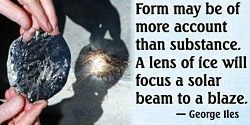
Form may be of more account than substance. A lens of ice will focus a solar beam to a blaze.
From chapter 'Jottings from a Note-book', in Canadian Stories (1918), 167.
Form your life humanly, and you have done enough: but you will never reach the height of art and the depth of science without something divine.
Idea 68. In Friedrich Schlegel, translated by Ernst Behler and Roman Struc, Dialogue on Poetry and Literary Aphorisms (trans. 1968), 155.
Formerly one sought the feeling of the grandeur of man by pointing to his divine origin: this has now become a forbidden way, for at its portal stands the ape, together with other gruesome beasts, grinning knowingly as if to say: no further in this direction! One therefore now tries the opposite direction: the way mankind is going shall serve as proof of his grandeur and kinship with God. Alas this, too, is vain! At the end of this way stands the funeral urn of the last man and gravedigger (with the inscription “nihil humani a me alienum puto”). However high mankind may have evolved—and perhaps at the end it will stand even lower than at the beginning!— it cannot pass over into a higher order, as little as the ant and the earwig can at the end of its “earthly course” rise up to kinship with God and eternal life. The becoming drags the has-been along behind it: why should an exception to this eternal spectacle be made on behalf of some little star or for any little species upon it! Away with such sentimentalities!
Daybreak: Thoughts on the Prejudices of Morality (1881), trans. R. J. Hollingdale (1982), 32.
Fortunately I experienced Max Wertheimer's teaching in Berlin and collaborated for over a decade with Wolfgang Köhler. I need not emphasize my debts to these outstanding personalities. The fundamental ideas of Gestalt theory are the foundation of all our investigations in the field of the will, of affection, and of the personality.
From A Dynamic Theory of Personality. Selected papers (1935), 240.
Fractal geometry will make you see everything differently. There is a danger in reading further. You risk the loss of your childhood vision of clouds, forests, flowers, galaxies, leaves, feathers, rocks, mountains, torrents of water, carpet, bricks, and much else besides. Never again will your interpretation of these things be quite the same.
Fractals Everywhere (2000), 1.
Free will is to mind what chance is to matter.
Notebook M (begun July 1838). In Charles Darwin, Paul H. Barrett and Peter J. Gautrey, Charles Darwin’s Notebooks, 1836-1844 (1987, 2009), 536. Darwin inserted a note “M. Le Comte,” perhaps (thinks the Webmaster) as a reference to the latter’s philosophy.
Frequently, I have been asked if an experiment I have planned is pure or applied science; to me it is more important to know if the experiment will yield new and probably enduring knowledge about nature. If it is likely to yield such knowledge, it is, in my opinion, good fundamental research; and this is more important than whether the motivation is purely aesthetic satisfaction on the part of the experimenter on the one hand or the improvement of the stability of a high-power transistor on the other.
Quoted in Richard R. Nelson, 'The Link Between Science and Invention: The Case of the Transistor,' The Rate and Direction of the Inventive Activity (1962). In Daniel S. Greenberg, The Politics of Pure Science (1999), 32, footnote.
Freudian psychoanalytical theory is a mythology that answers pretty well to Levi-Strauss's descriptions. It brings some kind of order into incoherence; it, too, hangs together, makes sense, leaves no loose ends, and is never (but never) at a loss for explanation. In a state of bewilderment it may therefore bring comfort and relief … give its subject a new and deeper understanding of his own condition and of the nature of his relationship to his fellow men. A mythical structure will be built up around him which makes sense and is believable-in, regardless of whether or not it is true.
From 'Science and Literature', The Hope of Progress: A Scientist Looks at Problems in Philosophy, Literature and Science (1973), 29.
Frogs will eat red-flannel worms fed to them by biologists; this proves a great deal about both parties concerned.
Quoted in Joseph Wood Krutch, The Best of Two Worlds (1953), 105.
From a long view of the history of mankind—seen from, say, ten thousand years from now—there can be little doubt that the most significant event of the 19th century will be judged as Maxwell’s discovery of the laws of electrodynamics. The American Civil War will pale into provincial insignificance in comparison with this important scientific event of the same decade.
In The Feynman Lectures on Physics (1964), Vol. 2, page 1-11.
From astronomy we find the east, west, south, and north, as well as the theory of the heavens, the equinox, solstice, and courses of the stars. If one has no knowledge of these matters, he will not be able to have any comprehension of the theory of sundials.
In De Architectura, Book 1, Chap 1, Sec. 10. As translated in Morris Hicky Morgan (trans.), Vitruvius: The Ten Books on Architecture (1914), 10.
From man or angel the great Architect did wisely to conceal, and not divulge his secrets to be scanned by them who ought rather admire; or if they list to try conjecture, he his fabric of the heavens left to their disputes, perhaps to move his laughter at their quaint opinions wide hereafter, when they come to model heaven calculate the stars, how they will wield the mighty frame, how build, unbuild, contrive to save appearances, how gird the sphere with centric and eccentric scribbled o’er, and epicycle, orb in orb.
Paradise Lost (1674, 1754), Book 8, 231.
From our home on the Earth, we look out into the distances and strive to imagine the sort of world into which we were born. Today, we have reached far into space. Our immediate neighborhood we know rather intimately. But with increasing distance our knowledge fades … The search will continue. The urge is older than history. It is not satisfied and will not be suppressed.
In 'From Our Home On The Earth', The Land (1946), 5, 145. As cited on the webpage of the Edwin Powell Hubble Papers.
From the point of view of the physicist, a theory of matter is a policy rather than a creed; its object is to connect or co-ordinate apparently diverse phenomena, and above all to suggest, stimulate and direct experiment. It ought to furnish a compass which, if followed, will lead the observer further and further into previously unexplored regions.
The Corpuscular Theory of Matter (1907), 1.
From the womb of darkness and cocoon of indifference is emerging a form of treatment that will eventually be added to the armamentarium of the alert and concerned physician.
Let's Live (Apr 1976). In Morton Walker and Hitendra H. Shah, Everything You Should Know About Chelation Therapy (1998), 15.
From this fountain (the free will of God) it is those laws, which we call the laws of nature, have flowed, in which there appear many traces of the most wise contrivance, but not the least shadow of necessity. These therefore we must not seek from uncertain conjectures, but learn them from observations and experimental. He who is presumptuous enough to think that he can find the true principles of physics and the laws of natural things by the force alone of his own mind, and the internal light of his reason, must either suppose the world exists by necessity, and by the same necessity follows the law proposed; or if the order of Nature was established by the will of God, the [man] himself, a miserable reptile, can tell what was fittest to be done.
…...
From whence it is obvious to conclude that, since our Faculties are not fitted to penetrate into the internal Fabrick and real Essences of Bodies; but yet plainly discover to us the Being of a GOD, and the Knowledge of our selves, enough to lead us into a full and clear discovery of our Duty, and great Concernment, it will become us, as rational Creatures, to imploy those Faculties we have about what they are most adapted to, and follow the direction of Nature, where it seems to point us out the way.
An Essay Concerning Human Understanding (1690). Edited by Peter Nidditch (1975), Book 4, Chapter 12, Section 11, 646.
Frost is but slender weeks away,
Tonight the sunset glow will stay,
Swing to the north and burn up higher
And Northern Lights wall earth with fire.
Nothing is lost yet, nothing broken,
And yet the cold blue word is spoken:
Say goodbye to the sun.
The days of love and leaves are done.
Tonight the sunset glow will stay,
Swing to the north and burn up higher
And Northern Lights wall earth with fire.
Nothing is lost yet, nothing broken,
And yet the cold blue word is spoken:
Say goodbye to the sun.
The days of love and leaves are done.
Apples by Ocean (1950), 10.
Furnished as all Europe now is with Academies of Science, with nice instruments and the spirit of experiment, the progress of human knowledge will be rapid and discoveries made of which we have at present no conception. I begin to be almost sorry I was born so soon, since I cannot have the happiness of knowing what will be known a hundred years hence.
…...
Further study of the division phenomena requires a brief discussion of the material which thus far I have called the stainable substance of the nucleus. Since the term nuclear substance could easily result in misinterpretation..., I shall coin the term chromatin for the time being. This does not indicate that this substance must be a chemical compound of a definite composition, remaining the same in all nuclei. Although this may be the case, we simply do not know enough about the nuclear substances to make such an assumption. Therefore, we will designate as chromatin that substance, in the nucleus, which upon treatment with dyes known as nuclear stains does absorb the dye. From my description of the results of staining resting and dividing cells... it follows that the chromatin is distributed throughout the whole resting nucleus, mostly in the nucleoli, the network, and the membrane, but also in the ground-substance. In nuclear division it accumulates exclusively in the thread figures. The term achromatin suggests itself automatically for the unstainable substance of the nucleus. The terms chromatic and achromatic which will be used henceforth are thus explained.
Further, it will not be amiss to distinguish the three kinds and, as it were, grades of ambition in mankind. The first is of those who desire to extend their own power in their native country, a vulgar and degenerate kind. The second is of those who labor to extend the power and dominion of their country among men. This certainly has more dignity, though not less covetousness. But if a man endeavor to establish and extend the power and dominion of the human race itself over the universe, his ambition (if ambition it can be called) is without doubt both a more wholesome and a more noble thing than the other two. Now the empire of man over things depends wholly on the arts and sciences. For we cannot command nature except by obeying her.
From Novum Organum (1620), Book 1, Aphorism 129. Translated as The New Organon: Aphorisms Concerning the Interpretation of Nature and the Kingdom of Man), collected in James Spedding, Robert Ellis and Douglas Heath (eds.), The Works of Francis Bacon (1857), Vol. 4, 114.
Furthermore, it’s equally evident that what goes on is actually one degree better than self-reproduction, for organisms appear to have gotten more elaborate in the course of time. Today's organisms are phylogenetically descended from others which were vastly simpler than they are, so much simpler, in fact, that it’s inconceivable, how any kind of description of the latter, complex organism could have existed in the earlier one. It’s not easy to imagine in what sense a gene, which is probably a low order affair, can contain a description of the human being which will come from it. But in this case you can say that since the gene has its effect only within another human organism, it probably need not contain a complete description of what is to happen, but only a few cues for a few alternatives. However, this is not so in phylogenetic evolution. That starts from simple entities, surrounded by an unliving amorphous milieu, and produce, something more complicated. Evidently, these organisms have the ability to produce something more complicated than themselves.
From lecture series on self-replicating machines at the University of Illinois, Lecture 5 (Dec 1949), 'Re-evaluation of the Problems of Complicated Automata—Problems of Hierarchy and Evolution', Theory of Self-Reproducing Automata (1966).
Galileo was no idiot. Only an idiot could believe that science requires martyrdom—that may be necessary in religion, but in time a scientific result will establish itself.
As quoted, without citation, in Harold Eves, Mathematical Circles Squared (1971). Collected in Bill Swainson, The Encarta Book of Quotations (2000), 361.
Gas Lights - Without Oil, Tallow, Wicks or Smoke. It is not necessary to invite attention to the gas lights by which my salon of paintings is now illuminated; those who have seen the ring beset with gems of light are sufficiently disposed to spread their reputation; the purpose of this notice is merely to say that the Museum will be illuminated every evening until the public curiosity be gratified.
[Promoting the gas lights Peale installed to attract paying visitors to his museum of portraits and natural history exhibits.]
[Promoting the gas lights Peale installed to attract paying visitors to his museum of portraits and natural history exhibits.]
First advertisement for Peale's Baltimore Museum and Gallery of Fine Arts, American and Commercial Daily Advertiser (13 Jun 1816)
(source)
Gates is the ultimate programming machine. He believes everything can be defined, examined, reduced to essentials, and rearranged into a logical sequence that will achieve a particular goal.
Generations to come, it may be, will scarcely believe that such a one as this ever in flesh and blood walked upon this earth.
…...
Gentlemen, as we study the universe we see everywhere the most tremendous manifestations of force. In our own experience we know of but one source of force, namely will. How then can we help regarding the forces we see in nature as due to the will of some omnipresent, omnipotent being? Gentlemen, there must be a GOD.
As quoted in W. E. Byerly (writing as a Professor Emeritus at Harvard University, but a former student at a Peirce lecture on celestial mechanics), 'Benjamin Peirce: II. Reminiscences', The American Mathematical Monthly (Jan 1925), 32, No. 1, 6.
Gentlemen, now you will see that now you see nothing. And why you see nothing you will see presently.
Quoted in R. Oesper, The Human Side of Scientists (1975), 164.
Geology has shared the fate of other infant sciences, in being for a while considered hostile to revealed religion; so like them, when fully understood, it will be found a potent and consistent auxiliary to it, exalting our conviction of the Power, and Wisdom, and Goodness of the Creator.
Geology and Mineralogy Considered with Reference to Natural Theology (1836), Vol. 1, 9.
GEOLOGY, n. The science of the earth's crust —to which, doubtless, will be added that of its interior whenever a man shall come up garrulous out of a well. The geological formations of the globe already noted are catalogued thus: The Primary, or lower one, consists of rocks, bones of mired mules, gas-pipes, miners' tools, antique statues minus the nose, Spanish doubloons and ancestors. The Secondary is largely made up of red worms and moles. The Tertiary comprises railway tracks, patent pavements, grass, snakes, mouldy boots, beer bottles, tomato cans, intoxicated citizens, garbage, anarchists, snap-dogs and fools.
The Collected Works of Ambrose Bierce (1911), Vol. 7, The Devil's Dictionary, 115.
Geometry seems to stand for all that is practical, poetry for all that is visionary, but in the kingdom of the imagination you will find them close akin, and they should go together as a precious heritage to every youth.
From The Proceedings of the Michigan Schoolmasters’ Club, reprinted in School Review (1898), 6 114.
Get into any taxi and tell the driver you are a mathematician and the response is predictable … you will hear the immortal words: “I was never any good at mathematics.” My response is: “I was never any good at being a taxi driver so I went into mathematics.”
In paper, 'A Mathematician’s Survival Guide', pdf document linked from his homepage at math.missouri.edu (undated, but 2011 or earlier, indicated by an “accessed on” date elsewhere.) Collected in Peter Casazza, Steven G. Krantz and Randi D. Ruden (eds.) I, Mathematician (2005), 31.
Get up at five, have lunch at nine,
Supper at five, retire at nine,
And you will live to ninety-nine.
Supper at five, retire at nine,
And you will live to ninety-nine.
Give me a place to stand, and I will move the earth.
F. Hultsch (ed.) Pappus Alexandrinus: Collectio (1876-8), Vol. 3, book 8, section 10, ix.
Give me extension and motion, and I will construct the Universe.
As quoted, without citation, in Morris Kline, Mathematics in Western Culture (1964), 106. Webmaster has not yet located this in a primary source. Can you help?
Give me matter, and I will construct a world out of it!
'Universal Natural History and Theory of the Heavens' (1755), preface. In W. Hastie (ed. and trans.), Kant's Cosmogony: As in his Essay on the Retardation of the Rotation of the Earth and his Natural History and Theory of the Heavens (1900), 29.
Give me the storm and tempest of thought and action, rather than the dead calm of ignorance and faith. Banish me from Eden when you will, but first let me eat of the fruit of the Tree of Knowledge.
Epigraph, title page of The Works of Robert G. Ingersoll (1902), Vol. 3. Since it is not printed with a citation, Webmaster believes it is attributable to the author of the book.
Give me the third best technology. The second best won’t be ready in time. The best will never be ready.
As quoted in a speech by an unnamed executive of General Electric, excerpted in Richard Dowis, The Lost Art of the Great Speech: How to Write It, How to Deliver It (2000), 150.
By
Given one well-trained physician of the highest type and he will do better work for a thousand people than ten specialists.
From speech 'In the Time of Henry Jacob Bigelow', given to the Boston Surgical Society, Medalist Meeting (6 Jun 1921). Printed in Journal of the Medical Association (1921), 77, 601.
Go into a room where the shutters are always shut (in a sick-room or a bed-room there should never be shutters shut), and though the room be uninhabited—though the air has never been polluted by the breathing of human beings, you will observe a close, musty smell of corrupt air—of air unpurified by the effect of the sun's rays.
Notes on Nursing: What it is and what it is not (1860), 120.
God asks no man whether he will accept life. That is not the choice. You must accept it. The only choice is how.
Quoted in Kim Lim (ed.), 1,001 Pearls of Spiritual Wisdom: Words to Enrich, Inspire, and Guide Your Life (2014), 24
Gödel proved that the world of pure mathematics is inexhaustible; no finite set of axioms and rules of inference can ever encompass the whole of mathematics; given any finite set of axioms, we can find meaningful mathematical questions which the axioms leave unanswered. I hope that an analogous Situation exists in the physical world. If my view of the future is correct, it means that the world of physics and astronomy is also inexhaustible; no matter how far we go into the future, there will always be new things happening, new information coming in, new worlds to explore, a constantly expanding domain of life, consciousness, and memory.
From Lecture 1, 'Philosophy', in a series of four James Arthur Lectures, 'Lectures on Time and its Mysteries' at New York University (Autumn 1978). Printed in 'Time Without End: Physics and Biology in an Open Universe', Reviews of Modern Physics (Jul 1979), 51, 449.
going to have an industrial society you must have places that will look terrible. Other places you set aside—to say, ‘This is the way it was.’
Assembling California
Good hard-pan sense iz the thing that will wash well, wear well, iron out without wrinkling, and take starch without kracking.
In The Complete Works of Josh Billings (1876), 78.
Good people are seldom fully recognised during their lifetimes, and here, there are serious problems of corruption. One day it will be realised that my findings should have been acknowledged.
It was difficult, but she always smiled when asked why she went on when recognition eluded her in her own country.
It was difficult, but she always smiled when asked why she went on when recognition eluded her in her own country.
Quoted in obituary by Anthony Tucker, 'Alice Stewart', The Guardian newspaper (28 Jun 2002).
Good work is no done by “humble” men. It is one of the first duties of a professor, for example, in any subject, to exaggerate a little both the importance of his subject and his own importance in it. A man who is always asking “Is what I do worth while?” and “Am I the right person to do it?” will always be ineffective himself and a discouragement to others. He must shut his eyes a little and think a little more of his subject and himself than they deserve. This is not too difficult: it is harder not to make his subject and himself ridiculous by shutting his eyes too tightly.
In A Mathematician’s Apology (1940, 1967), 66.
Google can aggregate all web and paper-based information, and they can build fantastic search engines, but that will not directly lead to truth or wisdom. For that we will continue to need education, training in critical thought, and good editors who can help us winnow the fact from the fiction.
From post 're:The Pursuit of Knowledge, from Genesis to Google' to the 'Interesting People' List (6 Jan 2005) maintained by David J. Farber, now archived at interesting-people.org website.
Governments and parliaments must find that astronomy is one of the sciences which cost most dear: the least instrument costs hundreds of thousands of dollars, the least observatory costs millions; each eclipse carries with it supplementary appropriations. And all that for stars which are so far away, which are complete strangers to our electoral contests, and in all probability will never take any part in them. It must be that our politicians have retained a remnant of idealism, a vague instinct for what is grand; truly, I think they have been calumniated; they should be encouraged and shown that this instinct does not deceive them, that they are not dupes of that idealism.
In Henri Poincaré and George Bruce Halsted (trans.), The Value of Science: Essential Writings of Henri Poincare (1907), 84.
Grand telegraphic discovery today … Transmitted vocal sounds for the first time ... With some further modification I hope we may be enabled to distinguish … the “timbre” of the sound. Should this be so, conversation viva voce by telegraph will be a fait accompli.
Postscript (P.S.) on page 3 of letter to Sarah Fuller (1 Jul 1875). Bell Papers, Library of Congress.
Great works are performed, not by strength, but by perserverance. He that shall walk, with vigour, three hours a day, will pass, in seven years, a space equal to the circumference of the globe.
As quoted, without citation, in John Walker, A Fork in the Road: Answers to Daily Dilemmas from the Teachings of Jesus Christ (2005), 179.
Guard well your spare moments. They are like uncut diamonds. Discard them and their value will never be known. Improve them and they will become the brightest gems in a useful life.
…...

Had we lived, I should have had a tale to tell of the hardihood, endurance and courage of my companions which would have stirred the heart of every Englishman. These rough notes and our dead bodies must tell the tale, but surely, a great rich country like ours will see that those who are dependent on us are properly provided for.
[Final words in a 'Message to the Public' left written in his diary dated 25 March 1912, shortly before he died on the Ross Ice Barrier, Antarctica. When searchers found his body, on 12 Nov 1912, Scott was discovered sitting upright against the pole of the tent with the diary behind his head, as if for a pillow.]
[Final words in a 'Message to the Public' left written in his diary dated 25 March 1912, shortly before he died on the Ross Ice Barrier, Antarctica. When searchers found his body, on 12 Nov 1912, Scott was discovered sitting upright against the pole of the tent with the diary behind his head, as if for a pillow.]
Final words in a 'Message to the Public' left written in his diary dated 25 March 1912, shortly before he died on the Ross Ice Barrier, Antarctica. In Logan Marshall, The Story of Polar Conquest: The Complete History of Arctic and Antarctic (1913), 24-25.
by Logan Marshall - Polar regions - 1913
Harvard Law: Under the most rigorously controlled conditions of pressure, temperature, humidity, and other variables, the organism will do as it damn well pleases.
The Coevolution Quarterly, Nos. 8-12 (1975), 138.
Have the changes which lead us from one geologic state to another been, on a long average uniform in their intensity, or have they consisted of epochs of paroxysmal and catastrophic action, interposed between periods of comparative tranquillity? These two opinions will probably for some time divide the geological world into two sects, which may perhaps be designated as the Uniformitarians and the Catastrophists.
In 'Review of Charles Lyell's Principles of Geology', Quarterly Review (1832), 47, 126.
He [Lord Bacon] appears to have been utterly ignorant of the discoveries which had just been made by Kepler’s calculations … he does not say a word about Napier’s Logarithms, which had been published only nine years before and reprinted more than once in the interval. He complained that no considerable advance had been made in Geometry beyond Euclid, without taking any notice of what had been done by Archimedes and Apollonius. He saw the importance of determining accurately the specific gravities of different substances, and himself attempted to form a table of them by a rude process of his own, without knowing of the more scientific though still imperfect methods previously employed by Archimedes, Ghetaldus and Porta. He speaks of the εὕρηκα of Archimedes in a manner which implies that he did not clearly appreciate either the problem to be solved or the principles upon which the solution depended. In reviewing the progress of Mechanics, he makes no mention either of Archimedes, or Stevinus, Galileo, Guldinus, or Ghetaldus. He makes no allusion to the theory of Equilibrium. He observes that a ball of one pound weight will fall nearly as fast through the air as a ball of two, without alluding to the theory of acceleration of falling bodies, which had been made known by Galileo more than thirty years before. He proposed an inquiry with regard to the lever,—namely, whether in a balance with arms of different length but equal weight the distance from the fulcrum has any effect upon the inclination—though the theory of the lever was as well understood in his own time as it is now. … He speaks of the poles of the earth as fixed, in a manner which seems to imply that he was not acquainted with the precession of the equinoxes; and in another place, of the north pole being above and the south pole below, as a reason why in our hemisphere the north winds predominate over the south.
From Spedding’s 'Preface' to De Interpretations Naturae Proœmium, in The Works of Francis Bacon (1857), Vol. 3, 511-512. [Note: the Greek word “εὕρηκα” is “Eureka” —Webmaster.]
He [Robert Boyle] is very tall (about six foot high) and straight, very temperate, and vertuouse, and frugall: a batcheler; keepes a Coach; sojournes with his sister, the Lady Ranulagh. His greatest delight is Chymistrey. He has at his sister’s a noble laboratory, and severall servants (Prentices to him) to look to it. He is charitable to ingeniose men that are in want, and foreigne Chymists have had large proofe of his bountie, for he will not spare for cost to get any rare Secret.
John Aubrey, Brief Lives (1680), edited by Oliver Lawson Dick (1949), 37.
He that desires to learn Truth should teach himself by Facts and Experiments; by which means he will learn more in a Year than by abstract reasoning in an Age.
In Academical Lectures on the Theory of Physic (1751), Vol. 1. As quoted in Thomas Steele Hall, A Source Book in Animal Biology (1951), 485.
He that leaves nothing to chance will do few things ill, but he will do very few things.
…...
He who gives a portion of his time and talent to the investigation of mathematical truth will come to all other questions with a decided advantage over his opponents. He will be in argument what the ancient Romans were in the field: to them the day of battle was a day of comparative recreation, because they were ever accustomed to exercise with arms much heavier than they fought; and reviews differed from a real battle in two respects: they encountered more fatigue, but the victory was bloodless.
Reflection 352, in Lacon: or Many things in Few Words; Addressed to Those Who Think (1820), 159.
He who is not courageous enough to take risks will accomplish nothing in life.
In Ebony (1984), 40, 140.
He who sees things grow from the beginning will have the best view of them.
Quoted in J. Lima-de-Faria (ed.), Historical Atlas of Crystallography (1990), vi.
He who thus considers things in their first growth and origin … will obtain the clearest view of them.
In Politics, Book 1, Chap. 1, as translated by Benjamin Jowett (1885), Vol. 1, 2.
He who understands Archimedes and Apollonius will admire less the achievements of the foremost men of later times.
Quoted, without citation, in Max Dehn, 'Mathematics, 300 B.C.-200 B.C.', The American Mathematical Monthly (Jan 1944), 51, No. 1, 31.
He will also find that the high and independent spirit, which usually dwells in the breast of those who are deeply versed in scientific pursuits, is ill adapted for administrative appointments; and that even if successful, he must hear many things he disapproves, and raise no voice against them.
Reflections on the Decline of Science in England and on Some of its Causes, (1830), 38.
He will manage the cure best who has foreseen what is to happen from the present state of matters.
In 'The Book of Prognostics', Part 1 (400 BC), as translated by Francis Adams, The Genuine Works of Hippocrates (1849), Vol. 1, 113. Also seen translated as “He will manage the cure best who foresees what is to happen from the present condition of the patient.”
He, who for an ordinary cause, resigns the fate of his patient to mercury, is a vile enemy to the sick; and, if he is tolerably popular, will, in one successful season, have paved the way for the business of life, for he has enough to do, ever afterward, to stop the mercurial breach of the constitutions of his dilapidated patients. He has thrown himself in fearful proximity to death, and has now to fight him at arm's length as long as the patient maintains a miserable existence.
Quoted by William M. Scribner, 'Treatment of Pneumonia and Croup, Once More, Etc,' in The Medical World (1885), 3, 187.
Heavy dependence on direct observation is essential to biology not only because of the complexity of biological phenomena, but because of the intervention of natural selection with its criterion of adequacy rather than perfection. In a system shaped by natural selection it is inevitable that logic will lose its way.
In 'Scientific innovation and creativity: a zoologist’s point of view', American Zoologist (1982), 22, 229.
Herewith I offer you the Omnipotent Finger of God in the anatomy of a louse: wherein you will find miracles heaped on miracles and will see the wisdom of God clearly manifested in a minute point.
Letter to Melchisedec Thevenot (Apr 1678). In G. A. Lindeboom (ed.), The Letters of Jan Swammerdam to Melchisedec Thivenot (1975), 104-5.
High in the North in a land called Svithjod there is a mountain. It is a hundred miles long and a hundred miles high and once every thousand years a little bird comes to this mountain to sharpen its beak. When the mountain has thus been worn away a single day of eternity will have passed
In The Story of America (1921). As cited in David Blatner, Spectrums: Our Mind-boggling Universe from Infinitesimal to Infinity (2012), 24.
His [Marvin Minsky’s] basic interest seemed to be in the workings of the human mind and in making machine models of the mind. Indeed, about that time he and a friend made one of the first electronic machines that could actually teach itself to do something interesting. It monitored electronic “rats” that learned to run mazes. It was being financed by the Navy. On one notable occasion, I remember descending to the basement of Memorial Hall, while Minsky worked on it. It had an illuminated display panel that enabled one to follow the progress of the “rats.” Near the machine was a hamster in a cage. When the machine blinked, the hamster would run around its cage happily. Minsky, with his characteristic elfin grin, remarked that on a previous day the Navy contract officer had been down to see the machine. Noting the man’s interest in the hamster, Minsky had told him laconically, “The next one we build will look like a bird.”
His Majesty has, with great skill, constructed a cart, containing a corn mill, which is worked by the motion of the carriage. He has also contrived a carriage of such a magnitude as to contain several apartments, with a hot bath; and it is drawn by a single elephant. This movable bath is extremely useful, and refreshing on a journey. … He has also invented several hydraulic machines, which are worked by oxen. The pulleys and wheels of some of them are so adjusted that a single ox will at once draw water out of two wells, and at the same time turn a millstone.
From Ain-i-Akbery (c.1590). As translated from the original Persian, by Francis Gladwin in 'Akbar’s Conduct and Administrative Rules', 'Of Machines', Ayeen Akbery: Or, The Institutes of the Emperor Akber (1783), Vol. 1, 284. Note: Akbar (Akber) was a great ruler and enlightened statesman.
His motion to the meeting of the Council of the Chemical Society:
That henceforth the absurd game of chemical noughts and crosses be tabu within the Society's precincts and that, following the practice of the Press in ending a correspondence, it be an instruction to the officers to give notice “That no further contributions to the mysteries of Polarity will be received, considered or printed by the Society.” His challenge was not accepted.
That henceforth the absurd game of chemical noughts and crosses be tabu within the Society's precincts and that, following the practice of the Press in ending a correspondence, it be an instruction to the officers to give notice “That no further contributions to the mysteries of Polarity will be received, considered or printed by the Society.” His challenge was not accepted.
From the personal and other items column of Chemistry and Industry (1925), 44, 1050.
Histology is an exotic meal, but can be as repulsive as a dose of medicine for students who are obliged to study it, and little loved by doctors who have finished their study of it all too hastily. Taken compulsorily in large doses it is impossible to digest, but after repeated tastings in small draughts it becomes completely agreeable and even addictive. Whoever possesses a refined sensitivity for artistic manifestations will appreciate that, in the science of histology, there exists an inherent focus of aesthetic emotions.
Opening remarks of paper, 'Art and Artifice in the Science of Histology' (1933), reprinted in Histopathology (1993), 22, 515-525. Quoted in Ross, Pawlina and Barnash, Atlas of Descriptive Histology (2009).
Historians will have to face the fact that natural selection determined the evolution of cultures in the same manner as it did that of species.
On Aggression, trans. M. Latzke (1966), 260.
Historically, science has pursued a premise that Nature can be understood fully, its future predicted precisely, and its behavior controlled at will. However, emerging knowledge indicates that the nature of Earth and biological systems transcends the limits of science, questioning the premise of knowing, prediction, and control. This knowledge has led to the recognition that, for civilized human survival, technological society has to adapt to the constraints of these systems.
As quoted in Chris Maser, Decision-Making for a Sustainable Environment: A Systemic Approach (2012), 4, citing N. Narasimhan, 'Limitations of Science and Adapting to Nature', Environmental Research Letters (Jul-Sep 2007), 2.
History warns us … that it is the customary fate of new truths to begin as heresies and to end as superstitions; and, as matters now stand, it is hardly rash to anticipate that, in another twenty years, the new generation, educated under the influences of the present day, will be in danger of accepting the main doctrines of the “Origin of Species,” with as little reflection, and it may be with as little justification, as so many of our contemporaries, twenty years ago, rejected them.
'The Coming of Age of the Origin of Species' (1880). In Collected Essays, Vol. 2: Darwiniana (1893), 229.
Hitherto man had to live with the idea of death as an individual; from now onward mankind will have to live with the idea of its death as a species.
As excerpted in Paul S. Burtness, 'Arthur Koestler (1905-)', The Contemporary University Reader (1963), 286.
Hitler is living—or shall I say sitting?—on the empty stomach of Germany. As soon as economic conditions improve, Hitler will sink into oblivion. He dramatizes impossible extremes in an amateurish manner.
In Cosmic Religion: With Other Opinions and Aphorisms (1931), 105. Also quoted in book review, 'Einstein Obiter Dicta', Time (6 Oct 1930), 16, No. 14, 18.
HOMŒOPATHY, n. A school of medicine midway between Allopathy and Christian Science. To the last both the others are distinctly inferior, for Christian Science will cure imaginary diseases, and they can
The Collected Works of Ambrose Bierce (1911), Vol. 7, The Devil's Dictionary, 139.
Honest pioneer work in the field of science has always been, and will continue to be, life’s pilot. On all sides, life is surrounded by hostility. This puts us under an obligation.
In Function of the Orgasm: Discovery of the Orgone (1927, 1973), 37.
Hospitals are only an intermediate stage of civilization, never intended ... to take in the whole sick population. May we hope that the day will come ... when every poor sick person will have the opportunity of a share in a district sick-nurse at home.
In 'Nursing of the Sick' paper, collected in Hospitals, Dispensaries and Nursing: Papers and Discussions in the International Congress of Charities, Correction and Philanthropy, Section III, Chicago, June 12th to 17th, 1893 (1894), 457.
How can altruism, which by definition reduces personal fitness, possibly evolve by natural selection? The answer is kinship: if the genes causing the altruism are shared by two organisms because of common descent, and if the altruistic act by one organism increases the joint contribution of these genes to the next generation, the propensity to altruism will spread through the gene pool. This occurs even though the altruist makes less of a solitary contribution to the gene pool as the price of its altruistic act.
In Sociobiology (1975), 3-4.
How can he [Thomas Edison] call it a wonderful success when everyone acquainted with the subject will recognize it as a conspicuous failure?
In The New York Herald, (18 Dec 1879). As quoted and cited in Rob Kaplan (ed.), Science Says (2001), 200.
How do we discover the individual laws of Physics, and what is their nature? It should be remarked, to begin with, that we have no right to assume that any physical law exists, or if they have existed up to now, that they will continue to exist in a similar manner in the future. It is perfectly conceivable that one fine day Nature should cause an unexpected event to occur which would baffle us all; and if this were to happen we would be powerless to make any objection, even if the result would be that, in spite of our endeavors, we should fail to introduce order into the resulting confusion. In such an event, the only course open to science would be to declare itself bankrupt. For this reason, science is compelled to begin by the general assumption that a general rule of law dominates throughout Nature.
Max Planck, Walter Henry Johnston, The Universe in the Light of Modern Physics (1931), 58.
How far will chemistry and physics … help us understand the appeal of a painting?
Colour: Why the World Isn’t Grey (1983). Quoted in Sidney Perkowitz, Empire of Light (1999), 1.
How few people will realize how much detail had to be gone into before Bakelite was a commercial success.
Diary entry (13 Oct 1909). In Savage Grace (1985, 2007), 65.
How indispensable to a correct study of Nature is a perception of her true meaning. The fact will one day flower out into a truth. The season will mature and fructify what the understanding had cultivated. Mere accumulators of facts—collectors of materials for the master-workmen—are like those plants growing in dark forests, which “put forth only leaves instead of blossoms.”
(16 Dec 1837). In Henry David Thoreau and Bradford Torrey (ed.), The Writings of Henry Thoreau: Journal: I: 1837-1846 (1906), 18.
How many famous men be there in this our age, which make scruple to condemne these old witches, thinking it to bee nothing but a melancholike humour which corrupteth thei imagination, and filleth them with all these vaines toyes. I will not cast my selfe any further into the depth of this question, the matter craveth a man of more leisure.
Describing melancholy as the innocent affliction of those regarded as witches instead of Satanic influence, while distancing himself from the controversy.
Describing melancholy as the innocent affliction of those regarded as witches instead of Satanic influence, while distancing himself from the controversy.
Discours de la conservation de la veue; des maladies mélancholiques, des catarrhes, et de la vieillese (1594). In Richard Surphlet (trans.) A Discourse of the Preservation of the Sight: of Melancholike Diseases; of Rheumes, and of Old Age (1599), 98-9. Quoted in Michael Heyd, Be sober and Reasonable (), 58.
How much has happened in these fifty years—a period more remarkable than any, I will venture to say, in the annals of mankind. I am not thinking of the rise and fall of Empires, the change of dynasties, the establishment of Governments. I am thinking of those revolutions of science which have had much more effect than any political causes, which have changed the position and prospects of mankind more than all the conquests and all the codes and all the legislators that ever lived.
Banquet speech, Glasgow. In Nature (27 Nov 1873), 9, 71.
How peacefully he sleep!
Yet may his ever-questing spirit, freed at length
from all the frettings of this little world,
Wander at will among the uncharted stars.
Fairfield his name. Perchance celestial fields
disclosing long sought secrets of the past
Spread 'neath his enraptured gaze
And beasts and men that to his earthly sight
were merely bits of stone shall live again to
gladden those eager eyes.
o let us picture him—enthusiast—scientist—friend—
Seeker of truth and light through all eternity!
Yet may his ever-questing spirit, freed at length
from all the frettings of this little world,
Wander at will among the uncharted stars.
Fairfield his name. Perchance celestial fields
disclosing long sought secrets of the past
Spread 'neath his enraptured gaze
And beasts and men that to his earthly sight
were merely bits of stone shall live again to
gladden those eager eyes.
o let us picture him—enthusiast—scientist—friend—
Seeker of truth and light through all eternity!
New York Sun (13 Nov 1935). Reprinted in 'Henry Fairfield Osborn', Supplement to Natural History (Feb 1936), 37:2, 135. Bound in Kofoid Collection of Pamphlets on Biography, University of California.
How strange it would be if the final theory were to be discovered in our lifetimes! The discovery of the final laws of nature will mark a discontinuity in human intellectual history, the sharpest that has occurred since the beginning of modern science in the seventeenth century. Can we now imagine what that would be like?
In Dreams of a Final Theory (1992), 235.
How twins are born my discourse will explain thus. The cause is chiefly the nature of the womb in woman. For if it has grown equally on either side of its mouth, and if it opens equally, and also dries equally after menstruation, it can give nourishment, if it conceive the secretion of the man so that it immediately divides into both parts of the womb equally. Now if the seed secreted from both parents be abundant and strong, it can grow in both places, as it masters the nourishment that reaches it. In all other cases twins are not formed. Now when the secretion from both parents is male, of necessity boys are begotten in both places; but when from both it is female, girls are begotten. But when one secretion is female and the other male, whichever masters the other gives the embryo its sex. Twins are like one another for the following reasons. First, the places are alike in which they grow; then they were secreted together; then they grow by the same nourishment, and at birth they reach together the light of day.
Regimen, in Hippocrates, trans. W. H. S. Jones (1931), Vol. 4, 273.
However improbable we regard [the spontaneous origin of life],… it will almost certainly happen at least once…. The time… is of the order of two billion years.… Given so much time, the “impossible” becomes possible, the possible probable, and the probable virtually certain. One only has to wait: time itself performs the miracles.
In 'The Origin of Life', Scientific American (Aug 1954), 191, No. 2, 46. Note that the quoted time of 2 billion years is rejected as impossibly short by such authors as H. J. Morowitz, in Energy Flow in Biology (1968), 317.
Hubris is the greatest danger that accompanies formal data analysis, including formalized statistical analysis. The feeling of “Give me (or more likely even, give my assistant) the data, and I will tell you what the real answer is!” is one we must all fight against again and again, and yet again.
In 'Sunset Salvo', The American Statistician (Feb 1986), 40, No. 1, 75.
Human consciousness is just about the last surviving mystery. A mystery is a phenomenon that people don’t know how to think about—yet. There have been other great mysteries: the mystery of the origin of the universe, the mystery of life and reproduction, the mystery of the design to be found in nature, the mysteries of time, space, and gravity. These were not just areas of scientific ignorance, but of utter bafflement and wonder. We do not yet have the final answers to any of the questions of cosmology and particle physics, molecular genetics and evolutionary theory, but we do know how to think about them. The mysteries haven't vanished, but they have been tamed. They no longer overwhelm our efforts to think about the phenomena, because now we know how to tell the misbegotten questions from the right questions, and even if we turn out to be dead wrong about some of the currently accepted answers, we know how to go about looking for better answers. With consciousness, however, we are still in a terrible muddle. Consciousness stands alone today as a topic that often leaves even the most sophisticated thinkers tongue-tied and confused. And, as with all the earlier mysteries, there are many who insist—and hope—that there will never be a demystification of consciousness.
Consciousness Explained (1991), 21-22.
Human evolution is nothing else but the natural continuation, at a collective level, of the perennial and cumulative process of “psychogenetic” arrangement of matter which we call life. … The whole history of mankind has been nothing else (and henceforth it will never be anything else) but an explosive outburst of ever-growing cerebration. … Life, if fully understood, is not a freak in the universe—nor man a freak in life. On the contrary, life physically culminates in man, just as energy physically culminates in life.
(1952). As quoted in Stephen Jay Gould, Hen's Teeth and Horse's Toes: Further Reflections in Natural History (1984, 1994), 246.
Human personality resembles a coral reef: a large hard/dead structure built and inhabited by tiny soft/live animals. The hard/dead part of our personality consists of habits, memories, and compulsions and will probably be explained someday by some sort of extended computer metaphor. The soft/live part of personality consists of moment-to-moment direct experience of being. This aspect of personality is familiar but somewhat ineffable and has eluded all attempts at physical explanation.
Quoted in article 'Nick Herbert', in Gale Cengage Learning, Contemporary Authors Online (2002).
Humans everywhere share the same goals when the context is large enough. And the study of the Cosmos provides the largest possible context … . If a human disagrees with you, let him live. In a hundred billion galaxies, you will not find another … . If we are to survive, our loyalties must be broadened further, to include the whole human community, the entire planet Earth.
Cosmos
I [do not know] when the end of science will come. ... What I do know is that our species is dumber than we normally admit to ourselves. This limit of our mental faculties, and not necessarily of science itself, ensures to me that we have only just begun to figure out the universe.
In Death by Black Hole: And Other Cosmic Quandaries (2007), 17.
I admit that the generation which produced Stalin, Auschwitz and Hiroshima will take some beating, but the radical and universal consciousness of the death of God is still ahead of us. Perhaps we shall have to colonise the stars before it is finally borne in upon us that God is not out there.
In Thomas Mann: a Critical Study (1971), 175.
I am afraid I am not in the flight for “aerial navigation”. I was greatly interested in your work with kites; but I have not the smallest molecule of faith in aerial navigation other than ballooning or of expectation of good results from any of the trials we hear of. So you will understand that I would not care to be a member of the aëronautical Society.
Letter (8 Dec 1896) to Baden Powell. This is the full text of the letter. An image of the handwritten original is on the zapatopi.net website
I am born into an environment–I know not whence I came nor whither I go nor who I am. This is my situation as yours, every single one of you. The fact that everyone always was in this same situation, and always will be, tells me nothing. Our burning question as to the whence and whither–all we can ourselves observe about it is the present environment. That is why we are eager to find out about it as much as we can. That is science, learning, knowledge; it is the true source of every spiritual endeavour of man. We try to find out as much as we can about the spatial and temporal surroundings of the place in which we find ourselves put by birth.
…...
I am compelled to fear that science will be used to promote the power of dominant groups rather than to make men happy.
In Icarus, or the Future of Science (1924), 5.
I am concerned about the air we breathe and the water we drink. If overfishing continues, if pollution continues, many of these species will disappear off the face of the earth.
I am convinced that an important stage of human thought will have been reached when the physiological and the psychological, the objective and the subjective, are actually united, when the tormenting conflicts or contradictions between my consciousness and my body will have been factually resolved or discarded.
Physiology of the Higher Nervous Activity (1932), 93-4.
I am further inclined to think, that when our views are sufficiently extended, to enable us to reason with precision concerning the proportions of elementary atoms, we shall find the arithmetical relation alone will not be sufficient to explain their mutual action, and that we shall be obliged to acquire a geometric conception of their relative arrangement in all three dimensions of solid extension.
Paper. Read to the Royal Society (28 Jan 1808), in 'On Super-acid and Sub-acid salts', Philosophical Transactions of the Royal Society of London, (1808), 98, 101.
I am more and more convinced that the ant colony is not so much composed of separate individuals as that the colony is a sort of individual, and each ant like a loose cell in it. Our own blood stream, for instance, contains hosts of white corpuscles which differ little from free-swimming amoebae. When bacteria invade the blood stream, the white corpuscles, like the ants defending the nest, are drawn mechanically to the infected spot, and will die defending the human cell colony. I admit that the comparison is imperfect, but the attempt to liken the individual human warrior to the individual ant in battle is even more inaccurate and misleading. The colony of ants with its component numbers stands half way, as a mechanical, intuitive, and psychical phenomenon, between our bodies as a collection of cells with separate functions and our armies made up of obedient privates. Until one learns both to deny real individual initiative to the single ant, and at the same time to divorce one's mind from the persuasion that the colony has a headquarters which directs activity … one can make nothing but pretty fallacies out of the polity of the ant heap.
In An Almanac for Moderns (1935), 121
I am not only a pacifist but a militant pacifist. I am willing to fight for peace. Nothing will end war unless the people themselves refuse to go to war.
…...
I am not pleading with you to make changes, I am telling you you have got to make them—not because I say so, but because old Father Time will take care of you if you don’t change. Consequently, you need a procurement department for new ideas.
As quoted in book review, T.A. Boyd, 'Charles F. Kettering: Prophet of Progress', Science (30 Jan 1959), 256.
I am of the decided opinion, that mathematical instruction must have for its first aim a deep penetration and complete command of abstract mathematical theory together with a clear insight into the structure of the system, and doubt not that the instruction which accomplishes this is valuable and interesting even if it neglects practical applications. If the instruction sharpens the understanding, if it arouses the scientific interest, whether mathematical or philosophical, if finally it calls into life an esthetic feeling for the beauty of a scientific edifice, the instruction will take on an ethical value as well, provided that with the interest it awakens also the impulse toward scientific activity. I contend, therefore, that even without reference to its applications mathematics in the high schools has a value equal to that of the other subjects of instruction.
In 'Ueber das Lehrziel im mathemalischen Unterricht der höheren Realanstalten', Jahresbericht der Deutschen Mathematiker Vereinigung, 2, 192. (The Annual Report of the German Mathematical Association. As translated in Robert Édouard Moritz, Memorabilia Mathematica; Or, The Philomath’s Quotation-Book (1914), 73.
I am one of those who think, like Nobel, that humanity will draw more good than evil from new discoveries.
In Pierre Biquard, Frédéric Joliot-Curie: the Man and his Theories (1966), 11.
I am particularly concerned to determine the probability of causes and results, as exhibited in events that occur in large numbers, and to investigate the laws according to which that probability approaches a limit in proportion to the repetition of events. That investigation deserves the attention of mathematicians because of the analysis required. It is primarily there that the approximation of formulas that are functions of large numbers has its most important applications. The investigation will benefit observers in identifying the mean to be chosen among the results of their observations and the probability of the errors still to be apprehended. Lastly, the investigation is one that deserves the attention of philosophers in showing how in the final analysis there is a regularity underlying the very things that seem to us to pertain entirely to chance, and in unveiling the hidden but constant causes on which that regularity depends. It is on the regularity of the main outcomes of events taken in large numbers that various institutions depend, such as annuities, tontines, and insurance policies. Questions about those subjects, as well as about inoculation with vaccine and decisions of electoral assemblies, present no further difficulty in the light of my theory. I limit myself here to resolving the most general of them, but the importance of these concerns in civil life, the moral considerations that complicate them, and the voluminous data that they presuppose require a separate work.
Philosophical Essay on Probabilities (1825), trans. Andrew I. Dale (1995), Introduction.
I am quite aware that we have just now lightheartedly expelled in imagination many excellent men who are largely, perhaps chiefly, responsible for the buildings of the temple of science; and in many cases our angel would find it a pretty ticklish job to decide. But of one thing I feel sure: if the types we have just expelled were the only types there were, the temple would never have come to be, any more than a forest can grow which consists of nothing but creepers. For these people any sphere of human activity will do, if it comes to a point; whether they become engineers, officers, tradesmen, or scientists depends on circumstances.
…...
I am sorry the infernal Divinities, who visit mankind with diseases, and are therefore at perpetual war with Doctors, should have prevented my seeing all you great Men at Soho to-day-Lord! what inventions, what wit, what rhetoric, metaphysical, mechanical and pyrotecnical, will be on the wing, bandy'd like a shuttlecock from one to another of your troop of philosophers! while poor I, I by myself I, imprizon'd in a post chaise, am joggled, and jostled, and bump'd, and bruised along the King's high road, to make war upon a pox or a fever!
Letter to Matthew Boulton, 5 April 1778. Quoted in Desmond King-Hele (ed.), The Letters of Erasmus Darwin (1981), 84.
I am sure that one secret of a successful teacher is that he has formulated quite clearly in his mind what the pupil has got to know in precise fashion. He will then cease from half-hearted attempts to worry his pupils with memorising a lot of irrelevant stuff of inferior importance.
In 'The Rhythmic Claims of Freedom and Discipline', The Aims of Education and Other Essays (1929), 46.
I am trying to get the hang of this new fangled writing machine, but I am not making a shining success of it. However, this is the first attempt I have ever made & yet I perceive I shall soon & easily acquire a fine facility in its use. … The machine has several virtues. I believe it will print faster than I can write. One may lean back in his chair & work it. It piles an awful stack of words on one page. It don't muss things or scatter ink blots around. Of course it saves paper.
Letter (9 Dec 1874). Quoted in B. Blivens, Jr., The Wonderful Writing Machine (1954), 61.
I am very sorry, Pyrophilus, that to the many (elsewhere enumerated) difficulties which you may meet with, and must therefore surmount, in the serious and effectual prosecution of experimental philosophy I must add one discouragement more, which will perhaps is much surprise as dishearten you; and it is, that besides that you will find (as we elsewhere mention) many of the experiments published by authors, or related to you by the persons you converse with, false and unsuccessful (besides this, I say), you will meet with several observations and experiments which, though communicated for true by candid authors or undistrusted eye-witnesses, or perhaps recommended by your own experience, may, upon further trial, disappoint your expectation, either not at all succeeding constantly, or at least varying much from what you expected.
Opening paragraph of The First Essay Concerning the Unsuccessfulness of Experiments (1673), collected in The Works of the Honourable Robert Boyle in Six Volumes to Which is Prefixed the Life of the Author (1772), Vol. 1, 318-319.
I am well convinced that Aerial Navigation will form a most prominent feature in the progress of civilization. (1804)
In Aeronautical and Miscellaneous Note-book (ca. 1799-1826): of Sir George Cayley (1933), 80.
I await your sentence with less fear than you pass it. The time will come when all will see what I see.
In Robert L. Weber, More Random Walks in Science (1982), 50.
I believe as a matter of faith that the extension of space travel to the limits of the solar system will probably be accomplished in several decades, perhaps before the end of the century. Pluto is 4000 million miles from the sun. The required minimum launching velocity is about 10 miles per second and the transit time is 46 years. Thus we would have to make the velocity considerably higher to make the trip interesting to man. Travel to the stars is dependent on radically new discoveries in science and technology. The nearest star is 25 million million miles way and requires a travel time of more than four years at the speed of light. Prof. Dr. Ing. E. Sanger has speculated that velocities comparable with the speed of light might be attained in the next century, but such extrapolation of current technology is probably not very reliable.
In Popular Mechanics (Sep 1961), 262.
I believe in evidence. I believe in observation, measurement, and reasoning, confirmed by independent observers. I’ll believe anything, no matter how wild and ridiculous, if there is evidence for it. The wilder and more ridiculous something is, however, the firmer and more solid the evidence will have to be.
After stating he did definitely not believe in flying saucers, ancient astronauts, Bermuda Triangle or life after death, he explained what he would believe in. From editorial, 'Don’t You Believe?', Isaac Asimov's Science Fiction Magazine (18 Jan 1982), 6, No. 1, 6.
Collected in The Roving Mind (1983), 43.
I believe it to be of particular importance that the scientist have an articulate and adequate social philosophy, even more important than the average man should have a philosophy. For there are certain aspects of the relation between science and society that the scientist can appreciate better than anyone else, and if he does not insist on this significance no one else will, with the result that the relation of science to society will become warped, to the detriment of everybody.
Reflections of a Physicist (1950), 287.
I believe quite simply that the small company of the future will be as much a research organization as it is a manufacturing company.
Written in 1944. Quoted in New York Times (2 Mar 1991), 29.
I believe that the useful methods of mathematics are easily to be learned by quite young persons, just as languages are easily learned in youth. What a wondrous philosophy and history underlie the use of almost every word in every language—yet the child learns to use the word unconsciously. No doubt when such a word was first invented it was studied over and lectured upon, just as one might lecture now upon the idea of a rate, or the use of Cartesian co-ordinates, and we may depend upon it that children of the future will use the idea of the calculus, and use squared paper as readily as they now cipher. … When Egyptian and Chaldean philosophers spent years in difficult calculations, which would now be thought easy by young children, doubtless they had the same notions of the depth of their knowledge that Sir William Thomson might now have of his. How is it, then, that Thomson gained his immense knowledge in the time taken by a Chaldean philosopher to acquire a simple knowledge of arithmetic? The reason is plain. Thomson, when a child, was taught in a few years more than all that was known three thousand years ago of the properties of numbers. When it is found essential to a boy’s future that machinery should be given to his brain, it is given to him; he is taught to use it, and his bright memory makes the use of it a second nature to him; but it is not till after-life that he makes a close investigation of what there actually is in his brain which has enabled him to do so much. It is taken because the child has much faith. In after years he will accept nothing without careful consideration. The machinery given to the brain of children is getting more and more complicated as time goes on; but there is really no reason why it should not be taken in as early, and used as readily, as were the axioms of childish education in ancient Chaldea.
In Teaching of Mathematics (1902), 14.
I believe the only way you can make sure that submarines will not be abused in future wars is that there should be no submarines.
The Homiletic Review, Vol. 83-84 (1922), Vol. 83, 208.
I called it ignose, not knowing which carbohydrate it was. This name was turned down by my editor. 'God-nose' was not more successful, so in the end 'hexuronic acid' was agreed upon. To-day the substance is called 'ascorbic acid' and I will use this name.
Studies on Biological Oxidation and Some of its Catalysts (C4 Dicarboxylic Acids, Vitamin C and P Etc.) (1937), 73.
I can assure you, reader, that in a very few hours, even during the first day, you will learn more natural philosophy about things contained in this book, than you could learn in fifty years by reading the theories and opinions of the ancient philosophers. Enemies of science will scoff at the astrologers: saying, where is the ladder on which they have climbed to heaven, to know the foundation of the stars? But in this respect I am exempt from such scoffing; for in proving my written reason, I satisfy sight, hearing, and touch: for this reason, defamers will have no power over me: as you will see when you come to see me in my little Academy.
The Admirable Discourses (1580), trans. Aurele La Rocque (1957), 27.
I can hear the sizzle of newborn stars, and know anything of meaning, of the fierce magic emerging here. I am witness to flexible eternity, the evolving past, and I know we will live forever, as dust or breathe in the face of stars, in the shifting pattern of winds.
In Secrets from the Center of the World (1989), 56.
I can well appreciate, Holy Father, that as soon as certain people realise that in these books which I have written about the Revolutions of the spheres of the universe I attribute certain motions to the globe of the Earth, they will at once clamour for me to be hooted off the stage with such an opinion.
'To His Holiness Pope Paul III', in Copernicus: On the Revolutions of the Heavenly Spheres (1543), trans. A.M. Duncan (1976), 23.
I cannot answer your question, because I have not yet read that chapter in the textbook myself, but if you will come to me tomorrow I shall then have read it, and may be able to answer you.
In reply to a student’s question after a lecture. As given in quotation marks in T. Brailsford Robertson, The Spirit of Research (1931), Vol. 1, 161. Note: Robertson worked in Loeb’s lab, and may be giving a recollection in his own words, rather than a verbatim quote.
I cannot conceive of a God who rewards and punishes his creatures, or has a will of the type of which we are conscious in ourselves. An individual who should survive his physical death is also beyond my comprehension, nor do I wish it otherwise; such notions are for the fears or absurd egoism of feeble souls.
…...
I cannot let the year run out without sending you a sign of my continued existence and to extend my sincere wishes for the well-being of you and your dear ones in the New Year. We will not be able to send New Year greetings much longer; but even when we have passed away and have long since decomposed, the bonds that united us in life will remain and we shall be remembered as a not too common example of two men, who truly without envy and jealousy, contended and struggled in the same field, yet nevertheless remained always closely bound in friendship.
Letter from Liebig to Wohler (31 Dec 1871). Quoted in Ralph Oesper, The Human Side of Scientists (1975), 206.
I cannot serve as an example for younger scientists to follow. What I teach cannot be learned. I have never been a “100 percent scientist.” My reading has always been shamefully nonprofessional. I do not own an attaché case, and therefore cannot carry it home at night, full of journals and papers to read. I like long vacations, and a catalogue of my activities in general would be a scandal in the ears of the apostles of cost-effectiveness. I do not play the recorder, nor do I like to attend NATO workshops on a Greek island or a Sicilian mountain top; this shows that I am not even a molecular biologist. In fact, the list of what I have not got makes up the American Dream. Readers, if any, will conclude rightly that the Gradus ad Parnassum will have to be learned at somebody else’s feet.
In Heraclitean Fire: Sketches from a Life before Nature (1978), 7.
I confess that Fermat’s Theorem as an isolated proposition has very little interest for me, for a multitude of such theorems can easily be set up, which one could neither prove nor disprove. But I have been stimulated by it to bring our again several old ideas for a great extension of the theory of numbers. Of course, this theory belongs to the things where one cannot predict to what extent one will succeed in reaching obscurely hovering distant goals. A happy star must also rule, and my situation and so manifold distracting affairs of course do not permit me to pursue such meditations as in the happy years 1796-1798 when I created the principal topics of my Disquisitiones arithmeticae. But I am convinced that if good fortune should do more than I expect, and make me successful in some advances in that theory, even the Fermat theorem will appear in it only as one of the least interesting corollaries.
In reply to Olbers' attempt in 1816 to entice him to work on Fermat's Theorem. The hope Gauss expressed for his success was never realised.
In reply to Olbers' attempt in 1816 to entice him to work on Fermat's Theorem. The hope Gauss expressed for his success was never realised.
Letter to Heinrich Olbers (21 Mar 1816). Quoted in G. Waldo Dunnington, Carl Friedrich Gauss: Titan of Science (2004), 413.
I consider [H. G. Wells], as a purely imaginative writer, to be deserving of very high praise, but our methods are entirely different. I have always made a point in my romances of basing my so-called inventions upon a groundwork of actual fact, and of using in their construction methods and materials which are not entirely without the pale of contemporary engineering skill and knowledge. ... The creations of Mr. Wells, on the other hand, belong unreservedly to an age and degree of scientific knowledge far removed from the present, though I will not say entirely beyond the limits of the possible.
Gordon Jones, 'Jules Verne at Home', Temple Bar (Jun 1904), 129, 670.
I consider that a man’s brain originally is like a little empty attic, and you have to stock it with such furniture as you choose. A fool takes in all the lumber of every sort that he comes across, so that the knowledge which might be useful to him gets crowded out, or at best is jumbled up with a lot of other things so that he has a difficulty in laying his hands upon it. Now the skilful workman is very careful indeed as to what he takes into his brain-attic. He will have nothing but the tools which may help him in doing his work, but of these he has a large assortment, and all in the most perfect order. It is a mistake to think that that little room has elastic walls and can distend to any extent. Depend upon it there comes a time when for every addition of knowledge you forget something that you knew before. It is of the highest importance, therefore, not to have useless facts elbowing out the useful ones.
In 'The Science Of Deduction', A Study In Scarlet (1887, 1904), 15-16.
I despise Birth-Control first because it is ... an entirely meaningless word; and is used so as to curry favour even with those who would first recoil from its real meaning. The proceeding these quack doctors recommend does not control any birth. ... But these people know perfectly well that they dare not write the plain word Birth-Prevention, in any one of the hundred places where they write the hypocritical word Birth-Control. They know as well as I do that the very word Birth-Prevention would strike a chill into the public... Therefore they use a conventional and unmeaning word, which may make the quack medicine sound more innocuous. ... A child is the very sign and sacrament of personal freedom. He is a fresh will added to the wills of the world; he is something that his parents have freely chosen to produce ... he is their own creative contribution to creation.
In 'Babies and Distributism', The Well and the Shadows (1935). Collected in G. K. Chesterton and Dale Ahlquist (ed.), In Defense of Sanity: The Best Essays of G.K. Chesterton (2011), 272.
I did not expect to find the electric cable in its primitive state, such as it was on leaving the manufactory. The long serpent, covered with the remains of shells, bristling with foraminiferae, was encrusted with a strong coating which served as a protection against all boring mollusks. It lay quietly sheltered from the motions of the sea, and under a favorable pressure for the transmission of the electric spark which passes from Europe to America in .32 of a second. Doubtless this cable will last for a great length of time, for they find that the gutta-percha covering is improved by the sea water.
[Referring to the Transatlantic telegraph cable laid in 1866, as viewed from the fictional submarine Nautilus.]
[Referring to the Transatlantic telegraph cable laid in 1866, as viewed from the fictional submarine Nautilus.]
Twenty Thousand Leagues Under The Seas, (1874), 285. Translated from the original French edition, Vingt Mille Lieues Sous Les Mers (1870).
I do ... humbly conceive (tho' some possibly may think there is too much notice taken of such a trivial thing as a rotten Shell, yet) that Men do generally rally too much slight and pass over without regard these Records of Antiquity which Nature have left as Monuments and Hieroglyphick Characters of preceding Transactions in the like duration or Transactions of the Body of the Earth, which are infinitely more evident and certain tokens than any thing of Antiquity that can be fetched out of Coins or Medals, or any other way yet known, since the best of those ways may be counterfeited or made by Art and Design, as may also Books, Manuscripts and Inscriptions, as all the Learned are now sufficiently satisfied, has often been actually practised; but those Characters are not to be Counterfeited by all the Craft in the World, nor can they be doubted to be, what they appear, by anyone that will impartially examine the true appearances of them: And tho' it must be granted, that it is very difficult to read them, and to raise a Chronology out of them, and to state the intervalls of the Times wherein such, or such Catastrophies and Mutations have happened; yet 'tis not impossible, but that, by the help of those joined to ' other means and assistances of Information, much may be done even in that part of Information also.
Lectures and Discourses of Earthquakes (1668). In The Posthumous Works of Robert Hooke, containing his Cutlerian Lectures and other Discourses read at the Meetings of the Illustrious Royal Society (1705), 411.
I do hate sums. There is no greater mistake than to call arithmetic an exact science. There are permutations and aberrations discernible to minds entirely noble like mine; subtle variations which ordinary accountants fail to discover; hidden laws of number which it requires a mind like mine to perceive. For instance, if you add a sum from the bottom up, and then from the top down, the result is always different. Again if you multiply a number by another number before you have had your tea, and then again after, the product will be different. It is also remarkable that the Post-tea product is more likely to agree with other people’s calculations than the Pre-tea result.
Letter to Mrs Arthur Severn (Jul 1878), collected in The Letters of a Noble Woman (Mrs. La Touche of Harristown) (1908), 50. Also in 'Gleanings Far and Near', Mathematical Gazette (May 1924), 12, 95.
I do not … reject the use of statistics in medicine, but I condemn not trying to get beyond them and believing in statistics as the foundation of medical science. … Statistics … apply only to cases in which the cause of the facts observed is still [uncertain or] indeterminate. … There will always be some indeterminism … in all the sciences, and more in medicine than in any other. But man’s intellectual conquest consists in lessening and driving back indeterminism in proportion as he gains ground for determinism by the help of the experimental method..
From An Introduction to the Study of Experimental Medicine (1865), as translated by Henry Copley Greene (1957), 138-140.
I do not believe in freedom of the will. Schopenhauer’s words: ‘Man can do what he wants, but he cannot will what he wills’ accompany me in all situations throughout my life and reconcile me with the actions of others even if they are rather painful to me. This awareness of the lack of freedom of will preserves me from taking too seriously myself and my fellow men as acting and deciding individuals and from losing my temper.
…...
I do not intend to go deeply into the question how far mathematical studies, as the representatives of conscious logical reasoning, should take a more important place in school education. But it is, in reality, one of the questions of the day. In proportion as the range of science extends, its system and organization must be improved, and it must inevitably come about that individual students will find themselves compelled to go through a stricter course of training than grammar is in a position to supply. What strikes me in my own experience with students who pass from our classical schools to scientific and medical studies, is first, a certain laxity in the application of strictly universal laws. The grammatical rules, in which they have been exercised, are for the most part followed by long lists of exceptions; accordingly they are not in the habit of relying implicitly on the certainty of a legitimate deduction from a strictly universal law. Secondly, I find them for the most part too much inclined to trust to authority, even in cases where they might form an independent judgment. In fact, in philological studies, inasmuch as it is seldom possible to take in the whole of the premises at a glance, and inasmuch as the decision of disputed questions often depends on an aesthetic feeling for beauty of expression, or for the genius of the language, attainable only by long training, it must often happen that the student is referred to authorities even by the best teachers. Both faults are traceable to certain indolence and vagueness of thought, the sad effects of which are not confined to subsequent scientific studies. But certainly the best remedy for both is to be found in mathematics, where there is absolute certainty in the reasoning, and no authority is recognized but that of one’s own intelligence.
In 'On the Relation of Natural Science to Science in general', Popular Lectures on Scientific Subjects, translated by E. Atkinson (1900), 25-26.
I do not like to see all the fine boys turning to the study of law, instead of to the study of science or technology. … Japan wants no more lawyers now; and I think the professions of literature and of teaching give small promise. What Japan needs are scientific men; and she will need more and more of them every year.
In letter to Masanobu Ōtani (1894), collected in Elizabeth Bisland The Writings of Lafcadio Hearn (1922), Vol. 14, 273.
I do not maintain that the chief value of the study of arithmetic consists in the lessons of morality that arise from this study. I claim only that, to be impressed from day to day, that there is something that is right as an answer to the questions with which one is able to grapple, and that there is a wrong answer—that there are ways in which the right answer can be established as right, that these ways automatically reject error and slovenliness, and that the learner is able himself to manipulate these ways and to arrive at the establishment of the true as opposed to the untrue, this relentless hewing to the line and stopping at the line, must color distinctly the thought life of the pupil with more than a tinge of morality. … To be neighborly with truth, to feel one’s self somewhat facile in ways of recognizing and establishing what is right, what is correct, to find the wrong persistently and unfailingly rejected as of no value, to feel that one can apply these ways for himself, that one can think and work independently, have a real, a positive, and a purifying effect upon moral character. They are the quiet, steady undertones of the work that always appeal to the learner for the sanction of his best judgment, and these are the really significant matters in school work. It is not the noise and bluster, not even the dramatics or the polemics from the teacher’s desk, that abide longest and leave the deepest and stablest imprint upon character. It is these still, small voices that speak unmistakably for the right and against the wrong and the erroneous that really form human character. When the school subjects are arranged on the basis of the degree to which they contribute to the moral upbuilding of human character good arithmetic will be well up the list.
In Arithmetic in Public Education (1909), 18. As quoted and cited in Robert Édouard Moritz, Memorabilia Mathematica; Or, The Philomath’s Quotation-book (1914), 69.
I do not think the division of the subject into two parts - into applied mathematics and experimental physics a good one, for natural philosophy without experiment is merely mathematical exercise, while experiment without mathematics will neither sufficiently discipline the mind or sufficiently extend our knowledge in a subject like physics.
to Henry Roscoe, Professor of Chemistry at Owens College (2 Jun 1870), B.C.S Archive Quoted in R.H. Kargon, Science in Victorian Manchester (1977), 215.
I do not think words alone will solve humanity’s present problems. The sound of bombs drowns out
men’s voices. In times of peace I have great faith in the communication of ideas among thinking men, but today, with brute force dominating so many millions of lives, I fear that the appeal to
man’s intellect is fast becoming virtually meaningless.
In 'I Am an American' (22 Jun 1940), Einstein Archives 29-092. Excerpted in David E. Rowe and Robert J. Schulmann, Einstein on Politics: His Private Thoughts and Public Stands on Nationalism, Zionism, War, Peace, and the Bomb (2007), 470. It was during a radio broadcast for the Immigration and Naturalization Service, interviewed by a State Department Official. Einstein spoke following an examination on his application for American citizenship in Trenton, New Jersey. The attack on Pearl Harbor and America’s declaration of war on Japan was still over a year in the future.
I do verily believe that the time will come when carriages propelled by steam will be in general use, as well for the transportation of passengers as goods, traveling at the rate of fifteen miles an hour, or 300 miles per day.
From 'On the Origin of Steam Boats and Steam Wagons', Thomas Cooper (ed.), The Emporium of Arts and Sciences (Feb 1814), 2, No. 2, 215.
I don’t know whether there is a finite set of basic laws of physics or whether there are infinite sets of structure like an infinite set of Chinese boxes. Will the electron turn out to have an interior structure? I wish I knew!
In Kendrick Frazier, 'A Mind at Play: An Interview with Martin Gardner', Skeptical Inquirer (Mar/Apr 1998), 37.

I don’t mind going back to daylight saving time. With inflation, the hour will be the only thing I’ve saved all year.
In Gene Perret and Terry Martin, Hilarious Roasts, Toasts & One-Liners (2004), 360.
I doubt that Fleming could have obtained a grant for the discovery of penicillin on that basis [a requirement for highly detailed research plans] because he could not have said, 'I propose to have an accident in a culture so that it will be spoiled by a mould falling on it, and I propose to recognize the possibility of extracting an antibiotic from this mould.'
Remarks to the Canadian Senate on Science Policy, in From Dream to Discovery: On Being a Scientist (1964). In Ken G. Smith (ed.) and Michael A. Hitt (ed), Great Minds in Management: the Theory of Process Development (2005), 368
I feel sorry for the person who can't get genuinely excited about his work. Not only will he never be satisfied, but he will never achieve anything worthwhile.
I feel that I have at last struck the solution of a great problem—and the day is coming when telegraph wires will be laid on to houses just like water or gas—and friends converse with each other without leaving home.
Letter (10 Mar 1876) to his father on the day his first words were sent by wire to Mr. Watson. As quoted in Robert V. Bruce, Bell: Alexander Graham Bell and the Conquest of Solitude (1973, 1990), 181.
I feel that to be a director of a laboratory should not be, by definition, a permanent mission. People should have the courage to step down and go back to science. I believe you will never have a good director of a scientific laboratory unless that director knows he is prepared to become a scientist again. … I gave my contribution; I spent five years of my life to work hard for other people’s interest. … It’s time to go back to science again. I have some wonderful ideas, I feel I’m re-born.
From 'Asking Nature', collected in Lewis Wolpert and Alison Richards (eds.), Passionate Minds: The Inner World of Scientists (1997), 202.
I felt an awesome responsibility, and I took the responsibility very seriously, of being a role model and opening another door to black Americans, but the important thing is not that I am black, but that I did a good job as a scientist and an astronaut. There will be black astronauts flying in later missions … and they, too, will be people who excel, not simply who are black … who can ably represent their people, their communities, their country.
I felt more determined than ever to become a physician, and thus place a strong barrier between me and all ordinary marriage. I must have something to engross my thoughts, some object in life which will fill this vacuum, and prevent this sad wearing away of the heart.
Entry from her early journal, stated in Pioneer Work in Opening the Medical Profession to Women (1895), 28.
I find that by confining a workman to one particular limb of the pistol until he has made two thousand, I save at least one quarter of his labor, to what I should provided I finishd them by small quantities; and the work will be as much better as it is quicker made. ... I have some seventeen thousand screws & other parts of pistols now forgd. & many parts nearly finished & the business is going on brisk and lively.
Describing subdivision of labour and standardization of parts.
Describing subdivision of labour and standardization of parts.
Letter to the Secretary of the Navy (1808), in S.N.D. and R.H. North, Memoir of Simeon North (1913), 64. Quoted in Joseph Wickham Roe, English and American Tool Builders (1916), 134.
I fully expect that NASA will send me back to the Moon as they treated Senator [John] Glenn, and if they don’t do otherwise, why, then I’ll have to do it myself.
About looking forward to the day he turned 77. In interview with Associated Press, as quoted in Peter Bond, 'Obituary: Charles Conrad Jnr', The Independent (10 Jul 1999).
I had at one time a very bad fever of which I almost died. In my fever I had a long consistent delirium. I dreamt that I was in Hell, and that Hell is a place full of all those happenings that are improbable but not impossible. The effects of this are curious. Some of the damned, when they first arrive below, imagine that they will beguile the tedium of eternity by games of cards. But they find this impossible, because, whenever a pack is shuffled, it comes out in perfect order, beginning with the Ace of Spades and ending with the King of Hearts. There is a special department of Hell for students of probability. In this department there are many typewriters and many monkeys. Every time that a monkey walks on a typewriter, it types by chance one of Shakespeare's sonnets. There is another place of torment for physicists. In this there are kettles and fires, but when the kettles are put on the fires, the water in them freezes. There are also stuffy rooms. But experience has taught the physicists never to open a window because, when they do, all the air rushes out and leaves the room a vacuum.
'The Metaphysician's Nightmare', Nightmares of Eminent Persons and Other Stories (1954), 38-9.
I had begun it, it will now be unnecessary for me to finish it.[At a late age, expressing his enthusiasm for mathematics had gone, as when informed of some other mathematician's current work.]
As quoted by Charles Hutton in A Philosophical and Mathematical Dictionary (1815), Vol. 1, 708.
I happen to be a kind of monkey. I have a monkeylike curiosity that makes me want to feel, smell, and taste things which arouse my curiosity, then to take them apart. It was born in me. Not everybody is like that, but a scientific researchist should be. Any fool can show me an experiment is useless. I want a man who will try it and get something out of it.
Quoted in Guy Suits, ''Willis Rodney Whitney', National Academy of Sciences, Biographical Memoirs (1960), 357.
I hardly know of a great physical truth whose universal reception has not been preceded by an epoch in which the most estimable persons have maintained that the phenomena investigated were directly dependent on the Divine Will, and that the attempt to investigate them was not only futile but blasphemous. And there is a wonderful tenacity of life about this sort of opposition to physical science. Crushed and maimed in every battle, it yet seems never to be slain; and after a hundred defeats it is at this day as rampant, though happily not so mischievous, as in the time of Galileo.
In Address (10 Feb 1860) to weekly evening meeting, 'On Species and Races, and their Origin', Notices of the Proceedings at the Meetings of the Members of the Royal Institution: Vol. III: 1858-1862 (1862), 199.
I hate and fear 'science' because of my conviction that, for long to come if not for ever, it will be the remorseless enemy of mankind. I see it destroying all simplicity and gentleness of life, all the beauty of the world; I see it restoring barbarism under a mask of civilization; I see it darkening men's minds and hardening their hearts.
The Private Papers of Henry Ryecroft (1903), 268-9.
I have a good idea every two years. Give me a topic, I will give you the idea!
[Reputed to have been a remark made to the head of his department at Caltech.]
[Reputed to have been a remark made to the head of his department at Caltech.]
As quoted in Norman K. Glendenning, Our Place in the Universe (2007), 48.
I have accumulated a wealth of knowledge in innumerable spheres and enjoyed it as an always ready instrument for exercising the mind and penetrating further and further. Best of all, mine has been a life of loving and being loved. What a tragedy that all this will disappear with the used-up body!
In and Out of the Ivory Tower (1960), 311.
I have always fancied that the end of the world will be when some enormous boiler, heated to three thousand millions of atmospheric pressure, shall explode and blow up the globe. ... They [the Americans] are great boilermakers.
Five Weeks in a Balloon (1863, 1962), 100.
I have been battering away at Saturn, returning to the charge every now and then. I have effected several breaches in the solid ring, and now I am splash into the fluid one, amid a clash of symbols truly astounding. When I reappear it will be in the dusky ring, which is something like the state of the air supposing the siege of Sebastopol conducted from a forest of guns 100 miles one way, and 30,000 miles the other, and the shot never to stop, but go spinning away round a circle, radius 170,000 miles.
Letter to Lewis Campbell (28 Aug 1857). In P. M. Harman (ed.), The Scientific Letters and Papers of James Clerk Maxwell (1990), Vol. 1, 1846-1862, 538.
I have been driven to assume for some time, especially in relation to the gases, a sort of conducting power for magnetism. Mere space is Zero. One substance being made to occupy a given portion of space will cause more lines of force to pass through that space than before, and another substance will cause less to pass. The former I now call Paramagnetic & the latter are the diamagnetic. The former need not of necessity assume a polarity of particles such as iron has with magnetic, and the latter do not assume any such polarity either direct or reverse. I do not say more to you just now because my own thoughts are only in the act of formation, but this I may say: that the atmosphere has an extraordinary magnetic constitution, & I hope & expect to find in it the cause of the annual & diurnal variations, but keep this to yourself until I have time to see what harvest will spring from my growing ideas.
Letter to William Whewell, 22 Aug 1850. In L. Pearce Williams (ed.), The Selected Correspondence of Michael Faraday (1971), Vol. 2, 589.
I have before mentioned mathematics, wherein algebra gives new helps and views to the understanding. If I propose these it is not to make every man a thorough mathematician or deep algebraist; but yet I think the study of them is of infinite use even to grown men; first by experimentally convincing them, that to make anyone reason well, it is not enough to have parts wherewith he is satisfied, and that serve him well enough in his ordinary course. A man in those studies will see, that however good he may think his understanding, yet in many things, and those very visible, it may fail him. This would take off that presumption that most men have of themselves in this part; and they would not be so apt to think their minds wanted no helps to enlarge them, that there could be nothing added to the acuteness and penetration of their understanding.
In The Conduct of the Understanding, Sect. 7.
I have decided today that the United States should proceed at once with the development of an entirely new type of space transportation system designed to help transform the space frontier of the 1970s into familiar territory, easily accessible for human endeavor in the 1980s and ’90s.
This system will center on a space vehicle that can shuttle repeatedly from Earth to orbit and back. It will revolutionize transportation into near space, by routinizing it. It will take the astronomical costs out of astronautics. In short, it will go a long way toward delivering the rich benefits of practical space utilization and the valuable spin-offs from space efforts into the daily lives of Americans and all people.
Statement by President Nixon (5 Jan 1972).
I have deep faith that the principle of the universe will be beautiful and simple.
…...
I have destroyed almost the whole race of frogs, which does not happen in that savage Batrachomyomachia of Homer. For in the anatomy of frogs, which, by favour of my very excellent colleague D. Carolo Fracassato, I had set on foot in order to become more certain about the membranous substance of the lungs, it happened to me to see such things that not undeservedly I can better make use of that [saying] of Homer for the present matter—
“I see with my eyes a work trusty and great.”
For in this (frog anatomy) owing to the simplicity of the structure, and the almost complete transparency of the vessels which admits the eye into the interior, things are more clearly shown so that they will bring the light to other more obscure matters.
“I see with my eyes a work trusty and great.”
For in this (frog anatomy) owing to the simplicity of the structure, and the almost complete transparency of the vessels which admits the eye into the interior, things are more clearly shown so that they will bring the light to other more obscure matters.
De Pulmonibus (1661), trans. James Young, Proceedings of the Royal Society of Medicine (1929-30), 23, 7.
I have had a fairly long life, above all a very happy one, and I think that I shall be remembered with some regrets and perhaps leave some reputation behind me. What more could I ask? The events in which I am involved will probably save me from the troubles of old age. I shall die in full possession of my faculties, and that is another advantage that I should count among those that I have enjoyed. If I have any distressing thoughts, it is of not having done more for my family; to be unable to give either to them or to you any token of my affection and my gratitude is to be poor indeed.
Letter to Augez de Villiers, undated. Quoted in D. McKie, Antoine Lavoisier: Scientist, Economist, Social Reformer (1952), 303.
I have indeed lived and worked to my taste either in art or science. What more could a man desire? Knowledge has always been my goal. There is much that I shall leave behind undone…but something at least I was privileged to leave for the world to use, if it so intends…As the Latin poet said I will leave the table of the living like a guest who has eaten his fill. Yes, if I had another life to spend, I certainly would not waste it. But that cannot be, so why complain?
Letter to R. C. Craw, quoted in Tuatara (1984) Vol. 27 (1): 5-7
I have just finished my sketch of my species theory. If as I believe that my theory is true & if it be accepted even by one competent judge, it will be a considerable step in science. I therefore write this, in case of my sudden death, as my most solemn & last request, which I am sure you will consider the same as if legally entered in my will, that you will devote 400£ to its publication & further will yourself, or through Hensleigh [Wedgwood], take trouble in promoting it.
Letter to Emma Darwin, 5 July 1844. In F. Burkhardt and S. Smith (eds.), The Correspondence of Charles Darwin 1844-1846 (1987), Vol. 3, 43.
I have long since come to see that no one deserves either praise or blame for the ideas that come to him, but only for the actions resulting therefrom. Ideas and beliefs are certainly not voluntary acts. They come to us—we hardly know how or whence, and once they have got possession of us we can not reject or change them at will. It is for the common good that the promulgation of ideas should be free—uninfluenced by either praise or blame, reward or punishment. But the actions which result from our ideas may properly be so treated, because it is only by patient thought and work, that new ideas, if good and true, become adopted and utilized; while, if untrue or if not adequately presented to the world, they are rejected or forgotten.
In 'The Origin of the Theory of Natural Selection', Popular Science Monthly (1909), 74, 400.
I have no doubt but that my engines will propel boats against the current of the Mississippi, and wagons on turnpike roads, with great profit.
Address to Lancaster turnpike company (25 Sep 1804). As cited in 'On the Origin of Steam Boats and Steam Wagons', Thomas Cooper (ed.), The Emporium of Arts and Sciences (Feb 1814), 2, No. 2, 213.
I have no doubt that certain learned men, now that the novelty of the hypotheses in this work has been widely reported—for it establishes that the Earth moves, and indeed that the Sun is motionless in the middle of the universe—are extremely shocked, and think that the scholarly disciplines, rightly established once and for all, should not be upset. But if they are willing to judge the matter thoroughly, they will find that the author of this work has committed nothing which deserves censure. For it is proper for an astronomer to establish a record of the motions of the heavens with diligent and skilful observations, and then to think out and construct laws for them, or rather hypotheses, whatever their nature may be, since the true laws cannot be reached by the use of reason; and from those assumptions the motions can be correctly calculated, both for the future and for the past. Our author has shown himself outstandingly skilful in both these respects. Nor is it necessary that these hypotheses should be true, nor indeed even probable, but it is sufficient if they merely produce calculations which agree with the observations. … For it is clear enough that this subject is completely and simply ignorant of the laws which produce apparently irregular motions. And if it does work out any laws—as certainly it does work out very many—it does not do so in any way with the aim of persuading anyone that they are valid, but only to provide a correct basis for calculation. Since different hypotheses are sometimes available to explain one and the same motion (for instance eccentricity or an epicycle for the motion of the Sun) an astronomer will prefer to seize on the one which is easiest to grasp; a philosopher will perhaps look more for probability; but neither will grasp or convey anything certain, unless it has been divinely revealed to him. Let us therefore allow these new hypotheses also to become known beside the older, which are no more probable, especially since they are remarkable and easy; and let them bring with them the vast treasury of highly learned observations. And let no one expect from astronomy, as far as hypotheses are concerned, anything certain, since it cannot produce any such thing, in case if he seizes on things constructed for another other purpose as true, he departs from this discipline more foolish than he came to it.
Although this preface would have been assumed by contemporary readers to be written by Copernicus, it was unsigned. It is now believed to have been written and added at press time by Andreas Osiander (who was then overseeing the printing of the book). It suggests the earth’s motion as described was merely a mathematical device, and not to be taken as absolute reality. Text as given in 'To the Reader on the Hypotheses in this Work', Copernicus: On the Revolutions of the Heavenly Spheres (1543), translated by Alistair Matheson Duncan (1976), 22-3. By adding this preface, Osiander wished to stave off criticism by theologians. See also the Andreas Osiander Quotes page of this website.
I have no doubt that in reality the future will be vastly more surprising than anything I can imagine. Now my own suspicion is that the Universe is not only queerer than we suppose,
but queerer than we can suppose.
In Possible Worlds and Other Papers (1927), 298.
I have no doubt that many small strikes of a hammer will finally have as much effect as one very heavy blow: I say as much in quantity, although they may be different in mode, but in my opinion, everything happens in nature in a mathematical way, and there is no quantity that is not divisible into an infinity of parts; and Force, Movement, Impact etc. are types of quantities.
From the original French, “Ie ne doute point que plusieurs petits coups de Marteau ne fassent enfin autant d’effet qu’vn fort grand coup, ie dis autant en quantité, bien qu’ils puissent estre différents, in modo; mais apud me omnia fiunt Mathematicè in Natura, & il n’y a point de quantité qui ne soit divisible en une infinité de parties; Or la Force, le Mouuement, la Percussion, &c. sont des Especes de quantitez,” in letter (11 Mar 1640) to Père Marin Mersenne (AT III 36), collected in Lettres de Mr Descartes (1659), Vol. 2, 211-212. English version by Webmaster using online resources.
I have no doubt that we will be successful in harnessing the sun's energy. … If sunbeams were weapons of war, we would have had solar energy centuries ago.
'Sayings of the Week.' The Observer, London (26 Aug 1973). Quoted in Barbara K. Rodes and Rice Odell, A Dictionary of Environmental Quotations (1992), 265.
I have no patience with the doctrine of “pure science,”—that science is science only as it is uncontaminated by application in the arts of life: and I have no patience with the spirit that considers a piece of work to be legitimate only as it has direct bearing on the arts and affairs of men. We must discover all things that are discoverable and make a record of it: the application will take care of itself.
In 'The Survey Idea in Country Life', collected in John Phelan, Readings in Rural Sociology (1920), 480.
I have not chosen a career that will lead me to a great fortune, but not my principal ambition.
In fact, later in life he enjoyed comfortable income from his science discoveries.
In fact, later in life he enjoyed comfortable income from his science discoveries.
Letter to his father, 1803. In Maurice Crosland, Gay-Lussac, Scientist and Bourgeois (1978), 1.
I have now said enough to show you that it is indispensable for this country to have a scientific education in connexion with manufacturers, if we wish to outstrip the intellectual competition which now, happily for the world, prevails in all departments of industry. As surely as darkness follows the setting of the sun, so surely will England recede as a manufacturing nation, unless her industrial population become much more conversant with science than they are now.
In 'The Study of Abstract Science Essential to the Progress of Industry', Records of the School of Mines (1852) 1, 48.
I have paid special attention to those Properties of the Positive Rays which seem to throw light on the problems of the structure of molecules and atoms and the question of chemical combination … I am convinced that as yet we are only at the beginning of the harvest of results which will elucidate the process of chemical combination, and thus bridge over the most serious gap which now exists between Physics and Chemistry.
Rays of Positive Electricity and their Application to Chemical Analyses (1921), v.
I have said that mathematics is the oldest of the sciences; a glance at its more recent history will show that it has the energy of perpetual youth. The output of contributions to the advance of the science during the last century and more has been so enormous that it is difficult to say whether pride in the greatness of achievement in this subject, or despair at his inability to cope with the multiplicity of its detailed developments, should be the dominant feeling of the mathematician. Few people outside of the small circle of mathematical specialists have any idea of the vast growth of mathematical literature. The Royal Society Catalogue contains a list of nearly thirty- nine thousand papers on subjects of Pure Mathematics alone, which have appeared in seven hundred serials during the nineteenth century. This represents only a portion of the total output, the very large number of treatises, dissertations, and monographs published during the century being omitted.
In Presidential Address British Association for the Advancement of Science, Sheffield, Section A,
Nature (1 Sep 1910), 84, 285.
I have stated, that in the thirteen species of ground-finches [in the Galapagos Islands], a nearly perfect gradation may be traced, from a beak extraordinarily thick, to one so fine, that it may be compared to that of a warbler. I very much suspect, that certain members of the series are confined to different islands; therefore, if the collection had been made on any one island, it would not have presented so perfect a gradation. It is clear, that if several islands have each their peculiar species of the same genera, when these are placed together, they will have a wide range of character. But there is not space in this work, to enter on this curious subject.
Journal of Researches: into the Natural History and Geology of the Countries Visited During the Voyage of H.M.S. Beagle Round the World (1839), ch. XIX, 475.
I have witnessed a most remarkable drama here, one which to me as a German was very unexpected, and quite shocking. I saw the famous M. Lavoisier hold a ceremonial auto-da-fe of phlogiston in the Arsenal. His wife... served as the sacrificial priestess, and Stahl appeared as the advocatus diaboli to defend phlogiston. In the end, poor phlogiston was burned on the accusation of oxygen. Do you not think I have made a droll discovery? Everything is literally true. I will not say whether the cause of phlogiston is now irretrievably lost, or what I think about the issue. But I am glad that this spectacle was not presented in my fatherland.
Letter to Chemische Annalen, 1789, 1, 519. Quoted (in English translation) in K. Hufbauer, The Formation of the German Chemical Community (1982), 96.
I hope that in 50 years we will know the answer to this challenging question: are the laws of physics unique and was our big bang the only one? … According to some speculations the number of distinct varieties of space—each the arena for a universe with its own laws—could exceed the total number of atoms in all the galaxies we see. … So do we live in the aftermath of one big bang among many, just as our solar system is merely one of many planetary systems in our galaxy? (2006)
In 'Martin Rees Forecasts the Future', New Scientist (18 Nov 2006), No. 2578.
I hope that in due time the chemists will justify their proceedings by some large generalisations deduced from the infinity of results which they have collected. For me I am left hopelessly behind and I will acknowledge to you that through my bad memory organic chemistry is to me a sealed book. Some of those here, [August] Hoffman for instance, consider all this however as scaffolding, which will disappear when the structure is built. I hope the structure will be worthy of the labour. I should expect a better and a quicker result from the study of the powers of matter, but then I have a predilection that way and am probably prejudiced in judgment.
Letter to Christian Schönbein (9 Dec 1852), The Letters of Faraday and Schoenbein, 1836-1862 (1899), 209-210.
I know not what fatal calamity has invaded the sciences, for when an error is born with them and with the lapse of time becomes as it were fixed, those who profess the science will not suffer its withdrawal.
— Jean Rey
Essays of Jean Rey, Doctor of Medicine, on an Enquiry into the Cause Wherefore Tin and Lead Increase in Weight on Calcination (1630). Translated in Alembic Club Reprint No. 11, (1895) 25.
I know not with what weapons World War III will be fought, but World War IV will be fought with sticks and stones.
In interview, Alfred Werner, Liberal Judaism (Apr-May 1949), 16. Einstein Archive 30-1104. As cited in Alice Calaprice, The New Quotable Einstein (2005), 173.
I know, indeed, and can conceive of no pursuit so antagonistic to the cultivation of the oratorical faculty … as the study of Mathematics. An eloquent mathematician must, from the nature of things, ever remain as rare a phenomenon as a talking fish, and it is certain that the more anyone gives himself up to the study of oratorical effect the less will he find himself in a fit state to mathematicize.
In Address (22 Feb 1877) for Commemoration Day at Johns Hopkins University. Published as a pamphlet, and reprinted in The Collected Mathematical Papers of James Joseph Sylvester: (1870-1883) (1909), Vol. 3, 72.
https://books.google.com/books?id=wgVbAAAAQAAJ
James Joseph Sylvester - 1877
I learned this, at least, by my experiment: that if one advances confidently in the direction of his dreams, and endeavors to live the life which he has imagined, he will meet with a success unexpected in common hours.
In Walden: or, Life in the Woods (1854, 1893), 496.
I like the word “nanotechnology.” I like it because the prefix “nano” guarantees it will be fundamental science for decades; the “technology” says it is engineering, something you’re involved in not just because you’re interested in how nature works but because it will produce something that has a broad impact.
From interview in 'Wires of Wonder', Technology Review (Mar 2001), 104, No. 2, 88.
I must confess, I am dreading today’s elections, … because no matter what the outcome, our government will still be a giant bonfire of partisanship. It is ironic since whenever I have met with our elected officials they are invariably thoughtful, well-meaning people. And yet collectively 90% of their effort seems to be focused on how to stick it to the other party.
On Sergey Brin’s Google+ page (6 Nov 2012).
I noticed affixed to a laboratory door the following words: “Les théories passent. Le Grenouille reste. [The theories pass. The frog remains.] &mdashJean Rostand, Carnets d’un biologiste.” There is a risk that in the less severe discipline of criticism the result may turn out to be different; the theories will remain but the frog may disappear.
In An Appetite for Poetry (1989), 5.
I prefer a God who once and for all impressed his will upon creation, to one who continually busied about modifying what he had already done.
Attributed. As stated in W.F. Bynum and Roy Porter, Oxford Dictionary of Scientific Quotations (2005), 575.
I presume that few who have paid any attention to the history of the Mathematical Analysis, will doubt that it has been developed in a certain order, or that that order has been, to a great extent, necessary—being determined, either by steps of logical deduction, or by the successive introduction of new ideas and conceptions, when the time for their evolution had arrived. And these are the causes that operate in perfect harmony. Each new scientific conception gives occasion to new applications of deductive reasoning; but those applications may be only possible through the methods and the processes which belong to an earlier stage.
Explaining his choice for the exposition in historical order of the topics in A Treatise on Differential Equations (1859), Preface, v-vi.
I purpose, in return for the honour you do us by coming to see what are our proceedings here, to bring before you, in the course of these lectures, the Chemical History of a Candle. I have taken this subject on a former occasion; and were it left to my own will, I should prefer to repeat it almost every year—so abundant is the interest that attaches itself to the subject, so wonderful are the varieties of outlet which it offers into the various departments of philosophy. There is not a law under which any part of this universe is governed which does not come into play, and is touched upon in these phenomena. There is no better, there is no more open door by which you can enter the study of natural philosophy, than by considering the physical phenomena of a candle.
A Course of Six Lectures on the Chemical History of a Candle (1861), 13-4.
I recognize nothing that is not material. In physics, chemistry and biology I see only mechanics. The Universe is nothing but an infinite and complex mechanism. Its complexity is so great that it borders on willfulness, suddenness, and randomness; it gives the illusion of free will possessed by conscious beings.
In Monism of the Universe (1931).
I refrained from writing another one, thinking to myself: Never mind, I will prove that I am able to become a greater scientist than some of you, even without the title of doctor.
Reaction when his thesis (1922) on rocket experiments was rejected as too cursory. In Astronautics (1959), 4, No. 6, 103.
I regard the brain as a computer which will stop working when its components fail. There is no heaven or afterlife for broken down computers; that is a fairy story for people afraid of the dark.
'Stephen Hawking: "There is no heaven; it's a fairy story"', interview in newspaper The Guardian (15 May 2011).
I remember my first look at the great treatise of Maxwell’s when I was a young man… I saw that it was great, greater and greatest, with prodigious possibilities in its power… I was determined to master the book and set to work. I was very ignorant. I had no knowledge of mathematical analysis (having learned only school algebra and trigonometry which I had largely forgotten) and thus my work was laid out for me. It took me several years before I could understand as much as I possibly could. Then I set Maxwell aside and followed my own course. And I progressed much more quickly… It will be understood that I preach the gospel according to my interpretation of Maxwell.
From translations of a letter (24 Feb 1918), cited in Paul J. Nahin, Oliver Heaviside: The Life, Work, and Times of an Electrical Genius of the Victorian Age (2002), 24. Nahin footnotes that the words are not verbatim, but are the result of two translations. Heaviside's original letter in English was quoted, translated in to French by J. Bethenode, for the obituary he wrote, "Oliver Heaviside", in Annales des Posies Telegraphs (1925), 14, 521-538. The quote was retranslated back to English in Nadin's book. Bethenode footnoted that he made the original translation "as literally as possible in order not to change the meaning." Nadin assures that the retranslation was done likewise. Heaviside studyied Maxwell's two-volume Treatise on Electricity and Magnetism.
I see nothing wrong ethically with the idea of correcting single gene defects [through genetic engineering]. But I am concerned about any other kind of intervention, for anything else would be an experiment, [which would] impose our will on future generations [and take unreasonable chances] with their welfare ... [Thus] such intervention is beyond the scope of consideration.
in The Second Creation: Dolly and the Age of Biological Control
I shall conclude, for the time being, by saying that until Philosophers make observations (especially of mountains) that are longer, more attentive, orderly, and interconnected, and while they fail to recognize the two great agents, fire and water, in their distinct affects, they will not be able to understand the causes of the great natural variety in the disposition, structure, and other matter that can be observed in the terrestrial globe in a manner that truly corresponds to the facts and to the phenomena of Nature.
'Aleune Osservazioni Orittologiche fatte nei Monti del Vicentino', Giomale d’Italia, 1769, 5, 411, trans. Ezio Vaccari.
I shall consider this paper an essay in geopoetry. In order not to travel any further into the realm of fantasy than is absolutely necessary I shall hold as closely as possibly to a uniformitarian approach; even so, at least one great catastrophe will be required early in the Earth's history.
'History of Ocean Basins', in A. E. J. Engel, H. L. James and B. F. Leonard (eds.), Petrologic Studies: A Volume to Honour F. Buddington (1962), 599-600.
I shall explain a System of the World differing in many particulars from any yet known, answering in all things to the common Rules of Mechanical Motions: This depends upon three Suppositions. First, That all Cœlestial Bodies whatsoever, have an attraction or gravitating power towards their own Centers, whereby they attract not only their own parts, and keep them from flying from them, as we may observe the Earth to do, but that they do also attract all the other Cœlestial bodies that are within the sphere of their activity; and consequently that not only the Sun and Moon have an influence upon the body and motion the Earth, and the Earth upon them, but that Mercury also Venus, Mars, Saturn and Jupiter by their attractive powers, have a considerable influence upon its motion in the same manner the corresponding attractive power of the Earth hath a considerable influence upon every one of their motions also. The second supposition is this, That all bodies whatsoever that are put into a direct and simple motion, will continue to move forward in a streight line, till they are by some other effectual powers deflected and bent into a Motion, describing a Circle, Ellipse, or some other more compounded Curve Line. The third supposition is, That these attractive powers are so much the more powerful in operating, by how much the nearer the body wrought upon is to their own Centers. Now what these several degrees are I have not yet experimentally verified; but it is a notion, which if fully prosecuted as it ought to be, will mightily assist the Astronomer to reduce all the Cœlestial Motions to a certain rule, which I doubt will never be done true without it. He that understands the nature of the Circular Pendulum and Circular Motion, will easily understand the whole ground of this Principle, and will know where to find direction in Nature for the true stating thereof. This I only hint at present to such as have ability and opportunity of prosecuting this Inquiry, and are not wanting of Industry for observing and calculating, wishing heartily such may be found, having myself many other things in hand which I would first compleat and therefore cannot so well attend it. But this I durst promise the Undertaker, that he will find all the Great Motions of the World to be influenced by this Principle, and that the true understanding thereof will be the true perfection of Astronomy.
An Attempt to Prove the Motion of the Earth from Observations (1674), 27-8. Based on a Cutlerian Lecture delivered by Hooke at the Royal Society four years earlier.
I should be the last to discard the law of organic heredity ... but the single word “heredity” cannot dispense science from the duty of making every possible inquiry into the mechanism of organic growth and of organic formation. To think that heredity will build organic beings without mechanical means is a piece of unscientific mysticism.
In 'On the Principles of Animal Morphology', Proceedings of the Royal Society of Edinburgh (1888), 15, 294-295. Original as Letter to Mr John Murray, communicated to the Society by Professor Sir William Turner. Page given as in collected volume published 1889.
I should like to urge some arguments for wilderness preservation that involve recreation,…. Hunting, fishing, hiking, mountain-climbing, camping, photography, and the enjoyment of natural scenery will all, surely, figure in your report. So will the wilderness as a genetic reserve, a scientific yardstick by which we may measure the world in its natural balance against the world in its man-made imbalance.
Letter (3 Dec 1960) written to David E. Pesonen of the Outdoor Recreation Resources Review Commission. Collected in 'Coda: Wilderness Letter', The Sound of Mountain Water: The Changing American West (1969), 145-146.
I should regard them [the Elves interested in technical devices] as no more wicked or foolish (but in much the same peril) as Catholics engaged in certain kinds of physical research (e.g. those producing, if only as by-products, poisonous gases and explosives): things not necessarily evil, but which, things being as they are, and the nature and motives of the economic masters who provide all the means for their work being as they are, are pretty certain to serve evil ends. For which they will not necessarily be to blame, even if aware of them.
From Letter draft to Peter Hastings (manager of a Catholic bookshop in Oxford, who wrote about his enthusiasm for Lord of the Rings) (Sep 1954). In Humphrey Carpenter (ed.) assisted by Christopher Tolkien, The Letters of J.R.R. Tolkien (1995, 2014), 190, Letter No. 153.
I sometimes think there is a malign force loose in the universe that is the social equivalent of cancer, and it’s plastic. It infiltrates everything. It’s metastasis. It gets into every single pore of productive life. I mean there won’t be anything that isn’t made of plastic before long. They’ll be paving the roads with plastic before they’re done. Our bodies, our skeletons, will be replaced with plastic.
From Robert Begiebing, 'Twelfth Round: An Interview with Norman Mailer', collected in J. Michael Lennon (ed.), Conversations with Norman Mailer (1988), 321.
I stand almost with the others. They believe the world was made for man, I believe it likely that it was made for man; they think there is proof, astronomical mainly, that it was made for man, I think there is evidence only, not proof, that it was made for him. It is too early, yet, to arrange the verdict, the returns are not all in. When they are all in, I think that they will show that the world was made for man; but we must not hurry, we must patiently wait till they are all in.
Attributed.
I strive that in public dissection the students do as much as possible so that if even the least trained of them must dissect a cadaver before a group of spectators, he will be able to perform it accurately with his own hands; and by comparing their studies one with another they will properly understand, this part of medicine.
In De Humani Corporis Fabrica Libri Septem [Seven Books on the Structure of the Human Body] (1543), 547. Quoted and trans. in Charles Donald O'Malley, Andreas Vesalius of Brussels, 1514-1564 (1964), 144.
I submit a body of facts which cannot be invalidated. My opinions may be doubted, denied, or approved, according as they conflict or agree with the opinions of each individual who may read them; but their worth will be best determined by the foundation on which they rest—the incontrovertible facts.
Experiments and Observations on the Gastric Juice, and the Physiology of Digestion (1833), Preface.
I tell my students, with a feeling of pride that I hope they will share, that the carbon, nitrogen, and oxygen that make up ninety-nine per cent of our living substance were cooked in the deep interiors of earlier generations of dying stars. Gathered up from the ends of the universe, over billions of years, eventually they came to form, in part, the substance of our sun, its planets, and ourselves. Three billion years ago, life arose upon the earth. It is the only life in the solar system.
From speech given at an anti-war teach-in at the Massachusetts Institute of Technology, (4 Mar 1969) 'A Generation in Search of a Future', as edited by Ron Dorfman for Chicago Journalism Review, (May 1969).
I tell them if they will occupy themselves with the study of mathematics they will find in it the best remedy against the lusts of the flesh.
The Magic Mountain (1924, 1965), 417.
I think I may fairly make two postulata. First, That food is necessary to the existence of man. Secondly, That the passion between the sexes is necessary and will remain nearly in its present state. These two laws ever since we have had any knowledge of mankind, appear to have been fixed laws of our nature; and, as we have not hitherto seen any alteration in them, we have no right to conclude that they will ever cease to be what they are now, without an immediate act of power in that Being who first arranged the system of the universe; and for the advantage of his creatures, still executes, according to fixed laws, all its various operations.
First 'Essay on the Principle of Population' (1798), reprinted in Parallel Chapters from the First and Second editions of An Essay on the Principle of Population (1895), 6.
I think it perfectly just, that he who, from the love of experiment, quits an approved for an uncertain practice, should suffer the full penalty of Egyptian law against medical innovation; as I would consign to the pillory, the wretch, who out of regard to his character, that is, to his fees, should follow the routine, when, from constant experience he is sure that his patient will die under it, provided any, not inhuman, deviation would give his patient a chance.
From his researches in Fever, 196. In John Edmonds Stock, Memoirs of the life of Thomas Beddoes (1810), 400.
I think it would be a very rash presumption to think that nowhere else in the cosmos has nature repeated the strange experiment which she has performed on earth—that the whole purpose of creation has been staked on this one planet alone. It is probable that dotted through the cosmos there are other suns which provide the energy for life to attendant planets. It is apparent, however, that planets with just the right conditions of temperature, oxygen, water and atmosphere necessary for life are found rarely.
But uncommon as a habitable planet may be, non-terrestrial life exists, has existed and will continue to exist. In the absence of information, we can only surmise that the chance that it surpasses our own is as good as that it falls below our level.
But uncommon as a habitable planet may be, non-terrestrial life exists, has existed and will continue to exist. In the absence of information, we can only surmise that the chance that it surpasses our own is as good as that it falls below our level.
As quoted by H. Gordon Garbedian in 'Ten Great Riddles That Call For Solution by Scientists', New York Times (5 Oct 1930), XX4. Garbedian gave no citation to a source for Shapley’s words. However, part of this quote is very similar to that of Sir Arthur Eddington: “It would indeed be rash to assume that nowhere else has Nature repeated the strange experiment which she has performed on the earth,” from 'Man’s Place in the Universe', Harper’s Magazine (Oct 1928), 157 573.
![Charles Richter quote: I think that harping on [earthquake] prediction is something between a will-o'-the-wisp and a red herring](https://todayinsci.com/R/Richter_Charles/RichterCharles-HarpingThm.jpg)
I think that harping on [earthquake] prediction is something between a will-o’-the-wisp and a red herring. Attention is thereby diverted away from positive measures to eliminate earthquake risk.
From interview in the Earthquake Information Bulletin (Jul-Aug 1971), 3, No. 4, as abridged in article on USGS website.
I think the next [21st] century will be the century of complexity. We have already discovered the basic laws that govern matter and understand all the normal situations. We don’t know how the laws fit together, and what happens under extreme conditions. But I expect we will find a complete unified theory sometime this century. The is no limit to the complexity that we can build using those basic laws.
[Answer to question: Some say that while the twentieth century was the century of physics, we are now entering the century of biology. What do you think of this?]
[Answer to question: Some say that while the twentieth century was the century of physics, we are now entering the century of biology. What do you think of this?]
'"Unified Theory" Is Getting Closer, Hawking Predicts', interview in San Jose Mercury News (23 Jan 2000), 29A. Answer quoted in Ashok Sengupta, Chaos, Nonlinearity, Complexity: The Dynamical Paradigm of Nature (2006), vii. Question included in Hans-Joachim Schellnhuber, Nicholas Stern and Mario Molina , Global Sustainability: a Nobel Cause (2010), 13. Cite from Brent Davis and Dennis J. Sumara, Complexity and Education: Inquiries Into Learning, Teaching, and Research (2006), 171.
I think there is something more important than believing: Action! The world is full of dreamers, there aren’t enough who will move ahead and begin to take concrete steps to actualize their vision.
…...
I think there will always be something interesting left to be discovered.
From interview with Neil A. Campbell, in 'Crossing the Boundaries of Science', BioScience (Dec 1986), 36, No. 11, 739.
I think this case will be remembered because it is the first case of this sort since we stopped trying people in America for witchcraft, because here we have done our best to turn back the tide that has sought to force itself upon this modern world, of testing every fact in science by a religious dictum.
Final remarks to the Court after the jury verdict was read at the Scopes Monkey Trial Eighth day's proceedings (21 Jul 1925) in John Thomas Scopes, The World's Most Famous Court Trial: Tennessee Evolution Case: a Complete Stenographic Report of the Famous Court Test of the Tennessee Anti-Evolution Act, at Dayton, July 10 to 21, 1925, Including Speeches and Arguments of Attorneys (1925), 316.
I think we all have a little voice inside us that will guide us. It may be God, I don’t know. But I think that if we shut out all the noise and clutter from our lives and listen to that voice, it will tell us the right thing to do.
Quoted in Kim Lim (ed.), 1,001 Pearls of Spiritual Wisdom: Words to Enrich, Inspire, and Guide Your Life (2014), 142
I think, considering what they have had to fight against, that women have been wonderful. I see no end to their development in science, as in the arts and professions and in business, if they have the will to work.
In Genevieve Parkhurst, 'Dr. Sabin, Scientist: Winner Of Pictorial Review’s Achievement Award', Pictorial Review (Jan 1930), 71.
I trust ... I have succeeded in convincing you that modern chemistry is not, as it has so long appeared, an ever-growing accumulation of isolated facts, as impossible for a single intellect to co-ordinate as for a single memory to grasp.
The intricate formulae that hang upon these walls, and the boundless variety of phenomena they illustrate, are beginning to be for us as a labyrinth once impassable, but to which we have at length discovered the clue. A sense of mastery and power succeeds in our minds to the sort of weary despair with which we at first contemplated their formidable array. For now, by the aid of a few general principles, we find ourselves able to unravel the complexities of these formulae, to marshal the compounds which they represent in orderly series; nay, even to multiply their numbers at our will, and in a great measure to forecast their nature ere we have called them into existence. It is the great movement of modern chemistry that we have thus, for an hour, seen passing before us. It is a movement as of light spreading itself over a waste of obscurity, as of law diffusing order throughout a wilderness of confusion, and there is surely in its contemplation something of the pleasure which attends the spectacle of a beautiful daybreak, something of the grandeur belonging to the conception of a world created out of chaos.
The intricate formulae that hang upon these walls, and the boundless variety of phenomena they illustrate, are beginning to be for us as a labyrinth once impassable, but to which we have at length discovered the clue. A sense of mastery and power succeeds in our minds to the sort of weary despair with which we at first contemplated their formidable array. For now, by the aid of a few general principles, we find ourselves able to unravel the complexities of these formulae, to marshal the compounds which they represent in orderly series; nay, even to multiply their numbers at our will, and in a great measure to forecast their nature ere we have called them into existence. It is the great movement of modern chemistry that we have thus, for an hour, seen passing before us. It is a movement as of light spreading itself over a waste of obscurity, as of law diffusing order throughout a wilderness of confusion, and there is surely in its contemplation something of the pleasure which attends the spectacle of a beautiful daybreak, something of the grandeur belonging to the conception of a world created out of chaos.
Concluding remark for paper presented at the Friday Discourse of the the Royal Institution (7 Apr 1865). 'On the Combining Power of Atoms', Proceedings of the Royal Institution (1865), 4, No. 42, 416.
I trust and believe that the time spent in this voyage … will produce its full worth in Natural History; and it appears to me the doing what little we can to increase the general stock of knowledge is as respectable an object of life, as one can in any likelihood pursue.
In Charles Darwin and Francis Darwin (ed.), The Life and Letters of Charles Darwin (1888), 245.
I undertake my scientific research with the confident assumption that the earth follows the laws of nature which God established at creation. … My studies are performed with the confidence that God will not capriciously confound scientific results by “slipping in” a miracle.
Quoted in Lenny Flank, Deception by Design: The Intelligent Design Movement in America (2007), 81. Also seen as cited from Arthur Newell Strahler, Science and Earth History: the Evolution/Creation Controversy (1987), 40-41.
I want to note that, because there is the aforementioned difference between mountain and mountain, it will be appropriate, to avoid confusion, to distinguish one [type] from another by different terms; so I shall call the first Primary and the second Secondary.
From De’ Crostacei e degli altri Marini Corpi che si truovano su’ monti (1740), 263, as translated by Ezio Vaccari, from the original Italian, “Qui sol piacemi notare, che, giacchè tra monti e monti v’è l'accennata differenza, farà bene, per ischifar la confusione , distinguere gli uni dagli altri con differenti vocaboli; e perciò i primi Primarie, i secondi Secondarie monti per me si appelleranno.”
I was a few miles south of Louisville when I planned my journey. I spread out my map under a tree and made up my mind to go through Kentucky, Tennessee, and Georgia to Florida, thence to Cuba, thence to some part of South America; but it will be only a hasty walk. I am thankful, however, for so much.
Letter, written 'among the hills of Bear Creek, seven miles southeast of Burkesville, Kentucky'(Sep 1867). In John Muir and William Frederick Badé (Ed.), A Thousand-Mile Walk to the Gulf (1916), xix-xx. Illness, probably malarial, contracted in Florida caused him to cut short his plans in Cuba. Forty-four years passed before he made the journey to South America, in 1911.
I was sitting in a chair in the patent office at Bern when all of a sudden a thought occurred to me: “If a person falls freely he will not feel his own weight.” I was startled. This simple thought made a deep impression on me. It impelled me toward a theory of gravitation.
Lecture in Japan (1922). The quote is footnoted in Michael White, John Gribbin, Einstein: a Life in Science (1995), 128, saying the talk is known as the 'Kyoto address', reported in J. Ishiwara, Einstein Koen-Roku (1977).
I well know what a spendidly great difference there is [between] a man and a bestia when I look at them from a point of view of morality. Man is the animal which the Creator has seen fit to honor with such a magnificent mind and has condescended to adopt as his favorite and for which he has prepared a nobler life; indeed, sent out for its salvation his only son; but all this belongs to another forum; it behooves me like a cobbler to stick to my last, in my own workshop, and as a naturalist to consider man and his body, for I know scarcely one feature by which man can be distinguished from apes, if it be not that all the apes have a gap between their fangs and their other teeth, which will be shown by the results of further investigation.
T. Fredbärj (ed.), Menniskans Cousiner (Valda Avhandlingar av Carl von Linné nr, 21) (1955), 4. Trans. Gunnar Broberg, 'Linnaeus's Classification of Man', in Tore Frängsmyr (ed.), Linnaeus: The Man and his Work (1983), 167.
I will ask you to mark again that rather typical feature of the development of our subject; how so much progress depends on the interplay of techniques, discoveries and new ideas, probably in that order of decreasing importance.
This is the original quote, which gave rise to the commonly seen misstated shortened quote as: “Progress in science depends on new techniques, new discoveries and new ideas, probably in that order”—with the qualifying words “interplay” and “decreasing importance” omitted. From Brenner’s own handwritten notes of a Speech (20 Mar 1980), 'Biology in the 1980s', at the Friedrich Miescher Institute in Basel, Switzerland. Reproduced in his article 'Life sentences: Detective Rummage investigates', The Scientist (19 Aug 2002), 16, No. 16, 15. He reflects on the original wording of the quote, from his notes that he “came across”, while rummaging through “the piles of papers that I have accumulated,” (hence “Detective Rummage” in the title). See more on the commonly seen misstated shortened quote also on the Sydney Brenner Quotes web page of this site, beginning, “Progress in science…”.
I will be moving through the book as if on a train looking out at the beautiful landscape of the Arts.
An opinion posted on yougov.com (13 Jan 2017) describing reading a novel set after the Russian Revolution with much historical background, stimulating the reader’s interest on the literature, painting and performing arts of the time.
I will be sufficiently rewarded if when telling it to others you will not claim the discovery as your own, but will say it was mine.
— Thales
…...
I will build a motor car for the great multitude … constructed of the best materials, by the best men to be hired, after the simplest designs that modern engineering can devise … so low in price that no man making a good salary will be unable to own one—and enjoy with his family the blessing of pleasure in God’s great open spaces.
(1909). In My Life and Work (1922), 73.
I will frankly tell you that my experience in prolonged scientific investigations convinces me that a belief in God—a God who is behind and within the chaos of vanishing points of human knowledge—adds a wonderful stimulus to the man who attempts to penetrate into the regions of the unknown.
As quoted in E.P. Whipple, 'Recollections of Agassiz', in Henry Mills Alden (ed.), Harper's New Monthly Magazine (June 1879), 59, 103.
I will give no deadly medicine to any one if asked, nor suggest any such counsel; and in like manner I will not give any woman the instrument to procure abortion. … I will not cut a person who is suffering with stone, but will leave this to be done by men who are practitioners of such work.
From 'The Oath', as translated by Francis Adams in The Genuine Works of Hippocrates (1849), Vol. 2, 780.
I will give you a “celestial multiplication table.” We start with a star as the unit most familiar to us, a globe comparable to the sun. Then—
A hundred thousand million Stars make one Galaxy;
A hundred thousand million Galaxies make one Universe.
The figures may not be very trustworthy, but I think they give a correct impression.
A hundred thousand million Stars make one Galaxy;
A hundred thousand million Galaxies make one Universe.
The figures may not be very trustworthy, but I think they give a correct impression.
In The Expanding Universe (1933), 4.
I will have nothing to do with a bomb!
[Response to being invited (1943) to work with Otto Robert Frisch and some British scientists at Los Alamos during the Manhattan Project to create the atomic bomb.]
[Response to being invited (1943) to work with Otto Robert Frisch and some British scientists at Los Alamos during the Manhattan Project to create the atomic bomb.]
Ruth Sime, Lise Meitner: A Life in Physics (1996), 305.
I will insist particularly upon the following fact, which seems to me quite important and beyond the phenomena which one could expect to observe: The same [double sulfate of uranium and potassium] crystalline crusts, arranged the same way [as reported to the French academy on 24 Feb 1896] with respect to the photographic plates, in the same conditions and through the same screens, but sheltered from the excitation of incident rays and kept in darkness, still produce the same photographic images … [when kept from 26 Feb 1896] in the darkness of a bureau drawer. … I developed the photographic plates on the 1st of March, expecting to find the images very weak. Instead the silhouettes appeared with great intensity.
It is important to observe that it appears this phenomenon must not be attributed to the luminous radiation emitted by phosphorescence … One hypothesis which presents itself to the mind naturally enough would be to suppose that these rays, whose effects have a great similarity to the effects produced by the rays studied by M. Lenard and M. Röntgen, are invisible rays …
[Having eliminated phosphorescence as a cause, he has further revealed the effect of the as yet unknown radioactivity.]
It is important to observe that it appears this phenomenon must not be attributed to the luminous radiation emitted by phosphorescence … One hypothesis which presents itself to the mind naturally enough would be to suppose that these rays, whose effects have a great similarity to the effects produced by the rays studied by M. Lenard and M. Röntgen, are invisible rays …
[Having eliminated phosphorescence as a cause, he has further revealed the effect of the as yet unknown radioactivity.]
Read at French Academy of Science (2 Mar 1896). In Comptes Rendus (1896), 122, 501. As translated by Carmen Giunta on the Classic Chemistry web site.
I will lift mine eyes unto the pills. Almost everyone takes them, from the humble aspirin to the multi-coloured, king-sized three deckers, which put you to sleep, wake you up, stimulate and soothe you all in one. It is an age of pills.
1962
I will not go so far as to say that to construct a history of thought without profound study of the mathematical ideas of successive epochs is like omitting Hamlet from the play which is named after him. That would be claiming too much. But it is certainly analogous to cutting out the part of Ophelia. This simile is singularly exact. For Ophelia is quite essential to the play, she is very charming-and a little mad. Let us grant that the pursuit of mathematics is a divine madness of the human spirit, a refuge from the goading urgency of contingent happenings.
In Science and the Modern World (1926), 31.
I will not now discuss the Controversie betwixt some of the Modern Atomists, and the Cartesians; the former of whom think, that betwixt the Earth and the Stars, and betwixt these themselves there are vast Tracts of Space that are empty, save where the beams of Light do pass through them; and the later of whom tell us, that the Intervals betwixt the Stars and Planets (among which the Earth may perhaps be reckon'd) are perfectly fill'd, but by a Matter far subtiler than our Air, which some call Celestial, and others Æther. I shall not, I say, engage in this controversie, but thus much seems evident, That If there be such a Celestial Matter, it must ' make up far the Greatest part of the Universe known to us. For the Interstellar part of the world (If I may so stile it) bears so very great a proportion to the Globes, and their Atmospheres too, (If other Stars have any as well as the Earth,) that It Is almost incomparably Greater in respect of them, than all our Atmosphere is in respect of the Clouds, not to make the comparison between the Sea and the Fishes that swim in it.
A Continuation of New Experiments Physico-Mechanical, Touching the Spring and Weight of the Air, and their Effects (1669), 127.
I will now direct the attention of scientists to a previously unnoticed cause which brings about the metamorphosis and decomposition phenomena which are usually called decay, putrefaction, rotting, fermentation and moldering. This cause is the ability possessed by a body engaged in decomposition or combination, i.e. in chemical action, to give rise in a body in contact with it the same ability to undergo the same change which it experiences itself.
Annalen der Pharmacie 1839, 30, 262. Trans. W. H. Brock.
I will paint for [man] not only the visible universe, but all that he can conceive of nature’s immensity in the womb of an atom.
In 'The Misery of Man Without God', Blaise Pascal (1910), Vol. 48, 27, as translated by W.F. Trotter.
I will set ambitious goals—to see 500 million solar panels installed within four years and enough renewable electricity to power every home in America within 10 years.
In Hillary Clinton, 'Hillary Clinton: America Must Lead at Paris Climate Talks', Time (29 Nov 2015).
I will sette as I doe often in woorke use, a paire of paralleles, or gemowe times of one lengthe, thus: =, bicause noe 2 thynges, can be moare equalle.
Explaining the sign he initiated to mean equality.
Explaining the sign he initiated to mean equality.
The Whetstone of Witte (1557). The word gemowe (related to the name Gemini) means twins.)
I will simply express my strong belief, that that point of self-education which consists in teaching the mind to resist its desires and inclinations, until they are proved to be right, is the most important of all, not only in things of natural philosophy, but in every department of dally life.
'Observations On Mental Education', a lecture before the Prince Consort and the Royal Institution, 6 May 1854. Experimental researches in chemistry and physics (1859), 477.
I will try to account for the degree of my aesthetic emotion. That, I conceive, is the function of the critic.
In Art (1913), 169.
I will venture to say there is more learning and science within the circumference of ten miles from where we now sit [in London], than in all the rest of the kingdom.
In James Boswell, The Life of Samuel Johnson (1820), Vol. 1, 267.
I will write peace on your wings and you will fly all over the world.
As given in United States Committee for Cooperation with the Japan Council Against A and H Bombs, Report from Hiroshima (1961), 48. The report says Sadako murmured these (translated) words while on her deathbed, holding one of the paper cranes she had folded.
I wish people would more generally bring back the seeds of pleasing foreign plants and introduce them broadcast, sowing them by our waysides and in our fields, or in whatever situation is most likely to suit them. It is true, this would puzzle botanists, but there is no reason why botanists should not be puzzled. A botanist is a person whose aim is to uproot, kill and exterminate every plant that is at all remarkable for rarity or any special virtue, and the rarer it is the more bitterly he will hunt it down.
Samuel Butler, Henry Festing Jones (ed.), The Note-Books of Samuel Butler (1917), 281.
I would be the last to deny that the greatest scientific pioneers belonged to an aristocracy of the spirit and were exceptionally intelligent, something that we as modest investigators will never attain, no matter how much we exert ourselves. Nevertheless … I continue to believe that there is always room for anyone with average intelligence … to utilize his energy and … any man could, if he were so inclined, be the sculptor of his own brain, and that even the least gifted may, like the poorest land that has been well-cultivated and fertilized, produce an abundant harvest..
From Preface to the second edition, Reglas y Consejos sobre Investigacíon Cientifica: Los tónicos de la voluntad. (1897), as translated by Neely and Larry W. Swanson, in Advice for a Young Investigator (1999), xv.
I would beg the wise and learned fathers (of the church) to consider with all diligence the difference which exists between matters of mere opinion and matters of demonstration. ... [I]t is not in the power of professors of the demonstrative sciences to alter their opinions at will, so as to be now of one way of thinking and now of another. ... [D]emonstrated conclusions about things in nature of the heavens, do not admit of being altered with the same ease as opinions to what is permissible or not, under a contract, mortgage, or bill of exchange.
Letter to Cristina di Lorena, Grand Duchess of Tuscany (the mother of his patron Cosmo), 1615. Quoted in Sedley Taylor, 'Galileo and Papal Infallibility' (Dec 1873), in Macmillan's Magazine: November 1873 to April 1874 (1874) Vol 29, 94.
I would like to emphasize strongly my belief that the era of computing chemists, when hundreds if not thousands of chemists will go to the computing machine instead of the laboratory for increasingly many facets of chemical information, is already at hand. There is only one obstacle, namely that someone must pay for the computing time.
'Spectroscopy, Molecular Orbitals, and Chemical Bonding', Nobel Lecture (12 Dec 1966). In Nobel Lectures: Chemistry 1963-1970 (1972), 159.
I would not have it inferred ... that I am, as yet, an advocate for the hypothesis of chemical life. The doctrine of the vitality of the blood, stands in no need of aid from that speculative source. If it did, I would certainly abandon it. For, notwithstanding the fashionableness of the hypothesis in Europe, and the ascendancy it has gained over some minds in this country [USA], it will require stubborn facts to convince me that man with all his corporeal and intellectual attributes is nothing but hydro-phosphorated oxyde of azote ... When the chemist declares, that the same laws which direct the crystallization of spars, nitre and Glauber's salts, direct also the crystallization of man, he must pardon me if I neither understand him, nor believe him.
Medical Theses (1805), 391-2, footnote.
I would not leave anything to a man of action; as he would be tempted to give up work. On the other hand I would like to help dreamers as they find it difficult to get on in life.
A few months before his death. As translated and stated in H. Schück and Ragnar Sohlman, The Life of Alfred Nobel (1929), 241.
I, Galileo Galilei, son of the late Vincenzo Galilei, of Florence, aged seventy years, being brought personally to judgment, and kneeling before your Most Eminent and Most Reverend Lords Cardinals, General Inquisitors of the universal Christian republic against heretical depravity, having before my eyes the Holy Gospels, which I touch with my own hands, swear that I have always believed, and now believe, and with the help of God will in future believe, every article which the Holy Catholic and Apostolic Church of Rome holds, teaches, and preaches. But because I have been enjoined by this Holy Office altogether to abandon the false opinion which maintains that the sun is the centre and immovable, and forbidden to hold, defend, or teach the said false doctrine in any manner, and after it hath been signified to me that the said doctrine is repugnant with the Holy Scripture, I have written and printed a book, in which I treat of the same doctrine now condemned, and adduce reasons with great force in support of the same, without giving any solution, and therefore have been judged grievously suspected of heresy; that is to say, that I held and believed that the sun is the centre of the universe and is immovable, and that the earth is not the centre and is movable; willing, therefore, to remove from the minds of your Eminences, and of every Catholic Christian, this vehement suspicion rightfully entertained toward me, with a sincere heart and unfeigned faith, I abjure, curse, and detest the said errors and heresies, and generally every other error and sect contrary to Holy Church; and I swear that I will never more in future say or assert anything verbally, or in writing, which may give rise to a similar suspicion of me; but if I shall know any heretic, or anyone suspected of heresy, that I will denounce him to this Holy Office, or to the Inquisitor or Ordinary of the place where I may be; I swear, moreover, and promise, that I will fulfil and observe fully, all the penances which have been or shall be laid on me by this Holy Office. But if it shall happen that I violate any of my said promises, oaths, and protestations (which God avert!), I subject myself to all the pains and punishments which have been decreed and promulgated by the sacred canons, and other general and particular constitutions, against delinquents of this description. So may God help me, and his Holy Gospels which I touch with my own hands. I, the above-named Galileo Galilei, have abjured, sworn, promised, and bound myself as above, and in witness thereof with my own hand have subscribed this present writing of my abjuration, which I have recited word for word. At Rome, in the Convent of Minerva, June 22, 1633. I, Galileo Galilei, have abjured as above with my own hand.
Abjuration, 22 Jun 1633. In J.J. Fahie, Galileo, His Life and Work (1903), 319-321.
I'm convinced that before the year 2000 is over, the first child will have been born on the moon.
Taped TV interview, broadcast on WMAL, Washington, (7 Jan 1972), as reported in 'Birth of Child on Moon Foreseen by von Braun', New York Times (7 Jan 1972), 14.
I'm not saying … I'm gonna change the world, but I guarantee you that I will spark the brain that will change the world.
From interview on MTV (1994).
I’d like the [Cosmos] series to be so visually stimulating that somebody who isn’t even interested in the concepts will just watch for the effects. And I’d like people who are prepared to do some thinking to be really stimulated.
Quoted by Dennis Meredith, in 'Carl Sagan’s Cosmic Connection and Extraterrestrial Life-Wish', Science Digest (Jun 1979), 85, 38. Reproduced in Carl Sagan and Tom Head, Conversations With Sagan (2006), 55.
I’m convinced that the best solutions are often the ones that are counterintuitive—that challenge conventional thinking—and end in breakthroughs. It is always easier to do things the same old way … why change? To fight this, keep your dissatisfaction index high and break with tradition. Don’t be too quick to accept the way things are being done. Question whether there’s a better way. Very often you will find that once you make this break from the usual way - and incidentally, this is probably the hardest thing to do—and start on a new track your horizon of new thoughts immediately broadens. New ideas flow in like water. Always keep your interests broad - don’t let your mind be stunted by a limited view.
1988
I’m not sure what solutions we’ll find to deal with all our environmental problems, but I’m sure of this: They will be provided by industry; they will be products of technology. Where else can they come from?
Nation's Business (12 Jun 1988).
I’m tired of that stupid phrase, “the birds and the bees” which is supposed to represent “the facts of life” or the beginnings of the sex instruction of the young. … Well for heaven’s sake, has anyone ever tried to explain sex by talking about the birds and the bees? What have the birds and the bees to do with it? IT’S THE BEES AND THE FLOWERS. Will you get that through your head? IT’S THE BEES AND THE FLOWERS. The bee travels to one flower and picks up pollen from the stamens. The pollen contains the male sex cells of the plant. The bee then travels to another flower (of the same species) and the pollen brushes off onto the pistil, which contains the female sex cells of the plant. … Now in the human being … we don’t rely on bees to do it for us.
From Isaac Asimov’s letter in 'Hue and Cry' letter column in magazine, James L. Quinn (ed.), IF: Worlds of Science Fiction (Dec 1957), 7, No. 6, 119
I’ve learned that no matter what happens, or how bad it seems today, life does go on, and it will be better tomorrow.
First stanza of poem 'On Turning 70'. The poem is printed in Michigan Office of Services to the Aging, Annual Report 2004 (2005), no page number.
I’ve learned that people will forget what you said, people will forget what you did, but people will never forget how you made them feel.
Concluding stanza of poem 'On Turning 70'. The poem is printed in Michigan Office of Services to the Aging, Annual Report 2004 (2005), no page number.
Ideas are like stars: You will not succeed in touching them with your hands, but like the seafaring man on the ocean desert of waters, you choose them as your guides, and following them, you reach your destiny.
…...
Ideas can be willed, and the imagination is their engine.
In The Marketing Imagination (1983, 1986), 127.
Ideas, like ghosts (according to the common notion of a ghost), must be spoken to a little before they will explain themselves.
From Dealings With the Firm of Dombey and Son (1846), Vol. 1, 184.
Ideologues of all persuasions think they know how the economy will respond to the Administration’s strange mixture of Lafferism and monetarism. Indeed, their self-confidence is so vast, and their ability to rationalize so crafty, that one cannot imagine a scenario for the next few years, that they would regard as falsifying their dogma. The failure of any prediction can always be blamed on quirky political decisions or unforeseen historical events.
In 'Mathematical Games: The Laffer Curve', Scientific American (Dec 1981), 245, No. 6, 30. Collected in The Night Is Large: Collected Essays, 1938-1995 (1997), 135.
If … you reward people for behavior that’s actually bad … then you’re going to encourage that behavior. Today, our [conservation] incentives aren’t set up well-you can make a lot of money burning fossil fuels, digging up wetlands, pumping fossil water out of aquifers that will take 10,000 years to recharge, overfishing species in international waters that are close to collapse, and so on.
From interview with Mark Tercek, 'Q&A With Ramez Naam: Dialogues on the Environment', Huffington Post (1 Jul 2013).
If a given scientist had not made a given discovery, someone else would have done so a little later. Johann Mendel dies unknown after having discovered the laws of heredity: thirty-five years later, three men rediscover them. But the book that is not written will never be written. The premature death of a great scientist delays humanity; that of a great writer deprives it.
Pensées d'un Biologiste (1939). Translated in The Substance of Man (1962), 89.
If a man devotes himself to the promotion of science, he is firstly opposed, and then he is informed that his ground is already occupied. At first men will allow no value to what we tell them, and then they behave as if they knew it all themselves.
In The Maxims and Reflections of Goethe (1906), 199.
If a man has a tent made of linen of which the apertures have all been stopped up, and be it twelve bracchia across (over twenty-five feet) and twelve in depth, he will be able to throw himself down from any height without sustaining injury. [His concept of the parachute.]
In Isaac Asimov and Jason A. Shulman, Isaac Asimov’s Book of Science and Nature Quotations (1988), 3-4, which notes twelve bracchia is over 25 feet. There are other translations with different units. Da Vinci’s illustration in his notebook showed a pyramid-shaped parachute below which hung a man suspended by a few short cords.
If a man is in any sense a real mathematician, then it is a hundred to one that his mathematics will be far better than anything else he can do, and that it would be silly if he surrendered any decent opportunity of exercising his one talent in order to do undistinguished work in other fields. Such a sacrifice could be justified only by economic necessity of age.
In A Mathematician's Apology (1940, 2012), 70.
If a man will begin with certainties, he shall end in doubts; but if he will be content to begin with doubts, he shall end in certainties.
The Advancement of Learning (1605) in James Spedding, Robert Ellis and Douglas Heath (eds.), The Works of Francis Bacon (1887-1901), Vol. 3, 293.
If a man will comprehend the richness and variety of the universe, and inspire his mind with a due measure of wonder and awe, he must contemplate the human intellect not only on its heights of genius but in its abysses of ineptitude...
M. Manilii Astronomicon. Liber Primus Recensuit et enarravit A.E. Housman. Editio Altera (1937), i, xix. Quoted in David Womersley, 'Dulness and Pope', British Academy, 2004 Lectures, (2005), 233.
If a man write a better book, preach a better sermon, or make a better mouse-trap than his neighbour, tho' he build his house in the woods, the world will make a beaten path to his door.
Attributed to Emerson by Sarah S. B. Yule, in her book Borrowings (compiled 1889, published 1893). Mrs Yule was quoted in The Docket (Feb 1912), that she wrote this in her notebook of memorable statements during an Emerson address. The Docket thus disproved Elbert Hubbard's claim to its authorship.
If a mathematician wishes to disparage the work of one of his colleagues, say, A, the most effective method he finds for doing this is to ask where the results can be applied. The hard pressed man, with his back against the wall, finally unearths the researches of another mathematician B as the locus of the application of his own results. If next B is plagued with a similar question, he will refer to another mathematician C. After a few steps of this kind we find ourselves referred back to the researches of A, and in this way the chain closes.
From final remarks in 'The Semantic Conception of Truth and the Foundations of Semantics' (1944), collected in Leonard Linsky (ed.), Semantics and the Philosophy of Language: A Collection of Readings (1952), 41.
If a scientist uncovers a publishable fact, it will become central to his theory.
'Mann’s Law,' in 'Advanced Researchmanship,' Murphy’s Law Book Two (1980).
If a small animal and a lighted candle be placed in a closed flask, so that no air can enter, in a short time the candle will go out, nor will the animal long survive. ... The animal is not suffocated by the smoke of the candle. ... The reason why the animal can live some time after the candle has gone out seems to be that the flame needs a continuous rapid and full supply of nitro-aereal particles. ... For animals, a less aereal spirit is sufficient. ... The movements of the lungs help not a little towards sucking in aereal particles which may remain in said flask and towards transferring them to the blood of the animal.
Remarking (a hundred years before Priestley identified oxygen) that a component of the air is taken into the blood.
Remarking (a hundred years before Priestley identified oxygen) that a component of the air is taken into the blood.
Quoted in William Stirling, Some Apostles of Physiology (1902), 45.
If a specific question has meaning, it must be possible to find operations by which an answer may be given to it ... I believe that many of the questions asked about social and philosophical subjects will be found to be meaningless when examined from the point of view of operations.
The Logic of Modern Physics (1960), 28.
If a teacher is full of his subject, and can induce enthusiasm in his pupils; if his facts are concrete and naturally connected, the amount of material that an average child can assimilate without injury is as astonishing as is the little that will fag him if it is a trifle above or below or remote from him, or taught dully or incoherently.
In The North American Review (Mar 1883), No. 316, 289.
If agriculture goes wrong, nothing else will have a chance to go right in the country.
Quoted as “He had a strong belief” in Journal of Plantation Crops (2002), 30-33, 72. Also in Combating Hunger and Achieving Food Security (2016), 86, ending with wording “in our country”, referring to India.
If all the parts of the universe are interchained in a certain measure, any one phenomenon will not be the effect of a single cause, but the resultant of causes infinitely numerous.
…...
If and when all the laws governing physical phenomena are finally discovered, and all the empirical constants occurring in these laws are finally expressed through the four independent basic constants, we will be able to say that physical science has reached its end, that no excitement is left in further explorations, and that all that remains to a physicist is either tedious work on minor details or the self-educational study and adoration of the magnificence of the completed system. At that stage physical science will enter from the epoch of Columbus and Magellan into the epoch of the National Geographic Magazine!
'Any Physics Tomorrow', Physics Today, January 1949, 2, 17.
If at this moment I am not a worn-out, debauched, useless carcass of a man, if it has been or will be my fate to advance the cause of science, if I feel that I have a shadow of a claim on the love of those about me, if in the supreme moment when I looked down into my boy’s grave my sorrow was full of submission and without bitterness, it is because these agencies have worked upon me, and not because I have ever cared whether my poor personality shall remain distinct forever from the All from whence it came and whither it goes.
And thus, my dear Kingsley, you will understand what my position is. I may be quite wrong, and in that case I know I shall have to pay the penalty for being wrong. But I can only say with Luther, “Gott helfe mir, ich kann nichts anders [God help me, I cannot do otherwise].”
And thus, my dear Kingsley, you will understand what my position is. I may be quite wrong, and in that case I know I shall have to pay the penalty for being wrong. But I can only say with Luther, “Gott helfe mir, ich kann nichts anders [God help me, I cannot do otherwise].”
In Letter (23 Sep 1860) to Charles Kingsley, Life and Letters of Thomas Henry Huxley (1901), 237.
If atomic bombs are to be added as new weapons to the arsenals of a warring world, or to the arsenals of nations preparing for war, then the time will come when mankind will curse the names of Los Alamos and Hiroshima. The people must unite, or they will perish.
Speech at Fuller Lodge when the U.S. Army was honouring the work at Los Alamos. (16 Oct 1945). Quoted in Kai Bird, Martin J. Sherwin, American Prometheus: the Triumph and Tragedy of J. Robert Oppenheimer (2005), 323.
If conservation of natural resources goes wrong, nothing else will go right.
Quoted in India Today (Apr 2008), 33, No 16, 130.
If each of us can be helped by science to live a hundred years, what will it profit us if our hates and fears, our loneliness and our remorse will not permit us to enjoy them? What use is an extra year or two to the man who “kills” what time he has?
If Einstein’s theory [of relativity] should prove to be correct, as I expect it will, he will be considered the Copernicus of the twentieth century.
As quoted in Philipp Frank and Shuichi Kusaka, Einstein, His Life and Times (1947), 101.
If enough of us stop looking away and decide that climate change is a crisis worthy of Marshall Plan levels of response, then it will become one.
From This Changes Everything: Capitalism vs. the Climate (2014), 6.
If experiments are performed thousands of times at all seasons and in every place without once producing the effects mentioned by your philosophers, poets, and historians, this will mean nothing and we must believe their words rather our own eyes? But what if I find for you a state of the air that has all the conditions you say are required, and still the egg is not cooked nor the lead ball destroyed? Alas! I should be wasting my efforts... for all too prudently you have secured your position by saying that 'there is needed for this effect violent motion, a great quantity of exhalations, a highly attenuated material and whatever else conduces to it.' This 'whatever else' is what beats me, and gives you a blessed harbor, a sanctuary completely secure.
'The Assayer' (1623), trans. Stillman Drake, Discoveries and Opinions of Galileo (1957), 273.
If farm ecology and economics go wrong, nothing else will go right in agriculture.
In 'Science and Shaping the Future of Rice', collected in Pramod K. Aggarwal et al. (eds.), 2006 International Rice Congress: Science, Technology, and Trade for Peace and Prosperity (2007), 5.
If I am right, then (religious fundamentalists) will not go to Heaven, because there is no Heaven. If they are right, then they will not go to Heaven, because they are hypocrites.
…...
If I choose to impose individual blame for all past social ills, there will be no one left to like in some of the most fascinating periods of our history. For example ... if I place every Victorian anti-Semite beyond the pale of my attention, my compass of available music and literature will be pitifully small. Though I hold no shred of sympathy for active persecution, I cannot excoriate individuals who acquiesced passively in a standard societal judgment. Rail instead against the judgment, and try to understand what motivates men of decent will.
…...
If I give you a pfennig, you will be one pfennig richer and I’ll be one pfennig poorer. But if I give you an idea, you will have a new idea, but I shall still have it, too.
…...
If I have put the case of science at all correctly, the reader will have recognised that modern science does much more than demand that it shall be left in undisturbed possession of what the theologian and metaphysician please to term its “legitimate field.” It claims that the whole range of phenomena, mental as well as physical—the entire universe—is its field. It asserts that the scientific method is the sole gateway to the whole region of knowledge.
From The Grammar of Science (1892), 29-30.
If I were a physician I would try my patients thus. I would wheel them to a window and let Nature feel their pulse. It will soon appear if their sensuous existence is sound. The sounds are but the throbbing of some pulse in me.
(26 Feb 1841). In Henry David Thoreau and Bradford Torrey (ed.), The Writings of Henry Thoreau: Journal: I: 1837-1846 (1906), 224.
If in some madhouse there is a lunatic who still believes the old churchly tenet that heaven is up above, even this [the first manned landing on the moon] probably will not disabuse him. Surely those of us still sane enough to be at large realize that this event will have no more to so with theology, God, or self-knowledge than any flower we pluck or any hand we press—in fact, much less.
(13 Jul 1969). As given in Alan F. and Jason R. Pater (eds.), What They Said in 1969: The Yearbook of Spoken Opinion (1970), 402.
If in the citation of work that we have both done together only one of us is named, and especially in a journal [Annalen der Chemie] in which both are named on the title page, about which everyone knows that you are the actual editor, and this editor allows that to happen and does not show the slightest consideration to report it, then everyone will conclude that this represents an agreement between us, that the work is yours alone, and that I am a jackass.
Letter from Wohler to Liebig (15 Nov 1840). In A. W. Hofmann (ed.), Aus Justus Liebigs und Friedrich Wohlers Briefwechsel (1888), Vol. 1, 166. Trans. W. H. Brock.
If it is a terrifying thought that life is at the mercy of the multiplication of these minute bodies [microbes], it is a consoling hope that Science will not always remain powerless before such enemies...
Paper read to the French Academy of Sciences (29 Apr 1878), published in Comptes Rendus de l'Academie des Sciences, 86, 1037-43, as translated by H.C.Ernst. Collected in Charles W. Eliot (ed.) The Harvard Classics, Vol. 38; Scientific Papers: Physiology, Medicine, Surgery, Geology (1910), 366.
If it is true as Whewell says, that the essence of the triumphs of Science and its progress consists in that it enables us to consider evident and necessary, views which our ancestors held to be unintelligible and were unable to comprehend, then the extension of the number concept to include the irrational, and we will at once add, the imaginary, is the greatest forward step which pure mathematics has ever taken.
In Theorie der Complexen Zahlensysteme (1867), 60. As translated in Robert Édouard Moritz, Memorabilia Mathematica; Or, The Philomath’s Quotation-book (1914), 281. From the original German, “Wenn es wahr ist, dass, wie Whewell meint, das Wesen der Triumphe der Wissenschaft und ihres Fortschrittes darin besteht, dass wir veranlasst werden, Ansichten, welche unsere Vorfahren für unbegreiflich hielten und unfähig waren zu begreifen, für evident und nothwendig zu halten, so war die Erweiterung des Zahlenbegriffes auf das Irrationale, und wollen wir sogleich hinzufügen, das Imaginäre, der grösste Fortschritt, den die reine Mathematik jemals gemacht hat.”
If Louis Pasteur were to come out of his grave because he heard that the cure for cancer still had not been found, NIH would tell him, “Of course we'll give you assistance. Now write up exactly what you will be doing during the three years of your grant.” Pasteur would say, “Thank you very much,” and would go back to his grave. Why? Because research means going into the unknown. If you know what you are going to do in science, then you are stupid! This is like telling Michelangelo or Renoir that he must tell you in advance how many reds and how many blues he will buy, and exactly how he will put those colors together.
Interview for Saturday Evening Post (Jan/Feb 1981), 30.
If mankind is to profit freely from the small and sporadic crop of the heroically gifted it produces, it will have to cultivate the delicate art of handling ideas. Psychology is now able to tell us with reasonable assurance that the most influential obstacle to freedom of thought and to new ideas is fear; and fear which can with inimitable art disguise itself as caution, or sanity, or reasoned skepticism, or on occasion even as courage.
'The Commemoration of Great Men', Hunterian Oration, Royal College of Surgeons (15 Feb 1952) British Medical Journal (20 Feb 1932), 1, 317-20. The Collected Papers of Wilfred Trotter, FRS (1941), 30.
If my theory of relativity is proven successful, Germany will claim me as a German and France will declare I am a citizen of the world. Should my theory prove untrue, France will say I am a German and Germany will declare I am a Jew.
In Speech (6 Apr 1922) to the French Philosophical Society, Sorbonne. Quoted in Alice Calaprice, The Quotable Einstein (1996), 8.
If one of these people, in whom the chance-worship of our remoter ancestors thus strangely survives, should be within reach of the sea when a heavy gale is blowing, let him betake himself to the shore and watch the scene. Let him note the infinite variety of form and size of the tossing waves out at sea; or against the curves of their foam-crested breakers, as they dash against the rocks; let him listen to the roar and scream of the shingle as it is cast up and torn down the beach; or look at the flakes of foam as they drive hither and thither before the wind: or note the play of colours, which answers a gleam of sunshine as it falls upon their myriad bubbles. Surely here, if anywhere, he will say that chance is supreme, and bend the knee as one who has entered the very penetralia of his divinity. But the man of science knows that here, as everywhere, perfect order is manifested; that there is not a curve of the waves, not a note in the howling chorus, not a rainbow-glint on a bubble, which is other than a necessary consequence of the ascertained laws of nature; and that with a sufficient knowledge of the conditions, competent physico-mathematical skill could account for, and indeed predict, every one of these 'chance' events.
In 'On the Reception of the Origin of Species'. In Francis Darwin (ed.), The Life and Letters of Charles Darwin, Including an Autobiographical Chapter (1888), Vol. 2, 200-1.
If our intention had been merely to bring back a handful of soil and rocks from the lunar gravel pit and then forget the whole thing, we would certainly be history's biggest fools. But that is not our intention now—it never will be. What we are seeking in tomorrow's [Apollo 11] trip is indeed that key to our future on earth. We are expanding the mind of man. We are extending this God-given brain and these God-given hands to their outermost limits and in so doing all mankind will benefit. All mankind will reap the harvest…. What we will have attained when Neil Armstrong steps down upon the moon is a completely new step in the evolution of man.
Banquet speech on the eve of the Apollo 11 launch, Royal Oaks Country Club, Titusville (15 Jul 1969). In "Of a Fire on the Moon", Life (29 Aug 1969), 67, No. 9, 34.
If Russia is to be a great power, it will be, not because of its nuclear potential, faith in God or the president, or Western investment, but thanks to the labor of the nation, faith in knowledge and science and the maintenance and development of scientific potential and education.
Quoted in Darryl J. Leiter, Sharon Leiter, A to Z of physicists (2003), 3.
If the 'Principle of Relativity' in an extreme sense establishes itself, it seems as if even Time would become discontinuous and be supplied in atoms, as money is doled out in pence or centimes instead of continuously;—in which case our customary existence will turn out to be no more really continuous than the events on a kinematograph screen;—while that great agent of continuity, the Ether of Space, will be relegated to the museum of historical curiosities.
Continuity: The Presidential Address to the British Association (1913), 40-41.
If the arrangement of society is bad (as ours is), and a small number of people have power over the majority and oppress it, every victory over Nature will inevitably serve only to increase that power and that oppression.
In Science, Liberty and Peace by Aldous Huxley (1947).
If the average man in the street were asked to name the benefits derived from sunshine, he would probably say “light and warmth” and there he would stop. But, if we analyse the matter a little more deeply, we will soon realize that sunshine is the one great source of all forms of life and activity on this old planet of ours. … [M]athematics underlies present-day civilization in much the same far-reaching manner as sunshine underlies all forms of life, and that we unconsciously share the benefits conferred by the mathematical achievements of the race just as we unconsciously enjoy the blessings of the sunshine.
From Address (25 Feb 1928) to National Council of Teachers of Mathematics, Boston. Abstract published in 'Mathematics and Sunshine', The Mathematics Teacher (May 1928), 21, No. 5, 245.
If the Commission is to enquire into the conditions “to be observed,” it is to be presumed that they will give the result of their enquiries; or, in other words, that they will lay down, or at least suggest, “rules” and “conditions to be (hereafter) observed” in the construction of bridges, or, in other words, embarrass and shackle the progress of improvement to-morrow by recording and registering as law the prejudices or errors of to-day.
[Objecting to any interference by the State with the freedom of civil engineers in the conduct of their professional work.]
[Objecting to any interference by the State with the freedom of civil engineers in the conduct of their professional work.]
Letter (13 Mar 1848) to the Royal Commission on the Application of Iron in Railway Structures. Collected in The Life of Isambard Kingdom Brunel, Civil Engineer (1870), 487. The above verbatim quote may be the original source of the following statement as seen in books and on the web without citation: “I am opposed to the laying down of rules or conditions to be observed in the construction of bridges lest the progress of improvement tomorrow might be embarrassed or shackled by recording or registering as law the prejudices or errors of today.” Webmaster has not yet found a primary source for his latter form, and suspects it may be a synopsis, rather than a verbatim quote. If you know of such a primary source, please inform Webmaster.
If the earth’s population continues to double every 50 years (as it is now doing) then by 2550 A.D. it will have increased 3,000-fold. … by 2800 A.D., it would reach 630,000 billion! Our planet would have standing room only, for there would be only two-and-a-half square feet per person on the entire land surface, including Greenland and Antarctica. In fact, if the human species could be imagined as continuing to multiply further at the same rate, by 4200 A.D. the total mass of human tissue would be equal to the mass of the earth.
In The Intelligent Man's Guide to Science: The Biological Sciences (1960), 117. Also in Isaac Asimov’s Book of Science and Nature Quotations (1988), 237.
If the expansion of the space of the universe is uniform in all directions, an observer located in anyone of the galaxies will see all other galaxies running away from him at velocities proportional to their distances from the observer.
The Creation of the Universe (1952), 31.
If the great story of the last century was the conflict among various political ideologies—communism, fascism and democracy—then the great narrative of this century will be the changes wrought by astonishing scientific breakthroughs
Atlanta Journal-Constitution, column also distributed by United Press Syndicate, American Know-How Hobbled by Know-Nothings (9 Aug 2005). In Eve Herold, George Daley, Stem Cell Wars (2007), 21.
If the human race ever stops acting on the basis of what it thinks it knows, paralyzed by fear that its knowledge may be wrong, then Homo sapiens will be making its application for membership in the dinosaur club.
To Plant a Seed (1972). In Gary Westfahl, Science Fiction Quotations: From the Inner Mind to the Outer Limits (2006), 2.
If the Humours of the Eye by old Age decay, so as by shrinking to make the Cornea and Coat of the Crystalline Humour grow flatter than before, the Light will not be refracted enough, and for want of a sufficient Refraction will not converge to the bottom of the Eye but to some place beyond it, and by consequence paint in the bottom of the Eye a confused Picture, and according to the Indistinctuess of this Picture the Object will appear confused. This is the reason of the decay of sight in old Men, and shews why their Sight is mended by Spectacles. For those Convex glasses supply the defect of plumpness in the Eye, and by increasing the Refraction make the rays converge sooner, so as to convene distinctly at the bottom of the Eye if the Glass have a due degree of convexity. And the contrary happens in short-sighted Men whose Eyes are too plump. For the Refraction being now too great, the Rays converge and convene in the Eyes before they come at the bottom; and therefore the Picture made in the bottom and the Vision caused thereby will not be distinct, unless the Object be brought so near the Eye as that the place where the converging Rays convene may be removed to the bottom, or that the plumpness of the Eye be taken off and the Refractions diminished by a Concave-glass of a due degree of Concavity, or lastly that by Age the Eye grow flatter till it come to a due Figure: For short-sighted Men see remote Objects best in Old Age, and therefore they are accounted to have the most lasting Eyes.
Opticks (1704), Book 1, Part 1, Axiom VII, 10-11.
If the only prayer you ever say in your entire life is thank you, it will be enough.
Quoted in Kim Lim (ed.), 1,001 Pearls of Spiritual Wisdom: Words to Enrich, Inspire, and Guide Your Life (2014), 179
If the present arrangements of society will not admit of woman’s free development, then society must be remodelled, and adapted to the great wants of humanity.
From letter (12 Aug 1848) to Emily Collins, reproduced in Elizabeth Cady Stanton, Susan Brownell Anthony, Matilda Joslyn Gage, History of Woman Suffrage (1881), Vol. 1, 91.
If the resident zoologist of Galaxy X had visited the earth 5 million years ago while making his inventory of inhabited planets in the universe, he would surely have corrected his earlier report that apes showed more promise than Old World monkeys and noted that monkeys had overcome an original disadvantage to gain domination among primates. (He will confirm this statement after his visit next year–but also add a footnote that one species from the ape bush has enjoyed an unusual and unexpected flowering, thus demanding closer monitoring.)
…...
If the study of all these sciences which we have enumerated, should ever bring us to their mutual association and relationship, and teach us the nature of the ties which bind them together, I believe that the diligent treatment of them will forward the objects which we have in view, and that the labor, which otherwise would be fruitless, will be well bestowed.
— Plato
…...
If the Tincture of the Philosophers is to be used for transmutation, a pound of it must be projected on a thousand pounds of melted Sol [gold]. Then, at length, will a medicine have been prepared for transmuting the leprous moisture of the metals. This work is a wonderful one in the light of nature, namely, that by the Magistery, or the operation of the Spagyrist, a metal, which formerly existed, should perish, and another be produced. This fact has rendered that same Aristotle, with his ill-founded philosophy, fatuous.
In Paracelsus and Arthur Edward Waite (ed.), The Hermetic and Alchemical Writings of Paracelsus (1894), Vol. 1, 28.
If the Weismann idea triumphs, it will be in a sense a triumph of fatalism; for, according to it, while we may indefinitely improve the forces of our education and surroundings, and this civilizing nurture will improve the individuals of each generation, its actual effects will not be cumulative as regards the race itself, but only as regards the environment of the race; each new generation must start de novo, receiving no increment of the moral and intellectual advance made during the lifetime of its predecessors. It would follow that one deep, almost instinctive motive for a higher life would be removed if the race were only superficially benefited by its nurture, and the only possible channel of actual improvement were in the selection of the fittest chains of race plasma.
'The Present Problem of Heredity', The Atlantic Monthly (1891), 57, 363.
If there be an order in which the human race has mastered its various kinds of knowledge, there will arise in every child an aptitude to acquire these kinds of knowledge in the same order. So that even were the order intrinsically indifferent, it would facilitate education to lead the individual mind through the steps traversed by the general mind. But the order is not intrinsically indifferent; and hence the fundamental reason why education should be a repetition of civilization in little.
Education: Intellectual, Moral and Physical (1861), 76.
If there is a regulation that says you have to do something—whether it be putting in seat belts, catalytic converters, clean air for coal plants, clean water—the first tack that the lawyers use, among others things, and that companies use, is that it’s going to drive the electricity bill up, drive the cost of cars up, drive everything up. It repeatedly has been demonstrated that once the engineers start thinking about it, it’s actually far less than the original estimates. We should remember that when we hear this again, because you will hear it again.
Talk (Apr 2007) quoted in 'Obama's Energy and Environment Team Includes a Nobel Laureate', Kent Garber, US News website (posted 11 Dec 2008).
If there is a wrong way to do something, then someone will do it.
[Subsequently became known as Murphy's Law: “If anything can go wrong, it will.”]
[Subsequently became known as Murphy's Law: “If anything can go wrong, it will.”]
As quoted in Robert L. Forward, 'Murphy Lives!', Science (Jan-Feb 1983), 83, 78. Short form in J.A. Simpson (ed), The Concise Oxford Dictionary of Proverbs (1982).
If there really is God who created the entire universe with all of its glories, and He decides to deliver a message to humanity, He will not use, as His messenger, a person on cable TV with a bad hairstyle.
From newspaper column '25 Things I Have Learned in 50 Years' (Oct 1998), collected in Dave Barry Turns Fifty (2010), 185.
If there’s more than one way to do a job and one of those ways will end in disaster, then somebody will do it that way.
[Early statement of what became known as Murphy's Law.]
[Early statement of what became known as Murphy's Law.]
As quoted in People (31 Jan 1983), 82. Also in Nick T. Spark, A History of Murphy's Law (2006), 47.
Nick T. Spark - Humor - 2006
If there’s one thing in physics I feel more responsible for than any other, it’s this perception of how everything fits together. I like to think of myself as having a sense of judgment. I’m willing to go anywhere, talk to anybody, ask any question that will make headway. I confess to being an optimist about things, especially about someday being able to understand how things are put together. So many young people are forced to specialize in one line or another that a young person can’t afford to try and cover this waterfront — only an old fogy who can afford to make a fool of himself. If I don't, who will?
Stated during a 1983 interview. Quoted in Dennis Overbye, 'John A. Wheeler, Physicist Who Coined the Term Black Hole, Is Dead at 96', New York Times (14 Apr 2008).
If they [enlightened men] take any interest in examining, in the infancy of our species, the almost obliterated traces of so many nations that have become extinct, they will doubtless take a similar interest in collecting, amidst the darkness which covers the infancy of the globe, the traces of those revolutions which took place anterior to the existence of all nations.
'Preliminary discourse', to Recherches sur les Ossemens Fossiles (1812), trans. R. Kerr Essay on the Theory of the Earth (1813), 3.
If this [the Mysterium cosmographicum] is published, others will perhaps make discoveries I might have reserved for myself. But we are all ephemeral creatures (and none more so than I). I have, therefore, for the Glory of God, who wants to be recognized from the book of Nature, that these things may be published as quickly as possible. The more others build on my work the happier I shall be.
Letter to Michael Maestlin (3 Oct 1595). Johannes Kepler Gesammelte Werke (1937- ), Vol. 13, letter 23, l. 251, p. 39-40.
If this cynicism and apathy are allowed to continue to fester, it will not only be dangerous, but in our democracy it will be suicidal.
Stating (1998) his commitment upon the announcement of the creation of the John Glenn Institute of Public Service and Public Policy Institute. As quoted on the OSU website, which also gives that in letters and documents from 1997, when he announced his retirement after four U.S. Senate terms, Glenn underscored his intent to dedicate his time toward dispelling “the apathy, mistrust and outright cynicism among our young people", which he saw as “a looming danger for the future of the country.”
If this fire determined by the sun, be received on the blackest known bodies, its heat will be long retain'd therein; and hence such bodies are the soonest and the strongest heated by the flame fire, as also the quickest dried, after having been moisten'd with water; and it may be added, that they also burn by much the readiest: all which points are confirm'd by daily observations. Let a piece of cloth be hung in the air, open to the sun, one part of it dyed black, another part of a white colour, others of scarlet, and diverse other colours; the black part will always be found to heat the most, and the quickest of all; and the others will each be found to heat more slowly, by how much they reflect the rays more strongly to the eye; thus the white will warm the slowest of them all, and next to that the red, and so of the rest in proportion, as their colour is brighter or weaker.
A New Method of Chemistry, 2nd edition (1741), 262.
If thou examinest a man having a break in the column of his nose, his nose being disfigured, and a [depression] being in it, while the swelling that is on it protrudes, [and] he had discharged blood from both his nostrils, thou shouldst say concerning him: “One having a break in the column of his nose. An ailment which I will treat. “Thou shouldst cleanse [it] for him [with] two plugs of linen. Thou shouldst place two [other] plugs of linen saturated with grease in the inside of his two nostrils. Thou shouldst put [him] at his mooring stakes until the swelling is drawn out. Thou shouldst apply for him stiff rolls of linen by which his nose is held fast. Thou shouldst treat him afterward [with] lint, every day until he recovers.
(circa 1700 B.C.) From “The Edwin Smith Surgical Papyrus”, an ancient Egyptian document regarded as the earliest known historical record of scientific thought. As translated in James Henry Breasted, The Edwin Smith Surgical Papyrus: Published in Facsimile and Hieroglyphic Transliteration with Translation and Commentary (1930), 440.
If to be the Author of new things, be a crime; how will the first Civilizers of Men, and makers of Laws, and Founders of Governments escape? Whatever now delights us in the Works of Nature, that excells the rudeness of the first Creation, is New. Whatever we see in Cities, or Houses, above the first wildness of Fields, and meaness of Cottages, and nakedness of Men, had its time, when this imputation of Novelty, might as well have bin laid to its charge. It is not therefore an offence, to profess the introduction of New things, unless that which is introduc'd prove pernicious in itself; or cannot be brought in, without the extirpation of others, that are better.
The History of the Royal Society (1667), 322.
If to-day you ask a physicist what he has finally made out the æther or the electron to be, the answer will not be a description in terms of billiard balls or fly-wheels or anything concrete; he will point instead to a number of symbols and a set of mathematical equations which they satisfy. What do the symbols stand for? The mysterious reply is given that physics is indifferent to that; it has no means of probing beneath the symbolism. To understand the phenomena of the physical world it is necessary to know the equations which the symbols obey but not the nature of that which is being symbolised. …this newer outlook has modified the challenge from the material to the spiritual world.
Swarthmore Lecture (1929) at Friends’ House, London, printed in Science and the Unseen World (1929), 30.
If we are correct in understanding how evolution actually works, and provided we can survive the complications of war, environmental degradation, and possible contact with interstellar planetary travelers, we will look exactly the same as we do now. We won’t change at all. The species is now so widely dispersed that it is not going to evolve, except by gradualism.
In Pamela Weintraub, The Omni Interviews (1984), 75.
If we are industrious, we shall never starve; for, ‘at the workingman’s house hunger looks in, but dares not enter.’ Nor will the bailiff or the constable enter, for ‘industry pays debts, while despair increaseth them.’
Published in Poor Richard's Almanac. Collected in Memoirs of Benjamin Franklin (1834), 477.
If we are still here to witness the destruction of our planet some five billion years or more hence ..., then we will have achieved something so unprecedented in the history of life that we should be willing to sing our swan song with joy.
…...
If we betake ourselves to the statistical method, we do so confessing that we are unable to follow the details of each individual case, and expecting that the effects of widespread causes, though very different in each individual, will produce an average result on the whole nation, from a study of which we may estimate the character and propensities of an imaginary being called the Mean Man.
'Does the Progress of Physical Science tend to give any advantage to the opinion of necessity (or determinism) over that of the continuency of Events and the Freedom of the Will?' In P. M. Hannan (ed.), The Scientific Letters and Papers of James Clerk Maxwell (1995), Vol. 2, 1862-1873, 818.
If we can possibly avoid wrecking this little planet of ours, we will, But—there must be risks! There must be. In experimental work there always are!
The First Men in the Moon (1901), 39.
If we define 'thought collective' as a community of persons mutually exchanging ideas or maintaining intellectual interaction, we will find by implication that it also provides the special 'carrier' for the historical development of any field of thought, as well as for the given stock of knowledge and level of culture. This we have designated thought style.
Genesis and the Development of a Scientific Fact (1935), 39.
If we die, we want people to accept it. We’re in a risky business, and we hope that if anything happens to us it will not delay the program. The conquest of space is worth the risk of life.
As quoted in John Andrews Barbour, Footprints on the Moon (1969), 125.
If we do not learn to eliminate waste and to be more productive and more efficient in the ways we use energy, then we will fall short of this goal [for the Nation to derive 20 percent of all the energy we use from the Sun, by 2000]. But if we use our technological imagination, if we can work together to harness the light of the Sun, the power of the wind, and the strength of rushing streams, then we will succeed.
Speech, at dedication of solar panels on the White House roof, 'Solar Energy Remarks Announcing Administration Proposals' (20 Jun 1979).
If we don’t end war, war will end us.
H.G. Wells and William Cameron Menzies, screenwriter. Dialogue by character John Cabal (actor, Raymond Massey), in movie Things to Come, responding to rumors of the impending war (1936).
If we had nothing but pecuniary rewards and worldly honours to look to, our profession would not be one to be desired. But in its practice you will find it to be attended with peculiar privileges, second to none in intense interest and pure pleasures. It is our proud office to tend the fleshly tabernacle of the immortal spirit, and our path, rightly followed, will be guided by unfettered truth and love unfeigned. In the pursuit of this noble and holy calling I wish you all God-speed.
Conclusion of Graduation Address, University of Edinburgh (1876). In John Vaughan, 'Lord Lister', The Living Age (1918), 297, 361.
If we have learned anything at all in this century, it is that all new technologies will be put to use, sooner or later, for better or worse, as it is in our nature to do
In 'Autonomy', The Lives of a Cell: Notes of a Biology Watcher (1974), 79.
If we have not found heaven within, it is a certainty we will not find it without.
Quoted in Kim Lim (ed.), 1,001 Pearls of Spiritual Wisdom: Words to Enrich, Inspire, and Guide Your Life (2014), 250
If we justify war, it is because all peoples always justify the traits of which they find themselves possessed, not because war will bear an objective examination of its merits.
In 'The Diversity of Cultures', Patterns of Culture (1934, 2005), 31.
If we make a couple of discoveries here and there we need not believe things will go like this for ever. An acrobat can leap higher than a farm-hand, and one acrobat higher than another, yet the height no man can overleap is still very low. Just as we hit water when we dig in the earth, so we discover the incomprehensible sooner or later.
Aphorisms, trans. R. J. Hollingdale (1990), 92.
If we thus go very far back to the source of the Mammalian type of organisation; it is extremely improbable that any of [his relatives shall likewise] the successors of his relations now exist,—In same manner, if we take [a man from] any large family of 12 brothers & sisters [in a state which does not increase] it will be chances against anyone [of them] having progeny living ten thousand years hence; because at present day many are relatives so that tracing back the [descen] fathers would be reduced to small percentage.—& [in] therefore the chances are excessively great against, any two of the 12, having progeny, after that distant period.
P. H. Barrett et al. (eds.), Charles Darwin's Notebooks, 1836-1844: Geology, Transmutation of the Species and Metaphysical Enquiries (1987), Notebook B, 40-1.
If we want an answer from nature, we must put our questions in acts, not words, and the acts may take us to curious places. Some questions were answered in the laboratory, others in mines, others in a hospital where a surgeon pushed tubes in my arteries to get blood samples, others on top of Pike’s Peak in the Rocky Mountains, or in a diving dress on the bottom of the sea. That is one of the things I like about scientific research. You never know where it will take you next.
From essay 'Some Adventures of a Biologist', as quoted in Ruth Moore, Man, Time, And Fossils (1953), 174.
If you advertise to tell lies, it will ruin you, but if you advertise to tell the public the truth, and particularly to give information, it will bring you success. I learned early that to tell a man how best to use tires, and to make him want them, was far better than trying to tell him that your tire is the best in the world. If you believe that yours is, let your customer find it out.
As quoted by H.M. Davidson, in System: The Magazine of Business (Apr 1922), 41, 446.
If you are on the side whence the wind is blowing you will see the trees looking much lighter than you would see them on the other sides; and this is due to the fact that the wind turns up the reverse side of the leaves which in all trees is much whiter than the upper side.
…...
If you are too fond of new remedies, first you will not cure your patients; secondly, you will have no patients to cure.
Attributed. In Peter McDonald, Oxford Dictionary of Medical Quotations (2004), 25.
If you are young, then I say: Learn something about statistics as soon as you can. Don’t dismiss it through ignorance or because it calls for thought. … If you are older and already crowned with the laurels of success, see to it that those under your wing who look to you for advice are encouraged to look into this subject. In this way you will show that your arteries are not yet hardened, and you will be able to reap the benefits without doing overmuch work yourself. Whoever you are, if your work calls for the interpretation of data, you may be able to do without statistics, but you won’t do as well.
In Facts from Figures (1951), 463.
If you ask ... the man in the street ... the human significance of mathematics, the answer of the world will be, that mathematics has given mankind a metrical and computatory art essential to the effective conduct of daily life, that mathematics admits of countless applications in engineering and the natural sciences, and finally that mathematics is a most excellent instrumentality for giving mental discipline... [A mathematician will add] that mathematics is the exact science, the science of exact thought or of rigorous thinking.
Address (28 Mar 1912), Michigan School Masters' Club, Ann Arbor, 'The Humanization of the Teaching of Mathematics. Printed in Science (26 Apr 1912). Collected in The Human Worth of Rigorous Thinking: Essays and Addresses (1916), 65-66.
If you do not rest on the good foundation of nature, you will labour with little honor and less profit.
As quoted in George Clausen, Six Lectures on Painting: Delivered to the Students of the Royal Arts in London, January, 1904 (1906), 30.
If you don’t behave as you believe, you will end by believing as you behave.
Quoted in Kim Lim (ed.), 1,001 Pearls of Spiritual Wisdom: Words to Enrich, Inspire, and Guide Your Life (2014), 258
If you don’t know where you are going, any road will get you there.
Paraphrase of a longer quote, an exchange between Alice and the Cheshire Cat, beginning “Would you tell me, please, which way I ought to go from here?” on the Lewis Carroll Quotes page of this website. Paraphrased quote as in Kim Lim (ed.), 1,001 Pearls of Spiritual Wisdom: Words to Enrich, Inspire, and Guide Your Life (2014), 246. Also paraphrased in the refrain, “If you don’t know where you’re going, any road’ll take you there,” to the song Any Road (1988) by George Harrison.
If you enquire about him [J.J. Sylvester], you will hear his genius universally recognized but his power of teaching will probably be said to be quite deficient. Now there is no man living who is more luminary in his language, to those who have the capacity to comprehend him than Sylvester, provided the hearer is in a lucid interval. But as the barn yard fowl cannot understand the flight of the eagle, so it is the eaglet only who will be nourished by his instruction.
Letter (18 Sep 1875) to Daniel C. Gilman. In Daniel C. Gilman Papers, Ms. 1, Special Collections Division, Milton S. Eisenhower Library, Johns Hopkins University. As quoted in Karen Hunger Parshall, 'America’s First School of Mathematical Research: James Joseph Sylvester at The Johns Hopkins University 1876—1883', Archive for History of Exact Sciences (1988), 38, No. 2, 167.
If you fix a piece of solid phosphorus in a quill, and write with it upon paper, the writing in a dark room will appear beautifully luminous.
From 'Artist and Mechanic', The artist & Tradesman’s Guide: embracing some leading facts & principles of science, and a variety of matter adapted to the wants of the artist, mechanic, manufacturer, and mercantile community (1827), 15.
If you have a lot of loose papers to carry, or sticks of kindling-wood, you will do it more easily if they are tied together in a single bundle. That is what the scientist is always doing, tying up fugitive facts into compact and portable packages.
In Chats on Science (1924), 4.
If you have great talents, industry will improve them; if moderate abilities, industry will supply their deficiencies. Nothing is denied to well-directed labour; nothing is ever to be attained without it.
From 'A Discourse Delivered to the Students of the Royal Academy, on the Distribution of Prizes' (11 Dec 1769), in Seven Discourses Delivered in the Royal Academy (1778), 57.
If you keep your standards high, people will always find a place for you.
Found in The NIH Catalyst (May-June 2003), 11, No. 3, 8, as part of list 'A Scientist’s Dozen,' cited as “culled and adapted…from a variety of sources” by Howard Young.
If you know how to make chemical or electrical energy out of solar energy the way plants do it—without going through a heat engine—that is certainly a trick. And I’m sure we can do it. It’s just a question of how long it will take to solve the technical question.
As quoted in 'Melvin Calvin and Photosynthesis', Science Matters@Berkeley, 2, No. 11.
If you know you're right, you don't care. You know that sooner or later, it will come out in the wash.
When asked about the long delay in recognition for her discovery.
When asked about the long delay in recognition for her discovery.
Quoted in Thomson Gale (Online), 'Barbara McClintock', World of Biology. Also quoted in Claudia Wallis, 'Honoring a Modern Mendel', Time (24 Oct 1983), 43-4.
If you look over my Scientific American columns you will see that they get progressively more sophisticated as I began reading math books and learning more about the subject. There is no better way to learn anything than to write about it!
In Kendrick Frazier, 'A Mind at Play: An Interview with Martin Gardner', Skeptical Inquirer (Mar/Apr 1998), 22, No. 2, 36.
If you poison the environment, the environment will poison you.
…...
If you walk along the street you will encounter a number of scientific problems. Of these, about 80 per cent are insoluble, while 19½ per cent are trivial. There is then perhaps half a per cent where skill, persistence, courage, creativity and originality can make a difference. It is always the task of the academic to swim in that half a per cent, asking the questions through which some progress can be made.
'The Making of a Scientist', Journal of the Royal Society of Arts, June 1983, 406.
If you want to become a chemist, you will have to ruin your health. If you don’t ruin your health studying, you won’t accomplish anything these days in chemistry.
Liebig's advice to Kekulé. Quoted in Berichte der Deutschen Chemischen Gesellschaft, 23, 1890. Trans. W. H. Brock.
If you will have your laws obeyed without mutiny. see well that they be pieces of God Almighty’s Law; otherwise, all the artillery in the world will not keep down mutiny.
In History of Friedrich II. of Prussia: Called Frederick the Great (1869), 128.
If your new theorem can be stated with great simplicity, then there will exist a pathological exception.
In Howard W. Eves Return to Mathematical Circles, (1988), 157.
If, again with the light of science, we trace forward into the future the condition of our globe, we are compelled to admit that it cannot always remain in its present condition; that in time, the store of potential energy which now exists in the sun and in the bodies of celestial space which may fall into it will be dissipated in radiant heat, and consequently the earth, from being the theatre of life, intelligence, of moral emotions, must become a barren waste.
Address (Jul 1874) at the grave of Joseph Priestley, in Joseph Henry and Arthur P. Molella, et al. (eds.), A Scientist in American Life: Essays and Lectures of Joseph Henry (1980), 120.
If, in the course of a thousand or two thousand years, science arrives at the necessity of renewing its points of view, that will not mean that science is a liar. Science cannot lie, for it’s always striving, according to the momentary state of knowledge, to deduce what is true. When it makes a mistake, it does so in good faith. It’s Christianity that’s the liar. It’s in perpetual conflict with itself.
In Adolf Hitler, Hugh Redwald Trevor-Roper, translated by Norman Cameron and R. H. Stevens, '14 October 1941', Secret Conversations (1941 - 1944) (1953), 51
If, unwarned by my example, any man shall undertake and shall succeed in really constructing an engine embodying in itself the whole of the executive department of mathematical analysis upon different principles or by simpler mechanical means, I have no fear of leaving my reputation in his charge, for he alone will be fully able to appreciate the nature of my efforts and the value of their results.
In Passages from the Life of a Philosopher (1864), 450.
Ignorance more frequently begets confidence than does knowledge: it is those who know little, and not those who know much, who so positively assert that this or that problem will never be solved by science.
The Descent of Man (1871), Vol. 1, 3.
Imagination is the beginning of creation. You imagine what you desire, you will what you imagine and at last you create what you will.
From Back to Methuselah: A Metabiological Pentateuch (1921), 9.
Imagination will often carry us to worlds that never were. But without it we go nowhere.
In Cosmos (1980), 4.
Imagine life as a game in which you are juggling five balls in the air. You name them - work, family, health, friends, and spirit - and you’re keeping all of these in the air. You will soon understand that work is a rubber ball. If you drop it, it will bounce back. But the other four balls - family, health, friends, and spirit are made of glass. If you drop one of these, they will be irrevocably scuffed, marked, nicked, damaged, or even shattered. They will never be the same. You must understand that and strive for balance in your life.
…...
In 1906 I indulged my temper by hurling invectives at Neo-Darwinians in the following terms. “I really do not wish to be abusive [to Neo-Darwinians]; but when I think of these poor little dullards, with their precarious hold of just that corner of evolution that a blackbeetle can understand—with their retinue of twopenny-halfpenny Torquemadas wallowing in the infamies of the vivisector’s laboratory, and solemnly offering us as epoch-making discoveries their demonstrations that dogs get weaker and die if you give them no food; that intense pain makes mice sweat; and that if you cut off a dog’s leg the three-legged dog will have a four-legged puppy, I ask myself what spell has fallen on intelligent and humane men that they allow themselves to be imposed on by this rabble of dolts, blackguards, imposters, quacks, liars, and, worst of all, credulous conscientious fools.”
In Back to Methuselah: A Metabiological Pentateuch (1921), lxi
In 1925 [state legislators] prohibited by law the teaching of evolution in Tennessee. … Anti-evolutionists feared that a scientific idea would undermine religious belief. In the present…, pro-evolutionists fear that a religious idea will undermine scientific belief. The former had insufficient confidence in religion; the latter, insufficient confidence in science.
In Building a Bridge to the 18th Century: How the Past Can Improve Our Future (1999), 167.
In 1945, therefore, I proved a sentimental fool; and Mr. Truman could safely have classified me among the whimpering idiots he did not wish admitted to the presidential office. For I felt that no man has the right to decree so much suffering, and that science, in providing and sharpening the knife and in upholding the ram, had incurred a guilt of which it will never get rid. It was at that time that the nexus between science and murder became clear to me. For several years after the somber event, between 1947 and 1952, I tried desperately to find a position in what then appeared to me as a bucolic Switzerland,—but I had no success.
Heraclitean Fire: Sketches from a Life before Nature (1978), 4.
In 2056, I think you’ll be able to buy T-shirts on which are printed equations describing the unified laws of our universe. All the laws we have discovered so far will be derivable from these equations.
Quoted in 'Brilliant Minds Forecast the Next 50 Years', New Scientist (18 Nov 2006).
In a sense [for the Copenhagen Interpretation], the observer picks what happens. One of the unsolved questions is whether the observer’s mind or will somehow determines the choice, or whether it is simply a case of sticking in a thumb and pulling out a plum at random.
…...
In a sense cosmology contains all subjects because it is the story of everything, including biology, psychology and human history. In that single sense it can be said to contain an explanation also of time's arrow. But this is not what is meant by those who advocate the cosmological explanation of irreversibility. They imply that in some way the time arrow of cosmology imposes its sense on the thermodynamic arrow. I wish to disagree with this view. The explanation assumes that the universe is expanding. While this is current orthodoxy, there is no certainty about it. The red-shifts might be due to quite different causes. For example, when light passes through the expanding clouds of gas it will be red-shifted. A large number of such clouds might one day be invoked to explain these red shifts. It seems an odd procedure to attempt to 'explain' everyday occurrences, such as the diffusion of milk into coffee, by means of theories of the universe which are themselves less firmly established than the phenomena to be explained. Most people believe in explaining one set of things in terms of others about which they are more certain, and the explanation of normal irreversible phenomena in terms of the cosmological expansion is not in this category.
'Thermodynamics, Cosmology) and the Physical Constants', in J. T. Fraser (ed.), The Study of Time III (1973), 117-8.
In acute diseases the physician must conduct his inquiries in the following way. First he must examine the face of the patient, and see whether it is like the faces of healthy people, and especially whether it is like its usual self. Such likeness will be the best sign, and the greatest unlikeness will be the most dangerous sign. The latter will be as follows. Nose sharp, eyes hollow, temples sunken, ears cold and contracted with their lobes turned outwards, the skin about the face hard and tense and parched, the colour of the face as a whole being yellow or black.
Prognostic, in Hippocrates, trans. W. H. S. Jones (1923), Vol. 2, 9.
In addition, the oil royalties the Federal Government does not collect from big oil will starve the Land and Water Conservation Fund of critical financial resources.
— Ron Kind
…...
In an age of egoism, it is so difficult to persuade man that of all studies, the most important is that of himself. This is because egoism, like all passions, is blind. The attention of the egoist is directed to the immediate needs of which his senses give notice, and cannot be raised to those reflective needs that reason discloses to us; his aim is satisfaction, not perfection. He considers only his individual self; his species is nothing to him. Perhaps he fears that in penetrating the mysteries of his being he will ensure his own abasement, blush at his discoveries, and meet his conscience. True philosophy, always at one with moral science, tells a different tale. The source of useful illumination, we are told, is that of lasting content, is in ourselves. Our insight depends above all on the state of our faculties; but how can we bring our faculties to perfection if we do not know their nature and their laws! The elements of happiness are the moral sentiments; but how can we develop these sentiments without considering the principle of our affections, and the means of directing them? We become better by studying ourselves; the man who thoroughly knows himself is the wise man. Such reflection on the nature of his being brings a man to a better awareness of all the bonds that unite us to our fellows, to the re-discovery at the inner root of his existence of that identity of common life actuating us all, to feeling the full force of that fine maxim of the ancients: 'I am a man, and nothing human is alien to me.'
Considerations sur les diverses méthodes à suivre dans l'observation des peuples sauvages (1800) The Observation of Savage Peoples, trans. F. C. T. Moore (1969), 61.
In answer to the question, “Was the development of the atomic bomb by the United States necessary?” I reply unequivocally, “Yes.” To the question, “Is atomic energy a force for good or for evil?” I can only say, “As mankind wills it.”
Final statements in And Now It Can Be Told: The Story Of The Manhattan Project (1962), 415.
In any conceivable method ever invented by man, an automaton which produces an object by copying a pattern, will go first from the pattern to a description to the object. It first abstracts what the thing is like, and then carries it out. It’s therefore simpler not to extract from a real object its definition, but to start from the definition.
From lecture series on self-replicating machines at the University of Illinois, Lecture 5 (Dec 1949), 'Re-evaluation of the Problems of Complicated Automata—Problems of Hierarchy and Evolution', Theory of Self-Reproducing Automata (1966).
In at least two-thirds of the American States one of the easiest ways to get into public office is to denounce him [Charles Darwin] as a scoundrel. But by the year 2030, I daresay, what remains of his doctrine, if anything, will be accepted as complacently as the Copernican cosmography is now accepted.
From Baltimore Evening Sun (6 Apr 1931). Collected in A Mencken Chrestomathy (1949, 1956), 330.
In August, 1896, I exposed the sodium flame to large magnetic forces by placing it between the poles of a strong electromagnet. Again I studied the radiation of the flame by means of Rowland's mirror, the observations being made in the direction perpendicular to the lines of force. Each line, which in the absence of the effect of the magnetic forces was very sharply defined, was now broadened. This indicated that not only the original oscillations, but also others with greater and again others with smaller periods of oscillation were being radiated by the flame. The change was however very small. In an easily produced magnetic field it corresponded to a thirtieth of the distance between the two sodium lines, say two tenths of an Angstrom, a unit of measure whose name will always recall to physicists the meritorious work done by the father of my esteemed colleague.
'Light Radiation in a Magnetic Field', Nobel Lecture, 2 May 1903. In Nobel Lectures: Physics 1901-1921 (1967), 34-5.
In due time the evolution theory will have to abate its vehemence, cannot be allow’d to dominate everything else, and will have to take its place as a segment of the circle, the cluster—as but one of many theories, many thoughts, of profoundest value—and readjusting the differentiating much, yet leaving the divine secrets just as inexplicable and unreachable as before—maybe more so.
In Specimen days & Collect (1883), 326.
In Europe I have been accused of taking my scientific ideas from the Church. In America I have been called a heretic, because I will not let my church-going friends pat me on the head.
Lecture at a teaching laboratory on Penikese Island, Buzzard's Bay. Quoted from the lecture notes by David Starr Jordan, Science Sketches (1911), 147.
In every section of the entire area where the word science may properly be applied, the limiting factor is a human one. We shall have rapid or slow advance in this direction or in that depending on the number of really first-class men who are engaged in the work in question. ... So in the last analysis, the future of science in this country will be determined by our basic educational policy.
Quoted in Vannevar Bush, Science, the Endless Frontier: A Report to the President, July 1945. In Transactions of the Kansas Academy of Science: Volumes 48-49, 246.
In fact a favourite problem of [Tyndall] is—Given the molecular forces in a mutton chop, deduce Hamlet or Faust therefrom. He is confident that the Physics of the Future will solve this easily.
Letter to Herbert Spencer (3 Aug 1861). In L. Huxley, The Life and Letters of Thomas Henry Huxley (1900), Vol. 1, 249.
In fact, we will have to give up taking things for granted, even the apparently simple things. We have to learn to understand nature and not merely to observe it and endure what it imposes on us. Stupidity, from being an amiable individual defect, has become a social crime.
The Origin of Life (1967), 163.
In fulfilling the wants of the public, a manufacturer should keep as far ahead as his imagination and his knowledge of his buying public will let him. One should never wait to see what it is a customer is going to want. Give him, rather, what he needs, before he has sensed that need himself.
As quoted by H.M. Davidson, in System: The Magazine of Business (Apr 1922), 41, 413.
In future times Tait will be best known for his work in the quaternion analysis. Had it not been for his expositions, developments and applications, Hamilton’s invention would be today, in all probability, a mathematical curiosity.
In Bibliotheca Mathematica (1903), 3, 189. As cited in Robert Édouard Moritz, Memorabilia Mathematica; Or, The Philomath’s Quotation-Book (1914), 178. [Note: Tait is Peter Guthrie Tait; Hamilton is Sir William Rowan Hamilton. —Webmaster]
In human freedom in the philosophical sense I am definitely a disbeliever. Everybody acts not only under external compulsion but also in accordance with inner necessity. Schopenhauer’s saying, that ‘a man can do what he wants, but not want what he wants,’ has been an inspiration to me since my youth up, and a continual consolation and unfailing well-spring of patience in the face of the hardships of life, my own and others. This feeling mercifully not only mitigates the sense of responsibility which so easily becomes paralysing, and it prevents us from taking ourselves and other people too seriously; it conduces to a view of life in which humour, above all, has its due place.
In The World As I See It (1934), 238.
In India, rice is grown below sea level in Kuttanad in Kerala and at above 3,000 meters in Kashmir and Himachal Pradesh. The importance of rice as the mainstay of a sustainable food security system will grow during this century because of climate change. No other cereal has the resilience of rice to grow under a wide range of growing conditions.
In 'Science and Shaping the Future of Rice', collected in Pramod K. Aggarwal et al. (eds.), 206 International Rice Congress: Science, Technology, and Trade for Peace and Prosperity (2007), 4.
In its earliest development knowledge is self-sown. Impressions force themselves upon men’s senses whether they will or not, and often against their will. The amount of interest in which these impressions awaken is determined by the coarser pains and pleasures which they carry in their train or by mere curiosity; and reason deals with the materials supplied to it as far as that interest carries it, and no further. Such common knowledge is rather brought than sought; and such ratiocination is little more than the working of a blind intellectual instinct. It is only when the mind passes beyond this condition that it begins to evolve science. When simple curiosity passes into the love of knowledge as such, and the gratification of the æsthetic sense of the beauty of completeness and accuracy seems more desirable that the easy indolence of ignorance; when the finding out of the causes of things becomes a source of joy, and he is accounted happy who is successful in the search, common knowledge passes into what our forefathers called natural history, whence there is but a step to that which used to be termed natural philosophy, and now passes by the name of physical science.
In this final state of knowledge the phenomena of nature are regarded as one continuous series of causes and effects; and the ultimate object of science is to trace out that series, from the term which is nearest to us, to that which is at the farthest limit accessible to our means of investigation.
The course of nature as it is, as it has been, and as it will be, is the object of scientific inquiry; whatever lies beyond, above, or below this is outside science. But the philosopher need not despair at the limitation on his field of labor; in relation to the human mind Nature is boundless; and, though nowhere inaccessible, she is everywhere unfathomable.
In this final state of knowledge the phenomena of nature are regarded as one continuous series of causes and effects; and the ultimate object of science is to trace out that series, from the term which is nearest to us, to that which is at the farthest limit accessible to our means of investigation.
The course of nature as it is, as it has been, and as it will be, is the object of scientific inquiry; whatever lies beyond, above, or below this is outside science. But the philosopher need not despair at the limitation on his field of labor; in relation to the human mind Nature is boundless; and, though nowhere inaccessible, she is everywhere unfathomable.
The Crayfish: an Introduction to the Study of Zoölogy (1880), 2-3. Excerpted in Popular Science (Apr 1880), 16, 789-790.
In man, then, let us take the amount that is extruded by the individual beats, and that cannot return into the heart because of the barrier set in its way by the valves, as half an ounce, or three drachms, or at least one drachm. In half an hour the heart makes over a thousand beats; indeed, in some individuals, and on occasion, two, three, or four thousand. If you multiply the drachms per beat by the number of beats you will see that in half an hour either a thousand times three drachms or times two drachms, or five hundred ounces, or other such proportionate quantity of blood has been passed through the heart into the arteries, that is, in all cases blood in greater amount than can be found in the whole of the body. Similarly in the sheep or the dog. Let us take it that one scruple passes in a single contraction of the heart; then in half an hour a thousand scruples, or three and a half pounds of blood, do so. In a body of this size, as I have found in the sheep, there is often not more than four pounds of blood.
In the above sort of way, by calculating the amount of blood transmitted [at each heart beat] and by making a count of the beats, let us convince ourselves that the whole amount of the blood mass goes through the heart from the veins to the arteries and similarly makes the pulmonary transit.
Even if this may take more than half an hour or an hour or a day for its accomplishment, it does nevertheless show that the beat of the heart is continuously driving through that organ more blood than the ingested food can supply, or all the veins together at any time contain.
In the above sort of way, by calculating the amount of blood transmitted [at each heart beat] and by making a count of the beats, let us convince ourselves that the whole amount of the blood mass goes through the heart from the veins to the arteries and similarly makes the pulmonary transit.
Even if this may take more than half an hour or an hour or a day for its accomplishment, it does nevertheless show that the beat of the heart is continuously driving through that organ more blood than the ingested food can supply, or all the veins together at any time contain.
De Motu Cordis (1628), The Circulation of the Blood and Other Writings, trans. Kenneth J. Franklin (1957), Chapter 9, 62-3.
In mathematics, … and in natural philosophy since mathematics was applied to it, we see the noblest instance of the force of the human mind, and of the sublime heights to which it may rise by cultivation. An acquaintance with such sciences naturally leads us to think well of our faculties, and to indulge sanguine expectations concerning the improvement of other parts of knowledge. To this I may add, that, as mathematical and physical truths are perfectly uninteresting in their consequences, the understanding readily yields its assent to the evidence which is presented to it; and in this way may be expected to acquire the habit of trusting to its own conclusions, which will contribute to fortify it against the weaknesses of scepticism, in the more interesting inquiries after moral truth in which it may afterwards engage.
In Elements of the Philosophy of the Human Mind (1827), Vol. 3, Chap. 1, Sec. 3, 182.
In my considered opinion the peer review system, in which proposals rather than proposers are reviewed, is the greatest disaster visited upon the scientific community in this century. No group of peers would have approved my building the 72-inch bubble chamber. Even Ernest Lawrence told me he thought I was making a big mistake. He supported me because he knew my track record was good. I believe that U.S. science could recover from the stultifying effects of decades of misguided peer reviewing if we returned to the tried-and-true method of evaluating experimenters rather than experimental proposals. Many people will say that my ideas are elitist, and I certainly agree. The alternative is the egalitarianism that we now practice and I’ve seen nearly kill basic science in the USSR and in the People's Republic of China.
Alvarez: Adventures of a Physicist (1987), 200-1.
In no subject is there a rule, compliance with which will lead to new knowledge or better understanding. Skilful observations, ingenious ideas, cunning tricks, daring suggestions, laborious calculations, all these may be required to advance a subject. Occasionally the conventional approach in a subject has to be studiously followed; on other occasions it has to be ruthlessly disregarded. Which of these methods, or in what order they should be employed is generally unpredictable. Analogies drawn from the history of science are frequently claimed to be a guide; but, as with forecasting the next game of roulette, the existence of the best analogy to the present is no guide whatever to the future. The most valuable lesson to be learnt from the history of scientific progress is how misleading and strangling such analogies have been, and how success has come to those who ignored them.
'Cosmology', in Arthur Beer (ed.), Vistas in Astronomy (1956), Vol. 2, 1722.
In old age, you realise that while you're divided from your youth by decades, you can close your eyes and summon it at will. As a writer it puts one at a distinct advantage.
Interview with Sarah Crown, in The Guardian (25 Jul 2009).
In order to imbue civilization with sound principles and enliven it with the spirit of the gospel, it is not enough to be illumined with the gift of faith and enkindled with the desire of forwarding a good cause. For this end it is necessary to take an active part in the various organizations and influence them from within. And since our present age is one of outstanding scientific and technical progress and excellence, one will not be able to enter these organizations and work effectively from within unless he is scientifically competent, technically capable and skilled in the practice of his own profession.
Encyclical (10 Apr 1963). In Pacem in Terris, Pt. 5, 50
In our search after the Knowledge of Substances, our want of Ideas, that are suitable to such a way of proceeding, obliges us to a quite different method. We advance not here, as in the other (where our abstract Ideas are real as well as nominal Essences) by contemplating our Ideas, and considering their Relations and Correspondencies; that helps us very little, for the Reasons, and in another place we have at large set down. By which, I think it is evident, that Substances afford Matter of very little general Knowledge; and the bare Contemplation of their abstract Ideas, will carry us but a very little way in the search of Truth and Certainty. What then are we to do for the improvement of our Knowledge in Substantial beings? Here we are to take a quite contrary Course, the want of Ideas of their real essences sends us from our own Thoughts, to the Things themselves, as they exist.
An Essay Concerning Human Understanding (1690). Edited by Peter Nidditch (1975), Book 4, Chapter 12, Section 9, 644.
In our time this search [for extraterrestrial life] will eventually change our laws, our religions, our philosophies, our arts, our recreations, as well as our sciences. Space, the mirror, waits for life to come look for itself there.
…...
In physiology, as in all other sciences, no discovery is useless, no curiosity misplaced or too ambitious, and we may be certain that every advance achieved in the quest of pure knowledge will sooner or later play its part in the service of man.
The Linacre Lecture on the Law of the Heart (1918), 147.
In point of fact, no conclusive disproof of a theory can ever be produced; for it is always possible to say that the experimental results are not reliable or that the discrepancies which are asserted to exist between the experimental results and the theory are only apparent and that they will disappear with the advance of our understanding. If you insist on strict proof (or strict disproof) in the empirical sciences, you will never benefit from experience, and never learn from it how wrong you are.
The Logic of Scientific Discovery: Logik Der Forschung (1959, 2002), 28.
In primitive art you will find no accurate representation: you will find only significant form. Yet no other art moves us so profoundly.
In Art (1913), 22.
In reality, all Arguments from Experience are founded on the Similarity which we discover among natural Objects, and by which we are induc'd to expect effects similar to those which we have found to follow from such Objects. And tho' none but a Fool or Madman will ever pretend to dispute the Authority of Experience, or to reject that great Guide of human Life, it may surely be allow'd a Philosopher to have so much Curiosity at least as to examine the Principle of human Nature, which gives this mighty Authority to Experience, and makes us draw Advantage from that Similarity which Nature has plac'd among different Objects. From Causes which appear similar we expect similar Effects. This is the Sum of our experimental Conclusions.
An Enquiry Concerning Human Understanding (1748), 63.
In science it often happens that scientists say, “You know that's a really good argument; my position is mistaken,” and then they would actually change their minds and you never hear that old view from them again. They really do it. It doesn't happen as often as it should, because scientists are human and change is sometimes painful. But it happens every day. I cannot recall the last time something like that happened in politics or religion. It’s very rare that a senator, say, replies, “That’s a good argument. I will now change my political affiliation.”
From keynote address at CSICOP conference, Pasadena, California (3 Apr 1987). Printed in 'The Burden of Skepticism', Skeptical Inquirer (1987), 12, No. 1. Collected in Kendrick Frazier (ed.), The Hundredth Monkey: And Other Paradigms of the Paranormal (1991), 5.
In science there is and will remain a Platonic element which could not be taken away without ruining it. Among the infinite diversity of singular phenomena science can only look for invariants.
In Jacques Monod and Austryn Wainhouse (trans.), Chance and Necessity: An Essay on the Natural Philosophy of Modern Biology (1971), 101.
In science, attempts at formulating hierarchies are always doomed to eventual failure. A Newton will always be followed by an Einstein, a Stahl by a Lavoisier; and who can say who will come after us? What the human mind has fabricated must be subject to all the changes—which are not progress—that the human mind must undergo. The 'last words' of the sciences are often replaced, more often forgotten. Science is a relentlessly dialectical process, though it suffers continuously under the necessary relativation of equally indispensable absolutes. It is, however, possible that the ever-growing intellectual and moral pollution of our scientific atmosphere will bring this process to a standstill. The immense library of ancient Alexandria was both symptom and cause of the ossification of the Greek intellect. Even now I know of some who feel that we know too much about the wrong things.
Voices in the Labyrinth: Nature, Man, and Science (1979), 46.
In science, each of us knows that what he has accomplished will be antiquated in ten, twenty, fifty years. That is the fate to which science is subjected; it is the very meaning of scientific work, to which it is devoted in a quite specific sense, as compared with other spheres of culture for which in general the same holds. Every scientific “fulfilment” raises new “questions”; it asks to be “surpassed” and outdated. Whoever wishes to serve science has to resign himself to this fact. Scientific works certainly can last as “gratifications” because of their artistic quality, or they may remain important as a means of training. Yet they will be surpassed scientifically—let that be repeated—for it is our common fate and, more our common goal. We cannot work without hoping that others will advance further than we have. In principle, this progress goes on ad infinitum.
From a Speech (1918) presented at Munich University, published in 1919, and collected in 'Wissenschaft als Beruf', Gessammelte Aufsätze zur Wissenschaftslehre (1922), 524-525. As given in H.H. Gerth and C. Wright-Mills (translators and eds.), 'Science as a Vocation', Max Weber: Essays in Sociology (1946), 138. A different translation of a shorter excerpt from this quote, beginning “[In] the realm of science, …” is also on the Max Weber Quotes web page on this site.
In scientific thought we adopt the simplest theory which will explain all the facts under consideration and enable us to predict new facts of the same kind. The catch in this criterion lies in the world “simplest.” It is really an aesthetic canon such as we find implicit in our criticisms of poetry or painting. The layman finds such a law as dx/dt = κ(d²x/dy²) much less simple than “it oozes,” of which it is the mathematical statement. The physicist reverses this judgment, and his statement is certainly the more fruitful of the two, so far as prediction is concerned. It is, however, a statement about something very unfamiliar to the plain man, namely the rate of change of a rate of change.
In 'Science and Theology as Art-Forms', Possible Worlds (1927), 227.
In some remote corner of the universe, poured out and glittering in innumerable solar systems, there once was a star on which clever animals invented knowledge. That was the haughtiest and most mendacious minute of ‘world history’—yet only a minute. After nature had drawn a few breaths the star grew cold, and the clever animals had to die. ... There have been eternities when [human intellect] did not exist; and when it is done for again, nothing will have happened.
…...
In summary, very large populations may differentiate rapidly, but their sustained evolution will be at moderate or slow rates and will be mainly adaptive. Populations of intermediate size provide the best conditions for sustained progressive and branching evolution, adaptive in its main lines, but accompanied by inadaptive fluctuations, especially in characters of little selective importance. Small populations will be virtually incapable of differentiation or branching and will often be dominated by random inadaptive trends and peculiarly liable to extinction, but will be capable of the most rapid evolution as long as this is not cut short by extinction.
Tempo and Mode in Evolution (1944), 70-1.
In teaching man, experimental science results in lessening his pride more and more by proving to him every day that primary causes, like the objective reality of things, will be hidden from him forever and that he can only know relations.
…...
In that memorable year, 1822: Oersted, a Danish physicist, held in his hands a piece of copper wire, joined by its extremities to the two poles of a Volta pile. On his table was a magnetized needle on its pivot, and he suddenly saw (by chance you will say, but chance only favours the mind which is prepared) the needle move and take up a position quite different from the one assigned to it by terrestrial magnetism. A wire carrying an electric current deviates a magnetized needle from its position. That, gentlemen, was the birth of the modern telegraph.
Le hasard favorise l’esprit preparé
Le hasard favorise l’esprit preparé
Inaugural Address as newly appointed Professor and Dean (Sep 1854) at the opening of the new Faculté des Sciences at Lille (7 Dec 1854). In René Vallery-Radot, The Life of Pasteur, translated by Mrs. R. L. Devonshire (1919), 76.
In the Choice of … Things, neglect not any, tho’ the most ordinary and trivial; the Commonest Peble or Flint, Cockle or Oyster-shell, Grass, Moss, Fern or Thistle, will be as useful, and as proper to be gathered and sent, as any the rarest production of the Country. Only take care to choose of each the fairest of its kind, and such as are perfect or whole.
In Brief Instructions for Making Observations in all Parts of the World (1696), 10.
In the American colleges, anon and anon, there goes on a crusade against the gross over-accentuation of athletic sports and pastimes, but it is not likely that it will ever yield any substantial reform … against an enterprise that brings in such large sums of money. … The most one hears … is that it is somehow immoral for college stadiums to cost five times as much as college libraries; no one ever argues that the stadiums ought to be abolished altogether.
From American Mercury (Jun 1931). Collected in A Mencken Chrestomathy (1949, 1956), 370.
In the beginning there was an explosion. Not an explosion like those familiar on earth, starting from a definite center and spreading out to engulf more and more of the circumambient air, but an explosion which occurred simultaneously everywhere, filling all space from the beginning, with every particle of matter rushing apart from every other particle. ‘All space’ in this context may mean either all of an infinite universe, or all of a finite universe which curves back on itself like the surface of a sphere. Neither possibility is easy to comprehend, but this will not get in our way; it matters hardly at all in the early universe whether space is finite or infinite. At about one-hundredth of a second, the earliest time about which we can speak with any confidence, the temperature of the universe was about a hundred thousand million (1011) degrees Centigrade. This is much hotter than in the center of even the hottest star, so hot, in fact, that none of the components of ordinary matter, molecules, or atoms, or even the nuclei of atoms, could have held together. Instead, the matter rushing apart in this explosion consisted of various types of the so-called elementary particles, which are the subject of modern highenergy nuclear physics.
The First Three Minutes: A Modern View of the Origin of the Universe (1977), 5.
In the case of a Christian clergyman, the tragic-comical is found in this: that the Christian religion demands love from the faithful, even love for the enemy. This demand, because it is indeed superhuman, he is unable to fulfill. Thus intolerance and hatred ring through the oily words of the clergyman. The love, which on the Christian side is the basis for the conciliatory attempt towards Judaism is the same as the love of a child for a cake. That means that it contains the hope that the object of the love will be eaten up.
…...
In the celestial spaces above the Earth’s atmosphere; in which spaces, where there is no air to resist their motions, all bodies will move with the greatest freedom; and the Planets and Comets will constantly pursue their revolutions in orbits … by the mere laws of gravity.
In 'General Scholium' from The Mathematical Principles of Natural Philosophy (1729), Vol. 2, Book 3, 388.
In the course of centuries the naïve self-love of men has had to submit to two major blows at the hands of science. The first was when they learnt that our earth was not the centre of the universe but only a tiny fragment of a cosmic system of scarcely imaginable vastness… the second blow fell when biological research destroyed man’s supposedly privileged place in creation and proved his descent from the animal kingdom and his ineradicable animal nature… But human megalomania will have suffered its third and most wounding blow from the psychological research of the present time which seeks to prove to the ego that it is not even master in its own house, but must content itself with scanty information of what is going on unconsciously in its mind.
Introductory Lectures on Psychoanalyis (1916), in James Strachey (ed.), The Standard Edition of the Complete Psychological Works of Sigmund Freud (1963), Vol. 16, 284-5.
In the course of normal speaking the inhibitory function of the will is continuously directed to bringing the course of ideas and the articulatory movements into harmony with each other. If the expressive movement which which follows the idea is retarded through mechanical causes, as is the case in writing ... such anticipations make their appearance with particular ease.
Folk Psychology (1900)
In the discussion of the. energies involved in the deformation of nuclei, the concept of surface tension of nuclear matter has been used and its value had been estimated from simple considerations regarding nuclear forces. It must be remembered, however, that the surface tension of a charged droplet is diminished by its charge, and a rough estimate shows that the surface tension of nuclei, decreasing with increasing nuclear charge, may become zero for atomic numbers of the order of 100. It seems therefore possible that the uranium nucleus has only small stability of form, and may, after neutron capture, divide itself into two nuclei of roughly equal size (the precise ratio of sizes depending on liner structural features and perhaps partly on chance). These two nuclei will repel each other and should gain a total kinetic energy of c. 200 Mev., as calculated from nuclear radius and charge. This amount of energy may actually be expected to be available from the difference in packing fraction between uranium and the elements in the middle of the periodic system. The whole 'fission' process can thus be described in an essentially classical way, without having to consider quantum-mechanical 'tunnel effects', which would actually be extremely small, on account of the large masses involved.
[Co-author with Otto Robert Frisch]
[Co-author with Otto Robert Frisch]
Lise Meitner and O. R. Frisch, 'Disintegration of Uranium by Neutrons: a New Type of Nuclear Reaction', Nature (1939), 143, 239.
In the distance tower still higher peaks which will yield to those who ascend them still wider prospects, and deepen the feeling whose truth is emphasized by every advance in science: that “Great are the Works of the Lord.”
From Inaugural Address to the Annual Meeting of the British Association for the Advancement of Science at Winnipeg. Collected in 'The British Association at Winnipeg',Nature (26 Aug 1909), 81. No. 2078, 257.
In the distant future I see open fields for far more important researches. Psychology will be based on a new foundation, that of the necessary acquirement of each mental power and capacity by gradation. Light will be thrown on the origin of man and his history.
On The Origin of Species by Means of Natural Selection (1859, 1882), 428
.
In the end, we conserve only what we love. We will love only what we understand. We will understand only what we are taught.
…...
In the first book I shall describe all the positions of the spheres, along with the motions which I attribute to the Earth, so that the book will contain as it were the general structure of the universe. In the remaining books I relate the motions of the remaining stars, and all the spheres, to the mobility of the Earth, so that it can be thence established how far the motions and appearances of the remaining stars and spheres can be saved, if they are referred to the motions of the Earth.
'To His Holiness Pope Paul III', in Copernicus: On the Revolutions of the Heavenly Spheres (1543), trans, A. M. Duncan (1976), 26.
In the following pages I offer nothing more than simple facts, plain arguments, and common sense; and have no other preliminaries to settle with the reader, than that he will divest himself of prejudice and repossession, and suffer his reason and feelings to determine for themselves; and that he will put on, or rather that he will not put off, the true character of man, and generously enlarge his view beyond the present day.
In Common Sense: Addressed to the Inhabitants of America (1792), 15.
In the future I see open fields for more important researches. Psychology will be securely based on the foundation already laid by Mr. Herbert Spencer, that of the necessary acquirement of each mental power and capacity by graduation.
Origin of Species
In the future it is likely that educated men will have to work harder and receive less.
From James Forrest Lecture (3 May 1894) at an Extra Meeting of the Institution of Civil Engineers, 'The Relation of Mathematics to Engineering', collected in Minutes of Proceedings of the Institution of Civil Engineers (1894), 346.
In the history of the discovery of zero will always stand out as one of the greatest single achievements of the human race.
Number: the Language of Science (1930), 35.
In the human body the central point is naturally the navel. For if a man be placed flat on his back, with his hands and feet extended, and a pair of compasses centered at his navel, the fingers and toes of his two hands and feet will touch the circumference of a circle described therefrom.
Leonardo da Vinci’s depiction of a man with outstretched limbs inscribed in a circle is thus called the Vitruvian Man (c. 1490). In De Architectura, Book 3, Chap 1, Sec. 3. As translated in Morris Hicky Morgan (trans.), Vitruvius: The Ten Books on Architecture (1914), 73.
In the last four days I have got the spectrum given by Tantalum. Chromium. Manganese. Iron. Nickel. Cobalt. and Copper and part of the Silver spectrum. The chief result is that all the elements give the same kind of spectrum, the result for any metal being quite easy to guess from the results for the others. This shews that the insides of all the atoms are very much alike, and from these results it will be possible to find out something of what the insides are made up of.
Letter to his mother (2 Nov 1913). In J. L. Heilbron (ed.), H. G. J. Moseley: The Life and Letters of an English Physicist 1887-1915 (1974), 209.
In the last two months I have been very busy with my own mathematical speculations, which have cost me much time, without my having reached my original goal. Again and again I was enticed by the frequently interesting prospects from one direction to the other, sometimes even by will-o'-the-wisps, as is not rare in mathematic speculations.
Letter to Ernst Weber (21 May 1843). Quoted in G. Waldo Dunnington, Carl Friedrich Gauss: Titan of Science (2004), 416.
In the mathematical investigations I have usually employed such methods as present themselves naturally to a physicist. The pure mathematician will complain, and (it must be confessed) sometimes with justice, of deficient rigour. But to this question there are two sides. For, however important it may be to maintain a uniformly high standard in pure mathematics, the physicist may occasionally do well to rest content with arguments which are fairly satisfactory and conclusive from his point of view. To his mind, exercised in a different order of ideas, the more severe procedure of the pure mathematician may appear not more but less demonstrative. And further, in many cases of difficulty to insist upon the highest standard would mean the exclusion of the subject altogether in view of the space that would be required.
In Preface to second edition, The Theory of Sound (1894), Vol. 1, vii.
In the midst of your illness you will promise a goat, but when you have recovered, a chicken will seem sufficient.
African proverb, Jukun
In the modern interpretation of Mendelism, facts are being transformed into factors at a rapid rate. If one factor will not explain the facts, then two are involved; if two prove insufficient, three will sometimes work out. The superior jugglery sometimes necessary to account for the results may blind us, if taken too naively, to the common-place that the results are often so excellently 'explained' because the explanation was invented to explain them. We work backwards from the facts to the factors, and then, presto! explain the facts by the very factors that we invented to account for them. I am not unappreciative of the distinct advantages that this method has in handling the facts. I realize how valuable it has been to us to be able to marshal our results under a few simple assumptions, yet I cannot but fear that we are rapidly developing a sort of Mendelian ritual by which to explain the extraordinary facts of alternative inheritance. So long as we do not lose sight of the purely arbitrary and formal nature of our formulae, little harm will be done; and it is only fair to state that those who are doing the actual work of progress along Mendelian lines are aware of the hypothetical nature of the factor-assumption.
'What are 'Factors' in Mendelian Explanations?', American Breeders Association (1909), 5, 365.
In the modern world, science and society often interact in a perverse way. We live in a technological society, and technology causes political problems. The politicians and the public expect science to provide answers to the problems. Scientific experts are paid and encouraged to provide answers. The public does not have much use for a scientist who says, “Sorry, but we don’t know.” The public prefers to listen to scientists who give confident answers to questions and make confident predictions of what will happen as a result of human activities. So it happens that the experts who talk publicly about politically contentious questions tend to speak more clearly than they think. They make confident predictions about the future, and end up believing their own predictions. Their predictions become dogmas which they do not question. The public is led to believe that the fashionable scientific dogmas are true, and it may sometimes happen that they are wrong. That is why heretics who question the dogmas are needed.
Frederick S. Pardee Distinguished Lecture (Oct 2005), Boston University. Collected in 'Heretical Thoughts About Science and Society', A Many-Colored Glass: Reflections on the Place of Life in the Universe (2007), 43-44.
In the nature of life and in the principles of evolution we have had our answer. Of men elsewhere, and beyond, there will be none, forever.
In 'Little Men and Flying Sources', The Immense Journey (1957), 162.
In the new era, thought itself will be transmitted by radio.
In 'Quotation Marks', New York Times (11 Oct 1931), XX2.
In the next twenty centuries … humanity may begin to understand its most baffling mystery—where are we going? The earth is, in fact, traveling many thousands of miles per hour in the direction of the constellation Hercules—to some unknown destination in the cosmos. Man must understand his universe in order to understand his destiny. Mystery, however, is a very necessary ingredient in our lives. Mystery creates wonder and wonder is the basis for man’s desire to understand. Who knows what mysteries will be solved in our lifetime, and what new riddles will become the challenge of the new generation? Science has not mastered prophesy. We predict too much for the next year yet far too little for the next ten. Responding to challenges is one of democracy’s great strengths. Our successes in space can be used in the next decade in the solution of many of our planet’s problems.
In a speech to a Joint Meeting of the Two Houses of Congress to Receive the Apollo 11 Astronauts (16 Sep 1969), in the Congressional Record.
In the past century, there were more changes than in the previous thousand years. The new century will see changes that will dwarf those of the last.
Referring to the 19th and 20th centuries.
Referring to the 19th and 20th centuries.
Lecture, 'Discovery of the Future' at the Royal Institution (1902). Quoted in Martin J. Rees, Our Final Hour: a Scientist's Warning (2004), 9.
In the process of natural selection, then, any device that can insert a higher proportion of certain genes into subsequent generations will come to characterize the species.
'The Morality of the Gene'.; Sociobiology: The New Synthesis (1975, 1980), 3.
In the pure mathematics we contemplate absolute truths which existed in the divine mind before the morning stars sang together, and which will continue to exist there when the last of their radiant host shall have fallen from heaven.
From Address (22 Apr 1857) for Inauguration of Washington University, St. Louis, Missouri, collected in 'Academical Education', Orations and Speeches on Various Occasions (1870), Vol. 3, 514. This is seen misattributed to Eric Temple Bell, who only quoted it, attributing it to Everett, in for example, Mathematics: Queen and Servant of Sciences (1938), 20.
In the same sense that our judicial system presumes us to be innocent until proven guilty, a medical care system may work best if it starts with the presumption that most people are healthy. Left to themselves, computers may try to do it in the opposite way, taking it as given that some sort of direct, continual, professional intervention is required all the time, in order to maintain the health of each citizen, and we will end up spending all our money on nothing but this.
In 'Aspects of Biomedical Science Policy', The New England Journal of Medicine (12 Oct 1972), 4. Also published as Occasional Paper of the Institute of Medicine.
In the space of one hundred and seventy-six years the Lower Mississippi has shortened itself two hundred and forty-two miles. That is an average of a trifle over one mile and a third per year. Therefore, any calm person, who is not blind or idiotic, can see that in the old Oolitic Silurian Period, must a million years ago next November, the Lower Mississippi River was upward of one million three hundred thousand miles long, and stuck out over the Gulf of Mexico like a fishing-rod. And by the same token any person can see that seven hundred and forty-two years from now the Lower Mississippi will be only a mile and three-quarters long, and Cairo and New Orleans will have their streets joined together, and be plodding comfortably along under a single mayor and a mutual board of aldermen. There is something fascinating about science. One gets such wholesale returns of conjecture out of such a trifling investment of fact.
Life on the Mississippi (1883, 2000), 173.
In the year 1456 ... a Comet was seen passing Retrograde between the Earth and the sun... Hence I dare venture to foretell, that it will return again in the year 1758.
A Synopsis of the Astronomy of Comets (1705),22.
In the year 1692, James Bernoulli, discussing the logarithmic spiral [or equiangular spiral, ρ = αθ] … shows that it reproduces itself in its evolute, its involute, and its caustics of both reflection and refraction, and then adds: “But since this marvellous spiral, by such a singular and wonderful peculiarity, pleases me so much that I can scarce be satisfied with thinking about it, I have thought that it might not be inelegantly used for a symbolic representation of various matters. For since it always produces a spiral similar to itself, indeed precisely the same spiral, however it may be involved or evolved, or reflected or refracted, it may be taken as an emblem of a progeny always in all things like the parent, simillima filia matri. Or, if it is not forbidden to compare a theorem of eternal truth to the mysteries of our faith, it may be taken as an emblem of the eternal generation of the Son, who as an image of the Father, emanating from him, as light from light, remains ὁμοούσιος with him, howsoever overshadowed. Or, if you prefer, since our spira mirabilis remains, amid all changes, most persistently itself, and exactly the same as ever, it may be used as a symbol, either of fortitude and constancy in adversity, or, of the human body, which after all its changes, even after death, will be restored to its exact and perfect self, so that, indeed, if the fashion of Archimedes were allowed in these days, I should gladly have my tombstone bear this spiral, with the motto, ‘Though changed, I arise again exactly the same, Eadem numero mutata resurgo.’”
In 'The Uses of Mathesis', Bibliotheca Sacra, Vol. 32, 516-516. [The Latin phrase “simillima filia matri” roughly translates as “the daughter resembles the mother”. “Spira mirabilis” is Latin for “marvellous spiral”. The Greek word (?µ???s???) translates as “consubstantial”, meaning of the same substance or essence (used especially of the three persons of the Trinity in Christian theology). —Webmaster]
In the year 2000, the solar water heater behind me, which is being dedicated today, will still be here supplying cheap, efficient energy. A generation from now, this solar heater can either be a curiosity, a museum piece, an example of a road not taken, or it can be just a small part of one of the greatest and most exciting adventures ever undertaken by the American people: harnessing the power of the Sun to enrich our lives as we move away from our crippling dependence on foreign oil.
[The next President, Republican Ronald Reagan, removed the solar panels and gutted renewable energy research budgets. The road was not taken, nationally, in the eight years of his presidency. Several of the panels are, indeed, now in museums. Most were bought as government surplus and put to good use on a college roof.]
[The next President, Republican Ronald Reagan, removed the solar panels and gutted renewable energy research budgets. The road was not taken, nationally, in the eight years of his presidency. Several of the panels are, indeed, now in museums. Most were bought as government surplus and put to good use on a college roof.]
Speech, at dedication of solar panels on the White House roof, 'Solar Energy Remarks Announcing Administration Proposals' (20 Jun 1979).
In the year of our Lord 729, two comets appeared around the sun, striking terror into all who saw them. One comet rose early and preceded the sun, while the other followed the setting sun at evening, seeming to portend awful calamity to east and west alike. Or else, since one comet was the precursor of day and the other of night, they indicated that mankind was menaced by evils at both times. They appeared in the month of January, and remained visible for about a fortnight, pointing their fiery torches northward as though to set the welkin aflame. At this time, a swarm of Saracens ravaged Gaul with horrible slaughter; … Both the outset and course of Ceolwulfs reign were filled by so many grave disturbances that it is quite impossible to know what to write about them or what the outcome will be.
— Bede
From Historia Ecclesiastica Gentis Anglorum, Book V, Chap. XXIII., as translated by Leo Sherley-Price, revised by R.E. Latham, Ecclesiastical History of the English People (1955, 1990), 323. Note: The observation likely was on a single comet seen twice each day. The event is also in both the Laud and Parker manuscripts of The Anglo-Saxon Chronicle.
In the year of our Lord’s incarnation 729, two comets appeared about the sun, to the great terror of the beholders. One of them went before the rising sun in the morning, the other followed him when he set at night, as it were presaging much destruction to the east and west; one was the forerunner of the day, and the other of the night, to signify that mortals were threatened with calamities at both times. They carried their flaming tails towards the north, as it were ready to set the world on fire. They appeared in January, and continued nearly a fortnight. At which time a dreadful plague of Saracens ravaged France with miserable slaughter; … the beginning
and progress of Ceolwulf’s reign were so filled with commotions, that it cannot yet be known what is to be said concerning them, or what end they will have.
— Bede
From Historia Ecclesiastica Gentis Anglorum, Book V, Chap. XXIII, as translated in J.A. Giles (ed.), The Venerable Bede’s Ecclesiastical History of England. Also the Anglo-Saxon Chronicle (1894), 291-292. The editor reprinted the translation based on the 1723 work of John Stevens into modern English. Note: The observation likely was on a single comet seen twice each day. The event is also in both the Laud and Parker manuscripts of The Anglo-Saxon Chronicle.
In these days of conflict between ancient and modern studies, there must surely be something to be said for a study which did not begin with Pythagoras, and will not end with Einstein, but is the oldest and the youngest of all.
In A Mathematician's Apology (1940, 2012), 76.
In time, manufacturing will to a great extent follow the sun.
[Speculating that with development of solar power the deserts would become great industrial areas.]
[Speculating that with development of solar power the deserts would become great industrial areas.]
As quoted in Rene Bache, 'Harnessing the Sun', Popular Mechanics (Apr 1928), 602.
In truth, ideas and principles are independent of men; the application of them and their illustration is man's duty and merit. The time will come when the author of a view shall be set aside, and the view only taken cognizance of. This will be the millennium of Science.
Notes of hints to Mr Ramsey, Professor of Geology, University College London, 1847. In George Wilson and Archibald Geikie, Memoir of Edward Forbes F.R.S. (1861), 429.
In truth, people can generally make time for what they choose to do; it is not really the time but the will that is wanting
The Pleasures of Life (1887, 2007), 44.
In view of the kind of matter we work with, it will never be possible to avoid little laboratory explosions.
Letter to Carl Jung, 18 Jun 1909. Quoted in William McGuire (ed.), The Freud-Jung Letters: The Correspondence between Sigmund Freud and C. G. Jung (1974), 235.
In war, science has proven itself an evil genius; it has made war more terrible than it ever was before. Man used to be content to slaughter his fellowmen on a single plane—the earth’s surface. Science has taught him to go down into the water and shoot up from below and to go up into the clouds and shoot down from above, thus making the battlefield three times as bloody as it was before; but science does not teach brotherly love. Science has made war so hellish that civilization was about to commit suicide; and now we are told that newly discovered instruments of destruction will make the cruelties of the late war seem trivial in comparison with the cruelties of wars that may come in the future.
Proposed summation written for the Scopes Monkey Trial (1925), in Genevieve Forbes Herrick and John Origen Herrick, The Life of William Jennings Bryan (1925), 405. This speech was prepared for delivery at the trial, but was never heard there, as both sides mutually agreed to forego arguments to the jury.
In working out physical problems there should be, in the first place, no pretence of rigorous formalism. The physics will guide the physicist along somehow to useful and important results, by the constant union of physical and geometrical or analytical ideas. The practice of eliminating the physics by reducing a problem to a purely mathematical exercise should be avoided as much as possible. The physics should be carried on right through, to give life and reality to the problem, and to obtain the great assistance which the physics gives to the mathematics.
In Electromagnetic Theory (1892), Vol. 2, 5.
Induction, then, is that operation of the mind by which we infer that what we know to be true in a particular case or cases, will be true in all cases which resemble the former in certain assignable respects. In other words, induction is the process by which we conclude that what is true of certain individuals of a class is true of the whole class, or that what is true at certain times will be true in similar circumstances at all times.
In A System of Logic, Ratiocinative and Inductive: Being a Connected View of the Principles of Evidence, and the Methods of Scientific Investigation (1843), Vol. 1, 352.
Inspect every piece of pseudoscience and you will find a security blanket, a thumb to suck, a skirt to hold. What does the scientist have to offer in exchange? Uncertainty! Insecurity!
Past, Present, and Future (1987), 65.
Instead of adjusting students to docile membership in whatever group they happen to be placed, we should equip them to cope with their environment, not be adjusted to it, to be willing to stand alone, if necessary, for what is right and true.
In speech, 'Education for Creativity in the Sciences', Conference at New York University, Washington Square. As quoted by Gene Currivan in 'I.Q. Tests Called Harmful to Pupil', New York Times (16 Jun 1963), 66.
Instead of disbursing her annual millions for these dye stuffs, England will, beyond question, at no distant day become herself the greatest coloring producing country in the world; nay, by the very strangest of revolutions she may ere long send her coal-derived blues to indigo-growing India, her tar-distilled crimson to cochineal-producing Mexico, and her fossil substitutes for quercitron and safflower to China, Japan and the other countries whence these articles are now derived.
From 'Report on the Chemical Section of the Exhibition of 1862.' As quoted in Sir Frederick Abel, 'The Work of the Imperial Institute' Nature (28 Apr 1887), 35, No. 913, 620. Abel called the display of the first dye-products derived from coal tar at the Exhibition of 1862, “one of the features of greatest novelty.”
Intelligence is not creative; judgment is not creative. If a sculptor is nothing but skill and mind, his hands will be without genius.
Translation by Lewis Galantière of Pilote de Guerre (1941) as Flight to Arras (1942, 2008), 130. A different translation is found in Jason Merchey, Values of the Wise: Humanity's Highest Aspirations (2004), 240: “Neither intelligence nor judgment are creative. If a scupltor is nothing but science and intelligence, his hands will have no talent.”
Into whatsoever houses I enter, I will enter to help the sick, and I will abstain from all intentional wrong-doing and harm, especially from abusing the bodies of man or woman, bond or free. And whatsoever I shall see or hear in the course of my profession, as well as outside my profession in my intercourse with men, if it be what should not be published abroad, I will never divulge, holding such things to be holy secrets.
Oath, in Hippocrates, trans. W. H. S. Jones (1923), Vol. 1, 301.
Investigators are commonly said to be engaged in a search for the truth. I think they themselves would usually state their aims less pretentiously. What the experimenter is really trying to do is to learn whether facts can be established which will be recognized as facts by others and which will support some theory that in imagination he has projected. But he must be ingenuously honest. He must face facts as they arise in the course of experimental procedure, whether they are favourable to his idea or not. In doing this he must be ready to surrender his theory at any time if the facts are adverse to it.
The Way of an Investigator: A Scientist's Experiences in Medical Research (1945), 34.
Is evolution a theory, a system or a hypothesis? It is much more: it is a general condition to which all theories, all hypotheses, all systems must bow and which they must satisfy henceforth if they are to be thinkable and true. Evolution is a light illuminating all facts, a curve that all lines must follow. ... The consciousness of each of us is evolution looking at itself and reflecting upon itself....Man is not the center of the universe as once we thought in our simplicity, but something much more wonderful—the arrow pointing the way to the final unification of the world in terms of life. Man alone constitutes the last-born, the freshest, the most complicated, the most subtle of all the successive layers of life. ... The universe has always been in motion and at this moment continues to be in motion. But will it still be in motion tomorrow? ... What makes the world in which we live specifically modern is our discovery in it and around it of evolution. ... Thus in all probability, between our modern earth and the ultimate earth, there stretches an immense period, characterized not by a slowing-down but a speeding up and by the definitive florescence of the forces of evolution along the line of the human shoot.
In The Phenomenon of Man (1975), pp 218, 220, 223, 227, 228, 277.
Is it not evident, that if the child is at any epoch of his long period of helplessness inured into any habit or fixed form of activity belonging to a lower stage of development, the tendency will be to arrest growth at that standpoint and make it difficult or next to impossible to continue the growth of the child?
In 'The Old Psychology vs. the New', Journal of Pedagogy (1894), 8, 76.
It [an ethical problem with in vitro fertilization] depends on whether you're talking ethics from the standpoint of some religious denomination or from just truly religious people. The Jewish or Catholic faiths, for example, have their own rules. But just religious people, who will make very devoted parents, have no problem with in vitro fertilization.
From address to the annual meeeting of the American Fertility Society in San Francisco (5 Feb 1979), as quoted in a UPI news article, reprinted in, for example, 'Steptoe Discusses Test Tube Ethics', The Milwaukee Journal (6 Feb 1979), 5. As reported, each sentence was separated in its own quote marks, separated by “Dr. Patrick Steptoe said” and “he said,” so the quote may not have been delivered as a single statement.
It [space travel] will free man from his remaining chains, the chains of gravity which still tie him to this planet. It will open to him the gates of heaven.
Attributed.
It [the Euglena] is a perfect laboratory in itself, and it will act and react upon the water and the matters contained therein; converting them into new compounds resembling its own substance, and at the same time giving up portions of its own substance which have become effete.
From Address (22 Jul 1854) delivered at St. Martin’s Hall, published as a pamphlet (1854), 8, and collected in 'Educational Value of Natural History Sciences', Lay Sermons, Addresses, and Reviews (1870), 75.
It always bothers me that according to the laws as we understand them today, it takes a computing machine an infinite number of logical operations to figure out what goes on in no matter how tiny a region of space and no matter how tiny a region of time … I have often made the hypothesis that ultimately physics will not require a mathematical statement, that in the end the machinery will be revealed and the laws will turn out to be simple, like the chequer board with all its apparent complexities. But this speculation is of the same nature as those other people make—“I like it”,“I don't like it”—and it is not good to be too prejudiced about these things.
In The Character of Physical Law (1965, 2001), 57.
It appears unlikely that the role of the genes in development is to be understood so long as the genes are considered as dictatorial elements in the cellular economy. It is not enough to know what a gene does when it manifests itself. One must also know the mechanisms determining which of the many gene-controlled potentialities will be realized.
'The Role of the Cytoplasm in Heredity', in William D. McElroy and Bentley Glass (eds.), A Symposium on the Chemical Basis of Heredity (1957), 162.
It can even be thought that radium could become very dangerous in criminal hands, and here the question can be raised whether mankind benefits from knowing the secrets of Nature, whether it is ready to profit from it or whether this knowledge will not be harmful for it. The example of the discoveries of Nobel is characteristic, as powerful explosives have enabled man to do wonderful work. They are also a terrible means of destruction in the hands of great criminals who lead the peoples towards war. I am one of those who believe with Nobel that mankind will derive more good than harm from the new discoveries.
Nobel Lecture (6 June 1905), 'Radioactive Substances, Especially Radium', collected in Stig Lundqvist (ed.), Nobel Lectures: Physics 1901-1921 (1998), 78.
It cannot, of course, be stated with absolute certainty that no elements can combine with argon; but it appears at least improbable that any compounds will be formed.
As surmised in Gases of the Atmosphere (1896, 1905), 193. [The first argon compound was finally made a century later (Aug 2000), argon fluorohydride, HArF, but unstable above 40 K (–233 °C). —Webmaster]
It does appear that on the whole a physicist… tries to reduce his theory at all times to as few parameters as possible and is inclined to feel that a theory is a “respectable” one, though by no means necessarily correct, if in principle it does offer reasonably specific means for its possible refutation. Moreover the physicist will generally arouse the irritation amongst fellow physicists if he is not prepared to abandon his theory when it clashes with subsequent experiments. On the other hand it would appear that the chemist regards theories—or perhaps better his theories (!) —as far less sacrosanct, and perhaps in extreme cases is prepared to modify them continually as each bit of new experimental evidence comes in.
'Discussion: Physics and Chemistry: Comments on Caldin's View of Chemistry', British Journal of the Philosophy of Science, 1960, 11, 222.
It has been asserted … that the power of observation is not developed by mathematical studies; while the truth is, that; from the most elementary mathematical notion that arises in the mind of a child to the farthest verge to which mathematical investigation has been pushed and applied, this power is in constant exercise. By observation, as here used, can only be meant the fixing of the attention upon objects (physical or mental) so as to note distinctive peculiarities—to recognize resemblances, differences, and other relations. Now the first mental act of the child recognizing the distinction between one and more than one, between one and two, two and three, etc., is exactly this. So, again, the first geometrical notions are as pure an exercise of this power as can be given. To know a straight line, to distinguish it from a curve; to recognize a triangle and distinguish the several forms—what are these, and all perception of form, but a series of observations? Nor is it alone in securing these fundamental conceptions of number and form that observation plays so important a part. The very genius of the common geometry as a method of reasoning—a system of investigation—is, that it is but a series of observations. The figure being before the eye in actual representation, or before the mind in conception, is so closely scrutinized, that all its distinctive features are perceived; auxiliary lines are drawn (the imagination leading in this), and a new series of inspections is made; and thus, by means of direct, simple observations, the investigation proceeds. So characteristic of common geometry is this method of investigation, that Comte, perhaps the ablest of all writers upon the philosophy of mathematics, is disposed to class geometry, as to its method, with the natural sciences, being based upon observation. Moreover, when we consider applied mathematics, we need only to notice that the exercise of this faculty is so essential, that the basis of all such reasoning, the very material with which we build, have received the name observations. Thus we might proceed to consider the whole range of the human faculties, and find for the most of them ample scope for exercise in mathematical studies. Certainly, the memory will not be found to be neglected. The very first steps in number—counting, the multiplication table, etc., make heavy demands on this power; while the higher branches require the memorizing of formulas which are simply appalling to the uninitiated. So the imagination, the creative faculty of the mind, has constant exercise in all original mathematical investigations, from the solution of the simplest problems to the discovery of the most recondite principle; for it is not by sure, consecutive steps, as many suppose, that we advance from the known to the unknown. The imagination, not the logical faculty, leads in this advance. In fact, practical observation is often in advance of logical exposition. Thus, in the discovery of truth, the imagination habitually presents hypotheses, and observation supplies facts, which it may require ages for the tardy reason to connect logically with the known. Of this truth, mathematics, as well as all other sciences, affords abundant illustrations. So remarkably true is this, that today it is seriously questioned by the majority of thinkers, whether the sublimest branch of mathematics,—the infinitesimal calculus—has anything more than an empirical foundation, mathematicians themselves not being agreed as to its logical basis. That the imagination, and not the logical faculty, leads in all original investigation, no one who has ever succeeded in producing an original demonstration of one of the simpler propositions of geometry, can have any doubt. Nor are induction, analogy, the scrutinization of premises or the search for them, or the balancing of probabilities, spheres of mental operations foreign to mathematics. No one, indeed, can claim preeminence for mathematical studies in all these departments of intellectual culture, but it may, perhaps, be claimed that scarcely any department of science affords discipline to so great a number of faculties, and that none presents so complete a gradation in the exercise of these faculties, from the first principles of the science to the farthest extent of its applications, as mathematics.
In 'Mathematics', in Henry Kiddle and Alexander J. Schem, The Cyclopedia of Education, (1877.) As quoted and cited in Robert Édouard Moritz, Memorabilia Mathematica; Or, The Philomath’s Quotation-book (1914), 27-29.
It has been pointed out already that no knowledge of probabilities, less in degree than certainty, helps us to know what conclusions are true, and that there is no direct relation between the truth of a proposition and its probability. Probability begins and ends with probability. That a scientific investigation pursued on account of its probability will generally lead to truth, rather than falsehood, is at the best only probable.
In A Treatise on Probability (1921), 322.
It has been proposed (in despair) to define mathematics as “what mathematicians do.” Only such a broad definition, it was felt, would cover all the things that might become embodied in mathematics; for mathematicians today attack many problems not regarded as mathematics in the past, and what they will do in the future there is no saying.
In 'The Extent of Mathematics', Prelude to Mathematics (1955), 11.
It has been recognized that hydrogen bonds restrain protein molecules to their native configurations, and I believe that as the methods of structural chemistry are further applied to physiological problems it will be found that the significance of the hydrogen bond for physiology is greater than that of any other single structural feature.
Nature of the Chemical Bond and the Structure of Molecules and Crystals (1939), 265.
It has been said repeatedly that one can never, try as he will, get around to the front of the universe. Man is destined to see only its far side, to realize nature only in retreat.
In 'The Innocent Fox,' The Star Thrower (1978), 63.
It has cost them but a moment to cut off that head; but a hundred years will not be sufficient to produce another like it.
Comment to Delambre about Lavoisier, who was executed on 8 May 1794. As quoted by Charles Hutton in
A Philosophical and Mathematical Dictionary (1815), Vol. 1, 708. The quotation is given in Douglas McKie, Antoine Lavoisier: The Father of Modern Chemistry (1935), 299, as: “Only a moment to cut off this head and perhaps a hundred years before we shall have another like it.” In The Doctor Explains (1931), 134-135, Ralph Hermon Major words it as, “It took but an instant to cut off his head; a hundred years will not suffice to produce one like it,” but in A History of Medicine (1954), Vol. 2, 618, Major repeats it as, “A moment was sufficient to sever his head, but a hundred years will not be enough perhaps to produce another like it.” Please contact Webmaster if you know the primary source, presumably in French.
It has often been said that power corrupts. But it is perhaps equally important to realize that weakness, too, corrupts. Power corrupts the few, while weakness corrupts the many. Hatred, malice, rudeness, intolerance, and suspicion are the faults of weakness. The resentment of the weak does not spring from any injustice done to them but from the sense of inadequacy and impotence. We cannot win the weak by sharing our wealth with them. They feel our generosity as oppression. St. Vincent De Paul cautioned his disciples to deport themselves so that the poor “will forgive them the bread you give them.”
In 'The Awakening of Asia', The Ordeal of Change (1963), 12.
It is a better world with some buffalo left in it, a richer world with some gorgeous canyons unmarred by signboards, hot-dog stands, super highways, or high-tension lines, undrowned by power or irrigation reservoirs. If we preserved as parks only those places that have no economic possibilities, we would have no parks. And in the decades to come, it will not be only the buffalo and the trumpeter swan who need sanctuaries. Our own species is going to need them too.
It needs them now.
Conclusion of essay 'The Marks of Human Passage', collected in This is Dinosaur: Echo Park Country and its Magic Rivers (1955), 17.
It is a curious and painful fact that almost all the completely futile treatments that have been believed in during the long history of medical folly have been such as caused acute suffering to the patient. When anesthetics were discovered, pious people considered them an attempt to evade the will of God. It was pointed out, however, that when God extracted Adam's rib He put him into a deep sleep. This proved that anesthetics are all right for men; women, however, ought to suffer, because of the curse of Eve.
In An Outline of Intellectual Rubbish (1943), 13.
It is a curious situation that the sea, from which life first arose should now be threatened by the activities of one form of that life. But the sea, though changed in a sinister way, will continue to exist; the threat is rather to life itself.
The Sea Around Us (1951).
It is a vulgar belief that our astronomical knowledge dates only from the recent century when it was rescued from the monks who imprisoned Galileo; but Hipparchus…who among other achievements discovered the precession of the eqinoxes, ranks with the Newtons and the Keplers; and Copernicus, the modern father of our celestial science, avows himself, in his famous work, as only the champion of Pythagoras, whose system he enforces and illustrates. Even the most modish schemes of the day on the origin of things, which captivate as much by their novelty as their truth, may find their precursors in ancient sages, and after a careful analysis of the blended elements of imagination and induction which charaterise the new theories, they will be found mainly to rest on the atom of Epicurus and the monad of Thales. Scientific, like spiritual truth, has ever from the beginning been descending from heaven to man.
Lothair (1879), preface, xvii.
It is above all the duty of the methodical text-book to adapt itself to the pupil’s power of comprehension, only challenging his higher efforts with the increasing development of his imagination, his logical power and the ability of abstraction. This indeed constitutes a test of the art of teaching, it is here where pedagogic tact becomes manifest. In reference to the axioms, caution is necessary. It should be pointed out comparatively early, in how far the mathematical body differs from the material body. Furthermore, since mathematical bodies are really portions of space, this space is to be conceived as mathematical space and to be clearly distinguished from real or physical space. Gradually the student will become conscious that the portion of the real space which lies beyond the visible stellar universe is not cognizable through the senses, that we know nothing of its properties and consequently have no basis for judgments concerning it. Mathematical space, on the other hand, may be subjected to conditions, for instance, we may condition its properties at infinity, and these conditions constitute the axioms, say the Euclidean axioms. But every student will require years before the conviction of the truth of this last statement will force itself upon him.
In Methodisches Lehrbuch der Elementar-Mathemalik (1904), Teil I, Vorwort, 4-5.
It is almost a universal fact that the rattlesnake will do all that it reasonably can to avoid man. The rattler's first wish is to get away from anything as large and as potentially dangerous as man. If the snake strikes, it is because it is cornered or frightened for its own safety.
It is always the case with the best work, that it is misrepresented, and disparaged at first, for it takes a curiously long time for new ideas to become current, and the older men who ought to be capable of taking them in freely, will not do so through prejudice.
From letter reprinted in Journal of Political Economy (Feb 1977), 85, No. 1, back cover, as cited in Stephen M. Stigler, The History of Statistics: The Measurement of Uncertainty Before 1900 (1986), 307. Stigler notes the letter is held by David E. Butler of Nuffield College, Oxford.
It is change, continuing change, inevitable change, that is the dominant factor in society today. No sensible decision can be made any longer without taking into account not only the world as it is, but the world as it will be … This, in turn, means that our statesmen, our businessmen, our everyman must take on a science fictional way of thinking.
In 'My Own View', Robert Holdstock (ed.), The Encyclopedia of Science Fiction (1978). As cited in Robert Andrews, The Columbia Dictionary of Quotations (1993), 129.
It is clear that in maize, seemingly blending is really segregating inheritance, but with entire absence of dominance, and it seems probably that the same will be found to be true among rabbits and other mammals; failure to observe it hitherto is probably due to the fact that the factors concerned are numerous. For the greater the number of factors concerned, the more nearly will the result obtained approximate a complete and permanent blend. As the number of factors approaches infinity, the result will become identical with a permanent blend.
Heredity: In Relation to Evolution and Animal Breeding (1911), 138-9.
It is clear, then, that the idea of a fixed method, or of a fixed theory of rationality, rests on too naive a view of man and his social surroundings. To those who look at the rich material provided by history, and who are not intent on impoverishing it in order to please their lower instincts, their craving for intellectual security in the form of clarity, precision, “objectivity”, “truth”, it will become clear that there is only one principle that can be defended under all circumstances and in all stages of human development. It is the principle: anything goes.
Against Method: Outline of an Anarchistic Theory of Knowledge (1975, 1993), 18-19.
It is clear, then, that though there may be countless instances of the perishing of unmoved movers, and though many things that move themselves perish and are succeeded by others that come into being, and though one thing that is unmoved moves one thing while another moves another, nevertheless there is something that comprehends them all, and that as something apart from each one of them, and this it is that is the cause of the fact that some things are and others are not and of the continuous process of change; and this causes the motion of the other movers, while they are the causes of the motion of other things. Motion, then, being eternal, the first mover, if there is but one, will be eternal also; if there are more than one, there will be a plurality of such eternal movers.
Physics, 258b, 32-259a, 8. In Jonathan Barnes (ed.), The Complete Works of Aristotle (1984), Vol. 1, 432.
It is contrary to the usual order of things, that events so harmonious as those of the system of the world, should depend on such diversified agents as are supposed to exist in our artificial arrangements; and there is reason to anticipate a great reduction in the number of undecompounded bodies, and to expect that the analogies of nature will be found conformable to the refined operations of art. The more the phenomena of the universe are studied, the more distinct their connection appears, and the more simple their causes, the more magnificent their design, and the more wonderful the wisdom and power of their Author.
Elements of Chemical Philosophy (1812), in J. Davy (ed.), The Collected Works of Sir Humphry Davy(1839-40), Vol. 4, 42.
It is demonstrable from Geology that there was a period when no organic beings had existence: these organic beings must therefore have had a beginning subsequently to this period; and where is that beginning to be found, but in the will and fiat of an intelligent and all-wise Creator?
Vindiciae Geologicae (1820), 21.
It is difficult to give an idea of the vast extent of modern mathematics. The word “extent” is not the right one: I mean extent crowded with beautiful detail—not an extent of mere uniformity such as an objectless plain, but of a tract of beautiful country seen at first in the distance, but which will bear to be rambled through and studied in every detail of hillside and valley, stream, rock, wood, and flower.
President’s address (1883) to the British Association for the Advancement of Science, in The Collected Mathematical Papers (1895), Vol. 8, xxii.
It is easy to make out three areas where scientists will be concentrating their efforts in the coming decades. One is in physics, where leading theorists are striving, with the help of experimentalists, to devise a single mathematical theory that embraces all the basic phenomena of matter and energy. The other two are in biology. Biologists—and the rest of us too—would like to know how the brain works and how a single cell, the fertilized egg cell, develops into an entire organism
Article 'The View From Mars', in Annals of the New York Academy of Sciences: Research Facilities of the Future (1994), 735, 37.
It is easy to overlook this thought that life just is. As humans we are inclined to feel that life must have a point. We have plans and aspirations and desires. We want to take constant advantage of the intoxicating existence we’ve been endowed with. But what’s life to a lichen? Yet its impulse to exist, to be, is every bit as strong as ours-arguably even stronger. If I were told that I had to spend decades being a furry growth on a rock in the woods, I believe I would lose the will to go on. Lichens don’t. Like virtually all living things, they will suffer any hardship; endure any insult, for a moment’s additions existence. Life, in short just wants to be.
…...
It is essential for men of science to take an interest in the administration of their own affairs or else the professional civil servant will step in—and then the Lord help you.
In Bulletin of the Institute of Physics, 1950.
It is evident that certain genes which either initially or ultimately have beneficial effects may at the same time produce characters of a non-adaptive type, which will therefore be established with them. Such characters may sometimes serve most easily to distinguish different races or species; indeed, they may be the only ones ordinarily available, when the advantages with which they are associated are of a physiological nature. Further, it may happen that the chain of reactions which a gene sets going is of advantage, while the end-product to which this gives rise, say a character in a juvenile or the adult stage, is of no adaptive significance.
Mendelism and Evolution (1931), 78-9.
It is evident, therefore, that one of the most fundamental problems of psychology is that of investigating the laws of mental growth. When these laws are known, the door of the future will in a measure be opened; determination of the child's present status will enable us to forecast what manner of adult he will become.
In The Intelligence of School Children: How Children Differ in Ability, the Use of Mental Tests in School Grading and the Proper Education of Exceptional Children (1919), 136
It is for such inquiries the modern naturalist collects his materials; it is for this that he still wants to add to the apparently boundless treasures of our national museums, and will never rest satisfied as long as the native country, the geographical distribution, and the amount of variation of any living thing remains imperfectly known. He looks upon every species of animal and plant now living as the individual letters which go to make up one of the volumes of our earth’s history; and, as a few lost letters may make a sentence unintelligible, so the extinction of the numerous forms of life which the progress of cultivation invariably entails will necessarily render obscure this invaluable record of the past. It is, therefore, an important object, which governments and scientific institutions should immediately take steps to secure, that in all tropical countries colonised by Europeans the most perfect collections possible in every branch of natural history should be made and deposited in national museums, where they may be available for study and interpretation. If this is not done, future ages will certainly look back upon us as a people so immersed in the pursuit of wealth as to be blind to higher considerations. They will charge us with having culpably allowed the destruction of some of those records of Creation which we had it in our power to preserve; and while professing to regard every living thing as the direct handiwork and best evidence of a Creator, yet, with a strange inconsistency, seeing many of them perish irrecoverably from the face of the earth, uncared for and unknown.
In 'On the Physical Geography of the Malay Archipelago', Journal of the Royal Geographical Society (1863), 33, 234.
It is for these reasons that I regard the decision last year to shift our efforts in space from low to high gear as among the most important decisions that will be made during my incumbency in the office of the Presidency.
Address at Rice University in Houston (12 Sep 1962). On website of John F. Kennedy Presidential Library and Museum. [This go-to-the-moon speech was largely written by presidential advisor and speechwriter Ted Sorensen.]
It is God who is the ultimate reason things, and the Knowledge of God is no less the beginning of science than his essence and will are the beginning of things.
Letter on a General Principle Useful in Explaining the Laws of Nature (1687).
It is good to realize that if love and peace can prevail on Earth, and if we can teach our children to honor nature’s gifts, the joys and beauties of the outdoors will be here forever.
…...

It is important to go into work you would like to do. Then it doesn't seem like work. You sometimes feel it's almost too good to be true that someone will pay you for enjoying yourself. I've been very fortunate that my work led to useful drugs for a variety of serious illnesses. The thrill of seeing people get well who might otherwise have died of diseases like leukemia, kidney failure, and herpes virus encephalitis cannot be described in words.
From her lecture notes.
It is impossible to put together a single prescription that will cure all ailing bodies.
As quoted in Fred Rosner, The Medical Legacy of Moses Maimonides (1998), 51.
It is interesting thus to follow the intellectual truths of analysis in the phenomena of nature. This correspondence, of which the system of the world will offer us numerous examples, makes one of the greatest charms attached to mathematical speculations.
Exposition du système du monde (1799)
It is ironical that, in the very field in which Science has claimed superiority to Theology, for example—in the abandoning of dogma and the granting of absolute freedom to criticism—the positions are now reversed. Science will not tolerate criticism of special relativity, while Theology talks freely about the death of God, religionless Christianity, and so on.
In 'Preface', Science at the Crossroads (1972), 13.
It is known that the mathematics prescribed for the high school [Gymnasien] is essentially Euclidean, while it is modern mathematics, the theory of functions and the infinitesimal calculus, which has secured for us an insight into the mechanism and laws of nature. Euclidean mathematics is indeed, a prerequisite for the theory of functions, but just as one, though he has learned the inflections of Latin nouns and verbs, will not thereby be enabled to read a Latin author much less to appreciate the beauties of a Horace, so Euclidean mathematics, that is the mathematics of the high school, is unable to unlock nature and her laws.
In Die Mathematik die Fackelträgerin einer neuen Zeit (1889), 37-38. As translated in Robert Édouard Moritz, Memorabilia Mathematica; Or, The Philomath’s Quotation-book (1914), 112.
It is more important to have beauty in one's equations than to have them fit experiment... It seems that if one is working from the point of view of getting beauty in one's equations, and if one has really a sound insight, one is on a sure line of progress. If there is not complete agreement between the results of one's work and experiment, one should not allow oneself to be too discouraged, because the discrepancy may well be due to minor features that are not properly taken into account and that will get cleared up with further developments of the theory.
In 'The Evolution of the Physicist’s Picture of Nature', Scientific American, May 1963, 208, 47.
It is my belief that the basic knowledge that we're providing to the world will have a profound impact on the human condition and the treatments for disease and our view of our place on the biological continuum.
From Text of Remarks on the Completion of the First Survey of the First Survey of the Entire Human Genome Project (26 Jun 2000).
It is no way derogatory to Newton, or Kepler, or Galileo, that Science in these days should have advanced far beyond them. Rather is this itself their crown of glory. Their works are still bearing fruit, and will continue to do so. The truths which they discovered are still living in our knowledge, pregnant with infinite consequences.
Co-author with his brother Augustus William Hare Guesses At Truth, By Two Brothers: Second Edition: With Large Additions (1848), Second Series, 251. (The volume is introduced as “more than three fourths new.” This quote is identified as by Julius; Augustus had died in 1833.)
It is not always possible to know what one has learned, or when the dawning will arrive. You will continue to shift, sift, to shake out and to double back. The synthesis that finally occurs can be in the most unexpected place and the most unexpected time. My charge ... is to be alert to the dawnings.
…...
It is not surprising that our language should be incapable of describing the processes occurring within the atoms, for, as has been remarked, it was invented to describe the experiences of daily life, and these consists only of processes involving exceedingly large numbers of atoms. Furthermore, it is very difficult to modify our language so that it will be able to describe these atomic processes, for words can only describe things of which we can form mental pictures, and this ability, too, is a result of daily experience. Fortunately, mathematics is not subject to this limitation, and it has been possible to invent a mathematical scheme—the quantum theory—which seems entirely adequate for the treatment of atomic processes; for visualization, however, we must content ourselves with two incomplete analogies—the wave picture and the corpuscular picture.
The Physical Principles of the Quantum Theory, trans. Carl Eckart and Frank C. Hoyt (1949), 11.
It is not the business of science to inherit the earth, but to inherit the moral imagination; because without that, man and beliefs and science will perish together.
In The Ascent of Man (1973, 2011), 323.
It is not the conscience which raises a blush, for a man may sincerely regret some slight fault committed in solitude, or he may suffer the deepest remorse for an undetected crime, but he will not blush... It is not the sense of guilt, but the thought that others think or know us to be guilty which crimsons the face.
The Expression of Emotions in Man and Animals
It is not therefore the business of philosophy, in our present situation in the universe, to attempt to take in at once, in one view, the whole scheme of nature; but to extend, with great care and circumspection, our knowledge, by just steps, from sensible things, as far as our observations or reasonings from them will carry us, in our enquiries concerning either the greater motions and operations of nature, or her more subtile and hidden works. In this way Sir Isaac Newton proceeded in his discoveries.
An Account of Sir Isaac Newton's Philosophical Discoveries, in Four Books (1748), 19.
It is not, indeed, strange that the Greeks and Romans should not have carried ... any ... experimental science, so far as it has been carried in our time; for the experimental sciences are generally in a state of progression. They were better understood in the seventeenth century than in the sixteenth, and in the eighteenth century than in the seventeenth. But this constant improvement, this natural growth of knowledge, will not altogether account for the immense superiority of the modern writers. The difference is a difference not in degree, but of kind. It is not merely that new principles have been discovered, but that new faculties seem to be exerted. It is not that at one time the human intellect should have made but small progress, and at another time have advanced far; but that at one time it should have been stationary, and at another time constantly proceeding. In taste and imagination, in the graces of style, in the arts of persuasion, in the magnificence of public works, the ancients were at least our equals. They reasoned as justly as ourselves on subjects which required pure demonstration.
History (May 1828). In Samuel Austin Allibone, Prose Quotations from Socrates to Macaulay (1880), 36.
It is now conceivable that our children's children will know the term cancer only as a constellation of stars. [Speaking on the Human Genome Project's progress.]
From White House Announcement of the Completion of the First Survey of the Entire Human Genome Project, broadcast on the day of the publication of the first draft of the human genome. Quoted in transcript on the National Archives, Clinton White House web site, 'Text of Remarks on the Completion of the First Survey of the Entire Human Genome Project' (26 Jun 2000).
It is now necessary to indicate more definitely the reason why mathematics not only carries conviction in itself, but also transmits conviction to the objects to which it is applied. The reason is found, first of all, in the perfect precision with which the elementary mathematical concepts are determined; in this respect each science must look to its own salvation .... But this is not all. As soon as human thought attempts long chains of conclusions, or difficult matters generally, there arises not only the danger of error but also the suspicion of error, because since all details cannot be surveyed with clearness at the same instant one must in the end be satisfied with a belief that nothing has been overlooked from the beginning. Every one knows how much this is the case even in arithmetic, the most elementary use of mathematics. No one would imagine that the higher parts of mathematics fare better in this respect; on the contrary, in more complicated conclusions the uncertainty and suspicion of hidden errors increases in rapid progression. How does mathematics manage to rid itself of this inconvenience which attaches to it in the highest degree? By making proofs more rigorous? By giving new rules according to which the old rules shall be applied? Not in the least. A very great uncertainty continues to attach to the result of each single computation. But there are checks. In the realm of mathematics each point may be reached by a hundred different ways; and if each of a hundred ways leads to the same point, one may be sure that the right point has been reached. A calculation without a check is as good as none. Just so it is with every isolated proof in any speculative science whatever; the proof may be ever so ingenious, and ever so perfectly true and correct, it will still fail to convince permanently. He will therefore be much deceived, who, in metaphysics, or in psychology which depends on metaphysics, hopes to see his greatest care in the precise determination of the concepts and in the logical conclusions rewarded by conviction, much less by success in transmitting conviction to others. Not only must the conclusions support each other, without coercion or suspicion of subreption, but in all matters originating in experience, or judging concerning experience, the results of speculation must be verified by experience, not only superficially, but in countless special cases.
In Werke [Kehrbach] (1890), Bd. 5, 105. As quoted, cited and translated in Robert Édouard Moritz, Memorabilia Mathematica; Or, The Philomath’s Quotation-Book (1914), 19.
It is now widely realized that nearly all the “classical” problems of molecular biology have either been solved or will be solved in the next decade. The entry of large numbers of American and other biochemists into the field will ensure that all the chemical details of replication and transcription will be elucidated. Because of this, I have long felt that the future of molecular biology lies in the extension of research to other fields of biology, notably development and the nervous system.
Letter to Max Perua, 5 June 1963. Quoted in William B. Wood (ed.), The Nematode Caenorhabditis Elegans (1988), x-xi.
It is of priceless value to the human race to know that the sun will supply the needs of the earth, as to light and heat, for millions of years; that the stars are not lanterns hung out at night, but are suns like our own; and that numbers of them probably have planets revolving around them, perhaps in many cases with inhabitants adapted to the conditions existing there. In a sentence, the main purpose of the science is to learn the truth about the stellar universe; to increase human knowledge concerning our surroundings, and to widen the limits of intellectual life.
In 'The Nature of the Astronomer’s Work', North American Review (Jun 1908), 187, No. 631, 915.
It is perfectly possible to be objective about an angry man, but it is inadvisable, for it will only make him angrier.
In Science is a Sacred Cow (1950), 120.
It is perhaps difficult sufficiently to emphasise Seeking without disparaging its correlative Finding. But I must risk this, for Finding has a clamorous voice that proclaims its own importance; it is definite and assured, something that we can take hold of —that is what we all want, or think we want. Yet how transitory it proves.
The finding of one generation will not serve for the next. It tarnishes rapidly except it be reserved with an ever-renewed spirit of seeking.
The finding of one generation will not serve for the next. It tarnishes rapidly except it be reserved with an ever-renewed spirit of seeking.
Swarthmore Lecture (1929) at Friends’ House, London, printed in Science and the Unseen World (1929), 87-88.
It is possible that in ten years’ time penicillin itself will be a back number and will be replaced by something better. It is quite certain though that to displace penicillin any newcomer will have to be very, very good.
In 'Truman Hails Fleming For Penicillin Drug', New York Times (26 Jul 1945), 17.
It is possible to read books on Natural History with intelligence and profit, and even to make good observations, without a scientific groundwork of biological instruction; and it is possible to arrive at empirical facts of hygiene and medical treatment without any physiological instruction. But in all three cases the absence of a scientific basis will render the knowledge fragmentary and incomplete; and this ought to deter every one from offering an opinion on debatable questions which pass beyond the limit of subjective observations. The psychologist who has not prepared himself by a study of the organism has no more right to be heard on the genesis of the psychical states, or of the relations between body and mind, than one of the laity has a right to be heard on a question of medical treatment.
The Physical Basis of Mind (1877), 4.
It is probable that the scheme of physics will be enlarged so as to embrace the behaviour of living organisms under the influence of life and mind. Biology and psychology are not alien sciences; their operations are not solely mechanical, nor can they be formulated by physics as it is today; but they belong to a physical universe, and their mode of action ought to be capable of being formulated in terms of an enlarged physics in the future, in which the ether will take a predominant place. On the other hand it may be thought that those entities cannot be brought to book so easily, and that they will always elude our ken. If so, there will be a dualism in the universe, which posterity will find staggering, but that will not alter the facts.
In Past Years: an Autobiography (1932), 350. Quoted in book review, Waldehar Kaempfert, 'Sir Oliver Lodge Stands by the Old Physics', New York Times (21 Feb 1932), BR5.
It is raining DNA outside. On the bank of the Oxford canal at the bottom of my garden is a large willow tree, and it is pumping downy seeds into the air. ... [spreading] DNA whose coded characters spell out specific instructions for building willow trees that will shed a new generation of downy seeds. … It is raining instructions out there; it’s raining programs; it’s raining tree-growing, fluff-spreading, algorithms. That is not a metaphor, it is the plain truth. It couldn’t be any plainer if it were raining floppy discs.
The Blind Watchmaker (1986), 111.
It is said that the composing of the Lilavati was occasioned by the following circumstance. Lilavati was the name of the author’s daughter, concerning whom it appeared, from the qualities of the ascendant at her birth, that she was destined to pass her life unmarried, and to remain without children. The father ascertained a lucky hour for contracting her in marriage, that she might be firmly connected and have children. It is said that when that hour approached, he brought his daughter and his intended son near him. He left the hour cup on the vessel of water and kept in attendance a time-knowing astrologer, in order that when the cup should subside in the water, those two precious jewels should be united. But, as the intended arrangement was not according to destiny, it happened that the girl, from a curiosity natural to children, looked into the cup, to observe the water coming in at the hole, when by chance a pearl separated from her bridal dress, fell into the cup, and, rolling down to the hole, stopped the influx of water. So the astrologer waited in expectation of the promised hour. When the operation of the cup had thus been delayed beyond all moderate time, the father was in consternation, and examining, he found that a small pearl had stopped the course of the water, and that the long-expected hour was passed. In short, the father, thus disappointed, said to his unfortunate daughter, I will write a book of your name, which shall remain to the latest times—for a good name is a second life, and the ground-work of eternal existence.
In Preface to the Persian translation of the Lilavati by Faizi (1587), itself translated into English by Strachey and quoted in John Taylor (trans.) Lilawati, or, A Treatise on Arithmetic and Geometry by Bhascara Acharya (1816), Introduction, 3. [The Lilavati is the 12th century treatise on mathematics by Indian mathematician, Bhaskara Acharya, born 1114.]
It is so hard for an evolutionary biologist to write about extinction caused by human stupidity ... Let me then float an unconventional plea, the inverse of the usual argument ... The extinction of Partula is unfair to Partula. That is the conventional argument, and I do not challenge its primacy. But we need a humanistic ecology as well, both for the practical reason that people will always touch people more than snails do or can, and for the moral reason that humans are legitimately the measure of all ethical questions–for these are our issues, not nature’s.
…...
It is strange, but the longer I live the more I am governed by the feeling of Fatalism, or rather predestination. The feeling or free-will, said to be innate in man, fails me more and more. I feel so deeply that however much I may struggle, I cannot change fate one jot. I am now almost resigned. I work because I feel I am at the worst. I can neither wish nor hope for anything. You have no idea how indifferent I am to everything.
In Letter to Anna Carlotta, collected in Anna Charlotte Leffler, Sonya Kovalevsky: A Biography (1895), 133, as translated by A. De Furuhjelm and A.M. Clive Bayley.
It is supposed that the ancients were ignorant of the law in hydraulics, by which water, in a tube, will rise as high as the fountain-head; and hence they carried their stupendous aqueducts horizontally, from hill-top to hill-top, upon lofty arches, with an incredible expenditure of labor and money. The knowledge of a single law, now familiar to every well-instructed school-boy,— namely, that water seeks a level, and, if not obstructed, will find it,—enables the poorest man of the present day to do what once demanded the wealth of an empire. The beautiful fragments of the ancient Roman aqueducts, which have survived the ravage of centuries, are often cited to attest the grandeur and power of their builders. To me, they are monuments, not of their power, but of their weakness.
In Thoughts Selected From the Writings of Horace Mann (1872), 231.
It is Surgery that, long after it has passed into obsolescence, will be remembered as the glory of Medicine.
In Letters to a Young Doctor (1982), 51.
It is tautological to say that an organism is adapted to its environment. It is even tautological to say that an organism is physiologically adapted to its environment. However, just as in the case of many morphological characters, it is unwarranted to conclude that all aspects of the physiology of an organism have evolved in reference to a specific milieu. It is equally gratuitous to assume that an organism will inevitably show physiological specializations in its adaptation to a particular set of conditions. All that can be concluded is that the functional capacities of an organism are sufficient to have allowed persistence within its environment. On one hand, the history of an evolutionary line may place serious constraints upon the types of further physiological changes that are readily feasible. Some changes might require excessive restructuring of the genome or might involve maladaptive changes in related functions. On the other hand, a taxon which is successful in occupying a variety of environments may be less impressive in individual physiological capacities than one with a far more limited distribution.
In W.R. Dawson, G.A. Bartholomew, and A.F. Bennett, 'A Reappraisal of the Aquatic Specializations of the Galapagos Marine Iguana (Amblyrhynchus cristatus)', Evolution (1977), 31, 891.
It is the business of science to offer rational explanations for all the events in the real world, and any scientist who calls on God to explain something is falling down on his job. This applies as much to the start of the expansion as to any other event. If the explanation is not forthcoming at once, the scientist must suspend judgment: but if he is worth his salt he will always maintain that a rational explanation will eventually be found. This is the one piece of dogmatism that a scientist can allow himself—and without it science would be in danger of giving way to superstition every time that a problem defied solution for a few years.
The Mystery of the Expanding Universe (1964), 122.
It is the duty of every man of good will to strive steadfastly in his own little world to make this teaching of pure humanity a living force, so far as he can. If he makes an honest attempt in this direction without being crushed and trampled under foot by his contemporaries, he may consider himself and the community to which he belongs lucky.
…...
It is the flash which appears, the thunderbolt will follow.
Translation of the original French, “C'est l'éclair qui paraît, la foudre va partir.” From the play, Oreste, Act 2, Scene 7. Accompanied with the translation in Craufurd Tait Ramage, Beautiful Thoughts from French and Italian Authors (1866), 365.
It is the old experience that a rude instrument in the hand of a master craftsman will achieve more than the finest tool wielded by the uninspired journeyman.
Quoted in The Life, Letters and Labours of Francis Galton (1930), Vol. 3A, 50.
It is the triumph of civilization that at last communities have obtained such a mastery over natural laws that they drive and control them. The winds, the water, electricity, all aliens that in their wild form were dangerous, are now controlled by human will, and are made useful servants.
In Tryon Edwards, A Dictionary of Thoughts (1908), 75.
It is the wisdom of rats, that will be sure to leave a house somewhat before it fall.
From essay, 'Of Wisdom for a Man’s Self'. As collected and translated in The Works of Francis Bacon (1765), Vol. 1, 479.
It is time, therefore, to abandon the superstition that natural science cannot be regarded as logically respectable until philosophers have solved the problem of induction. The problem of induction is, roughly speaking, the problem of finding a way to prove that certain empirical generalizations which are derived from past experience will hold good also in the future.
Language, Truth and Logic (1960), 49.
It is true that a mathematician who is not somewhat of a poet, will never be a perfect mathematician.
From letter to Sofia Kovalevskaya (27 Aug 1883), as quoted by Mittag-Leffler in Compte Rendu du Deuxième Congrès International des Mathématiciens Tenu à Paris du 6 au 12 Août 1900 (1902), 149. In Robert Edoward Moritz, Memorabilia Mathematica; Or, The Philomath's Quotation-book (1914), 121. From the original German, “Es ist wahr, ein Mathematiker, der nicht etwas Poet ist, wird nimmer ein vollkommener Mathematiker sein.” Also seen translated as, “No mathematician can be a complete mathematician unless he is also something of a poet”, in, for example, E.T. Bell, Men of Mathematics (1937), 432.
It is unlikely that we will ever see a star being born. Stars are like animals in the wild. We may see the very young, but never their actual birth, which is a veiled and secret event. Stars are born inside thick clouds of dust and gas in the spiral arms of the galaxy, so thick that visible light cannot penetrate them.
Perfect Symmetry: The Search for the Beginning of Time (1985), 44.
It is usual to say that the two sources of experience are Observation and Experiment. When we merely note and record the phenomena which occur around us in the ordinary course of nature we are said to observe. When we change the course of nature by the intervention of our will and muscular powers, and thus produce unusual combinations and conditions of phenomena, we are said to experiment. [Sir John] Herschel has justly remarked that we might properly call these two modes of experience passive and active observation. In both cases we must certainly employ our senses to observe, and an experiment differs from a mere observation in the fact that we more or less influence the character of the events which we observe. Experiment is thus observation plus alteration of conditions.
Principles of Science: A Treatise on Logic and Scientific Method (1874, 2nd ed., 1913), 400.
It is very desirable to have a word to express the Availability for work of the heat in a given magazine; a term for that possession, the waste of which is called Dissipation. Unfortunately the excellent word Entropy, which Clausius has introduced in this connexion, is applied by him to the negative of the idea we most naturally wish to express. It would only confuse the student if we were to endeavour to invent another term for our purpose. But the necessity for some such term will be obvious from the beautiful examples which follow. And we take the liberty of using the term Entropy in this altered sense ... The entropy of the universe tends continually to zero.
Sketch of Thermodynamics (1868), 100-2.
It is with our entire past ... that we desire, will and act ... from this survival of the past it follows that consciousness cannot go through the same state twice. The circumstances may still be the same, but they will act no longer on the same person ... that is why our duration is irreversible.
Creative Evolution (1911), trans. Arthur Mitchell, 6.
It is, I believe, justifiable to make the generalization that anything an organic chemist can synthesize can be made without him. All he does is increase the probability that given reactions will “go”. So it is quite reasonable to assume that given sufficient time and proper conditions, nucleotides, amino acids, proteins, and nucleic acids will arise by reactions that, though less probable, are as inevitable as those by which the organic chemist fulfills his predictions. So why not self-duplicating virus-like systems capable of further evolution?
The Place of Genetics in Modern Biology (1959),18.
It isn’t easy to become a fossil. … Only about one bone in a billion, it is thought, becomes fossilized. If that is so, it means that the complete fossil legacy of all the Americans alive today—that’s 270 million people with 206 bones each—will only be about 50 bones, one-quarter of a complete skeleton. That’s not to say, of course, that any of these bones will ever actually be found.
In A Short History of Nearly Everything (2003), 321-322.
It may be conceit, but I believe the subject will interest the public, and I am sure that the views are original.
Letter to his publisher, John Murray (5 Apr 1959). In Charles Darwin and Francis Darwin (ed.), The Life and Letters of Charles Darwin (1887), Vol. 2, 155.
It may be said of some very old places, as of some very old books, that they are destined to be forever new. The nearer we approach them, the more remote they seem: the more we study them, the more we have yet to learn. Time augments rather than diminishes their everlasting novelty; and to our descendants of a thousand years hence it may safely be predicted that they will be even more fascinating than to ourselves. This is true of many ancient lands, but of no place is it so true as of Egypt.
Opening remark in Pharaohs, Fellahs and Explorers (1891), 3.
It may be that ... when the advance of destructive weapons enables everyone to kill everybody else nobody will want to kill anyone at all. [Referring to the hydrogen bomb.]
Parliamentary debate concerning the hydrogen bomb (Nov 1953). In Robert Rhodes James, ed. Winston Churchill: His Complete Speeches, 1897-1963 (1974), Vol. 6, p.8505.
It may well be doubted whether, in all the range of Science, there is any field so fascinating to the explorer—so rich in hidden treasures—so fruitful in delightful surprises—as that of Pure Mathematics. The charm lies chiefly, I think, in the absolute certainty of its results: for that is what, beyond all mental treasures, the human intellect craves for. Let us only be sure of something! More light, more light … “And if our fate be death, give light and let us die” This is the cry that, through all the ages, is going up from perplexed Humanity, and Science has little else to offer, that will really meet the demands of its votaries, than the conclusions of Pure Mathematics.
Opening of 'Introduction', A New Theory of Parallels (1890), xv. As a non-fiction work, the author’s name on the title page of this book was Charles Lutwidge Dodgson. Being better known for his works of fiction as Lewis Carroll, all quotes relating to this one person, published under either name, are gathered on this single web page under his pen name.
It might be said of psychoanalysis that if you give it your little finger, it will soon have your whole hand.
…...
It must happen that in some cases the author is not understood, or is very imperfectly understood; and the question is what is to be done. After giving a reasonable amount of attention to the passage, let the student pass on, reserving the obscurity for future efforts. … The natural tendency of solitary students, I believe, is not to hurry away prematurely from a hard passage, but to hang far too long over it; the just pride that does not like to acknowledge defeat, and the strong will that cannot endure to be thwarted, both urge to a continuance of effort even when success seems hopeless. It is only by experience we gain the conviction that when the mind is thoroughly fatigued it has neither the power to continue with advantage its course in .an assigned direction, nor elasticity to strike out a new path; but that, on the other hand, after being withdrawn for a time from the pursuit, it may return and gain the desired end.
In 'Private Study of Mathematics', Conflict of Studies and other Essays (1873), 68.
It must not be forgotten that although a high standard of morality gives a slight or no advantage to each individual man and his children over the other men of the same tribe, yet an advancement in the standard of morality will certainly give an immense advantage to one tribe over another.
…...
It often happens that men, even of the best understandings and greatest circumspection, are guilty of that fault in reasoning which the writers on logick call the insufficient, or imperfect enumeration of parts, or cases: insomuch that I will venture to assert, that this is the chief, and almost the only, source of the vast number of erroneous opinions, and those too very often in matters of great importance, which we are apt to form on all the subjects we reflect upon, whether they relate to the knowledge of nature, or the merits and motives of human actions. It must therefore be acknowledged, that the art which affords a cure to this weakness, or defect, of our understandings, and teaches us to enumerate all the possible ways in which a given number of things may be mixed and combined together, that we may be certain that we have not omitted anyone arrangement of them that can lead to the object of our inquiry, deserves to be considered as most eminently useful and worthy of our highest esteem and attention. And this is the business of the art, or doctrine of combinations ... It proceeds indeed upon mathematical principles in calculating the number of the combinations of the things proposed: but by the conclusions that are obtained by it, the sagacity of the natural philosopher, the exactness of the historian, the skill and judgement of the physician, and the prudence and foresight of the politician, may be assisted; because the business of all these important professions is but to form reasonable conjectures concerning the several objects which engage their attention, and all wise conjectures are the results of a just and careful examination of the several different effects that may possibly arise from the causes that are capable of producing them.
Ars conjectandi (1713). In F. Maseres, The Doctrine of Permutations and Combinations (1795), 36.
It really is worth the trouble to invent a new symbol if we can thus remove not a few logical difficulties and ensure the rigour of the proofs. But many mathematicians seem to have so little feeling for logical purity and accuracy that they will use a word to mean three or four different things, sooner than make the frightful decision to invent a new word.
Grundgesetz der Arithmetik(1893), Vol. 2, Section 60, In P. Greach and M. Black (eds., Translations from the Philosophical Writings of Gottlob Frege (1952), 144.
It seems reasonable to envision, for a time 10 or 15 years hence, a “thinking center” that will incorporate the functions of present-day libraries together with anticipated advances in information storage and retrieval and ... a network of such centers, connected to one another by wide-band communication lines and to individual users by leased-wire services.
From article 'Man-Computer Symbiosis', in IRE Transactions on Human Factors in Electronics (Mar 1960), Vol. HFE-1, 4-11.
It seems to me that the idea of a personal God is an anthropological concept which I cannot take seriously. I also cannot imagine some will or goal outside the human sphere has been cited as a statement that precedes the last three sentences here, but this might have originated in a paraphrase, a transcription error, or a misquotation; it does not appear in any editions of the essay which have thus far been checked.
…...
It seems to me that you are solving a problem which goes beyond the limits of physiology in too simple a way. Physiology has realized its problem with fortitude, breaking man down into endless actions and counteractions and reducing him to a crossing, a vortex of reflex acts. Let it now permit sociology to restore him as a whole. Sociology will wrest man from the anatomical theatre and return him to history.
Letter to his son, Alexander, July-Aug 1868. Trans. Roger Smith, Inhibition: History and Meaning in the Sciences of Mind and Brain (1992), 223.
It took Galileo 16 years to master the universe. You have one night. It seems unfair. The genius had all that time. While you have a few short hours to learn sun spots from your satellites before the dreaded astronomy exam. On the other hand, Vivarin [caffeine tablets] help you keep awake and mentally alert… So even when the subject matter’s dull, your mind will remain razor sharp. If Galileo had used Vivarin, maybe he could have mastered the solar system faster, too.
Advertisement by Beecham for Vivarin, student newspaper, Columbia Daily Spectator (1 Dec 1988), Vol. 112, No. 186, 5.
It was badly received by the generation to which it was first addressed, and the outpouring of angry nonsense to which it gave rise is sad to think upon. But the present generation will probably behave just as badly if another Darwin should arise, and inflict upon them that which the generality of mankind most hate—the necessity of revising their convictions. Let them, then, be charitable to us ancients; and if they behave no better than the men of my day to some new benefactor, let them recollect that, after all, our wrath did not come to much, and vented itself chiefly in the bad language of sanctimonious scolds. Let them as speedily perform a strategic right-about-face, and follow the truth wherever it leads.
'On the Reception of the Origin of Species'. In F. Darwin (ed.), The Life and Letters of Charles Darwin, Including an Autobiographical Chapter (1888), Vol. 2, 204.
It was long before I got at the maxim, that in reading an old mathematician you will not read his riddle unless you plough with his heifer; you must see with his light, if you want to know how much he saw.
Letter to W. R. Hamilton, 27 January 1853. In R. P. Graves (ed.), A Life of Sir W. R. Hamilton (1889), Vol. 3, 438.
It was my good fortune to be linked with Mme. Curie through twenty years of sublime and unclouded friendship. I came to admire her human grandeur to an ever growing degree. Her strength, her purity of will, her austerity toward herself, her objectivity, her incorruptible judgement—all these were of a kind seldom found joined in a single individual… The greatest scientific deed of her life—proving the existence of radioactive elements and isolating them—owes its accomplishment not merely to bold intuition but to a devotion and tenacity in execution under the most extreme hardships imaginable, such as the history of experimental science has not often witnessed.
Out of My Later Years (1950), 227-8.
It was on the 25th November 1740 that I cut the first polyp. I put the two parts in a flat glass, which only contained water to the height of four to five lignes. It was thus easy for me to observe these portions of the polyp with a fairly powerful lens.
I shall indicate farther on the precautions I took in making my experiments on these cut polyps and the technique I adopted to cut them. It will suffice to say here that I cut the polyp concerned transversely, a little nearer the anterior than the posterior end. The first part was thus a little shorter than the second.
The instant that I cut the polyp, the two parts contracted so that at first they only appeared like two little grains of green matter at the bottom of the glass in which I put them—for green, as I have already said, is the colour of the first polyps that I possessed. The two parts expanded on the same day on which I separated them. They were very easy to distinguish from one another. The first had its anterior end adorned with the fine threads that serve the polyp as legs and arms, which the second had none.
The extensions of the first part was not the only sign of life that it gave on the same day that it was separated from the other. I saw it move its arms; and the next day, the first time I came to observe it, I found that it had changed its position; and shortly afterwards I saw it take a step. The second part was extended as on the previous day and in the same place. I shook the glass a little to see if it were still alive. This movement made it contract, from which I judged that it was alive. Shortly afterwards it extended again. On the following days I saw the same thing.
I shall indicate farther on the precautions I took in making my experiments on these cut polyps and the technique I adopted to cut them. It will suffice to say here that I cut the polyp concerned transversely, a little nearer the anterior than the posterior end. The first part was thus a little shorter than the second.
The instant that I cut the polyp, the two parts contracted so that at first they only appeared like two little grains of green matter at the bottom of the glass in which I put them—for green, as I have already said, is the colour of the first polyps that I possessed. The two parts expanded on the same day on which I separated them. They were very easy to distinguish from one another. The first had its anterior end adorned with the fine threads that serve the polyp as legs and arms, which the second had none.
The extensions of the first part was not the only sign of life that it gave on the same day that it was separated from the other. I saw it move its arms; and the next day, the first time I came to observe it, I found that it had changed its position; and shortly afterwards I saw it take a step. The second part was extended as on the previous day and in the same place. I shook the glass a little to see if it were still alive. This movement made it contract, from which I judged that it was alive. Shortly afterwards it extended again. On the following days I saw the same thing.
In Mémoires, pour servir à l'histoire d'un genre de polyps d'eau douce à bras en forme de cornes (1744), 7-16. Trans. John R. Baker, in Abraham Trembley of Geneva: Scientist and Philosopher 1710-1784 (1952), 31.
It will be a general expression of the facts that have been detailed, relating to the changes and transitions by electricity, in common philosophical language, to say, that hydrogen, the alkaline substances, the metals, and certain metallic oxides, are all attracted by negatively electrified metallic surfaces; and contrariwise, that oxygen and acid substances are attracted by positively electrified metallic surfaces and rejected by negatively electrified metallic surfaces; and these attractive and repulsive forces are sufficiently energetic to destroy or suspend the usual operation of elective affinity.
Bakerian Lecture, 'On Some Chemical Agencies of Electricity', Philosophical Transactions of the Royal Society, 1807, 97, 28-29.
It will be a vast boon to mankind when we learn to prophesy the precise dates when cycles of various kinds will reach definite stages.
Mainsprings of Civilization (1945), 458.
It will be contributing to bring forward the moment in which, seeing clearer into the nature of things, and having learnt to distinguish real knowledge from what has only the appearance of it, we shall be led to seek for exactness in every thing.
'An Essay on Pyrometry and Areometry, and on Physical Measures in General', Philosophical Transactions, 1778, 68, 493.
It will be found that everything depends on the composition of the forces with which the particles of matter act upon one another; and from these forces, as a matter of fact, all phenomena of Nature take their origin.
Philosophiae Naturalis Theoria (1758), sec. 1. 5
It will be found that those contained in one article [class of nebulae], are so closely allied to those in the next, that there is perhaps not so much difference between them, if I may use the comparison, as there would be in an annual description of the human figure, were it given from the birth of a child till he comes to be a man in his prime.
'Astronomical Observations... ' Philosophical Transactions (1811), 101, 271.
It will be noticed that the fundamental theorem proved above bears some remarkable resemblances to the second law of thermodynamics. Both are properties of populations, or aggregates, true irrespective of the nature of the units which compose them; both are statistical laws; each requires the constant increase of a measurable quantity, in the one case the entropy of a physical system and in the other the fitness, measured by m, of a biological population. As in the physical world we can conceive the theoretical systems in which dissipative forces are wholly absent, and in which the entropy consequently remains constant, so we can conceive, though we need not expect to find, biological populations in which the genetic variance is absolutely zero, and in which fitness does not increase. Professor Eddington has recently remarked that “The law that entropy always increases—the second law of thermodynamics—holds, I think, the supreme position among the laws of nature.” It is not a little instructive that so similar a law should hold the supreme position among the biological sciences. While it is possible that both may ultimately be absorbed by some more general principle, for the present we should note that the laws as they stand present profound differences—-(1) The systems considered in thermodynamics are permanent; species on the contrary are liable to extinction, although biological improvement must be expected to occur up to the end of their existence. (2) Fitness, although measured by a uniform method, is qualitatively different for every different organism, whereas entropy, like temperature, is taken to have the same meaning for all physical systems. (3) Fitness may be increased or decreased by changes in the environment, without reacting quantitatively upon that environment. (4) Entropy changes are exceptional in the physical world in being irreversible, while irreversible evolutionary changes form no exception among biological phenomena. Finally, (5) entropy changes lead to a progressive disorganization of the physical world, at least from the human standpoint of the utilization of energy, while evolutionary changes are generally recognized as producing progressively higher organization in the organic world.
The Genetical Theory of Natural Selection (1930), 36.
It will be possible in a few more years to build radio controlled rockets which can be steered into such orbits beyond the limits of the atmosphere and left to broadcast scientific information back to the Earth. A little later, manned rockets will be able to make similar flights with sufficient excess power to break the orbit and return to Earth. (1945) [Predicting communications satellites.]
In 'Can Rocket Stations Give Worldwide Coverage?', Wireless World (Oct 1945). Quoted and cited in Arthur C. Clarke, Greetings, Carbon-Based Bipeds!: Collected Essays, 1934-1998, 21.
It will be possible, through the detailed determination of amino-acid sequences of hemoglobin molecules and of other molecules too, to obtain much information about the course of the evolutionary process, and to illuminate the question of the origin of species.
'Molecular Disease and Evolution'. Typescript of the Rudolph Virchow Lecture (5 Nov 1962). Quoted in T. Hager, Force of Nature: The Life of Linus Pauling (1997), 541.
It will be! the mass is working clearer!
Conviction gathers, truer, nearer!
The mystery which for Man in Nature lies
We dare to test, by knowledge led;
And that which she was wont to organize
We crystallize, instead.
Conviction gathers, truer, nearer!
The mystery which for Man in Nature lies
We dare to test, by knowledge led;
And that which she was wont to organize
We crystallize, instead.
As spoken by character Wagner, in Johann Goethe and Bayard Taylr (trans.), Faust: A tragedy by Johann Wolfgang von Goethe, translated, in the original metres: The Second Part (1871), Act 2, Scene 2, Laboratory, 119.
It will never get well if you pick it.
American saying
It will, perhaps appear probable, that one of the great laboratories of nature for cleaning and purifying the air of our atmosphere is placed in the substance of the leaves, and put in action by the influence of the light.
In Tobias George Smollett (ed.), 'Experiments Upon Vegetables', The Critical Review, Or, Annals of Literature (1779), 48, 336.
It would be a mistake to suppose that a science consists entirely of strictly proved theses, and it would be unjust to require this. Only a disposition with a passion for authority will raise such a demand, someone with a craving to replace his religious catechism by another, though it is a scientific one. Science has only a few apodeictic propositions in its catechism: the rest are assertions promoted by it to some particular degree of probability. It is actually a sign of a scientific mode of thought to find satisfaction in these approximations to certainty and to be able to pursue constructive work further in spite of the absence of final confirmation.
In Introductory Lectures on Psycho-Analysis (1916-17). Also seen translated as: “It is a mistake to believe that a science consists in nothing but conclusively proved propositions, and it is unjust to demand that it should. It is a demand only made by those who feel a craving for authority in some form and a need to replace the religious catechism by something else, even if it be a scientific one.”
It would seem at first sight as if the rapid expansion of the region of mathematics must be a source of danger to its future progress. Not only does the area widen but the subjects of study increase rapidly in number, and the work of the mathematician tends to become more and more specialized. It is, of course, merely a brilliant exaggeration to say that no mathematician is able to understand the work of any other mathematician, but it is certainly true that it is daily becoming more and more difficult for a mathematician to keep himself acquainted, even in a general way, with the progress of any of the branches of mathematics except those which form the field of his own labours. I believe, however, that the increasing extent of the territory of mathematics will always be counteracted by increased facilities in the means of communication. Additional knowledge opens to us new principles and methods which may conduct us with the greatest ease to results which previously were most difficult of access; and improvements in notation may exercise the most powerful effects both in the simplification and accessibility of a subject. It rests with the worker in mathematics not only to explore new truths, but to devise the language by which they may be discovered and expressed; and the genius of a great mathematician displays itself no less in the notation he invents for deciphering his subject than in the results attained. … I have great faith in the power of well-chosen notation to simplify complicated theories and to bring remote ones near and I think it is safe to predict that the increased knowledge of principles and the resulting improvements in the symbolic language of mathematics will always enable us to grapple satisfactorily with the difficulties arising from the mere extent of the subject.
In Presidential Address British Association for the Advancement of Science, Section A., (1890), Nature, 42, 466.
It’s as important an event as would be the transfer of the Vatican from Rome to the New World. The Pope of Physics has moved and the United States will now become the center of the natural sciences.
on Albert Einstein’s move to Princeton, New Jersey, from Germany in 1933, in Brighter Than a Thousand Suns by Robert Jungk (1958).
It’s important to always bear in mind that life occurs in historical time. Everyone in every culture lives in some sort of historical time, though it might not be perceived in the same way an outside observer sees it. It’s an interesting question, “When is now?” “Now” can be drawn from some point like this hour, this day, this month, this lifetime, or this generation. “Now” can also have occurred centuries ago; things like unfair treaties, the Trail of Tears, and the Black Hawk War, for instance, remain part of the “Now” from which many Native Americans view their place in time today. Human beings respond today to people and events that actually occurred hundreds or even thousands of years ago. Ethnohistorians have played a major role in showing how now is a social concept of time, and that time is part of all social life. I can only hope that their work will further the understanding that the study of social life is a study of change over time.
From Robert S. Grumet, 'An Interview with Anthony F. C. Wallace', Ethnohistory (Winter 1998), 45, No. 1, 127.
Its [mathematical analysis] chief attribute is clearness; it has no means for expressing confused ideas. It compares the most diverse phenomena and discovers the secret analogies which unite them. If matter escapes us, as that of air and light because of its extreme tenuity, if bodies are placed far from us in the immensity of space, if man wishes to know the aspect of the heavens at successive periods separated by many centuries, if gravity and heat act in the interior of the solid earth at depths which will forever be inaccessible, mathematical analysis is still able to trace the laws of these phenomena. It renders them present and measurable, and appears to be the faculty of the human mind destined to supplement the brevity of life and the imperfection of the senses, and what is even more remarkable, it follows the same course in the study of all phenomena; it explains them in the same language, as if in witness to the unity and simplicity of the plan of the universe, and to make more manifest the unchangeable order which presides over all natural causes.
From Théorie Analytique de la Chaleur (1822), Discours Préliminaire, xiv, (Theory of Heat, Introduction), as translated by Alexander Freeman in The Analytical Theory of Heat (1878), 7.
Its [science’s] effectiveness is almost inevitable because it narrows the possibility of refutation and failure. Science begins by saying it can only answer this type of question and ends by saying these are the only questions that can be asked. Once the implications and shallowness of this trick are fully realised, science will be humbled and we shall be free to celebrate ourselves once again.
From Understanding the Present: An Alternative History of Science (2004), 249.
July 11, 1656. Came home by Greenwich ferry, where I saw Sir J. Winter’s project of charring sea-coal to burn out the sulphur and render it sweet [coke]. He did it by burning the coals in such earthen pots as the glassmen melt their metal, so firing them without consuming them, using a bar of iron in each crucible, or pot, which bar has a hook at one end, that so the coals being melted in a furnace with other crude sea-coals under them, may be drawn out of the pots sticking to the iron, whence they are beaten off in great half-exhausted cinders, which being rekindled make a clear pleasant chamber-fire deprived of their sulphur and arsenic malignity. What success it may have, time will discover.
Just as certain as death, Westinghouse will kill a customer within six months after he puts in a [alternating current] system of any size.
Found in Jonathan R. T. Hughes, The Vital Few: American Economic Progress and Its Protagonists (1965), 194. The author did not use quotation marks, or footnote any source, but did skip to the next line and use indented lines, when he stated Edison’s stubborn (and rather malicious) opposition to alternating current for home service. [Webmaster, as yet, has not found any earlier use of these words attributed to Edison, and is therefore fairly skeptical, and doubts that this is a verbatim quote, because it seems to have no earlier provenance. But this book may have been used by others to repeat these words as a quote. For example, without citation, in Isaac Asimov, Isaac Asimov's Book of Science and Nature Quotations (1988), 71. Can you help identify a primary source?]
Just as in the animal and vegetable kingdoms, an individual comes into being, so to speak, grows, remains in being, declines and passes on, will it not be the same for entire species? If our faith did not teach us that animals left the Creator's hands just as they now appear and, if it were permitted to entertain the slightest doubt as to their beginning and their end, may not a philosopher, left to his own conjectures, suspect that, from time immemorial, animal life had its own constituent elements, scattered and intermingled with the general body of matter, and that it happened when these constituent elements came together because it was possible for them to do so; that the embryo formed from these elements went through innumerable arrangements and developments, successively acquiring movement, feeling, ideas, thought, reflection, consciousness, feelings, emotions, signs, gestures, sounds, articulate sounds, language, laws, arts and sciences; that millions of years passed between each of these developments, and there may be other developments or kinds of growth still to come of which we know nothing; that a stationary point either has been or will be reached; that the embryo either is, or will be, moving away from this point through a process of everlasting decay, during which its faculties will leave it in the same way as they arrived; that it will disappear for ever from nature-or rather, that it will continue to exist there, but in a form and with faculties very different from those it displays at this present point in time? Religion saves us from many deviations, and a good deal of work. Had religion not enlightened us on the origin of the world and the universal system of being, what a multitude of different hypotheses we would have been tempted to take as nature's secret! Since these hypotheses are all equally wrong, they would all have seemed almost equally plausible. The question of why anything exists is the most awkward that philosophy can raise- and Revelation alone provides the answer.
Thoughts on the Interpretation of Nature and Other Philosophical Works (1753/4), ed. D. Adams (1999), Section LVIII, 75-6.
Just as it will never be successfully challenged that the French language, progressively developing and growing more perfect day by day, has the better claim to serve as a developed court and world language, so no one will venture to estimate lightly the debt which the world owes to mathematicians, in that they treat in their own language matters of the utmost importance, and govern, determine and decide whatever is subject, using the word in the highest sense, to number and measurement.
In 'Sprüche in Prosa', Natur, III, 868.
Just by studying mathematics we can hope to make a guess at the kind of mathematics that will come into the physics of the future ... If someone can hit on the right lines along which to make this development, it m may lead to a future advance in which people will first discover the equations and then, after examining them, gradually learn how to apply the ... My own belief is that this is a more likely line of progress than trying to guess at physical pictures.
'The Evolution of the Physicist's Picture of Nature', Scientific American, May 1963, 208, 47. In Steve Adams, Frontiers (2000), 57.
Just go on ... and faith will soon return.
[To a friend hesitant with respect to infinitestimals].
[To a friend hesitant with respect to infinitestimals].
As expressed in P. J. Davis and R. Hersh, The Mathematical Experience (1981, 1995), 277.
Just now nuclear physicists are writing a great deal about hypothetical particles called neutrinos supposed to account for certain peculiar facts observed in β-ray disintegration. We can perhaps best describe the neutrinos as little bits of spin-energy that have got detached. I am not much impressed by the neutrino theory. In an ordinary way I might say that I do not believe in neutrinos… But I have to reflect that a physicist may be an artist, and you never know where you are with artists. My old-fashioned kind of disbelief in neutrinos is scarcely enough. Dare I say that experimental physicists will not have sufficient ingenuity to make neutrinos? Whatever I may think, I am not going to be lured into a wager against the skill of experimenters under the impression that it is a wager against the truth of a theory. If they succeed in making neutrinos, perhaps even in developing industrial applications of them, I suppose I shall have to believe—though I may feel that they have not been playing quite fair.
From Tarner Lecture, 'Discovery or Manufacture?' (1938), in The Philosophy of Physical Science (1939, 2012), 112.
Keep on going and the chances are you will stumble on something, perhaps when you are least expecting it. I have never heard of anyone stumbling on something sitting down.
Keep some souvenirs of your past, or how will you ever prove it wasn’t all a dream?
…...
Kin Hubbard is dead. To us folks that attempt to write a little humor his death is just like Edison's would be to the world of invention. No man in our generation was within a mile of him, and I am so glad that I didn't wait for him to go to send flowers. I have said it from the stage and in print for twenty years. … Just think — only two lines a day, yet he expressed more original philosophy in ’em than all the rest of the paper combined. What a kick Twain and all that gang will get out of Kin.
In 'Will Rogers Pays Tribute To Hubbard and His Humor', The New York Times (27 Dec 1930), 15.
Knowing, henceforth, the physiognomy of the disease when allowed to run its own course, you can, without risk of error, estimate the value of the different medications which have been employed. You will discover which remedies have done no harm, and which have notably curtailed the duration of the disease; and thus for the future you will have a standard by which to measure the value of the medicine which you see employed to counteract the malady in question. What you have done in respect of one disease, you will be able to do in respect of many; and by proceeding in this way you will be able, on sure data, to pass judgment on the treatment pursued by your masters.
In Armand Trousseau, as translated by P. Victor and John Rose Cormack, Lectures on Clinical Medicine: Delivered at the Hôtel-Dieu, Paris (1873), Vol. 1, 40-41.
Knowledge always desires increase; it is like fire which must first be kindled by some external agent, but which will afterward propagate itself.
…...
Knowledge and ability must be combined with ambition as well as with a sense of honesty and a severe conscience. Every analyst occasionally has doubts about the accuracy of his results, and also there are times when he knows his results to be incorrect. Sometimes a few drops of the solution were spilt, or some other slight mistake made. In these cases it requires a strong conscience to repeat the analysis and to make a rough estimate of the loss or apply a correction. Anyone not having sufficient will-power to do this is unsuited to analysis no matter how great his technical ability or knowledge. A chemist who would not take an oath guaranteeing the authenticity, as well as the accuracy of his work, should never publish his results, for if he were to do so, then the result would be detrimental not only to himself, but to the whole of science.
Anleitung zur Quantitativen Analyse (1847), preface. F. Szabadvary, History of Analytical Chemistry (1966), trans. Gyula Svehla, 176.
Knowledge is a sacred cow, and my problem will be how we can milk her while keeping clear of her horns.
In 'Teaching and Expanding Knowledge,' Science, December 4, 1964.
Knowledge of physical science will not console me for ignorance of morality in time of affliction, but knowledge of morality will always console me for ignorance of physical science.
Pensées (1670), No. 23, translated by A. J. Krailsheimer (1995), 6.
Kurt Gödel’s achievement in modern logic is singular and monumental—indeed it is more than a monument, it is a landmark which will remain visible far in space and time. … The subject of logic has certainly completely changed its nature and possibilities with Gödel's achievement.
From remarks at the Presentation (Mar 1951) of the Albert Einstein Award to Dr. Gödel, as quoted in 'Tribute to Dr. Gödel', in Jack J. Bulloff, Thomas C. Holyok (eds.), Foundations of Mathematics: Symposium Papers Commemorating the Sixtieth Birthday of Kurt Gödel (1969), ix.
https://books.google.com/books?id=irZLAAAAMAAJ
Kurt Gödel, Jack J. Bulloff, Thomas C. Holyoke - 1969 -
Laboratory and discovery are related terms. Do away with laboratories, and the physical sciences will be become the image of the sterility of death.
Laboratoires et découvertes sont des termes corrélatifs. Supprimez les laboratoires, les sciences physiques deviendront l’image de la stérilité et de la mort.
Laboratoires et découvertes sont des termes corrélatifs. Supprimez les laboratoires, les sciences physiques deviendront l’image de la stérilité et de la mort.
In article 'The Budget of Science', Revue des Cours Scientifiques (1 Feb 1868) and published as a pamphlet, Some Reflections on Science in France. As translated in Patrice Debré and Elborg Forster (trans.), Louis Pasteur (2000), 143. Original French quote in René Vallery-Radot, La Vie de Pasteur (1900), 215. Note: Pasteur was fighting for a new laboratory building, but funding had been withdrawn—yet many millions were being spent to build an opera house. The full article, which was scorching, had been first sent to the newspaper, Moniteur in early Jan 1868, but it was declined as too politically controversial. Napoleon III was notified, and he was sympathetic. Other translations include: “Laboratories and discoveries are correlative terms. If you suppress laboratories, physical science will become stricken with barrenness and death.” In René Vallery-Radot and Mrs R. L. Devonshire (trans.) The Life of Pasteur (1902), 199.
Lavoisier was right in the deepest, almost holy, way. His passion harnessed feeling to the service of reason; another kind of passion was the price. Reason cannot save us and can even persecute us in the wrong hands; but we have no hope of salvation without reason. The world is too complex, too intransigent; we cannot bend it to our simple will.
…...
Learn the leading precognita of all things—no need to turn over leaf by leaf, but grasp the trunk hard and you will shake all the branches.
Advice cherished by Samuel Johnson that that, if one is to master any subject, one must first discover its general principles.
Advice cherished by Samuel Johnson that that, if one is to master any subject, one must first discover its general principles.
Advice from Rev. Cornelius Ford, a distant cousin, quoted in John P. Hardy, Samuel Johnson: A Critical Study (1979), 29.
Learning acquired in youth arrests the evil of old age; and if you understand that old age has wisdom for its food, you will so conduct yourself in youth that your old age will not lack for nourishment.
…...
Learning how to access a continuity of common sense can be one of your most efficient accomplishments in this decade. Can you imagine common sense surpassing science and technology in the quest to unravel the human stress mess? In time, society will have a new measure for confirming truth. It’s inside the people-not at the mercy of current scientific methodology. Let scientists facilitate discovery, but not invent your inner truth.
…...
Learning will be cast into the mire, and trodden down under the hoofs of a swinish multitude.
Reflections on the Revolution in France (1790 ), 117.
Leave the beaten track occasionally and dive into the woods. Every time you do so you will be certain to find something that you have never seen before. Of course, it will be a little thing, but do not ignore it. Follow it up, explore all around it: one discovery will lead to another, and before you know it, you will have something worth thinking about to occupy your mind. All really big discoveries are the results of thought.
Address (22 May 1914) to the graduating class of the Friends’ School, Washington, D.C. Printed in 'Discovery and Invention', The National Geographic Magazine (1914), 25, 650.
Leaving aside genetic surgery applied humans, I foresee that the coming century will place in our hands two other forms of biological technology which are less dangerous but still revolutionary enough to transform the conditions of our existence. I count these new technologies as powerful allies in the attack on Bernal's three enemies. I give them the names “biological engineering” and “self-reproducing machinery.” Biological engineering means the artificial synthesis of living organisms designed to fulfil human purposes. Self-reproducing machinery means the imitation of the function and reproduction of a living organism with non-living materials, a computer-program imitating the function of DNA and a miniature factory imitating the functions of protein molecules. After we have attained a complete understanding of the principles of organization and development of a simple multicellular organism, both of these avenues of technological exploitation should be open to us.
From 3rd J.D. Bernal Lecture, Birkbeck College London (16 May 1972), The World, the Flesh and the Devil (1972), 6. Collected in The Scientist as Rebel (2006), 292. (The World, the Flesh & the Devil: An Enquiry into the Future of the Three Enemies of the Rational Soul is the title of a book by J. D Bernal, a scientist who pioneered X-ray crystallography.)
Leo Szilard’s Ten Commandments:
1. Recognize the connections of things and the laws of conduct of men, so that you may know what you are doing.
2. Let your acts be directed towards a worthy goal, but do not ask if they will reach it; they are to be models and examples, not means to an end.
3. Speak to all men as you do to yourself, with no concern for the effect you make, so that you do not shut them out from your world; lest in isolation the meaning of life slips out of sight and you lose the belief in the perfection of the creation.
4. Do not destroy what you cannot create.
5. Touch no dish, except that you are hungry.
6. Do not covet what you cannot have.
7. Do not lie without need.
8. Honor children. Listen reverently to their words and speak to them with infinite love.
9. Do your work for six years; but in the seventh, go into solitude or among strangers, so that the memory of your friends does not hinder you from being what you have become.
10. Lead your life with a gentle hand and be ready to leave whenever you are called.
1. Recognize the connections of things and the laws of conduct of men, so that you may know what you are doing.
2. Let your acts be directed towards a worthy goal, but do not ask if they will reach it; they are to be models and examples, not means to an end.
3. Speak to all men as you do to yourself, with no concern for the effect you make, so that you do not shut them out from your world; lest in isolation the meaning of life slips out of sight and you lose the belief in the perfection of the creation.
4. Do not destroy what you cannot create.
5. Touch no dish, except that you are hungry.
6. Do not covet what you cannot have.
7. Do not lie without need.
8. Honor children. Listen reverently to their words and speak to them with infinite love.
9. Do your work for six years; but in the seventh, go into solitude or among strangers, so that the memory of your friends does not hinder you from being what you have become.
10. Lead your life with a gentle hand and be ready to leave whenever you are called.
Circulated by Mrs. Szilard in July 1964, in a letter to their friends (translated by Dr. Jacob
Bronowski). As printed in Robert J. Levine, Ethics and Regulation of Clinical Research (1988), 431.
Let him look at that dazzling light hung aloft as an eternal lamp to lighten the universe; let him behold the earth, a mere dot compared with the vast circuit which that orb describes, and stand amazed to find that the vast circuit itself is but a very fine point compared with the orbit traced by the stars as they roll their course on high. But if our vision halts there, let imagination pass beyond; it will fail to form a conception long before Nature fails to supply material. The whole visible world is but an imperceptible speck in the ample bosom of Nature. No notion comes near it. Though we may extend our thought beyond imaginable space, yet compared with reality we bring to birth mere atoms. Nature is an infinite sphere whereof the centre is everywhere, the circumference nowhere. In short, imagination is brought to silence at the thought, and that is the most perceptible sign of the all-power of God.
Let man reawake and consider what he is compared with the reality of things; regard himself lost in this remote corner of Nature; and from the tiny cell where he lodges, to wit the Universe, weigh at their true worth earth, kingdoms, towns, himself. What is a man face to face with infinity?
Let man reawake and consider what he is compared with the reality of things; regard himself lost in this remote corner of Nature; and from the tiny cell where he lodges, to wit the Universe, weigh at their true worth earth, kingdoms, towns, himself. What is a man face to face with infinity?
Pensées (1670), Section 1, aphorism 43. In H. F. Stewart (ed.), Pascal’s Pensées (1950), 19.
Let him who so wishes take pleasure in boring us with all the wonders of nature: let one spend his life observing insects, another counting the tiny bones in the hearing membrane of certain fish, even in measuring, if you will, how far a flea can jump, not to mention so many other wretched objects of study; for myself, who am curious only about philosophy, who am sorry only not to be able to extend its horizons, active nature will always be my sole point of view; I love to see it from afar, in its breadth and its entirety, and not in specifics or in little details, which, although to some extent necessary in all the sciences, are generally the mark of little genius among those who devote themselves to them.
'L'Homme Plante', in Oeuvres Philosophiques de La Mettrie (1796), Vol. 2, 70-1. Jacques Roger, The Life Sciences in Eighteenth-Century French Thought, edited by Keith R. Benson and trans. Robert Ellrich (1997), 377.
Let me describe briefly how a black hole might be created. Imagine a star with a mass 10 times that of the sun. During most of its lifetime of about a billion years the star will generate heat at its center by converting hydrogen into helium. The energy released will create sufficient pressure to support the star against its own gravity, giving rise to an object with a radius about five times the radius of the sun. The escape velocity from the surface of such a star would be about 1,000 kilometers per second. That is to say, an object fired vertically upward from the surface of the star with a velocity of less than 1,000 kilometers per second would be dragged back by the gravitational field of the star and would return to the surface, whereas an object with a velocity greater than that would escape to infinity.
When the star had exhausted its nuclear fuel, there would be nothing to maintain the outward pressure, and the star would begin to collapse because of its own gravity. As the star shrank, the gravitational field at the surface would become stronger and the escape velocity would increase. By the time the radius had got down to 10 kilometers the escape velocity would have increased to 100,000 kilometers per second, the velocity of light. After that time any light emitted from the star would not be able to escape to infinity but would be dragged back by the gravitational field. According to the special theory of relativity nothing can travel faster than light, so that if light cannot escape, nothing else can either. The result would be a black hole: a region of space-time from which it is not possible to escape to infinity.
When the star had exhausted its nuclear fuel, there would be nothing to maintain the outward pressure, and the star would begin to collapse because of its own gravity. As the star shrank, the gravitational field at the surface would become stronger and the escape velocity would increase. By the time the radius had got down to 10 kilometers the escape velocity would have increased to 100,000 kilometers per second, the velocity of light. After that time any light emitted from the star would not be able to escape to infinity but would be dragged back by the gravitational field. According to the special theory of relativity nothing can travel faster than light, so that if light cannot escape, nothing else can either. The result would be a black hole: a region of space-time from which it is not possible to escape to infinity.
'The Quantum Mechanics of Black Holes', Scientific American, 1977, 236, 34-40.
Let the artist have just enough to eat, and the tools of this trade: ask nothing of him. Materially make the life of the artist sufficiently miserable to be unattractive, and no-one will take to art save those in whom the divine daemon is absolute.
In Art (1958), 172.
Let the surgeon take care to regulate the whole regimen of the patient's life for joy and happiness by promising that he will soon be well, by allowing his relatives and special friends to cheer him and by having someone tell him jokes, and let him be solaced also by music on the viol or psaltery. The surgeon must forbid anger, hatred, and sadness in the patient, and remind him that the body grows fat from joy and thin from sadness.
In James Joseph Walsh, Old-Time Makers of Medicine (1911), 270.
Let the young know they will never find a more interesting, more instructive book than the patient himself.
Attributed.
Let us hope that the advent of a successful flying machine, now only dimly foreseen and nevertheless thought to be possible, will bring nothing but good into the world; that it shall abridge distance, make all parts of the globe accessible, bring men into closer relation with each other, advance civilization, and hasten the promised era in which there shall be nothing but peace and goodwill among all men.
Concluding paragraph, Progress in Flying Machines (1894), 269.
Let us keep the discoveries and indisputable measurements of physics. But ... A more complete study of the movements of the world will oblige us, little by little, to turn it upside down; in other words, to discover that if things hold and hold together, it is only by reason of complexity, from above.
In Teilhard de Chardin and Bernard Wall (trans.), The Phenomenon of Man (1959, 2008), 43. Originally published in French as Le Phénomene Humain (1955).
Let us now recapitulate all that has been said, and let us conclude that by hermetically sealing the vials, one is not always sure to prevent the birth of the animals in the infusions, boiled or done at room temperature, if the air inside has not felt the ravages of fire. If, on the contrary, this air has been powerfully heated, it will never allow the animals to be born, unless new air penetrates from outside into the vials. This means that it is indispensable for the production of the animals that they be provided with air which has not felt the action of fire. And as it would not be easy to prove that there were no tiny eggs disseminated and floating in the volume of air that the vials contain, it seems to me that suspicion regarding these eggs continues, and that trial by fire has not entirely done away with fears of their existence in the infusions. The partisans of the theory of ovaries will always have these fears and will not easily suffer anyone's undertaking to demolish them.
Nouvelles Recherches sur les Découvertes Microscopiques, et la Génération des Corps Organisés (1769), 134-5. Quoted in Jacques Roger, The Life Sciences in Eighteenth-Century French Thought, ed. Keith R. Benson and trans. Robert Ellrich (1997), 510-1.
Let us suppose that an ichthyologist is exploring the life of the ocean. He casts a net into the water and brings up a fishy assortment. Surveying his catch, he proceeds in the usual manner of a scientist to systematise what it reveals. He arrives at two generalisations:
(1) No sea-creature is less than two inches long.
(2) All sea-creatures have gills.
These are both true of his catch, and he assumes tentatively that they will remain true however often he repeats it.
In applying this analogy, the catch stands for the body of knowledge which constitutes physical science, and the net for the sensory and intellectual equipment which we use in obtaining it. The casting of the net corresponds to observation; for knowledge which has not been or could not be obtained by observation is not admitted into physical science.
An onlooker may object that the first generalisation is wrong. “There are plenty of sea-creatures under two inches long, only your net is not adapted to catch them.” The icthyologist dismisses this objection contemptuously. “Anything uncatchable by my net is ipso facto outside the scope of icthyological knowledge. In short, what my net can't catch isn't fish.” Or—to translate the analogy—“If you are not simply guessing, you are claiming a knowledge of the physical universe discovered in some other way than by the methods of physical science, and admittedly unverifiable by such methods. You are a metaphysician. Bah!”
(1) No sea-creature is less than two inches long.
(2) All sea-creatures have gills.
These are both true of his catch, and he assumes tentatively that they will remain true however often he repeats it.
In applying this analogy, the catch stands for the body of knowledge which constitutes physical science, and the net for the sensory and intellectual equipment which we use in obtaining it. The casting of the net corresponds to observation; for knowledge which has not been or could not be obtained by observation is not admitted into physical science.
An onlooker may object that the first generalisation is wrong. “There are plenty of sea-creatures under two inches long, only your net is not adapted to catch them.” The icthyologist dismisses this objection contemptuously. “Anything uncatchable by my net is ipso facto outside the scope of icthyological knowledge. In short, what my net can't catch isn't fish.” Or—to translate the analogy—“If you are not simply guessing, you are claiming a knowledge of the physical universe discovered in some other way than by the methods of physical science, and admittedly unverifiable by such methods. You are a metaphysician. Bah!”
In 'Selective Subjectivism', The Philosophy of Physical Science (1938, 2012), 16.
Libraries will in the end become cities, said Leibniz.
Aphorism 29 in Notebook C (1772-1773), as translated by R.J. Hollingdale in Aphorisms (1990). Reprinted as The Waste Books (2000), 37.
Lice, ticks, mosquitoes and bedbugs will always lurk in the shadows when neglect, poverty, famine or war lets down the defenses.
Rats, Lice and History (1935)
Lies are crafted to match the hopes and desires and the fears of the intended listener… truth, on the other hand, is what it is, neither what you want it to be, nor what you are afraid it will be. So that is why lies are always more believable than the truth.
In 'Why We Believe Lies' (2011), on web site geoffreylandis.com.
Life, forever dying to be born afresh, forever young and eager, will presently stand upon this Earth as upon a footstool, and stretch out its realm amidst the stars.
…...
Like all things of the mind, science is a brittle thing: it becomes absurd when you look at it too closely. It is designed for few at a time, not as a mass profession. But now we have megascience: an immense apparatus discharging in a minute more bursts of knowledge than humanity is able to assimilate in a lifetime. Each of us has two eyes, two ears, and, I hope, one brain. We cannot even listen to two symphonies at the same time. How do we get out of the horrible cacophony that assails our minds day and night? We have to learn, as others did, that if science is a machine to make more science, a machine to grind out so-called facts of nature, not all facts are equally worth knowing. Students, in other words, will have to learn to forget most of what they have learned. This process of forgetting must begin after each exam, but never before. The Ph.D. is essentially a license to start unlearning.
Voices In the Labyrinth: Nature, Man, and Science (1979), 2.
Like almost every subject of human interest, this one [mathematics] is just as easy or as difficult as we choose to make it. A lifetime may be spent by a philosopher in discussing the truth of the simplest axiom. The simplest fact as to our existence may fill us with such wonder that our minds will remain overwhelmed with wonder all the time. A Scotch ploughman makes a working religion out of a system which appalls a mental philosopher. Some boys of ten years of age study the methods of the differential calculus; other much cleverer boys working at mathematics to the age of nineteen have a difficulty in comprehending the fundamental ideas of the calculus.
In Teaching of Mathematics (1902), 19-20.
Living is like working out a long addition sum, and if you make a mistake in the first two totals you will never find the right answer. It means involving oneself in a complicated chain of circumstances.
In The Burning Brand: Diaries 1935-1950 (1961), 56.
Long lives are not necessarily pleasurable…. We will be lucky if we can postpone the search for new technologies for a while, until we have discovered some satisfactory things to do with the extra time. Something will surely have to be found to take the place of sitting on the porch re-examining one’s watch.
In 'The Long Habit', The Lives of a Cell: Notes of a Biology Watcher (1974), 57.
Look deep into nature, and then you will understand everything better.
…...
Look round the world, contemplate the whole and every part of it: you will find it to be nothing but one great machine, subdivided into an infinite number of lesser machines, which again admit of subdivisions to a degree beyond what human senses and faculties can trace and explain. All these various machines, and even their most minute parts, are adjusted to each other with an accuracy which ravishes into admiration all men who have ever contemplated them. The curious adapting of means to ends, throughout all nature, resembles exactly, though it much exceeds, the productions of human contrivance-of human design, thought, wisdom, and intelligence.
Dialogues Concerning Natural Religion (1779), 47-48.
Looking back … over the long and labyrinthine path which finally led to the discovery [of the quantum theory], I am vividly reminded of Goethe’s saying that men will always be making mistakes as long as they are striving after something.
From Nobel Prize acceptance speech (2 Jun 1920), as quoted and translated by James Murphy in 'Introduction: Max Planck: a Biographical Sketch', in Max Planck and James Murphy (trans.), Where is Science Going (1932), 23. This passage of Planck’s speech is translated very differently for the Nobel Committee. See elsewhere on this web page, beginning, “When I look back…”.
Looking down on this great metropolis, the ingenuity with which we continue to reshape our planet is very striking. It’s also sobering. It reminds me of just how easy it is for us to lose our connection with the natural world. Yet it is on this connection that the future of both humanity and the natural world will depend.
From BBC TV series Planet Earth II, while at London from the top of a skyscraper. As quoted in interview with Joe Shute, 'David Attenborough at 90: ‘I think about my mortality every day’', The Telegraph (29 Oct 2016).
Lord Kelvin, unable to meet his classes one day, posted the following notice on the door of his lecture room, “Professor Thomson will not meet his classes today.” The disappointed class decided to play a joke on the professor. Erasing the “c” they left the legend to read, “Professor Thomson will not meet his lasses today.” When the class assembled the next day in anticipation of the effect of their joke, they were astonished and chagrined to find that the professor had outwitted them. The legend of yesterday was now found to read, “Professor Thomson will not meet his asses today.”
From Address (2 Nov 1908) at the University of Washington. Footnote: E.T. Bell attributes the same anecdote to J.S. Blackie, Professor of Greek at Aberdeen and Edinburgh. As quoted and cited in Robert Édouard Moritz, Memorabilia Mathematica; Or, The Philomath’s Quotation-Book (1914), 180.
Love is of all stimulants the most powerful. It sharpens the wits like danger, and the memory like hatred; it spurs the will like ambition; it exalts the imagination like hashish; it intoxicates like wine.
In novel, Debenham’s Vow (1870, publ. Hurst and Blackett), Vol. 1, 137. In later collections of quotations, the phrase about “imagination” is omitted, for example, in Maturin M. Ballou (ed.), Edge-Tools of Speech (1886), 284.
Magnitude may be compared to the power output in kilowatts of a [radio] broadcasting station; local intensity, on the Mercalli or similar scale, is then comparable to the signal strength noted on a receiver at a given locality. Intensity, like signal strength, will generally fall off with distance from the source; it will also depend on local conditions at the point of observation, and to some extent on the conditions along the path from source to that point.
From interview in the Earthquake Information Bulletin (Jul-Aug 1971), 3, No. 4, as abridged in article on USGS website.
Make no little plans. They have no magic to stir men’s blood and probably themselves will not be realized. Make big plans; aim high in hope and work. … Let your watchword be order and your beacon beauty,
(1907) As quoted in 'Closing In', Charles Moore, Daniel H. Burnham, Architect, Planner of Cities (1921), Vol. 2, 147.
Malthus argued a century and a half ago that man, by using up all his available resources, would forever press on the limits of subsistence, thus condemning humanity to an indefinite future of misery and poverty. We can now begin to hope and, I believe, know that Malthus was expressing not a law of nature, but merely the limitation then of scientific and social wisdom. The truth or falsity of his prediction will depend now, with the tools we have, on our own actions, now and in the years to come.
From Address to the Centennial Convocation of the National Academy of Sciences (22 Oct 1963), 'A Century of Scientific Conquest'. Online at The American Presidency Project.
Man cannot have an effect on nature, cannot adopt any of her forces, if he does not know the natural laws in terms of measurement and numerical relations. Here also lies the strength of the national intelligence, which increases and decreases according to such knowledge. Knowledge and comprehension are the joy and justification of humanity; they are parts of the national wealth, often a replacement for the materials that nature has too sparcely dispensed. Those very people who are behind us in general industrial activity, in application and technical chemistry, in careful selection and processing of natural materials, such that regard for such enterprise does not permeate all classes, will inevitably decline in prosperity; all the more so were neighbouring states, in which science and the industrial arts have an active interrelationship, progress with youthful vigour.
Kosmos (1845), vol.1, 35. Quoted in C. C. Gillispie (ed.), Dictionary of Scientific Biography (1970), vol. 6, 552.
Man has mounted science, and is now run away with. I firmly believe that before many centuries more, science will be the master of men. The engines he will have invented will be beyond his strength to control. Someday science may have the existence of mankind in its power, and the human race commit suicide, by blowing up the world. Not only shall we be able to cruise in space, but I’ll be hanged if I see any reason why some future generation shouldn’t walk off like a beetle with the world on its back, or give it another rotary motion so that every zone should receive in turn its due portion of heat and light.
Letter to his brother, Charles Francis Adams Jr., London, (11 Apr 1862). In J. C. Levenson, E. Samuels, C. Vandersee and V. Hopkins Winner (eds.), The Letters of Henry Adams: 1858-1868 (1982), Vol. 1, 290.
Man has risen, not fallen. He can choose to develop his capacities as the highest animal and to try to rise still farther, or he can choose otherwise. The choice is his responsibility, and his alone. There is no automatism that will carry him upward without choice or effort and there is no trend solely in the right direction. Evolution has no purpose; man must supply this for himself. The means to gaining right ends involve both organic evolution and human evolution, but human choice as to what are the right ends must be based on human evolution.
The Meaning of Evolution: A Study of the History of Life and of its Significance for Man (1949), 310.
Man is a credulous animal, and must believe something; in the absence of good grounds for belief, he will be satisfied with bad ones.
…...
Man is a megalomaniac among animals—if he sees mountains he will try to imitate them by pyramids, and if he sees some grand process like evolution, and thinks it would be at all possible for him to be in on that game, he would irreverently have to have his whack at that too. That daring megalomania of his—has it not brought him to his present place?
'Application and Prospects', unpublished lecture, 1916. In Philip J. Pauly, Controlling Life: Jacques Loeb and the Engineering idea in Biology (1987), 179.
Man is full of desires: he loves only those who can satisfy them all. “This man is a good mathematician,” someone will say. But I have no concern for mathematics; he would take me for a proposition. “That one is a good soldier.” He would take me for a besieged town. I need, that is to say, a decent man who can accommodate himself to all my desires in a general sort of way.
From Pensées (1670), Sect. 6, Aphorism 18. As translated in W.H. Auden and L. Kronenberger (eds.) The Viking Book of Aphorisms (1966), 199. From the original French, “L’homme est plein de besoins: il n’aime que ceux qui peuvent les remplir tous. ‘C’est un bon mathématicien,’ dira-t-on. Mais je n’ai que faire de mathématiques; il me prendroit pour une proposition. ‘C’est un bon guerrier.’ Il me prendroit pour une place assiégée. Il faut donc un honnête homme qui puisse s’accommoder à tous mes besoins généralement,” in Oeuvres Complètes de Blaise Pascal (1858), Vol. 1, 276.
Man will not always stay on earth; the pursuit of light and space will lead him to penetrate the bounds of the atmosphere, timidly at first, but in the end to conquer the whole of solar space.
Epitaph he wrote for himself, engraved in bronze letters on the tall grey stone obelisk raised over his grave. As translated by Kenneth Syers and given in the English edition, Beyond the Planet Earth (1960) of K. Tsiolkovsky’s original Russian book (1920). Also seen translated as, “Mankind will not remain on the earth forever, but, in search of light and space, will at first timidly penetrate beyond the limits of the atmosphere and then finally conquer the spaces of the solar system.”
Man, in his quest for knowledge and progress, is determined and cannot be deterred. The exploration of space will go ahead, whether we join in or not, and it is one of the great adventures of all time, and no nation which expects to be the leader of other nations can expect to stay behind in this race for space.
Address at Rice University in Houston (12 Sep 1962). On website of John F. Kennedy Presidential Library and Museum.
Man’s usurpation over nature is an egotism that will destroy human as well as whale kingdoms. … Academies should return to wisdom study in tree groves rather than robot study in plastic cells…
Resolution at World Poetry Conference in Stony Brook, Long Island, New York by Beat Bard, Allen Ginsberg and 35 others. Quoted in Time (12 Jul 1968).
Mankind always takes up only such problems as it can solve; since, looking at the matter more closely, we will always find that the problem itself arises only when the material conditions necessary for its solution already exist or are at least in the process of formation.
In Karl Marx and N.I. Stone (trans.), A Contribution to the Critique of Political Economy (1904), 12.
Mankind has always drawn from outside sources of energy. This island was the first to harness coal and steam. But our present sources stand in the ratio of a million to one, compared with any previous sources. The release of atomic energy will change the whole structure of society.
Address to New Europe Group meeting on the third anniversary of the Hiroshima bomb. Quoted in New Europe Group, In Commemoration of Professor Frederick Soddy (1956), 7.
Mankind have been slow to believe that order reigns in the universe—that the world is a cosmos and a chaos.
… The divinities of heathen superstition still linger in one form or another in the faith of the ignorant, and even intelligent men shrink from the contemplation of one supreme will acting regularly, not fortuitously, through laws beautiful and simple rather than through a fitful and capricious system of intervention.
... The scientific spirit has cast out the demons, and presented us with nature clothed in her right mind and living under the reign of law. It has given us, for the sorceries of the alchemist, the beautiful laws of chemistry; for the dreams of the astrologer, the sublime truths of astronomy; for the wild visions of cosmogony, the monumental records of geology; for the anarchy of diabolism, the laws of God.
… The divinities of heathen superstition still linger in one form or another in the faith of the ignorant, and even intelligent men shrink from the contemplation of one supreme will acting regularly, not fortuitously, through laws beautiful and simple rather than through a fitful and capricious system of intervention.
... The scientific spirit has cast out the demons, and presented us with nature clothed in her right mind and living under the reign of law. It has given us, for the sorceries of the alchemist, the beautiful laws of chemistry; for the dreams of the astrologer, the sublime truths of astronomy; for the wild visions of cosmogony, the monumental records of geology; for the anarchy of diabolism, the laws of God.
Speech (16 Dec 1867) given while a member of the U.S. House of Representatives, introducing resolution for the appointment of a committee to examine the necessities for legislation upon the subject of the ninth census to be taken the following year. Quoted in John Clark Ridpath, The Life and Work of James A. Garfield (1881), 216.
Mankind will not remain on Earth forever, but in its quest for light and space will at first timidly penetrate beyond the confines of the atmosphere, and later will conquer for itself all the space near the Sun.
…...
Many animals even now spring out of the soil,
Coalescing from the rains and the heat of the sun.
Small wonder, then, if more and bigger creatures,
Full-formed, arose from the new young earth and sky.
The breed, for instance, of the dappled birds
Shucked off their eggshells in the springtime, as
Crickets in summer will slip their slight cocoons
All by themselves, and search for food and life.
Earth gave you, then, the first of mortal kinds,
For all the fields were soaked with warmth and moisture.
Coalescing from the rains and the heat of the sun.
Small wonder, then, if more and bigger creatures,
Full-formed, arose from the new young earth and sky.
The breed, for instance, of the dappled birds
Shucked off their eggshells in the springtime, as
Crickets in summer will slip their slight cocoons
All by themselves, and search for food and life.
Earth gave you, then, the first of mortal kinds,
For all the fields were soaked with warmth and moisture.
On the Nature of Things, trans. Anthony M. Esolen (1995), Book 5, lines 794-803, 181.
Many billions of years will elapse before the smallest, youngest stars complete their nuclear burning and into white dwarfs. But with slow, agonizing finality perpetual night will surely fall.
In The Last Three Minutes: Conjectures About The Ultimate Fate Of The Universe (1994, 2008), 50.
Many consider that the conflict of religion and science is a temporary phase, and that in due course the two mighty rivers of human understanding will merge into an even mightier Amazon of comprehension. I take the opposite view, that reconciliation is impossible. I consider that Science is mightier than the Word, and that the river of religion will (or, at least, should) atrophy and die.
In 'Religion - The Antithesis to Science', Chemistry & Industry (Feb 1997).
Many people are shrinking from the future and from participation in the movement toward a new, expanded reality. And, like homesick travelers abroad, they are focusing their anxieties on home. The reasons are not far to seek. We are at a turning point in human history. … We could turn our attention to the problems that going to the moon certainly will not solve … But I think this would be fatal to our future. … A society that no longer moves forward does not merely stagnate; it begins to die.
In 'Man On the Moon' (1969) collected in Margaret Mead and Robert B. Textor (ed.), The World Ahead: An Anthropologist Anticipates the Future (2005), 248. The original magazine article was written shortly before the first Moon landing for the lay public, in Redbook (Jun 1969). It was later reprinted in the Congressional Record—Senate (30 Jun 1969), 17725-17726.
Many scientists have tried to make determinism and complementarity the basis of conclusions that seem to me weak and dangerous; for instance, they have used Heisenberg’s uncertainty principle to bolster up human free will, though his principle, which applies exclusively to the behavior of electrons and is the direct result of microphysical measurement techniques, has nothing to do with human freedom of choice. It is far safer and wiser that the physicist remain on the solid ground of theoretical physics itself and eschew the shifting sands of philosophic extrapolations.
In New Perspectives in Physics (1962), viii.
Many small strikes of a hammer will finally have as much effect as one very heavy blow.
From the original French, “Plusieurs petits coups de Marteau ne fassent enfin autant d’effet qu’vn fort grand coup,” in letter (11 Mar 1640) to Père Marin Mersenne (AT III 36), collected in Lettres de Mr Descartes (1659), Vol. 2, 211-212. English version by Webmaster using online resources. See context in longer quote that begins, “I have no doubt….” on the René Descartes Quotes page of this website.
Many Species of Animals have been lost out of the World, which Philosophers and Divines are unwilling to admit, esteeming the Destruction of anyone Species a Dismembring of the Universe, and rendring the World imperfect; whereas they think the Divine Providence is especially concerned, and solicitous to secure and preserve the Works of the Creation. And truly so it is, as appears, in that it was so careful to lodge all Land Animals in the Ark at the Time of the general Deluge; and in that, of all Animals recorded in Natural Histories, we cannot say that there hath been anyone Species lost, no not of the most infirm, and most exposed to Injury and Ravine. Moreover, it is likely, that as there neither is nor can be any new Species of Animals produced, all proceeding from Seeds at first created; so Providence, without which one individual Sparrow falls not to the ground, doth in that manner watch over all that are created, that an entire Species shall not be lost or destroyed by any Accident. Now, I say, if these Bodies were sometimes the Shells and Bones of Fish, it will thence follow, that many Species have been lost out of the World... To which I have nothing to reply, but that there may be some of them remaining some where or other in the Seas, though as yet they have not come to my Knowledge. Far though they may have perished, or by some Accident been destroyed out of our Seas, yet the Race of them may be preserved and continued still in others.
— John Ray
Three Physico-Theological Discourses (1713), Discourse II, 'Of the General Deluge, in the Days of Noah; its Causes and Effects', 172-3.
Many times every day I think of taking off in that missile. I’ve tried a thousand times to visualize that moment, to anticipate how I’ll feel if I’m first, which I very much want to be. But whether I go first or go later. I approach it now with some awe, and I’m sure I’ll approach it with even more awe on my day. In spite of the fact that I will he very busy getting set and keeping tabs on all the instruments, there’s no question that I’ll need—and will have—all my confidence.
As he wrote in an article for Life (14 Sep 1959), 38.
Many will, no doubt, prefer to retain old unsystematic names as far as possible, but it is easy to see that the desire to avoid change may carry us too far in this direction; it will undoubtedly be very inconvenient to the present generation of chemists to abandon familiar and cherished names, but nevertheless it may be a wise course to boldly face the difficulty, rather than inflict on coming generations a partially illogical and unsystematic nomenclature.
'International Conference on Chemical Nomenclature', Nature (19 May 1892), 46, 57.
Mapping the human genome has been compared with putting a man on the moon, but I believe it is more than that. This is the outstanding achievement not only of our lifetime, but in terms of human history. A few months ago I compared the project to the invention of the wheel. On reflection, it is more than that. I can well imagine technology making the wheel obsolete. But this code is the essence of mankind, and as long as humans exists, this code is going to be important and will be used.
Quoted in the press release 'The first draft of the Book of Humankind has been read', 26 Jun 2000. On the Sanger Institute web site at www.sanger.ac.uk/HGP/draft2000/mainrelease.shtml
Mathematical knowledge is not—as all Cambridge men are surely aware—the result of any special gift. It is merely the development of those conceptions of form and number which every human being possesses; and any person of average intellect can make himself a fair mathematician if he will only pay continuous attention; in plain English, think enough about the subject.
'Science', a lecture delivered at the Royal Institution. The Works of Charles Kingsley (1880), 241.
Mathematical proofs, like diamonds, are hard and clear, and will be touched with nothing but strict reasoning.
In 'Mr Locke’s Reply to the Bishop of Worcester’s Answer to his Second Letter', collected in The Works of John Locke (1824), Vol. 3, 428.
Mathematicians go mad, and cashiers; but creative artists very seldom. I am not, as will be seen, in any sense attacking logic: I only say that the danger does lie in logic, not in imagination.
In Orthodoxy (1908), 27.
Mathematicians have tried in vain to this day to discover some order in the sequence of prime numbers, and we have reason to believe that it is a mystery into which the human mind will never penetrate.
As quoted in G. Simmons Calculus Gems (1992).
Mathematicians may flatter themselves that they possess new ideas which mere human language is as yet unable to express. Let them make the effort to express these ideas in appropriate words without the aid of symbols, and if they succeed they will not only lay us laymen under a lasting obligation, but, we venture to say, they will find themselves very much enlightened during the process, and will even be doubtful whether the ideas as expressed in symbols had ever quite found their way out of the equations into their minds.
Mathematics as an expression of the human mind reflects the active will, the contemplative reason, and the desire for aesthetic perfection. Its basic elements are logic and intuition, analysis and construction, generality and individuality. Though different traditions may emphasize different aspects, it is only the interplay of these antithetic forces and the struggle for their synthesis that constitute the life, usefulness, and supreme value of mathematical science.
As co-author with Herbert Robbins, in What Is Mathematics?: An Elementary Approach to Ideas and Methods (1941, 1996), x.
Mathematics contains much that will neither hurt one if one does not know it nor help one if one does know it.
…...
Mathematics is much more than a language for dealing with the physical world. It is a source of models and abstractions which will enable us to obtain amazing new insights into the way in which nature operates. Indeed, the beauty and elegance of the physical laws themselves are only apparent when expressed in the appropriate mathematical framework.
In Principles of Electrodynamics (1972, 1987), 105.
Mathematics is often erroneously referred to as the science of common sense. Actually, it may transcend common sense and go beyond either imagination or intuition. It has become a very strange and perhaps frightening subject from the ordinary point of view, but anyone who penetrates into it will find a veritable fairyland, a fairyland which is strange, but makes sense, if not common sense.
With co-author James R. Newman, in Mathematics and the Imagination (1940), 359.
Mathematics is the predominant science of our time; its conquests grow daily, though without noise; he who does not employ it for himself, will some day find it employed against himself.
In Werke [Kehrbach] (1890), Bd. 6, 105. As quoted, cited and translated in Robert Édouard Moritz, Memorabilia Mathematica; Or, The Philomath’s Quotation-Book (1914), 12.
Mathematics may be compared to a mill of exquisite workmanship, which grinds you stuff of any degree of fineness; but, nevertheless, what you get out depends upon what you put in; and as the grandest mill in the world will not extract wheat-flour from peascods, so pages of formulae will not get a definite result out of loose data.
From Anniversary Address of the President to the Geological Society, Quarterly Journal of the Geological Society (1869), l. In 'Geological Reform', Collected Essays: Discourses, Biological and Geological (1894), Vol. 8, 333.
Mathematics will not be properly esteemed in wider circles until more than the a b c of it is taught in the schools, and until the unfortunate impression is gotten rid of that mathematics serves no other purpose in instruction than the formal training of the mind. The aim of mathematics is its content, its form is a secondary consideration and need not necessarily be that historic form which is due to the circumstance that mathematics took permanent shape under the influence of Greek logic.
In Die Entivickelung der Mathematik in den letzten Jahrhunderten (1884), 6.
May the conscience and the common sense of the peoples be awakened, so that we may reach a new stage in the life of nations, where people will look back on war as an incomprehensible aberration of their forefathers!
…...
May we not assure ourselves that whatever woman’s thought and study shall embrace will thereby receive a new inspiration, that she will save science from materialism, and art from a gross realism; that the ‘eternal womanly shall lead upward and onward’?
As quoted in The Fair Women, ch. 16, by Jeanne Madeline Weimann (1981).From a paper published in Art and Handicraft in the Woman's Building, a book sponsored by the Board of Lady Managers of the Commission that planned the 1893 World's Columbian Expositio
Maybe we have to accept that after reaching the deepest possible level of understanding science can offer, there will nevertheless be aspects of the universe that remain unexplained. Maybe we will have to accept that certain features of the universe are the way they are because of happenstance, accident, or divine choice.
In The Elegant Universe: Superstrings, Hidden Dimensions, and the Quest for the Ultimate Theory (2000), 385.
Meanwhile I flatter myself with so much success, that: students... will not be so easily mistaken in the subjects of the mineral kingdom, as has happened with me and others in following former systems; and I also hope to obtain some protectors against those who are so possessed with the figuromania, and so addicted to the surface of things, that they are shocked at the boldness of calling a marble a limestone, and of placing the Porphyry amongst the Saxa.
An Essay Towards a System of Mineralogy (1770), trans. G. Von Engestrom, xxi.
Mechanical Notation ... I look upon it as one of the most important additions I have made to human knowledge. It has placed the construction of machinery in the rank of a demonstrative science. The day will arrive when no school of mechanical drawing will be thought complete without teaching it.
Passages From the Life of a Philosopher (1864), 452.
Medical statistics will be our standard of measurement: we will weigh life for life and see where the dead lie thicker, among the workers or among the privileged.
Inaugurating his journal, Die Medizinische Reform (1848), 182, in which he asked scholars to collect medical statistics. (The Medical Reform.) As quoted in Paul Farmer, Infections and Inequalities: The Modern Plagues (2001), 1. Cited in David L. Brunsma, Keri E. Iyall Smith and Brian K. Gran (eds.), Institutions Unbound: Social Worlds and Human Rights (2016), 10 & 207 footnote.
Medicine is the one place where all the show is stripped of the human drama. You, as doctors, will be in a position to see the human race stark naked—not only physically, but mentally and morally as well.
Martin H. Fischer, Howard Fabing (ed.) and Ray Marr (ed.), Fischerisms (1944).
Memory is a child walking along a seashore. You never can tell what small pebble it will pick up
and store away among its treasured things.
In Marilyn R. Zuckerman, Incredibly American: Releasing the Heart of Quality (1992), 25.
Men are weak now, and yet they transform the Earth’s surface. In millions of years their might will increase to the extent that they will change the surface of the Earth, its oceans, the atmosphere, and themselves. They will control the climate and the Solar System just as they control the Earth. They will travel beyond the limits of our planetary system; they will reach other Suns, and use their fresh energy instead of the energy of their dying luminary.
In Plan of Space Exploration (1926). Quote as translated in Vitaliĭ Ivanovich Sevastʹi︠a︡nov, Arkadiĭ Dmitrievich Ursul, I︠U︡riĭ Andreevich Shkolenko, The Universe and Civilisation (1981), 104.
Men who do not know the truth of things try to reach certainty about them, so that, if they cannot satisfy their intellects by science, their wills at least may rest on conscience.
In The New Science (3rd ed., 1744), Book 1, Para. 137, as translated by Thomas Goddard Bergin and Max Harold Fisch, The New Science of Giambattista Vico (1948), 56.
Men will gather knowledge no matter what the consequences. Science will go on whether we are pessimistic or optimistic, as I am. More interesting discoveries than we can imagine will be made, and I am awaiting them, full of curiosity and enthusiasm.
'Dr Linus Pauling, Atomic Architect', Science Illustrated (1948), 3, 40.
Men will never disappoint us if we observe two rules: (i) To find out what they are; (2) to expect them to be just that.
From chapter 'Jottings from a Note-book', in Canadian Stories (1918), 175.
Men will never fly, because flying is reserved for angels.
Attributed. As seen, for example, in Michael Blow, Men of Science and Invention (1961), 74. The subject quote can be found in several other books, and it is amusing to see how some writers’ imaginations create different contexts for it.
Men will not be content to manufacture life: they will want to improve on it.
The World, The Flesh and The Devil: An Enquiry into the Future of the Three Enemies of the Rational Soul (1929), 56.
Men, it has been well said, think in herds; it will be seen that they go mad in herds, while they only recover their senses slowly, one by one.
From Memoirs of Extraordinary Popular Delusions (1841), Vol. 1, 3.
Mere political reform will not cure the manifold evils which now afflict society. There requires a social reform, a domestic reform, an individual reform.
As quoted in Frank Daniels III (The Tennessean), 'Author Samuel Smiles thought reform started with ourselves', The Des Moines Register (22 Dec 2013). Also quoted in Timothy Travers, Samuel Smiles and the Victorian Work Ethic (1987),. 162.
Microorganisms will give you anything you want if you know how to ask them.
as quoted by Koki Horikoshi, in his closing remarks atThe 5th Japan Science and Technology Corporation International Symposium:New Frontiers in Microbiology, 30-31 Jan 1997, Tokyo, Japan
Modern cytological work involves an intricacy of detail, the significance of which can be appreciated by the specialist alone; but Miss Stevens had a share in a discovery of importance, and her work will be remembered for this, when the minutiae of detailed investigations that she carried out have become incorporated in the general body of the subject.
In obituary, 'The Scientific Work of Miss N.M. Steves', Science (11 Oct 1912), 36, No. 928, 468.
Modern technology has lost its magic. No longer do people stand in awe, thrilled by the onward rush of science, the promise of a new day. Instead, the new is suspect. It arouses our hostility as much as it used to excite our fancy. With each breakthrough there are recurrent fears and suspicion. How will the advance further pollute our lives; modern technology is not merely what it first appears to be. Behind the white coats, the disarming jargon, the elaborate instrumentation, and at the core of what has often seemed an automatic process, one finds what Dorothy found in Oz: modern technology is human after all.
In Science and Liberation edited by Rita Arditti, Pat Brennan, and Steve Cavrak (1980).
Modern warfare is in every respect so horrifying, that scientific people will only regret that it draws its means from the progress of the sciences. I hope that the present war [World War I] will teach the peoples of Europe a lasting lesson and bring the friends of peace into power. Otherwise the present ruling classes will really deserve to be swept away by socialism.
Fischer to Margaret Oppenheim, 14 Dec 1917. Fischer Papers, Bancroft Library, University of California. Quotation supplied by W. H. Brock.
Money never made a man happy yet, nor will it. There is nothing in its nature to produce happiness. The more a man has, the more he wants. Instead of filling a vacuum, it makes one.
…...
Money. It has such an inherent power to run itself clear of taint that human ingenuity cannot devise the means of making it work permanent mischief, any more than means can be found of torturing people beyond what they can bear. Even if a man founds a College of Technical Instruction, the chances are ten to one that no one will be taught anything and that it will have been practically left to a number of excellent professors who will know very well what to do with it.
Samuel Butler, Henry Festing Jones (ed.), The Note-Books of Samuel Butler (1917), 221.
More and more, as it becomes necessary to preserve the game, let us hope that the camera will largely supplant the rifle.
Introduction to Allen Grant Wallihan, Camera Shots at Big Game (1901), 11.
More than ever before in the history of science and invention, it is safe now to say what is possible and what is impossible. No one would claim for a moment that during the next five hundred years the accumulated stock of knowledge of geography will increase as it has during the last five hundred In the same way it may safely be affirmed that in electricity the past hundred years is not likely to be duplicated in the next, at least as to great, original, and far-reaching discoveries, or novel and almost revolutionary applications.
In A Century of Electricity (1890), 223.
Moreover, within the hollows of the earth,
When from one quarter the wind builds up, lunges,
Muscles the deep caves with its headstrong power,
The earth leans hard where the force of wind has pressed it;
Then above ground, the higher the house is built,
The nearer it rises to the sky, the worse
Will it lean that way and jut out perilously,
The beams wrenched loose and hanging ready to fall.
And to think, men can't believe that for this world
Some time of death and ruin lies in wait,
Yet they see so great a mass of earth collapse!
And the winds pause for breath—that's lucky, for else
No force could rein things galloping to destruction.
But since they pause for breath, to rally their force,
Come building up and then fall driven back,
More often the earth will threaten ruin than
Perform it. The earth will lean and then sway back,
Its wavering mass restored to the right poise.
That explains why all houses reel, top floor
Most then the middle, and ground floor hardly at all.
When from one quarter the wind builds up, lunges,
Muscles the deep caves with its headstrong power,
The earth leans hard where the force of wind has pressed it;
Then above ground, the higher the house is built,
The nearer it rises to the sky, the worse
Will it lean that way and jut out perilously,
The beams wrenched loose and hanging ready to fall.
And to think, men can't believe that for this world
Some time of death and ruin lies in wait,
Yet they see so great a mass of earth collapse!
And the winds pause for breath—that's lucky, for else
No force could rein things galloping to destruction.
But since they pause for breath, to rally their force,
Come building up and then fall driven back,
More often the earth will threaten ruin than
Perform it. The earth will lean and then sway back,
Its wavering mass restored to the right poise.
That explains why all houses reel, top floor
Most then the middle, and ground floor hardly at all.
On the Nature of Things, trans. Anthony M. Esolen (1995), Book 6, lines 558-77, 216.
Most discussions of the population crisis lead logically to zero population growth as the ultimate goal, because any growth rate, if continued, will eventually use up the earth... Turning to the actual measures taken we see that the very use of family planning as the means for implementing population policy poses serious but unacknowledged limits the intended reduction in fertility. The family-planning movement, clearly devoted to the improvement and dissemination of contraceptive devices, states again and again that its purpose is that of enabling couples to have the number of children they want.
With the publication of this article 'zero population growth' and the acronym 'ZPG' came into general use.
With the publication of this article 'zero population growth' and the acronym 'ZPG' came into general use.
'Population Policy: Will Current Programs Succeed?', Science, 1967, 158, 732.
Most educated people are aware that we're the outcome of nearly 4 billion years of Darwinian selection, but many tend to think that humans are somehow the culmination. Our sun, however, is less than halfway through its lifespan. It will not be humans who watch the sun's demise, 6 billion years from now. Any creatures that then exist will be as different from us as we are from bacteria or amoebae.
Lecture (2006), reprinted as 'Dark Materials'. As cited in J.G. Ballard, 'The Catastrophist', collected in Christopher Hitchens, Arguably: Selected Essays (2011), 353
Most females will forgive a liberty, rather than a slight.
Reflection 557, in Lacon: or Many things in Few Words; Addressed to Those Who Think (1820), 234.
Most inventors who have an idea never stop to think whether their invention will be saleable when they get it made. Unless a man has plenty of money to throw away, he will find that making inventions is about the costliest amusement he can find.
As quoted in French Strother, 'The Modern Profession of Inventing', World's Work and Play (Jul 1905), 6, No. 32, 186.
Most manufacturers take resources out of the ground and convert them to products that are designed to be thrown away or incinerated within months. We call these “cradle to grave” product flows. Our answer to that is “cradle to cradle” design. Everything is reused—either returned to the soil as nontoxic “biological nutrients” that will biodegrade safely, or returned to industry as “technical nutrients” that can be infinitely recycled.
In interview article, 'Designing For The Future', Newsweek (15 May 2005).
Most of the crackpot papers which are submitted to The Physical Review are rejected, not because it is impossible to understand them, but because it is possible. Those which are impossible to understand are usually published. When the great innovation appears, it will almost certainly be in a muddled, incomplete and confusing form. To the discoverer himself it will be only half-understood; to everybody else it will be a mystery. For any speculation which does not at first glance look crazy, there is no hope.
In 'Innovation in Physics', Scientific American (Sep 1958), 199. Collected in From Eros to Gaia (1993).
Most people … do not know that when the white man came Honolulu was a treeless, sandy plain, with a fringe of cocoanut trees along the shore. Honolulu, as it is to-day, is the creation of the foreigner. It is his handiwork. Walk into one of the numerous yards where plants and trees and vines are growing, as though on their native soil, and you will find that every one of them has been imported within a comparatively recent period. … Here is the rubber tree, the banyan, the baobab, the litchee, the avocado, the mango, and palms innumerable.
In John Leavitt Stevens and W.B. Oleson, 'Honolulu, and Other Places of Interest', Picturesque Hawaii (1894), 50.
Most people regard scientists as explorers … Imagine a handful of people shipwrecked on a strange island and setting out to explore it. One of them cuts a solitary path through the jungle, going on and on until he is exhausted or lost or both. He eventually returns to his companions, and they listen to him with goggling eyes as he describes what he saw; what he fell into, and what bit him. After a rest he demands more supplies and sets off again to explore the unknown. Many of his companions will be doing the same, each choosing his own direction and pursuing his pioneering path.
In The Development of Design (1981), 1.
Mother: He’s been depressed. All of a sudden, he can’t do anything.
Doctor: Why are you depressed, Alvy?
Mother: Tell Dr. Flicker. It’s something he read.
Doctor: Something he read, huh?
Alvy: The universe is expanding.
Doctor: The universe is expanding?
Alvy: Well, the universe is everything, and if it’s expanding, someday it will break apart and that would be the end of everything!
Mother: What is that your business? He stopped doing his homework.
Alvy: What’s the point?
Doctor: Why are you depressed, Alvy?
Mother: Tell Dr. Flicker. It’s something he read.
Doctor: Something he read, huh?
Alvy: The universe is expanding.
Doctor: The universe is expanding?
Alvy: Well, the universe is everything, and if it’s expanding, someday it will break apart and that would be the end of everything!
Mother: What is that your business? He stopped doing his homework.
Alvy: What’s the point?
With co-author Marshall Brickman, Annie Hall (1973).
Motivation will almost always beat mere talent.
…...
Mr. [Granville T.] Woods says that he has been frequently refused work because of the previous condition of his race, but he has had great determination and will and never despaired because of disappointments. He always carried his point by persistent efforts. He says the day is past when colored boys will be refused work only because of race prejudice. There are other causes. First, the boy has not the nerve to apply for work after being refused at two or three places. Second, the boy should have some knowledge of mechanics. The latter could be gained at technical schools, which should be founded for the purpose. And these schools must sooner or later be established, and thereby, we should be enabled to put into the hands of our boys and girls the actual means of livelihood.
From William J. Simmons, Men of Mark: Eminent, Progressive and Rising (1887), 108.
Muscles are in a most intimate and peculiar sense the organs of the will. They have built all the roads, cities and machines in the world, written all the books, spoken all the words, and, in fact done everything that man has accomplished with matter. Character might be a sense defined as a plexus of motor habits.
Youth, Its Education, Regimen and Hygiene (1907), 7.
My dynamite will sooner lead to peace than a thousand world conventions. As soon as men will find that in one instant, whole armies can be utterly destroyed, they surely will abide by golden peace.
As quoted, without citation, in Peter T. Davis and Craig R. McGuffin, Wireless Local Area Networks: Technology, Issues, and Strategies (1995), 159. Various sources since then have the quote with that wording. This shares the same sentiment - and may be an alternate translation - as Nobel’s quote given by Linus Pauling in his Nobel Acceptance Speech (see elsewhere on this page). Pauling in his speech said it was from a statement by Nobel in 1892, as reported by Bertha von Sutter. Webmaster has so far found no definitive print source for either version. Please contact Webmaster if you have.
My final remark to young women and men going into experimental science is that they should pay little attention to the speculative physics ideas of my generation. After all, if my generation has any really good speculative ideas, we will be carrying these ideas out ourselves.
'Reflections on the Discovery of the Tau Lepton', Nobel Lecture (8 Dec 1995). In Nobel Lectures: Physics 1991-1995 (1997), 193.
My grandfather opened the first chapter of his story, A Smile of the Walrus, with an old nursery rhyme, “Did you ever see a walrus smile all these many years? Why yes I’ve seen a walrus smile, but it was hidden by his tears.” As we open this new chapter in the battle against climate change, I fear that if we do not take action, then the smiles of our children, like the walrus, will be hidden by the tears they shed as they pay the consequences of our inaction, our apathy and our greed.
In 'What do the Arctic, a Thermostat and COP15 Have in Common?', Huffington Post (18 Mar 2010).
My main thesis will be that in the study of the intermediate processes of metabolism we have to deal not with complex substances which elude ordinary chemical methods, but with the simple substances undergoing comprehensible reactions... I intend also to emphasise the fact that it is not alone with the separation and identification of products from the animal that our present studies deal; but with their reactions in the body; with the dynamic side of biochemical phenomena.
'The Dynamic Side of Biochemistry', Address (11 Sep 1913) in Report on the 83rd Meeting of the British Association for the Advancement of Science (1914), 653.
My picture of the world is drawn in perspective and not like a model to scale. The foreground is occupied by human beings and the stars are all as small as three-penny bits. I don't really believe in astronomy, except as a complicated description of part of the course of human and possibly animal sensation. I apply my perspective not merely to space but also to time. In time the world will cool and everything will die; but that is a long time off still and its present value at compound discount is almost nothing.
From a paper read to the Apostles, a Cambridge discussion society (1925). In 'The Foundations of Mathematics' (1925), collected in Frank Plumpton Ramsey and D.H. Mellor (ed.), Philosophical Papers (1990), Epilogue, 249. Citation to the paper, in Nils-Eric Sahlin, The Philosophy of F.P. Ramsey (1990), 225.
My success will not depend on what A or B thinks of me. My success will be what I make of my work.
Quoted in India Today (Apr 2008), 33, No 16, as cited on webpage of Dhirubhai Ambani Institute of Information and Communication Technology.
My view, the skeptical one, holds that we may be as far away from an understanding of elementary particles as Newton's successors were from quantum mechanics. Like them, we have two tremendous tasks ahead of us. One is to study and explore the mathematics of the existing theories. The existing quantum field-theories may or may not be correct, but they certainly conceal mathematical depths which will take the genius of an Euler or a Hamilton to plumb. Our second task is to press on with the exploration of the wide range of physical phenomena of which the existing theories take no account. This means pressing on with experiments in the fashionable area of particle physics. Outstanding among the areas of physics which have been left out of recent theories of elementary particles are gravitation and cosmology
In Scientific American (Sep 1958). As cited in '50, 100 & 150 years ago', Scientific American (Sep 2008), 299, No. 3, 14.
My visceral perception of brotherhood harmonizes with our best modern biological knowledge ... Many people think (or fear) that equality of human races represents a hope of liberal sentimentality probably squashed by the hard realities of history. They are wrong. This essay can be summarized in a single phrase, a motto if you will: Human equality is a contingent fact of history. Equality is not true by definition; it is neither an ethical principle (though equal treatment may be) nor a statement about norms of social action. It just worked out that way. A hundred different and plausible scenarios for human history would have yielded other results (and moral dilemmas of enormous magnitude). They didn’t happen.
…...
Natural historians tend to avoid tendentious preaching in this philosophical mode (although I often fall victim to such temptations in these essays). Our favored style of doubting is empirical: if I wish to question your proposed generality, I will search for a counterexample in flesh and blood. Such counterexamples exist in abundance, for the form a staple in a standard genre of writing in natural history–the “wonderment of oddity” or “strange ways of the beaver” tradition.
In 'Reversing Established Orders', Leonardo’s Mountain of Clams and the Diet of Worms (2011), 394.
Natural Science treats of motion and force. Many of its teachings remain as part of an educated man's permanent equipment in life.
Such are:
(a) The harder you shove a bicycle the faster it will go. This is because of natural science.
(b) If you fall from a high tower, you fall quicker and quicker and quicker; a judicious selection of a tower will ensure any rate of speed.(c) If you put your thumb in between two cogs it will go on and on, until the wheels are arrested, by your suspenders. This is machinery.
(d) Electricity is of two kinds, positive and negative. The difference is, I presume, that one kind comes a little more expensive, but is more durable; the other is a cheaper thing, but the moths get into it.
Such are:
(a) The harder you shove a bicycle the faster it will go. This is because of natural science.
(b) If you fall from a high tower, you fall quicker and quicker and quicker; a judicious selection of a tower will ensure any rate of speed.
(d) Electricity is of two kinds, positive and negative. The difference is, I presume, that one kind comes a little more expensive, but is more durable; the other is a cheaper thing, but the moths get into it.
In Literary Lapses (1918), 130.
Natural science will in time incorporate into itself the science of man, just as the science of man will incorporate into itself natural science: there will be one science.
Economic and Philosophic Manuscripts of 1844 (1975),304. In Terence Ball and James Farr, After Marx (1984), 229.
Naturam expelles furca, tamen usque recurret,
Et mala perrumpet furtim fastidia victrix.
[Drive Nature out with a pitchfork, yet she hurries back,
And will burst through your foolish contempt, triumphant.]
Et mala perrumpet furtim fastidia victrix.
[Drive Nature out with a pitchfork, yet she hurries back,
And will burst through your foolish contempt, triumphant.]
— Horace
From Epistles, i, x, 24. First line as translated by Ralph Waldo Emerson. Second line Google translation by Webmaster. English variants, from 1539 and later, are given in George Latimer Apperson and Martin H. Manser, The Concise Dictionary of English Etymology (1993, 2006), 158.
Nature does nothing in vain when less will serve; for Nature is pleased with simplicity and affects not the pomp of superfluous causes.
In Isaac Newton and Andrew Motte (trans.), The Mathematical Principles of Natural Philosophy (1803), Vol. 2, 160. Newton's comment on his Rules of Reasoning Philosophy, Rule 1. Newton’s reference to “Nature does nothing in vain” recalls the axiom from Aristotle, which may be seen as “Natura nihil agit frustra” in the Aristotle Quotes on this web site.
Nature does nothing without a purpose. In children may be observed the traces and seeds of what will one day be settled psychological habits, though psychologically a child hardly differs for the time being from an animal.
In D. W. Thompson (trans.), Historia Animalium, VIII, 1. Another translation of the first sentence is, “Nature does nothing uselessly.”
Nature is beneficent. I praise her and all her works. She is silent and wise. … She is cunning, but for good ends. … She has brought me here and will also lead me away. I trust her. She may scold me, but she will not hate her work.
As quoted by T.H. Huxley, in Norman Lockyer (ed.), 'Nature: Aphorisms by Goethe', Nature (1870), 1, 10.
Nature is disordered, powerful and chaotic, and through fear of the chaos we impose system on it. We abhor complexity, and seek to simplify things whenever we can by whatever means we have at hand. We need to have an overall explanation of what the universe is and how it functions. In order to achieve this overall view we develop explanatory theories which will give structure to natural phenomena: we classify nature into a coherent system which appears to do what we say it does.
In Day the Universe Changed (1985), 11.
Nature is full of by-ends. A moth feeds on a petal, in a moment the pollen caught on its breast will be wedding this blossom to another in the next county.
From chapter 'Jottings from a Note-Book', in Canadian Stories (1918), 170.
Nature is so delightful and abundant in its variations that there would not be one that resembles another, and not only plants as a whole, but among their branches, leaves and fruit, will not be found one which is precisely like another.
…...
Nature proceeds little by little from things lifeless to animal life in such a way that it is impossible to determine the exact line of demarcation, nor on which side thereof an intermediate form should lie. Thus, next after lifeless things comes the plant, and of plants one will differ from another as to its amount of apparent vitality; and, in a word, the whole genus of plants, whilst it is devoid of life as compared with an animal, is endowed with life as compared with other corporeal entities. Indeed, as we just remarked, there is observed in plants a continuous scale of ascent towards the animal. So, in the sea, there are certain objects concerning which one would be at a loss to determine whether they be animal or vegetable. For instance, certain of these objects are fairly rooted, and in several cases perish if detached.
History of Animals, 588b, 4-14. In Jonathan Barnes (ed.) The Complete Works of Aristotle (1984), Vol. 1, 922.
Nature will be reported. Everything in nature is engaged in writing its own history; the planet and the pebble are attended by their shadows, the rolling rock leaves its furrows on the mountain-side, the river its channel in the soil; the animal, its bones in the stratum; the fern and leaf, their modest epitaph in the coal.
In The Prose Works of Ralph Waldo Emerson (1847, 1872), Vol. 2, 141.
Nature will tell you a direct lie if she can.
Neither on my death bed nor before will I ask myself such a question. Nature is not an engineer or a contractor, and I myself am a part of Nature.
Responding to a question concerning what would determine the success or failure of his life (12 Nov 1930), in Albert Einstein, the Human Side by Helen Dukas and Banesh Hoffman (1979), 91.
Neither the Army nor the Navy is of any protection, or very slight protection, against aerial raids. We may therefore look forward with certainty to the time that is coming, and indeed is almost now at hand, when sea power and land power will be secondary to air power, and that nation which gains control of the air will practically control the world.
In 'Preparedness for Aerial Defense', Addresses Before the Eleventh Annual Convention of the Navy League of the United States, Washington, D.C., April 10-13, 1916 (1916), 76.
Neurophysiologists will not likely find what they are looking for, for that which they are looking for is that which is looking.
…...

Never ask me what I have said or what I have written; but if you will ask what my present opinions are, I will tell you.
As quoted by Drewry Ottley, 'The Life of John Hunter', in James Frederick Palmer (ed.), The Works of John Hunter (1835), Vol. 1, 48.
Never leave an unsolved difficulty behind. I mean, don’t go any further in that book till the difficulty is conquered. In this point, Mathematics differs entirely from most other subjects. Suppose you are reading an Italian book, and come to a hopelessly obscure sentence—don’t waste too much time on it, skip it, and go on; you will do very well without it. But if you skip a mathematical difficulty, it is sure to crop up again: you will find some other proof depending on it, and you will only get deeper and deeper into the mud.
From letter to Edith Rix with hints for studying (about Mar 1885), in Stuart Dodgson Collingwood, The Life and Letters of Lewis Carroll (1898), 241.
Never tell people how to do things. Tell them what to do and they will surprise you with their ingenuity.
War as I Knew It (1947, 1995) 357.
Nevertheless if any skillful Servant of Nature shall bring force to bear on matter, and shall vex it and drive it to extremities as if with the purpose of reducing it to nothing, then will matter (since annihilation or true destruction is not possible except by the omnipotence of God) finding itself in these straits, turn and transform itself into strange shapes, passing from one change to another till it has gone through the whole circle and finished the period.
From 'Proteus; or Matter', De Sapientia Veterum (1609), Sec. 13. As translated in James Spedding, Robert Ellis and Douglas Heath (eds.), The Works of Francis Bacon (1857), Vol. 6, 726.
New discoveries in science and their flow of new inventions will continue to create a thousand new frontiers for those who still would adventure.
From Commencement Address at Ohio Wesleyan University, Delaware, Ohio (11 Jun 1949), 'Give Us Self-Reliance – or Give Us Security', on hoover.archives.gov website.
New sources of power … will surely be discovered. Nuclear energy is incomparably greater than the molecular energy we use today. The coal a man can get in a day can easily do five hundred times as much work as himself. Nuclear energy is at least one million times more powerful still. If the hydrogen atoms in a pound of water could be prevailed upon to combine and form helium, they would suffice to drive a thousand-horsepower engine for a whole year. If the electrons, those tiny planets of the atomic systems, were induced to combine with the nuclei in hydrogen, the horsepower would be 120 times greater still. There is no question among scientists that this gigantic source of energy exists. What is lacking is the match to set the bonfire alight, or it may be the detonator to cause the dynamite to explode. The scientists are looking for this.
[In his last major speech to the House of Commons on 1 Mar 1955, Churchill quoted from his original printed article, nearly 25 years earlier.]
[In his last major speech to the House of Commons on 1 Mar 1955, Churchill quoted from his original printed article, nearly 25 years earlier.]
'Fifty Years Hence'. Strand Magazine (Dec 1931). Reprinted in Popular Mechanics (Mar 1932), 57:3, 395.
Newton made a universe which lasted 300 years. Einstein has made a universe, which I suppose you want me to say will never stop, but I don't know how long it will last.
Speech (28 Oct 1930) at the Savoy Hotel, London in Einstein’s honor sponsored by a committee to help needy Jews in Eastern Europe. In Albert Einstein, Cosmic Religion: With Other Opinions and Aphorisms (1931), 32.
NEWTONIAN, adj. Pertaining to a philosophy of the universe, invented by Newton, who discovered that an apple will fall to the ground, but was unable to say why. His successors and disciples have advanced so far as to be able to say when.
The Collected Works of Ambrose Bierce (1911), Vol. 7, The Devil's Dictionary, 228.
No aphorism is more frequently repeated in connection with field trials, than that we must ask Nature few questions, or, ideally, one question, at a time. The writer is convinced that this view is wholly mistaken. Nature, he suggests, will best respond to a logical and carefully thought out questionnaire; indeed, if we ask her a single question, she will often refuse to answer until some other topic has been discussed.
'The Arrangement of Field Experiments', The Journal of the Ministry of Agriculture, 1926, 33, 511.
No creature is too bulky or formidable for man's destructive energies—none too minute and insignificant for his keen detection and skill of capture. It was ordained from the beginning that we should be the masters and subduers of all inferior animals. Let us remember, however, that we ourselves, like the creatures we slay, subjugate, and modify, are the results of the same Almighty creative will—temporary sojourners here, and co-tenants with the worm and the whale of one small planet. In the exercise, therefore, of those superior powers that have been intrusted to us, let us ever bear in mind that our responsibilities are heightened in proportion.
Lecture to the London Society of Arts, 'The Raw Materials of the Animal Kingdom', collected in Lectures on the Results of the Great Exhibition of 1851' (1852), 131.
No engineer can go upon a new work and not find something peculiar, that will demand his careful reflection, and the deliberate consideration of any advice that he may receive; and nothing so fully reveals his incapacity as a pretentious assumption of knowledge, claiming to understand everything.
In Railway Property: A Treatise on the Construction and Management of Railways (1866), 247.
No force however great can stretch a cord however fine into an horizontal line which is accurately straight: there will always be a bending downward.
In 'The Equilibrium of Forces on a Point', Elementary Treatise on Mechanics (1819), Vol. 1, 44. Note by Webmaster: …bending downward, however small.
No hypothesis concerning the nature of this 'something' shall be advanced thereby or based thereon. Therefore it appears as most simple to use the last syllable 'gen' taken from Darwin's well-known word pangene since it alone is of interest to use, in order thereby to replace the poor, more ambiguous word, 'Anlage'. Thus, we will say for 'das pangene' and 'die pangene' simply 'Das Gen' and 'Die Gene,' The word Gen is fully free from every hypothesis; it expresses only the safely proved fact that in any case many properties of organisms are conditioned by separable and hence independent 'Zustiinde,' 'Grundlagen,' 'Anlagen'—in short what we will call 'just genes'—which occur specifically in the gametes.
Elemente der Exakten Erblichkeitslehre (1909), 124. Trans. G. E. Allen and quoted in G. E. Allen, Thomas Hunt Morgan: The Man and His Science (1978), 209-10 (Footnote 79).
No idea should be suppressed. … And it applies to ideas that look like nonsense. We must not forget that some of the best ideas seemed like nonsense at first. The truth will prevail in the end. Nonsense will fall of its own weight, by a sort of intellectual law of gravitation. If we bat it about, we shall only keep an error in the air a little longer. And a new truth will go into orbit.
In Cecilia Payne-Gaposchkin: An Autobiography and Other Recollections (1996), 233.
No isolated experiment, however significant in itself, can suffice for the experimental demonstration of any natural phenomenon; for the “one chance in a million” will undoubtedly occur, with no less and no more than its appropriate frequency, however surprised we may be that it should occur to us.
The Design of Experiments (1935, 1971), 13-14.
No man that does not see visions will ever realize any high hope or undertake any high enterprise.
Address, Convention Hall, Philadelphia (10 May 1915). In 'Text of President’s Speech: Tells New Citizens, They Must Think Themselves Only Americans', New York Times (11 May 1915), 1.
No matter how we twist and turn we shall always come back to the cell. The eternal merit of Schwann does not lie in his cell theory that has occupied the foreground for so long, and perhaps will soon be given up, but in his description of the development of the various tissues, and in his demonstration that this development (hence all physiological activity) is in the end traceable back to the cell. Now if pathology is nothing but physiology with obstacles, and diseased life nothing but healthy life interfered with by all manner of external and internal influences then pathology too must be referred back to the cell.
In 'Cellular-Pathologie', Archiv für pathologische Anatomie und Physiologie und fur klinische Medizin (1855), 8, 13-14, as translated in LellandJ. Rather, 'Cellular Pathology', Disease, Life, and Man: Selected Essays by Rudolf Virchow (1958), 81.
No one in his senses, or imbued with the slightest knowledge of physics, will ever think that the earth, heavy and unwieldy from its own weight and mass, staggers up and down around its own center and that of the sun; for at the slightest jar of the earth, we would see cities and fortresses, towns and mountains thrown down.
Universae Naturae Theatrum (1597). In Dorothy Stimson, The Gradual Acceptance of the Copernican Theory of the Universe (1917), 45.
No one must think that Newton’s great creation can be overthrown in any real sense by this [Theory of Relativity] or by any other theory. His clear and wide ideas will for ever retain their significance as the foundation on which our modern conceptions of physics have been built.
In 'Time, Space, and Gravitation', The Times (28 Nov 1919). Excerpted in David E. Rowe and Robert J. Schulmann, Einstein on Politics: His Private Thoughts and Public Stands on Nationalism, Zionism, War, Peace, and the Bomb (2007), 104.
No one who has experienced the intense involvement of computer modeling would deny that the temptation exists to use any data input that will enable one to continue playing what is perhaps the ultimate game of solitaire.
Gaia: A New Look at Life on Earth (1979), 137-8.
No one, it has been said, will ever look at the Moon in the same way again. More significantly can one say that no one will ever look at the earth in the same way. Man had to free himself from earth to perceive both its diminutive place in a solar system and its inestimable value as a life-fostering planet. As earthmen, we may have taken another step into adulthood. We can see our planet earth with detachment, with tenderness, with some shame and pity, but at last also with love.
In Earth Shine (1969). As quoted and cited in Joseph J. Kerski, Interpreting Our World: 100 Discoveries That Revolutionized Geography (2016), 93.
No person will deny that the highest degree of attainable accuracy is an object to be desired, and it is generally found that the last advances towards precision require a greater devotion of time, labour, and expense, than those which precede them.
Reflections on the Decline of Science in England (1830), 167.
No research will answer all queries that the future may raise. It is wiser to praise the work for what it has accomplished and then to formulate the problems still to be solved.
Letter to Dr. E. B. Krumhaar (11 Oct 1933), in Journal of Bacteriology (Jan 1934), 27, No. 1, 19.
No theory of physics that deals only with physics will ever explain physics. I believe that as we go on trying to understand the universe, we are at the same time trying to understand man.
In The Intellectual Digest (June 1973), as quoted and cited in Mark Chandos, 'Philosophical Essay: Story Theory", Kosmoautikon: Exodus From Sapiens (2015).
No! What we need are not prohibitory marriage laws, but a reformed society, an educated public opinion which will teach individual duty in these matters. And it is to the women of the future that I look for the needed reformation. Educate and train women so that they are rendered independent of marriage as a means of gaining a home and a living, and you will bring about natural selection in marriage, which will operate most beneficially upon humanity. When all women are placed in a position that they are independent of marriage, I am inclined to think that large numbers will elect to remain unmarried—in some cases, for life, in others, until they encounter the man of their ideal. I want to see women the selective agents in marriage; as things are, they have practically little choice. The only basis for marriage should be a disinterested love. I believe that the unfit will be gradually eliminated from the race, and human progress secured, by giving to the pure instincts of women the selective power in marriage. You can never have that so long as women are driven to marry for a livelihood.
In 'Heredity and Pre-Natal Influences. An Interview With Dr. Alfred Russel Wallace', Humanitarian (1894), 4, 87.
Nobody, certainly, will deny that the idea of the existence of an omnipotent, just, and omnibeneficent personal God is able to accord man solace, help, and guidance; also, by virtue of its simplicity it is accessible to the most undeveloped mind. But, on the other hand, there are decisive weaknesses attached to this idea in its elf, which have been painfully felt since the beginning of history. That is, if this being is omnipotent, then every occurrence, including every human action, every human thought, and every human feeling and aspiration is also His work; how is it possible to think of holding men responsible for their deeds and thoughts before such an almighty Being? In giving out punishment and rewards He would to a certain extent be passing judgment on Himself. How can this be combined with the goodness and righteousness ascribed to Him?
…...
Non-standard analysis frequently simplifies substantially the proofs, not only of elementary theorems, but also of deep results. This is true, e.g., also for the proof of the existence of invariant subspaces for compact operators, disregarding the improvement of the result; and it is true in an even higher degree in other cases. This state of affairs should prevent a rather common misinterpretation of non-standard analysis, namely the idea that it is some kind of extravagance or fad of mathematical logicians. Nothing could be farther from the truth. Rather, there are good reasons to believe that non-standard analysis, in some version or other, will be the analysis of the future.
In 'Remark on Non-standard Analysis' (1974), in S. Feferman (ed.), Kurt Gödel Collected Works: Publications 1938-1974 (1990), Vol. 2, 311.
None but a naturalist can understand the intense excitement I experienced when I at length captured it [a hitherto unknown species of butterfly]. On taking it out of my net and opening the glorious wings, my heart began to beat, violently, the blood rushed to my head, and I felt much more like fainting than I have done when in apprehension of immediate death. I had a headache the rest of the day, so great was the excitement produced by what will appear to most people a very inadequate cause.
The Malay Archipelago (1890), 257-258.
None of Darwin’s particular doctrines will necessarily endure the test of time and trial. Into the melting-pot must they go as often as any man of science deems it fitting. But Darwinism as the touch of nature that makes the whole world kin can hardly pass away.
Anthropology (1912), 11.
Not only are there meaningless questions, but many of the problems with which the human intellect has tortured itself turn out to be only 'pseudo problems,' because they can be formulated only in terms of questions which are meaningless. Many of the traditional problems of philosophy, of religion, or of ethics, are of this character. Consider, for example, the problem of the freedom of the will. You maintain that you are free to take either the right- or the left-hand fork in the road. I defy you to set up a single objective criterion by which you can prove after you have made the turn that you might have made the other. The problem has no meaning in the sphere of objective activity; it only relates to my personal subjective feelings while making the decision.
The Nature of Physical Theory (1936), 12.
Not only such Actions as were at first Indifferent to us, but even such as were Painful, will by Custom and Practice become Pleasant. Sir Francis Bacon observes in his Natural Philosophy, that our Taste is never pleased better, than with those things which at first created a Disgust in it. He gives particular Instances of Claret, Coffee, and other Liquors, which the Palate seldom approves upon the first Taste; but when it has once got a Relish of them, generally retains it for Life.
In The Spectator (2 Aug 1712), No. 447, collected in The Spectator (9th ed., 1728), Vol. 6, 225-226.
Not that we may not, to explain any Phenomena of Nature, make use of any probable Hypothesis whatsoever: Hypotheses, if they are well made, are at least great helps to the Memory, and often direct us to new discoveries. But my Meaning is, that we should not take up anyone too hastily, (which the Mind, that would always penetrate into the Causes of Things, and have Principles to rest on, is very apt to do,) till we have very well examined Particulars, and made several Experiments, in that thing which we would explain by our Hypothesis, and see whether it will agree to them all; whether our Principles will carry us quite through, and not be as inconsistent with one Phenomenon of Nature, as they seem to accommodate and explain another.
An Essay Concerning Human Understanding (1690). Edited by Peter Nidditch (1975), Book 4, Chapter 12, Section 13, 648.
Not to destroy but to construct,
I hold the unconquerable belief
that science and peace will triumph over ignorance and war
that nations will come together
not to destroy but to construct
and that the future belongs to those
who accomplish most for humanity.
[His 1956 Christmas card.]
I hold the unconquerable belief
that science and peace will triumph over ignorance and war
that nations will come together
not to destroy but to construct
and that the future belongs to those
who accomplish most for humanity.
[His 1956 Christmas card.]
In Respectfully Quoted: A Dictionary of Quotations (1980), 366-367. The card used a variant of Louis Pasteur's earlier remark in 1892 (q.v.)
Nothing ever built ... arose to touch the skies unless some man dreamed that it should, some man believed that it could, and some man willed that it must.
Nothing holds me ... I will indulge in my sacred fury; I will triumph over mankind by the honest confession that I have stolen the golden vases of the Egyptians to build up a tabernacle for my God, far away from the confines of Egypt. If you forgive me, I rejoice ; if you are angry, I can bear it. The die is cast; the book is written, to be read either now or by posterity, I care not which. It may well wait a century for a reader, as God has waited six thousand years for an observer.
As given in David Brewster, The Martyrs of Science (1841), 217.
Nothing in our experience suggests the introduction of [complex numbers]. Indeed, if a mathematician is asked to justify his interest in complex numbers, he will point, with some indignation, to the many beautiful theorems in the theory of equations, of power series, and of analytic functions in general, which owe their origin to the introduction of complex numbers. The mathematician is not willing to give up his interest in these most beautiful accomplishments of his genius.
In 'The Unreasonable Effectiveness of Mathematics in the Natural Sciences,' Communications in Pure and Applied Mathematics (Feb 1960), 13, No. 1 (February 1960). Collected in Eugene Paul Wigner, A.S. Wightman (ed.), Jagdish Mehra (ed.), The Collected Works of Eugene Paul Wigner (1955), Vol. 6, 537.
Nothing retains less of desire in art, in science, than this will to industry, booty, possession.
Mad Love (1937) translated by Mary Ann Caws (1988), 25.
Nothing will benefit human health and increase chances for survival of life on Earth as much as the evolution to a vegetarian diet.
…...
Nothing will ever equal that moment of joyous excitement which filled my whole being when I felt myself flying away from the earth. It was not mere pleasure; it was perfect bliss. Escaped from the frightful torments of persecution and of calumny, I felt that I was answering all in rising above all.
after making man's first ascent by hydrogen balloon in 1783 quoted in Wonderful Balloon Ascents: Or, the Conquest of the Skies by F. Marion
Nothing you can't spell will ever work.
In 'Breaking into the Writing Game', The Illiterate Digest (1924). Also in column 'Rogers Interviews Self' (3 Jan 1933), The Spokesman-Review (4 Jan 1933), 1.
Nothing, however, is more common than energy in money-making, quite independent of any higher object than its accumulation. A man who devotes himself to this pursuit, body and soul, can scarcely fail to become rich. Very little brains will do; spend less than you earn; add guinea to guinea; scrape and save; and the pile of gold will gradually rise.
In Self-help: With Illustrations of Character and Conduct (1859, 1861), 301-302.
Notwithstanding all that has been discovered since Newton’s time, his saying that we are little children picking up pretty pebbles on the beach while the whole ocean lies before us unexplored remains substantially as true as ever, and will do so though we shovel up the pebbles by steam shovels and carry them off in carloads.
From 'Lessons from the History of Science: The Scientific Attitude' (c.1896), in Collected Papers (1931), Vol. 1, 47.
Now any dogma, based primarily on faith and emotionalism, is a dangerous weapon to use on others, since it is almost impossible to guarantee that the weapon will never be turned on the user.
In The Foundation Trilogy (1951), 155.
Now I must take you to a very interesting part of our subject—to the relation between the combustion of a candle and that living kind of combustion which goes on within us. In every one of us there is a living process of combustion going on very similar to that of a candle, and I must try to make that plain to you. For it is not merely true in a poetical sense—the relation of the life of man to a taper; and if you will follow, I think I can make this clear.
A Course of Six Lectures on the Chemical History of a Candle (1861), 155-6.
Now I will have less distraction.
Quoted as said upon losing the use of his right eye. In Howard Eves, Mathematical Circles (1969). Webmaster has not yet found a primary source. Can you help?
Now it is a well-known principle of zoological evolution that an isolated region, if large and sufficiently varied in its topography, soil, climate and vegetation, will give rise to a diversified fauna according to the law of adaptive radiation from primitive and central types. Branches will spring off in all directions to take advantage of every possible opportunity of securing food. The modifications which animals undergo in this adaptive radiation are largely of mechanical nature, they are limited in number and kind by hereditary, stirp or germinal influences, and thus result in the independent evolution of similar types in widely-separated regions under the law of parallelism or homoplasy. This law causes the independent origin not only of similar genera but of similar families and even of our similar orders. Nature thus repeats herself upon a vast scale, but the similarity is never complete and exact.
'The Geological and Faunal Relations of Europe and America during the Tertiary Period and the Theory of the Successive Invasions of an African Fauna', Science (1900), 11, 563-64.
Now the whole earth had one language and few words… . Then they said, Come, let us build ourselves a city, and a tower with its top in the heavens, and let us make a name for ourselves, lest we be scattered abroad upon the face of the whole earth.” And the Lord came down to see the city and the tower, which the sons of men had built. And the Lord said, “Behold, they are one people, and they have all one language; and this is only the beginning of what they will do; and nothing that they propose to do will now be impossible for them. Come, let us go down, and there confuse their language, that they may not understand one another’s speech.” So the Lord scattered them abroad from there over the face of all the earth, and they left off building the city. Therefore its name was called Babel, because there the Lord confused the language of all the earth… .
— Bible
(circa 725 B.C.)
Now, it may be stretching an analogy to compare epidemics of cholera—caused by a known agent—with that epidemic of violent crime which is destroying our cities. It is unlikely that our social problems can be traced to a single, clearly defined cause in the sense that a bacterial disease is ‘caused’ by a microbe. But, I daresay, social science is about as advanced in the late twentieth century as bacteriological science was in the mid nineteenth century. Our forerunners knew something about cholera; they sensed that its spread was associated with misdirected sewage, filth, and the influx of alien poor into crowded, urban tenements. And we know something about street crime; nowhere has it been reported that a member of the New York Stock Exchange has robbed ... at the point of a gun. Indeed, I am naively confident that an enlightened social scientist of the next century will be able to point out that we had available to us at least some of the clues to the cause of urban crime.
'Cholera at the Harvey,' Woods Hole Cantata: Essays on Science and Society (1985).
Now, the causes being four, it is the business of the student of nature to know about them all, and if he refers his problems back to all of them, he will assign the “why” in the way proper to his science—the matter, the form, the mover, that for the sake of which.
Physics, 198a, 22-4. In Jonathan Barnes (ed.), The Complete Works of Aristotle (1984), Vol. I, 338.
Now, what I want is, Facts. Teach these boys and girls nothing but Facts. Facts alone are wanted in life. Plant nothing else. And root out everything else. You can only form the minds of reasoning animals upon Facts: nothing else will ever be of any service to them. This is the principle on which I bring up my own children, and this is the principle on which I bring up these children. Stick to Facts, sir! ... In this life, we want nothing but Facts, sir: nothing but Facts!
Spoken by fictional character Thomas Gringrind, first paragraph, chap. 1, Hard Times, published in Household Words (1 Apr 1854), Vol. 36, 1.
Now, when all these studies reach the point of inter-communion and connection with one another, and come to be considered in their mutual affinities, then, I think, but not till then, will the pursuit of them have a value for our objects: otherwise there is no profit in them.
— Plato
From The Republic, Book 7, Chap. 7, 531. As translated in The Dialogues of Plato (1871), Vol. 2, 367.
Nursing has sometimes been made a trade, sometimes a profession; it will never be what it should be until it is made a religion.
As quoted in Sir William Withey Gull and Theodore Dyke Acland (ed.), A Collection of the Published Writings of William Withey Gull (1896), xxx.
Observation by means of the microscope will reveal more wonderful things than those viewed in regard to mere structure and connection: for while the heart is still beating the contrary (i.e., in opposite directions in the different vessels) movement of the blood is observed in the vessels—though with difficulty—so that the circulation of the blood is clearly exposed.
De Pulmonibus (1661), trans. James Young, Proceedings of the Royal Society of Medicine (1929-30), 23, 8.
Observation is simple, indefatigable, industrious, upright, without any preconceived opinion. Experiment is artificial, impatient, busy, digressive; passionate, unreliable. We see every day one experiment after another, the second outweighing the impression gained from the first, both, often enough, carried out by men who are neither much distinguished for their spirit, nor for carrying with them the truth of personality and self denial. Nothing is easier than to make a series of so-called interesting experiments. Nature can only in some way be forced, and in her distress, she will give her suffering answer. Nothing is more difficult than to explain it, nothing is more difficult than a valid physiological experiment. We consider as the first task of current physiology to point at it and comprehend it.
Inaugural lecture as docent of physiology at the University of Bonn (19 Oct) 1824. Published in Johannes Muller, Zur vergleichenden Physiologie des Gesichtssinnes des Menschen und der Thiere (1826), 20.
Occasionally he stumbled over the truth but he always picked himself up and hurried on as if nothing had happened.
As given in 'Picturesque Speech', Reader’s Digest (April 1942), 40, 92. Churchill was describing his political adversary Prime Minister Stanley Baldwin, according to an “ear-witness”, estimated as said “around 1936”, printed in Kay Halle, Irrepressible Churchill: A Treasury of Winston Churchill's Wit (1966), 133; therein given as: “Occasionally he stumbled over the truth, but hastily picked himself up and hurried on as if nothing had happened.” Also seen variously misquoted for example, such as: “man will occasionally stumble over the truth, but usually manages to pick himself up, walk over or around it, and carry on.” There is a full discussion on the quoteinvestigator.com website. [Note: the date estimate may have been inferred from Baldwin’s 1935-1937 term in office. —Webmaster.
Of all the forces of nature, I should think the wind contains the largest amount of motive power—that is, power to move things. Take any given space of the earth’s surface— for instance, Illinois; and all the power exerted by all the men, and beasts, and running-water, and steam, over and upon it, shall not equal the one hundredth part of what is exerted by the blowing of the wind over and upon the same space. And yet it has not, so far in the world’s history, become proportionably valuable as a motive power. It is applied extensively, and advantageously, to sail-vessels in navigation. Add to this a few windmills, and pumps, and you have about all. … As yet, the wind is an untamed, and unharnessed force; and quite possibly one of the greatest discoveries hereafter to be made, will be the taming, and harnessing of it.
Lecture 'Discoveries and Inventions', (1860) in Discoveries and Inventions (1915).
Of course, Behaviourism “works.” So does torture. Give me a no-nonsense, down-to-earth behaviourist, a few drugs, and simple electrical appliances, and in six months I will have him reciting the Athanasian Creed in public.
A Certain World: A Commonplace Book (1971),33.
Of my own age I may say … I was x years old in the year x × x. … I dare say Professor De Morgan, or some of your mathematical correspondents, will be able to find my age.
In Notes and Queries: Volume Twelve: July—December 1855 (4 Aug 1855), Vol. 12 No. 301, 94. The reply is signed as by M. However De Morgan is identified as author in C.O. Tuckey, 'Noughts and Crosses', The Mathematical Gazette (Dec 1929), 14, No. 204, 577, which points out: M “contributed other replies that were certainly from the pen of De Morgan.” Furthermore, De Morgan, mathematician, born in 1806, was 43 in the year 1849 (43 × 43, which is the only reasonable solution for an adult writing in 1855 since 42² = 1764).
Of several bodies all equally larger and distant, that most brightly illuminated will appear to the eye nearest and largest.
…...
On a huge hill, Cragged, and steep, Truth stands, and hee that will
Reach her, about must, and about must goo.
Reach her, about must, and about must goo.
Satyre, III, I. 79-81. The Works of John Donne (Wordsworth edition 1994), 113.
On Breaking Habits. To begin knocking off the habit in the evening, then the afternoon as well and, finally, the morning too is better than to begin cutting it off in the morning and then go on to the afternoon and evening. I speak from experience as regards smoking and can say that when one comes to within an hour or two of smoke-time one begins to be impatient for it, whereas there will be no impatience after the time for knocking off has been confirmed as a habit.
Samuel Butler, Henry Festing Jones (ed.), The Note-Books of Samuel Butler (1917), 220.
On J-Day our profession will have a lot to answer for! We might at least have withheld our hands instead of making them work against God.
On opening the incubator I experienced one of those rare moments of intense emotion which reward the research worker for all his pains: at first glance I saw that the broth culture, which the night before had been very turbid was perfectly clear: all the bacteria had vanished…as for my agar spread it was devoid of all growth and what caused my emotion was that in a flash I understood: what causes my spots was in fact an invisible microbe, a filterable virus, but a virus parasitic on bacteria. Another thought came to me also, If this is true, the same thing will have probably occurred in the sick man. In his intestine, as in my test-tube, the dysentery bacilli will have dissolved away under the action of their parasite. He should now be cured.
In Allan Chase, Magic Shots: A Human and Scientific Account of the Long and Continuing Struggle to Eradicated Infectious Diseases by Vaccination (1982), 249-250. Also in Allan J. Tobin and Jennie Dusheck, Asking About Life (2005), 206.
On the contrary, God was always invented to explain mystery. God is always invented to explain those things that you do not understand. Now when you finally discover how something works, you get some laws which you're taking away from God; you don't need him anymore. But you need him for the other mysteries. So therefore you leave him to create the universe because we haven't figured that out yet; you need him for understanding those things which you don't believe the laws will explain, such as consciousness, or why you only live to a certain length of time—life and death—stuff like that. God is always associated with those things that you do not understand. Therefore, I don't think that the laws can be considered to be like God because they have been figured out.
Quoted in P. C. W. Davies and Julian Brown (eds.), Superstrings: A Theory of Everything? (1988), 208-9.
On the most usual assumption, the universe is homogeneous on the large scale, i.e. down to regions containing each an appreciable number of nebulae. The homogeneity assumption may then be put in the form: An observer situated in a nebula and moving with the nebula will observe the same properties of the universe as any other similarly situated observer at any time.
From 'Review of Cosmology,', Monthly Notices of the Royal Astronomical Society (1948), 107-8; as quoted and cited in Hermann Friedmann, Wissenschaft und Symbol, Biederstein (1949), 472.
On two occasions I have been asked [by members of Parliament], “Pray, Mr. Babbage, if you put into the machine wrong figures, will the right answers come out?” I am not able rightly to apprehend the kind of confusion of ideas that could provoke such a question.
In 'Difference Engine No. 1', Passages from the Life of a Philosopher (1864), Chap. 5, 59.
Once you have mastered time, you will understand how true it is that most people overestimate what they can accomplish in a year-and underestimate what they can achieve in a decade!
…...
One began to hear it said that World War I was the chemists’ war, World War II was the physicists’ war, World War III (may it never come) will be the mathematicians’ war.
Co-author with and Reuben Hersh, The Mathematical Experience (1981), 96.
One feature which will probably most impress the mathematician accustomed to the rapidity and directness secured by the generality of modern methods is the deliberation with which Archimedes approaches the solution of any one of his main problems. Yet this very characteristic, with its incidental effects, is calculated to excite the more admiration because the method suggests the tactics of some great strategist who foresees everything, eliminates everything not immediately conducive to the execution of his plan, masters every position in its order, and then suddenly (when the very elaboration of the scheme has almost obscured, in the mind of the spectator, its ultimate object) strikes the final blow. Thus we read in Archimedes proposition after proposition the bearing of which is not immediately obvious but which we find infallibly used later on; and we are led by such easy stages that the difficulties of the original problem, as presented at the outset, are scarcely appreciated. As Plutarch says: “It is not possible to find in geometry more difficult and troublesome questions, or more simple and lucid explanations.” But it is decidedly a rhetorical exaggeration when Plutarch goes on to say that we are deceived by the easiness of the successive steps into the belief that anyone could have discovered them for himself. On the contrary, the studied simplicity and the perfect finish of the treatises involve at the same time an element of mystery. Though each step depends on the preceding ones, we are left in the dark as to how they were suggested to Archimedes. There is, in fact, much truth in a remark by Wallis to the effect that he seems “as it were of set purpose to have covered up the traces of his investigation as if he had grudged posterity the secret of his method of inquiry while he wished to extort from them assent to his results.” Wallis adds with equal reason that not only Archimedes but nearly all the ancients so hid away from posterity their method of Analysis (though it is certain that they had one) that more modern mathematicians found it easier to invent a new Analysis than to seek out the old.
In The Works of Archimedes (1897), Preface, vi.
One is almost tempted to say... at last I can almost see a bond. But that will never be, for a bond does not really exist at all: it is a most convenient fiction which, as we have seen, is convenient both to experimental and theoretical chemists.
'What is a Chemical Bond?', Coulson Papers, 25, Bodleian Library, Oxford. In Mary-Jo Nye, From Chemical Philosophy to Theoretical Chemistry (1993), 261.
One merit of mathematics few will deny: it says more in fewer words than any other science.
In 'The Poetry of Mathematics', The Mathematics Teacher (May 1926), 19, No. 5, 293. This is a paraphrase from Voltaire: “One merit of poetry few will deny; it says more and in fewer words than prose.”
One must care about a world one will not see.
…...
One must expect a war between U.S.A. and U.S.S.R. which will begin with the total destruction of London. I think the war will last 30 years, and leave a world without civilised people, from which everything will have to build afresh—a process taking (say) 500 years.
Stated just one month after the Hiroshima atomic explosion. Russell became one of the best-known antinuclear activists of his era.
Stated just one month after the Hiroshima atomic explosion. Russell became one of the best-known antinuclear activists of his era.
Letter to Gamel Brenan (1 Sep 1945). In Nicholas Griffin (Ed.), The Selected Letters of Bertrand Russell (2002), 410.
One never knows how hard a problem is until it has been solved. You don’t necessarily know that you will succeed if you work harder or longer.
From interview with Neil A. Campbell, in 'Crossing the Boundaries of Science', BioScience (Dec 1986), 36, No. 11, 739.
One of his followers said to him, “O Perfect One, why do you do this thing? For though we find joy in it, we know not the celestial reason nor the correspondency of it.” And Sabbah answered: “I will tell you first what I do; I will tell you the reasons afterward.”
In 'The Perfect One'. The Century Magazine (Dec 1918), 95, No. 2, 320. Collected in Ironical Tales (1927), 17.
One of the endearing things about mathematicians is the extent to which they will go to avoid doing any real work.
As quoted, without citation, in Howard W. Eves Return to Mathematical Circles, (1988), 156.
One of the largest promises of science is, that the sum of human happiness will be increased, ignorance destroyed, and, with ignorance, prejudice and superstition, and that great truth taught to all, that this world and all it contains were meant for our use and service; and that where nature by her own laws has defined the limits of original unfitness, science may by extract so modify those limits as to render wholesome that which by natural wildness was hurtful, and nutritious that which by natural poverty was unnourishing. We do not yet know half that chemistry may do by way of increasing our food.
'Common Cookery'. Household Words (26 Jan 1856), 13, 45. An English weekly magazine edited by Charles Dickens.
One of the major goals when studying specific genetic diseases is to find the primary gene product, which in turn leads to a better understanding of the biochemical basis of the disorder. The bottom line often reads, 'This may lead to effective prenatal diagnosis and eventual eradication of the disease.' But we now have the ironic situation of being able to jump right to the bottom line without reading the rest of the page, that is, without needing to identify the primary gene product or the basic biochemical mechanism of the disease. The technical capability of doing this is now available. Since the degree of departure from our previous approaches and the potential of this procedure are so great, one will not be guilty of hyperbole in calling it the 'New Genetics'.
'Prenatal Diagnosis and the New Genetics', The American Journal of Human Genetics, 1980, 32:3, 453.
One only passes from the darkness of ignorance to the enlightenment of science if one re-reads with ever-increasing love the works of the ancients. Let the dogs bark, let the pigs grunt! I will nonetheless be a disciple of the ancients. All my care will be for them and the dawn will see me studying them.
In Le Goff, Les Intellectuels ou moyen age (1957), 14
One rarely hears of the mathematical recitation as a preparation for public speaking. Yet mathematics shares with these studies [foreign languages, drawing and natural science] their advantages, and has another in a higher degree than either of them.
Most readers will agree that a prime requisite for healthful experience in public speaking is that the attention of the speaker and hearers alike be drawn wholly away from the speaker and concentrated upon the thought. In perhaps no other classroom is this so easy as in the mathematical, where the close reasoning, the rigorous demonstration, the tracing of necessary conclusions from given hypotheses, commands and secures the entire mental power of the student who is explaining, and of his classmates. In what other circumstances do students feel so instinctively that manner counts for so little and mind for so much? In what other circumstances, therefore, is a simple, unaffected, easy, graceful manner so naturally and so healthfully cultivated? Mannerisms that are mere affectation or the result of bad literary habit recede to the background and finally disappear, while those peculiarities that are the expression of personality and are inseparable from its activity continually develop, where the student frequently presents, to an audience of his intellectual peers, a connected train of reasoning. …
One would almost wish that our institutions of the science and art of public speaking would put over their doors the motto that Plato had over the entrance to his school of philosophy: “Let no one who is unacquainted with geometry enter here.”
Most readers will agree that a prime requisite for healthful experience in public speaking is that the attention of the speaker and hearers alike be drawn wholly away from the speaker and concentrated upon the thought. In perhaps no other classroom is this so easy as in the mathematical, where the close reasoning, the rigorous demonstration, the tracing of necessary conclusions from given hypotheses, commands and secures the entire mental power of the student who is explaining, and of his classmates. In what other circumstances do students feel so instinctively that manner counts for so little and mind for so much? In what other circumstances, therefore, is a simple, unaffected, easy, graceful manner so naturally and so healthfully cultivated? Mannerisms that are mere affectation or the result of bad literary habit recede to the background and finally disappear, while those peculiarities that are the expression of personality and are inseparable from its activity continually develop, where the student frequently presents, to an audience of his intellectual peers, a connected train of reasoning. …
One would almost wish that our institutions of the science and art of public speaking would put over their doors the motto that Plato had over the entrance to his school of philosophy: “Let no one who is unacquainted with geometry enter here.”
In A Scrap-book of Elementary Mathematics: Notes, Recreations, Essays (1908), 210-211.
One Science only will one Genius fit;
So vast is Art, so narrow Human Wit.
So vast is Art, so narrow Human Wit.
An Essay on Criticism (1709), 6.
One should guard against inculcating a young man with the idea that success is the aim of life, for a successful man normally receives from his peers an incomparably greater portion than the services he has been able to render them deserve. The value of a man resides in what he gives and not in what he is capable of receiving. The most important motive for study at school, at the university, and in life is the pleasure of working and thereby obtaining results which will serve the community. The most important task for our educators is to awaken and encourage these psychological forces in a young man {or woman}. Such a basis alone can lead to the joy of possessing one of the most precious assets in the world - knowledge or artistic skill.
…...
One summer night, out on a flat headland, all but surrounded by the waters of the bay, the horizons were remote and distant rims on the edge of space. Millions of stars blazed in darkness, and on the far shore a few lights burned in cottages. Otherwise there was no reminder of human life. My companion and I were alone with the stars: the misty river of the Milky Way flowing across the sky, the patterns of the constellations standing out bright and clear, a blazing planet low on the horizon. It occurred to me that if this were a sight that could be seen only once in a century, this little headland would be thronged with spectators. But it can be seen many scores of nights in any year, and so the lights burned in the cottages and the inhabitants probably gave not a thought to the beauty overhead; and because they could see it almost any night, perhaps they never will.
In The Sense of Wonder (1956), as condensed in Reader’s Digest (1986), 129, 174.
One will see a layer of smooth stones, popularly called fluitati [diluvium], and over these another layer of smaller pebbles, thirdly sand, and finally earth, and you will see this repeatedly … up to the summit of the Mountain. This clearly shows that the order has been caused by many floods, not just one.
In De' Corpi Marini che su Monti si Trovano (1721), 57, as translated by Ezio Vaccari.
One will weave the canvas; another will fell a tree by the light of his ax. Yet another will forge nails, and there will be others who observe the stars to learn how to navigate. And yet all will be as one. Building a boat isn’t about weaving canvas, forging nails, or reading the sky. It’s about giving a shared taste for the sea, by the light of which you will see nothing contradictory but rather a community of love.
From the French, “Celui-là tissera des toiles, l’autre dans la forêt par l’éclair de sa hache couchera l’arbre. L’autre, encore, forgera des clous, et il en sera quelque part qui observeront les étoiles afin d’apprendre à gouverner. Et tous cependant ne seront qu’un. Créer le navire ce n’est point tisser les toiles, forger les clous, lire les astres, mais bien donner le goût de la mer qui est un, et à la lumière duquel il n’est plus rien qui soit contradictoire mais communauté dans l’amour.” In Citadelle (1948), Sect. 75, 687. An English edition was published as “Wisdom of the Sands.” The translation in the subject quote is given the website quoteinvestigator.com which discusses how it may have been paraphrased anonymously to yield the commonly seen quote as “If you want to build a ship, don’t recruit the men to gather the wood, divide the work and give orders. Instead, teach them to yearn for vast and endless sea.”
One wonders whether a generation that demands instant satisfaction of all its needs and instant solution of the world’s problems will produce anything of lasting value. Such a generation, even when equipped with the most modern technology, will be essentially primitive - it will stand in awe of nature, and submit to the tutelage of medicine men.
In Reflections on the Human Condition (1973), 38.
Only a people serving an apprenticeship to nature can be trusted with machines. Only such people will so contrive and control those machines that their products are an enhancement of biological needs, and not a denial of them.
From The Grass Roots of Art: Lectures on the Social Aspects of Art in an Industrial Age (1955), 157. Collected in Herbert Read: Selected Writings: Poetry and Criticism (1964), 357.
Only after the last tree has been cut down. Only after the last river has been poisoned. Only after the last fish has been caught. Only then will you find that money cannot be eaten.
— Cree
Cree Indian prophecy. Quoted by the United Nations Director for the Environment at a conference in Geneva. Recalled by a writer in Ann: Zoologische wetenschappen Issues 275-276 (1984), 16.
![Ernest Henry Starling quote: Only by following out the injunction of our great predecessor [William Harvey] to search out and st](https://todayinsci.com/S/Starling_Ernest/StarlingErnest-MasteryThm.jpg)
Only by following out the injunction of our great predecessor [William Harvey] to search out and study the secrets of Nature by way of experiment, can we hope to attain to a comprehension of 'the wisdom of the body and the understanding of the heart,' and thereby to the mastery of disease and pain, which will enable us to relieve the burden of mankind.
'The Wisdom of the Body', The Lancet (1923), 205, 870.
Only by strict specialization can the scientific worker become fully conscious, for once and perhaps never again in his lifetime, that he has achieved something that will endure. A really definitive and good accomplishment is today always a specialized accomplishment.
From a Speech (1918) presented at Munich University, published in 1919, and collected in 'Wissenschaft als Beruf', Gessammelte Aufsätze zur Wissenschaftslehre (1922), 524-525. As given in H.H. Gerth and C. Wright-Mills (translators and eds.), 'Science as a Vocation', Max Weber: Essays in Sociology (1946), 135.
Only go on working so long as the brain is quite clear. The moment you feel the ideas getting confused leave off and rest, or your penalty will be that you will never learn Mathematics at all!
From letter to Edith Rix with hints for studying (about Mar 1885), in Stuart Dodgson Collingwood, The Life and Letters of Lewis Carroll (1898), 241.
Only science, exact science about human nature itself, and the most sincere approach to it by the aid of the omnipotent scientific method, will deliver man from his present gloom and will purge him from his contemporary share in the sphere of interhuman relations.
In Ivan Pavlov and William Horsley Gantt (trans.), Lectures on Conditioned Reflexes (1928, 1941), Preface, 41.
Only those works which are well-written will pass to posterity: the amount of knowledge, the uniqueness of the facts, even the novelty of the discoveries are no guarantees of immortality ... These things are exterior to a man but style is the man himself.
'Discours prononcé dans l'Académie française, Le Samedi 25 Aout 1753', Histoire Naturelle, Générale et Particulière, Avec la Description du Cabinet du Roi (1753), Vol. 7, xvi-xvii.
Open up a few corpses: you will dissipate at once the darkness that observation alone could not dissipate.
Anatomie générale appliquée à la physiologie à la médecine (1801), avant-propos, xic.
Organs, faculties, powers, capacities, or whatever else we call them; grow by use and diminish from disuse, it is inferred that they will continue to do so. And if this inference is unquestionable, then is the one above deduced from it—that humanity must in the end become completely adapted to its conditions—unquestionable also. Progress, therefore, is not an accident, but a necessity.
Social Statics: Or, The Conditions Essential to Human Happiness Specified, and the First of them Developed (1851), 65.
Orgel's First Rule: Whenever a spontaneous process is too slow or too inefficient a protein will evolve to speed it up or make it more efficient.
In Jack D. Dunitz and Gerald F. Joyce, 'Leslie Eleazer Orgel', Biographical Memoirs of Fellows of the Royal Society (2013), Vol. 59, 286.
Our [scientists] enterprise, the exploration of nature’s secrets, had no beginning and will have no end. Exploration is as natural an activity for human beings as conversation.
In From Eros to Gaia (1992), 197.
Our abiding belief is that just as the workmen in the tunnel of St. Gothard, working from either end, met at last to shake hands in the very central root of the mountain, so students of nature and students of Christianity will yet join hands in the unity of reason and faith, in the heart of their deepest mysteries.
…...
Our ability to live and work on other places in the solar system will end up giving us the science and technology that we need to save the species. I’m talking about human beings. I’d hate to miss all that fun.
Told to Associated Press. As reported in Richard Goldstein, 'John Young, Who Led First Space Shuttle Mission, Dies at 87', New York Times (6 Jan 2018).
Our atom of carbon enters the leaf, colliding with other innumerable (but here useless) molecules of nitrogen and oxygen. It adheres to a large and complicated molecule that activates it, and simultaneously receives the decisive message from the sky, in the flashing form of a packet of solar light; in an instant, like an insect caught by a spider, it is separated from its oxygen, combined with hydrogen and (one thinks) phosphorus, and finally inserted in a chain, whether long or short does not matter, but it is the chain of life. All this happens swiftly, in silence, at the temperature and pressure of the atmosphere, and gratis: dear colleagues, when we learn to do likewise we will be sicut Deus [like God], and we will have also solved the problem of hunger in the world.
Levi Primo and Raymond Rosenthal (trans.), The Periodic Table (1975, 1984), 227-228. In this final section of his book, Levi imagines the life of a carbon atom. He calls this his first “literary dream”. It came to him at Auschwitz.
Our attention will focus on the institutional context of technological innovation rather than … individual inventors, for the actual course of work that leads to the conception and use of technology always involves a group that has worked for a considerable period of time on the basic idea before success is achieved.
In The Social Context of Innovation: Bureaucrats, Families, and Heroes in the Early Industrial Revolution as Foreseen in Bacon’s New Atlantis (1982, 2003), 3.
Our children will attain to a far more fundamental insight into language, if we, when teaching them, connect the words more with the actual perception of the thing and the object. … Our language would then again become a true language of life, that is, born of life and producing life.
In Friedrich Fröbel and Josephine Jarvis (trans.), The Education of Man (1885), 145.

Our children will enjoy in their homes electrical energy too cheap to meter. … Transmutation of the elements, unlimited power, ability to investigate the working of living cells by tracer atoms, the secret of photosynthesis about to be uncovered, these and a host of other results, all in about fifteen short years. It is not too much to expect that our children will know of great periodic regional famines in the world only as matters of history, will travel effortlessly over the seas and under the and through the air with a minimum of danger and at great speeds, and will experience a life span far longer than ours, as disease yields and man comes to understand what causes him to age.
Speech at the 20th anniversary of the National Association of Science Writers, New York City (16 Sep 1954), as quoted in 'Abundant Power From Atom Seen', New York Times (17 Sep 1954) 5.
Our confused wish finds expression in the confused question as to the nature of force and electricity. But the answer which we want is not really an answer to this question. It is not by finding out more and fresh relations and connections that it can be answered; but by removing the contradictions existing between those already known, and thus perhaps by reducing their number. When these painful contradictions are removed, the question as to the nature of force will not have been answered; but our minds, no longer vexed, will cease to ask illegitimate questions.
Principles of Mechanics (1899), 7-8.
Our contemporary culture, primed by population growth and driven by technology, has created problems of environmental degradation that directly affect all of our senses: noise, odors and toxins which bring physical pain and suffering, and ugliness, barrenness, and homogeneity of experience which bring emotional and psychological suffering and emptiness. In short, we are jeopardizing our human qualities by pursuing technology as an end rather than a means. Too often we have failed to ask two necessary questions: First, what human purpose will a given technology or development serve? Second, what human and environmental effects will it have?
Report of the Subcommittee on Air and Water Pollution (7 Aug 1969). 'Environmental Quality: Summary and Discussion of Major Provisions', U.S. Environmental Protection Agency, Legal Compilation, (Jan 1973), Water, Vol. 3, 1365. EPA website.
Our exploration of the planets represents a triumph of imagination and will for the human race. The events of the last twenty years are perhaps too recent for us to adequately appreciate their proper historical significance.
We can, however, appraise the scientific significance of these voyages of exploration: They have been nothing less than revolutionary both in providing a new picture of the nature of the solar system, its likely origin and evolution, and in giving us a new perspective on our own planet Earth.
We can, however, appraise the scientific significance of these voyages of exploration: They have been nothing less than revolutionary both in providing a new picture of the nature of the solar system, its likely origin and evolution, and in giving us a new perspective on our own planet Earth.
— NASA
NASA Advisory Committee, report of Solar System Exploration Committee, Planetary Exploration Through Year 2000: A Core Program (1983).
Our factories may well put an end to war sooner than your (peace) congresses. The day when two army corps can annihilate one another in one second, all civilized nations, it is to be hoped, will recoil from war and discharge their troops.
As quoted by Linus Pauling in Nobel Prize Acceptance Speech (10 Dec 1963). Pauling in his speech said it was from a statement by Nobel “in 1892, as reported by Bertha von Sutter.” Printed in Göran Liljestrand (ed.), Les Prix Nobel en 1963, (1964).
Our failure to discern a universal good does not record any lack of insight or ingenuity, but merely demonstrates that nature contains no moral messages framed in human terms. Morality is a subject for philosophers, theologians, students of the humanities, indeed for all thinking people. The answers will not be read passively from nature; they do not, and cannot, arise from the data of science. The factual state of the world does not teach us how we, with our powers for good and evil, should alter or preserve it in the most ethical manner.
…...
Our federal income tax law defines the tax y to be paid in terms of the income x; it does so in a clumsy enough way by pasting several linear functions together, each valid in another interval or bracket of income. An archaeologist who, five thousand years from now, shall unearth some of our income tax returns together with relics of engineering works and mathematical books, will probably date them a couple of centuries earlier, certainly before Galileo and Vieta.
From Address (1940), given at the Bicentennial Conference at the University of Pennsylvania, 'The Mathematical Way of Thinking'. Collected in Hermann Weyl and Peter Pesic (ed.), Levels of Infinity: Selected Writings on Mathematics and Philosophy (2012), 67.
Our ignorance is God; what we know is science. When we abandon the doctrine that some infinite being created matter and force, and enacted a code of laws for their government ... the real priest will then be, not the mouth-piece of some pretended deity, but the interpreter of nature.
In The Gods, and Other Lectures, (1874), 56.
Our lifetime may be the last that will be lived out in a technological society.
Interview in The Christian Science Monitor (27 Mar 1974), F1.
Our national policies will not be revoked or modified, even for scientists. If the dismissal of Jewish scientists means the annihilation of contemporary German science, then we shall do without science for a few years.
Reply to Max Planck (President of the Kaiser Wilhelm Society for the Advancement of Science) when he tried to petition the Fuhrer to stop the dismissal of scientists on political grounds.
Reply to Max Planck (President of the Kaiser Wilhelm Society for the Advancement of Science) when he tried to petition the Fuhrer to stop the dismissal of scientists on political grounds.
In E. Y. Hartshorne, The German Universities and National Socialism (1937), 112.
Our posturing, our imagined self-importance, the delusion that we have some privileged position in the Universe, are challenged by this point of pale light. Our planet is a lonely speck in the great enveloping cosmic dark. In our obscurity, in all this vastness, there is no hint that help will come from elsewhere to save us from ourselves.
…...
Our sun, by the way … may become a white dwarf some day but apparently will never become a supernova.
In The Intelligent Man's Guide to the Physical Sciences (1960, 1968), 56. Also in Isaac Asimov’s Book of Science and Nature Quotations (1988), 316.
Our treatment of this science will be adequate, if it achieves the amount of precision which belongs to its subject matter.
In Nicomachean Ethics, Book 1, Chap 3. In Harris Rackham (trans.), Aristotle’s Ethics for English Readers (1943), 14.

Our ultimate task is to find interpretative procedures that will uncover each bias and discredit its claims to universality. When this is done the eighteenth century can be formally closed and a new era that has been here a long time can be officially recognised. The individual human being, stripped of his humanity, is of no use as a conceptual base from which to make a picture of human society. No human exists except steeped in the culture of his time and place. The falsely abstracted individual has been sadly misleading to Western political thought. But now we can start again at a point where major streams of thought converge, at the other end, at the making of culture. Cultural analysis sees the whole tapestry as a whole, the picture and the weaving process, before attending to the individual threads.
As co-author with Baron Isherwood, The World of Goods: Towards an Anthropology of Consumption (1979, 2002), 41-42.
Our world will yet grow so subtle that it will be as ludicrous to believe in a god as it is today to believe in ghosts.
Aphorism 57 in Notebook D (1773-1775), as translated by R.J. Hollingdale in Aphorisms (1990). Reprinted as The Waste Books (2000), 52.
Overdrafts on aquifers are one reason some of our geologist colleagues are convinced that water shortages will bring the human population explosion to a halt. There are substitutes for oil; there is no substitute for fresh water.
In The Population Explosion (1990), 30.
Overwhelming evidences of an intelligence and benevolent intention surround us, show us the whole of nature through the work of a free will and teach us that all alive beings depend on an eternal creator-ruler.
…...
Owing to his lack of knowledge, the ordinary man cannot attempt to resolve conflicting theories of conflicting advice into a single organized structure. He is likely to assume the information available to him is on the order of what we might think of as a few pieces of an enormous jigsaw puzzle. If a given piece fails to fit, it is not because it is fraudulent; more likely the contradictions and inconsistencies within his information are due to his lack of understanding and to the fact that he possesses only a few pieces of the puzzle. Differing statements about the nature of things, differing medical philosophies, different diagnoses and treatments—all of these are to be collected eagerly and be made a part of the individual's collection of puzzle pieces. Ultimately, after many lifetimes, the pieces will fit together and the individual will attain clear and certain knowledge.
'Strategies of Resort to Curers in South India', contributed in Charles M. Leslie (ed.), Asian Medical Systems: A Comparative Study (1976), 185.
Owing to this struggle for life, any variation, however slight and from whatever cause proceeding, if it be in any degree profitable to an individual of any species, in its infinitely complex relationship to other organic beings and to external nature, will tend to the preservation of that individual, and will generally be inherited by its offspring.
…...
Paris ... On this side of the ocean it is difficult to understand the susceptibility of American citizens on the subject and precisely why they should so stubbornly cling to the biblical version. It is said in Genesis the first man came from mud and mud is not anything very clean. In any case if the Darwinian hypothesis should irritate any one it should only be the monkey. The monkey is an innocent animal—a vegetarian by birth. He never placed God on a cross, knows nothing of the art of war, does not practice lynch law and never dreams of assassinating his fellow beings. The day when science definitely recognizes him as the father of the human race the monkey will have no occasion to be proud of his descendants. That is why it must be concluded that the American Association which is prosecuting the teacher of evolution can be no other than the Society for Prevention of Cruelty to Animals.
[A cynical article in the French press on the Scopes Monkey Trial, whether it will decide “a monkey or Adam was the grandfather of Uncle Sam.”]
[A cynical article in the French press on the Scopes Monkey Trial, whether it will decide “a monkey or Adam was the grandfather of Uncle Sam.”]
Article from a French daily newspaper on the day hearings at the Scopes Monkey Trial began, Paris Soir (13 Jul 1925), quoted in 'French Satirize the Case', New York Times (14 Jul 1925), 3.
Patients and their families will forgive you for wrong diagnoses, but will rarely forgive you for wrong prognoses; the older you grow in medicine, the more chary you get about offering iron clad prognoses, good or bad.
David Seegal, Journal of Chronic Diseases (1963), 16, 443.
Peace cannot be obtained by wishing for it. We live in the same world with Russia, whose leader has said he “wants to bury us”—and he means it. Disarmament, the cessation of tests, will not automatically bring us closer to peace.
From debate (20 Feb 1958) between Linus Pauling and Edward Teller on WQED-TV, San Francisco. Transcript published as Fallout and Disarmament: The Pauling-Teller Debate (1958). Reprinted in 'Fallout and Disarmament: A Debate between Linus Pauling and Edward Teller', Daedalus (Spring 1958), 87, No. 2, 153.
People looked at glaciers for thousands of years before they found out that ice was a fluid, so it has taken them and will continue to take them not less before they see that the inorganic is not wholly inorganic.
In Samuel Butler and Henry Festing Jones (ed.), 'Mind and Matter', The Note-books of Samuel Butler (1912, 1917), 77.
People who look for the first time through a microscope say now I see this and then I see that—and even a skilled observer can be fooled. On these observations I have spent more time than many will believe, but I have done them with joy, and I have taken no notice of those who have said why take so much trouble and what good is it?—but I do not write for such people but only for the philosophical!
As quoted, without citation, by Dugald Caleb Jackson and Walter Paul Jones, in This Scientific Age: Essays in Modern Thought and Achievement (1930), 132.
People will accept your idea much more readily if you tell them Benjamin Franklin said it first
In Dr. N Sreedharan, Quotations of Wit and Wisdom (2007), 35.
People will do anything, no matter how absurd, in order to avoid facing their own soul.
Quoted in Kim Lim (ed.), 1,001 Pearls of Spiritual Wisdom: Words to Enrich, Inspire, and Guide Your Life (2014), 121
People will not look forward to posterity, who never look backward to their ancestors.
People will work every bit as hard to fool themselves as they will to fool others—which makes it very difficult to tell just where the line between foolishness and fraud is located.
Voodoo Science. In Marc J. Madou, Fundamentals of Microfabrication: the Science of Miniaturization (2nd ed., 2002), 77.
Perfect as the wing of a bird may be, it will never enable the bird to fly if unsupported by the air. Facts are the air of science. Without them a man of science can never rise. Without them your theories are vain surmises. But while you are studying, observing, experimenting, do not remain content with the surface of things. Do not become a mere recorder of facts, but try to penetrate the mystery of their origin. Seek obstinately for the laws that govern them.
Translation of a note, 'Bequest of Pavlov to the Academic Youth of his Country', written a few days before his death for a student magazine, The Generation of the Victors. As published in 'Pavlov and the Spirit of Science', Nature (4 Apr 1936), 137, 572.
Perfect clarity would profit the intellect but damage the will.
In Pensées (1670), Section 12, No. 3. As translated in W.H. Auden and L. Kronenberger (eds.) The Viking Book of Aphorisms (1966), 347. From the original French, “La clarté parfaite ne servirait qu’à l’esprit, et nuirait à la volonté,” in Pensées de Blaise Pascal (1847),
Perhaps some day in the dim future it will be possible to advance the computations faster than the weather advances and at a cost less than the saving to mankind due to the information gained. But that is a dream.
Weather Prediction by Numerical Process (1922), 66. Quoted in Peter Lynch, The Emergence of Numerical Weather Prediction (2006), vii.
Perhaps the least inadequate description of the general scope of modern Pure Mathematics—I will not call it a definition—would be to say that it deals with form, in a very general sense of the term; this would include algebraic form, functional relationship, the relations of order in any ordered set of entities such as numbers, and the analysis of the peculiarities of form of groups of operations.
In Presidential Address British Association for the Advancement of Science, Sheffield, Section A,
Nature (1 Sep 1910), 84, 287.
Perhaps the majority of paleontologists of the present time, who believe in orthogenesis, the irreversibility of evolution and the polyphyletic origin families, will assume that a short molar must keep on getting shorter, that it can never get longer and then again grow relatively shorter and therefore that Propliopithecus with its extremely short third molar and Dryopithecus its long m3 are alike excluded from ancestry of the Gorilla, in which the is a slight retrogression in length of m3. After many years reflection and constant study of the evolution of the vertebrates however, I conclude that 'orthogenesis' should mean solely that structures and races evolve in a certain direction, or toward a certain goal, only until the direction of evolution shifts toward some other goal. I believe that the 'irreversibility of evolution' means only that past changes irreversibly limit and condition future possibilities, and that, as a matter of experience, if an organ is once lost the same (homogenous) organ can be regained, although nature is fertile in substituting imitations. But this not mean, in my judgement, that if one tooth is smaller than its fellows it will in all cases continue to grow smaller.
'Studies on the Evolution of the Primates’, Bulletin of the American Museum of Natural History, 1916, 35, 307.
Perhaps there are somewhere in the infinite universe beings whose minds outrank our minds to the same extent as our minds surpass those of the insects. Perhaps there will once somewhere live beings who will look upon us with the same condescension as we look upon amoebae.
…...
Perhaps... some day the precision of the data will be brought so far that the mathematician will be able to calculate at his desk the outcome of any chemical combination, in the same way, so to speak, as he calculates the motions of celestial bodies.
Oeuvres (1862), Vol. 2, 550-1. Trans. John Heilbron, Weighing Imponderables and Other Quantitative Science around 1800 (1993), 14.
Persecution is used in theology, not in arithmetic, because in arithmetic there is knowledge, but in theology there is only opinion. So whenever you find yourself getting angry about a difference of opinion, be on your guard, you will probably find, on examination, that your belief is going beyond what the evidence warrants?
In An Outline of Intellectual Rubbish (1943), 22.
Personally I think there is no doubt that sub-atomic energy is available all around us, and that one day man will release and control its almost infinite power. We cannot prevent him from doing so and can only hope that he will not use it exclusively in blowing up his next door neighbour. (1936)
Concluding remark in Lecture (1936) on 'Forty Years of Atomic Theory', collected in Needham and Pagel (eds.) in Background to Modern Science: Ten Lectures at Cambridge Arranged by the History of Science Committee, (1938), 114.
Philosophers have said that if the same circumstances don't always produce the same results, predictions are impossible and science will collapse. Here is a circumstance—identical photons are always coming down in the same direction to the piece of glass—that produces different results. We cannot predict whether a given photon will arrive at A or B. All we can predict is that out of 100 photons that come down, an average of 4 will be reflected by the front surface. Does this mean that physics, a science of great exactitude, has been reduced to calculating only the probability of an event, and not predicting exactly what will happen? Yes. That's a retreat, but that's the way it is: Nature permits us to calculate only probabilities. Yet science has not collapsed.
QED: The Strange Theory of Light and Matter (1985), 19.
Philosophers say, that Man is a Microcosm, or little World, resembling in Miniature every Part of the Great: And, in my Opinion, the Body Natural may be compared to the Body Politic: and if this be so, how can the Epicureans Opinion be true, that the Universe was formed by a fortuitous Concourse of Atoms; which I will no more believe, than that the accidental Jumbling of the Letters of the Alphabet, could fall by Chance into a most ingenious and learned Treatise of Philosophy. Risum teneatis Amici, Hor.
In 'A Tritical Essay Upon the Faculties of the Mind' (6 Aug 1707), collected in various volumes and editions, for example, The Works of J.S, D.D, D.S.P.D.: Volume 1: Miscellanies in Prose (1739), 173. An earlier, undated, fourth volume of Miscellanies gives the 6 Aug 1707 date the essay was written. The final Latin phrase can be translated as, “Can you help laughing, friends?” attributed to Horace. In Jonathan Swift and Temple Scott (ed.), The Prose Works of Jonathan Swift: A Tale of a Tub: the Battle of the Books, and Other Early Works (1897, reprint 1907), Vol. 1, 291, the editor footnotes that “this essay is a parody on the pseudo-philosophical essays of the time, in which all sense was lost in the maze of inconsequential quotations.” Indeed, the rest of the essay is, by design, a jumble of disjointed thoughts and makes next to no sense.
Philosophy is that part of science which at present people chose to have opinions about, but which they have no knowledge about. Therefore every advance in knowledge robs philosophy of some problems which formerly it had …and will belong to science.
'The Philosophy of Logical Atomism' (1918). In Betrand Russell and Robert Charles Marsh (Ed.), Logic and Knowledge: Essays, 1901-1950 (1988), 281.
Physical concepts are free creations of the human mind, and are not, however it may seem, uniquely determined by the external world. In our endeavour to understand reality we are somewhat like a man trying to understand the mechanism of a closed watch. He sees the face and the moving hands, even hears its ticking, but he has no way of opening the case. If he is ingenious he may form some picture of a mechanism which could be responsible for all the things he observes, but he may never be quite sure his picture is the only one which could explain his observations. He will never be able to compare his picture with the real mechanism and he cannot even imagine the possibility or the meaning of such a comparison. But he certainly believes that, as his knowledge increases, his picture of reality will become simpler and simpler and will explain a wider and wider range of his sensuous impressions. He may also believe in the existence of the ideal limit of knowledge and that it is approached by the human mind. He may call this ideal limit the objective truth.
Albert Einstein and Leopold Infeld, The Evolution of Physics (1938), 33.
Physical misery is great everywhere out here [Africa]. Are we justified in shutting our eyes and ignoring it because our European newspapers tell us nothing about it? We civilised people have been spoilt. If any one of us is ill the doctor comes at once. Is an operation necessary, the door of some hospital or other opens to us immediately. But let every one reflect on the meaning of the fact that out here millions and millions live without help or hope of it. Every day thousands and thousands endure the most terrible sufferings, though medical science could avert them. Every day there prevails in many and many a far-off hut a despair which we could banish. Will each of my readers think what the last ten years of his family history would have been if they had been passed without medical or surgical help of any sort? It is time that we should wake from slumber and face our responsibilities!
In On the Edge of the Primeval Forest, trans. C. T. Campion (1948, 1998), 126-127.
Physical Science and Industrialism may be conceived as a pair of dancers, both of whom know their steps and have an ear for the rhythm of the music. If the partner who has been leading chooses to change parts and to follow instead, there is perhaps no reason to expect that he will dance less correctly than before.
From 'Introduction: The Geneses of Civilizations', A Study of History (1948), Vol. 1, 3, footnote.
Physical science comes nearest to that complete system of exact knowledge which all sciences have before them as an ideal. Some fall far short of it. The physicist who inveighs against the lack of coherence and the indefiniteness of theological theories, will probably speak not much less harshly of the theories of biology and psychology. They also fail to come up to his standard of methodology. On the other side of him stands an even superior being—the pure mathematician—who has no high opinion of the methods of deduction used in physics, and does not hide his disapproval of the laxity of what is accepted as proof in physical science. And yet somehow knowledge grows in all these branches. Wherever a way opens we are impelled to seek by the only methods that can be devised for that particular opening, not over-rating the security of our finding, but conscious that in this activity of mind we are obeying the light that is in our nature.
Swarthmore Lecture (1929) at Friends’ House, London, printed in Science and the Unseen World (1929), 77-78.
Physical science is thus approaching the stage when it will be complete, and therefore uninteresting. Given the laws governing the motions of electrons and protons, the rest is merely geography—a collection of particular facts.
In What I Believe (1925), 2.
Physicians get neither name nor fame by the pricking of wheals or the picking out thistles,
or by laying of plaisters to the scratch of a pin; every old woman can do this. But if they would have a name and a fame, if they will have it quickly, they must do some great and desperate cures. Let them fetch one to life that was dead; let them recover one to his wits that was mad; let them make one that was born blind to see; or let them give ripe wits to a fool: these are notable cures, and he that can do thus, if he doth thus first, he shall have the name and fame he deserves; he may lie abed till noon.
In John Bunyan and Robert Philip (ed.), The Works of John Bunyan (1850), Vol. 1, 75.
Physicists often quote from T. H. White’s epic novel The Once and Future King, where a society of ants declares, “Everything not forbidden is compulsory.” In other words, if there isn't a basic principle of physics forbidding time travel, then time travel is necessarily a physical possibility. (The reason for this is the uncertainty principle. Unless something is forbidden, quantum effects and fluctuations will eventually make it possible if we wait long enough. Thus, unless there is a law forbidding it, it will eventually occur.)
In Parallel Worlds: a Journey Through Creation, Higher Dimensions, and the Future of the Cosmos (2006), 136.
Physicists only talk to physicists, economists to economists—worse still, nuclear physicists only talk to nuclear physicists and econometricians to econometricians. One wonders sometimes if science will not grind to a stop in an assemblage of walled-in hermits, each mumbling to himself words in a private language that only he can understand.
In 'The Skeleton of Science', General Systems Theory (1956). Collected in 'General Systems Theory—The Skeleton of Science', Beyond Economics: Essays on Society, Religion, and Ethics (1968), 85.
Physicists speak of the particle representation or the wave representation. Bohr's principle of complementarity asserts that there exist complementary properties of the same object of knowledge, one of which if known will exclude knowledge of the other. We may therefore describe an object like an electron in ways which are mutually exclusive—e.g., as wave or particle—without logical contradiction provided we also realize that the experimental arrangements that determine these descriptions are similarly mutually exclusive. Which experiment—and hence which description one chooses—is purely a matter of human choice.
The Cosmic Code: Quantum Physics as the Language of Nature (1982), 94.
Physics inquires whether the world is eternal, or perpetual, or had a beginning and will have an end in time, or whether none of these alternatives is accurate.
In The Metalogicon of John of Salisbury: A Twelfth-Century Defense of the Verbal and Logical Arts of the Trivium, Book 2, Chap. 12, as translated by Daniel D. McGarry (1955, 2009), 103. The translator footnotes “eternal” as “without beginning or end” and “perpetual” as “having a beginning, but without end.” The context is describing “physics” as one of the three fields of philosophy (literally, faculties): natural, moral and rational—translated as Physics, Ethics, Logic.
Physics, as we know it, will be over in six months.
— Max Born
As quoted in Stephen Hawking, Black Holes and Baby Universes and Other Essays (1993), 50. The context given with the quote was that in the late 1920s Max Born told made this remark to a group of scientists visiting Gottingen. This was shortly after the discovery by Paul Dirac, of the Dirac equation, which governs the behavior of the electron. (It seemed a comprehensive theory was imminent to unify the theories of physics.)
Plainly, then, these are the causes, and this is how many they are. They are four, and the student of nature should know them all, and it will be his method, when stating on account of what, to get back to them all: the matter, the form, the thing which effects the change, and what the thing is for.
From Physics, Book II, Part 7, 198a21-26. As quoted in Stephen Everson, 'Aristotle on the Foundations of the State', Political Studies (1988), 36, 89-101. Reprinted in Lloyd P. Gerson (ed.), Aristotle: Politics, Rhetoric and Aesthetics (1999), 74.
Population stabilization policies are a must for sustainable food, health, and livelihood security in many developing countries. If population policies go wrong, nothing else will have a chance to succeed.
In 'Malthus and Mendel: Children for Happiness', Politics and the Life Sciences (Sep 1997), 16, No. 2, 221.
Population, when unchecked, increases in a geometrical ratio. Subsistence increases only in an arithmetical ratio. A slight acquaintance with numbers will show the immensity of the first power in comparison of the second.
An Essay on the Principle of Population (1798), 1st edition, 14. As cited in James Bonar, Parson Malthus (1881), 18.
Power politics existed before Machiavelli was ever heard of; it will exist long after his name is only a faint memory. What he did, like Harvey, was to recognize its existence and subject it to scientific study.
The Prince and the Discourses by Niccolò Machiavelli, with an Introduction by Max Lerner (1950), xliii.
Praise up the humanities, my boy. That will make them think that you are broad-minded.
Said to R. V. Jones in 'Science, Technology and Civilisation', Bulletin of the Institute of Physics, 1962, 13, 101.
Prayers for the condemned man will be offered on an adding machine. Numbers … constitute the only universal language.
In Miss Lonelyhearts (1933), 15.
Preferring a search for objective reality over revelation is another way of satisfying religious hunger. It is an endeavor almost as old as civilization and intertwined with traditional religion, but it follows a very different course—a stoic’s creed, an acquired taste, a guidebook to adventure plotted across rough terrain. It aims to save the spirit, not by surrender but by liberation of the human mind. Its central tenet, as Einstein knew, is the unification of knowledge. When we have unified enough certain knowledge, we will understand who we are and why we are here. If those committed to the quest fail, they will be forgiven. When lost, they will find another way.
In Consilience: The Unity of Knowledge (1998), 5.
Problems in human engineering will receive during the coming years the same genius and attention which the nineteenth century gave to the more material forms of engineering.
We have laid good foundations for industrial prosperity, now we want to assure the happiness and growth of the workers through vocational education, vocational guidance, and wisely managed employment departments. A great field for industrial experimentation and statemanship is opening up.
We have laid good foundations for industrial prosperity, now we want to assure the happiness and growth of the workers through vocational education, vocational guidance, and wisely managed employment departments. A great field for industrial experimentation and statemanship is opening up.
Letter printed in Engineering Magazine (Jan 1917), cover. Quoted in an article by Meyer Bloomfield, 'Relation of Foremen to the Working Force', reproduced in Daniel Bloomfield, Selected Articles on Employment Management (1919), 301.
Procrustes in modern dress, the nuclear scientist will prepare the bed on which mankind must lie; and if mankind doesn’t fit—well, that will be just too bad for mankind. There will have to be some stretching and a bit of amputation—the same sort of stretching and amputations as have been going on ever since applied science really got going into its stride, only this time they will be a good deal more drastic than in the past. These far from painless operations will be directed by highly centralized totalitarian governments.
Brave New World (1932, 1998), Preface, xiii.
Professor Cayley has since informed me that the theorem about whose origin I was in doubt, will be found in Schläfli’s De Eliminatione. This is not the first unconscious plagiarism I have been guilty of towards this eminent man whose friendship I am proud to claim. A more glaring case occurs in a note by me in the Comptes Rendus, on the twenty-seven straight lines of cubic surfaces, where I believe I have followed (like one walking in his sleep), down to the very nomenclature and notation, the substance of a portion of a paper inserted by Schlafli in the Mathematical Journal, which bears my name as one of the editors upon the face.
In Philosophical Transactions of the Royal Society (1864), 642.
Professor von Pirquet has come to this country exactly at the right time to aid us. He has shown us how to detect tuberculosis before it has become so developed as to be contagious and has so taken hold of the individual as to be recognized by any other means. In thousands of cases I for my part am unable to detect tuberculosis in infancy or early childhood without the aid of the tuberculin test which Prof. von Pirquet has shown to be the best. He has taught us how by tubercular skin tests, to detect it. ... What Dr. von Pirquet has done already will make his name go down to posterity as one of the great reformers in tuberculin tests and as one who has done an immense amount of good to humanity. The skin test in twenty-four hours will show you whether the case is tubercular.
Discussion on 'The Relation of Tuberculosis to Infant Mortality', read at the third mid-year meeting of the American Academy of Medicine, New Haven, Conn, (4 Nov 1909). In Bulletin of the American Academy of Medicine (1910), 11, 78.
Proof that a given condition always precedes or accompanies a phenomenon does not warrant concluding with certainty that a given condition is the immediate cause of that phenomenon. It must still be established that when this condition is removed, the phenomen will no longer appear.
From An Introduction to the Study of Experimental Medicine (1865), as translated by Henry Copley Greene (1957), 55.
Proper Experiments have always Truth to defend them; also Reasoning join’d with Mathematical Evidence, and founded upon Experiment, will hold equally true; but should it be true, without those Supports it must be altogether useless.
In Academical Lectures on the Theory of Physic (1751), Vol. 1. As quoted in Thomas Steele Hall, A Source Book in Animal Biology (1951), 485.
Psychology appeared to be a jungle of confusing, conflicting, and arbitrary concepts. These pre-scientific theories doubtless contained insights which still surpass in refinement those depended upon by psychiatrists or psychologists today. But who knows, among the many brilliant ideas offered, which are the true ones? Some will claim that the statements of one theorist are correct, but others will favour the views of another. Then there is no objective way of sorting out the truth except through scientific research.
From The Scientific Analysis of Personality (1965), 14.
Psychology is in its infancy as a science. I hope, in the interests of art, it will always remain so.
In Epigrams of Oscar Wilde (2007), 51.
Psychotherapy–the theory that the patient will probably get well anyhow, and is certainly a damn fool.
In A Mencken Chrestomathy (1949, 1956), 626.
Pure mathematics and physics are becoming ever more closely connected, though their methods remain different. One may describe the situation by saying that the mathematician plays a game in which he himself invents the rules while the while the physicist plays a game in which the rules are provided by Nature, but as time goes on it becomes increasingly evident that the rules which the mathematician finds interesting are the same as those which Nature has chosen. … Possibly, the two subjects will ultimately unify, every branch of pure mathematics then having its physical application, its importance in physics being proportional to its interest in mathematics.
From Lecture delivered on presentation of the James Scott prize, (6 Feb 1939), 'The Relation Between Mathematics And Physics', printed in Proceedings of the Royal Society of Edinburgh (1938-1939), 59, Part 2, 124.
Pure mathematics consists entirely of such asseverations as that, if such and such is a proposition is true of anything, then such and such another propositions is true of that thing. It is essential not to discuss whether the first proposition is really true, and not to mention what the anything is of which it is supposed to be true. Both these points would belong to applied mathematics. … If our hypothesis is about anything and not about some one or more particular things, then our deductions constitute mathematics. Thus mathematics may be defined as the the subject in which we never know what we are talking about, not whether what we are saying is true. People who have been puzzled by the beginnings of mathematics will, I hope, find comfort in this definition, and will probably agree that it is accurate.
In 'Recent Work on the Principles of Mathematics', International Monthly (1901), 4, 84.
Pure mathematics is, in its way, the poetry of logical ideas. One seeks the most general ideas of operation which will bring together in simple, logical and unified form the largest possible circle of formal relationships. In this effort toward logical beauty spiritual formulas are discovered necessary for the deeper penetration into the laws of nature.
In letter (1 May 1935), Letters to the Editor, 'The Late Emmy Noether: Professor Einstein Writes in Appreciation of a Fellow-Mathematician', New York Times (4 May 1935), 12.
Put three grains of sand inside a vast cathedral, and the cathedral will be more closely packed with sand than space is with stars.
In 'Our Home in Space.' In R.C. Prasad (ed.), Modern Essays: Studying Language Through Literature (1987), 26.
Quantity is that which is operated with according to fixed mutually consistent laws. Both operator and operand must derive their meaning from the laws of operation. In the case of ordinary algebra these are the three laws already indicated [the commutative, associative, and distributive laws], in the algebra of quaternions the same save the law of commutation for multiplication and division, and so on. It may be questioned whether this definition is sufficient, and it may be objected that it is vague; but the reader will do well to reflect that any definition must include the linear algebras of Peirce, the algebra of logic, and others that may be easily imagined, although they have not yet been developed. This general definition of quantity enables us to see how operators may be treated as quantities, and thus to understand the rationale of the so called symbolical methods.
In 'Mathematics', Encyclopedia Britannica (9th ed.).
Quantum mechanics and relativity, taken together, are extraordinarily restrictive, and they therefore provide us with a great logical machine. We can explore with our minds any number of possible universes consisting of all kinds of mythical particles and interactions, but all except a very few can be rejected on a priori grounds because they are not simultaneously consistent with special relativity and quantum mechanics. Hopefully in the end we will find that only one theory is consistent with both and that theory will determine the nature of our particular universe.
As quoted in John D. Barrow, The Universe that Discovered Itself (2000), 360.
Quite distinct from the theoretical question of the manner in which mathematics will rescue itself from the perils to which it is exposed by its own prolific nature is the practical problem of finding means of rendering available for the student the results which have been already accumulated, and making it possible for the learner to obtain some idea of the present state of the various departments of mathematics. … The great mass of mathematical literature will be always contained in Journals and Transactions, but there is no reason why it should not be rendered far more useful and accessible than at present by means of treatises or higher text-books. The whole science suffers from want of avenues of approach, and many beautiful branches of mathematics are regarded as difficult and technical merely because they are not easily accessible. … I feel very strongly that any introduction to a new subject written by a competent person confers a real benefit on the whole science. The number of excellent text-books of an elementary kind that are published in this country makes it all the more to be regretted that we have so few that are intended for the advanced student. As an example of the higher kind of text-book, the want of which is so badly felt in many subjects, I may mention the second part of Prof. Chrystal’s Algebra published last year, which in a small compass gives a great mass of valuable and fundamental knowledge that has hitherto been beyond the reach of an ordinary student, though in reality lying so close at hand. I may add that in any treatise or higher text-book it is always desirable that references to the original memoirs should be given, and, if possible, short historic notices also. I am sure that no subject loses more than mathematics by any attempt to dissociate it from its history.
In Presidential Address British Association for the Advancement of Science, Section A (1890), Nature, 42, 466.
Quite likely the twentieth century is destined to see the natural forces which will enable us to fly from continent to continent with a speed far exceeding that of a bird.
'The Outlook for the Flying Machine'. The Independent: A Weekly Magazine (22 Oct 1903), 2510.
Racism is an ism to which everyone in the world today is exposed; for or against, we must take sides. And the history of the future will differ according to the decision which we make.
In Race: Science and Politics (1945), 5.
Reaching the Moon by three-man vessels in one long bound from Earth is like casting a thin thread across space. The main effort, in the coming decades, will be to strengthen this thread; to make it a cord, a cable, and, finally, a broad highway.
In 'The Coming Decades in Space', Boy’s Life (Jun 1972), 8. Reprinted in The Beginning and the End (1977), 203.
Read no newspapers, try to find a few friends who think as you do, read the wonderful writers of earlier times, Kant, Goethe, Lessing, and the classics of other lands, and enjoy the natural beauties of Munich’s surroundings. Make believe all the time that you are living, so to speak, on Mars among alien creatures and blot out any deeper interest in the actions of those creatures. Make friends with a few animals. Then you will become a cheerful man once more and nothing will be able to trouble you.
Letter (5 Apr 1933). As quoted in Jamie Sayen, Einstein in America: The Scientist’s Conscience in the Age of Hitler and Hiroshima (1985), 12. This is part of Einstein’s reply to a letter from a troubled, unemployed musician, presumably living in Munich.
Red is the color in which the interior of the body is painted. If an operation be thought of as a painting in progress, and blood red the color on the brush, it must be suitably restrained and attract no undue attention; yet any insufficiency of it will increase the perishability of the canvas.
In 'Letter to a Young Surgeon II', Letters to a Young Doctor (1996), 47.
Reeds will bend, but iron will not.
In Wolfgang Mieder, Wolfgang Mieder, Stewart A. Kingsbury (eds.), A Dictionary of American Proverbs (1992), 559.
Rejoice when other scientists do not believe what you know to be true. It will give you extra time to work on it in peace. When they start claiming that they have discovered it before you, look for a new project.
'Resolution and Reconstitution of Biological Pathways from 1919 to 1984', Federation Proceedings (1983), 12, 2902.
Religion is so great a thing that it is right that those who will not take the trouble to seek it if it be obscure, should be deprived of it.
In Pensées (1670), Section 24, No. 10. As translated in Blaise Pascal and W.F. Trotter (trans.), 'Thoughts', No. 574, collected in Charles W. Eliot (ed.), The Harvard Classics (1910), Vol. 48, 92. From the original French, “La religion est une chose si grande, qu’il est juste que ceux qui ne voudraient pas prendre la peine de la chercher, si elle est obscure, en soient privés,” in Ernest Havet (ed.), Pensées de Pascal (1892), 422.
Religion is something left over from the infancy of our intelligence, it will fade away as we adopt read on and science as our guidelines.
Unverified. Included here to provide this caution that it is widely attributed on the web, but without citation. Webmaster has not found it in a major book of quotations. If you know the primary source, please contact Webmaster.
Religion will not regain its old power until it can face change in the same spirit as does science. Its principles may be eternal, but the expression of those principles requires continual development.
In 'Religion and Science', The Atlantic (Aug 1925).
Remember this, the rule for giving an extempore lecture is—let the the mind rest from the subject entirely for an interval preceding the lecture, after the notes are prepared; the thoughts will ferment without your knowing it, and enter into new combinations; but if you keep the mind active upon the subject up to the moment, the subject will not ferment but stupefy.
In Letter (10 Jul 1854) to William Rowan Hamilton, collected in Robert Perceval Graves, Life of Sir William Rowan Hamilton (1882-89), Vol. 3, 487.
Removing the teeth will cure something, including the foolish belief that removing the teeth will cure everything.
Renegade scientists and totalitarian loonies are not the folks most likely to abuse genetic engineering. You and I are--not because we are bad but because we want to do good. In a world dominated by competition, parents understandably want to give their kids every advantage. ... The most likely way for eugenics to enter into our lives is through the front door as nervous parents ... will fall over one another to be first to give Junior a better set of genes.
'What Should the Rules Be?', Time magazine (22 Jan 2001).
Research may start from definite problems whose importance it recognizes and whose solution is sought more or less directly by all forces. But equally legitimate is the other method of research which only selects the field of its activity and, contrary to the first method, freely reconnoitres in the search for problems which are capable of solution. Different individuals will hold different views as to the relative value of these two methods. If the first method leads to greater penetration it is also easily exposed to the danger of unproductivity. To the second method we owe the acquisition of large and new fields, in which the details of many things remain to be determined and explored by the first method.
In Zum Gedächtniss an Julius Plucker', Göttinger Abhandlungen (1871), 16, Mathematische Classe, 6.
Research! A mere excuse for idleness; it has never achieved, and will never achieve any results of the slightest value.
As quoted from author’s conversation with Jowett, in Logan Pearsall Smith, Unforgotten Years (1938, 1939), 186-187.
Researchers, with science as their authority, will be able to cut [animals] up, alive, into small pieces, drop them from a great height to see if they are shattered by the fall, or deprive them of sleep for sixteen days and nights continuously for the purposes of an iniquitous monograph... Animal trust, undeserved faith, when at last will you turn away from us? Shall we never tire of deceiving, betraying, tormenting animals before they cease to trust us?
…...
Returning now to the Malay Archipelago, we find that all the wide expanse of sea which divides Java, Sumatra, and Borneo from each other, and from Malacca and Siam, is so shallow that ships can anchor in any part of it, since it rarely exceeds forty fathoms in depth; and if we go as far as the line of a hundred fathoms, we shall include the Philippine Islands and Bali, east of Java. If, therefore, these islands have been separated from each other and the continent by subsidence of the intervening tracts of land, we should conclude that the separation has been comparatively recent, since the depth to which the land has subsided is so small. It is also to be remarked that the great chain of active volcanoes in Sumatra and Java furnishes us with a sufficient cause for such subsidence, since the enormous masses of matter they have thrown out would take away the foundations of the surrounding district; and this may be the true explanation of the often-noticed fact that volcanoes and volcanic chains are always near the sea. The subsidence they produce around them will, in time, make a sea, if one does not already exist.
Malay Archipelago
Returning to the moon is an important step for our space program. Establishing an extended human presence on the moon could vastly reduce the costs of further space exploration, making possible ever more ambitious missions. Lifting heavy spacecraft and fuel out of the Earth’s gravity is expensive. Spacecraft assembled and provisioned on the moon could escape its far lower gravity using far less energy, and thus, far less cost. Also, the moon is home to abundant resources. Its soil contains raw materials that might be harvested and processed into rocket fuel or breathable air. We can use our time on the moon to develop and test new approaches and technologies and systems that will allow us to function in other, more challenging environments. The moon is a logical step toward further progress and achievement.
Speech, NASA Headquarters (14 Jan 2004). In Office of the Federal Register (U.S.) Staff (eds.), Public Papers of the Presidents of the United States, George W. Bush (2007), 58.
Richard Feynman was fond of giving the following advice on how to be a genius. You have to keep a dozen of your favorite problems constantly present in your mind, although by and large they will lay in a dormant state. Every time you hear or read a new trick or a new result, test it against each of your twelve problems to see whether it helps. Every once in a while there will be a hit, and people will say, “How did he do it? He must be a genius!”
In 'Ten Lessons I Wish I Had Been Taught', Indiscrete Thoughts (2008), 202.
Round about the accredited and orderly facts of every science there ever floats a sort of dust-cloud of exceptional observations, of occurrences minute and irregular and seldom met with, which it always proves more easy to ignore than to attend to … Anyone will renovate his science who will steadily look after the irregular phenomena, and when science is renewed, its new formulas often have more of the voice of the exceptions in them than of what were supposed to be the rules.
In 'The Hidden Self', Scribner’s Magazine (1890), Vol. 7, 361.
Rules are made for people who aren’t willing to make up their own.
Run the tape again, and let the tiny twig of Homo sapiens expire in Africa. Other hominids may have stood on the threshold of what we know as human possibilities, but many sensible scenarios would never generate our level of mentality. Run the tape again, and this time Neanderthal perishes in Europe and Homo erectus in Asia (as they did in our world). The sole surviving human stock, Homo erectus in Africa, stumbles along for a while, even prospers, but does not speciate and therefore remains stable. A mutated virus then wipes Homo erectus out, or a change in climate reconverts Africa into inhospitable forest. One little twig on the mammalian branch, a lineage with interesting possibilities that were never realized, joins the vast majority of species in extinction. So what? Most possibilities are never realized, and who will ever know the difference? Arguments of this form lead me to the conclusion that biology's most profound insight into human nature, status, and potential lies in the simple phrase, the embodiment of contingency: Homo sapiens is an entity, not a tendency.
Wonderful Life (1989), 320.
Running overtime is the one unforgivable error a lecturer can make. After fifty minutes (one microcentury as von Neumann used to say) everybody's attention will turn elsewhere.
In 'Ten Lessons I Wish I Had Been Taught', Indiscrete Thoughts (2008), 197.
Sample recommendation letter:
Dear Search Committee Chair,
I am writing this letter for Mr. John Smith who has applied for a position in your department. I should start by saying that I cannot recommend him too highly.
In fact, there is no other student with whom I can adequately compare him, and I am sure that the amount of mathematics he knows will surprise you.
His dissertation is the sort of work you don’t expect to see these days.
It definitely demonstrates his complete capabilities.
In closing, let me say that you will be fortunate if you can get him to work for you.
Sincerely,
A. D. Visor (Prof.)
Dear Search Committee Chair,
I am writing this letter for Mr. John Smith who has applied for a position in your department. I should start by saying that I cannot recommend him too highly.
In fact, there is no other student with whom I can adequately compare him, and I am sure that the amount of mathematics he knows will surprise you.
His dissertation is the sort of work you don’t expect to see these days.
It definitely demonstrates his complete capabilities.
In closing, let me say that you will be fortunate if you can get him to work for you.
Sincerely,
A. D. Visor (Prof.)
In A Mathematician Reads the Newspaper (1995), 43
Sarcastic Science, she would like to know,
In her complacent ministry of fear,
How we propose to get away from here
When she has made things so we have to go
Or be wiped out. Will she be asked to show
Us how by rocket we may hope to steer
To some star off there, say, a half light-year
Through temperature of absolute zero?
Why wait for Science to supply the how
When any amateur can tell it now?
The way to go away should be the same
As fifty million years ago we came—
If anyone remembers how that was
I have a theory, but it hardly does.
In her complacent ministry of fear,
How we propose to get away from here
When she has made things so we have to go
Or be wiped out. Will she be asked to show
Us how by rocket we may hope to steer
To some star off there, say, a half light-year
Through temperature of absolute zero?
Why wait for Science to supply the how
When any amateur can tell it now?
The way to go away should be the same
As fifty million years ago we came—
If anyone remembers how that was
I have a theory, but it hardly does.
'Why Wait for Science?' In Edward Connery Latham (ed.), The Poetry of Robert Frost: The Collected Poems, Complete and Unabridged (1979), 395.
Science … has no consideration for ultimate purposes, any more than Nature has, but just as the latter occasionally achieves things of the greatest suitableness without intending to do so, so also true science, as the imitator of nature in ideas, will occasionally and in many ways further the usefulness and welfare of man,—but also without intending to do so.
Human, All Too Human (1878), Vol. 1, 58. Quoted in Willard Huntington Wright, What Nietzsche Taught (1915), 57.
Science aims at constructing a world which shall be symbolic of the world of commonplace experience. It is not at all necessary that every individual symbol that is used should represent something in common experience or even something explicable in terms of common experience. The man in the street is always making this demand for concrete explanation of the things referred to in science; but of necessity he must be disappointed. It is like our experience in learning to read. That which is written in a book is symbolic of a story in real life. The whole intention of the book is that ultimately a reader will identify some symbol, say BREAD, with one of the conceptions of familiar life. But it is mischievous to attempt such identifications prematurely, before the letters are strung into words and the words into sentences. The symbol A is not the counterpart of anything in familiar life.
From 'Introduction', The Nature of the Physical World (1928), xiii.
Science and technology revolutionize our lives, but memory, tradition and myth frame our response. Expelled from individual consciousness by the rush of change, history finds its revenge by stamping the collective unconsciousness with habits, values, expectations, dreams. The dialectic between past and future will continue to form our lives.
…...
Science can be interpreted effectively only for those who have more than the usual intelligence and innate curiosity. These will work hard if given the chance and if they find they acquire something by so doing.
(1940). Epigraph, without citation, in I. Bernard Cohen, Science, Servant of Man: A Layman's Primer for the Age of Science (1948), xi. Also seen epigraph, without citation in Science Digest (1950), 28, 17.
Science can be introduced to children well or poorly. If poorly, children can be turned away from science; they can develop a lifelong antipathy; they will be in a far worse condition than if they had never been introduced to science at all.
[Unverified. Please contact Webmaster if you can identify the primary source.]
Science can be thought of as a large pool of knowledge, fed by a steady flow from the tap of basic research. Every now and then the water is dipped out and put to use, but one never knows which part of the water will be needed. This confuses the funding situation for basic science, because usually no specific piece of scientific work can be justified in advance; one cannot know which is going to be decisive. Yet history shows that keeping water flowing into the pool is a very worthwhile enterprise.
In 'Technology Development', Science (1983), 220, 576-580. As quoted and cited in H. Charles Romesburg, Best Research Practices (2009), 213.
Science can have a purifying effect on religion, freeing it from beliefs of a pre-scientific age and helping us to a truer conception of God. At the same time, I am far from believing that science will ever give us the answers to all our questions.
Essay 'Science Will Never Give Us the Answers to All Our Questions', collected in Henry Margenau, and Roy Abraham Varghese (eds.), Cosmos, Bios, Theos (1992), 65.
Science does not have a moral dimension. It is like a knife. If you give it to a surgeon or a murderer, each will use it differently.
Quoted in Bob Seidensticker, Future Hype: The Myths of Technology Change (2006), 11. Contact Webmaster if you know the primary source.
Science gives us the grounds of premises from which religious truths are to be inferred; but it does not set about inferring them, much less does it reach the inference; that is not its province. It brings before us phenomena, and it leaves us, if we will, to call them works of design, wisdom, or benevolence; and further still, if we will, to proceed to confess an Intelligent Creator. We have to take its facts, and to give them a meaning, and to draw our own conclusions from them. First comes Knowledge, then a view, then reasoning, then belief. This is why Science has so little of a religious tendency; deductions have no power of persuasion. The heart is commonly reached, not through the reason, but through the imagination, by means of direct impressions, by the testimony of facts and events, by history, by description. Persons influence us, voices melt us, looks subdue us, deeds inflame us. Many a man will live and die upon a dogma; no man will be a martyr for a conclusion.
Letter collected in Tamworth Reading Room: Letters on an Address Delivered by Sir Robert Peel, Bart., M.P. on the Establishment of a Reading Room at Tamworth (1841), 32. Excerpted in John Henry Newman, An Essay in Aid of a Grammar of Assent (1870), 89 & 94 footnote.
Science has a simple faith, which transcends utility. Nearly all men of science, all men of learning for that matter, and men of simple ways too, have it in some form and in some degree. It is the faith that it is the privilege of man to learn to understand, and that this is his mission. If we abandon that mission under stress we shall abandon it forever, for stress will not cease. Knowledge for the sake of understanding, not merely to prevail, that is the essence of our being. None can define its limits, or set its ultimate boundaries.
Science is Not Enough (1967), 191.
Science has hitherto been proceeding without the guidance of any rational theory of logic, and has certainly made good progress. It is like a computer who is pursuing some method of arithmetical approximation. Even if he occasionally makes mistakes in his ciphering, yet if the process is a good one they will rectify themselves. But then he would approximate much more rapidly if he did not commit these errors; and in my opinion, the time has come when science ought to be provided with a logic. My theory satisfies me; I can see no flaw in it. According to that theory universality, necessity, exactitude, in the absolute sense of these words, are unattainable by us, and do not exist in nature. There is an ideal law to which nature approximates; but to express it would require an endless series of modifications, like the decimals expressing surd. Only when you have asked a question in so crude a shape that continuity is not involved, is a perfectly true answer attainable.
Letter to G. F. Becker, 11 June 1893. Merrill Collection, Library of Congress. Quoted in Nathan Reingold, Science in Nineteenth-Century America: A Documentary History (1966), 231-2.
Science helps us before all things in this, that it somewhat lightens the feeling of wonder with which Nature fills us; then, however, as life becomes more and more complex, it creates new facilities for the avoidance of what would do us harm and the promotion of what will do us good.
In The Maxims and Reflections of Goethe (1906), 203.
Science is a boundless adventure of the human spirit, its insights afford terror as well as beauty, and it will continue to agitate the world with new findings and new powers.
In Francis Bello, Lawrence Lessing and George A.W. Boehm, Great American Scientists (1960, 1961), 4.
Science is being daily more and more personified and anthromorphized into a god. By and by they will say that science took our nature upon him, and sent down his only begotten son, Charles Darwin, or Huxley, into the world so that those who believe in him, &c.; and they will burn people for saying that science, after all, is only an expression for our ignorance of our own ignorance.
Samuel Butler, Henry Festing Jones (ed.), The Note-Books of Samuel Butler (1917), 32.
Science is now the craft of the manipulation, substitution and deflection of the forces of nature. What I see coming is a gigantic slaughterhouse, an Auschwitz, in which valuable enzymes, hormones, and so on will be extracted instead of gold teeth.
In Columbia Forum (Summer 1969). As quoted and cited in Rob Kaplan, Science Says (2000), 58.
Science is one thing, wisdom is another. Science is an edged tool, with which men play like children, and cut their own fingers. If you look at the results which science has brought in its train, you will find them to consist almost wholly in elements of mischief. See how much belongs to the word “Explosion” alone, of which the ancients knew nothing.
Written for fictional character, the Rev. Dr. Opimian, in Gryll Grange (1861), collected in Sir Henry Cole (ed.) The Works of Thomas Love Peacock(1875), Vol. 2, 380. (An incorrect citation is found in Robert L. Weber, More Random Walks in Science (1982), 48. Weber attributes to Arthur Eddington in 'The Decline of Determinism.' Webmaster checked an article by this name in Mathematical Gazette (May 1932) but found nothing resembling the quote therein.)
Science is organized knowledge. Wisdom is organized life.
[Author Will Durant’s summary of Kant’s ideas; not a direct translation of Kant’s own words.]
[Author Will Durant’s summary of Kant’s ideas; not a direct translation of Kant’s own words.]
Although often seen, these are (almost certainly) not Kant’s own words. While explaining Kant’s ideas, this are the words used by Will Durant in 'Kant and German Idealism: Transcendental Analytic', The Story of Philosophy (1924, 1938), 295-296. The first sentence, “Science is organized knowledge,” was first stated by Herbert Spencer in 1854 (see Science Quotes by Herbert Spencer.) On the webside of quoteinvestigator.com, which pinpoints Durant as the origin of the quote, it is further explained that Kant’s writing style used complicated expression that makes it rare to find intelligible direct quotes of Kant’s own words.
Science is rooted in the will to truth. With the will to truth it stands or falls. Lower the standard even slightly and science becomes diseased at the core. Not only science, but man. The will to truth, pure and unadulterated, is among the essential conditions of his existence; if the standard is compromised he easily becomes a kind of tragic caricature of himself.
Opening statement in 'On Truth', Social Research (May 1934), 1, No. 2, 135.
Science knows no country because knowledge belongs to humanity, and is the torch which illuminates the world. Science is the highest personification of the nation because that nation will remain the first which carries the furthest the works of thought and intelligence.
From banquet Toast (1876), at the International Congress of Sericulture, Milan, Italy, as translated in René Dubos, Louis Pasteur, Free Lance of Science (1960), 85. Banquet date identified in Maurice B. Strauss, Familiar Medical Quotations (1968), 519.
Science may be a boon if war can be abolished and democracy and cultural liberty preserved. If this cannot be done, science will precipitate evils greater than any that mankind has ever experienced.
In 'Boredom or Doom in a Scientific World', United Nations World (Sep 1948), Vol. 2, No. 8, 16.
Science preceded the theory of science, and is independent of it. Science preceded naturalism, and will survive it.
The Foundations of Belief: Being Notes Introductory to the Study of Theology (1895), 134.
Science predicts that many different kinds of universe will be spontaneously created out of nothing. It is a matter of chance which we are in.
[Answer to question: You've said there is no reason to invoke God to light the blue touchpaper. Is our existence all down to luck?]
[Answer to question: You've said there is no reason to invoke God to light the blue touchpaper. Is our existence all down to luck?]
'Stephen Hawking: "There is no heaven; it's a fairy story"', interview in newspaper The Guardian (15 May 2011).
Science seems to me to teach in the highest and strongest manner the great truth which is embodied in the Christian conception of entire surrender to the will of God. Sit down before fact as a little child, be prepared to give up every preconceived notion, follow humbly wherever and to whatever abysses nature leads, or you shall learn nothing. I have only begun to learn content and peace of mind since I have resolved at all risks to do this.
Letter to Charles Kingsley (23 Sep 1860). In L. Huxley, The Life and Letters of Thomas Henry Huxley (1903), Vol. 1, 316.
Science through its physical technological consequences is now determining the relations which human beings, severally and in groups, sustain to one another. If it is incapable of developing moral techniques which will also determine those relations, the split in modern culture goes so deep that not only democracy but all civilized values are doomed.
In Freedom and Culture (1939).
Science today will either have to seek a source of inspiration higher than itself or perish.
In Gravity and Grace, (1947, 1952), 186.
Science tries to answer the question: ‘How?’ How do cells act in the body? How do you design an airplane that will fly faster than sound? How is a molecule of insulin constructed? Religion, by contrast, tries to answer the question: ‘Why?’ Why was man created? Why ought I to tell the truth? Why must there be sorrow or pain or death? Science attempts to analyze how things and people and animals behave; it has no concern whether this behavior is good or bad, is purposeful or not. But religion is precisely the quest for such answers: whether an act is right or wrong, good or bad, and why.
Science and Imagination, ch. 4, Basic Books (1967).
Science was born as a result and consequence of philosophy; it cannot survive without a philosophical base. If philosophy perishes, science will be next to go.
— Ayn Rand
For the New Intellectual: The Philosophy of Ayn Rand (1963), 44.
Science will continue to surprise us with what it discovers and creates; then it will astound us by devising new methods to surprise us. At the core of science’s self-modification is technology. New tools enable new structures of knowledge and new ways of discovery. The achievement of science is to know new things; the evolution of science is to know them in new ways. What evolves is less the body of what we know and more the nature of our knowing.
'Speculations on the Future of Science'. In Clifford A. Pickover, Archimedes to Hawking: Laws of Science and the Great Minds Behind Them (2008), 172.
Science will never be able to reduce the value of a sunset to arithmetic. Nor can it reduce friendship or statesmanship to a formula. Laughter and love, pain and loneliness, the challenge of beauty and truth: these will always surpass the scientific mastery of nature.
As President, American Medical Association. From Commencement address at Emory University, Atlanta, 6 Jun 60
Science would have us believe that such accuracy, leading to certainty, is the only criterion of knowledge, would make the trial of Galileo the paradigm of the two points of view which aspire to truth, would suggest, that is, that the cardinals represent only superstition and repression, while Galileo represents freedom. But there is another criterion which is systematically neglected in this elevation of science. Man does not now—and will not ever—live by the bread of scientific method alone. He must deal with life and death, with love and cruelty and despair, and so must make conjectures of great importance which may or may not be true and which do not lend themselves to experimentation: It is better to give than to receive; Love thy neighbor as thyself; Better to risk slavery through non-violence than to defend freedom with murder. We must deal with such propositions, must decide whether they are true, whether to believe them, whether to act on them—and scientific method is no help for by their nature these matters lie forever beyond the realm of science.
In The End of the Modern Age (1973), 89.
Science—we have loved her well, and followed her diligently, what will she do? I fear she is too much in the pay of the counting-houses, and the drill-serjent, that she is too busy, and will for the present do nothing. Yet there are matters which I should have thought easy for her; say, for example, teaching Manchester how to consume its town smoke, or Leeds how to get rid of its superfluous black dye without turning it into the river, which would be as much worth her attention as the production of the heaviest black silks, or the biggest of useless guns.
In The Lesser Arts (1878).
Science, which gave us this dread power, shows that it can be made a giant help to humanity, but science does not show us how to prevent its baleful use. So we have been appointed to obviate that peril by finding a meeting of the minds and the hearts of our people. Only in the will of mankind lies the answer.
In a plan presented to the U.N. Atomic Energy Commission, June 14, 1946.
Scientific discovery, or the formulation of scientific theory, starts in with the unvarnished and unembroidered evidence of the senses. It starts with simple observation—simple, unbiased, unprejudiced, naive, or innocent observation—and out of this sensory evidence, embodied in the form of simple propositions or declarations of fact, generalizations will grow up and take shape, almost as if some process of crystallization or condensation were taking place. Out of a disorderly array of facts, an orderly theory, an orderly general statement, will somehow emerge.
In 'Is the Scientific Paper Fraudulent?', The Saturday Review (1 Aug 1964), 42.
Scientific method is not just a method which it has been found profitable to pursue in this or that abstruse subject for purely technical reasons. It represents the only method of thinking that has proved fruitful in any subject—that is what we mean when we call it scientific. It is not a peculiar
development of thinking for highly specialized ends; it is thinking, so far as thought has become conscious of its proper ends and of the equipment indispensable for success in their pursuit ... When our schools truly become laboratories of knowledge-making, not mills fitted out with information-hoppers, there will no longer be need to discuss the place of science in education.
Address to Section L, Education, of the American Association for the Advancement of Science, at Boston (1909), 'Science as Subject-Matter and as Method'. Published in Science (28 Jan 1910), N.S. Vol. 31, No. 787, 127.
Scientific method, although in its more refined forms it may seem complicated, is in essence remarkably simply. It consists in observing such facts as will enable the observer to discover general laws governing facts of the kind in question. The two stages, first of observation, and second of inference to a law, are both essential, and each is susceptible of almost indefinite refinement. (1931)
In The Scientific Outlook (1931, 2009), 3.
Scientific observation has established that education is not what the teacher gives; education is a natural process spontaneously carried out by the human individual, and is acquired not by listening to words but by experiences upon the environment. The task of the teacher becomes that of preparing a series of motives of cultural activity, spread over a specially prepared environment, and then refraining from obtrusive interference. Human teachers can only help the great work that is being done, as servants help the master. Doing so, they will be witnesses to the unfolding of the human soul and to the rising of a New Man who will not be a victim of events, but will have the clarity of vision to direct and shape the future of human society.
In Education For a New World (1946), 4.
Scientific research is based on the idea that everything that takes place is determined by laws of nature, and therefore this holds for the actions of people. For this reason, a research scientist will hardly be inclined to believe that events could be influenced by a prayer, i.e. by a wish addressed to a supernatural Being.
However, it must be admitted that our actual knowledge of these laws is only imperfect and fragmentary, so that, actually, the belief in the existence of basic all-embracing laws in Nature also rests on a sort of faith. All the same this faith has been largely justified so far by the success of scientific research.
However, it must be admitted that our actual knowledge of these laws is only imperfect and fragmentary, so that, actually, the belief in the existence of basic all-embracing laws in Nature also rests on a sort of faith. All the same this faith has been largely justified so far by the success of scientific research.
Letter (24 Jan 1936) replying to a a letter (19 Jan 1936) asking if scientists pray, from a child in the sixth grade in a Sunday School in New York City. In Albert Einstein, Helen Dukas (ed.) and Banesh Hoffmann (ed.), Albert Einstein, The Human Side (1981), 32-33.
Scientific training gives its votaries freedom from the impositions of modern quackery. Those who know nothing of the laws and processes of Nature fall an easy prey to quacks and impostors. Perfectionism in the realm of religion; a score of frauds in the realm of medicine, as electric shoe soles, hair brushes and belts, electropises, oxydonors, insulating bed casters, and the like; Christian science, in the presence of whose unspeakable stillness and self-stultifying idealism a wise man knows not whether to laugh or cry; Prof. Weltmer’s magnetic treatment of disease; divine healing and miracle working by long-haired peripatetics—these and a score of other contagious fads and rank impostures find their followers among those who have no scientific training. Among their deluded victims are thousands of men and women of high character, undoubted piety, good intentions, charitable impulses and literary culture, but none trained to scientific research. Vaccinate the general public with scientific training and these epidemics will become a thing of the past.
As quoted by S.D. Van Meter, Chairman, closing remarks for 'Report of Committee on Public Policy and Legislation', to the Colorado State Medical Society in Denver, printed in Colorado Medicine (Oct 1904), 1, No. 12, 363. Van Meter used the quote following his statement, “In conclusion, allow me to urge once more the necessity of education of the public as well as the profession if we ever expect to correct the evils we are striving to reach by State and Society legislation. Much can be accomplished toward this end by the publication of well edited articles in the secular press upon medical subjects the public is eager to know about.” Prof. Weltmer is presumably Sidney A. Weltmer, founder of The Weltmer Institute of Suggestive Therapeutics, who offered a Course in Magnetic Healing by mail order correspondence (1899). [The word printed as “electropises” in the article is presumably a typo for “electropoises”. —Webmaster]
Scientific truth will out, you can't hide the sun under a stone.
The Disposessed: An Ambiguous Utopia (1974). Quoted in Gary Westfahl, Science Fiction Quotations (2005), 322.
Scientists [still] refuse to consider man as an object of scientific scrutiny except through his body. The time has come to realise that an interpretation of the universe—even a positivist one—remains unsatisfying unless it covers the interior as well as the exterior of things; mind as well as matter. The true physics is that which will, one day, achieve the inclusion of man in his wholeness in a coherent picture of the world.
In Teilhard de Chardin and Bernard Wall (trans.), The Phenomenon of Man (1959, 2008), 36. Originally published in French as Le Phénomene Humain (1955).
Scientists are going to discover many subtle genetic factors in the makeup of human beings. Those discoveries will challenge the basic concepts of equality on which our society is based. Once we can say that there are differences between people that are easily demonstrable at the genetic level, then society will have to come to grips with understanding diversity—and we are not prepared for that.
(1983).
Scientists today … have to be able to interpret their findings just as skillfully as they conduct their research. If not, a lot of priceless new knowledge will have to wait for a better man.
In his Introduction for Dagobert David Runes (ed.), A Treasury of World Science (1962), viii.
See with what force yon river’s crystal stream
Resists the weight of many a massy beam.
To sink the wood the more we vainly toil,
The higher it rebounds, with swift recoil.
Yet that the beam would of itself ascend
No man will rashly venture to contend.
Thus too the flame has weight, though highly rare,
Nor mounts but when compelled by heavier air.
Resists the weight of many a massy beam.
To sink the wood the more we vainly toil,
The higher it rebounds, with swift recoil.
Yet that the beam would of itself ascend
No man will rashly venture to contend.
Thus too the flame has weight, though highly rare,
Nor mounts but when compelled by heavier air.
De Rerum Natura, second book, as quoted in translation in Thomas Young, A Course of Lectures on Natural Philosophy and the Mechanical Arts (1845), 12.

Segregationalists will even argue that God was the first segregationalist. “Red birds and blue birds don't fly together”, they contend. … They turn to some pseudo-scientific writing and argue that the Negro’s brain is smaller than the white man’s brain. They do not know, or they refuse to know that the idea of an inferior or superior race has been refuted by the best evidence of the science of anthropology. Great anthropologists, like Ruth Benedict, Margaret Mead, and Melville J. Herskovits, agree that, although there may be inferior and superior individuals within all races, there is no superior or inferior race. And segregationalists refuse to acknowledge that there are four types of blood, and these four types are found within every racial group.
'Love in Action', Strength To Love (1963, 1981), 45-46.
Self-esteem must be earned! When you dare to dream, dare to follow that dream, dare to suffer through the pain, sacrifice, self-doubts, and friction from the world, you will genuinely impress yourself.
…...
Sexuality is the key to the problem of the psychoneuroses and of the neuroses in general. No one who disdains the key will ever be able to unlock the door.
Fragment of an Analysis of a Case of Hysteria (1905), In James Strachey (ed.), The Standard Edition of the Complete Psychological Works of Sigmund Freud (1953), Vol. 7, 115.
Shall an invention be patented or donated to the public freely? I have known some well-meaning scientific men to look askance at the patenting of inventions, as if it were a rather selfish and ungracious act, essentially unworthy. The answer is very simple. Publish an invention freely, and it will almost surely die from lack of interest in its development. It will not be developed and the world will not be benefited. Patent it, and if valuable, it will be taken up and developed into a business.
Address as M.I.T. acting president, to the graduating class (11 Jun 1920). Published in Massachusetts Institute of Technology, Technology Review (Jul 1920), 22, 420.
She is a reflection of comfortable middle-class values that do not take seriously the continuing unemployment. What I particularly regret is that she does not take seriously the intellectual decline. Having given up the Empire and the mass production of industrial goods, Britain's future lay in its scientific and artistic pre-eminence. Mrs Thatcher will be long remembered for the damage she has done.
On Mrs Margaret H. Thatcher.
On Mrs Margaret H. Thatcher.
The Guardian, 15 Oct 1988.
Should a young scientist working with me come to me after two years of such work and ask me what to do next, I would advise him to get out of science. After two years of work, if a man does not know what to do next, he will never make a real scientist.
Quoted in Ralph Oesper, The Human Side of Scientists (1975), 165.
Should the research worker of the future discover some means of releasing this [atomic] energy in a form which could be employed, the human race will have at its command powers beyond the dream of scientific fiction, but the remotest possibility must always be considered that the energy once liberated will be completely uncontrollable and by its intense violence detonate all neighbouring substances. In this event, the whole of the hydrogen on earth might be transformed at once and the success of the experiment published at large to the universe as a new star.
'Mass Spectra and Isotopes', Nobel Lecture, 12 December 1922. In Nobel Lectures, Chemistry, 1922-1941 (1966), 20.
Shut your eyes to the medical columns of the newspapers, and you will save yourself many forebodings and symptoms.
'The Sure-Cure School,' Collier’s Weekly (14 Jul 1906). Reprinted in The Great American Fraud (1907), 84.
Significant inventions are not mere accidents. The erroneous view [that they are] is widely held, and it is one that the scientific and technical community, unfortunately, has done little to dispel. Happenstance usually plays a part, to be sure, but there is much more to invention than the popular notion of a bolt out of the blue. Knowledge in depth and in breadth are virtual prerequisites. Unless the mind is thoroughly charged beforehand, the proverbial spark of genius, if it should manifest itself, probably will find nothing to ignite.
Speech, at award of Perkin Medal. As quoted in 'Introduction', Royston M. Roberts, Serendipity (1989), x.

Simple molecules combine to make powerful chemicals. Simple cells combine to make powerful life-forms. Simple electronics combine to make powerful computers. Logically, all things are created by a combination of simpler, less capable components. Therefore, a supreme being must be in our future, not our origin. What if “God” is the consciousness that will be created when enough of us are connected by the Internet?!!
Thoughts by character Dogbert in Dilbert cartoon strip (11 Feb 1996).
Simply pushing harder within the old boundaries will not do.
…...
Since natural selection demands only adequacy, elegance of design is not relevant; any combination of behavioural adjustment, physiological regulation, or anatomical accommodation that allows survival and reproduction may be favoured by selection. Since all animals are caught in a phylogenetic trap by the nature of past evolutionary adjustments, it is to be expected that a given environmental challenge will be met in a variety of ways by different animals. The delineation of the patterns of the accommodations of diverse types of organisms to the environment contributes much of the fascination of ecologically relevant physiology.
In 'The roles of physiology and behaviour in the maintenance of homeostasis in the desert environment.', Symposia of the Society for Experimental Biology (1964), 11.
Since science's competence extends to observable and measurable phenomena, not to the inner being of things, and to the means, not to the ends of human life, it would be nonsense to expect that the progress of science will provide men with a new type of metaphysics, ethics, or religion.
'Science and Ontology', Bulletin of Atomic Scientists (1949), 5, 200.
Since the stomach gives no obvious external sign of its workings, investigators of gastric movements have hitherto been obliged to confine their studies to pathological subjects or to animals subjected to serious operative interference. Observations made under these necessarily abnormal conditions have yielded a literature which is full of conflicting statements and uncertain results. The only sure conclusion to be drawn from this material is that when the stomach receives food, obscure peristaltic contractions are set going, which in some way churn the food to a liquid chyme and force it into the intestines. How imperfectly this describes the real workings of the stomach will appear from the following account of the actions of the organ studied by a new method. The mixing of a small quantity of subnitrate of bismuth with the food allows not only the contractions of the gastric wall, but also the movements of the gastric contents to be seen with the Röntgen rays in the uninjured animal during normal digestion.
In 'The Movements of the Stomach Studied by Means of the Röntgen Rays,' American Journal of Physiology (1898), 1, 359-360.
Since you are now studying geometry and trigonometry, I will give you a problem. A ship sails the ocean. It left Boston with a cargo of wool. It grosses 200 tons. It is bound for Le Havre. The mainmast is broken, the cabin boy is on deck, there are 12 passengers aboard, the wind is blowing East-North-East, the clock points to a quarter past three in the afternoon. It is the month of May. How old is the captain?
Letter (14 Aug 1853) to Louise Colet. As quote and cited in Robert A. Nowlan, Masters of Mathematics: The Problems They Solved, Why These Are Important, and What You Should Know about Them (2017), 271.
Sir Isaac Newton and Dr. Bentley met accidentally in London, and on Sir Isaac’s inquiring what philosophical pursuits were carrying on at Cambridge, the doctor replied—None—for when you go a hunting Sir Isaac, you kill all the game; you have left us nothing to pursue.—Not so, said the philosopher, you may start a variety of game in every bush if you will but take the trouble to beat for it.
From Richard Watson, Chemical Essays (1786, 1806), Vol. 4, 257-258. No citation given, so—assuming it is more or less authentic—Webmaster offers this outright guess. Watson was the source of another anecdote about Newton (see “I find more sure marks…”). Thus, one might by pure speculation wonder if this quote was passed along in the same way. Was this another anecdote relayed to Watson by his former teacher, Dr. Robert Smith (Master of Trinity House), who might have been told this by Newton himself? Perhaps we’ll never know, but if you know a primary source, please contact Webmaster.
So far, the clumsily long name 'quasi-stellar radio sources' is used to describe these objects. Because the nature of these objects is entirely unknown, it is hard to prepare a short, appropriate nomenclature for them so that their essential properties are obvious from their name. For convenience, the abbreviated form 'quasar' will be used throughout this paper.
'Gravitational Collapse', Physics Today, 1964, 17, 21.
So it is clear, since there will be no end to time and the world is eternal, that neither the Tanais nor the Nile has always been flowing, but that the region whence they flow was once dry; for their action has an end, but time does not. And this will be equally true of all other rivers. But if rivers come into existence and perish and the same parts of the earth were not always moist, the sea must needs change correspondingly. And if the sea is always advancing in one place and receding in another it is clear that the same parts of the whole earth are not always either sea or land, but that all this changes in the course of time.
Meteorology, 353a, 14-24. In Jonathan Barnes (ed.), The Complete Works of Aristotle (1984), Vol. I, 575.
So long as new ideas are created, sales will continue to reach new highs.
In Forbes (1946), 57, 46.
So the universe will continue to expand forever, and the galaxies will get farther and farther apart, and things will just die. That’s the way it is. It doesn't matter whether I feel lonely about it or not.
As quoted in Obituary, 'Allan Sandage, 84, Astronomer, Dies; Charted Cosmos’s Age and Expansion', New York Times (17 Nov 2010), B19.
Society is a republic. When an individual endeavors to lift himself above his fellows, he is dragged down by the mass, either by means of ridicule or of calumny. No one shall be more virtuous or more intellectually gifted than others. Whoever, by the irresistible force of genius, rises above the common herd is certain to be ostracized by society, which will pursue him with such merciless derision and detraction that at last he will be compelled to retreat into the solitude of his thoughts.
In Heinrich Heine: His Wit, Wisdom, Poetry (1892), 26.
Society will pardon much to genius and special gifts; but, being in its nature conventional, it loves what is conventional, or what belongs to coming together.
Some beliefs may be subject to such instant, brutal and unambiguous rejection. For example: no left-coiling periwinkle has ever been found among millions of snails examined. If I happen to find one during my walk on Nobska beach tomorrow morning, a century of well nurtured negative evidence will collapse in an instant.
'A Foot Soldier for Evolution', In Eight Little Piggies (1994), 452.
Some have supposed that the mosquito is of a devout turn, and never will partake of a meal without first saying grace. The devotions of some men are but a preface to blood-sucking.
In Proverbs from Plymouth Pulpit (1887), 9.
Some miners’ wives take in washing and make more money than their husbands do. In every gold rush from this one to the Klondike, the suppliers and service industries will gather up the dust while ninety-nine per cent of the miners go home with empty pokes.
Assembling California
Some of my cousins who had the great advantage of University education used to tease me with arguments to prove that nothing has any existence except what we think of it. … These amusing mental acrobatics are all right to play with. They are perfectly harmless and perfectly useless. ... I always rested on the following argument. … We look up to the sky and see the sun. Our eyes are dazzled and our senses record the fact. So here is this great sun standing apparently on no better foundation than our physical senses. But happily there is a method, apart altogether from our physical senses, of testing the reality of the sun. It is by mathematics. By means of prolonged processes of mathematics, entirely separate from the senses, astronomers are able to calculate when an eclipse will occur. They predict by pure reason that a black spot will pass across the sun on a certain day. You go and look, and your sense of sight immediately tells you that their calculations are vindicated. So here you have the evidence of the senses reinforced by the entirely separate evidence of a vast independent process of mathematical reasoning. We have taken what is called in military map-making “a cross bearing.” When my metaphysical friends tell me that the data on which the astronomers made their calculations, were necessarily obtained originally through the evidence of the senses, I say, “no.” They might, in theory at any rate, be obtained by automatic calculating-machines set in motion by the light falling upon them without admixture of the human senses at any stage. When it is persisted that we should have to be told about the calculations and use our ears for that purpose, I reply that the mathematical process has a reality and virtue in itself, and that onie discovered it constitutes a new and independent factor. I am also at this point accustomed to reaffirm with emphasis my conviction that the sun is real, and also that it is hot— in fact hot as Hell, and that if the metaphysicians doubt it they should go there and see.
In My Early Life (1930).
Some of my youthful readers are developing wonderful imaginations. This pleases me. Imagination has brought mankind through the Dark Ages to its present state of civilization. Imagination led Columbus to discover America. Imagination led Franklin to discover electricity. Imagination has given us the steam engine, the telephone, the talking-machine and the automobile, for these things had to be dreamed of before they became realities. So I believe that dreams—day dreams, you know, with your eyes wide open and your brain-machinery whizzing—are likely to lead to the betterment of the world. The imaginative child will become the imaginative man or woman most apt to create, to invent, and therefore to foster civilization. A prominent educator tells me that fairy tales are of untold value in developing imagination in the young. I believe it.
Opening paragraph of preface, 'To My Readers', The Lost Princess of Oz (1917), 13.
Some of what these pamphlets [of astrological forecasts] say will turn out to be true, but most of it time and experience will expose as empty and worthless. The latter part will be forgotten [literally: written on the winds] while the former will be carefully entered in people’s memories, as is usual with the crowd.
On giving astrology sounder foundations, De fundamentis astrologiae certioribus, (1602), Thesis 2, Johannes Kepler Gesammelte Werke (1937- ), Vol. 4, 12, trans. J. V. Field, in Archive for History of Exact Sciences, 1984, 31, 229-72.
Some people will tell you “the hell with the environment” and others say “to hell with industrial development.” They're both wrong.
As quoted by Advocate News Service in 'Budget by Air Board Pleases State Salons', reporting budget hearings before Texas State House and Senate committees, before which Barden said that Texas must have a “balancing” of environmental and industrial growth needs. In The Victoria Advocate (30 Jan 1977), 5A.
Some Physiologists will have it that the Stomach is a Mill; others, that it is a fermenting Vat; others, again that it is a Stew-pan; but in my view of the matter, it is neither a Mill, a Fermenting vat nor a stew-pan, but a STOMACH, Gentlemen, a Stomach.
Epigraph on title page of J. A. Paris, A Treatise on Diet (1824, 1827), cited as a 'Manuscript Note From Hunter’s Lectures',
Some recent philosophers seem to have given their moral approval to these deplorable verdicts that affirm that the intelligence of an individual is a fixed quantity, a quantity that cannot be augmented. We must protest and react against this brutal pessimism; we will try to demonstrate that it is founded on nothing.
Les idées modernes sur les enfants (1909), 141.
Someday man will harness the rise and fall of the tides, imprison the power of the sun, and release atomic power.
…...
Someday someone will write a pathology of experimental physics and bring to light all those swindles which subvert our reason, beguile our judgement and, what is worse, stand in the way of any practical progress. The phenomena must be freed once and for all from their grim torture chamber of empiricism, mechanism, and dogmatism; they must be brought before the jury of man's common sense.
Jeremy Naydler (ed.), Goethe On Science: An Anthology of Goethe's Scientific Writings (1996), 31.
Something to remember. If you have remembered every word in this article, your memory will have recorded about 150 000 bits of information. Thus, the order in your brain will have increased by about 150 000 units. However, while you have been reading the article, you will have converted about 300 000 joules of ordered energy, in the form of food, into disordered energy, in the form of heat which you lose to the air around you by convection and sweat. This will increase the disorder of the Universe by about 3 x 1024 units, about 20 million million million times the increase in order because you remember my article.
An afterword to his three-page article discussing thermodynamics and entropy, in 'The Direction of Time', New Scientist (9 Jul 1987), 49.
Something will have gone out of us as a people if we ever let the remaining wilderness be destroyed; if we permit the last virgin forests to be turned into comic books and plastic cigarette cases; if we drive the few remaining members of the wild species into zoos or to extinction; if we pollute the last clean air and dirty the last clean streams and push our paved roads through the last of the silence, so that never again will Americans be free in their own country from the noise, the exhausts, the stinks of human and automotive waste.
Letter (3 Dec 1960) written to David E. Pesonen of the Outdoor Recreation Resources Review Commission. Collected in 'Coda: Wilderness Letter', The Sound of Mountain Water: The Changing American West (1969), 146.
Sooner or later for good or ill, a united mankind, equipped with science and power, will probably turn its attention to the other planets, not only for economic exploitation, but also as possible homes for man... The goal for the solar system would seem to be that it should become an interplanetary community of very diverse worlds... each contributing to the common experience its characteristic view of the universe. Through the pooling of this wealth of experience, through this “commonwealth of worlds,” new levels of mental and spiritual development should become possible, levels at present quite inconceivable to man.
…...
Specialists never contribute anything to their specialty; Helmholtz wasn’t an eye-specialist, but a German army doctor who invented the ophthalmoscope one Saturday afternoon when there wasn’t anything else to do. Incidentally, he rewrote whole chapters of physics, so that the physicists only know him as one of their own. Robert Mayer wasn’t a physicist, but another country doctor; and Pasteur, who made bacteriology, was a tanner’s son or a chemist, as you will.
In Fischerisms (1930), 7.
Statistical science is indispensable to modern statesmanship. In legislation as in physical science it is beginning to be understood that we can control terrestrial forces only by obeying their laws. The legislator must formulate in his statutes not only the national will, but also those great laws of social life revealed by statistics.
Speech (16 Dec 1867) given while a member of the U.S. House of Representatives, introducing resolution for the appointment of a committee to examine the necessities for legislation upon the subject of the ninth census to be taken the following year. Quoted in John Clark Ridpath, The Life and Work of James A. Garfield (1881), 217.
Statistics, one may hope, will improve gradually, and become good for something. Meanwhile, it is to be feared the crabbed satirist was partly right, as things go: “A judicious man,” says he, “looks at Statistics, not to get knowledge, but to save himself from having ignorance foisted on him.”
In Chartism (1839, 1840), 10.
Study is like the heaven’s glorious sun,
That will not be deep-search’d with saucy looks:
Small have continual plodders ever won,
Save base authority from others’ books.
That will not be deep-search’d with saucy looks:
Small have continual plodders ever won,
Save base authority from others’ books.
Dialog for Biron, written in Love’s Labour Lost (1598), Act 1, Scene 1, line 74-77.
Study nature, love nature, stay close to nature. It will never fail you.
As quoted in Carla Lind, Wright Style (1992), 23.
Such explosives [atomic bombs] in men’s hands, while their moral and intellectual status is declining, is about as useful as giving out firearms to all inmates of a gaol and then saying that you hope ‘this will ensure peace’.
From Letter (No. 102) to Christopher Tolkien (9 Aug 1945). In Humphrey Carpenter (ed.) assisted by Christopher Tolkien, The Letters of J.R.R. Tolkien (1995, 2014), 116, Letter No. 102.
Such is professional jealousy; a scientist will never show any kindness for a theory which he did not start himself.
In A Tramp Abroad (1880), 156.
Such pretensions to nicety in experiments of this nature, are truly laughable! They will be telling us some day of the WEIGHT of the MOON, even to drams, scruples and grains—nay, to the very fraction of a grain!—I wish there were infallible experiments to ascertain the quantum of brains each man possesses, and every man's integrity and candour:—This is a desideratum in science which is most of all wanted.
The Death Warrant of the French Theory of Chemistry (1804), 217.
Such propositions are therefore called Eternal Truths, not because they are Eternal Truths, not because they are External Propositions actually formed, and antecedent to the Understanding, that at any time makes them; nor because they are imprinted on the Mind from any patterns, that are any where out of the mind, and existed before: But because, being once made, about abstract Ideas, so as to be true, they will, whenever they can be supposed to be made again at any time, past or to come, by a Mind having those Ideas, always actually be true. For names being supposed to stand perpetually for the same ideas, and the same ideas having immutably the same habitudes one to another, Propositions concerning any abstract Ideas that are once true, must needs be eternal Verities.
An Essay Concerning Human Understanding (1690). Edited by Peter Nidditch (1975), Book 4, Chapter 11, Section 14, 638-9.
Suppose [an] imaginary physicist, the student of Niels Bohr, is shown an experiment in which a virus particle enters a bacterial cell and 20 minutes later the bacterial cell is lysed and 100 virus particles are liberated. He will say: “How come, one particle has become 100 particles of the same kind in 20 minutes? That is very interesting. Let us find out how it happens! How does the particle get in to the bacterium? How does it multiply? Does it multiply like a bacterium, growing and dividing, or does it multiply by an entirely different mechanism ? Does it have to be inside the bacterium to do this multiplying, or can we squash the bacterium and have the multiplication go on as before? Is this multiplying a trick of organic chemistry which the organic chemists have not yet discovered ? Let us find out. This is so simple a phenomenon that the answers cannot be hard to find. In a few months we will know. All we have to do is to study how conditions will influence the multiplication. We will do a few experiments at different temperatures, in different media, with different viruses, and we will know. Perhaps we may have to break into the bacteria at intermediate stages between infection and lysis. Anyhow, the experiments only take a few hours each, so the whole problem can not take long to solve.”
[Eight years later] he has not got anywhere in solving the problem he set out to solve. But [he may say to you] “Well, I made a slight mistake. I could not do it in a few months. Perhaps it will take a few decades, and perhaps it will take the help of a few dozen other people. But listen to what I have found, perhaps you will be interested to join me.”
[Eight years later] he has not got anywhere in solving the problem he set out to solve. But [he may say to you] “Well, I made a slight mistake. I could not do it in a few months. Perhaps it will take a few decades, and perhaps it will take the help of a few dozen other people. But listen to what I have found, perhaps you will be interested to join me.”
From 'Experiments with Bacterial Viruses (Bacteriophages)', Harvey Lecture (1946), 41, 161-162. As cited in Robert Olby, The Path of the Double Helix: The Discovery of DNA (1974, 1994), 237.
Suppose a number of equal waves of water to move upon the surface of a stagnant lake, with a certain constant velocity, and to enter a narrow channel leading out of the lake. Suppose then another similar cause to have excited another equal series of waves, which arrive at the same time, with the first. Neither series of waves will destroy the other, but their effects will be combined: if they enter the channel in such a manner that the elevations of one series coincide with those of the other, they must together produce a series of greater joint elevations; but if the elevations of one series are so situated as to correspond to the depressions of the other, they must exactly fill up those depressions. And the surface of the water must remain smooth; at least I can discover no alternative, either from theory or from experiment.
A Reply to the Animadversions of the Edinburgh Reviewers on Some Papers Published in the Philosophical Transactions (1804), 17-8.
Suppose an individual believes something with his whole heart; suppose further that he has a commitment to this belief and he has taken irrevocable actions because of it; finally, suppose that he is presented with evidence, unequivocal and undeniable evidence, that his belief is wrong: what will happen? The individual will frequently emerge, not only unshaken, but even more convinced of the truth of his beliefs than ever before. Indeed, he may even show a new fervor for convincing and converting other people to his view.
In When Prophecy Fails (1956), 3.
Suppose physics soon succeeds, as Stephen Hawking and a few other physicists hope and believe, in reducing physics to a single equation or a small set of equations that will “explain” all of nature’s fundamental laws. We can then ask the unanswerable question, "Why this set of equations?”
In Introduction, The Night Is Large: Collected Essays 1938-1995 (1996), xvii.
Suppose that you are in love with a lady on Neptune and that she returns the sentiment. It will be some consolation for the melancholy separation if you can say to yourself at some possibly pre-arranged moment, “She is thinking of me now.” Unfortunately a difficulty has arisen because we have had to abolish Now. There is no absolute Now, but only the various relative Nows, differing according to their reckoning of different observers and covering the whole neutral wedge which at the distance of Neptune is about eight hours thick. She will have to think of you continuously for eight hours on end in order to circumvent the ambiguity “Now.”
In The Nature of the Physical World (1929), 49.
Suppose the results of a line of study are negative. It might save a lot of otherwise wasted money to know a thing won’t work. But how do you accurately evaluate negative results? ... The power plant in [the recently developed streamline trains] is a Diesel engine of a type which was tried out many [around 25] years ago and found to be a failure. … We didn’t know how to build them. The principle upon which it operated was sound. [Since then much has been] learned in metallurgy [and] the accuracy with which parts can be manufactured
When this type of engine was given another chance it was an immediate success [because now] an accuracy of a quarter of a tenth of a thousandth of an inch [prevents high-pressure oil leaks]. … If we had taken the results of past experience without questioning the reason for the first failure, we would never have had the present light-weight, high-speed Diesel engine which appears to be the spark that will revitalize the railroad business.
When this type of engine was given another chance it was an immediate success [because now] an accuracy of a quarter of a tenth of a thousandth of an inch [prevents high-pressure oil leaks]. … If we had taken the results of past experience without questioning the reason for the first failure, we would never have had the present light-weight, high-speed Diesel engine which appears to be the spark that will revitalize the railroad business.
'Industrial Prospecting', an address to the Founder Societies of Engineers (20 May 1935). In National Research Council, Reprint and Circular Series of the National Research Council (1933), No. 107, 2-3.
Suppose then I want to give myself a little training in the art of reasoning; suppose I want to get out of the region of conjecture and probability, free myself from the difficult task of weighing evidence, and putting instances together to arrive at general propositions, and simply desire to know how to deal with my general propositions when I get them, and how to deduce right inferences from them; it is clear that I shall obtain this sort of discipline best in those departments of thought in which the first principles are unquestionably true. For in all our thinking, if we come to erroneous conclusions, we come to them either by accepting false premises to start with—in which case our reasoning, however good, will not save us from error; or by reasoning badly, in which case the data we start from may be perfectly sound, and yet our conclusions may be false. But in the mathematical or pure sciences,—geometry, arithmetic, algebra, trigonometry, the calculus of variations or of curves,— we know at least that there is not, and cannot be, error in our first principles, and we may therefore fasten our whole attention upon the processes. As mere exercises in logic, therefore, these sciences, based as they all are on primary truths relating to space and number, have always been supposed to furnish the most exact discipline. When Plato wrote over the portal of his school. “Let no one ignorant of geometry enter here,” he did not mean that questions relating to lines and surfaces would be discussed by his disciples. On the contrary, the topics to which he directed their attention were some of the deepest problems,— social, political, moral,—on which the mind could exercise itself. Plato and his followers tried to think out together conclusions respecting the being, the duty, and the destiny of man, and the relation in which he stood to the gods and to the unseen world. What had geometry to do with these things? Simply this: That a man whose mind has not undergone a rigorous training in systematic thinking, and in the art of drawing legitimate inferences from premises, was unfitted to enter on the discussion of these high topics; and that the sort of logical discipline which he needed was most likely to be obtained from geometry—the only mathematical science which in Plato’s time had been formulated and reduced to a system. And we in this country [England] have long acted on the same principle. Our future lawyers, clergy, and statesmen are expected at the University to learn a good deal about curves, and angles, and numbers and proportions; not because these subjects have the smallest relation to the needs of their lives, but because in the very act of learning them they are likely to acquire that habit of steadfast and accurate thinking, which is indispensable to success in all the pursuits of life.
In Lectures on Teaching (1906), 891-92.
Suppose you had a small electrical fire and... a structural engineer [looked] at your home’s wiring [and] reports that the wiring is “shot” and there is a 50% chance that your house would burn down in the next few years unless you replace all the wiring. The job will cost $20,000... so you get an independent assessment. The next engineer agrees with the first warning. You can either continue to shop for additional evaluations until you find the one engineer in 1,000 that is willing to give you the answer you want, “Your family is not in danger” or you can change the wiring.
[Comparing the urgency of action on climate change to a problem with electrical wiring in a house.]
[Comparing the urgency of action on climate change to a problem with electrical wiring in a house.]
From press conference at National Press Club (17 Sep 2008), 'Basic Research: Fueling America's Future'. Quoted on the Science Coalition website.
Surely every medicine is an innovation, and he that will not apply new remedies must expect new evils for time is the greatest innovator.
From essay, 'Of Innovations' (1625). As collected and translated in The Works of Francis Bacon (1765), Vol. 1, 479.
Surely it must be admitted that if the conceptions of Physics are presented to the beginner in erroneous language, there is a danger that in many instances these conceptions will never be properly acquired. And is not accurate language as cheap as inaccurate?
A paper read at the Association for the Improvement of Geometrical Teaching (19 Jan 1889), 'The Vices of our Scientific Education', in Nature (6 Jun 1889), 40, 128.
Surely the claim of mathematics to take a place among the liberal arts must now be admitted as fully made good. Whether we look at the advances made in modern geometry, in modern integral calculus, or in modern algebra, in each of these three a free handling of the material employed is now possible, and an almost unlimited scope is left to the regulated play of fancy. It seems to me that the whole of aesthetic (so far as at present revealed) may be regarded as a scheme having four centres, which may be treated as the four apices of a tetrahedron, namely Epic, Music, Plastic, and Mathematic. There will be found a common plane to every three of these, outside of which lies the fourth; and through every two may be drawn a common axis opposite to the axis passing through the other two. So far is certain and demonstrable. I think it also possible that there is a centre of gravity to each set of three, and that the line joining each such centre with the outside apex will intersect in a common point the centre of gravity of the whole body of aesthetic; but what that centre is or must be I have not had time to think out.
In 'Proof of the Hitherto Undemonstrated Fundamental Theorem of Invariants', Collected Mathematical Papers (1909), Vol. 3, 123.
Take an arrow, and hold it in flame for the space of ten pulses, and when it cometh forth you shall find those parts of the arrow which were on the outsides of the flame more burned, blacked, and turned almost to coal, whereas the midst of the flame will be as if the fire had scarce touched it. This is an instance of great consequence for the discovery of the nature of flame; and sheweth manifestly, that flame burneth more violently towards the sides than in the midst.
Observing, but not with the knowledge, that a flame burns at its outside in contact with air, and there is no combustion within the flame which is not mixed with air. In Sylva Sylvarum; or a Natural History in Ten Centuries (1627), Century 1, Experiment 32. Collected in The Works of Francis Bacon (1740), Vol 3, 9.
Taking him for all and all, I think it will be conceded that Michael Faraday was the greatest experimental philosopher the world has ever seen; and I will add the opinion, that the progress of future research will tend, not to dim or to diminish, but to enhance and glorify the labours of this mighty investigator.
In Faraday as a Discoverer (1868), 147.
Teach your tongue to say “I do not know” and you will progress.
As quoted in Robert Taylor, White Coat Tales: Medicine's Heroes, Heritage, and Misadventures (2010), 124.
Television will enormously enlarge the eye's range, and, like radio, will advertise the Elsewhere. Together with the tabs, the mags, and the movies, it will insist that we forget the primary and the near in favor of the secondary and the remote.
In 'Removal' (Jul 1938), collected in One Man's Meat (1942), 3.
Tell me what you eat: I will tell you what you are.
The Philosopher in the Kitchen (1825), Aphorism iv.
Thanks to the sharp eyes of a Minnesota man, it is possible that two identical snowflakes may finally have been observed. While out snowmobiling, Oley Skotchgaard noticed a snowflake that looked familiar to him. Searching his memory, he realized it was identical to a snowflake he had seen as a child in Vermont. Weather experts, while excited, caution that the match-up will be difficult to verify.
In Napalm and Silly Putty (2002), 105.
That brain of mine is something more than merely mortal; as time will show; (if only my breathing & some other etceteras do not make too rapid a progress towards instead of from mortality).
Before ten years are over, the Devil’s in it if I haven’t sucked out some of the life-blood from the mysteries of this universe, in a way that no purely mortal lips or brains could do.
Before ten years are over, the Devil’s in it if I haven’t sucked out some of the life-blood from the mysteries of this universe, in a way that no purely mortal lips or brains could do.
In letter to Charles Babbage (5 Jul 1843). British Library Additional Manuscripts, MSS 37192, folio 349. As quoted and cited in Dorothy Stein (ed.), 'This First Child of Mine', Ada: A Life and a Legacy (1985), 110.
That ability to impart knowledge … what does it consist of? … a deep belief in the interest and importance of the thing taught, a concern about it amounting to a sort of passion. A man who knows a subject thoroughly, a man so soaked in it that he eats it, sleeps it and dreams it—this man can always teach it with success, no matter how little he knows of technical pedagogy. That is because there is enthusiasm in him, and because enthusiasm is almost as contagious as fear or the barber’s itch. An enthusiast is willing to go to any trouble to impart the glad news bubbling within him. He thinks that it is important and valuable for to know; given the slightest glow of interest in a pupil to start with, he will fan that glow to a flame. No hollow formalism cripples him and slows him down. He drags his best pupils along as fast as they can go, and he is so full of the thing that he never tires of expounding its elements to the dullest.
This passion, so unordered and yet so potent, explains the capacity for teaching that one frequently observes in scientific men of high attainments in their specialties—for example, Huxley, Ostwald, Karl Ludwig, Virchow, Billroth, Jowett, William G. Sumner, Halsted and Osler—men who knew nothing whatever about the so-called science of pedagogy, and would have derided its alleged principles if they had heard them stated.
This passion, so unordered and yet so potent, explains the capacity for teaching that one frequently observes in scientific men of high attainments in their specialties—for example, Huxley, Ostwald, Karl Ludwig, Virchow, Billroth, Jowett, William G. Sumner, Halsted and Osler—men who knew nothing whatever about the so-called science of pedagogy, and would have derided its alleged principles if they had heard them stated.
In Prejudices: third series (1922), 241-2.
For a longer excerpt, see H.L. Mencken on Teaching, Enthusiasm and Pedagogy.
For a longer excerpt, see H.L. Mencken on Teaching, Enthusiasm and Pedagogy.
That is the biggest fool thing we have ever done. The [atomic] bomb will never go off, and I speak as an expert in explosives.
[A skeptical comment on the U.S. Atomic Bomb Project, to President Harry S. Truman in 1945.]
[A skeptical comment on the U.S. Atomic Bomb Project, to President Harry S. Truman in 1945.]
Memoirs: Year of Decisions (1955), Vol. 1, 11.
That is the way of the scientist. He will spend thirty years in building up a mountain range of facts with the intent to prove a certain theory; then he is so happy with his achievement that as a rule he overlooks the main chief fact of all—that all his accumulation proves an entirely different thing.
'The Bee'. In What is Man? and Other Essays? (1917), 283.
That man can interrogate as well as observe nature was a lesson slowly learned in his evolution. Of the two methods by which he can do this, the mathematical and the experimental, both have been equally fruitful—by the one he has gauged the starry heights and harnessed the cosmic forces to his will; by the other he has solved many of the problems of life and lightened many of the burdens of humanity.
In 'The Evolution of the Idea of Experiment in Medicine', in C.G. Roland, Sir William Osler, 1849-1919: A Selection for Medical Students (1982), 103. As cited in William Osler and Mark E. Silverman (ed.), The Quotable Osler (2002), 249
That many very remarkable change and involuntary motions are sudden produced in the body by various affections of the mind, is undeniably evinced from a number of facts. Thus fear often causes a sudden and uncommon flow of pale urine. Looking much at one troubled with sore eyes, has sometimes affected the spectator with the same disease.—Certain sounds cause a shivering over the whole body.—The noise of a bagpipe has raised in some persons an inclination to make urine.—The sudden appearance of any frightful object, will, in delicate people, cause an uncommon palpitation of the heart.—The sight of an epileptic person agitated with convulsions, has brought on an epilepsy; and yawning is so very catching, as frequently to be propagated through whole companies.
In An Essay on the Vital and Other Involuntary Motions of Animals (1751), 253-254.
That mathematics “do not cultivate the power of generalization,”; … will be admitted by no person of competent knowledge, except in a very qualified sense. The generalizations of mathematics, are, no doubt, a different thing from the generalizations of physical science; but in the difficulty of seizing them, and the mental tension they require, they are no contemptible preparation for the most arduous efforts of the scientific mind. Even the fundamental notions of the higher mathematics, from those of the differential calculus upwards are products of a very high abstraction. … To perceive the mathematical laws common to the results of many mathematical operations, even in so simple a case as that of the binomial theorem, involves a vigorous exercise of the same faculty which gave us Kepler’s laws, and rose through those laws to the theory of universal gravitation. Every process of what has been called Universal Geometry—the great creation of Descartes and his successors, in which a single train of reasoning solves whole classes of problems at once, and others common to large groups of them—is a practical lesson in the management of wide generalizations, and abstraction of the points of agreement from those of difference among objects of great and confusing diversity, to which the purely inductive sciences cannot furnish many superior. Even so elementary an operation as that of abstracting from the particular configuration of the triangles or other figures, and the relative situation of the particular lines or points, in the diagram which aids the apprehension of a common geometrical demonstration, is a very useful, and far from being always an easy, exercise of the faculty of generalization so strangely imagined to have no place or part in the processes of mathematics.
In An Examination of Sir William Hamilton’s Philosophy (1878), 612-13.
That physician will hardly be thought very careful of the health of others who neglects his own.
— Galen
From Lib. 5, De Sanitate tuenda (Of Protecting the Health). As quoted and cited in François Rabelais translated by Sir Thomas Urquhart and Motteux, The Works of Francis Rabelais (1849), Vol. 2, 191. Stated under 'Galen' in Peter McDonald, Oxford Dictionary of Medical Quotations (2004), 38. (Note by Webmaster: The quote appears in some 19th century quotation collections attributed to Rabelais himself—and this continues to the present (e.g. by Asimov)—but in the first book above, Rabelais clearly cites it to Galen.
That small word “Force,” they make a barber's block,
Ready to put on
Meanings most strange and various, fit to shock
Pupils of Newton....
The phrases of last century in this
Linger to play tricks—
Vis viva and Vis Mortua and Vis Acceleratrix:—
Those long-nebbed words that to our text books still
Cling by their titles,
And from them creep, as entozoa will,
Into our vitals.
But see! Tait writes in lucid symbols clear
One small equation;
And Force becomes of Energy a mere
Space-variation.
Ready to put on
Meanings most strange and various, fit to shock
Pupils of Newton....
The phrases of last century in this
Linger to play tricks—
Vis viva and Vis Mortua and Vis Acceleratrix:—
Those long-nebbed words that to our text books still
Cling by their titles,
And from them creep, as entozoa will,
Into our vitals.
But see! Tait writes in lucid symbols clear
One small equation;
And Force becomes of Energy a mere
Space-variation.
'Report on Tait's Lecture on Force:— B.A., 1876', reproduced in Bruce Clarke, Energy Forms: Allegory and Science in the Era of Classical Thermodynamics (2001), 19. Maxwell's verse was inspired by a paper delivered at the British Association (B.A.. He was satirizing a “considerable cofusion of nomenclature” at the time, and supported his friend Tait's desire to establish a redefinition of energy on a thermnodynamic basis.
That the Anatomy of the Nerves yields more pleasant and profitable Speculations, than the Theory of any parts besides in the animated Body: for from hence the true and genuine Reasons are drawn of very many Actions and Passions that are wont to happen in our Body, which otherwise seem most difficult and unexplicable; and no less from this Fountain the hidden Causes of Diseases and their Symptoms, which commonly are ascribed to the Incantations of Witches, may be found out and clearly laid open. But as to our observations about the Nerves, from our following Discourse it will plainly appear, that I have not trod the paths or footsteps of others, nor repeated what hath been before told.
In Anatomy of the Brain and Nerves (1664), trans. Samuel Pordage (1681), reprinted in William Peindel (ed.), Thomas Willis: Anatomy of the Brain and Nerves (1965), Vol. 2, 125.
That the machine of Heaven is not a hard and impervious body full of various real spheres, as up to now has been believed by most people. It will be proved that it extends everywhere, most fluid and simple, and nowhere presents obstacles as was formerly held, the circuits of the Planets being wholly free and without the labour and whirling round of any real spheres at all, being divinely governed under a given law.
De Mundi Aetherei Recentioribus Phaenomenis (On Recent Phenomena in the Aetherial World) (1588). Quoted in M. Boas Hall, The Scientific Renaissance 1450-1630 (1962), 117.
That the Universe was formed by a fortuitous Concourse of Atoms, I will no more believe than that the accidental Jumbling of the Letters of the Alphabet would fall by Chance into a most ingenious and learned Treatise of Philosophy, Risum teneatis Amici, Hor.
In 'A Tritical Essay Upon the Faculties of the Mind' (6 Aug 1707), collected in various volumes and editions, for example, The Works of J.S, D.D, D.S.P.D.: Volume 1: Miscellanies in Prose (1739), 173. An earlier, undated, fourth volume of Miscellanies gives the 6 Aug 1707 date the essay was written. The final Latin phrase can be translated as, “Can you help laughing, friends?” attributed to Horace.
That was the beginning, and the idea seemed so obvious to me and so elegant that I fell deeply in love with it. And, like falling in love with a woman, it is only possible if you do not know much about her, so you cannot see her faults. The faults will become apparent later, but after the love is strong enough to hold you to her. So, I was held to this theory, in spite of all difficulties, by my youthful enthusiasm.
Expressing how his work on quantum electrodynamics began with an original idea. In his Nobel Prize Lecture (11 Dec 1965), 'The Development of the Space-Time View of Quantum Electrodynamics'. Collected in Stig Lundqvist, Nobel Lectures: Physics, 1963-1970 (1998), 157.
That which the sciences can add to the privileges of the human race has never been more marked than at the present moment. … The air seems to become as accessible to him as the waters…. The name of Montgolfier, the names of those hardy navigators of the new element, will live through time; but who among us, on seeing these superb experiments, has not felt his soul elevated, his ideas expanded, his mind enlarged?
As quoted by François Arago, in a biography of Bailly, read to the Academy of Sciences (26 Feb 1844), as translated by William Henry Smyth, Baden Powell and Robert Grant, published in 'Bailly', Biographies of Distinguished Scientific Men (1859), Vol. 1, 124.
The ‘mad idea’ which will lie at the basis of a future fundamental physical theory will come from a realization that physical meaning has some mathematical form not previously associated with reality. From this point of view the problem of the ‘mad idea’ is the problem of choosing, not of generating, the right idea. One should not understand that too literally. In the 1960s it was said (in a certain connection) that the most important discovery of recent years in physics was the complex numbers. The author [Yuri Manin] has something like that in mind.
Mathematics and Physics (1981), Foreward. Reprinted in Mathematics as Metaphor: Selected Essays of Yuri I. Manin (2007), 90.
The [mechanical] bird I have described ought to be able by the help of the wind to rise to a great height, and this will prove to be its safety; since even if… revolutions [of the winds] were to befall it, it would still have time to regain a condition of equilibrium; provided that its various parts have a great power of resistance, so that they can safely withstand the fury and violence of the descent, by the aid of the defenses which I have mentioned; and its joints should be made of strong tanned hide, and sewn with cords of strong raw silk. And let no one encumber himself with iron bands, for these are very soon broken at the joints or else they become worn out, and consequently it is well not to encumber oneself with them.
'Of the Bird’s Movement' from Sul Voio degli Uccelli, 8 [7] r. in Leonardo da Vinci's Notebooks, trans. E. MacCurdy (1906), 153-4.
The “British Association for the Promotion of Science,” … is almost necessary for the purposes of science. The periodical assemblage of persons, pursuing the same or différent branches of knowledge, always produces an excitement which is favourable to the development of new ideas; whilst the long period of repose which succeeds, is advantageous for the prosecution of the reasonings or the experiments then suggested; and the récurrence of the meeting in the succeeding year, will stimulate the activity of the inquirer, by the hope of being then enabled to produce the successful result of his labours.
In 'Future Prospects', On the Economy of Machinery and Manufactures (1st ed., 1832), chap. 32, 274. Note: The British Association for the Advancement of Science held its first meeting at York in 1831, the year before the first publication of this book in 1832.
The achievements of the Beagle did not just depend on FitzRoy’s skill as a hydrographer, nor on Darwin’s skill as a natural scientist, but on the thoroughly effective fashion in which everyone on board pulled together. Of course Darwin and FitzRoy had their quarrels, but all things considered, they were remarkably infrequent. To have shared such cramped quarters for nearly five years with a man often suffering from serious depression, prostrate part of the time with sea sickness, with so little friction, Darwin must have been one of the best-natured
people ever! This is, indeed, apparent in his letters. And anyone who has participated in a scientific expedition will agree that when he wrote from Valparaiso in July 1834 that ‘The Captain keeps all smooth by rowing everyone in turn, which of course he has as much right to do as a gamekeeper to shoot partridges on the first of September’, he was putting a finger on an important ingredient in the Beagle’s success.
From Introduction to The Beagle Record (1979, 2012), 9.
The actuality of us being cognizant and accepting of the fact we are but a speck of sand in a universe sized desert, whose existence is irrelevant to any facet of universal function is a hard pill to swallow. Knowing the world will go on for another billion years after death and you will have no recollection of anything, just as you have no recollection of the billion years before your birth is a mind-boggling intuition.
…...
The advancement of agriculture, commerce and manufactures, by all proper means, will not, I trust, need recommendation. But I cannot forbear intimating to you the expediency of giving effectual encouragement as well to the introduction of new and useful inventions from abroad, as to the exertions of skill and genius in producing them at home.
Early suggestion for awarding patent protection. In First Annual Message to Congress on the State of the Union (8 Jan 1790).
The advances of biology during the past 20 years have been breathtaking, particularly in cracking the mystery of heredity. Nevertheless, the greatest and most difficult problems still lie ahead. The discoveries of the 1970‘s about the chemical roots of memory in nerve cells or the basis of learning, about the complex behavior of man and animals, the nature of growth, development, disease and aging will be at least as fundamental and spectacular as those of the recent past.
As quoted in 'H. Bentley Glass', New York Times (12 Jan 1970), 96.
The advantage is that mathematics is a field in which one’s blunders tend to show very clearly and can be corrected or erased with a stroke of the pencil. It is a field which has often been compared with chess, but differs from the latter in that it is only one’s best moments that count and not one’s worst. A single inattention may lose a chess game, whereas a single successful approach to a problem, among many which have been relegated to the wastebasket, will make a mathematician’s reputation.
In Ex-Prodigy: My Childhood and Youth (1953), 21.
The agreement of this law with nature will be better seen by the repetition of experiments than by a long explanation.
Referring to the magnetic effect of an electric current. Original communication written in Latin, as a pamphlet (21 Jul 1820) distributed privately to scientists and scientific societies, 'Experimenta Circa Effectum Conflictus Electrici in Acum Magneticam'. Published in Annals of Philosophy (Oct 1820), 16, No. 4, 277. Both original text in Latin and English translation by J.E. Kempe, in 'Experiments on the Effect of a Current of Electricity on the Magnetic Needle', Proceedings of the Institution of Electrical Engineers (1877), 5, 459-464. Translation also reprinted in The Science News-Letter (1932), 21, No. 567, 120.
The alternating current will kill people, of course. So will gunpowder, and dynamite, and whisky, and lots of other things; but we have a system whereby the deadly electricity of the alternating current can do no harm unless a man is fool enough to swallow a whole dynamo.
(1884). As quoted in Francis Ellington Leupp, George Westinghouse: His Life and Achievements (1918), 149.
The alternative to the Big Bang is not, in my opinion, the steady state; it is instead the more general theory of continuous creation. Continuous creation can occur in bursts and episodes. These mini-bangs can produce all the wonderful element-building that Fred Hoyle discovered and contributed to cosmology. This kind of element and galaxy formation can take place within an unbounded, non-expanding universe. It will also satisfy precisely the Friedmann solutions of general relativity. It can account very well for all the facts the Big Bang explains—and also for those devastating, contradictory observations which the Big Bang must, at all costs, pretend are not there
In 'Letters: Wrangling Over the Bang', Science News (27 Jul 1991), 140, No. 4, 51. Also quoted in Roy C. Martin, Astronomy on Trial: A Devastating and Complete Repudiation of the Big Bang Fiasco (1999), Appendix I, 217.
The American Cancer Society's position on the question of a possible cause-effect relationship between cigarette smoking and lung cancer is:
1. The evidence to date justifies suspicion that cigarette smoking does, to a degree as yet undetermined, increase the likelihood of developing cancer of the lung.
2. That available evidence does not constitute irrefutable proof that cigarette smoking is wholly or chiefly or partly responsible for lung cancer.
3. That the evidence at hand calls for the extension of statistical and laboratory studies designed to confirm or deny a causual relationship between cigarette smoking and lung cancer.
4. That the society is committed to furthering such intensified investigation as its resources will permit.
1. The evidence to date justifies suspicion that cigarette smoking does, to a degree as yet undetermined, increase the likelihood of developing cancer of the lung.
2. That available evidence does not constitute irrefutable proof that cigarette smoking is wholly or chiefly or partly responsible for lung cancer.
3. That the evidence at hand calls for the extension of statistical and laboratory studies designed to confirm or deny a causual relationship between cigarette smoking and lung cancer.
4. That the society is committed to furthering such intensified investigation as its resources will permit.
Conclusions of statement after a meeting of the ACS board of directors in San Francisco (17 Mar 1954). Quoted in 'Tobacco Industry Denies Cancer Tie'. New York Times (14 Apr 1954), 51.
The American, by nature, is optimistic. He is experimental, an inventor and a builder who builds best when called upon to build greatly. Arouse his will to believe in himself, give him a great goal to believe in, and he will create the means to reach it.
Given with date 1 Jan 1960 in Brian M. Thomsen, The Dream That Will Not Die: Inspiring Words of John, Robert, and Edward Kennedy (2010), 79. Webmaster has not seen a primary document for this quote. Although it is widely circulated, the origin is usually never cited. If you know the primary source, please contact Webmaster.
The Animal and Vegetable Kingdoms are to nearly join’d, that if you will take the lowest of one, and the highest of the other, there will scarce be perceived any great difference between them.
In An Essay Concerning Humane Understanding (1689, 1706, 5th ed.), 381.
The argument of the ‘long view’ may be correct in some meaninglessly abstract sense, but it represents a fundamental mistake in categories and time scales. Our only legitimate long view extends to our children and our children’s children’s children–hundreds or a few thousands of years down the road. If we let the slaughter continue, they will share a bleak world with rats, dogs, cockroaches, pigeons, and mosquitoes. A potential recovery millions of years later has no meaning at our appropriate scale.
…...
The art of flying has only just been born; it will be perfected, and some day we’ll go to the Moon.
In Entretiens sur la Pluralité des Mondes (1686), as translated in Conversations on the Plurality of Worlds (1990), 34.
The Astonishing Hypothesis is that “You,” your joys and your sorrows, your memories and your ambitions, your sense of identity and free will, are in fact no more than the behaviour of a vast assembly of nerve cells and their associated molecules. As Lewis Carroll’s Alice might have phrased it: “You’re nothing but a pack of neurons.”
In 'Introduction', The Astonishing Hypothesis: The Scientific Search for Soul (1994), 3.
The astronomer who studies the motion of the stars is surely like a blind man who, with only a staff [mathematics] to guide him, must make a great, endless, hazardous journey that winds through innumerable desolate places. What will be the result? Proceeding anxiously for a while and groping his way with his staff, he will at some time, leaning upon it, cry out in despair to Heaven, Earth and all the Gods to aid him in his misery.
In The Sleepwalkers by Arthur Koestler (1968).
The astronomers said, ‘Give us matter and a little motion and we will construct the universe. It is not enough that we should have matter, we must also have a single impulse, one shove to launch the mass and generate the harmony of the centrifugal and centripetal forces.’ ... There is no end to the consequences of the act. That famous aboriginal push propagates itself through all the balls of the system, and through every atom of every ball.
From essay, 'Nature', collected in Ralph Waldo Emerson and J.E. Cabot (ed.), Emerson's Complete Works: Essays, Second Series (1884), Vol. 3, 176-177.
The attempt of Lavoisier to reform chemical nomenclature is premature. One single experiment may destroy the whole filiation of his terms; and his string of sulphates, sulphites, and sulphures, may have served no end than to have retarded the progress of science by a jargon, from the confusion of which time will be requisite to extricate us.
Letter to Rev. James Madison (Paris, 1788). In Thomas Jefferson and John P. Foley (ed.), The Jeffersonian Cyclopedia (1900), 135. From H.A. Washington, The Writings of Thomas Jefferson (1853-54). Vol 2, 432.
The attitude of the intellectual community toward America is shaped not by the creative few but by the many who for one reason or another cannot transmute their dissatisfaction into a creative impulse, and cannot acquire a sense of uniqueness and of growth by developing and expressing their capacities and talents. There is nothing in contemporary America that can cure or alleviate their chronic frustration. They want power, lordship, and opportunities for imposing action. Even if we should banish poverty from the land, lift up the Negro to true equality, withdraw from Vietnam, and give half of the national income as foreign aid, they will still see America as an air-conditioned nightmare unfit for them to live in.
In 'Some Thoughts on the Present', The Temper of Our Time (1967), 107.
The Aurora borealis may now become connected with magnetic disturbances and storms in a very distinct manner and if the variations of the atmosphere cause both, it will also tie both together by a common hub.
In 'The Scientific Grammar of Michael Faraday’s Diaries', Part I, 'The Classic of Science', A Classic and a Founder (1937), collected in Rosenstock-Huessy Papers (1981), Vol. 1, 10.
The Author of nature has not given laws to the universe, which, like the institutions of men, carry in themselves the elements of their own destruction; he has not permitted in his works any symptom of infancy or of old age, or any sign by which we may estimate either their future or their past duration. He may put an end, as he no doubt gave a beginning, to the present system at some determinate period of time; but we may rest assured, that this great catastrophe will not be brought about by the laws now existing, and that it is not indicated by any thing which we perceive.
'Biographical Account of the Late Dr James Hutton, F.R.S. Edin.' (read 1803), Transactions of the Royal Society of Edinburgh (1805), 5, 55.
The automatic computing engine now being designed at N.P.L. [National Physics Laboratory] is atypical large scale electronic digital computing machine. In a single lecture it will not be possible to give much technical detail of this machine, and most of what I shall say will apply equally to any other machine of this type now being planned. From the point of view of the mathematician the property of being digital should be of greater interest than that of being electronic. That it is electronic is certainly important because these machines owe their high speed to this, and without the speed it is doubtful if financial support for their construction would be forthcoming. But this is virtually all that there is to be said on that subject. That the machine is digital however has more subtle significance. It means firstly that numbers are represented by sequences of digits which can be as long as one wishes. One can therefore work to any desired degree of accuracy. This accuracy is not obtained by more careful machining of parts, control of temperature variations, and such means, but by a slight increase in the amount of equipment in the machine.
Lecture to the London Mathematical Society, 20 February 1947. Quoted in B. E. Carpenter and R. W. Doran (eds.), A. M. Turing's Ace Report of 1946 and Other Papers (1986), 106.
The average English author [of mathematical texts] leaves one under the impression that he has made a bargain with his reader to put before him the truth, the greater part of the truth, and nothing but the truth; and that if he has put the facts of his subject into his book, however difficult it may be to unearth them, he has fulfilled his contract with his reader. This is a very much mistaken view, because effective teaching requires a great deal more than a bare recitation of facts, even if these are duly set forth in logical order—as in English books they often are not. The probable difficulties which will occur to the student, the objections which the intelligent student will naturally and necessarily raise to some statement of fact or theory—these things our authors seldom or never notice, and yet a recognition and anticipation of them by the author would be often of priceless value to the student. Again, a touch of humour (strange as the contention may seem) in mathematical works is not only possible with perfect propriety, but very helpful; and I could give instances of this even from the pure mathematics of Salmon and the physics of Clerk Maxwell.
In Perry, Teaching of Mathematics (1902), 59-61.
The average gambler will say “The player who stakes his whole fortune on a single play is a fool, and the science of mathematics can not prove him to be otherwise.” The reply is obvious: “The science of mathematics never attempts the impossible, it merely shows that other players are greater fools.”
Concluding remarks to his mathematical proof, with certain assumptions, that the best betting strategy for “Gambler’s Ruin” would be to always make his largest stake on his first play. In 'Gambler’s Ruin', Annals of Mathematics (Jul 1909), 2nd Series, 10, No. 4, 189. This is also seen, without primary source, quoted as “It is true that a man who does this is a fool. I have only proved that a man who does anything else is an even bigger fool,” in Harold Eves, Return to Mathematical Circles (1988), 39.
The average scientist is good for at most one revolution. Even if he has the power to make one change in his category system and carry others along, success will make him a recognized leader, with little to gain from another revolution.
In An Introduction to General Systems Thinking (1975).
The belief that mathematics, because it is abstract, because it is static and cold and gray, is detached from life, is a mistaken belief. Mathematics, even in its purest and most abstract estate, is not detached from life. It is just the ideal handling of the problems of life, as sculpture may idealize a human figure or as poetry or painting may idealize a figure or a scene. Mathematics is precisely the ideal handling of the problems of life, and the central ideas of the science, the great concepts about which its stately doctrines have been built up, are precisely the chief ideas with which life must always deal and which, as it tumbles and rolls about them through time and space, give it its interests and problems, and its order and rationality. That such is the case a few indications will suffice to show. The mathematical concepts of constant and variable are represented familiarly in life by the notions of fixedness and change. The concept of equation or that of an equational system, imposing restriction upon variability, is matched in life by the concept of natural and spiritual law, giving order to what were else chaotic change and providing partial freedom in lieu of none at all. What is known in mathematics under the name of limit is everywhere present in life in the guise of some ideal, some excellence high-dwelling among the rocks, an “ever flying perfect” as Emerson calls it, unto which we may approximate nearer and nearer, but which we can never quite attain, save in aspiration. The supreme concept of functionality finds its correlate in life in the all-pervasive sense of interdependence and mutual determination among the elements of the world. What is known in mathematics as transformation—that is, lawful transfer of attention, serving to match in orderly fashion the things of one system with those of another—is conceived in life as a process of transmutation by which, in the flux of the world, the content of the present has come out of the past and in its turn, in ceasing to be, gives birth to its successor, as the boy is father to the man and as things, in general, become what they are not. The mathematical concept of invariance and that of infinitude, especially the imposing doctrines that explain their meanings and bear their names—What are they but mathematicizations of that which has ever been the chief of life’s hopes and dreams, of that which has ever been the object of its deepest passion and of its dominant enterprise, I mean the finding of the worth that abides, the finding of permanence in the midst of change, and the discovery of a presence, in what has seemed to be a finite world, of being that is infinite? It is needless further to multiply examples of a correlation that is so abounding and complete as indeed to suggest a doubt whether it be juster to view mathematics as the abstract idealization of life than to regard life as the concrete realization of mathematics.
In 'The Humanization of Teaching of Mathematics', Science, New Series, 35, 645-46.
The best answer to the question, “Will computers ever be as smart as humans?” is probably “Yes, but only briefly”.
…...
The best class of scientific mind is the same as the best class of business mind. The great desideratum in either case is to know how much evidence is enough to warrant action. It is as unbusiness-like to want too much evidence before buying or selling as to be content with too little. The same kind of qualities are wanted in either case. The difference is that if the business man makes a mistake, he commonly has to suffer for it, whereas it is rarely that scientific blundering, so long as it is confined to theory, entails loss on the blunderer. On the contrary it very often brings him fame, money and a pension. Hence the business man, if he is a good one, will take greater care not to overdo or underdo things than the scientific man can reasonably be expected to take.
Samuel Butler, Henry Festing Jones (ed.), The Note-Books of Samuel Butler (1917), 217.
The best education will not immunize a person against corruption by power. The best education does not automatically make people compassionate. We know this more clearly than any preceding generation. Our time has seen the best-educated society, situated in the heart of the most civilized part of the world, give birth to the most murderously vengeful government in history.
In Before the Sabbath (1979), 40-41.
The body of Benjamin Franklin, Printer (like the cover of an old book, its contents torn out and stripped of its lettering and gilding), lies here, food for worms; but the work shall not be lost, for it will (as he believed) appear once more in a new and more elegant edition, revised and corrected by the Author.
Epitaph on his tombstone
The brain can be developed just the same as the muscles can be developed, if one will only take the pains to train the mind to think. Why do so many men never amount to anything? Because they don't think!
As quoted from an interview by B.C. Forbes in The American Magazine (Jan 1921), 10.
The calculus is to mathematics no more than what experiment is to physics, and all the truths produced solely by the calculus can be treated as truths of experiment. The sciences must proceed to first causes, above all mathematics where one cannot assume, as in physics, principles that are unknown to us. For there is in mathematics, so to speak, only what we have placed there… If, however, mathematics always has some essential obscurity that one cannot dissipate, it will lie, uniquely, I think, in the direction of the infinite; it is in that direction that mathematics touches on physics, on the innermost nature of bodies about which we know little….
In Elements de la géométrie de l'infini (1727), Preface, ciii. Quoted as a footnote to Michael S. Mahoney, 'Infinitesimals and Transcendent Relations: The Mathematics of Motion in the Late Seventeenth Century', collected in David C. Lindberg and Robert S. Westman (eds.), Reappraisals of the Scientific Revolution (1990), 489-490, footnote 46
The capital ... shall form a fund, the interest of which shall be distributed annually as prizes to those persons who shall have rendered humanity the best services during the past year. ... One-fifth to the person having made the most important discovery or invention in the science of physics, one-fifth to the person who has made the most eminent discovery or improvement in chemistry, one-fifth to the one having made the most important discovery with regard to physiology or medicine, one-fifth to the person who has produced the most distinguished idealistic work of literature, and one-fifth to the person who has worked the most or best for advancing the fraternization of all nations and for abolishing or diminishing the standing armies as well as for the forming or propagation of committees of peace.
From will (27 Nov 1895), in which he established the Nobel Prizes, as translated in U.S. Dept. of Commerce, Consular Reports, Issues 156-159 (1897), 331.
The central task of education is to implant a will and facility for learning; it should produce not learned but learning people. The truly human society is a learning society, where grandparents, parents, and children are students together.
In Reflections on the Human Condition (1973), 22.
The cerebrum I consider as the grand organ by which the mind is united to the body. Into it all the nerves from the external organs of the senses enter; and from it all the nerves which are agents of the will pass out.
Idea of a New Anatomy of the Brain (1811), 27.
The challenge is for bioethicists to position themselves to be on panels, boards and other decision making bodies where public policy positions will be established—where the exploding changes in health care that are now underway will be addressed.
In Hugo Tristram Engelhardt and H. Tristram Engelhardt, Jr., Global Bioethics (2006), 359.
The chemical compounds are comparable to a system of planets in that the atoms are held together by chemical affinity. They may be more or less numerous, simple or complex in composition, and in the constitution of the materials, they play the same role as Mars and Venus do in our planetary system, or the compound members such as our earth with its moon, or Jupiter with its satellites... If in such a system a particle is replaced by one of different character, the equilibrium can persist, and then the new compound will exhibit properties similar to those shown by the original substance.
Quoted in Ralph Oesper, The Human Side of Scientists (1975), 55.
The Columbia is lost; there are no survivors. … In an age when space flight has come to seem almost routine, it is easy to overlook the dangers of travel by rocket, and the difficulties of navigating the fierce outer atmosphere of the Earth. These astronauts knew the dangers, and they faced them willingly, knowing they had a high and noble purpose in life. Because of their courage and daring idealism, we will miss them all the more. … The cause in which they died will continue. Mankind is led into the darkness beyond our world by the inspiration of discovery and the longing to understand. Our journey into space will go on.
Address to the Nation on the Space Shuttle Columbia tragedy, from the Cabinet Room (1 Feb 2003). In William J. Federer, A Treasury of Presidential Quotations (2004), 437.
The combination of such characters, some, as the sacral ones, altogether peculiar among Reptiles, others borrowed, as it were, from groups now distinct from each other, and all manifested by creatures far surpassing in size the largest of existing reptiles, will, it is presumed, be deemed sufficient ground for establishing a distinct tribe or sub-order of Saurian Reptiles, for which I would propose the name of Dinosauria.
'Report on British Fossil Reptiles', Report of the Eleventh Meeting of the British Association for the Advancement of Science (1842), 103.
The Commonwealth of Learning is not at this time without Master-Builders, whose mighty Designs, in advancing the Sciences, will leave lasting Monuments to the Admiration of Posterity; But every one must not hope to be a Boyle, or a Sydenham; and in an Age that produces such Masters, as the Great-Huygenius, and the incomparable Mr. Newton, with some other of that Strain; 'tis Ambition enough to be employed as an Under-Labourer in clearing Ground a little, and removing some of the Rubbish, that lies in the way to Knowledge.
An Essay Concerning Human Understanding (1690). Edited by Peter Nidditch (1975), The Epistle to the Reader, 9-10.
The companies that can afford to do basic research (and can’t afford not to) are ones that dominate their markets. … It’s cheap insurance, since failing to do basic research guarantees that the next major advance will be owned by someone else.
In Accidental Empires (1992), 79.
The conservation of natural resources is the fundamental problem. Unless we solve that problem it will avail us little to solve all others.
'Our National Inland Waterways Policy', Address to the Deep Waterway Convention, Memphis, Tennessee, 4 Oct 1907. In American Waterways (1908), 9.
The constructions of the mathematical mind are at the same time free and necessary. The individual mathematician feels free to define his notions and set up his axioms as he pleases. But the question is will he get his fellow-mathematician interested in the constructs of his imagination. We cannot help the feeling that certain mathematical structures which have evolved through the combined efforts of the mathematical community bear the stamp of a necessity not affected by the accidents of their historical birth. Everybody who looks at the spectacle of modern algebra will be struck by this complementarity of freedom and necessity.
In 'A Half-Century of Mathematics',The American Mathematical Monthly (Oct 1951), 58, No. 8, 538-539.
The contemplation of celestial things will make a man both speak and think more sublimely and magnificently when he descends to human affairs.
In Louis Klopsch, Many Thoughts of Many Minds (1896), 18.
The contents of this section will furnish a very striking illustration of the truth of a remark, which I have more than once made in my philosophical writings, and which can hardly be too often repeated, as it tends greatly to encourage philosophical investigations viz. That more is owing to what we call chance, that is, philosophically speaking, to the observation of events arising from unknown causes, than to any proper design, or pre-conceived theory in this business. This does not appear in the works of those who write synthetically upon these subjects; but would, I doubt not, appear very strikingly in those who are the most celebrated for their philosophical acumen, did they write analytically and ingenuously.
'On Dephlogisticated Air, and the Constitution of the Atmosphere', in The Discovery of Oxygen, Part I, Experiments by Joseph Priestley 1775 (Alembic Club Reprint, 1894), 5.
The contingency of history (both for life in general and for the cultures of Homo sapiens) and human free will (in the factual rather than theological sense) are conjoined concepts, and no better evidence can be produced than the ‘experimental’ production of markedly different solutions in identical environments.
…...
The cosmos is all that is, or ever was, or ever will be.
Opening statement from 'The Shores of the Cosmic Ocean', episode 1, TV series, Cosmos (1980). Also in Cosmos (1980, 1985), 4.
The dangers that face the world can, every one of them, be traced back to science. The salvations that may save the world will, every one of them, be traced back to science.
In Today and Tomorrow (1974), 304.
The day will come when some more powerful man will get fame and riches from my invention, but nobody will believe that poor John Fitch can do anything worthy of attention.
Quoted from his manuscript autobiography (cited as in the Franklin Library, Philadelphia), in James T. Lloyd, Lloyd's Steamboat Directory: And Disasters of the Western Waters (1856), 24.
The day will come when, after harnessing space, the winds, the tides, and gravitation, we shall harness for God the energies of love. And on that day, for the second time in the history of the world, we shall have discovered fire.
From 'The Evolution of Chastity' (Feb 1934), as translated by René Hague in Toward the Future (1975), 86-87.
The dedicated physician is constantly striving for a balance between personal, human values [and] scientific realities and the inevitabilities of God's will.
'The Brotherhood of Healing', address to the National Conference of Christians and Jews (12 Feb 1958). In James Beasley Simpson, Contemporary Quotations (1964), 177.
The demand for certainty is one which is natural to man, but is nevertheless an intellectual vice. If you take your children for a picnic on a doubtful day, they will demand a dogmatic answer as to whether it will be fine or wet, and be disappointed in you when you cannot be sure.
From 'Philosophy For Laymen', collected in Unpopular Essays (1950, 1996), 38. This idea may be summarized as “What men want is not knowledge, but certainty” — a widely circulated aphorism attributed to Russell, but for which Webmaster has so far found no citation. (Perhaps it is a summary, never expressed in those exact words, but if you know the primary source, please contact Webmaster.)
The design of a book is the pattern of reality controlled and shaped by the mind of the writer. This is completely understood about poetry or fiction, but it is too seldom realized about books of fact. And yet the impulse which drives a man to poetry will send a man into the tide pools and force him to report what he finds there. Why is an expedition to Tibet undertaken, or a sea bottom dredged? Why do men, sitting at the microscope, examine the calcareous plates of a sea cucumber and give the new species a name, and write about it possessively? It would be good to know the impulse truly, not to be confused by the “services to science” platitudes or the other little mazes into which we entice our minds so that they will not know what we are doing.
In John Steinbeck and Edward Flanders Ricketts, Introduction to Sea of Cortez: a Leisurely Journal of Travel and Research (1941), opening paragraph. John Steinbeck had an interest in marine science before he met Ricketts. This book is an account of their trip in the Gulf of California, once called the Sea of Cortez, and recording the marine life to be found there.
The determining cause of most wars in the past has been, and probably will be of all wars in the future, the uncertainty of the result; war is acknowledged to be a challenge to the Unknown, it is often spoken of as an appeal to the God of Battles. The province of science is to foretell; this is true of every department of science. And the time must come—how soon we do not know—when the real science of war, something quite different from the application of science to the means of war, will make it possible to foresee with certainty the issue of a projected war. That will mark the end of battles; for however strong the spirit of contention, no nation will spend its money in a fight in which it knows it must lose.
Times Literary Supplement (28 Nov 1902), 353-4.
The development of mathematics toward greater precision has led, as is well known, to the formalization of large tracts of it, so that one can prove any theorem using nothing but a few mechanical rules... One might therefore conjecture that these axioms and rules of inference are sufficient to decide any mathematical question that can at all be formally expressed in these systems. It will be shown below that this is not the case, that on the contrary there are in the two systems mentioned relatively simple problems in the theory of integers that cannot be decided on the basis of the axioms.
'On Formally Undecidable Propositions of Principia Mathematica and Related Systems I' (193 1), in S. Feferman (ed.), Kurt Gödel Collected Works: Publications 1929-1936 (1986), Vol. I, 145.
The difference between intelligence and education is this: intelligence will make you a good living.
The difficulty really is psychological and exists in the perpetual torment that results from your saying to yourself, “But how can it be like that?” which is a reflection of uncontrolled but utterly vain desire to see it in terms of something familiar. … If you will simply admit that maybe [Nature] does behave like this, you will find her a delightful, entrancing thing. Do not keep saying to yourself, if you can possible avoid it, "But how can it be like that?" because you will get 'down the drain', into a blind alley from which nobody has escaped. Nobody knows how it can be like that.
[About wave-particle duality.]
[About wave-particle duality.]
'Probability abd Uncertainty—the Quantum Mechanical View of Nature', the sixth of his Messenger Lectures (1964), Cornell University. Collected in The Character of Physical Law (1967), 129.
The discovery that these soccer-ball-like molecules can be made in large quantities will have an effect on chemistry like the sowing of a bucket of flower seeds—the results will spring up everywhere from now on. I’d be surprised if we don’t see thousands of new fullerene compounds in the next few years, some of which are almost certain to have important uses.
As quoted in Malcolm W. Browne, 'Bizarre New Class of Molecules Spawns Its Own Branch of Chemistry', New York Times (25 Dec 1990), Late Edition (East Coast), L37.
The dispute between evolutionists and creation scientists offers textbook writers and teachers a wonderful opportunity to provide students with insights into the philosophy and methods of science. … What students really need to know is … how scientists judge the merit of a theory. Suppose students were taught the criteria of scientific theory evaluation and then were asked to apply these criteria … to the two theories in question. Wouldn’t such a task qualify as authentic science education? … I suspect that when these two theories are put side by side, and students are given the freedom to judge their merit as science, creation theory will fail ignominiously (although natural selection is far from faultless). … It is not only bad science to allow disputes over theory to go unexamined, but also bad education.
In Building a Bridge to the 18th Century: How the Past Can Improve Our Future (1999), 168.
The doctor is the servant and the interpreter of nature. Whatever he thinks or does, if he follows not in nature’s footsteps he will never be able to control her.
De Praxi Medica (1696), Introduction.
The doctrine called Philosophical Necessity is simply this: that, given the motives which are present to an individual’s mind, and given likewise the character and disposition of the individual, the manner in which he will act might be unerringly inferred: that if we knew the person thoroughly, and knew all the inducements which are acting upon him, we could foretell his conduct with as much certainty as we can predict any physical event.
A System of Logic, Ratiocinative and Inductive (1858), 522.
The dogma of Christianity gets worn away before the advances of science. Religion will have to make more and more concessions. Gradually the myths crumble.
In Adolf Hitler, Hugh Redwald Trevor-Roper, translated by Norman Cameron and R.H. Stevens, '14 October 1941', Secret Conversations (1941 - 1944) (1953), 49-50.
The dogma of the impossibility of determining the atomic constitution of substances, which until recently was advocated with such fervor by the most able chemists, is beginning to be abandoned and forgotten; and one can predict that the day is not far in the future when a sufficient collection of facts will permit determination of the internal architecture of molecules. A series of experiments directed toward such a goal is the object of this paper.
The dream is a little hidden door in the innermost and most secret recesses of the psyche, opening into the cosmic night which was psyche long before there was any ego-consciousness, and which will remain psyche no matter how far our ego-consciousness may extend.
In Civilization in Transition (1964), 144.
The effort to eliminate synthetic pesticides because of unsubstantiated fears about residues in food will make fruits and vegetables more expensive, decrease consumption, and thus increase cancer rates. The levels of synthetic pesticide residues are trivial in comparison to natural chemicals, and thus their potential for cancer causation is extremely low. [Ames believes that “to eat your veggies” is the best way to prevent cancer.]
Paper to the American Chemical Society, 'Pollution, Pesticides and Cancer Misconceptions.' As cited by Art Drysdale, 'Latest Insider News: Natural vs. Synthetic Chemical Pesticides' (14 Feb 1999), on the mitosyfraudes.org website. Bruce Ames has written a similar sentiment in various other publications.
The electrical matter consists of particles extremely subtile, since it can permeate common matter, even the densest metals, with such ease and freedom as not to receive any perceptible resistance.
If anyone should doubt whether the electrical matter passes through the substance of bodies, or only over along their surfaces, a shock from an electrified large glass jar, taken through his own body, will probably convince him.
Electrical matter differs from common matter in this, that the parts of the latter mutually attract, those of the former mutually repel each other.
If anyone should doubt whether the electrical matter passes through the substance of bodies, or only over along their surfaces, a shock from an electrified large glass jar, taken through his own body, will probably convince him.
Electrical matter differs from common matter in this, that the parts of the latter mutually attract, those of the former mutually repel each other.
'Opinions and Conjectures, Concerning the Properties and Effects of the Electrical Matter, arising from Experiments and Observations, made at Philadelphia, 1749.' In I. Bernard Cohen (ed.), Benjamin Franklin's Experiments (1941), 213.
The energy of a covalent bond is largely the energy of resonance of two electrons between two atoms. The examination of the form of the resonance integral shows that the resonance energy increases in magnitude with increase in the overlapping of the two atomic orbitals involved in the formation of the bond, the word ‘overlapping” signifying the extent to which regions in space in which the two orbital wave functions have large values coincide... Consequently it is expected that of two orbitals in an atom the one which can overlap more with an orbital of another atom will form the stronger bond with that atom, and, moreover, the bond formed by a given orbital will tend to lie in that direction in which the orbital is concentrated.
Nature of the Chemical Bond and the Structure of Molecules and Crystals (1939), 76.
The enthusiasm of Sylvester for his own work, which manifests itself here as always, indicates one of his characteristic qualities: a high degree of subjectivity in his productions and publications. Sylvester was so fully possessed by the matter which for the time being engaged his attention, that it appeared to him and was designated by him as the summit of all that is important, remarkable and full of future promise. It would excite his phantasy and power of imagination in even a greater measure than his power of reflection, so much so that he could never marshal the ability to master his subject-matter, much less to present it in an orderly manner.
Considering that he was also somewhat of a poet, it will be easier to overlook the poetic flights which pervade his writing, often bombastic, sometimes furnishing apt illustrations; more damaging is the complete lack of form and orderliness of his publications and their sketchlike character, … which must be accredited at least as much to lack of objectivity as to a superfluity of ideas. Again, the text is permeated with associated emotional expressions, bizarre utterances and paradoxes and is everywhere accompanied by notes, which constitute an essential part of Sylvester’s method of presentation, embodying relations, whether proximate or remote, which momentarily suggested themselves. These notes, full of inspiration and occasional flashes of genius, are the more stimulating owing to their incompleteness. But none of his works manifest a desire to penetrate the subject from all sides and to allow it to mature; each mere surmise, conceptions which arose during publication, immature thoughts and even errors were ushered into publicity at the moment of their inception, with utmost carelessness, and always with complete unfamiliarity of the literature of the subject. Nowhere is there the least trace of self-criticism. No one can be expected to read the treatises entire, for in the form in which they are available they fail to give a clear view of the matter under contemplation.
Sylvester’s was not a harmoniously gifted or well-balanced mind, but rather an instinctively active and creative mind, free from egotism. His reasoning moved in generalizations, was frequently influenced by analysis and at times was guided even by mystical numerical relations. His reasoning consists less frequently of pure intelligible conclusions than of inductions, or rather conjectures incited by individual observations and verifications. In this he was guided by an algebraic sense, developed through long occupation with processes of forms, and this led him luckily to general fundamental truths which in some instances remain veiled. His lack of system is here offset by the advantage of freedom from purely mechanical logical activity.
The exponents of his essential characteristics are an intuitive talent and a faculty of invention to which we owe a series of ideas of lasting value and bearing the germs of fruitful methods. To no one more fittingly than to Sylvester can be applied one of the mottos of the Philosophic Magazine:
“Admiratio generat quaestionem, quaestio investigationem investigatio inventionem.”
Considering that he was also somewhat of a poet, it will be easier to overlook the poetic flights which pervade his writing, often bombastic, sometimes furnishing apt illustrations; more damaging is the complete lack of form and orderliness of his publications and their sketchlike character, … which must be accredited at least as much to lack of objectivity as to a superfluity of ideas. Again, the text is permeated with associated emotional expressions, bizarre utterances and paradoxes and is everywhere accompanied by notes, which constitute an essential part of Sylvester’s method of presentation, embodying relations, whether proximate or remote, which momentarily suggested themselves. These notes, full of inspiration and occasional flashes of genius, are the more stimulating owing to their incompleteness. But none of his works manifest a desire to penetrate the subject from all sides and to allow it to mature; each mere surmise, conceptions which arose during publication, immature thoughts and even errors were ushered into publicity at the moment of their inception, with utmost carelessness, and always with complete unfamiliarity of the literature of the subject. Nowhere is there the least trace of self-criticism. No one can be expected to read the treatises entire, for in the form in which they are available they fail to give a clear view of the matter under contemplation.
Sylvester’s was not a harmoniously gifted or well-balanced mind, but rather an instinctively active and creative mind, free from egotism. His reasoning moved in generalizations, was frequently influenced by analysis and at times was guided even by mystical numerical relations. His reasoning consists less frequently of pure intelligible conclusions than of inductions, or rather conjectures incited by individual observations and verifications. In this he was guided by an algebraic sense, developed through long occupation with processes of forms, and this led him luckily to general fundamental truths which in some instances remain veiled. His lack of system is here offset by the advantage of freedom from purely mechanical logical activity.
The exponents of his essential characteristics are an intuitive talent and a faculty of invention to which we owe a series of ideas of lasting value and bearing the germs of fruitful methods. To no one more fittingly than to Sylvester can be applied one of the mottos of the Philosophic Magazine:
“Admiratio generat quaestionem, quaestio investigationem investigatio inventionem.”
In Mathematische Annalen (1898), 50, 155-160. As translated in Robert Édouard Moritz, Memorabilia Mathematica; Or, The Philomath’s Quotation-book (1914), 176-178.
The essence of knowledge is generalization. That fire can be produced by rubbing wood in a certain way is a knowledge derived by generalization from individual experiences; the statement means that rubbing wood in this way will always produce fire. The art of discovery is therefore the art of correct generalization. ... The separation of relevant from irrelevant factors is the beginning of knowledge.
The Rise of Scientific Philosophy (1951), 5.
The essence of religion is inertia; the essence of science is change. It is the function of the one to preserve, it is the function of the other to improve. If, as in Egypt, they are firmly chained together, either science will advance, in which case the religion will be altered, or the religion will preserve its purity, and science will congeal.
In The Martyrdom of Man (1876), 41.
The establishment of the periodic law may truly be said to mark a line in chemical science, and we anticipate that its application and and extension will be fraught With the most important consequences. It reminds us how important above all things is the correct determination of the fundamental constants of our science—the atomic weights of the elements, about which in many cases great uncertainty prevails; it is much to be desired that this may not long remain the case. It also affords the strongest encouragement to the chemist to persevere in the search for new elements.
In The Encyclopaedia Britannica: Ninth Edition (1877), Vol. 5, 714.
The evidence from both approaches, statistical and experimental, does not appear sufficiently significant to me to warrant forsaking the pleasure of smoking. As a matter of fact, if the investigations had been pointed toward some material that I thoroughly dislike, such as parsnips, I still would not feel that evidence of the type presented constituted a reasonable excuse for eliminating the things from my diet. I will still continue to smoke, and if the tobacco companies cease manufacturing their product, I will revert to sweet fern and grape leaves.
Introduction in Eric Northrup, Science Looks at Smoking (1957), 34.
The evolution of the human race will not be accomplished in the ten thousand years of tame animals, but in the million years of wild animals, because man is, and always will be, a wild animal.
The Next Million Years (1953),133.
The existence of a first cause of the universe is a necessity of thought ... Amid the mysteries which become more mysterious the more they are thought about, there will remain the one absolute certainty that we are over in the presence of an Infinite, Eternal Energy from which all things proceed.
As quoted in John Murdoch, India's Needs: Material, Political, Social, Moral, and Religious (1886), 126.
The experimenter who does not know what he is looking for will never understand what he finds.
Attributed. Also seen as, “He who does not know what he is looking for will not lay hold of what he has found when he gets it.” If you know a primary source, perhaps in the original French, please contact Webmaster.
The experiments that we will do with the LHC [Large Hadron Collider] have been done billions of times by cosmic rays hitting the earth. ... They're being done continuously by cosmic rays hitting our astronomical bodies, like the moon, the sun, like Jupiter and so on and so forth. And the earth's still here, the sun's still here, the moon's still here. LHC collisions are not going to destroy the planet.
As quoted in Alan Boyle, 'Discovery of Doom? Collider Stirs Debate', article (8 Sep 2008) on a msnbc.com web page.
The explorations of space end on a note of uncertainty. And necessarily so. … We know our immediate neighborhood rather intimately. With increasing distance our knowledge fades, and fades rapidly. Eventually, we reach the dim boundary—the utmost limits of our telescopes. There, we measure shadows, and we search among ghostly errors of measurement for landmarks that are scarcely more substantial. The search will continue. Not until the empirical resources are exhausted, need we pass on to the dreamy realms of speculation.
From conclusion of The Silliman Memorial Lectures Series delivered at Yale University (Fall 1935). Collected in The Realm of the Nebulae: The Silliman Memorial Lectures Series (1936), 201-202.
The explosion of the Alamogordo bomb ended the initial phase of the MED project: the major technical goal had been achieved …. The feat will stand as a great monument of human endeavor for a long time to come.
In Enrico Fermi: Physicist (1970), 148-149. (MED = Manhattan Engineering District, code name for the atomic bomb development project.)
The eye of the master will do more work than both his hands.
In James Wood, Dictionary of Quotations from Ancient and Modern, English and Foreign Sources (1893), 426:34.
The fact is that up to now the free society has not been good for the intellectual. It has neither accorded him a superior status to sustain his confidence nor made it easy for him to acquire an unquestioned sense of social usefulness. For he derives his sense of usefulness mainly from directing, instructing, and planning-from minding other people’s business-and is bound to feel superfluous and neglected where people believe themselves competent to manage individual and communal affairs, and are impatient of supervision and regulation. A free society is as much a threat to the intellectual’s sense of worth as an automated economy is to the workingman’s sense of worth. Any social order that can function with a minimum of leadership will be anathema to the intellectual.
In 'Concerning Individual Freedom', The Ordeal of Change (1963), 141.
The facts of nature are what they are, but we can only view them through the spectacles of our mind. Our mind works largely by metaphor and comparison, not always (or often) by relentless logic. When we are caught in conceptual traps, the best exit is often a change in metaphor–not because the new guideline will be truer to nature (for neither the old nor the new metaphor lies ‘out there’ in the woods), but because we need a shift to more fruitful perspectives, and metaphor is often the best agent of conceptual transition.
…...
The fate of human civilization will depend on whether the rockets of the future carry the astronomer’s telescope or a hydrogen bomb.
Concluding remark, BBC Reith Lecture (30 Nov 1958), 'Astronomy and the State', published as The Individual and the Universe (1959, 1961), 73.
The fateful question for the human species seems to me to be whether and to what extent their cultural development will succeed in mastering the disturbance of their communal life by the human instinct of aggression and self-destruction … One thing only do I know for certain and that is that man's judgements of value follow directly from his wihes for happiness—that, accordingly, they are an attempt to support his illusions with arguments. (1930)
Civilization and its Discontents (2005), 154.
The first acquaintance which most people have with mathematics is through arithmetic. That two and two make four is usually taken as the type of a simple mathematical proposition which everyone will have heard of. … The first noticeable fact about arithmetic is that it applies to everything, to tastes and to sounds, to apples and to angels, to the ideas of the mind and to the bones of the body.
In An Introduction to Mathematics (1911), 9.
The first nonabsolute number is the number of people for whom the table is reserved. This will vary during the course of the first three telephone calls to the restaurant, and then bear no apparent relation to the number of people who actually turn up, or to the number of people who subsequently join them after the show/match/party/gig, or to the number of people who leave when they see who else has turned up.
The second nonabsolute number is the given time of arrival, which is now known to be one of the most bizarre of mathematical concepts, a recipriversexcluson, a number whose existence can only be defined as being anything other than itself. In other words, the given time of arrival is the one moment of time at which it is impossible that any member of the party will arrive. Recipriversexclusons now play a vital part in many branches of math, including statistics and accountancy and also form the basic equations used to engineer the Somebody Else’s Problem field.
The third and most mysterious piece of nonabsoluteness of all lies in the relationship between the number of items on the check [bill], the cost of each item, the number of people at the table and what they are each prepared to pay for. (The number of people who have actually brought any money is only a subphenomenon of this field.)
The second nonabsolute number is the given time of arrival, which is now known to be one of the most bizarre of mathematical concepts, a recipriversexcluson, a number whose existence can only be defined as being anything other than itself. In other words, the given time of arrival is the one moment of time at which it is impossible that any member of the party will arrive. Recipriversexclusons now play a vital part in many branches of math, including statistics and accountancy and also form the basic equations used to engineer the Somebody Else’s Problem field.
The third and most mysterious piece of nonabsoluteness of all lies in the relationship between the number of items on the check [bill], the cost of each item, the number of people at the table and what they are each prepared to pay for. (The number of people who have actually brought any money is only a subphenomenon of this field.)
Life, the Universe and Everything (1982, 1995), 47-48.
The first objection to Darwinism is that it is only a guess and was never anything more. It is called a “hypothesis,” but the word “hypothesis,” though euphonioous, dignified and high-sounding, is merely a scientific synonym for the old-fashioned word “guess.” If Darwin had advanced his views as a guess they would not have survived for a year, but they have floated for half a century, buoyed up by the inflated word “hypothesis.” When it is understood that “hypothesis” means “guess,” people will inspect it more carefully before accepting it.
'God and Evolution', New York Times (26 Feb 1922), 84. Rebuttals were printed a few days later from Henry Fairfield Osborn and Edwin Grant Conklin.
The first principle for the student to recognise, and one to which in after life he will often have to recur, is that his work lies not in the fluctuating balance of men’s opinion, but with the unchangeable facts of nature.
From Address (Oct 1874) delivered at Guy’s Hospital, 'On The Study of Medicine', printed in British Medical journal (1874), 2, 425. Collected in Sir William Withey Gull and Theodore Dyke Acland (ed.), A Collection of the Published Writings of William Withey Gull (1896), 4.
The first question which you will ask and which I must try to answer is this, “What is the use of climbing Mount Everest ?” and my answer must at once be, “It is no use.” There is not the slightest prospect of any gain whatsoever. Oh, we may learn a little about the behavior of the human body at high altitudes, and possibly medical men may turn our observation to some account for the purposes of aviation. But otherwise nothing will come of it. We shall not bring back a single bit of gold or silver, not a gem, nor any coal or iron. We shall not find a single foot of earth that can be planted with crops to raise food. It’s no use. So, if you cannot understand that there is something in man which responds to the challenge of this mountain and goes out to meet it, that the struggle is the struggle of life itself upward and forever upward, then you won’t see why we go. What we get from this adventure is just sheer joy. And joy is, after all, the end of life. We do not live to eat and make money. We eat and make money to be able to enjoy life. That is what life means and what life is for.
…...
The first step in wisdom is to know the things themselves; this notion consists in having a true idea of the objects; objects are distinguished and known by classifying them methodically and giving them appropriate names. Therefore, classification and name-giving will be the foundation of our science.
Systema Naturae (1735), trans. M. S. J. Engel-Ledeboer and H. Engel (1964), 19.
The following general conclusions are drawn from the propositions stated above, and known facts with reference to the mechanics of animal and vegetable bodies:—
There is at present in the material world a universal tendency to the dissipation of mechanical energy.
Any restoration of mechanical energy, without more than an equivalent of dissipation, is impossible in inanimate material processes, and is probably never effected by means of organized matter, either endowed with vegetable life, or subjected to the will of an animated creature.
Within a finite period of time past the earth must have been, and within a finite period of time to come the earth must again be, unfit for the habitation of man as at present constituted, unless operations have been, or are to be performed, which are impossible under the laws to which the known operations going on at present in the material world are subject.
There is at present in the material world a universal tendency to the dissipation of mechanical energy.
Any restoration of mechanical energy, without more than an equivalent of dissipation, is impossible in inanimate material processes, and is probably never effected by means of organized matter, either endowed with vegetable life, or subjected to the will of an animated creature.
Within a finite period of time past the earth must have been, and within a finite period of time to come the earth must again be, unfit for the habitation of man as at present constituted, unless operations have been, or are to be performed, which are impossible under the laws to which the known operations going on at present in the material world are subject.
In 'On a Universal Tendency in Nature to the Dissipation of Mechanical Energy', Proceedings of the Royal Society of Edinburgh, 1852, 3, 141-142. In Mathematical and Physical Papers (1882-1911), Vol. 1, 513-514.
The following story is true. There was a little boy, and his father said, “Do try to be like other people. Don’t frown.” And he tried and tried, but could not. So his father beat him with a strap; and then he was eaten up by lions. Reader, if young, take warning by his sad life and death. For though it may be an honour to be different from other people, if Carlyle’s dictum about the 30 million be still true, yet other people do not like it. So, if you are different, you had better hide it, and pretend to be solemn and wooden-headed. Until you make your fortune. For most wooden-headed people worship money; and, really, I do not see what else they can do. In particular, if you are going to write a book, remember the wooden-headed. So be rigorous; that will cover a multitude of sins. And do not frown.
From 'Electromagnetic Theory, CXII', The Electrician (23 Feb 1900), Vol. 44, 615.
The forces which displace continents are the same as those which produce great fold-mountain ranges. Continental drift, faults and compressions, earthquakes, volcanicity, transgression cycles and polar wandering are undoubtedly connected causally on a grand scale. Their common intensification in certain periods of the earth’s history shows this to be true. However, what is cause and what effect, only the future will unveil.
In The Origins of Continents and Oceans (4th ed. 1929), trans. John Biram (1966), 179.
The fuel in the earth will be exhausted in a thousand or more years, and its mineral wealth, but man will find substitutes for these in the winds, the waves, the sun's heat, and so forth. (1916)
From Under the Apple-Trees (1916), 308.
The functional validity of a working hypothesis is not a priori certain, because often it is initially based on intuition. However, logical deductions from such a hypothesis provide expectations (so-called prognoses) as to the circumstances under which certain phenomena will appear in nature. Such a postulate or working hypothesis can then be substantiated by additional observations ... The author calls such expectations and additional observations the prognosis-diagnosis method of research. Prognosis in science may be termed the prediction of the future finding of corroborative evidence of certain features or phenomena (diagnostic facts). This method of scientific research builds up and extends the relations between the subject and the object by means of a circuit of inductions and deductions.
In 'The Scientific Character of Geology', The Journal of Geology (Jul 1961), 69, No. 4, 454-5.
The future belongs to Science. More and more she will control the destinies of the nations. Already she has them in her crucible and on her balances.
In René Vallery-Radot, The Life of Pasteur (1919), xvi.
The future does not belong to those who are content with today, apathetic toward common problems and their fellow man alike, timid and fearful in the face of bold projects and new ideas. Rather, it will belong to those who can blend passion, reason and courage in a personal commitment to the great enterprises and ideals of American society.
…...
The future generation of scientists will be a sorry lot if the best teachers leave the academic circles for more lucrative positions in military or industrial laboratories.
In 'The Physicist Returns from the War', The Atlantic Monthly (Oct 1945), 176, No. 4, 108. Collected in 'Physics: A Physicist Surveys the Scene', American Thought 1947 (1947), 326.
The future is not a result of choices among alternative paths offered by the present, but a place that is created-created first in the mind and will, created next in activity. The future is not some place we are going to, but one we are creating. The paths are not to be found, but made, and the activity of making them, changes both the maker and the destination.
…...
The future of humanity is uncertain, even in the most prosperous countries, and the quality of life deteriorates; and yet I believe that what is being discovered about the infinitely large and the infinitely small is sufficient to absolve this end of the century and millennium. What a very few are acquiring in knowledge of the physical world will perhaps cause this period not to be judged as a pure return to barbarism.
In 'News from the Sky', Other People’s Trades (1989), 23-24.
The future of Thought, and therefore of History, lies in the hands of the physicists, and … the future historian must seek his education in the world of mathematical physics. A new generation must be brought up to think by new methods, and if our historical departments in the Universities cannot enter this next phase, the physical departments will have to assume this task alone.
In The Degradation of the Democratic Dogma (1920), 283.
The future offers very little hope for those who expect that our new mechanical slaves will offer us a world in which we may rest from thinking. Help us they may, but at the cost of supreme demands upon our honesty and our intelligence. The world of the future will be an ever more demanding struggle against the limitations of our intelligence, not a comfortable hammock in which we can lie down to be waited upon by our robot slaves.
In God & Golem, Inc (1964), 73-74.
The general public has long been divided into two parts those who think science can do anything, and those who are afraid it will.
From interview with Graham Chedd, 'The Lady Gets Her Way', New Scientist (5 Jul 1973), 59, No. 853, 15-16.
The genius of Man in our time has gone into jet-propulsion, atom-splitting, penicillin-curing, etc. There is left none over for works of imagination; of spiritual insight or mystical enlightenment. I asked for bread and was given a tranquilizer. It is important to recognize that in our time man has not written one word, thought one thought, put two notes or two bricks together, splashed color on to canvas or concrete into space, in a manner which will be of any conceivable imaginative interest to posterity.
The Most of Malcolm Muggeridge (1966), 70.
The gentleman [Mr. Taber] from New York says [agricultural research] is all foolish. Yes; it was foolish when Burbank was experimenting with wild cactus. It was foolish when the Wright boys went down to Kitty Hawk and had a contraption there that they were going to fly like birds. It was foolish when Robert Fulton tried to put a boiler into a sail boat and steam it up the Hudson. It was foolish when one of my ancestors thought the world was round and discovered this country so that the gentleman from New York could become a Congressman. (Laughter.) ... Do not seek to stop progress; do not seek to put the hand of politics on these scientific men who are doing a great work. As the gentleman from Texas points out, it is not the discharge of these particular employees that is at stake, it is all the work of investigation, of research, of experimentation that has been going on for years that will be stopped and lost.
Speaking (28 Dec 1932) as a member of the 72nd Congress, early in the Great Depression, in opposition to an attempt to eliminate a small amount from the agricultural appropriation bill. As quoted in 'Mayor-Elect La Guardia on Research', Science (1933), New Series, 78, No. 2031, 511.
The glimpses of chemical industry's services to man afforded by this book could be presented only by utilizing innumerable chemical products. The first outline of its plan began to take shape on chemically produced notepaper with the aid of a chemically-treated graphite held in a synthetic resin pencil. Early corrections were made with erasers of chemically compounded rubber. In its ultimate haven on the shelves of your bookcase, it will rest on a coating of chemical varnish behind a pane of chemically produced glass. Nowhere has it been separated from that industry's products.
Man in a Chemical World (1937), L'Envoi, 284.
The goal of Computer Science is to build something that will last at least until we've finished building it.
Source uncertain. Usually seen on the web, identified as Anonymous (and, rarely, attributed to Carl William Brown.) If you know a primary print source, please contact Webmaster.
The good news is that Americans will, in increasing numbers, begin to value and protect the vast American Landscape. The bad news is that they may love it to death.
The American Land
The great age of the earth will appear greater to man when he understands the origin of living organisms and the reasons for the gradual development and improvement of their organization. This antiquity will appear even greater when he realizes the length of time and the particular conditions which were necessary to bring all the living species into existence. This is particularly true since man is the latest result and present climax of this development, the ultimate limit of which, if it is ever reached, cannot be known.
Hydrogéologie (1802), trans. A. V. Carozzi (1964), 77.
The great heroes and heroines of our society are of course the teachers, and in particular the teachers of kids in their first years. Once a child has been shown what the natural world is, it will live with them forever.
As quoted in Alexandra Pope, 'Attenborough Awarded RCGS Gold', Canadian Geographic, (May 2017), 137, No. 3, 73.
The great mathematician, like the great poet or naturalist or great administrator, is born. My contention shall be that where the mathematic endowment is found, there will usually be found associated with it, as essential implications in it, other endowments in generous measure, and that the appeal of the science is to the whole mind, direct no doubt to the central powers of thought, but indirectly through sympathy of all, rousing, enlarging, developing, emancipating all, so that the faculties of will, of intellect and feeling learn to respond, each in its appropriate order and degree, like the parts of an orchestra to the “urge and ardor” of its leader and lord.
In Lectures on Science, Philosophy and Art (1908), 22.
The great pleasure of a dog is that you may make a fool of yourself with him and not only will he not scold you, but he will make a fool of himself too.
Samuel Butler, Henry Festing Jones (ed.), The Note-Books of Samuel Butler (1917), 220.
The great truths with which it [mathematics] deals, are clothed with austere grandeur, far above all purposes of immediate convenience or profit. It is in them that our limited understandings approach nearest to the conception of that absolute and infinite, towards which in most other things they aspire in vain. In the pure mathematics we contemplate absolute truths, which existed in the divine mind before the morning stars sang together, and which will continue to exist there, when the last of their radiant host shall have fallen from heaven. They existed not merely in metaphysical possibility, but in the actual contemplation of the supreme reason. The pen of inspiration, ranging all nature and life for imagery to set forth the Creator’s power and wisdom, finds them best symbolized in the skill of the surveyor. "He meted out heaven as with a span;" and an ancient sage, neither falsely nor irreverently, ventured to say, that “God is a geometer”.
In Orations and Speeches (1870), Vol. 3, 614.
The great use of a life is to spend it for something that outlasts it.
In Letter to W. Lutoslawski (13 Nov 1900). Collected in Ralph Barton Perry (ed.), The Thought and Character of William James: As Revealed in Unpublished Correspondence and Notes, Together with His Published Writings Vol.2 (1935), 289. Footnote for cite of Letter from The Thought and Character of William James: Briefer Version (1948, 1964), 247.

The greater is the circle of light, the greater is the boundary of the darkness by which it is confined. But, notwithstanding this, the more light we get, the more thankful we ought to be, for by this means we have the greater range for satisfactory contemplation. In time the bounds of light will be still farther extended; and from the infinity of the divine nature, and the divine works, we may promise ourselves an endless progress in our investigation of them: a prospect truly sublime and glorious.
In Experiments and Observations with a Continuation of the Observations on Air (1781), Vol. 2, Preface, ix.
The greatest achievements in the science of this [twentieth] century are themselves the sources of more puzzlement than human beings have ever experienced. Indeed, it is likely that the twentieth century will be looked back at as the time when science provided the first close glimpse of the profundity of human ignorance. We have not reached solutions; we have only begun to discover how to ask questions.
In 'On Science and Certainty', Discover Magazine (Oct 1980).
The greatest challenge facing mankind is the challenge of distinguishing reality from fantasy, truth from propaganda. We must daily decide whether the threats we face are real, whether the solutions we are offered will do any good, whether the problems we’re told exist are in fact real problems, or non-problems.
…...
The greatest marvel is not in the individual. It is in the succession, in the renewal and in the duration of the species that Nature would seem quite inconceivable. This power of producing its likeness that resides in animals and plants, this form of unity, always subsisting and appearing eternal, this procreative virtue which is perpetually expressed without ever being destroyed, is for us a mystery which, it seems, we will never be able to fathom.
'Histoire des Animaux', Histoire Naturelle, Générale et Particulière, avec la Description du Cabinet du Roi (1749), Vol. 2, 3. Trans. Phillip R. Sloan.
The highest object at which the natural sciences are constrained to aim, but which they will never reach, is the determination of the forces which are present in nature, and of the state of matter at any given moment—in one word, the reduction of all the phenomena of nature to mechanics.
In Über das Ziel der Naturwissenschaften (1865), 9. As translated in John Bernhard Stallo, The Concepts and Theories of Modern Physics (1882), 18. From the original German, “Das höchste Ziel, welches die Naturwissenschaften zu erstreben haben, ist die Verwirklichung der eben gemachten Voraussetzung, also die Ermittelung der Kräfte, welche in der Natur vorhanden sind, und des Zustandes, in dem die Materie in einem Augenblicke sich befindet, mit einem Worte, die Zurückführung aller Naturerscheinungen auf die Mechanik.”
The highest reach of science is, one may say, an inventive power, a faculty of divination, akin to the highest power exercised in poetry; therefore, a nation whose spirit is characterised by energy may well be eminent in science; and we have Newton. Shakspeare [sic] and Newton: in the intellectual sphere there can be no higher names. And what that energy, which is the life of genius, above everything demands and insists upon, is freedom; entire independence of all authority, prescription and routine, the fullest room to expand as it will.
'The Literary Influence of Acadennes' Essays in Criticism (1865), in R.H. Super (ed.) The Complete Prose Works of Matthew Arnold: Lectures and Essays in Criticism (1962), Vol. 3, 238.
The History of Evolution is the real source of light in the investigation of organic bodies. It is applicable at every step, and all our ideas of the correlation of organic bodies will be swayed by our knowledge of the history of evolution. To carry the proof of it into all branches of research would be an almost endless task. (1828)
Quoted as an epigraph to Chap. 3, in Ernst Haeckel, The Evolution of Man, (1886), Vol 1, 48.
The history of philosophy is to a great extent that of a certain clash of human temperaments… I will write these traits down in two columns. I think you will practically recognize the two types of mental make-up that I mean if I head the columns by the titles “tender-minded” and “tough-minded” respectively.
THE TENDER-MINDED. Rationalistic (going by “principles”), Intellectualistic, Idealistic, Optimistic, Religious, Free-willist, Monistic, Dogmatical.
THE TOUGH-MINDED. Empiricist (going by “facts”), Sensationalistic, Materialistic, Pessimistic, Irreligious, Fatalistic, Pluralistic, Sceptical.
THE TENDER-MINDED. Rationalistic (going by “principles”), Intellectualistic, Idealistic, Optimistic, Religious, Free-willist, Monistic, Dogmatical.
THE TOUGH-MINDED. Empiricist (going by “facts”), Sensationalistic, Materialistic, Pessimistic, Irreligious, Fatalistic, Pluralistic, Sceptical.
'The Present Dilemma in Philosophy', in Pragmatism: A New Way for Some Old Ways of Thinking, Popular Lectures on Philosophy (1907), 6, 12.
The honor you have given us goes not to us as a crew, but to ... all Americans, who believed, who persevered with us. What Apollo has begun we hope will spread out in many directions, not just in space, but underneath the seas, and in the cities to tell us unforgettably what we will and must do. There are footprints on the moon. Those footprints belong to each and every one of you, to all mankind. They are there because of the blood, sweat, and tears of millions of people. Those footprints are the symbol of true human spirit.
From his acceptance speech (13 Aug 1969) for the Medal of Freedom presented to him as one of the three astronauts on the first manned moon landing mission. In Leon Wagener, One Giant Leap: Neil Armstrong's Stellar American Journey (2004), 226.
The hope that new experiments will lead us back to objective events in time and space is about as well founded as the hope of discovering the end of the world in the unexplored regions of the Antarctic.
…...
The House is composed of very good men, not shining, but honest and reasonably well-informed, and in time will be found to improve, and not much inferior in eloquence, science, and dignity, to the British Commons. They are patriotic enough, and I believe there are more stupid (as well as more shining) people in the latter, in proportion.
Letter to George Richard Minot (27 May 1789). Quoted in Set Ames (Ed.) Works of Fisher Ames (1854), Vol. 1, 45.
The human mind prefers something which it can recognize to something for which it has no name, and, whereas thousands of persons carry field glasses to bring horses, ships, or steeples close to them, only a few carry even the simplest pocket microscope. Yet a small microscope will reveal wonders a thousand times more thrilling than anything which Alice saw behind the looking-glass.
In The World Was My Garden (1938, 1941), 11.
The human race has reached a turning point. Man has opened the secrets of nature and mastered new powers. If he uses them wisely, he can reach new heights of civilization. If he uses them foolishly, they may destroy him. Man must create the moral and legal framework for the world which will insure that his new powers are used for good and not for evil.
State of the Union Address (4 Jan 1950). In William J. Federer, A Treasury of Presidential Quotations (2004), 291.
The hype, skepticism and bewilderment associated with the Internet—concerns about new forms of crime, adjustments in social mores, and redefinition of business practices— mirror the hopes, fears, and misunderstandings inspired by the telegraph. Indeed, they are only to be expected. They are the direct consequences of human nature, rather than technology.
Given a new invention, there will always be some people who see only its potential to do good, while others see new opportunities to commit crime or make money. We can expect the same reactions to whatever new inventions appear in the twenty-first century.
Such reactions are amplified by what might be termed chronocentricity—the egotism that one’s own generation is poised on the very cusp of history. Today, we are repeatedly told that we are in the midst of a communications revolution. But the electric telegraph was, in many ways, far more disconcerting for the inhabitants of the time than today’s advances are for us. If any generation has the right to claim that it bore the full bewildering, world-shrinking brunt of such a revolution, it is not us—it is our nineteenth- century forebears.
Given a new invention, there will always be some people who see only its potential to do good, while others see new opportunities to commit crime or make money. We can expect the same reactions to whatever new inventions appear in the twenty-first century.
Such reactions are amplified by what might be termed chronocentricity—the egotism that one’s own generation is poised on the very cusp of history. Today, we are repeatedly told that we are in the midst of a communications revolution. But the electric telegraph was, in many ways, far more disconcerting for the inhabitants of the time than today’s advances are for us. If any generation has the right to claim that it bore the full bewildering, world-shrinking brunt of such a revolution, it is not us—it is our nineteenth- century forebears.
In The Victorian Internet (1998).
The hypotheses which we accept ought to explain phenomena which we have observed. But they ought to do more than this; our hypotheses ought to foretell phenomena which have not yet been observed; ... because if the rule prevails, it includes all cases; and will determine them all, if we can only calculate its real consequences. Hence it will predict the results of new combinations, as well as explain the appearances which have occurred in old ones. And that it does this with certainty and correctness, is one mode in which the hypothesis is to be verified as right and useful.
Philosophy of the Inductive Sciences (1847), Vol. 2, 62-63.
The idea that we shall be welcomed as new members into the galactic community is as unlikely as the idea that the oyster will be welcomed as a new member into the human community. We're probably not even edible.
In Joseph Silk, The Infinite Cosmos: Questions from the Frontiers of Cosmology (2006), 199.
The ideal government of all reflective men, from Aristotle onward, is one which lets the individual alone–one which barely escapes being no government at all. This ideal, I believe, will be realized in the world twenty or thirty centuries after I have passed from these scenes and taken up my public duties in Hell.
…...
The importance of rice will grow in the coming decades because of potential changes in temperature, precipitation, and sea-level rise, as a result of global warming. Rice grows under a wide range of latitudes and altitudes and can become the anchor of food security in a world confronted with the challenge of climate change.
In 'Science and Shaping the Future of Rice', collected in Pramod K. Aggarwal et al. (eds.), 206 International Rice Congress: Science, Technology, and Trade for Peace and Prosperity (2007), 4.
The important thing is not so much that every child should be taught, as that every child should have the opportunity of teaching itself. What does it matter if the pupil know a little more or a little less? A boy who leaves school knowing much, but hating his lessons, will soon have forgotten all he ever learned; while another who had acquired a thirst for knowledge, even if he had learned little, would soon teach himself more than the first ever knew.
[Elementary Education, Revised New Code (1871), Resolution.] Hansard's Parliamentary Debates (19 Jul 1872), vol. 207, 1463. Also in The Pleasures of Life (2007), 71.(Appleton, 1887), 183-184, or (2007), 71.
The incomplete knowledge of a system must be an essential part of every formulation in quantum theory. Quantum theoretical laws must be of a statistical kind. To give an example: we know that the radium atom emits alpha-radiation. Quantum theory can give us an indication of the probability that the alpha-particle will leave the nucleus in unit time, but it cannot predict at what precise point in time the emission will occur, for this is uncertain in principle.
The Physicist's Conception of Nature (1958), 41.
The influence of his [Leibnitz’s] genius in forming that peculiar taste both in pure and in mixed mathematics which has prevailed in France, as well as in Germany, for a century past, will be found, upon examination, to have been incomparably greater than that of any other individual.
In Elements of the Philosophy of the Human Mind (1827), Vol. 3, Chap. 1, Sec. 3, 187.
The inherent unpredictability of future scientific developments—the fact that no secure inference can be drawn from one state of science to another—has important implications for the issue of the limits of science. It means that present-day science cannot speak for future science: it is in principle impossible to make any secure inferences from the substance of science at one time about its substance at a significantly different time. The prospect of future scientific revolutions can never be precluded. We cannot say with unblinking confidence what sorts of resources and conceptions the science of the future will or will not use. Given that it is effectively impossible to predict the details of what future science will accomplish, it is no less impossible to predict in detail what future science will not accomplish. We can never confidently put this or that range of issues outside “the limits of science”, because we cannot discern the shape and substance of future science with sufficient clarity to be able to say with any assurance what it can and cannot do. Any attempt to set “limits” to science—any advance specification of what science can and cannot do by way of handling problems and solving questions—is destined to come to grief.
The Limits of Science (1984), 102-3.
The initiation of the fermentation process does not require so complicated an apparatus as is represented by the living cell. The agent responsible for the fermenting action of the press juice is rather to be regarded as a dissolved substance, doubtless a protein; this will be denoted zymase.
'Gahrung ohne Hefezellen', Berichte der deutschen chemischen Gesellschaft, 1897, 30, 119-20. Trans. in Joseph S. Froton, Proteins, Enzymes, Genes: The Interplay of Chemistry and Biology (1999), 117.
The intellect has little to do on the road to discovery. There comes a leap in consciousness, call it intuition or what you will, and the solution comes to you and you don’t know why or how.
Quoted in Forbes (15 Sep 1974). In Larry Chang, Wisdom for the Soul (2006), 179.
The key to the utilization of atomic energy for world peace will be found in the will of all people to restrict its use for the betterment of mankind.
Opening address (7 Nov 1945) of Town Hall’s annual lecture series, as quoted in 'Gen. Groves Warns on Atom ‘Suicide’', New York Times (8 Nov 1945), 4. (Just three months before he spoke, two atom bombs dropped on Japan in Aug 1945 effectively ended WW II.)
The kinetic concept of motion in classical theory will have to undergo profound modifications. (That is why I also avoided the term “orbit” in my paper throughout.) … We must not bind the atoms in the chains of our prejudices—to which, in my opinion, also belongs the assumption that electron orbits exist in the sense of ordinary mechanics—but we must, on the contrary, adapt our concepts to experience.
Letter to Niels Bohr (12 Dec 1924), in K. von Meyenn (ed.), Wolfgang Pauli - Wissenschaftliche Korrespondenz (1979), Vol. 1, 188. Quoted and cited in Daniel Greenberger, Klaus Hentschel and Friedel Weinert, Compendium of Quantum Physics: Concepts, Experiments, History and Philosophy (2009), 615.
The knowledge of Natural-History, being Observation of Matters of Fact, is more certain than most others, and in my slender Opinion, less subject to Mistakes than Reasonings, Hypotheses, and Deductions are; ... These are things we are sure of, so far as our Senses are not fallible; and which, in probability, have been ever since the Creation, and will remain to the End of the World, in the same Condition we now find them.
A Voyage to the Islands Madera, Barbados, Nieves, S. Christophers and Jamaica: With the Natural History of the Herbs and Trees, Four-footed Beasts, Fishes, Birds, Insects, Reptiles, &c. of the Last of those Islands (1707), Vol. 1, 1.
The large collection of problems which our modern Cambridge books supply will be found to be almost an exclusive peculiarity of these books; such collections scarcely exist in foreign treatises on mathematics, nor even in English treatises of an earlier date. This fact shows, I think, that a knowledge of mathematics may be gained without the perpetual working of examples. … Do not trouble yourselves with the examples, make it your main business, I might almost say your exclusive business, to understand the text of your author.
In 'Private Study of Mathematics', Conflict of Studies and other Essays (1873), 74.
The last few centuries have seen the world freed from several scourges—slavery, for example; death by torture for heretics; and, most recently, smallpox. I am optimistic enough to believe that the next scourge to disappear will be large-scale warfare—killed by the existence and nonuse of nuclear weapons.
Alvarez: Adventures of a Physicist (1987), 152.
The last person who left the lab will be the one held responsible for everything that goes wrong.
Found in The NIH Catalyst (May-June 2003), 11, No. 3, 8, as part of list 'A Scientist’s Dozen,' cited as “culled and adapted…from a variety of sources” by Howard Young.
The law of diminishing returns means that even the most beneficial principle will become harmful if carried far enough.
'Penetrating the Rhetoric', The Vision of the Anointed (1996), 102.
The laws of science are the permanent contributions to knowledge—the individual pieces that are fitted together in an attempt to form a picture of the physical universe in action. As the pieces
fall into place, we often catch glimpses of emerging patterns, called theories; they set us searching for the missing pieces that will fill in the gaps and complete the patterns. These theories, these provisional interpretations of the data in hand, are mere working hypotheses, and they are treated with scant respect until they can be tested by new pieces of the puzzle.
In Commencement Address, California Institute of Technology (10 Jun 1938), 'Experiment and Experience'. Collected in abridged form in The Huntington Library Quarterly (Apr 1939), 2, No. 3, 244.

The less we do to address climate change now, the more regulation we will have in the future.
— Bill Nye
In Harnessing Science to Change the World (2015), 275.
The Lincoln Highway is to be something more than a road. It will be a road with a personality, a distinctive work of which the Americans of future generations can point with pride - an economic but also artistic triumph. (1914)
The line separating investment and speculation, which is never bright and clear, becomes blurred still further when most market participants have recently enjoyed triumphs. Nothing sedates rationality like large doses of effortless money. After a heady experience of that kind, normally sensible people drift into behavior akin to that of Cinderella at the ball. They know that overstaying the festivities—that is, continuing to speculate in companies that have gigantic valuations relative to the cash they are likely to generate in the future—will eventually bring on pumpkins and mice. But they nevertheless hate to miss a single minute of what is one helluva party. Therefore, the giddy participants all plan to leave just seconds before midnight. There’s a problem, though: They are dancing in a room in which the clocks have no hands.
…...
The living will envy the dead.
[Speaking of nuclear war.]
[Speaking of nuclear war.]
Attributed. No verification of any form of this quote has been found in the speeches or writings of Khrushchev. An Associated Press article (4 Aug 1979) about hearings on the Salt II referred to senators quoting Khrshchev in these words. This form of the quote has since been widely circulated, for example, in the Washington Post (20 Mar 1981), A23. Senator Frank Church, chairman of the Senate Committee on Foreign Relations, in a hearing (11 July 1979) attributed Khrushchev as saying “the survivors would envy the dead”. The senator repeated this remark at another hearing five days later. (Recorded in The Salt II Treaty, hearings before the Committee on Foreign Relations, U.S. Senate, 96th Congress (1979), 1st session, Pt. 1, 333, and Pt. 2, 27). The quote about &;dquo;survicors” was also given in Ed Zuckerman, 'Hiding from the Bomb—Again', Harper’s Magazine (Aug 1979), 36. A copy of that issue, in circulation before its cover date, was in the Library of Congress, stamped 12 Jul 1979. In Respectfully Quoted: A Dictionary of Quotations (1989), 239.
The magnitude of the railway works undertaken in this country will be still more clearly exhibited, if you consider the extent of the Earth-Works. Taking them at an average of 70,000 cubic yards to a mile, they will measure 550,000,000 cubic yards. What does this represent? We are accustomed to regard St. Paul’s as a test for height and space; but by the side of the pyramid of earth these works would rear, St. Paul’s would be but as a pigmy by a giant. Imagine a mountain half a mile in diameter at its base, and soaring into the clouds one mile and a half in height;—that would be the size of the mountain of earth which these earth-works would form.
From 'Railway System and its Results' (Jan 1856) read to the Institution of Civil Engineers, reprinted in Samuel Smiles, Life of George Stephenson (1857), 512.
The main conclusion arrived at in this work, namely that man is descended from some lowly-organised form, will, I regret to think, be highly distasteful to many persons. But there can hardly be a doubt that we are descended from barbarians.
The Descent of Man (1871), Vol. 2, 404.
The man in the street will, therefore, twist the statement that the scientist has come to the end of meaning into the statement that the scientist has penetrated as far as he can with the tools at his command, and that there is something beyond the ken of the scientist. This imagined beyond, which the scientist has proved he cannot penetrate, will become the playground of the imagination of every mystic and dreamer. The existence of such a domain will be made the basis of an orgy of rationalizing. It will be made the substance of the soul; the spirits of the dead will populate it; God will lurk in its shadows; the principle of vital processes will have its seat here; and it will be the medium of telepathic communication. One group will find in the failure of the physical law of cause and effect the solution of the age-long problem of the freedom of the will; and on the other hand the atheist will find the justification of his contention that chance rules the universe.
Reflections of a Physicist (1950),102-3.
The man or corporation who has not determined at the outset to do good to others while doing good to himself will fail in the end.
As quoted in Edward J. Wheeler (ed.), 'The Demeanor of John D. Rockefeller, Jr., Under Fire,' Current Opinion (Jul 1914), 57, No. 1, 21. This quote was one out of a collation in the article, “from his many talks to the Bible Class he formerly conducted and from various interviews.”
The mathematical life of a mathematician is short. Work rarely improves after the age of twenty-five or thirty. If little has been accomplished by then, little will ever be accomplished.
Reflections: Mathematics and Creativity', New Yorker (1972), 47, No. 53, 39-45. In Douglas M. Campbell, John C. Higgins (eds.), Mathematics: People, Problems, Results (1984), Vol. 2, 5.
The mathematician is perfect only in so far as he is a perfect being, in so far as he perceives the beauty of truth; only then will his work be thorough, transparent, comprehensive, pure, clear, attractive and even elegant. All this is necessary to resemble Lagrange.
In Wilhelm Meister, Wanderjahre, Zweites Buch, in 'Sprüche in Prosa' Natur, VI, 950.
The mathematician may be compared to a designer of garments, who is utterly oblivious of the creatures whom his garments may fit. To be sure, his art originated in the necessity for clothing such creatures, but this was long ago; to this day a shape will occasionally appear which will fit into the garment as if the garment had been made for it. Then there is no end of surprise and delight.
Number: the Language of Science (1930), 231.
The mathematicians have been very much absorbed with finding the general solution of algebraic equations, and several of them have tried to prove the impossibility of it. However, if I am not mistaken, they have not as yet succeeded. I therefore dare hope that the mathematicians will receive this memoir with good will, for its purpose is to fill this gap in the theory of algebraic equations.
Opening of Memoir on Algebraic Equations, Proving the Impossibility of a Solution of the General Equation of the Fifth Degree. The paper was originally published (1824) in French, as a pamphlet, in Oslo. Collected in Œuvres Complètes (1881), Vol. 1, 28. Translation by W.H. Langdon collected in David Eugene Smith, A Source Book in Mathematics (2012), 261. In this work, he showed why—despite two centuries of efforts by mathematicians—solving equations of the fifth degree would remain futile. The insights from this paper led to the modern theory of equations.
The mathematics of the twenty-first century may be very different from our own; perhaps the schoolboy will begin algebra with the theory of substitution groups, as he might now but for inherited habits.
From Address before the New York Mathematical Society, Bulletin of the New York Mathematical Society (1893), 3, 107. As cited in G.A. Miller, 'Appreciative Remarks on the Theory of Groups', The American Mathematical Monthly (1903), 10, No. 4, 89.
https://books.google.com/books?id=hkM0AQAAMAAJ
1903
The mechanist is intimately convinced that a precise knowledge of the chemical constitution, structure, and properties of the various organelles of a cell will solve biological problems. This will come in a few centuries. For the time being, the biologist has to face such concepts as orienting forces or morphogenetic fields. Owing to the scarcity of chemical data and to the complexity of life, and despite the progresses of biochemistry, the biologist is still threatened with vertigo.
Problems of Morphogenesis in Ciliates: The Kinetosomes in Development, Reproduction and Evolution (1950), 92-3.
The mind of man may be compared to a musical instrument with a certain range of notes, beyond which in both directions we have an infinitude of silence. The phenomena of matter and force lie within our intellectual range, and as far as they reach we will at all hazards push our inquiries. But behind, and above, and around all, the real mystery of this universe [Who made it all?] lies unsolved, and, as far as we are concerned, is incapable of solution.
In 'Matter and Force', Fragments of Science for Unscientific People (1871), 93.
The modern physicist is a quantum theorist on Monday, Wednesday, and Friday and a student of gravitational relativity theory on Tuesday, Thursday, and Saturday. On Sunday he is neither, but is praying to his God that someone, preferably himself, will find the reconciliation between the two views.
In I Am a Mathematician, the Later Life of a Prodigy (1956), 109.
The moon landing will, no doubt, be an epoch-making event—a phenomena of awe, unrestrained excitement and sensation. But, the most wondrous event would be if man could relinquish all the stains and defilements of the untamed mind and progress toward achieving the real mental peace and satisfaction when he reaches the moon.
In 'Reactions to Man’s Landing on the Moon Show Broad Variations in Opinions', The New York Times (21 Jul 1969), 6.
The moral order of the universe will be maintained regardless of the individual power of any man.
As quoted in Edward J. Wheeler (ed.), 'The Demeanor of John D. Rockefeller, Jr., Under Fire,' Current Opinion (Jul 1914), 57, No. 1, 21. This quote was one out of a collation in the article, “from his many talks to the Bible Class he formerly conducted and from various interviews.”
The more a man is imbued with the ordered regularity of all events the firmer becomes his conviction that there is no room left by the side of this ordered regularity for causes of a different nature. For him neither the rule of human nor the rule of divine will exists as an independent cause of natural events. To be sure, the doctrine of a personal God interfering with natural events could never be refuted, in the real sense, by science, for this doctrine can always take refuge in those domains in which scientific knowledge has not yet been able to set foot.
…...
The more a science advances, the more will it be possible to understand immediately results which formerly could be demonstrated only by means of lengthy intermediate considerations: a mathematical subject cannot be considered as finally completed until this end has been attained.
In Formensystem binärer Formen (1875), 2.
The more important fundamental laws and facts of physical science have all been discovered, and these are now so firmly established that the possibility of their ever being supplanted in consequence of new discoveries is exceedingly remote. Nevertheless, it has been found that there are apparent exceptions to most of these laws, and this is particularly true when the observations are pushed to a limit, i.e., whenever the circumstances of experiment are such that extreme cases can be examined. Such examination almost surely leads, not to the overthrow of the law, but to the discovery of other facts and laws whose action produces the apparent exceptions. As instances of such discoveries, which are in most cases due to the increasing order of accuracy made possible by improvements in measuring instruments, may be mentioned: first, the departure of actual gases from the simple laws of the so-called perfect gas, one of the practical results being the liquefaction of air and all known gases; second, the discovery of the velocity of light by astronomical means, depending on the accuracy of telescopes and of astronomical clocks; third, the determination of distances of stars and the orbits of double stars, which depend on measurements of the order of accuracy of one-tenth of a second-an angle which may be represented as that which a pin's head subtends at a distance of a mile. But perhaps the most striking of such instances are the discovery of a new planet or observations of the small irregularities noticed by Leverrier in the motions of the planet Uranus, and the more recent brilliant discovery by Lord Rayleigh of a new element in the atmosphere through the minute but unexplained anomalies found in weighing a given volume of nitrogen. Many other instances might be cited, but these will suffice to justify the statement that “our future discoveries must be looked for in the sixth place of decimals.”
In Light Waves and Their Uses (1903), 23-4. Michelson had some years earlier referenced “an eminent physicist” that he did not name who had “remarked that the future truths of physical science are to be looked for in the sixth place of decimals,” near the end of his Convocation Address at the Dedication of the Ryerson Physical Laboratory at the University of Chicago, 'Some of the Objects and Methods of Physical Science' (4 Jul 1894), published in University of Chicago Quarterly Calendar (Aug 1894), 3, No.2, 15. Also
The most important discoveries will provide answers to questions that we do not yet know how to ask and will concern objects that we can not yet imagine.
In Hubble Space Telescope flaw: hearing before the Committee on Science, Space, and Technology, U.S. House of Representatives, One Hundred First Congress, second session, July 13, 1990 (1990), 105.
The most important thing for us to recall may be, that the crucial quality of science is to encourage, not discourage, the testing of assumptions. That is the only ethic that will eventually start us on our way to a new and much deeper level of understanding.
Concluding sentences of Preface, Quasars, Redshifts and Controversies (1987).
The most important thing we can do is inspire young minds and to advance the kind of science, math and technology education that will help youngsters take us to the next phase of space travel.
As summarized on a CNN web page - without quotation marks - from a statement by Glenn about the fourth National Space Day (4 May 2000). 'All systems go for National Space Day' on CNN website.
The most merciful thing in the world, I think, is the inability of the human mind to correlate all its contents. We live on a placid island of ignorance in the midst of black seas of infinity, and it was not meant that we should voyage far. The sciences, each straining in its own direction, have hitherto harmed us little; but some day the piecing together of dissociated knowledge will open up such terrifying vistas of reality, and of our frightful position therein, that we shall either go mad from the revelation or flee from the light into the peace and safety of a new dark age.
Written in 1926, and first published in magazine, Weird Tales (Feb 1928), 11, No. 2, first paragraph. In The Call of Cthulhu (2014), 2.
The most powerful factors in the world are clear ideas in the minds of energetic men of good will.
In Outline of Science (1922), Vol. 1, 180.

The mountains and hills will burst into song before you, and all the trees of the field will clap their hands. Instead of the thornbush will grow the pine tree, and instead of briers the myrtle will grow.
— Bible
Bible: New International Version (1984), Isaiah 55:12-13.
The name of Sir Isaac Newton has by general consent been placed at the head of those great men who have been the ornaments of their species. … The philosopher [Laplace], indeed, to whom posterity will probably assign a place next to Newton, has characterized the Principia as pre-eminent above all the productions of human intellect.
In Life of Sir Isaac Newton (1831), 1, 2.
The nation that prepares for war will sooner or later have war. We get just anything we prepare for, and we get nothing else. Everything that happens is a sequence: this happened today because you did that yesterday.
Aphorism in The Philistine (Apr 1905), 20, No. 5, 160.
The National Health Service is rotting before our eyes, with a lack of political will to make the tough choices for a first-class service for an ever more demanding population.
The Times (Jul 2000), Leader.
The natural sciences are sometimes said to have no concern with values, nor to seek morality and goodness, and therefore belong to an inferior order of things. Counter-claims are made that they are the only living and dynamic studies... Both contentions are wrong. Language, Literature and Philosophy express, reflect and contemplate the world. But it is a world in which men will never be content to stay at rest, and so these disciplines cannot be cut off from the great searching into the nature of things without being deprived of life-blood.
Presidential Address to Classical Association, 1959. In E. J. Bowen's obituary of Hinshelwood, Chemistry in Britain (1967), Vol. 3, 536.
The nature of the atoms, and the forces called into play in their chemical union; the interactions between these atoms and the non-differentiated ether as manifested in the phenomena of light and electricity; the structures of the molecules and molecular systems of which the atoms are the units; the explanation of cohesion, elasticity, and gravitation—all these will be marshaled into a single compact and consistent body of scientific knowledge.
In Light Waves and Their Uses? (1902), 163.
The nature of the connexion between the mind and nervous matter has ever been, and must continue to be, the deepest mystery in physiology; and they who study the laws of Nature, as ordinances of God, will regard it as one of those secrets of his counsels ‘which Angels desire to look into.’
[Co-author with William Bowman]
[Co-author with William Bowman]
In Robert Todd and William Bowman, The Physiological Anatomy and Physiology of Man (1845), Vol. 1, 262. Bowman was a British surgeon (1816-1892).
The New Logic—It would be nice if it worked. Ergo, it will work.
In A Mencken Chrestomathy (1949, 1956), 615.
The new mathematics is a sort of supplement to language, affording a means of thought about form and quantity and a means of expression, more exact, compact, and ready than ordinary language. The great body of physical science, a great deal of the essential facts of financial science, and endless social and political problems are only accessible and only thinkable to those who have had a sound training in mathematical analysis, and the time may not be very remote when it will be understood that for complete initiation as an efficient citizen of the great complex world-wide States that are now developing, it is as necessary to be able to compute, to think in averages and maxima and minima, as it is now to be able to read and write.
Mankind in the Making (1903), 204. This is seen in a shorter form, somewhat misquoted in a paraphrase as: “Statistical thinking will one day be as necessary for efficient citizenship as the ability to read and write.” However, note that in fact, Wells refers only to “mathematical analysis” such as “averages and maxima and minima” — and did not specify (more complex) “statistics” at all! For citation of the paraphrase, see Samuel Wilks Quotations on this site.
The next decade will perhaps raise us a step above despair to a cleaner, clearer wisdom and biology cannot fail to help in this. As we become increasingly aware of the ethical problems raised by science and technology, the frontiers between the biological and social sciences are clearly of critical importance—in population density and problems of hunger, psychological stress, pollution of the air and water and exhaustion of irreplaceable resources.
As quoted in 'H. Bentley Glass', New York Times (12 Jan 1970), 96.
The Nihilists do not believe in nothing; they only believe in nothing that does not commend itself to themselves; that is, they will not allow that anything may be beyond their comprehension. As their comprehension is not great their creed is, after all, very nearly nihil.
Samuel Butler, Henry Festing Jones (ed.), The Note-Books of Samuel Butler (1917), 216.
The nineteenth century will ever be known as the one in which the influences of science were first fully realised in civilised communities; the scientific progress was so gigantic that it seems rash to predict that any of its successors can be more important in the life of any nation.
From Inaugural Address as President of the British Association, published Nature (10 Sep 1903),439. (Lockyer was editor of the journal at the time.)
The number of hypotheses and theories about climate change are numerous. Quite naturally they have caught the public attention, as any proof of past climactic change points to the possibility of future climate change, which inevitably will have significant implications for global economics.
'Klimaschwankungen seit 1700 nebst Bemerkungen fiber die Klimaschwankungen der Diluvialzeit' Pencks Geographische Abhandlingen (1890) 4,2. In Eduard Brückner, Nico Stehr (Ed.), Hans von Storch (Ed.) and Barbara Stehr, Eduard Brückner (2000), 11.
THE OATH. I swear by Apollo [the healing God], the physician and Aesclepius [son of Apollo], and Health [Hygeia], and All-heal [Panacea], and all the gods and goddesses, that, according to my ability and judgment, I will keep this Oath and this stipulation—to reckon him who taught me this Art equally dear to me as my parents, to share my substance with him, and relieve his necessities if required; to look upon his offspring in the same footing as my own brothers, and to teach them this art, if they shall wish to learn it, without fee or stipulation; and that by precept, lecture, and every other mode of instruction, I will impart a knowledge of the Art to my own sons, and those of my teachers, and to disciples bound by a stipulation and oath according to the law of medicine, but to none others. I will follow that system of regimen which, according to my ability and judgment, I consider for the benefit of my patients, and abstain from whatever is deleterious and mischievous. I will give no deadly medicine to any one if asked, nor suggest any such counsel; and in like manner I will not give to a woman a pessary to produce abortion. With purity and with holiness I will pass my life and practice my Art. I will not cut persons laboring under the stone, but will leave this to be done by men who are practitioners of this work. Into whatever houses I enter, I will go into them for the benefit of the sick, and will abstain from every voluntary act of mischief and corruption; and, further, from the seduction of females or males, of freemen and slaves. Whatever, in connection with my professional practice or not, in connection with it, I see or hear, in the life of men, which ought not to be spoken of abroad, I will not divulge, as reckoning that all such should be kept secret. While I continue to keep this Oath unviolated, may it be granted to me to enjoy life and the practice of the art, respected by all men, in all times! But should I trespass and violate this Oath, may the reverse be my lot!
The Genuine Works of Hippocrates, trans. Francis Adams (1886), Vol. 2, 344-5.
The only limit to our realization of tomorrow will be our doubts of today.
…...
The only thing that will redeem mankind is cooperation.
…...
The only thing we know for sure about the future is that it will be radically different from the past. In the face of this enormous uncertainty, the least we can do for future generations is to pass on as many of the planet’s resources as possible.
In The Sinking Ark: A New Look at the Problem of Disappearing Species (1979), 189.
The only thing you will ever be able to say in the so-called ‘social’ sciences is: some do, some don’t..
…...
The only way to get rid of the [football] combats of gorillas which now bring millions to the colleges will be to invent some imbecility which brings in even more. To that enterprise, I regret to have to report, I find myself unequal.
From American Mercury (Jun 1931). Collected in A Mencken Chrestomathy (1949, 1956), 372.
The original question, “Can machines think?,” I believe too meaningless to deserve discussion. Nevertheless I believe that at the end of the century the use of words and general educated opinion will have altered so much that one will be able to speak of machines thinking without expecting to be contradicted.
(1950) As quoted in The World of Mathematics (1956), 2083.
The other book you may have heard of and perhaps read, but it is not one perusal which will enable any man to appreciate it. I have read it through five or six times, each time with increasing admiration. It will live as long as the ‘Principia’ of Newton. It shows that nature is, as I before remarked to you, a study that yields to none in grandeur and immensity. The cycles of astronomy or even the periods of geology will alone enable us to appreciate the vast depths of time we have to contemplate in the endeavour to understand the slow growth of life upon the earth. The most intricate effects of the law of gravitation, the mutual disturbances of all the bodies of the solar system, are simplicity itself compared with the intricate relations and complicated struggle which have determined what forms of life shall exist and in what proportions. Mr. Darwin has given the world a new science, and his name should, in my opinion, stand above that of every philosopher of ancient or modem times. The force of admiration can no further go!!!
Letter to George Silk (1 Sep 1860), in My Life (1905), Vol. I, 372-373.
The outlook seems grim. Natural selection under civilized conditions may lead mankind to evolve towards a state of genetic overspecialization for living in gadget-ridden environments. It is certainly up to man to decide whether this direction of his evolution is or is not desirable. If it is not, man has, or soon will have, the knowledge requisite to redirect the evolution of his species pretty much as he sees fit. Perhaps we should not be too dogmatic about this choice of direction. We may be awfully soft compared to paleolithic men when it comes to struggling, unaided by gadgets, with climatic difficulties and wild beasts. Most of us feel most of the time that this is not a very great loss. If our remote descendants grow to be even more effete than we are, they may conceivably be compensated by acquiring genotypes conducive to kindlier dispositions and greater intellectual capacities than those prevalent in mankind today.
[Co-author with American statistician Gordon Allen.]
[Co-author with American statistician Gordon Allen.]
Theodosius Dobzhansky and Gordon Allen, 'Does Natural Selection Continue to Operate in Modern Mankind?', American Anthropologist, 1956, 58 599.
The ovary of an ancestress will contain not only her daughter, but also her granddaughter, her great-grand-daughter, and her great-great-granddaughter, and if it is once proved that an ovary can contain many generations, there is no absurdity in saying that it contains them all.
Attributed.

The path towards sustainable energy sources will be long and sometimes difficult. But America cannot resist this transition, we must lead it. We cannot cede to other nations the technology that will power new jobs and new industries, we must claim its promise. That’s how we will maintain our economic vitality and our national treasure—our forests and waterways, our crop lands and snow-capped peaks. That is how we will preserve our planet, commanded to our care by God. That’s what will lend meaning to the creed our fathers once declared.
In Second Inaugural Address (21 Jan 2013) at the United States Capitol.
The phosphorous smell which is developed when electricity (to speak the profane language) is passing from the points of a conductor into air, or when lightning happens to fall upon some terrestrial object, or when water is electrolysed, has been engaging my attention the last couple of years, and induced me to make many attempts at clearing up that mysterious phenomenon. Though baffled for a long time, at last, I think, I have succeeded so far as to have got the clue which will lead to the discovery of the true cause of the smell in question.
[His first reference to investigating ozone, for which he is remembered.]
[His first reference to investigating ozone, for which he is remembered.]
Letter to Michael Faraday (4 Apr 1840), The Letters of Faraday and Schoenbein, 1836-1862 (1899), 73. This letter was communicated to the Royal Society on 7 May, and an abstract published in the Philosophical Magazine.
The photons which constitute a ray of light behave like intelligent human beings: out of all possible curves they always select the one which will take them most quickly to their goal.
In Scientific Autobiography and Other Papers (1968), 186.
The physician being, then, truly a blind man, armed with a club, who, as chance directs the weight of his blow, will be certain of annihilating nature or the disease.
…...
The physician of the future will be an Immunisator.
In Studies on Immunisation: And Their Application to the Diagnosis and Treatment of Bacterial Infections (1909), title page. As cited in Andrew Cunningham and Perry Williams, The Laboratory Revolution in Medicine (2002), 248, footnote 7.
The picture of scientific method drafted by modern philosophy is very different from traditional conceptions. Gone is the ideal of a universe whose course follows strict rules, a predetermined cosmos that unwinds itself like an unwinding clock. Gone is the ideal of the scientist who knows the absolute truth. The happenings of nature are like rolling dice rather than like revolving stars; they are controlled by probability laws, not by causality, and the scientist resembles a gambler more than a prophet. He can tell you only his best posits—he never knows beforehand whether they will come true. He is a better gambler, though, than the man at the green table, because his statistical methods are superior. And his goal is staked higher—the goal of foretelling the rolling dice of the cosmos. If he is asked why he follows his methods, with what title he makes his predictions, he cannot answer that he has an irrefutable knowledge of the future; he can only lay his best bets. But he can prove that they are best bets, that making them is the best he can do—and if a man does his best, what else can you ask of him?
The Rise of Scientific Philosophy (1951, 1973), 248-9. Collected in James Louis Jarrett and Sterling M. McMurrin (eds.), Contemporary Philosophy: A Book of Readings (1954), 376.
The planned and orderly development and conservation of our natural resources is the first duty of the United States. It is the only form of insurance that will certainly protect us against disasters that lack of foresight has repeatedly brought down on nations since passed away.
In 'The Conservation of Natural Resources', The Outlook (12 Oct 1907), 87, 294.
The poetic Wheeler is a prophet, standing like Moses on the top of Mount Pisgah, looking out over the promised land that his people will one day inherit.
Spoken at a 90th birthday celebration. Quoted in Dennis Overbye, 'John A. Wheeler, Physicist Who Coined the Term Black Hole, Is Dead at 96', New York Times (14 Apr 2008).
The point of philosophy is to start with something so simple as not to seem worth stating and to end with something so paradoxical that no one will believe it
The Philosophy of Logical Atomism (1959), 10.
The Pole moves from day to day. Perhaps if commander Byrd did not strike the exact spot with his flag the Pole will find the flag.
In 'Quotation Marks', New York Times (15 Dec 1929), XX4. Byrd made the first flight over the South Pole on 29 Nov 1929 and dropped a small American flag.
The politician … is sometimes tempted to encroach on the normal territory of the scientific estate. Sometimes he interferes directly with the scientist’s pursuit of basic science; but he is more likely to interfere when the scientist proposes to publish findings that upset the established political or economic order, or when he joins with the engineering or medical profession in proposing to translate the findings of science into new policies. … Who decides when the apparent consensus of scientific opinion on the relation of cigarettes to lung cancer is great enough to justify governmental regulatory action, and of what kind? In such issues the problem is less often whether politics will presume to dictate to science than it is how much politics is to be influenced by the new findings of science.
In The Scientific Estate (1965), 201.
The position in which we are now is a very strange one which in general political life never happened. Namely, the thing that I refer to is this: To have security against atomic bombs and against the other biological weapons, we have to prevent war, for if we cannot prevent war every nation will use every means that is at their disposal; and in spite of all promises they make, they will do it.
…...
The position of the anthropologist of to-day resembles in some sort the position of classical scholars at the revival of learning. To these men the rediscovery of ancient literature came like a revelation, disclosing to their wondering eyes a splendid vision of the antique world, such as the cloistered of the Middle Ages never dreamed of under the gloomy shadow of the minster and within the sound of its solemn bells. To us moderns a still wider vista is vouchsafed, a greater panorama is unrolled by the study which aims at bringing home to us the faith and the practice, the hopes and the ideals, not of two highly gifted races only, but of all mankind, and thus at enabling us to follow the long march, the slow and toilsome ascent, of humanity from savagery to civilization. And as the scholar of the Renaissance found not merely fresh food for thought but a new field of labour in the dusty and faded manuscripts of Greece and Rome, so in the mass of materials that is steadily pouring in from many sides—from buried cities of remotest antiquity as well as from the rudest savages of the desert and the jungle—we of to-day must recognise a new province of knowledge which will task the energies of generations of students to master.
'Author’s Introduction' (1900). In Dr Theodor H. Gaster (ed.), The New Golden Bough (1959), xxv-xxvi.
The power that produced Man when the monkey was not up to the mark, can produce a higher creature than Man if Man does not come up to the mark. What it means is that if Man is to be saved, Man must save himself. There seems no compelling reason why he should be saved. He is by no means an ideal creature. At his present best many of his ways are so unpleasant that they are unmentionable in polite society, and so painful that he is compelled to pretend that pain is often a good. Nature holds no brief for the human experiment: it must stand or fall by its results. If Man will not serve, Nature will try another experiment.
Back to Methuselah: a Metabiological Pentateuch (1921), xvii.
The present theory of relativity is based on a division of physical reality into a metric field (gravitation) on the one hand and into an electromagnetic field and matter on the other hand. In reality space will probably be of a uniform character and the present theory will be valid only as a limiting case. For large densities of field and of matter, the field equations and even the field variables which enter into them will have no real significance. One may not therefore assume the validity of the equations for very high density of field and matter, and one may not conclude that the 'beginning of the expansion' must mean a singularity in the mathematical sense. All we have to realise is that the equations may not be continued over such regions.
In O. Nathan and H. Norden (eds.), Einstein on Peace (1960), 640.
The preservation of a few samples of undeveloped territory is one of the most clamant issues before us today. Just a few more years of hesitation and the only trace of that wilderness which has exerted such a fundamental influence in molding American character will lie in the musty pages of pioneer books. … To avoid this catastrophe demands immediate action.
…...
The pressures for human cloning are powerful; but, although it seems likely that somebody, at some time, will attempt it, we need not assume that it will ever become a common or significant feature of human life.
In The Second Creation: Dolly and the Age of Biological Control
The Primal Plant is going be the strangest creature in the world, which Nature herself must envy me. With this model and the key to it, it will be possible to go on for ever inventing plants and know that their existence is logical; that is to say, if they do not actually exist, they could, for they are not the shadowy phantoms of a vain imagination, but possess an inner necessity and truth. The same law will be applicable to all other living organisms.
To Herder, 17 May 1787. Italian Journey (1816-17), trans. W. H. Auden and Elizabeth Mayer (1970), 310-11.
The Principle of Uncertainty is a bad name. In science or outside of it we are not uncertain; our knowledge is merely confined, within a certain tolerance. We should call it the Principle of Tolerance. And I propose that name in two senses: First, in the engineering sense, science has progressed, step by step, the most successful enterprise in the ascent of man, because it has understood that the exchange of information between man and nature, and man and man, can only take place with a certain tolerance. But second, I also use the word, passionately, about the real world. All knowledge, all information between human beings, can only be exchanged within a play of tolerance. And that is true whether the exchange is in science, or in literature, or in religion, or in politics, or in any form of thought that aspires to dogma. It’s a major tragedy of my lifetime and yours that scientists were refining, to the most exquisite precision, the Principle of Tolerance, and turning their backs on the fact that all around them, tolerance was crashing to the ground beyond repair. The Principle of Uncertainty or, in my phrase, the Principle of Tolerance, fixed once for all the realization that all knowledge is limited. It is an irony of history that at the very time when this was being worked out there should rise, under Hitler in Germany and other tyrants elsewhere, a counter-conception: a principle of monstrous certainty. When the future looks back on the 1930s it will think of them as a crucial confrontation of culture as I have been expounding it, the ascent of man, against the throwback to the despots’ belief that they have absolute certainty. It is said that science will dehumanize people and turn them into numbers. That is false: tragically false. Look for yourself. This is the concentration camp and crematorium at Auschwitz. This is where people were turned into numbers. Into this pond were flushed the ashes of four million people. And that was not done by gas. It was done by arrogance. It was done by dogma. It was done by ignorance. When people believe that they have absolute knowledge, with no test in reality this is how they behave. This is what men do when they aspire to the knowledge of gods. Science is a very human form of knowledge. We are always at the brink of the known; we always feel forward for what is to be hoped. Every judgment in science stands on the edge of error, and is personal. Science is a tribute to what we can know although we are fallible. In the end, the words were said by Oliver Cromwell: “I beseech you, in the bowels of Christ: Think it possible you may be mistaken.” We have to cure ourselves of the itch for absolute knowledge and power. We have to close the distance between the push-button order and the human act. We have to touch people. [Referring to Heisenberg’s Uncertainty Principle.]
'Knowledge or Certainty,' episode 11, The Ascent of Man (1972), BBC TV series.
The probability of an event is the reason we have to believe that it has taken place, or that it will take place.
In 'Règles générales des probabilités', Recherches sur la Probabilités des Jugemens (1837), Chap. 1, 30, as translated in George Boole, An Investigation of the Laws of Thought (1854), 244. From the original French, “La probabilité d’un événement est la raison que nous avons de croire qu’il aura ou qu’il a eu lieu.”
The problem of values arises only when men try to fit together their need to be social animals with their need to be free men. There is no problem, and there are no values, until men want to do both. If an anarchist wants only freedom, whatever the cost, he will prefer the jungle of man at war with man. And if a tyrant wants only social order, he will create the totalitarian state.
Science and Human Values (1961), 63.
The process of discovery is very simple. An unwearied and systematic application of known laws to nature, causes the unknown to reveal themselves. Almost any mode of observation will be successful at last, for what is most wanted is method.
In A Week on the Concord and Merrimack Rivers (1862), 382.
The process of natural selection has been summed up in the phrase “survival of the fittest.” This, however, tells only part of the story. “Survival of the existing” in many cases covers more of the truth. For in hosts of cases the survival of characters rests not on any special usefulness or fitness, but on the fact that individuals possessing these characters have inhabited or invaded a certain area. The principle of utility explains survivals among competing structures. It rarely accounts for qualities associated with geographic distribution.
The nature of animals which first colonize a district must determine what the future fauna will be. From their specific characters, which are neither useful nor harmful, will be derived for the most part the specific characters of their successors.
It is not essential to the meadow lark that he should have a black blotch on the breast or the outer tail-feather white. Yet all meadow larks have these characters just as all shore larks have the tiny plume behind the ear. Those characters of the parent stock, which may be harmful in the new relations, will be eliminated by natural selection. Those especially helpful will be intensified and modified, but the great body of characters, the marks by which we know the species, will be neither helpful nor hurtful. These will be meaningless streaks and spots, variations in size of parts, peculiar relations of scales or hair or feathers, little matters which can neither help nor hurt, but which have all the persistence heredity can give.
The nature of animals which first colonize a district must determine what the future fauna will be. From their specific characters, which are neither useful nor harmful, will be derived for the most part the specific characters of their successors.
It is not essential to the meadow lark that he should have a black blotch on the breast or the outer tail-feather white. Yet all meadow larks have these characters just as all shore larks have the tiny plume behind the ear. Those characters of the parent stock, which may be harmful in the new relations, will be eliminated by natural selection. Those especially helpful will be intensified and modified, but the great body of characters, the marks by which we know the species, will be neither helpful nor hurtful. These will be meaningless streaks and spots, variations in size of parts, peculiar relations of scales or hair or feathers, little matters which can neither help nor hurt, but which have all the persistence heredity can give.
Foot-notes to Evolution. A Series of Popular Addresses on the Evolution of Life (1898), 218.
The process of tracing regularity in any complicated, and at first sight confused, set of appearances, is necessarily tentative; we begin by making any supposition, even a false one, to see what consequences will follow from it ; and by observing how these differ from the real phenomena, we learn what corrections to make in our assumption.
A System of Logic, Ratiocinative and Inductive (1858), 295.
The progress of biology in the next century will lead to a recognition of the innate inequality of man. This is today most obviously visible in the United States.
In The Inequality of Man (1932), 18.
The proof given by Wright, that non-adaptive differentiation will occur in small populations owing to “drift,” or the chance fixation of some new mutation or recombination, is one of the most important results of mathematical analysis applied to the facts of neo-mendelism. It gives accident as well as adaptation a place in evolution, and at one stroke explains many facts which puzzled earlier selectionists, notably the much greater degree of divergence shown by island than mainland forms, by forms in isolated lakes than in continuous river-systems.
Evolution: The Modern Synthesis (1942), 199-200.
The psychiatric interviewer is supposed to be doing three things: considering what the patient could mean by what he says; considering how he himself can best phrase what he wishes to communicate to the patient; and, at the same time, observing the general pattern of the events being communicated. In addition to that, to make notes which will be of more than evocative value, or come anywhere near being a verbatim record of what is said, in my opinion is beyond the capacity of most human beings.
From The Psychiatric Interview (1954, 1970), 48.
The public blabbers about preventative medicine, but will neither appreciate nor pay for it. You get paid for what you cure.
The puritanical potentialities of science have never been forecast. If it evolves a body of organized rites, and is established as a religion, hierarchically organized, things more than anything else will be done in the name of 'decency.' The coarse fumes of tobacco and liquors, the consequent tainting of the breath and staining of white fingers and teeth, which is so offensive to many women, will be the first things attended to.
Wyndham Lewis: an Anthology of his Prose (1969), 170.
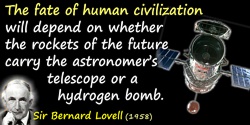
The pursuit of the good and evil are now linked in astronomy as in almost all science. … The fate of human civilization will depend on whether the rockets of the future carry the astronomer’s telescope or a hydrogen bomb.
In BBC Reith Lecture (30 Nov 1958), 'Astronomy and the State', published as The Individual and the Universe (1959, 1961), 72.
The quantum hypothesis will eventually find its exact expression in certain equations which will be a more exact formulation of the law of causality.
In Max Planck and James Vincent Murphy (trans.), Where is Science Going?, (1932), 143.
The question is not whether “big is ugly,” “small is beautiful,” or technology is “appropriate.” It is whether technologists will be ready for the demanding, often frustrating task of working with critical laypeople to develop what is needed or whether th
Technology Review (Feb 1980).
The question now at issue, whether the living species are connected with the extinct by a common bond of descent, will best be cleared up by devoting ourselves to the study of the actual state of the living world, and to those monuments of the past in which the relics of the animate creation of former ages are best preserved and least mutilated by the hand of time.
The Antiquity of Man (1863), 470.
The question whether atoms exist or not... belongs rather to metaphysics. In chemistry we have only to decide whether the assumption of atoms is an hypothesis adapted to the explanation of chemical phenomena... whether a further development of the atomic hypothesis promises to advance our knowledge of the mechanism of chemical phenomena... I rather expect that we shall some day find, for what we now call atoms, a mathematico-mechanical explanation, which will render an account of atomic weight, of atomicity, and of numerous other properties of the so-called atoms.
Laboratory (1867), 1, 303.
The races are in fact disappearing, although the process will require thousands of years at present rates
Interview (1967) with The Times. As quoted in obituary by Douglas Martin, New York Times (20 Jan 2005).
The rage for railroads is so great that many will be laid in parts where they will not pay.
Letter to Mr. Sanders, one of the founders of the Liverpool and Manchester Railway (12 Dec 1824). As quoted in 'Beginnings of Railway Enterprise', The Railway News (8 Dec 1866), 6, 579.
The reader will find no figures in this work. The methods which I set forth do not require either constructions or geometrical or mechanical reasonings: but only algebraic operations, subject to a regular and uniform rule of procedure.
From the original French, “On ne trouvera point de Figures dans set Ouvrage. Les méthodes que j’y expose ne demandent ni constructions, ni raisonnements géométriqus ou méchaniques, mais seulement des opérations algébriques, assujetties à une march régulière et uniforme.” In 'Avertissement', Mécanique Analytique (1788, 1811), Vol. 1, i. English version as given in Cornelius Lanczos, The Variational Principles of Mechanics (1966), Vol. 1, 347.
The real achievement in discoveries … is seeing an analogy where no one saw one before. … The essence of discovery is that unlikely marriage of … previously unrelated forms of reference or universes of discourse, whose union will solve the previously insoluble problem.
In Act of Creation (1964), 201.
The real crisis we face today is a spiritual one; at root, it is a test of moral will and faith.
Quoted in Kim Lim (ed.), 1,001 Pearls of Spiritual Wisdom: Words to Enrich, Inspire, and Guide Your Life (2014), 28
The real danger is not that computers will begin to think like men, but that men will begin to think like computers.
As quoted, without citation, in Howard W. Eves, Return to Mathematical Circles, (1988), 63.
The real purpose of scientific method is to make sure Nature hasn’t misled you into thinking you know something you don’t actually know. There’s not a mechanic or scientist or technician alive who hasn’t suffered from that one so much that he’s not instinctively on guard. … If you get careless or go romanticizing scientific information, giving it a flourish here and there, Nature will soon make a complete fool out of you.
In Zen and the Art of Motorcycle Maintenance: An inquiry into Values (1974), 100-101.
The reason I have made films about the undersea lies simply is my belief that people will protect what they love. Yet we love only what we know.
In Jacques Cousteau and Susan Schiefelbein, The Human, the Orchid, and the Octopus: Exploring and Conserving Our Natural World (2007), 202.
The Reason of making Experiments is, for the Discovery of the Method of Nature, in its Progress and Operations. Whosoever, therefore doth rightly make Experiments, doth design to enquire into some of these Operations; and, in order thereunto, doth consider what Circumstances and Effects, in the Experiment, will be material and instructive in that Enquiry, whether for the confirming or destroying of any preconceived Notion, or for the Limitation and Bounding thereof, either to this or that Part of the Hypothesis, by allowing a greater Latitude and Extent to one Part, and by diminishing or restraining another Part within narrower Bounds than were at first imagin'd, or hypothetically supposed. The Method therefore of making Experiments by the Royal Society I conceive should be this.
First, To propound the Design and Aim of the Curator in his present Enquiry.
Secondly, To make the Experiment, or Experiments, leisurely, and with Care and Exactness.
Thirdly, To be diligent, accurate, and curious, in taking Notice of, and shewing to the Assembly of Spectators, such Circumstances and Effects therein occurring, as are material, or at least, as he conceives such, in order to his Theory .
Fourthly, After finishing the Experiment, to discourse, argue, defend, and further explain, such Circumstances and Effects in the preceding Experiments, as may seem dubious or difficult: And to propound what new Difficulties and Queries do occur, that require other Trials and Experiments to be made, in order to their clearing and answering: And farther, to raise such Axioms and Propositions, as are thereby plainly demonstrated and proved.
Fifthly, To register the whole Process of the Proposal, Design, Experiment, Success, or Failure; the Objections and Objectors, the Explanation and Explainers, the Proposals and Propounders of new and farther Trials; the Theories and Axioms, and their Authors; and, in a Word the history of every Thing and Person, that is material and circumstantial in the whole Entertainment of the said Society; which shall be prepared and made ready, fairly written in a bound Book, to be read at the Beginning of the Sitting of the Society: The next Day of their Meeting, then to be read over and further discoursed, augmented or diminished, as the Matter shall require, and then to be sign'd by a certain Number of the Persons present, who have been present, and Witnesses of all the said Proceedings, who, by Subscribing their names, will prove undoubted testimony to Posterity of the whole History.
First, To propound the Design and Aim of the Curator in his present Enquiry.
Secondly, To make the Experiment, or Experiments, leisurely, and with Care and Exactness.
Thirdly, To be diligent, accurate, and curious, in taking Notice of, and shewing to the Assembly of Spectators, such Circumstances and Effects therein occurring, as are material, or at least, as he conceives such, in order to his Theory .
Fourthly, After finishing the Experiment, to discourse, argue, defend, and further explain, such Circumstances and Effects in the preceding Experiments, as may seem dubious or difficult: And to propound what new Difficulties and Queries do occur, that require other Trials and Experiments to be made, in order to their clearing and answering: And farther, to raise such Axioms and Propositions, as are thereby plainly demonstrated and proved.
Fifthly, To register the whole Process of the Proposal, Design, Experiment, Success, or Failure; the Objections and Objectors, the Explanation and Explainers, the Proposals and Propounders of new and farther Trials; the Theories and Axioms, and their Authors; and, in a Word the history of every Thing and Person, that is material and circumstantial in the whole Entertainment of the said Society; which shall be prepared and made ready, fairly written in a bound Book, to be read at the Beginning of the Sitting of the Society: The next Day of their Meeting, then to be read over and further discoursed, augmented or diminished, as the Matter shall require, and then to be sign'd by a certain Number of the Persons present, who have been present, and Witnesses of all the said Proceedings, who, by Subscribing their names, will prove undoubted testimony to Posterity of the whole History.
'Dr Hooke's Method of Making Experiments' (1664-5). In W. Derham (ed.), Philosophical Experiments and Observations Of the Late Eminent Dr. Robert Hooke, F.R.S. And Geom. Prof. Gresh. and Other Eminent Virtuoso's in his Time (1726), 26-8.
The recurrence of a phenomenon like Edison is not very likely. The profound change of conditions and the ever increasing necessity of theoretical training would seem to make it impossible. He will occupy a unique and exalted position in the history of his native land, which might well be proud of his great genius and undying achievements in the interest of humanity.
As quoted in 'Tesla Says Edison Was an Empiricist', The New York Times (19 Oct 1931), 25. In 1884, Tesla had moved to America to assist Edison in the designing of motors and generators.
The reformer [of the body of law] who would seek to improve such a system in any material degree, mistakes his vocation. That task had better be left to time and experience. He will often find it impossible to know what to eradicate and what to spare, and in plucking up the tares, the wheat may sometimes be destroyed. “The pound of flesh” may be removed, indeed, but with it will come, gushing forth, the blood of life.
From biographical preface by T. Bigelow to Austin Abbott (ed.), Official Report of the Trial of Henry Ward Beecher (1875), Vol. 1, xii.
The release of atomic energy has not created a new problem. It has merely made more urgent the necessity of solving an existing one … I do not believe that civilization will be wiped out in a war fought with the atomic bomb. Perhaps two thirds of the people of the Earth would be killed.
In interview with Raymond Swing, 'Einstein on the Atomic Bomb' Atlantic Monthly, (Nov 1945), 176, No. 5, 43.
The remotest discoveries of the Chemist, the Botanist, or the Mineralogist, will be as proper objects of the Poet’s art as any upon which it can be employed, if the time should ever come when these things shall be familiar to us, and the relations under which they are contemplated by the followers of these respective sciences shall be manifestly and palpably material to us as enjoying and suffering beings.
In W. J. B. Owen (ed.), Preface to the Lyrical Ballads (1800, 1957), 124-125.
The Republic of Technology where we will be living is a feedback world.
In The Republic of Technology: Reflections on our Future Community (1979), 9.
The required techniques of effective reasoning are pretty formal, but as long as programming is done by people that don’t master them, the software crisis will remain with us and will be considered an incurable disease. And you know what incurable diseases do: they invite the quacks and charlatans in, who in this case take the form of Software Engineering gurus.
…...
The results of mathematics are seldom directly applied; it is the definitions that are really useful. Once you learn the concept of a differential equation, you see differential equations all over, no matter what you do. This you cannot see unless you take a course in abstract differential equations. What applies is the cultural background you get from a course in differential equations, not the specific theorems. If you want to learn French, you have to live the life of France, not just memorize thousands of words. If you want to apply mathematics, you have to live the life of differential equations. When you live this life, you can then go back to molecular biology with a new set of eyes that will see things you could not otherwise see.
In 'A Mathematician's Gossip', Indiscrete Thoughts (2008), 213.
The ridge of the Lammer-muir hills... consists of primary micaceous schistus, and extends from St Abb's head westward... The sea-coast affords a transverse section of this alpine tract at its eastern extremity, and exhibits the change from the primary to the secondary strata... Dr HUTTON wished particularly to examine the latter of these, and on this occasion Sir JAMES HALL and I had the pleasure to accompany him. We sailed in a boat from Dunglass ... We made for a high rocky point or head-land, the SICCAR ... On landing at this point, we found that we actually trode [sic] on the primeval rock... It is here a micaceous schistus, in beds nearly vertical, highly indurated, and stretching from S.E. to N. W. The surface of this rock... has thin covering of red horizontal sandstone laid over it, ... Here, therefore, the immediate contact of the two rocks is not only visible, but is curiously dissected and laid open by the action of the waves... On us who saw these phenomena for the first time, the impression will not easily be forgotten. The palpable evidence presented to us, of one of the most extraordinary and important facts in the natural history of the earth, gave a reality and substance to those theoretical speculations, which, however probable had never till now been directly authenticated by the testimony of the senses... What clearer evidence could we have had of the different formation of these rocks, and of the long interval which separated their formation, had we actually seen them emerging from the bosom of the deep? ... The mind seemed to grow giddy by looking so far into the abyss of time; and while we listened with earnestness and admiration to the philosopher who was now unfolding to us the order and series of these wonderful events, we became sensible how much farther reason may sometimes go than imagination can venture to follow.
'Biographical Account of the Late Dr James Hutton, F.R.S. Edin.' (read 1803), Transactions of the Royal Society of Edinburgh (1805), 5, 71-3.
The right that must become paramount is not the right to procreate, but rather the right of every child to be born with a sound physical and mental constitution, based on a sound genotype. No parents will in that future time have the right to burden society with a malformed or mentally incompetent child. Just as every child must have the right to full educational opportunity and a sound nutrition, so every child has the inalienable right to a sound heritage.
Expressing concern that in a coming overpopulated world, “sacred rights of man must alter.” Presidential Address (28 Dec 1970) to the American Association for the Advancement of Science. 'Science: Endless Horizons or Golden Age?', Science (8 Jan 1971), 171, No. 3866, 24. As quoted in obituary by Douglas Martin, New York Times (20 Jan 2005).
The same society which receives the rewards of technology must, as a cooperating whole, take responsibility for control. To deal with these new problems will require a new conservation. We must not only protect the countryside and save it from destruction, we must restore what has been destroyed and salvage the beauty and charm of our cities. Our conservation must be not just the classic conservation of protection and development, but a creative conservation of restoration and innovation. Its concern is not with nature alone, but with the total relation between man and the world around him. Its object is not just man's welfare, but the dignity of man's spirit.
In his 'Message to Congress on Conservation and Restoration of Natural Beauty' written to Congress (8 Feb 1965). It was a broad initiative aimed at beautifying America, guaranteeing water and air quality, and preserving natural areas. In Lyndon B. Johnson: Containing the Public Messages, Speeches, and Statements of the President (1965), Vol.1, 156.
United States. President (1963-1969 : Johnson), Lyndon Baines Johnson, United States. Office of the Federal Register - 1970
The sand should be neither coarse nor fine but of a middling quality or about the size of the common pop[p]y seed. If the sand is too coarse the mortar will be short or brittle … If the sand is too fine the cement will shrink and crack after it has been used.
Directions for Using White's Patent Hydraulic Cement.
The science of legislation, is like that of medicine; in one respect, that it is far more easy to point out what will do harm, than what will do good.
Reflection 529, in Lacon: or Many things in Few Words; Addressed to Those Who Think (1820), 219.
The sciences are like a beautiful river, of which the course is easy to follow, when it has acquired a certain regularity; but if one wants to go back to the source, one will find it nowhere, because it is everywhere; it is spread so much [as to be] over all the surface of the earth; it is the same if one wants to go back to the origin of the sciences, one will find only obscurity, vague ideas, vicious circles; and one loses oneself in the primitive ideas.
In Essai sur les machines en général (1783), conclusion, as translated in Ivor Grattan-Guinness, Convolutions in French Mathematics, 1800-1840 (1990), Vol. 1, 32.
The sciences of Natural History and Botany require so much time to be devoted to them that, however pleasing, they may be justly considered as improper objects for the man of business to pursue scientifically, so as to enter into the exact arrangement and classification of the different bodies of the animal, vegetable, and mineral kingdoms. But reading and personal observation will supply him with ample matter for reflection and admiration.
'On the Advantages of Literature and Philosophy in general and especially on the Consistency of Literary and Philosophical with Commercial Pursuits' (Read 3 Oct 1781). As quoted in Robert Angus Smith, A Centenary of Science in Manchester (1883), 79.
The scientific doctrine of progress is destined to replace not only the myth of progress, but all other myths of human earthly destiny. It will inevitably become one of the cornerstones of man's theology, or whatever may be the future substitute for theology, and the most important external support for human ethics.
New Bottles for New Wine (1957), 21.
The scientific man does not aim at an immediate result. He does not expect that his advanced ideas will be readily taken up. His work is like that of the planter—for the future. His duty is to lay the foundation for those who are to come, and point the way.
In 'The Problem of Increasing Human Energy', Century Illustrated Monthly Magazine (Jun 1900), 60, 211.
The scientific theorist is not to be envied. For Nature, or more precisely experiment, is an inexorable and not very friendly judge of his work. It never says “Yes” to a theory. In the most favorable cases it says “Maybe,” and in the great majority of cases simply “No.” If an experiment agrees with a theory it means for the latter “Maybe,” and if it does not agree it means “No.” Probably every theory will someday experience its “No”—most theories, soon after conception.
In Albert Einstein: The Human Side by Helen Dukas and Banesh Hoffmann (1979).
The scientific world-picture vouchsafes a very complete understanding of all that happens–it makes it just a little too understandable. It allows you to imagine the total display as that of a mechanical clockwork which, for all that science knows, could go on just the same as it does, without there being consciousness, will, endeavor, pain and delight and responsibility connected with it–though they actually are. And the reason for this disconcerting situation is just this: that for the purpose of constructing the picture of the external world, we have used the greatly simplifying device of cutting our own personality out, removing it; hence it is gone, it has evaporated, it is ostensibly not needed.
…...
The scientist has marched in and taken the place of the poet. But one day somebody will find the solution to the problems of the world and remember, it will be a poet, not a scientist.
As quoted in The Star (1959). Collected in Jonathon Green, Morrow's International Dictionary of Contemporary Quotations (1982).
The scientist is not responsible for the laws of nature, but it is a scientist’s job to find out how these laws operate. It is the scientist’s job to find ways in which these laws can serve the human will. However, it is not the scientist’s job to determine whether a hydrogen bomb should be used. …
In A Passion for Science edited by L. Wolpert and A. Richards (1988).
The scientist is not responsible for the laws of nature. It is his job to find out how these laws operate. It is the scientist’s job to find the ways in which these laws can serve the human will. However, it is not the scientist’s job to determine whether a hydrogen bomb should be constructed, whether it should be used, or how it should be used. This responsibility rests with the American people and with their chosen representatives.
In 'Back to the Laboratories', Bulletin of the Atomic Scientists (Mar 1950), 6, No. 3, 71. Quoted in L. Wolpert and A. Richards (eds.), A Passion for Science (1988), 9, but incorrectly attributed to Robert Oppenheimer.
The scientist takes off from the manifold observations of predecessors, and shows his intelligence, if any, by his ability to discriminate between the important and the negligible, by selecting here and there the significant steppingstones that will lead across the difficulties to new understanding. The one who places the last stone and steps across to the terra firma of accomplished discovery gets all the credit.
In As I Remember Him (1940).
The scientist who recognizes God knows only the God of Newton. To him the God imagined by Laplace and Comte is wholly inadequate. He feels that God is in nature, that the orderly ways in which nature works are themselves the manifestations of God's will and purpose. Its laws are his orderly way of working.
The Human Meaning of Science (1940), 69.
The scientist who yields anything to theology, however slight, is yielding to ignorance and false pretenses, and as certainly as if he granted that a horse-hair put into a bottle of water will turn into a snake.
Minority Report (1956), 33.
The sea is not all that responds to the moon. Twice a day the solid earth bobs up and down, as much as a foot. That kind of force and that kind of distance are more than enough to break hard rock. Wells will flow faster during lunar high tides.
Annals of the Former World
The seeds of discoveries presented to us by chance will remain barren, if attention do not render them fruitful.
From the original French, “Les semences des découvertes présentées à tous par le hazard, sont stériles, si l’attention ne les séconde,” in De l'Homme, de ses Facultés Intellectuelles, et de son Éducation (1773), Tome 1, Discours 3, Chap. 3, 269. English version from Claude Adrien Helvétius and W. Hooper (trans.), 'On Man and his Education', A Treatise on Man, His Intellectual Faculties and His Education: A Posthumous Work of M. Helvetius (1777), Vol. 1, Essay 3, Chap. 3, 261.
The self-fulfilling prophecy is, in the beginning, a false definition of the situation evoking a new behavior which makes the originally false conception come true. The specious validity of the self-fulfilling prophecy perpetuates a reign of error. For the prophet will cite the actual course of events as proof that he was right from the very beginning. … Such are the perversities of social logic.
In article, 'The Self-Fulfilling Prophecy', The Antioch Review (Summer 1948), 8, No. 2, 195-196. Included as Chap. 7 of Social Theory and Social Structure (1949), 181-195. Note: Merton coined the expression “self-fulfilling prophecy.”
The simple rule about weapons is that if thery can be built, they will be built.
Accidental Empires (1992), 79.
The simplest schoolboy is now familiar with facts for which Archimedes would have sacrificed his life. What would we not give to make it possible for us to steal a look at a book that will serve primary schools in a hundred years?
In Souvenirs d’Enfance et de Jeunesse (1846), Preface, 13. From the original French, “Le simple écolier sait maintenant des vérités pour lesquelles Archimède eût sacrifié sa vie. Que ne donnerions-nous pas pour qu’il nous fût possible de jeter un coup d’œil furtif sur tel livre qui servira aux écoles primaires dans cent ans?”
The stakes are immense, the task colossal, the time is short. But we may hope–we must hope–that man’s own creation, man’s own genius, will not destroy him. Scholars, indeed all men, must move forward in the faith of that philosopher who held that there is no problem the human reason can propound which the human reason cannot reason out.
From 'Is Einstein Right?', in William Allison Shimer (ed.), The American Scholar (1946), 15, 476. Reprinted in American Thought 1947 (1947), 196. Gauss is commenting on an article by Einstein about the challenges following the creation of the atomic bomb, 'The Real Problem Is in the Hearts of Men', New York Times Magazine (23 Jun 1946), SM4.
The star [Tycho’s supernova] was at first like Venus and Jupiter, giving pleasing effects; but as it then became like Mars, there will next come a period of wars, seditions, captivity and death of princes, and destruction of cities, together with dryness and fiery meteors in the air, pestilence, and venomous snakes. Lastly, the star became like Saturn, and there will finally come a time of want, death, imprisonment and all sorts of sad things.
The steady progress of physics requires for its theoretical formulation a mathematics which get continually more advanced. ... it was expected that mathematics would get more and more complicated, but would rest on a permanent basis of axioms and definitions, while actually the modern physical developments have required a mathematics that continually shifts its foundation and gets more abstract. Non-euclidean geometry and noncommutative algebra, which were at one time were considered to be purely fictions of the mind and pastimes of logical thinkers, have now been found to be very necessary for the description of general facts of the physical world. It seems likely that this process of increasing abstraction will continue in the future and the advance in physics is to be associated with continual modification and generalisation of the axioms at the base of mathematics rather than with a logical development of any one mathematical scheme on a fixed foundation.
Introduction to a paper on magnetic monopoles, 'Quantised singularities in the electromagnetic field', Proceedings of the Royal Society of Lonndon (1931), A, 133 60. In Helge Kragh, Dirac: a Scientific Biography (1990), 208.
The stone age did not end for lack of stone, and the oil age will end long before the world runs out of oil.
…...
The strata of the earth are frequently very much bent, being raised in some places, and depressed in others, and this sometimes with a very quick ascent or descent; but as these ascents and descents, in a great measure, compensate one another, if we take a large extent of country together, we may look upon the whole set of strata, as lying nearly horizontally. What is very remarkable, however, in their situation, is, that from most, if not all, large tracts of high and mountainous countries, the strata lie in a situation more inclined to the horizon, than the country itself, the mountainous countries being generally, if not always, formed out of the lower strata of earth. This situation of the strata may be not unaptly represented in the following manner. Let a number of leaves of paper, of several different sorts or colours, be pasted upon one another; then bending them up together into a ridge in the middle, conceive them to be reduced again to a level surface, by a plane so passing through them, as to cut off all the part that had been raised; let the middle now be again raised a little, and this will be a good general representation of most, if not of all, large tracts of mountainous countries, together with the parts adjacent, throughout the whole world.
'Conjectures Concerning the Cause, and Observations upon the Phenomena of Earthquakes', Philosophical Transactions of the Royal Society of London (1760), 51, 584-5.
The structure known, but not yet accessible by synthesis, is to the chemist what the unclimbed mountain, the uncharted sea, the untilled field, the unreached planet, are to other men … The unique challenge which chemical synthesis provides for the creative imagination and the skilled hand ensures that it will endure as long as men write books, paint pictures, and fashion things which are beautiful, or practical, or both.
In 'Art and Science in the Synthesis of Organic Compounds: Retrospect and Prospect', in Maeve O'Connor (ed.), Pointers and Pathways in Research (1963), 41.
The Struggle for Existence amongst all organic beings throughout the world, which inevitably follows from their high geometrical powers of increase ... This is the doctrine of Malthus, applied to the whole animal and vegetable kingdoms. As many more individuals of each species are born than can possibly survive; and as, consequently, there is a frequently recurring struggle for existence, it follows that any being, if it vary however slightly in any manner profitable to itself, under the complex and sometimes varying conditions of life, will have a better chance of surviving, and thus be naturally selected. From the strong principle of inheritance, any selected variety will tend to propagate its new and modified form.
From On the Origin of Species by Means of Natural Selection; or, The Preservation of Favoured Races in the Struggle for Life (1861), 12.
The student of palaetiological sciences is a scientist and a historian. The former tries to be as uniformitarian as possible, the latter has to recognize the contingency of events which will ever be a 'skandalon' to the scientist. Verily, the geologist 'lives in a divided world'.
Natural Law and Divine Miracle: The Principle of Uniformity in Geology, Biology and Theology (1963), 151.
The student should read his author with the most sustained attention, in order to discover the meaning of every sentence. If the book is well written, it will endure and repay his close attention: the text ought to be fairly intelligible, even without illustrative examples. Often, far too often, a reader hurries over the text without any sincere and vigorous effort to understand it; and rushes to some example to clear up what ought not to have been obscure, if it had been adequately considered. The habit of scrupulously investigating the text seems to me important on several grounds. The close scrutiny of language is a very valuable exercise both for studious and practical life. In the higher departments of mathematics the habit is indispensable: in the long investigations which occur there it would be impossible to interpose illustrative examples at every stage, the student must therefore encounter and master, sentence by sentence, an extensive and complicated argument.
In 'Private Study of Mathematics', Conflict of Studies and other Essays (1873), 67.
The study of mathematics cannot be replaced by any other activity that will train and develop man’s purely logical faculties to the same level of rationality.
In The American Mathematical Monthly (1949), 56, 19. Excerpted in John Ewing (ed,), A Century of Mathematics: Through the Eyes of the Monthly (1996), 186.
The study of the history of mathematics will not make better mathematicians but gentler ones, it will enrich their minds, mellow their hearts, and bring out their finer qualities.
In The Study of the History of Mathematics (1936), 28.
The success of the paradigm... is at the start largely a promise of success ... Normal science consists in the actualization of that promise... Mopping up operations are what engage most scientists throughout their careers. They constitute what I am here calling normal science... That enterprise seems an attempt to force nature into the preformed and relatively inflexible box that the paradigm supplies. No part of the aim of normal science is to call forth new sorts of phenomena; indeed those that will not fit the box are often not seen at all. Nor do scientists normally aim to invent new theories, and they are often intolerant of those invented by others.
The Structure of Scientific Revolutions (1962), 23-4.

The Superfund legislation set up a system of insurance premiums collected from the chemical industry to clean up toxic wastes. This new program may prove to be as far-reaching and important as any accomplishment of my administration. The reduction of the threat to America's health and safety from thousands of toxic-waste sites will continue to be an urgent but bitterly fought issue—another example for the conflict between the public welfare and the profits of a few private despoilers of our nation's environment.
Keeping Faith: Memoirs of a President (1980), 591.
The superstition that the hounds of truth will rout the vermin of error seems, like a fragment of Victorian lace, quaint, but too brittle to be lifted out of the showcase.
In National Review (16 Jan 1962), 12, 21.
The suppression of uncomfortable ideas may be common in religion or in politics, but it is not the path to knowledge; it has no in the endeavor of science. We do not know in advance who will discover fundamental insights.
In Cosmos (1985), 74.
The surest way to health, say what they will,
Is never to suppose we shall be ill;
Most of the ills which we poor mortals know
From doctors and imagination flow.
Is never to suppose we shall be ill;
Most of the ills which we poor mortals know
From doctors and imagination flow.
In 'Night: An Epistle to Robert Lloyd', Poems of Charles Churchill (1822), Vol. 1, 98.
The swift metamorphosis and the onward march of civilization, sweeping ever westward and transforming and taming our wilderness, fills us with a strange regret, and we rejoice that parts of that wilderness will yet remain to us unchanged
…...
The tastes and pursuits of manhood will bear on them the traces of the earlier impressions of our education. It is therefore not unreasonable to suppose that some portion of the neglect of science in England, may be attributed to the system of education we pursue.
Reflections on the Decline of Science in England (1830), 3.
The teaching of elementary mathematics should be conducted so that the way should be prepared for the building upon them of the higher mathematics. The teacher should always bear in mind and look forward to what is to come after. The pupil should not be taught what may be sufficient for the time, but will lead to difficulties in the future. … I think the fault in teaching arithmetic is that of not attending to general principles and teaching instead of particular rules. … I am inclined to attack Teaching of Mathematics on the grounds that it does not dwell sufficiently on a few general axiomatic principles.
In John Perry (ed.), Discussion on the Teaching of Mathematics (1901), 33. The discussion took place on 14 Sep 1901 at the British Association at Glasgow, during a joint meeting of the mathematics and physics sections with the education section. The proceedings began with an address by John Perry. Professor Hudson was the first speak in the Discussion which followed.
The technologists claim that if everything works [in a nuclear fission reactor] according to their blueprints, fission energy will be a safe and very attractive solution to the energy needs of the world. ... The real issue is whether their blueprints will work in the real world and not only in a “technological paradise.”...
Opponents of fission energy point out a number of differences between the real world and the “technological paradise.” ... No acts of God can be permitted.
Opponents of fission energy point out a number of differences between the real world and the “technological paradise.” ... No acts of God can be permitted.
'Energy and Environment', Bulletin of the Atomic Scientists (May 1972), 6.
The test of a preacher is that his congregation goes away saying, not, “What a lovely sermon!” but “I will do something.”
…...
The theoretical side of physical chemistry is and will probably remain the dominant one; it is by this peculiarity that it has exerted such a great influence upon the neighboring sciences, pure and applied, and on this ground physical chemistry may be regarded as an excellent school of exact reasoning for all students of the natural sciences.
In Theories of Solutions (1912), xx.
The third [argument of motion is] to the effect that the flying arrow is at rest, which result follows from the assumption that time is composed of moments: if this assumption is not granted, the conclusion will not follow.Arrow paradox
— Zeno
Aristotle, Physics, 239b, 30-1. In Jonathan Barnes (ed.), The Complete Works of Aristotle (1984), Vol. 1, 405.
The time has come to link ecology to economic and human development. When you have seen one ant, one bird, one tree, you have not seen them all. What is happening to the rain forests of Madagascar and Brazil will affect us all.
Quoted in Jamie Murphy and Andrea Dorfman, 'The Quiet Apocalypse,' Time (13 Oct 1986).
The time to talk about it [genetic engineering to improve a baby's genes] in schools and churches and magazines and debate societies is now. If you wait, five years from now the gene doctor will be hanging out the MAKE A SMARTER BABY sign down the street.
'If We Have It, Do We Use It?', Time magazine (13 Sep 1999).
The time will come when people will travel in stages moved by steam engines, from city to city, almost as fast as birds fly,—fifteen or twenty miles an hour. Passing through the air with such velocity, changing the scene in such rapid succession, will be the most exhilarating exercise.
(about 1804). As quoted in Henry Howe, 'Oliver Evans', Memoirs of the Most Eminent American Mechanics: (1840), 80.
The transition from a paradigm in crisis to a new one from which a new tradition of normal science can emerge is far from a cumulative process, one achieved by an articulation or extension of the old paradigm. Rather it is a reconstruction of the field from new fundamentals, a reconstruction that changes some of the field's most elementary theoretical generalizations as well as many of its paradigm methods and applications. During the transition period there will be a large but never complete overlap between the problems that can be solved by the old and by the new paradigm. But there will also be a decisive difference in the modes of solution. When the transition is complete, the profession will have changed its view of the field, its methods, and its goals.
The Structure of Scientific Revolutions (1962), 84-5.
The trend of mathematics and physics towards unification provides the physicist with a powerful new method of research into the foundations of his subject. … The method is to begin by choosing that branch of mathematics which one thinks will form the basis of the new theory. One should be influenced very much in this choice by considerations of mathematical beauty. It would probably be a good thing also to give a preference to those branches of mathematics that have an interesting group of transformations underlying them, since transformations play an important role in modern physical theory, both relativity and quantum theory seeming to show that transformations are of more fundamental importance than equations.
From Lecture delivered on presentation of the James Scott prize, (6 Feb 1939), 'The Relation Between Mathematics And Physics', printed in Proceedings of the Royal Society of Edinburgh (1938-1939), 59, Part 2, 122.
The trick in discovering evolutionary laws is the same as it is in discovering laws of physics or chemistry—namely, finding the right level of generalization to make prediction possible. We do not try to find a law that says when and where explosions will occur. We content ourselves with saying that certain sorts of compounds are explosive under the right conditions, and we predict that explosions will occur whenever those conditions are realized.
In 'Paleoanthropology: Science or Mythical Charter?', Journal of Anthropological Research (Summer 2002), 58, No. 2, 193.
The true man of science will know nature better by his finer organization; he will smell, taste, see, hear, feel, better than other men. His will be a deeper and finer experience.
In 'Natural history of Massachusetts', The Dial: A Magazine for Literature, Philosophy, and Religion (Jul 1842), 3, No. 1, 40.
The truly scientific mind is altogether unafraid of the new, and while having no mercy for ideas which have served their turn or shown their uselessness, it will not grudge to any unfamiliar conception its moment of full and friendly attention, hoping to expand rather than to minimize what small core of usefulness it may happen to contain.
In 'Observation and Experiment and Their Use in the Medical Sciences', British Medical Journal (1930), 2, 129-34. As cited in Edward J. Huth and T.J. Murray, Medicine in Quotations: Views of Health and Disease Through the Ages (2006), 357 and 512.
The truly wise ask what the thing is in itself and in relation to other things, and do not trouble themselves about the use of it,—in other words, about the way in which it may be applied to the necessities of existence and what is already known. This will soon be discovered by minds of a very different order—minds that feel the joy of living, and are keen, adroit, and practical.
In The Maxims and Reflections of Goethe (1906), 190.
The truth is out there, and we will find it.
…...
The ultimate function of prophecy is not to tell the future, but to make it. Your successful past will block your visions of the future.
…...
The ultimate test of man's conscience may be his willingness to sacrifice something today for future generations whose words of thanks will not be heard.
Former governor of Wisconsin, Founder of Earth Day.
The unavoidable conclusion is that the unprecedented meekness of the majority is responsible for the increase in violence. Social stability is the product of an equilibrium between a vigorous majority and violent minorities. Disorder does not come from an increased inner pressure or from the interaction of explosive ingredients. There is no reason to believe that the nature of the violent minorities is now greatly different from what it was in the past. What has changed is the will and ability of the majority to react.
In 'Thoughts on the Present', First Things, Last Things (1971), 110.
The union of the political and scientific estates is not like a partnership, but a marriage. It will not be improved if the two become like each other, but only if they respect each other's quite different needs and purposes. No great harm is done if in the meantime they quarrel a bit.
The Scientific Estate (1965), 71.
The United States this week will commit its national pride, eight years of work and $24 billion of its fortune to showing the world it can still fulfill a dream. It will send three young men on a human adventure of mythological proportions with the whole of the civilized world invited to watch—for better or worse.
In 'Prestige of U.S. Rides on Apollo', Los Angeles Times (13 Jul 1969). As quoted and cited in Michael Collins, Carrying the Fire: An Astronaut’s Journey (2001), 315.
The Universe, that is the All, is made neither of gods nor of men, but ever has been and ever will be an eternal living Fire, kindling and extinguishing in destined measure, a game which Zeus plays with himself.
Translation as an epigraph in Ludwig Büchner, Force and Matter: Or, Principles of the Natural Order of the Universe (1891), 1. Various alternate translations can be found, including: “The unchanging order of all things was made neither by a god nor a man, but it has always been, is, and will be, the living fire, which is kindled arid extinguished in regular succession.” In K. O. Müller, History of the Literature of Ancient Greece (1840), Vol. 1, 245.
The value of history is, indeed, not scientific but moral: by liberalizing the mind, by deepening the sympathies, by fortifying the will, it enables us to control, not society, but ourselves—a much more important thing; it prepares us to live more humanely in the present and to meet rather than to foretell the future.
In 'A New Philosophy of History', The Dial (2 Sep 1915), 148. This is Becker’s concluding remark in his review of a book by L. Cecil Jane, The Interpretation of History. Becker refutes Jane’s idea that the value of history lies in whether it consists in furnishing “some clue as to what the future will bring.”
The value of mathematical instruction as a preparation for those more difficult investigations, consists in the applicability not of its doctrines but of its methods. Mathematics will ever remain the past perfect type of the deductive method in general; and the applications of mathematics to the simpler branches of physics furnish the only school in which philosophers can effectually learn the most difficult and important of their art, the employment of the laws of simpler phenomena for explaining and predicting those of the more complex. These grounds are quite sufficient for deeming mathematical training an indispensable basis of real scientific education, and regarding with Plato, one who is … as wanting in one of the most essential qualifications for the successful cultivation of the higher branches of philosophy
In System of Logic, Bk. 3, chap. 24, sect. 9.
The value the world sets upon motives is often grossly unjust and inaccurate. Consider, for example, two of them: mere insatiable curiosity and the desire to do good. The latter is put high above the former, and yet it is the former that moves some of the greatest men the human race has yet produced: the scientific investigators. What animates a great pathologist? Is it the desire to cure disease, to save life? Surely not, save perhaps as an afterthought. He is too intelligent, deep down in his soul, to see anything praiseworthy in such a desire. He knows by life-long observation that his discoveries will do quite as much harm as good, that a thousand scoundrels will profit to every honest man, that the folks who most deserve to be saved will probably be the last to be saved. No man of self-respect could devote himself to pathology on such terms. What actually moves him is his unquenchable curiosity–his boundless, almost pathological thirst to penetrate the unknown, to uncover the secret, to find out what has not been found out before. His prototype is not the liberator releasing slaves, the good Samaritan lifting up the fallen, but the dog sniffing tremendously at an infinite series of rat-holes.
In 'Types of Men: The Scientist', Prejudices (1923), 269-70.
The vast possibilities of our great future will become realities only if we make ourselves, in a sense, responsible for that future.
In 'The Conservation of Natural Resources', The Outlook (12 Oct 1907), 87, 294.
The views of space and time which I wish to lay before you have sprung from the soil of experimental physics, and therein lies their strength. They are radical. Henceforth space by itself, and time by itself, are doomed to fade away into mere shadows, and only a kind of union of the two will preserve an independent reality.
'Space And Time', a translation of an address delivered at the 80th Assembly of German Natural Scientists and Physicians, at Cologne, 21 Sep 1908. In H.A. Lorentz, H. Weyl, H. Minkowski, et al., The Principle of Relativity: A Collection of Original Memoirs on the Special and General Theory of Relativity (1952), 74. Also seen translated as, “From henceforth, space by itself, and time by itself, have vanished into the merest shadows and only a kind of blend of the two exists in its own right.”
The vigorous branching of life’s tree, and not the accumulating valor of mythical marches to progress, lies behind the persistence and expansion of organic diversity in our tough and constantly stressful world. And if we do not grasp the fundamental nature of branching as the key to life’s passage across the geological stage, we will never understand evolution aright.
…...
The visible universe is subject to quantification, and is so by necessity. … Between you and me only reason will be the judge … since you proceed according to the rational method, so shall I. … I will also give reason and take it. … This generation has an innate vice. It can’t accept anything that has been discovered by a contemporary!
As quoted in James Burke, The Day the Universe Changed (1985), 41. Burke also quotes the first sentence in The Axemaker's Gift (1995), 112, but after the first ellipsis, is substituted “If you wish to hear more from me, give and take reason, because I am not the kind of man to satisfy his hunger on the picture of a steak!”
The volume now in press will make the new gospel of geology and mineralogy, and if I live to complete my mineralogical text-book, I shall do for the mineral what Darwin did for the organic world.
Letter to a friend (1886), as quoted in Paper read before the American Philosophical Society (1 Apr 1898) by James Douglas, printed as A Memoir of Thomas Sterry Hunt (1898), 12.
The watchmaker to whom one gives a watch that does not run will take it all apart and will examine each of the pieces until he finds out which one is damaged. The physician to whom one presents a patient cannot dissect him to establish the diagnosis. The physicist resembles a doctor, not a watchmaker.
In Revue des Questions Scientifiques, 1897.
The weeping philosopher too often impairs his eyesight by his woe, and becomes unable from his tears to see the remedies for the evils which he deplores. Thus it will often be found that the man of no tears is the truest philanthropist, as he is the best physician who wears a cheerful face, even in the worst of cases.
From Memoirs of Extraordinary Popular Delusions (1841), Vol. 1, 323.
The whole of the developments and operations of analysis are now capable of being executed by machinery ... As soon as an Analytical Engine exists, it will necessarily guide the future course of science.
Passages From the Life of a Philosopher (1864), 136-137.
The whole question of imagination in science is often misunderstood by people in other disciplines. They try to test our imagination in the following way. They say, “Here is a picture of some people in a situation. What do you imagine will happen next?” When we say, “I can’t imagine,” they may think we have a weak imagination. They overlook the fact that whatever we are allowed to imagine in science must be consistent with everything else we know; that the electric fields and the waves we talk about are not just some happy thoughts which we are free to make as we wish, but ideas which must be consistent with all the laws of physics we know. We can’t allow ourselves to seriously imagine things which are obviously in contradiction to the laws of nature. And so our kind of imagination is quite a difficult game. One has to have the imagination to think of something that has never been seen before, never been heard of before. At the same time the thoughts are restricted in a strait jacket, so to speak, limited by the conditions that come from our knowledge of the way nature really is. The problem of creating something which is new, but which is consistent with everything which has been seen before, is one of extreme difficulty
In The Feynman Lectures in Physics (1964), Vol. 2, Lecture 20, p.20-10 to p.20-11.
The winds, the sea, and the moving tides are what they are. If there is wonder and beauty and majesty in them, science will discover these qualities. If they are not there, science cannot create them. If there is poetry in my book about the sea, it is not because I deliberately put it there, but because no one could write truthfully about the sea and leave out the poetry.
Address upon receiving National Book Award at reception, Hotel Commodore, New York (27 Jan 1952). As cited in Linda Lear, Rachel Carson: Witness for Nature (1997), 219. She was referring to her book being recognized, The Sea Around Us.
The wise man, however, will avoid partial views of things. He will not, with the miser, look to gold and silver as the only blessings of life; nor will he, with the cynic, snarl at mankind for preferring them to copper and iron. … That which is convenient is that which is useful, and that which is useful is that which is valuable.
From 13th Lecture in 1818, in Bence Jones, The Life and Letters of Faraday (1870), Vol. 1, 255.
The wonderful structure of the animal system will probably never permit us to look upon it as a merely physical apparatus, yet the demands of science require that the evidently magnified principles of vitality should be reduced to their natural spheres, or if truth requires, wholly subverted in favor of those more cognizable by the human understanding. The spirit of the age will not tolerate in the devotee of science a quiet indifference. ...
In 'An Inquiry, Analogical and Experimental, into the Different Electrical conditions of Arterial and Venous Blood', New Orleans Medical and Surgical Journal (1853-4), 10, 584-602 & 738-757. As cited in George B. Roth, 'Dr. John Gorrie—Inventor of Artificial Ice and Mechanical Refrigeration', The Scientific Monthly (May 1936) 42 No. 5, 464-469.
The works which this man [Joseph Banks] leaves behind him occupy a few pages only; their importance is not greatly superior to their extent; and yet his name will shine out with lustre in the history of the sciences.
Funeral oration at the Academy of Sciences, Paris (2 Apr 1821). Quoted in Hector Charles Cameron, Sir Joseph Banks, K.B., P.R.S.: the Autocrat of the Philosophers (1952) 209.
The world is charged with the grandeur of God. It will flame out, like shining from shook foil.
Quoted in Kim Lim (ed.), 1,001 Pearls of Spiritual Wisdom: Words to Enrich, Inspire, and Guide Your Life (2014), 165
The world is devoted to physical science, because it believes theses discoveries will increase its capacity of luxury and self-indulgence. But the pursuit of science only leads to the insoluble.
In Lothair (1879), 70.
The world is not as it was when it came from its Maker’s hands. It has been modified by many great revolutions, brought about by an inner mechanism of which we very imperfectly comprehend the movements; but of which we gain a glimpse by studying their effects: and their many causes still acting on the surface of our globe with undiminished power, which are changing, and will continue to change it, as long as it shall last.
Letter 1 to William Wordsworth. Quoted in the appendix to W. Wordsworth, A Complete Guide to the Lakes, Comprising Minute Direction for the Tourist, with Mr Wordsworth's Description of the Scenery of the County and Three Letters upon the Geology of the Lake District (1841), 6.
The world looks like a multiplication-table, or a mathematical equation, which, turn it how you will, balances itself.
From 'Compensation', collected in The Complete Works of Ralph Waldo Emerson (1903), 102.
The world will never starve for want of wonders but only for the want of wonder.
In Tremendous Trifles (1909), 7.
The world won’t come to an end, but the incidence of disasters will have a very big impact, and in ways we can't predict. … Rises in seas levels will displace millions of people. It’s estimated there will be 150 million refugees by 2050, homeless as a result of global warming. It’s how we deal with these problems that is as much the challenge as tackling the causes of global warming.
In The Independent (10 Aug 2003).
The world, I think, will wait a long time for Nikola Tesla's equal in achievement and imagination.
Attributed.
The worst thing that will probably happen—in fact is already well underway—is not energy depletion, economic collapse, conventional war, or the expansion of totalitarian governments. As terrible as these catastrophes would be for us, they can be repaired in a few generations. The one process now going on that will take millions of years to correct is loss of genetic and species diversity by the destruction of natural habitats. This is the folly our descendants are least likely to forgive us.
Biophilia (1984), 121.(1990), 182.
The wound is granulating well, the matter formed is diminishing in quantity and is laudable. But the wound is still deep and must be dressed from the bottom to ensure sound healing. … In view of the fact that sinister stories continue to be manufactured and to be printed, it may again be stated, as emphatically as possible, that during the operation no trace of malignant disease was observed, … His Majesty will leave Buckingham Palace for change of air shortly, and the date of the Coronation will be announced almost immediately.
In 'The King’s Progress Towards Recovery', British Medical Journal (1902), 144. The appendectomy caused the coronation of King Edward VII to be postponed.
Their specific effect on the glucosides might thus be explained by assuming that the intimate contact between the molecules necessary for the release of the chemical reaction is possible only with similar geometrical configurations. To give an illustration I will say that enzyme and glucoside must fit together like lock and key in order to be able to exercise a chemical action on each other. This concept has undoubtedly gained in probability and value for stereochemical research, after the phenomenon itself was transferred from the biological to the purely chemical field. It is an extension of the theory of asymmetry without being a direct consequence of it: for the conviction that the geometrical structure of the molecule even for optical isomers exercises such a great influence on the chemical affinities, in my opinion could only be gained by new actual observations.
'Einfluss der Configuration auf die wirkung der Enzyme', Berichte der deutschen Chemischen Gesellschaft, 1894, 27, 2985-93. Trans. B. Holmstedt and G. Liljestrand (eds.) Readings in Pharmacology (1963), 251.
Then I had shown, in the same place, what the structure of the nerves and muscles of the human body would have to be in order for the animal spirits in the body to have the power to move its members, as one sees when heads, soon after they have been cut off, still move and bite the ground even though they are no longer alive; what changes must be made in the brain to cause waking, sleep and dreams; how light, sounds, odours, tastes, warmth and all the other qualities of external objects can impress different ideas on it through the senses; how hunger, thirst, and the other internal passions can also send their ideas there; what part of the brain should be taken as “the common sense”, where these ideas are received; what should be taken as the memory, which stores the ideas, and as the imagination, which can vary them in different ways and compose new ones and, by the same means, distribute the animal spirits to the muscles, cause the limbs of the body to move in as many different ways as our own bodies can move without the will directing them, depending on the objects that are present to the senses and the internal passions in the body. This will not seem strange to those who know how many different automata or moving machines can be devised by human ingenuity, by using only very few pieces in comparison with the larger number of bones, muscles, nerves, arteries, veins and all the other parts in the body of every animal. They will think of this body like a machine which, having been made by the hand of God, is incomparably better structured than any machine that could be invented by human beings, and contains many more admirable movements.
Discourse on Method in Discourse on Method and Related Writings (1637), trans. Desmond M. Clarke, Penguin edition (1999), Part 5, 39-40.
Then if the first argument remains secure (for nobody will produce a neater one, than the length of the periodic time is a measure of the size of the spheres), the order of the orbits follows this sequence, beginning from the highest: The first and highest of all is the sphere of the fixed stars, which contains itself and all things, and is therefore motionless. It is the location of the universe, to which the motion and position of all the remaining stars is referred. For though some consider that it also changes in some respect, we shall assign another cause for its appearing to do so in our deduction of the Earth’s motion. There follows Saturn, the first of the wandering stars, which completes its circuit in thirty years. After it comes Jupiter which moves in a twelve-year long revolution. Next is Mars, which goes round biennially. An annual revolution holds the fourth place, in which as we have said is contained the Earth along with the lunar sphere which is like an epicycle. In fifth place Venus returns every nine months. Lastly, Mercury holds the sixth place, making a circuit in the space of eighty days. In the middle of all is the seat of the Sun. For who in this most beautiful of temples would put this lamp in any other or better place than the one from which it can illuminate everything at the same time? Aptly indeed is he named by some the lantern of the universe, by others the mind, by others the ruler. Trismegistus called him the visible God, Sophocles' Electra, the watcher over all things. Thus indeed the Sun as if seated on a royal throne governs his household of Stars as they circle around him. Earth also is by no means cheated of the Moon’s attendance, but as Aristotle says in his book On Animals the Moon has the closest affinity with the Earth. Meanwhile the Earth conceives from the Sun, and is made pregnant with annual offspring. We find, then, in this arrangement the marvellous symmetry of the universe, and a sure linking together in harmony of the motion and size of the spheres, such as could be perceived in no other way. For here one may understand, by attentive observation, why Jupiter appears to have a larger progression and retrogression than Saturn, and smaller than Mars, and again why Venus has larger ones than Mercury; why such a doubling back appears more frequently in Saturn than in Jupiter, and still more rarely in Mars and Venus than in Mercury; and furthermore why Saturn, Jupiter and Mars are nearer to the Earth when in opposition than in the region of their occultation by the Sun and re-appearance. Indeed Mars in particular at the time when it is visible throughout the night seems to equal Jupiter in size, though marked out by its reddish colour; yet it is scarcely distinguishable among stars of the second magnitude, though recognized by those who track it with careful attention. All these phenomena proceed from the same course, which lies in the motion of the Earth. But the fact that none of these phenomena appears in the fixed stars shows their immense elevation, which makes even the circle of their annual motion, or apparent motion, vanish from our eyes.
'Book One. Chapter X. The Order of the Heavenly Spheres', in Copernicus: On the Revolutions of the Heavenly Spheres (1543), trans. A. M. Duncan (1976), 49-51.
There are certain general Laws that run through the whole Chain of natural Effects: these are learned by the Observation and Study of Nature, and are by Men applied as well to the framing artificial things for the Use and Ornament of Life, as to the explaining the various Phænomena: Which Explication consists only in shewing the Conformity any particular Phænomenon hath to the general Laws of Nature, or, which is the same thing, in discovering the Uniformity there is in the production of natural Effects; as will be evident to whoever shall attend to the several Instances, wherin Philosophers pretend to account for Appearances.
A Treatise Concerning the Principles of Human Knowledge [first published 1710], (1734), 87-8.
There are diverse views as to what makes a science, but three constituents will be judged essential by most, viz: (1) intellectual content, (2) organization into an understandable form, (3) reliance upon the test of experience as the ultimate standard of validity. By these tests, mathematics is not a science, since its ultimate standard of validity is an agreed-upon sort of logical consistency and provability.
In 'The Future of Data Analysis', Annals of Mathematical Statistics (1962), 33, No. 1, 5-6.
There are in this world optimists who feel that any symbol that starts off with an integral sign must necessarily denote something that will have every property that they should like an integral to possess. This of course is quite annoying to us rigorous mathematicians; what is even more annoying is that by doing so they often come up with the right answer.
In 'Integrals Devised for Special Purposes', Bulletin of the American Mathematical Society (1963), 69, 611.
There are many arts and sciences of which a miner should not be ignorant. First there is Philosophy, that he may discern the origin, cause, and nature of subterranean things; for then he will be able to dig out the veins easily and advantageously, and to obtain more abundant results from his mining. Secondly there is Medicine, that he may be able to look after his diggers and other workman ... Thirdly follows astronomy, that he may know the divisions of the heavens and from them judge the directions of the veins. Fourthly, there is the science of Surveying that he may be able to estimate how deep a shaft should be sunk … Fifthly, his knowledge of Arithmetical Science should be such that he may calculate the cost to be incurred in the machinery and the working of the mine. Sixthly, his learning must comprise Architecture, that he himself may construct the various machines and timber work required underground … Next, he must have knowledge of Drawing, that he can draw plans of his machinery. Lastly, there is the Law, especially that dealing with metals, that he may claim his own rights, that he may undertake the duty of giving others his opinion on legal matters, that he may not take another man’s property and so make trouble for himself, and that he may fulfil his obligations to others according to the law.
In De Re Metallica (1556), trans. H.C. and L.H. Hoover (1950), 3-4.
There are many fine things which you mean to do some day, under what you think will be more favorable circumstances. But the only time that is yours is the present.
…...
There are many points in the history of an invention which the inventor himself is apt to overlook as trifling, but in which posterity never fail to take a deep interest. The progress of the human mind is never traced with such a lively interest as through the steps by which it perfects a great invention; and there is certainly no invention respecting which this minute information will be more eagerly sought after, than in the case of the steam-engine.
Quoted in The Origin and Progress of the Mechanical Inventions of James Watt (1854), Vol.1, 4.
There are science teachers who actually claim that they teach “a healthy skepticism.” They do not. They teach a profound gullibility, and their dupes, trained not to think for themselves, will swallow any egregious rot, provided it is dressed up with long words and an affectation of objectivity to make it sound scientific.
In Science is a Sacred Cow (1950), 189.
There are some men who are counted great because they represent the actuality of their own age, and mirror it as it is. Such an one was Voltaire, of whom it was epigrammatically said: “he expressed everybody's thoughts better than anyone.” But there are other men who attain greatness because they embody the potentiality of their own day and magically reflect the future. They express the thoughts which will be everybody's two or three centuries after them. Such as one was Descartes.
Quoted in James Roy Newman, The World of Mathematics (2000), Vol. 1, 239.
There are those who will say “unless we announce disasters, no one will listen”, but I’m not one of them. It’s not the sort of thing I would ever say. It’s quite the opposite of what I think and it pains me to see this quote being used repeatedly in this way. I would never say we should hype up the risk of climate disasters in order to get noticed.
In Steve Connor, 'Fabricated quote used to discredit climate scientist', The Independent (10 Feb 2010).
There are two processes which we adopt consciously or unconsciously when we try to prophesy. We can seek a period in the past whose conditions resemble as closely as possible those of our day, and presume that the sequel to that period will, save for some minor alterations, be similar. Secondly, we can survey the general course of development in our immediate past, and endeavor to prolong it into the near future. The first is the method the historian; the second that of the scientist. Only the second is open to us now, and this only in a partial sphere.
From 'Fifty Years Hence', Strand Magazine (Dec 1931). Reprinted in Popular Mechanics (Mar 1932), 57, No. 3, 393.
There are two ways of extending life: firstly by moving the two points “born” and “died” farther away from one another… The other method is to go more slowly and leave the two points wherever God wills they should be, and this method is for the philosophers.
Aphorism 22 in Notebook B (1768-1771), as translated by R.J. Hollingdale in Aphorisms (1990). Reprinted as The Waste Books (2000), 21.
There are, and always have been, destructive pseudo-scientific notions linked to race and religion; these are the most widespread and damaging. Hopefully, educated people can succeed in shedding light into these areas of prejudice and ignorance, for as Voltaire once said: “Men will commit atrocities as long as they believe absurdities.”
From an article in a periodical of Miami-Dade Junior College by Bernard Sussman, 'Exclusive Interview with Martin Gardner', Southwind (Fall 1968), 3, No. 1, 7-11. As quoted and cited in Dana Richards, 'Martin Gardner: A “Documentary”', collected in Elwyn R. Berlekamp and Tom Rodgers (ed.) The Mathemagician and Pied Puzzler: A Collection in Tribute to Martin Gardner (1999), 11.
There are, at present, fundamental problems in theoretical physics … the solution of which … will presumably require a more drastic revision of our fundmental concepts than any that have gone before. Quite likely, these changes will be so great that it will be beyond the power of human intelligence to get the necessary new ideas by direct attempts to formulate the experimental data in mathematical terms. The theoretical worker in the future will, therefore, have to proceed in a more direct way. The most powerful method of advance that can be suggested at present is to employ all the resources of pure mathematics in attempts to perfect and generalize the mathematical formalism that forms the existing basis of theoretical physics, and after each success in this direction, to try to interpret the new mathematical features in terms of physical entities.
At age 28.
At age 28.
Proceedings of the Royal Society (1931), A133, 60. In A. Pais, 'Playing With Equations, the Dirac Way'. Behram N. Kursunoglu (Ed.) and Eugene Paul Wigner (Ed.), Paul Adrien Maurice Dirac: Reminiscences about a Great Physicist (1990), 109.
There cannot always be fresh fields of conquest by the knife; there must be portions of the human frame that will ever remain sacred from its intrusions, at least in the surgeon's hands. That we have already, if not quite, reached these final limits, there can be little question. The abdomen, the chest, and the brain will be forever shut from the intrusion of the wise and humane surgeon.
Quoted in C. Cerf and V. Navasky (eds.), I Wish I hadn't Said That: The Experts Speak and Get it Wrong! (2000), 31.
There exist limitless opportunities in every industry. Where there is an open mind, there will always be a frontier.
There is a demon in technology. It was put there by man and man will have to exorcise it before technological civilization can achieve the eighteenth-century ideal of humane civilized life.
A God Within (1972), 216.
There is a genuine thirst for scientific knowledge in most homes. Satisfying that thirst will, I believe, create a friendly attitude toward science and scientists which will favor the cause of science in the future. Science needs an informed and friendly public to back it up.
[Stating the goals of his NBC TV show, Nature of Things, which first aired on 5 Feb 1948.]
[Stating the goals of his NBC TV show, Nature of Things, which first aired on 5 Feb 1948.]
'Televising Science'. Physics Today (Jan 1949), 2, 26. Quoted in Marcel Chotkowski LaFollette, Science on the Air (2008), 215.
There is a kind of plant that eats organic food with its flowers: when a fly settles upon the blossom, the petals close upon it and hold it fast till the plant has absorbed the insect into its system; but they will close on nothing but what is good to eat; of a drop of rain or a piece of stick they will take no notice. Curious! that so unconscious a thing should have such a keen eye to its own interest.
In Erewhon: Or Over the Range (1880), 190.
There is a point of view among astronomical researchers that is generally referred to as the Principle of Mediocrity. ... If the Sun and its retinue of worlds is only one system among many, then many other systems will be like ours: home to life. Indeed, to the extent that this is true, we should be prepared for the possibility that, even in the Milky Way galaxy, billions of planets may be carpeted by the dirty, nasty business known as life.
Quoted in 'Do Aliens Exist in the Milky Way', PBS web page for WGBH Nova, 'Origins.'
There is a theory which states that if ever anyone discovers exactly what the Universe is for and why it is here, it will instantly disappear and be replaced by something even more bizarre and inexplicable. There is another theory which states that this has already happened.
In The Restaurant at the End of the Universe (1980), facing p. 1.
There is always more in one of Ramanujan’s formulae than meets the eye, as anyone who sets to work to verify those which look the easiest will soon discover. In some the interest lies very deep, in others comparatively near the surface; but there is not one which is not curious and entertaining.
Commenting on the formulae in the letters sent by Ramanujan from India, prior to going to England. Footnote in obituary notice by G.H. Hardy in the Proceedings of the London Mathematical Society (2) (1921), 19, xl—lviii. The same notice was printed, with slight changes, in the Proceedings of the Royal Society (A) (1921), 94, xiii—xxix. Reprinted in G.H. Hardy, P.V. Seshu Aiyar and B.M. Wilson (eds.) Collected Papers of Srinivasa Ramanujan (1927), xxi.
There is always the danger in scientific work that some word or phrase will be used by different authors to express so many ideas and surmises that, unless redefined, it loses all real significance.
'Valence and Tautomerism', Journal of the American Chemical Society (1913), 35, 1448.
There is an attraction and a charm inherent in the colossal that is not subject to ordinary theories of art … The tower will be the tallest edifice ever raised by man. Will it therefore be imposing in its own way?
Quoted in J. Harriss, The Tallest Tower: Eiffel and the Belle Epoque (1975), 25. Cited by David P. Billington, 'Bridges and the New Art of Structural Engineering,' in National Research Council (U.S.). Transportation Research Board Subcommittee on Bridge Aesthetics, Bridge Aesthetics Around the World (1991), 67. From the original French in interview of Eiffel by Paul Bourde, in the newspaper Le Temps (14 Feb 1887). Reprinted in 'Au Jour le Jour: Les Artistes Contre la Tour Eiffel', Gazette Anecdotique, Littéraire, Artistique et Bibliographique (Feb 1887), 126, and in Gustave Eiffel, Travaux Scientifiques Exécutés à la Tour de 300 Mètres de 1889 à 1900 (1900), 14. “Il y a du reste dans le colossal une attraction, un charme propre auxquels les théories d’art ordinaires ne sont guère applicables. … Ma tour sera le plus haut édifice qu'aient jamais élevé les hommes. Ne serat-elle donc pas grandiose aussi a sa façon?
There is beauty in space, and it is orderly. There is no weather, and there is regularity. It is predictable…. Everything in space obeys the laws of physics. If you know these laws, and obey them, space will treat you kindly. And don't tell me that man doesn't belong out there. Man belongs wherever he wants to go—and he’ll do plenty well when he gets there.
Quoted in 'Reach For The Stars', Time (17 Feb 1958), 71, 25.
There is common misapprehension that the magnitude scale is itself some kind of instrument or apparatus. Visitors will ask to “see the scale,” and are disconcerted by being referred to tables and charts used for applying the scale to readings taken from the seismograms.
From interview with Henry Spall, as in an abridged version of Earthquake Information Bulletin (Jan-Feb 1980), 12, No. 1, that was on the USGS website.
There is in Nature a general prototype in each species on which each individual is modeled, but which seems, in realizing itself, to alter itself or perfect itself according to circumstances. So that, relative to certain qualities, this is an extraordinary appearing variation in the succession of these individuals, and at the same time a constancy which appears wonderful in the entire species. The first animal, the first horse, for example, has been the external model and the interieur mold on which all horses which have been born, all those which now exist, and all those which will be born have been formed.
'Le Cheval', Histoire Naturelle, Générale et Particulière, Avec la Description du Cabinet du Roi (1753), Vol. 4, 215-6. Trans. Phillip R. Sloan.
There is just one thing I can promise you about the outer-space program: Your tax dollar will go farther.
Attributed in Reader's Digest (1961). In Fred R. Shapiro, The Yale Book of Quotations (2006), 101.
There is more danger of numerical sequences continued indefinitely than of trees growing up to heaven. Each will some time reach its greatest height.
Grundgesetz der Arithmetik(1893), Vol. 2, Section 60, In P. Greach and M. Black (eds., Translations from the Philosophical Writings of Gottlob Frege (1952), 204.
There is much about which even experts are ignorant; this will probably always be the case.
In 'With Science on Our Side', Washington Post (9 Jan 1994).
There is no area of the world that should not be investigated by scientists. There will always remain some questions that have not been answered. In general, these are the questions that have not yet been posed.
As quoted in J. Robert Moskin, Morality in America, 70-71. Otherwise unconfirmed in this form. Please contact webmaster if you know a primary print source.
There is no art so difficult as the art of observation: it requires a skillful, sober spirit and a well-trained experience, which can only be acquired by practice; for he is not an observer who only sees the thing before him with his eyes, but he who sees of what parts the thing consists, and in what connexion the parts stand to the whole. One person overlooks half from inattention; another relates more than he sees while he confounds it with that which he figures to himself; another sees the parts of the whole, but he throws things together that ought to be separated. ... When the observer has ascertained the foundation of a phenomenon, and he is able to associate its conditions, he then proves while he endeavours to produce the phenomena at his will, the correctness of his observations by experiment. To make a series of experiments is often to decompose an opinion into its individual parts, and to prove it by a sensible phenomenon. The naturalist makes experiments in order to exhibit a phenomenon in all its different parts. When he is able to show of a series of phenomena, that they are all operations of the same cause, he arrives at a simple expression of their significance, which, in this case, is called a Law of Nature. We speak of a simple property as a Law of Nature when it serves for the explanation of one or more natural phenomena.
'The Study of the Natural Sciences: An Introductory Lecture to the Course of Experimental Chemistry in the University of Munich, for the Winter Session of 1852-53,' as translated and republished in The Medical Times and Gazette (22 Jan 1853), N.S. Vol. 6, 82.
There is no belief, however foolish, that will not gather its faithful adherents who will defend it to the death.
In The Stars in Their Courses? (1971), 36.
There is no conclusive evidence of life after death. But there is no evidence of any sort against it. Soon enough you will know. So why fret about it?
In 'From the Notebooks of Lazarus Long', Time Enough for Love: The Lives of Lazarus Long (1973), 257.
There is no doubt that human survival will continue to depend more and more on human intellect and technology. It is idle to argue whether this is good or bad. The point of no return was passed long ago, before anyone knew it was happening.
…...
There is no expedient to which a man will not resort to avoid the real labor of thinking.[Greatly abbreviated and paraphrased.]
The original 1784 version of this quote begins “A provision of endless apparatus…” (see elsewhere on this page). Over the years, the original 35-word quote has been paraphrased, re-paraphrased and abbreviated to these 18 words. In this form, it was published by B.C. Forbes in 'Why Do So Many Men Never Amount to Anything?',The American Magazine (Jan 1921). The journalist, having visited Thomas Edison’s laboratory, wrote that Edison showed him a placard inscribed with this quote, including the name of Joshua Reynolds, with the intention of having copies placed “all over the plant.” The quote was subsequently repeated by other writers, (describing Edison’s use of the sign), some of whom omitted the name of Joshua Reynolds incorrectly implying attribution to Edison.
There is no failure for the man who realizes his power, who never knows when he is beaten; there is no failure for the determined endeavor; the unconquerable will. There is no failure for the man who gets up every time he falls, who rebounds like a rubber ball, who persist when everyone else gives up, who pushes on when everyone else turns back.
…...
There is no logical impossibility in the hypothesis that the world sprang into being five minutes ago, exactly as it then was, with a population that "remembered" a wholly unreal past. There is no logically necessary connection between events at different times; therefore nothing that is happening now or will happen in the future can disprove the hypothesis that the world began five minutes ago.
In The Analysis of Mind (1921) 159–160.
There is no more convincing proof of the truth of a comprehensive theory than its power of absorbing and finding a place for new facts, and its capability of interpreting phenomena which had been previously looked upon as unaccountable anomalies. It is thus that the law of universal gravitation and the undulatory theory of light have become established and universally accepted by men of science. Fact after fact has been brought forward as being apparently inconsistent with them, and one alter another these very facts have been shown to be the consequences of the laws they were at first supposed to disprove. A false theory will never stand this test. Advancing knowledge brings to light whole groups of facts which it cannot deal with, and its advocates steadily decrease in numbers, notwithstanding the ability and scientific skill with which it may have been supported.
From a review of four books on the subject 'Mimicry, and Other Protective Resemblances Among Animals', in The Westminster Review (Jul 1867), 88, 1. Wallace is identified as the author in the article as reprinted in William Beebe, The Book of Naturalists: An Anthology of the Best Natural History (1988), 108.
There is no plea which will justify the use of high-tension and alternating currents, either in a scientific or a commercial sense. They are employed solely to reduce investment in copper wire and real estate.
In 'The Dangers of Electric Lighting', North American Review (Nov 1889), 149, No. 396, 633.
There is no result in nature without a cause; understand the cause and you will have no need of the experiment.
'Philosophy', in The Notebooks of Leonardo da Vinci, trans. E. MacCurdy, (1938) Vol. 1, 70.
There is no such whetstone, to sharpen a good wit and encourage a will to learning, as is praise.
The Schoolmaster (1570)
There is no supernatural, there is only nature. Nature alone exists and contains all. All is. There is the part of nature that we perceive, and the part of nature that we do not perceive. … If you abandon these facts, beware; charlatans will light upon them, also the imbecile. There is no mean: science, or ignorance. If science does not want these facts, ignorance will take them up. You have refused to enlarge human intelligence, you augment human stupidity. When Laplace withdraws Cagliostro appears.
In Victor Hugo and Lorenzo O'Rourke (trans.) Victor Hugo's Intellectual Autobiography: (Postscriptum de ma vie) (1907), 320.
There is no way to guarantee in advance what pure mathematics will later find application. We can only let the process of curiosity and abstraction take place, let mathematicians obsessively take results to their logical extremes, leaving relevance far behind, and wait to see which topics turn out to be extremely useful. If not, when the challenges of the future arrive, we won’t have the right piece of seemingly pointless mathematics to hand.
In 'The Unplanned Impact of Mathematics', Nature (14 Jul 2011), 475, No. 7355, 167.
There is not the slightest indication that nuclear energy will ever be obtainable. It would mean that the atom would have to be shattered at will.
From interview, 'Atom Energy Hope is Spiked By Einstein: Efforts at Loosing Vast Force is Called Fruitless,' Pittsburgh Post-Gazette (29 Dec 1934), 13. As quoted in John Finney (ed.), Hiroshima Plus 20 (1965), 16.
There is nothing opposed in Biometry and Mendelism. Your husband [W.F.R. Weldon] and I worked that out at Peppards [on the Chilterns] and you will see it referred in the Biometrika memoir. The Mendelian formula leads up to the “ancestral law.” What we fought against was the slovenliness in applying Mendel's categories and asserting that such formulae apply in cases when they did not.
Letter to Mrs.Weldon (12 Apr 1907). Quoted in M. E. Magnello, 'Karl Pearson's Mathematization of Inheritance: From Ancestral Heredity to Mendelian Genetics (1895-1909)', Annals of Science (1998), 55, 89.
There is nothing which Nature so clearly reveals, and upon which science so strongly insists, as the universal reign of law, absolute, universal, invariable law... Not one jot or tittle of the laws of Nature are unfulfilled. I do not believe it is possible to state this fact too strongly... Everything happens according to law, and, since law is the expression of Divine will, everything happens according to Divine will, i.e. is in some sense ordained, decreed.
Lecture 18, 'Predestination and Free-Will', Religion and Science: A Series of Sunday Lectures (1874), 278.
There is one class of mind that loves to lean on rules and definitions, and another that discards them as far as possible. A faddist will generally ask for a definition of faddism, and one who is not a faddist will be impatient of being asked to give one.
Samuel Butler, Henry Festing Jones (ed.), The Note-Books of Samuel Butler (1917), 221.
There is one class of mind that loves to lean on rules and definitions, and another that discards them as far as possible. A faddist will generally ask for a definition of faddism, and one who is not a faddist will be impatient of being asked to give one.
Samuel Butler, Henry Festing Jones (ed.), The Note-Books of Samuel Butler (1917), 221.
There is one thing against which a scientist will have to guard himself: narrow patriotism.
Quoted in India Today (Apr 2008), 33, No 16, as cited on webpage of Dhirubhai Ambani Institute of Information and Communication Technology.
There is perhaps no science of which the development has been carried so far, which requires greater concentration and will power, and which by the abstract height of the qualities required tends more to separate one from daily life.
In 'Provisional Report of the American Subcommittee of the International Commission on Teaching of Mathematics', Bulletin American Society (Nov 1910), 97.
There is thus a possibility that the ancient dream of philosophers to connect all Nature with the properties of whole numbers will some day be realized. To do so physics will have to develop a long way to establish the details of how the correspondence is to be made. One hint for this development seems pretty obvious, namely, the study of whole numbers in modern mathematics is inextricably bound up with the theory of functions of a complex variable, which theory we have already seen has a good chance of forming the basis of the physics of the future. The working out of this idea would lead to a connection between atomic theory and cosmology.
From Lecture delivered on presentation of the James Scott prize, (6 Feb 1939), 'The Relation Between Mathematics And Physics', printed in Proceedings of the Royal Society of Edinburgh (1938-1939), 59, Part 2, 129.
There must be no barriers to freedom of inquiry. There is no place for dogma in science. The scientist is free, and must be free to ask any question, to doubt any assertion, to seek for any evidence, to correct any errors. ... Our political life is also predicated on openness. We know that the only way to avoid error is to detect it and that the only way to detect it is to be free to inquire. And we know that as long as men are free to ask what they must, free to say what they think, free to think what they will, freedom can never be lost, and science can never regress.
Life (10 Oct 1949), 136.
There once was a guy named Pruitt / Who said to the climate “Oh, screw it.” / The people said NO! / We will not give up SNOW. / The science is real and you knew it.
Sign carried by a protester during the People’s Climate March, Washington, D.C. (29 Apr 2017). Pictured on Twitter @123catherinep. Note: Scott Pruitt was the (very short term) then head of the Environmental Protection Agency (EPA).
There will always be a frontier where there is an open mind and a willing hand.
There will always be a psychological problem in the peasant’s soul: no one is born a Communist. In the Soviet Union farmers look in the barn for “their” horses even after they have given them to the collective.
As quoted in Editorial, 'The High Cost of Marx on the Farm', Life (23 Nov 1962), 38.
There will always be dreams grander or humbler than your own, but there will never be a dream exactly like your own...for you are unique and more wondrous than you know!
…...
There will come a time when the world will look back to modern vivisection in the name of science as they now do the burning at the stake in the name of religion.
Concluding remark from 'Vivisection', an original paper in Surgical Anaesthesia: Addresses, and Other Papers (1894, 1900), 370.
There will one day spring from the brain of science a machine or force so fearful in its potentialities, so absolutely terrifying, that even man, the fighter, who will dare torture and death in order to inflict torture and death, will be appalled, and so abandon war forever.
…...
There will still be things that machines cannot do. They will not produce great art or great literature or great philosophy; they will not be able to discover the secret springs of happiness in the human heart; they will know nothing of love and friendship.
…...
There’s no question in my mind that the capability of [the space shuttle] to put 65,000 pounds in low earth orbit—to put payloads up there cheaper than we’ve been able to do it before, not having to throw away the booster—will absolutely revolutionize the way we do business here on earth in ways that we just can’t imagine. It will help develop science and technology. With the space shuttle—when we get it operational—we’ll be able to do in 5 or 10 years what it would take us 20 to 30 years to do otherwise in science and technology development.
Interview for U.S. News & World Report (13 Apr 1981), 56.
There’s probably 5000 times more solar energy than the humans will ever need. We could cover our highways with solar collectors to make ribbons of energy, and I think that it’s really the largest job creation program in the history of the planet that’s in front of us. It’s a celebration of the abundance of human creativity combined with the abundance of the natural world.
In audio segment, 'William McDonough: Godfather of Green', WNYC, Studio 360 broadcast on NPR radio (18 Mar 2008) and archived on the station website.
There’s something about a pious man such as he. He will cheerfully cut your throat if it suits him, but he will hesitate to endanger the welfare of your immaterial and problematical soul.
…...
There's nothing situate under heaven's eye
But hath his bond in earth, in sea, in sky.
The beasts, the fishes, and the winged fowls
Are their males' subjects and at their controls.
Man, more divine, the master of all these,
Lord of the wide world and wild wat'ry seas,
Indu'd with intellectual sense and souls,
Of more pre-eminence than fish and fowls,
Are masters to their females, and their lords;
Then let your will attend on their accords.
But hath his bond in earth, in sea, in sky.
The beasts, the fishes, and the winged fowls
Are their males' subjects and at their controls.
Man, more divine, the master of all these,
Lord of the wide world and wild wat'ry seas,
Indu'd with intellectual sense and souls,
Of more pre-eminence than fish and fowls,
Are masters to their females, and their lords;
Then let your will attend on their accords.
The Comedy of Errors (1594), II, i.
Therefore it is by no means an idle game if we become practiced in analysing long-held commonplace concepts and showing the circumstances on which their justification and usefulness depend, and how they have grown up, individually, out of the givens of experience. Thus their excessive authority will be broken.
…...
These Disciplines [mathematics] serve to inure and corroborate the Mind to a constant Diligence in Study; to undergo the Trouble of an attentive Meditation, and cheerfully contend with such Difficulties as lie in the Way. They wholly deliver us from a credulous Simplicity, most strongly fortify us against the Vanity of Scepticism, effectually restrain from a rash Presumption, most easily incline us to a due Assent, perfectly subject us to the Government of right Reason, and inspire us with Resolution to wrestle against the unjust Tyranny of false Prejudices. If the Fancy be unstable and fluctuating, it is to be poized by this Ballast, and steadied by this Anchor, if the Wit be blunt it is sharpened upon this Whetstone; if luxuriant it is pared by this Knife; if headstrong it is restrained by this Bridle; and if dull it is rouzed by this Spur. The Steps are guided by no Lamp more clearly through the dark Mazes of Nature, by no Thread more surely through the intricate Labyrinths of Philosophy, nor lastly is the Bottom of Truth sounded more happily by any other Line. I will not mention how plentiful a Stock of Knowledge the Mind is furnished from these, with what wholesome Food it is nourished, and what sincere Pleasure it enjoys. But if I speak farther, I shall neither be the only Person, nor the first, who affirms it; that while the Mind is abstracted and elevated from sensible Matter, distinctly views pure Forms, conceives the Beauty of Ideas, and investigates the Harmony of Proportions; the Manners themselves are sensibly corrected and improved, the Affections composed and rectified, the Fancy calmed and settled, and the Understanding raised and excited to more divine Contemplations. All which I might defend by Authority, and confirm by the Suffrages of the greatest Philosophers.
Prefatory Oration in Mathematical Lectures (1734), xxxi.
These expert men, technologists, engineers, or whatever name may best suit them, make up the indispensable General staff of the industrial system; and without their immediate and unremitting guidance and correction the industrial system will not work. It is a mechanically organized structure of technical processes designed, installed, and conducted by these production engineers. Without them and their constant attention the industrial equipment, the mechanical appliances of industry, will foot up to just so much junk.
Collected in 'The Captains of Finance and the Engineers', The Engineers and the Price System (1921), 69. Previously published in The Dial (1919).
These microscopic organisms form an entire world composed of species, families and varieties whose history, which has barely begun to be written, is already fertile in prospects and findings of the highest importance. The names of these organisms are very numerous and will have to be defined and in part discarded. The word microbe which has the advantage of being shorter and carrying a more general meaning, and of having been approved by my illustrious friend, M. Littré, the most competent linguist in France, is one we will adopt.
In paper read to the Académie de Medecine (Mar 1878). In Charles-Emile Sedillot, 'Influence de M. Pasteur sur les progres de la chirurgie' [Influence of Pasteur on the progress of surgery].
These results demonstrate that there is a new polymerase inside the virions of RNA tumour viruses. It is not present in supernatents of normal cells but is present in virions of avian sarcoma and leukemia RNA tumour viruses. The polymerase seems to catalyse the incorporation of deoxyrinonucleotide triphosphates into DNA from an RNA template. Work is being performed to characterize further the reaction and the product. If the present results and Baltimore's results with Rauscher leukemia virus are upheld, they will constitute strong evidence that the DNA proviruses have a DNA genome when they are in virions. This result would have strong implications for theories of viral carcinogenesis and, possibly, for theories of information transfer in other biological systems. [Co-author with American virologist Satoshi Mizutani]
'RNA-dependent DNA Polymerase in Virions of Rous Sarcoma Virus', Nature (1970), 226, 1213.
These two orders of mountains [Secondary and Tertiary] offer the most ancient chronicle of our globe, least liable to falsifications and at the same time more legible than the writing of the primitive ranges. They are Nature's archives, prior to even the most remote records and traditions that have been preserved for our observant century to investigate, comment on and bring to the light of day, and which will not be exhausted for several centuries after our own.
Observations sur la Formation des Montagnes', Acta Academiae Scientiarum Imperialis Petropolitanae (1777) [1778], 46. Trans. Albert Carozzi.
They say it doesn’t matter how long one washes one’s hands, because there will still be organisms in the sweat glands and hair follicles, so I rub my hands with Vaseline.
Reginald Pound and Michael Joseph, Harley Street (1967), 31.
They tend to be suspicious, bristly, paranoid-type people with huge egos they push around like some elephantiasis victim with his distended testicles in a wheelbarrow terrified no doubt that some skulking ingrate of a clone student will sneak into his very brain and steal his genius work.
…...
They think that differential equations are not reality. Hearing some colleagues speak, it’s as though theoretical physics was just playing house with plastic building blocks. This absurd idea has gained currency, and now people seem to feel that theoretical physicists are little more than dreamers locked away ivory towers. They think our games, our little houses, bear no relation to their everyday worries, their interests, their problems, or their welfare. But I’m going to tell you something, and I want you to take it as a ground rule for this course. From now on I will be filling this board with equations. … And when I'm done, I want you to do the following: look at those numbers, all those little numbers and Greek letters on the board, and repeat to yourselves, “This is reality,” repeat it over and over.
Zig Zag, trans. Lisa Dillman (2008), 63.
They will have the World to be in Large, what a Watch is in Small; which is very regular, and depends only upon the just disposing of the several Parts of the Movement.
Conversations on the Plurality of Words (1686), trans. William Gardiner (1715), 11.
Think of a single problem confronting the world today. Disease, poverty, global warming… If the problem is going to be solved, it is science that is going to solve it. Scientists tend to be unappreciated in the world at large, but you can hardly overstate the importance of the work they do. If anyone ever cures cancer, it will be a guy with a science degree. Or a woman with a science degree.
Quoted in Max Davidson, 'Bill Bryson: Have faith, science can solve our problems', Daily Telegraph (26 Sep 2010)
Thinking is merely the comparing of ideas, discerning relations of likeness and of difference between ideas, and drawing inferences. It is seizing general truths on the basis of clearly apprehended particulars. It is but generalizing and particularizing. Who will deny that a child can deal profitably with sequences of ideas like: How many marbles are 2 marbles and 3 marbles? 2 pencils and 3 pencils? 2 balls and 3 balls? 2 children and 3 children? 2 inches and 3 inches? 2 feet and 3 feet? 2 and 3? Who has not seen the countenance of some little learner light up at the end of such a series of questions with the exclamation, “Why it’s always that way. Isn’t it?” This is the glow of pleasure that the generalizing step always affords him who takes the step himself. This is the genuine life-giving joy which comes from feeling that one can successfully take this step. The reality of such a discovery is as great, and the lasting effect upon the mind of him that makes it is as sure as was that by which the great Newton hit upon the generalization of the law of gravitation. It is through these thrills of discovery that love to learn and intellectual pleasure are begotten and fostered. Good arithmetic teaching abounds in such opportunities.
In Arithmetic in Public Education (1909), 13. As quoted and cited in Robert Édouard Moritz, Memorabilia Mathematica; Or, The Philomath’s Quotation-book (1914), 68.
This [cyanide] poison is for professors of chemistry only. You, as a professor of mechanics, will have to use the rope.
Said during the Nazi occupation of Norway.
Said during the Nazi occupation of Norway.
Quoted in Kaufman, Industrial Chemist and Chemical Manufacturer, Jan 1988.
This [discovery of a cell-free yeast extract] will make him famous, even though he has no talent for chemistry.
Baeyer to Willstatter. Quoted in R. Willstatter, From My Life (1965), trans. J. S. Froton.
This [Republican] political movement has patently demonstrated that it will not defend the integrity of science in any case in which science runs afoul of its core political constituencies. In so doing, it has ceded any right to govern a technologically advanced and sophisticated nation.
In 'Epilogue', The Republican War on Science (2005), 255.
This Academy [at Lagado] is not an entire single Building, but a Continuation of several Houses on both Sides of a Street; which growing waste, was purchased and applied to that Use.
I was received very kindly by the Warden, and went for many Days to the Academy. Every Room hath in it ' one or more Projectors; and I believe I could not be in fewer than five Hundred Rooms.
The first Man I saw was of a meagre Aspect, with sooty Hands and Face, his Hair and Beard long, ragged and singed in several Places. His Clothes, Shirt, and Skin were all of the same Colour. He had been Eight Years upon a Project for extracting Sun-Beams out of Cucumbers, which were to be put into Vials hermetically sealed, and let out to warm the Air in raw inclement Summers. He told me, he did not doubt in Eight Years more, that he should be able to supply the Governor's Gardens with Sunshine at a reasonable Rate; but he complained that his Stock was low, and interested me to give him something as an Encouragement to Ingenuity, especially since this had been a very dear Season for Cucumbers. I made him a small Present, for my Lord had furnished me with Money on purpose, because he knew their Practice of begging from all who go to see them.
I saw another at work to calcine Ice into Gunpowder; who likewise shewed me a Treatise he had written concerning the Malleability of Fire, which he intended to publish.
There was a most ingenious Architect who had contrived a new Method for building Houses, by beginning at the Roof, and working downwards to the Foundation; which he justified to me by the life Practice of those two prudent Insects the Bee and the Spider.
In another Apartment I was highly pleased with a Projector, who had found a device of plowing the Ground with Hogs, to save the Charges of Plows, Cattle, and Labour. The Method is this: In an Acre of Ground you bury at six Inches Distance, and eight deep, a quantity of Acorns, Dates, Chestnuts, and other Masts or Vegetables whereof these Animals are fondest; then you drive six Hundred or more of them into the Field, where in a few Days they will root up the whole Ground in search of their Food, and make it fit for sowing, at the same time manuring it with their Dung. It is true, upon Experiment they found the Charge and Trouble very great, and they had little or no Crop. However, it is not doubted that this Invention may be capable of great Improvement.
I had hitherto seen only one Side of the Academy, the other being appropriated to the Advancers of speculative Learning.
Some were condensing Air into a dry tangible Substance, by extracting the Nitre, and letting the acqueous or fluid Particles percolate: Others softening Marble for Pillows and Pin-cushions. Another was, by a certain Composition of Gums, Minerals, and Vegetables outwardly applied, to prevent the Growth of Wool upon two young lambs; and he hoped in a reasonable Time to propagate the Breed of naked Sheep all over the Kingdom.
I was received very kindly by the Warden, and went for many Days to the Academy. Every Room hath in it ' one or more Projectors; and I believe I could not be in fewer than five Hundred Rooms.
The first Man I saw was of a meagre Aspect, with sooty Hands and Face, his Hair and Beard long, ragged and singed in several Places. His Clothes, Shirt, and Skin were all of the same Colour. He had been Eight Years upon a Project for extracting Sun-Beams out of Cucumbers, which were to be put into Vials hermetically sealed, and let out to warm the Air in raw inclement Summers. He told me, he did not doubt in Eight Years more, that he should be able to supply the Governor's Gardens with Sunshine at a reasonable Rate; but he complained that his Stock was low, and interested me to give him something as an Encouragement to Ingenuity, especially since this had been a very dear Season for Cucumbers. I made him a small Present, for my Lord had furnished me with Money on purpose, because he knew their Practice of begging from all who go to see them.
I saw another at work to calcine Ice into Gunpowder; who likewise shewed me a Treatise he had written concerning the Malleability of Fire, which he intended to publish.
There was a most ingenious Architect who had contrived a new Method for building Houses, by beginning at the Roof, and working downwards to the Foundation; which he justified to me by the life Practice of those two prudent Insects the Bee and the Spider.
In another Apartment I was highly pleased with a Projector, who had found a device of plowing the Ground with Hogs, to save the Charges of Plows, Cattle, and Labour. The Method is this: In an Acre of Ground you bury at six Inches Distance, and eight deep, a quantity of Acorns, Dates, Chestnuts, and other Masts or Vegetables whereof these Animals are fondest; then you drive six Hundred or more of them into the Field, where in a few Days they will root up the whole Ground in search of their Food, and make it fit for sowing, at the same time manuring it with their Dung. It is true, upon Experiment they found the Charge and Trouble very great, and they had little or no Crop. However, it is not doubted that this Invention may be capable of great Improvement.
I had hitherto seen only one Side of the Academy, the other being appropriated to the Advancers of speculative Learning.
Some were condensing Air into a dry tangible Substance, by extracting the Nitre, and letting the acqueous or fluid Particles percolate: Others softening Marble for Pillows and Pin-cushions. Another was, by a certain Composition of Gums, Minerals, and Vegetables outwardly applied, to prevent the Growth of Wool upon two young lambs; and he hoped in a reasonable Time to propagate the Breed of naked Sheep all over the Kingdom.
Gulliver's Travels (1726, Penguin ed. 1967), Part III, Chap. 5, 223.
This characteristic of modern experiments–that they consist principally of measurements,–is so prominent, that the opinion seems to have got abroad, that in a few years all the great physical constants will have been approximately estimated, and that the only occupation which will then be left to men of science will be to carry these measurements to another place of decimals … But we have no right to think thus of the unsearchable riches of creation, or of the untried fertility of those fresh minds into which these riches will continue to be poured.
Maxwell strongly disagreed with the prominent opinion, and was attacking it. Thus, he was saying he did not believe in such a future of merely making “measurements to another place of decimals.” In 'Introductory Lecture on Experimental Physics', (Oct 1871). In W.D. Niven (ed.), The Scientific Papers of James Clerk Maxwell (1890), Vol. 2, 244. Note that his reference to making measurements to another place of decimals is often seen extracted as a short quote without the context showing - obscuring the fact that he actually despised that opinion.
This compassion, or sympathy with the pains of others, ought also to extend to the brute creation, as far as our necessities will admit; for we cannot exist long without the destruction of other animal or vegetable beings either in their mature or embryon state. Such is the condition of mortality, that the first law of nature is “eat, or be eaten.” Hence for the preservation of our existence we may be supposed to have a natural right to kill those brute creatures, which we want to eat, or which want to eat us; but to destroy even insects wantonly shows an unreflecting mind, or a depraved heart.
In A Plan for the Conduct of Female Education in Boarding Schools (1797), 48.
This country will not be a permanently good place for any of us to live in unless we make it a reasonably good place for all of us to live in.
Speech at the Auditorium, Chicago, Illinois, 17 Jun 1912. In Social Justice and Popular Rule reprinted in Politics and People (1974), 316-317.
This day relenting God
Hath placed within my hand
A wondrous thing; and God
Be praised. At His command,
Seeking His secret deeds
With tears and toiling breath,
I find thy cunning seeds,
O million-murdering Death.
I know this little thing
A myriad men will save.
O Death, where is thy sting?
Thy victory, O Grave?
Poem he wrote following the discovery that the malaria parasite was carried by the amopheline mosquito.
Hath placed within my hand
A wondrous thing; and God
Be praised. At His command,
Seeking His secret deeds
With tears and toiling breath,
I find thy cunning seeds,
O million-murdering Death.
I know this little thing
A myriad men will save.
O Death, where is thy sting?
Thy victory, O Grave?
Poem he wrote following the discovery that the malaria parasite was carried by the amopheline mosquito.
From a privately printed book of verse, anonymously published, by R.R., In Exile (1906). As cited by S. Weir Mitchell, in 'The Literary Side of a Physician’s Life—Ronald Ross as a Poet', Journal of the American Medical Association (7 Sep 1907), 49, No. 10, 853. In his book, Ronald Ross stated “These verses were written in India between the years 1891 and 1899, as a means of relief after the daily labors of a long, scientific research.”
This discovery, indeed, is almost of that kind which I call serendipity, a very expressive word, which as I have nothing better to tell you, I shall endeavour to explain to you: you will understand it better by the derivation than by the definition. I once read a silly fairy tale, called The Three Princes of Serendip: as their highnesses travelled, they were always making discoveries, by accidents and sagacity, of things which they were not in quest of: for instance, one of them discovered that a mule blind of the right eye had travelled the same road lately, because the grass was eaten only on the left side, where it was worse than on the right—now do you understand serendipity?
Letter to Sir Horace Mann (28 Jan 1754), in W. S. Lewis, Warren Hunting Smith and George L. Lam (eds.), Horace Walpole's Correspondence with Sir Horace Mann (1960), Vol. 20, 407-408.
This frustration of reading the tabloid press… it would easy to become convinced that the human race is on a mission to divide things into two clean columns… Good or evil, healthy or deadly or natural or chemical… everything organic and natural is good, ignoring the fact that organic natural substances include arsenic… Everything chemical is bad, ignoring that fact the everything is chemicals. Everything is chemicals! The day they discover yoga mats are carcinogenic will be the happiest day of my life.
Introducing his song, 'The Fence', on DVD, Live at the Royal Albert Hall (2011).
This irrelevance of molecular arrangements for macroscopic results has given rise to the tendency to confine physics and chemistry to the study of homogeneous systems as well as homogeneous classes. In statistical mechanics a great deal of labor is in fact spent on showing that homogeneous systems and homogeneous classes are closely related and to a considerable extent interchangeable concepts of theoretical analysis (Gibbs theory). Naturally, this is not an accident. The methods of physics and chemistry are ideally suited for dealing with homogeneous classes with their interchangeable components. But experience shows that the objects of biology are radically inhomogeneous both as systems (structurally) and as classes (generically). Therefore, the method of biology and, consequently, its results will differ widely from the method and results of physical science.
Atom and Organism: A New Approach to Theoretical Biology (1966), 34.
This is a moment to seize. The kaleidoscope has been shaken. The pieces are in flux. Soon they will settle again. Before they do, let us re-order this world around us. Today, humankind has the science and technology to destroy itself or to provide prosperity to all. Yet science can’t make that choice for us. Only the moral power of a world acting as a community can.
Address to Labour Party Conference, Brighton (2 Oct 2001), in the wake of the 9/11 destruction of the World Trade Center. Quoted in Tony Blair, A Journey: My Political Life (2011), 367.
This is in a real sense the capstone of the initial missions to explore the planets. Pluto, its moons and this part of the solar system are such mysteries that New Horizons will rewrite all of the textbooks.
…...
This is not the age of pamphleteers. It is the age of the engineers. The spark-gap is mightier than the pen. Democracy will not be salvaged by men who talk fluently, debate forcefully and quote aptly.
In Science for the Citizen (1938), 1075.
This is the element that distinguishes applied science from basic. Surprise is what makes the difference. When you are organized to apply knowledge, set up targets, produce a usable product, you require a high degree of certainty from the outset. All the facts on which you base protocols must be reasonably hard facts with unambiguous meaning. The challenge is to plan the work and organize the workers so that it will come out precisely as predicted. For this, you need centralized authority, elaborately detailed time schedules, and some sort of reward system based on speed and perfection. But most of all you need the intelligible basic facts to begin with, and these must come from basic research. There is no other source. In basic research, everything is just the opposite. What you need at the outset is a high degree of uncertainty; otherwise it isn’t likely to be an important problem. You start with an incomplete roster of facts, characterized by their ambiguity; often the problem consists of discovering the connections between unrelated pieces of information. You must plan experiments on the basis of probability, even bare possibility, rather than certainty.
The Planning of Science, The Lives of a Cell: Notes of a Biology Watcher, (1974) .
This is the question
Marry
Children—(if it Please God)—Constant companion (& friend in old age) who will feel interested in one—object to be beloved and played with—better than a dog anyhow. Home, & someone to take care of house—Charms of music and female chit-chat.—These things good for one’s health.—but terrible loss of time.—
My God, it is Intolerable to think of spending ones whole life, like a neuter bee, working, working—& nothing after all.—No, no, won’t do. Imagine living all one’s day solitary in smoky dirty London House.—Only picture to yourself a nice soft wife on a sofa with good fire, & books & music perhaps-—Compare this vision with the dingy reality of Grt. Marlbro’ Street.
Not Marry
Freedom to go where one liked—choice of Society and little of it. —Conversation of clever men at clubs—Not forced to visit relatives, & to bend in every trifle. —to have the expense and anxiety of children—perhaps quarreling—Loss of time. —cannot read in the Evenings—fatness & idleness—Anxiety & responsibility—less money for books &c—if many children forced to gain one’s bread. —(but then it is very bad for ones health to work too much)
Perhaps my wife won’t like London; then the sentence is banishment & degradation into indolent, idle fool.
Marry—Marry—Marry Q.E.D.
It being proved necessary to Marry When? Soon or late?
Marry
Children—(if it Please God)—Constant companion (& friend in old age) who will feel interested in one—object to be beloved and played with—better than a dog anyhow. Home, & someone to take care of house—Charms of music and female chit-chat.—These things good for one’s health.—but terrible loss of time.—
My God, it is Intolerable to think of spending ones whole life, like a neuter bee, working, working—& nothing after all.—No, no, won’t do. Imagine living all one’s day solitary in smoky dirty London House.—Only picture to yourself a nice soft wife on a sofa with good fire, & books & music perhaps-—Compare this vision with the dingy reality of Grt. Marlbro’ Street.
Not Marry
Freedom to go where one liked—choice of Society and little of it. —Conversation of clever men at clubs—Not forced to visit relatives, & to bend in every trifle. —to have the expense and anxiety of children—perhaps quarreling—Loss of time. —cannot read in the Evenings—fatness & idleness—Anxiety & responsibility—less money for books &c—if many children forced to gain one’s bread. —(but then it is very bad for ones health to work too much)
Perhaps my wife won’t like London; then the sentence is banishment & degradation into indolent, idle fool.
Marry—Marry—Marry Q.E.D.
It being proved necessary to Marry When? Soon or late?
Notes on Marriage, July 1838. In F. Burkhardt and S. Smith (eds.), The Correspondence of Charles Darwin 1837-1843 (1986), Vol. 2, 444.
This is what writers mean when they say that the notion of cause involves the idea of necessity. If there be any meaning which confessedly belongs to the term necessity, it is unconditionalness. That which is necessary, that which must be, means that which will be, whatever supposition we may make in regard to all other things.
A System of Logic, Ratiocinative and Inductive (1858), 203.
This law [of gravitation] has been called “the greatest generalization achieved by the human mind”. … I am interested not so much in the human mind as in the marvel of a nature which can obey such an elegant and simple law as this law of gravitation. Therefore our main concentration will not be on how clever we are to have found it all out, but on how clever nature is to pay attention to it.
In The Character of Physical Law (1965), 14.
This missing science of heredity, this unworked mine of knowledge on the borderland of biology and anthropology, which for all practical purposes is as unworked now as it was in the days of Plato, is, in simple truth, ten times more important to humanity than all the chemistry and physics, all the technical and indsutrial science that ever has been or ever will be discovered.
Mankind in the Making (1903), 72.
This new force, which was unknown until now, is common to organic and inorganic nature. I do not believe that this is a force entirely independent of the electrochemical affinities of matter; I believe, on the contrary, that it is only a new manifestation, but since we cannot see their connection and mutual dependence, it will be easier to designate it by a separate name. I will call this force catalytic force. Similarly, I will call the decomposition of bodies by this force catalysis, as one designates the decomposition of bodies by chemical affinity analysis.
In'Some Ideas on a New Force which Acts in Organic Compounds', Annales chimie physiques, 1836, 61, 146. Translated in Henry M. Leicester and Herbert S. Klickstein, A Source Book in Chemistry 1400-1900 (1952), 267.
This planet is essentially a body of crystallized and uncrystallized igneous material. The final philosophy of earth history will therefore be founded on igneous-rock geology.
In Igneous Rocks and their Origin (1914), 1.
This skipping is another important point. It should be done whenever a proof seems too hard or whenever a theorem or a whole paragraph does not appeal to the reader. In most cases he will be able to go on and later he may return to the parts which he skipped.
In George Edward Martin, The Foundations of Geometry and the Non-Euclidean Plane (1982), 19.
This trend [emphasizing applied mathematics over pure mathematics] will make the queen of the sciences into the quean of the sciences.
As given, without citation, in Howard W. Eves Mathematical Circles Squared (1972), 158, which attributes it (via Dirk J. Struik) to a memorandum in which Passano wrote of the trend in the Dept. of Mathematics at M.I.T. Webmaster has as yet been unable to identify a primary source. (Can you help?) [Note: “quean” is an archaic word for: a disreputable woman; specifically : prostitute.—Merriam-Webster. “Thus the semantic spread between queen and quean could not be greater: from a woman of the highest repute to one of the lowest.” —alphadictionary.com]
This very sun, this very moon, these stars, this very order and revolution of the universe, is the same which your ancestors enjoyed, and which will be the admiration of your posterity.
From Essay 1, Chapter 19. In Craufurd Tait Ramage (ed.), Beautiful Thoughts from French and Italian Authors (1866), 164.
This whole theory of electrostatics constitutes a group of abstract ideas and general propositions, formulated in the clear and precise language of geometry and algebra, and connected with one another by the rules of strict logic. This whole fully satisfies the reason of a French physicist and his taste for clarity, simplicity and order. The same does not hold for the Englishman. These abstract notions of material points, force, line of force, and equipotential surface do not satisfy his need to imagine concrete, material, visible, and tangible things. 'So long as we cling to this mode of representation,' says an English physicist, 'we cannot form a mental representation of the phenomena which are really happening.' It is to satisfy the need that he goes and creates a model.
The French or German physicist conceives, in the space separating two conductors, abstract lines of force having no thickness or real existence; the English physicist materializes these lines and thickens them to the dimensions of a tube which he will fill with vulcanised rubber. In place of a family of lines of ideal forces, conceivable only by reason, he will have a bundle of elastic strings, visible and tangible, firmly glued at both ends to the surfaces of the two conductors, and, when stretched, trying both to contact and to expand. When the two conductors approach each other, he sees the elastic strings drawing closer together; then he sees each of them bunch up and grow large. Such is the famous model of electrostatic action imagined by Faraday and admired as a work of genius by Maxwell and the whole English school.
The employment of similar mechanical models, recalling by certain more or less rough analogies the particular features of the theory being expounded, is a regular feature of the English treatises on physics. Here is a book* [by Oliver Lodge] intended to expound the modern theories of electricity and to expound a new theory. In it are nothing but strings which move around pulleys, which roll around drums, which go through pearl beads, which carry weights; and tubes which pump water while others swell and contract; toothed wheels which are geared to one another and engage hooks. We thought we were entering the tranquil and neatly ordered abode of reason, but we find ourselves in a factory.
*Footnote: O. Lodge, Les Théories Modernes (Modern Views on Electricity) (1889), 16.
The French or German physicist conceives, in the space separating two conductors, abstract lines of force having no thickness or real existence; the English physicist materializes these lines and thickens them to the dimensions of a tube which he will fill with vulcanised rubber. In place of a family of lines of ideal forces, conceivable only by reason, he will have a bundle of elastic strings, visible and tangible, firmly glued at both ends to the surfaces of the two conductors, and, when stretched, trying both to contact and to expand. When the two conductors approach each other, he sees the elastic strings drawing closer together; then he sees each of them bunch up and grow large. Such is the famous model of electrostatic action imagined by Faraday and admired as a work of genius by Maxwell and the whole English school.
The employment of similar mechanical models, recalling by certain more or less rough analogies the particular features of the theory being expounded, is a regular feature of the English treatises on physics. Here is a book* [by Oliver Lodge] intended to expound the modern theories of electricity and to expound a new theory. In it are nothing but strings which move around pulleys, which roll around drums, which go through pearl beads, which carry weights; and tubes which pump water while others swell and contract; toothed wheels which are geared to one another and engage hooks. We thought we were entering the tranquil and neatly ordered abode of reason, but we find ourselves in a factory.
*Footnote: O. Lodge, Les Théories Modernes (Modern Views on Electricity) (1889), 16.
The Aim and Structure of Physical Theory (1906), 2nd edition (1914), trans. Philip P. Wiener (1954), 70-1.
This will end the mythology of the dumb little Dutch boy with his stupid finger in the dike to save his country.
On completion of new, technologically advanced sea barrier in the Netherlands
On completion of new, technologically advanced sea barrier in the Netherlands
NY Times 5 Oct 86
This work [an essay by Thomson, ‘On the method of analysing sulphate of zinc’] belongs to those few productions from which science will derive no advantage whatever. Much of the experimental part, even of the fundamental experiments, appears to have been made at the writing-desk; and the greatest civility which his contemporaries can show its author, is to forget it was ever published. … love of science makes it imperative to detect quackery, and expose it to the judgement of every one as it merits
In Jahresbericht (1827), 6, 77 and 181. Woehler's translation quoted in 'Attack of Berzelius on Dr. Thomson's Attempt to Establish the First Principles of Chemistry by Experiment', Philosophical Magazine (Dec 1828), 4, No. 24, 451. The latter article comments, “It well becomes Berzelius to expose fallacy in argument, or detect error in analysis; but let him not pass beyond the limits of fair criticism: let him not arraign the character of the individual., who may be actuated by motives and principles as pure as his own. Intemperate attacks, such as this, reflect back upon their author, and indicate a mind inflamed by pique, jealousy, or some unworthy passion.”
This world is but the vestibule of an immortal life. Every action of our lives touches on some chord that will vibrate in eternity.
Quoted in Kim Lim (ed.), 1,001 Pearls of Spiritual Wisdom: Words to Enrich, Inspire, and Guide Your Life (2014), 167
This world, after all our science and sciences, is still a miracle; wonderful, inscrutable, magical and more, to whosoever will think of it.
In Lecture 1 (5 May 1840), collected in On Heroes, Hero-Worship and the Heroic in History (1841), 11.
Those afraid of the universe as it really is, those who pretend to nonexistent knowledge and envision a Cosmos centered on human beings will prefer the fleeting comforts of superstition. They avoid rather than confront the world. But those with the courage to explore the weave and structure of the Cosmos, even where it differs profoundly from their wishes and prejudices, will penetrate its deepest mysteries.
Cosmos (1985), 275.
Those of us who were familiar with the state of inorganic chemistry in universities twenty to thirty years ago will recall that at that time it was widely regarded as a dull and uninteresting part of the undergraduate course. Usually, it was taught almost entirely in the early years of the course and then chiefly as a collection of largely unconnected facts. On the whole, students concluded that, apart from some relationships dependent upon the Periodic table, there was no system in inorganic chemistry comparable with that to be found in organic chemistry, and none of the rigour and logic which characterised physical chemistry. It was widely believed that the opportunities for research in inorganic chemistry were few, and that in any case the problems were dull and uninspiring; as a result, relatively few people specialized in the subject... So long as inorganic chemistry is regarded as, in years gone by, as consisting simply of the preparations and analysis of elements and compounds, its lack of appeal is only to be expected. The stage is now past and for the purpose of our discussion we shall define inorganic chemistry today as the integrated study of the formation, composition, structure and reactions of the chemical elements and compounds, excepting most of those of carbon.
Inaugural Lecture delivered at University College, London (1 Mar 1956). In The Renaissance of Inorganic Chemistry (1956), 4-5.
Those who dwell as scientists … among the beauties and mysteries of the earth are never alone or weary of life. Those who contemplate the beauty of the earth find reserves of strength that will endure as long as life lasts.
In The Sense of Wonder (1956, 1965), 88-89.
Those who intend to practise Midwifery, ought first of all to make themselves masters of anatomy, and acquire a competent knowledge in surgery and physic; because of their connections with the obstetric art, if not always, at least in many cases. He ought to take the best opportunities he can find of being well instructed; and of practising under a master, before he attempts to deliver by himself. ... He should also embrace every occasion of being present at real labours, ... he will assist the poor as well as the rich, behaving always with charity and compassion.
In A Treatise on the Theory and Practice of Midwifery (1766), 440-441.
Though genius isn't something that can be produced arbitrarily, it is freely willed—like wit, love, and faith, which one day will have to become arts and sciences. You should demand genius from everyone, but not expect it. A Kantian would call this the categorical imperative of genius.
Critical Fragment 16 in Friedrich Schlegel's Lucinde and the Fragments (1971), 144.
Though human ingenuity may make various inventions which, by the help of various machines answering the same end, it will never devise any inventions more beautiful, nor more simple, nor more to the purpose than Nature does; because in her inventions nothing is wanting, and nothing is superfluous, and she needs no counterpoise when she makes limbs proper for motion in the bodies of animals.
W. An. IV. 184a (7). Translated by Jean Paul Richter, in 'Physiology', The Literary Works of Leonardo da Vinci: Compiled and Edited from the Original Manuscripts (1883), Vol. 2, 126, selection 837.
Though science can cause problems, it is not by ignorance that we will solve them.
…...
Though the parallel is not complete, it is safe to say that science will never touch them unaided by its practical applications. Its wonders may be catalogued for purposes of education, they may be illustrated by arresting experiments, by numbers and magnitudes which startle or fatigue the imagination but they will form no familiar portion of the intellectual furniture of ordinary men unless they be connected, however remotely, with the conduct of ordinary life.
Decadence (1908), 53.
Through and through the world is infected with quantity: To talk sense is to talk quantities. It is not use saying the nation is large—How large? It is no use saying the radium is scarce—How scarce? You cannot evade quantity. You may fly to poetry and music, and quantity and number will face you in your rhythms and your octaves.
In 'The Aims of Education', The Aims of Education: & Other Essays (1917), 11.
Through it [Science] we believe that man will be saved from misery and degradation, not merely acquiring new material powers, but learning to use and to guide his life with understanding. Through Science he will be freed from the fetters of superstition; through faith in Science he will acquire a new and enduring delight in the exercise of his capacities; he will gain a zest and interest in life such as the present phase of culture fails to supply.
'Biology and the State', The Advancement of Science: Occasional Essays & Addresses (1890), 108-9.
Through our scientific and technological genius we’ve made of this world a neighborhood. And now through our moral and ethical commitment we must make of it a brotherhood. We must all learn to live together as brothers—or we will all perish together as fools.
Commencement Address for Oberlin College, Ohio, 'Remaining Awake Through a Great Revolution' ,(Jun 1965). Oberlin College website.
Through radio I look forward to a United States of the World. Radio is standardizing the peoples of the Earth, English will become the universal language because it is predominantly the language of the ether. The most important aspect of radio is its sociological influence. (1926)
As quoted (without citation) in Orrin Elmer Dunlap, Radio's 100 Men of Science: Biographical Narratives of Pathfinders (1944), 131.
Through the ages, man's main concern was life after death. Today, for the first time, we find we must ask questions about whether there will be life before death.
The Crazy Ape (1970), 18.
Through the magic of motion pictures, someone who’s never left Peoria knows the softness of a Paris spring, the color of a Nile sunset, the sorts of vegetation one will find along the upper Amazon and that Big Ben has not yet gone digital.
…...
Thus identified with astronomy, in proclaiming truths supposed to be hostile to Scripture, Geology has been denounced as the enemy of religion. The twin sisters of terrestrial and celestial physics have thus been joint-heirs of intolerance and persecution—unresisting victims in the crusade which ignorance and fanaticism are ever waging against science. When great truths are driven to make an appeal to reason, knowledge becomes criminal, and philosophers martyrs. Truth, however, like all moral powers, can neither be checked nor extinguished. When compressed, it but reacts the more. It crushes where it cannot expand—it burns where it is not allowed to shine. Human when originally divulged, it becomes divine when finally established. At first, the breath of a rage—at last it is the edict of a god. Endowed with such vital energy, astronomical truth has cut its way through the thick darkness of superstitious times, and, cheered by its conquests, Geology will find the same open path when it has triumphed over the less formidable obstacles of a civilized age.
More Worlds than One: The Creed of the Philosopher and the Hope of the Christian (1854), 42.
Thus ordered thinking arises out of the ordered course of nature in which man finds himself, and this thinking is from the beginning nothing more than the subjective reproduction of the regularity according to the law of natural phenomena. On the other hand, this reproduction is only possible by means of the will that controls the concatenation of ideas.
An Introduction to Psychology (1912)
Thus will the fondest dream of Phallic science be realized: a pristine new planet populated entirely by little boy clones of great scientific entrepreneurs free to smash atoms, accelerate particles, or, if they are so moved, build pyramids—without any social relevance or human responsibility at all.
…...
Thus you may multiply each stone 4 times & no more for they will then become oyles shining in ye dark and fit for magicall uses. You may ferment them with ☉ [gold] and [silver], by keeping the stone and metal in fusion together for a day, & then project upon metalls. This is the multiplication of ye stone in vertue. To multiply it in weight ad to it of ye first Gold whether philosophic or vulgar.
Praxis (c.1693), quoted in Betty Jo Teeter Dobbs, The Janus Faces of Genius: The Role of Alchemy In Newton's Thought (1991), 304.
Till facts be grouped and called there can be no prediction. The only advantage of discovering laws is to foretell what will happen and to see the bearing of scattered facts.
Species Notebook
Time is awake when all things sleep.
Time stands straight when all things fall.
Time shuts in all and will not be shut.
Is, was, and shall be are Time’s children.
O Reason! be witness! be stable!
Time stands straight when all things fall.
Time shuts in all and will not be shut.
Is, was, and shall be are Time’s children.
O Reason! be witness! be stable!
— Vyasa
In The Mahabarata (1968), Vol. 1, 31, v. 247-248
Time stays long enough for anyone who will use it.
…...
Time will soon destroy the works of famous painters and sculptors, but the Indian arrowhead will balk his efforts and Eternity will have to come to his aid. They are not fossil bones, but, as it were, fossil thoughts, forever reminding me of the mind that shaped them… . Myriads of arrow-points lie sleeping in the skin of the revolving earth, while meteors revolve in space. The footprint, the mind-print of the oldest men.
(28 Mar 1859). In Henry David Thoreau and Bradford Torrey (ed.), The Writings of Henry Thoreau: Journal: XII: March, 2, 1859-November 30, 1859 (1906), 91.
Time... is an essential requirement for effective research. An investigator may be given a palace to live in, a perfect laboratory to work in, he may be surrounded by all the conveniences money can provide; but if his time is taken from him he will remain sterile.
Quoted in S. Benison, A. C. Barger and E. L. Wolfe, Walter B Cannon: The Life and Times of a Young Scientist (1987), 253.
To array a man's will against his sickness is the supreme art of medicine.
In Thomas Wallace Knox, Life and Work of Henry Ward Beecher: An Authentic, Impartial and Complete (1887), 274.
To be creative, scientists need libraries and laboratories and the company of other scientists; certainly a quiet and untroubled life is a help. A scientist's work is in no way deepened or made more cogent by privation, anxiety, distress, or emotional harassment. To be sure, the private lives of scientists may be strangely and even comically mixed up, but not in ways that have any special bearing on the nature and quality of their work. If a scientist were to cut off an ear, no one would interpret such an action as evidence of an unhappy torment of creativity; nor will a scientist be excused any bizarrerie, however extravagant, on the grounds that he is a scientist, however brilliant.
In Advice to a Young Scientist (1979), 40.
To cross the seas, to traverse the roads, and to work machinery by galvanism, or rather electro-magnetism, will certainly, if executed, be the most noble achievement ever performed by man.
In Elements of Electro-Metallurgy: or The Art of Working in Metals by the Galvanic Fluid (1841), 147.
To discover a Conception of the mind which will justly represent a train of observed facts is, in some measure, a process of conjecture, ... and the business of conjecture is commonly conducted by calling up before our minds several suppositions, selecting that one which most agrees with what we know of the observed facts. Hence he who has to discover the laws of nature may have to invent many suppositions before he hits upon the right one; and among the endowments which lead to his success, we must reckon that fertility of invention which ministers to him such imaginary schemes, till at last he finds the one which conforms to the true order of nature.
Philosophy of the Inductive Sciences (1847), Vol. 2, 54.
To expect that the intricacies of science will be pierced by a careless glance, or the eminences of fame ascended without labour, is to expect a peculiar privilege, a power denied to the rest of mankind; but to suppose that the maze is inscrutable to diligence, or the heights inaccessible to perseverance, is to submit tamely to the tyranny of fancy, and enchain the mind in voluntary shackles.
'The Need For General Knowledge,' Rambler No. 137 (9 Jul 1751). In Samuel Johnson, Donald Greene (ed.), Samuel Johnson (1984), 223.
To function efficiently in today’s world, you need math. The world is so technical, if you plan to work in it, a math background will let you go farther and faster.
In 'Ross, Mary Golda :The Cherokee Nation Remembers the First Woman Engineer for Lockheed', Indian Country News, article published online (13 May 2008) on the indiancountrynews.com website.
To make still bigger telescopes will be useless, for the light absorption and temperature variations of the earth’s atmosphere are what now limits the ability to see fine detail. If bigger telescopes are to be built, it will have to be for use in an airless observatory, perhaps an observatory on the moon.
(1965). In Isaac Asimov’s Book of Science and Nature Quotations (1988), 284.
To mix science up with philosophy is only to produce a philosophy that has lost all its ideal value and a science that has lost all its practical value. It is for my private physician to tell me whether this or that food will kill me. It is for my private philosopher to tell me whether I ought to be killed.
In All Things Considered (1908), 187.
To my deep mortification my father once said to me, “You care for nothing but shooting, dogs, and rat-catching, and you will be a disgrace to yourself and all your family.”
Despite this, perhaps rare, angry or unjust outburst, Darwin regarded his father as “the kindest man I ever knew and whose memory I love with all my heart.” In Charles Darwin and Francis Darwin (ed.), 'Autobiography', The Life and Letters of Charles Darwin (1887, 1896), Vol. 1, 30.
To our senses, the elements are four
and have ever been, and will ever be
for they are the elements of life, of poetry, and of perception,
the four Great Ones, the Four Roots, the First Four
of Fire and the Wet, Earth and the wide Air of the World.
To find the other many elements, you must go to the laboratory
and hunt them down.
But the four we have always with us, they are our world.
Or rather, they have us with them.
and have ever been, and will ever be
for they are the elements of life, of poetry, and of perception,
the four Great Ones, the Four Roots, the First Four
of Fire and the Wet, Earth and the wide Air of the World.
To find the other many elements, you must go to the laboratory
and hunt them down.
But the four we have always with us, they are our world.
Or rather, they have us with them.
'The Four', David Herbert Lawrence, The Works of D.H. Lawrence (1994), 593.
To pick a hole–say in the 2nd law of Ωcs, that if two things are in contact the hotter cannot take heat from the colder without external agency.
Now let A & B be two vessels divided by a diaphragm and let them contain elastic molecules in a state of agitation which strike each other and the sides. Let the number of particles be equal in A & B but let those in A have equal velocities, if oblique collisions occur between them their velocities will become unequal & I have shown that there will be velocities of all magnitudes in A and the same in B only the sum of the squares of the velocities is greater in A than in B.
When a molecule is reflected from the fixed diaphragm CD no work is lost or gained.
If the molecule instead of being reflected were allowed to go through a hole in CD no work would be lost or gained, only its energy would be transferred from the one vessel to the other.
Now conceive a finite being who knows the paths and velocities of all the molecules by simple inspection but who can do no work, except to open and close a hole in the diaphragm, by means of a slide without mass.
Let him first observe the molecules in A and when lie sees one coming the square of whose velocity is less than the mean sq. vel. of the molecules in B let him open a hole & let it go into B. Next let him watch for a molecule in B the square of whose velocity is greater than the mean sq. vel. in A and when it comes to the hole let him draw and slide & let it go into A, keeping the slide shut for all other molecules.
Then the number of molecules in A & B are the same as at first but the energy in A is increased and that in B diminished that is the hot system has got hotter and the cold colder & yet no work has been done, only the intelligence of a very observant and neat fingered being has been employed. Or in short if heat is the motion of finite portions of matter and if we can apply tools to such portions of matter so as to deal with them separately then we can take advantage of the different motion of different portions to restore a uniformly hot system to unequal temperatures or to motions of large masses. Only we can't, not being clever enough.
Now let A & B be two vessels divided by a diaphragm and let them contain elastic molecules in a state of agitation which strike each other and the sides. Let the number of particles be equal in A & B but let those in A have equal velocities, if oblique collisions occur between them their velocities will become unequal & I have shown that there will be velocities of all magnitudes in A and the same in B only the sum of the squares of the velocities is greater in A than in B.
When a molecule is reflected from the fixed diaphragm CD no work is lost or gained.
If the molecule instead of being reflected were allowed to go through a hole in CD no work would be lost or gained, only its energy would be transferred from the one vessel to the other.
Now conceive a finite being who knows the paths and velocities of all the molecules by simple inspection but who can do no work, except to open and close a hole in the diaphragm, by means of a slide without mass.
Let him first observe the molecules in A and when lie sees one coming the square of whose velocity is less than the mean sq. vel. of the molecules in B let him open a hole & let it go into B. Next let him watch for a molecule in B the square of whose velocity is greater than the mean sq. vel. in A and when it comes to the hole let him draw and slide & let it go into A, keeping the slide shut for all other molecules.
Then the number of molecules in A & B are the same as at first but the energy in A is increased and that in B diminished that is the hot system has got hotter and the cold colder & yet no work has been done, only the intelligence of a very observant and neat fingered being has been employed. Or in short if heat is the motion of finite portions of matter and if we can apply tools to such portions of matter so as to deal with them separately then we can take advantage of the different motion of different portions to restore a uniformly hot system to unequal temperatures or to motions of large masses. Only we can't, not being clever enough.
Letter to Peter Guthrie Tait (11 Dec 1867). In P. M. Harman (ed.), The Scientific Letters and Papers of James Clerk Maxwell (1995), Vol. 2, 331-2.
To preserve my brains I want food and this is now my first consideration. Any sympathetic letter from you will be helpful to me here to get a scholarship…
Letter to G.H. Hardy (27 Feb 1913). Excerpt in obituary notice by G.H. Hardy in the Proceedings of the London Mathematical Society (2) (1921), 19, xl—lviii. Reprinted in G.H. Hardy, P.V. Seshu Aiyar and B.M. Wilson (eds.) Collected Papers of Srinivasa Ramanujan (1927), xxvii.
To prove to an indignant questioner on the spur of the moment that the work I do was useful seemed a thankless task and I gave it up. I turned to him with a smile and finished, “To tell you the truth we don’t do it because it is useful but because it’s amusing.” The answer was thought of and given in a moment: it came from deep down in my soul, and the results were as admirable from my point of view as unexpected. My audience was clearly on my side. Prolonged and hearty applause greeted my confession. My questioner retired shaking his head over my wickedness and the newspapers next day, with obvious approval, came out with headlines “Scientist Does It Because It’s Amusing!” And if that is not the best reason why a scientist should do his work, I want to know what is. Would it be any good to ask a mother what practical use her baby is? That, as I say, was the first evening I ever spent in the United States and from that moment I felt at home. I realised that all talk about science purely for its practical and wealth-producing results is as idle in this country as in England. Practical results will follow right enough. No real knowledge is sterile. The most useless investigation may prove to have the most startling practical importance: Wireless telegraphy might not yet have come if Clerk Maxwell had been drawn away from his obviously “useless” equations to do something of more practical importance. Large branches of chemistry would have remained obscure had Willard Gibbs not spent his time at mathematical calculations which only about two men of his generation could understand. With this faith in the ultimate usefulness of all real knowledge a man may proceed to devote himself to a study of first causes without apology, and without hope of immediate return.
From lecture to a scientific society in Philadelphia on “The Mechanism of the Muscle” given by invitation after he received a Nobel Prize for that work. The quote is Hill’s response to a post-talk audience question asking disapprovingly what practical use the speaker thought there was in his research. The above quoted answer, in brief, is—for the intellectual curiosity. As quoted about Hill by Bernard Katz in his own autobiographical chapter, 'Sir Bernard Katz', collected in Larry R. Squire (ed.), The History of Neuroscience in Autobiography (1996), Vol. 1, 350-351. Two excerpts from the above have been highlighted as standalone quotes here in this same quote collection for A. V. Hill. They begin “All talk about science…” and “The most useless investigation may prove…”.
To save a man’s life against his will is the same as killing him.
— Horace
…...
To say that mind is a product or function of protoplasm, or of its molecular changes, is to use words to which we can attach no clear conception. You cannot have, in the whole, what does not exist in any of the parts; and those who argue thus should put forth a definite conception of matter, with clearly enunciated properties, and show, that the necessary result of a certain complex arrangement of the elements or atoms of that matter, will be the production of self-consciousness. There is no escape from this dilemma—either all matter is conscious, or consciousness is something distinct from matter, and in the latter case, its presence in material forms is a proof of the existence of conscious beings, outside of, and independent of, what we term matter. The foregoing considerations lead us to the very important conclusion, that matter is essentially force, and nothing but force; that matter, as popularly understood, does not exist, and is, in fact, philosophically inconceivable. When we touch matter, we only really experience sensations of resistance, implying repulsive force; and no other sense can give us such apparently solid proofs of the reality of matter, as touch does. This conclusion, if kept constantly present in the mind, will be found to have a most important bearing on almost every high scientific and philosophical problem, and especially on such as relate to our own conscious existence.
In 'The Limits of Natural Selection as Applied to Man', last chapter of Contributions to the Theory of Natural Selection (1870), 365-366.
To set foot on the soil of the asteroids, to lift by hand a rock from the Moon, to observe Mars from a distance of several tens of kilometers, to land on its satellite or even on its surface, what can be more fantastic? From the moment of using rocket devices a new great era will begin in astronomy: the epoch of the more intensive study of the firmament.
(1896). As quoted in Firmin Joseph Krieger, Behind the Sputniks: A Survey of Soviet Space Science (1958), 23.
To stop short in any research that bids fair to widen the gates of knowledge, to recoil from fear of difficulty or adverse criticism, is to bring reproach on science. There is nothing for the investigator to do but go straight on, 'to explore up and down, inch by inch, with the taper his reason;' to follow the light wherever it may lead, even should it at times resemble a will-o'-the-wisp.
Referring to his interest in psychical (spiritual) research.
Referring to his interest in psychical (spiritual) research.
Presidential address to the British Association (1898). Quoted in Harold Begbie in Pall Mall magazine (Jan 1903). In Albert Shaw, The American Monthly Review of Reviews (1903), 27, 232.
To suppose that so perfect a system as that of Euclid’s Elements was produced by one man, without any preceding model or materials, would be to suppose that Euclid was more than man. We ascribe to him as much as the weakness of human understanding will permit, if we suppose that the inventions in geometry, which had been made in a tract of preceding ages, were by him not only carried much further, but digested into so admirable a system, that his work obscured all that went before it, and made them be forgot and lost.
In Essay on the Powers of the Human Mind (1812), Vol. 2, 368.
To take one of the simplest cases of the dissipation of energy, the conduction of heat through a solid—consider a bar of metal warmer at one end than the other and left to itself. To avoid all needless complication, of taking loss or gain of heat into account, imagine the bar to be varnished with a substance impermeable to heat. For the sake of definiteness, imagine the bar to be first given with one half of it at one uniform temperature, and the other half of it at another uniform temperature. Instantly a diffusing of heat commences, and the distribution of temperature becomes continuously less and less unequal, tending to perfect uniformity, but never in any finite time attaining perfectly to this ultimate condition. This process of diffusion could be perfectly prevented by an army of Maxwell’s ‘intelligent demons’* stationed at the surface, or interface as we may call it with Prof. James Thomson, separating the hot from the cold part of the bar.
* The definition of a ‘demon’, according to the use of this word by Maxwell, is an intelligent being endowed with free will, and fine enough tactile and perceptive organisation to give him the faculty of observing and influencing individual molecules of matter.
* The definition of a ‘demon’, according to the use of this word by Maxwell, is an intelligent being endowed with free will, and fine enough tactile and perceptive organisation to give him the faculty of observing and influencing individual molecules of matter.
In 'The Kinetic Theory of the Dissipation of Energy', Nature (1874), 9, 442.
To the average mathematician who merely wants to know his work is securely based, the most appealing choice is to avoid difficulties by means of Hilbert's program. Here one regards mathematics as a formal game and one is only concerned with the question of consistency ... . The Realist position is probably the one which most mathematicians would prefer to take. It is not until he becomes aware of some of the difficulties in set theory that he would even begin to question it. If these difficulties particularly upset him, he will rush to the shelter of Formalism, while his normal position will be somewhere between the two, trying to enjoy the best of two worlds.
In Axiomatic Set Theory (1971), 9-15. In Thomas Tymoczko, New Directions in the Philosophy of Mathematics: an Anthology (), 11-12.
To the days of the aged it addeth length;
To the might of the strong it addeth strength;
It freshens the heart, It brightens the sight;
’Tis like quaffing a goblet of morning light.
So, water, I will drink nothing but thee,
Thou parent of health and energy!
To the might of the strong it addeth strength;
It freshens the heart, It brightens the sight;
’Tis like quaffing a goblet of morning light.
So, water, I will drink nothing but thee,
Thou parent of health and energy!
From 'Song of the Water Drinker', The Metropolitan Magazine (1835), 15, 283. Attributed to E. Johnson, but without a full name with which to find more biographical information, Webmaster is putting these lines under Anonymous.
To the distracting occupations belong especially my lecture courses which I am holding this winter for the first time, and which now cost much more of my time than I like. Meanwhile I hope that the second time this expenditure of time will be much less, otherwise I would never be able to reconcile myself to it, even practical (astronomical) work must give far more satisfaction than if one brings up to B a couple more mediocre heads which otherwise would have stopped at A.
Letter to Friedrich Bessel (4 Dec 1808). Quoted in G. Waldo Dunnington, Carl Friedrich Gauss: Titan of Science (2004), 415.
To understand [our cosmological roots]...is to give voice to the silent stars. Stand under the stars and say what you like to them. Praise them or blame them, question them, pray to them, wish upon them. The universe will not answer. But it will have spoken.
…...
To wage war with Marchand or anyone else again will benefit nobody and bring little profit to science. You consume yourself in this way, you ruin your liver and eventually your nerves with Morrison pills. Imagine the year 1900 when we have disintegrated into carbonic acid, ammonia and water and our bone substance is perhaps once more a constituent of the bones of the dog who defiles our graves. Who will then worry his head as to whether we have lived in peace or anger, who then will know about your scientific disputes and of your sacrifice of health and peace of mind for science? Nobody. But your good ideas and the discoveries you have made, cleansed of all that is extraneous to the subject, will still be known and appreciated for many years to come. But why am I trying to advise the lion to eat sugar.
Letter from Wohler to Liebig (9 Mar 1843). In A. W. Hofmann (ed.), Aus Justus Liebigs und Friedrich Wohlers Briefwechsel (1888), Vol. 1, 224. Trans. Ralph Oesper, The Human Side of Scientists (1975), 205.
To work our railways, even to their present extent, there must be at least 5,000 locomotive engines; and supposing an engine with its tender to measure only 35 feet, it will be seen, that the whole number required to work our railway system would extend, in one straight line, over 30 miles, or the whole distance from London to Chatham.
From 'Railway System and its Results' (Jan 1856) read to the Institution of Civil Engineers, reprinted in Samuel Smiles, Life of George Stephenson (1857), 512.
To your care and recommendation am I indebted for having replaced a half-blind mathematician with a mathematician with both eyes, which will especially please the anatomical members of my Academy.
Letter (26 Jul 1766) to Jean le Rond D’Alembert appreciating his recommendation to bring the younger Joseph-Louis Lagrange (age 30) to the Academy of Sciences in Berlin when Leonhart Euler (age 59), vacated the post of director of mathematics. Euler lost the sight of one eye to disease in 1740, and a cataract took the sight of the remaining eye in 1766. As quoted in Florian Cajori, 'Frederick the Great on Mathematics and Mathematicians', The American Mathematical Monthly (Mar 1927), 34, No. 3, 128.
Tobacco has not yet been fully tried before the bar of science. But the tribunal has been prepared and the gathering of evidence has begun and when the final verdict is rendered, it will appear that tobacco is evil and only evil; that as a drug it is far more deadly than alcohol, killing in a dose a thousand times smaller, and that it does not possess a single one of the quasi merits of alcohol.
In Tobaccoism: or, How Tobacco Kills (1922), Preface, 8.
Today we are on the eve of launching a new industry, based on imagination, on scientific research and accomplishment. … Now we add radio sight to sound. It is with a feeling of humbleness that I come to this moment of announcing the birth in this country of a new art so important in its implications that it is bound to affect all society. It is an art which shines like a torch of hope in the troubled world. It is a creative force which we must learn to utilize for the benefit of all mankind. This miracle of engineering skill which one day will bring the world to the home also brings a new American industry to serve man’s material welfare … [Television] will become an important factor in American economic life.
Address at dedication of RCA Exhibit Building, New York World Fair before unveiling the RCA television exhibit (20 Apr 1939). In RCA Review: A Technical Journal (1938), Vols 3-4, 4.
As quoted in Marcy Carsey and Tom Werner, 'Father of Broadcasting: David Sarnoff (Time 100)', Time (7 Dec 1998), 152, No. 23, 88; and in Eugene Lyons, David Sarnoff: A Biography (1966), 216.
Today, in directly harnessing the power of the Sun, we're taking the energy that God gave us, the most renewable energy that we will ever see, and using it to replace our dwindling supplies of fossil fuels.
Speech, at dedication of solar panels on the White House roof, 'Solar Energy Remarks Announcing Administration Proposals' (20 Jun 1979).
Torture numbers, and they will confess to anything.
'Our Warming World', New Republic, 11 November 1999, Vol. 221, 42.
Tranquilizers to overcome angst, pep pills to wake us up, life pills to ensure blissful sterility. I will lift up my ears unto the pills whence cometh my help.
New Statesman (3 Aug 1962). In Thelma C. Altshuler, Martha M. McDonough and Audrey J. Roth, Prose as Ewxperience (2007), 5.
Travel by canoe is not a necessity, and will nevermore be the most efficient way to get from one region to another, or even from one lake to another anywhere. A canoe trip has become simply a rite of oneness with certain terrain, a diversion off the field, an art performed not because it is a necessity but because there is value in the art itself.
…...
Trees are great promoters of lakes and rivers…; for, since the woods and forests have been grubbed and cleared, all bodies of water are much diminished; so that some streams, that were very considerable a century ago, will not now drive a common mill.
Letter (7 Feb 1776) to Daines Barrington, collected in The Natural History of Selborne (1813), Vol. 1, 348.
True Agnosticism will not forget that existence, motion, and law-abiding operation in nature are more stupendous miracles than any recounted by the mythologies, and that there may be things, not only in the heavens and earth, but beyond the intelligible universe, which “are not dreamt of in our philosophy.” The theological “gnosis” would have us believe that the world is a conjurer’s house; the anti-theological “gnosis” talks as if it were a “dirt-pie,” made by the two blind children, Law and Force. Agnosticism simply says that we know nothing of what may be behind phenomena.
In Life and Letters of Thomas Henry Huxley (1913), Vol. 3, 98, footnote 3.
True science is distinctively the study of useless things. For the useful things will get studied without the aid of scientific men. To employ these rare minds on such work is like running a steam engine by burning diamonds.
From 'Lessons from the History of Science: The Scientific Attitude' (c.1896), in Collected Papers (1931), Vol. 1, 32.
Truth and falsity, indeed understanding, is not necessarily something purely intellectual, remote from feelings and attitudes. ... It is in the total conduct of men rather than in their statements that truth or falsehood lives, more in what a man does, in his real reaction to other men and to things, in his will to do them justice, to live at one with them. Here lies the inner connection between truth and justice. In the realm of behavior and action, the problem recurs as to the difference between piece and part.
From 'On Truth', collected in Mary Henle (ed.), Documents of Gestalt Psychology (1961), 28.
Try and penetrate with our limited means the secrets of nature and you will find that, behind all the discernible concatenations, there remains something subtle, intangible and inexplicable. Veneration for this force beyond anything that we can comprehend is my religion. To that extent I am, in point of fact, religious.
…...
Try not to become a man of success, but rather try to become a man of value. He is considered
successful in our day who gets more out of life than he puts in. But a man of value will give more than he receives."
In William Miller, 'Old Man's Advice to Youth: Never Lose a Holy Curiosity', Life (2 May 1955), 64.
Twenty years from now you will be more disappointed by the things you didn’t do than by the ones you did. So throw off the bowlines, Sail away from the safe harbor. Catch the trade winds in your sails. Explore. Dream. Discover.
…...
Twin sister of natural and revealed religion, and of heavenly birth, science will never belie her celestial origin, nor cease to sympathize with all that emanates from the same pure home. Human ignorance and prejudice may for a time seem to have divorced what God has joined together; but human ignorance and prejudice shall at length pass away, and then science and religion shall be seen blending their particolored rays into one beautiful bow of light, linking heaven to earth and earth to heaven.
…...
Two kinds of symbol must surely be distinguished. The algebraic symbol comes naked into the world of mathematics and is clothed with value by its masters. A poetic symbol—like the Rose, for Love, in Guillaume de Lorris—comes trailing clouds of glory from the real world, clouds whose shape and colour largely determine and explain its poetic use. In an equation, x and y will do as well as a and b; but the Romance of the Rose could not, without loss, be re-written as the Romance of the Onion, and if a man did not see why, we could only send him back to the real world to study roses, onions, and love, all of them still untouched by poetry, still raw.
C.S. Lewis and E.M. Tillyard, The Personal Heresy: A Controversy (1936), 97.
Two managers decided they would go moose hunting. They shot a moose, and as they were about to drag the animal by the hind legs, a biologist and an engineer came along.
The Biologist said, “You know, the hair follicles on a moose have a grain to them that causes the hair to lie toward the back.”
The Engineer said, “So dragging the moose that way increases your coefficient of friction by a tremendous amount. Pull from the other end, and you will find the work required to be quite minimal.”
The managers thanked the two and started dragging the moose by the antlers.
After about an hour, one manager said, “I can’t believe how easy it is to move this moose this way. I sure am glad we ran across those two.”
“Yeah,” said the other.“But we’re getting further and further away from our truck.”
The Biologist said, “You know, the hair follicles on a moose have a grain to them that causes the hair to lie toward the back.”
The Engineer said, “So dragging the moose that way increases your coefficient of friction by a tremendous amount. Pull from the other end, and you will find the work required to be quite minimal.”
The managers thanked the two and started dragging the moose by the antlers.
After about an hour, one manager said, “I can’t believe how easy it is to move this moose this way. I sure am glad we ran across those two.”
“Yeah,” said the other.“But we’re getting further and further away from our truck.”
In Jon Fripp, Michael Fripp and Deborah Fripp, Speaking of Science (2000), 193.
Under certain given circumstances, and only under those circumstances, an agglomeration of men presents new characteristics very different from those of the individuals composing it. The sentiments and ideas of all the persons in the gathering take one and the same direction, and their conscious personality vanishes. A collective mind is formed, doubtless transitory, but presenting very clearly defined characteristics. The gathering has thus become what, in the absence of a better expression, I will call an organized crowd, or, if the term is considered preferable, a psychological crowd. It forms a single being and is subject to the law of the mental unity of crowds.
From Psychologie des Foules (1895), 12. English text in The Crowd: A Study of the Popular Mind (1897), Book 1, Chap. 1, 1-2. The original French text is, “Dans certaines circonstances données, et seulement dans ces circonstances, une agglomération d’hommes possède des caractères nouveaux fort différents de ceux des individus composant cette agglomération. La personnalité consciente s’évanouit, les sentiments et les idées de toutes les unités sont orientés dans une même direction. Il se forme une âme collective, transitoire sans doute, mais présentant des caractères très nets. La collectivité est alors devenue ce que, faute d’une expression meilleure, j’appellerai une foule organisée, ou, si l’on préfère, une foule psychologique. Elle forme un seul être et se trouve soumise à la loi de l'unité mentale des foules.”
Under the... new hypothesis [of Continental Drift] certain geological concepts come to acquire a new significance amounting in a few cases to a complete inversion of principles, and the inquirer will find it necessary to re-orient his ideas. For the first time he will get glimpses... of a pulsating restless earth, all parts of which are in greater or less degree of movement in respect to the axis of rotation, having been so, moreover, throughout geological time. He will have to leave behind him—perhaps reluctantly—the dumbfounding spectacle of the present continental masses, firmly anchored to a plastic foundation yet remaining fixed in space; set thousands of kilometres apart, it may be, yet behaving in almost identical fashion from epoch to epoch and stage to stage like soldiers, at drill; widely stretched in some quarters at various times and astoundingly compressed in others, yet retaining their general shapes, positions and orientations; remote from one another through history, yet showing in their fossil remains common or allied forms of terrestrial life; possessed during certain epochs of climates that may have ranged from glacial to torrid or pluvial to arid, though contrary to meteorological principles when their existing geographical positions are considered -to mention but a few such paradoxes!
Our Wandering Continents: An Hypothesis of Continental Drifting (1937), 3.
Undoubtedly, the capstone of every mathematical theory is a convincing proof of all of its assertions. Undoubtedly, mathematics inculpates itself when it foregoes convincing proofs. But the mystery of brilliant productivity will always be the posing of new questions, the anticipation of new theorems that make accessible valuable results and connections. Without the creation of new viewpoints, without the statement of new aims, mathematics would soon exhaust itself in the rigor of its logical proofs and begin to stagnate as its substance vanishes. Thus, in a sense, mathematics has been most advanced by those who distinguished themselves by intuition rather than by rigorous proofs.
As quoted in Hermann Weyl, Unterrichtsblätter für Mathematik und Naturwissenschaften (1932), 38, 177-188. As translated by Abe Shenitzer, in 'Part I. Topology and Abstract Algebra as Two Roads of Mathematical Comprehension', The American Mathematical Monthly (May 1995), 102, No. 7, 453.
Uniformity in the currency, weights, and measures of the United States is an object of great importance, and will, I am persuaded, be duly attended to.
First Annual Message to Congress on the State of the Union (8 Jan 1790).
Universities hire professors the way some men choose wives—they want the ones the others will admire.
In Why the Professor Can’t Teach: Mathematics and the Dilemma of University Education (1977), 92.
Unless man can make new and original adaptations to his environment as rapidly as his science can change the environment, our culture will perish.
On Becoming a Person: A Therapist's View of Psychotherapy (1961), 348.
Unless science is controlled by a greater moral force, it will become the Antichrist prophesied by the early Christians.
Quoted in 'Antiseptic Christianity', book review of Lindbergh, Of Flight and Life in Time magazine, (6 Sep 1948).
Unless the chemist learns the language of mathematics, he will become a provincial and the higher branches of chemical work, that require reason as well as skill, will gradually pass out of his hands.
Quoted in Journal of the Chemical Society, 1929, 6, 254.
Unless we [practice conservation], those who come after us will have to pay the price of misery, degradation, and failure for the progress and prosperity of our day.
In The Fight for Conservation (1910), 3-4.
Unless you expect the unexpected you will never find it, for it is hard to discover and hard to attain.
As quoted in Peter Pešic, Labyrinth: A Search for the Hidden Meaning of Science (2001), 2.
Unless you make yourself equal to God, you cannot understand God: for the like is not intelligible save to the like. Make yourself grow to a greatness beyond measure, by a bound free yourself from the body; raise yourself above all time, become Eternity; then you will understand God. Believe that nothing is impossible for you, think yourself immortal and capable of understanding all, all arts, all sciences, the nature of every living being. Mount higher than the highest height; descend lower than the lowest depth. Draw into yourself all sensations of everything created, fire and water, dry and moist, imagining that you are everywhere, on earth, in the sea, in the sky, that you are not yet born, in the maternal womb, adolescent, old, dead, beyond death. If you embrace in your thought all things at once, times, places, substances, qualities, quantities, you may understand God.
Quoted in F. A. Yales, Giordano Bruno and the Hermetic Tradition (1964), 198.

Until we consider animal life to be worthy of the consideration and reverence we bestow upon old books and pictures and historic monuments, there will always be the animal refugee living a precarious life on the edge of extermination, dependent for existence on the charity of a few human beings.
In Encounters With Animals (1970), 105.
Upon the whole, Chymistry is as yet but an opening science, closely connected with the usefull and ornamental arts, and worthy the attention of the liberal mind. And it must always become more and more so: for though it is only of late, that it has been looked upon in that light, the great progress already made in Chymical knowledge, gives us a pleasant prospect of rich additions to it. The Science is now studied on solid and rational grounds. While our knowledge is imperfect, it is apt to run into error: but Experiment is the thread that will lead us out of the labyrinth.
In Alexander Law, Notes of Black's Lectures, vol. 3, 88. Cited in Charles Coulston Gillispie, Dictionary of Scientific Biography: Volumes 1-2 (1981), 181.
Using any reasonable definition of a scientist, we can say that 80 to 90 percent of all the scientists that have ever lived are alive now. Alternatively, any young scientist, starting now and looking back at the end of his career upon a normal life span, will find that 80 to 90 percent of all scientific work achieved by the end of the period will have taken place before his very eyes, and that only 10 to 20 percent will antedate his experience.
Little Science, Big Science (1963), 1-2.
Vanity is so anchored in the heart of man … and wishes to have his admirers. … Those who write against it want to have the glory of having written well, and those who read it desire the glory of having read it. I who write this have perhaps this desire, and perhaps those who will read it….
In Pensées (1670), Section 2, No. 3. As translated in Blaise Pascal and W.F. Trotter (trans.), 'Thoughts', No. 150, collected in Charles W. Eliot (ed.), The Harvard Classics (1910), Vol. 48, 60. A similar translation is in W.H. Auden and L. Kronenberger (eds.) The Viking Book of Aphorisms (1966), 40. From the original French, “La vanité est si ancrée dans le cœur de l’homme … et veut avoir ses admirateurs;… Ceux qui écrivent contre veulent avoir la gloire d’avoir bien écrit; et ceux qui le lisent veulent avoir la gloire de l’avoir lu; et moi qui écris ceci, ai peut-être cette envie; et peut-être que ceux qui le liront…” in Ernest Havet (ed.), Pensées de Pascal (1892), 122.
Very little of Roman literature will find its way into the kingdom of heaven, when the events of this world will have lost their importance. The languages of heaven will be Chinese, Greek, French, German, Italian, and English, and the blessed Saints will dwell with delight on these golden expressions of eternal life. They will be wearied with the moral fervour of Hebrew literature in its battle with a vanished evil, and with Roman authors who have mistaken the Forum for the footstool of the living God.
In 'The Place of Classics in Education', The Aims of Education: & Other Essays (1917), 104.
Vision, in my view, is the cause of the greatest benefit to us, inasmuch as none of the accounts now given concerning the Universe would ever have been given if men had not seen the stars or the sun or the heavens. But as it is, the vision of day and night and of months and circling years has created the art of number and has given us not only the notion of Time but also means of research into the nature of the Universe. From these we have procured Philosophy in all its range, than which no greater boon ever has come or will come, by divine bestowal, unto the race of mortals.
— Plato
…...
Volcanic action is essentially paroxysmal; yet Mr. Lyell will admit no greater paroxysms than we ourselves have witnessed—no periods of feverish spasmodic energy, during which the very framework of nature has been convulsed and torn asunder. The utmost movements that he allows are a slight quivering of her muscular integuments.
'Address to the Geological Society, delivered on the Evening of the 18th of February 1831', Proceedings of the Geological Society (1834), 1, 307.
Voluntary attention is … a habit, an imitation of natural attention, which … serves, at the same time, as its point of departure and point of support. … Attention … creates nothing; and if the brain be sterile, if the associations are poor, it will act its part in vain.
As translated in The Psychology of Attention (1890), 45 & 65. Also translated as, “Voluntary attention is a habit, an imitation of natural attention, which is its starting-point and its basis. … Attention creates nothing; and if the brain is barren, if the associations are meagre, it functions in vain”, in William W. Speer, Primary Arithmetic: First Year, for the Use of Teachers (1902), 2-3.
By
Walking home at night, I shine my flashlight up at the sky. I send billions of ... photons toward space. What is their destination? A tiny fraction will be absorbed by the air. An even smaller fraction will be intercepted by the surface of planets and stars. The vast majority ... will plod on forever. After some thousands of years they will leave our galaxy; after some millions of years they will leave our supercluster. They will wander through an even emptier, even colder realm. The universe is transparent in the direction of the future.
Atoms of Silence
Watson, if I can get a mechanism which will make a current of electricity vary in its intensity, as the air varies in density when a sound is passing through it, I can telegraph any sound, even the sound of speech.
As quoted by Thomas A. Watson, in Exploring Life: The Autobiography of Thomas A. Watson (1926), 62.
We academic scientists move within a certain sphere, we can go on being useless up to a point, in the confidence that sooner or later some use will be found for our studies. The mathematician, of course, prides himself on being totally useless, but usually turns out to be the most useful of the lot. He finds the solution but he is not interested in what the problem is: sooner or later, someone will find the problem to which his solution is the answer.
'Concluding Remarks', Proceedings of the Royal Society of London, Series A, A Discussion of New Materials, 1964, 282, 152-3.
We affirm the neutrality of Science ... Science is of no country. ... But if Science has no country, the scientist must keep in mind all that may work towards the glory of his country. In every great scientist will be found a great patriot.
Address at the International Medical Congress, Palace of Industry, Copenhagen (10 Aug 1884). In René Vallery-Radot, The Life of Pasteur, translated by Mrs. R. L. Devonshire (1919), 399.
We are a plague on the Earth. It’s coming home to roost over the next 50 years or so. It’s not just climate change; it’s sheer space, places to grow food for this enormous horde. Either we limit our population growth or the natural world will do it for us, and the natural world is doing it for us right now.
As quoted and cited from Radio Times in Louise Gray, 'David Attenborough - Humans are Plague on Earth', The Telegraph (22 Jan 2013).
We are all travelers who are journeying … not knowing where the next day of our life is going to take us. We have no understanding of the surprises that are in store for us. Steadily we will know, understand and decipher and then it will all start to make sense. Until then keep travelling.
We are concerned to understand the motivation for the development of pure mathematics, and it will not do simply to point to aesthetic qualities in the subject and leave it at that. It must be remembered that there is far more excitement to be had from creating something than from appreciating it after it has been created. Let there be no mistake about it, the fact that the mathematician is bound down by the rules of logic can no more prevent him from being creative than the properties of paint can prevent the artist. … We must remember that the mathematician not only finds the solutions to his problems, he creates the problems themselves.
In A Signpost to Mathematics (1951), 19. As quoted and cited in William L. Schaaf, 'Memorabilia Mathematica', The Mathematics Teacher (Mar 1957), 50, No. 3, 230. Note that this paper incorrectly attributes “A.H. Head”.
We are dabbling in what will always be considered the blackest of black magic. The day will come when people will want to string us up from the nearest lamppost.
His first remark at the first meeting of the Reactor Safety Committee of the Atomic Energy Commission (1947).
His first remark at the first meeting of the Reactor Safety Committee of the Atomic Energy Commission (1947).
Quoted in Edward Teller with Judith L. Shoolery, Memoirs: A Twentieth-Century Journey in Science and Politics (2001), 265.
We are fast approaching a situation in which nobody will believe anything we [physicists] say in any matter that touches upon our self-interest. Nothing we do is likely to arrest our decline in numbers, support or social value.
'Hard Times', Physics Today (Oct 1992), 45, 9.
We are going to die, and that makes us the lucky ones. Most people are never going to die because they are never going to be born. The potential people who could have been here in my place but who will in fact never see the light of day outnumber the sand grains of Arabia. Certainly those unborn ghosts include greater poets than Keats, scientists greater than Newton. We know this because the set of possible people allowed by our DNA so massively outnumbers the set of actual people. In the teeth of these stupefying odds it is you and I, in our ordinariness, that are here.
Unweaving the Rainbow (1998), 1.
We are in the grip of a scientific materialism, caught in a vicious cycle where our security today seems to depend on regimentation and weapons which will ruin us tomorrow.
Quoted in 'Antiseptic Christianity', book review of Lindbergh, Of Flight and Life in Time magazine, (6 Sep 1948).
We are like the inhabitants of an isolated valley in New Guinea who communicate with societies in neighboring valleys (quite different societies, I might add) by runner and by drum. When asked how a very advanced society will communicate, they might guess by an extremely rapid runner or by an improbably large drum. They might not guess a technology beyond their ken. And yet, all the while, a vast international cable and radio traffic passes over them, around them, and through them... We will listen for the interstellar drums, but we will miss the interstellar cables. We are likely to receive our first messages from the drummers of the neighboring galactic valleys - from civilizations only somewhat in our future. The civilizations vastly more advanced than we, will be, for a long time, remote both in distance and in accessibility. At a future time of vigorous interstellar radio traffic, the very advanced civilizations may be, for us, still insubstantial legends.
…...
We are moving rapidly into the post-Darwinian era, when species other than our own will no longer exist, and the rules of Open Source sharing will be extended from the exchange of software to the exchange of genes.
In 'Our Biotech Future', The New York Review of Books (2007). As quoted and cited in Kenneth Brower, 'The Danger of Cosmic Genius', The Atlantic (Dec 2010).
We are not to consider the world as the body of God: he is an uniform being, void of organs, members, or parts; and they are his creatures, subordinate to him, and subservient to his will.
From 'Query 31', Opticks (1704, 2nd ed., 1718), 379.
We are once for all adapted to the military status. A millennium of peace would not breed the fighting disposition out of our bone and marrow, and a function so ingrained and vital will never consent to die without resistance, and will always find impassioned apologists and idealizers.
From 'Remarks at The Peace Banquet' (7 Oct 1904), Boston, on the closing day of the World’s Peace Congress. Printed in Atlantic Monthly (Dec 1904), 845-846. Collected in Essays in Religion and Morality (1982), Vol. 9, 121.
We are placed here with certain talents and capabilities. It is up to each of us to use those talents and capabilities as best you can. If you do that, I think there is a power greater than any of us that will place the opportunities in our way, and if we use our talents properly, we will be living the kind of life we should live.
At NASA press conference (9 Apr 1959) to introduce the Mercury 7 astronauts. As quoted in Joseph N. Bell, Seven Into Space: The Story of the Mercury Astronauts (1960), 69.
We are redefining and we are restating our Socialism in terms of the scientific revolution … The Britain that is going to be forged in the white heat of this revolution will be no place for restrictive practices or outdated methods on either side of industry.
Speech (1 Oct 1963) at the Labour Party Conference, Scarborough. Quoted in David Rubinstein, The Labour Party and British Society (2006), 122.
We are very lucky to be living in an age in which we are still making discoveries. It is like the discovery of America—you only discover it once. The age in which we live is the age in which we are discovering the fundamental laws of nature, and that day will never come again. It is very exciting, it is marvelous, but this excitement will have to go.
From transcript of the seventh Messenger Lecture, Cornell University (1964), 'Seeking New Laws.' Published in The Character of Physical Law (1965, reprint 2001), 172.
We are, of course, extremely concerned that if this did, in fact, happen, that there is going to be a tremendous public outcry, and we will be concerned with what the Congress does, … Obviously, we are concerned about there being a backlash against the medical applications of this technology, which have, of course, the potential to cure millions of patients.
…...
We believe one magnificent highway of this kind [the Lincoln Highway], in actual existence, will stimulate as nothing else could the building of enduring highways everywhere that will not only be a credit to the American people but that will also mean much to American agriculture and American commerce.
From Letter (24 Sep 1912) to his friend, the publisher Elbert Hubbard asking for help facilitating fund-raising. In Jane Watts Fisher, Fabulous Hoosier: A Story of American Achievement (1947), 79.
We can reason out to a certain extent what the men and women of tomorrow will be free to do, but we cannot guess what they will decide to do.
(1939). As quoted in an epigraph in Marcel Chotkowski LaFollette, Science on American Television: A History (2013), 1.
We cannot expect in the immediate future that all women who seek it will achieve full equality of opportunity. But if women are to start moving towards that goal, we must believe in ourselves or no one else will believe in us; we must match our aspirations with the competence, courage and determination to succeed.
From a speech given to students in Stockholm, Sweden, Oct 1977 as quoted in The Decade of Women (1980) by Suzanne Levine and Harriet Lyons
We cannot, of course, give a definition of matter which will satisfy the metaphysician, but the naturalist may be content to know matter as that which can be perceived by the senses, or as that which can be acted upon by, or can exert, force.
In William Thomson and Peter Guthrie Tait, Treatise on Natural Philosophy (1867), Vol. 1, 161.
We come finally, however, to the relation of the ideal theory to real world, or “real” probability. If he is consistent a man of the mathematical school washes his hands of applications. To someone who wants them he would say that the ideal system runs parallel to the usual theory: “If this is what you want, try it: it is not my business to justify application of the system; that can only be done by philosophizing; I am a mathematician”. In practice he is apt to say: “try this; if it works that will justify it”. But now he is not merely philosophizing; he is committing the characteristic fallacy. Inductive experience that the system works is not evidence.
In A Mathematician’s Miscellany (1953). Reissued as Béla Bollobás (ed.), Littlewood’s Miscellany (1986), 73.
We divide the world…
Into things that give you cancer and the things that cure cancer
And the things that don't cause cancer, but there's a chance they will cause cancer in the future.
Into things that give you cancer and the things that cure cancer
And the things that don't cause cancer, but there's a chance they will cause cancer in the future.
From song, 'The Fence' (2010).
We do not know how the scientists of the next century will define energy or in what strange jargon they will discuss it. But no matter what language the physicists use they will not come into contradiction with Blake. Energy will remain in some sense the lord and giver of life, a reality transcending our mathematical descriptions. Its nature lies at the heart of the mystery of our existence as animate beings in an inanimate universe.
In 'Energy in the Universe,' Scientific American, September 1971 [See William Blake].
We don’t teach our students enough of the intellectual content of experiments—their novelty and their capacity for opening new fields… . My own view is that you take these things personally. You do an experiment because your own philosophy makes you want to know the result. It’s too hard, and life is too short, to spend your time doing something because someone else has said it’s important. You must feel the thing yourself—feel that it will change your outlook and your way of life.
In Bernstein, 'Profiles: Physicists: I', The New Yorker (13 Oct 1975), 108.
We expect that the study of lunar geology will help to answer some longstanding questions about the early evolution of the earth. The moon and the earth are essentially a two-planet system, and the two bodies are probably closely related in origin. In this connection the moon is of special interest because its surface has not been subjected to the erosion by running water that has helped to shape the earth’s surface.
In Scientific American (Sep 1964). As cited in '50, 100 & 150 Years Ago', Scientific American (Dec 2014), 311, No. 6, 98.
We find that one of the most rewarding features of being scientists these days ... is the common bond which the search for truth provides to scholars of many tongues and many heritages. In the long run, that spirit will inevitably have a constructive effect on the benefits which man can derive from knowledge of himself and his environment.
Nobel Prize Banquet Speech (10 Dec 1972).
We grow great by dreams. All big men are dreamers. They see things in the soft haze of a spring day or in the red fire of a long winter’s evening. Some of us let these great dreams die, but others nourish and protect them; nurse them through bad days till they bring them to the sunshine and light which comes always to those who sincerely hope that their dreams will come true.
Quoted, for example, in The American Exporter (1930), Vol. 106, 158. Webmaster has found this quote in numerous texts, but as yet has not identified the original. (Can you help?)
We have a right to expect that the best trained, the best educated men on the Pacific slope, the Rocky Mountains, and great plains States will take the lead in the preservation and right use of forests, in securing the right use of waters, and in seeing that our land policy is not twisted from its original purpose, but is perpetuated by amendment, by change when such change is necessary in the life of that purpose, the purpose being to turn the public domain into farms each to be the property of the man who actually tills it and makes his home in it.
Address at Leland Stanford, Jr., University, Palo Alto, California, 12 May 1903. Addresses and Presidential Messages of Theodore Roosevelt, 1902-1904 (1904), 198.
We have before us the restoration of that ancient land whose name was a synonym for abundance, prosperity, and grandeur for many generations. Records as old as those of Egypt and as well attested tell of fertile lands and teeming populations, mighty kings and warriors, sages and wise men, over periods of thousands of years. ... A land such as this is worth resuscitating. Once we have apprehended the true cause of its present desolate and abandoned condition, we are on our way to restoring it to its ancient fertility. A land which so readily responded to ancient science, and gave a return which sufficed for the maintenance of a Persian Court in all its splendor, will surely respond to the efforts of modern science and return manifold the money and talent spent on its regeneration.
From The Restoration of the Ancient Irrigation Works on the Tigris: or, The Re-creation of Chaldea (1903), 30.
We have dominated and overruled nature, and from now on the earth is ours, a kitchen garden until we learn to make our own chlorophyll and float it out in the sun inside plastic mebranes. We will build Scarsdale on Mount Everest.
In The Medusa and the Snail: More Notes of a Biology Watcher (1974, 1979), 108.
We have increased conservation spending, enacted legislation that enables us to clean up and redevelop abandoned brownfields sites across the country, and implemented new clean water standards that will protect us from arsenic.
…...
We have little more personal stake in cosmic destiny than do sunflowers or butterflies. The transfiguration of the universe lies some 50 to 100 billion years in the future; snap your fingers twice and you will have consumed a greater fraction of your life than all human history is to such a span. ... We owe our lives to universal processes ... and as invited guests we might do better to learn about them than to complain about them. If the prospect of a dying universe causes us anguish, it does so only because we can forecast it, and we have as yet not the slightest idea why such forecasts are possible for us. ... Why should nature, whether hostile or benign, be in any way intelligible to us? All the mysteries of science are but palace guards to that mystery.
…...
We have one great guiding principle which, like the pillar of cloud by day, and the pillar of fire by night, will conduct us, as Moses and the Israelites were once conducted, to an eminence from which we can survey the promised scientific future. That principle is the conservation of energy.
In 'What is Electricity?', Popular Science Monthly (Nov 1884), 26, 77.
We have reason not to be afraid of the machine, for there is always constructive change, the enemy of machines, making them change to fit new conditions.
We suffer not from overproduction but from undercirculation. You have heard of technocracy. I wish I had those fellows for my competitors. I'd like to take the automobile it is said they predicted could be made now that would last fifty years. Even if never used, this automobile would not be worth anything except to a junkman in ten years, because of the changes in men's tastes and ideas. This desire for change is an inherent quality in human nature, so that the present generation must not try to crystallize the needs of the future ones.
We have been measuring too much in terms of the dollar. What we should do is think in terms of useful materials—things that will be of value to us in our daily life.
We suffer not from overproduction but from undercirculation. You have heard of technocracy. I wish I had those fellows for my competitors. I'd like to take the automobile it is said they predicted could be made now that would last fifty years. Even if never used, this automobile would not be worth anything except to a junkman in ten years, because of the changes in men's tastes and ideas. This desire for change is an inherent quality in human nature, so that the present generation must not try to crystallize the needs of the future ones.
We have been measuring too much in terms of the dollar. What we should do is think in terms of useful materials—things that will be of value to us in our daily life.
In 'Quotation Marks: Against Technocracy', New York Times (1 Han 1933), E4.
We have seen that the cytoplasm of nerve has a fluid consistency. Hence its molecules are free to move. According to the thermodynamic principle known as the Gibbs-Thompson rule, any substance in the interior of a liquid which will reduce the free energy of the surface of the liquid, will be concentrated in the surface. The composition of the surface is, therefore, determined by the composition of the fluid from which it is formed; and as the rule is one having universal application, it must hold also for the cytoplasm of nerve. We must think of the surface membrane, then, as a structure which is in equilibrium with the interior of the axon, or at least as one which deviates from equilibrium only because, for dynamic reasons, equilibrium cannot be attained.
With Joseph Erlanger (1874-1965), American physiologist.
With Joseph Erlanger (1874-1965), American physiologist.
Joseph Erlanger and Herbert S. Gasser (eds.), Electrical Signs of Nervous Activity (1937), 136.
We have spent the best part of the past century enthusiastically testing the world to utter destruction; not looking closely enough at the long-term impact our actions will have.
Speech, awards ceremony for green entrepreneurs, Buckingham Palace (30 Jan 2014). As quoted in Benn Quinn, 'Climate Change Sceptics are ‘Headless Chickens’, Says Prince Charles', The Guardian (31 Jan 2014).
We have taken to the Moon the wealth of this nation,
the vision of its political leaders,
the intelligence of its scientists,
the dedication of its engineers,
the careful craftsmanship of its workers,
and the enthusiastic support of its people.
We have brought back rocks, and I think it is a fair trade . . .
Man has always gone where he has been able to go. It’s that simple.
He will continue pushing back his frontier,
no matter how far it may carry him from his homeland.
the vision of its political leaders,
the intelligence of its scientists,
the dedication of its engineers,
the careful craftsmanship of its workers,
and the enthusiastic support of its people.
We have brought back rocks, and I think it is a fair trade . . .
Man has always gone where he has been able to go. It’s that simple.
He will continue pushing back his frontier,
no matter how far it may carry him from his homeland.
…...
We have usually no knowledge that any one factor will exert its effects independently of all others that can be varied, or that its effects are particularly simply related to variations in these other factors.
The Design of Experiments (6th Ed., 1951), 92.
We in the modern world expect that tomorrow will be better than today.
In Day the Universe Changed (1985), 19.
We inhabit a complex world. Some boundaries are sharp and permit clean and definite distinctions. But nature also includes continua that cannot be neatly parceled into two piles of unambiguous yeses and noes. Biologists have rejected, as fatally flawed in principle, all attempts by antiabortionists to define an unambiguous ‘beginning of life,’ because we know so well that the sequence from ovulation or spermatogenesis to birth is an unbreakable continuum–and surely no one will define masturbation as murder.
…...
We know enough to be sure that the scientific achievements of the next fifty years will be far greater, more rapid, and more surprising, than those we have already experienced. … Wireless telephones and television, following naturally upon the their present path of development, would enable their owner to connect up to any room similarly equipped and hear and take part in the conversation as well as if he put his head in through the window.
From 'Fifty Years Hence', Strand Magazine (Dec 1931). Reprinted in Popular Mechanics (Mar 1932), 57, No. 3, 394-396.
We learn wisdom from failure much more than from success. We often discover what will do, by finding out what will not do; and probably he who never made a mistake never made a discovery.
In Self-help: With Illustrations of Character and Conduct (1859, 1861), 349.
We may as well cut out group theory. That is a subject that will never be of any use in physics.
Discussing mathematics curriculum reform at Princeton University (1910), as quoted in Abraham P. Hillman, Gerald L. Alexanderson, Abstract Algebra: A First Undergraduate Course (1994), 94.
We may conclude, that the flux and reflux of the ocean have produced all the mountains, valleys, and other inequalities on the surface of the earth; that currents of the sea have scooped out the valleys, elevated the hills, and bestowed on them their corresponding directions; that that same waters of the ocean, by transporting and depositing earth, &c., have given rise to the parallel strata; that the waters from the heavens gradually destroy the effects of the sea, by continually diminishing the height of the mountains, filling up the valleys, and choking the mouths of rivers; and, by reducing every thing to its former level, they will, in time, restore the earth to the sea, which, by its natural operations, will again create new continents, interspersed with mountains and valleys, every way similar to those we inhabit.
'Second Discours: Histoire et Théorie de la Terre', Histoire Naturelle, Générale et Particulière, Avec la Description du Cabinet du Roi (1749), Vol. I, 124; Natural History, General and Particular (1785), Vol. I, Irans. W. Smellie, 57-8.
We may discover resources on the moon or Mars that will boggle the imagination, that will test our limits to dream. And the fascination generated by further exploration will inspire our young people to study math, and science, and engineering and create a new generation of innovators and pioneers.
Speech, NASA Headquarters (14 Jan 2004). In Office of the Federal Register (U.S.) Staff (eds.), Public Papers of the Presidents of the United States, George W. Bush (2007), 58-59.
We may indeed live yet to see, or at least we may feel some confidence that those who come after us will see, such bodies as oxygen and hydrogen in the liquid, perhaps even in the solid state, and the question of their metallic or non-metallic nature thereby finally settled.
In Thomas Andrews, Peter Guthrie Tait (ed.) and Alexander Crum Brown (ed.) The Scientific Papers of the Late Thomas Andrews (1889), lx.
We may produce at will, from a sending station. an electrical effect in any particular region of the globe; we may determine the relative position or course of a moving object, such as a vessel at sea, the distance traversed by the same, or its speed.
In 'The Problem of Increasing Human Energy', Century Illustrated Monthly Magazine (Jun 1900), 60, 208-209.
We may, I think, draw a yet higher and deeper teaching from the phenomena of degeneration. We seem to learn from it the absolute necessity of labour and effort, of struggle and difficulty, of discomfort and pain, as the condition of all progress, whether physical or mental, and that the lower the organism the more need there is of these ever-present stimuli, not only to effect progress, but to avoid retrogression. And if so, does not this afford us the nearest attainable solution of the great problem of the origin of evil? What we call evil is the essential condition of progress in the lower stages of the development of conscious organisms, and will only cease when the mind has become so thoroughly healthy, so well balanced, and so highly organised, that the happiness derived from mental activity, moral harmony, and the social affections, will itself be a sufficient stimulus to higher progress and to the attainment of a more perfect life.
In 'Two Darwinian Essays', Nature (1880), 22, 142.
We may... have to relinquish the notion, explicit or implicit, that changes of paradigm carry scientists and those who learn from them closer and closer to the truth... The developmental process described in this essay has been a process of evolution from primitive beginnings—a process whose successive stages are characterized by an increasingly detailed and refined understanding of nature. But nothing that has been or will be said makes it a process of evolution toward anything.
The Structure of Scientific Revolutions (1962), 169-70.
We must examine the moral alchemy through which the in-group readily transmutes virtue into vice and vice into virtue, as the occasion may demand. … We begin with the engagingly simple formula of moral alchemy: the same behavior must be differently evaluated according to the person who exhibits it. For example, the proficient alchemist will at once know that the word “firm” is properly declined as follows:
I am firm,
Thou art obstinate,
He is pig-headed.
There are some, unversed in the skills of this science, who will tell you that one and the same term should be applied to all three instances of identical behavior.
I am firm,
Thou art obstinate,
He is pig-headed.
There are some, unversed in the skills of this science, who will tell you that one and the same term should be applied to all three instances of identical behavior.
In article, 'The Self-Fulfilling Prophecy', The Antioch Review (Summer 1948), 8, No. 2, 195-196. Included as Chap. 7 of Social Theory and Social Structure (1949), 201.
We must make the following remark: a proof, that after a certain time t1, the spheres must necessarily be mixed uniformly, whatever may be the initial distribution of states, cannot be given. This is in fact a consequence of probability theory, for any non-uniform distribution of states, no matter how improbable it may be, is still not absolutely impossible. Indeed it is clear that any individual uniform distribution, which might arise after a certain time from some particular initial state, is just as improbable as an individual non-uniform distribution; just as in the game of Lotto, any individual set of five numbers is as improbable as the set 1, 2, 3, 4, 5. It is only because there are many more uniform distributions than non-uniform ones that the distribution of states will become uniform in the course of time. One therefore cannot prove that, whatever may be the positions and velocities of the spheres at the beginning, the distributions must become uniform after a long time; rather one can only prove that infinitely many more initial states will lead to a uniform one after a definite length of time than to a non-uniform one. Loschmidt's theorem tells us only about initial states which actually lead to a very non-uniform distribution of states after a certain time t1; but it does not prove that there are not infinitely many more initial conditions that will lead to a uniform distribution after the same time. On the contrary, it follows from the theorem itself that, since there are infinitely many more uniform distributions, the number of states which lead to uniform distributions after a certain time t1, is much greater than the number that leads to non-uniform ones, and the latter are the ones that must be chosen, according to Loschmidt, in order to obtain a non-uniform distribution at t1.
From 'On the Relation of a General Mechanical Theorem to the Second Law of Thermodynamics' (1877), in Stephen G. Brush (ed.), Selected Readings in Physics (1966), Vol. 2, Irreversible Processes, 191-2.
We must not overlook the role that extremists play. They are the gadflies that keep society from being too complacent or self-satisfied; they are, if sound, the spearhead of progress. If they are fundamentally wrong, free discussion will in time put an end to them.
I Remember (1940), 405.
We must raise the salaries of our operators or they will all be taken from us, that is, all that are good for anything. You will recollect that, at the first meeting of the Board of Directors, I took the ground that 'it was our policy to make the office of operator desirable, to pay operators well and make their situation so agreeable that intelligent men and men of character will seek the place and dread to lose it.' I still think so, and, depend upon it, it is the soundest economy to act on this principle.
Letter to T.S. Faxton, one of his lieutenants (15 Mar 1848). Samuel F. B. Morse, His Letters and Journals (1914), vol. 2, 274.
We must somehow keep the dreams of space exploration alive, for in the long run they will prove to be of far more importance to the human race than the attainment of material benefits. Like Darwin, we have set sail upon an ocean: the cosmic sea of the Universe. There can be no turning back. To do so could well prove to be a guarantee of extinction. When a nation, or a race or a planet turns its back on the future, to concentrate on the present, it cannot see what lies ahead. It can neither plan nor prepare for the future, and thus discards the vital opportunity for determining its evolutionary heritage and perhaps its survival.
…...
We need a name for the new replicator, a noun that conveys the idea of a unit of cultural transmission, or a unit of imitation. 'Mimeme' comes from a suitable Greek root, but I want a monosyllable that sounds a bit like 'gene'. I hope my classicist friends will forgive me if I abbreviate mimeme to meme. If it is any consolation, it could alternatively be thought of as being related to 'memory', or to the French word même. It should be pronounced to rhyme with 'cream'.
In The Selfish Gene (1976).
We need science education to produce scientists, but we need it equally to create literacy in the public. Man has a fundamental urge to comprehend the world about him, and science gives today the only world picture which we can consider as valid. It gives an understanding of the inside of the atom and of the whole universe, or the peculiar properties of the chemical substances and of the manner in which genes duplicate in biology. An educated layman can, of course, not contribute to science, but can enjoy and participate in many scientific discoveries which as constantly made. Such participation was quite common in the 19th century, but has unhappily declined. Literacy in science will enrich a person’s life.
In Popular Mechanics (Sep 1961), 256
We need to substitute for the book a device that will make it easy to transmit information without transporting material.
In Libraries of the Future (1965), 6.
We of an older generation can get along with what we have, though with growing hardship; but in your full manhood and womanhood you will want what nature once so bountifully supplied and man so thoughtlessly destroyed; and because of that want you will reproach us, not for what we have used, but for what we have wasted...So any nation which in its youth lives only for the day, reaps without sowing, and consumes without husbanding, must expect the penalty of the prodigal whose labor could with difficulty find him the bare means of life.
'Arbor Day: A Message to the School-Children of the United States', 15 Apr 1907. In Presidential Addresses and State Papers (1910), Vol. 11, 1207-8.
We often frame our understanding of what the [Hubble] space telescope will do in terms of what we expect to find, and actually it would be terribly anticlimactic if in fact we find what we expect to find. … The most important discoveries will provide answers to questions that we do not yet know how to ask and will concern objects we have not yet imagined.
As quoted in Timothy Ferris, 'The Space Telescope: A Sign of Intelligent Life', New York Times (29 Apr 1990), A1.
We often think, naïvely, that missing data are the primary impediments to intellectual progress–just find the right facts and all problems will dissipate. But barriers are often deeper and more abstract in thought. We must have access to the right metaphor, not only to the requisite information. Revolutionary thinkers are not, primarily, gatherers of fact s, but weavers of new intellectual structures.
…...
We see, then, that the disappearance of the conscious personality, the predominance of the unconscious personality, the turning by means of suggestion and contagion of feelings and ideas in an identical direction, the tendency to immediately transform the suggested ideas into acts; these, we see, are the principal characteristics of the individual forming part of a crowd. He is no longer himself, but has become an automaton who has ceased to be guided by his will.
From Psychologie des Foules (1895), 20. English text in The Crowd: A Study of the Popular Mind (1897), Book 1, Chap. 1, 12. Original French text: “Donc, évanouissement de la personnalité consciente, prédominance de la personnalité inconsciente, orientation par voie de suggestion et de contagion des sentiments et des idées dans un même sens, tendance a transformer immédiatement en actes les idée suggérées, tels sont les principaux caractères de l’individu en foule. II n’est plus lui-même, il est devenu un automate que sa volonté ne guide plus.”
We seem to be heading for a state of affairs in which the determination of whether or not Doomsday has arrived will be made either by an automatic device ... or by a pre-programmed president who, whether he knows it or not, will be carrying out orders written years before by some operations analyst.
In The Race to Oblivion, (1970), 232.
We set sail on this new sea because there is new knowledge to be gained, and new rights to be won, and they must be won and used for the progress of all people. For space science, like nuclear science and technology, has no conscience of its own. Whether it will become a force for good or ill depends on man, and only if the United States occupies a position of preeminence can we help decide whether this new ocean will be a sea of peace or a new terrifying theater of war.
Address at Rice University in Houston (12 Sep 1962). On website of John F. Kennedy Presidential Library and Museum. [This go-to-the-moon speech was largely written by presidential advisor and speechwriter Ted Sorensen.]
We shall not cease from exploration
And the end of all our exploring
Will be to arrive where we started
And know the place for the first time.
This was a favorite quotation of John Bahcall, who used it in his presentation at the Neutrino 2000 conference.
And the end of all our exploring
Will be to arrive where we started
And know the place for the first time.
This was a favorite quotation of John Bahcall, who used it in his presentation at the Neutrino 2000 conference.
Poem, 'Little Gidding,' (1942). Collected in Four Quartets (1943), Pt. 5, 39.
We should admit in theory what is already very largely a case in practice, that the main currency of scientific information is the secondary sources in the forms of abstracts, reports, tables, &c., and that the primary sources are only for detailed reference by very few people. It is possible that the fate of most scientific papers will be not to be read by anyone who uses them, but with luck they will furnish an item, a number, some facts or data to such reports which may, but usually will not, lead to the original paper being consulted. This is very sad but it is the inevitable consequence of the growth of science. The number of papers that can be consulted is absolutely limited, no more time can be spent in looking up papers, by and large, than in the past. As the number of papers increase the chance of any one paper being looked at is correspondingly diminished. This of course is only an average, some papers may be looked at by thousands of people and may become a regular and fixed part of science but most will perish unseen.
'The Supply of Information to the Scientist: Some Problems of the Present Day', The Journal of Documentation, 1957, 13, 195.
We should all be concerned about the future because we will have to spend the rest of our lives there.
We should be very jealous of who speaks for science, particularly in our age of rapidly expanding technology. How can the public be educated? I do not know the specifics, but of this I am certain: The public will remain uninformed and uneducated in the sciences until the media professionals decide otherwise. Until they stop quoting charlatans and quacks and until respected scientists speak up.
In article, 'Who Speaks For Science?', Chemical Times and Trends (Jan 1990). As quoted in Jay H. Lehr (ed.), Rational Readings on Environmental Concerns (1992), 730, and cited on p.735.
We sound the future, and learn that after a period, long compared with the divisions of time open to our investigation, the energies of our system will decay, the glory of the sun will be dimmed and the earth, tideless and inert, will no longer tolerate the race which has for a moment disturbed its solitude. Man will go down into the pit, and all his thoughts will perish.
The Foundations of Belief: Being Notes Introductory to the Study of Theology (1895), 30-1.
We speak of it [astrology] as an extinct science; yet let but an eclipse of the sun happen, or a comet visit the evening sky, and in a moment we all believe in astrology. In vain do you tell the gazers on such spectacles that a solar eclipse is only the moon acting for the time as a candle-extinguisher to the sun, and give them bits of smoked glass to look through, and draw diagrams on the blackboard to explain it all. They listen composedly, and seem convinced, but in their secret hearts they are saying—“What though you can see it through a glass darkly, and draw it on a blackboard, does that show that it has no moral significance? You can draw a gallows or a guillotine, or write the Ten Commandments on a blackboard, but does that deprive them of meaning?” And so with the comet. No man will believe that the splendid stranger is hurrying through the sky solely on a momentous errand of his own. No! he is plainly signalling, with that flashing sword of his, something of importance to men,—something at all events that, if we could make it out, would be found of huge concern to us.
From 'Introductory Lecture on Technology for 1858-59', published as The Progress of the Telegraph (1859), 19-20.
We spend our years as a tale that is told, but the tale varies in a hundred different ways, varies between man and man, between year and year, between youth and age, sorrow and joy, laughter and tears. How different the story of the child’s year from the man’s; how much longer it seems; how far apart seem the vacations, and the Christmases, and the New Years! But let the child become a man, and he will find that he can tell full fast enough these stories of a year; that if he is disposed to make good use of them he has no hours to wish away; the plot develops very rapidly, and the conclusion gallops on the very heels of that first chapter which records the birth of a new year.
In Edward Parsons Day (ed.), Day’s Collacon: An Encyclopaedia of Prose Quotations (1884), 1050.
We urgently need [the landmark National Ocean Policy] initiative, as we use our oceans heavily: Cargo ships crisscross the sea, carrying goods between continents. Commercial and recreational fishing boats chase fish just offshore. Cruise ships cruise. Oil and gas drilling continues, but hopefully we will add renewable energy projects as well. Without planning, however, these various industrial activities amount to what we call “ocean sprawl,” steamrolling the resources we rely upon for our livelihoods, food, fun, and even the air we breathe. While humankind relies on many of these industries, we also need to keep the natural riches that support them healthy and thriving. As an explorer, I know firsthand there are many places in the ocean so full of life that they should be protected.
In 'A Blueprint for Our Blue Home', Huffington Post (18 Jul 2011).
We were very privileged to leave on the Moon a plaque ... saying, ‘For all Mankind’. Perhaps in the third millennium a wayward stranger will read the plaque at Tranquility Base. We’ll let history mark that this was the age in which that became a fact. I was struck this morning in New York by a proudly waved but uncarefully scribbled sign. It said, ‘Through you we touched the Moon.’ It was our privilege today to touch America. I suspect perhaps the most warm, genuine feeling that all of us could receive came through the cheers and shouts and, most of all, the smiles of our fellow Americans. We hope and think that those people shared our belief that this is the beginning of a new era—the beginning of an era when man understands the universe around him, and the beginning of the era when man understands himself.
Acceptance speech (13 Aug 1969), upon receiving the Medal of Freedom as a member of the first manned moon-landing mission. In James R. Hansen, First Man: The Life of Neil A. Armstrong (2005), 569.
We will be able to depart this life with the quiet peace-giving notion, that we were permitted to contribute to the happiness of many who will live after us. In our long lives we endeavored to unfold the collective consciousness. In our lives we have known hell and heaven; the final balance, however, is that we helped pave the way to dynamic harmony in this earthly house. That, I believe, is the meaning of this life.
Letter to old unnamed friend (Jul 1981), quoted in Willem J. M. van der Linden, 'In Memoriam: R. W. van Bemmelen', Netherlands Journal of Geosciences, Geologie en Mijnbouw (1984), 63, No. 1.
We will be misguided in our intentions if we point at one single thing and say that it will prevent war, unless, of course, that thing happens to be the will, the determination, and the resolve of people everywhere that nations will never again clash on the battlefield.
Opening address (7 Nov 1945) of Town Hall’s annual lecture series, as quoted in 'Gen. Groves Warns on Atom ‘Suicide’', New York Times (8 Nov 1945), 4. (Just three months before he spoke, two atom bombs dropped on Japan in Aug 1945 effectively ended WW II.)
We will build a machine that will fly.
As written in quotation marks by Pierre Lecomte du Noüy in Between Knowing and Believing (1967), 160, as a remark made to his brother, Jacques Montgolfier, in Spring 1783. The quote is also included in Isaac Asimov and Jason A. Shulman, Isaac Asimov’s Book of Science and Nature Quotations (1988), 4. Neither gives a citation. Because the quote is not more widely published, Webmaster doubts its authenticity, and has been unable to verify from an original source. Please contact Webmaster if you know a primary source.
We will build the roads and bridges, the electric grids and digital lines that feed our commerce and bind us together. We'll restore science to its rightful place, and wield technology's wonders to raise health care's quality and lower its cost. We will harness the sun and the winds and the soil to fuel our cars and run our factories. And we will transform our schools and colleges and universities to meet the demands of a new age. All this we can do. All this we will do.
From First Inaugural Address (20 Jan 2009)
We will look upon the earth and her sister planets as being with us, not for us.
From Ch. 6, 'Sisterhood as Cosmic Covenant', Beyond God the Father: Toward a Philosophy of Women’s Liberation (1973), 178.
We will not act prematurely or unnecessarily risk the costs of worldwide nuclear war in which even the fruits of victory would be ashes in our mouth. But neither will we shrink from that risk at any time it must be faced.
(1962) From address televised during the Cuban missile crisis (22 Oct 1962). As quoted in The Uncommon Wisdom of JFK: A Portrait in His Own Words 92003), 89.
We will now discuss in a little more detail the Struggle for Existence.
On the Origin of Species by Means of Natural Selection (1859, 1902), 57.
We will undertake extended human missions to the moon as early as 2015, with the goal of living and working there for increasingly extended periods.
Speech, NASA Headquarters (14 Jan 2004). In Office of the Federal Register (U.S.) Staff (eds.), Public Papers of the Presidents of the United States, George W. Bush (2007), 58.
We work day after day, not to finish things; but to make the future better ... because we will spend the rest of our lives there.
We, the people, still believe that our obligations as Americans are not just to ourselves, but to all posterity. We will respond to the threat of climate change, knowing that the failure to do so would betray our children and future generations. Some may still deny the overwhelming judgment of science, but none can avoid the devastating impact of raging fires and crippling drought and more powerful storms.
In Second Inaugural Address (21 Jan 2013) at the United States Capitol.
We’re inquiring into the deepest nature of our constitutions: How we inherit from each other. How we can change. How our minds think. How our will is related to our thoughts. How our thoughts are related to our molecules.
Newsweek 4 Jul 76
Well-observed facts, though brought to light by passing theories, will never die; they are the material on which alone the house of science will at last be built.
From An Introduction to the Study of Experimental Medicine (1865), as translated by Henry Copley Greene (1957), 165.
What [man landing on the moon] is doing up there is indulging his obsession with the impossible. The impossible infuriates and tantalizes him. Show him an impossible job and he will reduce it to a possibility so trite that eventually it bores him.
'Why on Earth Are We There? Because It's Impossible', New York Times (21 Jul 1969), 17.
What animates a great pathologist? Is it the desire to cure disease, to save life? Surely not, save perhaps as an afterthought. He is too intelligent, deep in his soul, to see anything praiseworthy in such a desire. He knows from life-long observation that his discoveries will do quite as much harm as good, that a thousand scoundrels will profit to every honest man, that the folks who most deserve to be saved will probably be the last to be saved. ... What actually moves him is his unquenchable curiosity—his boundless, almost pathological thirst to penetrate the unknown, to uncover the secret, to find out what has not been found out before. ... [like] the dog sniffing tremendously at an infinite series of rat-holes. ... And yet he stands in the very front rank of the race
In 'The Scientist', Prejudices: third series (1922), 269-70.
What do we plant when we plant the tree?
We plant the ship, which will cross the sea.
We plant the mast to carry the sails;
We plant the planks to withstand the gales—
The keel, the keelson, and beam and knee;
We plant the ship when we plant the tree.
What do we plant when we plant the tree?
We plant the houses for you and me.
We plant the rafters, the shingles, the floors,
We plant the studding, the lath, the doors,
The beams and siding, all parts that be;
We plant the house when we plant the tree.
What do we plant when we plant the tree?
A thousand things that we daily see;
We plant the spire that out-towers the crag,
We plant the staff for our country's flag,
We plant the shade, from the hot sun free;
We plant all these when we plant the tree.
We plant the ship, which will cross the sea.
We plant the mast to carry the sails;
We plant the planks to withstand the gales—
The keel, the keelson, and beam and knee;
We plant the ship when we plant the tree.
What do we plant when we plant the tree?
We plant the houses for you and me.
We plant the rafters, the shingles, the floors,
We plant the studding, the lath, the doors,
The beams and siding, all parts that be;
We plant the house when we plant the tree.
What do we plant when we plant the tree?
A thousand things that we daily see;
We plant the spire that out-towers the crag,
We plant the staff for our country's flag,
We plant the shade, from the hot sun free;
We plant all these when we plant the tree.
(Feb 1890) In The Poems of Henry Abbey (1895), 262.
What happens if a big asteroid hits Earth? Judging from realistic simulations involving a sledge hammer and a common laboratory frog, we can assume it will be pretty bad.
In Geoff Tibballs, The Mammoth Book of Zingers, Quips, and One-Liners (2004), 502.
What has been done is little—scarcely a beginning; yet it is much in comparison with the total blank of a century past. And our knowledge will, we are easily persuaded, appear in turn the merest ignorance to those who come after us. Yet it is not to be despised, since by it we reach up groping to touch the hem of the garment of the Most High.
In A Popular History of Astronomy During the Nineteenth Century (1893), 528. Also quoted in Carl Sagan, Broca's Brain (1986), 240.
What intellectual phenomenon can be older, or more oft repeated, than the story of a large research program that impaled itself upon a false central assumption accepted by all practitioners? Do we regard all people who worked within such traditions as dishonorable fools? What of the scientists who assumed that the continents were stable, that the hereditary material was protein, or that all other galaxies lay within the Milky Way? These false and abandoned efforts were pursued with passion by brilliant and honorable scientists. How many current efforts, now commanding millions of research dollars and the full attention of many of our best scientists, will later be exposed as full failures based on false premises?
…...
What is more difficult, to think of an encampment on the moon or of Harlem rebuilt? Both are now within the reach of our resources. Both now depend upon human decision and human will.
…...
What is possible can never be demonstrated to be false; and 'tis possible the course of nature may change, since we can conceive such a change. Nay, I will go farther, and assert, that he could not so much as prove by any probable arguments, that the future must be conformable to the past. All probable arguments are built on the supposition, that there is this conformity betwixt the future and the past, and therefore can never prove it. This conformity is a matter of fact, and if it must be proved, will admit of no proof but from experience. But our experience in the past can be a proof of nothing for the future, but upon a supposition, that there is a resemblance betwixt them. This therefore is a point, which can admit of no proof at all, and which we take for granted without any proof.
An Abstract of A Treatise on Human Nature (1740), ed. John Maynard Keynes and Piero Sraffa (1938), 15.
What is terrorism? Terrorism in some sense is a reaction against the creation of a type one [planet-wide advanced] civilization. Now most terrorists cannot articulate this. … What they’re reacting to is not modernism. What they’re reacting to is the fact that we’re headed toward a multicultural tolerant scientific society and that is what they don’t want. They don’t want science. They want a theocracy. They don’t want multiculturalism. They want monoculturalism. So instinctively they don’t like the march toward a type one civilization. Now which tendency will win? I don’t know, but I hope that we emerge as a type one civilization.
From transcript of online video interview (29 Sep 2010) with Paul Hoffman, 'What is the likelihood that mankind will destroy itself?', on bigthink.com website.
What is the use of this history, what the use of all this minute research? I well know that it will not produce a fall in the price of pepper, a rise in that of crates of rotten cabbages, or other serious events of this kind, which cause fleets to be manned and set people face to face intent upon one another's extermination. The insect does not aim at so much glory. It confines itself to showing us life in the inexhaustible variety of its manifestations; it helps us to decipher in some small measure the obscurest book of all, the book of ourselves.
Introducing the natural history and his study of the insect Minotaurus typhoeus. In Jean-Henri Fabre and Alexander Teixeira de Mattos (trans.), The Life and Love of the Insect (1918), 128.
What makes planets go around the sun? At the time of Kepler, some people answered this problem by saying that there were angels behind them beating their wings and pushing the planets around an orbit. As you will see, the answer is not very far from the truth. The only difference is that the angels sit in a different direction and their wings push inward.
In The Character of Physical Law (1965), 18.
What of the future of this adventure? What will happen ultimately? We are going along guessing the laws; how many laws are we going to have to guess? I do not know. Some of my colleagues say that this fundamental aspect of our science will go on; but I think there will certainly not be perpetual novelty, say for a thousand years. This thing cannot keep on going so that we are always going to discover more and more new laws … It is like the discovery of America—you only discover it once. The age in which we live is the age in which we are discovering the fundamental laws of nature, and that day will never come again. Of course in the future there will be other interests … but there will not be the same things that we are doing now … There will be a degeneration of ideas, just like the degeneration that great explorers feel is occurring when tourists begin moving in on a territory.
In The Character of Physical Law (1965, 1994), 166.
What remains to be learned may indeed dwarf imagination. Nevertheless, the universe itself is closed and finite. … The uniformity of nature and the general applicability of natural laws set limits to knowledge. If there are just 100, or 105, or 110 ways in which atoms may form, then when one has identified the full range of properties of these, singly and in combination, chemical knowledge will be complete.
Presidential Address (28 Dec 1970) to the American Association for the Advancement of Science. 'Science: Endless Horizons or Golden Age?', Science (8 Jan 1971), 171, No. 3866, 24.
What scientist would not long to go on living, if only to see how the little truths he has brought to light will grow up?
Pensées d'un Biologiste (1939). Translated in The Substance of Man (1962), 254.
What this country needs is radicals who will stay that way regardless of the creeping years.
What we do see depends mainly on what we look for. ... In the same field the farmer will notice the crop, the geologists the fossils, botanists the flowers, artists the colouring, sportmen the cover for the game. Though we may all look at the same things, it does not all follow that we should see them.
The Beauties of Nature (1893, 2009), 12.
Whatever be the detail with which you cram your student, the chance of his meeting in after life exactly that detail is almost infinitesimal; and if he does meet it, he will probably have forgotten what you taught him about it. The really useful training yields a comprehension of a few general principles with a thorough grounding in the way they apply to a variety of concrete details. In subsequent practice the men will have forgotten your particular details; but they will remember by an unconscious common sense how to apply principles to immediate circumstances. Your learning is useless to you till you have lost your textbooks, burnt your lecture notes, and forgotten the minutiae which you learned by heart for the examination. What, in the way of detail, you continually require will stick in your memory as obvious facts like the sun and the moon; and what you casually require can be looked up in any work of reference. The function of a University is to enable you to shed details in favor of principles. When I speak of principles I am hardly even thinking of verbal formulations. A principle which has thoroughly soaked into you is rather a mental habit than a formal statement. It becomes the way the mind reacts to the appropriate stimulus in the form of illustrative circumstances. Nobody goes about with his knowledge clearly and consciously before him. Mental cultivation is nothing else than the satisfactory way in which the mind will function when it is poked up into activity.
In 'The Rhythm of Education', The Aims of Education: & Other Essays (1917), 41.
Whatever plan of classification, founded on the natural relations of the elements, be adopted, in the practical study of chemistry, it will always be found most advantageous to commence with the consideration of the great constituents of the ocean and the atmosphere.
Introducing sections on oxygen and hydrogen, in Elementary Chemistry, Theoretical and Practical (1854), 104.
Whatever terrain the environmental historian chooses to investigate, he has to address the age-old predicament of how humankind can feed itself without degrading the primal source of life. Today as ever, that problem is the fundamental challenge in human ecology, and meeting it will require knowing the earth well—knowing its history and knowing its limits.
In 'Transformations of the Earth: toward an Agroecological Perspective in History', Journal of American History (Mar 1990), 76, No. 4, 1106.
Whatever we Greeks receive from the barbarians, we improve and perfect; there is good hope and promise, therefore that Greeks will carry this knowledge far beyond that which was introduced from abroad.
— Plato
From the 'Epilogue to the Laws' (Epinomis). As quoted in William Whewell, History of the Inductive Sciences from the Earliest to the Present Time (1837), Vol. 1, 161. (Although referenced to Plato’s Laws, the Epinomis is regarded as a later addition, not by Plato himself.)
Wheeler hopes that we can discover, within the context of physics, a principle that will enable the universe to come into existence “of its own accord.” In his search for such a theory, he remarks: “No guiding principle would seem more powerful than the requirement that it should provide the universe with a way to come into being.” Wheeler likened this 'self-causing' universe to a self-excited circuit in electronics.
In God and the New Physics (1984), 39. Wheeler quotation footnoted 'From the Black Hole', in H. Woolf (Ed.),Some Strangeness in the Proportion (1980).
When a conjecture inspires new hopes or creates new fears, action is indicated. There is an important asymmetry between hope, which leads to actions that will test its basis, and fear, which leads to restriction of options frequently restricting testing of the basis for the fear. As we know only too well, many of our hopes do not survive their tests. However, fears accumulate untested. Our inventory of untested fears has always made humanity disastrously vulnerable to thought control. While science was independent of politics, its greatest triumph was the reduction of that vulnerability.
Dartmouth College (1994)
When all the trees have been cut down,
when all the animals have been hunted,
when all the waters are polluted,
when all the air is unsafe to breathe,
only then will you discover you cannot eat money.
when all the animals have been hunted,
when all the waters are polluted,
when all the air is unsafe to breathe,
only then will you discover you cannot eat money.
Quoted in Kim Lim (ed.), 1,001 Pearls of Spiritual Wisdom: Words to Enrich, Inspire, and Guide Your Life (2014), 28
When an observation is made on any atomic system that has been prepared in a given way and is thus in a given state, the result will not in general be determinate, i.e. if the experiment is repeated several times under identical conditions several different results may be obtained. If the experiment is repeated a large number of times it will be found that each particular result will be obtained a definite fraction of the total number of times, so that one can say there is a definite probability of its being obtained any time that the experiment is performed. This probability the theory enables one to calculate. (1930)
The Principles of Quantum Mechanics 4th ed. (1981), 13-14
When autumn returns with its long anticipated holidays, and preparations are made for a scamper in some distant locality, hammer and notebook will not occupy much room in the portmanteau, and will certainly be found most entertaining company.
In The Story of a Boulder: or, Gleanings from the Note-book of a Field Geologist (1858), viii.
When Benjamin Franklin invented the lightning-rod, the clergy, both in England and America, with the enthusiastic support of George III, condemned it as an impious attempt to defeat the will of God. For, as all right-thinking people were aware, lightning is sent by God to punish impiety or some other grave sin—the virtuous are never struck by lightning. Therefore if God wants to strike any one, Benjamin Franklin [and his lightning-rod] ought not to defeat His design; indeed, to do so is helping criminals to escape. But God was equal to the occasion, if we are to believe the eminent Dr. Price, one of the leading divines of Boston. Lightning having been rendered ineffectual by the “iron points invented by the sagacious Dr. Franklin,” Massachusetts was shaken by earthquakes, which Dr. Price perceived to be due to God’s wrath at the “iron points.” In a sermon on the subject he said,“In Boston are more erected than elsewhere in New England, and Boston seems to be more dreadfully shaken. Oh! there is no getting out of the mighty hand of God.” Apparently, however, Providence gave up all hope of curing Boston of its wickedness, for, though lightning-rods became more and more common, earthquakes in Massachusetts have remained rare.
In An Outline of Intellectual Rubbish (1943), 6-7.
When Da Vinci wanted an effect, he willed, he planned the means to make it happen: that was the purpose of his machines. But the machines of Newton … are means not for doing but for observing. He saw an effect, and he looked for its cause.
From The Common Sense of Science (1951), 25.
When even the brightest mind in our world has been trained up from childhood in a superstition of any kind, it will never be possible for that mind, in its maturity, to examine sincerely, dispassionately, and conscientiously any evidence or any circumstance which shall seem to cast a doubt upon the validity of that superstition. I doubt if I could do it myself.
In Is Shakespeare Dead?: From My Autobiography (1909), 127-128.
When every fact, every present or past phenomenon of that universe, every phase of present or past life therein, has been examined, classified, and co-ordinated with the rest, then the mission of science will be completed. What is this but saying that the task of science can never end till man ceases to be, till history is no longer made, and development itself ceases?
From The Grammar of Science (1892), 15.
When experimental results are found to be in conflict with those of an earlier investigator, the matter is often taken too easily and disposed of for an instance by pointing out a possible source of error in the experiments of the predessessor, but without enquiring whether the error, if present, would be quantitatively sufficient to explain the discrepancy. I think that disagreement with former results should never be taken easily, but every effort should be made to find a true explanation. This can be done in many more cases than it actually is; and as a result, it can be done more easily by the man “on the spot” who is already familiar with the essential details. But it may require a great deal of imagination, and very often it will require supplementary experiments.
From 'August Krogh' in Festkrift Københavns Universitet 1950 (1950), 18, as cited by E. Snorrason, 'Krogh, Schack August Steenberg', in Charles Coulton Gillispie (ed.), Dictionary of Scientific Biography (1973), Vol 7, 501. The DSB quote is introduced, “All his life Krogh was more interested in physical than in chemiical problems in biology, and he explained his critical attitude thus.”
When external objects are impressed on the sensory nerves, they excite vibrations in the aether residing in the pores of these nerves... Thus it seems that light affects both the optic nerve and the aether and ... the affections of the aether are communicated to the optic nerve, and vice versa. And the same may be observed of frictions of the skin, taste, smells and sounds... Vibrations in the aether will agitate the small particles of the medullary substance of the sensory nerves with synchronous vibrations... up to the brain... These vibrations are motions backwards and forwards of small particles, of the same kind with the oscillations of pendulums, and the tremblings of the particles of the sounding bodies (but) exceedingly short and small, so as not to have the least efficacy to disturb or move the whole bodies of the nerves... That the nerves themselves should vibrate like musical strings is highly absurd.
Observations on Man, His Frame, His Duty, and His Expectations (1749), part 1, 11-22.
When Franklin drew the lightning from the clouds, he little dreamed that in the evolution of science his discovery would illuminate the torch of Liberty for France and America. The rays from this beacon, lighting this gateway to the continent, will welcome the poor and the persecuted with the hope and promise of homes and citizenship.
Speech at unveiling of the Statue of Liberty, New York. In E.S. Werner (ed.), Werner's Readings and Recitations (1908), 108.
When I examine the conclusion [on experiments with the electric light bulb experiments published in the Herald] which everyone acquainted with the subject will recognize as a conspicuous failure, trumpeted as a wonderful success, I [conclude]... that the writer ... must either be very ignorant, and the victim of deceit, or a conscious accomplice in what is nothing less than a fraud upon the public.
Letter to the Sanitary Engineer (22 Dec 1880). Quoted in Charles Bazermanl, The Languages of Edison's Light (2002), 186.
When I look back upon the past, I can only dispel the sadness which falls upon me by gazing into that happy future when the infection [puerperal fever] will be banished. But if it is not vouchsafed for me to look upon that happy time with my own eyes … the conviction that such a time must inevitably sooner or later arrive will cheer my dying hour.
[Webmaster note: He had identified that puerperal fever was transmitted to women by the “cadaveric material” on the hands of physicians coming direct from the post-mortem room to an examination. He discovered that washing the physician’s hands in a solution of chlorinated lime prevented the transmission of this disease. His doctrine was opposed by many, and he died in an insane asylum in 1865, at age 47.] Original publication, Die Aetiologie, der Begriff und die Prophylaxis des Kindbettfiebvers (1861), trans. by F.P. Murphy as The Etiology, the Concept, and the Prophylaxis of Childbed Fever (1941), Foreword. As quoted in Francis Randolph Packard (ed.), Annals of Medical History (1939), 3rd Series, 1, 94; and Stephen Jay Gould, Hen’s Teeth and Horse’s Toes: Further Reflections in Natural History (1985), 274.
When I touch that flower, I am not merely touching that flower. I am touching infinity. That little flower existed long before there were human beings on this earth. It will continue to exist for thousands, yes millions of years to come.
As quoted from a first-person conversation with the author, in Glenn Clark, The Man Who Talked With the Flowers: The Intimate Life Story of Dr. George Washington Carver (1939), 39.
When I undertake the dissection of a human cadaver I pass a stout rope tied like a noose beneath the lower jaw and through the two zygomas up to the top of the head, either more toward the forehead or more toward the occiput according as I want the cadaver to hang with its head up or down. The longer end of the noose I run through a pulley fixed to a beam in the room so that I may raise or lower the cadaver as it hangs there or may turn it round in any direction to suit my purpose; and should I so wish I can allow it to recline at an angle upon a table, since a table can easily be placed underneath the pulley. This is how the cadaver was suspended for drawing all the muscle tables... though while that one was being drawn the rope was passed around the occiput so as to show the muscles in the neck. If the lower jaw has been removed in the course of dissection, or the zygomas have been broken, the hollows for the temporal muscles will nonetheless hold the noose sufficiently firmly. You must take care not to put the noose around the neck, unless some of the muscles connected to the occipital bone have already been cut away. It is best to suspend the cadaver like this because a human body lying on a table is very difficult to turn over on to its chest or its back.
From De Humani Corporis Fabrica Libri Septem (1543), Book II, 268, as translated by William Frank Richardson and John Burd Carman, in 'How the Cadaver Can Be Held Erect While These Muscles are Dissected', On The Fabric of the Human Body: Book II: The Ligaments and Muscles (1998), 234.
When I was growing up, I always knew I’d be in the top of my class in math, and that gave me a lot of self-confidence. [But now that students can see beyond their own school, they see that] there are always going to be a million people better than you at times, or someone will always be far better than you. I feel there’s an existential angst among young people. I didn’t have that. They see enormous mountains, where I only saw one little hill to climb.
From address at a conference on Google campus, co-hosted with Common Sense Media and the Joan Ganz Cooney Center at Sesame Workshop 'Breakthrough Learning in the Digital Age'. As quoted in Technology blog report by Dan Fost, 'Google co-founder Sergey Brin wants more computers in schools', Los Angeles Times (28 Oct 2009). On latimesblogs.latimes.com website.
As quoted, without citation, in Can Akdeniz, Fast MBA (2014), 280.
When I was living with the Indians, my hostess, a fine looking woman, who wore numberless bracelets, and rings in her ears and on her fingers, and painted her face like a brilliant sunset, one day gave away a very fine horse. I was surprised, for I knew there had been no family talk on the subject, so I asked: “Will your husband like to have you give the horse away?” Her eyes danced, and, breaking into a peal of laughter, she hastened to tell the story to the other women gathered in the tent, and I became the target of many merry eyes. I tried to explain how a white woman would act, but laughter and contempt met my explanation of the white man’s hold upon his wife’s property.
Speech on 'The Legal Conditions of Indian Women', delivered to Evening Session (Thur 29 Mar 1888), collected in Report of the International Council of Women: Assembled by the National Woman Suffrage Association, Washington, D.C., U.S. of America, March 25 to April 1, 1888 (1888), Vol. 1, 240.
When important decisions have to be taken, the natural anxiety to come to a right decision will often keep us awake. Nothing, however, is more conducive to healthful sleep than plenty of open air.
The Pleasures of Life (1887, 2007), 87.
When intelligent machines are constructed, we should not be surprised to find them as confused and as stubborn as men in their convictions about mind-matter, consciousness, free will, and the like.
Concluding sentence from 'Matter, Mind, and Models', Proceedings of the International Federation of Information Processing Congress (1965), Vol. 1, 49. As quoted in Jeremy Bernstein, 'A.I.', The New Yorker (14 Dec 1981), 57, 70.
When it is considered that this light, when obtained with mercury gas, has an efficiency at least eight times as great as that obtained by an ordinary incandescent lamp, it will be appreciated that it has its use in places where lack of red is not important, for the economy of operation will much more than compensate for the somewhat unnatural color given to illuminated objects.
'Electric Gas Lamps and Gas Electrical Resistance Phenomena', a paper read at the 150th AIEE meeting 3 Jan 1902. In Transactions of the American Institute of Electrical Engineers (1902), 61.
When one considers in its length and in its breadth the importance of this question of the education of the nation's young, the broken lives, the defeated hopes, the national failures, which result from the frivolous inertia with which it is treated, it is difficult to restrain within oneself a savage rage. In the conditions of modern life the rule is absolute, the race which does not value trained intelligence is doomed. Not all your heroism, not all your social charm, not all your wit, not all your victories on land or at sea, can move back the finger of fate. To-day we maintain ourselves. To-morrow science will have moved forward yet one more step, and there will be no appeal from the judgment which will then be pronounced on the uneducated.
In 'Organisation of Thought', The Aims of Education: & Other Essays (1917), 22.

When our thoughts—which bring actions—are filled with hate against anyone, Negro or white, we are in a living hell. That is as real as hell will ever be.
While hate for our fellow man puts us in a living hell, holding good thoughts for them brings us an opposite state of living, one of happiness, success, peace. We are then in heaven.
While hate for our fellow man puts us in a living hell, holding good thoughts for them brings us an opposite state of living, one of happiness, success, peace. We are then in heaven.
In Alvin D. Smith, George Washington Carver: Man of God (1954), 27-28. Cited in Linda O. McMurry, George Washington Carver, Scientist and Symbol (1982), 107. Smith's book is about his recollections of G.W. Carver's Sunday School classes at Tuskegee, some 40 years earlier. Webmaster, who has not yet been able to see the original book, cautions this quote may be the gist of Carver's words, rather than a verbatim quote.
When people talk of atoms obeying fixed laws, they are either ascribing some kind of intelligence and free will to atoms or they are talking nonsense. There is no obedience unless there is at any rate a potentiality of disobeying.
Samuel Butler, Henry Festing Jones (ed.), The Note-Books of Samuel Butler (1917), 72.
When rich men are thus brought to regard themselves as trustees, and poor men learn to be industrious, economical, temperate, self-denying, and diligent in the acquisition of knowledge, then the deplorable strife between capital and labor, tending to destroy their fundamental, necessary, and irrefragable harmony will cease, and the world will no longer be afflicted with such unnatural industrial conflicts as we have seen during the past century...
Address (31 May 1871) to the 12th annual commencement at the Cooper Union, honoring his 80th birthday, in New York City Mission and Tract Society, Annual report of the New York City Mission and Tract Society (1872), 69.
When science finally locates the center of the universe, some people will be surprised to learn they're not it.
Source uncertain. Often identified as Anonymous. Sometimes attributed to Bernard Bailey, for example, in a chapter heading quote (without citation) in juvenile fiction by P.G. Kain, The Social Experiments of Dorie Dilts: Dumped by Popular Demand (2007), 126. Sometimes found on the web attributed to Bernard Bailey, but just as often it is Anonymous. If you can identify Bernard Bailey or know an original print source, please contact Webmaster.
When the ability to have movement across social class becomes virtually impossible, I think it is the beginning of the end of a country. And because education is so critical to success in this country, if we don't figure out a way to create greater mobility across social class, I do think it will be the beginning of the end.
In a segment from PBS TV program, Newshour (9 Sep 2013).
When the aggregate amount of solid matter transported by rivers in a given number of centuries from a large continent, shall be reduced to arithmetical computation, the result will appear most astonishing to those...not in the habit of reflecting how many of the mightiest of operations in nature are effected insensibly, without noise or disorder.
Principles of Geology (1837), Vol. 1, 230.
When the disease is stronger than the patient, the physician will not be able to help him at all, and if the strength of the patient is greater than the strength of the disease, he does not need a physician at all. But when both are equal, he needs a physician who will support the patient’s strength and help him against the disease.
— Rhazes
…...
When the first “thermonuclear device” was approaching the test stage and someone asked Teller, “Will it work?” he had to admit that he didn’t know. “But you didn’t know that five years ago,” the questioner pointed out. “True,” Teller answered, “but now we don’t know on much better grounds.”
As given by in Robert Coughlan, 'Dr. Edward Teller’s Magnificent Obsession', Life (6 Sep 1954), 70.
When the intensity of emotional conviction subsides, a man who is in the habit of reasoning will search for logical grounds in favor of the belief which he finds in himself.
In Mysticism and Logic (2004), 15.
When the interval between the intellectual classes and the practical classes is too great, the former will possess no influence, the latter will reap no benefit.
In History of Civilization (1857), Vol. 1, 244. As quoted and cited in Blackwood’s Edinburgh Magazine (1858), 84, No. 517, 532.
When the last Puritan has disappeared from the earth, the man of science will take his place as a killjoy, and we shall be given the same old advice but for different reasons.
Attributed.
When the logician has resolved each demonstration into a host of elementary operations, all of them correct, he will not yet be in possession of the whole reality, that indefinable something that constitutes the unity ... Now pure logic cannot give us this view of the whole; it is to intuition that we must look for it.
Science and Method (1914 edition, reprint 2003), 126.
When the morning breezes blow toward the town at sunrise, if they bring with them mists from marshes and, mingled with the mist, the poisonous breath of the creatures of the marshes to be wafted into the bodies of the inhabitants, they will make the site unhealthy.
In De Architectura, Book 1, Chap 4, Sec. 1. As translated in Morris Hicky Morgan (trans.), Vitruvius: The Ten Books on Architecture (1914), 16.
When the movement of the comets is considered and we reflect on the laws of gravity, it will be readily perceived that their approach to Earth might there cause the most woeful events, bring back the deluge, or make it perish in a deluge of fire, shatter it into small dust, or at least turn it from its orbit, drive away its Moon, or, still worse, the Earth itself outside the orbit of Saturn, and inflict upon us a winter several centuries long, which neither men nor animals would be able to bear. The tails even of comets would not be unimportant phenomena, if in taking their departure left them in whole or part in our atmosphere
From Cosmologische Briefe über die Einrichtung des Weltbaues (1761). As quoted in Carl Sagan, Broca’s Brain: Reflections on the Romance of Science (1986), 95.
When the seagulls follow the trawler, it is because they think sardines will be thrown into the sea.
Only utterance at press conference, directed at the media, after he won his appeal at Croydon Magistrates Court against a prison sentence for his conviction of assault on a hostile fan. Quoted in Simon Midgley, 'When the seagulls follow the trawler, it is because they think sardines will be thrown into the sea', The Independent (31 Mar 1995). According to Maurice Watkins (legal director of Manchester United) the statement was prepared by Cantona before facing the press, though the reporters may have taken it to be spontaneous. In Simon Stone, 'Maurice Watkins reveals role in Eric Cantona’s “seagulls” speech', The Independent (27 Nov 2012).
When the uncultured man sees a stone in the road it tells him no story other than the fact that he sees a stone … The scientist looking at the same stone perhaps will stop, and with a hammer break it open, when the newly exposed faces of the rock will have written upon them a history that is as real to him as the printed page.
In Nature’s Miracles: Familiar Talks on Science (1899), Vol. 1, 2.
When the views entertained in this volume on the origin of species, or when analogous views are generally admitted, we can dimly forsee that there will be a considerable revolution in natural history.
The Origin of Species (1859), Penguin edn , J. W. Burrow (ed.) (1968), 455.
When two people are under the influence of the most violent, most insane, most delusive, and most transient of passions, they are required to swear that they will remain in that exalted, abnormal, and exhausting condition continuously until death do them part.
…...
When understanding of the universe has become widespread, when the majority of men know that the stars are not sources of light but worlds, perhaps inhabited worlds like ours, then the Christian doctrine will be convicted of absurdity.
In Adolf Hitler, Hugh Redwald Trevor-Roper, translated by Norman Cameron and R. H. Stevens, '14 October 1941', Secret Conversations (1941 - 1944) (1953), 50
When we build, let us think that we build forever. Let it not be for present delight nor for present use alone. Let it be such work as our descendants will thank us for; and let us think, as we lay stone on stone, that a time is to come when those stones will be held sacred because our hands have touched them, and that men will say, as they look upon the labor and wrought substance of them, “See! This our father did for us.”
From Lectures on 'Architecture and Painting' (Nov 1853), delivered at Edinburgh, collected in The Seven Lamps of Architecture (May 1849, 1887), 172.
When we make the photon meet a tourmaline crystal, we are subjecting it to an observation. We are observing whether it is polarised parallel or perpendicular to the optic axis. The effect of making the observation is to force the photon entirely into the state of perpendicular polarisation. It has to make a sudden jump from being partly in each of these two states to being entirely in one or other of them. Which of the two states it will jump into cannot be predicted, but is governed only by probability laws. If it jumps into the perpendicular state it passes through the crystal and appears on the other side preserving this state of polarisation.
The Principles of Quantum Mechanics (1930).
When we think how narrow and devious this path of nature is, how dimly we can trace it, for all our lamps of science, and how from the darkness which girds it round great and terrible possibilities loom ever shadowly upwards, it is a bold and a confident man who will put a limit to the strange by-oaths into which the human spirit may wander.
Lot No. 249 (1892)
When will society, like a mother, take care of all her children?
Journal (31 May 1837). In Mary Tyler Peabody Mann, Life and Works of Horace Mann (1891), 73.
When wireless is perfectly applied the whole earth will be converted into a huge brain, which in fact it is, all things being particles of a real and rhythmic whole. We shall be able to communicate with one another instantly, irrespective of distance. Not only this, but through television and telephony we shall see and hear one another as perfectly as though we were face to face, despite intervening distances of thousands of miles; and the instruments through which we shall be able to do this will be amazingly simple compared with our present telephone. A man will be able to carry one in his vest pocket.
From interview by John B. Kennedy, in 'When Woman is Boss', Collier’s Magazine (30 Jan 1926), 17.
When you are criticizing the philosophy of an epoch do not chiefly direct your attention to these intellectual positions which its exponents feel it necessary to defend. There will be some fundamental assumption which adherents of all the various systems of the epoch unconsciously presuppose.
In Science and the Modern World (1925, 2011), 61. This idea can be seen summarized as “All epochs of thought have unconscious assumptions,” but this is not a quote found in these few words in Whitehouse’s writings.
When you are identifying science of the motion of water, remember to include under each subject its application and use, so that the science will be useful.
…...
When you can dump a load of bricks on a corner lot, and let me watch them arrange themselves into a house — when you can empty a handful of springs and wheels and screws on my desk, and let me see them gather themselves together into a watch — it will be easier for me to believe that all these thousands of worlds could have been created, balanced, and set to moving in their separate orbits, all without any directing intelligence at all.
In 'If A Man Die, Shall He Live again?', More Power To You: Fifty Editorials From Every Week (1917), 218-219.
When you do not know the nature of the malady, leave it to nature; do not strive to hasten matters. For either nature will bring about the cure or it will itself reveal clearly what the malady really is.
— Avicenna
'General Therapeutics', in The Canon of Medicine, adapted byL. Bakhtiar (1999), 468.
When you have made a thorough and reasonably long effort, to understand a thing, and still feel puzzled by it, stop, you will only hurt yourself by going on. Put it aside till the next morning; and if then you can’t make it out, and have no one to explain it to you, put it aside entirely, and go back to that part of the subject which you do understand.
From letter to Edith Rix with hints for studying (about Mar 1885), in Stuart Dodgson Collingwood, The Life and Letters of Lewis Carroll (1898), 240.
When you say A[tomic] P[ower] is ‘here to stay’ you remind me that Chesterton said that whenever he heard that, he knew that whatever it referred to would soon be replaced, and thought pitifully shabby and old-fashioned. So-called ‘atomic’ power is rather bigger than anything he was thinking of (I have heard it of trams, gas-light, steam-trains). But it surely is clear that there will have to be some ‘abnegation’ in its use, a deliberate refusal to do some of the things it is possible to do with it, or nothing will stay!
From Letter draft to Joanna de Bortadano (Apr 1956). In Humphrey Carpenter (ed.) assisted by Christopher Tolkien, The Letters of J.R.R. Tolkien (1995, 2014), 246, Letter No. 186.
When you, my dear Father, see them, you will understand; at present I can say nothing except this: that out of nothing I have created a strange new universe. All that I have sent you previously is like a house of cards in comparison with a tower.
Referring to his creation of a non-euclidean geometry, in a letter (3 Nov 1823) to his father, Farkas Bolyai (in Hungarian). Quoted, as a translation, in Marvin J. Greenberg, Euclidean and Non-Euclidean Geometries: Development and History (1993), 163
When, however, you see the specification, you will see that the fundamental principles are contained therein. I do not, however, claim even the credit of inventing it, as I do not believe a mere description of an idea that has never been reduced to practice—in the strict sense of that phrase—should be dignified with the name invention.
Letter (5 Mar 1877) to Alexander Graham Bell. Quoted in The Bell Telephone (1908), 168.
Whenever a textbook is written of real educational worth, you may be quite certain that some reviewer will say that it will be difficult to teach from it. Of course it will be difficult to teach from it. It it were easy, the book ought to be burned; for it cannot be educational. In education as elsewhere, the broad primrose path leads to a nasty place. This evil path is represented by a book or a set of lectures which will practically enable the student to learn by heart all the questions likely to be asked at the next external examination.
In 'The Aims of Education', The Aims of Education: & Other Essays (1917), 6-7.
Whenever I meet in Laplace with the words “Thus it plainly appears”, I am sure that hours and perhaps days, of hard study will alone enable me to discover how it plainly appears.
Mécanique céleste (1829-39), Celestial mechanics (1966).
Where the untrained eye will see nothing but mire and dirt, Science will often reveal exquisite possibilities. The mud we tread under our feet in the street is a grimy mixture of clay and sand, soot and water. Separate the sand, however, as Ruskinn observes—let the atoms arrange themselves in peace according to their nature—and you have the opal. Separate the clay, and it becomes a white earth, fit for the finest porcelain; or if it still further purifies itself, you have a sapphire. Take the soot, and it properly treated it will give you a diamond. While lastly, the water, purified and distilled, will become a dew-drop, or crystallize into a lovely star. Or, again, you may see as you will in any shallow pool either the mud lying at the bottom, or the image of the heavens above.
The Pleasures of Life (1887, 2007), 63.
Where there is an observatory and a telescope, we expect that any eyes will see new worlds at once.
In A Week on the Concord and Merrimack Rivers (1862), 382-383.
Where there is cinnabar above, yellow gold will be found below. Where there is lodestone above, copper and gold be found below. Where there is calamine above, lead, tin, and red copper will be found below. Where there is haematite above, iron will be found below. Thus it can be seen that mountains are full of riches.
From Guo Me-ruo et al., Collections of Rectifications of the Book of Guang Zi (1956), 146-7. Trans. Yang Jing-Yi.
Where there is much to learn, there of necessity will be much arguing, much writing, many opinions; for opinion in good men is but knowledge in the making.
In Areopagitica: A speech of Mr John Milton for the Liberty of Unlicenced printing to the Parliament of England (23 Nov 1644), 31.
Whereas the man of action binds his life to reason and its concepts so that he will not be swept away and lost, the scientific investigator builds his hut right next to the tower of science so that he will be able to work on it and to find shelter for himself beneath those bulwarks which presently exist.
On Truth and Lies in a Nonmoral Sense (1873). Collected in Keith Ansell-Pearson (ed.), and Duncan Large (ed.), The Nietzsche Reader (2006), 121.
Wherever man has left the stamp of mind on brute-matter; whether we designate his work as structure, texture, or mixture, mechanical or chymical; whether the result be a house, a ship, a garment, a piece of glass, or a metallic implement, these memorials of economy and invention will always be worthy of the attention of the Archaeologist.
In Lecture to the Oxford meeting of the Archaeological Institute (18 Jun 1850), printed in 'On the Study of Achaeology', Archaeological Journal (1851), 8, No. 29, 25.
Wherever you may find the inventor … you may give him wealth or you may take from him all that he has; and he will go on inventing. He can no more help inventing than he can help thinking or breathing. Inventors are born, not made.
(1891) As quoted in Stacy V. Jones, You Ought to Patent That (1962), 21.
Whether a man is on the earth, or the sun, or some other star, it will always seem to him that the position that he occupies is the motionless center, and that all other things are in motion.
…...
While Newton seemed to draw off the veil from some of the mysteries of nature, he showed at the same time the imperfections of the mechanical philosophy; and thereby restored her ultimate secrets to that obscurity, in which they ever did and ever will remain.
The History Of Great Britain, Containing the Commonwealth and the Reigns of Charles II. and James II. (2nd ed. 1759), Vol. 2, 450.
While the method of the natural sciences is... analytic, the method of the social sciences is better described as compositive or synthetic. It is the so-called wholes, the groups of elements which are structurally connected, which we learn to single out from the totality of observed phenomena... Insofar as we analyze individual thought in the social sciences the purpose is not to explain that thought, but merely to distinguish the possible types of elements with which we shall have to reckon in the construction of different patterns of social relationships. It is a mistake... to believe that their aim is to explain conscious action ... The problems which they try to answer arise only insofar as the conscious action of many men produce undesigned results... If social phenomena showed no order except insofar as they were consciously designed, there would indeed be no room for theoretical sciences of society and there would be, as is often argued, only problems of psychology. It is only insofar as some sort of order arises as a result of individual action but without being designed by any individual that a problem is raised which demands a theoretical explanation... people dominated by the scientistic prejudice are often inclined to deny the existence of any such order... it can be shown briefly and without any technical apparatus how the independent actions of individuals will produce an order which is no part of their intentions... The way in which footpaths are formed in a wild broken country is such an instance. At first everyone will seek for himself what seems to him the best path. But the fact that such a path has been used once is likely to make it easier to traverse and therefore more likely to be used again; and thus gradually more and more clearly defined tracks arise and come to be used to the exclusion of other possible ways. Human movements through the region come to conform to a definite pattern which, although the result of deliberate decision of many people, has yet not be consciously designed by anyone.
…...
While, on the one hand, the end of scientific investigation is the discovery of laws, on the other, science will have reached its highest goal when it shall have reduced ultimate laws to one or two, the necessity of which lies outside the sphere of our cognition. These ultimate laws—in the domain of physical science at least—will be the dynamical laws of the relations of matter to number, space, and time. The ultimate data will be number, matter, space, and time themselves. When these relations shall be known, all physical phenomena will be a branch of pure mathematics.
'Address to the section of Mathematical and Physical Science', Reports of the British Association for the Advancement of Science (1895), 595.
Who of us would not be glad to lift the veil behind which the future lies hidden; to cast a glance at the next advances of our science and at the secrets of its development during future centuries? What particular goals will there be toward which the leading mathematical spirits of coming generations will strive? What new methods and new facts in the wide and rich field of mathematical thought will the new centuries disclose?
Opening of Lecture (1900), 'Mathematische Probleme' (Mathematical Problems), to the International Congress of Mathematicians, Paris. From the original German reprinted in David Hilbert: Gesammelte Abhandlungen (Collected Treatises, 1970), Vol. 3. For full citation, see the quote that begins, “This conviction of the solvability…”, on the David Hilbert Quotes page on this website.
Who will observe the observers?
…...
Whoever limits his exertions to the gratification of others, whether by personal exhibition, as in the case of the actor and of the mimic, or by those kinds of literary composition which are calculated for no end but to please or to entertain, renders himself, in some measure, dependent on their caprices and humours. The diversity among men, in their judgments concerning the objects of taste, is incomparably greater than in their speculative conclusions; and accordingly, a mathematician will publish to the world a geometrical demonstration, or a philosopher, a process of abstract reasoning, with a confidence very different from what a poet would feel, in communicating one of his productions even to a friend.
In Elements of the Philosophy of the Human Mind (1827), Vol. 3, Chap. 1, Sec. 3, 202.
Whoever wins to a great scientific truth will find a poet before him in the quest.
…...
Whoever, in the pursuit of science, seeks after immediate practical utility, may generally rest assured that he will seek in vain.
Academical Discourse (22 Nov 1862) delivered at Heidelberg. Collected in Hermann von Helmholtz, Edmund Atkinson (trans.), Popular Lectures on Scientific Subjects: First Series (1883), 29.
Why Become Extinct? Authors with varying competence have suggested that dinosaurs disappeared because the climate deteriorated (became suddenly or slowly too hot or cold or dry or wet), or that the diet did (with too much food or not enough of such substances as fern oil; from poisons in water or plants or ingested minerals; by bankruptcy of calcium or other necessary elements). Other writers have put the blame on disease, parasites, wars, anatomical or metabolic disorders (slipped vertebral discs, malfunction or imbalance of hormone and endocrine systems, dwindling brain and consequent stupidity, heat sterilization, effects of being warm-blooded in the Mesozoic world), racial old age, evolutionary drift into senescent overspecialization, changes in the pressure or composition of the atmosphere, poison gases, volcanic dust, excessive oxygen from plants, meteorites, comets, gene pool drainage by little mammalian egg-eaters, overkill capacity by predators, fluctuation of gravitational constants, development of psychotic suicidal factors, entropy, cosmic radiation, shift of Earth’s rotational poles, floods, continental drift, extraction of the moon from the Pacific Basin, draining of swamp and lake environments, sunspots, God’s will, mountain building, raids by little green hunters in flying saucers, lack of standing room in Noah’s Ark, and palaeoweltschmerz.
'Riddles of the Terrible Lizards', American Scientist (1964) 52, 231.
Why do the laws that govern [the universe] seem constant in time? One can imagine a Universe in which laws are not truly law-full. Talk of miracle does just this, invoking God to make things work. Physics aims to find the laws instead, and hopes that they will be uniquely constrained, as when Einstein wondered whether God had any choice when He made the Universe.
Gregory Benford, in John Brockman, What We Believe But Cannot Prove. In Clifford A. Pickover, Archimedes to Hawking: Laws of Science and the Great Minds Behind Them (2008), 182-183.
Why may not the present generation, who have already good turnpikes, make the experiment of using steam carriages upon them? They will assuredly effect the movement of heavy burthens; with a slow motion of two and a half miles an hour, and as their progress need not be interrupted, they may travel fifty or sixty miles in the 24 hours.
From 'On the Origin of Steam Boats and Steam Wagons', Thomas Cooper (ed.), The Emporium of Arts and Sciences (Feb 1814), 2, No. 2, 215.
Why should we limit by dogma or otherwise man’s liberty to select his food and drink? … the great practical rule of life in regard of human diet will not be found in enforcing limitation of the sources of food which Nature has abundantly provided.
In Eating and Living: Diet in Relation to Age and Activity (1885), 16-17.
Why, it is asked, since the scientist, by means of classification and experiment, can predict the “action of the physical world, shall not the historian do as much for the moral world”! The analogy is false at many points; but the confusion arises chiefly from the assumption that the scientist can predict the action of the physical world. Certain conditions precisely given, the scientist can predict the result; he cannot say when or where in the future those conditions will obtain.
In 'A New Philosophy of History', The Dial (2 Sep 1915), 148. This is Becker’s review of a book by L. Cecil Jane, The Interpretation of History. Becker refutes Jane’s idea that the value of history lies in whether it consists in furnishing “some clue as to what the future will bring.”
Why, sir, there is every probability that you will soon be able to tax it!
Said to William Gladstone, the Chancellor of the Exchequer, when he asked about the practical worth of electricity.
Said to William Gladstone, the Chancellor of the Exchequer, when he asked about the practical worth of electricity.
Quoted in R. A. Gregory, Discovery, Or The Spirit and Service of Science (1916), 3.
Why, then, are we surprised that comets, such a rare spectacle in the universe, are not known, when their return is at vast intervals?. … The time will come when diligent research over long periods will bring to light things which now lie hidden. A single lifetime, even though entirely devoted to the sky, would not be enough for the investigation of so vast a subject … And so this knowledge will be unfolded only through long successive ages. There will come a time when our descendants will be amazed that we did not know things that are so plain to them …. Many discoveries are reserved for ages still to come, when memory of us will have been effaced. Our universe is a sorry little affair unless it has in it something for every age to investigate … Nature does not reveal her mysteries once and for all. Someday there will be a man who will show in what regions comets have their orbit, why they travel so remote from other celestial bodies, how large they are and what sort they are.
Natural Questions, Book 7. As translated by Thomas H. Corcoran in Seneca in Ten Volumes: Naturales Quaestiones II (1972), 279 and 293.
Will fluorine ever have practical applications?
It is very difficult to answer this question. I may, however, say in all sincerity that I gave this subject little thought when I undertook my researches, and I believe that all the chemists whose attempts preceded mine gave it no more consideration.
A scientific research is a search after truth, and it is only after discovery that the question of applicability can be usefully considered.
It is very difficult to answer this question. I may, however, say in all sincerity that I gave this subject little thought when I undertook my researches, and I believe that all the chemists whose attempts preceded mine gave it no more consideration.
A scientific research is a search after truth, and it is only after discovery that the question of applicability can be usefully considered.
Proceedings of the Royal Institution (1897). In Annual Report of the Board of Regents of the Smithsonian Institution to July 1897 (1898), 261.
Will it be possible to solve these problems? It is certain that nobody has thus far observed the transformation of dead into living matter, and for this reason we cannot form a definite plan for the solution of this problem of transformation. But we see that plants and animals during their growth continually transform dead into living matter, and that the chemical processes in living matter do not differ in principle from those in dead matter. There is, therefore, no reason to predict that abiogenesis is impossible, and I believe that it can only help science if the younger investigators realize that experimental abiogenesis is the goal of biology.
The Dynamics of Living Matter (1906), 223.
Will none wipe the sneer of the face of the cosmos?
The Broken Sword (1954)
Will our Philosophy to later Life
Seem but a crudeness of the planet's youth,
Our Wisdom but a parasite of Truth?
Seem but a crudeness of the planet's youth,
Our Wisdom but a parasite of Truth?
Essay read at the Heretics Club, Cambridge (May 1922), 'Philosophic Ants', collected in Essays of a Biologist (1923), 176.
Will power is only the tensile strength of one’s own disposition. One cannot increase it by a single ounce.
In The Burning Brand: Diaries 1935-1950 (1961), 88.
Will we ever again be able to view a public object with civic dignity, unencumbered by commercial messages? Must city buses be fully painted as movable ads, lampposts smothered, taxis festooned, even seats in concert halls sold one by one to donors and embellished in perpetuity with their names on silver plaques?
…...
William James used to preach the “will to believe.” For my part, I should wish to preach the “will to doubt.” … What is wanted is not the will to believe, but the wish to find out, which is the exact opposite.
From Conway Memorial Lecture, South Place Institute, London (24 Mar 1922), printed as Free Thought and Official Propaganda (1922), 14. Collected in Sceptical Essays (1928, 2004), 129.
Winwood Reade … remarks that while a man is an insoluble puzzle, in the aggregate he becomes a mathematical certainty. You can, for example, never foretell what any one man will do, but you can say with precision what an average number will be up to. Individuals vary, but percentages remain constant. So says the statistician.
Character Sherlock Holmes recommends Winwood Reade’s book The Martyrdom of Man to Dr. Watson in The Sign of the Four (1890), 196. Earlier in the novel, Holmes calls Reade’s book “one of the most remarkable ever penned.” Reade is a real person and his book was published in 1872. The actual statement in it reads: “As a single atom man is an enigma: as a whole he is a mathematical problem.”
With an interest almost amounting to anxiety, geologists will watch the development of researches which may result in timing the strata and the phases of evolutionary advance; and may even-going still further back—give us reason to see in the discrepancy between denudative and radioactive methods, glimpses of past aeons, beyond that day of regeneration which at once ushered in our era of life, and, for all that went before, was 'a sleep and a forgetting'.
Radioactivity and Geology (1909), 250-1.
With highly civilised nations continued progress depends in a subordinate degree on natural selection; for such nations do not supplant and exterminate one another as do savage tribes. Nevertheless the more intelligent members within the same community will succeed better in the long run than the inferior, and leave a more numerous progeny, and this is a form of natural selection.
…...
With respect to those who may ask why Nature does not produce new beings? We may enquire of them in turn, upon what foundation they suppose this fact? What it is that authorizes them to believe this sterility in Nature? Know they if, in the various combinations which she is every instant forming, Nature be not occupied in producing new beings, without the cognizance of these observers? Who has informed them that this Nature is not actually assembling, in her immense elaboratory, the elements suitable to bring to light, generations entirely new, that will have nothing in common with those of the species at present existing? What absurdity then, or what want of just inference would there be, to imagine that the man, the horse, the fish, the bird will be no more? Are these animals so indispensably requisite to Nature, that without them she cannot continue her eternal course? Does not all change around us? Do we not ourselves change? ... Nature contains no one constant form.
The System of Nature (1770), trans. Samuel Wilkinson (1820), Vol. 1, 94-95.
With the experience and knowledge gained on the moon, we will then be ready to take the next steps of space exploration: human missions to Mars and to worlds beyond.
Speech, NASA Headquarters (14 Jan 2004). In Office of the Federal Register (U.S.) Staff (eds.), Public Papers of the Presidents of the United States, George W. Bush (2007), 58.
With the extension of mathematical knowledge will it not finally become impossible for the single investigator to embrace all departments of this knowledge? In answer let me point out how thoroughly it is ingrained in mathematical science that every real advance goes hand in hand with the invention of sharper tools and simpler methods which, at the same time, assist in understanding earlier theories and in casting aside some more complicated developments.
In 'Mathematical Problems', Lecture at the International Congress of Mathematics, Paris, (8 Aug 1900). Translated by Dr. Maby Winton Newson in Bulletin of the American Mathematical Society (1902), 8, 479. As quoted and cited in Robert Édouard Moritz, Memorabilia Mathematica; Or, The Philomath's Quotation-book (1914), 94-95. It is reprinted in Jeremy Gray, The Hilbert Challenge (2000), 282.
With these developments we have every reason to anticipate that in a time not very distant most telegraphic messages across the oceans will be transmitted without cables. For short distances we need a “wireless” telephone, which requires no expert operators.
In 'The Problem of Increasing Human Energy', Century Illustrated Monthly Magazine (Jun 1900), 209. Collected My Inventions: And Other Writings (2016), 123.
Within a hundred years of physical and chemical science, men will know what the atom is. It is my belief when science reaches this stage, God will come down to earth with His big ring of keys and will say to humanity, 'Gentlemen, it is closing time.'
Quoted in Ralph Oesper, The Human Side of Scientists (1975), 17.
Without birds to feed on them, the insects would multiply catastrophically. ... The insects, not man or other proud species, are really the only ones fitted for survival in the nuclear age. ... The cockroach, a venerable and hardy species, will take over the habitats of the foolish humans, and compete only with other insects or bacteria.
As quoted in obituary by Douglas Martin, New York Times (20 Jan 2005).
Without poetry our science will appear incomplete, and most of what now passes with us for religion and philosophy will be replaced by poetry.
Thomas Humphry Ward (ed.) with Introduction by Matthew Arnold, The English Poets: Chaucer to Donne (3rd. Ed., 1880), Vol. 1, xviii.
Without theory, practice is but routine born of habit. Theory alone can bring forth and develop the spirit of invention. ... [Do not] share the opinion of those narrow minds who disdain everything in science which has not an immediate application. ... A theoretical discovery has but the merit of its existence: it awakens hope, and that is all. But let it be cultivated, let it grow, and you will see what it will become.
Inaugural Address as newly appointed Professor and Dean (Sep 1854) at the opening of the new Faculté des Sciences at Lille (7 Dec 1854). In René Vallery-Radot, The Life of Pasteur, translated by Mrs. R. L. Devonshire (1919), 76.
Without this language [mathematics] most of the intimate analogies of things would have remained forever unknown to us; and we should forever have been ignorant of the internal harmony of the world, which is the only true objective reality. …
This harmony … is the sole objective reality, the only truth we can attain; and when I add that the universal harmony of the world is the source of all beauty, it will be understood what price we should attach to the slow and difficult progress which little by little enables us to know it better.
This harmony … is the sole objective reality, the only truth we can attain; and when I add that the universal harmony of the world is the source of all beauty, it will be understood what price we should attach to the slow and difficult progress which little by little enables us to know it better.
From La Valeur de la Science, as translated by George Bruce Halsted, in 'The Value of Science', Popular Science Monthly (Sep 1906), 69 195-196.
Workers must root out the idea that by keeping the results of their labors to themselves a fortune will be assured to them. Patent fees are so much wasted money. The flying machine of the future will not be born fully fledged and capable of a flight for 1,000 miles or so. Like everything else it must be evolved gradually. The first difficulty is to get a thing that will fly at all. When this is made, a full description should be published as an aid to others. Excellence of design and workmanship will always defy competition.
As quoted in Octave Chanute, Progress in Flying Machines (1894), 218.
X-rays will prove to be a hoax.
In Marc J. Madou, Fundamentals of Microfabrication: the Science of Miniaturization (2nd ed., 2002), 325.
X-rays. Their moral is this—that a right way of looking at things will see through almost anything.
Samuel Butler, edited by Geoffrey Keynes and Brian Hill, Samuel Butler’s Notebooks (1951), 282.
Yes indeed: the human mind, so blind and languid, shamefully and dishonourably wishes to hide, and yet does not wish anything to be concealed from itself. But it is repaid on the principle that while the human mind lies open to the truth, truth remains hidden from it. Yet even thus, in its miserable condition, it prefers to find joy in true rather than false things. It will be happy if it comes to find joy only in that truth by which all things are true—without any distraction interfering.
Confessions [c.397], Book X, chapter 23 (34), trans. H. Chadwick (1991), 200.
Yes, gentlemen, give me the map of any country, its configuration, its climate, its waters, its winds, and the whole of its physical geography; give me its natural productions, its flora, its zoology, &c., and I pledge myself to tell you, a priori, what will be the quality of man in history:—not accidentally, but necessarily; not at any particular epoch, but in all; in short, —what idea he is called to represent.
Introduction to the History of Philosophy (1832), trans. by Henning Gotfried Linberg, 240.
Yet as I cast my eye over the whole course of science I behold instances of false science, even more pretentious and popular than that of Einstein gradually fading into ineptitude under the searchlight; and I have no doubt that there will arise a new generation who will look with a wonder and amazement, deeper than now accompany Einstein, at our galaxy of thinkers, men of science, popular critics, authoritative professors and witty dramatists, who have been satisfied to waive their common sense in view of Einstein's absurdities.
In Elizabeth Dilling, A "Who's Who" and Handbook of Radicalism for Patriots (1934), 49.
Yet I also appreciate that we cannot win this battle to save species and environments without forging an emotional bond between ourselves and nature as well–for we will not fight to save what we do not love (but only appreciate in some abstract sense). So let them all continue–the films, the books, the television programs, the zoos, the little half acre of ecological preserve in any community, the primary school lessons, the museum demonstrations, even ... the 6:00 A.M. bird walks. Let them continue and expand because we must have visceral contact in order to love. We really must make room for nature in our hearts.
…...
You all have learned reliance
On the sacred teachings of Science,
So I hope, through life, you will never decline
In spite of philistine Defiance
To do what all good scientists do.
Experiment.
Make it your motto day and night.
Experiment.
And it will lead you to the light.
On the sacred teachings of Science,
So I hope, through life, you will never decline
In spite of philistine Defiance
To do what all good scientists do.
Experiment.
Make it your motto day and night.
Experiment.
And it will lead you to the light.
From 'Experiment', a song in the musical Nymph Errant (1933).
You ask me how, with so much study, I manage to retene my health. ... Morpheous is my last companion ; without 8 or 9 hours of him yr correspondent is not worth one scavenger's peruke. My practices did at ye first hurt my stomach, but now I eat heartily enou' as y’ will see when I come down beside you. [On the value of sleep, and harm of eating poorly while intent on study.]
Letter to Dr. Law (15 Dec 1716) as quoted in Norman Lockyer, (ed.), Nature (25 May 1881), 24, 39. The source refers to it as an unpublished letter.
You believe in the God who plays dice, and I in complete law and order in a world that objectively exists, and which I, in a wildly speculative way, am trying to capture. … Even the great initial success of the quantum theory does not make me believe in the fundamental dice-game, although I am well aware that our younger colleagues interpret this as a consequence of senility. No doubt the day will come when we will see whose instinctive attitude was the correct one.
Letter to Max Born (7 Sep 1944). In Born-Einstein Letters, 146. Einstein Archives 8-207. In Albert Einstein, Alice Calaprice, Freeman Dyson, The Ultimate Quotable Einstein (2011), 393-394. Often seen paraphrased as “I cannot believe that God plays dice with the cosmos.” Also see a related quote about God playing dice on the Stephen W. Hawking Quotes page of this website.
You bring me the deepest joy that can be felt by a man [Pasteur himself] whose invincible belief is that Science and Peace will triumph over Ignorance and War, that nations will unite, not to destroy, but to build, and that the future will belong to those who will have done most for suffering humanity. But whether our efforts are or are not favored by life, let us be able to say, when we come near to the great goal, “I have done what I could.”
Speech at the Sorbonne, Paris, France (27 Dec 1892) where his 70th birth was recognized. His son presented the speech due to the weakness of Pastuer's voice. In René Vallery-Radot, The Life of Pasteur, R. L. Devonshire (trans.) (1902), Vol. 2, 297.
You can certainly destroy enough of humanity so that only the greatest act of faith can persuade you that what’s left will be human.
…...
You can prepare yourself for work. The paintings of the great masters, the compositions of great musicians, the sermons of great preachers, the policies of great statesmen, and the campaigns of great generals, do not spring full bloom from barren rock. … If you are a true student you will be more dissatisfied with yourself when you graduate than you are now.
From Cameron Prize Lecture (1928), delivered before the University of Edinburgh. As quoted in J.B. Collip 'Frederick Grant Banting, Discoverer of Insulin', The Scientific Monthly (May 1941), 52, No. 5, 473-474.
You do not know what you will find, you may set out to find one thing and end up by discovering something entirely different.
About “pure fundamental research.” From Dedication Address opening the Oklahoma Medical Research Foundation, Fleming stressed training “to look for significance in scientific ‘accidents,’” and “the importance of serendipity in science,” as well as a “free atmosphere which will allow genius full play.” In 'Penicillin Discoverer Calls For Free Path for Research', New York Times (4 Jul 1949), 1.
You frequently state, and in your letter you imply, that I have developed a completely one-sided outlook and look at everything and think of everything in terms of science. Obviously my method of thought and reasoning is influenced by a scientific training—if that were not so my scientific training will have been a waste and a failure.
Letter to her father, Ellis Franklin, undated, perhaps summer 1940 while she was an undergraduate at Cambridge. Excerpted in Brenda Maddox, The Dark Lady of DNA (2002), 60.
You have heard of the new chemical nomenclature endeavored to be introduced by Lavoisier, Fourcroy, &c. Other chemists of this country, of equal note, reject it, and prove in my opinion that it is premature, insufficient and false. These latter are joined by the British chemists; and upon the whole, I think the new nomenclature will be rejected, after doing more harm than good. There are some good publications in it, which must be translated into the ordinary chemical language before they will be useful.
Letter to Dr. Currie (Paris, 1788). In Thomas Jefferson and John P. Foley (ed.), The Jeffersonian Cyclopedia (1900), 135. From H.A. Washington, The Writings of Thomas Jefferson (1853-54). Vol 2, 544.
You know that my apprehension is, that the thing may take a while, and for a while there may be an active demand for them, but that like any other novelty, it will have its brief day and be thrown aside.
Scholes frequently expressed his dismay in this way, according to IBM history at http://www-03.ibm.com/ibm/history/exhibits/modelb/modelb_informal.html
You know, all is development. The principle is perpetually going on. First, there was nothing, then there was something; then—I forget the next—I think there were shells, then fishes; then we came—let me see—did we come next? Never mind that; we came at last. And at the next change there will be something very superior to us—something with wings. Ah! That's it: we were fishes, and I believe we shall be crows.
Tancred: or, The New Crusade (1847), 124.
You may say organize, organize, organize; but there may be so much organization that it will interfere with the work to be done.
Speech, 'Municipal Corruption' (4 Jan 1901). In Gabriel Wells, Mark Twain's Speeches (1923), 218. In Mark Twain and Brian Collins (ed.), When in Doubt, Tell the Truth: and Other Quotations from Mark Twain (1996), 44.
You shall not eat or drink in the company of other people but with lepers alone, and you shall know that when you shall have died you will not be buried in the church.
Advice to lepers in the Middle Ages in Treves. Quoted in O. Schell, Zur Geschichte des Aussatzes am Niederrhein, Ardir für Geschichte der Medezin (1910), 3, 335-46.
You should call it entropy, for two reasons. In the first place your uncertainty function has been used in statistical mechanics under that name, so it already has a name. In the second place, and more important, no one really knows what entropy really is, so in a debate you will always have the advantage.
From the recollection of Claude Shannon given in discussion with Myron Tribus (Apr 1961) about the reason Shannon chose the word “entropy” for his information function (first used by Shannon in a 1945 memorandum at Bell Labs). The suggestion from Neumann to use “entropy” dates back to a Neumann-Shannon conversation c.1940. Shannon’s recollection of the Neumann’s recommendation was quoted as recollected by Tribus in Myron Tribus and Edward C. McIrving, 'Energy and Information', Scientific American (1971), 225, 179-88.
You who are scientists may have been told that you are, in part, responsible for the debacle of today … but I assure you that it is not the scientists … who are responsible. … Surely it is time for our republics … to use every knowledge, every science that we possess. … You and I … will act together to protect and defend by every means … our science, our culture, our American freedom and our civilization.
Address (10 May 1940) to American Scientific Congress in Washington. This was the day the Nazis invaded the Low Countries. As quoted in Robert Coughlan, 'Dr. Edward Teller’s Magnificent Obsession', Life (6 Sep 1954), 64.
You will be able to appreciate the influence of such an Engine on the future progress of science. I live in a country which is incapable of estimating it.
To an unidentified American, Burndy Library, as quoted inAnthony Hyman, Charles Babbage: Pioneer of the Computer (1985), 135.
You will be able to appreciate the influence of such an Engine on the future progress of science. I live in a country which is incapable of estimating it.
To an unidentified American, Burndy Library, as quoted inAnthony Hyman, Charles Babbage: Pioneer of the Computer (1985), 135.
You will be astonished to find how the whole mental disposition of your children changes with advancing years. A young child and the same when nearly grown, sometimes differ almost as much as do a caterpillar and butterfly.
Letter to E. Haeckel (19 Nov 1868). In Charles Darwin and Francis Darwin, The Life and Letters of Charles Darwin (1887), 104.
You will be astonished when I tell you what this curious play of carbon amounts to. A candle will burn some four, five, six, or seven hours. What, then, must be the daily amount of carbon going up into the air in the way of carbonic acid! ... Then what becomes of it? Wonderful is it to find that the change produced by respiration ... is the very life and support of plants and vegetables that grow upon the surface of the earth.
In A Course of Six Lectures on the Chemical History of a Candle (1861), 117.
You will die but the carbon will not; its career does not end with you. It will return to the soil, and there a plant may take it up again in time, sending it once more on a cycle of plant and animal life.
…...
You will never convince some palaeontologists that an impact killed the dinosaurs unless you find a dinosaur skeleton with a crushed skull and a ring of iridium round the hole.
Quoted in 'Extinction Wars' by Stell Weisburd, Science News (1 Feb 1986), 77.
You will never find anybody who can give you a clear and compelling reason why we observe “Daylight Saving Time.”
From newspaper column '25 Things I Have Learned in 50 Years' (Oct 1998), collected in Dave Barry Turns Fifty (2010), 181.
You will never find time for anything. If you want time you must make it.
…...
You will never stub your toe standing still. The faster you go, the more chance there is of stubbing your toe, but the more chance you have of getting somewhere.
You will understand the true spirit neither of science nor of religion unless seeking is placed in the forefront.
Swarthmore Lecture (1929) at Friends’ House, London, printed in Science and the Unseen World (1929), 88.
You, in this country [the USA], are subjected to the British insularity in weights and measures; you use the foot, inch and yard. I am obliged to use that system, but must apologize to you for doing so, because it is so inconvenient, and I hope Americans will do everything in their power to introduce the French metrical system. ... I look upon our English system as a wickedly, brain-destroying system of bondage under which we suffer. The reason why we continue to use it, is the imaginary difficulty of making a change, and nothing else; but I do not think in America that any such difficulty should stand in the way of adopting so splendidly useful a reform.
Journal of the Franklin Institute, Nov 1884, 118, 321-341
Young people, especially young women, often ask me for advice. Here it is, valeat quantum. Do not undertake a scientific career in quest of fame or money. There are easier and better ways to reach them. Undertake it only if nothing else will satisfy you; for nothing else is probably what you will receive. Your reward will be the widening of the horizon as you climb. And if you achieve that reward you will ask no other.
In Cecilia Payne-Gaposchkin: An Autobiography and Other Recollections (1996), 227.
Your character will be what you yourself choose to make it.
The Use of Life (1895), 252.
Your Grace will no doubt have learnt from the weekly reports of one Marco Antonio Bragadini, called Mamugnano. … He is reported to be able to turn base metal into gold… . He literally throws gold about in shovelfuls. This is his recipe: he takes ten ounces of quicksilver, puts it into the fire, and mixes it with a drop of liquid, which he carries in an ampulla. Thus it promptly turns into good gold. He has no other wish but to be of good use to his country, the Republic. The day before yesterday he presented to the Secret Council of Ten two ampullas with this liquid, which have been tested in his absence. The first test was found to be successful and it is said to have resulted in six million ducats. I doubt not but that this will appear mighty strange to your Grace.
'The Famous Alchemist Bragadini. From Vienna on the 1st day of November 1589'. As quoted in George Tennyson Matthews (ed.) News and Rumor in Renaissance Europe: The Fugger Newsletters (1959), 173. A handwritten collection of news reports (1568-1604) by the powerful banking and merchant house of Fugger in Ausburg.
 In science it often happens that scientists say, 'You know that's a really good argument; my position is mistaken,' and then they would actually change their minds and you never hear that old view from them again. They really do it. It doesn't happen as often as it should, because scientists are human and change is sometimes painful. But it happens every day. I cannot recall the last time something like that happened in politics or religion.
(1987) --
In science it often happens that scientists say, 'You know that's a really good argument; my position is mistaken,' and then they would actually change their minds and you never hear that old view from them again. They really do it. It doesn't happen as often as it should, because scientists are human and change is sometimes painful. But it happens every day. I cannot recall the last time something like that happened in politics or religion.
(1987) -- 





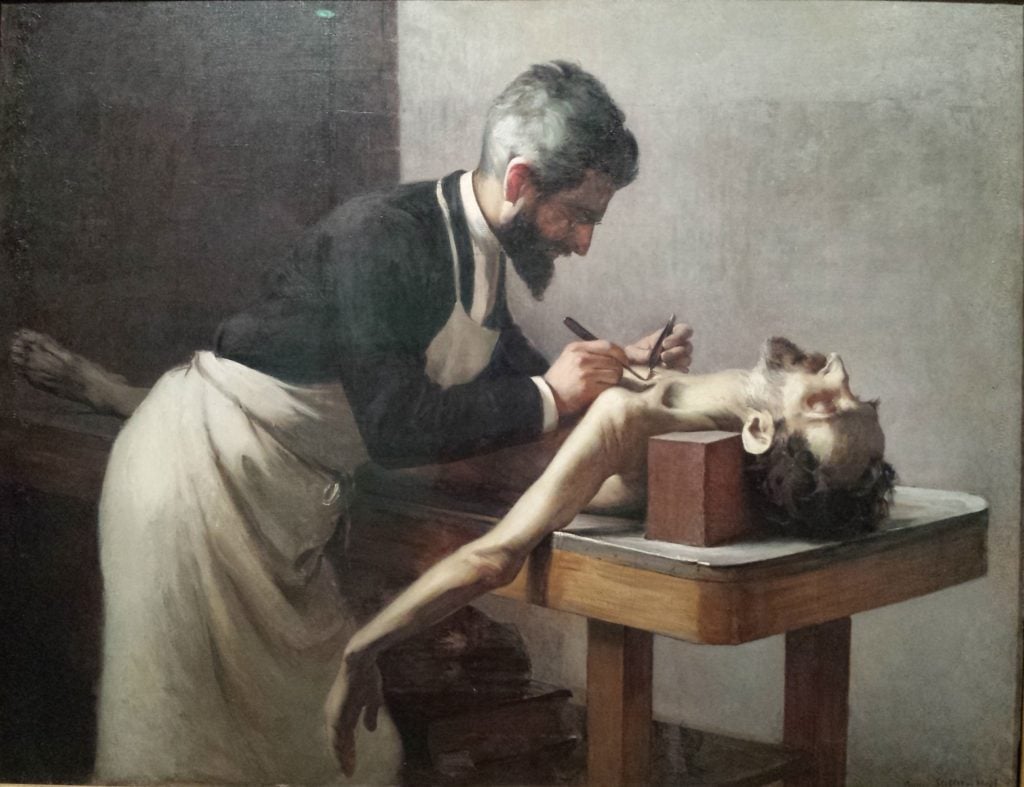


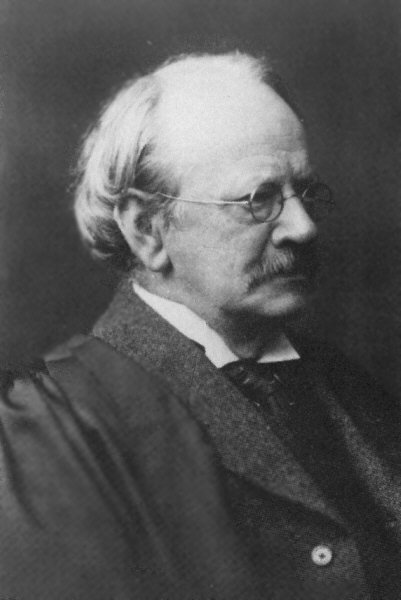


.jpg)





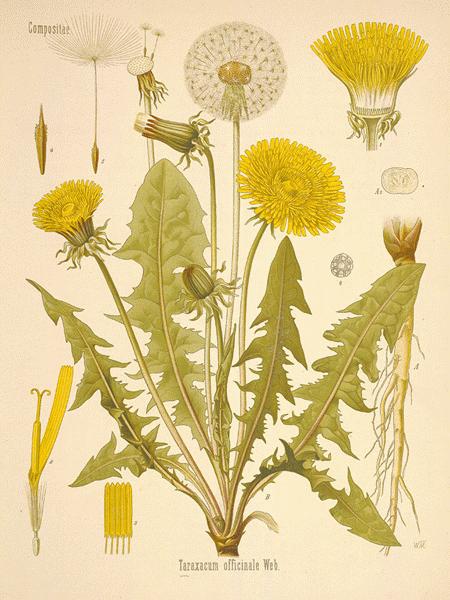
.jpg)


.jpg)


